/*Accordion Page Settings*/

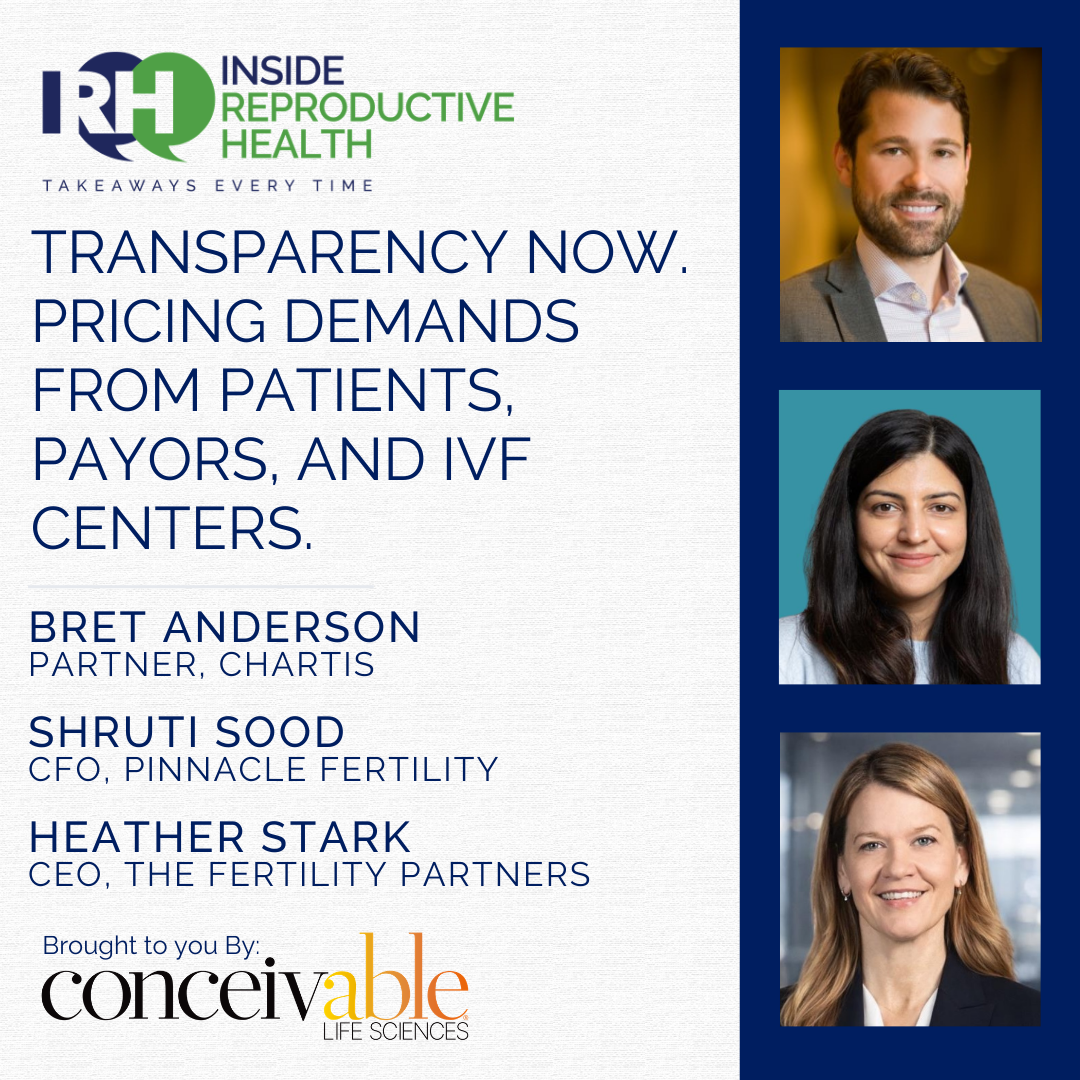
280 Transparency Now. Pricing Demands From Patients, Payors, and IVF Centers. Bret Anderson. Shruti Sood. Heather Stark


Today’s Advertiser helped make the production and delivery of this episode possible. But the themes expressed by the guests do not necessarily reflect the views of Inside Reproductive Health, nor of the Advertiser. The Advertiser does not have editorial control over the content of this episode, nor does the Advertiser's sponsorship constitute an endorsement of the guest or their organization. The guest's appearance is not an endorsement of the Advertiser.


Patients want clearer pricing, clinics want operational sustainability, managed care wants predictable cost control…

…and everyone wants more transparency.

This episode centers on the groundbreaking Journal of Assisted Reproduction and Genetics (JARG) paper on Activity-Based Costing in IVF and what it actually costs.

We’re joined by Pinnacle CFO Shruti Sood, The Fertility Partners CEO Heather Stark, and Chartis Partner Bret Anderson to discuss:

  • Why IVF costs have not been accurately accounted for

  • How activity-based costing could reshape pricing models

  • The real impact of payer consolidation

  • Where clinics confuse capacity problems with volume problems

  • Whether different prognosis patients should be priced differently

  • How managed care pressure will change IVF economics


Are Your IVF Lab Costs Hiding in Plain Sight?
Finally — a Promising Framework to Expose the True Economics of IVF Operations

For years, the real costs of IVF have been obscured by traditional accounting methods that can’t capture the complexity of biological inputs, skilled labor, and capital utilization. The result? An opaque view of efficiency, scalability, and profitability.

This groundbreaking Journal of Assisted Reproduction and Genetics (JARG) paper, introduces Activity-Based Costing (ABC) — a transparent, accounting model revealing how leading fertility centers can:

  • Uncover hidden cost drivers across procedures

  • Scale operations while maintaining quality of care

  • Project true per-cycle costs with evidence-based precision

  • Optimize resource allocation for sustainable growth

Provided by Conceivable Life Sciences, this paper is a must-read for IVF executives, lab directors, and investors seeking clarity in a rapidly consolidating field.

Discover how ABC can transform your understanding of IVF economics — and your bottom line.

Download the JARG paper here to see how leading clinics will redefine efficiency and transparency.

  • Shruti Sood (00:00)

    I think what we need today is more clarity. Does an IVF cycle includes the testing of the embryos? Does this cycle package that we are offering includes the medications? And what all actually goes in?


    from whether the diagnostic testing done before we start an IVF cycle is included in it. So I'm sorry to say the answer is not as simple as giving you a number, whether it cost a 5,000 or a 10,000 because it varies upon the patient that walks in the door.


    Griffin Jones (00:36)

    What do we want? Transparency. When do we want it? Well, they definitely want it now.


    But my guess point of view...


    that transparency something different fertility centers.


    than it does to IVF patients.


    and even to different populations.


    of fertility patients.


    informing part of this discussion.


    is a paper called Activity-Based Costing in a framework for transparency and operational scaling of fertility services.


    And my guests saw things from that paper.


    that inform their view how fertility services will be priced and how they'll respond to the pressures.


    coming from increased managed care.


    Shruti Sood now Chief Financial Officer at Pinnacle.


    It's been five or six years.


    that she's been in the accounting, finance side of the fertility space.


    She talks about areas where care has increased to 90%.


    She talks about the decrease of reimbursements, that's simply coming from pair consolidation.


    They're not even using activity-based costing as a lever yet.


    She talks about how.


    in six months since Pinnacle has implemented.


    their own electronic witnessing program.


    the decrease in embryologist time and was previously being wasted.


    She's joined by Heather Stark, Chief Executive Officer at the Fertility Partners, the largest fertility center network in Canada.


    also has a presence in the United States.


    She gives us an update.


    on both provincial mandates.


    and employer sponsored managed care.


    to me for all the people.


    longing for the good old days of self-pay.


    My impression is that it's still very much alive in Canada.


    But to Heather's point, maybe not for too much longer.


    talks about the investments.


    being made in technology.


    and where she's seen confusing capacity problems for volume problems.


    And then we've got Bret Anderson.


    whose partner


    at a healthcare technology strategy firm called Chartis


    talks about the standardization.


    necessary reliably predict and control costs still increasing quality.


    I ask each of them to weigh in on a friendly Steve Rooks and Dr. David Sable had an Inside Reproductive Health post.


    about the viability of different pricing.


    for different prognosis patients.


    You should all see this paper for yourself. You can download it.


    Unconceivable Life Sciences website, you can download it.


    on Inside Reproductive Health's where you found this podcast or our email where you found this podcast.


    And if you're not there, just Google activity-based costing in IVF,


    Journal of Assisted Reproduction in Genetics.


    It will make you we have not been accounting for IVF costs accurately. Enjoy.


    Griffin Jones (04:11)

    Mr. Anderson, Bret, Ms. Sood Shruti, Ms. Stark, Heather, welcome to all of you to the Inside Reproductive Health podcast.


    Heather Stark (04:18)

    Thank you. ⁓


    Bret Anderson (04:19)

    Great to be here.


    Shruti Sood (04:20)

    Nice to be here.


    Griffin Jones (04:21)

    for a surprise free casual conversation of today's interview. Shruti how much does an IVF cycle cost?


    Shruti Sood (04:28)

    I'm glad you are questioning it Griffin, but I'm sorry to say the answer is not simple. The cost varies very different. It varies from what all is being included in an IVF cycle. And the question that I would ask is that I think what we need today is more clarity. Does an IVF cycle includes the testing of the embryos? Does this cycle package that we are offering includes the medications? And what all actually goes in?


    from whether the diagnostic testing done before we start an IVF cycle is included in it. So I'm sorry to say the answer is not as simple as giving you a number, whether it cost a 5,000 or a 10,000 because it varies upon the patient that walks in the door.


    Griffin Jones (05:09)

    Shruti, you got to be honest. nobody else is listening. It's just you and me here. Did you think about it in those terms before you read Rook's and Alejandro and Alan's paper? Or did that change your thinking?


    Shruti Sood (05:13)

    Yes.


    I would say that it did add on to another tool in my toolbox of how I look at costing at IVF cycle. And the reason why I say that is because this is going to be my sixth year starting in the fertility space, working in fertility space. And I've seen that cost undergo a huge change in the last five years. Because when we see a cost from a very traditional IVF clinic that was sort of like a mom and pop shop.


    to now when we are seeing what happens when there is data to guide our decisions about the costing in a lab space and comparing it to a small lab space versus another. And it's not just about the area of the lab or the capacity. It's about the equipments that we have, the technological advancement, about the skill set of the embryologists that work in a lab or that are in the clinic providing the services to the patients. It has gone huge.


    But the answer to your question, I don't think I answered it clearly. Yes, it did change a little bit from what I knew about it five years ago to where we are today.


    Griffin Jones (06:29)

    We'll talk a little bit more about those changes. But what's your interest been in this? Because you are partnered at technology strategy firms. So when I think of IVF costing, you know, I'm thinking of people that are used to dealing with managed care or finances and fertility clinic networks. How did you come into all this?


    Bret Anderson (06:49)

    Sure. So I've been involved with ⁓ technology consulting for hospitals, health systems, and other providers for over 20 years now. And we oftentimes will work with those providers to get a better sense of what their overall economics are on that microeconomic level so that they can identify where the different variations to Shruti's point, there are a lot of variations. You know, can't.


    predict what the actual cost is going to be for each of the individual patients that walk in through the clinic door. But at the same time, we have a good sense of the different span of different procedures, different types of testing that will be involved. And when you look at the different arrays, the different cohorts of patients, you start to see some different categories or some buckets of costs come into play. And I think what, to get to your earlier question, Griffin, around the paper and where I came into play is, you know, ⁓


    connecting with a few folks that I know on the Conceivable team, they were interested in my perspective on how that aligns when I work with health systems or private equity backed outfits and where they are seeing the opportunities for greater economic returns on those investments. Oftentimes, and I think we can all agree that over the last decade or so, there's been great advancements in the coverage levels for IBF. And I think that there has been probably an


    a greater focus on the revenue side and less so on the cost side. That's not to say that there hasn't been a focus on the cost side, but when we think about the economics of those investments, especially with so many private equity dollars flowing into IVF clinics over the last decade or so, I think that there has been a greater focus on expanding coverage. Now, what that tells me, having seen different, what I would consider to be some concierge type practices,


    or things that have varying levels of coverage, you tend to see a migration towards managed care. As you see an expansion, you know, above 50 % in some locales. live up in Boston, and so there is an insurance mandate for coverage here. And so you have insurance companies up here in Boston and other major metropolitan areas where there is insurance mandates, start to look at what is the actual cost of delivering some of this IVF care.


    in some of these bigger cohorts of patients. To Shruti's point, you're not going to be able to ⁓ index the actual reimbursement to each individual patient, but what's the average cost? And are there opportunities to gain efficiencies? Because that will largely be driven by the payers that are expanding coverage, driven by lot of employers that want to provide this for their employees, but at the same time, they want to do it most efficiently. So that's where I see the industry going over the next five years.


    We've been focusing over the last five to 10 on expansion of coverage. I think that the next five to 10 are going to be much more focused on the economics of the operating model and the care model that we deliver that care through.


    Griffin Jones (09:42)

    The premise of the paper, which is titled Activity-Based Costing in IVF, and it's a paper that was released in Jarg last year. Alejandro Chavez, Barriola, Steve Rooks, Giuseppe Silvestri, Alan Murray are the authors, is that IVF isn't one price unit. It is a compilation of work orders that can vary widely in cost depending on the number of retrieves.


    eggs that are retrieved, services that are added on such as Xixi and others, and that we haven't done a really good job of being able to account for how widely costs vary per embryo and per egg as those numbers range widely. Bret, is that true in most areas of healthcare or is IVF a little behind in this regard?


    Bret Anderson (10:34)

    You know, I think that overall in healthcare, because I have ⁓ a broader view of the healthcare delivery landscape beyond IVF, and I think that's where the conceivable team wanted my perspective on where IVF is now and where some of those opportunities for improvement are. You know, I won't say that the rest of the delivery landscape has got that solved, but I will say that there has been a greater focus on activity-based costing and getting a better handle on those economics.


    As there have been things driven largely by the payers of migrating care, for example, knee and hip replacements, the outpatient setting. For those health systems that recognize that payers are now demanding that to happen and providing less and less reimbursement than the traditional hospital setting for those procedures, they're now thinking to themselves, how do I make the economics work? Because I don't want to lose the volume of those orthopedic patients.


    And now I have to be thinking to myself, what is the average cost for every additional minute of operating time in an ambulatory surgery center compared to the hospital? How do my overhead costs change? How do the marginal costs for each individual procedure change? What are my supply costs looking like? And is there significant variation? So what are the opportunities that hospitals and health systems that I oftentimes work with?


    have at their disposal to make these new economics work that they are now being put in this box, you know, largely from the payers that want to manage care in a more efficient way. How do they actually make that work? And so I think that this is going to be a new and emerging imperative for IVF to do a similar type approach over the next, like I said, five to 10 years. It's not going to happen overnight, but as you see greater and greater coverage levels and you have


    different payers have different pricing power in different markets, they will be driving much more efficiencies as they get greater clarity into what the actual economics and the costs are delivering this care.


    Griffin Jones (12:32)

    I want to talk more about managed care and ask Shruti some questions as those pairs force our hands. But first, Heather, how do you get your head around this as CEO? And do you feel like you have to get your head around as quickly being that your network, the Fertility Partners, is not exclusively but largely in Canada. ironically, there's not as much managed care in IVF in Canada yet.


    So is activity-based costing something that you got to worry about right now or does having more self-pay give you some more time?


    Heather Stark (13:06)

    Yeah, you know, the landscape is interesting in Canada, certainly because we have this, you know, private, largely private coverage, but the public landscape is evolving and it varies province to province across the country. And we operate coast to coast. So, you know, we think a lot about, you know, system design to be ready for that and to be able to manage that.


    care landscape as it evolves. And I think for TFP, you know, it is important that we understand and cost, sorry, understand cost in the system and about how we evolve our clinics.


    Griffin Jones (13:41)

    I don't want to take us too far down a rabbit hole, but give us a little bit of a state of Canada. So Ontario provides a certain amount of funding and they increased it by 25 % last year, is that right? And then Quebec used to have a lot of funding and then they, like 10 years ago or so, they slashed it to almost nothing. So where are the provinces at right now with regard to how much care is mandated?


    Heather Stark (14:07)

    Yeah, so it does vary across the country. So British Columbia is the newest to provide covered care and it provides the cost of a cycle. It is income scale. Alberta doesn't provide coverage at the provincial level. sorry, Saskatchewan and Manitoba have like tax credit level coverage for people.


    And in Ontario and Quebec, there is a cost per cycle coverage as well. And that has expanded with the Ontario fertility program most recently. And in the East Coast, there is some coverage as well. So it's evolving and it's important that we are engaged with these payers to help them understand the cost for care so that it is managed responsibly across the various providers in the landscape.


    Griffin Jones (14:54)

    So there's no province in Canada though that's at the level of like a Massachusetts where sometimes you're paying for five IVF cycles and nothing like that.


    Heather Stark (15:04)

    No, nothing like that. there's been discussion of sort of federally mandated coverage for that as well. But it's a, I would say, rapidly evolving landscape and one that, you know, we need to be a voice at the table to make sure that the care that's provided isn't squeezed by this cost constraint of a covered cycle. And remembering, of course, that our patients move through cycles over time. You know, our goal at TFP, and I think with all of us in the industry is


    It's family completion. It doesn't start and stop with one cycle. So making sure that we can provide great care to our patients and that care isn't just limited to this one potentially paid for cycle by government. In Canada, it's something that evolves with the patient over time. And we need to make sure that we understand costs deeply so that we can provide that great care and not squeeze patients, squeeze staff.


    and squeeze margins at end of the day.


    Griffin Jones (16:00)

    How much has the penetration of carve outs like progeny, carrot, maven, advanced like in a place like Alberta where there's no provincial care, how much insurance coverage or carve out coverage are you seeing from like the average patient in Calgary or something? Because I'm thinking of a place like Atlanta, there's no mandate in Georgia, but I truly would know better than I did. But I would bet like 60 plus percent of the patients in Atlanta have some kind of coverage from


    their employers because it's so metropolitan and because employer coverage has become so pervasive. How close are we to that in Canada?


    Heather Stark (16:37)

    I think so in Canada, we don't have that same mandated coverage. And so we don't.


    Griffin Jones (16:44)

    No, but I mean,


    so even like in places where there isn't a mandate just because the employers are deciding because they want to retain employees or recruit them, they'll use progeny or something. They'll offer it as a benefit. So are we seeing companies do that in the absence of a mandate or still not a lot?


    Heather Stark (17:04)

    So I think we're seeing a shift in this and an evolution in the coverage of this.


    because of the landscape that we operate in, the data and information even about that coverage isn't widely known because you don't have a mandate. So it's not something where like in certain states, you're direct billing, in Canada, the patient is privately paying and then seeking that coverage. So the data and sort of nuance of coverage isn't widely known, I would say.


    Griffin Jones (17:37)

    Shruti, I imagine that's been one of the biggest changes that you've seen in six years. Talk about how managed care has impacted how IVF centers need to account for cost and.


    Shruti Sood (17:48)

    Right. So what we are, glad to say that at Pinnacle, what we saw, we saw this coming five years ago. Back in 2022, what we focused was on how to actually do the mechanics of the clinics, how to make it operate at a very efficient level, because we did see this margin compression coming. We want this, we did see this access to care getting better over the years. We have just now seen that January 1st, 2026,


    California, the largest state in the country, has actually become a mandated state. So we did see this coming, which is actually great news for fertility access in the country, where we can now see more volume coming through our doors. But that also means that we actually need to look at our cost, not just from the traditional cost perspective, but from all the cost levers, whether it's from the labor side, from capital investment, and actual...


    operational changes that needs to be made in the clinic where we can work and be as nimble as the right now the IVF industry is to actually take in more volume, work with the payers because we are seeing this mandated managed care access change a lot. Like compared to Canada, I was listening to Heather, in a state like Illinois, it's 90%.


    in a state like Washington, which is not even a mandated state, but because of the employer providing fertility, it acts like a mandated state because 90 % of the employers do provide fertility coverage. So we did see that coming. And to your point, I think for the next five or 10 years, this activity-based costing is actually very important and should be one of the tools, not the only tool, I would be very clear about that, but should be one of the tools.


    that should be taken into account when we are looking at strategic decisions, including pricing.


    Griffin Jones (19:45)

    How have reimbursements changed over that time, Shruti?


    Shruti Sood (19:48)

    The reimbursements have changed in the sense that when we look at progenies of the world, they are providing better coverage. But yes, we are also seeing employers change their payers, their fertility coverage, because they are getting more nuance like, okay, should we be providing three benefit cycles, or three IVF cycles versus one IVF cycle? So we are seeing that reimbursement actually go a little bit down. So like I talked about, we are seeing that margin compression.


    I grows more and more, becomes more, I guess, I think the right word I'm looking at is becoming more prominent in healthcare. It was largely a self care and now it is becoming more and more like hospitals and other healthcare industries work, yes.


    Griffin Jones (20:33)

    And have they been using activity-based costing to compress the margins or the margins are just compressing by virtue of them having more buying power?


    Shruti Sood (20:42)

    That's what this is the latter. The margins are being compressed because of that. Yes.


    Griffin Jones (20:47)

    So they're not even using activity based costing yet. I imagine they will. Nobody said nobody sent this progeny. Nobody sent this paper to the insurance companies because I think they might. mean, truly do you envision a world where they say, OK, we're not going to pay the average of what it cost a clinic to or excuse me, we're going to pay the average. We're not going to pay what it might cost a clinic to retrieve 40 eggs because that cost is very, very different from


    ⁓ retrieving a patient who has eight eggs. And so whatever the average is, that's what we're going to pay. Do you do see them doing that in the not too distant future?


    Shruti Sood (21:27)

    I don't want to say I don't think I can speak on behalf of the insurance companies. I wish I could. And I hope there if they are listening, I think the the one issue that we face and we are working towards in our clinics is the lack of data, the lack of data that the insurance company doesn't have today from the fertility care from the fertility centers in the country to get what is a cost of the cycle to get what because


    that varies so much with the labor skill set of the labs and everything else in the market that they don't have this, we don't have all of the data with us. So I think one of the issues that I think it does talk about in the white paper as well, which I'm glad it does is that data is our friend. Data should be used to guide these decisions. I don't know if it is guiding these decisions currently with the insurance pairs, but I do hope it does.


    Griffin Jones (22:17)

    Did you perceive a lack of data when you entered the fertility field, Heather? Because now the CEO of Fertility Partners, you're crafting a vision of what that's going to look like. But you were the CFO of a not too tiny company called Weight Watchers for a not too little while, if I'm not mistaken. so maybe I'm assuming too much and giving Weight Watchers too much credit. But I'll operate on your assumption that you had all kinds of data.


    Did you find when you entered the fertility space, I'm trying to make this vision, so I want to do this, but I can't believe that I don't even have these kind of numbers in front of me or what have you been learning?


    Heather Stark (22:58)

    I think there's two ways to tackle the data question. We are incredibly data rich ⁓ within our space in isolation, within our own environment. So within TFP, I find myself very data rich. It's figuring out how to leverage that data really responsibly to make great decisions with that data. And something like this white paper, I think it's really important that we're thinking about


    you know, using costing as a flashlight on cost and, you know, to Shruti's point, like, it's not the single tool. It's something that we can use really responsibly, use it to unlock, you know, how we use talent and technology and where we invest and so forth. And the bigger data challenge, the second part to that is, you know, publicly accessible data. It's just, it's really challenging. And I find that, you know, from a,


    patient advocacy perspective, it's really important that we get consistent data. It's different in Canada than it is in the US, pregnancy rates and so forth. They're not as commonly or consistently reported. yeah, sure. Yeah, yeah, yeah, it might be. But anyway, ideally, you want to unlock blind spots with data.


    Griffin Jones (24:03)

    Well, we don't know if they will be in the US anymore now with the CDC slashing anyway, so we might be on the same page now.


    Heather Stark (24:18)

    And I really think about how do we leverage it to create better system thinking. There's just so much we can do with data. like TFP, we're relatively new. I think we're six years in now at this point. And we scaled really quickly. Our wait times increased. Our labs felt strained. Our instincts, as I understand it, I wasn't there then.


    But the instincts were like hire more, buy more. But with data, you can map the work. You can figure out that the constraints aren't volume, it's flow, like figuring out that workflow design and making targeted investments where they're needed. you know, your capacity problems can often look like volume problems, but they're really flow problems. So I think with the data, this paper, you really can...


    force yourself to look at the data and see the work, not just the totals and the component parts of the work. And as I said, shine a flashlight on a problem and use it as a tool to solve.


    Griffin Jones (25:22)

    Right, you seen that phenomena that capacity problems look like volume problems and what solves for that?


    Bret Anderson (25:29)

    Absolutely. Heather's bringing up a great point and something that I would also just caveat the white paper, which brings a tremendous amount of value. I recognize that there are a lot of IVF clinics out there where the economics may not be the exact same. There's going to be different fully loaded burden rates of labor, especially in some of the more expensive ⁓ markets like Boston. But I think that the overall directional lessons that I took away from it are one,


    know, IVF clinics should get to a point, operationally speaking, where they are standardized enough in a lot of their major processes. Recognizing to Shruti's earlier point, there's going to be a little bit of variation, but you want to reduce the unwarranted variation as much as possible so you can shine this flashlight on them and you can uncover where those different variations exist in your operations and you know, what is actually going to be value add at the end of the day. So


    When Shruti is talking about, you know, a lot of employers are, you know, expanding access and, whether or not there's a mandate in a certain state or even in a different province in Canada, I definitely see that. I think employers as well as managed care companies, insurance companies, they want value out of this. And as providers, you can't provide back to them a clear sense of what that value is until you've standardized many of those processes. And you can actually say,


    Here's what an average cost is getting back to your original question. And here's what we do. Here are the levers that we pull to try to drive that down. Things that we know, if we minimize the variation in our supply spend, because some clinics are getting charged twice as much for the same Petri dish as somebody else, you want to be able to make sure that those avoidable cost incurrences are managed. I think the other thing that the paper did is that what


    what standardization does to some degree is open up the opportunities for greater scale. Now you can't wave your magic wand and say that that's gonna happen overnight, but you can easily scale something that you don't already have standardized and know what it looks like. So you can understand what those resources are from a labor and a supply and equipment perspective are. You can imagine, when you look at,


    I know that there was some narrative around thinking about this as a manufacturing line. There are no scaling plans for Bentley or Rolls Royce because they do so much of their manufacturing of those vehicles by hand and manual processes. And that's part of their value proposition. But there's clearly a market for those that want those vehicles at a lower price point. But you need to be able to create a standardized assembly line


    recognizing there's still going to be variation in the options you put in the vehicle, the colors you paint on it at the end of the day. But the vast majority of that process is still standardized. And it also helps you avoid variations in quality. That's one of the big things that I'm seeing with a lot of my hospital and health system clients is that they are trying to standardize as many of the care pathways as they can. For those that have IVF clinics, that includes them.


    so that they can identify where patients fly off the rails from those care pathways and they can do things just like Toyota does in their production model that has gotten a lot of notoriety over the last few decades about its quality improvement. They have kept that quality high because they know exactly where the assembly line breaks down. And hospitals and health systems, would probably point to Virginia Mason out in Seattle has been great at this. They were embracing the Toyota production model.


    and applying that to a lot of their care pathways and identifying where some of that variation was and being able to really drive up and maintain high quality as a result. So I think that that's something that when I'm an employer or a managed care company, I want to know who have the better outcomes and who are maintaining it through a very systematic and standardized process.


    Griffin Jones (29:27)

    Have you checked out much of conceivables or a machine? How much standardization do you think that will bring to IVF? And is it quite a bit or is there still a lot that needs to be solved for?


    Bret Anderson (29:44)

    I think that it makes a significant move in the right direction. Will it solve for all the different standardization, you know, variation out there? No, but I think that it certainly moves things, you know, in the right direction. And I also see this as being reflective of a broader trend in lab and pathology where you have so much automation now integrated. I know in the paper there was


    the call out of blood testing and LabCorp and Quest Diagnostics are using robotics left and right. And it's driving down the cost for our typical blood panels and even some cancer diagnostics. I know that there's some trepidation about integrating ⁓ robotics into what can be a very deeply personal care experience in IVF, but I would also say that we're introducing it in things like cancer diagnostics and


    trying to perpetuate our life and not just create it. So, you know, where robotics come into play, I think are great for achieving greater scale and access, driving down the costs. But at the end of the day, I see a tremendous upside value in minimizing the clinical quality variation that are just, it's inherent with human operators. That's not to say that we shouldn't have humans in the loop, but let's redefine what that operating and care model is.


    so that we best deploy those embryologists that we already know that they're at a staffing shortage across the country and across the world so that we can best use them at scale and in conjunction with the robotics and the technology that's now coming online.


    Griffin Jones (31:15)

    Shruti, you're nodding your head.


    Shruti Sood (31:17)

    Yes, I definitely agree with everything that Bret just said that we have seen so much technological investment in the IVF, you know, the success rate in the last 30 years. Now we need to see the same technological advancement in outside the outside patient care in terms of whether it's in the clinic operations, in lab operations, and standardization is the key. We don't want again as a non medical provider. I what I'm looking at is


    what the best in class lab, lab embryologist, physicians, what they agree with. But as long as they're working on the same standards, they are using the same supplies, that is when you can actually compare the data. And you know you're comparing apples to apples. And that is when you can see, okay, if I have a lab on one coast of the country doing the same volume with, let's say, ⁓ X number of incubators, why does a lab...


    doing less half the volume of this asking for more incubators. And that is when you get the two labs together, have them collaborate and self-solve the issue without us or non-medical people getting involved. It's the idea that when we have seen so much advancement in the IVF success rate, let's use the technology for outside the patient care. Let's use it in the clinic operations. Let's use it in scheduling of the resources.


    and so that we can actually be very efficient in our costing.


    Griffin Jones (32:46)

    This is not a rhetorical question and it's for whoever wants to take it. Can you reduce activity-based costing? Can you even truly figure out activity-based costing and then reduce it without first standardizing operating procedures across labs?


    Bret Anderson (33:03)

    I think you can do it, Griffin, but it's going to minimize the impact that it's going to have on the cost levers that you want to pull as a result. So what I mean by that is you can do an ABC process at your different clinics that have wildly different processes for the same cohort of patients. But what that's going to minimize your ability to do if you're looking at it as like a network strategy move.


    you're going to have to have a tailored approach, a different roadmap of activities for each one. And I think that that's going to take an exceedingly long time to actually achieve any sort of economies of scale that you would otherwise get from, you know, the standardization of those processes. And I think it's, you know, what we typically ascribe in our hospital and the health system context is you want to be able to standardize


    You want to be able to centralize before you optimize because the optimization needs to come at much more of the system level. And you don't want to have a distributed strategic plan and roadmap for each individual clinic, because that's going to be very cumbersome to manage. And it's, you're just not going to be able to implement and execute to the same degree. If it was much more standardized across the clinics and as Shruti's point, you know, she brought up a great example of, you know, being able to share best practices.


    You want this to be a team-based environment across your clinics where they are sharing how they're doing things differently and sharing innovations. mean, we should be continuously looking to improve, but if we're all at different starting points, it's going to be very difficult to scale those innovations across those clinic sites.


    Shruti Sood (34:25)

    Love you.


    And Bret, to add to that, to get the buy-in. If you don't, you you want these people who aren't actually providing these services to actually be bought in. And the only way to buy them in is if it's collaborative, if it's not just pressed upon them. I think that's the very key aspect as well.


    Bret Anderson (34:55)

    completely agree.


    Absolutely.


    Heather Stark (35:00)

    It's


    important to from the network perspective to make sure you're like, obviously, we're providing that connectivity point to sure these point. But you know, it's about providing shared infrastructure and shared learning and targeted investment that we can do with the expansion of all this information, but really importantly, not to flatten that.


    Shruti Sood (35:05)

    you


    Heather Stark (35:18)

    like clinical nuance that exists. We've got different patient populations, like the payer landscape, like we talked about earlier, is different. We've got different scales of clinics. And I think it's just important that we're shining this light on studying variation and driving it to, you know, leverage it, like learn across from studying that variation.


    Griffin Jones (35:38)

    glad you brought up different patient populations, Heather, because one of the patient populations that the paper discussed was egg freezing patients. And I imagine that egg freezing has to be somewhere in your vision for TFPA. And maybe it's something you haven't gotten to yet. But what have you been thinking about it so far? Where do fertility networks need to go with regard to egg freezing?


    Heather Stark (36:02)

    You know, this is an interesting next evolution. I think it's an important one because it tackles that very problem that drives so much of our demand, which is people waiting so long in their fertility journeys. So yeah, you know, this is obviously an expansion point for the business and making sure that our patient population as it evolves.


    is aware of these services and is aware of the ability to preserve your fertility and get ahead of it. an interesting next evolution and important for us to understand even in the context of the lifetime value of a patient and how we serve them over their lifetime because they may come to us for fertility preservation early on in their life and then come back to us for


    how to use that egg that they've preserved over time. Obviously, they need help using it. So yeah, I think it's just an interesting next evolution and definitely on the radar of things that we need to understand.


    Griffin Jones (37:00)

    Jason Barrett, the Chief Scientific Officer of KindBody felt very strongly that the price of egg freezing needs to come down a lot on the front end. activity based costing reveals that because it doesn't cost a lot on the front end relative to other procedures in the IVF lab and that by bringing it down more, get people in more, they are gonna pay more on the back end because that's where a lot of the cost is realized.


    But in many cases, it's still going to be less expensive for them if they're not then having to use a donor. so you might say I need more time to know how viable it is, but your gut instinct, what you've seen so far, do you think that's viable that centers are gonna be able to do that in the near future, dramatically reduce the price of egg freezing or is there not the appetite for that yet?


    Heather Stark (37:53)

    I think that you should be thinking about pricing for that in terms of what it is in the service you're actually providing. You could bundle it with a service later in life for the patient, or you could have it as a discrete service as well. understanding what the costs are that go into that, you should be able to provide them with a reasonable cost. There's also the cryo that comes along with that. Obviously, you've got to preserve the specimens over time.


    Shruti Sood (37:59)

    you


    Griffin Jones (38:20)

    So would have to


    charge for that separately, right? But you could still really bring down the cost of just like the retrieval.


    Heather Stark (38:27)

    Yeah,


    well, and I think the pricing models vary across landscapes. And, you know, it isn't the price of a full IVF cycle, obviously, it is a piece of that. But yeah, I think patients deserve pricing clarity. And we should think about how to put it in front of them in a...


    palatable way but also one that makes sense and also one that makes sense for us as a business with with an appropriate margin like margin and healthcare does matter so that we can continue to invest in it and invest in the talent and technology that we need to to scale our businesses.


    Griffin Jones (39:02)

    Shruti, what do you see for the potential for egg freezing?


    Shruti Sood (39:05)

    I do see that yes, there is definitely potential. don't know if it's going to be dramatic, but what I do want to add on, like what Heather said was, it's the transparency. Today's patients want transparency more than the reduction in price. And transparency can mean different things for different people. A transparency for a patient that's coming for egg fries freezing cycle can be just like, give me the details and I'm good with it and I want the details. But then a transparency for another patient would be


    I want a package bundled pricing. I want to pay for one all set. what is it that, know, like to your point Griffin, you were asking like there may be clinics that are advertising very low cost IVF cycles, but then I hate to say it's devil is in the details. They are not telling us everything that is not part of that low cost cycle. That is the medication included. Same for egg freezing. I can say, ⁓ I have a very dramatically reduced egg freezing price and not include.


    the medication's cost in it, or not clearly specify is the first year storage fees included or not, and is that going to come in the back end. So I think from what I see from the finance side and what this white paper does a good job at is the transparency. Activity-based costing does that. So that is why I really do like this tool, that it shines light on all the aspects of the costing that should be taken into account, because once we are transparent on the cost,


    we can be transparent in our pricing to our patients and they don't feel like, why is this clinic offering me a certain price versus this clinic offering the same packages because they're not actually comparing apples to apples in this case. So for, I, when I.


    Griffin Jones (40:40)

    Am I


    inferring too much Rudy that transparency means something different to the people performing the service that it means to the people receiving the service so in other words itemizing Costs might not be as important to the patients It sounds like it's very important to the center because they need to know how much things actually cost and that's why activity-based costing is so important


    but what the patient cares about is in a car dealership, it's called the OTD price, the out the door price. So when I go into a car dealer, I'm not playing around with them. I'm just like, me the OTD. I don't want to hear about monthly payments. don't want to hear about this is what it would be if you financed and this is the OTD price is what the vehicle costs, including taxes and fees. And then I'm negotiating off of that. so am I inferring too much, Shruti?


    Shruti Sood (41:29)

    Right. I don't think.


    Griffin Jones (41:29)

    thinking that that transparent


    means different things for the center and for the patient.


    Shruti Sood (41:34)

    That is absolutely correct, Riff. And you're thinking about it the right way. And what I also want to say is this, transparency means different for different patients. For some patients, do want to know, they just don't want to know the out of the door price. They do want to know the details. They want to know at what stage, how much is it going to cost? And that's what gives them comfort. Versus a patient saying, give me all of it, like I don't want to have any surprises in the end. So.


    That's what I mean as we have to meet our patients where they are in their journey. And that could mean very different transparency.


    Heather Stark (42:06)

    I think we're in an environment too with, know, patients have access to so much information. Like there's just such a flood of information and they're searching for answers and responsible transparency means, you know, for us as providers, understanding what drives cost underneath. So our pricing can be defensible, but you know, really importantly, we're expanding access without eroding quality, like understanding those component parts. I think about like,


    know, payer pricing squeezes for us as we operate in different markets across the country, we want to make sure that we can meet the payer demands without eroding quality. And I just think it's so important. And then transparency in the marketplace itself so that, you know, patients can understand what is in the underlying price. you know, you don't want to distort things and you want to make sure that you're not eroding quality as well ⁓ as your


    peeling the onion of cost within the center itself.


    Griffin Jones (43:02)

    Do you all think that it will be possible to replicate that quality and reduce each of those line item costs without robotics? Conceivable and or they might have the the the lead now, but I'm talking about robotics in general. think to your point, Bret, of sure, if you want to spend 400 grand on a Rolls Royce, somebody will put it together by hand for you. But for those people that need a thirty five thousand dollar Camry, Toyota is not


    doing that just by hand. There's a ton of robotics involved and way more than there was five years ago, way more than there was 10 years ago. How necessary is robotics going to be to do this and how quickly do you see it happening?


    Bret Anderson (43:47)

    I see it happening more and more over the next five to 10 years. Again, it's not going to happen overnight, but I just don't see, when I look at the care and operating model and what goes into it, the ABC paper did a great job of just unpacking all those different costs. There's only so much more we can ask of our embryologists in terms of productivity.


    There's only so much more we can drive down the costs at scale of some of the equipment, the supplies that go into these different procedures and processes. And I think that a lot of hospitals, health systems, and other providers are looking to robotics as a way to fundamentally redefine who does what and how we're integrating new technologies to do the processes, to do the work, and how can we drive those transaction costs of those different processes as close to zero as possible.


    A lot of hospitals and health systems no longer employ written scribes, know, the people typing on a computer in an exam room because now we have ambient listening to do that. And, you know, I think that that drives down the overall marginal cost of each individual patient for the provider, you know, pretty significantly so that they are less burdened by the administrivia of delivering care. And I can envision


    that a lot of the processes that an embryologist and some of the staff that techs in a lab are asked to do, I'm sure that there are a number of things that they would much rather have a robot do because it offloads it from their shoulders. It allows them to focus on much more of the complex, the really interesting cases, if you will. And I think that there's still certainly a hands-on role for them in many regards. But it allows them to reduce the, you know,


    the non-critical thinking, the repetitive tasks that a lot of these labs have. And when you unlock those sorts of potentials with the robotics that don't get tired, that can do these repetitive tasks and that can do it at very high quality and limited variation, I think you really unlock ⁓ the potential not just for greater access that you can care for additional IVF cycles, but it's potentially a great engagement tool.


    provider satisfaction tool of the embryologists in your lab. They're now able to oversee a lot of these processes and to offload the kind of menial or repetitive tasks that they don't like doing about their job, but it's just been part and parcel to it for decades. And so how do we redefine these different processes within the lab to both get the scale that I think we all need to address the access challenges that we commonly see, the cost challenges certainly.


    but also allow for a greater and more engaging experience of the embryologists that we'll still continue to employ. I don't see a need for the embryologists going anywhere. I think that we just need to be deploying them better and more efficiently to take care of the access challenges that we have currently between the supply and demand mismatch we have across the country and across the world.


    Griffin Jones (46:42)

    Shruti, you're not an embryologist, you don't run a lab, but can you see from the numbers that you look at, my embryologists are still wasting time on this or this is still a wasted cost and what are those?


    Heather Stark (46:45)

    you you


    Shruti Sood (46:55)

    That is something that we do shine a light or go through closely. But again, there is more data needed that we are looking at to actually say,


    OK, is my embryologist still using time on administrative or repeated tasks that they don't need to? And again, like you said it correctly, I'm not an embryologist. I've never been in charge and responsible for a lab. So I can't speak to it. But the idea is that we


    are letting the embryologist also self-solve this. They are part of the decision-making. That is what I think I value at is that they are the specialist and the best in class and we want to empower our embryologists to actually take these decisions as well.


    Griffin Jones (47:39)

    You want them making the decisions and it sounds like there's still some more conclusive data you'd like to see before you said, okay, this is definitely a waste, but it sounds like you have a hunch and you're talking to your embryologist. Where do you think that administrative time is going? Or what do you think those specific administrative tasks are that you think, you know, this is costing us more money and it's not making them happy? What do you suspect that is so far?


    Shruti Sood (48:02)


    I think it changes. I don't have a number for you Griffin today because it has been changing in like in just the last six months. Like we introduced a lab and automated lab witnessing program that actually did count, it did reduce their number of hours. So it's changing from what it is today versus, you know, and I don't have the latest data with me, but yes, like I said, it's the industry is so nimble right now and we are ready to meet the patient demand. I think that.


    Griffin Jones (48:29)

    But that was


    so that was an area though that six months ago, it was costing more embryology time and then with witnessing now it's costing less. So it's a clear measure. Heather, the new CEOs, they'll always say, ask me in a year Griffin, after I've been on and but I'm the new person always sees something and you've been there a few months now, there's almost always something that they see right away. And when you said


    Shruti Sood (48:36)

    That's yes.


    Griffin Jones (48:54)

    Something to the effect of the capacity issues are often mistaken for volume issues or vice versa I'm paraphrasing what you said. I know you're thinking of something specific I know that there was something that you noticed pretty early on that you're like this is wasteful. What was it?


    Heather Stark (49:09)

    Yeah, it's a great question. you know, I love I actually moved from the the CFO role into the CEO role on my nine month anniversary, which wasn't lost on me what we do developing in nine months. Yeah, you know, I've had many aha moments, but you know, I bring it back here to


    Griffin Jones (49:21)

    Yeah. Poetic.


    Heather Stark (49:33)

    there's this this beautiful combination of talent and technology back to what Bret was saying, like, there's such human drivers to what we do. And if we can unlock them with great technology around them, I think there's something really interesting that can be built and sort of tying together the threads of information that we can drive in the cost base of cycles, understanding the real drivers of work.


    you can really understand how you can invest around the people, the great talent that we have ⁓ in this space to improve outcomes and improve their environment and reducing their long-term strain. So I think that, yeah, I think it's gonna be an interesting road ahead where we match technology innovation with talent.


    Griffin Jones (50:20)

    I want each of your opinions on how viable you'll think this will be in the future. So Inside Reproductive Health had a little poll about activity-based costing and it linked to this paper by Silvestri and Chavez Barriola and Rooks and Murray. And we just asked the question about


    should IVF cycles be priced by activity or flat fee. And it got a little bit of a debate going and Steve Rooks and Dr. David Sable had a very respectful back and forth about the viability of being able to charge different fees based on quality of embryos, number of eggs, number of embryos, the quality of each. Because if I'm not


    mistaking his argument and I'm paraphrasing it so people should go back and and and ask Steve Brooks about his argument to make sure I'm not mischaracterizing either his or sables but that effectively you're subsidizing poor responders with with with really good responders. It sounded like David Sable didn't think that was viable. What do you all think is possible or not for the not too distant future?


    Heather Stark (51:33)

    I on pricing I go back to like


    We can pull it apart, we can try to get granular, but I think patients are actually craving more simplicity in what they're finding than pulling it apart and pricing everything individually. And any of us can start competing on price or compete on price, I know people are. But I bring it back to building the systems, the systems that improve outcomes for our patients, importantly protect the teams, like the talent I was talking about.


    so important that they can deliver a great standard of care and that we're expanding access really responsibly. There's no shortage of demand here in our market and we need to be expanding that really responsibly and creating value along the way. So I go back to the simpler pricing models versus the pull it apart pricing models, but really digging into the system build.


    Shruti Sood (52:25)

    And yeah, I think going back to the same, would say that pricing should, I agree with the standard, the pricing should not be determined by the cost, like, you know, of the quality of the patients or the patient embryos. I think those are completely two different, you know, where we look, and pricing is not synonymous with costing. Again, costing is one of the drivers of the pricing.


    but there is much more that, you know, like Heather pointed about, about the system and the talent. I think that's where we need to be, you know, we need to focus on and be more transparent with our patients. think that's what, that is what will improve the access to fertility. Our patients are, they want access, they're asking for it and they, and we're moving in the right direction. And that's what I think the focus should be.


    Heather Stark (53:12)

    I think too, if you reduce it to a commodity, like all these component parts, you're going to get commodity behavior. You're going to get cost compression. You're going to get short-term optimization. You're going to get really fragile systems. So better to treat it like complex clinical infrastructure that it is designed differently around it and create that durable value around it.


    Griffin Jones (53:34)

    you feel the same way Bret you're to take a contrarian view


    Bret Anderson (53:37)

    Yeah, I agree with them. I think that there will still be variable pricing across patients, but it's going to be for a la carte services. It's going to be for PGT and, you know, some of the more predictable things that you can make decisions on and decide the value oriented with those different a la carte procedures and services. But I don't foresee at least in the next few years, there being a significant variation in pricing just based on the egg retrieval. And to your point, Griffin,


    subsidizing one group ⁓ across another because there's frankly, before the retrieval, there's not much as a patient you can do about that. So there's not much predictability. think Heather's point about wanting simplicity and that pricing is right on. And I also think that there's a significant opportunity across IVF clinics. We have touched on this already is from a standardization standpoint, there's other cost levers.


    to drive up margin and margin opportunities that we don't necessarily have to see and capitalize on just from variable pricing. I think that while there is elasticity in the costs associated with different egg count retrievals, I perceive greater opportunity in securing margin across IVF clinics from standardization of processes, driving down supply costs, achieving some economies of scale. And you don't really need to do that for variable pricing based on egg retrievals.


    Heather Stark (54:56)

    I think too, going back to the comments you're making earlier, Bret on like robotics and technology, it's cost is going to get so much more exponentially more interesting for all of us. ⁓ You know, and it's going to be what differentiates the clinics that we operate.


    Bret Anderson (55:07)

    Mm-hmm.


    Griffin Jones (55:10)

    Do say that because


    of managed care, Heather, and because of price compression or for other reasons?


    Heather Stark (55:15)

    Well, I think that it's going to come down to investments and innovation and technology and building great teams and all of this is going to come with a cost. And I think there's risks to optimizing costs or getting too nuanced in pricing in isolation. And we need to be thinking about linking cost visibility or pricing granularity to like outcomes and experience. like all of these things matter so much ⁓ and matter in sort of building defensible.


    systems that we can all scale responsibly. system builders are going to be different than cost enforcers in our market.


    Griffin Jones (55:54)

    I'd like to have each of the three of you back on individually to give you individual time to talk some more. I think Heather, we already have plans to invite you back on. You've given a little preview to what that's going to be like. Thank you to all three of you for coming on the program.
The Chartis Group
LinkedIn

Pinnacle Fertility
LinkedIn

The Fertility Partners
LinkedIn

Bret Anderson
LinkedIn

Shruti Sood
LinkedIn

Heather Stark
LinkedIn


279 Genetics. Diagnostics. Third Party IVF. Patient Finance. Category Deep Div3


No organization or individual mentioned or participating in this podcast reviewed or had editorial control over its content. Any sponsor-related information, where applicable, was considered by Inside Reproductive Health through its Business Intelligence Hub.


Clinics are feeling the pressure. 

And one year after the PGT class action lawsuits, the ripple effects are still unfolding.

We’re back with another Fertility Field Overview, and this one looks at what’s happening across patient finance, IVF benefits and third-party reproduction, genetics and diagnostics, and the evolving self-pay landscape.

We discuss:

  • Whether IVF benefits managers are helping clinics (or squeezing them)

  • Which lending institutions and loan programs are positioned to rise to the top

  • Why some say the third-party IVF experience is getting worse

  • What’s changed in genetics and diagnostics since the PGT lawsuits

  • How clinics are reducing workload through at-home testing solutions

  • How fertility compares to the broader self-pay healthcare market

Get an even deeper inside look at the current state of fertility networks from our recent Intel Articles:

Diagnostics, Genetics, Third Party IVF, Patient Finance


You Can Stop Being Left Out Now, Y’Know

Next Big Exposure Before ESHRE!

If your organization belongs to this category but wasn’t included in this category overview podcast episode, then your competitors are dominating the attention of your customers: REIs, fertility network executives, embryologists, and others.

These same competitors will get more coverage in a report or podcast episode, about your category

  • To start the year

  • Before PCRS

  • Before ESHRE

  • Before ASRM

Why let them get all the attention?

If you don’t want to miss out before ESHRE, you have to join the IVF Heroes Universe as a sponsor now, before the next deadline.

You read it. Your employees read it. Your customers read it. Why miss out when you get so much for so little?

  • Griffin Jones (00:09)

    We're back at it with overviews. What's happening in four different categories in the fertility world with patient finance and IVF benefits, Third Party IVF, Genetics, Diagnostics. Progeny stock might be up, but fertility clinics are getting squeezed, are they adapting?What's happening in the rest of the self-pay world? How does the fertility field compare other segments of healthcare with regard to finance care?cWhich lending institutions and loan programs will rise to the top. Why is third party IVF experience been getting worse according to some, even though it's supposed to be getting better? Like the damn internet. And then I have a guest join me and add some color commentary on the state of fertility diagnostics and genetics. It's been a year since the PGT action lawsuits. What's been the result of that? And then, how are clinics reducing workload with at-home testing. Like Fellow. And our special guest shares what she thinks is really driving that. Enjoy.


    Griffin Jones (01:58)

    Look who's here. Dr. Shefali Shastri is here. Thanks for coming to help me provide some commentary on the state of category chef.


    Dr. Shefali Shastri (02:07)

    Hi Griff, it's great to see you, it's great to be here.


    Griffin Jones (02:10)

    Let's start with fertility diagnostics. The central theme of that state of report was that people are burnt out AF. That means nurses, providers, embryologists, they've got a ton of administrative burden on their plate. Care teams want at home testing to relieve them of some of that burden and managed care payers seem to be driving a lot of that. Let's start with people being burned out. When I'm at a conference, I like to ask people,


    I say, raise your hand if you feel completely underwater. And I'll ask that in rooms of doctors, nurses, embryologists, execs, business managers. How many people do you think have their hands down? Shef, virtually nobody, right? Everybody feels completely underwater. The report talks a little bit about nurses facing physical, emotional, mental exhaustion. ⁓


    Dr. Shefali Shastri (02:54)

    Their hands down? Yeah, no one.


    Griffin Jones (03:07)

    Michael Baker had shared some of the things that embryologists are going through. They're hard pressed for time already. They have a bunch of busy work on their plate. What are you seeing with regard to the different directions that people are being pulled in?


    Dr. Shefali Shastri (03:22)

    I mean, honestly, what I think is the way we practice fertility medicine today, it's not your mother's IVF. You know, what they did in the early 2000s was very different. And so, I mean, basic things, even just in terms of medications and the amount of medications and, you know, day three embryo transfers versus day five embryo transfers versus PGT, not doing PGT, counseling patients each step of the way and all these nuances, it's very different.


    practicing in 2025, 2026 than it was 20 years ago. A, all this technology was not available. And B, I don't think the patient awareness was there. Currently, everything is out there on the internet, on Reddit, on Google, reviews. And so how, as a practice, whether it's at the level of the nurses, the patient services people, the physicians, the embryologists,


    How do you keep up with that constant information ⁓ seeking? And so I think that's what makes it so difficult, the complexity of the medicine, along with all of that's sort of the need and the desire to know ASAP. People are expected to be available immediately. It's like texting. We thought we were helping our practice by putting together these, developing these great portals. And I really do think that they're helpful, ultimately.


    But it's not a text message. It's not, I portal message you, you should message me back within a minute. But often that's how these tools are used. So I hear you, that's we're seeing.


    Griffin Jones (04:49)

    And there


    are those tools that I want to zoom in on in other categories of AI and people that think that they can help solve that issue. This report talks a little bit about how at home testing might be helpful. Do you think that at home testing actually is helpful? Or do you think it will add administrative tasks somewhere else? Does it kind of depend? this report


    talked a lot about what fellow is doing. And it seems like a lot of clinics like fellow. But does that home testing actually reduce burden on care teams? Or does it just kind of rob Peter to pay Paul?


    Dr. Shefali Shastri (05:30)

    No, I think it can. I think if utilized properly, it can. It's a great tool. let's talk about, you know, an example is an at-home semen analysis kit that is FDA approved, that is very accurate. So it's a really good test that's being marketed directly to consumer. But they've also partnered with so many clinics, so clinics can utilize that as part of their sort of toolkit. If it's used properly, I think it's great. It's one less thing that has to be scheduled.


    by the clinic. If it's used properly, if a partner submits a semen analysis before they ever come in for the initial visit, that's something the doc can review at their initial visit. It's an opportunity to go over all the things that have been done already. So I do think it can be very beneficial. I also think it depends on what support is going along with it. So if Fellow has counselors that can counsel you on your results, I think that's great.


    I think that if used independently without any counseling, I think it's a whole different ballgame. So to me, I definitely think some of these at-home diagnostics can be very helpful in terms of the workflow, if used in the proper manner.


    Griffin Jones (06:44)

    It seems like the managed care payers are driving a lot of this. The report talked about how Maven is engaged with Velo and seems like Progeny is and so that's they like to see that. Why do you think that is?


    Dr. Shefali Shastri (07:00)

    Very honestly, I think it's patient driven. I don't think it's clinic driven per se, but I think there's a great way to utilize it for clinics. I think it's patient driven. I think that's what patients want. I want to be able to automate semen analysis. I want to get it done and see what it is. I don't want to have to see a doctor before I do this. I don't have to go in for an hour consult. I think it's easy. I think it's access.


    Griffin Jones (07:22)

    So it's a little bit more bottom up. And do you think that then the payers are saying to the clinics like, hey, we're engaging with these folks, we're going to cover it because it's our employees that are saying that they want this?


    Dr. Shefali Shastri (07:38)

    Well, I think, I mean, I think there's a couple of central themes, right? That, you know, definitely insurance companies and payers, definitely clinics are focused on, you know, one, improving access, two, improving costs. You know, we want to take a very complicated process and break it down a little bit. And so meet patients where they're at. Not every patient is ready to come in for a full consult visit.


    talk about this, talk about that. Some people just want the information, you know? And so, I mean, that's not everyone, but there's some people like that. So you're meeting patients where they're at, if you cover semen, at home semen analysis kits. And there's also a stigma around all of this, even though I think it's much different today than it was 10 years ago, there's still a stigma around it. You know, we still see so many patients whose partners don't want to come in for the semen analysis. I mean, the way I think about it, that's all they gotta do.


    Griffin Jones (08:30)

    Yeah, it sucks.


    Dr. Shefali Shastri (08:31)

    that's all you've got to do though. Your partner is going to be going through so much more, you know? And so if it makes it easier for compliance, for access, we'll mail you a kit, you mail it back. I mean, it doesn't get much easier than that, I think. ⁓ So to me, the way I see it, and I may be wrong, but I think it's a lot more patient-driven. And I think it's also more efficient in terms of cost and just the workflow.


    Griffin Jones (08:56)

    Interesting. Let's talk genetics. The central theme of the state of genetics report was about how it's been the year after the lawsuits. So we had those big lawsuits at the end of 2024 and those were about PGT, but I think there's a lot of related implications to carrier screening and we'll talk a little bit about that, but about how PGT labs have been quiet since then.


    Some new players might be stepping up and then on the carrier screening side to your point it was a lot about how patient expectations and Dr. Reddit and Dr. Chat GPT and instant gratification plus the myriad of genetic test results that could be super scary. All of that together can be a sort of patient experience nightmare and can be draining on providers and staff.


    Dr. Shefali Shastri (09:44)

    totally.


    Griffin Jones (09:49)

    With the with regard to the lawsuits, did was this something that docs talked much about when it happened at the end of 2024? Was your reaction just like we're, you know, we've got our heads down, we're just looking at the evidence in front of us? Or did it cause you to pay attention to things or have conversations in certain frames that maybe you weren't before?


    Dr. Shefali Shastri (10:09)

    So that's a great question. So I feel like in our practice at RMA, not to mention specific labs, we worked with a lab that was not indicated or implied in this large class action lawsuit. And I think this lawsuit was more around the claims that people thought were being made regarding PGT results. So that was the central theme around this. the genetics, the PGT lab that we used,


    wasn't part of because they don't make those claims. They haven't made those claims. So that's like the overall from a safety standpoint and a litigation standpoint, we felt very safe, you know. But the truth is, I think that pre-implantation genetic testing can be very misunderstood because the results are not so straightforward. We like to take something that's super complex and kind of like break it down, normal or abnormal. It's not that simple. And some of the basic nuances about PGT, which I could go on and on about,


    we're looking at five to seven cells. How indicative is that of an entire human being or of an embryo to start with? So there's a lot of nuances there that are very difficult to counsel a patient on. And so I think that PGT, the way it was originally being done, even seven to 10 years ago to what we're doing today is very different. And I think we've learned a lot of lessons along the way. And I think one of the big keys is you can't make all these claims.


    What PGT is doing is screening the embryos to give you an opportunity to transfer back the embryo that gives you your best chance at having a healthy baby. That's the claim that you can make. There can be false positives. There can be false negatives. I think it really depends on the lab and the actual molecular technology that they're utilizing and the mathematic modeling that they're using. So you need more than a PhD in genetics to actually


    develop a test like this. And then to be able to understand a test like this, it's dumbed down. So, you know, those are my thoughts about PGT. And I feel like in the, you know, with the physicians, with our docs, I mean, I think this has grown into us from, you know, 10 years ago, each generation of new molecular technology that's introduced to be utilized on the PGTA platform, you know, has been discussed, you know? And so I don't think it was anything like a


    anything new, we understand the limitations. Does everyone understand the limitations? I'm not sure. Do patients understand all the limitations? I think it's really important to counsel them. And so I think that's really what a lot of this is around.


    Griffin Jones (12:38)

    It's hard for me to know which PGT labs have adapted since then or are adapting during that time, because I just feel like a lot of them got quiet. And to me, it's like, well, are you really investing in the science? you, were you just peddling something that was being overused? And I'm sure some of them weren't, but it's hard for me to decipher who's who, because I think once that class action happened,


    a lot of them just crawled into a cave. But I do know that some people are doing some things. And I remember when I was interviewing you and Kate Devine, Dr. Devine from Shady Grove, that she was saying that she was at Ashree and she was excited about something from Juniper. And I probably need to ask her more about that. have you checked them out? Do know what they're up to?


    Dr. Shefali Shastri (13:32)

    So what I'll say is I think there's a lot of work being done in genetics. I say that that's such a general thing to say. Genetics is continuously our understanding and our abilities are continuously expanding. There's a lot of technology that's available, but I'm not sure it's ready for the mainframe yet. I'm not sure that it's ready to be utilized clinically. I think there's a value.


    in a lot of, in some of the information that's available, but I think it's really important how you use it. And so, to me, Juniper is probably not ready for real time just yet. Do I have faith and do I think it's amazing what they're doing? Absolutely.


    Griffin Jones (14:12)

    When you say


    as things progress in that way, are there certain areas where there's sufficient evidence for maybe some cases and then you get more evidence for a wider breadth of cases?


    Dr. Shefali Shastri (14:26)

    what I mean is, you know, when you think about whole genome sequencing, I think the technology is amazing. That being said, do you really want to report on everything that you find when you do whole genome sequencing? No, you don't because there's so much background noise. That being said, if you can model specific pieces of information like genes associated with embryo viability.


    And if you could do that and you can validate that and then roll it out, I think that's tremendously powerful. But I can't say, think whole genome sequencing is the way that we're going to be going and just get these extensive reports. What do you do with that information?


    Griffin Jones (15:07)

    I think that even though the class action was about PGT labs, that there still are kind of implications that carry over into carrier screening. The stories that when I was interviewing yourself and Dr. Devine and Dr. Keegan, there's things that are happening where there's a lot going on with panels and sometimes these panels are exceeding 700 genes and then maybe


    one lab calls something a positive or another lab calls something a negative, how do providers deal with that?


    Dr. Shefali Shastri (15:44)

    And these are some of those nuances. To be very honest, I think these genetic carrier panels, these expanded carrier panels are amazing. Because 20 years ago, when we didn't have the technology to report on these expanded gene panels, we couldn't look at 200 or 300 or 400 or 500 or 700 genes. There were a lot of unknowns. And the way you found out that you were a carrier was when you had a baby that was deeply affected or passed.


    So when you look at progress, it's amazing what's been done with technology. That being said, nothing is perfect. Nothing is without risk or without, there's always a small level of error in everything. And so the way I look at it, mean, think that it's, ⁓ and the way I counsel my patients, I'll tell them, currently this is what we think. Like currently it looks like.


    Let me give you an example. This is an interesting that's come up recently. In the past, I've had patients, past five years ago, seven years ago, who were undergoing these genetic carrier panels. And if they were found to be a carrier of a single mutation, and there's a gene for non-syndromic hearing loss, and if they were found to have a mutation and their partner also had a mutation, you would say, wow, you have a high likelihood or a 25 % chance that one of your children will be affected by hearing loss.


    What do we know now? And this wasn't known back then. They weren't able to clearly elucidate this, but today they can. Well, if you have X, Y, and Z mutations on this gene versus A and B mutations on these genes, A and B mutations, even if you have an affected baby, that's mild. It's going to be a very mild case. But if you have X and Y, that's going to be a severe case. So we have a much clearer picture, a much clearer understanding of that today. That knowledge and that


    technology was not known or available seven years ago. So you counsel patients to what you currently know. And so that's a nuance that everyone has to


    Griffin Jones (17:44)

    Are these examples of what people use gene screen for? Because the report also talks about Dr. Jamie Griffo of NYU had a similar point of view as you about the sort of I don't think he didn't say Dr. Reddit or Dr. Chad GPT. He saying, look, they expect us to be perfect. He's referring to you've got these really deep panels, you've got increasingly complex


    Dr. Shefali Shastri (17:50)

    Yeah, this is.


    Griffin Jones (18:09)

    PGT decisions and carrier screening decisions. so, I remember the report also just talks about you and Deb Keegan at CCRM and Kate Divine at Shady Grove and Aramay of New York is also using gene screen. It seems like everybody is. Is that what people are using them for?


    Dr. Shefali Shastri (18:27)

    So,


    I mean, think, yeah, I mean, I think it's, so one, we're physicians. And I have to be very honest with you. I think the docs that you've mentioned, I think are very interested and very knowledgeable in genetics. Not everyone is, but I think all of our labs do extensive amount of PGTA, PGTM, PGTSR. So I think being a physician in one of these practices, you have to be well-versed. That being said,


    I'm not a genetic counselor, I'm not a geneticist, I don't have the bandwidth to be on top of every nuance that's identified in the last six months, nine months, 12 months, a year, two years, you know. So it's interesting. And if you remember, we definitely work with GeneScreen to counsel our patients on their carrier panels. We also have in-house genetic counselors. mean, at RMA, we think the number one key here is the counseling that goes along with the test.


    every test will have some limitation. The most important thing is for the patient to understand what that limitation is and what do these results mean to us? What does this result mean to us today and how do we make an informed decision on that? And so, A, I think that if you offer your patients genetic carrier panels or PGT, which if you don't in today's day and age, then I question your standard of care. So I almost feel like, I don't know how you're in this field and you don't, but.


    So if you do, I really feel like you have to have, you have to partner with a genetic counselor who is able to extensively counsel all your patients on the nuances, on the general tests and the nuances of these tests and of the results. And I don't, it's not because I think I'm a poor counselor or that I don't understand the information per se. I use our genetic counselors as a resource. I will ask them, hey, what do you think about this? I haven't seen this before, you know?


    ⁓ And should I be worried about this? So, I mean, physicians use our counselors as resources, but two, I haven't been trained in genetic counseling. That's not my niche. That's not my specialty. I'm the type of person, I really believe I'm really good at what I do. And I spend so much time honing that. But there's other people that are really good at genetic counseling. There's other people that are constantly staying on top of these new findings. That's who I'm gonna refer my patient to.


    Griffin Jones (20:42)

    it's carrier screening, whether it's PGT, whether it's other diagnostics, what do you want to see change? What are you excited about or any hot takes?


    Dr. Shefali Shastri (20:53)

    I mean, what do I want to see? I mean, I have to be honest with you, 2026 is really all around access. I want to make sure that patients are able to, the number of people that need care or diagnostics to identify the root cause are able to get that care. So to me, that's why going back a second, some of these at-home tests, I think are really changing the way that we practice and will change the way that people interface, patients interface with the fertility, with fertility medicine.


    In terms of genetics, I think genetics is ever-changing, moving forward ever-changing, and we will continue to hone in. So we talked about whole genome sequencing. I don't think, I mean, we've been able to, you know, sequence the whole genome for some time. It's, the question always is, what are we doing with this information, and how are we using this information, and how are we presenting this information? So I think more and more, there's, you know, labs out there that are looking specifically at epigenetics.


    You know, there are labs that are like it with mouse sperm, you know, epigenetics, that's path fertility. There's, you know, companies like Tuniper, labs like Tuniper that are looking at specific genes to identify variability of embryos. You know, ⁓ will there be a specific panel looking at RPL, recurrent pregnancy loss? I, to me, those are the things that are coming down the pipeline. So if you're a patient that has implantation failure, I'm hoping that there's something there from the genetics, you know, within the embryo.


    that can help us identify or get, you the way I think about it, that magnifying glass just gets deeper and deeper, you know? So to me, that's what I think is gonna, you know, really be up and coming in the next five years. I think we do, we practice IVF very well today, but it's far from a hundred percent. And so it's that sort of smaller gap of patience that we are not successful, you know, immediately or early on.


    And a lot of these patients, after cycle, after cycle, after cycle, at some point something will stick, and we won't even know why it worked. That's the sort of cohort that I think will really be helped by some of these ⁓ further advancements.


    Griffin Jones (22:55)

    You're the best, Chef. Thank you so much for coming on and helping us think about how to think of these two segments in our state of reports.


    Dr. Shefali Shastri (23:04)

    for having me.


    Griffin Jones (23:04)

    Patient experience is worse than it's ever been in 18 years. It's only getting worse.


    I'll never forget that, that's what Eloise Drane told me last year.


    She's been a surrogacy agency owner for almost 20 years.


    and her view is...


    Patient experience is supposed to be getting better.


    But it's not.


    going the wrong direction.


    This is like the damn internet.


    Has anybody else ticked off how cluttered the internet has become?


    It's like worse than it was in 2010.


    One of the reasons this is identified in the state of third party IVF services.


    Report.


    is that you're going to tank patient experience every time you're making patients be their own case managers.


    It's not just third party IVF. It's everything.


    But at least with third party IVF, there's not an excuse anymore.


    Because you got to do the psychological evaluations, right? For donors, for surrogates.


    Do they do them for intended parents too? I should know that.


    And then so they're having to coordinate with the bank or the agency and the clinic and the counselor.


    vast majority of clinics don't have counselors on staff, they're referring to somebody.


    Call us back when you're ready. Are your teams calling them?


    Like babysit the patient through this process. This voicemail and phone tag.


    You wanna do more third party IVF? You ain't gonna do it.


    if patients are having to deal with that.


    There's just way too many cracks in that system, way too much drop off. And then even when you are successful, it ain't good for your patient experience.


    patients aren't happy that they had to deal with all that.


    lot of clinics have been using Mine360 for that. Mine360.


    started by people.


    that have run fertility practices.


    Julius Varzoni being at the top of that.


    A lot of people know Julius because he's so plugged in to the practice manager community.


    So he and Mine360 know what they're dealing with.


    And so mine 360 takes this whole process.


    They centralized the criteria for IPs, donors.


    GC's


    and you give patients clear expectations about next step.


    They do virtual fertility focused assessments, PhD, psychologists, trained specifically in third party.


    Boom boom boom.


    Let somebody else deal with that case management.


    And it sounds like several dozen fertility centers, maybe even more, maybe it's even more than that at that point.


    I'm mine 360 for that.


    And the bank side is still the same damn problem.


    Intended parents are still having a heck of a time finding the right donor. And not that many banks.


    have sufficient selection.


    because you gotta have the right screening. ⁓


    And so in order to be able to have the rigorous screening.


    and have.


    enough donors you need some scale.


    It's hard for a lot of egg banks to be able to manage that some do


    And it helps when you got people investing in that infrastructure. My Egg Bank. Probably being one of those.


    They were started at, what is it, RAB in Atlanta? RBA?


    RBA, they become a national egg network. have multiple production centers. And then they're able to get donors.


    from multiple ethnicities.


    And so think that's why they keep growing.


    because Clinics third party programs don't wanna spend time on donor sourcing. They got enough to do. need people that can deliver.


    Griffin Jones (26:43)

    There is probably a place.


    with this type of patient experience and counseling.


    ends and the egg bank begins. And I think that's an area that lead in.


    because they integrate fertility counseling before, during, after donor conception. one of their differentiators.


    they view emotional support.


    as part of the whole process rather than just a step in the process.


    They've also got a global geographic coverage.


    and their mental health resources are in-house.


    some of these egg banks are going to emerge victorious.


    many of them are gonna go away.


    Shared Beginnings might be one.


    that you hear a lot more about this year.


    Griffin Jones (27:21)

    Then you've got gametes and embryos across the country for a lot of different reasons.


    You're only going to have more.


    Don't really want to send that with FedEx. you're starting to see some specialization cryo transport.


    Cryoport being one of those.


    I think they did deal with Inception with My Egg Bank with some others.


    is because clinics and banks want somebody that this is what they do. They've got continuous monitoring, they got integrated tracking.


    and your cryo security doesn't just happen at the egg bank or the sperm bank.


    It's gotta happen to and from the clinics too.


    So expect donor demand to rise.


    Expect patient expectations around coordination, transparency, increasing meaning I want to know exactly


    where my donor eggs are right now. I want to know what they're like in transit.


    Where did they just come from? those kind of demands from patients to rise.


    and expect more third party programs.


    to use Mine360 and if there's any other services like that out there.


    Because networks and private practices and academic centers too, they all want to grow the third party programs. You can't do if people are dropping out and having a lousy experience.


    I don't know. 360 is not a publicly traded company. Maybe call Julia, see if you can buy some stock.


    Griffin Jones (28:36)

    What's going on with IVF benefit management in the United States? Nobody's really sure it seems.


    You had the Trump administration indicate that fertility benefits can be offered outside traditional group health Kind of like dental and vision.


    and not trigger the full set of ACA requirements.


    So in theory, that'll allow employers to add fertility benefits.


    without having to redesign their whole primary health plans.


    but it doesn't mandate IVF coverage.


    doesn't change how fertility care's price to reimburse.


    It might lower some regulatory barriers.


    And maybe that gets a little bit more employer coverage.


    But much remains to be seen.


    Meanwhile, it's still the case that fertility centers often absorb the consequences of partial coverage.


    The State of IVF Benefits and Patient Finance Report.


    stated that employer benefit managers often reimburse fertility clinics at a fraction of build rates, some cases around 50%.


    Inside Reproductive Health checked in with David Stern, now CEO of Kind Body.


    Who's really developed an expertise in this area?


    both in his new role and when he was CEO at Boston IVF.


    Probably should have invited David. On to this episode with me to provide some extra commentary.


    Sorry David, I'll remember next time.


    But Stern told Inside Reproductive Health in December, much has changed as far as reimbursement with insurance companies goes.


    Cash pay patients often subsidize the low rates reimbursed by insurance companies and carve-outs. they probably hit the limit of what they're able to pay.


    But even though it's not happening at the federal level yet, we do know that payer covered IVF is increasing in its market not just because of employer demand.


    California mandate.


    finally go into effect.


    Some states have proven.


    that you can have a viable business with a very large share of managed care.


    David thinks that practices are going to have to adapt.


    some of those adaptations are gonna be using REIs at the top of their license and using


    not just like a life and Cycle Clarity, but those were two that David had mentioned.


    He also thinks bots might be able to do some of the manual process, like verification of benefits.


    I think practices can expect this trend to continue.


    their margins continue to get cut.


    might get lower reimbursement rates, they're going to find ways to scale. what the market wants. had their highest stock price of the at the end of the year.


    their president, Michael Stummer.


    step down at the very end of the year.


    According to TradingView


    They're not going to name a successor to him.


    And I have no idea what that means for you.


    But you're always going to have a cohort of self-pay, right?


    even in countries.


    that usually have universal healthcare they have covered IVF the UK.


    there are still a lot of self-pay cases.


    But like Stern says...


    people have kind of reached the limit of what they can pay. centers have to find a way to...


    help them find ways to pay for treatment.


    So I'm expecting more activity.


    from some of these lenders.


    this year.


    I think it'll probably come down to a two-horse race.


    I wonder if that race won't be between CapEx and PatientFi


    They both have active CEOs.


    Todd Watts is the CEO of PatientFi.


    I see him making more appearances in the fertility world, to bring some best practices.


    from other medical sectors into the fertility space.


    to help with patient experience and revenue cycle management.


    Alex Shire is the CEO of CapExMD.


    Very fertility focused.


    seems plugged into the space.


    So I wonder if the category doesn't become a two-horse race between those two. don't know if Lending Club is still in the fertility space.


    I could be wrong, but it seemed like fertility was a small part of what they did.


    So maybe they're focusing on.


    other areas.


    Then again, I think Dr. Adamson's company.


    uses Lending Club.


    Maybe they use others too.


    I'm not sure what they're up to.


    But I'm a big Dr. Adamson fan.


    So I think as long as he's in the game, you can never count his firm out.


    PatientFi also seems to be growing pretty rapidly. They're on that Deloitte list, fast 500.


    came in at like 54th.


    And I think speed is part of their value proposition.


    Get patience on immediately.


    And we know that speed is critical for conversion.


    More broadly, I think these companies look at other sectors, like even dental.


    And the percent of care that's financed in IVF


    is dwarfed by the percent that it's financed in other sectors of healthcare.


    Yes.


    There's the strive to get more coverage.


    And you have people Serena Chen.


    Resolve.


    doggedly fighting for that You have people


    like Dr. Arredondo.


    from Positive IVF.


    who says, yes, that's great, let's do that too. that's not the same thing making IVF more affordable.


    We have to drive down the cost of IVF.


    Hopefully both of those things happen.


    but it still could be the case.


    that patient care is underfinanced in the fertility space.


    You don't want people to have to pay that much IVF, but to the extent that they do...


    if they're paying that for dental care.


    I think most people.


    would prioritize their family building above that.


    So it seems like a bit of a lack of patient education.


    And I think that's really hurting centers conversion rates.


    So I wonder if people like CapEx.


    Don't try to zoom in on that this year.


    I have to admit though.


    We have not really mapped delineation between lending institution.


    and save loan Like sometimes there's some overlap.


    And then sometimes there's some competition.


    And that might cause me to reassess this whole Or at least part of Like future family.


    I know they added $400 million in financing capacity.


    And with that kind of cash it's almost like an insurance framework. got actuarial aerial modeling.


    And then you can do cycle guarantees.


    And so maybe they're a bigger player than I even realize right now.


    I know they just got a new CEO.


    Claire Tompkins was their CEO. She transitioned to board chair. Alden Romney is going to be their new CEO.


    He's a veteran of the fertility space.


    I remember thinking that he had good ideas when he was running Pacific Fertility Center. think he left be a CEO of the sector somewhere now he's back in the field.


    So they might be somebody that I pay attention to more this year.


    Speaking of actuarial modeling.


    I want to learn more about what Sunfish does and how they do it.


    because I keep seeing them being adopted by different networks and different practices. And the patient feedback I read about.


    is they reduce the opacity behind IVF


    formed a partnership with Loom Fertility.


    Mark Leandris, Josh Hurwitz over there. Like those guys.


    that they do flat fee IVF bundles, partial refund protections.


    and they simplify that process.


    Their CEO is Angela Rastegar. One day I think Inside Reproductive Health will do a piece about the cool kids in the fertility space.


    And so this is going be one of those cool kids.


    She's one of these rising stars.


    It's almost like...


    They come from the consumer tech space.


    but they embed themselves in the fertility space and they're just as much from this field as they are from those other ones.


    She was on Dr. Shaheen's podcast.


    which is probably a huge part of their growth.


    Some of the people that have really gotten this off the ground.


    In the multi cycle packages, the refund guarantees.


    is bundle. think bundling with medications is also huge.


    Patients hate not knowing what treatment is gonna cost because they're such a variable with medications. I think that's a huge thing that Bundle did.


    But I'll tell you the main reason that I pay attention to bundle.


    I think TJ a lot of autonomy to that team.


    and they seemed to really care.


    Sherry Sheryl Campbell, Terry Van Steen.


    Courtney Barrett.


    They've each been there for years.


    And these aren't people that are checking boxes.


    They really, really care about bundle. They really care about the patients that they engage with. And to me, that's so huge.


    because financial counseling is one of the biggest drop off points in the patient journey.


    You can have the best financial products.


    But if you do not have people that really, really


    You're not going to engage the patients.


    Those people love what they do.


    And fertility centers need people like that.


    to stop losing so many darn patients at that point in the journey.


    Who knows what will happen on the federal side?


    Probably a little, not a in the next year.


    Expect.


    the lending institutions to dial it up 2026.


    because this field is underfinanced.


    and then expect the California consolidation networks.


    in employer demand increasingly put the squeeze.


    on your margins figure out ways to adapt.

Dr. Shefali Shastri
LinkedIn


278 AI. Patient Journey. Software. Devices. Cryosafety. Category Deep Dive


No organization or individual mentioned or participating in this podcast reviewed or had editorial control over its content. Any sponsor-related information, where applicable, was considered by Inside Reproductive Health through its Business Intelligence Hub.


Patients, providers, and staff are doing far too much manual work, and with today’s tech it’s time to operationalize.

This Fertility Field Overview breaks down the current state of AI-enabled operations, patient journey software, device innovation, cryo safety…

…and where the field is falling behind.

This episode covers:

  • My bold prediction regarding IVI RMA’s approach to tech adoption (Hint: Think late 2000s Google)

  • Why manual workflows are burning out staff and frustrating patients

  • The operational tech stack clinics should already be building toward

  • Where large vendors are stalling (and where fertility-first companies are stepping up)

  • How AI, automation, and safer cryo systems could redefine clinic operations

  • What recent conversations with operators, physicians, and scientists suggest about what’s coming next

Get an even deeper inside look at the current state of fertility networks from our recent Intel Articles:

Artificial Intelligence, Devices & Consumables, Software, Patient Journey, Cryo Safety


You Can Stop Being Left Out Now, Y’Know

Next Big Exposure Before ESHRE!

If your organization belongs to this category but wasn’t included in this category overview podcast episode, then your competitors are dominating the attention of your customers: REIs, fertility network executives, embryologists, and others.

These same competitors will get more coverage in a report or podcast episode, about your category

  • To start the year

  • Before PCRS

  • Before ESHRE

  • Before ASRM

Why let them get all the attention?

If you don’t want to miss out before ESHRE, you have to join the IVF Heroes Universe as a sponsor now, before the next deadline.

You read it. Your employees read it. Your customers read it. Why miss out when you get so much for so little?

  • Griffin Jones (00:08)

    Patients, providers, and staff are doing way too much, way too damn much. It's not acceptable. The technology is there. Unfortunately, it's your job to figure it out. I'm just the guy that tells you about it.


    but providers staff and patients.


    cannot be doing all of these manual tasks. I lay out the tech suite for you.It's time to operationalize. With regard to devices, a lot of large corporations are doing nothing because fertility is a drop in the bucket to them. And with regard to new tech adoption, I have a very specific prediction about IVI RMA and I'm piecing together little things that I picked up on or inferred and made up completely out of nowhere from interviews Lynn Mason, Tom Molinaro, Iris Gonzalez, and Denny Sakkas And then I think about what people like doctors, Seidler, Bortoletto and Vaughn are doing. And so it gives me this little inkling that IVI RMA is going to do like Google in the late 2000s. And this could be a figment of my imagination, but it'll still be fun to see if I'm right or not. This is the Fertility Fields Overview on AI operation software, patient journey systems, devices, and cryo safety. And enjoy cameos from my special guests.


    Griffin Jones (02:23)

    And look who just slid in to help me think about cryo safety and cryo storage and devices and equipment. Dr. Jason Barritt Chief Scientific Officer at KindBody. Thanks for sliding in.


    Dr. Jason Barritt (02:33)

    Hello.


    Yeah, let's talk.


    Griffin Jones (02:36)

    start with cryo safety, seems like incidents still haunt the field, even if they're from a long time ago, there's always the specter of them. And it's not just incidents that might be caused in the lab, it's things that can happen outside of lab. So it's not just tank failures and things like that and gamete swaps, it's things like wildfires that happened at the beginning of last year, very close to where you live.


    Dr. Jason Barritt (02:52)

    .


    Griffin Jones (03:04)

    and things like the Palm Springs clinic bombing, which no one saw coming and hopefully we never see again. Talk to us about how embryologists think about these types of events.


    Dr. Jason Barritt (03:17)

    So I'll say that embryologists are exceedingly dedicated to the safety and security of the tissues that they are trusted with. It is one of the very special things about our job is they let us have that trust in it and we hold it very dearly. In fact, nobody would pick this career with the stress level associated with it and time commitment to it if you didn't believe in unbelievable safety and security of tissues that are for somebody else.


    So we spend a significant amount of time thinking about this. And yes, as you said, the history of unfortunate, exceedingly bad outcome situations with either a tank failure, filling failure, or alarm monitoring failure, or even an access failure have haunted the field hundreds and hundreds and hundreds of places right now, today.


    every single second are trying to protect all their tissues at many, many, clinics. Additionally, there's some very large, good, high quality centers that also do just storage. there is a entire business that's come in about this for the safety and security of tissues, monitoring systems, backup to monitoring systems.


    weight-based monitoring systems, temperature-based monitoring systems. There's also cameras, thermal imaging, and everything that can possibly go into these things in order to be able to safely and secure the tissues that are in our hands during the time that ⁓ they are not actually making a baby. So it is an exceedingly important thing to embryologists. want to do everything?


    Griffin Jones (04:52)

    And that includes transport


    and safety. I just think you're in Beverly Hills. You were so close to those fires that happened last year. I remember CryoFuture taking a lot of measures at that time to move specimens around and keep their facilities safe. What was that whole episode like?


    Dr. Jason Barritt (05:14)

    very stressful. Not only for all those who have been affected by the actual fires themselves and friends and family and colleagues, but also the fact that we wanted to protect all the tissues. And we actually had to not perform some things during that period of time in order to make sure that we were not going to have something that wouldn't be safe. So it was a very, very coordinated, huge amount of communication.


    wonderful system that CryoFuture allowed us the opportunity to pre-plan, pre-stage, be ready, and then watch and monitor the progress of the fighting of the fire and or the fire itself. And through a huge amount of work with them they were able to move multiple centers.


    entire cryo storage off to a much farther away, much safer situation in a exceedingly timely way in order to protect those. It was a very large lift and a very, very careful move in a very emergent situation.


    and they actually took them to their safe location, which is safer than anybody else could have been with multiple monitoring systems and multiple fail safes in place. So it actually went to the most safe place that you could possibly go to in all of Los Angeles.


    Griffin Jones (06:30)

    And that's part of the reason why you're seeing more cryo storage providers and more demand for them, I would think, right? Like you've got Haven Cryo and that seems to be starting to grow because people want to their specimens in different places or be able to get their specimens to different.


    Dr. Jason Barritt (06:48)

    Mm.


    Griffin Jones (06:49)

    places in case one geographic area is compromised. So you got Haven Cryo growing. You've got Reprotech making an investment in IMT matcher. and, so like, going beyond just like, okay, we got witnessing over here and storage over here to trying to become an end to end traceability system. And I like Brad Zennstra a lot. and then you've got a couple of others.


    Dr. Jason Barritt (06:51)

    Hmm.


    Griffin Jones (07:15)

    that space. You've got fertility billing solutions that maybe not storage alone, but helping to automate the digital audit, giving tools, patients, consent pathways to help with all that documentation.


    I think ultimately you're probably going to have two companies eventually be the ones that it's either Coke or Pepsi. What will it take for those two companies to get to that position? What will they have to have to be enticing enough to people like you?


    Dr. Jason Barritt (07:47)

    All these fertility clinics, all these wonderful people were never trained in, built places, and could never actually achieve all the monitoring system safety and security that a purpose-built system would allow.


    can have daily measurements of liquid nitrogen in a tank. And we could have a remote temperature sensitive monitoring system. But we could also have a weight based one. And we could have then video cameras. And then we could have for safety and security. Then we could have thermal imaging cameras. And then, ⁓ we could have that in a bomb safe place. Or we could have that also in a earthquake safe place.


    All of those things are what these purpose-built places allow. And they can do this because they purposely went at it as to what is the highest level and most oversight we can get. How do we get to two? I think that's quite a hurdle. I think it's gonna be a few more than that.


    The thing is that we have some regions in our country that are the most used for these types of services and have the most tissues and they're going to maintain out of those primarily. But we've got to get the tissues there and back when needed in a safe way also. And that transport is exceedingly important. They have to have validated and all the time checked temperature logging of those transport tanks. We have to have couriers.


    that are for medical grade transport. These tissues, any time they are not sitting in our tank appropriately, they're at risk, which means we need to minimize that or eliminate that whenever possible. And that's the thing that something like, CryoFuture is doing. They're not just about the storage where they have four or five different alarming systems. They have earthquake proof, they have bomb proof, they have all sorts of different things that they have prepared for, but they also take care of the transport back and forth.


    monitor it every minute with temperature sensors in order to make sure it's there and trackers. You got to know where your stuff is. what truck it's in and that type of thing. So you've got to have all that information. No individual IVF center can do that. We need the partners who are specialists in this. Two, I think is too small. I think we're going to have to have a couple.


    Griffin Jones (09:56)

    Let's talk about devices, equipment, consumables. The thesis of the state of that category was that it's our biggest category in terms of number of companies, and among the fewest that we've heard anything from. So I think it's part of the problem of investment in the field is that you have a lot of companies that


    make things to sell to lab directors and sell to REIs. Many of them are part of much larger groups and fertility is a small piece of their entire portfolio. So they don't invest a lot in it. They don't get a lot of autonomy. And so you have who otherwise should be big capital players, maybe not investing a lot in that space. and I'm,


    guardedly optimistic with next spring, you know, consolidating a few of those folks and, and you don't have to name any names. But do you find that to be the case that, you know, it's like, hey, this is a monster company. And I can't get some of the basic things I need from them or basic customer service or get them to sponsor this regional embryologist meeting or whatever, just because you can't get the right person because


    Whoever you know is just one person in a giant corporation.


    Dr. Jason Barritt (11:19)

    in the sense that almost all laboratories, want to consolidate and be organized and then have volume discounts and or access to the things specifically for the field. And that is what basically has happened is it's gotten to a limited number of distributors who are the key for


    our success. They will get on site more of a certain item, larger lots of them, test them, maintain them, and then be able to hold and reserve for you if you wish to order and use over a longer period of time, specializing in our field. So it is a huge change to have things like, I'll say it, the Cooper companies having NextSpring come in, having IVF Store.


    as major suppliers of these things. The truth is, yes, you can go find many of the individual items that they will all carry from any other individual source. And we used to do that, usually trying to get prices lower. But what we found is it's just so difficult to do. And when you have vendors that you have to go to for all your different things, it's very good news is that by consolidating them around the field,


    of IVF. has massively increased our ability to get high quality items in timely fashion that have been tested and made sure that it is the right thing for our field.


    Griffin Jones (12:37)

    for those that do have a presence in the space, the plus side to them is that they can make a big headway in that sector if their competitors are just kind of sleeping giants because their attention is elsewhere. I think of Samsung, that's on the clinical side, obviously, but for ultrasound machines, you maybe had one player in the space for a long time.


    And if Samsung is able to get in here and say, you know, we're starting to use AI tools and we're starting to work with people like Cycle Clarity, and we've got this thing called uterine assist, and we can reduce your scans, then they start to get a big penetration here. And hopefully that's a positive feedback loop that then gets them investing more in the fertility space. think they just won a large fertility clinic network they might be announcing that.


    soon if they haven't already. But that's someone that is coming from a very large corporation, but been able to show a little bit of dedication to the space, benefit from it, and maybe they grow more because of that as well.


    More up your alley about media. And I think that's Mendola on from CCRM and Dr. Baker on from Inception. They both like VitroLife's media.


    With regard to the quality of media, what are you paying attention to?


    Dr. Jason Barritt (14:01)

    So I definitely think VitroLife has great products. They have invested a tremendous amount of time and money in some of the best manufacturing and some of the best testing so that they could stand behind it and absolutely make sure that even if anybody ever questioned anything about it, they had everything in place to make sure that it was meeting that highest standard and that it was possibly something else that might have been leading to


    not most desired situation. A few of the other manufacturers have absolutely increased their testing and their controls and where they make it and how they make it. That has been done. I'll say the Irvine scientific ones increased the way they were testing it, moved to another even higher level included with their other ones in order to test their materials beforehand and during and then after in order to make sure it met that.


    is a tough thing to make the decision on what media to use because there are good people all in support of it. None of the good places or another big networks probably make this decision anywhere based on money. The truth is difference in total amount of cost is not going to be enough to change anything.


    What's going to be big enough is being able to get it, get it, get it at such a high quality, have all the controls and everything in place so that you can support and know you've minimized any variation that would occur, and therefore you have the highest quality outcomes based on it.


    Griffin Jones (15:21)

    Here's a prediction for you that no one asked for, but I'll give it anyway on the hardware side of things. The fertility partners in Canada, I think, is almost 100 % embryoscope or time lapse in all of their labs. I don't think that we've seen that on the US yet, but I think that it's coming. I've many of your peers on and I've all of them.


    is time lapse a nice to have or a must have? And the consensus has been it's not a nice to have anymore. It's a must have because of our need to standardize. And I that it might be RMA slash Boston IVF that is the one to do that in the US. Here's why I'm saying that. Because I've had


    Dr. Sakkas on and his view is that in five years time, every lab is gonna have some form of time-lapse imaging in their incubators. And then I've had Iris Gonzalez on who's the COO of RMA. And she talks about a system they have for meeting patient expectations and getting patient feedback. And then I see a group that


    formed in the Boston area that was former Boston IVF docs. It's doctors Pietro Bortoletto, Dennis Vaughn, Dr. Emily Seidler. They have a group called Terra Fertility. And before Terra was even open, I saw an Instagram post from them that said, you can see your embryos development in real time. And they're using Embryoscope that way. And I thought they get it. They understand how


    patients want to be plugged into everything for better or worse. You want to be able to see everything in real time. And that's such a good way to use time lapse imaging. I see Terra innovating that way. And then I think of, those innovators like Dr. Sakkas and Iris, and I think of RMA's CEO, who is Lynn Mason and Dr. Tom Molinaro their chief medical officer who are, I think, both forward thinking.


    Dr. Jason Barritt (17:22)

    You


    Griffin Jones (17:27)

    And I think they look at that group that splintered off of, one of their groups that maybe could have potentially been a part of them. I think it's like in the late 2000s, Jason, where they're like, we need to incubate this in our own ecosystem so that people aren't breaking off to do this kind of stuff elsewhere. We need them to know that they can do that here. And so I wonder,


    Dr. Jason Barritt (17:34)

    their acquisitions.


    Griffin Jones (17:52)

    if they're not the ones to say, let's have Embryoscope or time lapse imaging in every single lab and they're the ones to do it and they do it sooner than later. because they see that, ⁓ people are using this to be on the cutting edge. We can be the ones, the first ones to do a network in the if I'm I'm kicking, Esso.


    while they're down because I don't even know if they're still in business. say, you have no idea what you're talking about. a better year than ever. But all I'm just saying is, I don't hear anything from them. I think they both had CEO changes recently. think they both had North American sales and marketing teams recently. And just from where I sit as a marketer, it's like you don't get those windows for too long.


    take advantage of it. ⁓ I don't know if they can provide the support to US groups like others can. again, maybe they can. I'm speculating all of that, just inferring all of it. But if I am, that means that other people are too. And so if I were people behind embryoscope, I'd be acting now.


    Dr. Jason Barritt (18:40)

    you


    Griffin Jones (19:00)

    well, before those other groups come back. Anyway, that's my prediction. What do you see on the hardware side? What are you paying attention to?


    Dr. Jason Barritt (19:06)

    In 2012, I was all in on time lapse. Yes, it happened to be the embryoscope at that point.


    is a huge advantage to being able to select and follow embryos and see things This helps you do it. It's 5,000 times the information and what you get if you do just general culture. That's power in decision-making. It's power in conversation with patients to make them understand what is or is not happening.


    in the right way. It is a huge advantage in the way patients are treated and their outcomes. it's expensive and that is probably the only thing actually holding it back because the incubators themselves are unbelievably good. The advantage and the reason this is going to go and it's going to go fairly quickly now is that it has so much information


    And the one thing artificial intelligence systems like is information to make decisions based on. That leads to success for patients. AI is absolutely helping us.


    pick embryos better, and the more information it can get, the better it's going to do. showing it the entire journey allows it to select it at an unbelievably different level, including being able to help us understand what is probably going on at the genetic level inside embryos. That in itself means way less costly PGT testing.


    way less invasive testing, and as many doctors understand, unfortunately it's not 100%. And nothing is going to be. But this will give you an advantage to getting there much quicker and being able to select the most optimal embryos much quicker, which leads to ultimately the reason everybody comes to us. Take home a baby as quickly as you possibly can, successfully, normally.


    Griffin Jones (21:00)

    speaking of AI, one of the companies mentioned in the report is called Baibys, it's B-A-I-B-Y-S. I know that's a rising firm. I know that they automate sperm selection and that they took on a long standing challenge because 96% of sperm in a healthy sample


    are abnormal, at least according to the source that was referenced there. Have you checked out that group at all? Or are there others that you've checked out that you're paying close attention to?


    Dr. Jason Barritt (21:30)

    So yes, there has been for actually a couple years now a ⁓ selection tool that will help identify the best, optimal sperm live so that you can go catch them and use it is a great system. I think it comes out from the IVF 2.0 group it makes an absolute


    instantaneous microsecond selection of all the sperm that are on the screen and identifies them, follows them so you can track them and allows you to go get them. Similar thing is being done with idea here is yes, the vast majority of sperm are not optimal.


    it is a true advantage to have whatever is being done by those companies to be able to select the most optimal sperm because most are bad. And yes, when we say, yeah, there's 30 million there, you only need one. Well, it is true, but you actually...


    the right one. All of us came about because it was one that was going to work. We don't know how many wouldn't have worked, but it's all the other ones. So finding that right one is exceedingly important. Being able to do it live so that the embryologists can select those ones and use only those ones is exceedingly important. I will say that I've generally seen fertilization rates, normal fertilization rates, increase when you use better technology.


    better separation, ultimately now a selection tool that can do it faster than any of our eyes or experience can do it, using artificial intelligence in order to figure that out, of which are the most optimal, using many factors that we can't spend time doing. Those are what's improving pregnancy rates and for fertilization, because we're getting the right sperm.


    Griffin Jones (23:04)

    One of the other big trends that's been happening is a rise of embryology academies. So there's a focus on getting more embryologists trained. saw that Dr. Schenckman just posted that she formed one ASRM has theirs that they're trying to get some more exposure for. IVF Academy has Dr. Magarelli as their dean on the clinical side. And then they've got Tony Anderson there running the embryology training program. And I think that they're really focused on


    getting younger embryologists up to speed quickly, getting people to a place where then they can start focusing on some of the more senior level practices of being an embryologist. What do you make of this rise in embryology academies? Why didn't it happen


    Dr. Jason Barritt (23:43)

    Yes.


    Griffin Jones (23:51)

    10 years ago.


    Dr. Jason Barritt (23:52)

    So here's the thing. All of us directors were hiring and then having to train our own people internally. This is a lot of work and it takes a tremendous amount of not only time but money because you're spending an exceedingly important trained senior embryologist to train somebody who is not that and therefore you're actually taking two people's time in order to spend time on training. These schools allow first part of it at least to be done.


    completely outside of the laboratory and not affecting normal operations and things that are going on at that and not taking away your senior embryologist from doing the great work that they already know how to do. So it's very inefficient to do it inside your own house. another program is called West or World Embryology Skills and Training out in Carlsbad out here in California. I have been a user per se yeah, yeah, yeah.


    Griffin Jones (24:40)

    I know Debbie and Bill have been at it a long time. So I don't mean to say that


    nobody's been doing it. It's just that now it seems like more people have realized like we need more and I know that IVF Academy has invested.


    Dr. Jason Barritt (24:45)

    yeah. And Tony's been doing it for years too.


    Tony's been at it for probably 10 plus years too. And going down to Texas to get trained and things like that. So many have seen this. What it gives is a giant basis for the field and everything about it and your ability to do it and want to do it. And that is the key thing. We're selecting out the...


    individuals who really want to do it really will dedicate themselves to doing it. That is the key to the success. And if you can have that done by somebody else, you can get a candidate in that is even better and has a much better base to jump off from. Additionally, you can send people for additional training on specific skills and updates on those things, which is a huge advantage because it takes forever to do that inside your own house unless you're very, very large. And if you have six people that need to get trained, you can't do them.


    You have limited resources. This type of program allows


    also helps them advance faster in their career. I know it sounds like a big commitment at the beginning, but the truth is, that's what an apprentice situation was about. And that led to unbelievably wonderful things for many, many people in long careers.


    I am fully for external training.


    Griffin Jones (26:00)

    The thing I want to conclude about is you can't talk about the lab or AI or any of it without talking about Conceivable. And it took a lot of people by storm last year in terms of people being really impressed with the system. And I I think they've got some things that they're going to be publishing this year, which we look forward to following. But the report, the state of report reported on and your discussion with Steve Brooks,


    about the economics paper of economics in the lab. And that gets people thinking about Conceivable, but it is an issue certainly apart from them, whether people are trying to solve it with robotics and automation or not. What did you think of or did anything come to you after that conversation that you would further add?


    Dr. Jason Barritt (26:47)

    It is coming and it's coming faster than any of us would suspect. The reason is consistency and cost-effective use of resources. These are not cheap systems to develop, build, and put in place. But the truth is, once they are in place, they are the most efficient use, not only of the time of the people, but of the equipment, and therefore we can serve more people.


    and do it at the highest quality level, which is really what we're in this for. We want them to be able to get served. And the only way to do that is to have systems in place that allow it to be cost effective and available when they need it. And that is the key thing here. The system is going to work and it's going to work very well at big scale.


    This will allow it to be more centralized. I'll call it hub and spoke type situations, but of the highest quality care that is available to make it succeed at a level and be able to have


    unbelievable consistency.


    Griffin Jones (27:48)

    Dr. Jason Barritt, thank you so much for coming on and helping us think about this.


    Dr. Jason Barritt (27:53)

    you. Have a great day.


    Griffin Jones (27:53)

    Another special guest at my door Lauren Berson is here with a special cameo appearance. Thanks so much for joining me Lauren


    Lauren Berson (28:01)

    I am pumped to be here.


    Griffin Jones (28:02)

    First, let's go over the state ofs and then I want to get your opinion. start with EMR slash clinic operations software category. The state of report that Inside Reproductive in January regarding that category really had to do with


    fertility centers are so fragmented with their data, a lot of that has to do with people are trying to use EMRs as operating systems for everything when they were originally built to just be that electronic medical Eduardo Harrington talks about


    Lauren Berson (28:33)

    Yes.


    Griffin Jones (28:36)

    there's not a ton of CRMs at the clinical level. That's, I think, part of the problem. What's your take on this?


    Lauren Berson (28:41)

    this industry, think has been ignored by technology for a long time. And I don't, I've never really met a clinic that loves their EMR. But when you speak to, clinic staff who are embedded in this EMR all day long, trying to get things done and improve workflows, I think the reality is it took them years to integrate and it takes years or months.


    right, to make changes. And it becomes a really challenging balancing act if you actually want to get things done. And I think the way we entered the space, instead of being a system of record, right, we thought about becoming a system of action. Meaning, to exactly your point, how difficult it is to make change in that core system of record.


    there's a sort of set of emerging players like Conceive, like, Wawa or Salve that are trying to kind of say, you know what, we might be more of the operating system that connects patient management, clinic workflows, and maybe even payments into one system. And we can integrate with the EMR eventually, but we can actually get a lot more done given that those systems are just not as nimble, right? They're fragmented, not tech forward in a way.


    I think there's a lot of momentum in that space, but at the end of the day, you still need an EMR.


    Griffin Jones (29:58)

    Is part of the challenge the scale and how small the fertility space is and it makes it harder to scale? Like if we were in a bigger field, would this be happening more quickly or would it be easier? The report mentions Metatex and I think they do business in the United States as well, but they've done a lot of business in Europe and they formed from the Nexus group and they're in


    over 500 facilities in over 50 countries. They're in 2,400 clinics in 70 plus countries, or at least and nexus and astria, if I'm saying that correctly. And so they're able to reduce paperwork, they're to minimize disruptions. I think that helps having that scale. And when you're plugged into an entire continent like that,


    Maybe that's the only way to do it. Maybe it's global or you see that? it global or bust? And would this be happening faster if the fertility space were larger?


    Lauren Berson (30:53)

    at the end of the day, what we're dealing with is complicated practice, complicated workflows, burned out clinicians in some cases.


    And so there's almost like an aversion to changing systems, right? Because it took them so long to get there and they have so much on their plates. At the end of the day, adoption requires, deep integration, time, ripping out what they spent years working on. And if they're still getting things done and serving patients in a way in which they feel works,


    it's really, really difficult to maintain or create that kind of change.


    Griffin Jones (31:28)

    Do you feel like that you need to focus on the US as an entrepreneur or North America or can you do global all at the same time?


    Lauren Berson (31:37)

    You know, it's interesting, we can and will do global. In particular, we have nurses and coaches around the world. We have some folks to support all different time zones. When I started the company, felt like, first of all, I'm here and I understand the US healthcare system the most. I felt like globally things would be too different, right? In terms of.


    their healthcare systems and how patients move through the journey. And I've realized that there's actually a lot more commonality than there is difference. And so, know, Conceive in particular definitely lends itself well global presence.


    Griffin Jones (32:09)

    To your point too, there are some resistance points to change and I think it has to do with kind of when the company started. I think some companies started just before the internet even or before internet 2.0 at least and before the cloud. And so it's a lot harder for those companies to transition. Some are just starting now and then some are kind of in between. think Artisan's in an interesting position because


    Lauren Berson (32:22)

    Totally. Yes.


    Griffin Jones (32:35)

    They've been around for a little bit, but they started off in the cloud and they have also expanded a lot in different parts of the world. And so they've been gaining traction and then they decide who they're gonna integrate with. So they've integrated with CycleClarity. love that by the way. Anybody that integrates with CycleClarity, feel like just everybody should.


    Lauren Berson (32:40)

    Yeah.


    Agree.


    Griffin Jones (32:54)

    it makes sense from a value standpoint. I like that they've done things with Xiltrix and so in focusing on lab safety. So I like the way that Artisan is has been expanding. And then I'm interested to see some new challengers come in the space. Engaged MD was a company that


    Lauren Berson (33:02)

    Mm.


    Griffin Jones (33:09)

    has been around for a while. This report talks about like now they kind of like have their first competitor like Berry Fertility is here. think Berry engages with Pinnacle if I'm not mistaken. Fact check me on that audience. But they have a smart intake solution. so they're working a lot more than than just consent.


    Lauren Berson (33:20)

    I


    Griffin Jones (33:28)

    It's about business intelligence, getting deeper insights with analytics and accelerating clinic workflows. I'll be interested to see what Berry does. For you, how do you feel like you have to decide how far you're going to expand into versus like that would be a distraction?


    Lauren Berson (33:45)

    I think the reality is we're still learning and we will always iterate with consumer demand, right? Which is patients and clinic demand because we serve, we service both. So for example, a year ago, if you had asked me if we would ever have patients talk to AI, I would say, absolutely not. Patients come to us because they want emotional support and they want to know they're talking to a human. Consumer behavior has changed significantly, right?


    So we have, you know, we're starting to integrate AI in the front lines. You'll always know if you're talking to a chat bot, right, versus a human, and you can always bypass that, but it's just changed. I used Chat GPT for therapy once, you know, like we're in a crazy, crazy world. As we've embedded deeper into clinics that we partner with, and I think that is the key, really embedding yourself into workflows, we've identified new opportunities and challenges that are just not being solved. Again, because if we look at this space,


    it's really nascent and there's just not a lot of solutions that have gotten traction. And so we will absolutely evolve our offering as sort of the market dictates and as our partners dictate. Cause we have some really deep partnerships now where we get into the clinic and we observe things that we can actually easily do because we have a technology solution that now is integrated.


    Griffin Jones (35:00)

    Do you feel that patient experience and patient journey is the thing to solve for right now?


    made so many advancements on the science side. And of course, there's always more improvements to be made, but the patient journey has really lagged. Patient experience has suffered.


    so that brings us into I think you really occupy a space. Is this the thing to solve for right now?


    Lauren Berson (35:24)

    I think there's so much to do, candidly. your point, I think the most we've done is innovation in the lab and the research there. Like we've definitely come a long way in the last several decades, but in many ways, we're still in infancy stages. I've said this many times, but I really believe that, right? We've, know, IVF outcomes have improved and that's amazing. And there's more and more research.


    looking at how do we improve egg quality? How do we even measure it to improve it? There's a million different things. I do think the reality is, that's what's been ignored, is the patient experience. But I would clarify a little bit. I love about Conceive, obviously, because it's my second child, and my life's work, is that we do two things. We are actually solving for patient experience, but clinic outcomes and ROI.


    So not only are we there 24 seven for patients to give them both the clinical reinforcement. So reinforcing their care by doctor, by patient around the world, wherever you are in three minutes or less, but we're there to provide emotional support, right? And then community on top. we are the full patient support layer, but by virtue of what we do, we're actually accelerating time to treatment, Reducing clinician workload.


    and improving service recovery and reputation. And so I think those two things are really important to go hand in hand, Because I think there have been definitely a plethora of companies that have approached this from sort of just the patient angle, community groups and things like that. And I think that's great. And those need to exist and they will, right? There's thousands of Reddit forums and Facebook groups. But I think by actually providing almost like a digital twin for Dr. Copperman in New York, so that if you leave his office and you forget what he says, you come to us and we'll remind you.


    To reinforce those SOPs and extend the reach of the clinic, that's the real sort of integration layer, I think, that is the thing that has not been solved. So while I think in some, a lot of things need to be solved in this space, I think this is a big one and it hasn't really been touched.


    Griffin Jones (37:22)

    And we have to too, right? Because patients are just stressed the F out. I like the research that Dr. Domar was referencing. but she saying they work with Navy SEALs, they work with the NFL, they used to work with Russian Olympians, and they've never seen stress tests, stress levels like they saw in the women that they were following during the Stim phase of their cycle. And...


    if we don't solve


    for this is only going to get worse and worse. It has been getting worse, I think, because of the anxiety of we're used to instant gratification and then with the more potential for communication. But if that potential is unmet, then anxiety raises. It seems like patients are demanding it.


    Lauren Berson (38:06)

    love Dr. Domar's research so much and all of the effort she's put into really understanding like levels of anxiety, right? And I think what's unique in fertility, which is why I think you see this a little bit differently because most patients are afraid to advocate for themselves.


    But because this tech, tends to be a cash pay experience where you're shelling out tens of thousands of dollars. I think you have this sort of like, OK, wait a second, right? I want better care than this. And I didn't like that the way that was communicated or this completely fell through the cracks or there was an error here or an error there. And so I think all of this overwhelms the system. And the reality is these journeys are absolutely all consuming.


    They take over your life when you're going through it. Like we measure, we map to the PHQ-9 on these markers of mental health, reduction in anxiety levels, improvement in optimism. If you just have a little support, right? Just a little bit more than ChatGPT-ing your way through it, like you're gonna have a better outcome.


    Griffin Jones (39:04)

    Tell us more about what you've done with RMA of New York and others, what Conceive has done.


    Lauren Berson (39:09)

    we do really three things really well. 24-7 care. You text us any time and we answer you in several minutes from nurses and coaches. When we're partnered with a clinic like with RMA of New York, we are there to reinforce your care every step of the way based on what your doctor's preferences are. So Dr. Copperman versus Dr. Sekhon they have different preferences even within that clinic.


    And so we know Griffin is a patient of Dr. Sekhon and we're gonna answer this question probably the way she did in your appointment, but it's so overwhelming you don't retain the information. And we do it in minutes, the sophisticated questions like get on FaceTime and do IVF injection support, or should I do PRP for my endometrial lining And then secondly,


    ⁓ we have coaches. And this, think, I like to say we put the care in healthcare.


    they do is they excel in just like helping you get your life back. And by virtue of this, you're able to make decisions and move faster through the journey because you're not getting stuck with, how do I manage my doctor appointments with work? We help you map all these things out. We go really deep.


    The third thing we do is really diagnostic support. That's more preconception, but we can support patients who are actively in treatment, who are doing, know, who want ovulation support through blood testing.


    able to move patients faster through the journey, but vastly reduce time spent per patient per month. We have after-hours support, so we take over that out-of-office message. you message your clinic at 5:01 and they say, our office is now closed, Conceive is there front and center, we answer those questions. And if the patient is satisfied, we send a report to the clinic. So they literally don't have to answer those questions the next morning. So we're really reducing duplicative work and reducing work on the clinician's shoulders. And the third piece,


    that comes out of this is really the reputation management. We're the first place that patients come when they're upset about something. They're not always going to tell the clinic. The clinic will hear about the really crappy experiences, but everything in between, it's kind of that Yelp effect. And so we're able to help improve workflows before they become issues, identify when patients are maybe getting sick from a new medication. We've done all of those things with our clinic partners because we have this unique data lens and layer to say 10 % of patients are stuck booking their next appointment.


    12 % of patients got sick from this new medication. And so we can help the clinic both solve one-off urgent scenarios of patients maybe wanting to leave, but also overall workflow improvement.


    Griffin Jones (41:33)

    All of the patient populations prior to needing IVF are also folks that need this type of digital interaction because if they just are asking all these questions to a fertility center, forget it, there is no bandwidth for it. And I think some have done a really good job of that. read in the report that Doveras I don't know if I'm pronouncing that correctly, maybe it's Doveras but they have really focused on that. They've been able to


    Lauren Berson (41:48)

    There's none.


    Griffin Jones (41:59)

    help to fill the preconception gap. They took over 100,000 clinical studies, they synthesized them, make it into a personalized experience, and then they did a study with 600 participants from 46 different states showing their engagement, and more than half of those hadn't even seen a fertility professional yet. So we need something for those kind of folks. seems like...


    Lauren Berson (42:22)

    Yes.


    Griffin Jones (42:23)

    Doveras is tackled that and maybe you all have too.


    thanks so much for coming on and helping me think about this.


    Lauren Berson (42:29)

    Always a blast hanging with you, Griffin.


    Griffin Jones (42:31)

    Doctors, nurses, managers, embryologists, they're responsible for way, way, way, way too much data entry. That's the central theme of the State of Artificial Intelligence report that was published by Inside Reproductive Health in January.


    Data flows aren't automated. They're often manual. They're left up to the patient very often. a loss of control at the clinic level of how that happens.


    and it's very expensive to pay personnel.


    people that takes to move a patient through.


    that clinical experience from team member to team member.


    That's my good friend, Dr. Eduardo Harriton.


    of RFC of the bay area.


    painting the picture for us.


    of what's going on with the underlying need for artificial intelligence for a number of different applications in the clinic and the lab.


    There's just too much variability.


    and that gap appears to be widening.


    Patients expect personalized predictions, not general ones. They want transparency. When they say transparency...


    They mean they want real-time updates all the time.


    and they want it all to be But the legacy tools still require so much repetitive manual inputs.


    And so the measurement's inconsistent.


    So it's not like AI.


    is a single category.


    That's just the way we've been reporting on it now.


    there's a lot of different applications.


    and have to do with the problems that clinics are facing.


    So clinics struggle with inconsistent follicular measurements.


    inefficiencies of standard monitoring protocols.


    And those challenges don't just affect clinical accuracy and patient experience.


    messes up the predictability of lab and clinic workflow.


    The report talks about how psycho clarity has been making a huge headway.


    in resolving those issues for clinics.


    They compared 177 IVF cycles.


    where the REIs under predicted mature oocytes by 4.8.5%. But CycleClarity's algorithm


    over predicted only by 0.71%.


    in that cohort.


    Cycle Clarity was much more accurate.


    They also looked at some retrospective data.


    with 858 patients.


    and found that Cycle Clarity is ultrasound monitoring.


    produce the same outcomes.


    as traditional monitoring


    time that it took to do all that was 66 % less. If I'm understanding correctly, you should go to the report to link to the original sources in case my interpretation is fuzzy.


    what this means.


    is that we have an AI tool.


    that's as or maybe even more accurate.


    then the way


    Doctors and techs are doing it now.


    and it can be done so much faster.


    and communicate so many other technologies in real time.


    Whether it's Cycle Clarity or others, these are the things that we have to be doing to get rote work off of clinicians and staff's plate.


    You had similar things happening in the lab. Future fertility has been.


    growing by a lot they recently added to insure coverage in Canada.


    They help with oocyte grading. So obviously, two really big applications for that are fertility preservation and donor egg.


    They've got a couple different products, violet, magenta, rose.


    They introduced euploidy insights. Not sure if that's a product or a feature, but it's a non-invasive model that identifies which oocytes are most likely to develop into euploid blasts.


    So it's Future Fertility if you want to check them out.


    One of the things the state of artificial intelligence


    reported on


    is that patients are waiting far too long.


    for treatment, they're waiting far too long even to get diagnosed.


    Only 16% of women with infertility are ever formally diagnosed, according to this source. Some wait up to 11 years.


    And the OBGYNs, who often see them first, they often don't have the tools.


    or the training or the experience to properly assess them.


    Levy Health has a clinical decision support system. They try to reduce the delays helping OB-GYNs the channel, giving them structured diagnostic pathways. In one of their pilots, 96% of women using Levy's software unknown diagnoses.


    They averaged three newly identified conditions with many beginning treatment within eight weeks.


    So they're triaging patients, they're triaging patients, they're triaging egg donors. streamline reserve revaluation.


    among other things. so the whole point of Levy is to shorten the screening timeline.


    to two to three months. So you're reducing the high attrition that often happens with donors and with patients for that matter.


    Because Levy's taking care of that further upstream.


    The report shows just how broad the AI category is.


    We're scripted as a media company.


    hundreds of thousands if not millions.


    of women's health patients.


    read and listen to at one point or another.


    But they made the first LLM trained exclusively.


    on medically reviewed women's health content.


    at according to this report.


    And they built it on Rescripted's content library and the resources provided by their partners. They call it Clara. Good name, Rescripted.


    and they reach roughly 20 million women monthly. Is that right? sounds like a ton.


    Either way, it patients for.


    and those patients to determine what their probabilities for success are.


    and UNIFI's machine learning apparently breakthroughs in that area because a lot of different clinics participated in that Univfy study. I don't know if you saw that study.


    There are a number of different clinics. I wish I knew how many the patient number was at over 24,000.


    And according to the report...


    had dramatically higher conversion rates.


    The report says 213 % those going to 180


    and 241 % higher total IVF utilization, though I don't know over what time period.


    That's referencing.


    That would be really big. know Univfy has done a lot with machine learning.


    You all can find the report.


    by clicking through the sources listed in the State of Artificial Intelligence article. check that out.


    because Univfy might be something that would really help you with your conversion rates.


    And we haven't even gotten to business insights which is an area that US fertility again.


    with my friend, Dr. Heriton being big of that, an IVY Fertility.


    standardizing their data.


    Because USF might have one EMR, but you're still acquiring clinics, right? I'm not sure if Ivy has one EMR, they might have different ones.

    Even then, it's been entered different ways. You got to standardize that data some way. That is a nightmare to do.

    You need a whole team of data scientists and data entry people cleaning up the data, double checking their work. They use Cercle You may have heard about Cercle They seem to really like it. Cercle was a company that asked a couple different people about who's adding the most value right now. I didn't prompt them with any multiple choice. Didn't even ask them what AI company is providing the most value. I just said what company is providing the most value. More than one person told me Cercle. That's how I heard about them originally, and it's because they address that fragmentation by standardizing the diverse data sets into usable formats for clinics. And they're really focused on reducing the hallucination rate so it's accurate, scalable, data-driven. And that's what we want AI to be.

Kindbody
LinkedIn

Conceive
Website

Dr. Jason Barritt
LinkedIn

Lauren Berson
Website


277 PGT's Crucial Moment. Drs. Meera Shah & Deirdre Conway


Today’s Advertiser helped make the production and delivery of this episode possible. But the themes expressed by the guests do not necessarily reflect the views of Inside Reproductive Health, nor of the Advertiser. The Advertiser does not have editorial control over the content of this episode, nor does the Advertiser's sponsorship constitute an endorsement of the guest or their organization. The guest's appearance is not an endorsement of the Advertiser.


For more than a decade, the debate around PGT has felt like the same arguments, the same uncertainty, and little change in day-to-day clinical decision-making.

So what’s different now?

Joining the conversation are two REIs, Dr. Deirdre Conway of Utah Fertility Center and Dr. Meera Shah of Nova IVF. Together they examine how recent events, emerging data, and evolving lab practices are reshaping how physicians think about PGT.

They discuss:

  • What has changed since the late-2024 class action lawsuit against PGT labs

  • How practices and networks are evaluating PGT lab partnerships today

  • Why IVY Fertility has not yet selected a single PGT lab

  • What additional evidence clinicians want to see around PGT-A and PGT-G

  • Which PGT lab stood out to Dr. Conway (And the story behind her first case)

This is a grounded, clinician-led conversation about evidence, accountability, and what it would actually take for the PGT debate to move forward.


The New Standard of Care in IVF
Juniper Genomics’ PGT-G for “Genomics” delivers deeper genetic insight beyond standard PGT.

  • Built for high-performance IVF clinics.  

  • Scale seamlessly without disrupting workflow. 

  • See how leading clinics are adopting the next generation of PGT. 

Start a conversation with our CEO, Jeremy Grushcow, PhD. 

  • Griffin Jones (00:03.941)

    Dr. Conway, Deirdre, Dr. Shah, Meera, thank you both for joining me for a technical difficulty free episode of Inside Reproductive Health.


    Deirdre Conway (00:15.192)

    Thank you.


    Dr. Meera Shah (00:15.22)

    Pleasure to be here, Griffin. Thank you.


    Griffin Jones (00:18.125)

    It seems to me as a lay person, not as a clinician who's looked at the literature at all, that the debate around PGT has been the same for the 10 or 12 years that I've been in the field. How much of it is the same versus how much has changed?


    Deirdre Conway (00:39.34)

    I mean, I would say.


    I can speak from experience a little bit. was thinking back to my fellowship days at UCLA, and we were having one of our many feisty journal clubs that involved this exact topic. And this was, I think it was about 2010 or 2011. And it was just the same conversation as to whether PGT should even be used and for whom, and does it even really move the needle? I mean, this was back in, this was actually in the fish days, like where people were using very basic technology.


    to screen the number of chromosomes in the embryos. And there was so much controversy about it. And I will never forget in this big room full of a mixture of private practice doctors and academic physicians and all of these fellows, this embryologist sitting there that was one of the senior embryologists in the lab that we used at UCLA. She said, in my heart of hearts, I know PGT is the future of IVF. And that comment just raised for...


    for years just you know so much controversy and everyone is up in arms in this journal club because it was like well where's the data right like I think that's sort of the heart of it and I think we've come a long way because obviously there's been so many iterations of different kinds of technology to screen the chromosomes in the embryos and it's been broken down into the different age groups and I mean the technology is changing so quickly it's almost hard for us as fertility doctors without a genetic background to keep up with it but at the end


    day I think we've learned so much and I think it's definitely very helpful and applicable for certain patient populations. You know, but it is like the circuitous conversation that we continue to have and I think it's tricky for us also because we're always trying to work within, you know, the confines of ASRM guidelines and be ethical with our patients, but there's so much consumer information out there in the world too that makes it really hard to balance, like, you know, what information do


    Deirdre Conway (02:40.152)

    we feel good about disseminating to our patients versus what they're getting from the consumers or just from marketing itself and trying to figure out like where is that healthy balance and with whom is it exactly perfect for.


    Griffin Jones (02:52.058)

    Why do you think she said that, that in her heart of hearts she just knew that PGT was the future?


    Deirdre Conway (02:59.882)

    I think she just...


    felt like we were on the brink of something huge within our specialty. And I think she believed in it. And I think she maybe appreciated that there would be changes that would make it better and we'd learn more. like at that point, I think it was still, mean, that was right, like you said, 10 to 12 years ago, where it was like the technology, lack of better word, it kind of sucked. Like fish wasn't great. like it just was terrible technology at that point. But I think she


    felt like it was like icksy, right? Like there was just this major change that was about to happen in our specialty that was going to move the needle in a really positive direction, but she couldn't exactly explain how that was gonna happen and how it was gonna shake out. So I think she believed in it, but it was like the data was still not there.


    Griffin Jones (03:54.267)

    So why does the debate still seem so circular, Mira? Is it because we haven't had sufficient scientific evidence mount on either side? Or is it that more or less an equal amount of scientific evidence has been piling on each side of the scale? What's going on?


    Dr. Meera Shah (04:13.396)

    made lot of progress in the last 10 to 15 years. mean, if you look at the utilization of PGT in all IVF cycles in 2011, it was under 5%. And now it's over 50%. And many clinics are doing all PGT cycles. So clearly there's been some compelling data that supported the use of PGT for embryo selection. And I do think that the data in certain populations is, again, compelling that it improves by birth rates and it reduces miscarriage rates and that it promotes


    the single embryo transfer. I think what we've all been frustrated with is a few things. First, know, the stagnation and the success rates. I haven't really seen the needle move that much in the last five to 10 years. We still see that 40 to 50 percent of patients are going to fail a euploid transfer and that is, mean Deirdre and I can attest to the fact that those are the hardest conversations that we have. We don't have answers. Women are blaming themselves. We start going down these


    diagnostic rabbit holes, we start doing empiric treatments out of desperation, right? When probably if we just transfer another embryo, they're going to have a pretty good success rate. And we know that because there's good literature now supporting that with three, two to three, you employ transfers, the cumulative life birth rate is going to be above 80 to 90%. So we know that there's really not persistent maternal factors in most cases. So I think from my perspective, you know, the frustration lies in that we've kind of stagnated


    with those success rates and we haven't seen a lot of improvement. There has been some improvement in PGT platforms, which we can talk about later in the podcast, but I think, you know, some of the mistrust in PGT results and the misleading marketing that PGT companies do, I think we as clinicians have to be very transparent in telling patients that there are limitations to PGT, that, you know, a euploid embryo, I mean, PGT is a screening test. We have to be clear about that. It's not a diagnostic test. It's screening an embryo for viability, but it's not


    the ultimate test. don't know whether that embryo is going to lead to a live birth until it's actually transferred. So I think with these recent class action lawsuits and a lot of now mistrust in the public about PGT resulting, there's all these new clinical trials showing that these abnormal embryos are leading to healthy babies. We have to do, the onus is on us and the PGT companies to really be very clear about what the platform offers, what its limitations are. And before we go and discard quote abnormal embryos,


    Dr. Meera Shah (06:42.976)

    we need to be clear to have another conversation with the patient to be sure we know, you know, what the patient understands about that. So those are some of the things that I think are ongoing in this debate. And, you know, I think the future is bright with PGT. I think we're starting to see some newer platforms that are starting to really push the envelope a little bit, looking at genomic information in a different way. And we're starting to look at lethal variants and reduced viability variants that can impact the viability of an embryo.


    so that ultimately as clinicians we can better prioritize which is the best euploid embryo to transfer.


    Griffin Jones (07:20.496)

    This is not a rhetorical question. Again, a guy that does not have a clinical or scientific background. it is an open-ended question, even if it might not sound like it. Why doesn't the stagnation in success rates conclude the debate? Like if you've had the technology advance for the last 10 years and success rates are very similar, why doesn't that put the


    Arrest all this.


    Dr. Meera Shah (07:54.824)

    think that there's been some improvements in PGT platforms, for example.


    I think in the past they've mainly been like a single modality platform using FISH and then it became ArrayCGH and QPCR and then now NGS is the primary platform for most PGT. And in recent years we've started to see that that's shifting now to a more dual modality platform that now you're using NGS plus SNP and you're using a secondary platform to get more accurate information. And so I think now with the advent of being able to take a trifecta and biopsy and do whole genome sequencing,


    able to look for even tens of thousands of more variants that could reduce the viability potential of an embryo. So I think we're now starting to see that, you know, with the technology we have, you can take a few trifecta term cells and do a lot more analysis on it because of the better technology and the arrays that we have and the better genomic information we have to correlate certain variants with clinical outcomes. think the combination of those two things are really going to allow us to see, you know, push to a higher


    success rates and hopefully a removal from the stagnation that we've been in the last 10-15 years.


    Deirdre Conway (09:04.824)

    But I think to spin off of what Meera is saying also, we've been able to very clearly define what patient populations it's helpful for, right? So there's like...


    a lot of changes in women as we know, because men genetically change in a very different way, because you're always making sperm, as opposed to women who get to have all of our eggs with us even before we're born. So the aging in eggs and the way that the genetics in the eggs get stickier as we get older makes it such that women in their later 30s, like 38 and up, getting. And I think for many years as the technology improved, in those age groups, in their later 30s,


    beyond, there's definitely very clear benefit to doing the genetic testing on the embryos in general so you can define which embryos are genetically euclid.


    Griffin Jones (09:55.803)

    Sorry, dude, I'm gonna have to cut you off. Somebody have a door open or is there something going on either one of your halls? I was just, I was hearing like office background. are there, can you hear people in the back there? Really? Okay. I was picking up something. So let's,


    Deirdre Conway (10:04.44)

    totally silent.


    music.


    Griffin Jones (10:23.488)

    Let's have you pick that thought up. Deirdre, sorry, I was going to.


    Deirdre Conway (10:25.134)

    I mean, I think what's confusing is, and let me know, maybe I wonder if, I mean, I'm.


    inside my office, but there's like a nursing station, I don't, I don't hear anything. anyway, I think there's certain populations of couples or individuals that are older women that clearly do benefit from the genetic testing. So you can further define how much embryos are going to give you that highest implantation and pregnancy rate with the lowest miscarriage rate. think what, I think what Mira like emphasizing is in the younger couples where the, like the egg source or the female partner, where if it did don't,


    egg created embryo. It's really been very like plateaued for so many years. So it's like there's got to be something else going on with those within the embryos genetically or something qualitatively with those embryos like that we just don't have the bandwidth to be able to see. So I think there are certain groups of people that definitely clearly benefit from it. But it's like these younger age groups and donor created embryos where you're not really seeing even much of a difference.


    difference between pregnancy rates and life birth rates with or without genetic testing. And yet these people are not all getting pregnant. And it's like, why is that? And so like you're saying you go down these rabbit holes of trying to figure out all of these things that are ultimately probably not that helpful on the implantation side. And then we're just, feel like on the brink of having more information that could be more useful for people moving forward. they're not being utilized. don't think by like, I don't know that many people that are


    really like utilizing any of this more advanced technology on embryos and I think people are reluctant also to change because there's so much you know litigant is kind of a litigant society and when you have a company you're comfortable with using you you don't want to just like pivot to using a new company very easily.


    Griffin Jones (12:21.476)

    When you stratify the data based on those particular patient populations, do you see a more meaningful impact on success rates?


    Deirdre Conway (12:32.13)

    I mean, we personally are very conservative with the genetic testing. I we've used the same genetic testing company for like seven or eight years in my clinic because we are so nervous about changing. And it's hard because you want to find the balance of like you want a genetic testing company that's advancing their technology because it's changing so rapidly. But at the same time, you want to be really careful because it's, I think, hard for us to understand what they're really offering in a lot of this new technology.


    is also from a consumer standpoint, extremely expensive. Like it can be 2,000 to 2,500 because the technology is there, but it's so new, it's very expensive still. And so I feel like you wouldn't be using this for like every patient doing genetics screening on embryos yet. So I don't feel like we have that information yet. I feel like we're kind of on like the tip of an iceberg in a way, like we're almost there, but it's not really commercially used very much yet. And so we have it in my clinic with


    really changed anything about what we're doing as of yet.


    Griffin Jones (13:35.745)

    To get us over that iceberg, Myriad mentioned that there are newer platforms looking at genomic variants. Who's doing that? Who are you paying attention to?


    Dr. Meera Shah (13:49.652)

    clinical advisor for a new PGD company called Juniper Genomics. And one of the things that fascinated me about Juniper Genomics is that they are the first platform that's actually a dual modality platform looking at the DNA and the transcriptome of the embryo. And by getting that additional layer of information, I think that's going to lead ultimately to more accurate results. One of the biggest concerns that I think a lot of us in clinical medicine share is that we are


    a lot of potentially viable embryos. And when I did some of the clinical validation work with genipurigenomics, and we had taken a subset of embryos that had been tested with standard PGT, we had rebiopsied them and actually biopsied the inner cell mass and the entire rest of the embryo. We found that 25 % of aneuploid embryos were reclassified as euploid. That means that we are definitely discarding embryos that have reproductive potential.


    to me is something that I've always felt, but seeing that data present in that way was really supportive of that underlying suspicion that I've always carried. And that suspicion has really been something that I've carried more and more as I've been transferring, for example, more mosaic embryos. And I've had huge success with transferring mosaic embryos and all of these pregnancies have led to healthy live births with no persistence of the mosaicism in the live born. So what Juniper Genomics is doing is they're starting with


    the dual modality platform looking at the DNA and the transcriptome of the embryo. And then they're the first platform that's actually looking at a group of reduced viability variants that may affect the ability of the euploid embryo to implant successfully. So they've taken an expert panel to curate a list of over 20,000 genes that are associated with developmental issues in the embryo implantation. And they are able to call that out in the embryo with the same


    of trifecta-derm cells that you would do a normal PGT biopsy. So what's great about this platform is that the workflow stays the same for the clinic and the lab. The embryologists are still doing their normal trifecta-derm biopsy. You don't need more DNA for the sample. And the kits and everything are just as easy and straightforward to use as any other PGT platform. But now I'm getting these reports that offer, you know, so they offer a two-step workflow wherein a patient can first opt in to get PGTA results. And then once we review


    Dr. Meera Shah (16:19.342)

    that PGTA result, we can go into PGTG, looking at a deeper dive into the genome, looking at these 20,000 variants in the genome that may affect viability so that we can then further prioritize which euploid embryo may have the highest reproductive potential. And our patients are really, really interested in this information. I'm based in the Bay Area where our patients are eager to get as much information. I have patients that are optimizers that want to optimize everything from their very first sight.


    And then I see a lot of edge cases where patients have, you know, been to three other clinics, done five other cycles and are coming to me as the last resort. So this platform I'm using for those patients, but also just it's become our standard platform for all patients because I'm finding that number one, we are seeing more eucloid embryos called. So almost every patient that I've seen of all age groups has had at least one embryo to transfer. And this is in compared to our traditional PGD platforms where I feel like a lot of


    patients are getting no euploid, having to do second or third cycles. And that's a huge cost burden on the patient, not to mention the emotional toll. So I'm finding that this platform is valuable to me because it's allowing me to have more confidence and transfer an embryo with a higher success rate. And I am actually seeing that I've had almost 100 % implantation ongoing pregnancy rates in the transfers that I've completed so far. I'm also finding that the patients are really appreciating the additional layer of information, the ability


    Deirdre Conway (17:29.006)

    you.


    Dr. Meera Shah (17:48.954)

    to be able to rank their u-point embryos by something more than just the morphology. In fact, it's really interesting to see that what I would have ranked as the best embryo to transfer based on morphology is different than what the Juniper platform might tell me is the best embryo based on what reduced variants were detecting in that embryo. So I think we're just getting more information. It does bring about more nuanced, complicated conversations with patients, and that's why their team has a really wonderful group of genetic counselors that are able to do pre-test counseling, post-test counseling,


    and everything in between. I think that's so vital to any new PGD platform that's offering something more unique is having those resources to make sure that burden doesn't fall all on the clinician. And they are able to do that. So I think the combination of more information, better prioritization of the embryo selection choice, and patients really loving this additional information has led to some great success in our clinic.


    Griffin Jones (18:41.84)

    written up down some follow up questions to ask for that. But Duj, I want to understand at what point you have to make these decisions as a group at the practice level, at the network level. You mentioned that, you know, at a company wide level, you're using the same lab that you've trusted for a while. What goes into the decision making process to decide, you know, we're going to try some other folks or we're going to bet


    this lab to see if they still are the ones and it and when is it appropriate to do that all in lockstep versus this doctor can just order from the lab that they want to and that doctor can just order from the lab they want to.


    Deirdre Conway (19:25.324)

    I mean, think that's a great question.


    Definitely think it varies from clinic to clinic and lab to lab. It depends on the network you're in. As you know, everybody's consolidating these days. so depending on the different networks, I'm sure that they have certain regulations that you have to work within a certain genetic testing company and all the clinicians are just going to kind of fit that mold. Our practice has been a little bit different because we started as a tiny little boutique practice. had three, two other positions and I was the third position joining this in 2012 when I moved from California.


    We were kind of using two different companies, but as our practice grew and things got busier and we needed it to be more streamlined we felt like it really was much safer and regulated in the lab if we all agreed upon one PGT company to be using just for workflows and nursing portals patients Everybody involved a lot of obviously the embryologists that are working with the samples and the kits and everything So there are exceptions so within our practice we use one genetic test


    testing company and we have decided that that makes the most sense for safety, efficiency, and also just like quality control and optimizing outcomes for our patients. So we used one and we kind of all agreed we had like a whole very nerdy system that we used where we like ranked each one and we looked at all the different platforms and I think I probably understood only half of it but you because a lot of it is like very technical right like all these different platforms that Mira was talking about and really trying to dive into understanding like what are the pros and cons


    of the different platforms that are used when they're changing so quickly can be kind of tricky, it also has to do with just customer care and just talking through the grapevine. And so we had our embryologists kind of stratify pros and cons to the different genetic testing companies. And then we made like kind of voted and made a unanimous decision to use one. Of course, there's exceptions occasionally just based on insurance coverage and things, but for the most part, we use one company. There has been discussion of trying to create a little bit even more uniformity.


    Deirdre Conway (21:27.84)

    on the platform on part of IEV Fertility and so it would be amazing if we were all using the same PGT company but it's just that you know I think when you have these systems in place and they're working for you it's a hard thing to change.


    Griffin Jones (21:41.774)

    Amy Jones, Ivy's chief quality officer was supposed to join us for this conversation. We ran into some technical difficulties. So some of those conversations that I would have pushed to her are just going to have to fall in your lap, dear, Devin and Mara. So you're just going to have to pick up the slack somehow. So even if you have to fake the funk, what's in the way of that happening at the Ivy level right now? Why didn't it happen two years ago or?


    Deirdre Conway (21:53.327)

    I know. Mira's here too.


    Griffin Jones (22:10.349)

    or six months ago, what still needs to be resolved?


    Deirdre Conway (22:14.21)

    I think.


    For one, just as I mentioned, each clinic and each lab, it's like, why fix it if it's not broken? I mean, one of the most traumatizing experiences to me as a young fertility doctor, early in my practice was I had a patient with a misreported result for a genetic test that was a PTTM case that was for a single gene. And they reported it as a carrier when in fact the embryo was affected and that child was born with cystic fibrosis.


    At which point we just made the decision to switch to a different genetic testing company and never changed since that And so I think you it's like you don't want to fix it if it's not broken Because there's just it's such a the genetics are so fragile such a fragile ecosystem and so I think each clinic in each lab is Very particular and when you have something that's really working for you I think there's gonna be a lot of resistance to change it, but I think there's also the weight of like


    new technology for one and trying to stay up on that because if there is something like Mira suggesting like for instance with Juniper with this amazing new technology where they have the ability to do the more basic genetic testing on embryos and then also


    can even go back, is my understanding, and add this additional layer of information that could be really helpful if this patient's story unfolds and they actually need the additional information. They can actually go back and get it from the genetic material that they have and the information.


    Griffin Jones (23:48.293)

    Have you used them at all?


    Deirdre Conway (23:50.186)

    I have used them. I would say not a lot yet, but I've been experimenting a little bit. I have one of the few patients that are going through with them, but one that's fully treated in an ongoing pregnancy currently. was like my sample size of one was a really amazing experience because it was somebody with a high number of failed transfers and miscarriages that then had two miscarriages to two different surrogates because we really weren't sure if it was uterine factor or embryo factor.


    And then finally after two additional miscarriages with two different uteri basically, we decided to try this juniper and it was like an experiment for me because it was new technology and it was kind of cutting edge. So we tried it and this particular couple now has an ongoing pregnancy with the same surrogate for the first time in their entire lives after like 10 years of infertility and losses.


    Griffin Jones (24:43.793)

    I can hear a couple eyes rolling saying, an N of one. But so far, so good.


    Deirdre Conway (24:46.83)

    I


    It was one. It was one. totally, yeah, only one. But I mean, I think, you know, yet to be determined. But I think the other barrier, I think just in general, is that there is a lot of like financial aspects of this when you're involving private equity, right? So then there's, I think, some consolidation in that space as well and attempt to align with private equity, seeing an opportunity potentially to capitalize on alignment with genetic testing companies. And I think, you know, like we are not there.


    yet in my platform with Ivy, but I'm sure that in some other larger companies, know, there's going to be some pull. But I think, it was just trying to balance the medicine, the science, the genetics, and, you know, potential opportunity financially as well.


    Griffin Jones (25:34.427)

    Mira, I'm gonna ask you a, please.


    Dr. Meera Shah (25:37.64)

    I just wanted to add quickly to what Deirdre shared, which is we're part of the same network, IV Fertility, and our private equity group, I think, is unique in that they let clinics really remain very autonomous in many ways and make clinical decision making on our own. And I certainly value that and respect that quite a bit, which is why we joined this network in the first place. But we are in the process of convening a group of clinicians and genetic experts to essentially do a deeper dive vetting on


    each of these PGT companies because our end goal, all of us, is to improve life birth rates, improve success rates. So we are currently in the process of vetting all of these PGT companies, evaluating their benefits and limitations, costs, looking at all of the parameters to ultimately try to have a short list of preferred PGT companies that we work with. I think when an individual clinic is looking to collaborate with a PGT company, it's really


    important that first they do their due diligence and research to look into the company and ask questions like what kind of modality is being used. it a single or dual modality platform? Because you are going to see more accurate results with the latter. Second is asking questions about the rebiopsy concordance rates. Like if they've done studies to look at that, because if you're seeing that the rebiopsy concordance rate is low, that's a red flag. And then finally, think mosaicism is something that every PGT company differs on.


    And it's really important to ask questions about what thresholds are being used and on what basis those are being used for what are the clinical outcomes that justify those thresholds. So, I mean, we all use our different platforms and I think ultimately we're all working towards using and figuring out the best platform to use. And so we are currently as a network looking into how we can better investigate these individual platforms and choose the best one as a global practice.


    Griffin Jones (27:35.825)

    I want to talk more about that criteria. Deirdre, do you remember the criteria that you used when you and your partners came together and decided to use one PGT lab? What were the specific criteria to the extent that you can recall?


    Deirdre Conway (27:49.066)

    I mean it was eight years ago that we switched, but it was at that time the best technology that we had, which I think at that time was like a race EGH and that was sort of where it was at.


    Griffin Jones (27:59.632)

    You said you had a nerdy system. you remember what were the rows on the checklist that you were checking off?


    Deirdre Conway (28:03.04)

    into like what is yeah so it was the platform


    I mean, and even then, I think we were discussing like percent mosaicism or no read also, because sometimes you'll get no read embryos where there just is no result. And I do think some companies have higher and lower no read rates, which is really frustrating for the patients because then they have to go back and decide if they're to transfer it without the information or re biopsy the embryo, which is not ideal. So that was part of it. And then I think it was also just a little bit reputation, honestly. And that was a whole column, just who we know that


    that uses them, what their experience has been with them, both from a scientific standpoint, just the results that they get, but also customer service, because some of the genetic testing companies can be, from a scientific standpoint, great, but if the patients are having a really bad experience with their side of it from a customer service standpoint, then it reflects poorly on us as well. So even though I think obviously, like you said, at the end of the day, it's success rates and moving the needle with live birth rates,


    want our patients to have a great experience throughout the process and it is a reflection of us. So that was part of it and I think it was both the embryology side and the clinical side talking to like friends in other practices that use them and seeing what their experience has been. And then what we did is we had like our top two based on the platform experience and also our nurses would do like a little meet and greet with their clinical team and like get a chance to look at the portal see how it would look for the patients for the nurses.


    And then we like tried each of them for a few months and then we sort of exchanged notes, compared them and made that final decision on who we chose.


    Griffin Jones (29:46.757)

    What about the criteria that you all are using right now, Mira? What does that look like?


    Deirdre Conway (29:50.222)

    Thank


    Dr. Meera Shah (29:51.934)

    think it's similar. You know, the platform that we use does also depend on the particular patient, what coverage they have. For example, our progeny patients have to use a specific platform that's in network with progeny, whereas our patients that have a different payer might be able to have more flexibility, more options for other platforms. So we are using Juniper for our first line PGT platform. However, we're working with progeny to share with them the data that we've had


    so far to essentially convince them that this is, even though it is maybe more costly, you know, at beginning of the process, that it may be more cost effective in the long haul. Because if we're reducing the number of transfers needed, reducing the time to pregnancy, reducing the miscarriage risk, this is all going to be in favor of what's best for the patient and also very cost effective in retaining patients as well.


    Griffin Jones (30:45.425)

    Do you have enough evidence to show that yet or would you like to see more and if so, what would you like to see more of?


    Dr. Meera Shah (30:53.918)

    course, you we're in process of collecting data. know Juniper is is really trying to collect a robust amount of data to present their presenting abstracts at different conferences. And ultimately, our goal is to present to present our live birth data. That's what we all want to see at the end of the day. So, you know, my my my experiences so far, you know, I've transferred under, you know, under 10 for 10 patients. And we like I said, I've had a much higher success rate than with traditional PGT. However, that sample size is small. So there can be variants. However,


    My experience to date has been positive, not only because I feel like the information I'm able to provide patients is satisfying a need for them. I've also taken care of many patients like Deirdre's patient that she mentioned, who have RPL, recurrent pregnancy loss, recurrent implantation failure, or again, they just had a lot of trauma related to failed cycles in the past, who are now having success on their first transfer with our practice using this platform. And so the reward has been very great.


    up to this point. hope to continue seeing that. But I know Juniper is actively recruiting patients for their research arm to be able to publish the data and to present it and provide a compelling argument for other clinics to bring this platform on board.


    Griffin Jones (32:07.793)

    So far so good. I want a bigger sample size. What's customer service been like for them? Because I think that some, to your point Deirdre, some labs over invested in customer service. Or I shouldn't say they over invested in it, but they sort of bundled it in, but it was a huge cost and it wasn't sustainable. And we saw what happened to PGT labs. So it makes me, it could make me cautious about


    other PGT labs, like, they going to be able to provide that customer service? What's that been like so far in your small sample size,


    Dr. Meera Shah (32:46.918)

    It's been very good so far. mean, from my lab standpoint, they're finding that the workflow is no different than working with any other PGD platform. The kits are very easy to use. The loading of the samples is straightforward. The communication with their lab team is great when samples are received and when it's undergoing processing. They have a portal now where we can access information, download reports, schedule consultations pre and post cycle to review all the information with the genetic counselor.


    very positive. So far they're very open to feedback and feedback that I've shared with them has been immediately implemented to create a really positive patient experience so far.


    Griffin Jones (33:28.183)

    Here's a dumb question, it's never stopped me from asking it before. It's never stopped me from asking such a question before. Do you have to do PGTG to see that difference in classification of euploid versus aneuploid, or can you see that sort of difference with just PGTA?


    Dr. Meera Shah (33:52.881)

    So they have a two-step workflow. So initially, the embryos will go through standard PGTA. Again, it's using their DNA transcriptome platform to get more accurate results. And then once we have those results, patients can opt in or out of doing PGTG. Most of our patients are opting in to do the analysis so that we can further prioritize which of their employed embryos are best for transfer. But the PGTA part is no different than any other platform where you're going to get a readout that says,


    euploid and euploid potentially mosaic if they believe that there's true mosaic signal in the embryo. So that part will look identical to what other PGTA reports will look like. And then the secondary analysis with PGTG will give you the deeper dive and give you a more in-depth analysis into which embryos have reduced viability variants that might affect the success rate of those embryo transfers. We still offer transfers of all of those embryos, but we might caution the patient differently. We might counsel them differently.


    we might potentially even talk to them about doing more cycles to have a larger bank or more embryos banked, but it is able to help us triage the decision making after that cycle is completed.


    Griffin Jones (35:07.761)

    Dear Joe, if we're having a different conversation five or 10 years from now that the scales have tipped one way or the other in this debate, what will have had to have happened for that to be true?


    Deirdre Conway (35:23.182)

    think that, I mean that's a great question, I think it would need to become more mainstream. I think that we're still just on the verge of this, right? Because I think here is like on the cutting edge using this technology and there's so many other companies out there that are fighting for.


    a little similar but different space. So I think it's going to have to sort out which ones are really helping to optimize the patient experience, but also like at the end of the day, pregnancy rates for these people that we see every day all day are the miscarriages and the failed transfers. But then there's these other companies out there doing similar types of technology, but it's looking at like different panels of genes for other markers. This is like the whole other, I don't even know. It's like the elephant in the room. I'm not sure I even want to bring it up, but it's the PGTP conversation, which is like there's a lot of these startup companies that are finding gene associations that they're then searching for in the embryos that and then they're giving what's called a polygenic risk score. And this is a whole different type of technology looking for risk of certain types of like neurodevelopmental problems. And this is where the whole slippery slope is with, you know, are we performing like eugenics where people can select eye color, hair color, look for genes for intelligence.


    And so that's the whole conversation that is out there in the world, right? And ASRM, our guiding body is trying to restrict some of this because it's a slippery slope between trying to help improve outcomes and getting into like all of this other stuff that a lot of the other genetic testing companies are doing right now. So I think there's going to have to be some sorting out of like what is really good science and what is not and very well validated. And so I think we're like trying to figure out the science and what really does


    improve outcomes and gather more data with companies like Juniper. So I think like that's why I felt when I met with them because we meet with so many different genetic testing companies all the time and I'm generally not very inspired to be honest like because they're very similar and when I met with Jeremy who's the CEO of Juniper I was like this is extremely cool. Like I'm actually really excited about this and I think like


    Griffin Jones (37:33.913)

    Why? made them stand out? Because you've talked to a lot of them and like you said, most of them seem kind of similar. What made that group different?


    Deirdre Conway (37:43.224)

    Well, this technology, like what Mira was saying, is really different because they're looking for these critical genes that are related to embryo development. And like in my patient in particular, and again, sample size of one, like take it with grain of salt, but they were able to isolate a specific gene that the female partner was carrying. And it was going into all the embryos. It was like very critical for embryo development. And so she, you know, ended up, had embryos from a donor egg.


    her partner sperm, and that was the one embryo that actually made it through to like now the second trimester. But they're actually able to like isolate very specific critical genes that are associated with embryo development. And so I think that there's some technology that's just exciting, but it's going to take a few years for enough patients to go through this process of, think, honestly, buying into it and trying it so they can increase their volume and get some better data as they get more numbers.


    Griffin Jones (38:44.699)

    I imagine if you're doing PGTG, you probably don't even want to be thrown into the same conversation as PGTP. Is that right?


    Dr. Meera Shah (38:57.434)

    Very distinct from one another and as Deirdre was saying and the ASRM ethics committee just released a statement I believe in December stating that it is not ready for primetime and it's really a low fidelity approach where PGTP


    Griffin Jones (39:09.649)

    What's not ready for prime time? Sorry.


    Dr. Meera Shah (39:14.824)

    PGTP, the polygenic risk score and the ability to prioritize embryos and assess health. mean, let's be clear, PGT, there's no technology that can guarantee a healthy baby, right? We're doing tests for viability, but that's very distinct from looking at health. And polygenic risk scores are looking at data sets that correlate certain variants with genetic risk and health conditions. But we know that a lot of these conditions are multifactorial.


    Dr. Meera Shah (39:44.71)

    and have very significant environmental factors that contribute to ultimate risk. So, PTTG is distinct from that because again, it's a more high fidelity approach. It's specifically looking at genes that are causative of embryonic developmental issues, not just correlated with, but they cause a lethal abnormality.


    Deirdre Conway (40:06.446)

    Thanks


    Dr. Meera Shah (40:08.028)

    or variant in the embryonic development. So they're really distinct from each other. And I think Juniper has been very clear to steer clear of that and to focus just on viability variants and not polygenic risk scores.


    Griffin Jones (40:21.691)

    What does this term say about PGTG?


    Deirdre Conway (40:25.324)

    I don't think there is any state. mean, it's so new. That's the thing is just such a brand new technology that I'm not sure that and like Mary said, it's like I know Jeremy's been out there. He had so many talks and posters and abstracts at ASRM. So I think there's a lot of like there's a lot of buzz about it, but it's just going to be time so that we have more data to really like feel good that it becomes a little bit more mainstream. And then I hope that as it does become utilized more than it becomes sort of like an economy of scale where it'll be


    become more affordable because right now in my community in Utah is very different. My patients are very cost effective, a little more conservative. So it will not be that affordable, I think, for a lot of our patient population. But there are certain people where it's just amazing for or those people that really want that additional information and that would benefit from it. But I think hopefully over time as it becomes more popular, it will also become more cost effective and more mainstream.


    Griffin Jones (41:25.819)

    I'm sure if you're a PGTG lab, you want to get lots of cases from doctors and you want to have super users because you want to become a viable broader scale platform. And you don't just want to be the edge case lab, right? But in the meantime, while you're building that sufficient sample size and marshaling that evidence and developing the research behind it all. Is that a way in for many of your colleagues to try out PGTG? Like, their edge cases, is that their way in while we're still figuring out the body of scientific evidence?


    Dr. Meera Shah (42:16.904)

    I think it's one way to convince a group that might be skeptical to consider using it for an edge case or maybe for a couple that is trying to just over optimize for everything from the very beginning of their treatment journey. But I think in our case and our clinics experience, we've been using it for all patients really, because I find that one of the greatest advantages of this platform is that because again, it's looking at transcriptome data and DNA information that we're able to have a lower false


    positive and false negative rate, we're able to, I believe, call more euploid embryos. And that I've seen play out in all of the cycles that I've done so far with them. And even for my patients who are over 42, 43, where typically those patients are doing two or three cycles just to get one euploid embryo, anecdotally, of course, this is a small sample size, but I'm finding that those patients are getting euploid embryos a lot sooner than what I usually typically see. So I think that seems to appeal to a lot of people when


    I share that with them because I feel like we all have a healthy skepticism around PCHT. I think we all share a concern that we are discarding a lot of viable embryos. And that's come about with some of the data on mosaic embryo transfers. Now we're seeing more data come out about segmental embryo transfers. We're seeing that 20 to 30 percent of those are leading to healthy live births. I think the skepticism is something that we're all feeling and seeing. And so we all want to be able to have more confidence ultimately in our results. And I feel that using this as a first line platform, even if it's just the PGDA part and having that PGTG be a secondary analysis that patients can opt into upfront, or as Yergin was mentioning, if their transfer fails, and now we're trying to retrospectively evaluate that cycle to decide what our next steps are, that can be done. That DNA is stored, that PGT analysis can be done, that deeper dive can be done in the future to look back at the cycle failure and better understand what the root cause was.


    Deirdre Conway (44:21.87)

    Honestly, that's like almost the most amazing for me from a very practical perspective for the patients. You don't know when you're going into treatment like this particular patient that is my sample size one so far. I mean, she came to me just infertile for a year and started through the whole painful process of like the less aggressive treatments with IUIs and then they unexplained infertility. And then they go through these embryo transfers of genetically normal embryos having miscarriages. And then like five years down the road are wanting this additional information and then they went backwards and tested their genetically normal embryos to find out what the problem was and actually did isolate a couple different things. But I think it's really cool that you can do it that way because I think the price structure is different if you're just initially doing the more basic PGTA. And then most of the people that we're talking to every day about failed transfers or miscarriages if you avoid embryos, you're not expecting that's going to happen. And so it's really nice to be able to go backwards and get that information afterwards without doing any additional manipulation on the embryo.


    Griffin Jones (45:27.525)

    Well, I look forward to bringing you both back on to keep our audience updated on this topic as time progresses because one, we'll have more evidence in the coming years and we'll have more to talk about, and two, because we got a really late start for some technical difficulties today. So Dr. Deirdre Conway, Dr. Mishra, thank you both so much for joining me on the Inside Reproductive Health Podcast.


    Deirdre Conway (45:51.406)

    Thank you so much.


    Dr. Meera Shah (45:52.958)

    Thank you.

Nova IVF
LinkedIn

Utah Fertility Center
LinkedIn

Dr. Meera Shah
LinkedIn

Dr. Deirdre Conway
Website


276 Crazy Again. Fertility Network Overview with Griffin Jones


No organization or individual mentioned or participating in this podcast reviewed or had editorial control over its content. Any sponsor-related information, where applicable, was considered by Inside Reproductive Health through its Business Intelligence Hub.


“Everyone in our class is freaking out right now…”

That’s the text I got from a fellow last year during the Park City retreat.

In this episode, I break down the state of fertility center networks in 2026, based on what I’m hearing directly from physicians, operators, and investors across the field.

This is not sponsored commentary, and none of the organizations mentioned had editorial control or preview access. This is my unfiltered read on what’s actually happening, and where things are headed.

We cover:

  • Why most large fertility networks are for sale (and why more consolidation is likely in 2026)

  • How the war for REI talent is driving valuation, strategy, and culture

  • Why groups of 5–10 physician-owned practices may be critical for innovation long-term

  • What younger doctors are actually optimizing for (Hint: it’s not just comp)

  • How burnout, autonomy, research, and safety are becoming competitive differentiators

  • The growing importance of embryology, lab automation, and patient safety infrastructure

Get an even deeper inside look at the current state of fertility networks from our recent Intel Article


  • Griffin Jones (01:03)

    Everyone's freaking out. That's the opening to the state of fertility center networks. 2026 article released by inside reproductive health, you're going to be getting these every quarter in one form or another either podcast episode, or news reports of what's going on in every vertical in the fertility space. And we start with fertility center networks, if you want to get in on this and have the opportunity to have some positive coverage and things that you want included about how you're impacting your vertical, become a sponsor of the IVF Heroes universe. It's super easy. But you should also know that none of the organizations or individuals mentioned in any of these category overviews have had any editorial control over its content. They don't get to review it. We do take some information and consider it from the Business Intelligence Hub, but nobody that I'm talking about, be they an individual or a company has had a chance to take a look at this. It's our reporting of what's going on in the space.


    And then when it's a podcast episode, it's my commentary about just what I think, not me as a journalist or news editor, but as a commentator of what I'm speculating about and what I'm hearing. The reason why that quote started off is I got a text back last year when the Park City fellows retreat was going on, from a fellow I know saying we're in the process of signing with different practices. Everyone in our class is freaking out right now and asking me, is this group going to sell? What's that going to be like? And I said, yeah, they're going to sell. Almost all of them are going to sell. Almost all of them are for sale right now. And maybe that's a good thing, but it's something that people need to consider. And I think that younger docs are a little freaked out about it.


    I don't think they should be universally freaked out about it. I some networks are doing things better than others. But I do think it's something they should consider. And I think that it's part of what's going on in terms of the war for talent, the race to be as efficient as possible and what seems to be like a renewed interest in independent practice.


    When I say that these groups are selling the first domino to fall was US fertility they Acquired or 42.5 % stake of theirs was acquired by L. Katterton seems like their Existing private equity partner Amulet Capital Partners is staying in the game. So they're injecting new capital in and so the information on the


    deal that Inside Reproductive Health got said that the physicians in management will keep 15 % ownership of the venture.


    I suspect that with that money, you'll see US Fertility purchase some more practices. I think one deal is probably pending in the news. I think that the pause that we saw on the acquisition of private practices might resume and US Fertility uses some of this money to buy the last remaining


    independent practices that still look really good to a group that size. I speculate that the independent practices that have remained those ones that have four or five, six, seven docs that are independent, those are the ones that everybody wants. They've held out this long. I don't think they're going to go without seeing a really hefty price tag. And


    maybe US fertility now has that capital and interest in doing so. That's some speculation from my end.


    But I wonder if we don't see the crazy high multiples that we saw in 2021.


    if we don't see a few more of those this year.


    My guess is that we see one to three other network seller consolidate in 2026.


    All the while though, as my good friend Dr. Eduardo Heraton says, clinics are already at physical and human capacity limits.


    so they're trying to grow.


    but they're doing as much as they can right now. And that shortage affects operations and valuation.


    because networks have to look at a clinic's ability to recruit and retain physicians and private equity firms need to look at a network's ability to grow by physician count.


    There's some groups that have done a lot in that regard.


    I Prelude is actually one of them. I talked with Dr. Jason Yee about Burnout.


    and Dr. Ali Domar.


    and how Inception is investing.


    in nurturing their providers.


    But I also remember from the report that Inside Reproductive Health did last year on where all the class of 2024 graduate fellows went to go work.


    I want to say six of them went to go work for Prelude.


    And that was third by a very, very close margin.


    And that seems really high to me because at least at that time, Prelude didn't have a fellowship program.


    to me that suggests they're doing something to be really attractive to younger doctors. I'll be interested to see if that's a trend. Inside Reproductive Health is going to do the same report for the class of 2025, just here in a couple months. And then later in the year, we'll do the class of 2026.


    but they have to pull out all the stops to attract and retain docks.


    because the demand for docs is insane.


    Many of you know Dr. Ronald Feinberg, I saw a LinkedIn post of his.


    think he took a snapshot of a job board.


    The average starting salary for those, most of which were small markets, was $650K a year plus bonuses.


    And when we did a survey just before the pandemic in 2020,


    The average dollar amount that fellows were getting.


    right after graduation was like 400K a year.


    So as this bidding war for doctors intensifies.


    lot of REIs are saying, what did we used to do? We used to open up our own practices and own and operate them? Maybe I'll give that a shot. There were three Boston IVF docs that left the Boston IVF last year. They opened Terra Fertility in September.


    It was Pietro Bordoletto, Dennis Vaughn, and Emily Seidler.


    And I like this move because they did it together.


    These were three docs that I thought were going to take over that network.


    you know, someday. But they decided to go off on their own together.


    And I want that for other young REIs who are doing the same thing.


    And I'm not saying that somebody should open their own practice, some people definitely should not.


    Sometimes it's really great to work for a network. That's neither here nor there. I'm just saying if you are going off on your own, doing it solo is so much harder than doing it with three.


    Unless that's what you want to do for the rest of your life. And some people do. But I think as IVF becomes a higher volume field of medicine, as self pay decreases and employer carve out companies and insurance.


    Squeeze margins drive down reimbursement. I think it's gonna be really hard to be a single provider group


    The value and leverage in a business is when you have


    more providers. And it's a lot easier to get to five docs and then seven and then 10. When you're starting with three.


    it's really hard to go from one to two even one to three when you're starting with just one.


    I like that these Terra docs trusted each other. They like each other.


    And when I talk to a lot of docs that are starting their own practices now,


    Oftentimes to me it sounds like...


    they're going back to the competitiveness that I often heard from independent practice owners 12 years ago.


    Just sort of like a distrust of each other.


    And I think it'll be hard to be a lone wolf.


    I terror grows not insanely quickly.


    but reasonably quickly, and that it shows the model of a physician-owned group.


    where REIs can set aside their egos.


    to work together to build a group that's much bigger than themselves.


    Part of the reason this is all happening is I think that some people just don't see private equity.


    as any less risky than starting their own thing.


    I had Dr. Kyle Tobler and his partners at Idaho Center for Reproductive Medicine on the podcast.


    And he says, look, when you do the math.


    The is just so much more.


    when you own it.


    Pretty similarly, I Dr. Lauren Johnson of Carolina Conceptions. I had four of her partners with her on that same episode.


    And she said, listen.


    It could be even riskier working for a private equity back group. You don't know who's going to be at the table with you 10 or 15 years down the road.


    And she looks at her partners and she's like, I know who these people are. I know what their values are. And I can count on them to be at the table with me.


    And so for those doctors for whom owning a practice


    is the right fit for them. I hope they seek out partners like that.


    I think there's more resources for them now. Have you heard of Pop Art? People have been talking about it. Pop Art. think it stands for Physician-Owned Practice Alliance for Reproductive Technologies.


    You might know Rhoda Rizkalla-Cavaris from Arizona, Dr. Julian Escobar from Texas. They formed an alliance.


    for purchasing power for independent practices.


    People have tried this in the past and it didn't work. I don't know why it didn't work. I'd like to see it work.


    And so I'm glad to see pop art getting off the ground because people seem excited about it. People are telling me about it.


    Networks are using their docs as differentiators, at least the good networks are.


    Jason Yee is a prelude doc at Aspire Houston.


    You always see the fellows hanging out with him at PCRS.


    You can tell leadership.


    is listening to his point of view.


    because he points to that seven to ten year wall that a lot of REIs hit.


    It's a tough time of career. It's often a tough phase of life with younger children.


    And I think a lot of networks wouldn't want their docs talking about physician burnout.


    Not only did Inception not try to stop that episode, they sponsored it.


    They have a microphone.


    to this doctor talking about.


    these challenges that other REIs are facing.


    because it's important to them. I also liked his point of view, as Dr. Yeh's point of view, is that we've got corporate leadership here, so that means that those clinical decisions are left in the hands of doctors. That actually means we have a lot of autonomy. So sometimes when you have a physician leader,


    that is also the corporate leader.


    They want to impose their clinical way.


    And so his colleagues feel like they have a ton of autonomy.


    And it's not just doctors.


    that networks are using.


    And Kind Body brought in David Stern as their CEO this year, last year.


    That's a big name. That's somebody that has had success.


    That's a move you do when you've... want to communicate.


    to everyone. We're writing the ship here. We've got somebody that's done it before.


    And I think.


    Jason Barrett is probably an underestimated.


    He's underestimated the right word, understated.


    but powerful influence for Kind Body. I really think that he's a stabilizing force.


    And there's a handful of senior lab leaders. The new generation of senior lab leaders. It's been like there's been a turnover the last few years.


    that the current and ascending generation of young grand brella just really look up to. Michael Baker from Inceptions, one of them, Jason Barrett is definitely another.


    And I think that adds to Kind Body's credibility.


    CCRM is doing something cool.


    They're using their marketing pipeline.


    as a way of supporting and being attractive to doctors.


    They'll do stuff with influencers in the patient space.


    Instagram influencers, TikTok influencers.


    people from underrepresented communities.


    And then also.


    You get some pretty good feature on legacy outlets like Pop Sugar and the Atlantic.


    and then they'll throw that support to their doctors.


    because younger doctors today.


    really want help building their practice, they want to do it quickly. It's really hard to do it on their own.


    we've been talking about the demand and scarcity of doctors. But the same can be said for almost all clinical staff and it can certainly be said for embryologists.


    Embryology shortage might even be greater.


    I think there's a lot of networks that hardly done squat.


    for reducing the manual.


    bullcrap that nurses and embryologists have to do. some that are still really far behind.


    think there's a couple leaders


    that are now kind of forcing others to catch up.


    I like Innovations.


    partnership with Alife for that reason


    been here in Alife get a lot remarks. lot of people USF seem to really like them. Innovation seems to really like them.


    And I think Innovation really takes the lab seriously.


    Dwight their CEO Dwight Ryan


    He's a veteran.


    when it comes to developing IVF labs.


    He's been doing it for decades, people turn to him for that exact And he's the CEO of innovation. He's also got Kathy Miller.


    And Kathy has a ton of experience. Big labs that buy all the sexy toys.


    Small labs.


    that are probably analog as heck.


    But think she's been.


    big for them to have.


    In Europe and Canada, the challenges are slightly different.


    You got a lot more managed care over there in Europe at least.


    But in general, Europeans feel like their healthcare system's getting worse.


    I feel like it's stagnating.


    The services are getting worse, but their taxes are going up.


    and that it's just not a leader innovation and healthcare.


    FutureLife seems to be bucking that trend.


    Francisco Lobosco, he's their CEO.


    He's positioned them as a technology enabled network.


    they're really focused on a unified patient journey using systems that connect them.


    They also acquired chain of clinics in Romania.


    And they don't just use they use CRMs.


    to support the patient journey.


    Canada is different from Europe, should say. even though you have Health Canada...


    And you have a public payer healthcare system in general, it's not the way fertility is most of fertility is self pay. But then you got the province of Ontario, which five or 10 years ago started their 10 years ago, probably started some funding and then they've expanded that


    they've expanded their fertility funding a quarter of a bill.


    and they have a 25 % tax credit.


    problem with that is in Canada, you already have several month wait at a of clinics.


    and you have people that are not paying for healthcare out of pocket. That's a bad combination.


    I think the Fertility Partners is getting ahead of that.


    They're investing.


    in advancing, developing, and retaining their personnel.


    They were given a great place to work certification.


    talking about the workplace stability.


    It's a good place for people to work.


    even his patient volume soar. And now they have a new CEO. believe her name is Heather Stark.


    was the CFO.


    We'll be interested to see how her vision comes to fruition.


    If you want to attract younger docs,


    Research is going to set you apart for a good cohort of them.


    There are a ton of docs that do not want to give up on research. Got to figure out a way to work it into the business model. Make it work for you, make it work for them. Preg has done that. I like the people at John Nichols, John Payne, they've been friends of mine. Faith Ripley is somebody I've admired for a long time.


    They grew their group to nine REIs.


    That's just freaking impressive.


    And they were also part of, I believe it was Univfy's study.


    showing how their prediction model outperform the national SART benchmark allowed center specific outcome forecasting. That's the stuff that younger doctors want. And imagine that's only one of a myriad of reasons of why pregnant has been able to recruit so many docs.


    That's all in pretty much one geographic area to give or take in the greater South Carolina area.


    And besides research, safety. Nobody wants their frickin' name in the paper. Not for a lawsuit, I mean. Not for a terrible...


    gamete mismatch or something like that. Had Dr. Steve Kaz, Dr. Schenkman on in the beginning of last year.


    Dr. Katz said, we're pushing for our IVF labs. He said, I want all of them to have electronic witnessing.


    I hope he was successful in that.


    I think people are listening. Pinnacle's super interesting to me. They've done some...


    things that I've been waiting for Fertility Center Networks to do, one of which was unify the Brand. I had that conversation with Mark Siegel many years ago.


    And he's asking, what do you think? Do you leave these individual branded names? Kind of like how Boston IVF did.


    Or do you have a universal brand equity?


    And I believe in the latter. There's pros and cons, of course, everything's a trade off. It's probably really scary to do.


    Pinnacle took the plunge.


    No, it's Pinnacle, Seattle. Pinnacle, Arizona.


    You have to have a national flag.


    in order to unite everyone under the nation, you know what mean? If everybody just has loyalty to their state flag, then ⁓ this national identity, that's just some...


    parent company. And it's really hard to have a unified patient experience and the unified operations that support that. But back to safety.


    Beth Zonreich and her team built an in-house electronic witnessing platform.


    They say it's working. They also say that it saved them a million dollars annually.


    I think there's a lot to go in each column of the buy versus build debate.


    If that is the case.


    That would be a huge thumb press.


    on the scale for the side of build.


    IVI RMA became the first and only reproductive medic


    It's an organization in the United States to receive a federally recognized patient safety organization designation.


    They created the Institute for Safety and Reproductive Medicine.


    And as I told their COO, Iris Gonzalez.


    I've gotten to their chief medical officer, Tom Molinaro, and their CEO, Lynn Mason, just a tiny bit.


    Not super well, but just enough to believe them when they talk about their style of dyad leadership, that they genuinely support each other. And I think that trickles down to how all the physicians and business people view and support each other.


    safety, war for talent.


    Couple of the bigger independent practice groups maybe going for crazy multiples like they were a few years back.


    Probably one, even two or three networks bought or consolidating. These are the things that I expect for 2026.


    for you doctors going off on your own. Hell yes, I support you.


    Some of you should absolutely work for networks. For some of you, that's a way better deal.


    But I do think we need more of those five, seven, eight, 10 doctor independently owned physician only owned groups.


    in order to spur more innovation in this field. Otherwise, the concentration of buyers is too small, makes it harder for new technologies to get adopted.


    because they have to customize way too much.


    and it really delays.


    finding that product market fit.


    among other reasons. That's why I want to see independent groups of that size again. And so for those of you


    who are called to own your own practice.


    I just hope you take seriously getting to know your colleagues, trying to establish genuine, affectionate, trusting relationships with them.


    so that maybe you don't have to go it alone. Maybe a group of you could do something really special.

Fertility Bridge
LinkedIn
Facebook
Instagram

Griffin Jones
LinkedIn


275 What Will Happen to the Legacy of Boston IVF? Dr. Alan Penzias


Today’s Advertiser helped make the production and delivery of this episode possible. But the themes expressed by the guests do not necessarily reflect the views of Inside Reproductive Health, nor of the Advertiser. The Advertiser does not have editorial control over the content of this episode, nor does the Advertiser's sponsorship constitute an endorsement of the guest or their organization. The guest's appearance is not an endorsement of the Advertiser.


As Boston IVF becomes part of a much larger organization, a natural question emerges: 

Does a legacy brand get diluted, or does its history shape what comes next?

In this episode, Dr. Alan Penzias reflects on Boston IVF’s deep roots and how that heritage continues to influence the organization’s future within the RMA network.

The conversation covers:

  • Boston IVF’s founding history and the leaders who shaped it

  • Whether scale threatens (or strengthens)  institutional culture

  • The “buy-versus-build” debate playing out across fertility networks

  • Dr. Penzias’s perspective on AI and evolving clinical infrastructure

  • How Boston IVF’s tradition of Grand Rounds has scaled across the network

  • Serving patients in smaller cities and rural communities (without compromising quality)

Dr. Penzias also shares updates on longtime Boston IVF leaders, including the evolving roles of Drs. Michael Alper and Selwyn Oskowitz, and reflects on how mentorship and tradition continue to drive innovation.

This episode is a thoughtful look at legacy, leadership, and how fertility care evolves without losing its soul.


Improve Patient Experience. Reduce Doctor Burnout.
See Why Other Fertility Doctors Love These CRNAs

Fertility doctors from across the country are getting support from this one anesthesia firm.

Fertility doctors across the US are using Kaleidoscope Anesthesia

  • Kaleidoscope Anesthesia’s CRNAs are known for clinical excellence, their calm bedside manner, and enhancing patient care experience.

  • Avoid burnout by offloading this responsibility to professionals you trust.

  • Scalable, agile staffing, from daily coverage to full perioperative system design.

  • 200+ seasoned CRNAs. Nationwide reach. Fast onboarding.

We’ll show you how other fertility centers are improving patient experience, reducing doctor and staff burnout, reducing cancelations, and improving workflow.  

  • Dr. Alan Penzias (00:00)

    Boston IVF from the very beginning, the brand was more important than the individuals. Because whereas each of us were three individuals, the entity was bigger than any of us. And that created brand value. And that was a very novel concept to have the brand of the corporation and the company, the service provider, be bigger than the individual. And that is what has been the key to transitioning to a larger organization.


    Griffin Jones (00:36)

    Is Boston IVF going to go away now that it's part of a much larger organization? Or is its rich history going to influence this now much larger footprint? Dr. Alan Penzias walks us through of that rich history. Maybe I didn't think that he was one of the founders of Boston IVF, but I always kind of had in my head that he was. And that's probably because he's been a partner there for so long. And that brand has such a long and deep history. It's like Eddie Murphy and Bill Murray weren't the founding cast members of SNL, but we still sort of think of them in that class.


    Ask Dr. Penzias if he's worried about losing that heritage. Ask him about Boston IVF and RMA's vision for the future. Some of that includes the buy versus build debate happening at networks, and his take on AI. And his view on switching to RMA-ZMR Artemis.


    In that history, we talk about some of Boston founders. Dr. Penzias shares that Dr. Michael Alper, now in a consulting role for the group, but doesn't see new patients anymore. We talk about Dr. Selwyn Oskowitz, who certainly made an impression on me as I started working in the field just a year or two before he left. He shares how Boston IVFs tradition of Grand Rounds has evolved, has permeated throughout the network, and some of the innovations and improvements that that's led to specifically. And we talk about serving patient populations in small cities and rural areas because these can be awesome places to live, great places to have a career, and even better places to raise a family. How have they been able to support that?


    And I talk a little about Kaleidoscope Anesthesia associates, because fertility centers and networks keep picking them up, and they keep saying much of a difference they've made for them. Enjoy this conversation with Dr. Alan Penzias.


    Dr. Alan Penzias (03:14)

    It was great when I joined Boston IVF in 1996. I was the second physician who wasn't a founder to be hired and was the first doctor to be put in a satellite office. Prior to that, everything was delivered in a single office in one Brookline place in Brookline, Massachusetts. And so it was really interesting to really experience the growth from the ground up.


    first thing that we noticed was, hmm, not all the charts are always here. So fortunately technology started to help with that and instead of having to carry paper, we went electronic. And then we started to scale and we started to grow. And all medical care is local. Every doctor is just sitting in front of one patient. It's just that when you do that at scale, it provides some tremendous advantages and has some challenges too.


    Griffin Jones (04:05)

    lot of people I think attribute Boston IVF's explosive growth to the mandate in Massachusetts, but that didn't happen until later, am I right? Was the growth explosive long before that?


    Dr. Alan Penzias (04:20)

    Boston IVF was founded in 1986 and the mandate came in around that time. So they came, this kind of grew up together. And certainly it helped fuel things because it provided the affordability of care and the opportunity to get the care that they needed locally.


    Griffin Jones (04:39)

    I really I didn't know that. I'm going to make you educate me on that for a little bit. Was the mandate in 1986 similar to what it is today?


    Dr. Alan Penzias (04:47)

    It's changed a little bit over time, but the large scale component of it was that it required insurers who provided indemnity insurance to include fertility treatment. Didn't specify, but it said to include fertility treatment in their care. It was the second state to do so after Maryland had enacted such a mandate.


    Griffin Jones (05:11)

    And so you're the second doc hired, you said 1996, the second doc hired that wasn't a founder. So was there six of you at that time?


    Dr. Alan Penzias (05:20)

    At that time there were six, correct. And then shortly thereafter we added a couple more.


    Griffin Jones (05:25)

    And then talk to us about what the pace was like over the years. Did it kind of go up linearly or was there certain times where it seemed like you were doing sprints? Like, you know, maybe we went three years without hiring a doc and then this year we're hiring four docs. Was it more even or did there tend to be fits and spurts?


    Dr. Alan Penzias (05:45)

    It was linear in the beginning. We recognized that providing care in that single location was terrific and convenient for everybody who was providing care there, but it wasn't convenient for the patients. And I think one of the founding principles of Boston IVF, and it's a core belief in EVRMA as well, is that the patient is at the center of everything we do. So we recognized that, okay, if there are patients who live


    a little bit of a distance from here and it's inconvenient because of the monitoring and making appointments and coming in, you know, driving into town. Certainly there are people who need the care that we're not serving. So we grew to an outpost in Lexington, Massachusetts was that first office. And then with hiring two new doctors, we opened one a little further north up in Burlington Mass in that area and then south of the city.


    Quincy Mass. So we started using, for those who are familiar with Boston, it's on the Eastern seaboard. It's got two C-shaped highways that sort of begin at the sea, arc out toward the suburbs in the west, and then arc back in Route 128. So we said, okay, along that 128 corridor there's a large number of people, so let's go north, let's go south, and then we've covered the central core as well as above and below. And then from there


    we continued to expand.


    Griffin Jones (07:16)

    What was it like transitioning over time founders out of the practice and then having associates become partners and then those partners become more senior partners? I think that to the uninitiated, many of them would have thought that you were one of the, I think people think of you as one of the founders because you've been there 30 years. And so it seems like there was some successful transition there.


    But you had some iconic docs that founded it and we've had Dr. Alper on the show, but I'm a big fan of Selwyn Oskowitz. I miss him. I hope he still listens to the program. I know that he tunes in every now and again. Last I talked to him, he was doing charity work in Rwanda. But I started my career at the end of his and I was at the New England Fertility Society meeting and


    The tribute to him was so moving. I just thought I want to have a career where people feel similarly about me. So they're not small shoes to fill. What was that like, not just for yourself, but for the partners that came after you?


    Dr. Alan Penzias (08:25)

    I think that the vision that the initial four partners, Selwyn Oskowitz, Merle Berger, Erwin Thompson, and Michael Alper had was that it was a very special opportunity. Many practices, and I think that we see this not only in our field, but in others, as a practice grows, individual doctors may have the idea that they want to have patients referred to them specifically. So the brand identity of the practice


    is tied up in the brand of the individual. Boston IVF from the very beginning, and this was pretty uncommon then and I think was quite prescient, was that the brand was more important than the individuals. So it was very quick that I learned that we were happier when I saw a referral refer to Boston IVF rather than refer to Michael Alper, refer to Alan Penzias, refer to Selwyn Oskowitz. Because whereas each of us


    were three individuals, the entity was bigger than any of us. And that created brand value. And that was a very novel concept to have the brand of the corporation and the company, the service provider, be bigger than the individual. And that is what has been the key to transitioning to a larger organization.


    Griffin Jones (09:44)

    Was that the result of each of your defaults as individuals or was there a collective strategic decision to be that way? Because I've worked with many practices and it's like, that's that doctor's nurse. It's not the practice's nurse is like, that's that doctor's nurse and this doctor's doing things one way and that doctor's doing things a different way. And God forbid a patient be referred to one doctor. And if that doctor has a wait list,


    the call center knows to move that, you suggest the other doctor without the wait list to that referee. That's often how it is. So for you all to do something different, was that intentional or did it just sort of happen that way?


    Dr. Alan Penzias (10:30)

    I think that initially, you know, because at the start I wasn't part of the organization, but as I was a resident in OBGYN in 1986, I was an intern and started doing some collaborative research with the doctors individually. And I think it was just their personalities. They got along well. They recognized that working as a team was going to be something advantageous to each of them. There are benefits to being a part of a team. And that means that there are sacrifices you make to be part of that team.


    I think each of them had been in practice with the exception of Michael Alper who had just joined them having finished his fellowship. The other three had been in individual practices and seen what the advantages were to being referred to as an individual and having an individual practice. But the collective added much more, there was much more upside to being part of a group than to just being the individual. And that was where it came from. And then certainly as


    Erwin Thompson was the first partner to retire and then Merle Berger and ultimately Selwyn. And Michael Alper has recently stopped seeing patients. He's still with the organization in a consulting capacity. But it was really, think, Michael's vision of this that helped foster those original transitions of younger partners buying out the senior members. And to some extent, while the seniors were still in place, they electively decided


    to sell shares to four of us. So I was one of the first, there were four of us who became the first non-founders to enter the partnership. And each of the senior partners who were there decided to sell a portion of their stock to each of the four of us so that we could have an ownership stake and have skin in the game. It was not necessarily purely financially advantageous to them.


    because if their income stream was in some way tied to their percentage equity, by giving that up, they were surrendering something. On the other hand, they also recognized that by motivating four new people to be partners and have skin in the game, that we would work as hard at our practice and building the reputation of the company as they did to get it started. So that was the initial step. And then there were some


    modifications of the way that shares were sold, but it was always with the idea that in order to keep the lifeblood of the company alive, to keep the brand going, to deliver the best possible patient care, working as a team required, bringing in new doctors and making them feel really invested in the practice. And that is again, philosophically why the union of EVRMA and Boston IVF now into EVRMA North America,


    has worked beautifully, it's because their philosophy and ours really aligned tremendously. And I think that speaks well to our network, and perhaps we'll have a chance to explore that a little bit too.


    Griffin Jones (13:35)

    And I want to explore that and some of the small markets that Boston IVF has entered that aren't terribly far from Boston. After that, you all did a cashless merger, right? There was an RSC at that time in Massachusetts.


    Dr. Alan Penzias (13:51)

    Yes. So we had started to open up our first independent center up in Portland, Maine, and that was the first offsite location that we had. At that time, Michael Alper and I were traveling from Boston to different OBGYN offices in ⁓ three different cities in Maine to provide consultations, but the patients had to come down to Boston. Reproductive Science Center, which was originally an IntegraMed program, was our


    largest in-market competitor. And we recognized that there was mutual alignment on the way we took care of patients and that a merger of the two practices would be beneficial. And we did a cashless merger in 2014.


    Griffin Jones (14:37)

    were they integra-med or you all were integra-med or?


    Dr. Alan Penzias (14:39)

    They were integra,


    you know, we were independent. They were part of integra med. they, no, not at all. They had actually, their practice had, their integra med contract had expired. So they were able to separate from integra med and in doing so became independent. And then we had a merger.


    Griffin Jones (14:43)

    Did you all become IntegraMed for a time?


    There's shortages of doctors everywhere in small markets and in big markets. There's shortages of embryologists. There's shortages of all kinds of support staff. The anesthesiologist shortage is one that is a growing challenge for fertility practices across the country. Coverage is really difficult to secure. And when it is available, it doesn't always take the burden off physicians and their staff. That's why so many fertility centers are turning to Kaleidoscope Anesthesia.


    Their CRNAs are seasoned professionals. They have licensed CRNAs in all 50 states. They're known for clinical excellence. They have fertility experience. You shouldn't hear what people like Dr. Lynn Westfall have to say about them. They provide a calm patient experience. You should read some of their reviews online. And they've got more than 200 CRNAs nationwide. Kaleidoscope can scale to your practice, whether you need daily coverage or you need a complete


    perioperative anesthesia program. can build out the entire anesthesia component of your fertility center. They can make it turnkey, scalable, and far less of a burden on your team. Visit kaleidoscopeanesthesia.com. Not easy to spell, but you'll figure it out. Kaleidoscopeanesthesia.com to connect with their team and to discuss your anesthesia needs.


    So Portland, Maine is sounds like the first small market that you all entered. When did New Hampshire come about? When did Albany, New York and Syracuse and Rochester and and tell me about that expansion into the rest of New England and Eastern New York state.


    Dr. Alan Penzias (16:35)

    Absolutely. So the first was New Hampshire. I'm sorry. The first was Portland, Maine. And then the next venture that we entered into was a partnership in Evansville, Indiana with the Women's Hospital of Indiana. And we were introduced by mutual acquaintances to the leadership at the hospital. Michael Alper and I and Steve Bayer, another one of our partners, traveled out there with our executive leadership team and they presented a very interesting opportunity.


    They knew that we had multiple locations in the Boston area. They knew that we had academic interests being the REI program ⁓ at our local hospital, Beth Israel Deaconess Medical Center, working with other area teaching facilities and teaching hospitals. And they thought that we would be a good fit for them and their personality in providing good patient care. So we partnered with them and


    I have an Indiana medical license and have spent significant time in that wonderful city. It's a beautiful place in southern Indiana, right above the Kentucky border, three hours east of St. Louis, about three hours south of Indianapolis, two hours north of Nashville, Tennessee. And we were working locally and we helped recruit a physician, Dr. Dan Griffin, who is ⁓ magnificent.


    and help them build the IVF program that they have today. So we recognize that we could take our expertise for opening offices and now having opened a second laboratory and then help with the setting up, mentoring a new doctor because Dan came out of his fellowship at University of Connecticut, was interested, he was from Indiana, was interested in going back to the state and we were able to help provide the model by which


    This young doctor would be able to be in his own independent center, be the lead doctor, become a valued member of the medical community, yet give him the resources that he needed to mentorship on site. He spent some time with us in Boston. We traveled out there very frequently to help mentor him along the way and build a very successful program, which continues to this day. We also then


    we're looking more locally and we set up programs in, we next went to Albany, New York. It was an existing IVF program that we had relationship with and occasionally would send patients to us for some specialty care. The doctor there was, ⁓ became ill and presented an opportunity. He was worried about the staff and the continuity of the employees. So we actually made the purchase.


    before he untimely passed away so that he knew that the IVF Center was in good hands and that it would continue the legacy of what he built there would go on. And we recruited a doctor ⁓ who had been a resident in Albany who was completing her fellowship in Cleveland. And again, licensed in New York, we have several doctors. Steve Bayer, one of our partners, spent significant time helping nurture and


    mentor Sonia Elguero, built out the lab. We provided the expertise from our central lab in Waltham to help train and grow the center and build it out. And that became our next site. We then from there continued on with our expansion and ⁓ went into Syracuse, acquired an interest in the practice in Salt Lake City. And then Syracuse has had


    then Rhode Island, New Hampshire, Wilmington, North Carolina, and acquired a practice interest in Newark, Delaware.


    Griffin Jones (20:23)

    I am a fan of small markets. live in one. I think that small cities are the best buy for quality of life. I don't think a lot of younger REIs seem to see it that way. Most of the ones that I talk to would rather live in Cambridge and practice in Waltham than live in Buffalo, New York or Rochester, New York or Indianapolis. And that's not a slight on those places. I think those places have a lot.


    offer and the quality of life is tremendous, especially if you have a young family. But what I see on is that most of the docs are either majority more than half want to go to 10 cities, and then maybe there's another 20 after that that have preference. And then those small cities that I just mentioned, our eyes only go there if they or their spouse is within a few hours of from there. What has the challenge been like?


    relative to recruiting for your offices around Boston versus those other practice markets.


    Dr. Alan Penzias (21:24)

    I remember having a conversation with one of our residents many years ago and she was really on the horns of a dilemma. She was very interested in REI and going into our field, but she also had some very specific ideas about where she wanted to live because of a family situation. And my comment to her was, if you become an REI, you will do what you love and it is the best career. I would do it again in a heartbeat. would


    counsel people, you know, I'm a real enthusiast for what we do because I have a stack of cards over in a basket in my left shoulder that I got, you know, from Christmas cards. And there are people, their kids are in college, their kids are having families now, they've been in field long enough, and they still think of me at Christmas and at holidays and send me a card because I was that key in their life. So if you want to have a career that you have that kind of impact on people, which is


    profound and incredibly humbling, you can do it. But it may not be that you have an opportunity in every single city. The other thing I think that many doctors feel very entrepreneurial, but also are a little bit afraid of, well, if I go to a smaller market, because if I'm in Boston, if I'm in New York, Los Angeles, you know, pick a major metropolitan area, at least if I'm in a big practice, I'll get the mentorship that I need.


    Because we all know that a new medical school grad has a degree, has a license, but has never treated a patient in an unsupervised manner and been responsible for care and has no practical experience. So it's really daunting and that's why residencies exist. But likewise, when you finish residency and you've been, had some super, you know, some ability to treat patients, but with oversight, you're not ready to just completely practice on your own and it's daunting to do so. And same thing with fellowship.


    So I think that sometimes people will look at these smaller, the bigger markets thinking it's a great place to live. know I've heard of Los Angeles, I've heard of New York, I've been to Boston, but I haven't been to Albany, New York. I haven't been to ⁓ Evansville, Indiana or Syracuse. Or I may have visited Orlando or Seattle or Houston, but I haven't really considered living there because I want to be in a big place.


    and I wanna have a lot of doctors around and I wanna have a lot of technology at my disposal. But on the other hand, there's also that inner kind of desire to run something, to be the big dog, to really be the leader of a team and to run your own IVF center. And I think that these smaller markets present a perfect opportunity for some docs. And we've been able to essentially talk to doctors and talk to them and sort of...


    provide that reassurance that they will get the mentorship, that if they are willing to move to this smaller market, they will become a very big fish in a mid-sized pond and they will be a key go-to member of the medical community, as opposed to being one reproductive endocrinologist of 40 in the city of Boston. They will have prominence in their community. They will lead


    they will be the person in town that everybody wants to go to because they're the ones who are delivering the care that will get those people pregnant. So I think it's that balance of talking to young docs and showing them that, there are limited numbers of opportunities. Of course, in the major cities, there are jobs that come up periodically, but it's these smaller and mid-size markets that have many more opportunities and present a tremendous opportunity


    for any young doctor who wants to be nurtured, wants to be mentored, and run their own IVF center without all the risk associated with it.


    Griffin Jones (25:26)

    So they're running their own IVF center in these markets, but they are running it the Boston IVF way, right? The RMA way. So talk to me about that because if I want maximum autonomy, I've got to go with my own, but then I'm getting more risk. So what type of autonomy, what type of relationship do they have if they're running their center, but they are running it within a bigger group? Talk to me about that.


    Dr. Alan Penzias (25:54)

    I think that's one of the bigger misconceptions. And I think that that's where we start to see some differentiation among the different networks. There are some networks that may be top-down management. Here is how we do it the XYZ way. Here's the handbook. This is what you do. Like love it or leave it. That's the way you're going to practice period. Hard stop. We've always viewed Boston IVF, EVRMA. I kind of think of it as like a Camelot where it's like the Knights of the Round Table and our Grand Rounds.


    is a perfect example where we have 40 doctors on Zoom from all across the country doing a once a month, we have ⁓ a four hour Grand Ransom on the second Tuesday of every month, but all ideas are equal. People are sharing ideas. People are not intimidated. It's not the loudest voice who can pound the table. People come with ideas and we all share and we all are co-equals. And that's a really big difference. As a network, we provide a backbone.


    We provide the tools, we provide a medical record system, we provide the laboratory staff, we provide the expertise in the laboratory, the equipment, all of that kind of stuff. From a treatment standpoint, doing the right thing for the patient is what we want. We have some protocols that we use and we think of them as that's a starting point. And we'll talk about, you know, how do you do a stimulation for a plain vanilla?


    routine infertility IVF, 35 year old person. here's, you know, you measure some hormones, here's a guidance, here's some experience, and that's the starting point. And then every doctor is sitting in front of their patient and treating patients in a manner that they feel is evidence-based because we are very big on evidence. I was the former chair of the practice committee at SRM for six years, and I'm a huge advocate of the guidances and guidelines and committee opinions.


    And that is again a hallmark of the EVRMA network where evidence-based and doctors are encouraged to do the right thing for patients. And so you're not being told top down, this is how we funnel every single patient. This is how you must practice. It's really a grassroots bottom up. What's the situation the patient is in? Do the right thing for the patient. Here are the tools that you have to work with. And if you run into trouble,


    If you have a question, you have teammates in your network that you can call. You can participate in the Grand Rounds and ask a question. We have at our Grand Rounds, we have the first.


    Griffin Jones (28:30)

    Yeah, tell me more


    about that because the grand rounds is something that Boston IVF is known for and I think you've led that or at least.


    and tell me about that. Is it intra practice or intra office? Is it something that you do virtually across areas?


    Dr. Alan Penzias (28:43)

    Yes,


    it's a virtual meeting. It used to be in person when we were more limited, but now it's all virtual. And we have all of the legacy Boston IVF practices have been participating in this historically. There are some others from within the EVRMA network who join us selectively to participate. The first hour and a half we call patient care committee. And we have a format that if you have a case that's particularly challenging,


    You send it in to the PCC team. We have our second year fellow aggregates the cases and we do a presentation and it's again, it's a stylized presentation and you have 40 doctors and 20 scientists all on the line. The fellow who has studied the case and has access to the record presents it to the entire group. The doctor whose case that is, is listening and participating as needed. And then the fellow makes a recommendation and then you have


    all of your colleagues saying, this is interesting. I had another patient like this or hey, have you tried this and that? And at the end of the day, the group comes up with a recommendation that the doctor can then take back, make a decision on and bring to the patient if they want. Said, hey, I had a, you're, we have a second opinion. It's actually 40 second opinions and we're all together. So it could be a case from Dan Griffin in Evansville. It could be a case from Wendy Vitek in Syracuse or Ben Lannan in.


    in Portland, Maine, or from me here in Waltham, Massachusetts. And so that's a great opportunity and a great example of the collaboration. And there's no judgment. That's the other great thing about being in part of a network. It's that if I have a question that I really don't know the answer to, I don't have to be embarrassed because I can pick up the phone and call Tom Mullen and say, Tom, you know, I have a question about something. And I think that this is one of your areas of expertise or


    ⁓ Scott Moran in San Francisco, I was exchanging email with him yesterday because there was something that a patient of mine had asked about in San Francisco for resource. And so I reached out to him. And recently I was looking for somebody in Texas. So I reached out to Nola Hurley in our Houston office. And, you know, because we're all part of the same team, it's in everybody's best interest. We are all thinking of, although we are individual locations,


    we're all part of the same team. We're all wearing the same sweatshirt. And so if we can help a patient in our network by using our collective experience to be able to pass a barrier that they can't get past, everybody wins and we're all excited and we all celebrate that. So the grand rounds are just an example.


    Griffin Jones (31:18)

    Can you think of any specific


    examples from ground rounds that ideas, specific ideas that were incubated?


    Dr. Alan Penzias (31:25)

    Absolutely. So one of the big things that we talked about was mixing medicines and talk about cellulose and oskowitz. In the years when the medications were all intramuscular and they were all supposed to be injected individually, there were people who were taking three intramuscular injections at once in order to be able to achieve their daily dose of medicine. That's a huge barrier to care.


    So Selwyn kind of led this discussion and we incubated the idea at Grand Rounds and we talked about it and we did some research and Selwyn went out and worked with the local pharmacy and we decided that it was okay and safe because he did some test runs and you could actually mix the medicines together after they were reconstituted. Now all of sudden it's a single injection. Then from there we said, well, can we go further? Is it possible just based on the physiology we were talking about?


    the anatomy, the physiology, these are proteins, could they be absorbed subcutaneously? And before the labeling said that it was okay to give these medicines subcutaneously, did, you we discussed, we looked at the literature, we met as a group, we incubated this idea, and then we decided we're gonna go in subcutaneously, and then it worked. And then ultimately, packaging followed. So that's just one example of something. Another, in the QA, QI,


    total quality management. know, Michael Alper actually wrote, brought ISO to the Boston IVF. So we were the first North American IVF center to be ISO certified. ISO is a standard of excellence and quality management, most associated with manufacturing. But there were some European programs that were this way. And again, he brought this to grand rounds that this is something that could help us with.


    document control and on the clinical side. The laboratory was always very organized, but being able to deploy this as a systematic way of having quality management was something that we brought to Grand Rands, discussed, incubated, and then deployed. Errors in IVF. If you look out for papers about errors in IVF, there very few. Michael Alpert, Denny Sackis, and Brent Barrett incubated that idea at our Grand Rands and said, what if we look at


    you know, serious errors, not serious errors, near misses, and we actually track this. And how about publishing? Everybody was afraid to do that, but we again, talked about the idea we had always talked about things that went on in the field, but, and within our own practice, but what about publishing? It was a radical idea, and they published a paper, and it became a standard. So those are just a handful of the things.


    how to stimulate the ovary and what's a good number of eggs that we'll get to be able to have a full family size. So at the time, one of our fellows was working on a project. We brought it. It was called the One and Done and being able to stimulate. So we looked at our data. We talked about it. We then investigated. And again, these are ideas that we batted around at grand rounds and ultimately found out that, you if you have 16 eggs and you're under 35 years old,


    there's a greater than 50 % chance that you can have two children complete a family of two with a single egg retrieval. So those are just a handful of things. There's other scientific things if we kind of expand that, you know, in the realm of sort of the genetic testing and the PGT and when to use expanded carrier screening and deploy that and how can we help patients avoid serious diseases. Some of the laboratory techniques that we used. And then also we were able to evaluate some things that we thought might be helpful and then realized that


    upon examination and discussion weren't really so helpful. And so we were able to move our clinical practice along. So those are just a few examples off the of my head.


    Griffin Jones (35:16)

    It's a dependable way of collaborating, securing dependable anesthesia coverage is harder than ever, but Kaleidoscope anesthesia gives fertility practices a better way forward. Their CRNAs bring clinical excellence, professionalism, check out their reviews and you'll see patient-centered care that elevates the entire experience while reducing stress on doctors and their staff. And Kaleidoscope isn't just about filling shifts.


    They can build out the entire anesthesia component of your practice. They make it turnkey, scalable, a lot less of a burden on your doctors, on your administrators. The results, fewer cancellations, reduced burnout on your team, improved workflow, a healthier bottom line, a happier patient experience. With more than 200 seasoned CRNAs and nationwide reach, Kaleidoscope is helping fertility practices run more smoothly every day. Learn more at Kaleidoscope Anesthesia.


    com. This rich history that you've built and been a part of building at Boston IVF from local practice to bigger group with still those local components. Now, you all are owned by someone else. And, and I've been a I've been becoming ⁓ a somewhat of a fan of the leadership at RMA. I've said that I don't know, Tom Mullen, Arwin Lynn Mason super well, but I've been getting to know them.


    a little bit more over the last year or so. And I've liked what I've seen. With that said, there's people above them that I'll probably never meet that fly helicopters to work. And so how do you retain the culture within that? And I'll say, Alan, I remember when David Stern was your CEO, he made a really good argument for


    ⁓ the local identity that you described in the local branding that Boston IVF has maintained in its different areas and And and I think David made the case really well, I still agree with the way that that's on right and pinnacle have done it which is that is the way that I would do it I would make a unified brand and I would I would be lockstep and maybe I don't know what I'm talking about, but


    I would do it for the reasons of rallying all of the states under the identity of a single nation state while maintaining some state identity but having to have that national flag around. Do you worry about Boston IVF being dissolved, losing its identity in that much bigger group that you all are a part of now?


    Dr. Alan Penzias (37:53)

    No, I don't worry about it at all. And I think it really comes back to alignment of interests. I think that in some networks, as I mentioned when we're talking about top-down, here's what you're going to do and this is how you do it, to doctors. But let's also think about from a business perspective, some large groups have been created that were not necessarily practices that were aligned philosophically, but were financial fiscal entities that were just kind of sewn together.


    because they were convenient. And I think that that is a much harder way of putting a group together and has less durability and less identity. And the reason I say that is when we look at, you talk about EVRMA Global and the founding, one of the founders, Antonio Apelethier in ⁓ Valencia, who I happen to know very well, when he was training at Yale with Alan Duterni, I did, philosophically,


    He was always about the evidence. He was always about teaching. He was always about research. And the patient, put the patient at the center of everything you do and everything else will follow. So when he started that practice and built a very large network across Europe, South America, ultimately they found a compatriot practice that was based in the U.S. in RMA that they also found philosophically was aligned in the same way, evidence-based medicine.


    into research, ran a fellowship program and interested in teaching and kept patients at the center of everything they do. And then we have us with that same core philosophy. And it just so happened that we had a geographic footprint different than the RMA group. So it was a natural alignment, both geographically as well as scientifically, patient care wise, research, fellowship, teaching, of the ducks all lined up.


    And that's what makes the network. So that's why I don't worry about what the name of the organization is, if it'll change in the future, if it'll merge. And, you know, there's all sorts of ideas of potentially making some kind of a unified brand. But the truth is that we all practice the same way. Our fellowship, another great example. We had one fellow per year for the three-year fellowship. And one of the first things that I was told when I was in a meeting with Lynn Mason,


    and who's our CEO and Tom Mullinara, our chief medical officer was, they said, you know what, you're a big practice, you've got a long track record of success, we want you to increase your fellowship. I said, well, how are we gonna cover that? He don't worry about it, we'll figure out how to pay for it. Go out and apply and get a second fellow. So we put the application together and this year we've matched for two fellows and we're gonna have two fellows per year starting in August. Why? Because the commitment to education, the commitment to research,


    philosophically was there. If you have programs that are not aligned that way, it's like, wait a second, I'm not going to be able to take an extra $10 home because we're spending that on research or I'm not going to be able to do something fancy and get paid a little bit more because we're doing some more research. But philosophically, we recognize that advancing the field is something incredibly precious. And it's actually a privilege to be in the position


    with all the resources we have to devote some of that to research, to patient care. As an organization, EVRMA Global, and we get this newsletter once a month with what papers, peer-reviewed publications, there have been in the organization. In 2025, I think that the group published 249 peer-reviewed papers. I would say that that's probably bigger than any university that I can think of in this field, and it's all because


    we want to be able to contribute to patient care and betterment globally, not just locally. And we have the resources and the data to do it. Teaching, there's fellowship programs in our network now. We have four in EVRMA and we're hopeful that we had a site visit a couple of months ago and we're hoping to get some good news that we'll be starting a brand new fellowship within our network. And we'll have five fellowship programs, training programs.


    Griffin Jones (42:06)

    Can you share where?


    Dr. Alan Penzias (42:08)

    I'd rather just keep it quiet because I don't want to jinx anything, but it is in the EV Army North America network. So it'll be very exciting to have that.


    Griffin Jones (42:20)

    How do you continue to incentivize doctors and make a career path for them when there are other companies, other financiers at the top that own equity, and try to make it similar to the partnership path that you enjoyed? you said earlier in this conversation that the founders had a philosophy of


    growing the younger doctors into partners, letting them buy in. But when you have someone else that has a controlling stake or maybe even a large minority stake, don't you eventually run out of equity for other younger doctors to buy into? How do you retain that career path that you enjoyed and helped to foster for this new generation?


    Dr. Alan Penzias (43:10)

    I think that's a great question. And the answer is that in our network, every doctor, we want doctors to come into our network wanting to be on the partnership track. And there is an opportunity for every doctor to be able to, if it's a good fit, if they work hard, if they meet the correct metrics, if they practice ⁓ in an ethical and evidence-based way and they're an integral part of the team, there's an opportunity to purchase equity.


    because the parent company wants doctors to have skin in the game. It is not that the parent company says, want to own 100 % of the equity and just have employed physicians, because they recognize very clearly that it's in their best interest to have doctors motivated to be partners. So there's always equity available that was made available to either through retiring shareholders


    or in a pool of shares that the company will sell to doctors to keep them interested.


    Griffin Jones (44:13)

    What do you think is cutting edge nowadays as you look forward to technology? What do you think has changed maybe if we're in any kind of pivotal moment in the last year, two years? I don't want you to back way far. I don't even want you thinking back five or 10 years ago. What do you think has changed significantly in the last one to two years? What do you think will change in the next one to three years?


    Dr. Alan Penzias (44:40)

    I think there are, I would break that down into a couple of different areas. I think that in terms of how a doctor practices and the tools that we have are continuing to evolve. Specifically, what I'm talking about is the medical record. So I grew up in an era where everything was paper and illegible handwriting was the rule. There was a lot of opportunity for error because people didn't read or it wasn't available. Somebody didn't have access to the chart.


    And largely that got solved with electronic medical records, but on the gain side of that, there was also problems because with electronic records, now you had to document everything in a different way and there was a system and it wasn't all free form notes. So the ease of documentation with all the limitations downstream that were many and problematic went away and you gained some other issues that were more problematic. So


    it's been a balance and trade off with the EMRs, but the EMRs have also evolved. And now many of them have a lot of features and particularly, again, one of the nice things in our network is the Artemis program, which I'm a big fan of. You know, we had used another product for many, many years, which we were very happy with. And then the functionality that we find in Artemis is phenomenal. And on the backend, there's a lot of data.


    So I have access not only through, because it's connected to Tableau, so I can actually look at in real time and see statistics on all sorts of different things that are sort of scraped from without patient specificity. So it's all HIPAA compliant. So I can look at trends, I can see things. So I can actually have a better understanding of my practice because I'm using this electronic tool.


    and the data is coming out in real time that then help direct me to understand what I'm doing. So that's a great advantage and that's an advance. There's other technology and I think a lot of people throw the term AI around very loosely and label anything that nowadays is AI is a common buzzword. But realistically building tools into the electronic record as the


    I'm working with some of the developers and they've got some great tools that they're using to help make our documentation easier, to help make patient communication better, to be able to summarize things easier, to make it easier for our nurses to interact with our patients in real time in a rapid manner by having some assist from these large language models that are captive and based on the data that's in front of you inside the record, not


    wholesale making things up like going to chat GPT, just to name one source where sometimes people will associate AI. So I think that, please, please.


    Griffin Jones (47:34)

    If I may interrupt down just to


    so I don't lose this thought on AI and tech that the complaint that many of the new AI and tech companies have is that many of the EMRs won't integrate with them and they say they will but they don't really What's that like for you all? I haven't heard what they've said about Artemis specifically, but that's a general view that


    many of them hold and it's hard for many of these new technologies to be adopted because of that. Is Artemis any better or are you picky and choosy about which technologies are able to integrate and if so, what's that criteria?


    Dr. Alan Penzias (48:15)

    they're building tools into Artemis. So they're using it on the back end to process. And I don't know the technical side of it. I just see the front end and I interact with the developers to sort of give feedback on how the tools that they're providing are working. But everything from summarizing electronic records that come in to generating patient portal messages based on a progress note.


    So you have your progress note, here's everything that I put together, press a button and it all of a sudden will generate a note to the patient in the portal that you edit of course before you send, but it is in patient friendly language. So it's interpreting my medical ease and my careful documentation that my nurse and my embryologist and my colleagues will understand, but maybe a little bit opaque and inaccessible to a patient.


    So by using that tool, I can create a very nice summary. And it's funny, I had a patient in the office the other day and they had a fairly complex history and we were kind of going through things and English wasn't their first language. And we sat there and so I showed them what my note was and I pressed the button and said, I'm gonna make this into a note that you can understand. We're gonna review it together, because I wanna confirm and this was my double check of how good the technology was. I'm gonna.


    have you read that note and tell me if you know exactly what you're supposed to do when you get your period and are supposed to call us. So I showed them my note with all of my medical ease and I generated the portal message which has a nice little friendly intro and a little friendly outro at the bottom and then went through the steps and their eyes like lit up like I understand what I'm supposed to do. I know who I'm gonna call. I know how long it's gonna take to get my


    cycle approved. I know what the name of the person I need to ask for if I have a question and it was all because that little button up there. and that's the kind of feedback that we give the developers. Say this is working real well and now let's deploy it out. so building those tools into the record I think is one thing that's really super helpful. So that's just one example on that side that I think will be continuing to evolve and that will make


    a game changer, I think, going forward for patient experience. And then there are tools, again, with responses to queries that a patient will send in through the patient portal. There is some development of a tool that will have the ability for nurses. It looks at the question and it can suggest some answers. So it'll just speed what the nurse does by giving something, OK, the patient asked this, would you like to respond with that?


    and give them a prompt and say, oh yeah, that looks pretty good. Maybe modify it a little bit. So it's not autonomous somebody not watching this, but it's giving an assist. It's kind of like using stilts to get a little higher. It's like being able to have, when you're using a pulley, if you're having to pick something up heavy or a lever, because you're getting an extra assist, it's not just your mechanical effort, you're getting a little power assist that makes your ability to respond accurately.


    faster and more personalized. So that's on the medical record side. Technologically, there's other things too.


    Griffin Jones (51:38)

    I don't know where EVRMA is on the build versus buy spectrum. There are some networks that are more on the buy side of the spectrum. are more that are some that are more on the build side. And it's not like anyone is all one or the other. Where do you stand in that buy versus build? And where do you think that doctors have to have say in in some of that? Because it does seem to me that


    that sometimes networks are trying to build things. So I'm like, you're not a tech company. Why are you trying to, it's so hard for even a tech company to do that. That's a distraction. And, and maybe sometimes it's worth it. And sometimes it isn't. Where, where do you stand? And where do you think that doctors really need to have a strong voice?


    Dr. Alan Penzias (52:27)

    Absolutely. I think that the it really depends on what the application is. So if it's building incubators, we're not in the incubator building business, we're in the incubator using business. So there it's very clear. We're going to get an outside vendor. We're going to be able to purchase something that another company makes and use it with our expertise, which is core. When we're talking about any technology, the question always is outsource, in source.


    specifically with AI, think as you're referring to, what tools does the doctor need to know about? You know, and that is where you're using a program and if you're at a hospital, for example, using Epic, what tools does Epic bring in and what do you use externally? I know that our hospital system has adopted a medical AI scribe that they're brought in a vendor and they're going to use integrating it with Epic.


    because they decided that Epic didn't have the ability to add that feature and they didn't have the in-house expertise despite being a large hospital network in the greater Boston area. So they brought in another source that they contracted with to bring in that medical expertise. I think individual doctors and individual practices, really it's kind of a little bit of a buyer beware because


    depending on what resources you have available to you if you're in a small independent practice, how much time do you have to vet all of the tools? Are they really accurate? Is this the best tool for it? Is it not so good? How do you vet that? And again, being part of a large network where you can have a team of people vetting these kind of things and then reassure you, yes, we've run it through some very high level resources that we have. We've devoted time to thinking. We decided to outsource this because it's


    better by doing so, we decided to build this in-house because we have the expertise and we're going to provide it to you as part of a as being part of our network.


    Griffin Jones (54:28)

    Dr. Penzias, thank you for coming on the program to share a bit about the history and the future vision, but also for standing up for small markets. I'm a proponent of small cities and we can't be serious about the access to care conversation if we're not serious about getting coverage in those smaller cities, which I think are the best places to grow up and raise a family and not have any fricking traffic on your way to work.


    Thanks so much for coming on the program, ⁓


    Dr. Alan Penzias (55:00)

    Thanks Griffin, thanks for having me.

Dr. Alan Penzis
LinkedIn


274 Fertility Practices Have to Get This Right. The REI-FC Relationship. Dr. Allison Bloom. Cheryl Campbell


Today’s Advertiser helped make the production and delivery of this episode possible. But the themes expressed by the guests do not necessarily reflect the views of Inside Reproductive Health, nor of the Advertiser. The Advertiser does not have editorial control over the content of this episode, nor does the Advertiser's sponsorship constitute an endorsement of the guest or their organization. The guest's appearance is not an endorsement of the Advertiser.


The gap between provider care and financial counseling may be costing you patients.

This episode focuses on that gap.

Joining the conversation are Dr. Allison Bloom, practicing REI at Main Line Fertility, and Cheryl Campbell, Director of Operations at BUNDL.

Together they examine:

  • Where the clinical care and financial counseling should intersect

  • Why patients fall out of care between the provider visit and financial counseling

  • What physicians and financial counselors should (and should not) communicate

  • How misalignment leads to patient drop-off (Even among insured patients)

  • How better preparation before the provider visit improves conversion and retention

  • Why “covered” patients often still lack sufficient financial guidance


1 in 4 patients Leave Their Clinic After a Failed Cycle
BUNDL keeps these patients in your clinic

Our BUNDLed IVF packages, including a 100% money-back guarantee program, empower patients to keep going without adding costs.

Multi-Cycle IVF, Clear Costs, and Financial Peace of Mind with BUNDL

  • Caps total fertility cost with one upfront, discounted price covering multiple cycles & unlimited frozen embryo transfers  

  • BUNDLGUARD means qualifying patients get 100% of their investment back if not successful

  • Optional medication coverage is included and refundable under top plans  

  • BUNDL’s team supports clinics and patients with billing, payment management & advocacy

Unlock clarity and confidence — Empower your patients and grow your practice. 

Start With BUNDL — Give Patients a Guaranteed Path to Parenthood.  

  • Allison Bloom (00:00)

    Finances come up very often on the first visit. I think patients are nervous when they come in. I think you sense that and you have to make them comfortable. I very rarely get through a new patient consult without people asking me, well, do I have coverage for that? Or how much is that going to cost? Financial counselors, again, have a huge role to play to educate the patients about their insurance and their coverage.


    Griffin Jones (00:33)

    If you'd prefer to continue losing and frustrating fertility patients at one of the most pivotal points of their clinic journey, skip this episode. Many of your patients are dropping out in that phase between the provider and the financial counselor because the baton wasn't properly passed. I bring on an expert financial counselor and an REI who have each put a lot of thought into how their roles in the process come together. I scrutinize where those roles converge and diverge so that you providers and managers can build a better patient experience convert more needing patients to treatment and serve them better.


    The doctor, Allison Bloom, a practicing REI at Main Line Fertility in Philadelphia, who handles a lot of third party cases, and Cheryl Campbell, director of operations at BUNDL who manages and coaches financial counselors.


    How many children do you want to have is the question that builds our bridge between these two roles. But Bloom and Campbell make it clear what doctors and financial counselors should and shouldn't say.


    A large percentage of covered patients don't have sufficient coverage and they're not receiving the financial counseling they need to retain and help patients later.


    This is a huge missed opportunity that partners and executives should be paying attention to.


    Bloom and Campbell share tips for preparing the patient to engage in the follow-up that works.


    including meeting with the financial counselor prior to the visit with the provider.


    Dr. Bloom shares why her practice keeps using BUNDL so frequently.


    If you get this handoff right, you will better serve your patients and you'll improve your practice's top line dramatically. Enjoy.


    Allison Bloom (03:03)

    that patients are nervous. think...


    Patients feel sometimes embarrassed walking into the clinic. They feel like there's something wrong with them and they feel ashamed. They feel alone often in the journey that they have no one to talk to. And I think it's really important that we sort of provide a setting where they don't feel alone and they feel supported and feel like that we're a family for them and yeah, make them feel supported in the journey. I think that's often something that they come in very fearful of.


    Griffin Jones (03:32)

    Where do you think is the appropriate limit to that? Because I could see hitting a ceiling where you just can't provide all of the support that someone's gonna need. You can't fill in all of the rules for what a partner maybe should be doing, or friends should be doing, or relatives maybe should be doing. Where do you think is this is what we need to do in the practice versus I've taken it as far as I can go?


    Allison Bloom (04:00)

    Yeah.


    I think like you said, think making sure that the partner's on board and I think having the partner at visits is really helpful because often the partner doesn't understand what the other partner is going through and I think explaining things in person is really helpful so that they know it's not their fault and that there's things that can be done to help them. I think not only as the physician but as a practice in terming your staff of being supportive of it and I think if that's on


    enough just getting people on the outside and giving support in terms of ⁓ mental health providers and support groups and resources online to support the things we can support within our clinic and within their family structure.


    Griffin Jones (04:44)

    So do you see it more as like the emotional needs come make themselves more visible first before like the logistical needs that, you know, like people saying, are they bringing up to you issues about money or paying for treatment or coverage or did they leave all that stuff for the financial counselor? Like, are they broaching that with you or is that kind of happening down the hall and you're mostly talking to them about their case?


    Allison Bloom (05:11)

    No, think finances come up very often on the first visit. I think patients are nervous when they come in. I think you sense that and you have to make them comfortable. And I think that starts at the front door, at the person greeting them in the office. And by the time they reach you and sit down in your office, you hope that some of that nerves and that energy has become more relaxed because of the people around you have set that tone. But by the time they sit down you and you start to talk about care,


    I very rarely get through a new patient consult without people asking me, well, do I have coverage for that? Or how much is that going to cost? Or if we start talking about their family size and what I think their best treatment plan is, they often ask, I need to talk to the financial person. Or is there someone I can talk to about that?


    Or I need to call my insurance company.


    Griffin Jones (06:02)

    How do you respond?


    Allison Bloom (06:05)

    ⁓ Well, we're very lucky that we do get, I call them these little cheat sheets, which has been a game changer in our practice. Our team really runs their insurance prior to coming in. you know, as physicians, we don't say that we know everything about their coverage, but we do get sort of a basic overview of what their coverage is. So we can at least reassure them or tell them something that first day as.


    Yeah, you coming in for your basic diagnostics. Yes, you have some coverage for that. Or yes, you have some coverage for IUI or IVF. Now we don't say that what that is, but at least we can give them some basics there. We also say that we do have financial counselors available to help. And then I do, I also talk quite a lot about, know, that fertility coverage doesn't often cover everything. And sometimes when people don't have coverage that there are other resources out there like


    BUNDL and also some financial programs that can help finance some of these things. Because my goal is to build their family, not just to have that one baby. I always sort of ask the first visit, what do they see their family looking like? And that's my goal. And a lot of times people are so afraid that they just say, well, I just want a baby. And I say, well, what do you see your family looking? And they say, well, I really want two or three babies. I say, well,


    Well, that's our goal is two or three babies. Let's see how we can do that.


    Griffin Jones (07:25)

    I hear some people say that the doctor really shouldn't be talking about finance or insurance stuff at all. And then on the other hand, I see your point of people are going to bring it up anyway. So maybe the cheat sheet is the nice solution in that spectrum. But where do you side in that debate for lack of a better framing? What do you think is the doctor's appropriate role with regard to talking about?


    those topics that you just mentioned in your cheat sheet and then where is it time to move them on to somebody else?


    Allison Bloom (07:58)

    Yeah, I think that depends on what you're comfortable with.


    I think every doctor is different. think some physicians may not want to be burdened with understanding the intricacies of coverage. And I don't mean to say that I understand all the intricacies of coverage, but I know that there are some coverages out there that we understand very well and that they're very simplified when it comes to fertility coverage. And we work with them so much that I think that we can guide our patients how to best use that coverage.


    Cheryl Campbell (08:07)

    Thank


    Allison Bloom (08:28)

    And I think it's important and I often say to patients, hey listen, from a medical standpoint, I don't know necessarily that you need to do IVF, but from a benefits standpoint, this may be the best way to use your coverage. For example, I see a lot of same sex couples with donor sperm who want multiple children. Doing IUIs with donor sperm for multiple children may not be cost effective.


    Cheryl Campbell (08:42)

    Thank


    Allison Bloom (08:51)

    Do they need IVF because they have infertility? No. But should they know how to understand their coverage and make that informed decision? Yes. And I tell them that. I'm not telling you to do IVF. You need to understand your coverage and make an informed decision of how you want to approach this journey. And then you let me know how you want to approach this journey. And then we will approach that together with how you decide.


    Cheryl Campbell (09:13)

    thing.


    Griffin Jones (09:17)

    You sound pretty comfortable talking about it. Is it just the cheat sheet that's made you comfortable? Or have you had special training? Or are you more inclined to talk about personal finances in other parts of your life? is there something else that you feel like makes some of your colleagues not as comfortable as you are?


    Allison Bloom (09:21)

    Yeah.


    No, I am not very good at other financial things. I just, I think I just care about...


    the patients as a whole and I think the financial burden is real. And I really feel for the patients who can't get to where they want to be because of the finances. And I think I take that into consideration in all my care. I don't just treat everybody the same way. And I don't think every single person needs every test and every single person needs the same treatment. And I try to meet patients to where they're at because not everybody can afford something.


    And if they really need a certain treatment, then I try to find a way to get them there either through, you know, again, you know, a financial program or through a BUNDL or sometimes even through a research program if we have it.


    Griffin Jones (10:26)

    Well, now I'm going to go to my financial counseling guru. There's a handful of financial counseling experts that I go to when I want to ask about this stuff. Cheryl Campbell is at the top of that list. And Cheryl, do you like that idea of doctors talking about finance? I think of it from a client services perspective. Like sometimes there's project managers. They don't want the strategist saying anything about project management. They're like, don't mess up.


    Allison Bloom (10:29)

    You


    Cheryl Campbell (10:30)

    No.


    Griffin Jones (10:51)

    the stuff, you're going to set some wrong expectation. Do you have any of those kind of reservations about doctors talking to patients about the financial process?


    Allison Bloom (10:52)

    Thank


    Cheryl Campbell (11:02)

    I think it's great. And in fact, I think when patients come to us to talk about BUNDL and they've had maybe a slice of this type of conversation with their doctor, I think it assures them because I think they're feeling that, you know, they're counting a lot on what the doctor is saying. And so, you know, I think the doctor talking a little bit about, you know, what your coverage might be, what the financial piece might be, it really helps us. We never want doctors to feel, you know,


    that they have to go down that road because we're happy to take that piece and kind of go with it and make sense of it against the backdrop of what they're hearing on the clinical side. We ultimately want the docs focused on what the clinical piece is looking like, what the plan looks like, and then let BUNDL kind of fill in. But it's always great when doctors feel that, find their level of comfort with it. Because I think it assures patients that, okay, we're all in this together. We're all partnered up in this. We all want the same goal.


    Griffin Jones (11:56)

    What about when they don't find that level of comfort and you want them to shut up? I don't think that many, not most, but many or at least some REIs are anywhere near, have the knack that Dr. Bloom does. And so are there times where you're having a patient come to your team with some sort of expectation in mind or some kind of framing in mind that you think,


    Cheryl Campbell (12:00)

    Hahaha!


    Griffin Jones (12:23)

    I wouldn't have said it that way.


    Cheryl Campbell (12:27)

    Sure, yes, there might be some points to our program where docs might misspeak or, you know, maybe get it a little wrong. Certainly nothing intentional, but like, for instance, with our refund program, you know, you want to be careful. We have to clinically qualify people for that. We think we do a really good job of getting a lot of people in that program. But, you know, there is a sliding scale of criteria. And I think if a doc is saying, hey, they've got a program, 100 % guarantee you can get in, you know, we want to kind of


    pump the brakes on that say, well, let us take a closer look at everything. We try to counsel docs to say, if you have a 28 year old sitting in front of you, you can say they're going to get the refund program because they will. It's really kind of the sort of more advanced maternal age when we're getting into 36, 37 year olds, we want to take a look at more. So sometimes there can be patients coming to us saying, hey, I hear I'm going to get into this refund program. And my doctor said, I'm a good candidate. so we just have to kind of roll it back a little bit, take a deeper look, but


    nothing real. mean, we don't see many doctors kind of quoting prices, things like that. So short of that, I think any information is easily, you know, we can redirect it or, you know, kind of work with the patient on it if it's a misspeak.


    Griffin Jones (13:39)

    How should docs be setting up the conversation with the financial counselors so that the financial counselors are set up for success?


    Cheryl Campbell (13:48)

    Well, think that, I mean, for BUNDL, right, we're solving for not only trying to help patients on the financial side, but really be a multi-cycle option, right? It's that elephant in the room. We know 60 to 70 % of patients are probably going to need multiple rounds of IVF. So that's really kind of where BUNDL's biggest hurdle is. And so I think for financial counselors, the ideal


    back and forth with doctors would be, hey, this is a good candidate, you know, just to know. And again, our doctors are range in terms of what they'll do. Some may not want to speak about multicycle at all, and that's fine. Some patients will bring it up and Dr. Bloom, you correct me if I'm wrong. I mean, some patients are like, I wanna, I'm gonna do this. I wanna go twice. I wanna go, I want three cycles. I'm building a big family. I wanna go back to back on retrieval. So some patients will advocate for that themselves. But I think as far as the financial piece,


    piece to the physician, it really is, is this a good candidate for multicycle? Is it a self-pay patient? Is it a patient with spotty or minimal insurance? Because even though BUNDL sits in that kind of self-pay bucket, we really want to talk to patients that are even minimally insured. Because even though patients might have some coverage now, by April, May, I want to make sure those patients come back to me if they've maxed out on any benefits. I think it's just creating that whatever that


    connection works between the financial counselor and their physician to sort of say, hey, this is a patient that really could use some exploration with BUNDL. And I think that it's just trying to keep that line there. And some doctors want to feel better about it than others.


    Griffin Jones (15:27)

    Do you either or do you want to train physicians so they ask the question that Dr. Bloom had mentioned, which is how big do you want your family to be? How many children do you have? Do you train them on that or do you want to be training them on that to start the conversation that way?


    Cheryl Campbell (15:43)

    Well,


    it's funny that it came up because it's exactly what we try to say to docs. You don't have to say much, but you know, and we say it too. What does your family planning look like? What is it? What is your thought? Because we want to make sure from a BUNDL standpoint that we put them in the right program because our programs have different variations to them. So we're psyched if that's the question. Yes, I think rather than, you know, say mention multi-cycle mention BUNDL, it really is that. What is your family plan? What does it look like? What's the plan? What do you want?


    Allison Bloom (15:47)

    Yeah.


    Cheryl Campbell (16:13)

    Because I think a lot of patients are, want a baby, I just want a baby. Well, you know, here we are. Do you want three babies? you like, you know, it's kind of and then they kind of have that aha moment, where it's like, yeah, I didn't I thought I could just, I just I just want that baby, because I'm struggling and I'm having such a hard time. And so I think that that is such a soft landing, such a great way to start that conversation. So I guess to answer your question, yes, if I think there was one thing


    that we could really talk about is really just that. Because I think it naturally then moves towards, well, here's options, right? We have a program that you can do back to back and save money and get your transfers. Because remember, you need transfers for a baby. And it just kind of creates that entire conversation.


    Griffin Jones (16:58)

    Allison, when did you start taking that approach? Because I don't think it's immediately obvious that REIs do that or should do that. My PCP doesn't ask me how long do you want to live for? How old do you still want to be able to climb up stairs for? How heavy of a grandchild do you want to be able to lift when you're in your marginal decade of life? My PCP isn't asking me those questions. And maybe they should.


    So I don't think it's immediately obvious approach. When did you start?


    Allison Bloom (17:28)

    something I kind of did from the beginning and I think I got it from some of my mentors ahead of me but I think where it really became transparent is again I think I see a lot of same-sex couples with donor sperm and I think that's another place where you really have to plan ahead how many vials of sperm do you need and in order to know how many vials of sperm you need you need to know how many children you want if you want the same donor and I think


    that that is such an integral question in that population. And I think it goes to the insurance piece as well. So I think it was something I learned from mentors. I think it's really important in the donor community. And then it's equally as important when you think about coverage and cycle planning. Like Cheryl said, think patients don't understand that not every IVF cycle is going to result in an embryo. Patients don't understand that not every


    IVF cycles are gonna result in enough embryos. But if you don't tell them that, they're not supposed to know that. So it's really important that you educate them about their own body and their own numbers and their own expectations. To me, I'm very transparent with the patients and it's not being negative or positive, it's being realistic. And it's setting expectations so that they're not disappointed, but that they're also planning for


    the possibilities of needing more than one cycle. And if they go and they save all their money on this one cycle and they have one embryo.


    fails and they're heartbroken, well, we didn't give them what they wanted. And we didn't do a service to them. So I'd rather be honest with them and then prepare and maybe wait six months and get the money or however they need to do it and get them into a program that is going to get them to their end goal than just tell them not the truth or not be honest with them from the get-go.


    Griffin Jones (19:19)

    So it's an interesting point about third party IVF though, that if they are going to want to have the same donor for subsequent children, that's something that they're going to have to think about now. is it something that, I mean, the need is equal across cases, or maybe not, it's extremely important across all cases, but that it's even more of an obvious sort of nudge with third party?


    Allison Bloom (19:43)

    Yes, absolutely.


    Griffin Jones (19:45)

    Jill, is it an important question? Is this a question that only the provider should be asking or should the financial counselor be asking the question, how big do want your family to be? How many children do you want to have regardless of the discussion that has happened with the provider?


    Cheryl Campbell (20:01)

    think that's a tough one, right? Probably not. That might not be the juncture where that's happening. Look, financial counseling is a quick, mean, for the most part, it's overwhelming. And part of why BUNDL exists is to help being an extension of that. Financial counselors, there's a lot. These are busy. Allison's in a very busy clinic. A lot of our network is very busy clinics. Financial counselors have a lot. And so I think that it's...


    It's hard to get granular, right? At that discussion. You wanna hope that they're passing along, you know, a good bucket of information because again, to Allison's point, I think it's information, options, transparency. Like patients don't underestimate how much patients want that, right? They wanna know what they can know. We educate all day long in the best way we can from our standpoint. So I think patients just, want the options, they want the information and understanding.


    I think financial counselors just have a shorter window with the patient and not because they don't want to give them all the tools they can give them, but I think it's just a different juncture. So when we are able to, again, be that extension with financial counseling, we can get into more of the weeds on things and kind of really talk through the stuff that maybe had been touched on the surface and then try to sort of you know, kind of meet that out a little bit better.


    ⁓ But the financial council, it's tough because I think it's just a smaller window.


    Griffin Jones (21:26)

    Allison, when I asked that question, you had a little bit of a trepidatious look on your face like, I don't like that idea. Tell me about that.


    Cheryl Campbell (21:27)

    Yeah.


    Allison Bloom (21:30)

    Yeah.


    just think the financial counselors, again, they are busy and they have a huge role to play to educate the patients about their insurance and their coverage.


    And they don't have the medical background. So for them to intervene and start to give advice about how to use their coverage in terms of what medical path or what interventions to use, I don't think is the right place.


    Now, where I think that we can do better is educating patients how to optimize their coverage, meaning sometimes patients don't have enough coverage. And I don't think we do a good enough job of teaching patients, and not just us, but the insurance companies, of teaching patients of how to optimize that coverage. For example, patients spend a lot of money of their coverage on medications. And if they pay for their medications out of pocket,


    then those medications are actually cheaper and they'll have more money to use towards procedures and cycles. But the patients don't understand that unless you tell them that, right? So again, this is me probably overstepping, but I tell the patients, ask these questions, know, find out how much your medications cost through your insurance or if you self-pay, right? If we know we're gonna need to do more than one cycle and you have X number of dollars through your insurance,


    then let's see how much we can get from your insurance to pay for your cycles and then you self-pay your medications. But this is something that, why should the patients know this? Someone has to teach them this. So these are the things we need to teach our financial counselors how to educate the patients on. That is a role that is appropriate.


    Griffin Jones (23:13)

    That particular concept of paying for meds out of pocket because they're cheaper that way. Do either of you or do any of us know yet if that's as true, less true, more true with TrumpRx?


    Cheryl Campbell (23:27)

    I know, I don't know. Yeah, not sure.


    Griffin Jones (23:30)

    That will be something that's interesting to pay attention to. wonder if it becomes more true. I really have no idea. Cheryl, you mentioned you want them being the doctors to get good information for the financial counselors so that you have more to work with. What other information would you like them to have uncovered other than the desired


    Cheryl Campbell (23:33)

    Yeah.


    Griffin Jones (23:55)

    size of family.


    Cheryl Campbell (23:56)

    the FCs to get at their first console kind of thing.


    Griffin Jones (23:57)

    No,


    the that you want would have wanted the providers to have have uncovered so that the FCs already have that information by the time they're meeting with them


    Cheryl Campbell (24:07)

    Right.


    Well, again, I think what anything that points to the clinical plan, right? I think that anything that the docs can uncover and then, and again, every clinic is different, I think, with when that financial counseling piece comes in, it could be, you know, post conversation with the doc, maybe it's pre, although I'm guessing most of the time it's kind of, you know, they go to the doc and then there's literally sitting down with the FC to talk about, you know,


    that financial piece, but I think that at that juncture, it's great if they can know anything about the plan. Again, for us, is it a multi cycle?


    Griffin Jones (24:41)

    Is that to say


    that you're seeing a lot of notes that have very little reference to a clinical plan or none?


    Cheryl Campbell (24:48)

    Sometimes,


    yeah, sometimes I think sometimes when we get a patient cut over to us, they're not, the FC may not be 100 % sure fully what the plan is or how that's computing to what the financial, and again, I think this kind of piggybacks on what Allison is saying, which is it's just building a little more education at that level. That is a frustrating level for a patient when,


    Okay, they're feeling good now about what they heard in the clinical side. Okay, I need these diagnostics. I might need meds. I can maybe understand. They get to the financial counseling piece and they're hearing a little bit of what you might have coverage. We think you have coverage. We have this plan, which is multi-cycle. We've got this plan, which is a grant. It's a little overwhelming. And I think that...


    it's that's the moment to kind of tie all these pieces together and really help the patient. And I think that we're not always getting the full picture when we get a patient. And I think that it's just the financial counselors. Again, it does come back to education and what we'd like them to kind of feel comfortable. We're not asking them to kind of get an AMH necessarily, but you know, just some idea of, is this an IUI patient? Is this potentially a donor patient? Is this the same sex couple? Is this, just like,


    That really helps us when we're trying to counsel, when we take the patient over and say, okay, BUNDL's got this program for you. And so we stumble and stutter a bit at that juncture where we're counting on that clinical refer. We're counting on wanting those patients to know about BUNDL. The worst conversation is when somebody didn't know about BUNDL. So first and foremost, just let patients know there is this option.


    It may be out of the realm of anything they can do, but we certainly don't want them to never know that there isn't an option for them. So that's the main thing. But I think that it's something cohesive, a little bit more understanding of what that journey is going to look like for the patient at that moment. And I think sometimes it's a little spotty with the information that comes over.


    Griffin Jones (26:46)

    Allison, when FCs have spotty information or a lack of indication on what the treatment plan might be, is that from poor note taking? Is it something else? What does that come from?


    Allison Bloom (26:59)

    yeah, well, I mean, sometimes at your first visit with a patient, they don't know the plan, which means we don't know the plan, right? So if you have a patient that comes in with primary infertility or secondary infertility, you're laying out a diagnostic cycle for them, right? And then you're laying out really two treatment options generally. You're laying out a medicated IUI path and an IVF path.


    And honestly, sometimes it comes down to what's covered and what they can afford. And part of that financial counseling visit is for the patient to understand their coverage and to understand what they can afford. And unfortunately, a lot of patients are forced into less effective treatments.


    because they're cheaper or that's what they can afford. And sometimes for some patients that might not be the right treatment. That treatment might actually pose higher risk, like higher risk on multiples. But that visit may not, they may not go into that financial counseling visit with a set plan. That financial counseling visit is the visit for them to figure out what they can do financially. And I think that's very common in way that they approach that visit.


    Griffin Jones (28:14)

    this would be an entirely different topic. So I don't want to take us too far down this rabbit hole, but I do want to explore it to see where the edge of our conversation goes, which is some people increasingly are talking about as the field grows and as we hopefully become a field of medicine that serves population health, that you need a tier of the system or an adjacent system that triages patients, that sees patients before they need IVF and that


    REIs are really seeing patients that are IVF ready. Would that system help this theoretically? there other challenges that might come from that?


    Allison Bloom (28:52)

    I think that's such a gray area to say that there's patients that are non-IVF and IVF patients. I think that's such an informed decision making process with the patient and the provider. I just don't think there's many patients that fit in that box.


    for many reasons. know, there's differences in ease, there's differences in egg reserve, there's differences in diagnoses, there's differences in desire for family size. So I think that would be really hard.


    If you're talking about our EPPs seeing our ovulation induction cycles within our clinics, yeah, that happens. My EPP does most of that. But I don't think that could be divided outside of this clinic because if you talk about three to four cycles of medicated IUIs, if they want to start that, they're very quickly coming back and doing IVF. People are not sitting in that category anymore for long periods of time. I think that's few and far between.


    especially the way we're sort of helping people financially getting into IVF if they truly need it.


    Griffin Jones (29:56)

    That is the limit that I wanted to explore with that. And it is its own topic because I do know that people want to pursue that. And you've given me a little bit of ammo for how I can press them with those questions. Cheryl, you talked about maxing on benefits. And I think oftentimes we would think of a program like BUNDL as something that's exclusively for self-pay patients, but it's very much not. And so talk to me more about that.


    Cheryl Campbell (30:07)

    Yeah.


    It is very much not. And I think that as we grow and expand, we're seeing more and more that there isn't the bucket of self-pay insurance, right? I think years ago, maybe that was the case, right? It was like, you were designated insurance, that was it. You were done or self-pay, that was it. But I think now coverage is spotty. still is. Listen, we have patients that we call it BUNDL their unicorn coverage, right? That means they've got it all and we're thrilled for them. And that's great. But that is


    definitely not the large percent of patients. And I think we're now able to help counsel patients through, know, maybe they're covering in their meds, maybe they're getting a cycle of monitoring, maybe they're getting a cycle. And so again, like I said, that one cycle for a fertility patient, you know, is going to, they're done. They're coming and talking to me now, March, April, right? They're ready to go. They're 36, they're 37. They're not waiting until they can figure out, you know, more coverage. So,


    It's great that we're now expanding and able to help people, because again, it's just not the one size fits all. It's taking a look at everything for them. And we think we're helping a lot more patients that felt that they were just done if they did their insurance and then that was it, or paid one self-pay and that was it. So I think we're just trying to kind of expand what that box is now and help more more patients.


    Griffin Jones (31:41)

    Do you have any idea of what the percentages might be? Even just like really rough ballparks of what percentage of covered patients you think are not sufficiently covered to reach their goal of family building? I even if it's like, is it 20 % or is it 80 %? Like, do you have any idea if it's a small sliver, if it's the majority?


    Cheryl Campbell (31:58)

    I know that's a hard one.


    Well, you know, when we look at practices that have let's say they're I don't know what would mainline be Dr. Bloom like a 6040 insurance cash 7030 that 70 bucket of insurance. You know, half of that is probably probably more, you know, probably more is just like maybe that one cycle covered or a $10,000 max or Yeah. Yeah.


    Allison Bloom (32:15)

    7030.


    least.


    I mean, a lot of people have a $10,000 max. mean, that's


    not coverage.


    Cheryl Campbell (32:38)

    That's not coverage at all. And the thing is, is that we're working closely to try to say, hey, listen, this patient that had the 10,000 max maybe did something. Maybe they did something in January, February. Just make sure we don't lose them. That's another avenue of us is that let's not just ding them as insurance. Let's make sure that they can bubble back up and talk to BUNDL or talk to BUNDL back in January. Let them max out. We do this all the time. We'll say to patients, use what you can with what you've got and then


    Here's BUNDL, here's what your quote is, here's what we would look like. So maybe in two months down the road, you come back to us if you're not successful with where you're headed and we can help you. So we're trying to make sure that maybe an insurance patient is now that becomes cash pay. And again, this is another financial counseling piece is kind of keeping people like that on the radar to say, hey, let's make sure that at least they know their options with BUNDL because now they're.


    Now they're feeling like I'm out of luck. I'm at, I don't know what I'm doing. I've got this great plan from Dr. Bloom, know what I want to do, but now like I can't get started. And we are program that can kind of help them continue on and, at least can, you know, get started again.


    Griffin Jones (33:48)

    You mentioned that there can be a tendency to just drop them and they're in the covered bucket. Do many or even most practice financial counselors tend to do that? Do they tend to take those under covered folks and just put them in that insured bucket and not have these conversations with them early enough?


    Cheryl Campbell (33:53)

    Hmm.


    They can, they can do and that's just purely based on the way their workflow is and what their job is and that's understandable. They see them as a covered.


    Griffin Jones (34:16)

    But is


    it a mistake with regard to preparing the patient for what they're ultimately going to need?


    Cheryl Campbell (34:22)

    Maybe a little, maybe it's a missed opportunity to be honest. Again, we struggle with it a little bit because we want to make sure that patients have the full, again, as a ⁓ fertility patient myself many years ago, I remember just, you want options, you just want options. You don't want to be told that you're out of options or information. And I think that's what this is. This is set it all up now, let patients have all these options upfront so that for every eventuality,


    they understand, wait, okay, I'm done with that cycle. That didn't work. I had coverage for a medicated IUI, whatever. Now I'm in the IVF bucket. I remember BUNDL. It's just trying to keep that continuity. So yes, to answer your question, I think there's sometimes a disconnect there where they will not reengage and reemerge them as a self-pay patient. And that's a struggle. I think that that's something that we could kind of do better with. But understandably,


    I think for an FC, they might be thinking, well, this is an insured patient. And listen, I will tell you, I have insured patients that will use BUNDL anyway. They don't want to go down the road of trying to tackle, what does this 10, 15, I think I have meds, I think I have monitoring. You know, they may just say, maybe I will put that to use down the road if I'm in a fertility journey, but right here upfront, BUNDL is what I want to do. It's easier. I'm going to be able to work with the BUNDL team. I'm going to be able to get this done upfront. I'm going to be able to get the loan that I need.


    right now because I can't dip back and get a loan for a single cycle maybe down the road. I've got to get it here now. So it's just all those variables when we educate patients, they've got it all up front and I think they it's just giving them the opportunity to make an informed decision.


    Griffin Jones (36:03)

    You mentioned a couple of times how short the window between the financial counselor and the patient can be. Is that just a function of it's at the end of a long visit in the office, you want to get them home or are there other reasons why that window is so short?


    Cheryl Campbell (36:18)

    I just think it's a, it's a, they're busy. I think it's just, I think it's just the nature of what that function is within. Well, the clinic, you know, it's all, it's all domino effect, right? It's a, it's a busy clinic. It's a, it's a busy doctor. We see a lot of FCs we sort of in like pod situations. I think they do it at mainline. Dr. Broomworth and FC will be assigned out to a group of docs. So they're managing their entire group of patients.


    Griffin Jones (36:26)

    they being the financial counselor they being the patient


    Cheryl Campbell (36:45)

    I just think it's, it is a tough role and it's a important crucial role. And I think that it's just a little, can be overwhelming. And I think to, and to Allison's point too, you know, these are, these are, you know, they want the same thing as, we all do, right? They want the good patient experience. They want the patient to be successful, but there isn't, you know, we, but the education is important and they need to kind of understand a little, you know,


    just about clinical stuff in general possibly, just helping them to understand how does it all come together because they're really just working numbers all day long and you know, that's, it gets rote. I think it just gets, it can get very staid, you know.


    Griffin Jones (37:27)

    Allison,


    you're nodding. It seemed like you had an opinion of why that's such a short window.


    Allison Bloom (37:35)

    Well, first of all, our financial counselors are not in the office, so they're not seeing them the same day. So most of these are telehealth or phone calls. But yeah, think they're just.


    they're pulled in a lot of directions. We do have our own financial counselor, so I have my own financial counselor for my patients, which is nice so we can interact with them at least. But it is, it's a tough thing to counsel those patients, and I think that's a very stressful call for a lot of patients is the money piece. But I will sort of take this back to the role of the physician as well. So I think this is a place where the physician can also help. So after every IVF cycle, I meet with all my patients about a week


    leader and in most of the time they're telehealth calls. But part of that next cycle planning step and especially when we know that they need to do another cycle, I always talk about three things. Where are they mentally, physically, and financially? And what can they do in those three realms? Are they mentally prepared to do another cycle? How did they handle the cycle physically in terms of timeline? And I always talk about where they are financially.


    And that has to do with, know, do they have coverage left? You know, and if they don't, how are we going to do this and can they do this? Right? And I take that approach and I think that's not that I need to figure it all out for them, but I think that it's important that we sort of, you know, understand that this is something that they're dealing with. And I think just acknowledging it, you know, shows the patients that


    this is real, right? Like this is a burden and we understand it and like anything that we can do to help or respect that I think is important, you know, and sometimes it's okay. Let's talk about BUNDL. Let's talk about, you know, a loan company. Let's talk about ways I can, you know, make your cycle meds more affordable. You know, let's change protocols. So these are things that I think where the physicians can come in to make a big difference and make sure that these patients don't get lost as well.


    Griffin Jones (39:40)

    So Dr. Bloom answered it from the provider side of the question, the question being what can practices do to expand that window? And she answered it of what providers can do. What can practices do or managers do to expand that short window? Is the answer scheduling more time or different times? I've heard of some practices that will actually have the financial counselor meet with the patient even before.


    They meet with the REI and then again, and they'll just have a very brief meeting before just to say, hey, here's what you might talk about that. And then you're going to come back and see me. Maybe it's just five or 10 minutes even, but just to sort of get the patient acquainted with that process and with the financial counseling team so that when they come back, they're more engaged. What can managers be doing to expand that window, if anything?


    Cheryl Campbell (40:31)

    think that equates to one of the best practices for sure is that you can maybe do a pre meet and then, you know, have your regular financial session. And then I think the best thing to do is kind of teach a cadence of follow up, right? One thing that we, will say my team is very good at is just knowing that follow up cadence with a patient. When was our last conversation? And it sounded like they were struggling with making decision about X. So, you know, just


    note-taking, look, simple note-taking, right? And again, understanding that these FCs have a lot of patients on their plate, so to speak, but I think one thing that would go a really long way is really that follow-up. Hey, did that patient cut over to BUNDL? Hey, BUNDL, did you talk to these five patients? So, you know, how did that go? Do I need to intervene in any way? And just not just kind of do the handoff and be done in a perfect world, but because I know that it's tough because they have a lot going on, but


    I think follow-up is always key. I think patients knowing that you are taking care of, that you are on their radar, that you're not just being handed over, you're not just, you know, give us 15,000 and then you're done with me and I can move you on. I think anything that can really just sort of give that patient the understanding like, hey, I'm with you, I'm your person, I'm advocating for you, maybe you don't need me anymore, but you know, I'm here. I think it's...


    It's simple stuff like that, really.


    Griffin Jones (42:00)

    You said that prior meeting is one of the most effective things you can do. it just because it teaches them to participate in that cadence of follow-up or is it something else too?


    Cheryl Campbell (42:10)

    Well, I just think it makes the patient like, wow, I'm, they got me, I'm being seen and being heard. I think when Allison started the entire conversation about how, you know, patients come in feeling broken, they don't feel heard, they feel like they failed, they're embarrassed. Is it me? Is it my partner? Is it like everyone else has a child? I don't. I think so anything you can do, I think at any point along this journey,


    to sort of make the patient understand that they're sort of a part. They're now going to enter into a difficult, yes, likely a difficult time, but with a practice and a subset of clinicians and admin teams and FCs, we're all here with you and we're gonna give you the best possible information, opportunities. And if you need me, I'm here for you. you need five minutes, if you need 10 minutes, at any time, it just gives them that feeling like, okay.


    I've got a team behind me.


    Griffin Jones (43:06)

    Allison, you seem to have a slight preference for BUNDL and Cheryl. I promise this is not a jerk comment. I'm just asking, why would a doctor care?


    Allison Bloom (43:12)

    Yeah.


    Griffin Jones (43:15)

    Why would a doctor care which financial program the practice ends up using?


    Allison Bloom (43:20)

    I mean, I think as long as they serve the purpose, you know, and that...


    That's the point, right? So, you know, one, think that, you know, we work closely with BUNDL, so this is what I know, but they're very good to our patients. They counsel our patients very well. They're respectful to the patients. They're, you know, reliable. They meet with patients almost the same day or within a day. You know, they're providing the service that they say that they're preserved, that they're, you know...


    that they're promising, right? So I feel like that is why we continue to go back to them. And I continue to tell my patients to use them. I think also, when you think about multi-cycle, you tell these patients that they're going to get lower cost per cycle. I think also it's like, it just reduces that pressure. That it's like, if that first cycle doesn't succeed, it's not like everything was in on that cycle and we're done and it's all gone.


    takes off that financial pressure is a big piece of it. And I think the other thing is that patients really like the option for that guard, right? Like that protection program. And it's not for everybody. And if they want a bigger family, I talk to them about like, do not do the BUNDL guard, because they're going to make you use all your embryos, right? Which is great if you want one child and you know, like, hey, listen, I've been at this forever and I need to leave here with a baby.


    do the BUNDL guard, right, if you qualify. But if you want two or three kids and we end up with one embryo or two embryos and you're 37 years old, that is not the right program for you. So, you know, come back and talk to me. And I think they're really honest with patients about that.


    and the patients will come back and ask my advice and I think there's open communication. So I think that it's a great service. I've been very pleased I haven't had any complaints from patients. The patients are very happy after their consults. And I usually tell my patients or my new patients that I'm talking to, I think a large majority of cash pay patients that don't have insurance who need IVF will use BUNDL.


    you know, if I tell them that they're going to need more than one cycle.


    Griffin Jones (45:29)

    Cheryl, what's one thing you want either providers or financial counselors to start or stop doing?


    Cheryl Campbell (45:37)

    look, I think that we want patients. I've said, I say this all the time and, and, and Dr. Bloom kind of just nailed it right now. It's just like, start just having that conversation about options, about, you know, this looks like this.


    So here's what I can give you. Here's what I can tell you that we offer. But you know what? It doesn't have to be about BUNDL either. We want people to have all the options. I can just say that from a BUNDL standpoint, it's important for us to kind of stay true to what we do. We're a multi-cycle program. We partner with lenders. We can try to give you, we will work with you. I have patients I've been working with for a year to get them started. They're not financially there yet, but we can take your patients and help you. I think it's just stay connected, stay connected with.


    programs like BUNDL to kind of look at that full experience for the patient. Let us share ideas. Again, doctors are very busy. They're not going to necessarily dip back. But Dr. Bloom knows that she's got a line to me to reach out about a patient at any moment to say, hey, listen, I'm not sure she qualifies for guard, but her reserve is really good. Can we get her it? Whatever. think it's just continuing to have it. Let's not all be siloed. Let's just try to


    give options, educate, be upfront, be transparent, share ideas. I know that's very maybe kumbaya, but I just think that's the patient experience. When patients feel left off to the side, if a patient ever said to me, gosh, I felt like BUNDL really just kind of like took my money and ran and wasn't like, it's just like a knife to the heart. Like I can't.


    Allison Bloom (46:56)

    Yeah


    Cheryl Campbell (47:13)

    I can't say enough about how much we don't want patients to ever feel this is just either a money grab or or a, you know, or something where we don't have the patients best interest at heart. Like I said, my whole team are fertility patients and it doesn't matter that we experienced it a year ago or 20 years ago, it still hits that, you know, we had to go through this. And so we want patients to understand that when we counsel them and that we're there with them and we really understand what they're going through.


    Griffin Jones (47:39)

    I gave your team a little bit of a shout out, Cheryl, by name. You, yourself, two others, Courtney and Kerry, and I don't know how many, I don't think I did that for anybody else's admin team in a overview that I did of the patient finance and payer category. I think it's because you can tell that that's who you are. You are a person that will not sleep if somebody even feels like they got the short end of the stick.


    Cheryl Campbell (47:42)

    You do.


    Wow. Thank you.


    Griffin Jones (48:07)

    And so, and I think that's who people want to do business with. So I look forward to having you back on a fourth time, Shail. Also, both of you busted silos today. You'll get a silo. You should get a silo busting award that because I think we pointed out the exact places where the provider's role ends and the financial counselors begin so we can have a proper handoff of that baton. Thank you so much for joining me today.

Main Line Fertility
LinkedIn

BUNDL
LinkedIn

Dr. Allison Bloom
LinkedIn

Cheryl Campbell
LinkedIn


273 The War for Fertility Talent. How RMA Retains and Develops Their People. COO, Iris González


Today’s Advertiser helped make the production and delivery of this episode possible. But the themes expressed by the guests do not necessarily reflect the views of Inside Reproductive Health, nor of the Advertiser. The Advertiser does not have editorial control over the content of this episode, nor does the Advertiser's sponsorship constitute an endorsement of the guest or their organization. The guest's appearance is not an endorsement of the Advertiser.


How do large fertility networks retain great people when everyone is struggling to do the same?

In this week’s episode of Inside Reproductive Health, Iris González, Chief Operating Officer of IVI RMA North America, talks about how one of the largest fertility organizations in the country approaches retention, leadership, and patient experience at scale.

Iris shares:

  • How IVI RMA uses regular operator meetings to address retention across practices

  • The dyad leadership model used throughout the organization

  • IVI RMA’s built-in backup staffing strategies

  • Why IVI RMA implemented patient advisory councils (and how they act on the feedback)

  • The operational changes they made to improve financial counseling

  • How IVI RMA tripled patient survey participation (While improving NPS)


Patient-Centered Fertility Clinics Are Fighting for Their Freedom of Pharmacy Choice
When Your Patients Pay Twice as Much… Who Really Wins?

One clinic got tired of the red tape at their payor’s preferred pharmacy and decided to fight for their freedom of choice. The result? Huge savings for their patients—and smoother workflows for their nurses. 

Here’s what one patient emailed their nurse: 

“I received all my medications from Mandell’s for around $5,300. The same prescriptions were nearly $10,000 through ****, and over $7,000 at ***—even with insurance.” 

See what happens when you partner with Mandell’s Pharmacy

  • Iris González (00:00)

    A team member as they're mastering the current role they can see a role far away and have ideas of what success look like for that role. But it's really important for us to outline key competencies, so that team members understand and see what they cannot see from their current seat and allow them to continue to explore, in a safe way that also honours team members and tries to mitigate as much as possible that resentment type of experience.


    Griffin Jones (00:37)

    How does the IVIRMA handle retention, you're going through the same problems that everybody else is, aren't you? It is hard to keep really good people. IVIRMA has a lot of people. So how do they do it? They meet with their practice operators twice a month, all the practice operators from all the IVIRMA practices in North America, they meet, what do they talk about? Well, one of the things that they talk about is how they retain their people. What did they come up with? I talked with their chief operating officer, Iris González, she talks about retention of personnel, she talks about the dyad leadership style that RMA employees not just at the top level, but in all of their regions and practices. She talks a little bit about their physician meetings, nursing boot camps.


    She talks about backup solutions that RMA has to make sure that they don't just have to fill a vacancy for the sake of filling it. She talks about something that RMA just implemented at the end of 2025 or finished implementing, which are patient advisory councils.


    She talks about how they filter and implement the feedback from these patient advisory councils. And you know what one of their biggest pain points was these patients? financial counseling process. What did RMA do? Now, instead of counselors just reporting to their local practice manager,


    They report to a team that runs all of the financial counselors for all of the practices. And Iris shares some of the methods that they've implemented help them to retain and delight patients.


    Iris also shares how RMA tripled their response. So wasn't just that they went from 8 8.5 on the net promoter score to nine.It's that they tripled the number of people. that filled out the bloody survey. We all struggle to do that, don't we? How did RMA do it? Iris González explains.


    I also share a little story about Mandell's Pharmacy and a clinic that was really happy with them. A note from a clinic from a patient because everybody loves working with Mandell's. I hope you enjoy this conversation with Iris González, Chief Operating Officer at IVIRMA North America.


    Ms. González, Iris welcome to the Inside Reproductive Health podcast.


    Iris González (03:48)

    Griffin, thanks so much for having me. Looking forward to our conversation and chat today.


    Griffin Jones (03:53)

    What's the hardest part about retaining and recruiting people at a company the size of IVIRMA?


    Iris González (03:59)

    It's a great question, Griffin. Certainly for us, what we are constantly mining for and thinking about is not just having a conversation with a candidate in front of us for the opportunity to get in our doors today, but also thinking about how can we help retain our talent, retain team members that are joining our community so that...


    Not only are they having a satisfying career and job in the moment, but they can build a meaningful career with us. So as we grow, they can continue to grow as well.


    Griffin Jones (04:36)

    So you got to sell them a little bit on what's in it for them. How are you vetting them? What are some of the things that you're doing to make sure that they're going to be a good fit for the organization?


    Iris González (04:48)

    Yeah, I think to your point, Griffin, that as we are having conversations with candidates, it's a two way process. So just as we are interviewing them, we recognize that candidates are also interviewing us. And so for us, what we're screening for and really thinking about are three critical areas. Character, and so that's mission fit, mission orientation, it's competence, your technical skills, your technical capability.


    And third is culture or chemistry fit. We're really deliberate and thoughtful around being clear around what kind of team members are really going to succeed with us. And for us, it's pretty clear. It's team members who are exhibiting behaviors are aligned with our organizational values of excellence, of research, and of world-class clinical outcomes.


    And so as long as we're having conversations and interviewing with candidates there, I think that helps create that transparency early on as well. So we can make both ways mutually informed decisions.


    Griffin Jones (05:55)

    People will probably want me to ask about things you do to retain docs and embryologists, but for my own curiosity, I'm more curious about the people on your path in the accountability chart, the operations people.


    from practice managers to other areas of ops, how you're vetting, training, developing those kinds of people, because I have come to believe that true operations people are few and far between, that many of them are either consultants, like they can tell you and they can even see the problem and they can describe it, but operations is about operationalizing. You have to make it come to life.


    every day and that's totally different than just being consultant. And then the other camp that people often fall in is their project managers like they can they can manage projects effectively like they're reliable, they'll cross the thing off the to do list and they'll make sure the dates are on time. But often they'll just project manage chaos, they won't actually improve the system.


    that they'll be focused on the delivery, the fulfillment of what they're supposed to do, but then they fail to really operationalize and instill better systems. How do you vet and develop those kinds of people?


    Iris González (07:21)

    Yeah, it's such a great question and I really appreciate how you outline that Griffin. Start with first things first, for practice operators within IVIRMA, done a really good job at identifying the competencies that are required in order to be successful in the role. And those competencies,


    that inform our selection process. How do we interview? How do we set expectations? How do we provide clarity on what good looks like? All of that has been pressure tested and informed by physician leaders across the organization, as well as team members and leaders in various roles in our organization that have been here for a lot longer than me have all helped to pressure test to inform. We also spend time, I, for example, I hold


    bi-weekly basis, a national practice operator meeting. And so creating a collaborative space where we can ask questions, be curious together, and build a safe place where team members can learn from each other allows me then to see leading practices, leading ways of working that then I can build systems of scale for how can we repeat and select or onboard, train, develop.


    talent to be successful. And we do that, we can say that's for practice operators. We have a phenomenal nursing bootcamp program. We have phenomenal best in class lab leadership programming. So, and we're building it out more and more. We have a fantastic Chief Human Resource Officer, Tracy Ward, who joined us recently over the last six months.


    So we are really taking the opportunity to codify it and scale it further. Our ambition and intent is that that will be well-defined selection process informed from team members and experts who have done the work. Like my own background, I grew through operations, owning and running clinics into multi-site leadership so that we can make sure that no matter the entry point or no matter the role, these


    We feel really good that every single team member has a clear selection path and development path that creates for them optionality for how they can also grow with us as an organization.


    Griffin Jones (09:41)

    The National Practice Operators meeting is that practice managers and is it practice managers of different RMA practices? Is it every manager of every practice? Tell me more about that meeting.


    Iris González (09:52)

    Yeah, it's every single practice operator, whether you're an administrator, manager, director for every single one of our practices in North America. So Canada and the United States all participate edge to edge United States every week.


    Iris González10:08)

    every two weeks.


    Griffin Jones (10:09)

    every two weeks. How many people are on that meeting?


    Iris González (10:11)

    So it's a great question. So we'll have 16 field leaders across one representing each one of our markets. And then we also have a cadre of what we call home office leaders as well. So sometimes that might be our CFO, our CCO, our chief commercial officer. It might be Dr. Molinaro. It might be Tracy Ward, who I just referenced, depending on the topic. That forum is really designed


    not just for deep dive curiosity questions that are facilitating agreements on how we can unify our ways of working and learn from each other, but there are also forums where we want to add value to our practice operators and develop their skill set and develop their capabilities in a meaningful way as well.


    Griffin Jones (10:57)

    What do you guys talk about?


    Iris González (11:00)

    We can talk about everything under the sun Griffin from, you know, niche patient population opportunities. Talk to me about how we're handling this type of patient and what has worked well to provide them individualized care. What might, you know, we are running into a stumbling block around recruiting X type of talent. What are ways in which we can be creative to push through that?


    We have new enhancements rolling out in our proprietary EMR. Let's make sure that you understand all of the value that we have added to you and your teams on a day-to-day basis so you can maximize the usage of that. We might talk about patient sentiment, patient experience, insights that we're seeing on a North America basis or regionalized differences. We could talk about scheduling. We could talk about


    Griffin Jones (11:55)

    Of the different buckets of problems that you all talk about and solve together.


    Iris González11:55)

    competitors in the marketplace. So really it's to fortify and double down on strengths that our practice operators have and also support them in asking bigger questions to open up their aperture and their own leadership so that we can also support them in again, maximizing the impact that they can make in their practices.


    Griffin Jones (12:25)

    recruitment, retention, maybe patient recruitment, EMR stuff, that whole gamut, what would you say, which bucket do you find to be the most common, the most common pain points that practice operators are facing? Is there people, isn't it?


    Iris González (12:40)

    100%,


    100%, it's retention. It's, hey, I have so-and-so talent specific role that's leaving for 25 cents extra, a dollar extra to a hospital type of environment. So recruitment is certainly the number one area of focus for our teams and for myself included.


    Griffin Jones (13:04)

    It's hard to find good people, they say, and getting good people that you work with at multiple different levels is key, which is why people like independent clinic star independent clinic Carolina conceptions is working with good people not just inside but everywhere that their organization touches. They sent an email to one of their payers that was from


    that one of their patients because they were fighting for the freedom of choice for their pharmacy partners. Carolina conception sent this email I received all my medications from Mandell's for around $5,300 the same prescriptions were nearly $10,000 at one pharmacy and over 7000 another even with insurance Mandell's saved me thousands of dollars and preserve my insurance benefits. That practice sent that to that payer and talked about Mandell's in that way because that's what happens.


    when you partner with a pharmacy that actually advocates for your patients because they're good people fighting for good people. And it makes life easier for your nurses who are also good people. Mendels helps fertility clinics simplify workflows, lower costs and deliver better patient care without the red tape. See what they can do for your team at Mendelspharmacy.com or reach out to me and I'll be happy to make the intro. That's Mendelspharmacy.com.


    So it's hard to get good people, but it's also the expression of it's hard to find good people is only part true. It's hard to attract and to retain good people because they've got tons of options. There's not that many good people out there relative to our needs. I don't care what anybody says. Most businesses do not deliver an exceptional product. It is really, really hard to deliver an exceptional


    product or service. So therefore, most of us are probably mediocre at our jobs. And to be really, really good, there's only so many people in the talent pool that are, but they are out there. But they got options. And so you were talking about how do we retain them? Is it? Well, first, let's stick with that issue. What solutions have you come up with that as a


    It's like, yeah, we can pay them one more dollar an hour, but then somebody else out there is just going to offer one more dollar after that. And you can only climb that tree for so high. What have you found that's been effective?


    Iris González (15:26)

    Yeah, and Griffin, I couldn't agree with you more. Just fantastic talent has options. And so this has been well studied. think I've been tackling or thinking about and executing on this question for the last 15 years. And so this more and more, the picture becomes so very clear that fantastic candidates and potential teammates need to feel.


    a sense of connection and care more often than not to their direct supervisor and to their organization that builds a sense of connection. Not just for the hearing now and the job that's in front, but to feel connection and care for for the possibility of ahead of what's ahead. I think that it requires leadership again at all every single level that we might have at EVR in May to be clear on


    helping to understand how we want to personally and professionally connect with our team. We need to understand what motivates them. We need to understand their own professional career ambitions five years out, 10 years out. And we then as a leader have the responsibility to build out deliberate career development plans that are leveraging a team member's unique strengths of today.


    and helps them stretch and build experiences where it's helping them increase their readiness for the next opportunity. So I think, I'll pause.


    Griffin Jones (17:05)

    Well, this administrative and operational background that you're describing is so necessary for retaining people, isn't it? And that is a challenge for single doc groups and


    I do like what's happening in terms of there have been many doctors the last year or two that have said, you know what, I'm going to try my own thing. And they start their own practice. And I think many of them will do a good job. But I think even if you're just trying to be a boutique group, and you're trying to be a single doc group with eight employees, if you lose one of those employees, life is hard. If you lose two or three of those employees, that could


    put you out of business ultimately. It could really mess things up for your patients, et cetera. And I think we're just in a day and age now where people need that sort of career development, that there's a certain HR and administrative background that employees, if not expect, they need it. And...


    And maybe it wasn't that way 30 years ago that you could have kind of cobbled it together and just focused on delivering the product that time ago. But now employees need that administrative HR resource, SOP library, career development pathway spelled out for them, or else you're just fighting against the wind.


    Iris González (18:30)

    Completely agree. I think also we can't make assumptions that just for example, we bring a team member in through the doors and they're a REI nurse that inherently that means that they want to become a nurse lead, nurse manager, nurse director. We need to paint to them also conversations early on to understand what really has them curious, what has them operating in a flow state that brings out their best and then painting the picture for them that yes, you can pursue that specialized path. But also for us as an organization, here are other options and pathways that you can also grow more broadly as a leader and within your own skill set and capability. And I'll say Griffin, for us as an organization that we have been in existence for more than 30 years, we have so many wonderful examples of team members who started off in the front lines.


    whether REI nurse and now one of our national leaders over clinic operations, or we have a team member who started off as a compliance analyst, and now they're supporting and leading all of our national operations on the corporate side. We have so many examples, practice to practice, and organizationally of how we have cared for and nurtured team members to build meaningful long lasting careers with us.


    Griffin Jones (19:53)

    And so in that career development pathway, does it also include like, here's what success looks like, and does not look like because I imagine that you also have people that say, I want that job over there. And maybe they're not the best fit. And so you need to be able to clearly show them


    Hey, so and so in order for you to get this position over here, you're going to need to do A, B and C. And I think if you don't have A, B and C spelled out really clearly, that's where I see a lot of resentment happening because people feel like they got passed over and what the heck, I've hustled for you and you hired this outsider and that's a promotion that I saw coming to me.


    And I think in the absence of having this, these are the outcomes that this role has to be able to deliver in order for us to feel confident that you're the person to deliver those outcomes in your current seat, you have to deliver outcomes A, B and C. Does your path include something like that?


    Iris González (21:01)

    Absolutely. Absolutely, Griffin. it's so so important to do this early on in a team member as they're mastering the current role that they're occupying and they can see a role far away or close to them and have ideas of what it takes and what the success look like for that role. But it's really important for us to outline key experiences that help accelerate the readiness for that role. It's also really important for us to outline key competencies, whether that's the ability to plan and align, whether that's the ability to have situational adaptability, whether that's the ability to really attract top talent, whatever the core competencies are so that team members get a bit more transparency early on to understand and see what they cannot see from their current seat and then therefore be able to discern and have a self-reflection and conversations with themselves to say, ooh, does that continue to intrigue me? Does that continue to honor my own interests in something that I want to continue to pursue? Or does that transparency allow me to have clarity and say, actually, I thought I wanted that role, but I don't, and allow them to continue to explore, again, in a safe way that also honours team members and tries to mitigate as much as possible that resentment type of experience.


    Griffin Jones (22:26)

    When managers are talking about people as being among their biggest challenge, are they talking about just retention or they also talking about just getting people to do the darn job? Because at the Association for Reproductive Managers meeting two years ago, I want to say it was,


    there was a panel and everybody was in the room was just nodding and everybody was saying the same thing which is like we just can't get people to just do the most basic stuff like show up for work like not be hung over in front of a patient like To you know to have basic professionalism with their co-workers and so they were all talking about many of them use an agency for virtual assistance from the Philippines because they're like we get way better service from these folks, we can train them better, they're they're better team members. And meanwhile, we can't get somebody in Chicago, you know, somebody $35 an hour to do the same, and they just will like, not come to work on the second day. Are they facing those challenges? And what do do about those kinds of challenges?


    Iris González (23:38)

    Yeah, we're not facing those type of challenges, Griffin, but I think this is what goes back to, you know, our philosophy is, yes, we have a vacancy, but we don't want to fill a vacancy with a first available human that can fill the seat. We want to be really mindful and deliberate around tapping all available avenues in order to help.


    start conversations with the right team members that are going to positively impact our community. It allows us to deliver patient-centered care. So we try as much as possible from the very onset, of the blocks with our recruitment team, to screen out team members that perhaps are, or candidates, I should say, that are looking for a job and trying to align as much as possible team members and candidates that are looking for a meaningful, long-lasting career with us.


    Griffin Jones (24:33)

    That presumes a certain depth and cross training that you have in your team though in order to be able to absorb that doesn't it because I hear what you're saying you don't want to fill a vacancy just for the sake of filling a vacancy and I think that's really important I think that I have also taken that to an extreme sometimes where it's like you're hurting the rest of the team by not putting people in in other seats and so


    I think it's a luxury to be able to get ahead to where you then start to have a bench of players and you have people cross-trained because then you are in a better position to make smart personnel decisions with regard to advancement, hiring, firing, and not necessarily endure all of the consequences that come with it.


    But it's hard to get there. I liken it to, okay, you don't necessarily need 53 people on a football team, the total roster space, in order to win a football game. But you do need 11 at a time, because if you don't have 11 on the field, you ain't gonna win the game. And so how do you balance the not wanting to fill a seat for the sake of filling it?


    with making sure that the rest of your team isn't absorbing all of the stress and overwork because of that vacancy.


    Iris González (25:58)

    Yeah, I think it's a great point, Griffin. And the crux or the major part of this opportunity is we have to invest in our leaders, just as we do today, to help make sure that they have meaningful connection with their direct reports, whether that's in structured one on ones, whether that's in team huddles on a frequent basis so that they can understand and get a sense.


    for their team, each every individual to say who's doing well, who's striving, succeeding, who might be struggling in their role and need some coaching support or, and we hope that seldom that there are the surprise vacancies that occur. And in that leadership process, we want our direct supervisors to manage up and have those proactive conversations as much as possible. We are


    starting and activating our recruitment process earlier than, hey, just until we're caught in a vacant hole, number one. And so looking for evergreen recs for core roles within our clinic or outside of our clinic. So we always have an active pipeline to support us, I think is really important. The second piece is helping to ensure, and we do this really well in our smaller practices and our smaller clinics.


    inherently with the size of the team, we're going to see some overlap and some cross training so that you have instead of specialization that happens more often when we are becoming a larger practice or becoming a larger market. And we leverage those strengths as well. And then the third piece is having transparent accountability conversations with our local leaders to making town acquisition process.


    a time bound conversation so that we don't over index on, I need to wait for perfection. And we also don't under index and just hire the first person that comes in front of us. We really want to support and facilitate the right matchmaking process because that's what's going to lend itself for tenure, for experience, for repetitions in our ecosystem that helps create a win-win situation for everybody involved. That teammate.


    the team that they're participating and contributing to and certainly to the patients that they're in service to as well.


    Griffin Jones (28:24)

    So you got a full recruitment pipeline, you've got cross training, you're empowering the managers, do you have any services to act as like a third string like, like locum agencies or per diem agencies or virtual assistant agencies or or anything like that one thing that I like about being a remote only company, and I know that many of the people in the brick and mortar audience can't do this, but I'm able to use independent contractors and part time W2’s more frequently than most brick and mortar places are. And that allows me to have more redundancy than I otherwise would for being a company this size. And so you can have a second and a third string and makes life so much better if even if that person isn't going to be the ultimate solution, at least buys you some time without burdening the rest of the team. Do you have any, do you have anything like that for a third string? Can brick and mortar practices do that?


    Iris González (29:25)

    We do. So a couple of different prongs that we have there, Griffin. Number one is we continue to and lean in with our practice teams and ask them sort of curiously, what are the kind of work that they're doing on a day-to-day basis that might not be patients impacting face-to-face, but enables patient care within our practice. And so we'll centralize that.


    And we can have centralized teams that are local within the United States. And then we'll also have virtual assistance, certainly, as a safety net and a backup. We will also have different recruitment and search firms depending on the role. And that's where Tracy coming into our organization is doing a phenomenal job at assessing for vendors that may be able to bring us talent.


    if our local internal teams are struggling in a particular market or in a particular role. And so we feel pretty confident in those areas and one that we're always challenging ourselves at the leadership level to making sure that we can identify hotspots early and then find backup solutions to help mistake proof for our practice teams. We certainly want them to be focused at the top of their capabilities day in and day out on delivering and providing fantastic patient care. And then also wanting to operate without any single points of failure within our ecosystem as well.


    Griffin Jones (30:50)

    When you're molding leaders, I've gotten to know Lynn and Tom a little bit this last year or two. And first, when I interviewed


    Lynn Mason and she's like, you know, I've got this relationship with Tom and we're we have a really close leadership style and and I'm thinking, okay, everybody says that. But I don't want to embarrass either of them. But getting to know each of them just a little bit over this last year or two, I really perceive it to be genuine. I really perceive it to be that these are two people that care what the other one thinks that really want to support each other that really want to extend that to the rest of the team. Are there


    behaviors that you can see in there that you can teach your team to to mimic so that like you can teach your practice managers to have that type of relationship with their doctors. What behavior what specific behaviors are they and how do you develop them?


    Iris González (31:49)

    Yeah, 100 % Griffin. This goes back. And the relationship between Lynn and Dr. Molinaro certainly is very, very genuine and sincere. I would say for us as a executive team, we're all talking to each other every day, just around the clock in different forums and different mediums. And we try to operate as much as possible under the philosophy of role modeling the behaviors.


    that we want to continue to nurture and cultivate to our regional teams, to our home office team, and then support them in cascading that down and role modeling those behaviors down to the practice level between from again, practice operator to medical directors, from the regional vice presidents to the regional medical director and their extending leadership team up to the executive level.


    Griffin Jones (32:38)

    What do you think is next for your team that you haven't implemented yet that hat you want to in the next six months Okay.


    Iris González32:48)

    Yeah, it's a great question Griffin. think for that, myself and my team, we would be honest and sincere to saying we have lots of ideas operationally around how we can continue to support the practices. One thing that we were able to put a feather in our cap in at the tail end of 2025 was actually standing up the first of its kind, at least from what we know in North America, patient advisory councils for both the United States and for Canada.


    And these councils are made up of patient representatives from every single one of the markets in which we deliver care to that come together in this governing council that we're actually using to help prioritize operational priorities. So when we're saying that we're being, we're delivering patient centered care, this is an area where we're going to enhance and accelerate that.


    Griffin Jones (33:41)

    How do you channel the feedback that you get from those advisory councils? Because on one hand, patients are the most important people to listen to, period. And on the other hand, they've never run a fertility center before.


    So they have insights that we have to listen to. But sometimes people can give feedback about things that I as a student might give feedback about the school district that I went to. But I've never been a teacher. I've never been a principal. I've never I don't know how property taxes fund the school district. I don't know any of that stuff. So it's like, yes, there's a lot of important feedback that I could give. But you need to channel it in such a way that you're not just working on random suggestions. How do you channel the feedback?


    Iris González (34:28)

    Yeah. that's a great question Griffin. So we have socialized it really well internally across our team in North America and we ask our teams to share their curiosities. What are ways that in priorities and areas of work that they're working on that they would like some patient insight, patient feedback, patient prioritization on? And then we'll raise that to the council so that they can help.


    refine, pressure test, give us nuance that sometimes us looking at it every day may miss out on. So we try to give structure on the controllables so that we can really maximize the feedback that our patient advisory council is giving that also makes them feel centered and important. And that we're not just asking for feedback and putting in a vacuum, but certainly that's one that can be actionable.


    So I'll give you a perfect example of this. We have our centralized contact center team. It's a mixed hybrid of team members within the United States, as well as some virtual assistants that help with scheduling of patient care. There's an important conversation to be had with this advisory council of the importance and the implications of who is answering the phone.


    if they're a prospective patient to support them in scheduling their first appointment. Do they see it? Do they experience that as a commodity? And it really doesn't matter whether you give it to me on a patient portal and I can self-schedule or it doesn't matter to me if I'm calling from someone out of the country or no, I actually see this as an impressionable, meaningful moment in my experience and in my trust building process.


    kind of differentiation and nuance in the conversation is a helpful example of how we can really maximize a patient advisory council and then support us in operationally enhancing patient-centered care.


    Griffin Jones (36:33)

    If you want to know why so many clinics fight to work with Mandell's Pharmacy, here's a perfect example. One of the partner clinics, Carolina Conceptions, recently had to push back on a payer who was trying to limit pharmacy choice. Instead of backing down, they shared a real patient email that made the case for Mandell's loud and clear. The patient priced out the exact same medications, three pharmacies.


    Mendels came in around $5,300. One pharmacy was nearly $10,000. The other was $7,000, even with insurance. It's all because Mendels did the extra legwork for that patient. They saved her thousands and helped preserve her benefits. That's what Mendels does every day. They advocate for patients, protect their budgets, and take stress off already overloaded nurses and stressed patients. They're more than a pharmacy. They're a partner that keeps treatment moving smoothly.


    without the runaround, without the red tape. So if you want your team and your patients to get that kind of gold level service, then you wanna reach out to Mendels. Visit mendelspharmacy.com or you can reach out to me. I'll be happy to make an intro. It's mendelspharmacy.com. So when you're working with these types of improvements that involve the patient experience, they're


    is often a counter need, which is just delivering the service that needs to be delivered today. Like we have to deal with the patients in front of us today. We don't have time to implement this new technology. How do you manage the needs of improving the system behind the delivery with the overburdened people that are just trying to get through their own day as busy as can be.


    Iris González (38:19)

    Yeah, it's a such a great point that you make Griffin. This is where it's really important for ourselves, myself included as a leadership team to spend time in clinics. We need to be able to certainly review the data that we can see from a national and organizational perspective and then have the appropriate


    leadership acumen, so to speak, in order to be able to know, man, I need to put myself in a suitcase and I need to go travel to my Houston, Texas team. And I need to go put my scrubs on and I need to go spend some time shoulder to shoulder with my team so I can have an appreciation for what their day-to-day looks like, even with the improvements that we're making and really see where those blockages are. So then we can hit the just do it, the quick wins, the things that we can help alleviate their day-to-day and instills trust.


    It instills the ability that they're going to continue to give us feedback as an example, but they also use it as an input back up through our leadership channels so that we can be mindful of including those experiences as part of that system continuous improvement.


    Griffin Jones (39:30)

    Do you have to incentivize them? Do have to incentivize them in some way to implement these things? Because today we just, and this won't be the day that we're, I'm talking about the day we're recording, but on the day we're recording, Inside Reproductive Health published the state of clinical operational software, and then we have another category, the state of patient concierge, and maybe those two things will come together, and we really wanna spend a lot of time mapping out the different things that those different solutions do.


    But I know that there are so many tech solutions, Venahealth, Conceive, Frame, Berry, Levee Health, that work on the patient experience in different ways and automating parts of the patient journey, doing things for triage, automating communications. And I think some of them really, really do help. But


    I often find that people, even when people at your level, they just are like, yeah, we need to do this, that the managers are just dragging their feet because they're not incentivized to actually implement it. Do you need to account for that somehow in the compensation or the bonus structure that people are focused on improving the bigger system, not just the little problem in front of them?


    Iris González (40:49)

    Such a great point, Griffin. I think two things. One is we feel pretty confident that we have an incentive structure that's aligned, that helps maximize. We want to help make sure that we can maximize your interest in supporting what's in front of you and the organization with your compensation. And so we have that as part of our total rewards for team members. think beyond that.


    It's really important as we're going to fantastic strategic partners, many of which were in conversations that you mentioned, Griffin, that we're mindful of a couple of distinctions. One is our practice teams that are living and breathing and feeling the experience on a day-to-day basis. They need to help prioritize where can we meaningfully build capacity for them and what's actually adding value.


    versus what could be experienced as short and enhancement, but actually takes away some critical patient-facing time that they actually value a lot and so does the patient. So that's a fine line, I think, to balance, to be mindful of. And again, this is where it's so critical to have our local teams' as we continue to grow relationships with those thoughtful strategic partners.


    Griffin Jones (42:13)

    You all use net promoter score and you use, think, employee engagement surveys too, right? And it sounds like that you've had a turnaround or an improvement, I should say, in the adoption rate, the completion rate of those. What happened and how did you do it?


    Iris González (42:32)

    Yeah, it's a great area of pride for us, Griffin. Generally speaking, in health care, you end up shooting for a great target. A great ambition is to have a net promoter score between 80 to 85. Where we are at the end of 2025 is actually at a 90. And that's been by tripling our actual response rate during the same period. So we're hearing from more patients and patients that we're hearing from.


    are seeing or experiencing or feeling those improvements along the way. I actually read every single patient comment that comes either internally or externally in the system because I think it's incredibly valuable to get as many sort of data points and experiences from our patients to recognize what we're doing well. So consistently across the board, patients share how fantastic our care teams are at engaging with them and giving them the warm


    and being empathetic and giving them that caring individualized lens. And then there are areas where we also have opportunities for improvement. So a perfect example, patients are asking for more transparency in the cost and the financing process. And so that helps us back to the question you just finished asking about strategic partners. It helps us connect dots between what our patients need and are asking for and how we think about


    strategic partners that can help increase transparency early on in the process and can instill confidence and trust to our patients in that area.


    Griffin Jones (44:11)

    It's impressive to go from 8 or 8.5 to 9, but I'm more impressed that you tripled the response rate. How did you do that?


    Iris González (44:21)

    Yeah, so in this one here, we did do an incentive. We essentially put together little laminate cards across every single one of our practices. And at the end of every patient that came through our doors, we asked them to respond to the survey. And we shared with them that on a monthly basis, we were going to give a nominal sort of gift card, just a random selection, just to help patients.


    get into that normalization process of giving feedback. And for our teams, making our teams want to get the feedback. And so helping for them to ensure that they understand that feedback is a gift. It gives us an opportunity to learn and reinforce what we're doing well. And also potentially seeing some of our blind spots so that we can be deliberate and thoughtful around how we could, again, handle the patient in front of us, but then also use it to inform how we could create a better informed system.


    Griffin Jones (45:16)

    I bet you had to incentivize the team to do that too, right? To make sure that they were actually, you didn't? What did you do to motivate them or to get a difference in completion rate? Because I've noticed that many times people just, they aren't doing that. Like they're supposed to give out the laminate card to the patient and there's a stack of laminate cards in a file cabinet somewhere.


    Iris González45:41)

    Yeah, it's a great point. the laminate was just actually there as a visual aid, one in every single one of the clinics, not to distribute to our patients. It's just a visual cue to help remind our team members that we're in the clinic to ask for that survey or to ask for feedback, the gift of feedback. And then the other piece, I think the lever that really helped us was just adding a visual prompt within our patient portal app so that the patients would directly have the visual reminder in the app directly to respond to the survey.


    Griffin Jones (46:12)

    If you pointed to one specific thing that raised your NPS score from, I'm sure it was multiple things, but if you had to point to, if I'm only allowed to do one of those things again to get from 8 or 8.5 to 9, what was it?


    Iris González (46:27)

    It's a great question. The focus for us was on better transparency and better improvements on sort of our financial coordination, our financial counseling process.


    Griffin Jones (46:41)

    Really? I would have thought it would have been about like, know, calls back for pregnancy tests or getting results on time or that sort of thing. That was the...


    Iris González46:43)

    Yeah.


    To your point, Griffin, the opportunity was around communication. when we niche down, just we would expect the same, whether it's from patients or within an internal organization, we always have the opportunity to communicate more and more. When we niche down to it, it was really around financial coordination process and timeliness or communication and support that made a patient feel like they had an individualized, thoughtful solution for them.


    Griffin Jones (47:21)

    That's awesome. What did you do differently with your financial counselors?


    Iris González (47:26)

    So many things of which include centralizing them. So instead of having every single one of our practice try to independently manage our financial coordinators, we centralize them under one leadership structure so that we can help unify scripting, collaboration, support them in a campaign where we call it Pathway to Yes.


    that completely changed the tone and the sentiment internally within the team so that they would really feel that sense of connection and care and impact to how they were meaningfully delivering or supporting patient care, I should say, to also giving them the confidence that they had the right knowledge-based information to navigate any potential objections.


    to feel that they were gonna have the right leadership support, that, listen, listening to a call and doing some quality auditing is not a bad thing. Again, it's an opportunity for feedback where we can coach you on your strengths, acknowledge that, recognize that, and then give you some helpful tips to enhance your patient care interaction.


    Griffin Jones (48:38)

    It's so smart. So you're saying that they, are they still in the clinics physically, the financial counselors? But instead of just saying like, okay, I report to Sally, the practice manager here, I report to Susie and who runs all the financial counselors for IVIRMA. How long did it take you to restructure that? I did that parallel at the same time that we were standing up the regional dyad model. So it was over the course of 2025 where we were able to restructure it in phases. We have to pilot so we can show some proof of concept, help instill the confidence, make sure that we're socializing the wins that are happening, and then keep going. we've been, and it's had a lot of additional benefits. We've been able to see a reduction in turnover by more than 10%.


    So that means team members are staying with us longer. That means they're getting more experience, more exposure, more repetitions, so that they are able to deliver and meet the patient in front of them with all of that lived experience.


    Griffin Jones (49:48)

    That is a boss move. Yes, I love that. I think it just makes so much more sense than reporting up to the practice manager. And it's something that if you're a really small practice, you don't have the luxury to be able to do that. But you were able to say, okay, we have all of these financial counselors. Did you end up hiring someone outside to manage all of them or?


    or was that person either a practice manager or a finance manager at one of your existing practices and then you elevated that person?


    Iris González50:20)

    Yeah, elevated a person who was formerly they had started off as a practice manager in one of our larger clinics. So she had already deep experience on touching financial coordination and everything else under the sun within a practice. So that was a fantastic win win situation.


    Griffin Jones (50:39)

    Boss move. The regional dyad though, that's what I was alluding to a little bit before with that's what that that's that's what Tom and Lynn have a little bit together. Tom Mullen are your chief medical officer and Lynn Mason, your chief executive officer, they've got that dyad relationship and asking how you bring that down to other people. So you got the regional dyad and it sounds like you're implementing some thing there. Tell me about that.


    Iris González (51:01)

    Yeah, so to that point, Griffin, organizationally at the very top level, it's Lynn and Dr. Molinaro internally within a day to day, our ecosystem and infrastructure. It's myself and Dr. Molinaro where we're operating together. And so we chat with each other every single day. Maybe it was less than 60 minutes ago where we were last connecting with each other. And we have, you


    shared processes or shared structure where we're aligning with each other on goals, on priorities that are fully informed by teams that have different reporting lines, but we're really deliberate in helping, making sure that they are collaborating as much as possible. So it starts with myself and Dr. Molinaro having shared priorities.


    that are informed by our practices, informed by our regional dyads, and informed by external market factors that we're also paying attention to. then therefore, and of course, that's fully informed by Lynn's organizational priorities for North America that are informed by our global priorities. But breaking that down, our regions then are having


    regional priorities that line back up and then our practices have their priorities that line back up to those regional visions and roll back up to North America as well. So we have management process management structure at play so that care teams can chat and connect with each other and align on a daily basis.


    Our practice teams can share their successes and their areas of improvement on a monthly basis. Our regionals share back on a quarterly basis. And so we are constantly receiving feedback around what's working well. So we're caring for the patients and teams that are in front of us and what's at hand and be prioritized and also looking ahead and prioritizing and anticipating for the needs as well.


    Griffin Jones (53:07)

    Let's say you were gonna have someone come work for you that in five to 10 years was gonna take over your job, be the COO, one of the largest fertility clinic networks in the world. What are you coaching him or her to do right now?


    Iris González (53:25)

    That's a great question, Griffin. And I'll tell you, I'm always succession planning. My leadership philosophy is that I'm always hiring teammates around me that are better than me in a particular functional area. And I think that that's an important piece that I'm also imparting with my teams all the way down, again, to the supervisor level. It helps us then give freely, give information freely, teach freely, and coach from a place of, I coach my team and I have multiple options for a succession plan. That means that I then will have other opportunities to solve and to continue to make an impact in this industry that I otherwise cannot if I stay here and I become a bottleneck. So for my team, whether we're on the field side, the regional vice presidents that support and drive the regions or for my home office leaders that I have


    supporting North America, it's teaching and it's coaching the ability to situationally adapt. So we might, for example, have a, we have our North Star, we have a vision for what's ahead. And we might have gone through lots of rigor and lots of process in order to feel really confident about the big three, the big five audacious goals.


    And we might have detailed it out to figuring out what are the key actions, activities, milestones of results that are going to get us there. The ability to be situationally adaptable in order to constantly re-inform that priority or to say, this is not working well, this action, this activity that I thought was going to lead a result.


    the ability to be able to courageously let that go and to learn and to feel forward and to hear feedback from the team to be able to adjust the game plan. Call the audible for what's ahead to support that team that I think again, reinvigorates and doubles down on trust and doubles down on execution as well. So situation adaptability is a big one. I think a second area is helping


    the team to really be mindful for building systems that continue to honor patient care, that allows for individualization at the local level, but harnesses all of the incredible expertise from our network. So the ability to really facilitate dialogue and drive consensus or drive a grievance


    to a particular direction is really important because that fine line of scale, just for scale sake, is not helpful for an organization. have to, healthcare is local. So you have to be able to identify where there are opportunities, but then be courageous enough to facilitate conversations to help us get to agreement and bring out the best of everybody. That puts us in win-win situations. So that's two. The third one is a lens outward.


    We need to, the more that we're thinking about the landscape around us, the implications of fertility, how can we leave a legacy and a positive mark on the field of reproductive medicine? What are, how is our patient population or potential population changing or thinking around family building, around care, around expectation setting? The more that we can understand these various external elements.


    I think again for leaders, it helps them in their own discernment process, their own prioritization process. And then fourth is a really important one. And it's at the beginning or it's a theme here for our conversation, Griffin, which is it has to be someone who is tenacious towards talent development. We are patient centered, but the real engine behind the delivery of reproductive medicine is through our talent.


    And so in my world, my aim is not just to build jobs, it's to help build enduring meaningful careers that for however long team members can contribute to our organization. That's fantastic. And more importantly, it's if they can continue to elevate and enhance the field of reproductive medicine, that's the big goal. So having team members that have that lens and that mindset would be my fourth, which is to me actually number one.


    Griffin Jones (57:53)

    They can't get to your level just by being doers. They can't even get to your level just by being leaders. They need to be leaders who can develop other leaders. There's 100 questions on my list that I wanted to ask you.


    that I didn't get to. So I will have to have you back on, Iris, because it's been a pleasure to get to know you today. I hope you come back on the podcast in the next few months.


    Iris González (58:22)

    I would welcome the opportunity Griffin. Again, appreciate the time so much today.

Iris Gonzålez
LinkedIn


272 The Massive Blindspot in IVF Costing. Dr. Jason Barritt. Steve Rooks.


Today’s Advertiser helped make the production and delivery of this episode possible. But the themes expressed by the guests do not necessarily reflect the views of Inside Reproductive Health, nor of the Advertiser. The Advertiser does not have editorial control over the content of this episode, nor does the Advertiser's sponsorship constitute an endorsement of the guest or their organization. The guest's appearance is not an endorsement of the Advertiser.


How much does an IVF cycle cost?

Seems like a simple question. But as this week’s guests explain—it’s not.

The way most of us account for “an IVF cycle” hides how many individual work orders and variables are actually involved. That lack of clarity can distort cost, efficiency, and strategy.

This week on Inside Reproductive Health, Griffin talks with Steve Rooks, co-author of a groundbreaking paper in JARG on activity-based costing in IVF, and Dr. Jason Barritt, Chief Scientific Officer at Kindbody, to unpack what’s really behind those numbers.

Together, they discuss:

– Why “an IVF cycle” isn’t a single service but a set of unique work orders

– How retrieval volume, ICSI, and PGT each reshape the cost per cycle

– The dramatic efficiency differences between labs performing 200 vs. 4,000 cycles per year

– The growing impact of managed care on margins

– How scalable systems like AURA from Conceivable Life Sciences could expand IVF access


Are Your IVF Lab Costs Hiding in Plain Sight?
Finally — a Promising Framework to Expose the True Economics of IVF Operations

For years, the real costs of IVF have been obscured by outdated accounting methods that can’t capture the complexity of biological inputs, skilled labor, and capital utilization. The result? A distorted view of efficiency, scalability, and profitability. 

In this groundbreaking white paper, Dr. Alejandro Chavez-Badiola, Steve Rooks, Giuseppe Silvestri, and Alan Murray introduce Activity-Based Costing (ABC) — a transparent, data-driven model revealing how leading fertility centers can: 

  • Uncover hidden cost drivers across procedures 

  • Scale operations while maintaining quality of care 

  • Project true per-cycle costs with evidence-based precision 

  • Optimize resource allocation for sustainable growth 

  • Provided by Conceivable Life Sciences, this paper is a must-read for IVF executives, lab directors, and investors seeking clarity in a rapidly consolidating field. 

Discover how ABC can transform your understanding of IVF economics — and your bottom line. 

Download the White Paper Now to see how leading clinics are redefining efficiency and transparency.

  • Steve Rooks (00:00)

    There are a lot of factors that goes into the cost of an IVF cycle, starting with what type of cycle it is through labor rates, through utilization, through the actual supplies used, can vary by clinic. something that's not considered too often is the actual egg and embryo count ⁓ per procedure. So there's quite a few factors that could drive that cost of a cycle quite dramatically.


    Griffin Jones (00:31)

    How much does an IVF cycle cost? No, what is an IVF cycle? Those are basic questions, right? Not so sure based on the type of accounting that we've been doing to account for what an IVF cycle is, is an umbrella term versus the activity based costing that reveals how many work orders actually go into an IVF cycle or could go into an IVF cycle. So I bring on two experts. One is Steve Rooks, the other is Dr. Jason Barritt. Steve was the co-author of a paper in Jarg.


    that talked about activity-based costing in IVF. And if you haven't read that paper, you've got to. We're gonna link to it in this episode, or Conceivable Life Sciences will have it on their website, but find that link, download that paper, read that paper. He did it with his co-authors, including but not limited to Dr. Alejandro Chavez-Badiola and Alan Murray of Conceivable Life Sciences, because what they found is that what we call an IVF cycle,


    is actually several different work orders that really dramatically vary what the cost of executing that service might be. So I bring on Dr. Jason Barritt, who you know is the Chief Scientific Officer of KindBody, who has run labs for a long time and runs several labs now to get a better idea of what's going on. What you're seeing is egg freezing costs tripling.


    at times when you are increasing the number of eggs that are retrieved. You have a much different cost than if you're retrieving 10 eggs than if you're retrieving 30, 40, or Steve's been in the retrieval room where 50 eggs have been


    If you're biopsying the embryo for PGT, you have a much different cost than if you're not. If you're doing ICSI, you have a much different cost than if you're not.


    Lab efficiency improves 30 % or greater between labs doing 500 cycles or 200 cycles a year.


    and those 2000 cycle plus labs.


    have even higher marginal cost than those doing 4,000 cycles plus.


    in the future.


    They've given me a to cover on its own as IVF labs, as reference labs that REIs use.


    They each talk about what they would do if they were young independent practice owners starting from scratch right now.


    They each prepare me to have this conversation again with a panel of Fertility Network CFOs.


    And Dr. Barritt has me on the lookout.


    for those dealing with the insurance companies directly.


    because managed care demands efficiency. the cost averaging has existed in the fertility space for some time.


    is now much different.


    when you have those managed care payers.


    that will devour your margins.


    if you're not accounting for the costs properly.


    Dr. Barritt talks about what impressed him about Conceivable Life Sciences system AURA


    and how that scale is going to be necessary to bring IVF care to millions more than we're currently Enjoy.


    Steve Rooks (04:19)

    There are a lot of factors that goes into the cost of an IVF cycle, starting with what type of cycle it is through labor rates, through utilization, through the actual supplies used, can vary by clinic. And actually, something that's not considered too often is the actual egg and embryo count ⁓ per procedure. So there's quite a few factors that could drive that cost of a cycle quite dramatically.


    Griffin Jones (04:46)

    Tell me about where this is coming from. You worked on a paper. It's about activity-based costing in the IVF lab.


    Steve Rooks (04:50)

    Yes. Well, the funny thing is the genesis


    of this really came from when I was the chief operating officer of the fertility partners. And there were three particular situations where I was screaming for something like this, because coming from a private equity background, a consulting background and engineering background, I had long been used to having this kind of tool to properly assess the economics of anything I was looking at.


    So one great example, and Dr. Berrick has probably experienced this, we had two sister clinics fairly close to each other. One had been shut down for renovation. So the lab was shut for a good two or three months. And the arguments about what the transfer cost was going to be, what the one clinic with an existing lab was going to charge the other clinic to do lab services, was unbelievable. So I had to step in.


    and do this kind of modeling to say, here's the real cost of that lab service. And you should be getting X amount of gross margin on that. So here's a fair rate. And it was less than what the clinic providing the service was expecting. So that was one example. Another great example is, and again, Dr. Barritt has gone through this before, I was frustrated with the lack of OEM of the equipment vendors.


    not providing me with the kind of economic justification to say, hey, why do I want to spend $100,000 on a time-lapse incubator versus a regular bench top for $36,000, $37,000? Please help me justify that because I've got a CFO in the back here who's not going to be too happy unless I can justify it. So again, being able to bring the economics of the value of a time-lapse incubator from a time standpoint, an outcome standpoint, et cetera, I didn't have those.


    It all starts with ⁓ a good understanding of the baseline economics for your particular clinic when you're looking at making improvements or changes or trying to come up with pricing strategies, et cetera.


    Griffin Jones (06:48)

    So you're referring to this model and you said you wish we had this kind of tool, but people don't know what this is. So you're talking about activity-based costing. Tell us what activity-based costing is.


    Steve Rooks (06:53)

    Yes. So yeah. so then this,


    yeah. So in this case then, down there, basically the conceivable team came to me and said, Steve, we suspect you probably have a good handle on the economics of clinic and lab operations. Could you help us come up with an activity based costing model? Which I said, yeah, I pretty much have the elements of it, but let's go into a little more detail. So that was the basis for the jarg paper.


    that I'm sure you'll list in the credits for the podcast. But that jarg paper was meant to look at a fuller range of economics that I hadn't done before. So basically, this approach starts with understanding the fixed time, the variable time on average or on a conservative estimate for each step in the process from sperm prep and egg processing through to vitrification.


    you measure the fixed time on average for your clinic and the variable time for egg for embryo so that you can come up with the time consumed properly for each full procedure from start to finish. Then you would work out what is the true labor burden rate. And all too often, what standard accounting might do, might say, OK, we're paying them whatever, $60 an hour. So that's the number we'll use.


    But the reality is it doesn't consider all the burden cost of an, of a, particularly a senior embryologist in terms of going to conferences or time off or, you know, vacation, et cetera. So when you pull all that burden together, along with the fact that they're not being utilized a hundred percent, no embryologist is being utilized a hundred percent, even though on those crazy days midweek where they feel like they're being utilized 125%, the reality is they're, they're typically being utilized between


    70 to 85 % or so depending on the fluctuation in the workload. So you've got to count for that. So the actual cost per hour is not going to be 60, 70 bucks. It's going to be more like a hundred bucks. So you layer that on. Then you lay out a full bill of materials and many clinics do this, a full bill of materials for each procedure. You know, what are all the elements that you're using in that step for a given procedure? What's their unit cost, et cetera. And that's going to vary by clinic as well too, but you layer that on.


    And then the final step, often is never done, is to consider the equipment being used for a given procedure. So, you know, egg freezing versus Ixian biopsy is very different. And there's a capital charge with the equipment that's being used that should be considered if you are thinking about anything that drives changes in investment, et cetera. And so what I literally did is for each one of these procedure steps, I said, here are all the equipment that's being used. Here's how much time is being used.


    Here is the capital charge for that equipment in terms of we spent X amount to buy it. The effective cost of that from a cost of capital is whatever, seven, 8 % effective interest. So you can create a capital charge for the equipment you're using. And then that, of course, goes into play when you're thinking about changing equipment, et cetera. So all that comes in to say that what you get then is an average cost per procedure.


    that also varies by the number of eggs or embryos. And that has a big part to play depending on that variable component. And by the way, this may sound like a lot of work, but the reality is anybody with a good electronic witnessing system should be able to capture this very, very easily in terms of capturing the start and stop time for each element of the procedure. Those without electronic witnessing can certainly do time studies. And that's what we did by and large for this effort is to get the time studies.


    But by doing this analysis, what we can see is how does that cost vary by the type of procedure? So comparing say egg freezing to an IVF cycle with with ICSI and biopsy to also looking at the variation around the number of eggs or embryos processed for each one of those and how that varies around the average. And then finally looking at the impact of scale. So what is what is 4000 cycles cost per cycle?


    in a 4,000 unit operation versus say eight 500 unit operations. And the reality is the cost is going to be higher if you've got that distributed 500 unit versus the 4,000. There's something called pooling of resources that makes a larger operation much more efficient from a labor standpoint, which effectively increases the utilization rate. And therefore the burden rate comes down in that situation. Anyway, that is probably more than one.


    Griffin Jones (11:32)

    Let's try to dig in into


    those today and Jason, I want to come to you for a second because you've run labs for a long time.


    So intuitively, as an operator, you've probably seen this principle for a long time. What did the paper show you and how did it relate to your experience?


    Jason (11:54)

    I will say thanks for opening this discussion up because the truth is we are trying to reduce the costs so we can have more access to care. It's one of the things as the kind body chief scientific officer I am burdened with is trying to find the most efficient way of doing it so we can serve even more. We've expanded and grown quite a lot with the 24 laboratories across the United States of varying sizes as has


    Some of them were really only running two, 300 cycles a year and some were running 3,000, 4,000 cycles in. And so I have all the different parts of what was in this paper. And we're a bunch insurance and then some cash pay. And then it happens to be that KindBuddy is also an enterprise client.


    ⁓ We go direct to employers and so we have a direct feed of patients there who we have to see as we're the only provider for it. So we have to have scale and resources available for those. It happens to be that we have a very, very, very large client in Walmart and that one happens to have employees across the entire country. We need to be efficient in being able to serve them and they can't all travel everywhere to one place in order to get that service. So we had to be spread out.


    What the paper really showed me was, I'll call it the true number. I had this knowledge. sort of, every practice owner definitely has it. We see, my gosh, an embryologist costs X. A partially trained one costs X lower. And then finally, a trainee costs this. But my, I have to have a senior person with the trainee the entire time. So it's actually even more expensive to have different people at different levels. And then,


    Hey, yeah, if I do one case on a day versus I do 10 cases on a day, if I still have to have four people at work, I'm really inefficient with my person usage time. And then there's also, hey, it's a 10 case day. And we ended up with four cases that had 30, 40 eggs each and then 10 cases that had 10 or less or all the other cases that had 10 or less. Well,


    That is very inefficient in what it's occurring also. And you have to prioritize the use and time and equipment. So I have this knowledge, this understanding when operating these that we have to always be ready to handle whatever comes in the door. That's great. That's exactly what we're supposed to be prepared for. Unfortunately, that leads to massive inefficiencies in you're not always going to get everything in the door every time, but you got to have everybody ready there and you got to have all the equipment there.


    And the truth is, having two micromanipulation setups with laser systems, two hoods or more with all the microscopes that go in those things, with two to maybe even three times the amount of incubators you would actually be using at any one moment efficiently, your cost is massively high in order to be prepared to handle whatever comes in. And the embryologists don't actually control how many come in the door.


    That's actually an efficiency that occurs way before the lab, way before the OR. And we have to pay attention to that because I can't overstaff, but I sure can't understaff. Understaffing is risk and other types of inefficiencies that come with it. That is not what we're in the business of. Let's reduce that, make it efficient, make it safe. So we have to have the people here to handle whatever comes in. So what the paper truly did is put numbers to it. So


    Instead of me as a chief scientific officer, I can discuss with the CFO, I can discuss with the chief operating officer and technically even the CEO where our efficiencies are and where our burdens are and dealing with those in different ways. More equipment, more people or batching in some clinics, to be honest. All of these have downstream effects, positive effects when analyzed. This put numbers to them.


    And that allowed us to have a better discussion about the efficiency of use of everything in lab. Now, you called it ABC for the cost and determining the cost. Two of the biggest factors you brought up, we all knew it, is the number of cases that land on a day and the efficiency of that, and then how many eggs and or embryos you're handling. These have huge effects. think...


    Steve Rooks (16:08)

    Yes.


    Jason (16:19)

    I think in one case, you specifically described a 300 % increase in the number of eggs for egg freezing, costing 165 % more of your resources in the lab. Congratulations, you got more eggs. And the same price was paid by you as the same price was paid by somebody else. Because of that, because of the way that pricing model exists even today, we have to charge a higher amount


    Steve Rooks (16:34)

    Yes.


    Actually,


    Jason (16:46)

    for those who get less eggs, because we're charging a lower amount for those who have more eggs, because I have to staff it. I have to have the equipment there to handle when I get given 30 eggs to freeze versus when I get given 10 eggs to freeze. So it's a model that allows me to see numbers and have a rational discussion about it. Now don't get me wrong. These are people at equipment handling things for patients.


    Steve Rooks (16:50)

    Yes.


    Jason (17:12)

    And they're going to have some elasticity. That's the other main thing that you put into the paper. There is some elasticity in the system, but it's not forever. You will break that rubber band at some point and not be efficient or safe any longer. And so you have to really think ahead on these ones. And as was also described in equipment purchase, I'm going to use your example again of a time-lapse incubator, unbelievably wonderful incubators. And then they come with a whole lot more data to go with it.


    Steve Rooks (17:37)

    Yes.


    Jason (17:41)

    But if you can't use that data efficiently and or you can't appropriately charge for that, both in time and in equipment expense, you will not be able to get any return on that investment. And that is a big deal. If we're actually trying to increase care and increase success, we need to really know what those are. And that's what the paper really helped us look at.


    Griffin Jones (18:06)

    Let's talk about that example that Dr. Barritt brought up of the number of eggs that are retrieved and how that can cause a lot of variance. Am I understanding correctly, Steve, that when I read the paper, seemed like egg freezing costs increase 55 % if you're tripling your egg count. if you're retrieving 30 eggs or 40 eggs versus 10, talk to us about what's going on.


    Steve Rooks (18:34)

    Yeah, actually Dr. Barritt is


    right. It's almost a tripling of the cost. And the perverse thing there, especially if you look at it from an IVF cycle standpoint, less the egg freezing.


    Griffin Jones (18:43)

    Sorry,


    of what costs specifically? Of just embryologist time?


    Steve Rooks (18:46)

    The total cost.


    yeah, everything because of the multiplier effect of the number of things. mean, using our conservative framework, because we wanted this not to be a benchmark exercise. We wanted this to be a framework illustration because again, every clinic is going to have different inputs to this model. And I do have it in Excel that allows you to do your own thing, but using that conservative thing as a, just as a baseline.


    10 eggs, you're looking at a total cost of roughly $1,000 per cycle. 40 eggs, and this is in a 500 cycle lab, by the way, 40 eggs would be almost $3,000, $2,800. And that includes the capital charge. It includes the time and the supplies, et cetera. So that's a significant delta. And when you consider that,


    Delta on the IVF side, you know, we were all focused on doing what Dr. Sable likes to say about reducing cost of baby. And the perverse thing about charging a fixed fee, even though that seems, you know, common sense, charging a fixed fee for say an IVF XC with biopsy is that the poorer responders are effectively paying more per blast, far more per blast than the


    good responders who are much more likely to have a baby sooner. So you're exacerbating the cost to baby for the poor responders if you're charging a fixed rate versus some kind of variable rate that accounts for the fact that they're costing you less to process. So that's something that I don't think the industry is about to jump on board and say, okay, we've got a variable pricing structure for IVF-IXI to make it fairer to the poor responders.


    But that's a perverse result of this analysis that points to that fact that the poor guys are subsidizing the good responders who don't need subsidizing at all. But anyway, that's a good example of what came out of the analysis.


    Griffin Jones (20:44)

    And I should keep reminding people throughout the course of this conversation, we're going to link to the paper, we're going to link to it maybe either directly or we'll link to Conceivable Life Sciences page where it lives. But it'll be on the pages where we distribute this podcast episode, we'll put it in the show notes if you're listening. If you just came through like Apple Podcasts or Spotify, find it through Conceivable Life Sciences or through Inside Reproductive Health.


    podcast page. If you got it via email, we're going to link to it there. And I'll give a little bit more of a background on the paper since this is you're one of the co-authors, Steve, and this was in JARG, which is the Journal of Assisted Reproduction and Genetics. are a co-author. Giuseppe Silvestri is a co-author. Alan Murray,


    and Dr. Alejandro Chavez Barriola, are both co-founders of Conceivable Life Sciences, are co-authors. So you talked about the variables at play. Jason, did you ever make it down to conceivable in Mexico City? And where might robotics in the future play into all this?


    Steve Rooks (21:38)

    Yes.


    Jason (21:56)

    Hmm.


    Well, thank you for bringing that up. I actually didn't have to go down to Mexico City. I got to see all the equipment operating live as they can stream it all now. And I actually got to very luckily in San Antonio for this year's American Society of Reproductive Medicine. I actually got to go see a setup for the first time, think probably ever a robotic system, fully AI automated without human interaction.


    pick up two embryos in two different drops and move them to another dish in two different drops all by itself with no human interaction whatsoever. And you don't think that is a big deal at first because every single embryologist moves hundreds of things every day. But the truth is to get a machine to do very accurate isolation movement in multiple dimensions, because remember it's looking at something and then moving fluid and tissues.


    safely and securely and will stop if something doesn't go right. That is a giant complicated step. We think it's simple and easy. We'll pull out what we call a stripper tip, our hang on, and just go like that and we can move them up and down. But to realize how much that takes of our senses to be able to do is remarkable. And we're actually having to teach the computers how to do it. It's learning now itself and figuring it out. And it can be more accurate now. can.


    do that work. So I was very lucky to see it live. As I said, probably the very first time in a hotel room in San Antonio, Texas, a computerized system moved embryos around. It was quite interesting. But yeah, I've seen the Conceivable Life Sciences ⁓ or the pieces of the AURA system or AURA system working now. That automation is technically the automation of what an embryologist does. This isn't


    redoing embryology. This is using technology and advancing in it in order to replicate essentially what an embryologist is doing. Now, it has massive efficiencies once it gets going because the embryologist is the inefficient part of it. A robot technically doesn't sleep, doesn't need to go to the bathroom, probably doesn't have a bad day.


    It's amazing what a robot can be efficiently versus a human. We are very efficient with what we do, but we're down other times and in other ways. So it's really an interesting thing. So what they did is show that automation will be able to make efficiency levels in this that are beyond anything, even in this paper, that exist. Additionally, as I sort of mentioned, the AI portion of this.


    Although, yes, we need to think and we need to think about what we're doing, why we're doing it, how we're going to do it. The truth is the vast majority of an embryologist's day is repeatedly doing very similar things for the next patient and then the next egg and the next egg and then the next patient and the next embryo, the next embryo, and then the next. It is much easier to let AI learn what to do in each one of those situations and


    actually, and I know this sounds really bad for my career, but the truth is the AI systems can already look at a couple million eggs, a couple million embryos, know them, learn about them, grade them, move them, score them and rank them. And although I can see that many in my lifetime, it can learn that in a day or a week, maybe.


    It would take that long and it can be as accurate as I am and more consistent in all likelihood. Therefore it's how I'm going to use that AI system to be efficient with me as an embryologist. If you let the machines help you do the inefficient things or the things that need to be more accurate and repeatable, you become the much more efficient item in this. So you have the machines doing the repeated work.


    the pipetting, the movement, and then you have them helping with the grading, you can make this two other levels of efficiency, which would then massively increase the access to care and massively decrease once we can get there, the cost of doing this. The truth is an Aura system is going to be a lot of money at this point because it's such new technology to automate an embryologist and all the steps that we do on a daily basis. However, once that


    can be done and the efficiency of how many things can be done in a eight hour day or even more, we are going to reach unbelievable levels of efficiency that have never been seen in this field. And we'll be able to do it reliably, repeatedly, and very, very safely, which is the key to actually us being able to go forward.


    Griffin Jones (26:49)

    That brings us back to your earlier point, Steve, about economic justification. How will robotics have an advantage in activity based costing or won't it? it is will it will it have some kind of disadvantage somehow?


    Steve Rooks (27:02)

    Well, basically it'll come down to one, it's much more consistent as Dr. Barritt said. I mean, there's variability across embryologists and part of the factor that drives inefficiencies in the lab is that variability across embryologists. So for a given task. So that variability would be reduced significantly.


    And it's also, again, it operates much faster and without stress and without risk. And so it's gonna come down to the pricing that they have. And to some degree, this model helps a clinic consider, okay, I'm gonna build a new lab. How does my expected cost in that new lab compare to what Conceivable is offering? And that's a very telling, when you...


    add in especially the capital costs, et cetera, that allows, especially for new labs, that consideration, but also if you've got to rebuild or renovate one as well. So it's going to be driving down the labor component of it. You're still going to the same supplies. There'll be some slight modifications. And it's going to be also the capital costs that's effectively embedded. So it all comes down to how they're going to price, Conceible's going to price the system relative to


    the effective status quo cost that you'll see in clinics.


    Griffin Jones (28:23)

    which we're figuring out in no small part thanks to this research that you're doing and the things that Dr. Barritt's pointing out. Did I glean correctly from the paper that labs that are doing, 500 retrievals a year, they've got 40 % higher margins than centers that are doing 2,000 cycles a year? Yes.


    Steve Rooks (28:48)

    I mean, higher costs.


    Yes. Yes. ⁓ Yeah, the this comes into ⁓ something as a mechanical engineer. I, you know, had studied way back of understanding the power of what's called pooling resources. And the overarching analytic framework is something called queuing theory that goes all the way back to the original use was evaluating


    Griffin Jones (28:50)

    Yeah, excuse me, marginal cost. excuse me, cost of a good tool.


    Steve Rooks (29:13)

    the pooling of resources on a manufacturing line, and then very quickly to the pooling of switches for telephone systems, et cetera. And what it does, it shows that if you're trying to process 4,000 cycles, if you were to do it with eight 500 lab setups versus one 4,000 lab setup, the 4,000 lab setup is so much more efficient. And the reason for that is driven by the stochastic nature


    of the inputs that you're getting from the patients. And that goes back to what Dr. Barritt said, you could have one egg, zero eggs, 50 eggs. I've seen, I've been on site for a 50 egg retrieval and I felt pity for that REI doing that. But that variability combined with the variability and the different types of procedures going on. So you could have an egg freezer followed by an ICSI patient, know, both of them having 30 eggs, but having very different, ⁓


    process times, et cetera. When you have that combination of variability in a workload, whether it's a telephone system, a manufacturing line, or an embryology lab, that creates waste when you're doing it, you're not pooling all the resources. So when you're separating those 4,000 cycles into eight separate 500 cycle units, you're going to have far more people


    and it'll cost a lot more than if you could do it in one center that it can absorb that stochastic variability that you have inherently in the system. Does that make sense? I can show you a very detailed diagram of that, but I don't want to bore you with it.


    Griffin Jones (30:43)

    it


    Well, I want to ask Jason how you would pool those resources together, like in the real world, like how you would actually make that happen. And I want to give Alan Murray, your co-author, some credit, Steve, because I never thought of an IVF cycle as a, as a, as a cohort of work orders prior to him making me think about that, that, that when we use the word IVF cycle, we are using a generic umbrella term to describe various


    Steve Rooks (31:08)

    Yes.


    Griffin Jones (31:16)

    work orders in various combinations. And you use the example, maybe you're doing XE, maybe you're doing PGT, maybe there's more eggs involved. And I completely understand your point that when you're switching from these different work orders so rapidly that you're gonna create an efficiency that it would be better to do multiple kinds of the same or similar work orders and then do multiple


    kinds of another work order. But Jason, how do you do that in real life?


    Jason (31:46)

    Well, let me step back one second and give the 4,000 cycle lab versus eight 500 cycle labs. Those eight labs are all going to need one hood and one micromanipulation setup and then multiple incubators. Well, that's eight initial hoods, we'll call it. That's not the only thing you'd have in those ones, but you have a hood, essentially with heated surfaces, microscopes in them and things like that.


    You're somewhere between 80,000 and 140,000 per setup hood with all the different things, including witnesses, systems, and things like integrated into it. Well, in a 4,000 place, you probably only need two retrieval hoods because you'd run two operating rooms, probably back to back to back to back, be able to retrieve into the two different hoods. You'd be efficient. The other places you need eight hoods. That's four times more money upfront just for equipment. Now personnel. The truth is doing


    Eight individual retrievals of one at eight places is one embryologist in the efficient use of their time. Eight retrievals in one day in a 4,000 case place. Not that this is probably best, but you can put out one embryologist in that seat, maybe two, and switch them out. You are much more efficient than having eight people. So that's how you have to think about it from the standpoint of why larger places, or what I'll call a reference lab.


    will be the key to the efficiency and bringing the cost down.


    I'll say this in the conceivable thing, which is why I totally understand why Alan and the conceivable team really wanted to have an understanding of this, because they're trying to model an embryologist, but also make it more cost effective to do it and scale it. And that's the other beast of this. The automated embryologist, Aura, can probably do the same procedure an embryologist would do, but


    They don't need a huge amount of time in between each one and they don't need another one sitting there ready to sit in and go and do the next thing. And therefore it can be at least two times, if not eight times more efficient with just the same procedures. And therefore what you've done is you've scaled it in a way that truthfully, in order to mass serve all the people who need the care and it's millions of people who are not eligible in the United States, at least I have no idea what the number would be in Canada.


    but millions of people that are not getting the care because of the cost to get in the door or not covered by insurance, or even when some is covered by insurance, it's still sometimes quite a few dollars after that. We have to probably go to Hub & Spoke, which was a discussion item, in the fact that we have a large reference laboratory surgical center.


    that handles a large number of cases. And then we'll give you your example again, eight satellite clinics that are all feeding into one, because the key thing is that efficiency of use. The conceivable system would be able to handle all that without a problem and have minimal other staff around instead of eight sets of staff all going to work in individual places every day in order to serve it. It also means that you can get


    and I know this sounds a little weird, but you can get a little farther away from your laboratory and serve even more patients. Because the truth is, a lot of labs are in, I'll call them big cities. Not everybody lives in the big city. Some people live a half hour out, some people live an hour out. In LA, some people live three hours out, which I don't understand that commute, but whatever. You would be able to even see more patients because you would see them


    most of the time at their local satellite and only have to travel into the main center once for retrieval and once for transfer, possibly if we're 100 % successful. And therefore, you're even more efficient with your use, your time, your people, the commuting, and how many patients you can see. So.


    Just making an automated embryologist isn't the real goal. Yes, it has to be done in order to get to the true goal. And we have to use AI to get better at it, then we can even be more efficient with it. But it's also the model of this efficiency of large numbers of cases in one very expensive location. So we can cost average this down. It's just not efficient to do eight individual satellite locations all with full build outs than one that eight feed into.


    Griffin Jones (36:11)

    This volume and scale, Steve, is this, we had an inflection point because of that, that account, excuse me, that activity-based costing is necessary. I think of another sector where activity-based costing is paramount and really commonplace, and that's professional services firms, your McKinsey's, your Bain's, your...


    but also your group M's, your Saatchi and Saatchi's, any large professional services organization has these costs down at the activity based costing level. And I think of that same sector where they don't have it down and it's boutique niche firms. So I had a low seven figure boutique niche professional service firm. We didn't have this down. We charged a price premium.


    And we could because we were doing strategy and we were deeply in a niche, but it was a niche boutique. was not scalable. In order to scale, you would have to have what Saatchi and Saatchi has in place. Are we at the point right now where we made it this far without knowing all of this variance in cost because we were a boutique field, but now this is the standard for how costs need to be calculated?


    Steve Rooks (37:11)

    Yes.


    Yes. And I'll put my, my ex consultant hat on and say, you know, we're still in that the fertility vertical is still in that kind of premium service view and has not, and it's very reluctant to switch into whether it's the Tarjay or the Walmart of high volume, lower cost. And this is where you're starting to see it. Like, you know, guys like


    Paco at positive and certainly Dr. Kiltz has been doing it forever at CNY. Cause the interesting thing is when you look at the actual numbers, you know, are the 400 art cycles at start reports, 200 are actually retrieval cycles, donor cycles, roughly. given 450 plus clinic labs in the U S that implies that the average clinic lab in the U S is doing less than 500 cycles. Now. Yeah. There's some big operations like say shady Grove.


    And of course, Dr. Kilts in Syracuse and Dr. Barritt mentioned, probably one of the vile locations in Chicago, are at that scale and are taking advantage of it. if we truly want to significantly lower cost to baby, as some are trying to do, in order to expand access and affordability, we're going to have to start sharpening our pencils and driving the efficiencies


    in new ways to get the, just recently did a recalculation of cost to baby using the latest and greatest numbers. On average right now, if you, you use the SART data from 2023, cost to baby, gross cost to baby, including all meds before coverage, before insurance, et cetera, is $85,000. And that's basically 2.8 cycles times roughly $30,000 with all in. So you $85,000.


    for the average. And now we know, you know, going back to the poor responders versus the good responders, that you're going to have some patients that are going to try everything they can. They're going to spend 200,000 plus. And so in order to then enable all the middle class and more people to access this, we've got to get that cost down, cut it in half ideally, but at least a third. So this is where leveraging the consolidation, as Dr. Barrison said,


    to get more 4,000 cycle operations is one path to cutting that cost by 30%. So yeah, I think we're at a point where it'll take a few key firms to really go after to say, you know what? I'm done with the premium model and I'm gonna focus on driving volume and still make good money.


    but driving a more efficient operation and still providing high touch through technology, know, a better patient engagement apps, you know, things like cycle clarity using AI across the journey in order to still give patients at a lower cost an equivalent or better experience.


    Griffin Jones (40:17)

    Where do you think practices need to start? one and before I want to get each of your advice on how I have this conversation with CFOs because I'm going to I'm going to do I'm going to have like a panel of two, three, four CFOs read the paper and then I'm going to bring them on and I want you guys to coach me a little bit for when they try to give me the we already knew that answer. So but


    Without even talking about those folks, let's talk about maybe the independent practice owner. I'm thinking of a lot of these young docs that have just started practices in the last year or two. That cycle is starting again, where younger docs who were associates at networks for two or three years, they've decided, okay, maybe I go the partnership track, or maybe I go do my own thing. For those that have gone and done their own thing, they're figuring all of this out for the very first time, and they have the opportunity to do it right from the beginning.


    Steve Rooks (41:12)

    Yes.


    Griffin Jones (41:12)

    What should they do?


    Steve Rooks (41:14)

    If I could start first and then Dr. Barritt can follow up on it. I would say it's going back to actually what Dr. Barritt said about the hub and spoke model to say, to go back to a different version of what Ovation and CCRM did by creating larger operational reference labs and having those new clinics with the very capable and eager, you know, younger REIs not having to worry about operating a lab, but just having the procedure room and the egg processing and the embryo thought capability.


    and partnering. Now the key is conceivable with whomever has to set up these reference labs in the appropriate locations so that some of the smaller motivated, you know, mid-career REIs can say, you know what, I can go off and I don't have to worry about the lab because I'm going to get that service very efficiently, effectively at a lower cost through the conceivable partner reference lab. And I'm going to focus on the front end with the patient and the clinic, cetera. So that is my view of where


    this could go with conceivable coming into play or scale coming into play. Let's call it that instead.


    Griffin Jones (42:20)

    Is that the way you do it, Jason, or do you do it a little differently?


    Jason (42:22)

    Hmm.


    So I think we're going to go through another transition. And that's the transition of what I'll call managed care. In the United States, at least, it was a premium. It was not generally covered. It is getting covered now to certain level. That's actually going to drive our efficiency and our costs down. Because the truth is, insurance companies are supposed to make money. They are an in-between.


    they're gonna take a piece of that pie. The only way to have that piece of pie is find that money somewhere else in the system. And if you also wanna reduce the cost, which they would really like to do, that means you have to be even more efficient at the clinic and or lab level. They're going to push for these things. They want to cost average down and so does the clinic in order to be able to serve that number of patients. Now, that means more work per se for the same amount of dollar.


    However, they're going to drive that because that's the only way to get to the coverage levels that need to be there. I mean, who knows what the real number is, but one in six couples have difficulty. At least one in 10 need true intervention. We just don't have the scale to handle that at this point. And so even if your example, Griffin, the, I'll call it the near the beginning of their careers, REIs, politely,


    They don't have one and a half to two and a half million dollars to just invest in building a laboratory, surgical center or procedural center, hooking to it and them being the only provider using it. And the return on that investment, unless you're going to have a big PE firm or somebody come by you, is not going to be good for quite some period of time. And most don't have the capital to be able to do it. So they're going to have to come together. The example is


    as you said, is a reference laboratory. I was very lucky to run one for 10 years in Beverly Hills, California, where we had seven internal physicians, which based the majority of the cases, not too much more than the majority, but the majority of cases at that location. And then 19 other physicians in this beautiful Los Angeles area would all bring their patients to Beverly Hills for their laboratory care, surgical and laboratory care. This allowed that efficiency.


    My team in the laboratory was able to staff at an appropriate level to handle whatever was coming in, handle big cases and small cases, and do it in an efficient way. And all those other physicians who were outside of it did not have to provide capital investment, which then lowered the cost that they were charging the patients, or they could take more insurance patients. That allowed the efficiency and more care to happen because we did that model. I believe...


    that what's going to happen is insurance is going to drive down the cost because they're going to want to cover more people for the same dollar. And they're going to make some money because they don't really do anything unless they're making money. And that means it's going to come from somewhere. And where it's going to come from is the clinic and the lab. And therefore, we have to be more efficient in both of those. You mentioned cycle clarity, Steve. So the efficient use for ultrasound evaluation of the follicles as they're growing and developing is, you


    very uncomfortable situation that you have to go in and get scanned and things like that. So they've reduced the time from many, many minutes of having to go through that procedure to one. That makes it so much better for the patient, so much more efficient for getting patients in and out. Also, you can literally see between four and five times the amount of patients that you were spending before. And the machine can do the measurements, accurately put them into the EMR and calculate everything for you. You don't have to have humans sitting there.


    copying it onto a piece of paper or scanning it in and then scanning it into another system and then evaluating what this... All that efficiency occurs because the computer assists with it. And then additionally, it can assist the physicians in helping understand when in the cycle might be optimal based on the growth and development of those follicles to actually surge that patient. I'm not saying the computer will ever tell us exactly what to do. We do need to intervene. But it's pretty darn accurate for the estimation of what


    should be done and then can estimate the number of eggs you'd expect, the number of mature eggs you'd expect, and you can start to model out the efficiency of a lab in how many cases they're going to have on Wednesday next week and how many cases and how many eggs they're expecting to be able to retrieve on that Wednesday. And therefore, they can staff appropriately or have equipment and services in place to handle that. That's what's really coming and changing.


    is if we can use these things efficiently. Because like psychoclarity is a, I'll politely call it, it's a computer system that you access through your ultrasound machine and your EMR. The polite answer is eight different single physician practices all could put their data into one system. They can all get their individual patient data and have no problem with that. But the system could also connect all eight of those because they're all going to bring those eight cases to one reference laboratory.


    Steve Rooks (47:18)

    Exactly. Yes.


    Jason (47:18)

    for efficiency purposes, now they can plan. They can know


    how many embryologists need to be there Wednesday next week.


    Steve Rooks (47:23)

    That's a very good point that that reference lab is going to need a coordination and true manufacturing planning system. I hate to call it that, but that's what it basically is. would, which very few clinics actually have. So Griffin, could add one thing actually to that is kind of thing. I've actually had an REI who's seen the paper reach out to me and say, I want you to do the front end of the clinic. Now I want you to do ABC from the time the patient calls in.


    Jason (47:46)

    You


    Steve Rooks (47:50)

    through the procedure to the lab. So I have end to end visibility on the true cost. So I could really start seeing where I'm costing myself and my patients extra because I'm inefficient and other ways to deal with that. So.


    Griffin Jones (48:05)

    Hopefully Beth and Nate are listening because they probably have good data for that that you could plug into. So Beth, then Nate Zunreich, if you're looking for a research partner, Steve Rooks just raised his hand. And I've also made a little note that Reference Lab has its own topic and mapping how Reference Lab would work is its own podcast episode. So we're going to do that one too, fellas. And so I've written that down.


    Steve Rooks (48:23)

    Yes.


    Jason (48:28)

    So can I say one other quick thing before you


    leave it? I am not saying the individual doc, individual laboratory, I'll call it concierge level, hand holding, anything you need done, highest level, it's very inefficient, cost dollar-wise, but it will still exist. And it will exist because not everybody can be treated by, I'll call it the standard or the general care. There will be some who need beyond it.


    Technically, there's also some who want the high touch. They want that, I am not a general patient. It's gonna exist. It's still going to be in place. Politely, let's just say you can go to an orthopedic surgeon and you can get a knee replacement done or a hip replacement done. But if you really want the A level, you really want that other one.


    You might have to go out of network, out of pocket, out of everything, but you want to be able to pitch again for the Dodgers. You're going to pay for that concierge level. You're going to do that because there's a reason to. So it will still exist. Those smaller, super high-touch concierge level will exist. But the vast, vast majority will be done at


    I'll call it reference related areas in order to be efficient with the scale that we need to reach.


    Griffin Jones (49:55)

    Now each of you give me some ammo for when I have the CFO panel and they say, we knew all this stuff already. What should I ask them? What should I be probing or pointing out to them?


    Steve Rooks (50:07)

    I think just asking them one, do they know what their average true cost for a given procedure and how does it vary by egg and embryo? And I very much doubt that any of them could give you a true answer on that. mean, cause they tend to, the accounting systems tend to just average out the labor costs and average out the supply costs and don't consider the actual consumption of the specific resources for each type of procedure and each volume unit. So.


    It comes down to the system they have in place, but hell, I did it myself with an Excel spreadsheet, so it can be done.


    Jason (50:43)

    It can be done, but I think where you're actually going is managed care is going to do us for us or help us do this. I know this sounds really bad, but the CFO is not probably the only person who actually needs to be on your panel. The accounts receivable are actually managed care coordinators are the actual ones who are going to understand this because they see the individual patient.


    with the individual costs that they are gonna realize is gonna be there and what that reimbursement will need to be to cover your costs. And then your CFO says, ⁓ can we get the things at that price? Can we succeed at collecting the amount of things? Because the truth is we're going to be forced into a situation where, and I sort of wanna use this example even though I don't live there, but Massachusetts has a covered system where they're...


    a number of cycles are covered without a problem. Same with Illinois.


    All those systems are now driven by what the insurer will pay. And you need to find a way to get into that box. That's why it's not just a CFO who knows the front end of the house or the back end of the house and what that cost dollar would be for not only your rent, but, we're depreciating equipment, but you want me to buy another one of those. But then


    Do you really need another embryologist? Why do you need the senior one? Can't you just use an inefficient, know, an efficient non fully trained one? And wait, why do you have to, why do you have to advance them and pay them more because they learned a new skill? Is that worth it? And they analyze it in a very, very different way than the efficiency that an insurance company does. They want to get the XE done at the lowest cost possible. They're not going to pay you for a premium 40 egg case.


    They're going to pay you for the average 10 egg case. So you've got to find a way to actually be efficient. And your CFO is not going to fully understand that until they realize what the managed care is going to pay for one of those. And the truth is the managed care is only going to pay for what I'll call it or very close to the lowest cost anybody will be willing to do that work for.


    Griffin Jones (52:47)

    And that's how insurance companies work.


    Steve Rooks (52:49)

    And


    Jason (52:49)

    Hey!


    Steve Rooks (52:50)

    you better know what your true cost is in order to feel comfortable about how far you can go. Yeah.


    Jason (52:56)

    Yeah,


    I've seen some agreements be made that were below what I believe the cost for us to do the work was whenever it's above a certain number of materials. And I'm like, you do realize we're doing this for zero. So in other words, we're paying for all the stuff to be on, all the people and everything else, and we're not making a penny. Are you sure you wanna keep doing that work? Nothing wrong with it if we're in a socialized medicine situation.


    but that is not where the US is at.


    Steve Rooks (53:26)

    And let me give you one other quick use case. One thing I was trying to do while was still at TFP is really rethink how we price egg freezing. Because to me, all too often, egg freezing is priced way too high for the customer base that needs it, especially those below 30. And so I always thought, can't we, if we understand the true economics, why can't we consciously decide to lower


    the effect of gross margin we're realizing at the entry point and knowing they could drive volume and also knowing the take rate at the back end or estimating, say, how much gross margin can we move from the front end to the thaw development and fertilization and transfer at the back end with a, you'd have to tie it together. That is, you can't then move your embryo to another, I mean your eggs to another location.


    But this allows you to have a lower entry point for egg freezing and get many more women to consider it as an option tied into consumer financing center. Nobody's necessarily really thinking about it that way. They're still charging roughly, think, anywhere between 67 and 80 % of a NICSI cycle. And to me, it's too high. I know, Dr. Barritt, what do you think?


    Jason (54:39)

    So I would love to see egg freezing massively reduced in its cost entry point, because I think it would provide the care for so many more people. The truth is, what's the usage on the other end? Well, we're still technically figuring that all out. ⁓ But if it was applied more, yes, it would be very inefficient at the beginning. It's expensive for the medias that we use, the dishes, the cryo devices to store everything appropriate, record, keep, document, everything. It's expensive.


    Steve Rooks (54:53)

    Exactly.


    Jason (55:08)

    But the truth is, it's not nearly as expensive as a full IVF. And even if the efficiency is later on, only 10 % of those people come back to actually use them. Only 10%. The cost to doing that on the back end would then cover enough that all those other 90 % would not have overpaid at the beginning. And that is the model that we have to actually get to. The truth is, the barrier at the very beginning is to save fertility potential.


    Steve Rooks (55:11)

    Yes.


    Jason (55:38)

    for, and I know it sounds really bad, only 10 % efficiency of use of these things later on, 90 % don't even come back and use them. But the truth is when those 10 % come back, it's their baby. Whereas they most likely had very little chance of having it be their baby any other way. And then they have to get very expensive with donor materials. And that's another gigantic expense that we really can't afford to do easily that people pay out of pocket for, almost no insurances cover.


    The idea here is that the truth is I really wish we could get this down to like 3000 bucks and every single person who has eggs that wants to do develop, wait, career, do whatever, not the right situation. Congratulations, put them away. Three grand, 90 % of the time you're not coming back for them. But later on, if you do come back for them, you pay the price at the backside because that's when you needed them, but you don't pay the donor price when you get them in the future.


    We've got to be able to figure out that model and then reduce the cost. Now the problem is, it all depends on how many eggs you get. And the truth is, if we get these people to come earlier, we're going to get more eggs. But the truth is, do we really need all those eggs? Probably not, is the other side of this, which could then reduce the cost even more because the truth is, some of these stimulations are using by even $8,000 worth of drugs.


    in order to get the stimulation and a bunch of eggs put away so that person feels safe about it. Probably don't need that many. We probably need the 10 to 12. If you're under 30, we probably need very few eggs in comparison. But our system is built on get as many as you possibly can and put them away. That's inefficient. Massive extra amount of work. And if 90 % of it goes unused on the back end, we've had to cover our costs some way. And that unfortunately means we charge the price at the beginning.


    Griffin Jones (57:31)

    So many good future topics. And remember people, you are going to be able to get this paper either through InsideReproductiveHealth.com or on Conceivable Life Sciences website, which is anywhere where you found this podcast. Go back to that and we'll link to that paper. No matter what you have to do, if you have to track down Steve at his house, get that paper because everything that we're referencing is going to be there. And I'm going to bring this angle up with multiple different people.


    Steve Rooks (57:50)

    Thank


    Griffin Jones (57:59)

    in different ways. And thanks to my good friends, Steve Rooks and Jason Barritt for shining light on it for me.


    Steve Rooks (58:05)

    Thank you.

Kindbody
LinkedIn

The Fertility Partners
LinkedIn

Dr. Jason Barritt
LinkedIn

Steve Rooks
LinkedIn


271 Things Are Changing Fast. The Need for Genetic Counselors. Dr. James Grifo


Today’s Advertiser helped make the production and delivery of this episode possible. But the themes expressed by the guests do not necessarily reflect the views of Inside Reproductive Health, nor of the Advertiser. The Advertiser does not have editorial control over the content of this episode, nor does the Advertiser's sponsorship constitute an endorsement of the guest or their organization. The guest's appearance is not an endorsement of the Advertiser.


“They expect us to be perfect.”

That’s how Dr. Jamie Grifo, Chief Executive Physician of the Inception/Prelude Network, describes the expectations placed on reproductive endocrinologists from patients, payors, and policymakers alike.

And while perfection may be impossible, preparation and partnership aren’t.

He discusses:

– Why NYU Langone has three in-house genetic counselors in their REI department

– How they counseled over 700 new patients last year

– What led to 300 PGT-M cycles out of 5,500 retrievals

– The challenges of sharing counselors across a growing network

– Regulatory complexities from state and federal oversight

– Why some REIs may be missing key opportunities to help patients with mosaic embryos


Genetics in Fertility Care Means More Than a Test - It Demands a Team.
57% of Patients Had Missed Risks. 42% Changed Clinical Care. 19% of Donors Found Ineligible.

Genetic testing is complex - and interpreting what it means for patients and donors is even more so. Without dedicated expertise, critical family-history and variant insights are often missed. 

  • 57% of patients were found to have previously unrecognized genetic or family-history risks, and 42% of those findings changed clinical management (Thompson et al., Am J Perinatol 2020).

  • In donor screening, 84% of applicants shared new or clarifying health information during genetic counseling, with 19% subsequently found ineligible under ASRM or program guidelines (Varriale C, et al., J Assist Reprod Genet. 2025).

  • Incomplete genetic review risks care gaps, regulatory exposure, and loss of trust.

GeneScreen delivers concierge-level, comprehensive genetic counseling that integrates seamlessly with your clinical workflow - scalable, accurate, and patient-centered. 

References:

Accuracy of Routine Prenatal Genetic Screening in Patients Referred for Genetic Counseling - PubMed 

Discrepancies between application and genetic consultation during routine ovum donor screening in large fertility network - PubMed

  • James Grifo MD PhD (00:00)

    Genetics is one of those things that doctors were trained in it. We understand it, but you really need specialty people and you need resources for your patients and you need to spend a lot of time talking to them and counseling them. And genetic counselors are uniquely suited for that. They have knowledge that's better than ours. And they also know how to counsel patients better than we're trained. And so they become our kind of our right arm helping us with the patient with the problem and solving it for them.


    Griffin Jones (00:40)

    They expect us to be perfect. I wonder how many REIs would agree with my guess that that's how patients, payers and politicians view them. Probably 100%. And while some of you try to act like you're perfect some of the time, when you're being honest, when it's just your pal ol' Griff here, you know you can't be. Dr. Jamie Grifo is chief executive physician of the Inception Prelude Network, practicing REI at NYU Langone. He's an MD, PhD. He's been studying genetics and ART since the 80s and 90s. And even he turns to genetic counselors for help and has for over a decade. Dr. Grifo shares why NYU Langone has three in-house genetic counselors in their REI department, how they counseled over 700 new patients last year, how their program did 5,500 retrievals, and why 300 of them were cycles with PGTM.


    Dr. Grifo weighs the benefits of having counselors at the practice and the challenges of sharing them across the network. He talks about the regulatory challenges posed by different government agencies at the state and federal levels. I talk about how many of Dr. Grifo's fellow leaders in genetics and ART use a company called GeneScreenbecause GeneScreen's, genetic counselors act like in-house genetic counselors, and they help genetic counselors at clinics who actually are in-house. support them. Dr. Grifo shares an interesting point that many REIs might be missing opportunities to help their patients because they can't counsel on the viability of certain mosaic embryos the way a genetic counselor can.If you're interested in the fast pace, whiplash speed, world of genetics and ART. Enjoy this conversation with Dr. Jamie Grifo.


    Griffin Jones (03:18)

    Dr. Grifo, Jamie, welcome back to the Inside Reproductive Health podcast.


    James Grifo MD PhD (03:23)

    Great to see you Griffin, thanks for inviting me.


    Griffin Jones (03:26)

    Why are genetic counselors important?


    James Grifo MD PhD (03:29)

    Boy. So when I started in this field a long time ago, patients didn't know they carried genetic diseases. They found out by having babies with them. And often we had no tests for it and all we had were really poor treatments for the babies that were born with these illnesses. Fast forward to where we are now. And this was my dream back when I started in this field, the idea that you could find the embryo.


    with a chromosomal or genetic abnormality, a gene defect that causes disease, and we could not put those embryos back so we could eliminate the possibility your child would have one of 558 known recessive gene diseases of newborns. That was always the dream and guess what, we're here. The problem is back when I started, medical information, like every 10 years doubled. Well, now I think medical information doubles every two, three months.


    And medicine has gotten so highly specialized because within a discipline, it's hard to keep up with everything that's happening. you know, the genetics is one of those things that doctors were trained in it. We understand it, but you really need specialty people and you need resources for your patients and you need to spend a lot of time talking to them and counseling them. And genetic counselors are uniquely suited for that. They know a lot more than we get trained as doctors. And we learn, you know, as we.


    as we treat patients, they have knowledge that's better than ours. And they also know how to counsel patients better than we're trained. And so they become our kind of our right arm helping us with the patient with the problem and solving it for them.


    So it really is essential that in some way, if you're doing IVF and you're a heavy PGTM program like we are, because I did the first successful.


    United States born embryo biopsy in 1992. That's how long we've been doing this. we now with improvements in molecular genetics are so much better. And pretty much if a patient carries a gene that's known to cause disease, our specialty labs can build a probe for it and we can test an embryo for it. And we can prevent that couple who has either a 25 or 50 % chance of their baby being born with a lifelong illness, which is horrible. And we can...


    Avoid that by finding the embryos that are healthy and not using the ones that aren't. But, you know, we do a simple blood test on these patients. We get information on what they carry, both partners. They need to be counseled. Genetic counselors know how to do that. Then there's the specific diseases you need to know about every single one. And our genetic counselors know very detailed information about all of them so they can counsel patients. Some of the diseases that we find are not that significant, that you can live


    with it, but patients need to know that and we're obligated as physicians treating patients to give them everything we know so that they can make informed decisions about how they want to build their family. in order to do that, you need to be disciplined. You need to have the right support staff. And it was not that long ago, but you know, we used to refer it out to the genetics people, but it's much better having them in our office. We have three genetics counselors now on our staff.


    They did 700 consults with patients to talk about genetic issues. They looked at 4,000 carrier screening results and went over them with patients. You can't do that as a doctor. You don't have the time nor the training. So they're a big part of our team. And as you know, with PGT, we also have identified mosaic embryos.


    as embryos that are not chromosomally normal eucloid, like the embryos that the majority of which make the babies, mosaic embryos, we now know and can counsel patients on. Some of them have a very high chance of making a healthy baby. Some of them have a very low chance of making a healthy baby, but still can. So we have all this information and it needs to be shared with patients. It needs to be done in a methodical, organized way so that patients are fully informed.


    And we've now transferred hundreds of mosaic embryos that have made healthy babies. And many clinics are afraid to transfer those embryos because they don't have the knowledge that our genetics counselors do and we do in our experience. So the world has changed so fast and it's hard for all clinics to keep up. And we're a specialty clinic. did about 5,500. We're going to do about 5,500 retrievals this year. And a big chunk of what we do is PGTM.


    mean, we've done over 300 cycles of PGTM in 2024. We're doing more in 2025. It's not complete yet, so I don't have the data. But this is how fast this stuff has caught on, and we have to keep up with it. And you can't do that alone. Not even.


    Griffin Jones (08:18)

    So that's


    a lot of retrievals and it's also a lot of cases. So you got three genetics counselors and you said they've counseled 700 patients. Do you mean this year we're recording towards the end?


    James Grifo MD PhD (08:26)

    Yeah, 2024.


    I don't have 2025 data because we're still in it, but it's more, at least the same or more, those numbers. I just gave you the 12 months ending December 2024. We did 700 internal genetic counselor consults regarding single gene diseases and also, you know, aneuploidies. 300 cycles of IVF were done to test for a single gene disorder.


    know, commonly things known like Tay-Sachs, cystic fibrosis, gauches, canavans. But there are some diseases of the 558 I had never even heard of until I look them up. I mean, you find that the couple, each of them carry that 25 % of their babies are going to be born with an illness and that's not good.


    Griffin Jones (09:13)

    I wanted to ask you about that. Can you think of any specific cases in the last six months or a year where your genetic counselor counseled a patient that you think, like, I didn't know that, or I wouldn't have thought of that?


    James Grifo MD PhD (09:27)

    Well, I mean, no, because I'm in this specialty field here and this is what we focused on at NYU. It's been my whole career. So I'm probably a little bit more knowledgeable than most doctors, but many doctors, you know, don't know a lot about all this stuff and they need the Gen X counselors to counsel the patients. I mean, we're doing also lot of hereditary cancer genes that are known to be associated with increased risk of cancer in patients, you know, offspring. we can...


    you know, find that in embryos and not use those embryos. Things like the BRCA gene, which is the breast cancer gene. You know, it's, and every day new things are being discovered. And, and some families are actually being diagnosed. Hey, we didn't think you had a disease. Now we found the gene and now we can build a test when, you know, a year ago we couldn't. So, and we just have to keep up with that. It's not, it's not easy. And that's where our genetics counselors come in, but


    I can name a number of cases where patients came from outside where the doctor read the report and thought that the patient was fine and had nothing to worry about. But when you actually read between the fine print and realized some of these patients were misinformed and a genetics counselor catches those, they're very rare, but we can't tolerate any bad outcomes. have to be perfect, we're expected to be


    them are human and no human is perfect. So it's a lot of pressure and it's a lot of responsibility. But you know what? We're here for our patients. That's what it's all about. We're about healthy babies one at a time. Because if we want to build a better world, we got to help parents be parents, especially the ones who want to take it so seriously. And so it's so important in their lives that the world will get better if we help more of these patients.


    Griffin Jones (11:15)

    So you're so immersed in this field of genetics that there's not necessarily going to be a case that a genetics counselor is going to know significantly more than you or catch something more than you. So to you, you personally, what's the use of a genetics counselor? Why not just do it yourself?


    James Grifo MD PhD (11:31)

    ⁓ I mean, they


    definitely know more than me. I know, I know a lot, but they know way more than me. called, I call them up all the time, ask them a question about a specific case and help me look it up. And then they go to the literature and they find what's changed since the last time I read about it, you know, three years ago or whatever it's changed. And I don't know, because I can't keep up with that literature. So, you know, I I have a pretty good understanding of most of the things that we deal with, but it's all nuanced and it's ever changing. And you need people who.


    can be a resource and you can send a little text right and they're either across the hall or you walk over with a report and say, wait a minute, what did I tell this patient? And I always have them talk to our, the patients talk to our genetic counselors, because they need that. They need to hear it from me, they need to hear it from somebody who counsels patients with genetic diseases. They know how to speak to them in a different way than doctors are trained that makes them more comfortable and helps them understand risk and right sizes risk.


    You know, people get pretty alarmist at times and you you don't want to alarm your patients. You just want to educate them and you want to give them the best outcome.


    Griffin Jones (12:35)

    RMA of New York got smart about the genetics challenge. What's one of the things they did? They used GeneScreen. Dr. Kate Devine of US Fertility, Dr. Shafali Shastri from RMA, Dr. Deb Keegan from CCRM. They're all leaders in genetics in the fertility space. What's one thing they all use? GeneScreen. If you're a fertility doctor or a clinic owner, you already know genetics is one of those areas that can get complicated fast. Panels keep


    changing and patients have more and more questions. Even the best clinical teams miss things. In one review, 57 % of fertility patients had missed genetic risks in routine screenings. 42 % of those changed clinical care. You do not need that kind of legal risk or that kind of risk to your patient. That's where GeneScreen comes in. They provide concierge level genetic counseling that plugs right into your team, scalable, accurate, and always patient centered. Visit


    gene-screen.com or ask me and I'll make an intro to them. Those guys are great. That's gene-screen.com. So, Jamie, you've got three genetic counselors now. How long have you had those three? Did you start with all three and build out that program once?


    James Grifo MD PhD (13:47)

    No, we


    started with one and then we added a second pretty quickly and then we added a third pretty quickly. I don't remember the timing of it, we've had Andrea has been with us about 10 years, Andrea Besser, and she's brilliant and incredible. She's probably one of the most knowledgeable fertility genetics counselors out there just because of her experience. And not all clinics can have this level of service. We have the volume to support it.


    Other clinics can use outside resources. They work quite well, like you said, GeneScreen. It's just that a clinic like ours, we need it internally. It's more personalized for our patients and for us as well. It streamlines our ability to take care of these patients, but not every clinic can have that kind of overhead to manage it. We just are so busy that it makes sense. So there's lots of ways of doing this. This is just the way we've evolved because we've been


    a center of excellence in, you know, PGTM and focused on it. And so we put it in-house. But that's what works for us and what works for others. The GeneScreen works for others. They're all good. You need resources. You need knowledgeable help. And you need somebody who's keeping up with the field because the genetics field is so rapidly changing.


    Griffin Jones (15:00)

    I know I'm asking you to go far down memory lane, but to the extent that you can remember a decade or so ago, what was the impetus that made you say we need a genetic counselor? Did your colleague physicians also come to you with the same issue? Did you then have to approach the REI division or OBGYN division at NYU? And how did that whole process work? did you, like one, how did you come to the need? And then two,


    how did you design exactly what work that they were gonna do so that you could prove it was something of value?


    James Grifo MD PhD (15:36)

    So we used to refer them to our genetics team here at NYU, sometimes for specific illnesses with other institutions where there's more expertise in a particular gene. But the problem with that is communicating doctor to genetics counselor is quite time consuming, lots of phone tag, and the ability to miss something because of that was just too high. And we just realized, hey, we need to bring this in-house because we're spending too much time.


    know, coordinating care and we should just have, we have enough volume to support it. It's better for the patient. It's faster. We get them in really quickly because it's our team supporting our team and we don't, you know, not supporting multiple teams. So it makes for a better patient experience. It makes for a better doctor experience. It also, we're double checking each other. We're constantly in contact with each other. We're in the same office. That's an advantage. And you know,


    I can call them anytime I got their cell, they got my cell, they can call me when there's a problem. It's just a lot easier than using a third party referral service, but that works well for most centers because most centers don't have the volume that we have. When you have the volume we have, we need it in-house and that's how we got there. And no, I didn't need to ask permission. I'm the division director. I presented a meeting to our team. said, Hey, look, we're going to do this. We have this person. She's going to be great.


    And everybody said, wow, thank God that's really great. You know, this is really hard calling genetics and waiting to hear and then having to go back and forth with the patient and talk to the patients. And I don't really have the training to be a genetics counselor. We need somebody in here. Everybody agreed with it. you know, it was an expense that we pay for and we think it's worth it. It's built into the infrastructure and, you know, our volume, you know, allows us to do that and it makes it affordable for us to do that.


    And then again, it's really about the patient. You you can do things in simpler ways in many cases. I didn't get into this field to see how many corners I can cut and how easy I can make it. want to be the best we can be. This is a group of people every day come to work trying to get better because our patients deserve it, our field deserves it, we deserve it. And so having that in-house has really, really streamlined our genetics. And also,


    What happens then is we train residents and fellows. They interact with them, that we've written some scientific papers because of our clinical experience with them. So it allows us to reach the younger doctors to be in the future and get them really involved in it. So it's really a win-win-win. The patient wins, we win, the program wins, and our specialty wins. So that's what we're about. And that's why we do it the way we do it. And it's been really great.


    Griffin Jones (18:23)

    Of those 700 cases counseled last year, for instance, very generally, what's the breakout of PGT versus carrier screening?


    James Grifo MD PhD (18:31)

    So, I mean, we did over 4,000 carrier screen consults discussing and reviewing. So the 700 internal genetic consults are a combination of, know, aneuploidies, mosaicism, and pre-implantation genetic testing for monogenic diseases, and then also the translocations, the structural rearrangements. So it's a mix of all of those. The majority are


    Aneuploidy and mosaicism, a big chunk are single gene disorders, PGTM, and a small fraction are the translocations, but they are really significant. Those patients have recurrent miscarriage, they have pregnancy losses, and until you diagnose that and are able to find the balanced embryos, those patients struggle and suffer. So they're probably the smallest component of that. But you need expertise in all of them, and that's what our genetics counselors have.


    Our experience, you know, because we see so many different things, we're a tertiary care center, we get the referrals of the complicated cases. Because of that, we're constantly being retrained and improved every day just by what happens and what the patients that we see. And that's what you have to do in medicine these days. Things are changing so fast. You have to be nimble and you have to be quick. And when you have people right down the hall, you're nimble and quick. And that's good for patients and good for us.


    Griffin Jones (19:50)

    Why not just use the counselors from the genetics labs? They've got plenty of good counselors, the different carrier screening labs out there, for instance, and I think the PGT labs do too. Why not just use those folks? Why have counselors in-house?


    James Grifo MD PhD (20:10)

    So because the counselors in-house are more responsive to us, not that the others aren't, very responsive, but not only that, they're longitudinal. So they're here all the time. So the patients bond with them and know them and get comfortable with them. They do WebEx's with them and meet them. And so they want to talk to specific people. They're comfortable because they trust them. They build a level of trust and caring and empathy that you know.


    It's not so easy when you're a reference lab and talking to thousands and thousands of patients, we're just one center. So I think those are, you know, just things that we like for our patients to make their experience with us better and more, you know, patient friendly and comfortable. Cause you know, there's a lot of discomfort when you're talking about genetic things and anything we can do to take down the temperature and take down the worry and, build trust and help them understand. We, we know what they're going through and what, what it's like to be them.


    how to help them build the family that they want safely with good outcomes. If you're gonna be a comprehensive care center in this field, you gotta do that. So that's why we've chosen to. it's not for every clinic. You can't support the infrastructure. We do because it's worth it to us and we wanna spend the money on it because it's worth it for our patients.


    Griffin Jones (21:24)

    you've made the patient experience argument for having in-house genetic counselors. Is there also a quality of care that, are they able to address the patient more holistically than a genetics counselor from one of the labs? And why or why not?


    James Grifo MD PhD (21:42)

    Yeah, because they have


    our chart. They have our experience with the patient. The patient's already spoken to us, so they know the whole conversation when they talk to them. They're already familiar to start. And then they're in constant contact, because it's not a one visit thing. You have a lot of contact along the way. And having continuity of care and talking to the same person is really powerful for a patient, because


    They don't have to tell their story all over again to a new person and wonder if they can trust them like the first one they spoke to. And it just takes something that's very hard for patients and makes it a little more palatable and a lot more user friendly.


    Griffin Jones (22:19)

    Do insurance companies sufficiently cover this?


    James Grifo MD PhD (22:23)

    No, no, we


    eat the cost. It's just because of the way it's structured and the way we do it, it's just, you know, it's just, we build it into our infrastructure. It's just worth it. It's an investment we make in our program for our patients benefit. And I think it's one of the reasons we're successful because we do those kinds of things.


    Griffin Jones (22:44)

    Is that more because of the way that you all do it and want to do it? is that something that's insufficient from the fertility carve-outs and insurance companies?


    James Grifo MD PhD (22:56)

    I don't really even know to be quite honest, because I don't really get to that level of detail around that stuff. It's just that I think you have to have a specific genetics counselor MD trained who's going to be, you know, signing off on all the charts for the insurance companies to, you know, reimburse and they just don't reimburse genetics counselors at the same level. And so it's just, you know, when we need an MD


    Genetics counselor, we use them and the patients go see them and they build them separately. for what we need to do, we don't need to do that very often. So we just keep it in house and do it. It's worth it. But not every clinic can afford it. But you have a volume like we have and you have the volume of patients with these issues that we have, it's well worth it.


    Griffin Jones (23:42)

    Tell me about their workflow. How does their workflow integrate with yours? At what point does a patient go see one of your genetics counselors and in between what kind of visits and then how do they interact with you, interface with you, interface with the rest of the care team? Tell me about that.


    James Grifo MD PhD (24:02)

    Yeah. So for instance, I just saw a patient in office today who I'd done a WebEx, you know, an hour long talk and they carry, you know, to they carry the same recessive gene and they came to me and we spoke about it. I saw her like two weeks ago initially on Web. And today I saw her in the office for the initial visit and ultrasound and all the other stuff. She'd already seen my genetic counselor the day after I spoke to her.


    There's a whole note in the chart that I can read and know and the patient knows and that's all sent to them. And so it's very patient oriented, patient friendly. And then we're familiar with each other too. I mean, when you're a doctor, you work with familiar people, there's a level of understanding and a level of familiarity that also makes us more efficient and makes errors less likely and makes


    you know, problems less likely. And so, yeah, they're right down the hall. If I need to talk to one right now, I just walk there. They're not always here every day. They do a lot of stuff for moat. But I have access to them and they have access to me whenever it's necessary. And I think that really is how it works. As the patients come in and need consulting, I mean, they're busy. That's why we kept adding genetic counselors. Their time gets filled. There's always patients that want to talk to them about their embryos.


    about which one they should transfer, what about this mosaic, what's gonna be the outcome, what can I expect, what are the risks, what would you do if you were me, if this was your family member, those are kind of questions patients need to be able to ask and feel comfortable with. And it gives us a level of security as physicians knowing that we're providing a level of care. mean, it's just, you know.


    It's accurate, it's intact, we don't have to worry about missing things and having a baby born with a problem. Because forget about the lawsuit, that's awful. The baby being missed is worse for everybody, especially the patient. So we're very mindful of that. want to make sure patients have best outcomes and that we have tremendous amount of pressure. I don't think people realize how hard our job is in that regard and how many things can go wrong in an IVF clinic. And we're expected to


    to be perfect and like we're human, no one's perfect. We do an incredibly good job because you have built-in safeties, this is one of them. Having your genetics counselors at your disposal in your office is a safety and so that's a big part of it. And they're busy all day doing consults with patients, talking to us, talking to the genetics labs, organizing, know, how do you get your probes made? They interface and make us more efficient with the reference labs and the genetics counselors at the reference labs.


    and they're very friendly with them. they're a resource for us. We're a resource for them. So it benefits the labs we work with. It's just a win for everybody. so, you know, some things are just, are worth it, even though it's a sacrifice and it does cost money, but it's just worth it.


    Griffin Jones (26:59)

    Did you notice a difference when they're remote versus when they're down the hall? suspect during COVID they were remote a lot more frequently.


    James Grifo MD PhD (27:04)

    Well, but there's


    always one here. So if the other two are remote, there's always one here. So that's not a problem. But when I say remote, I just pick up the phone instead of walking to our office. It's not hard. Let me get back to you really quickly. So no, COVID was a unique situation. We, as you know, practiced during COVID despite the SRM saying we shouldn't. And we couldn't do that. Our patients are old and waiting was not going to help them.


    You know, through the FPA, all of, actually some of our most fiercest competitors, but, you know, fierce friends too. We all got together and made protocols of how do you practice? How do you help your patients in the middle of a pandemic? And we came up with procedures and protocols. Cause when you have the SRM saying we shouldn't be doing it, we're really out on a limb. And we all came up with agreement about how to do it. And we even published the paper. did 1400 cycles during COVID.


    And in New York City, where 1,400 people you would have expected 100 to 150 of them to get COVID, two people got COVID. And our patients who got COVID, we said to them, we'll do a free cycle. If your cycles cancel with COVID, you'll pay for the drug. We'll do the rest. And those two patients had a cold. They were at home in bed. They weren't hospitalized. None of our staff got COVID. And we demonstrated that you could do this safely. And when you're highly motivated not to get COVID during a pandemic because you're doing your cycle and you know,


    It's amazing how effective that is. And we proved that, we published that. Unfortunately, the SRM never really recognized it, but it is what it is. We're set up for the next pandemic, because there will at some point be another pandemic. And we now have demonstrated a safe way to do that. And yeah, our genetics counselors were off site that whole time, but they still were talking to patients. They still were helping us. We had minimal staff in-house just to keep the risk down.


    It's amazing how efficient you can be with remote. I mean, it's like I'm talking to you, you're how many miles away. It's as if we were sitting in the same office. So it works.


    Griffin Jones (29:07)

    What are the most common questions that your genetic counselors get and what are the most common questions that you have for them?


    James Grifo MD PhD (29:15)

    So, you know, how do I counsel this patient on this thing that, you know, she carries hemochromatosis, what should I tell her? And, you know, it's an autosomal dominant disease in many cases, and, you know, half the embryos are going to get it. And, you know, you can live with it, people do. And, you know, that's where the genetics counselors are really powerful because they go through all the manifestations. Because, you know, you have a gene disorder, every patient expresses it differently. And, you know, some people can have very


    unperturbed lives with a genetic illness and some can be absolutely devastated. And you can't predict which now allows us to help patients not have to be in the middle of that we can avoid it completely. Congenital adrenal hyperplasia which people live with and many people have and do fine. When two carriers show up they're motivated to not have their child have it because they're living with it they know what it's like.


    know, mom's had breast cancer and you carry the BRCA gene and you're going through all kinds of treatments, knowing someday your ovaries are going to be removed. Someday you're going to have a mastectomy. You're going to have a healthy life and not get breast cancer. But you got this gene that's really interfering with a lot. You don't want your child to have it. And, know, how, you know, how do we test for it? How do we, you know, what about the male embryos? What's their risk? And, you know, there's, there's all kinds of things that come up and, know, each individual disease in and of itself is a study.


    know, cystic fibrosis. Some patients get really severe form and it's really awful and some don't. But the reality is you can't predict what's going to happen. We really counsel patients not to, you know, have that or have a baby with that. So we do our best to prevent that. it is, you know, every day is a journey. Every day is an adventure.


    Griffin Jones (31:01)

    Every day is an adventure just like the rest of the fertility space and genetics because genetics and fertility care isn't just about the test. It's about what happens after. That's why other top clinics, Army of New York, CCRM, US Fertility, they all trust GeneScreen because even the best teams miss things. In one study, 57 % of fertility patients had genetic or family history risk that went unnoticed. And then when those were found, 42 % changed clinical care.


    In donor screening, nearly one in five were found ineligible after proper genetic review. That's the difference between confident care and costly gaps. And when these other people are using GeneScreen, they're people that some of them don't have in-house genetic counselors. Many of them do. And GeneScreen's, genetic counselors work with their in-house genetic counselors like they are in-house genetic counselors, like they're an extension.


    of their care team, or at least that's what they'll tell me. GeneScreen gives your patients and your team what off the shelf testing can't. Expert genetic counseling that's seamless, scalable, and built to protect your program from risk. They don't just run reports, they see what others might miss. Find out why the leading fertility clinics and networks are choosing GeneScreen. Visit gene-screen.com or reach out and I'll make that intro. I'll be happy to do that. Gene-screen.com.


    This might be a dumb question, Jamie, but could networks share genetic counselors so that they're covering multiple different practices or, didn't in house genetic counselors, should they really be embedded at the practice level?


    James Grifo MD PhD (32:41)

    Well, I mean, there's definitely advantages being embedded in the clinic just because of all the reasons I discussed. You certainly could do this on a network basis. And it's just a big task. then how do you pay for it is a problem that needs to be addressed and is addressable. It's just a matter of


    doing that. But, know, Hannah Green, one of our genetics counselors, the second one we hired, Andrea Besser was the first and Carissa Eubers are more recent one. I mean, they've all given amazing talks at ASRM. This year, Hannah gave a great talk at ASRM talking about, you know, some of her things that happened last year where we picked up things that were missed by, you know, patients who came to us from other centers who had their carrier screening done and they were they they were told that everything is okay.


    and everything wasn't okay. One was a translocation case with a normal karyotype, which is easy to miss in those circumstances. One was a thalassemia case that was misinterpreted. One was an SMA, spinal muscular atrophy case, one of the most common genetic disorders that we see even more so than cystic fibrosis. And so, you know, they saved these patients from a lot of problems by, you know,


    the type interaction that we have. So that's what we do. That's what GeneScreen does. And we're happy with our system. We built that. It's been 10 years in the making. And it works.


    Griffin Jones (34:15)

    Have you made that case to your network to the prelude network? Have you made a case for hey, let's, let's replicate what we've done here at NYU and let's have more in house genetic counselors and let's share them together? Or have you been more focused on what you've got in your program?


    James Grifo MD PhD (34:32)

    Yeah. I mean, the problem with being across state lines is, you know, WebEx, unless you're licensed in every state, you can't do that. And so, you know, it's, you don't have a license to practice in other, other places. And, you know, some of the obstacles are more regulatory as opposed to like, Hey, let's just do this. And, you know, unfortunately the people who make the rules have no clue of what we do in the office. And they make rules that sound, you know,


    smart from their angle, but they don't realize how much harm they cause. The unintended consequences of untrained regulators is probably one of the biggest hazards we have in medicine. And no one's willing to address it. No one's willing to deal with it. And it's really a shame because it probably drives the cost of care. And hopefully someday somebody in the regulatory space is going to start to address those problems. that's


    That's unfortunate. that's one of the hurdles that we would have to do if we gonna do this on a network-wide basis. How do you have somebody in one state be talking to patients in another state and not having cover for that and not having license for that? It's very complex. I imagine GeneScreen has got license in every state so they can do that, but that's cost prohibitive for us.


    Griffin Jones (35:43)

    I know I'm kind of putting you on the spot asking you to think off the top of your head, but are there other regulatory challenges that you come into contact with fairly regularly with regard to genetics?


    James Grifo MD PhD (35:57)

    Well, I mean, New York State Department of Health regulates everything here in New York. So, and they don't really interact with like the FDA or the CDC. you know, it gets really complicated because they all have different ideas about how to do things and they don't always, they're not always consistent. you know, genetics is one of those areas where you're going to see inconsistencies. So that makes our job more difficult because at the end of day, we practice in New York, we have to answer to them first.


    And then if what New York State is telling us to do isn't in line with what the CDC or FDA is saying, that we have to somehow get through that, it's really a lot of work. But it's all one thing. Well, mean, just how you report things, how you talk to patients about things, how you record them in the chart. And it's minutiae, but it's necessary minutiae in order to practice in a regulatory environment.


    Griffin Jones (36:37)

    What do they have different ideas about?


    James Grifo MD PhD (36:55)

    It's all well-meaning. Everybody wants perfection, but it's hard to regulate perfection and litigate perfection. And it's just, you know, it's part of life. It's just some of the frustrations that we have trying to make things better. But, you know, we do our best and we help a lot of people. That's really what it's all about anyway.


    Griffin Jones (37:14)

    You


    talked a little bit about mosaicism and having genetic counselors that can counsel on when it might be viable to transfer a mosaic embryo. You know that you're talking to a non clinician here. I think you know that I'm not qualified to give first aid to a paper cut. So help me understand our other centers. Are they are they missing out on


    James Grifo MD PhD (37:36)

    Sure.


    Griffin Jones (37:42)

    a number of patients that they could be helping because they don't have genetic counselors to help them navigate that challenge with mosaicism and help me understand the challenge.


    James Grifo MD PhD (37:53)

    Perhaps,


    yeah, perhaps. I think a lot of people are risk averse, you know, in practice doctors are really afraid of getting sued. And so some of them are unwilling to take risks, which we have to take every day. In the old days of IVF, we didn't know mosaic embryos were being transferred. I did, because we published it in 1994 that about 20 % of embryos had evidence of mosaicism at the eight cell stage.


    No one knew what to do with that publication. actually was rejected four times because no one believed it. And the fifth journal finally let us publish it. And it wasn't until we started doing PGT-A with next generation sequencing that it became very clear that there were a lot of embryos that had abnormal cells along with normal cells. And that's really what a mosaic embryo is. And the reality is probably every embryo has abnormal cells in his mosaic, but the level of mosaicism is below 20%.


    our test doesn't even pick it up. We call it euploid, but there's a reason why only about 63 % of euploid embryos make a baby, because sometimes the abnormal cells take over and you don't get a baby. With most mosaic embryos that make a baby, the euploid cells take over and you get a baby and you never knew there were abnormal cells. And so be it with mosaic embryos, not knowing we were transferring these for all these years before we had this test, the baby was born, the baby was healthy, no one knew it started as a mosaic embryo, we did.


    And that's why when we started finding them in our PGTA platform, we didn't discard those embryos because we knew they had potential. We just didn't know. And then what we did is as patients had nothing in the freezer except the mosaic, we said to them, look, we think this embryo could work for you. Here's what we know. What do you think? And the patients said, you know what? It's my only embryo. If I don't transfer, I'll never have a baby. And some of them didn't. And then we started realizing that


    There were classes of mosaic embryos, depending on if a whole chromosome was missing or extra, or if a piece of a chromosome was missing or extra in a percentage of the cells. And if it was a low percentage versus a high percentage, we now have a whole data set, internal data set, where we can say, okay, this mosaic embryos is a low level segmental, meaning a small segment of a piece of this chromosome is missing.


    in 20 to 40 % of the cells, meaning 60 to 80 % of the cells are euploid. And if those cells take over, you'll get a baby. In our experiences, we put that embryo back. It does as well as a euploid embryo. And we needed to transfer enough of them to find that out. So those, we have very low threshold for transferring. Patients have had amniotes. No one's had an abnormal amnio from it. They have healthy babies from it. We usually put embryos back one at a time. So now we can say to a patient, hey, yeah, this is mosaic, but.


    This is really like a euploid embryo in terms of how it performs. You can use this embryo. Now you have an embryo that you wouldn't necessarily use because you're afraid of the word mosaic. we're like, wow, we have lots of mosaic babies or embryos from babies from mosaic embryos who are not mosaic, they're euploid because that's what happens to those normal cells take over. But, know, at the other extreme is 40 to 80 % of the cells are missing or have an extra whole chromosome. Those are called whole chromosome high level mosaics.


    about 13 % of them make a baby and about 66 % of them miscarry. So how did we find that out? Well, patients said, look, it's the only embryo I have. I'm willing to do the transfer, help us do this, we'll help, we'll follow you, we'll make it, we'll carefully follow you in pregnancy. And some patients want those embryos because it's their only chance and they're willing to take the 66 % miscarriage rate. Most patients are like, no way, I'm just gonna do another retrieval, but they at least get to make the decision.


    In the old days of IVF, patients didn't even know they were making those decisions. We didn't either. We were just transferring these embryos, not knowing, I'm sorry, your embryo, you miscarried. that's terrible. That's nature. Too bad. You know, guess what? It doesn't have to be too bad. You played embryos miscarry 9 % of the time. You know, my 40 year old women miscarry 45 % of the time if they get naturally pregnant. Who wants a miscarriage? Like it's a big value point for a patient not to have a miscarriage, not to lose a pregnancy, not to lose three months of precious time when they're that age trying to build a family.


    So these technologies help us give our patients more information. And yes, some embryos that could have made a baby aren't transferred, but that's by the patient's choice, not because we're telling them what to do. And people don't understand that. They just criticize us. They don't understand because they're not here seeing the interactions with us and the patients. The patients do. That's why they come. They get it. They understand how hard we work for them to help them. The critics outside don't get it. They all, shouldn't be doing that. You know, it's not perfect. It's not 100 % accurate. Nothing is.


    Mother nature isn't, but we're better having less miscarriages. We're better avoiding an amniocentesis being abnormal since we started doing PGTA with next generation sequencing in 2011. We haven't had an abnormal amnio since then. In IBF with unscreened embryos, used to have in 40 year old women one or two per hundred babies. That was awful. You get to 16 weeks pregnant and terminate a pregnancy. That's not being a good doctor.


    when you have a technology that prevents it. So, you know, the critics of PGTA, they have to reconcile that with the patients because that, it's not, the PGTA would never be perfect, but it's better than what we're doing without it. And, you know, you have to know how to do it. You have to have a lab that supports it. You have to have a ability to culture embryos. You have to have a really good reference lab that tests your embryos. And it's well worth it. Having singleton pregnancies, low miscarriage rates and no abnormal amniotes.


    And then in the process, screening these patients for 558 recessive genes and allowing them not to have babies with genetic illnesses is kind of a goal. Like you want your patient to have a healthy baby. You want them to have one. It's safer. You want them to not miscarry. It's awful. You want them to not to get 16 weeks and have a problem and have to make a tough decision because it traumatizes them. And this technology does that. And you need genetic counselors to support how we speak to them, how we talk to them about these embryos of mosaics and


    and the aneuploid embryos. And so that's why we have it.


    Griffin Jones (44:00)

    In the absence of those genetic counselors, do think it's often the case that REIs would just say, you know, that's mosaic, let's just do another retrieval? I'm recommending that we do another retrieval as.


    James Grifo MD PhD (44:11)

    Yeah, yeah, I think


    people do because the doctor is afraid to take the risk. And I understand that because lawyers don't get nature being imperfect. They just think everything should be perfect and no patient should have a bad outcome. And they try to litigate away the errors of Mother Nature and then put the blame on us so they can, you know, compensate the quote victim of Mother Nature. So doctors are in a bad position and nobody's protecting us.


    You know, we just have to deal with it and live with it and, have those lawsuits and have to go to court and all this stuff. And it's just, it's terrible actually, because we didn't do anything wrong. All we did was let nature do what nature does and we get blamed for it. And it's, and so, yeah, I think that's a lot of it is people are afraid of that. I get that. I understand that. and the patients are afraid of it too though. Like I don't want to take any risk. Give me a less risk. I'll do another retrieval. It's worth it for me to not worry about.


    the other, you know, that too. So there's a lot of complexity in it. And, know, like in a sound bite, you can't really have a conversation, but this is why I love podcasts. Cause you can actually help people understand that everything isn't black and white, that there's gray everywhere and we have to manage it. And the only way you manage it is you put the patient first among everything. Cause that's what matters most. That's who we are here to serve. That's why we do what we do.


    ⁓ and live with the consequences of all the things that another nature throws at us and all the heartbreaks and heartaches because we suffer them too when we see our patients, you know, have a bad outcome and we want them to have the best outcome and that's why we keep, you know, trying to move the needle and get better and do newer better things. So we'll keep doing that.


    Griffin Jones (45:48)

    Well, neither you or I are lawyers and we're sure as sherbert not giving legal advice, but I might suspect that genetic counselors are in a better position to give informed consent when they are to inform the patient. So the patient has informed consent when they do make those decisions. Because the to your point, it's not perfect, it requires some explanation. And I just have a hard time seeing most REIs


    having the time and the frequency of interaction to be able to counsel the patient like that.


    James Grifo MD PhD (46:24)

    Yeah, and that's why GeneScreen is a good thing because not every clinic can do what we do. So that gives them, you know, the opportunity to have, you know, experts in their corner to help them. And then that ultimately helps the patient. So, you know, there's not one size fits all way to do things in our field and clinics have to play to their strengths and, you know, fill the gaps with other things that can, you know, offer the service that patients need to have a good outcome. ⁓


    It's great that there's opportunities and options and that doctors have the resources available to us and patients too as well so that we can give our best.


    Griffin Jones (47:01)

    In the big old field of genetics and genomics, what research are you excited about and paying attention to right now?


    James Grifo MD PhD (47:09)

    Just learning how to be more accurate with PGTA testing and we're reaching a level of accuracy that's phenomenal. Everyone was worried about aneuploid embryos, some of them making babies, but if your threshold for your test is set right, we haven't had a baby from a transferred aneuploid embryo. Yes, we transfer them because patients think from what they read on the web that they can make babies. We've transferred a bunch and none of them has made a healthy baby.


    Richard Scott even did in his non-selection study, transferred 106 anti-ploid embryos, get a baby out of it. We got a lot of miscarriages. We transferred 35. We got a lot of miscarriages. So now we can have a data set to say to patients, look, you don't want to transfer this embryo. If it's one out of 135, is that a good enough number to justify the 40 miscarriages that you get from those 135 transfers? Do you want to spend the money on a failed transfer and waste it?


    and waste a month in a futile cycle. And, you know, it's really helps patients make better decisions and not suffer more than they already are suffering. so, you know, making that accuracy better is, you know, to me, one of the most critical things, something we've been working on for my whole career, really. And it has gotten better. And so, you know, in collaboration with the genetics, different genetics lab providers, we've helped them


    up their game tremendously and that's been a really big win for everybody.


    Griffin Jones (48:36)

    What segments of genetics and art would you like to see more research? If there was younger REIs, younger geneticists listening to this interview right now and you were giving them advice on here's how you make a name for yourself, where do you think you'd like to see more research being done?


    James Grifo MD PhD (48:58)

    Well, I think, you know, the area of being able to manage particular genes that result in higher risk for inheritance is a field that has a lot of potential, a lot of work and needs a lot of validation. And, you know, that is a real tall task, but if those tests could be validated to the level of, you know, security that they're accurate, that would be a really great thing.


    except it's also very complex too, because what if your only embryo has a little bit higher chance of having a heart attack than, you your other embryos that aren't, you can't transfer it because they're aneuploid. You know, do you do another retrieval for that? Or you say, well, you know, this person can eat better and live healthier life and not have the risk of heart attack. You know, do you really want to select for that gene? You know, that's going to be an ethical quandary and also a challenge because how do you explain it to patients so they understand it to the level that it's going to, you know,


    not cause more anxiety than, know, because we can't control everything. So, I mean, that's an area that's really ripe for a lot of study and research and finding out a path that's going to be most effective that causes little harm, but great benefit. And that's always the challenge. There's always a balance of those two. You know, people not knowing things and not worrying about things takes away a lot of anxiety. That's a good thing. People knowing too much


    puts in a lot of anxiety because you start worrying about all the things that can happen even if they're rare is a challenge too. How do you manage that? How do you manage your patient? How do you give them safety and security? We have no certainty. We have to live with it. It's life. It's the real world.


    Griffin Jones (50:34)

    I really appreciated when you emailed me because you're very proud of your program. You're very proud of the genetics counselors that you work with. And it was clearly in the best interest of the patient. I you've said we're not getting reimbursed or at least not reimbursed enough. I don't care about that. It's the right thing to do. We have to do it for the patient. So I really appreciate when you shared that with me the first time and then throughout this conversation.


    What would you want people to know about your program and the people that you work with?


    James Grifo MD PhD (51:06)

    Well, I'm really proud of our genetics counselors. I see how hard they work and how hard they try to help patients reach a level of comfort that they can feel secure in their choices. And it's they're amazing individuals. They, every time I listen to them speak, you know, like the conference, was a whole thing, Carissa gave a talk about segmental embryos and the way she described how she talks to the patient about it.


    was just so refreshing to see that, you know, these young, newly trained, really smart people are going to make us better, make the world better and make it all the whole specialty better. And yeah, I'm very proud of them. And I'm glad that we could, you know, give them the opportunity to, you know, really hone their skills and see how good they can become. And that's really, you know, we all try hard. We want our best outcomes for patients. Life brings hardships and


    things don't always work out and there's lots of heartbreak, but there's about 20,000 babies out there our 30 years of effort has resulted in and that's changed the lives of so many families and so many people. And that's why we go to work every day. Cause who gets to say you do that when you go to work every day. It's really, it's really cool. It's high stress, high anxiety from our part. There's a lot of pressure on us. There's a lot of heartbreak when things don't work out, but at the end of the day, you know,


    making a difference in people's lives is one of the most rewarding things you can do. And so I have a team of people who think like that every day, who come to work every day, like, how can we do better? How can we get better? And you do that for 30 years and you get, can, you we have, we got a long ways to go still, but you know, we'll just keep fighting for that. And then my, all my new young docs, we trained and they're, they're awesome. They're incredible. I mean, if my daughter came to this clinic, any of my docs, I'd be thrilled that.


    she was seen by them because that's the kind of people they are. many of us have been infertility patients, have experienced it firsthand, what our patients go through. Some of us talk about it, some of us don't, but it really helps you be better at what you do, be more empathetic and help our patients through a tough time. So I'm really blessed. And it's mainly the team, the embryology team that we have is just incredible at every level.


    You're only as good as your weakest link. And, we try to make all our links not weak, very strong. And it's really a privilege.


    Griffin Jones (53:32)

    Dr. Jamie Grifo you're always a good guest because of how passionate you are. And if your genetic counselors are half as passionate as you are, I'd love to have one or more of them on the podcast in the future. Thanks for coming back on the program.


    James Grifo MD PhD (53:46)

    Sounds great. Thank you so much for doing this. This is awesome.

Inception Fertility
LinkedIn
Facebook
Instagram

Dr. James Grifo
LinkedIn


270 Quality in IVF Labs. From Acceptable to Exceptional. Drs. Michael Baker & Robert Mendola


Today’s episode is paid content from our feature sponsor, who helps Inside Reproductive Health to deliver information for free, to you! Here, the Advertiser has editorial control. Feature sponsorship is not an endorsement, and does not necessarily reflect the views of Inside Reproductive Health.


Embryologists have a lot riding on the line.

Bad supplies can cause big problems. Good supplies can create big improvements. Either way, success rates and patients’ lives hang in the balance. Every detail in the IVF lab matters.  “Good enough” can cost more than it saves, because only the highest standards protect consistency, outcomes and trust..   

We’re joined this week by two of the most respected leaders in embryology. Dr. Michael Baker, Lab Director at Aspire HFI, and Dr. Robert Mendola, Lab Director at CCRM and member of the network’s Innovation Advisory Board.

Together, they break down:

– The full chain of quality assurance, from suppliers to networks to individual lab

– The burden and importance of retesting lab materials

– Why labs should evaluate not just blastocyst formation but cell counts per blast

– The tension between cost control, standardization, and lab autonomy

– The suppliers and products that stand out for exceptional quality (including Vitrolife’s media and oils)

– Why transparency and competition should set the standard for lab supply quality (instead of regulation)


Bottled Brilliance for Life’s Most Delicate Journey
An unbroken chain of quality, crafted to nurture every stage of embryo development. 

In the IVF lab, there is no room for compromise. That’s why Vitrolife media is built on a foundation of scientific precision, safety, and consistency

  • MEA-tested media — every batch tested to exceed industry standards to ensure embryo viability  

  • OVOIL & OVOIL HEAVY — engineered for consistency and stability you can rely on 

  • G-MOPS™ buffer — trusted for proven performance during critical handling steps 

  • Gx Media & EmbryoGlue™ — clinically proven solutions that strengthen embryo development and support successful implantation 

With Vitrolife media, you gain more than products — you gain a partner committed to protecting embryos and supporting your lab with peace of mind, every step of the way.

  • Robert Mendola, PhD, HCLD (00:00)

    You want to test even in-house these medias and consumables that you use. an extreme importance to that to not even just solely rely on the commercial, testing and the passing grade or whatnot. So any kind of consumable, any kind of media that comes in, there's such an importance to testing all of these end products to make sure that there's no toxicity, there's no potential ramifications, negative ramifications on our patients' outcomes.


    Griffin Jones (00:39)

    Embryologists, you have a lot riding on the line, don't you? Bad supplies can cause big problems. Good supplies can cause big improvements. Either way, it affects your success rates and your patients lives. REIs and executives, you're on the hook too. Your success, tragedy, mediocrity, glory, and that of your patients can sometimes be tied to a gosh darn dish of media. Two of the most listened to voices, in my opinion, on the subject of quality of IVF lab supplies, are doctors Michael Baker and Robert Mendola.And for all the manufacturers of lab supplies and devices out there, these two give you an hour of free consulting on how to be first in class and how to sell a lot more product to colleagues like them. Dr. Mendola is a lab director at CCRM and he's on the Networks Innovation Advisory Board. Dr. Baker is an onsite lab director at Aspire HFI and an offsite director for many other labs in the Prelude Network. They described the order of quality assurance the supplier to the fertility network to the individual IVF They described the burden of retesting and why it's so important for labs to choose the highest quality suppliers. They call on suppliers to measure not only the number of blastocysts that develop, also the cell counts of each blast. They weigh the tensions between cost control, standardization of best practices and the autonomy that local lab directors and embryologists need to choose the best quality supplies. They share which products they like the best from different companies, including where Vitrolife has gone above and beyond in media and oils and why Vitrolife's level of quality control is so crucial. They opine on why it should be the suppliers themselves, not a government agency or consumer watchdog that through transparency and competition sets and forces the standard of quality of supplies, and thus the responsibility of networks and labs to confirm those standards are They each sign off with their specific request for transparency from manufacturers of IVF lab supplies. Enjoy this conversation from two lab directors raising the bar for quality of IVF lab supplies.


    Robert Mendola, PhD, HCLD (03:52)

    So I think one of the most concerning is the need for a universal standards for quality control from the commercial companies. So that being said, a more of a higher standards when it comes to testing their media.


    and their consumables. Right now, in most cases, they use MEA, myosin embryo assays, where a lot of the times they just look at blastocyst development, how many blasts develop. But I think they could take it one step further. I know some companies do, where they not only look at the blasts that develop, but they look at the total cell counts in each of these blasts. So it gives a more specific and a higher standard that they have to meet.


    to make sure there's no toxicity in their consumables, in their media, in their oil. So that being said, I would like to see that to have a universal standard so that each commercial company can abide by that and then give us the reassurance as IVF centers that purchase these products to make sure that the highest quality, especially when it comes to success and potential success for our patients. ⁓


    Griffin Jones (05:01)

    What's in the absence of the universal standard?


    What does it look like without that?


    Robert Mendola, PhD, HCLD (05:08)

    So a lot of times it could be, you know, some companies can just, they use a mouse embryo assay and there's different strains of mice that they can use that are more sensitive. So if you're using a more of a, an outbred mouse instead of the inbred kind of versions, you're looking at a higher potential sensitivity so that you can kind of test the product. And then with that,


    ⁓ with the higher sensitivity testing have more reassurance that you're not missing any potential toxicity. That being said, not only about particular strains that you're choosing, but also to go one step further, you're looking at the developed blasts, you know, to kind of see, okay, what kind of ramifications, if any negative ramifications, made this testing have on the specific blasts. So you're doing a cell count on top of just developed blasts, so that you can reassure.


    what you're having is not any mist toxicity or compounding toxicity that can have negative ramifications at the end product.


    Griffin Jones (06:09)

    And so is it that some of them don't even have that testing or they just have different thresholds for what's acceptable?


    Robert Mendola, PhD, HCLD (06:17)

    They have a limited testing. So in other words, if they just meet the blastocyst development, then that's, we're good and clear check. And so therefore, you know, continue the process. But even if you have a blastocyst as much as we see in our IVF centers, you have different quality blastocysts. So you want to make sure that the testing you're seeing is at the highest quality that you're not having any negative ramifications that impeding the development. So you're having less cell development.


    ⁓ And so that, you know, having that higher standards, I think would kind of hold these companies to a higher standard of testing.


    Griffin Jones (06:56)

    What do you think, Michael, what do you think is the biggest missing piece in terms of quality assurance or something that is controversial that you're not totally satisfied with yet?


    Michael Baker (07:08)

    Well, as I'm thinking about that question, just looking back at the multitude of laboratories that I've touched across the years and just seeing the variations between each lab and what they're looking for when I arrive, both in terms of internal quality control but also external. We have a lot of


    trust that just has to be in the partnership between us and our.


    suppliers. If there's just not a capacity to be retesting at the highest levels once we get a product in, that certificate of analysis needs to be reliable. I've seen a lot of corrective actions put into place that respond to some poor event internally that we are going to begin


    more testing, more busy work. I'm trying to hold the suppliers accountable so that they come to us with their corrective actions and asking them, what have you done to prevent that from happening again? And they all have put heavy investments into their quality improvement over the past several years. And I...


    look forward to hopefully a decreased frequency of negative media tension that draws the public eye where we really want to demonstrate our commitment to excellence.


    Griffin Jones (08:44)

    I want to make sure that I understand the retesting. So are you saying that a product comes in, it has a certificate of analysis from the supplier and then you all are retesting it? Am I understanding that correctly?


    Michael Baker (08:56)

    That's going to vary widely from lab to lab, but some lab directors would respond to a ⁓ quality event by trying to solve that internally. So bringing in mouse embryo testing or sperm survival testing into the laboratory where our embryologists are hard pressed for time already, and we need to be focused on taking care of our patients' embryos.


    It's concerning when we feel like we have to take on that burden of ensuring the vendors' consistent, reliable products.


    Griffin Jones (09:33)

    What are those quality events that trigger that? Is that only when you hear about some kind of recall or when an incident happens or if you're noticing some sort of inexplicable dip in your numbers or is it something that you do routinely?


    Michael Baker (09:47)

    In my my moderate tenure, I've fortunately arrived onto the scene after the fact of most of the horror stories that happened decades in the past as we were trying to learn these lessons the hard way.


    If there was a problem with oil or culture media, it's going to first show up in the statistics that we're monitoring consistently, but then it will be disclosed to patients. It will be possibly picked up on a national level.


    when those things have happened in recent memory, it's just, what is the level of response necessary to protect the patients from that type of repeating incident?


    Robert Mendola, PhD, HCLD (10:36)

    Michael said, you you want to test even in-house these medias and consumables that you use. there's an importance, an extreme importance to that to not even just solely rely on the commercial, you know, testing and the passing grade or whatnot. So any kind of consumable, any kind of media that comes in,


    And this is, as Michael said, it's tougher with the smaller programs, even in a big program, there's such an importance to testing all of these end products to make sure that there's no toxicity, there's no potential ramifications, negative ramifications on our patients' outcomes. So we test all our medias, all our consumables. We have a central quality control center that does all this testing, testing each lot prior to a circulation within the IVF center.


    because that gives the reassurance that you're not relying solely on these companies that, as I said before, don't have the universal standards. So we take it upon ourselves to do that reassurance to make sure that there's no negative ramifications on our patients. And I think that's a priority and it should be a priority to the centers out there because you have to have that reassurance to make sure that there's no unforeseen toxicity. look, they test it in-house when they're


    production during production, but you have transport, you have things that take place much further after that, that could have some negative ramifications so that when the end product comes, before we put it into circulation, we test everything to make sure we get the blessing from our quality control team to say, is good, continue use, and it's fair to use.


    Griffin Jones (12:23)

    That central quality control center that you've got Bob, is that at one place in the CCRM network or is that at each lab?


    Michael Baker (12:24)

    Yeah.


    Robert Mendola, PhD, HCLD (12:30)

    Yes.


    We well, we tried to and again, this is the benefits of a big program. We have a centrally located quality control lab, so they test all lots of any consumable. They test all lots of any potential media that's going to go into circulation. So we buy in bulk so that all of our networks can use that same specific lot. But it's not in use until they give the go ahead to say, look at we tested above and beyond.


    what the restrictions are on the company itself. And again, that gives us the reassurance that there's no end product concerns from production that we can see and that we get to go ahead and have the best quality that we can have for our patients.


    Michael Baker (13:14)

    Yeah, we've also identified that strategy again to let the embryologists focus on the embryos. Finding ways to do annual lot holds of your consumables and be able to test that is going to provide immense efficiency in a multi network or multi location network.


    Still a lot of independent shops out there though and...


    there are third party vendors that are taking that upon themselves for those small practices and they will test things beyond the certificate of analysis as well. you get that security of, of that secondary test one way or the other.


    Griffin Jones (14:03)

    Michael, are you calling for retesting to be done by the supplier and if so outside of quality events?


    Michael Baker (14:12)

    I'm calling for the quality management of the suppliers to be best in class.


    Outsourcing of quality control testing has its pros and cons, but having it in-house, yet independent, having it...


    not influenced by the overarching business concerns, we'll be able to hopefully meet a higher standard than sending it off to some testing facility that's outside of your oversight altogether.


    Robert Mendola, PhD, HCLD (14:49)

    I agree with Michael and I think that, you know, we would like to see a higher standard of testing that we cannot do in-house. So in other words, we can do the human sperm bioassay, we can do our own mouse, assay as well, but we want to see above and beyond so that they're reassuring everything that they're putting out there is of the highest quality. So to do the confocal microscopy staining where they're counting cells, to do...


    you know, high end stuff that we can't do in-house, even if it comes to, you know, even the future of a transcriptome or a genomic, you know, profile of these medias and impact on cells. And that's kind of what we would like to see from these companies to hold them at the highest standards to kind of say, look it, we're doing this above and beyond what you could even see in your lab. And we are reassuring that it's of the highest quality, which we would love to see from these companies.


    Griffin Jones (15:41)

    Are any of them doing that right now, Bob?


    Robert Mendola, PhD, HCLD (15:45)

    I do know that Vitrolife in particular for their oil, they test that with the highest standards. And I do know that they kind of do the mouse embryo assay, counting the cells on top of just blast development. So they go one step further and they do the confocal microscopy, the staining to kind of determine how many cells develop as well as just blast development for their oil production, I know for sure. So.


    That's a reassurance that, you know, okay, they're going above and beyond that what we can do in house, you know, that that gives you a better reassurance on the quality of their product. So.


    Griffin Jones (16:22)

    So when I asked this question, you're getting it from somebody who was a D student in high school biology. So I am hearing that media isn't just media and that in this day and age that we're in of everybody's got to do cost control. Everybody has to watch the PNL closely. and there are different pressures, but it sounds like


    that maybe that's not a commodity that's just, it's just toothpaste, who cares? Can you tell me more about what the consequences are like when you don't have that rigor of quality control?


    Robert Mendola, PhD, HCLD (17:00)

    ⁓ Yes, so I mean with the quality control of the commercial company itself you want the highest and the highest standards After that, of course, you still want to do your quality control in your own particular network and then on top of that you want to have a quality control of your particular lab to make sure all the parameters are in place and this is the most important stuff checking the pH is checking the temperature checking osmolality


    checking oxygen content. we look at those parameters to make sure, yes, okay, so the media is reassured that it's fine. We do our bioassays to make sure it's to be in use, but then we got to maintain that. And that's when the everyday quality control is of the utmost importance, you know, so that we're monitoring our pH, we're monitoring our temperatures to make sure that these medias are at the proper levels for our best case scenario and offer our best success.


    And when you look at the specific medias, okay, yes, you have different medias, you know, and IVF media has seen significant advancement over the past three decades, you know, and you have different medias that some people would choose for their own potential reasons for, whether it's time-lapse for extended culture, whatever that kind of pertains to your own specific procedures and protocols to give you the best potential patient outcome. But it takes the quality control program to make sure each specific media


    is held at the proper levels because without the proper levels you can have significant implications on embryo development, know, genetic disposition. You could promote possible, you know, negative ramifications if you're not maintaining that. So depending on even which media you choose, you have to set your incubators for the right levels to make sure that the proper pH is maintained. So like I just mentioned, vitriolife, they're a little bit more basic in media.


    So the CO2 level of your incubator would be around six or 6.5 to maintain that pH of 7.26 to 7.3. If you use Cooper Surgical Sage One Step, that's a little more acidic. So your pH then, or your CO2 levels in your incubator will only have to be around five to 5.3. And again, the constant everyday QC checks is of the utmost importance because you're testing specifically to your location, your incubator settings.


    the proper levels for your patients.


    Griffin Jones (19:24)

    You said Michael, that you want to see first in class quality control. And I know that you will go to different companies, different products, different solutions for that across the lab. if this, if these guys have got the best witnessing system, that's where you're going. If this company over here has got the best incubator, that's where you're going. the, and so, and, and I like to see that because I, I,


    it to me, it shows me that the lab director is making the decision. And I worry that as more capital risk firms consolidate more of the marketplace, that just those types of decisions will start to get taken out of people like yours hands. And not that people are going to be negligent, but


    just that they'll say, okay, yeah, one person can kind of make these decisions across the board and, and not have somebody in the lab being able to have the autonomy to say, no, I don't agree with that. I really think this is the strongest quality. Can you tell us about what control you think is really, really important for the lab director to retain at the local level?


    Michael Baker (20:37)

    Yeah, I've been very fortunate in recent years to be afforded a significant amount of local autonomy for making those decisions for each local laboratory. The decision of what incubator to purchase or what media to use as a network being able to negotiate preferred arrangements with


    multiple products and still giving the local lab director the Flexibility of making choices even if it's more expensive if it's justified Costs of what I spend are honestly not far from or they're they're honestly fairly far from my mind except that I want to use the


    least amount of the best product that I need to use. But without having to compromise on quality due to cost, we've been able to find those vendors that can do their part very well for our patients and we've found great success with that.


    Griffin Jones (21:41)

    The flip side of the autonomy part is standardization, because as much as I want autonomy, also would like to see some more standardization that kind of kicked off the conversation. does, how do autonomy and standardization converge well, specifically? how do you give the lab directors the appropriate autonomy, but have


    Michael Baker (21:53)

    No.


    Griffin Jones (22:09)

    the appropriate standardization so that Sally's not doing this and Rick's not doing this when it might not be in line with best practices.


    Michael Baker (22:17)

    I'll say, so you take it from daily quality control, checks of pH and equipment and gases, then you get up to your quality management and your quality assurance of your statistics, setting high benchmarks and small tolerances so that when things start to drift, that there's corrective action. Within our network, we also have a ton of support.


    So I'm not making these decisions in a vacuum. We have our laboratory steering committee that will help with the.


    identifying best practices and sharing and if everything's working exceptionally well then those choices are left alone and if there's cause for concern we've got people to ask for advice.


    Griffin Jones (23:11)

    You got lots of different suppliers that you work with and like and think are first in class in different areas. Who's first in class in consumables?


    Michael Baker (23:20)

    Consumables is a broad topic in general. ⁓ I'll give Beat Your Life credit. Early on in my directing years, I was in Denver and they invited me to their production facility with their mouse embryo assays and really built that foundation of reliability and quality. So all things culture media and...


    I'm quite a fan. When you start getting into pipette tips, dishes and micro tools, find Cooper or IVF store reliable sources of quality products and then just throw out the last big one of the big three.


    Next spring has really my trust with all things cryo with eggs and embryos. So I know I've got a broad range of ⁓ praise to give everybody and hopefully I spread the love.


    Griffin Jones (24:24)

    You know what I'm going to do some day. we started to take all of the companies on the industry side, categorize them. We've got them in 16 primary categories now, devices, AI, operations software, pharmacy, pharmaceuticals, that sort of thing. And then we're starting to build out all of the sub categories. And what I want to do eventually is be able to have our audience vote on different things of who's the best.


    who's got the best witnessing system? Who's got the best EMR? Who's got the best pharmacy? There's a lot more infrastructure that I got to build to have good sample sizes and also have the right people. I don't want to ask embryologists who the best pharmacy is. I want to ask nurses who the best culture media company is, but...


    Robert Mendola, PhD, HCLD (25:08)

    .


    Griffin Jones (25:11)

    And I would like to be able to see like if we're doing something like EMR, what's the breakdown of ⁓ doctors voted that this was the best EMR, but practice managers voted that this was the best EMR. Coming someday, fellas. Don't hold your breath because it's not tomorrow, but that's on the roadmap of our product roadmap. I'm thinking about the...


    Robert Mendola, PhD, HCLD (25:24)

    Mm-hmm.


    Griffin Jones (25:36)

    standardization, the universal standard that you started the conversation with Bob and then thinking about what Michael said about there are third party quality control centers. Could one of those third party quality control centers be the body that sets and enforces the standard or do you think it needs to be a government agency or some other kind of consumer watchdog?


    Robert Mendola, PhD, HCLD (26:03)

    I don't know about government. mean, it may be that, know, again, I'm not huge into the whole government, you know, know, enforcing that I think it comes from the demand of the IVF centers themselves, as if, you know, one, as you were talking about all these different companies that set the standard or set, you know, here's number one, here's number two.


    I think if you have those specific centers set the pace to say, look at what we're doing for you, lab directors and IVF centers. We're taking care of and making sure, we're reassuring there's no toxicity, there's no negative ramifications because we're doing X, Y, and Z tests way above from what you could even look at. So that gives us the reassurance that, okay, then that's a priority if that fits in our mold of what we're using.


    that I would like to choose that one because it's a of reassurance for us that what we're getting is of the highest quality. So I think it comes from that, that the commercial company almost advertises that look what we're doing above and beyond. And I think from that, that sets the standard that others have to kind of follow through and catch up to kind of have that as a benefit to our end users. So.


    Griffin Jones (27:20)

    So you don't think that there necessarily needs to be a watchdog? Am I understanding that correctly? That if the suppliers start competing on the different measures that you suggested, that that could be sufficient?


    Robert Mendola, PhD, HCLD (27:33)

    Yeah, yeah.


    I think that could be sufficient. I think that that could be a good advertisement for these specific companies to say, look, we're reassuring that you don't have to worry about this. And then if any, you know, you know, and avoiding any potential negative repercussions because of the lack of testing, the lack of, you know, toxicity testing. So I think that could set the standard.


    And again, of course, if necessary, then there would be some kind of mandatory standard set, universal standard. But I think that if the commercial companies use that as a tool or as an advertisement, it kind of catches our attention real fast to say, OK, that's that's something that we would like to kind of look further into or, you know, choose if we had a fair assessment from what we're choosing.


    Michael Baker (28:27)

    Yeah, I think the vendors are setting the standard. And when something slips through, as long as they identify the root cause and fill that crack, any third party middleman would still be learning lessons the hard way. And at least with our primary suppliers, they are, again, they're trying to do


    5,000 % more quality control than the embryologist, the end user can perform. And when we have that level of confidence, perhaps we don't have to start talking about, well, maybe we should do a mouse embryo assay with confocal cell counts, because if we take that on as the fertility clinic, the cost ultimately gets passed on to the patient. So we have to rely on the


    Robert Mendola, PhD, HCLD (29:19)

    Mm-hmm.


    Michael Baker (29:22)

    vendors to step up and do the highest levels of testing so that our patients are safe and they don't pay for quality twice.


    Griffin Jones (29:34)

    So the way I see it, because the vendor setting the standard and doing the policing is certainly at a minimum, it's part of it. And it may be the best policing option, by policing, simply mean enforcement of the standard and setting of standards. You've essentially got three different paths, none of which are perfect, right? Because if you have a government agency,


    there's regulatory capture all the darn time that you've got this agency that's supposed to regulate this industry. And then they capture the people have interests in that agency one way or the other, and they can mess things up in a way that that that makes the problem worse. The same thing can happen when you have private


    watchdogs, private consumer watchdogs. Look at what happened with S &P and Moody. They're not government agencies, but their financial incentives align in such a way and then they start to relax their standards a little bit. I totally see your point about the vendors being the ones that set the standards, but how do you know that they're actually fulfilling those standards because they might be using subcontractors somewhere down the road and


    And so how do you, if you do that third route where it's the supplier that is the one setting the standard, how do you know that they're actually completing what they say they are?


    Robert Mendola, PhD, HCLD (31:04)

    Well, I think that's where it comes down to even with all the bells and whistles of what they're offering and they could reassure that we're testing above and beyond and that's great, but you still are doing your own QC testing for the end product user just for that reassurance that there's no unforeseen, you know, toxicity that has occurred post-production during transport. You still come back to having that tried and true and,


    quality control program and reassurance that you need to have as the end user before you put anything into circulation for your patients.


    Griffin Jones (31:42)

    Michael, it sounds like from what you're describing that that level of quality control, both at the network level and the IVF lab level right now isn't just being the last line of defense and maybe it should really be the last line of defense as opposed to picking up the slack. Sounds like there's a lot of slack being picked up right now. Am I understanding that correctly?


    Michael Baker (32:06)

    with the careful selection of high quality vendors, I don't feel like we are having to pick up the slack. If your decisions are being motivated by financial profitability, then you may need to play better defense, but the cost is gonna get paid one way or the other. We have taken the approach of really


    Asking the hard questions of our vendors, wanting to see their evidence of compliance and improvement, learning about their ISO certifications and their external inspections and everything they're doing to, well, hopefully that we're seeing vendors bring their quality control more in-house so that they're not reliant on external.


    third-party testing that, I mean, it's not just about quality. When you start getting into those relationships, then we've got supply chain disruptions, and that is equally impactful to a fertility laboratory. They need to be ⁓ in full control over those pipelines and get rapid feedback and have very high degrees of transparency with the end user.


    so that we can share mild alerts across their user base and that transparency builds up trust and confidence as well.


    Griffin Jones (33:36)

    Dumb question, does every consumable in the IVF lab need to be FDA approved? Every pipette, every media, every oil?


    Michael Baker (33:47)

    There, so like a freeze and a thaw kit will have FDA approval. Things that are sort of nourishing and growing human embryos, those get FDA approval. Some of the plasticware and consumables, they'll have the bioassay testing and all of the quality control, but there's some generic supplies that have


    have not been brought forth to the FDA, suppose. correct me if I'm wrong, anything that's not FDA approved for use goes through validations and approval by the lab.


    Robert Mendola, PhD, HCLD (34:34)

    That's


    Griffin Jones (34:35)

    So with, would that be an issue with the generics? Because I wonder with lab, every lab director hates the whole process of getting an FDA audit. It's, I say if you, the quickest way to ruin a lab director, practice director, medical directors month is to get these endless FDA audits and these surprise things. And, you're always really trying to follow the checklist.


    to the letter, but would it be, could it be something that is negative in an FDA audit or exposes you to more risk if you had some generics that weren't FDA approved?


    Robert Mendola, PhD, HCLD (35:14)

    I don't even know necessarily FDA approved, but again, like Michael said, has to have the bioassays has to have the testing done for reassurance that it can be used with human material, you know. So that has to be first and foremost before you can use it, you know, for human material. So that all of those restrictions are, you know, carefully weighed and analyzed before you're choosing which


    potential consumable you're using in your lab. So aside of that, once those are tried and true and acceptable, then you're looking into the further quality control testing of this material just for the reassurance, you know, for use for these patients.


    Michael Baker (35:56)

    It's probably a fairly frequent misconception of the FDA audit though. The FDA comes in looking for


    compliance in protecting recipients of donor tissue from infectious disease. Many of them do start asking about things inside of the laboratory, but specifically the purviews on third party infectious disease control.


    Robert Mendola, PhD, HCLD (36:22)

    or donor material and such.


    Griffin Jones (36:24)

    Michael, you were talking a bit about supply chain and how critical that is. Are there other instances where the quality of a product affects the workflow of your embryologists?


    Michael Baker (36:38)

    Outside of the reliable delivery of routine scheduled shipments and the ability to count on having the supplies, that's some of the most disruptive stuff in the laboratory. It turns a normal day into a little bit of adventure and troubleshooting, trying to...


    figure out what the solution is going to be when a vendor falls short of getting you what you need in a timely basis. But we try to have three months supply of stock and have safety nets to our safety nets.


    mean, sometimes there's micro tools that we have to discard and that requires a little bit more time to set up if we're catching imperfect products before use. But yeah, I just love to not have to worry about the next COVID emergency disrupting supply chains and all the chaos that came with that.


    Griffin Jones (37:44)

    I think we'd all need higher pay grades to prevent all of that. Can either of you think of instances where you saw an immediate difference that maybe you weren't even expecting when you switched products or when you found that, wow, there was something that really kind of impacted our success rates from just changing something that you were using?


    Robert Mendola, PhD, HCLD (37:48)

    for having.


    We've so in the past we've seen, you know, certain consumables that pass the MEA test that show doesn't pass our QC, you know, and that goes to some specific catheters that we saw prior that we had to do our own QC. So that's one way how it impact workflow because now it sets into standard of, okay, now we're expecting this could be a potential concern.


    So now we have to make sure we focus on this and have our QC specific for these particular consumables, catheters and such to assure that that's not gonna happen and take place. that again is the imperative benefits of having your own internal QCs just to kind of catch that, that the production, the commercial company is not catching because


    even though they passed their MEA for whatever testing they did, it didn't pass our end user bioassay. So that is one instance. So that's one particular consumable example. We've just from our quality control, of course, making sure pH is the utmost importance and temperature.


    You know, we've seen, you know, just doing a quality control of our temperature in the hood. Of course, you want to make sure that the temperature is set so that, you know, whatever your culture drop is in the dish is reading the correct temperature, you know. So a lot of times looking at the digital reading of your hood, even if it's at 70, 37 degrees in the dish itself, you know, the best thing to do would be test the culture drops in your dishes on the hood.


    because you might have to bump up the temperature a little bit on that hood to get the proper reading for what you want to have your temperature dishes in. One thing of concern, and I found this in the past, that there's a lot of centers out there that use bell jars in their laminar flow hoods. And the bell jar is basically a little bell jar that's connected to the gas tube. So if you're using bicarbonate media, you want to maintain the pH in that hood.


    So a lot of people put a bell jar that's connected to a gas supply and they cover their dishes in that process. Well, the concern is with that, that you're putting the bell jar on these cultured dishes. You're maintaining the pH, but you have to be concerned about the temperature. Because what you're doing is you're preventing the flow from the laminar flow hood and you're actually increasing the temperature of your dishes to a significant concern.


    So anyone who's out there using bell jars, I would have to say refrain from, or even do your own internal QC check of that, where you're not having any negative ramifications on your potential culture dishes underneath that bell jar. So that's one thing I'd like to share.


    Griffin Jones (41:03)

    Are they that problematic where people just shouldn't be using them?


    Michael Baker (41:04)

    And so.


    Robert Mendola, PhD, HCLD (41:08)

    Yeah, we don't use it at all. And we kind of cease and desist, you know, it's our protocols are moving, you know, of the culture dishes are timely enough that you're not sitting it on the hood, you know, trying to regulate in the hood, you know, that specific gas, you know, co2 levels. So that's kind of like, yeah, so we kind of do not use those whatsoever. ⁓


    Griffin Jones (41:32)

    Are some people


    still using them? And if so, why?


    Robert Mendola, PhD, HCLD (41:37)

    because they're not looking at that potential concern, you know, possibly, you know, so that's, that's, that's correct. So that's why yes, public service announcement for all the centers out there.


    Griffin Jones (41:42)

    Because they haven't listened to this podcast episode, and then once they do...


    Michael Baker (41:53)

    Well, for as frequently as we're checking on our KPIs, our FERT rates, our BLAST rates, our pregnancy rates, and we're trying to maintain consistent excellence and for any fluctuations, we're going to investigate. And when you were asking for examples,


    there was an unexpected increase in success rates and we investigated that just the same to try to figure out was that a change in media lot or a oil lot or anything else on the clinical side, on the lab side.


    Griffin Jones (42:28)

    What did you find?


    Michael Baker (42:30)

    I honestly, the most recent improvements in laboratory success rates that I have been fortunate to participate in was I concluded that over the course of a year, the simplifying of process and letting the embryologists focus on what they do best. They take care of embryos. They have the utmost respect for daily quality control.


    and letting them focus in on that work without causing inefficient communications and busy work. That was a really nice lesson to learn.


    Griffin Jones (43:10)

    I do an entire episode about that. Speaking of other embryologists at the local level, how do you distribute quality control? Because of course you might have somebody trained to do the testing, but at some level, everyone in the lab is responsible for quality control. How do you train young embryologists, not just young embryologists or new embryologists, everyone, but how do you train them and what do want them looking for?


    Robert Mendola, PhD, HCLD (43:39)

    You want to instill in even in your youngest embryologist, even your lab assistants, just the science behind of what you're doing, what you're trying to prevent, you know, any negative ramification on subsequent development. So when you kind of are showing someone, don't just say, okay, do the dish prep for tomorrow. But if you kind of instill in them why it's important to move fast, why it's important to not do.


    30 dishes at one time and have the media, you know, to air where it's kind of, you know, evaporating and you're changing the osmolality. You want to instill in them the importance of what kind of ramifications that, you know, protocol that purpose that job task.


    how can have significant ramifications from that day forward? So it's like, and a lot of times when we have our youngest, you know, we have them do the dish prep, because it's like, that's the first thing you can do, we do the dish prep. But if you don't instill in them, you know, the importance of that, you know, doing it properly, making sure that, you know, you're not having evaporation of your small culture drops where you're making one dish at a time or, you know, a couple of dishes, getting that oil overlay on their fast to avoid.


    any shift in osmolality. That is such importance. And I think that that needs to be portrayed by the lab directors and senior embryologists to instill in them, you know, what's going on? What's the science behind this? And why is this important? And how this can impact, you know, significantly day five or day six of this embryo development and so on. So that's kind of important in the quality control.


    Michael Baker (45:09)

    It comes down to education and opening their eyes, not just showing them what to do every morning at 6 a.m., but making them realize how important it is. And exactly as Bob was saying about the embryologists making dishes, doesn't take any fine motor skills, no familiarity with a biopsy microscope. It's something that can be learned quickly.


    but it has some of the highest levels of impact on our.


    overall success. That dish is going to take care of those embryos for five, six, seven days and starts from the very beginning. ⁓


    Griffin Jones (45:52)

    You've both suggested multiple things that suppliers and labs can do to improve quality across the supply chain. If we turned on the Inside Reproductive Health Jedi mind control frequency in this episode that the suppliers had to do one thing that you say, and they have to do it. What one thing are you each picking?


    Robert Mendola, PhD, HCLD (46:19)

    I would pick the higher standards of MEA testing. So I would select, set a standard where it increases that need for the universal standard so that you're looking at more than just blast development, you're looking at the specific cell development in that blast. So you're looking at more specifics and have that transparency so that


    It could kind of then filter down to more confidence on the end user to assure there's no toxicity in what we're purchasing from them.


    Michael Baker (46:48)

    for something that is it would take a Jedi mind trick to pull off but I would ask for complete open transparency to their quality logs I'd love to be able to know the frequency of their products failing their own tests and what


    corrective actions they've put into place for things we will never hear about ⁓ because it's on the, it's entirely under their roof, but the frequency of failures is a major leading indicator for when the stars align and some.


    something manages to escape from their control. And so I think I'd ask for that level of insight into quality management.


    Griffin Jones (47:35)

    For all you lab and device, lab device and supply companies out there, you just got an hour of free consulting from Dr. Mendola and Dr. Baker. They told you exactly how you can improve your market share and sell a lot more products. So I hope they, I hope they take your advice gentlemen, and I appreciate you sharing these insights. And I also think that you painted attention for other topics that we'll cover in depth in the future and hopefully with each of you coming back onto the program. Thank you so much for joining me.

Aspire HFI
LinkedIn

CCRM Fertility
LinkedIn

Dr. Michael Baker
LinkedIn

Dr. Robert Mendola
LinkedIn


269 Why Clinicians Are Struggling. Dr. Alice Domar


Today’s Advertiser helped make the production and delivery of this episode possible. But the themes expressed by the guests do not necessarily reflect the views of Inside Reproductive Health, nor of the Advertiser. The Advertiser does not have editorial control over the content of this episode, nor does the Advertiser's sponsorship constitute an endorsement of the guest or their organization. The guest's appearance is not an endorsement of the Advertiser.


How are clinicians doing?

Patients are expecting more, offering less gratitude, and leaving negative reviews faster than ever. Sound familiar?

Dr. Alice Domar, Chief Compassion Officer at Inception, talks about the emotional toll of working in reproductive medicine and what can be done about it.

Dr. Domar shares:

– Practical strategies for burnout prevention

– The one small intervention proven to improve patient retention

– Results from three psychosocial trials currently underway at Inception

– The patient traits most predictive of treatment dropout

– How Inception Fertility supports providers through empathic communication training

- What needs to change to better support frontline fertility professionals.


Looking to Take Your Career to the Next Level?
Discover the Fastest-Growing Fertility Network in North America – Your Dream Job Awaits!

Are you ready to grow in a career that matters? Join Prelude, the fastest-growing fertility network, offering exciting opportunities in clinical, administrative, and REI roles with unmatched career growth and a fantastic employee experience.

  • Competitive salary & benefits

  • Growth potential and geographic flexibility

  • A supportive and dynamic team environment

  • Rewarding work that makes an impact<call to action> - short explanation of what will happen when they click the button

Take Action Now!

  • Alice D. Domar, Ph.D (00:00)

    Patients now are very different than patients from 30 years ago. they expect way more of the staff. They are more demanding, they're more critical, And so people who work with these patients feel enormous pressure to meet the needs of the patients and that falls on the physicians and the nurses and the whole team. And so people are really stressed.

    Griffin Jones (00:31)

    How are clinicians doing? Patients are expecting more from their clinical teams than ever. They are quicker to leave scathing reviews and they offer fewer tokens of gratitude than they did in the past, according to my guest. Does that sound familiar? Dr. Alice Domar is back on the program to share what can be done, like burnout prevention, like one tiny little intervention that increases patient retention, three psychosocial trials that she's running right now at the Inception Research Institute, and how Inception and the research institute give her so much free rein to be able to conduct research that helps improve patients converting to treatment and their engagement and their satisfaction and the same for clinicians. talks about characteristics of patients who are more likely to drop out of treatment, cool things that Inception does to support their providers and patients like empathic communication training for clinicians and giving every patient who wants one a copy of Dr. Domar's recently updated book, Conquering Infertility.

    During this interview I zigzag between the challenges providers have and the challenges patients have and I think Dr. Domar shows how these issues are interwoven. She also talks about why embryologists face an even greater level of stress and anxiety and the average tenure of a fertility nurse has been cut in half from four years to two years.

    Ali got me fired up about fertility nurses. promise we'll tackle more issues in 2026 that are issues for fertility nurses. There are times when nurses are completely ignored and I'm fed up with it. Enjoy this conversation with Ali Domar as she sets the stage for why.

    Alice D. Domar, Ph.D (03:11)

    I'm the chief compassion officer at Inception. And so I feel like I'm responsible, not just for patients, but for our employees. And it's hard. You know, I think, I know patients now are very different than patients from 30 years ago. They seem to be, they expect way more of the staff.


    They are more demanding, they're more critical, they post negative reviews on social media. And so people who work with these patients feel enormous pressure to meet the needs of the patients at the time where, you know, everyone's worried about volume and everyone's worried about, you know, meeting the numbers and that falls on the physicians and the nurses and the whole team. And so people are really stressed.


    Griffin Jones (03:58)

    On any given night, who are you more concerned about, patients or clinicians?


    Alice D. Domar, Ph.D (04:03)

    Yes.


    Well, you I'm a psychologist and so, you know, I always feel for patients because infertility is such a traumatic journey. But I'm shocked at least on a weekly basis at how patients treat, you know, nurses and doctors and front desk staff and phlebotomists and ultrasound techs. I mean, the lack of respect, the raised voices, the swearing.


    And again, probably 90 % of patients are wonderful, but it's the 10 % that make people think about leaving.


    Griffin Jones (04:38)

    And so it seems like there's been more of this in the last 30 years. They expect more of clinicians. Is there anything that can be done about that? Is any of your research come across things that can proactively address those? will we end up talking a little bit about that today? And if not, is there anything that can be done about that?


    Alice D. Domar, Ph.D (05:00)

    Well, you know, there is such a thing as burnout prevention and you Liz Grill, who's my work wife, she and I once a year do a, on a cruise ship, a burnout prevention course for healthcare professionals. So the one we're doing in 2026 is a cruise from Athens to two islands and then 48 hours in Cairo. And so we actually have an opportunity with mostly physicians, some nurses, cetera.


    to actually do hands-on experiential burnout prevention strategies. But that's what I do with all the Prelude Clinic staff. I do a lot of what we call stress lunches, where I try very hard to give them a sense of what patients are going through and talk about how hard infertility is. And a lot of people don't really think about what patients are going through in terms of, the patient may be nasty to you today. And it's because last night her little sister called and said she was pregnant by accident.


    which for an infertility patient is very traumatizing. And so I think it's really important for everyone who works in the field to understand psychologically what our patients are experiencing and all their triggers. But yeah, I teach, we teach relaxation techniques and stress management techniques and communication strategies and how to use these apps to, for example, we got the app company, Calm,


    to give us a deal so that every inception employee not only has access to calm, but five of their family members do too. And so I encourage everyone to do some form of relaxation every day or to use them when a patient pushes your button, which happens to a lot of people all the time. But it was interesting, I was in Australia a month ago for their annual, the Australian New Zealand annual meeting. And there was a lecture.


    but I got to a little late because I'm on crutches after knee surgery. And it's by a psychologist in Australia named Elizabeth Bancroft, who herself is autistic. And she specializes in working with infertility patients who are on the spectrum and or have ADHD. And she presented all this data on the fact that for women on the spectrum, the prevalence of endometriosis and or PCOS is much higher in that population. And patients who are on the spectrum


    handle infertility treatment very differently and they really need in effect special care and their dropout rates are high. And I'm listening to this lecture and I was gobsmacked because in my 37 years in the field, I never really thought about how do women on the spectrum handle this. And I wonder if those are the patients that we see as red flags because they don't interpret things the same.


    as women who are not on the spectrum. And so things like fluorescent lighting or a noise in the waiting room may really bother them. And the average nurse or physician may not understand that.


    Griffin Jones (08:01)

    What's the relation between the population on the spectrum and the population with ADHD? I would generally think those are two very different populations, but do they have commonalities?


    Alice D. Domar, Ph.D (08:12)

    they do have some commonalities. And in fact, so since I got back from Australia, I've been communicating with Dr. Bancroft and another colleague of hers, because what I want to do is she has a 40 item questionnaire to basically identify triggers for women on the spectrum and or women with ADHD to see if they need and she's developed a program to meet the needs of these patients. And she has a 0 % dropout rate from treatment and women who go through her program and


    what I want to do and I'm trying to do now is take her 40 item questionnaire, which is way too long, and collapse it into maybe a six item entity that we can give to new patients to know if they have certain sensitivities that the team needs to know about. You know, maybe a little extra TLC, maybe dim the lights, you know, things like that, which will meet the needs of those patients and allow them


    to withstand the rigors of treatment and so they can stay in treatment until they have a baby. That's one of my big goals right now.


    Griffin Jones (09:18)

    that really would be something that you might be able to prevent some of the backlash that comes from patients who are having a really hard time. If you could get ahead of knowing that there are some particular preferences that maybe are beyond just preferences that if they're accounted for, you get less of that backlash later on. you...


    Alice D. Domar, Ph.D (09:41)

    It's sort of prophylactic.


    If we know a patient has sensitivities from their patient questionnaire, we can hopefully at least know about them ahead of time. And so they don't get triggered and they stay in treatment. I mean, the other big thing I've been working on is to try to, you know, I've been doing this for 12 years to try to figure out which patients are at highest risk of dropping out and what can we do to support them better and keep them in treatment until they get pregnant.


    Griffin Jones (10:10)

    Tell us about recent studies that you've done or as recent as you're able to talk about and what characteristics are patients most likely to have that are likely to drop out?


    Alice D. Domar, Ph.D (10:22)

    So I was invited about a year ago by the journal Human Reproduction to write a lit review on psychological interventions to reduce dropout rates. And I thought that'd be, you know, I was very happy to be invited and I did it with one of my interns who was a college student. And this poor kid spent hours and hours and hours and hours hours researching, trying to find any published research other than mine.


    on how to prevent or what psychological inventions and they're literally two published studies and those are mine. So either people are not adequately paying attention or people, I don't know why. So the first study we did was, we did it with Jackie Boyvin and it was supported by what's now called Organon. And we recruited, I think it was 240 women, I think anyway, who were about to do their first IVF cycle.


    half of them randomly were mailed a stress management packet and had relaxation strategies and cognitive strategies, et cetera, et cetera. And the other half randomly were not mailed that packet. We had no contact with them whatsoever for a year. And then at the end of the year, we looked at the dropout rates. So we never, we didn't know if the women received the packet. We didn't know if they opened the packet. We didn't know if they used the packet, but their dropout rates were 67 % less in the control group.


    and they were less anxious and their quality of life was better and they cope much better with treatment. So we published that study and nobody asked us for a copy of that stress management packet. And here, you you could, you know, you would think that any clinic in the world would use say, wow, this packet costs $12. And nowadays you could probably make it all available electronically. So it would probably not cost anything.


    And you can reduce dropout rates by 67%. You think that's a gold mine. And then we published another study, I don't know, maybe a year or two ago, where we looked at patients who had had their new patient consult and never came back. And we, three months later, sent them an email saying, hey, we just want to know why you didn't come back. And is there anything we could have done to support you to come back? Sending that email statistically increased their chances of coming back.


    doesn't cost anything to send an email. You can do it automatically. So what those two studies showed, there's almost these tiny interventions dramatically increase retention.


    Griffin Jones (12:48)

    How much more likely were they to come back if they received that email?


    Alice D. Domar, Ph.D (12:53)

    I think it was 41 % versus, I mean 42 % versus 31%. I think there was an 11 % difference. I don't have the, you think I should have my own stats on my own head, but I'm too old to have my own stats on my own head. It was hugely significant.


    Griffin Jones (13:06)

    Yeah, but that's, yeah, it's pretty significant. And so that means


    you're converting a quarter more of your patients in that case. And we saw something similar. When we were helping clinics with marketing, we would help them a little bit with conversion. And that was one of the things that we found is that if you set up an email sequence and reach out to those patients, you will convert more of them just by touching base with them. And it can be a really low cost.


    Alice D. Domar, Ph.D (13:14)

    Yeah. Yeah.


    Mm-hmm.


    Griffin Jones (13:35)

    intervention from


    Alice D. Domar, Ph.D (13:35)

    Yeah. Well, every clinic in this country or every, every


    clinic everywhere is hemorrhaging patients because you know, it takes a lot of time and effort to get the patient in the door and then they drop out. And, know, again, from a psychological point of view, someone who has infertility has been trying for a year or two is probably unlikely to spontaneously conceive at that point, which means if they drop out, they're unlikely to become a biological parent.


    And if they're dropping out because of stress, is, know, obviously money is the number one reason people drop out. But the number two reason globally for insured patients is stress, which means we're not doing a good enough job. If patients are dropping out because they're simply too stressed to continue, we're not doing our job.


    Griffin Jones (14:21)

    Last I spoke with you, clinics weren't doing the best job of measuring their dropout. Has that gotten any better as networks are really focused on their patient pipelines? they measuring more now, patient dropout?


    Alice D. Domar, Ph.D (14:35)

    Yeah, well, because EMR makes


    it much easier. So it's much easier. You can push a button and know what your dropout rates are. If you have someone who's able to do that kind of data analysis. It's huge. Dropout rates are huge. And it's global. It's not just in the US.


    Griffin Jones (14:50)

    did you vary the email at all? like, experiment with this copy versus that copy?


    Alice D. Domar, Ph.D (14:56)

    mean, the funny thing was it started out as just, I wanted to know why. You know, is it because you got pregnant? Is it because you didn't like the center? Is it you didn't like the doctor? Is it, you know, and then we added a paragraph at the end saying, there's anything we can do to better support you, please, and we gave a person's name and a phone number. And so we did that for, I think, five months. My research assistant at the time sent the email and then she had the audacity to get pregnant and went on maternity leave.


    So for three months, we didn't send the email. And when she came back, I said, huh, I wonder what our dropout rate was when we sent the email versus when we didn't send the email. And that's how we got that data. So it ended up being a publishable quote unquote study, but it didn't start that way. It started as me trying to figure out why patients were dropping out.


    Griffin Jones (15:43)

    In either of those studies or any others, did you find characteristics of patients that were more likely to drop out? College educated women are more or less likely or from this type of background, can you tell us the characteristics of the profile of patients who are more likely to discontinue treatment?


    Alice D. Domar, Ph.D (15:53)

    Less likely.


    So we didn't look at it in that study, and I have not done the research, but there's been a ton of research out of Europe where there, think there are 10 different characteristics that in effect predict dropout rates. And the ones I'm most interested in are being depressed, which more than half our patients are, having inadequate partner support. Ironically, one study out of France showed the more frozen embryos, the more likely they were to drop out.


    which is counterintuitive because the more frozen embryos one has, the more likely one is to get pregnant. There are a lot of different, you know, the older, you know, if a patient in her 40s is more likely to drop out than somebody in their late 20s or early 30s, we actually did a study on that. So there is a relationship between age and there's a relationship between prognosis. Then you have patients who have, you know, extremely low AMHs and their physician has said, give up. Yeah, they're likely to drop out. But the ones that we can change.


    We can change depression levels. Hopefully we can change partner support. We can't change education level, et cetera, et cetera, but we can change the psychological one.


    Griffin Jones (17:07)

    That's interesting to me about partner support. was an article in Inside Reproductive Health recently, a company called Q Engage that that they help with a number of different things. And one of them has to do with online reputation management. And they looked at negative reviews and a lot of it had to do with how the partner was engaged or not engaged and to hear inadequate partner support being a factor in dropout. Well, there's some of that


    that you can't control, right? But there might be, you can't change if the partner's a jerk, but you might be able to extrapolate some of that to say that, an engaged partner may be able to help more than a non-engaged partner.


    Alice D. Domar, Ph.D (17:39)

    No, if the partner's a jerk, you can't change.


    Absolutely. mean, as I said, the frustrating part is there are some things you can change that people are not changing. And actually, when I was doing that research, excuse me, I interviewed about 250 patients who were fully insured. this was in Massachusetts where people have six IVF cycles covered. And these were patients who had insurance and dropped out before getting pregnant, before using their insurance. And so we actually interviewed them.


    And every single one said it was a communication issue with either their physician or their nurse or their team, and they just couldn't handle the stress. And that led to me starting to do empathy training. And so I've been bopping around the country training our physicians in empathic communication. And so in fact, Ferrin has been sponsoring these dinners where I go to any of the prelude clinics and we have a nice dinner.


    And then it's actually fun because I explain all the science about empathic communication and I, you know, go through how to actually communicate empathically. And then I have 14 vignettes on the hardest conversations an ARIA ever has. You know, there's no heartbeat on your ultrasound or, you know, your AMH is too low or an employee is not doing a good job or a nurse has made a mistake. And so they role play. So the physicians either play themselves or the patient or the nurse and


    the ones who are playing the physician, you know, communicates this to the quote unquote patient. And then I criticize them. I literally stand behind them and they do their thing. And I'm like, okay, that was good, but maybe you could try it this way. And this had a really good impact. I've gotten some really nice emails from our docs saying, wow, you know, you're right. This really does work.


    Griffin Jones (19:33)

    and they do it right there at dinner.


    Alice D. Domar, Ph.D (19:35)

    Yeah, they roleplay at dinner.


    Griffin Jones (19:37)

    Do you find them doing things in the role play that you see patients comment about?


    Alice D. Domar, Ph.D (19:44)

    Yeah. Again, these are really tough conversations. How do you tell a patient she's got to lose weight? Or how do you tell a couple that they're severe malfact or infertility? These are the 14 toughest conversations. There are a lot of physicians who do a really good job. In fact, what we ended up doing just to really get the message across is we


    went to two of our physicians who are just really good communicators and we have the six hardest conversations. And so had these two physicians with like fake patients or fake nurses. So we videotaped this and we had them do it badly as a not to do. And then we had them do it well as a this. So that's to train our younger physicians and how to have these conversations. And that's really helpful because in a med school and residency and fellowship, there's not


    any really specific training on empathic communication. And a few years ago, one of our fellows actually did his fellowship research project on this, a randomized controlled trial, and found that empathic communication had a really big impact on how well patients cope.


    Griffin Jones (20:52)

    Would you recommend or recommend against setting the stage? What I mean by that is when I'm having a direct conversation with someone or if I have to broach a more difficult subject, if I set the stage that I'm going to have a direct conversation about a difficult subject with you.


    they're less offended, they're more at ease. And so if I'm a doctor, I might be saying, I'm gonna talk to you about BMI and how that impacts your prognosis and treatment plans that I recommend. Some people might think that I'm calling them skinny or fat. I would never call anyone skinny or fat. And I am only going to talk about how BMI may impact your prognosis and what I recommend. Is that okay? And so I might...


    ask something like that to disarm them at first. Would you recommend doing something like that or do you think...


    Alice D. Domar, Ph.D (21:41)

    Yeah, you'd be a great REI. You'd be a


    great REI sort of the conversation like that. I mean, the focus really needs to be on health rather than on weight. But yeah, it's good to sort of what we call an emotional segue to sort of ease into the conversation and just say, know, I wish I had, you know, if someone doesn't have a heartbeat or their IVF cycle was negative, it's like, I really wish I had better news to share with you and to give them that segue into the conversation.


    These are the conversations our physicians and nurses dread because there's a lot of bad news being delivered in our field and it's really hard. I mean, the problem with our field is our successes disappear. Once they have a good prenatal ultrasound, we don't see them again. We only see the ones who didn't succeed, who come back again and again and again, and that psychologically can feel catastrophic. So all you see are failures. You don't see the successes.


    Griffin Jones (22:39)

    So you have a TikTok account, right? Ask Allie, where patients can ask you different questions. Do you get these kinds of questions from patients that doctors would be on the other side of, or is it more of their mental health journey?


    Alice D. Domar, Ph.D (22:55)

    So I have avoided social media my entire life and it was suggested to me that I stop avoiding social media. So we just started on TikTok and Instagram or as my kids call it, the gram, me recording stuff, but also launching this Ask Allie, really about the emotional aspects of infertility, partner issues, family issues, lifestyle issues, alternative medicine issues, et cetera, et cetera.


    And so we literally just launched it a couple of days ago. So I haven't gotten questions yet, but I'm happy to answer them. It's easier to ask Allie at inceptionllc.com.


    Griffin Jones (23:30)

    Are you going to try and collect them in any way, like putting them into a spreadsheet or anything so that you could analyze them after a long period of time, put them into some kind of sample?


    Alice D. Domar, Ph.D (23:39)

    hadn't thought of that,


    I suspect the marketing department will want to do something with him.


    Griffin Jones (23:44)

    Yeah, I think that would be really interesting to see putting it into a word cloud and seeing what comes up the most. So they talk to you.


    Alice D. Domar, Ph.D (23:51)

    Yeah.


    I mean, do webinar,


    sorry, I do patient webinars once a month and people for like the last 20 minutes can ask questions. And usually there are too many questions to fit in the hours. Then I just email all the patients back. I mean, it's the questions I've been facing my whole career. How do I cope? How do I cope better? How do my partner and I cope? When do I know it's time to stop treatment or move on to donor-agor sperm?


    Griffin Jones (24:21)

    Do you find that they're asking doctors these questions or doctors telling you they're getting these sorts of questions and they don't know how to answer them?


    Alice D. Domar, Ph.D (24:30)

    They do get these questions and the ones who have been in the field for a while know how to answer them. I think for the new physicians, it's tougher because most of fellowship training is on the treatment of infertility, not the care of patients.


    Griffin Jones (24:45)

    So with the Research Institute, tell us more about what and how you do research at the Research Institute.


    Alice D. Domar, Ph.D (24:53)

    So when I got to Inception, about three and a half years ago, they had this little tiny research section and I actually brought a study with me and it was sort of decided that we were gonna really try to grow the Inception Research Institute and I got a couple psychosocial grants, but it became very apparent to me really early on that what we really wanted to do was attract pharma trials and device trials and I'm a psychologist and I can't be the PI.


    And so several years ago, I started to court my BFF, Dr. Gaurang Daftari, and tried to convince him that he would be happy if he joined the Inception Research Institute. And he did. So October 1st of last year, he came on as the Chief Scientific Officer. And so he and I sort of co-run the Inception Research Institute. I am in charge of all the psychosocial trials, and he's in charge of all the pharma and device trials.


    Not go wood, it's been incredible. We are at capacity now. We're doing these amazing studies and we're very attractive because we have one EMR across all of our clinics.


    Griffin Jones (26:01)

    Why is that important?


    Alice D. Domar, Ph.D (26:02)

    because you can effortlessly do a study and collect data across all our clinics. And so we have a grant now to do retrospective analysis and you literally push a button and you get the data from 50,000 patients.


    Griffin Jones (26:16)

    So with those two studies that you mentioned previously, were they through the research institute?


    Alice D. Domar, Ph.D (26:23)

    Yeah, all the research, no, the ones I said about the dropout, that was before I got to inception. So we basically have three psychosocial trials going on. One is with FRAME, which is the coaching support aspect. And we're doing a randomized control trial right now where patients are contacted after their new patient consult. And those who sign up to be in the study have a randomized to get FRAME for free.


    and the others are controls for three months and then the controls get framed. So we're in the midst of recruiting for that. We're also doing a FDA registry trial with Curio. So we're recruiting patients who have been told they need to do IVF and they're randomized either to use the Fertilift, which is a new online web-based cognitive behavioral platform and half a randomized not. And then we've been doing, since I got there, trials with Auto.


    which is a company in Canada, which has a device that measures 54 aspects of physiological stress. And that's, mean, all the research is exciting, but the auto stuff is cutting edge.


    Griffin Jones (27:27)

    So all three of these psychosocial trials are going on now.


    Alice D. Domar, Ph.D (27:32)

    We just finished collecting data on auto. The frame and curio are ongoing now. Auto, we presented at ASRM last year and we're in the middle, knee deep in the data analysis and we're using the biostatistics department at Queens University in Toronto because we wanted to use an impartial stats group. The results are going to be controversial. because what we would like to, what we are


    Studying is whether or not stress manifested physiologically, either through the cardiovascular system or the central nervous system, is associated with IVF failure.


    Griffin Jones (28:09)

    What can you talk about from what you published or discussed at last year's ASRM?


    Alice D. Domar, Ph.D (28:16)

    The first study we looked at was the, when I say stress levels, I'm talking about physiological stress of patients during their baseline, which was seven days before they started their IVF cycle, and then the stim cycle, so when they took medications. I remember I was at Eschery two years ago with the CEO of Auto, and he had just gotten some of the preliminary results. said, and this is a, the Auto has data from 30 years ago. They work with Navy SEALs and the NFL.


    They used to work with like the Russian Olympic teams. They had never seen stress levels like they saw in these women during the STEM phase of their cycle. And so we presented ASRM last year was comparing patients during their baseline versus their STEM phase. And it was P values that I as a researcher can only dream about. was like P is less than 0.0007. So women were extremely physiologically stressed during the STEM phase.


    Griffin Jones (29:13)

    when do you expect that you'll be able to share the, you publish the remaining results of the second phase?


    Alice D. Domar, Ph.D (29:21)

    As soon as we can get the manuscript written, we're going to have, we have three different manuscripts. So I can talk about the baseline versus STEM because we presented it. And then we have another manuscript about how we are using, not me, but Queens biostatistics guys whose IQs are three times mine, how they're using AI to create models about whether or not physiological stress can predict IVF outcomes. So that's going to be another paper. And the third one is the actual data.


    Can physiological stress predict IVF?


    Griffin Jones (29:51)

    So are we talking like this time next year or longer, a couple months or?


    Alice D. Domar, Ph.D (29:53)

    yeah i mean it better darn well


    be published within the next six months. I do have to retire at some point in my life.


    Griffin Jones (29:57)

    How about the,


    yes, well, are you gonna? Good.


    Alice D. Domar, Ph.D (30:03)

    Not for a while. I need to


    finish all this research and I have a lot more to accomplish and now I have all this autism spectrum stuff so now I'm not going to retire anytime soon. Too much to do.


    Griffin Jones (30:15)

    Yeah, we're


    giving you more rabbit holes to go down. Too many stones left unturned, Ali. We've got to keep you around for a while. I'll be interested in hearing about the results from the frame trial as well. When do you expect to be able to publish that?


    Alice D. Domar, Ph.D (30:18)

    Yeah.


    Probably a year is my guess. mean, you have to recruit patients and then they all have to go through the three months and then can collect data and finish the data analysis and then write a manuscript which has like eight co-authors on it and you rewrite and you rewrite and you rewrite and then you submit it to a journal and the first journal rejects it. So you have to go to a second journal and then the reviewers will have lots of such, it's a long process.


    Griffin Jones (30:37)

    Yeah.


    Was the research institute part of your initial charge when you came to? Inception was that part of the deal or what you came on as chief compassion officer and then you nudge TJ and say hey I want to I want to do this kind of stuff or did they come to you?


    Alice D. Domar, Ph.D (31:09)

    I mean, came on as Chief Compassion Officer and TJ and I had six goals for me. And I brought that auto study with me. So I knew I'd be doing a little bit of research and they had a research coordinator, Amber Mendoza, who's amazing. And I think when I got there, you know, as a researcher, having one EMR across all these clinics is a researcher's dream. And so I realized that I could accomplish way more.


    at Inception than I'd ever been able to do in my career. And so early on, Chris Bright, who's the president of Inception said, okay, you're the director of the Inception Research Institute. And TJ, I mean, knock on wood, TJ has never said no to me. So everything I go to him with, he's like, don't ask me, just do it. So.


    Griffin Jones (31:56)

    There's going be a lot more studies about patients with ADHD, DJ. There's a lot of different angles that you can pursue. Do you remember the six goals? Can you rattle them off?


    Alice D. Domar, Ph.D (32:01)

    Yeah.


    No. But I do


    want to say is that the Inception Research Institute within about two years of launching it had more trials registered at clinicaltrials.gov than any other network in North America, which is great because it means we're returning. The six goals, gosh, I, you know, no, I don't remember. I'm sure it's in my contract. mean, you know, obviously one was to create as many stress management programs for patients as I could.


    Number two was to create stress management programs for the staff. I wanted to put a mental health professional embedded in every practice and that's on hold right now. Maybe research, I'd have to go back and look at my contract. That was four years ago.


    Griffin Jones (32:46)

    Is it as important to have a mental health professional embedded in every practice as it was 10 years ago? Is there a lot that can be done with virtual therapy in your view, or does it really need to be in person?


    Alice D. Domar, Ph.D (33:02)

    It's a tough question, because I don't think a name has ever done a study on this, so I can't answer it. I would say that, you know, I was at Boston IVF for 20 years, and I felt like, and there was a whole team of mental health professionals that were embedded, and we didn't just offer a lot to patients by physically being there. So for example, when you're physically embedded, you know, if a patient comes in for a prenatal ultrasound and there's no heartbeat, every patient in that situation was guaranteed to see a psychologist within an hour.


    And that's an amazing thing to offer to patients. And it meant that every staff member could come and talk to us. And so I'd say when I was there, it was half patient support and half employee support. I do think right now, mean, since COVID, I have not physically seen a patient in five, what, five and a half years. Everything I do with patients is on Zoom. And we know that therapy via Zoom is just as good. And so, yeah, you know,


    and curio are both not live interventions. But there's something about a nice warm mental health professional, you know, physically being there to remind people that they're there. It's important.


    Griffin Jones (34:11)

    No one's ever done a study on it with all of these therapy apps that are out there now. You would think that someone would have done a study to see if they're as good as in person, but I guess that would be hard to control for, right? Because you have different therapists.


    Alice D. Domar, Ph.D (34:27)

    It'd very hard. you know,


    yeah. I mean, there's, there've been lots of studies comparing, you know, online interventions to in-person interventions, but not specifically that I know of with infertility patients. ⁓ I mean, to be honest, there's very little research going on in the U.S. I mean, it's, I mean, there's almost no money available to do randomized controlled trials in the U.S. I mean, the federal government, I haven't heard of any funded research. So in the U.S. there's really,


    Griffin Jones (34:39)

    okay.


    Alice D. Domar, Ph.D (34:54)

    not much going on. So one either has to rely on companies like frame and curio and the pharma companies, auto, it's tough to get funding. So, know, in Europe,


    Griffin Jones (35:04)

    But


    elsewhere in therapy there have been studies and what do those studies show?


    Alice D. Domar, Ph.D (35:09)

    yeah, yes, yes.


    The study shows that remote therapy is as good as in-person therapy. So that's why you see all these remote platforms springing up.


    Griffin Jones (35:20)

    You've updated your book Conquering Infertility recently. What's new?


    Alice D. Domar, Ph.D (35:23)

    That's so kind of to mention.


    What's new, so, you know, what's really interesting is that Inception wanted me to update it because they are now giving away free copies of Concrete and Fertility to all their patients. so I took the publisher sent me the Word document, which was written probably 25 years ago. And my assignment was to update it. And clearly there was a fair amount of medical stuff. mean, in the first, in the original version, there's


    all this talk about having a high FSH, which obviously converts into low FSH. And there had to be updates about PGT and all the other medical stuff. And I added a lot more content on LGBTQ and I changed all the pronouns. when we read the book originally, it was really meant for heterosexual couples and we had to make it much more broad. But the emotional stuff hasn't changed.


    I mean, you had to change names, because names that were popular 25 years ago are not popular now. And so I had to look up popular names from like 30 to 35 years ago. But no, the emotional stuff, I mean, I have a small private practice, so I'm still in tune with patients and the emotional stuff I didn't have to revise.


    Griffin Jones (36:37)

    So Ashley used to be the baby's name and now it's the patient's name. Linda's out of the picture and now the baby is Olivia.


    Alice D. Domar, Ph.D (36:42)

    Yeah, Karen's out of the picture.


    Yes, Olivia, Ava, Maya, know, the names have changed. Like boys have to be, you know, Noah and stuff. So yeah, I did change all the names. I also had some fun. I don't know if anyone in inception has caught this, but I changed a lot of the names to people I work with. So there's Lindsay and Cat and Amber. Yeah.


    Griffin Jones (37:09)

    That's fun.


    That's a good way to test if they're paying attention reading the book. They give it to every patient at every clinic?


    Alice D. Domar, Ph.D (37:16)

    I don't think anyone has. So any Inception patient who wants a copy


    of the book, yeah, they have them in waiting room, people can take a copy. Yeah, they order thousands and thousands of books.


    Yes.


    Griffin Jones (37:26)

    Did you


    ever go to inception clinics and do signings?


    Alice D. Domar, Ph.D (37:29)

    I haven't done that actually, that's a good idea. I I did a book signing.


    Griffin Jones (37:32)

    That's next. Let's go, Faring. You got something else to


    sponsor. Let's do book signings at different clinics. I think that would be cool.


    Alice D. Domar, Ph.D (37:40)

    I did one at ASRM


    last year at the Inception booth and we ran out of books within 10 minutes. Yeah, it was fun.


    Griffin Jones (37:47)

    Nice. ⁓


    Was that the updated version of the book yet?


    Alice D. Domar, Ph.D (37:52)

    No, that


    was, think it was actually two of my other books. I think it was Be Happy Without Being Perfect and Self-Nurture. was for people attending A.S. sermon, it wasn't for patients.


    Griffin Jones (38:02)

    Well, let's do it again. You have a talk coming up at ASRM. By the time this episode airs, that talk will have already happened. So what did people hear about at ASRM when they're listening to this episode?


    Alice D. Domar, Ph.D (38:10)

    I know. So Liz Grell and I are


    doing it together. It's an inaugural symposium in honor of Dr. Schlaff, who died recently and his family is sponsoring it. So Liz is going to talk. mean, I'm the chair, I'll sort of open the thing, but Liz will talk about sort of what we know in terms of research on burnout and burnout prevention. And then I'm doing real hands-on, like let's do some relaxation techniques.


    talk about cognitive strategies, how could you better care for yourself? And then we'll do Q and A.


    Griffin Jones (38:44)

    What will Dr. Grill talk about that I haven't asked you about yet with regard to what we know about physician burnout?


    Alice D. Domar, Ph.D (38:52)

    It's actually clinician burnout, not just for docs. ⁓ I saw her talk, you'd think I'd have this sit-in my tongue. I think she just, she presents a lot more data than has been known on burnout in the REI field. know, what physicians are reporting and there's research out of Europe and then ASRM every few years surveys REI nurses. And she's going to talk about nursing turnover and how it's basically doubled in the last five or 10 years.


    Griffin Jones (38:55)

    Okay.


    Alice D. Domar, Ph.D (39:18)

    We nurses used to stay in the field for four years, now it's two. And it cost clinics a fortune to replace a nurse.


    Griffin Jones (39:25)

    Wow. And over what period of time is that? It used to be.


    Alice D. Domar, Ph.D (39:28)

    So used to be nurses


    would stay in the field for four years and now it's two.


    Griffin Jones (39:33)

    Yeah, wow. And do we know over how quickly of a span that changed? Like was it four years average in 2020 and now it's two? That's such a big deal.


    Alice D. Domar, Ph.D (39:35)

    Yeah.


    I actually don't know. It's ASRM data, it's not my data. But the nurses, they do the survey


    and they ask them. And a nurse right now isn't just a nurse, she's a travel agent and she's a counselor and she's a pastoral person. And these nurses have to wear 10 different hats. And they also have to understand the technology because most networks now use portals.


    Griffin Jones (39:49)

    Yeah.


    Alice D. Domar, Ph.D (40:05)

    And so they have to understand how to work with the portals and how to use EMR. And nurses honestly are the ones that are sandwiched between these frantically anxious and depressed patients and the physicians. And patients aren't going to take their angst out on the nurses. take it out on the physicians. They take it out on the nurses and the support staff.


    Griffin Jones (40:24)

    They get ignored a lot too, don't they, the nurses?


    Alice D. Domar, Ph.D (40:26)

    Absolutely. Yeah, they do.


    Griffin Jones (40:28)

    I know it because, or at least from where I stand, because I have built a living making a trade media company for the fertility space. My audience is the people that work for, operate clinics, the clinicians, the business people, the embryologists, and I have different companies that market on.


    our media platform to those different constituents. And the reason why we don't make more content for and about nurses is because it's really hard for me to get companies that want to target them because they just don't feel like they make a lot of decisions for whatever it is they're selling. if I'm, yeah, yeah. And I think thankfully, yeah, thankfully.


    Alice D. Domar, Ph.D (41:11)

    Do you see my eyes rolling?


    They have huge influence. Nurses have huge


    influence.


    Griffin Jones (41:20)

    I


    100 % and what but what it I think they need a larger microphone too. And and I've been working on different companies and I'm like, just give them the mic, give them our microphone and and let them have a bit more of a collective voice. And you'll see how influential they are. And I think that I've gotten a couple people to bite on that I think one pharmacy in particular.


    Alice D. Domar, Ph.D (41:28)

    Absolutely.


    Griffin Jones (41:47)

    really understands the importance of nurses, but it's an area where I feel like this is something we should be talking way more of. that fact, I didn't know it in those terms. I could have intuited something like that, but just the fact that you can button it down to fertility nurses used to have an average tenure of four years. Now it's two. It can't have again, right? Like you can't let that have again.


    Alice D. Domar, Ph.D (41:56)

    Cute.


    Huge.


    Griffin Jones (42:14)

    because then you're talking about an average tenure of one year per fertility nurse. You can't run a clinic like that.


    Alice D. Domar, Ph.D (42:21)

    Well, it takes a


    year to get a nurse up to speed and the practice manager of a big practice told me a couple of years ago that it costs the practice $300,000 to replace a nurse. So it's very short-sighted not to support nurses. And in fact, you should do a whole show with Liz and I that's just for nurses.


    Griffin Jones (42:41)

    Done. Done. We will do one that is just for nurses.


    Alice D. Domar, Ph.D (42:42)

    Yeah, because I


    worry about the whole staff. I worry a lot about the front desk staff, because they are the ones that often take the most abuse. globally, the front desk staff have high turnover rates, because they're abused by patients. mean, again, 90 % of patients are fine, but it's that 10%. And I'm just making that number up. And they...


    Griffin Jones (43:03)

    Yeah.


    No, wait,


    I didn't want to interrupt your thought. I was thinking back to something you said earlier where now the nurses, she's not just a nurse anymore, she's this administrative assistant, she has to do, that's unacceptable in my view. And we have to have a louder voice that nurses should not be doing all of this admin work, especially when the technology exists there. And I don't know if it's the frames out there who I think have a,


    good repute, conceive, levy health, engage in MD might be working on some more stuff. There's, and there's other folks that I'm forgetting that I'm gonna feel bad about not including, but they, these types of solutions are out there and it's not okay to just say, the nurses are just gonna call people. One, because that limits, that really restricts your patient pipeline as well, but two,


    you are, we're driving nurses out of the field by doing that.


    Alice D. Domar, Ph.D (44:02)

    And it's, know, so if you have a nurse who's burnt out, one of the symptoms of burnout is you lose compassion. You just, you know, they become, you know, automated and the patients notice and then the patients drop out or the patients post a bad review. And so there are a thousand reasons why we need to take better care of our nurses, you know, for the nurses, mental and physical health, number one, but clinics run on nurses.


    Griffin Jones (44:30)

    I don't want to


    Alice D. Domar, Ph.D (44:30)

    In Boston, we say


    people run on Dunkin. Infertility clinics run on nurses.


    Griffin Jones (44:35)

    Yeah.


    Who do you think of when you think of most of your healthcare experiences? You think of your interactions with the nurse. That's the person that is representative of your experience in a fertility practice. And if they're not engaged, then good luck improving patient engagement.


    Alice D. Domar, Ph.D (45:00)

    Well, it's interesting because 30 years ago, nurses got gifts every day from patients. I remember you'd go into the Boston IDF lunchroom and there'd be baskets of muffins or bagels or cookies or fruit baskets, et cetera, that patients would show their appreciation to the nursing staff. And they don't anymore. And it's not funny. So a couple of weeks ago, my father-in-law was dying. He was in an ICU. And he actually died. But you know,


    The second day he was, and I was his healthcare proxy, so I spent a lot of time there. And I noticed that the nurses had been given a box of chocolate. And I said, do you guys like chocolate? You know, I'd be very happy to bring in a box of chocolates for you. And you know what they all said to me? Please just write a thank you note. No one writes us thank you notes, but when someone does send us a thank you note, we post it in our break room. And every time we've had a bad moment with a patient, we go into the break room and we read those notes.


    So my husband and I wrote long notes for the ICU staff and the ER staff. I still brought donuts every day, but they want to be appreciated. And, you know, again, 30 years ago, 20 years ago, even 10 years ago, patients showed their appreciation. And, you know, we have a new thing at inception that every month the patient experience director assigns each executive, all the employees who got a shout out on social media.


    And each of us is assigned however many employees at that clinic got a shout out on social media. And we have this, it's called a bonusly program where people get bonusly points and they can use the points to get, you know, gift cards for pretty much anything. And so every month, every executive gets assigned. And so what we do is, you know, I get my, I see what the shout out is and I send a message to that employee with bonusly points and it's, it's broadcast to the entire company. And that way we are acknowledging.


    every employee who got a shout out from a patient. But it should be thousands of shout outs per month and it's not. The patients are just not acknowledging when employees take really good care of them. They post negative reviews, they don't post, I mean, it happens once in a while, but it should be thousands, not dozens.


    Griffin Jones (47:18)

    I would have thought that nurses were still getting a lot of thank you notes. I wonder how common that experience is. And I think it's a good poll question for us to put out there to fertility nurses. Do you get more or less thank you notes than you used to? And what you just said is it should be thousands. I think that in today's day and age, we're so used to expecting everything to be instant. We're expecting everything to be catered


    to us that we've learned some bad habits as a consumer population and that people need to be disabused of some of those bad habits. And that was one of things that I would try to get practices to think about in their marketing that they should talk a little bit about nursing burnout or compassion fatigue in their marketing.


    Alice D. Domar, Ph.D (48:09)

    They should talk a lot about


    it. They should talk a lot about it.


    Griffin Jones (48:12)

    Well,


    so they should definitely talk a lot about but they should talk about a little bit in their external marketing to patients because I want patients knowing that my nurses aren't robots, that they're not these cold steel avatars that don't have emotions, that they are really trying their best that they have so much on their plate. And if I'm coming in with that as my as my preface, then


    I can start being more grateful for what they do because what's the expression? Gratitude is expectation minus delivery or minus actuality. So if my expectation is that everything should just be perfect and how dare it not be, then I'm not gonna be grateful. But if my expectation is, these nurses really have a lot on their plate, then I might start to be grateful for what they're doing and express that gratitude.


    Alice D. Domar, Ph.D (48:51)

    I have no idea.


    Griffin Jones (49:08)

    You've got me fired up about nurses and I am going to have you and Dr. Grill back on and I'm going to think of some sort of goal. think I can get, I don't want to speak for them, but I'm going to speak for them a little bit anyway to, sort of like, to, you know, like to put it into the


    Alice D. Domar, Ph.D (49:10)

    Good.


    Griffin Jones (49:25)

    atmosphere, like Mendell's Pharmacy, I think I can get them to help a little bit with this because they really, they really, really appreciate nurses that they are one of the people that actually stick up for them care about them. I think I can get them to help out a little bit. But I want to 2026 I made a New Year's resolution a couple years ago that I was going to do a lot more content for embryologists. And then boom, it happened and we got more more


    Alice D. Domar, Ph.D (49:47)

    They're stressed too, by the way. Let's


    not forget every other. I just was part of a big study that was published last year.


    Griffin Jones (49:51)

    We did


    Alice D. Domar, Ph.D (49:52)

    Embryologists are very stressed because in most of what one does, a mistake can be remedied. An embryologist's mistake can't be remedied in general. everything they do is really high stakes.


    Griffin Jones (50:07)

    as are they part of the the people that you address? So when you talk about clinician dropout, are they


    Alice D. Domar, Ph.D (50:12)

    Yes.


    always seek


    out embryologists. And in fact, several times now I've gone to New York and literally taken out all the NYU embryologists for a nice steak dinner, just to show how much we appreciate them and talk about stress management and everything else. Yeah, embryologists, I would say that when I go to clinics to do these stress lunches, and then I sort of sit in an office just to do one-on-ones with anybody, a lot of the people that come talk to me are embryologists.

    Griffin Jones (50:41)

    Well, I am going to have you back and we'll talk more about embryologists because they deserve their time. And I'm going to have you back to talk about nurses because I can't get enough of you, Ali. Thank you for coming back on the show.

    Alice D. Domar, Ph.D (50:45)

    Sounds great. Thanks for inviting me.

Inception Fertility
LinkedIn
Facebook
Instagram

Dr. Alice Domar
LinkedIn


268 The IVF Lab in 5 Years. Dr. Denny Sakkas


Today’s Advertiser helped make the production and delivery of this episode possible. But the themes expressed by the guests do not necessarily reflect the views of Inside Reproductive Health, nor of the Advertiser. The Advertiser does not have editorial control over the content of this episode, nor does the Advertiser's sponsorship constitute an endorsement of the guest or their organization. The guest's appearance is not an endorsement of the Advertiser.


What will the IVF lab look like in five years?

Trying to predict and shape that response is Dr. Denny Sakkas, Chief Scientific Officer at Boston IVF and head of the scientific advisory board for AutoIVF.

In this episode of Inside Reproductive Health, Dr. Sakkas about what automation really means for embryologists, and how new technologies could transform lab operations, chain of custody, and patient safety.

Dr. Sakkas shares:

– The potential downsides to automation and where caution is needed

– How AutoIVF differs from AURA by Conceivable Life Sciences

–  His prediction about time-lapse imaging within five years

– The areas where embryologists must hold firm on lab standards

– The next big innovations he’s watching (and what Boston IVF plans to purchase next year)


90-Day Free Trial for Qualified Fertility Centers!
Experience the future of embryo evaluation with a risk-free 90-day trial of EmbryoScope

See all the benefits that EmbryoScope’s time lapse technology can bring to your clinic, including: 

  • Continuous uninterrupted culture

  • Improved embryo development

  • Streamlined workflow for maximum lab efficiency

No risk. See if your IVF lab is eligible to participate.

Don’t miss this exclusive opportunity!  Click here to see if your IVF center is eligible to participate in a 90-day Embryoscope trial to measure the impact it can have in your lab.

  • Denny Sakkas (00:00)

    I give quite a lot of talks to embryologists and, The first question that always comes up is, you know, am I going to lose my job? ⁓ what's my job going to look like, in, 10 years time?

    So I really think there'll be more jobs created in the future. may be, as I said, you may be playing a different role. The role will change. I think it's hard to predict, but the position will still be there, but it will evolve in some way.

    Griffin Jones (00:35)

    What will the IVF lab look like in five years? Trying to shape the response of that question as much as answer it is Boston IVF's Chief Scientific Officer, Dr. Denny Sakkas. In addition to running Boston IVF labs and having ran labs in England and Switzerland, Dr. Sages is now the head of the scientific advisory board for a venture called AutoIVF.

    I asked Dr. Sakkas about the potential downsides to automation in the lab, how his new venture works, and what are the differences between it and Aura from Conceivable Life Sciences.
    Denny's prediction that all IVF labs will have some version of time lapse imaging in five years? When and where embryologists need to stand firm about what type of conditions or supplies they have to work with, other innovations he's excited about, and what he says he plans to buy for Boston IVF labs within the next year. Enjoy this episode about automation and chain of custody management in the IVF lab with Dr. Denny Sakkas.

    Denny Sakkas (02:30)

    if you think about it, we've been actually, we've had automation for a long time. Some of the older embryologists, and maybe I'll include myself in that, that ilk, you know, we used to make their own culture media, for example.


    We used to make our own micro-pipettes for micro-manipulation. Automation basically took that away from us in some way because automated companies, well, if you want to call it that, but companies now are automating that process. So we buy all our culture media. I'm not really aware of any clinics now that make their own culture media.


    Sadly, I think if you ask most of our embryologists, they wouldn't know how to make even culture media. So that's been automated for a long way, even though it's automated by commercial providers and we buy it. And micromanipulation puppets, they were a pain to make. I can guarantee you that. And now, know, the companies have automated that. There's quite a few companies that...


    provide them, they know when we buy a pipette, we know it's gonna be the right diameter, the right angle, the right consistency. And I can guarantee you many, many years ago, it wasn't like that. So in some forms, automation sort of has been around for quite a while. I think now we're starting to look at it slightly different in terms of how it's sort of coming into the process.


    Griffin Jones (03:48)

    You said sadly, many people wouldn't know how to make culture media today in the lab. Are you just waxing nostalgic when you say sadly is a figure of speech or do feel like we did lose something by people not having that practice?


    Denny Sakkas (04:05)

    You know, I think it's maybe a topic of another podcast you might want to do, but, you know, the change in, in our field, you know, many years ago, the embryologists were all PhDs. They'd come out of animal backgrounds, ⁓ you know, and I'm talking 30, 40 years ago and just the growth in the areas demanded that we have, you know, you, don't have enough people with that training. a lot of, a lot of the embryologists now that are getting trained.


    I don't want to call them technicians because they're really clinical embryologists, but a lot of the background that people that have been in the field for 30, 40 years is missing. And little things like, not little things, but understanding culture, how you make culture media, how we used to make pipettes, that's changed a lot with the implementation of being able to get these products. And that's happened in all fields. Genetics is the classic. I don't think


    half of your molecular biologists running genetic assays in the lab probably would know how to make some of the buffers and some of the materials that go into running the genetic tests. So I think it's happened across the field everywhere.


    Griffin Jones (05:15)

    Now my understanding would be that if people are doing less of that, if they're not having to put pipettes together because they're paying to make, if they're not having to figure out how to make culture media, that they are becoming less of technicians and then they're able to free up their time for more study, for more experimentation, for more research to become more


    of scientists and less of technicians. But is that not necessarily the case?


    Denny Sakkas (05:45)

    ⁓ I think it will, it could happen depending on the personalities in the field. So I think that definitely has occurred in the past and hopefully it will occur in the future. We're talking about automation, one of the good things hopefully of automation will allow the embryologist to do other things, be more focused on certain procedures that are much more difficult.


    maybe to sort of have more patient interaction, which will be a better thing. And obviously, hopefully think about things that will improve IVF in the laboratory especially, which is sort of the area I'm involved with. So I think you're correct that hopefully it will allow certain people that have that drive within them to have more time to do things like think about.


    How do I improve the process and what else can I do to make things better for the patients?


    Griffin Jones (06:43)

    Do you think that patient interaction with embryologists is an inevitability? Is it something that we're just starting to see a little bit of not yet? had Professor Christina Hickman or Dr. Christina Hickman on the program who runs a program called Avenues in London. And then I've seen some other folks talking about using embryoscope for the reason of being able to show patients, here's what's going on with your embryos. But it's the embryologist


    that is having some contact with the patients, at least in some programs, at least in Dr. Hickman's program. Is that something that you think will become the standard or are you not so sure?


    Denny Sakkas (07:24)

    Historically, know, the embryologists had a lot of contact with patients and they would do a fertilization call. They, you know, they were more in touch with them about, you know, how their embryos are growing and things like that. if patients had a question, they would sometimes, you know, contact the embryologist to talk about it. That sort of has, it's stayed in a few of the smaller clinics, but I think the larger clinics, you know, it's sort of, they're just too busy and it's gone away. So I would hope that


    having a bit more, not downtime, but having some automation would allow that. And even, as you mentioned, automation for patients being able to access their embryo videos or embryo pictures through patient portals and maybe more interaction through patient portals, which are secure, allow that. So I would hope in the future that


    that embryologists do have a particular place where they are able to interact more with patients. Because in the end, I think a lot of us get into this field because of want and feeling that we're really helping patients. if you're not talking to them, you lose a little bit about, lose a bit of that. So I know, and I still do, I still enjoy talking to patients when I can.


    Griffin Jones (08:41)

    So I want to talk about those benefits that could come from automation because maybe those are among the duties that embryologists are able to pursue and then perhaps more research and other things they can do when they don't have to be doing so much manual work. I do want to ask if in your view, you, there a risk to automation? you see, can you foresee some downsides or some unintended


    consequences, some second or third order consequences that if we're not careful about, even if they don't outweigh the benefits that automation would bring, that you still wouldn't want them. Are there some things that you're concerned about?


    Denny Sakkas (09:20)

    Well, I mentioned before that it may help us sort of interact more with patients, but it may remove that personalization from talking to patients. there is a risk as much as we don't really want it that the true clinical embryologist that we have may become a bit more technical in some way and not have the background about talking to patients.


    understanding basic embryology. So that's one of the risks that it may become just a technical expertise or move more to a technical expertise. So that I think is always one of the risks with automation. But as you said, hopefully I think that may not happen or it may allow embryologists to pursue maybe a more technical


    career, but others to pursue more of a, you know, research or, you know, a more embryology, clinical embryology focused career. So it may in some ways separate sort of the type of people that we have in a laboratory. It might be different roles that they may play in the future.


    Griffin Jones (10:30)

    Your sample size might be skewed. The question I'm to ask you is what you're hearing from embryologists because you're working on automation. So maybe you're talking with folks who are more excited about it. What is your litmus test of feedback from embryologists on automation? My guess is that it would generally be good if they can see


    Denny Sakkas (10:39)

    Hmm.


    Griffin Jones (10:52)

    these other opportunities because I've talked to so many young embryologists. I'm talking folks in their mid 20s, late 20s that want to leave embryology because they just don't want to be in a lab all day. They don't want to be in a 10 by 12 room or whatever it is and feeling like they're just going back and forth from station to station and no windows and no ability to work from home, et cetera, et cetera.


    And so to me, seems like, if they could be doing other things while there are, there's robotics and technology in the lab that they'd be favorable to it, but maybe not. there are, do see, I do see some people on LinkedIn, especially that like to comment that they're very skeptical of it. What is, you know, what's your straw poll of what embryologists are saying?


    Denny Sakkas (11:42)

    I obviously give quite a lot of talks to embryologists and, The first question that always comes up is, you know, am I going to lose my job? ⁓ you know, what's my job going to look like, you know, in, 10 years time? you know, firstly, automation and any, any, new practice or new equipment or whatever.


    always takes a long time to develop. you know, there's a timeline of when these things will come in that might be longer than, you know, all of us think. Secondly, you know, I tell them that automation, one of the things we hope it does is bring a greater access for patients. So, you know, in many ways, the labs might be much busier than they are today.


    So that may not be a thing if someone doesn't want to work that much, but I'm sure they will be busier. So I really think there'll be more jobs created in the future. may be, as I said, you may be playing a different role in terms of you may be running different types of equipment. You may have more of an interface with computers and...


    interfaces with instruments if you want. The role will change. I don't know if it's going to be, you you're going to be locked up in a room in a 10 by 12, hopefully not. And hopefully the automation will allow you to get away, you know, for 10, 15 minutes, you know, rather than fully having to concentrate on a particular technique. And, you know, you will have 10, 15 minutes to get away.


    maybe do administrative work, do other work. So as I said, I think the role will change. I mentioned before that a lot of embryologists spend a lot of their time making micro-pipettes and making culture media. We forget about that, but we're still busy and we're still able to do other things. So like all these things, I think the role will evolve. How that will evolve, will it evolve the more technical?


    Will you be more of a technician or will you have time to do more research or think about novel ideas, have more time to interact with patients? I think it's hard to predict, but the position will still be there, but it will evolve in some way.


    Griffin Jones (13:56)

    Tell us about the project that you're working on with regard to automation.


    Denny Sakkas (14:00)

    Yeah, so, you know, we've good or bad, you know, they say that, you know, if you keep repeating the same thing, you might be either crazy or, or, you know, brilliant. I'm probably more on the crazy side. I've been involved with a few startups for quite a few years, going back to the early 2000s, and even before that, actually, the the current project I'm involved with is, you know, we're really excited. It's a


    startup company called AutoIVF and I'm lucky I'm chairman of their scientific advisory board. This is a novel technique based on microfluidics. Microfluidics, you know, I'm calling it a novel technology, but it's a platform that's been around for many, many years actually now. I'm lucky to work with some really amazing people that are in that field. And it's been used for many years for isolating, you know, rare cells from


    you blood basically. you can, it's quite amazing. You can find one rare or two rare cells from blood in particular cancer diagnosis from, you know, leaders of blood to detect cancer. So that's been around for a while. So we've actually in collaboration with the people we work with, we've used the similar technology where you can isolate from large volumes and the volumes that I'm talking about a follicular fluid. So


    what we've developed is a system that actually can confine the oocytes in the follicular fluid and it's completely automated. So you pour the follicular fluid in one side, the device actually sorts through all the blood, the tissue, the somatic cells, finds your oocytes and then it will denude your oocytes. from, you know, 100, 150 ml of follicular fluid, you end up with a few microliters.


    of very clean oocytes at the other end in a very 15 to 20 minutes. So it's quite exciting. And the company also has other techniques in the pipeline, again, using micro fluidics for doing other processes in the IVF lab.


    Griffin Jones (16:05)

    And what was the genesis of deciding on this as opposed to any number of different other approaches you could have taken?


    Denny Sakkas (16:13)

    I think it's the team that we had developed. It's a very strong team. Obviously, their focus was microfluidics. We also wanted to not repeat what's going on in the lab, so not sort of just mimic all the steps that are going on in the IVF lab now. We wanted to introduce novel concepts. And actually, the...


    the technology has brought some amazing surprises to us in terms of just simply, you know, trying to take a novel approach at, you know, an egg retrieval process. The egg retrieval process, I'm sure in 1978, the way Bob Edwards did it then, it hasn't really changed that much. You you put the fluid in a dish, you look around, you know, for cumulose-al-sac complexes, you clean them and put them in, you know, in a new drop. So...


    Griffin Jones (16:54)

    Mm-hmm.


    Denny Sakkas (17:02)

    We wanted to challenge those concepts with novel technologies and with new technologies. And I think we've done that, having some of the results that we've seen already.


    Griffin Jones (17:11)

    So what do you think will be the wider application of this? Is this something that labs need to buy additional equipment for, or do they need to change the space of their lab in any way? Do they need to change their workflow in any way?


    Denny Sakkas (17:25)

    No, actually, it's something that will fit into their workflow. you know, every lab, know, every IVF lab does an egg retrieval. The device is probably the size of a printer. You know, not many people use printers now, I think, even so. It could replace the space that you had your printer in. So it's just a little bit larger than a just genuine printer. It could sit in your egg retrieval room.


    it could sit where you're actually currently doing your egg retrievals. So it basically will allow you to, you know, pour the fluid in, whether that's a, you know, an embryologist, a technician, even a nurse in the operating room. And, know, 20, 30 minutes later, depending on the type of retrieval, you will have a dish ready for the embryologist to take, take those oocytes and continue, you know, to do ICSI, to do egg freezing, whatever. So


    it basically will help the workflow. It'll take away the embryologist's job of having to concentrate there and doing the egg retrieval process. And as I said, there's some added benefits that we've already seen to this process.


    Griffin Jones (18:38)

    Are there still decisions as this standardization happens and automation happens across the lab, are there still decisions that really should be being made at the local level? So part of the promise of standardization is you don't want so many darn decisions made at the local level because there's so much variance and with that variance, it's hard to do quality assurance and quality control and come up with best practices and follow the scientific method. And so you want to come up with here's the


    the best practices and then we replicate those best practices at scale. But are there still decisions that should be being made by the embryologists as these things become automated and standardized? What do embryologists still need to be in control of at the local level?


    Denny Sakkas (19:25)

    You know, I think just the process, the logistics of the process, so handling the material, making sure the chain of custody is correct, making sure, you know, that the quality control of all these instruments, you we have a lot of instruments in the labs already. You know, one of the things we're very pedantic on is that the temperature is correct, the gas environment is correct.


    ⁓ You know that the eggs and the embryos and the sperm, you know, are very precious and that we're treating them correctly. You know, in effect, we're chaperoning them from the ovary back to the uterus in some way. That's the job of the lab. If they're good, you know, we're quite good now at getting pregnancies, establishing pregnancies, but definitely in those five to seven days and obviously freezing, et cetera, you can do a lot of things wrong that will harm


    Griffin Jones (19:57)

    Hmm.


    Denny Sakkas (20:13)

    the chance of a patient's pregnancy chances. So I see the lab as a very strong chaperone for this process. I think still, whatever we do, whatever automation we introduce, see the role of the laboratory, the embryologist is in making sure that sort of piece of chaperoning is consistent. And like you said, that we're doing it the same in all labs around the world.


    Unfortunately, we know that that probably isn't happening. know, there are some labs of better quality than others, and there are many other biological reasons too that, you know, there's variation in labs also.


    Griffin Jones (22:03)

    as consolidation happens in the field, I see a bit of a spectrum on one end of the spectrum, you might have a network that they make decisions very centralized. And if this is what we're doing across the board, we're doing it at every lab, we're doing it at every clinic. And then there are others where they're still very much kind of letting this clinic do it their way and this lab do it their way. I do worry about clinicians not being able to practice


    the way that they want to.


    what things of yours do you feel very protective about that I want to be able to order this, I want to be able to buy this or fire this person or hire that person or build this way or not this way that you really want embryologists to stay in control of?


    Denny Sakkas (22:47)

    Yeah, that's an interesting question. think it expands, as you said, to the clinical side too. You know, the fear is that you get these big conglomerates coming in and they focus somewhat on finances in a way. So the concern is both for clinically and in the laboratory that they


    believe a cookie cutter method of treating patients will work, and you can do that for all patients. So they sometimes may remove flexibility from either the clinician or the embryology lab. The cookie cutter approach probably maybe works for 70, 80 % of the patients. We do pretty well with those. But then you've got 20 to 30 % of patients that may be more challenging, let's say.


    So, you know, there's still a lot of fundamental arguments. I won't go into the clinical side about, you know, stimulations and that, but even in the lab, fundamental arguments about techniques that we do in the lab, you know, and again, know, PGT is good for everybody. Ixie versus insemination, you know, is that good for anyone?


    things like fresh transfer versus frozen transfer. So we're still struggling with a lot of these questions, know, 40 years after the first baby, basically. So making us do things in a particular way may change the flexibility of, you know, how we treat patients. And as I said, I don't think it's probably gonna hurt, you know, 70 to 80 % of cycles, but having some flexibility maybe for 20, 30 % of patients could


    could mean for that particular patient if they have a live birth or not. ⁓ A difficult patient that may benefit from a fresh transfer, for example, may not benefit from a frozen embryo, they may not have enough embryos, but we still are not 100 % convinced that maybe a patient's poorer looking embryo, let's say, that we might put back as a fresh and we may not have frozen,


    we know that they sometimes can give live birth. So I think there are things that we still need to be cognizant of and have some control, know, and that comes down to media, know, sperm preps, the ability to transfer maybe fresh versus frozen embryos, doing PGT or not. You know, it would be nice that we still have some flexibility in treating patients, you know, in the future and not maybe...


    be told that this is what you're doing. You're just doing things in one way and that's the way that works good. But I don't, I think some percentage of patients may lose out if we take that approach.


    Griffin Jones (25:32)

    I think you've listened to this show before and you know that I'm not an embryologist. I don't have a scientific background. So I can't judge if how significant the quality of oil matters or the quality of media matters. Who's out there that has good quality or does it matter? Is it relatively substitutable?


    Denny Sakkas (25:35)

    Yes.


    you know, one of the good things that came out of the commercialization of, of, of IVF media, let's say now as an example, and oil is that the processes they use are very stringent. Okay. We've had some, you know, deviations, let's say, but in general, when we buy culture media from, from whatever company, you know, that, that we were pretty, ⁓ confident that that


    media has been well controlled, made with good medical practice, good conditions. So I think all the companies do a pretty good job now at doing this. And as I said, oil was like the biggest phobia of embryologists. If you had one batch of good oil, for example, we would hoard it to a sort of a...


    maybe a very strange state that you would lock all your good bottles of oil in a cupboard and not let anyone touch them. But now we're much more confident. all the companies do a very good job. Historically, some of the media I was lucky. I worked with David Gardner many years ago. And we had sort of developed the origins. It's probably changed 100 times more now of the Vitrolife media.


    But so I'm a bit more familiar with those. But in general, all the culture media that are being made now are very high quality, well tested. And I think most people can trust them, I think.


    Griffin Jones (27:21)

    One area where I have noticed a discrepancy between what lab directors say they want and what the business seems to be paying for is time lapse imaging. I've asked every lab director, at least in recent memory, maybe earlier on I didn't, but I've been asking them, do you view time lapse as a nice to have or a must have? I think all of them have said either must have or quickly becoming a must have.


    I maybe there's somebody that says nice to have and maybe you'll be the contrarian that says it's just a nice to have. What's your view on time lapse?


    Denny Sakkas (27:54)

    So the best description I've heard about time-lapses from Michael Alper, our CEO at Boston IVF. He calls it pornography for embryologists. And he's right. I can still sit and look at these time-lapse images, the videos, they're really, they're amazing. I think we've always wanted to watch the embryos in some manner. So I think


    I think having the time lapse is a huge bonus in the labs. Like all new items, it becomes a commercial thing, the cost versus the benefit. All the studies we've seen today indicate that


    The benefit is actually in that these time-lapse incubators are very good incubators. So they're very good at growing embryos and taking care of them, allowing us not to move the embryos and being able to see how embryos are progressing. So in that manner, they're fantastic. I know people have discussed AI, artificial intelligence, machine learning. At that level, we're still sort of trying to understand how much that's gonna help us.


    We still do quite well with blastocyst morphology and picking the embryos. I think eventually in five years time, I think all laboratories will have some concept of time lapse videos or time lapse incubators in their laboratories. It may not be what we have currently, know, the embryoscopes and the other types of ⁓ time lapse systems.


    So it may not look like that, but I think we will all have time lapse imaging capabilities in our incubators and our laboratories, I think in five to 10 years.


    Griffin Jones (29:44)

    Why? Why is that important?


    Denny Sakkas (29:46)

    Well, I think, you know, as I said before, one of the difficulties is we do get that information. We'll get a nice blastocyst and a lot of those blastocysts are great. We can buy off, them get, you euploid embryos. But again, you know, focusing on patients that may not have performed that well, we can then go back and look at their videos and say, okay, this is what we've seen in this patient. You know, they've had delayed fertilization.


    their cleavage was not in characterization. So getting that information, getting the time lapse imaging information for, again, the majority of patients is probably not gonna change that much for that patient. But again, for your patients that are having issues getting to a live birth, having a successful treatment, we may see things in those videos that might tell us, a second, there's something wrong that...


    with the embryos of this patient. Now that may mean we tell that patient, you may want to look at another approach to IVF or to achieving a life, having a baby at home basically. And that hopefully will quicken the diagnosis for that patient. So they're not doing multiple attempts of three, four, five IVF cycles, which are very draining on a patient's


    know, morale and, you know, it's very difficult for patients to go through those treatments. So if we, if the, I think the time-lapse will also help us in giving more feedback to patients in terms of their embryology, you know, their embryo development.


    Griffin Jones (31:21)

    Is it possible to fully automate the IVF lab without time lapse imaging?


    Denny Sakkas (31:26)

    you probably could, but I think again, you know, I think we do get a lot of information from the time lapse videos. So I, I think if you're automating, you know, if we're going, as I mentioned before, the auto IVF system has an egg retrieval, you know, automated, if, if we, we can link that with an embryo scope, which, you know, we're, we're, we're already thinking about, ⁓ with, and, then, you know, the whole process is, I think, you know,


    why wouldn't you, if you're automating, why wouldn't you want those videos, especially if it's, know, the capabilities are already there, the incubators are really good. I think we will do that because that will be extra information that we will get. think in the long run, even though artificial intelligence probably hasn't, you know, given us the specific embryo morphology picture, I think having all the data, having a lot of data,


    including patient data, maybe other information from culture media. I think time-lapse will actually help us going forward in the future with more information.


    Griffin Jones (32:32)

    Do you have time lapse incubators in your labs?


    Denny Sakkas (32:35)


    So we're a very big lab. we actually, we had one, but we were actually looking at getting some in now. As I said, I think inevitably, I think down the road we'll be getting them. Historically in the US, time-lapse has sort of been less, I don't want to call pervasive, but utilized because of our, a lot of labs rely heavily on genetic testing, PGT.


    In Europe, they're much more in Europe, in Asia, in Australia, you probably see more time lapse instrumentation, but I think in the US also they'll be coming in soon. we're similar for us also, we'll probably start using them also.


    Griffin Jones (33:16)

    So the trend seems to be moving towards time lapse. It seems from my lay point of view that embryoscope has a slight lead in that market. That when I ask people, it seems like there's a slight preference towards embryoscope. I imagine you're checking out them all and you're looking into them. Have you looked into embryoscope and what do you see good, or neutral?


    Denny Sakkas (33:37)

    Yeah, I know the Embryoscope much better. They were first to market. We had historically had a lot of involvement with the initial company Unisense that had developed the Embryoscope. So we knew them very well. And as I said, they've probably been on the market the longest. like all instrumentation, it's gone through its development and it's probably


    I don't want to say the most mature, it's the most common one. So I think people sort of gravitate towards that in a way for, if you're automating the time-lapse system, if you want.


    Griffin Jones (34:13)

    So we're talking in late 2025, maybe this recording will ⁓ air in late 2025 or early 2026. But if we were recording again in late 2026, think you'll have a time lapse incubator.


    Denny Sakkas (34:19)

    You


    Yeah, I think so. Yeah, yeah, we'll definitely have them. And hopefully we'll, we may be doing the retrievals automated also.


    Griffin Jones (34:35)

    Tell me more about that.


    Denny Sakkas (34:37)

    As I said, for us, that's an incredibly exciting technology. So I can just, I can't tell you everything about it, but the approach that we've taken where it is a novel technology and where we're not sort of relying on mimicking systems that we already do, it's actually allowed us some surprises. So one of the biggest surprises we have,


    is that consistently we actually find more eggs than the manual screening. we're actually finding in when we look at screened that embryologists have already looked at and we've done this in multiple centers, we actually find extra eggs. And we've tested those eggs, we've done a lot of, they're not ones that would have been useless. We actually have a live birth, I can tell you now. ⁓


    we actually have a live birth from an egg that would have actually been discarded that was not found manually. So we're super excited about this technology. We believe also that we mentioned some of the benefits of automation and any of the types of automation that I think are coming out now. One thing it does do is it homogenizes the treatment of eggs, embryos.


    freezing, it sort of does standardize that in some way, which is a thing that we worry about a lot in the lab, making sure everyone's doing the same protocol. So we're pretty excited that at least at this first step, this technology is apparently giving us some...


    more eggs, which is huge for a patient. The first question a patient always asks you, how many eggs did I get? And we've known from years of studies that the more eggs you get, the more chance you have of getting a live birth. It's a pretty straight correlation. So we're pretty excited about that. The other thing that I think is interesting about going to the retrieval step for automation is that


    One of our, one of, one of my collaborators called it's the gatekeeper of IVF. If you want, you have to get the eggs. So one of the things, and I, and I think I mentioned at the beginning, you know, we spoke about like automation, there's some good things and some things that we concerned about. But one of the biggest things I think automation will bring and you know, hopefully this device that we're talking about from auto IVF is that.


    you can then take that device and do a retrieval anywhere in the US. You can go to the smallest little town in the US and do a retrieval. You can freeze those eggs, ship them to the big lab. So in doing that, you're actually taking the lab to the patient. And I think that's the big thing for the future, that we will then increase access of IVF for the...


    majority of patients who are infertile that don't actually have that access today. So I think that's the biggest benefit that at least we hope, you know, will bring with our technology.


    Griffin Jones (38:07)

    So forgive me for not knowing the life stage of Auto IVF. I'm only slightly familiar with this venture. are you all in commercialization stage yet, pre-commercial? you doing this in conjunction with all of the pre-commercialization steps with Boston IVF? Tell me about that.


    Denny Sakkas (38:26)

    So we have a full prototype. We have a few full prototypes that we're now starting to put out to clinics around the US and internationally to do the next step of validation. A lot of validation has already gone on in the human. As I said, we have a live birth and we've got a lot of data.


    with multiple clinics that we're able to actually see extra eggs. So that's something as an embryologist surprised me at the level we're seeing it. given this technology's agnostic to sort of visualizing the embryo, it's like using ⁓ nighttime vision glasses in the dark, basically. You're getting a better.


    idea of where the oocytes are. So it's finding the oocytes much better than, I hate to say, than I think an embryologist. ⁓ So the stage, the company was in stealth mode for quite a few years. It's now sort of coming out if you want, as companies do. And now making the instrument available to a number of clinics for clinical validation as


    like you said that's part of the whole commercialization process.


    Griffin Jones (39:36)

    If you've been down to Mexico City to see Conceivable, and if so, where do they converge or diverge from what you all are doing?


    Denny Sakkas (39:44)

    Yeah, so yes, I have seen it. I've seen the full aura system. I haven't seen it actually operating, you know, collecting oocytes and running cases, but I know they're doing a clinical trial. It's, you know, it's an amazing set of instruments. You know, I'm an embryologist, so I'm very easily impressed by, you know, the engineering that's gone into it, which is pretty impressive.


    You know, it's, as you know, it's a series of five large, I think five large instruments that, you know, are robots in a way. So, you know, I could imagine someone in the, you know, in the early 1920s seeing a car manufactured by hand and then seeing, you know, robots coming into it, you know, and being able to manufacture a car. And so, you know, what's,


    great is they've taken the lab process and taken all the manual processing and used robots to do everything, is pretty cool. They've got some other innovations, which are like the freezing technologies are very interesting. So it's a really impressive system. I think where we fit in, we're obviously using a completely different technology.


    I don't want to say, well, in some ways it's a bit more novel. The robotics has been around for many years. So, you know, we do fit in with their system, you know, in terms of maybe in the future if they're set up in a large warehouse system of a lab that's more centralized, you know, we could definitely feed oocytes to them to process and then, you know, bring them back to be transferred if needed.


    We also, in some way we're competitors, AutoRVF is a competitor. They're also developing ⁓ the whole lab eventually, it's already, we know that we'll be in a much, much smaller footprint than what they basically have currently developed. Although that, I think in a few years will probably change in a way.


    Griffin Jones (41:45)

    What other innovations do you want your colleagues to adopt in the coming years? Do you think about what's in the pipeline or maybe what's currently available, but many of your colleagues haven't adopted yet? If you could do a Jedi mind trick with your colleagues and get them to do what you wanted to do, what innovations are they implementing in the coming years?


    Denny Sakkas (42:09)

    You know, I spoke before about our system, you know, even conceivable system, hopefully will change access for patients. So the innovations I really want to see, and we're already seeing some of these, you know, we've seen at home semen testing, for example. There's a lot of effort going into at home hormone testing and even ultrasound testing. So allowing


    the patient to do things more in their privacy. Reproduction to infertility historically has been a really emotional thing for patients to deal with, I think. Has some taboos, I think some of those have been lessened in a while, but many cultures, we're lucky in the US in some way, but many cultures, there's still a taboo to infertility.


    the more we can take things back to the patient and whether that's testing, allowing, you know, collection of the samples at home or closer to where they live. think the technologies that I really want to see in the next few years are at-home ultrasound, at-home hormone testing. I'd love to see retrievals taken to the doorstep of patients.


    ⁓ So they don't have to travel, you know, hours sometimes for some patients or even, you know, even if you're in Boston, it can might take you an hour to get to your local clinic to have a blood test, you know, in New York, it's the same thing. if we can take the treatment more to patients, allow them to do it, you know, in a more comfortable state, I think, you know, the stress.


    even the stress will actually come down and you know we may see improvements in live birth rates and pregnancy rates just from allowing you know a more friendly procedure for these patients because I don't know Griffin if you've been involved with IVF at all you know it's it's ⁓ an emotional roller coaster you know right from the beginning of your diagnosis to you know maybe even having the live birth it's it's ⁓


    it really is ⁓ difficult for patients. So if we can change that in a way by making it more accessible through various technologies, that's what I'd really like to see in the future.


    Griffin Jones (44:22)

    I'm glad you mentioned that because I think of David Sable and Abigail Cyrus three criteria for innovation and IVF they're thinking, reducing costs to baby, reducing time to baby, and reducing life disruption to baby. often talk about the first one, sometimes talk about the second one, third one probably don't talk about enough, which you just mentioned. and it just can't be understated how disruptive it is to have to leave work to have to drive across town to have to get a babysitter to have to


    etc, etc. And, and I hope that the innovations that that you're talking about and others really make a dent in that in the coming years. Dr. Sakkas I look forward to having you back on the program. Thanks for coming on and sharing your thoughts with us today.


    Denny Sakkas (45:05)

    Thanks, Griffin. It's been a pleasure. ⁓ You're right, David Sabel has been talking about this for many, many years. And we're following in some way in his footsteps. But it takes a village, as they say. So hopefully, we're part of that village and can get. It really is true that the access is one of the missing pieces. So the better we can get at that, I think, in the future, ⁓ hopefully we'll be back in a few years telling you. we've got technologies that creating that access. So I look forward to talking to you again.

Dr. Denny Sakkas
LinkedIn


267 What IVY Fertility is Using And Why. Amy Jones


Today’s Advertiser helped make the production and delivery of this episode possible. But the themes expressed by the guests do not necessarily reflect the views of Inside Reproductive Health, nor of the Advertiser. The Advertiser does not have editorial control over the content of this episode, nor does the Advertiser's sponsorship constitute an endorsement of the guest or their organization. The guest's appearance is not an endorsement of the Advertiser.


Lab directors—how do you make sure your concerns actually reach ownership?

Vendors—how are you being vetted by the groups you serve?

This week on Inside Reproductive Health, Amy Jones, Chief Quality Officer of Ivy Fertility, talks about how one of the country’s leading networks evaluates quality, chooses partners, and plans for growth.

Amy shares:

– The specific criteria Ivy uses to vet vendors for cryostorage and digital witnessing

– How they’re implementing an AI solution to compare data across EMRs

– The patient concierge platform guiding patients through the IVF journey

– Where current patient education tools fall short

– The tradeoffs of proactive expansion

– And why fertility professionals get into trouble when they stay “too stuck in their own lane”


Improve Patient Experience. Reduce Doctor Burnout. 

See Why Other Fertility Doctors Love These CRNAs 

Fertility doctors from across the country are getting support from this one anesthesia firm.  

  • Fertility doctors across the US are using Kaleidoscope Anesthesia

  • Kaleidoscope Anesthesia’s CRNAs are known for clinical excellence, their calm bedside manner, and enhancing patient care experience. .

  • Avoid burnout by offloading this responsibility to professionals you trust.

  • Scalable, agile staffing, from daily coverage to full perioperative system design.

  • 200+ seasoned CRNAs. Nationwide reach. Fast onboarding. 

We’ll show you how other fertility centers are improving patient experience, reducing doctor and staff burnout, reducing cancellations, and improving workflow.  

  • Amy Jones (00:00)

    once they can afford IVF, getting them through the process, we've just found that there's much room for improvement in terms of patient experience and efficiency There are many places where a patient can get dropped or lost or not have appropriate expectations set. Once they approach us, have to be able to get them through from the new patient appointment to whatever procedure, you know, they're designated for.


    Griffin Jones (00:35)

    Lab directors and clinicians, how do you get your concerns represented to ownership or corporate? You who sell things to fertility centers and networks, how are you being vetted? Amy Jones was a lab director, now she helps assess and implement quality measures on the lab, clinic, and business side as the chief quality officer of IVY Fertility.


    Amy share specific criteria for how IVY Fertility chose their cryo storage and digital witnessing partners and AI solution that they are implementing to compare data across EMRs, a patient concierge platform they're using to move patients through the journey, the limits to the current patient education platforms that are out there, the trade offs of proactively planning for expansion when doctors and embryologists are too stuck in their own darn lane.


    I share a bit about a firm called Kaleidoscope Anesthesia Associates because some of you have written to me about how awesome Kaleidoscope are.


    And some of you have talked about how much of a pain anesthesia staffing is. What a match. Amy's criteria for vetting partners is something that you and I can both systematize, and I hope to do so for all our benefit. Enjoy this conversation with Amy Jones, Chief Quality Officer of IVY Fertility.


    Griffin Jones (02:47)

    Ms. Jones, Amy, welcome to the Inside Reproductive Health podcast.


    Amy Jones (02:51)

    Thank you, pleased to be here.


    Griffin Jones (02:53)

    What is a chief quality officer brought in to solve for?


    Amy Jones (02:58)

    Well, as you can imagine, I wear many hats. But my role is primarily to lead the quality strategy for the organization. So that includes monitoring outcomes, ensuring that outcomes are appropriately reported, risk mitigation, efficiency, patient efficiency, getting them through.


    evaluating how we can improve the patient experience.


    Griffin Jones (03:25)

    Were the issues that you saw issues that they already knew about and they're bringing you in to address them or were you identifying issues?


    Amy Jones (03:25)

    compliance.


    Well, I think every organization needs someone looking at quality right in this field. And there are just a plethora of quality issues to monitor and solve. And so probably if every organization could afford to have 10 of me, they would have that.


    But I wasn't there before I was hired, so I'm not exactly sure if they were looking to solve or being proactive.


    Griffin Jones (04:03)

    Talk about one role being responsible for, it's not that one role is responsible for quality, but often people would just say, well, each department is responsible for their own quality, right? Like the medical directors are responsible for the quality of their protocols. The lab directors are responsible for the quality of their individual labs. What does having a one role that helps to oversee quality do?


    Amy Jones (04:28)

    Yeah, so I mean, we're definitely focusing on outcomes and risk mitigation. So those are two huge areas in this field, as I'm sure you're aware. And a huge area of risk is cryo storage. And so our goal is to not require standardized protocol


    protocols across the board. It's not our approach at all. But creating alignment on key issues is important. And so ⁓ we try to make decisions if it's involving the lab, with the lab directors participating in those decisions.


    So it's a collaborative approach.


    Griffin Jones (05:09)

    What is she you mentioned cryo storage? What other issues did you see as being among the biggest that that you have to tackle? Yeah


    Amy Jones (05:18)

    in addition, in terms of risk.


    Well, you know, everything in the IVF lab involves risk and witnessing is a huge area. So, you know, any sort of mismatches can be extremely problematic. And so we've created alignment on that as well.


    Griffin Jones (05:34)

    Can you talk to us about some of the measures that you took either in cryo storage or witnessing? The measures that you took, of the steps that you took or just things you decided to do?


    Amy Jones (05:40)

    Some of the what? Yeah,


    so we have implemented a system called Vareus systems for monitoring cryo storage. The monitoring is duplicative in all the labs. So if one system fails, we have another. But Vareus is a great system.


    You receive notification of a tank failure in time and plenty of time to make adjustments. We also require that all the labs have ready backup storage tank as large as their largest tank in case, you know, to account for any failure. We're implementing witnessing systems in all of the labs and ensuring that they're used appropriately.


    Griffin Jones (06:25)

    Was that a cell? Did you have to convince the lab directors of this?


    Amy Jones (06:28)

    No, that was not


    a sell at all. They want it. Because right now, manual witnessing, it takes a lot of time.


    Griffin Jones (06:34)

    Do you find that your job then is sometimes to fight for the things that people already want? Cause I hear from lab directors all the time that they want witnessing, but it's still not like implemented across places because some business person doesn't want to pay for it. So is your job advocate for them and be fighting for what it is that they'd like to have implemented.


    Amy Jones (06:42)

    Absolutely, yeah.


    Absolutely, but I wouldn't even describe it as a fight. It's just more an education approaching the stakeholders with information. I information is power. And also, you know, there's so many components. Financial is a component. And so we incorporate that as well. So when we're making a decision to go with a particular device, obviously the


    The best one is what we'll gravitate towards, but we have to into account costs. So it's a balance. But I have to say, with this approach, when you get the support of the lab directors and then you approach the physicians and leadership with the information that they need to make a decision and they can see that it's been researched, it's not just, hey, we want this new.


    Gadget? They're generally supportive.


    Griffin Jones (07:45)

    I imagine it's a question of prioritization as well, that you have so many competing priorities, how do you rank them?


    Amy Jones (07:52)

    cryo storage and witnessing is like a very obvious at the top that was easy for us to decide to do. Also, outcome reporting is very important. And I've been in this field a long time. outcome reporting has not changed very much over the years. So we have EMRs. We enter information into EMRs. It's very hard to get information out of EMRs.


    And so we have these homegrown spreadsheets that labs use. So one of the first things I did was implement a standardized spreadsheet. What was the idea that we would move away from this? Because clearly an Excel spreadsheet is not the most efficient method of tracking data, and it's duplicative. ⁓


    Griffin Jones (08:36)

    Yeah, it sounds like homegrown


    spreadsheet is the the arch enemy of a chief quality officer.


    Amy Jones (08:43)

    Yeah, yeah. So we aligned on that, and now we're moving towards using AI. We're piloting an AI company and their technology for exporting and ingesting the data from the EMR. And I think that will save us a lot of time, but it's a big lift. It's a heavy lift because it's not just the IVF.


    who's involved, it's everyone who uses the EMR.


    Griffin Jones (09:07)

    Is that circle the is that the AI company you all are piloting? Tell tell me more about technology and how you see it being able to improve safety and quality.


    Amy Jones (09:16)

    So right


    now, when we report data, the process of even though we have aligned on the standardized spreadsheet, the data still has to be cleaned, right? And that takes time. And it has to be crunched and put in a presentable form. So I find that we spend a lot of time doing that as opposed to thinking about the data.


    Right, and so I think that when the shift comes where we just push a button and the AI generates the data that we need.


    it's going to be life changing for us.


    Griffin Jones (09:53)

    Talk more about the data that we need. What data do we need specifically to make smarter decisions around quality?


    Amy Jones (10:00)

    So, I mean, as you can imagine, there's so much that influences the success of an IVF cycle, including the patient experience, because as we know, stress causes estradiol rise, which can impact how someone responds to stimulation. But stimulation itself, we rarely can connect the


    the specifics of IVF stem to what happens in the outcomes in the IVF lab. So that's one of the items, stimulation, how long did they stem, what drugs did they use, when did they trigger.


    What was the maturity rate in the eggs? What were the patient characteristics? What were the sperm characteristics? What specifically is going to impact blastocyst if it impacts blastocyst development and you get a blastocyst, are your rates equivalent to that of someone who produces many blastocysts? mean, there's so many questions that can be answered.


    And I think that, you know, within a center and between centers, there are so many different protocols used, right, for IVF simulation. And then you get into the IVF lab and there are different media, different timings that people decide to strip the eggs, hyaluronidase the eggs or inject the eggs when they decide to do embryo biopsy.


    how far along the embryo is when they do embryo biopsy, that makes a difference. That makes a really big difference. The embryo is not as expanded, doesn't have as many cells. You're taking a larger percentage of the embryo at that point. And so looking at all those features in detail and with the appropriate quantity of data points is going to be hugely impactful, I think.


    Griffin Jones (11:52)

    Do you have criteria for different types of solutions or is there an overarching criteria for any solution you might implement? Does it completely depend on we're gonna vet cryo storage totally different than we might vet a witnessing system or is there a certain set of criteria that you use to apply rigor to any solution you might be considering?


    Amy Jones (12:17)

    Yeah, I mean, that's a great question. ⁓ I think it is probably at this point more specific to what the technology is that you're looking at. certainly with cryo storage is a great example. With cryo storage, we ⁓ formed a committee and sent out questionnaires to the vendors that we're interested in using so that we could compare how each of the vendors are executing.


    certain functions in terms of cryo storage safety. And we did come up with criteria and if they didn't have a particular feature, they had the opportunity to create that feature or adjust. It's not like we're saying, well, you don't have this, so we're not gonna use you. This is what we need. And for instance,


    Safe shipping using medical couriers as opposed to using FedEx. It's a good example. That's an easy adjustment. Monitoring the tanks while they're in shipment. It's an easy adjustment.


    Griffin Jones (13:21)

    I'm gonna stay on this thread a little bit because I want free consulting from you. I think it'll be mutually beneficial. Part of what we're building as a trade media company is the crunch base of the fertility sector.


    Last year we started the IVF Heroes universe. We just made a list of all the companies that sell to IVF labs and fertility clinics about 500 categorized them in about 15 different primary categories and my


    long term goal. is so that people like you can go and do like the first parts, the first phases of the RFP process that you're currently doing. And so I want to aggregate as much of this sort of, know, like what you're getting in questionnaires, I want to get from as many different types of companies so that it's easier for people to be able to compare


    different types of companies. You gave a couple of those criteria for that questionnaire in cryo storage, that they monitoring in transit, they have safe couriers. What are some other criteria that you frequently see that would be useful to have ⁓ side-by-side comparison? Who their tech partners are, like what their tech stack is?


    Amy Jones (14:32)

    Technology, technology.


    Just that they


    have technology for tracking what they have in, if we're talking about cryo storage, they have technology to track what they have in storage and the technology facilitates an efficient process of shipping back and forth. I mean, it is a very huge time burden on the embryology team, shipping specimens back and forth. And so,


    Griffin Jones (14:43)

    Yeah.


    Amy Jones (15:03)

    If an efficient process is already in place, that's a big win for that vendor.


    Griffin Jones (15:11)

    How about other categories that you might be considering? Are there any commonalities between the questionnaires? that's the questionnaire that cryo storage folks get. There may be a completely different one for EMRs, et cetera, but is there some commonalities?


    Amy Jones (15:22)

    Well, dude.


    Data security,


    that's huge. So they have to be compliant with it. IT is not my area of expertise, but there are measures in place so that we ensure that they have certain certificates in terms of compliance for data security.


    Griffin Jones (15:43)

    And so some different kinds of certificates, different kind of partners, those are among the things that you're looking for.


    Amy Jones (15:51)

    Yeah, and I mean, so cryo storage, if we were looking at PGT labs, for instance, what accreditation do they have? That's important.


    Griffin Jones (16:01)

    When you're looking for quality in partners, you want to look for people that have had success elsewhere in the space and that have solved some big problems for clinics. The anesthesia shortage, anesthesiology shortage is a growing challenge for fertility practices across the country. Coverage can be difficult to secure and when it's available.


    When it's available, it doesn't always ease the burden on physicians and staff. That's why so many centers are turning to Kaleidoscope Anesthesia. Their CRNAs are seasoned professionals known for clinical excellence, a calm patient experience, dependable support with more than 200 CRNAs nationwide. Kaleidoscope can scale to your practice, whether you need daily coverage or a complete anesthesia program.


    They can build out the entire anesthesia component of your fertility practice, making it turnkey, scalable, and far less of a burden on your team. Visit kaleidoscopeanesthesia.com to request a staffing quote. When you're vetting people, Amy, how long does it typically take? It might completely depend on the category, but.


    Do you have a sort of passive process where you're always vetting people or is it, okay, now we're focused on improving this problem and we're gonna vet just companies in this priority area that we're trying to solve for.


    Amy Jones (17:30)

    Yeah, I think that we can't tackle everything at once, but once we sort of wrap up one implementation as we're nearing the end, we'll take on the next and start that vetting process. We've done, I think, a couple simultaneously, but it takes a lot of time and it takes organizing multiple people and their schedules.


    regular meetings.


    Griffin Jones (17:51)

    Do you build a task force for each one? Is it the same people if it's in the lab, for example? Are you gonna have the same people that cryo storage as you are witnessing, or can it be different people even if it's the same vertical area?


    Amy Jones (18:08)

    Yeah, we try to involve different people because we want everyone to be engaged and invested in our decision making process. So we have different people, for instance, involved in the Circle AI project, different primary people involved. But ultimately, all of the lab directors will be involved and the practice directors and the physicians. I it's a huge undertaking.


    be incredibly impactful.


    Griffin Jones (18:36)

    when do you decide if a solution just needs a sort of criteria that different clinics could pick from different partners or implement different solutions versus when every clinic or every lab should have this solution?


    Amy Jones (18:52)

    Yeah, that's another good question. So with PGT, for instance, right now we're using a myriad of companies. And we are not dictating at all who they need to use, but we do have recommended criteria. So we have here are some.


    And it's not a policy, it's a guideline. So we have policies, we have guidelines, and this is a guideline. So we have a list of recommendations just so they know what the criteria should be and they can ask those questions themselves.


    Griffin Jones (19:26)

    How do you see the field? What do you think are the most important things for being able to expand access without sacrificing quality?


    Amy Jones (19:34)

    That's tough. Obviously, coverage.


    you know, financial is the main barrier to access. But getting people through the door once they are aware or they can afford IVF, getting them through the door and then through the process, that's we've just found that there's much room for improvement in terms of


    patient experience and efficiency in that particular realm. There are many places where a patient can get dropped or lost or not have appropriate expectations set. It's daunting the amount of information that patients are given and expected to sort of ingest and understand and apply.


    And so I think that that is an area we can expand access, but we also have to, know, once they approach us, have to be able to get them through from the new patient appointment to whatever procedure, you know, they're designated for.


    Griffin Jones (20:32)

    Tell me about that. Tell me more about how you're seeing challenges in the patient journey and how you're approaching that.


    Amy Jones (20:37)

    Yeah, so the patient journey, you it starts really just with the patient being aware that that or the person being aware that they should maybe consider speaking to a reproductive endocrinologist. And so sort of top of funnel type of information. So I think we're you know, we're focusing on patient education and the different geographies once we get them in the door.


    Setting the expectations from the start, we're really working hard on that so that they understand how long the process takes. Once they decide on IVF, setting the expectation of...


    If you make it to baseline, you've paid for the cycle and signed the consents and you've crossed off all or checked off all those boxes, then just because you stem doesn't mean you'll make it to retrieval. And so setting that expectation just because you make it to retrieval doesn't mean you'll have mature eggs or fertilization or blastocyst development.


    or a successful embryo transfer or normal embryos if you have PGT. And so just incorporating the education process into the patient journey and repeating, repeating, repeating is hugely important. Improving the journey itself, think patients require many touch points. think that technology will help with that. I don't think it can be the only.


    ⁓ measure we take, think we still need the human touch, whether it's the human touch by


    nurses and personnel in the center or the use of auxiliary services like frame. We've we've engaged with a company called frame


    to facilitate that patient journey.


    Griffin Jones (22:18)

    Talk to us about...


    frame and what do they offer versus some other people that you looked at.


    Amy Jones (22:23)

    Frame is a very light touch. do not go into the realm of medical advice or they're simply a support. So they facilitate the patient getting to the appointment.


    Right? Knowing what to expect at the appointment and if they have questions, how to get their questions answered. So Fram is answering the questions. They're telling the patient, here is how you can get answers to your questions. Because so many times patients don't realize, we'll just use our EMR portal. Or you need to call this particular number if you need answers to your questions. So they.


    they facilitate the process. we have just preliminary information, but thus far it's been very helpful.


    Griffin Jones (23:05)

    Do you think that you'll need other technologies for other parts of the journey?


    Amy Jones (23:10)

    It's hard to say. mean, think that frame right now is working well for us. But the part of the journey after the patients have decided to do IVF and then they need to have financial consult and then tell their physician they're ready to go forward, that's where they drop off. So the...


    The financial console, and this is, know, I'm sort of wandering into an area where I'm not an expert at all, but that piece is so important and it's a very emotional piece for patients, as you can imagine, because you're hitting a patient in two very sensitive spots, fertility and their bank account, right? And so I think...


    If there is technology to, or companies that can assist with that piece, that could be helpful.


    Griffin Jones (24:02)

    Whether it's patient journey, whether it's lab side, whether it's clinical side or business side or anywhere else, have there been a couple needs that you just haven't found the best solution for yet? Maybe you find some solutions that they can do a lot of it or some of it, but I really wish for this problem there was a more comprehensive solution. Can you talk about that at all?


    Amy Jones (24:26)

    Patient education. So right now, Engaged MD is a great solution. They have the modules which are helpful, but different people learn differently. Some people are auditory learners, some people are visual learners. It does not completely check that box for.


    educating patients and we know this because you know we will have assigned these modules and and then they come to us with questions and you know they clearly don't understand whatever process it is that they've signed up for which could be heartbreaking at times and so I think that


    We have to do a better job of educating patients. And how that is an efficient manner, it's difficult to know because as mandated states and impact is great.


    You know, when you're transitioning from self-pay to insurance pay, right? You have to become more how you get patients into the door and through the process. And so a risk of sacrificing the patient experience and the patient education because of efficiency. And so I think that we're.


    We're going to have to pay attention to that and figure out the best way to set expectations and educate patients before they come into the center and while they're in the center and when they leave.


    Griffin Jones (25:51)

    I would have thought that engaged MD would have had that unlock. it just the case that there's more education that needs to be done than beyond informed consent, that there's just a bottomless pit of how many questions a patient could ask?


    Amy Jones (26:06)

    They don't even know what questions to ask sometimes. Right? So they'll kind go through and watch the videos, but it doesn't mean they understand. They're really comprehending that they're asking the right questions in their mind. So for instance, you know, any patient who is coming through to have their embryos tested, they need to ask themselves what


    How are we going, what will we do next if all of our embryos are abnormal? one tends to put oneself in the head in sand. Like this won't happen to us. It's not going to happen to us. But you have to have that conversation and sort of make a determination before it happens. So that's something that I would recommend to any patient coming through.


    Griffin Jones (26:50)

    Do you there's a way for technology to solve that beyond an AI agent that can just answer as many questions as need to be answered and take as much time to proactively educate the patient and engage on a personal level as possible? Is there gonna be any way to do this without having an AI Russell Fulk that talks to patients before actually meeting with the real...


    Russell Falk.


    Amy Jones (27:16)

    You know, I don't know if that's possible, but that would be, you it would be great if you could have an interactive AI agent to ask questions to and to, you know, generate information that leads to more questions. I don't, I'm not sure that that exists now, unfortunately.


    Griffin Jones (27:35)

    I have seen some AI agents that are starting to at least be able to answer a lot of the top of the funnel questions. There's certainly a limit to what they can answer, but the text versions are pretty good. And I think there might be not now, but in the not too distant future, ones that are able to do a lot of that as like, ⁓


    audio or even having a video avatar. Have you seen any solutions that are anywhere close to that?


    Amy Jones (28:06)

    I haven't. But I think AI would be incredibly helpful. Have the patient answer some questions. How many, how large of a family do you want? How old are you? What's your AMH? Here are the things that you need to consider. If you're 35 and you have an embryo transfer and you get pregnant and you don't have another embryo in storage or the other embryo doesn't lead to a live birth.


    then you're gonna be 37, 38, 39, next time you come through. Patients don't necessarily consider that. mean, some are more sophisticated than others, but these are all questions that they need to ask and they need to have in-depth discussions with their partners if that's relevant.


    Griffin Jones (28:54)

    A lot of times it just comes down to good old fashioned human beings being able to solve the problem and securing dependable anesthesia coverage is as hard as it's ever been. It's a real problem for a lot of groups, but Kaleidoscope Anesthesia gives fertility practices a better way. Their CRNAs bring clinical excellence, professionalism. You can read Google reviews of fertility clinics where people are glowing about


    their CRNA. It reduces stress on the doctors and the staff and Kaleidoscope isn't just about filling the shift. They can build out the entire anesthesia component of your practice, make it turnkey, scalable, much less of a burden on your physicians and administrators. The results, fewer cancellations, reduced burnout, improved workflow, and a healthier bottom line with more than 200 seasoned CRNAs nationwide.


    Kaleidoscope is helping fertility practices run more smoothly. Learn more at kaleidoscopanesthesia.com. It's kaleidoscopanesthesia.com. What do you think are the risks associated with rapid growth of so many clinics?


    Amy Jones (30:06)

    patients falling through the cracks, I mean, before they even get to IVF. But once they get to IVF, generally labs will limit the number of retrievals that can fall in any week simply because you have limited incubator space, limited set number of embryologists who can do the work. I don't see the risk necessarily in the IVF lab because lab directors will generally put parameters around what


    they can accept in their IVF lab. But I think it's patients having to wait for treatment. I think that's going to be an issue unless we proactively plan for expansion. as you know, it's hard to do unless you know for sure that it's going to impact the number of patients who walk through the door.


    You know, I worked in Europe for several years and they have coverage generally for infertility treatment, which is fantastic.


    But if you look at the rates, and these are published rates, they're lower than ours are in the United States. So I think we should be really careful about sacrificing quality for quantity.


    Griffin Jones (31:17)

    proactively planning for expansion is often sometimes things that venture capital back groups do too much and then it bites them in the butt. And consequently, it's something that many private equity back groups don't do enough of because they have an incentive to improve the bottom line.


    How do you proactively plan for expansion?


    Amy Jones (31:41)

    It's a balancing act between needing to grow. We know that physicians create growth, needing and wanting to grow, and also keeping an eye on the bottom line, which includes expenses in every area of the practice, but the IVF lab as well.


    And mean, I think that's something that we are getting better at. As lab directors, we're learning how to function in this space, not only as lab directors, but also on the business side. mean, I think it's fair for lab directors to have a seat at the table. But to do that, you need to have an idea of how your purchasing is impacting the bottom line and whether you're doing it wisely.


    So it's a, I think it's a real balancing act, but generally I think that we can look at heat maps of where your patients are coming from, where there's growth, where there's an interest in infertility treatment and move towards those areas, develop in those areas.


    Griffin Jones (32:42)

    Maybe you alluded to it a little bit with embryologists thinking about how their purchase patterns shape what's realistic and not. The question I have for you is, as you're implementing these solutions to scale and ensure quality, what do you run into frequently that you just want doctors and embryologists to think more about? That


    if they were thinking about the issue in this way that things would be easier and and they'd be able to see more benefits from it.


    Amy Jones (33:18)

    and communication regarding...


    how the patient workflow, how the patient journey, the start to finish from when they walk in the door when they leave the IVF lab. think that we have a great system in a few of our clinics where we sort of have a triad of the nurse manager, executive director, and lab director working as a team. And I think that benefits


    not only the company in the bottom line, but also the patient. Because these three important components are communicating with each other and are aware of. ⁓


    of risks and how one risk affects the other department.


    Griffin Jones (34:01)

    Am I inferring too much by picking up that they're too siloed that very often it's we're worried about what is immediately in front of us and not how it relates to everything else.


    Amy Jones (34:14)

    Absolutely.


    Griffin Jones (34:14)

    How have you in the past gotten them to see how what happens in another area of the practice or the company is relevant to them and vice versa?


    Amy Jones (34:27)

    I mean, I think being present and overly communicating. So go to the meetings, participate in the agenda, communicate, overly communicate, and be open to...


    to questions and criticism. You just have to be. if...


    Griffin Jones (34:43)

    Is it more that


    part? Because I feel like I feel like over communicating wouldn't be a problem for them. Aren't people just dying to tell you what they need, what they want more of? See more of the problem being them seeing what the rest of the organization needs.


    Amy Jones (34:54)

    You know embryologists, right?


    Embryologists are perfectionists. so, you know, we, before we talk about anything or communicate anything, we want it to be perfectly laid out. And if it's not, we're just kind of, you know, tend to hold back. So getting the embryologists, getting the love directors to come out of their shell.


    a little bit and also be open to feedback.


    from other departments.


    Griffin Jones (35:25)

    I'll be getting feedback from you, Amy, as I build out our database, I'll be coming to you saying, is this important? What else should other information that we should we be getting and staying in touch? And I appreciate you laying out the framework for us today. Amy Jones, thank you very much for coming on the Inside Reproductive Health podcast.

    Amy Jones (35:48)

    Thank you so much for having me, Griffin.

Amy Jones
LinkedIn


266 Break the IVF Cartel. Francisco Arredondo & Robert Kiltz


Today’s Advertiser helped make the production and delivery of this episode possible. But the themes expressed by the guests do not necessarily reflect the views of Inside Reproductive Health, nor of the Advertiser. The Advertiser does not have editorial control over the content of this episode, nor does the Advertiser's sponsorship constitute an endorsement of the guest or their organization. The guest's appearance is not an endorsement of the Advertiser.


What’s the definition of a cartel, and has the way we pay for care created one in fertility?

This week on Inside Reproductive Health, two practice-owning REIs with very different models join Griffin to push that question hard. Dr. Robert Kiltz (CNY Fertility) and Dr. Francisco Arredondo (Pozitvf IVF & The IVF Academy) dig into the economics, the ethics, and the possible alternatives to the status quo.

They discuss:

  • Dr. Arredondo’s argument that today’s IVF system resembles a cartel (and what can be done about it)

  • The right question to ask about access and cost in IVF

  • How insurance helped create today’s medical-industrial complex

  • Dr. Kiltz’s meeting with HHS leadership and what it revealed

  • Lessons from Aravind Eye Care in India (Could that model work for IVF?)

  • What the IVF Academy is teaching clinicians about entrepreneurship and sustainable practice

This episode doesn’t offer easy answers. It’s a clear-eyed conversation about structural incentives, mission, and what it will take to make IVF more affordable and accessible.


STOP LOSING IVF PATIENTS TO COST & STRESS!

Meitheal Fertility’s Affordable, Generic Medications Keep Patients in Treatment & Boost IVF Conversions

Are your patients dropping out due to high costs and emotional stress? You’re not alone. The biggest hurdle in IVF isn’t just medical—it’s financial and psychological. Now, Meitheal Fertility offers a solution.

Lower costs with high-quality, generic fertility medications
Reduce patient dropout and increase conversions
Boost patient satisfaction with affordable alternatives
Expand revenue streams by unlocking a new market sector

Discover the Solution Now – Learn about our current medications including Ganirelix and Cetrorelix as well as our product pipeline. Help more patients start and complete their IVF journey.

  • Paco Arredondo (00:00)

    You know, what is the official definition in the dictionary of a cartel? An association of manufacturers or suppliers with the purpose of maintaining prices at a high level and restricting competition. Okay. And nobody in our industry intentionally believes that because when we went to medical school, we went to medical school to do good, to help other people. What incentive does it makes for us to go and try to make something a lower price. Number one is because it's the right thing to do.


    Griffin Jones (00:40)

    What's the definition of a cartel? How did insurance create the current medical industrial complex? Can not-for-profits make IVF more affordable? My guests are two REIs, two practice owners in different parts of the country that are two of the leaders in providing and scaling affordable IVF. One's Dr. Robert Kiltz owner of the largest independently owned fertility center in the United States by volume, CNY Fertility, and Dr. Francisco Arredondo, founder of Pozitivf and the IVF Academy in Texas. They discuss...


    What is the right question to begin with? They discuss the history of the insurance driven medical industrial complex. Dr. Kiltz is meeting with HHS Secretary Robert Kennedy's undersecretary.


    Dr. Arredondo's visit to one of the largest providers of eye care on the planet, the Aravind Hospital in India, and how we can adapt that model to fertility care.


    Dr. Kiltz' views on faith, money, and service. What they're teaching clinicians about business and entrepreneurship at the IVF Academy.


    CNY Fertility converting to a not-for-profit as a part of Dr. Kiltz's legacy planning?


    And Dr. Arredondo's take on IVF's current state as a cartel, even if unintentional, what can be done about it?


    Dr Rob Kiltz (02:51)

    I think if we can inspire more people to move into this space, that's the better because there's infinite opportunities to help more and more people.


    whether it's IVF or IUI or nutrition or mindset, these are things that are important. But we know that IVF has a very powerful improvement in success for so many people. My mission at CNY Fertility is again, let's grow the pot.


    here for more people to be able to do that even by simply talking online about these methods and inspiring people to join us.


    Griffin Jones (03:32)

    But that's not all you're doing, Robin. You are reaching hundreds of thousands, maybe even more people with your fireside chats, with your different social media. You are educating a lot of people. But you've also built an entire system to make IVF more affordable.


    Paco Arredondo (03:47)

    Yeah, I think.


    Dr Rob Kiltz (03:47)

    Well,


    we're certainly doing that. And I know Paco is involved in this also, that we can do it by just doing it. This is this idea that we're trying to get the government. I recently went to a visit with Dr. Fink, Undersecretary in the HHS under Kennedy. And they're not looking to suddenly, you know.


    make a bill that IVF is going to be covered for everyone, the people have to do this. And that's what I went to say is, listen, we at CNY Fertility are diligently involved in how can we help people get pregnant naturally first? And then if they need assistance, how can we make it more accessible and affordable? We need to be doing that together.


    Paco Arredondo (04:32)

    I could not agree more and ⁓ Rob is kind enough to mention me, but Rob has been doing this for a while and he has been certainly the leader in more ⁓ affordable and it's important to mention that affordable doesn't equal lower quality, it means higher value.


    But what Joshua said, it's super basic. Number one, fertility should not be seen as a luxury. It is a human right. Number one. Number two, it's one of the most powerful preventive medicine tools. People don't get that IVF, is the most powerful preventive and cost effective preventive tool.


    as good as vaccines, we can prevent billions of dollars utilizing PGTM to avoid genetic diseases. So no longer anybody should see this as a luxury. Having a healthy child should not give the wallet a heart attack. And


    the importance that Rob and other people have been doing to try to make it more accessible, it goes under a very basic premise, which is what good is science if most people can't afford it? We've been, you know, we've been


    When we began doing IBF in 1978, my first presence into IBF was in 1989. I was a medical student. Pregnancy rates were 5, 10%, 12%.


    And actually, by the way, that's the reason why people compare IBF to IUI, because at that time, you know, sometimes I was even better. Right. But nowadays, we are in this activism that we are comparing to things right now. Let's don't fool ourselves. The most effective tool that we have is IBF. And we just need to make it more affordable now.


    Going to what Rob mentioned about government interventions. Just give me one, two minutes. We have to get into this little rabbit hole that is important, which is health insurance. Everybody knows that IVF should be covered by health insurance and government mandate. It would be nice. You have to understand the history of health insurances.


    Health insurances were nonexistent before World War II. They were not health insurance. So why health insurance appeared? Well, after post World War II, there were no workers. So how do we retain workers? What is the most catastrophic financial thing that they have? Health care. 80 % of them till this day that goes in people that go into bankruptcy go because health care issues. So


    Dr Rob Kiltz (07:19)

    Mm-hmm.


    Paco Arredondo (07:21)

    Healthcare insurance, so it was never created to control cost, was never created to improve quality, was always created just to prevent financial catastrophe. And in a way, health insurance is the underlying culprit of the medical industrial complex. And two, post-pandemia.


    There's no workers again. Or let's give them health care insurance. everybody has health insurance. by the way, the people that we're going to try to attract is between 25 and 45. Fertility benefit managers. Both health insurance and fertility benefit managers is the right answer to the wrong question. The question they're trying to answer is.


    How can we make more people to pay for IVF? How can we get more people to pay for healthcare? And that's the wrong question. The right question, which Rob has been trying to answer for a while and also a little bit more recently, is how can we make IVF affordable? Different question.


    And when you ask the right question is you get the right answer. I don't know if you know this story about the two monks that were drinking and they were very, very good at drinking. And they go and says, you know what, we have to tell the bishop that we have to tell the bishop that when we drink, we are such more persuasive. We should he should let us drink and pray at the same time. Yeah, let's go and ask him the next day in the bar. The two priests get together and says,


    Did you talk to him? Yes, me too. What did he tell you? He said, oh, he told me no. He says, what? He told me yes. What did you ask? He said, well, I asked him if we could actually drink while we pray. And he said, absolutely not. What did you ask him? He says, well, I asked him if.


    we could pray while we drink. I said, anytime is good to pray. Absolutely, you can do it. So how we the industry has avoided the right question that I think Rob has been trying to answer for several years by now.


    Griffin Jones (09:33)

    By answering the right answer to the wrong question, is the contrapositive also true? In other words, are they giving the wrong answer to the right question? Are fertility benefits managers making or going to make fertility care more expensive, just like how the insurance industrial complex made many expensive?


    Dr Rob Kiltz (09:57)

    Well, let me back up just a little bit. We know that in general, the health of humans around the globe, and we're talking specifically in America, is getting worse and worse and worse. So we're getting sicker at younger ages, and the cost of healthcare goes up and up and up. And as Dr. Arredondo mentioned that the single leading


    reason for bankruptcy absolutely is health care debt. And so I always want to step back and say, well, how can we help people be healthier and not even need us? Because that's number one. If we can help more people be healthy, and that's why I talk a lot about nutrition,


    I talk a lot about faith and fasting and I talk a lot about paleo, keto and carnivore diets. Lots of different things you can do in all of this because the leading answer for what's the cause of disease is I don't know. And even as why is healthcare cost so much? The answer is I don't know. And I think really the answer


    is let's help our brothers and sisters, absolutely our children's children's children, because I know Griffin, you just had children, you have young children. I am a granddad now, and I know how powerful this is, but the healthcare costs are rising and the incidence of disease, including infertility, and if you think about it, the canary in the coal mine is reproductive disorders.


    And so we're seeing more and more canaries die in the coal mine, even though you can't smell it or see it or know it. Our job is to recognize that polycystic ovarian syndrome, endometriosis, pelvic inflammatory diseases, and male and female reproductive disorders are on the rise. The American College of Obigyuan recommends a plant-based diet primarily for


    pregnant lactating women, but they also recommend red wine. So back to the priests, the monks asking for alcohol, we recommended ⁓ illogical diet, lifestyle that may be the biggest cause. So let's start there. And then, and I know Dr. Arredondo is working like myself to train nurse practitioners, physicians assistants.


    and other doctors, not REI board certified specialists to provide the services that we need an army of people in order to reduce the cost. Limited numbers, the specialty stays special and the costs stay high.


    We need to train every human being to understand nutrition and healthcare and how to be healthier themselves, take control of that, have the ability through Dr. Arundando's practice or my practice to get every test they want to understand why they're infertile and then how they can take their own healthcare in their own hands. And through the power of the people to bring the cost down because right now more and more people that aren't


    not doctors are controlling health care. And so let's give the power to the people and help them understand it and invest in all sorts of health care themselves. And then making fertility care and specifically IVF more affordable and accessible by opening up to training more people and make it easier and more accessible and affordable for everyone.


    Griffin Jones (13:40)

    making note of those two buckets, there's the operational level of making fertility care more affordable, the APPs, nurses, OBGYNs, and the way you structure your practice, there's a societal level of preventative medicine, of education, of diet. And I want to come back to each of those. And maybe we will even in this conversation, but Paco is the flip side to what you were saying of answering the right answer to the wrong question is the flip side of that are the employer


    managers making our ART more expensive or are they going to?


    Paco Arredondo (14:13)

    It would be


    silly at this moment for me to criticize people that are trying to do what they believe is the right thing. And I think they're trying to, know, the healthcare industry when it started was a good, with good intention. Fertility benefit management is the good intention, but we're not addressing the root cause. Two things on what you said and what Rob mentioned to us. There are...


    In medicine, there's three solid pillars, preventive, curative, and rehabilitation. And there is no question that the most cost effective of all the medicines is the preventive. I just made the argument that preventive genetic diseases will save billions of dollars, and we have the math to prove it. The same way that good lifestyle, good nutrition,


    and all these will prevent. And if I can criticize our industry and our group of physicians and institutions is that we've done very little in the preventive and we know what are the preventive things for fertility. There's three or four. One, no smoking. Two, abnormal weight, up or down. Three.


    The biological clock, in other words, once more, preventive medicine, freezing eggs. So all those are, and the fourth one is sexual transmitted diseases. Those are the four underlying culprits that we can have control as an individual in society to significantly reduce infertility. On the other side of what you mentioned,


    is a lot of our colleagues are very afraid. I think it's, you know, the momentum is changing and I like that because, you know, at the beginning some people are criticizing and then, you know, first they ignore you then criticize you and then, you know, everybody wins. OB-GYNs, nurse practitioners, physician assistants will not, let me emphasize this, will not replace reproductive endocrinologist.


    But reproductive endocrinologists that use OBGYNs, nurse practitioners, PAs, will replace the REs that will not use those people. Because it's impossible for the demand that we have to satisfy, with the supply that we have, to satisfy the demand that we have. So, you know,


    instead of acting out of fear and scarcity we should think in abundance we can do this and who needs to make the rules is the REIs and if we don't do them somebody else will and like Rob said a lot of people that don't know anything about medicine and are making those decisions


    Griffin Jones (17:07)

    In reproductive medicine, we all know the leading cause of IVF cycle dropout isn't a lack of medical options, it's cost. High medication expenses create stress that pushes patients out of treatment and keeps conversion rates lower than they should be. Meitheal Fertility is working to change that with affordable


    high quality generic medications like Ganarellix and Setrorellix. By lowering financial barriers, clinics see fewer treatment dropouts, higher completion rates, and improved overall outcomes. And it's not just better for patients, it also means stronger practice performance and expanded revenue opportunities. Meitheal Fertility is actively building a pipeline to broaden access to across fertility care. Learn more about their current portfolio and pipeline and what's next at


    meithealfertility.com. A lot of the changes you guys are talking about at the operational level and the societal level seem like a lot of it can be a lot of work. And one of the reasons for doing all of that work might be, well, they're going to make IVF either insurance payer or mandated or government payers and really lower the margins. Therefore,


    we've got to have something that's more efficient. so we've got to start working on the positive IVF models and the CNY fertility models because that's the only way it's going to be viable. To your point, Rob, if Kennedy's undersecretary at HHS is saying, yeah, we're probably not going to do that IVF mandate after all or anytime soon, then what's the impetus for making all these changes at the operational and society level? If somebody can just make


    a really good living doing the way they've always done it.


    Dr Rob Kiltz (18:51)

    Well, I think the biggest problem has been the limited number of REIs, reproductive endocrinologist fertility specialists that are trained.


    and they've cut back on the numbers over the years and the supply and demand, it's just the standard economic curve, right? If the supply of specialists is low, demand is high, the costs are higher. And we've been training gynecologists


    nurse practitioner PAs for years and even nurses that become the specialists who doing IUIs and ultrasounds in the practice or helping manage much of the system that I think if you look at all other areas of health care


    nurse practitioners and PAs are utilized tremendously doing many more ⁓ complicated procedures than we allow them to do in reproductive medicine to the point that I think our specialty is really coming hard out against it. But it's gonna be pushed back.


    because of the needs and the costs. And the truth is everyone else is doing it. Why should our specialty be any different? the, we, our job at CNY, my job, I went into medicine not to make money. I went into medicine for a mission to help people. But what I found is that the mission seems to be more about profits than people.


    And I want to maintain my purpose as a doctor is how do we help more people? And that's why I've integrated Eastern and Western ideas together, not to throw one out as good and one as bad.


    but to bring them together, let me help you conceive naturally or become healthy naturally. And then at the same time, through the CNY fertility system where we're training internally.


    And also with Dr. Arandondo's practice and Dr. Magarelli, who's been part of that for us in the past and I know through others and Pinnacle I think is working on training program. Kind Body has been doing that. It's good to see, but we need to bring them in. Right now.


    Colorado and SRM or I don't know who else is involved. They're trying to stop a qualified physician assistant from doing what she's trained and qualified for. And we think that's wrong. And we're going to continue.


    Griffin Jones (21:36)

    Can


    you tell me more about that? I'm not familiar with that.


    Dr Rob Kiltz (21:38)

    I think I'm going to leave it as my statement I've made. It's happening in our communities where we're trying to prevent doctors and even trying to prevent gynecologists who are duly trained. And in my case, my nurse practitioner or PA is far more experienced, has done more retrievals and transfers than the majority of REs out there. And a specialty from training programs.


    And so our job is to train, qualify people that can do this under the proper training programs that we should be able to give power to more people to provide the care. And in our case, we're trying to lower the price even more. so we need to be, and what's happening is the community is pushing for this. And we want to make that happen through CNY fertility.


    Paco Arredondo (22:30)

    Yeah. A couple of points there. One is for those in our field that are very evidence-based, there is solid randomized controlled trials that embryo transfers by nurse practitioners are exactly as good as a fertility specialist. Several. Or better, for sure. So, evidence-based tells you that.


    Dr Rob Kiltz (22:50)

    or better, or better.


    Paco Arredondo (22:56)

    Number two, let's say that tomorrow with a magic wand, we make everybody able to pay for IVF. We don't have the people. We don't have the people. And partly not in an intentional bad effort. And I want to underlie that. It's not in a bad effort that one person or a couple of people done, but


    You know, I hate to do this, but I will have to I'm going to say it because I've been trying to say it for a while. When I said this to a lot of people. People get angry at me. You know, what is the official definition in the dictionary of a cartel?


    association of manufacturers or suppliers with the purpose of maintaining prices at a high level and restricting competition. Okay. And nobody in our industry intentionally believes that because when we went to medical school, we went to medical school to do good, to help other people. Let's get back to that group.


    let's get back to the route that we are here to help others. And your original question Griffin was what incentive does it makes for us to go and give something or try to make something a lower price. Number one is because it's the right thing to do.


    is the right thing to do. But number two, the reason is difficult. You're getting into the core of what the innovator's dilemma is. The innovator's dilemma, know, Toyota comes with the Corolla at a lower price and GM and forces. Should I go and defend that low cost or should I make more SUVs that have a much bigger margin of profit? That's what they did in Toyota.


    kept that. And now Toyota is suffering exactly the same. Why should I go and defend that part with Kia and Hyundai when I can have the privilege of fighting with the Lexus, with the Mercedes-Benz and BMW? So the core of the innovator's dilemma is this. There's three types of innovations. One,


    Sustaining innovation when you have a product and you make it better and better and better when you have IBF that it was a 10 % and now we are at 60 % That's sustaining innovation. But in a sense we as an industry we've been polishing the same Ferrari For 47 years the second type of innovation which Rob is an expert and the second to one of them is efficiencies


    which entails everything that you mentioned, utilizing nurse practitioners, PAs, OBGYNs, making the things faster, do not use things that you don't need, do not upsell just because you want to upsell, be transparent. If somebody's the leader on transparency and putting all the prices in a website, here's my guy here on the left, which I can tell you that I copy that from him.


    So is it transparency or having the prices out there? So that's the second, efficiency. And the third one is developing new markets, going after the non-consumers. So when patients, and I tell them our approach to other colleagues, my colleague says,


    My patient will never tolerate not seeing me every day. My patient will not tolerate seeing a nurse practitioner. Yes, your patient. My patients in this sense now, they are grateful. Before, when I used to practice the boutique ⁓ IVF, people demanded my expertise. Now people take it as a gift. They are so grateful and they don't have that many demands.


    So those are the three.


    Griffin Jones (26:50)

    You're saying because and Rob can speak to this. People are assuming that the alternative to not seeing the doctor every at every visit is seeing the doctor at every visit. But the alternative for the vast majority of people to not seeing the doctor at every visit is to see absolutely no one.


    Paco Arredondo (27:07)

    Mm-hmm.


    Dr Rob Kiltz (27:09)

    The world is changing. Our good friend at Sama Fertility, SARTech, who's spearheading home vaginal scanning. The testing world where it's all going to be home testing on your devices is growing. Home inseminations are growing.


    with Josh Abrams work and creating the automated IVF laboratory of basically a robot that does tremendous amount of work. So you'll need fewer embryologists in the lab. That's coming. Healthcare controlled by the consumer is coming. It's already there in many ways. Many people are touting themselves as a ⁓ coach.


    a medical coach, a fertility coach, they're giving information that used to be at the control of the doctor world. It's changing right now. And we either join it and be part of it to also participate in how we can make it easier and more accessible and affordable for people to have home care access.


    And that's where I think is really big in the supplement world, the nutrition world, the meditation world, the sunlight therapy or red light therapy or acupuncture. So many of the things are expanding.


    and are going to leave us behind unless we immerse ourselves in learning more about these things. We provide nutrition and acupuncture and all sorts of other modalities, but we also do strictly telehealth. We have our health care coaches that are available for our clients to get access in.


    My nurses have been doing monitoring for 25 years with us and more so and you may be able to say, listen, I want to go to the boutique. Those should and will continue. But we're also at the same time saying, hey, listen, people say, I want you to to my ultrasound. I say, I don't do them. My nurses have more knowledge than 99 % of


    Paco Arredondo (29:01)

    It's fun.


    Dr Rob Kiltz (29:15)

    of well-trained and well-seasoned docs out there. Again, I always, you know, why did you get into medical school and someone else not? Is because you're smarter than them? More capable than them? It has nothing to do with that. The same thing with getting a fellowship. There are only so many slots. So what the world is doing with the new technology of these devices is giving people the access that nowadays,


    our clients, our patients control what meds they want, when they want to trigger, how they want things to happen. And we're very open to all of that. And which I think, again, we're talking about making something accessible and affordable. It's going to happen without us and healthcare because you're talking about generic medications.


    Our ability to get, mean, medication world, the pharmaceutical world is way too costly and it should be much less. Well, maybe we should look at more natural cycle IVFs, not even all these medications. You know, even when it comes to PGT testing, is it required or necessary? It's not. Again, the majority may be able to do something so simple where they're calling us and saying, you know, the system is going to be all AI, robotic.


    They're gonna self schedule their retrieval. I mean, we're just gonna show up currently and retrieve the eggs. The robot's gonna help create the embryo. And our current method is a technician is gonna put the embryos in the uterus.


    Paco Arredondo (30:48)

    Yeah, when we talk about these three levels and the fear of competition. So every market has three levels, top, medium and low. Ritz Carlton, Four Seasons, Windham Holiday Inn Express, Motel 6. And you can go Ferrari, BMW, Mercedes, Toyota. Well, currently in our business,


    Most of the practices in the affordability sections are risk-altering four seasons. The rest are homeless, not even a tent. Homeless. So if you, and even us, and I would say, I would argue even Dr. and myself, that we give ⁓ cycles at half or one third the price of other centers.


    we are still not affordable. I'm going to give you one statistics. 2025, 59%, six out of 10 people in United States cannot afford a $1,000 surprising expense. Let me repeat that. 60 % of the people in the United States do not have $1,000 in the bank. Let that sink in because when I


    discuss with colleagues and tell me, well, you know, it's only $2,000, $3,000 more. What are you talking about? We live in a bubble. What are you talking about? Most of the people can't afford that.


    Dr Rob Kiltz (32:20)

    Well, one of the things we've done is we've created self financing. We finance everyone. We don't do a credit check on anyone. we've done well over the years. People need some assistance and they have to postpone their payment for a little bit. That's worked out wonders for our system. And I think that we need to be making, I mean, the standard percentage,


    for financing. mean they're charging 20 % for financing which is outrageous and you know we need to be doing it much better in our standard medical system and it would be nice and and and this is something we should let's create it. Craco is is ⁓ the society of affordable fertility care and and ⁓ invite others to be part of this to share the ways of doing it and and open up I invite


    Paco Arredondo (33:11)

    Not a happy day.


    Dr Rob Kiltz (33:14)

    Anyone wants to come visit my center, you know, Parker came. I have nothing to hide. And, and, ⁓ the more we open up to teach more people how to do it. That's the beauty.


    Paco Arredondo (33:16)

    here.


    Yeah, so that's actually very consistent for us. You know, when we created positive, the vision was very clear. Number one, having a healthy child is a universal human right. We want to accomplish that vision with two missions. One, having as many clinics at more affordable rate.


    and two, creating and sharing knowledge. And that's what we create the idea of Academy and everybody we don't train people only for us. We train people for everybody. So anybody it's open. But talking about, you know, dovetailing this to something that I was talking to Griffin before the we started is that in the efficiency levels and your model remind me. So I recently went to India to visit Aravind. Aravind is the largest


    hospital in the world they do like three to four million cataracts a year you pay whatever you want and 50 % of them is free and on top of that every year they do 85 to 87 million in surplus


    And they are actually a nonprofit. they just reinvented, they reinvested and they have created a new hospitals. But the way they did is by creating their own lenses, create their own this. Right now, the cost of medication is 40 % the cost of the whole IVF for you or 50. It's just ridiculous. And medication that has been in the market since 1960,


    Dr Rob Kiltz (34:54)

    We are creating a non-for-profit.


    CNY Fertility is converting to a non-for-profit along with our parent company, Kiltz Health, with the pure intention of how to provide more care for more people at a lower price. And again, always instilling quality into that mix. We can do a lot better. And as you went to India, where I think they do many other types of practice of medicine,


    and


    more efficiently. We're very inefficient, our systems. can do much better in integrating AI and robotics, but we want people to go to work. People, that's the most important thing to me is helping more people provide the services and training, creating.


    the academy, the university, and that's what we're really ⁓ focused on. I'm soon to turn 70 and it's like, well, what's going to happen when you're gone? I see it just keeps going. Just keeps going. We're here to do what God has gifted us to do. Help our brothers and sisters around the globe have a vibrant, healthy life and build families because, you know, that's really the foundation that so many people are suffering from.


    postponing it or, you know, unnatural lifestyles, both what they put in their mind, in their mouths and how we're all living. We're going too fast. We've got to slow it down.


    Griffin Jones (36:19)

    For every fertility practice, the biggest hidden loss isn't clinical, it's financial. When patients abandon treatment because of high medication costs, you're not just losing cycles, you're losing revenue, efficiency and long term growth. Meitheal Fertility helps practices change that equation by offering affordable, high quality genetic generic medications like Ganarelex and Setorelex. They reduce patient drop off and keep more cycles moving forward.


    that translates into higher conversion rates, more completed treatments, and a stronger bottom line for your clinic. Plus, with a growing product pipeline, Hall is positioning practices to capture a broader market and expand revenue streams without compromising quality. Don't let cost be the barrier that stalls both your patient's journeys and your practice's performance. Visit meithealfertility.com. That's meithealfertility.com.


    to learn how to strengthen your business through affordability. did I hear you correctly that CNY is converting to a nonprofit?


    I was talking with someone and don't ask me who it was because I honestly don't remember who it was and they were saying it like a compliment. But they almost kind of said it as a throwaway line and we were talking about models for affordable IVF and they're like, oh, then they're CNY but that's basically a nonprofit. whoever it was meant it as a compliment. But now you actually are becoming a nonprofit. Tell us about that.


    Dr Rob Kiltz (37:47)

    Well, the whole, let's see. So Kiltz is gonna die. And then everyone's like, what's gonna happen when he dies? Well, we're gonna divide it up and everyone's gonna, I said, who should get anything? Nobody. We're here for healthcare, help care. And I've always, that's been my life since I was a little kid. And so...


    I've committed, I've sort of like, I've been working my brain on this. Everyone's like, what's gonna happen? We gotta do all this estates and trusts. And I'm like, like not for profit, just do it. And so we're working on, not for profit is for the profits of people, not for the cash in the bank, but the creation of our...


    our brothers and sisters. That's why I am here and what I've gone into. I live a very good life. And that if we can give back to continue the mission so that it's not gonna be disabled and be thrown into the junk yard. Now, I always say when I'm dead, something will happen. But if we have some control,


    of creating a non-for-profit of St. Jude's, of the Shriners, many other healthcare systems are doing that, that we are here where the profits are all put right back into the mission of what we're doing on both the pharmaceutical side, the surgical side, the nutritional side, you know, all the healthcare sides that we're putting into. That's what I'm committed to.


    to doing before I go and that it continues when I'm gone.


    Griffin Jones (39:25)

    My impression, maybe I'm wrong about this, I don't know if it's fact based, but that the most sustainable type of organization is a profitable sole proprietorship or privately held business because profit is what sustains a business. Now you've listed some nonprofits that have been around for quite a while, but then there's lots of nonprofits out there that they struggle to get funding or they spend too much and they can't be viable. Is this going to be more viable, less viable? Do you have concerns about that?


    Dr Rob Kiltz (39:51)

    Well,


    so exactly this setup we're all working on, there's, look, if you don't sustain profits, you will go. And if it's just asking for money in order to keep you, that's not the intention here. The intention here is that we continue to sustain the profitability of the company. And we're also able to sustain between certainly donations,


    I mean, what's the best investment we can all do into our health care and family building? But it isn't in order to say, look at how much money we're all making. That is not it. It's really to say, look at all the families that we've helped grow and improve in this world. We do, we have given away millions of dollars of healthcare over the last 25 years plus. One is we don't get paid by a lot of insurance companies.


    They're the number one companies to ⁓ fault us on paying us, by the way. And then there's going to be always individuals that can't pay us, and we don't send them to collections. We do our very best. But we maintain our $4,000 standard IVF for a long time. And it's worked nicely for us.


    I'm working on $3,500 and things, yeah, profitability. I I own and run all of CNY Fertility, technically. I didn't get a degree in economics, but I'm a voracious reader, learner, I'm a doer. I just go to work every day and if I don't know, I ask people like Dr. Arredondo, Griffin Jones, and I ask many other people at all levels, our colleagues, how do you do it? What do you do?


    I've I've gone to Tony Robbins, Jack Canfield. I'm a voracious reader of economics and business. But the number one thing I've learned more than anything is positivity. Positiv... Look at you have to be positive. You have to have faith. have have faith. faith is the bird that flies and sings in the darkness of dawn.


    Griffin Jones (41:49)

    Hehehehe


    Dr Rob Kiltz (42:02)

    and recognizes that faith is the light that shines on all of us, right? And so I think that's another thing that we're missing in healthcare and in our lives is faith in God within all of us. Whether you're Buddhist, Muslim, Christian, Jewish, Hindu, atheistic, it doesn't matter. Those are the things that we need to bring together.


    and to bring about the ⁓ profitability of our lives, which isn't money in the bank. And by the way, have you ever been to the bank and seen your money?


    Paco Arredondo (42:37)

    You


    Griffin Jones (42:39)

    not all of it


    Dr Rob Kiltz (42:40)

    There's no money there.


    It's all a mindset. That's why when we go to these meetings, we work positively with everyone, all sides. We want to uplift all of us. Again, there's always going to be the Ferrari, the Lexus and the Toyota or whatever it is you want to consider because we all work together as brothers and sisters. That's the most important part here. I'm not here to break anyone apart.


    I want us to work together and we need to do better at that.


    Griffin Jones (43:14)

    Speaking of sustainability and scalability, Pakka, when you talked about the Airvin Hospital in India, I can already hear people saying, yeah, but that won't work in IVF. Because the second you change one thing, that gives people carte blanche to say, that won't work. The IVF patients in Houston, they're nothing like the IVF patients in Dallas. That would never work. And so I can already hear people saying, that's cataracts. That's something where people are following.


    a much more replicable model. There's too much variance in ART. How do you respond to the notion that we could never do something like that in the fertility space?


    Paco Arredondo (43:52)

    It's a pity excuse because you're not going to copy things. You're going to get inspired by them and the principles that they have proven evidently, which is by being efficient, by doing more with less without ever compromising quality and safety.


    They have proven in that field, in that area. And actually, this was a conversation with the main director of Aravind. says, we have learned, they've been 50 years doing this. And we have learned that they have eight hospitals now in India. We have learned that the philosophy of Madurai is not equal to Chennai. And we have to adapt. So what I'm saying is nonsense.


    You can adapt things, you're not going to copy things. But just saying that that will not work here is a very cheap excuse not to try something that has been proven to work. I mean, you have to adapt it. Even the most standardized companies have to adapt locally. McDonald's sells McLaughster in Maine and Chorizo Con Huevo in San Antonio.


    So I think you have to adapt to the people, but the principles are the same. And I'll tell you this, Arabin has the highest outcomes than anybody in the world. And you look at it, it's so humble, place. And I have to give you one piece of data. An average doctor in the United States does 300 calories a year. The doctors there do 1500.


    It's so they just doing I've seen it with my own eyes in four minutes. They change a lens in four minutes and Seamless So I would say it's an excuse we should try and maybe and maybe they're right But then we are trying then we we pivot we do this we do that but just like Rob says we're doers We don't wait for Go ahead


    Dr Rob Kiltz (45:55)

    There are three people in the world. The watchers, the complainers, and the doers. And essentially, I'm not here to ask anyone to do what I'm doing. I'm just gonna go do it. It really is, and I don't complain about anyone doing anything. I think we have an amazing, amazing world we live in with amazing creators. And so the real trick here is just go create.


    and build something that you'll look back and like, whoa, I love nature and history. And I was watching something on Smithsonian channel. loved it. About Alexander von Humboldt, amazing. About the SS Beagle and Charles Darwin. And then listening and watching about


    the ancient peoples of the British Isles, Ireland, and the ancient, ancient history of what they built and getting back to the builders. They had rocks, they had dirt, they had many...


    They had many things that from nature at their disposal and they just went and began to do it. And like anything else, I found myself in need of doing something. So I took the resources I had and began to build something. And there are gonna be many infinite more people doing things similar to us and more. We'll be looking back like, whoo.


    Griffin Jones (47:25)

    Let's talk to some of those doers that are listening. I'm thinking of the younger physicians. Maybe they're still in fellowship. Maybe they're even in residency and they're applying for fellowship. Or maybe they already work in the space and they are looking for something more or something different, something more mission driven. There's probably a lot of people, the investment bankers listening to this, Rob, that when you're talking, he's talking about God and love and...


    not making all the money he can. Skip, skip, skip, skip. But I also know that there's a lot of people listening to this. saying, now that sounds like the life that I want to live. So for those younger doctors, younger clinicians, younger embryologists that are mission driven, where do they fit into all of this?


    Dr Rob Kiltz (48:09)

    Well, number one is my bankers are my best friends. 25, 30 years ago, I took an Excel spreadsheet, wrote a business plan, went to the bank, borrowed $150,000, and I started CNY Fertility. And I still go and borrow money to invest in equipment and brick and mortar.


    My P and VC buddies are my good friends. go to those meetings and I talk. It's just another way of doing things. So I would say that OPM, other people's money, I borrow money. I borrow millions of dollars. But if you're thinking fear, well, you may not be going in the right area. You have to have faith first. You move in through life and...


    You know, it's everything life is transactional. There's nothing that isn't transactional here. We all borrow something in order to pay back something because that's life relationships, our homes, our cars, our food or everything. So I would say that, you know, go visit different places, meet the people and say, hey, that's what I want to do. And then go about doing it or working with someone. I mean, we're we're here, you know,


    I run the business a lot, but I also love just doing the practice of medicine, letting other people do the running of the business in so many ways. So I think a lot of it is, I didn't start off this way, I failed, failed, failed, failed. You know, those are the things, or I didn't like, or something pushed me and rubbed me the wrong way. But I'm a workaholic and I love work.


    And I think work, we're born for work and your bankers are important and the investment people are important. It's just a matter of how you want to measure it. There are plenty of people loan you a billion dollars or some number in between in order to go create. And so, but you need to take some risk and understand your, your, you're not.


    You know, I take all the risk and I understand my risk. I'm, okay with it. I've learned that you must lead with risk, but I would say that like anything else, there are lots of different places you can work at CCRM or, or, or, or Pinnacle or CNY fertility or, or ⁓ a positive idea. You could work at all these things.


    You might even work with someone and say, you know what, I want to work for myself eventually. But you got to ask. This is why one of my favorite books is The Success Principles by Jack Canfield. I highly recommend all of us in medicine, I don't care where you are, read the books, listen to the books on success and business. Blue ocean, red ocean about it's a pie that's infinite, not limited.


    And so we're all basically the same, but we're different. And I would say go visit. And the more nos you get, but you keep on asking, you're gonna get that yes. And you just got to keep on asking. I've had a number of people come visit me. I visited them.


    We're all working together. Boston IVF are my good friends. CCRM, Pinnacle, Shady Grove, we're all working together in this because it's not one or the other. It's all of us together. And if you want to get an MBA degree, go do it. So much online, but you know, it's like, accept a lot of nos to get to your yeses in life. That's how I sort of get into it.


    And if you don't like one thing, do another.


    Griffin Jones (51:48)

    Paco, I'm going to phrase the question slightly different for you as we were talking about the current state of IVF being a cartel and you're not saying that that's intentional that people got together in a room and said that this is it just sort of it just sort of ended up that way and so you've been giving suggestions from a place of love and productivity to break that cartel for those younger docs, younger embryologists and younger clinicians.


    Paco Arredondo (52:00)

    Yeah, I know.


    Griffin Jones (52:16)

    that are starting to make their career, or they've still got 20, 30 years left in it, how are they going to break this cartel?


    Paco Arredondo (52:23)

    Well, I think the first thing is for them to look inside, just like Rob was saying, is who I am, what do I want to do, what risk I am willing to take, and prepare myself to follow my dream. And with all the knowledge that we have in our field,


    When we are prepared to jump, a lot of us physicians, which our software of the mind has been not intentionally once more, but because of the way architecturally we are created through the process of ⁓ schooling, we are not risk takers. We're actually risk avoiders.


    And it's okay as long as you know which role you're playing. You're playing the physician. You have to first do no harm. If you are playing an ⁓ entrepreneur, you know, you have to take some risks. this is the mindset of the entrepreneur is totally different than the manager. And both are equally important. An entrepreneur, when they want to break


    this ⁓ rule, this status quo, you have to break rules. You have to think different. You have to think awkward. You have to do association of ideas from different fields. Once you create the system, now you have to be a good manager and good managers have to follow rules and they have to be disciplined. The entrepreneurs cannot be disciplined.


    So that's why a lot of the startups, when they go from zero to five, the mindset is totally different from five to one thousand. And why a lot of the startups, entrepreneurs are never good managers in their own company. There are rare occasions when you know which hat you're using and then put it on, remove the other one, put the other one.


    And so what I would say to specifically answer your question is see what you want. And that's why in the IBF Academy USA, we in our courses and to the people that we train, nurse practitioners, the PAs, the OBGYNs that we train, we not only give them all the reproductive endocrinology for IBF.


    leadership, skills, operations management, leadership, we do marketing, cost analysis, basic financing, things that are super important. And guess how many times they taught us that in medical school, OB-GYN residency, and REI. Zippo.


    Zippo. So we are much more than just physicians. there is something and it's in my book that I learned from my dad is whatever you gain in debt, you losing with.


    So you actually have to read about a lot of things. You have to be prepared things outside medicine. I can tell you a lot of the things that we've done is because we've been reading outside medicine and we're sometimes we physicians are a little bit selfish and egotistic and say, oh, I cannot learn. I'm a doctor. I cannot learn from, you know, the airline industry or the car salesman. I don't have anything to learn from them. Oh, yeah, you do.


    And sometimes just to interact or communication skills will also give at the IVF Academy communication skills, how to build a story, to create a narrative so you can persuade the people properly, ethically. So what I would say to those people is find who you are. Once you understand who you are and what risk you're going to take, prepare yourself and go. I think that a lot of the people don't want to go to


    work for big companies and they want to not to go to Budweiser. They want to be their own microbreweries, but they're scared of how to set up a lab, how to do marketing, how to set up the insurance and all that actually in the IVF Academy we do in order to teach them how to build up your own microbrewery.


    Griffin Jones (56:34)

    I could talk to you guys for another two hours. And so I think someday we're going to have to have an in-person hour session. I love having you guys on the show and look forward to having you back on. Dr. Paco Arredondo, Dr. Rob Kiltz, thank you both for joining me on the Inside Reproductive Health podcast.
PozitIVF Fertility
LinkedIn

CNY Fertility
LinkedIn

Dr. Francisco Arredondo
LinkedIn

Dr. Robert Kiltz
LinkedIn


265 The Leadership Lesson. Dr. Alison Bartolucci & Cara Reymann


Today’s Advertiser helped make the production and delivery of this episode possible. But the themes expressed by the guests do not necessarily reflect the views of Inside Reproductive Health, nor of the Advertiser. The Advertiser does not have editorial control over the content of this episode, nor does the Advertiser's sponsorship constitute an endorsement of the guest or their organization. The guest's appearance is not an endorsement of the Advertiser.


If you’ve ever tried to get doctors, embryologists, and executives on the same page…you’ll want to hear this one.

In this episode of Inside Reproductive Health, Dr. Alison Bartolucci (CSO) and Cara Reymann (CEO) of First Fertility talk candidly about leadership, lab management, and network-wide decision-making.

They discuss:

– The emotional cost of leading a fertility network

– When to build consensus (and when to just drive the bus)

– The decision to implement digital witnessing across all nine IVF labs

– The “magic question” Cara uses to align stakeholders

– Why First Fertility abandoned plans for a single EMR

– Why Alison swears by using a lab monitoring service (and the business benefits beyond happy embryologists)


Alison Bartolucci Trusts This System. Here’s Why…
When a refrigerator failed, XiltriX caught it immediately - saving the lab.

“Their customer service is second to none. When we needed help, they were on a plane getting us hooked up and troubleshooting right away.” -Alison Bartolucci, Chief Scientific Officer, First Fertility

With 24/7 live monitoring, automatic escalation alerts, and a dedicated response team, XiltriX gives IVF labs an extra layer of security others don’t offer.

Request your free demo to see if your IVF lab can benefit from the same advantages. In your free demo, you’ll receive:

  • A tailored presentation focused on your lab’s priorities

  • A live software walkthrough

  • Real-world IVF case studies

  • An overview of XiltriX’s 24/7 SafetyNet Team

See why Alison and her team rely on XiltriX to keep their labs safe.

👉 Request your free demo today!

  • Cara (00:00)

    How you manage people's expectations can really determine success or failure. We want alignment, but we also have to be realistic that we're not going to get a hundred percent of people on board a hundred percent of the time. And so this idea that there will be times that we have to disagree, but commit is important because what matters is what are we trying to accomplish and does that accomplishment represent, a step forward for the organization, even if it's not the way that you see it.

    Griffin Jones (00:41)

    Ruling fertility practices with an iron fist. That's what I'd do, but I can't get doctors to come work for me for reasons that are probably unrelated. So I talked to two people for whom fertility doctors and embryologists do actually work. And we talk about when and how to build consensus and when and how to say this is the direction the bus is driving in. I think it's the first time I've had the CEO and the CSO of a fertility network on at the same time. I've wanted to do it for a little while. And because of Ms. Cara Reymann and Dr. Alison Bartolucci from First Fertility, I think we'll do plenty more of it. They share the emotional cost of being a leader, the network wide decision to implement digital witnessing in all nine of First Fertility's IVF labs, the relationship between the clinical business and lab executives, including Alison's and Cara's. A magic question. I'm the one calling it that by the way, that Cara asks. to get stakeholders on the same page about an issue. Cara's decision to abandon a mandate to implement one EMR across first fertility. Why Alison thinks the customer service of a lab monitoring service called XiltriX is so phenomenal and the business benefit of that beyond happy embryologists. And Alison's approach to building rapport with her embryologists and lab directors when they were at first reluctant to open up to her.

    Each Dr. Bartolucci and Ms. Reymann deserve their own interview. Don't worry, I will. In the meantime, enjoy this one.


    Alison Bartolucci (03:11)

    I think Cara and I, you know, share the same vision. And that's why when, when, at least when I met her, I was so excited to have the opportunity or the potential at that time opportunity to really have a seat at the table as a lab representative, as a lab director. And our interactions are sometimes very formal and have a clear mission. Other times it's more casual, but I would say all of the above. We talk on the phone, we text, we meet once a week, we meet with other executive leaders, other lab leaders. She's very much in the trenches as am I.

    Griffin Jones (03:51)

    So a good interviewer would have looked up who the chief medical officer of First Fertility was first before asking this question, but let's pretend a good interviewer was asking this question. Are you doing it with your, is it always CSO, CMO, CEO at the same time, or sometimes you're having one-to-one meetings? How does everybody come together?


    Cara (04:14)

    We don't have a chief medical officer. So what we do have is a medical advisory board and we meet with that medical advisory board on a monthly basis. And so other executives in the organization participate in that meeting. And it's really the opportunity to shape the direction of the organization clinically. We really let the lab and our scientific partners as well as the physicians shape the agenda for that meeting.


    And then our administrative team is there to add contact support, take away, know, thoughts, ideas, make sure we can execute on some of the things that they talk about. But it's been a journey over the last two years to really build that part of the organization. I came to First Fertility in 2023. We did not have active teams in these areas at that time.


    So it was one of the first things that we tried to organize around was, what does our medical leadership, clinical leadership look like? What does our scientific leadership look like?


    Griffin Jones (05:18)

    There wasn't a medical advisory board at the time you joined, Cara?


    Cara (05:22)

    There was not. There was an idea of one. There was not a formal cadence of meetings. There wasn't a lot of engagement around that. So I think the foundation was there. And then it was just, how do we actually make it meaningful? And really, what do we want that group to add? What value do we want to learn from that group? What value do we think we can bring to that group?


    I'm very pleased to have a very engaged group, both with the Medical Advisory Board and the lab, and really pleased to see that they come to the table with ideas that, you know, their own. do a journal club, think. What is it, Alison? Once a quarter, the Medical Advisory Board meeting, actually, rather than just being a board meeting, it's a journal club. That was the idea of one of our board members that leads some research in one of our centers. So...


    I think all around it's created a culture of engagement that has created a lot of camaraderie and great value, just professionally, but also for the organization.


    Griffin Jones (06:26)

    How did you decide, how did you all decide on that structure of having a medical advisory board as opposed to, or as opposed to and or a chief medical officer?


    Cara (06:35)

    Yeah, it's a good question. I think it's an evolution. think for sure as we grow, a chief medical officer is something that has been on my radar and I have a desire to pursue that. But I think we were still trying to learn who we were as an organization when I joined. And this has given us some room and some space to get to know each other, to understand what everybody's priorities are.


    to really build our own priorities as an organization. And also we grew really quickly. We almost doubled in size just in a single year. So there was a lot to work through, adding as many new team members into the mix during that period. So one step at a time, and I think we still have a lot ahead of us and are still looking forward to this landscape evolving and our leadership evolving.


    Griffin Jones (07:27)

    So it's part of the evolution. Alison, do you have a scientific advisory board or are you ruling the labs with an iron fist?


    Alison Bartolucci (07:35)

    No, that's not my style. And again, like that was something that ⁓ Cara had envisioned and really formalized as well as creating this laboratory advisory board where the lab gets to come together, the lab directors and even the lab managers as well come together once a month and they are deciding what's important. They're deciding the policies that they want to have implemented across the network. They're deciding what


    vendors they're going to align with, things that are important to everybody. And they're making the decisions and they're making the plans on how to execute on them. What was really exciting for me was that I feared that as we came in as First Fertility, there would be resistance from the lab.


    I was initially a little bit nervous about how they would embrace being part of First Fertility, being part of the advisory board. I have to admit, it was a little bit quiet in the beginning.


    a lot of me talking and crickets. But over time, we really formed these relationships. And what was so telling to me was that everyone actually was really looking for this opportunity to have a bigger community. By design, the lab is, if you think about the physical IVF lab, if you've ever seen one, they tend to be completely. Exactly, yeah.


    Griffin Jones (09:03)

    Not much bigger than a prison cell. I'm pretty sure Scandinavian


    countries have bigger prison cells than most IVF.


    Alison Bartolucci (09:09)

    Yes, there's


    no windows. It's on purpose, isolated from the rest of the clinic. And what happens is that physical isolation kind of drifts into the cultural isolation. So to bring everyone together and sharing these tales of woe, but also shared experiences, it's become this broader community that they


    ask each other, know, they ping each other when they have questions or it's been really great to watch it unfold.


    Cara (09:43)

    Yeah, and I've watched this evolution. And I warned Alison that these first meetings, it's always going to be very quiet. I think people are wanting to know what to expect. They're afraid to engage. And I told her, just keep moving forward. Keep developing a agenda or a forum where people can speak up.


    And then the more they do it, the more they'll speak up. And so I don't attend all of the lab board meetings, but I like to drop in periodically. I do that to everybody. I don't know if they love it or hate it, but I learn a lot from those interactions. And it is remarkable. It's remarkable to see how enthusiastic that team is. It's remarkable to see how much candid conversation they have with one another. And Alison and I, some of our conversations,


    you know, have been, you know, hey, I had this meeting with the lab board, it did or didn't go as expected, you know, what were your thoughts about what you saw? So I think a lot of leadership is just being reflective and unpacking, you know, okay, I took this approach, did it work, it not work? You know, what might have worked better? And that's why I try to spend a lot of my time because I think how we engage with each other matters. And then, you know, it becomes


    It creates that momentum for more engagement.


    Griffin Jones (11:01)

    Alison, when you were having a bit of one way conversations in the beginning, do you think that was because people were thinking, this, she's just going to make us do it her way that this is, they weren't necessarily seeing it as a First Fertility team yet that here's Alison, she's from cars, she's from Yukon system. and so like,


    That's her way of doing things as opposed to our way of doing things. that why you think there was a bit of trepidation in the beginning?


    Alison Bartolucci (11:36)

    Definitely. Definitely in that, you know, almost all of us are total introverts and shy by nature. So that those two things combined. Absolutely. But I think, you know, and that's that's how I felt. You know, that's how everybody feels. And it's completely normal. But, you know, I I think that once the realization occurred that I just like Cara had brought me in to have a seat at the table for First Fertility, I was bringing these


    people in to also have a seat and to really voice their concerns, their perspectives and really make a difference in First Fertility, but that translates to the field as a whole.


    Griffin Jones (12:19)

    Looking back, do you think of any things that you might have been able to do to speed up that process? Or is that just the nature of rapport building? It takes time. It takes you just showing up, doing it, them seeing that they can trust you. Are there any things that you look back at and you think, maybe if I had introduced this practice, I could have started to get the ball rolling a little bit more quickly, or is time just necessary?


    Alison Bartolucci (12:47)

    No, I mean, I think, I mean, we're in different, we're in completely different locations. I think, you know, when you were first asking me that, the first thing that came to mind was like, well, yeah, if I was with them every day and working side by side, like I used to be as a lab director, but that's impossible. Cara really was the one who encouraged me to meet with them individually, one-on-one. So that process evolved, I think.


    if I had been more maybe proactive about meeting with them one-on-one, maybe we would have expedited that process. But overall, I think the way it unfolded was very organic and contributed to the success.


    Griffin Jones (13:26)

    what have the consequences been of the prisoners getting together? Have the riots started yet?


    Cara (13:30)

    I know you always wondered.


    Yeah, exactly right. Will the inmates run the asylum?


    I think the way that we manage expectations is, you you have to be realistic. You're working with groups of people and not just the lab group. you know, everybody wants the outcome that they want, right? But that outcome has to be delivered in the context of a very dynamic environment. So, you know, the lab team might want one outcome.


    the physician and clinical teams might want a different outcome. The network of First Fertility might want yet a third outcome. So How you manage people's expectations as you kind of move through those exercises, you know, can really determine success or failure. I think we try to message at every step of the way that, you know, we are seeking input. We want alignment, but


    We also have to be realistic that we're not going to get a hundred percent of people on board a hundred percent of the time. And so this idea that there will be times that we have to disagree, but commit is important because what matters is not your opinion or my opinion. What matters is what are we trying to accomplish and does that accomplishment represent, you know, a step forward for the organization, even if it's not the step forward, the way that you see it.


    you know, helps people at least be able to feel like, okay, I got to have a say. And more importantly, can you understand where somebody else is coming from? I have this conversation a lot. I've had to have a lot of difficult conversations and I try to tell people, you know, my commitment is you may not always agree with me, but I want you to understand. And I think when you give people those opportunities, you know, everybody in the end,


    is generally a reasonable person. And if you can just establish that respectful culture where feedback is not only sought but appreciated, then I find it easier to kind of get through those difficult conversations where there's kind of multiple different goals and personalities and desires at the table.


    Griffin Jones (15:42)

    That's what makes it hard being in that top seat is that you've got multiple constituents and those needs are sometimes at odds. Your job is to find out where they aren't at odds and to bring them together. But that does require some people to focus on some of their needs more than others or getting them to see the value in the bigger picture. Can you think of a specific example? And you might be limited into how much detail that you can go into, but to the extent that you can.


    What's a specific example you can think of where you had to have one of those harder conversations?


    Cara (16:18)

    can think of many. ⁓ But we've done a couple of things over this last year. We implemented the electronic witnessing system, which Alison can talk more about. But we went through a thoughtful process of how we evaluated the different products that were on the market, what we felt was going to serve our goals and needs. And the word that people like to use, and I never let them get away with this, by the way, and I think it's part of a healthy culture, is people like to show up and use


    Alison Bartolucci (16:19)

    Thank


    Cara (16:45)

    you know, sometimes some language that's not always productive, like, you know, just tell me if this is a mandate. Is this a mandate? Because if it's a mandate, then, you know, we'll just do whatever you tell us to do. And, you know, I just don't let people get away with painting it, you know, with that broad of a brushstroke. We all agreed that pursuing an electronic witnessing system was material, you know, to the quality of the services.


    and the risk management of the organization. And that's what it's about. It's not about whether or not it's a mandate. It's about whether or not this is technology that makes us safer and creates more value. And if that's the goal, then it just comes down to, it going to be product A or product B? And what does it mean in practical reality when we have to actually implement and use those products?


    I try to do my part in keeping people's perspectives coming from the right direction because you definitely, I think, get some of that language and verbiage. But Alison can talk about the process because we also learned a few lessons in how we went through the exercise. And we were communicating in one channel and maybe needed to communicate a little more broadly and in a little more detail to other channels so that they could also


    be brought along and understand. So, know, Alison, maybe you can share some of your lessons learned there.


    Alison Bartolucci (18:15)

    So, I mean, that's actually, it's a good example because the, I was really patting myself on the back about bringing the lab board in and letting them kind of vet the vendors and the products and then make a decision as a group, which they did. And it was really a wonderful process. And the whole point was that, you know, to Cara's point, I mean, it's not about being a mandate. If it was, that's not, that's going to defeat the purpose of


    implementing these systems because if they're not embraced and used as part of the daily operation of the lab, then there's no point, then you're wasting your money. So, you know, it was this great process, but I kept it very much, you know, contained within the lab people, you know, the lab directors, lab managers, the embryologists, the andrology technicians, but, you know, I was really proud of how much I was communicating.


    But the one piece I didn't think about was like all the administrative people and the center leaders totally in the dark. And when we kind of just made the announcement, yeah, it floored me. I was like, well, what do they care? But yeah, it does affect them substantially. It's their budgets. They actually have to use the systems as well. And also just having


    transparency and visibility into what we're doing is key. And again, that helps.


    Griffin Jones (19:43)

    Let's spend


    a little bit more time on that. might sound like the minutia of one particular example, but I think it illustrates the principle that a lot of people are going through. What are some of the, because I probably would have shared your default point of view, which is what do they care? We're doing witnessing in the lab. What does it matter to these admin folks? What were the downstream implications that mattered to them?


    Alison Bartolucci (19:58)

    Yeah.


    I don't want to waste their time.


    You know, I think at the very core, was just that they were kept in the dark. And I think that is important for me as a leader to understand that people, you know, fear what they don't know. And I think we all do this. You can kind of construe all these imaginary conspiracy theories in your head as to what people are cooking up. And so the fact, just the mere fact,


    that I was not sharing this with them was, I think, the most egregious. But really, was, I think, from a real practical standpoint, just knowing, understanding what it was, what they were going to need to prepare for from a logistical standpoint, how they could then support their lab in terms of


    purchasing consumables and budgeting and expectations and.


    Cara (21:02)

    Yeah, there were some downstream things that


    were fair when you think about, who needed to know? There was a budget implication, because obviously you're purchasing a system. You can't bill for that system, and so you're absorbing the cost of that system. There was some installation that had to happen in terms of hardware, software, devices. I don't know all the details, but there certainly was an element of that. So then it's like, OK.


    How do you schedule around that, especially in a busy laboratory where you're trying to do your day-to-day work? I do think there's some point of entry that maybe happens across different team members. So now it becomes a workflow consideration. And then it's timing, who's going first? And you learn something every time you do an implementation. So it's always like, OK, you've got to get one under your belt. What do you learn from that? Then you move on to the next one.


    You know, they were really fair considerations across all of those things. And to Alison's point, you you can think that you're doing everything right. And listen, we could have a whole podcast about how it would be so much easier to just run things with an iron fist and say, we're doing this. This is what it's going to look like. Move along. I mean, we could move so fast. ⁓ But what you do when you approach things that way is you lose the goodwill.


    Alison Bartolucci (22:01)

    Hahaha.


    Cara (22:18)

    I think eventually maybe you can get it back because if these things then prove themselves out and everybody ultimately comes around and says, yeah, this is better. That's great. But like, man, the friction, the goodwill that you have to try to push through is really difficult, can be very damaging. So we choose to do the hard work upfront, which is to be engaged, to welcome opinions. But we're not going to be perfect. In this instance,


    you know, we had to take a step back and, know, tell us this point. She was really proud of the process that she ran and she did get some harsh feedback when she shared that we were going to be doing this, expecting it was going to be so, you know, well received. And she called me and was like, man, I'm a little caught off guard. And I said, well, and you know, I'm here to give her the perspective of like, okay, well, if you think about it from this perspective, kind of, you know, then you can understand where that might be coming from. And she said, okay, you're right. I didn't think about it that way. And it's like,


    The great thing is, you can just go back and fix that. It's not like you've lost that opportunity forever, right? Like you just pause and say, hey, I listened to your feedback. You're right. I should have been shared more information sooner. Let's do it now. And then we'll get there. And that's what we did in that circumstance. I think how many more do we have to do, Alison? We're almost done.


    Alison Bartolucci (23:37)

    Just two.


    Yeah, two more left. Nine.


    Griffin Jones (23:41)

    Out of how many labs?


    So I want to ask about when you decide to do something across all nine labs versus when you decide to do some things at some labs, because I imagine there are things where it's more important to do it across all nine and others where you can do it this way or that way. know that at some of the labs that you use, I think you use XiltriX. I've had people like Dr. Jindalhan seem to really like it and


    People like Dr. Shankman seem to really like it. What do you use XiltriX for?


    Alison Bartolucci (24:15)

    So we use XiltriX in a couple of our labs. It's the main alarm system for one of them and will be for ⁓ one of the ones that's sort of under construction right now. I remember Dr. Jindal talking about the customer service and I second that comment. It is second to none. actually the lab that


    we have it installed in currently needed something kind of urgently. And they were, I mean, on a plane getting it hooked up, troubleshooting. In fact, this is a great story that I kind of forgot actually. They put ⁓ a temperature probe in one of the refrigerators that was in there and they called me and they were like, I think this refrigerator is dying. And I was like, ⁓ that's a coincidence.


    You know, like you just put something in there, blah, blah. But we looked at the data and it's true. Like the temperature was like all over the place. And I mean, literally, as soon as they installed that, they were saving our butts. So they are exemplary. I do like they, one of their features that I think puts them apart is they have, you know, the


    The alarms will call the lab people and there's a phone tree kind of like what you would expect. But if none of the lab people respond, it goes to them and they're there 24 hours. And I think that's a really nice measure of security there that others don't offer.


    Griffin Jones (25:45)

    I want to come


    back to that principle of customer service. I want to not lose the other question I wanted to ask about when you decide to do something at the network level. So for example, for witnessing, you could have said just some of our labs should have witnessing. Sounds like you all came to a consensus and decided that it's material to the quality of the work to have all nine labs have electronic witnessing.


    What, how do you decide when something should be done at all nine versus this lab can decide for themselves?


    Alison Bartolucci (26:18)

    Well, with the witnessing, know, it was a unique opportunity to really align on something because none of them had anything in place currently. you know, understanding and identifying that this was an important technology that I think we all, everyone can agree is crucial. And then saying, so none of us have it and we have an opportunity to all have the same thing.


    So that was how we approached it there. Now, when we look at other systems, like alarm systems, for example, they all have alarm systems. So it's a little bit different. So it's like, as you're looking for new systems, here's what we've recommended from the network standpoint. Here are the people we have good experiences with, but we're not going to sort of fix something that's not broken.


    Griffin Jones (27:06)

    So


    one part of the criteria is, there a blank enough slate? But is there also a criteria of need? Like, so for example, let's say they were all using, you know, some were using this kind of time lapse or that some were using this kind of alarm or some were using this kind of oil and media or some were. At what point is it, or maybe there isn't one.


    Alison Bartolucci (27:10)

    Yeah, right.


    Griffin Jones (27:25)

    is to say, not just is there a blank slate, but one in any one of these categories is clearly so much better of a product or maybe so much better of a practice than the others that we've got to standardize this across the board.


    Alison Bartolucci (27:38)

    Yeah, and I'm not sure, you know, there's so many great products out there that I don't know. I don't know if there's anything that's not really subjective, you know, in terms of this one is better than the other. But what we do again, the lab board together with me is we establish criteria like you can use you can use whatever media you want. But this is how you know, this is what your blast.


    This is what we've established for benchmarks for blastocyst development for fertilization. So as long as you are operating within these guidelines, that is sufficient. So I think the approach that we've taken is to say, you have the autonomy to some extent, but we all have to be meeting these standards together.


    Griffin Jones (28:26)

    Cara, that doesn't drive you crazy as a business person to have different labs in different clinics, ordering things, doing different things. And if I can say so, I think First Fertility has a reputation of being on the spectrum that allows for more clinic autonomy. And I think that might mean for more lab autonomy as well. So if there's a spectrum, maybe on one end of the spectrum, you've got, I had Dr. Kishitz Murdi on from Indira IVF in India. He's like, I hired 250 docs.


    who are all younger than me, and I tell them exactly what protocols to do. It's more democratic in coming up with the protocols, but those are the protocols. You don't do other protocols. And as a business person, I'm like, yeah, I like that. But you all kind of have a reputation of being on the other end of the spectrum where you let this clinic decide and that lab decide. And I don't know that situation too intimately, so maybe I'm making that up. But Alison seems to...


    Alison Bartolucci (29:07)

    my god.


    Griffin Jones (29:23)

    be providing some evidence for that. doesn't drive you crazy as a business person. Just say, let's let's come up with these things. So we're all buying the same thing and following the same processes. So it's easier to have a scalable business.


    Cara (29:36)

    Yeah, I wouldn't say that it doesn't drive me crazy. I would say that I'm a very practical person at heart, and I also am very committed to a long-term goal and vision. And I know precisely how to make progress along that timeline. And sometimes the best way to make progress is actually to move a little slower so that you can build the trust.


    Get people's, know, build consensus, get people's buy-in. You know, what you're seeing with First Fertility is that we are moving closer and closer to looking alike, but it's by choice. It's by choice because we've done things one at a time. People have seen the value of those things. And now when we want to do the next thing, their experience is such that, well, the last time we did this, had a good outcome. Maybe it wasn't a perfect outcome.


    ⁓ But they're more trusting in that next decision to do the next thing. And so what I expect to see with First Fertility is that we will accelerate on that journey. But I also believe you don't have to have everything look exactly alike. I remain probably one of only clinics that doesn't have, I mean, big networks that doesn't have a single EMR. When I came to First Fertility, there had been


    a mandate as I was informed that everybody would move into the same EMR, that EMR had been selected, and there was a complete uproar across the organization about that decision. And, the first thing I did


    in my role was to just say, hey, I'm going to pump the brakes here. I need to learn a little bit more about this decision before I'm ready to commit. I do come from a background. I worked for a company for 12 years. I went through the process of that company moving on to a single EMR, but it was a different circumstance. That company came together under a single tax ID. That's typically not the case in networks. You don't have single tax ID. fertility is not a space that has matured.


    in its technological advancements and applications. And so it's somewhat risky, I think, to move too quickly in forcing some of these changes at a network level, because the field, the technology hasn't matured to that point. For me at that time, I was less, I had less of a desire to force physicians to make


    clinical workflow changes than I did to just have access to the data that I needed the way that I needed it. And so the way that we kind of compromised early on in First Fertility was to say, like Alison said, look, we have to meet certain criteria. Some of that is our criteria and some of it like is imposed upon us just regulatory criteria. And I said,


    You know, look, clinical decisions are your decisions. I respect the tools that you want to use for your clinical practice. But the administrative decisions are my decisions, are our decisions, and for fertility and, you know, the administrative team. And we need the tools that we need to do that work for you. And so we'll select those tools, right? So I'm not going to select your tools, but you're also not going to select my tools. And kind of once we looked at it that way, everybody thought, that sounds OK.


    So we've moved into a single billing system. Same thing. We'll do our last installation in the next month or so here on that billing system. I knew that the network was going to naturally move probably towards a single EMR. We're down to, for all intents and purposes, two EMRs in our network. I don't doubt that our journey eventually gets us there. But again, it will get us there, I think, in a more organic way. And I think that will be healthier.


    Griffin Jones (33:18)

    Let's


    talk about that overlap for a little bit because I ask every CEO that comes on when every CEO says we don't make clinical decisions for our doctors, we don't tell them what to do. And everybody except for Dr. Murty has pretty, pretty much said that. And I don't think that they're being disingenuous. I think that that's the way they view it. I just don't think that they fully really appreciate the overlap between administrative operations and clinical operations and that if I


    If I'm saying, okay, here's the pharmacy that we're using guys, you might think that's an administrative decision, but not entirely. That does impact what works with nurses. Or if I say, here's the patient software that we're going to use, the patient education software that we're going to use, that impacts how well patients are informed and they go through treatment and they might sound like administrative decisions.


    And again, I am a person that I like standardization. I don't think it's standardization is always good or always bad. These are trade-offs. But I do think that you're pointing to something, the MR being good example where there is that overlap between admin and clinical. at the end of the day, somebody's got to win. And in this case, you were willing to say, all right, we're just going to do the billing part and you make the decisions on the clinical side. But doesn't, isn't.


    their attention there.


    Cara (34:43)

    always, the way that I handle that is you gather the information holistically. What happens on the admin side? What happens on the clinical side? And then you look at it, you actually just ask the question, tell me how we can afford not to do it. And that's a hard question to answer when you put the right information together. So that makes the conversation a little bit easier. And when physicians


    finally get the opportunity to have dialogue around what it takes to be successful in the environment and support and provide everything that they want, they begin to understand that everything is a series of choices. And I'm perfectly willing to support their choices, but they have to tell me, you know,


    how we can do that under certain restrictions or limitations because I'm always willing to compromise. But oftentimes, what you have to compromise, you're not willing to. So you have to go back and re-examine your decision and say, OK, I understand now there's many more moving parts to this than I realized. And it requires me to be more thoughtful or critical in how I'm looking at something.


    ⁓ And then we come back to the table, we have another discussion and you know, I have yet to be confronted with a circumstance and I've been confronted with some very, very difficult ones that I haven't been able to navigate successfully. That doesn't mean that everybody's walked away happy, but I think it does mean, you know, we've all been able to walk away and say, you know, that, okay, I'm satisfied, I can live with this because at least I understand it.


    Griffin Jones (36:25)

    Some people might not have an answer to the question, tell me how we can afford not to do it because it's not their domain. But does that question sometimes help people to see that there are implications that are much more broad for the organization than just their domain?


    Cara (36:42)

    100%.


    Griffin Jones (36:43)

    have you all and Alison, maybe you've come to this or maybe you haven't yet, but you've talked a little bit about the there's benefits to ruin, ruling with an iron fist, but there's benefits to consensus. And you've talked about the benefits of coming to consensus and hearing people out. But there are also downsides to that. And I think ultimately, good leadership is about building the skills


    that allow you to hit the perfect spot on the X, Y axis. It's very, very hard to be perfect with that stuff. But I've definitely erred on the too much consensus in the past and realizing that I was involving people that it wasn't really their domain and they didn't really have consequences if the decision didn't pan out, yet they felt like they should have the say over certain things. that was a consequence of ⁓ poor management on my part. But I did see that


    Cara (37:12)

    you


    Griffin Jones (37:36)

    there is a way to build the consensus and then there's a time for saying, now we've made the decision and this is what we're doing. And there has to be a spokesperson for that. And that's the leader's job. So if you come to the point where you've gotten bitten from too much consensus or too slow to execution,


    Alison Bartolucci (37:58)

    Yeah, absolutely. I mean, somebody said to me once, you know, it's about giving everyone a voice. That doesn't mean that we are going to, that doesn't mean they have a decision, like they get to make the decision necessarily, but having a voice so that their opinion is heard is what is important. you know, yeah, I have certainly fallen victim to trying to get everybody's consensus, trying to...


    to sort of like make everybody happy. And we all know what happens. mean, nothing gets done and everyone is unhappy. So, you know, I think, yeah, it's a learning experience. It was important to me to form relationships with all the lab directors. But of course, at some point I need to say, and have had to say, no, this is not a non-negotiable.


    this needs, like for example, I mean, I'm not saying they were doing this, but we, know, some of the things that I have said are non-negotiables. There has to be, before we had electronic witnessing, double witnessing, there has to be, you have to be identifying patients and samples with at least two unique identifiers. The men have to be present when they bring their samples into the clinic. So there have been, and,


    You know, I did get some pushback on some of those things that, you know, down the line. But those were things that I, you know, in my experience will burn you. that those are the non-negotiables. And these things come up all the time.


    Cara (39:32)

    This has been an interesting evolution for Alison and actually I've loved watching it. I think she and I had some conversations early on about the tendency to be too nice, to want to build too much. And by the way, you know this is a female thing, right? This is completely a female thing. The desire to want, to make everybody happy and to please people and we're wired.


    to do this. And it really, I think, erodes our ability to be strong leaders sometimes, or to be seen as strong leaders sometimes, because you're too busy trying to please people. And you need to learn in those moments to be very clear and very confident in what you are willing and what you are not willing to either tolerate or accept based on what it means.


    for the team or for the organization. And those are really hard moments. So I've been super proud of how Alison has really embraced her leadership skill and developed that. Because she certainly, I think, stepped into this a little more timid. This was her first chief scientific officer role. So it's always hard to step into that first role and show up in a way.


    where you can walk into a room and have the command of the room. And she's worked very hard on it, and she's earned it with her team, and she's coming from the right perspective and direction. Sometimes you just need somebody behind you saying, why are you questioning yourself on this? Like, of course, this is the right decision and the right direction, and you just need to be clear about saying, like, hey, I appreciate your point of view here. You the rationale is the safety and the risk and all of those things, and we can't compromise on those things, and therefore, this is the process.


    There does come that time when you have to draw that line.


    Griffin Jones (41:16)

    I think that you're hitting on the balance of mature leadership, which is the balance of agreeability and disagreeability. And it's not being infinitely one or the other. think after Sheryl Sandberg wrote her book, it was like, let's just be disagreeable. just, it's like, you didn't like that from the old guard. Why would you like it from a new generation of leaders? It's more about, no, there are times where you have to be disagreeable. And


    in those times, you do it. And that's part of being a good leader. in those moments, like the examples you were illustrating, Cara, what I like to do is meet with the stakeholders that I know aren't bought in that prior to any group meetings individually, steelman their argument to them say, I understand this is important to you because of A, B, and C. And A, B, and C are important. We are going to go in this direction instead because of D, E, and F. And here's why I've got to


    I've got to prioritize D, E, and F over A, B, and C at this time. It helps a lot. I run a very small company. I imagine that would be really, really hard to do in a bigger organization. What's the limit to how much you can do that in an organization your size?


    Cara (42:26)

    I would tell you maybe the unexpected answer is I don't know there's a limit in terms of you know number of issues that you can do that with but I will tell you there's an emotional limit. It takes a lot to invest in you know just building the consensus across an organization because you are personally like you said Griffin you are personally showing up you know you are personally you know there to listen and learn and and you are


    giving that the airtime it needs and you're letting that inform your decision. And then, knowing you've put that much time, effort, emotion, care into something and know that you can never please everybody and there will always be people who no matter what are just gonna throw all the darts at you.


    can be super difficult because you know how much you put into caring about, you know, making the right decision and giving people the right platform, but also knowing like you're going to end up at a student. It can be hard. And so the more that you're navigating that, you know, if you're doing three, four, five different things, yeah, it's super hard, I think, to absorb, you know, that type of feedback because we're all human at the end of the day and we all have good intentions.


    ⁓ We hope that we can align and you know end up at good conclusions. But yeah emotionally I would tell you is the limitation like how much can you absorb as a single person in terms of you know, just Heat, you know, and sometimes it's very personal by the way, right? Somebody's not happy and they can be very personal with that Yes, as long as I've been doing it


    You know, I don't always have as tough of an exterior as I need to make it through, you know, kind of multiple different disruptive phases at the same time.


    Griffin Jones (44:22)

    When do you decide that, okay, we're beyond the point of having healthy debate and a consensus now somebody's this person's a saboteur, they're not letting this go forward. And therefore, we have to part ways with that person, because I've been there before, too. I want my team to bring issues to me, I want them to fight for what's important. And I want to hear them out. And I do that steel man steel manning. if they're if they're still fighting, I'd see like, okay, did I miss anything? But I don't mean to do this.


    to say that I'm doing this infinitely. We get to a point where it's like, okay, I've still managed argument back to you. You're not pointing out anything else that I've missed. This is the decision that we're going forward in. And if someone were to keep fighting against that, I'm going to part ways with that person more quickly than I would have in the past. at that point, it's not about, you haven't heard the opposing sides. It's


    that you have someone that is making a decision because they think they're at the top of the organization and they're not. When do you decide that this is somebody that you got to part ways with?


    Cara (45:28)

    Yeah, I think there's a dynamic that we have to acknowledge that is unavoidable, which is you can't part ways with doctors necessarily. I mean, of course you can, but you never want to get to that point. And that can be a major barrier. And so in those circumstances, what I rely on is the whole of the group has generally been very aligned. And so that's the strategy of look.


    we're all headed this way. We invite you. We invite you to be with us. But if you don't want to be with us, that's OK. But you will end up alone. And then we just have to be OK with understanding. We can't bring that person along. There are certain things that, again, what do you tolerate and not tolerate? That we won't tolerate safety, quality, risk, things of that nature.


    But generally speaking, those aren't the problems. And so we all just support each other and say, let's just keep moving forward because we can't let one person be an obstacle. On the administrative side, obviously, there's more discretion there. And Alison can maybe speak up for me here. But I believe I do a very good job of being very clear in setting expectations, not just


    know, directionally, strategically for the company, but just culturally, right? Like there are things that we can do as a team and there are things that we cannot do that I will not allow because they do not represent the team that we're trying to build here. And everybody gets to have a choice, right? Like, again, you can come with us, you know, or, you know, you'll be left behind. And if being left behind makes you very disruptive to what we're trying to accomplish,


    then we will have a conversation about what it looks like to be successful here. And I tend to try to handle those in a way that says, listen, this is what success looks like. It's your choice to show up and represent that because if you can't, you can't be successful here. And I've had that conversation in the organization and it means one of two things, which is you can decide that this isn't for you and that someplace else is a better fit, which is okay. Like listen.


    There's no judgment, right? Everybody has a fit for themselves and this is not the fit for everybody. This is a super engaged team, like we're all in it together and that's not for everybody. Or alternatively, right? Like if you can't come along, I owe it to the team, actually. I owe the organization the best team and I have a strategy or I have, it's not a strategy, it's just my way.


    I will fully invest in you as a leader. You get everything for me. You get one on one time. get, know, like call me when you need to bump something off of me. You know, like you will get it. And I will heavily invest in you. But if you can't come along and overcome the challenges that are natural to trying to, you know, step up into leadership, then there will come a time when I actually owe the team the decision. And I have to shift my thinking and my perspective from.


    okay, what do I owe this individual in terms of supporting their leadership growth versus what do I owe the team in terms of the leaders that are leading them? And you never like to have to get to that point, but it is a reality. And if you're not ready to make those decisions, like you're just not ready to be in an executive position. It means making tough decisions.


    Griffin Jones (48:45)

    Alison, I want to talk about how that parlay's to your team and then how you help your team to make arguments that are that keep the organizations, the other needs in the organization in focus. So as opposed to just thinking of this is beneficial because it impacts my lane, here are other areas and not to pick on XiltriX, but you gave that example of XiltriX's customer service.


    customer service is something where I could see a lot of executives, maybe even myself, if my team members were just like, but they have great customer service, I'd be like, that's nice. These guys are 20 % cheaper over here, or whatever it might be. Or these guys let us do annual terms as opposed to monthly or vice versa, or some other business consideration. That they would have to make it make sense from a business.


    perspective. And customer service, I'm not just picking on Zilltrix. I do think there are organizations that have really, really good customer service out there that doesn't end up being as much of a competitive advantage as it should be. How do you make the business case for something like that? Why is that important?


    Alison Bartolucci (49:52)

    Well, from a customer service specifically standpoint, mean, the thing to keep in mind is that a lot of, know, Murphy's law is that these things that will happen in the lab will happen on a Sunday at seven o'clock at night and or on Christmas Eve or something. so customer service does end up playing a really important role because oftentimes the person that's in the lab, you know, either


    needs help or doesn't understand how to work the, know, or something's happening with the equipment so they can't reach the lab director so they call the manufacturer. Or even like, even from a, you know, like for PGT, for example, like so many times we were like, I gotta call the lab. I don't know, like they didn't send me a box to ship the samples or they didn't send me a shipping label. And being able to like just pick up the phone and get in touch with someone.


    ends up having a real material impact on the operations of the lab. I mean, I see your point. It can't be that like it's double the cost, but the customer service is a really important part because the embryologists, you know, it's not like they have somebody just sitting there answering the phone, filing paperwork. I mean, they're also in the middle of doing ICSI and performing important procedures. So they don't want to be stuck trying to get through to somebody and they want to


    somebody that they can just count on to help them. Yeah.


    Griffin Jones (51:20)

    What is one thing that has really benefited you that the other person does or has done? So, I'll start with you. What's one thing that Cara does or has done that has been a big help to you?


    Alison Bartolucci (51:36)

    Well, in case you hadn't picked up on this, the concept of leadership has been transformative. And I've been able to, I hope, really convey that to the people that I work with. But I started this position thinking like, yeah, I'm a really good leader. I'm a lab director. I know what I'm doing. I am really good at ICSE and I can biopsy an embryo and therefore I am a good leader.


    But there's a book and a saying that the skills that got you into this position are not necessarily the skills that are going to make you successful. And I think what Cara has brought to me in my professional career is that she has driven home the importance of leadership and that it is something that we can teach and that you can.


    that you should be, or we all should be learning as we go and paying it forward to everyone else.


    Griffin Jones (52:31)

    What you, Cara? What's something that Alison does or has done for you that has been a big help?


    Cara (52:37)

    Alison's biggest responsibility is to ensure that she keeps her fertility out of the news. you know, we have an incredible group of, you know, centers and professionals that are part of the organization. And of course, everybody believes that they're doing all the right things. And yet,


    Griffin Jones (52:45)

    you


    Cara (52:58)

    Alison is able to spend time with those team members in those environments and immediately identify areas that people didn't even realize either were risks or were potential areas of affecting their lab environments. And who would even know that those circumstances exist?


    if you didn't have somebody who was responsible for that. And so I'm thankful every day. mean, Alison got on a call with us the other day, one of our team meetings, and she was in her scripts. And I was like, oh, where are you today? And she was in the lab with the team. And so being able to have the visibility into those environments for the purpose of ensuring that we just understand what do they look like? Are they aware?


    you know, of different developments that have happened or different standards or different risks, because who knows who they were trained by and, know, what did that look like for them? You know, now we're setting our own standard. And so, you know, I'm very thankful every day that I have somebody who is at the helm for us in that regard. And it just comes back to that appointment of the chief scientific officer role, which is if not that, you know, then then what you're relying on everybody's different perspective.


    of what quality, value, risk, et cetera means. But now with Alison here, you get to formulate that perspective together and establish it together and ensure that it's consistent. And everybody then has an opportunity to learn from that. So she's also, again, just very much present with her teams. She's not just sitting.


    in an ivory tower somewhere. She's traveling, she's spending time. She's developing leaders the way that I invest in developing our leaders in the administrative world. And I just think it makes for a good environment and experience and commitment to purpose for everybody.


    Griffin Jones (55:07)

    And now that I know that each of you are interesting enough to have your own podcast episodes, that's allowed now. We'll have each of you back on. You deserve your own shows because I could keep talking to each of you for a lot longer. Cara Reymann, Ellison Bartolucci, thank you to both of you for coming on the Inside Reproductive Health podcast.


    Cara (55:12)

    Yeah.


    Alison Bartolucci (55:12)

    Thank


    Cara (55:25)

    was a pleasure. Thank you.

    Alison Bartolucci (55:26)

    Thank you.

First Fertility
LinkedIn
Facebook
Instagram

Cara Reymann
LinkedIn

Dr. Alison Bartolucci
LinkedIn


264 Overwhelmed on a Daily Basis. Fertility Doctors Respond to Genetic Risk.


Today’s episode is paid content from our feature sponsor, who helps Inside Reproductive Health to deliver information for free, to you! Here, the Advertiser has editorial control. Feature sponsorship is not an endorsement, and does not necessarily reflect the views of Inside Reproductive Health.


Overwhelm. Anxiety. Cases that stay with you.

That’s how some of the field’s most experienced professionals describe genetics in reproductive medicine today.

In this episode of Inside Reproductive Health, we brought together leaders from RMA, CCRM, Shady Grove, and GeneScreen to talk about the genetics overload in modern ART.

They talk with Griffin about:

  • The liability landmine that genetics has become

  • Why one lab’s “positive” is another lab’s “negative” (The Panel Paradox)

  • Real cases where rare findings blindsided experienced REIs

  • Smart strategies to stratify counseling (Without missing critical risks)

  • The growing complexity of third-party reproduction

  • The coming wave of whole genome sequencing and polygenic risk scores

This isn’t a high-level overview. It’s a blunt conversation about the real risks, broken workflows, and what’s coming next for your lab and patients.

  • Kate Devine (00:00)

    We are responding to patient demand in genetics and living in a world where more is more in many ways, not just on carrier screening panels, but we're entering, I think, into an era where our patients are going to be requesting whole genome sequencing of their embryos and so on. And so we are in a challenging place where we're using tests that are probably more than our patients need. And then sometimes not clearly even understood by anyone in terms of what all of the results mean.


    Griffin Jones (00:42)

    Overwhelm anxiety cases that stay with you. These are some of the words I heard while learning about how fertility professionals are drowning in seas of 700 plus gene panels, variants of unknown significance, and patients are now starting to demand whole genome sequencing for their embryos. We've assembled an all star panel Dr. Shefali Shastri from RMA, Dr. Deb Keegan from CCRM, Dr. Kate Devine from Shady Grove, and Jill Chisholm from GeneScreen.


    That's US fertility, IVIRMA, CCRM, wrapped on one podcast. It's actually probably Jill and the GeneScreen people that deserve the credit because GeneScreen was clearly the bonding agent. They're all using them. They all have a lot of positive things to say about GeneScreen, but let's pretend it was me. Pretend I was the reason four very busy people from very different companies contorted their schedules to have this conversation. We talk about the liability landmine.


    Why genetics has become ART's biggest source of risk and how clinics are protecting themselves. The Panel Paradox, why one lab says a patient is positive while another might say it's negative and what to do when that happens. Smart workflows, how top clinics stratifying genetic counseling to move patients faster. smart workflows, how Shady Grove is Stratifying Genetic Counseling to Move Patients Faster Without Missing Critical Risks.


    The rare case trap, real examples of one-off genetic scenarios that blindsided experienced REIs. How third party reproduction has become a genetic counseling maze, and the coming tsunami. I hold genome embryo screening and polygenic risk scores are about to change everything. This isn't your typical genetics overview. It's a jam session about the messy realities of practicing reproductive medicine in the age of genetic information overload.


    Deb Keegan (02:43)

    fastest advances in change I've seen, I think, since I started this about 20 years ago. The complexity, the amount of information that we as providers and patients need to distill to understand what their risks are.


    what the testing means. So if we're gonna talk very concretely, I would say, use an example, like when I had my first child 22 years ago and 23 years ago was getting tested, all they offered was cystic fibrosis because I was a Caucasian, right, of Caucasian ancestry. By the time I got to my next kid, almost two years later, they added this thing called Fragile X testing.


    And that was, she's 19. Now, 20 years later, there are panels that are screening for 700 plus of these genetic mutations, right? That, you know, if we identify, we can act and prevent the transmission of diseases. So going from two to over 700 and what that means and what the severity of the diseases are and what the impact is,


    It overwhelms me on a daily basis because if you think about the patient load we're all seeing and how many people are getting tested and what the current recommendations are and keeping track of those recommendations because they do differ between different bodies, different guidelines and recommendations. think tracking that information and understanding the impact of the results has changed a lot because many, many years ago we really just didn't do it.


    That would be my biggest thing is just being overwhelmed by how much information is there and what to do with it.


    Griffin Jones (04:31)

    Shefali, you're nodding your head.


    Shefali M Shastri (04:33)

    Yeah, so well, first of all, I'm thrilled to be here with all of you. And, you know, just to sort of ditto what Deb was, you know, articulating. I think that the expanse, the depth of genetic screening that's available today is amazing. I mean, I remember probably like 15 years ago, early in my practice, I remember seeing a few couples who had come to see me after they had babies or young toddlers who had passed away. And at that time,


    unknown reasons they couldn't identify after going to every pediatric top pediatric hospital in the country, they couldn't identify the cause. And when they presented, you know, a few years later, when they were able to come in for fertility treatment with a simple carrier panel, we were able to identify what happened previously. And so to me, that honestly was the, I think one of the biggest realizations in terms of the power of a carrier panel and what it has today in genetics.


    ⁓ And then on top of that, obviously in our lifetime, it's amazing where we went from day three embryo transfers to blastocyst transfers to PGT testing. And now it's not just single gene testing or gender, you know, ⁓ selection to reduce the chance of disease transmission, but it's really, you know, developing probes for single gene diseases. And obviously we can talk so much more about ⁓ what's on the horizon in terms of


    know, next gen sequencing and, and, you other capabilities. Um, but it's pretty, you know, in our, and I feel like in our lifetime, our careers, genetics has been the, has propagated us forward so much and helped us sort of realize, um, the ability to have not just a baby, but a healthy baby, healthy baby, healthy mom. Um, and you know, it's a reality for the large majority of our cases.


    Griffin Jones (06:18)

    You mentioned that it's overwhelming, Deb. What's the overwhelming part that you're not sure what prognosis or excuse me, maybe what plan to pursue or that there's ⁓ a thousand different options that someone could take? What's the overwhelming part?


    Deb Keegan (06:35)

    I think the first thing I think of are the number of diseases that we can track, that we can test. And I don't know the names of most of them, right? So I'm ordering these panels and there's hundreds of things on them. And when they come back, what I'm really looking for is, you know, is the patient, what is the patient positive for?


    what is the partner positive for, what is the donor positive for, right? I'm looking specifically at reproductive risk, but there's probably so much more that I'm not thinking about, right? It seems like it should be so much more complex than that. And so the moving parts too of helping the patient understand in the event that they are at a higher risk. And hopefully we'll talk about that later.


    Who's best equipped to help guide those patients? Who is most informed to answer the questions about impact of disease and what if I do this and what if I don't? Who can talk to someone who chose a donor where the donor wasn't screened necessarily for a similar mutation? And then there's the whole question of


    how the mutations were screened. Were we looking for the most common mutation or was it sequencing and the existence of different panels too that aren't always the same? I think you guys get what I'm talking about, right? So the nuances in the testing themselves and what that means for the results you get, because I've had patients where somebody screened positive on one panel.


    but not on the other. And then when we retested them on another panel, they were positive. So like, who's choosing what? maybe somebody can shed some light on that. are there so much variance in the different panels that are out there? 400, 500, 700, this gene or not this gene? That's overwhelming to me.


    Griffin Jones (08:35)

    Kate, how do you deal with that?


    Kate Devine (08:36)

    I couldn't agree more.


    And you know, at the end of the day, the American College of Medical Genetics is recommending, you know, their tier three panels that have 97 disorders tested, which, you know, that is an evidence-based recommendation, but We are responding to patient demand in genetics and living in a world where more is more in many ways, not just on carrier screening panels, but we're entering, I think,


    into an era where our patients are going to be requesting whole genome sequencing of their embryos and so on. And so I think that the timing of this podcast could not be kind of more timely in that we are in a challenging place where we're using tests that are probably more than our patients need. And then sometimes on the embryo genetic side, really sort of not


    clearly even understood by anyone in terms of what all of the results mean.


    Griffin Jones (09:36)

    Dr. Keegan asked the question, why is there so much variance between panels? Let me tackle that question by phoning in my phone a friend, Lifeline. Jill Chisholm, why is there so much variance between panels?


    Jill (09:45)


    So I think the issue is that there's different labs that do different things. And so some unmask certain things and some don't. So it's not so much that each lab can't actually run these mutations. It's that some choose to unmask certain things and some don't. A lot of it could be cost to the lab where they can run certain things to such level of detail. And then they have


    Some that have, you know, confirmation, what's the Sanger sequencing to make sure that their actual results are reported accurately. Some use next gen sequencing to confirm next gen. So it's just different ways of confirmation, different, how they run different mutations. So I think that also can lead to results being a little different. Also in terms of variants.


    you know, there are so many different variants of undetermined significance that we don't know about. And so when we are looking at the whole exome, whole genome, we have to deal with a lot of these unknowns, right? Where we have these variants that are change in the gene, but not necessarily a pathogenic or benign mutation. We don't know that yet. So we, there's a lot of still research that needs to be done. And I think that these targeted panels that we're using,


    Deb Keegan (10:43)

    Okay.


    Jill (11:01)

    I just think some labs will report certain things that others won't. And so it becomes a little challenging. And then some will do smaller panels and some want to do the largest what we should be focusing on is really what is clinically significant to the patient or what's medically actionable. And so I think a lot of times that what we're running sometimes isn't always actionable. And so it becomes a challenge.


    ⁓ but I, but I do feel very strongly in what Kate and Deb and Chef were saying, which thank you all three so much for being on. I'm excited to have you guys. You've always been like such, big supporters in genetics and to be honest, ⁓ no more than you all think, because there's a lot of out there that there's a lot of unknowns and you guys are always so knowledgeable. but what I, what I think is going to happen is, ⁓ as kind of Kate mentioned with the whole exome whole genome on embryos, actually think at birth, we're going to start to see.


    more babies just being, you know, they're going to sequence ⁓ the genome and we're headed in a direction where I believe it's just going to be coming more mainstream ⁓ where everyone's going to want more and we're going to have more. So it's important that we look at that and make sure we know who's interpreting those.


    Griffin Jones (12:06)

    What?


    For those doctors that have had that experience where one panel says that someone's positive for a particular disease and another one says it's negative, what do you do in that situation?


    Kate Devine (12:22)

    I mean, I think in general, we consult our friendly genetic counselor and depending upon the ⁓ size of our clinics that may be somebody in-house for, you know, clinics, larger networks, maybe a clinical genetic counselor who is, you know, in clinical practice outside of one's own institution or, you know, it might be GeneScreen because there are services


    Shefali M Shastri (12:26)

    you


    Deb Keegan (12:28)

    you


    Kate Devine (12:48)

    available thankfully that are remote and easily accessible and highly expert. so genetic counselors can help us determine whether again, as Jill was just saying, the result is clinically actionable. Sometimes when it's positive on one and negative on another, the reason is that a certain testing company has chosen not to include that variant in their reporting because it has very low clinical penetrance or low


    Shefali M Shastri (13:06)

    you


    Kate Devine (13:15)

    clinical significance and maybe that patient just needs to be counseled that that PGTM isn't really indicated for that particular variant or mutation in combination with the sperm source as the case may be.


    Deb Keegan (13:28)

    And Kate, that goes back to what you said about if we look at guidelines or what's recommended by the ACGME, why are we doing those then, right? Because a lot of those mutations that are not clinically significant or that have variable penetrance and we don't know what it means, and you said it yourself, nobody necessarily knows. It causes a lot of anxiety, I think, for patients and providers.


    to come up positive on these things. And we're like, yeah, well, you're positive and we don't really know what that means. So I do think often about, this expanded as expanded as it's become, what are we creating on the side? Like what is the collateral damage to the patient and furthering our understanding because


    And there is because we're so caught up in a lot of things that maybe aren't clinically significant. Right?


    Griffin Jones (14:22)

    Are all


    three of you GeneScreen fiends? Do all three of you use GeneScreen or just Kate?


    Deb Keegan (14:29)

    No, we do. We do.


    Griffin Jones (14:31)

    Tell me how you use them.


    Shefali M Shastri (14:33)

    Yeah, so we have, so at RMA we have a small in-house genetic counseling team who really works primarily with our single gene cases. So our patients who present or who are found to be carriers at high risk for a single gene disease and who will be, excuse me, utilizing IVF with PGTM. And so we just, and we put that into place more recently to mitigate risk just to make sure


    Deb Keegan (14:36)

    Okay.


    Shefali M Shastri (14:59)

    Everyone's on the same page. There is counseling prior to the actual PGTM probe development IVF cycle. And then once we get the results back, prior to embryo transfer. And so that's really what the focus of our in-house counselors are for. We use GeneScreen for all of our, for the most part, for our routine counseling. And we really highly, highly recommend that every patient and partner undergoes


    extended carrier panel screening. And so, you know, I don't think that you can offer something like that without having a counseling session to review those results. And to Jill's point and to Kate's point, there are a lot of nuances, there are a lot of gray areas that come up. in order to, you know, we don't want to overwhelm patients with sort of background noise, but we want them to really understand what's relevant and clinically what's going to make a difference in their care. So that's how we utilize, you know, genetic counseling in our practice.


    But I have to tell you, I think it's definitely a work in progress. It hasn't always been, you know, as such, and I think we're continuously growing. So we currently have two genetic counselors in-house for all of our PGTM cases. We also work closely with Juno, and they have their genetic counselors. So I think that the genetic counseling component is so important if you're offering this type of technology and treatment.


    Griffin Jones (16:17)

    You recommend that extended panel for all patients, Shefali? How common is that and why do you do that?


    Kate Devine (16:17)

    Yeah, and we recently.


    Shefali M Shastri (16:21)

    We do. We do.


    We do that primarily because the way I'll counsel my patients is this is something that's available and this is something that we highly recommend. If you're going to be going through all of this treatment, ultimately, I want to give you your best shot of having a healthy pregnancy, healthy baby, healthy outcome. And so if there is something as basic, I think that 15, 20 years ago, sure, let's test for the basic fundamentals, cystic fibrosis.


    at SMA, at Fragile X. There's so much more available today. I also think when you talk to our patients and you think about an individual or a couple that's going through IVF, they're thinking that you are doing everything. You've done all of this, so I'm going to have this perfect outcome. And so that's not reality, right? And I always try to bring people down and say, hey, listen, once you get pregnant, unfortunately, anything can happen. Our goal is to try to mitigate your risk, to give you your best chance of having a healthy outcome.


    And part of that risk mitigation is having genetic care panels on. Let's get some more information. I always try to couch it as, let's do this screening test, let's see what we find. You'll have a conversation with the genetic counselor to review this in conjunction with your family history. If there's something that comes up that's uncovered, we'll talk about it in more detail. So we recommend it really to give our patients the best outcome.


    Kate Devine (17:41)

    you know, I agree with everything you said, Shefali. That said, we've taken a little bit of a different approach of late, actually working with GeneScreen in that, you know, there's the risk to our patients, right, of course, and that's the reason we're getting and recommending these panels in the first place. There's also risk taken on by the physicians and the clinic, and actually, I think we'd all agree that genetics and all of its


    uses in ART is sort of our biggest source of risk, actually. And while we need to make sure that our patients are well-counseled in response to these results that come back, you know, we've sort of taken it onto ourselves to counsel patients about their every type of genetic risk that could possibly exist. And that wasn't really always the case. And when we decide that that's our responsibility,


    we take risk on ourselves as well. And so this is something that we've thought about a lot and kind of struggled with. And the other piece is that to mandate genetic counseling for every single couple slows patients down. And as we all know, all of our patients want a baby yesterday. And so when, for one thing, they come back and they're not mutual carriers on a panel that has four, five, 600 disorders on it, as we've discussed.


    then they have to wait for an appointment while they may be able to get in relatively quickly with some of the services we've already discussed, you know, then they may have to start their IVF cycle, one menstrual cycle later, which is a source of disappointment for them and also may induce extra costs. So we've actually taken an approach where we have gene screen review for us, all of our results, and we have a


    low intermediate and high risk stratification. And for patients who are low risk, they receive that result as low risk that's been reviewed and signed off on by a genetic counselor. But then the couple needs to sign off on their residual risk. So we have a residual risk acknowledgement that they understand exactly as you said so eloquently, Shefali, is that, look, we can't promise you that your baby's going to be healthy, have no medical problems, have no genetic problems.


    But this result really has not indicated any increased risk for you. And so it's a green light to proceed once you acknowledge, again, your residual risk.


    Deb Keegan (20:02)

    I think that is an incredibly efficient approach, especially given all that we're talking about as the results come flooding in. We're pretty similar in that we counsel and offer expanded carrier screening to everybody. We don't require it. If we find that the patient has, for whatever reason, they don't want to proceed with it despite our counseling, before we...


    them, we will bring in the genetic counselor to talk to them about what that means to decline it. What could they be missing? So there's that piece that we use GenesCrene for too, because ultimately what we do every day is share decision making, right? And there is patient autonomy that needs to be considered and respected. But if I'm not getting through pointing out the things that we feel are important to mitigate risk.


    then we at least have them agree to see a genetic counselor to talk about it further, because I think that expertise might help them understand better. We're not trained to do that. So that's one way we add, ⁓ you know, Gene Screen in to help us, patients that just don't want to do anything. Regarding our PGTA and and who does the counseling, we have in-house at CCRM,


    headed up by Mandy Katz-Jaff in the reproductive genetics lab. So her team helps with A The carrier screening pretty much is mostly through GeneScreen. And GeneScreen is able to see our results. They interface with our resulting labs, and then they reach out to the patient and they do the counseling session and we get that report.


    And it is stratified in that way. And anything that's flagged that needs further discussion with physician or plan, it's very clearly outlined and discussed and kind of moves up to the front of the line. So that if you need to do PGTM or something like that. So many ways we're using gene screen because we don't have in-house genetic counselors per se hanging around like RMA does.


    to where heavily rely on Jill. Thanks, Jill.


    Griffin Jones (22:10)

    Kate, you said that genetics in art is the biggest risk in art or something like that. What was it that you said and unpack that please?


    Kate Devine (22:17)

    So in terms of the risk that we take on by, for example, telling our patients they need an 800 mutation or 800 disorder panel, is that we then need to be able to interpret it appropriately and explain it such that if they have a child that's affected by something that we should have known that they had risk for and didn't appropriately explain to them.


    you know, then that's actionable on the part of the patient. If they have a sick child, it's a tragedy as well. And so the more that we send and even discuss in terms of patients' familial and actual genetic risk, the more the clinic is responsible for. And so we really do need the help of genetic counselors in the position that we're currently in. Some of us deal with this by, for example, and Jill mentioned this earlier, unmasking.


    using the kinds of panels where all of the information is there for pretty much all of the disorders that any of the panels have, but we don't report everything and we're able to unmask, for example, in the setting of if they have a sperm or egg donor that has mutation that they weren't originally reported on. And that's a very nice way to keep the panels a manageable size, but also


    be able to access that information if we need it. And again, a huge source of risk is having the wrong staff members being tasked with reviewing these results. And so when one thing that we really wanted to solve for in our protocol is that we have our genetics, our carrier screening lab do one pass. So they do again, an automated review.


    they identify mutations that are not just carrier-carrier, but also carriers at risk for symptoms, know, manifesting carriers, some people will refer to them as, and also then having a live review by a genetic counselor. So by the time it's reviewed by, for example, a medical assistant or a nurse, or even a physician that might not have, you know, as none of us do, perfect genetic knowledge, it's already been twice reviewed.


    so that we can't miss something that could potentially impact these patients or their child.


    Griffin Jones (24:29)

    to move on to PGT in a second I want to stick with care screening for the moment what are the consequences that you see that come from these risks


    Jill (24:39)

    Yeah. I think, you know, I feel for the REIs and the IVF docs, I feel it's tough. They're getting these like patients that have gone through OB-GYN, some of them haven't had carrier screening. And so it kind of gets dumped on when they're ready to have a baby. And they want like, as Kate mentioned, they want to have a baby tomorrow. So it becomes challenging because it really has kind of like should be done earlier on in some ways. And then it becomes a


    Kate Devine (24:40)

    it.


    Jill (25:05)

    know, mad rush to get things done. And I will say one of the things that I, you know, I do pride myself in being able to do having an experience of an IVF background is knowing that there's a workflow that needs to happen, that needs to go quick. We can't delay these cycles. They want to have these, these are very anxious patients. so the reason we created the model that we did, and I think Kate's model even of mitigate, stratifying the risk and mitigating


    still be able to mitigate risk is helpful because it allows people to get through the system a little faster. And so we can also still have a live genetic counselor's eyes on it, which is really important because you just don't want that to get missed. So I believe that that will be helpful in getting patients through. And I think our technology, we've been able to, while we have in-house counselors that are amazing and...


    great, as everyone mentioned, they can't always see everybody, right? So we have to find a way to make sure everybody has access, not just because we don't know. And so I think the answer to that is everyone having access is where I've seen where you might've thought that somebody may have been a low risk patient that we've now determined from when we looked at everything that maybe they're a little bit higher than we thought. so a couple of incidents, I mean, I'll give you one case which was very interesting and I...


    I still think this is a valuable lesson in terms of where we can incorporate potentially more technology to build into some family history. But we had a patient that had Lynch syndrome, risk of colon cancer, developing colon cancer herself. And so when we met with her, we just kind of talked about, and this is the downside of eliminating hereditary cancer, which I don't think is our problem.


    ⁓ when it comes to your reproductive risk, except for now there's PGT that you can do on the embryos for this. And so when we were meeting with this patient, we turned out, we let, checked the partner. The partner said, I, by the way, have my father died of colorectal. We tested him for Lynch syndrome. And as it turns out, they both were carriers now in, a, in a world of dominant disorders, you think, okay, well, they both have a risk of developing.


    you colon colorectal or for the female, you know, uterine ovarian or colorectal with Lynch syndrome. Both of them being carriers though cause what's called CMRDD, which is constant mismatch repair syndrome. And that actually one in four chance one in, sorry, children usually have a chance of a recessive. It's a turns into a recessive condition where they can have a childhood cancer by the age of 10. So in, and they have cafe au lait spots, they have some, symptoms. So


    when this couple went back and they looked at their child at home, that they were in for secondary infertility. So they already had a child at home. When they went back and they looked at their child at home, they said, you know, she has these spots, let's get her checked. They went to an oncologist. Turns out she does have CMRDD. So it ended up being where they were able to put her into a protocol and just understand now what was wrong with her all this time. And then now do PGT on the embryos for Lynch syndrome. So.


    I know it's a rare and unusual case and we do have some of those that are very unusual, but our goal is to figure out like, you where those little gaps are. And I do think that ⁓ one of the other things I feel very good about is that since we have come in to give access to everybody, we feel very strongly that we've mitigated risk for a lot of practices.


    Kate Devine (28:24)

    Thanks.


    Jill (28:36)

    They came to us, there was some issues and then now we felt very strongly that we haven't seen that in a long time. So we're hoping that like just stay on top of these things and really just going with the, with the, trying to understand a little bit more about how we can build in technology and tools with AI potentially, or things that can help assist us to get to that level quicker so that we can move these workflows along. Because the goal is not to have these.


    patients not wanna have their consultation, not wanna see somebody. And I understand that you're going through fertility. You don't wanna have to talk to a genetic counselor for 45 minutes. It's like the last thing you wanna do. So I think there's ways like we built with Kate, which I think has been great. I'm excited about it. Hopefully that we can build in some more even family tools around that, that maybe we can even identify maybe some more challenging patients like you said, that could be a risk that we miss.


    Griffin Jones (29:29)

    Jeff, the example that Jill just told about Lynch syndrome, is that something that most REIs or the counseling that comes with most CARES screening panels would have picked up on?


    Shefali M Shastri (29:39)

    No, so it's interesting. when we talk about, I mean, I feel like we've had a number of like one-off cases over the last 15 years working with gene screen, you know? But so one thing is, so hereditary cancer screening, not routine and standard, especially for fertility practices. We do try, I mean, especially like when we're talking, know, between Kate, Deb and I, we're talking about these three large networks, we have lots and lots of


    Deb Keegan (29:40)

    Yeah.


    Shefali M Shastri (30:06)

    practices that are part of our networks. So even our practice patterns may not be consistent from location to location in terms of the medical practices. So we have definitely gold standards that we have tried to confer throughout our physician interactions. So for us at RMA, it's routine and standard that you get a family history. Are we all the same? we all have the depth of our family history consistent across?


    Physician to physician, I hope so, but let's see. And so if someone's identified at risk, then what we do at RMA, we have a pretty strict algorithm. That patient should have comprehensive genetic counseling, not just results review for their carrier panel. And the purpose of the comprehensive counseling is to try to identify or prevent cases like this. But part of the problem is as a physician,


    I don't know how many physicians would have known about this, you know, the recessive disorder associated with both parents as Lynch syndrome carriers. That's not something that I'm well versed on, and I think I'm very in tune to genetics. It's just, I don't have the bandwidth to keep up with all these mutations and these, you know, manifestations that have been found. And so I think that to me, if you...


    Deb Keegan (31:24)

    Thank you.


    Shefali M Shastri (31:24)

    We try to trigger the right algorithm. When you take your patient's family history, if they are high risk or there's a question of anything, we're sending them to comprehensive counseling. Kate, to your point, it does slow things down and it does. So everything is a sort of risk benefit ratio. Like everything in medicine is risk benefit ratio. And I try to discuss that with the patient and counsel that appropriately. don't want to mandate everyone has to do something. But if you're considered high risk and there has to be some way to...


    sort of identify that, then you may benefit from this. I mean, we've all seen patients who have regret. Early on, I remember before SMA was part of a routine carrier panel, I had a couple who had two children, healthy, no issues. This patient was now in her 40s. They got pregnant with their third on their own without any fertility treatment. And the baby was born with SMA. If you go through those OB records,


    They declined, declined, declined over and over again despite counseling, SMA screening, because it was now standard. And this baby, oh my gosh, God forbid, was born with SMA and passed shortly thereafter. I mean, these cases stay with us, right? And so if you've been burnt once or you've been burnt, you are going to ask those questions and you're going to send them for counseling and ideally screening. So.


    Deb Keegan (32:33)

    Yeah.


    I


    had a patient that saw just on TikTok a story like that. And their new patient visit was because they wanted to have genetic carrier screening and counseling to determine their risk before they started, you know, before they started trying to have a family. In my perfect world, a genetic counselor sits in my consults with me and, and, you know, grabs that family history and then does part two.


    Kate Devine (33:05)

    Thank


    Jill (33:06)

    Yeah.


    Deb Keegan (33:11)

    and we determine it right then and there. What do we need beyond carrier screening and do we need to do comprehensive screening and every patient, because we are an entry point. I know that we focus on what is the reproductive risk, but if you think about things like hereditary cancer screening, we talk about mitigating risk for future generations, right? Like where does the responsibility begin and end when we are talking about potential development of disease?


    in the families, the kids we help create, right? So my perfect world would be that person or that entity like for every single patient and then the shared decision-making about how far do they wanna go down the road? Do they wanna talk about the cancer screening? Yes or no, right? And I think in that way, we're taking an opportunity to...


    to reduce risk in future generations, but also if you pick something up in someone now, putting them in a surveillance program that will help prevent progressive disease, some sort of cancer. So there's a lot of opportunity there, but unfortunately it is not efficient to Kate's point in a reproductive medical setting.


    Kate Devine (34:27)

    I love that the genetic counselor on your shoulder, know, ideal world. I think that would be great. And also, Chef, it couldn't be more true that it all comes down to that family history. People need to be stratified even in advance of the care screening being sent. And there are some patients that need to have a comprehensive genetic consult, you know, regardless of even their care screening decision.


    Griffin Jones (34:50)

    The risk benefit calculation is complicated a little bit by another pillar, which is public relations. And there's a sociological phenomenon that the rarer something becomes, the less acceptable it is. And you can think of that in a number of different cases. Childhood mortality, for example. 200 years ago, if you were having five children, two of them weren't living till their 10th birthday and everybody understood that. that...


    if that came anywhere close in a population of 100,000 today, we would be up in arms and sick about it. now the same thing can be said in genetics as well. And you talk about how rare these different cases can be, Jill, and they're one-offs. But as Shefali says, there's one-offs that add up over time. And it seems to me like the genetic counselor exists for


    this world of one-offs, don't they?


    Shefali M Shastri (35:45)

    They do. I'll tell you something to add. I know, so offline, we'll talk very frequently with GeneScreen when we get results back. One of the things specifically for these one-offs or to address some of these potential risk cases, internally, we have a team of two three genetic counselors at the RMA Network. One of the things that we established was a genetics ethics committee. And I would imagine you guys may have the same.


    And so there are definitely cases where we see these, not just, they started off as one-offs and then you see it every couple of months as we grow and we have more and more patients, we see that result again. And so instead of sending them all to genetic counseling or immediate genetic counseling, PGTM, or scaring the patient or not having an immediate answer, we will, do we require a PGTM? Can we be that authoritative as a practice and say,


    you came up as a carrier of X, and Z, you must do PGTM. Or it's your option, whether you do PGTM or not. How do you identify what is mandated, what is not? You don't want to be so paternalistic and you want patients to have autonomy, but what's sort of the right balance there? And that goes, Griffin, when you talked about the risk benefit ratio, we put together this genetics ethics committee that's run by Amber, who is the head of our in-house genetic counseling.


    This is for our providers, our medical providers, so we can have a discussion around, have we seen this before? Has this been vetted out before? This, like an example, would be non-syndromic hearing loss, right? There are certain cases that are severe. are certain mutations that are associated with mild. If this has been vetted out before, we have a catalog of scenarios that has been vetted out before. So if you review those results with your patient, they're going to speak with a genetic counselor, but up front, you have information for them.


    They're not waiting a month just to, you know, on the sidelines waiting to see what happens. And so that's something else we put into place to sort of address that risk benefit ratio, you know, because we don't have access for a genetic consultation for every single patient immediately.


    Griffin Jones (37:52)

    We've mostly been talking or we've been talking a lot about intended parents. Jill, how are clinics changing their protocols for donor screening?


    Jill (38:01)

    So donors are actually where we're the busiest. We have an entire genetic counseling team just dedicated to third party egg donation, sperm donation. We have relationships with all the banks. That has become, that was kind of, that's how like clinics kind of start with us because they really need help with it. They struggle in terms of, you know, the recipient might have one test and then the donor has another. And so they're trying to figure out like, you know, we do,


    Shefali M Shastri (38:28)

    you


    Jill (38:29)

    consults where we have to say, well, this is the panel that this you had, this is the panel that she had. So how do we compare those two? And what does that mean? Do you need to be tested for anything more? it what's that risk look like if you had a 283 panel versus a 700 panel plus?


    So we have to like look at those in different ways. And I think that's what we do well because we're an independent company where we're not really affiliated with one lab. So by working with all the different labs, we can sort of look at it from a unbiased perspective, sort of say, you know, this is what we think based on those things. I also think, you know, I actually worked with, I started a egg donor program years ago when I first got out, when I started at RMA years ago.


    And so that helped me a lot learn about the recipients in general and the intended parents and how stressful that process is not having control over what that donor like their donor, what their genetics are. And so that, that conversation becomes really valuable to them because they are so looking for information on, know, I'm, choosing someone to essentially become my egg donor.


    I want to know everything about, you know, their DNA, their background, what their family history. And a lot of times, like, I, would say, like, we would go over something and say, okay, well, she has asthma. And the recipient would say, I have asthma too. That's amazing. like, I'm like, you know, instead of being like, well, could be a risk that now you have more asthma. you know, they kind of felt like they could relate to that donor because they had the same thing as them. And so we learned a lot about like, what is really.


    Deb Keegan (40:03)

    it.


    Jill (40:13)

    important to these recipients, why they choose certain donors. And now with banks, it becomes more standard practice where they might want to look at, they see everything ahead of time, but they may just have more questions about it. And then they sometimes want to review more than one donor where they can feel like, okay, I'm looking at this donor, but tell me a little bit about this one. And sometimes we help facilitate those decisions based on, you know,


    genetic risk or history or something that might just make them feel a little bit better about one candidate versus the other. So we're very strong in our third party counseling. And I think that ⁓ that has helped a lot with ⁓ allowing us to see the patients also later in the process. that the sort of continuity of flow where we've met already with the donor, we met with in some cases, we then we meet with the intended parents and then we can kind of go through.


    you know, what that reproductive risk looks like. So I think there's still a big strong need for genetic counselors in the third party arena. And just going back again, I just want to reiterate like what Chef Kate and Deb said in terms of like having the in-house counselors is actually really great for us because we want to make sure that like our goal is just to, because there's not enough just to have that.


    increase that access to care. having over, you know, 55 plus genetic counselors who specialize in fertility, being able to come in and say, can we help? But we also like do talk to the in-house counselors a lot about, you know, how can we, we're working with one right now on how we can build that, as we discussed earlier, a family history ahead of time so that then when they come in, we know which ones we have to see and which ones we don't. So we work with the GECs on that. And I think,


    it's helpful to have an in-house that then can then also help us understand the clinic and the workflow while we're also helping get and increase the access and the demand of the volume that comes in.


    Griffin Jones (42:09)

    For the docs, are third-party cases more complicated than they used to be, or is it just that there's more of them?


    Kate Devine (42:15)

    So they can be, going back to not to beat the same drum, but talk about a challenge to efficiency. Because as Jill said, here we are in a situation where the world is this patient or couple's oyster now, right? They're able to select the donor and with that, the genetics of that will provide half or sometimes if they're choosing an egg and a sperm donor.


    Deb Keegan (42:22)

    No.


    Kate Devine (42:39)

    the full genetics of their potential child. And so I do think this is a place where GeneScreen is a godsend. that they make it easy and that they can review multiple donors that once the patient has really narrowed it down at the same time. And I think without question, every single patient that is using donor gametes of any kind needs to have genetic counseling because there's just so much to it.


    almost none of our patients are in a position to really be able to fully comprehend without the assistance of an expert.


    Shefali M Shastri (43:12)

    I would echo


    that though. What I would say is there's so many egg banks and there's so many donor agencies and there's not a consistency in terms of what, know, expanded carrier panel they're utilizing, whether or not everyone gets a karyotype. There's not a consistency there. And so for us, what we use as our sort of, you know, screening is gene screen. We have them, they're the ones who sort of this out.


    I also think by having a genetic counselor sort of review all of this, it raises the bar and sets a standard amongst egg banks, donor agencies, et cetera, knowing that these are the requirements or these are, and when I say requirements, I don't mean like rigid. I mean, this is what people want. And so it raises the bar in terms of the screening for donors that are available.


    Griffin Jones (43:59)

    sounds like the gateway drug might be donor screening and then you're getting in more with carrier screening for the rest of the needs. Jill, it also sounds like you might be doing more with PGT. Tell me about where that's going.


    jill (44:13)

    so we've been getting approached a lot lately on PGT, specifically for pre and post, because we're finding that there's a lot of ⁓ unknowns for the patients to understand what they're doing and what type of testing they're having. In fact, with carrier screening, we do a lot more, you know, because it's sort of mandated or regulated in some clinics, we just do a lot of the post-tests and interpretation of results.


    But with PGT, we're getting asked a lot on the pre-test side of things because they feel that the patients will then understand what process they're going through, whether it's PGT-A, PGT-M, PGTSR, whatever they're coming in for. They also have been, we've been asked a lot to doing pre post counseling for mosaic embryos because there's so many unknowns. And so even though


    We understand the risks are low of certain things. I believe it's just important for the patients to have that information and understand what they're doing before they go in just because of the sensitivity of what is actually going on and in terms of the risks to any potential embryo that could happen or for future offspring.


    I think the conversation is now being had more. We've built a whole team of counselors, genetic counselors now for PGT. We're learning a lot more that there's some asking us now for doing whole exome whole genome sequencing on the embryos. Again, I think we're still learning a lot. We're still building a lot and growing with it. But we're being asked not just by clinics, but also by PGT labs to help assist with some of the education surrounding PGT in general.


    Deb Keegan (45:52)

    Yeah, think the pre to your point, the increasing requests for pre had a lot to do with, you know, patients thinking if I do this and it's a normal result, then it's a perfect baby in pregnancy. Right. So I think that has a lot to do with dispelling the fact that PGTA is going to solve every everything. And I think Shefali alluded to that doesn't mean you're not going to have a miscarriage. It doesn't mean you're not going to have a baby that's affected. And to really, I think


    educate the patients about what, you know, are there errors in the lab? Are there things that happen after implantation that, you know, produce a different outcome genetically than what we saw in the lab? I think it's very complex. So I think it is very helpful to have those discussions ahead of signing up for PGTA.


    Shefali M Shastri (46:38)

    I just, think it's really interesting. Like, Kate, I think that's very, I think the way that you guys are stratifying the risk, yeah, I think that's.


    Deb Keegan (46:42)

    I love it.


    Jill (46:44)

    Can you guys hear me?


    Kate Devine (46:44)

    I love


    it so much. It took us like a year and a half to sort everything out. This is just like an idea that I had that it's like, know, first patients get upset when they have to do it and their results are low risk or they're both negative, but we need them to acknowledge the residual risk. Otherwise, you know, we're exposed. So.


    Shefali M Shastri (46:58)

    Yeah.


    Absolutely. Absolutely. That's why we


    have them see genetic counseling still. And if they honestly refuse or are ready to go and you don't want to delay them, then it falls back on the doc. Then the doc counsels them and documents it. I love that you have a precise sort of layered system.


    Kate Devine (47:14)

    Yeah. Yeah.


    Well, and then it also the


    double check of, cause we have had near misses where somebody signs off on genetic results that perhaps it's an X-linked, they're an X-linked carrier or something like that. And the whomever was looking at it didn't realize, they're not carrier carrier green light. And there that's imposes a tremendous amount of risk for a sick baby. ⁓ And so to have the, you know, two


    Deb Keegan (47:43)

    terrifying for everybody.


    Kate Devine (47:47)

    systems to check that we haven't missed anything in these huge panels. And then also, you know, the patient has the option if they're low risk to forgo the genetic testing and but still acknowledge the residual risk we felt was kind of like the best of all worlds in terms of.


    Shefali M Shastri (48:01)

    best option.


    You know, the other loophole is when a patient is a carrier for a recessive disorder and so and the partner is not and so they're considered low risk, but being a carrier for that recessive disorder increases your personal risk of not responding to chemotherapy or not, know, like, yeah.


    Kate Devine (48:16)

    Right, right. we, yeah, the manifesting carriers are carriers at risk


    for symptoms. So they fall in the intermediate risk category. So they still have to do the counseling, but it's a 20 minute session instead of a full hour. So we have, ⁓ you know, different levels too. And then it's all priced in. So everyone pays the same price. The people that need the long consult get it. The people that get the intermediate consult get that. And those that are low risk.


    Shefali M Shastri (48:24)

    Yes. Yeah.


    Yeah.


    Kate Devine (48:45)

    for the most part don't do a full genetic counseling session.


    Deb Keegan (48:48)

    And that's


    Kate Devine (48:48)

    it goes to GeneScreen and they have a genetic counselor review it and certify the report. And then they send a report to the patient and if it's low risk, they also manage obtaining the


    Deb Keegan (48:53)

    Got it.


    Kate Devine (49:00)

    ⁓ residual risk acknowledgment. So we put together with our legal department, know, verbiage that basically says, yes, your result is negative. This means you're at a decreased risk for the conditions for which you were tested. However, this does not mean that all genetic risk is eliminated or that, you know, it's not possible that your child could have a health condition. Genetic counseling is available if desired, but not required. And then, you know,


    Deb Keegan (49:19)

    Yeah.


    Kate Devine (49:26)

    please sign that you acknowledge your residual risk.


    Deb Keegan (49:28)

    So really by the time it gets to you, that's the third review because if the lab is doing it, presenting it to GeneScreen GeneScreen then looking at it, right? Signing off on it, hits the clinic, you guys are signing off on it. You've seen it three times, plus the patients acknowledged results in residual risk. Pretty amazing. I think everybody should do that because until we have the genetic counselor, you know, AI.


    Kate Devine (49:33)

    Correct.


    Exactly.


    Deb Keegan (49:55)

    or someone there with you the whole time, it's probably the best I've heard of how it works.


    Kate Devine (50:02)

    That


    AI exists. There are a couple of different companies that offer it, but everyone I know who has attempted to use them, they've had huge problems where it misses


    Deb Keegan (50:13)

    Mm, not there yet, maybe.


    Shefali M Shastri (50:14)

    not real time yet.


    Kate Devine (50:16)

    it sounds like a panacea, but it's so complex that you just, need a real human expert to look at the result and make sure there's nothing that's being


    Griffin Jones (50:26)

    What is the future of genomics in ART? And I don't mean 30 years out, but three to five years out. And why is it timely? What's the inflection point that's happening now?


    jill (50:38)

    as we kind of talked about on this podcast, mean, genetics is evolving very quickly. know, ⁓ Deb even mentioned not only being tested for cystic fibrosis, and then of course it was the big three, CFSMA, Fragile X, and then these panels just started exploding. even to the point of prenatal where you're having


    NIPT testing, but then there was the nuclear translucency, which again, that only took a certain quick time for it to start exploding and becoming more now a mainstream test that patients have once they become pregnant or couples. So I think that we all covered that where it was when we started GeneScreen from 2013 to now is incredible on what we've seen in terms of these increases in panels.


    the the embryo testing, and cancer, hereditary cancer, where that has gone. We're also looking now at cardio and neuro, and I do think that, as I mentioned earlier, there's going to be a point where there's going to be whole-exome whole-genome, not on the embryos, but even at birth. It's happening in the NICUs already, where babies are being tested to make sure.


    ⁓ They have you know figuring out what you know what what it is that's that's happening But I think it's going to end up becoming more preventative where they're to do that before they're even Get to that stage, so I think we need to stay on one of the things I'm interested is that genetic counselors Has a two years master program and so they're very specialized in in talking just about this they keep up with their CMEs their CMEs there. They're constantly going to


    to conferences to learn more and to stay on top of it. And that is all we do, right? That is all we do is genetics. So I think we're allowing the community, not just in IVF, but in prenatal and oncology and cardiology and neurology to be able to now look to genetic counselors for support and to build workflows to help them see their patients faster and do what they do best. And so.


    I believe where doctors need to look now is just finding ways to build it in their workflow where they can continue to do what they do really well and utilizing a genetic counselor or a specialist to be able to build into that workflow in a way that their patients can get the best possible care they can get and understanding the risks that are involved and understanding what this might mean for them ⁓ regardless of,


    if it's of a low risk or not, you know, just understanding where they stand. the other thing we have to think about is these longevity programs where patients are now going to programs where they can, you know, get their testing done to see, you know, how long they can live based on prevention instead of waiting for it to


    genomics is going to, and genetic testing is going be a part of a lot of different areas of medicine. And so, as GeneScreen, we're here to support that in any workflow that we need to get the patients to get through the system and be able to also support the doctors, the PAs, the NPs, the nurses, the whole staff in evaluating and answering those questions. And I think technology is going to be really helpful in that. And so I do believe that.


    AI technology, are all interfacing, these are all things we can do to make this process easier so patients don't have to go through so many different barriers and they can get this access quickly and efficiently.


    Kate Devine (54:02)

    it is absolutely the case that we will all have to deal with some sort of PGTA that involves whole genome, whole exome, or whole transcriptome evaluation of embryos. And, you know, it's basically all of us REIs putting our fingers in the dam of the tsunami for now.


    in trying to mostly hold this off until we understand it better. And then we have all the ethical issues of the cost of this technology. That said, it's coming. Patients are gonna demand it and they're gonna start demanding it in larger and larger numbers. And the interpretation is just gonna be incredibly, incredibly challenging. Again, we will get information that no one knows how to interpret.


    Deb Keegan (54:47)

    in addition to that, PGTP, or the poly polygenic embryo screening where we're identifying embryos at risk for developing diabetes or heart disease. And I think there was just a paper that came out on that this week or last week as sort of the next frontier and that it's here, but people are doing it. And Shefali and I had a conversation about that earlier.


    you know, but where do you draw the line if you are selecting out for those genes, what are you doing to other genes that they may be interacting with that we don't understand? that's going to be another area. I think that's upon us and interesting, but difficult ethically and also scientifically.


    jill (55:24)

    Okay.


    Shefali M Shastri (55:29)

    And lastly, what I'll say, what I'll just add, like on the horizon, I think that in addition to ⁓ what Kate and Debra are


    referring to, I mean, I think that once PGT becomes, you know, there's a much greater accountability with non-invasive screening tests, I think it's going to be accessed much, much more than it already is. So that's going to increase just the numbers. I also think, I mean, if you think out probably past five years,


    If you think out to CRISPR-Cas9, once that is non-invasive or less invasive of a methodology, think that's where we're going to probably be growing. But the question goes back to what Deb referred to, where do you draw the line? It's slippery slope. And so these are some of the questions that come up ⁓ ethically and also in terms of if something is available, do you always offer it?


    jill (55:59)

    you


    Shefali M Shastri (56:18)

    you know, and who are

    you to not offer it or who are you, you know? And so I think those are some of the questions or concerns that we'll have to struggle with. And I hope that before we, I hope the cart doesn't get ahead of the horse. I hope that before all of this is introduced into the, you know, mass market, there's, you know, more thoughtfulness there.

    Griffin Jones (56:37)

    gonna have to be a


    Kate Devine (56:37)

    Yeah, and I would say, you know, to put a positive spin on it, because yes, it imposes a lot of challenges. The pleiotropy issue that Deb raised is a huge thing, meaning like off-target effects when we're trying to, you know, potentially select for health characteristics or even traits. What negative impact could that have on a child's life? That said, you know, was in Esra, you know, last month and


    I heard some incredibly exciting talks. The Juniper group, I'm really excited about the approach that they're taking by doing both the whole genome and whole transcriptome evaluation of embryos and specifically looking at variants that are known to be impediments to embryo viability and how they also are able to associate those variants in the parents.

    Kate Devine (57:25)

    and determine is this de novo, which we know that de novo variants obviously make a lot more sense as something that could potentially count, for example, for things like recurrent implantation failure or embers that don't implant, right? Because obviously the parents are alive and healthy. And then the other piece that they look at is these X-linked inherited mutations that are associated with lack of viability can...

    Kate Devine (57:49)

    kind of be the answer potentially for a lot of our patients who over and over again fail at IVF and we don't know why. So there's also a lot of exciting technology on the horizon. And I just really hope that these groups, as much as there's this market pressure to become profitable, I hope that they validate them appropriately.

    Deb Keegan (58:06)

    Yeah, to your point, it also will have to be gated by virtue of the fact that it won't be standard, probably. And how will people afford it? How will it be accessible, universal, available when no one can afford it? So that's going to make it even more interesting as we get into the ethics of it, right? Somebody who has the same risk in, you know, one with one insurance or one income versus someone who doesn't, there's a trade off there,

    Kate Devine (58:38)

    The ASRM ethics committee definitely has their work cut out for them this decade.

    Griffin Jones (58:42)

    It's been awesome having all four of you on the program. Thanks for coming on.

GeneScreen
LinkedIn

RMA Network
LinkedIn

CCRM Fertility
LinkedIn

Shady Grove
LinkedIn

Jill Chisholm
LinkedIn

Dr. Shefali Shastri
LinkedIn

Dr. Deb Keegan
LinkedIn

Dr. Kate Devine


263 The Vanishing Fertility Doctor Dream. Drs. Kevin Maas, Cristin Slater, Kyle Tobler.


Today’s Advertiser helped make the production and delivery of this episode possible. But the themes expressed by the guests do not necessarily reflect the views of Inside Reproductive Health, nor of the Advertiser. The Advertiser does not have editorial control over the content of this episode, nor does the Advertiser's sponsorship constitute an endorsement of the guest or their organization. The guest's appearance is not an endorsement of the Advertiser.


Doctors used to dream not just of earning well, but of controlling how they practiced and how they cared for patients.

Doctors Cristin Slater, Kevin Maas, and Kyle Tobler—partners at the independently owned Idaho Center for Reproductive Medicine—explain why that dream feels so far away for many.

Here’s what we cover:

  • Why Dr. Maas says he’d never go back to a private equity-owned network

  • Hidden legal clauses & earn-outs that can trap REIs

  • The tug-of-war between business interests and clinical decisions

  • How independent practices can innovate (including the tech they love)

  • The advice they’d give to any fellow or young REI thinking about their future, and how they can still live the dream


What's Your Practice Really Worth?
When the biggest decision of your career needs advisors who've been there before.

You deserve to know, and we’ll help you. MidCap Advisors represents fertility clinics and other fertility companies when they sell their businesses. Our expertise includes,

  • Over $4 Billion in transactions closed

  • Understand cycle volumes, lab partnerships, and payer mix impact on valuations

  • Expertise spans single-location sales to multi-state network acquisitions

  • Perfect fit for founders facing growth, exit, or partnership decisions

  • We speak your language because our team worked in the fertility

No retainer fee. No consulting fee.
We only get paid if you sell your business. Our job is to be your trusted advisors and help you, even if it’s not quite time to sell.

  • Dr. Kevin Maas (00:00)

    So you've signed this agreement that you think is going to protect you if that company doesn't uphold its end of the bargain. And then when it collapses, suddenly we find that we may be beholden without our input to another private equity company that can swoop in and assume control of the clinic. So there was a fair amount of expense that we had to incur to become independent through no fault of our own.


    Griffin Jones (00:37)

    hadn't thought of it like this before, but the vanishing fertility doctor dream feels a lot like the vanishing American dream, doesn't it? Or whatever country you're in where this is true, young people shut out of stability, drowning in debt, unable to build the life they imagined. The same story is unfolding in REI, isn't it? Doctors used to dream of not just earning well, but also having control over their finances, how they practice and how they care for patients. Three guests helped me see it that way. Doctors, Cristin Slater, Kevin Moss, Kyle Tobler, they're all partners at the independently owned.


    Griffin Jones (01:08)

    Idaho Center for Reproductive Medicine in Boise. They used to be an integra-med group. Dr. Moss says he'd never go back to with a private equity owned network. And they explain why. Earnings squandered, legal clauses hidden in Delaware law, clinical decisions overruled by business interests. If you're a younger doctor thinking about your future, you need to hear this. I'm not saying all network or private equity firms are the same. They're not. There are pros and cons. But when someone says, handle the business, you focus on the medicine. These doctors give examples of how that often ain't the case. Dr. Tobler shares a moment from the fellows Park City retreat when he was a fellow that made him know that he wanted to go into private practice ownership. We talk about the challenges of keeping doctors engaged in private equity groups after they can't buy into a certain equity or if they've sold after they hit their earn out.


    I press them on innovation for independent practice groups. And that gets us talking about the tech stack that they've invested in that they really like and the tech stack I think every practice needs to have. If you're a younger doc and just want to talk to someone who's been there, I've gotten to know these three over the years. They're kind, open, and I'll happily make an intro for you. If you have no intention of going to Boise, you want to go someplace completely different, I bet they would still be happy to give you their time.


    They're that kind of people. Enjoy this conversation with the partner team at Idaho Center for Reproductive Medicine.


    Announcer (02:35)

    Today's advertiser helped make the production and delivery of this episode possible for free to you. But the themes expressed by the guests do not necessarily reflect the views of inside reproductive health, nor of the advertiser. The advertiser does not have editorial control over the content of this episode, and the guest's appearance is not an endorsement of the advertiser.


    Griffin Jones (02:57)

    Two episodes in a row where I've had all the docs from an independent practice on board. I'll tell you that Carolina Conceptions had all 5 docs on, but I'm so honored that I've all the docs of these different independent practices. To me, it's an honor. Kevin, would you ever sell your practice to a private equity backed fertility network again?


    Dr. Kevin Maas (03:20)

    We've had offers in the past. It's something that we've partners have discussed several times. And I think we all agree that that's not something we're interested in doing. ⁓


    Griffin Jones (03:32)

    Why not?


    Dr. Kevin Maas (03:33)

    You know, I think we want to maintain control of the clinic. We've been part of a network previously. And, you know, I think when you join that type of private equity network, there's kind of promises made, you'll have access to resources. You'll have the backing of these big financial resources to grow the practice how you want. But we found that when it really came to wanting to expand our practice when we were in the network. We really didn't have the freedom to do it the way we thought we would.


    Griffin Jones (04:04)

    Did you want to expand your practice?


    Dr. Kevin Maas (04:06)

    I think, example, this was a while ago when I think it was Dr. Slater and myself and Dr. Slater, can clarify if I get anything wrong. But for example, we were looking at wanting to purchase some additional incubators to expand the capacity of the lab. you know, ended up, you know, and then on a different occasion, we want to purchase an in-house hysteroscopy set up to provide hysteroscopic services in-house.


    And in both cases, we approached IntegraMed at, you know, with our proposition. In both cases, they turned it down. And as part of the agreement, if you purchased some of these things with kind of pre-tax earnings from the business, the equipment belonged to the private equity group, not to the clinic. So it made it like, it was an extra disincentive to not want to do things. actually ended up being kind of.


    an inhibitor for growth and expansion to meet the demands of our patient population.


    Griffin Jones (05:07)

    To me, Cristin, maybe you can chime in on this, but I've always never fully bought the idea that we do the business stuff and then we don't interfere with medicine. To me, I don't think there's any way of completely forcing that. To me, that seems like an example. We want these incubators. No, you can't have those incubators. I between the business relationship and the clinical decisions when you're a physician trying to have that control.


    Dr. Cristin Slater (05:38)

    With the clinical practice, know, and the financial part of that, they're intimately evolved and they work together. And I think you have to have all of your interests and values aligned. And if some of your values are expanding clinical growth, but the financial aspect isn't, then they're not aligned.


    Griffin Jones (05:55)

    Where are there examples that you can think of. Like where you wanted to go a certain direction and they said that they weren't going to fund it.


    Dr. Cristin Slater (06:05)

    Yeah, I wanted to building a new building. You we thought that they would help us to build a new building. you know, initially they said no, and they said, we're going to give you this interest rate, which is higher than the interest rate that I could get from the bank.


    Griffin Jones (06:19)

    Would you have had? Could you have? Could you have?


    Griffin Jones (06:20)

    to borrow from them? Borrowed from the bank or did you have-


    Dr. Cristin Slater (06:25)

    Yeah, could borrow from the bank, but the bank was a lower interest rate than the private equity.


    Griffin Jones (06:30)

    And so, and then at that point, if you're having to do that, it's kind of like, well, why am I working with a- that's right.


    Dr. Cristin Slater (06:36)

    You feel like, okay, you've got someone who's got capital and this is a great benefit that you can do these things you normally wouldn't do on your own.


    Griffin Jones (06:45)

    I did an episode with Dr. Schnorr, two or three ago, called an IntegraMed autopsy. And it was a really good episode and he talked in a lot of about his situation. But what audience might remember is that IntegraMed did own equity in some practices. It did not own equity in other practices, rather it had a management contract. Did they own equity in your business?


    Griffin Jones (06:48)

    three years ago called


    really popular.


    detail


    for you.


    Dr. Cristin Slater (07:12)

    We were a management contract clinic.


    Griffin Jones (07:16)

    Was that easy or to rec... There's still a lot of...


    Griffin Jones (07:18)

    cover from or what


    things that were dropped in your lap.


    Dr. Cristin Slater (07:24)

    The most painful thing was when they went bankrupt. I don't know if people are aware, but we would give our money to IntegraMed and they would give us back to it for our distribution. We would do it quarterly. So when they were going bankrupt, they had taken our quarterly money, didn't get it back. A little painful. Another thing is the bankruptcy law is completely different than any other legal system. So we had to pay lots of money at the bankruptcy court and so we paid money to lose money. It was just an interesting experience with the legal system.


    Dr. Kevin Maas (07:56)

    And I think along the lines of what Cristin's saying, it was kind of eye-opening with the legal process because when IntegraMed kind of went bankrupt, you know, there's language in the contract we had with IntegraMed that basically said if they defaulted on their fiduciary responsibility to the clinic, that, you know, this contract's null and void, but, you know, this was kind of...


    litigated in the state of Delaware where that language isn't binding, apparently. So you've signed this agreement that you think is going to protect you if that company doesn't uphold its end of the bargain. And then when it collapses, suddenly we find that we may be beholden without our input to another private equity company that can swoop in and assume control of the clinic. So there was a fair amount of expense that we had to incur to


    become independent through no fault of our own. was their kind of financial recklessness that endangered our clinic, took away a quarter's worth of our earnings from us. And then at the end, we had to fight for our independence on top of it, even though we thought there was language of the contract that protected us.


    Griffin Jones (09:12)

    referring to an assignment clause is what was in that contract that they call their contract to another company or is there something else about in the state of Delaware that you learned about?


    Griffin Jones (09:17)

    could sell.


    was breach.


    Dr. Kevin Maas (09:27)

    Don't trust me legally because I'm probably not the person. I just know it was something that we ended up having to contend with that was a major issue. I'm not sure, you know, it was years ago, so I'm not sure in terms of specific language in the contract, whether it was kind of one or the other, but it was something we had to deal with definitely in order to gain independence from kind of what happened.


    Griffin Jones (09:47)

    Did you just walk into all of this?


    Dr. Kyle Tobler (09:49)

    Yeah. Well, I actually, it's funny you asked because I was in 2020, I was getting out of the army looking for practice to join. And this was spring of that, I was doing in the winter. I actually was going to join a practice elsewhere thinking it was independently owned. And I had actually signed a contract and it was, I was told to me that the way they explained it, sounded like it was only to, I thought that had a business, a business contract, but they found out this practice was outright owned. And they talk about


    you know, you become a partner and shares and all that. When you assume partner, you think ownership, but it was like, wait, you're not going to be a true partner. This thing's already owned. So I backed out of it and kept looking. And then I aligned myself with, you know, Kevin and I have known each other for years since fellowship, we did fellowship together, same year group. Anyway, so I reached out to Kevin and said, hey, are you guys looking? Because Boise looks like a cool place. You guys are definitely, you know, a small group that I'd love to join. And then just kind of lined itself. But the sad part was,


    Griffin Jones (10:25)

    What?


    Dr. Kyle Tobler (10:48)

    Then IntegraMed, where I was gonna join them that spring, and that's when IntegraMed fell apart, and they took the hard decision. They had a major financial hit, and they still brought me on as an employee, even though they were in a tough spot. I really appreciate, and COVID was happening. they had a lot going on, and I really, I do appreciate them not saying, hey, sorry, dude, and still taking the risk with me.


    Griffin Jones (11:12)

    I also could have been a risk for you.


    Griffin Jones (11:13)

    sounds like a


    too it sounds like there's a mutual mutual how much how much did you know not


    Griffin Jones (11:18)

    Whereas


    Dr. Kyle Tobler (11:21)

    I mean, they kind of explained the situation where and I was kind of aware of it because I was watching practices that IntegraMed was not doing well and the practices associated with them were getting hurt. But as far as kind of how much they were out of pocket and the details in that, I wasn't privy to


    Griffin Jones (11:36)

    If you're a fertility practice owner, you're either thinking, heck yes, I'm with these guys. I'm going to be independent. I'm fulfilling this dream. I love it. I'm going hard. Or you're in the other camp and you're thinking, yeah, it's okay for you guys. I might be ready to be out of this. If you think you're even close to that second camp and you're thinking about selling your practice as your fertility company, talk to the guys at MidCap Advisors. To help you understand your current transactional value, we will teach you things about what drives the value of your specific practice or business.


    They'll show you that for the long term as well as the short term. And they will keep you informed on what's going on with other practices in the M&A landscape because they do a lot of deals in the fertility space and they don't charge anything for that. They represent the sell side. They're advisors on the sell side. You, the practice owner, the business owner thinking about selling your company. They don't charge for any of that unless you sell your company. They do a ton of free consulting, way too much in my opinion. They're too patient in my opinion. You know those calm, rational, measured people, the kind of people that you want to room in a crisis? It's those guys. Aren't they the worst? You can talk to Bob Goodman, Brijinder Minhas, Richard Groberg at MidCap Advisors. Go to midadvisors.com or ask me, I'll make the intro. It's midcapadvisors.com. And so, Cristin, why hire another doc during that time?


    Dr. Cristin Slater (13:02)

    Well, honestly, I mean, the amount of money that we were giving IntegraMed was quite a bit. So if we hire another doctor and we're not having to give IntegraMed that money, honestly, it financially worked out better. It's like, it's better for Kyle to join where he's not giving X percentage to the private equity company. Truly, you know, in our situation, it really was.


    Griffin Jones (13:25)

    So tell me about, so I'm not quite totally understanding the quarterly money that didn't get paid back, help me understand that.


    Dr. Cristin Slater (13:34)

    It's a strange setup. So they would get all of the money for the quarter. And I think other clinics may have done it monthly. And then at the end of the month or end of the quarter, the true up, then they take the expenses out and then they give the distributions. But it just so happened we were on a quarterly basis. So they had all the money from the quarter and never gave us back those distributions. Plus didn't pay all the bills because they were taking all the money, paying the bills, giving us their distributions. so that last quarter, they took the money, they didn't pay all the bills, they paid some of them, not all of them, and then we didn't get distribution. So we lost that. So that was that financial mishap. And then also with contracts, when you're working with a private equity, in the contract, it'll say you give a certain percentage to the private equity. But when we're not with private equity, we're not giving that percentage. So that is saving money. And we can use that money to have a good accountant and have a good office manager and extra money, typically there is extra money. And so at that point, it really wasn't a risk to Kyle. We would have told him if it was, but it really wasn't.


    Griffin Jones (14:42)

    And Boise is also kind of up and coming market too. think that people that don't know about Boise, you go there and it's, yeah, listening, the doctor giving the hush signal because I think nobody wants another Denver or Austin on their hands if they're from a Western city like that. If you're looking for the new Denver, you're looking for the new Austin, go there before it gets ruined. 15 years, it's going to...


    Griffin Jones (14:43)

    Cool.


    cool app, but it is.


    Dr. Cristin Slater (15:11)

    Good quality of life, good outdoor activities, that's for sure.


    Griffin Jones (15:14)

    Yeah, it's a really cool spot. Kyle, did you come for the con... You said you had looked at a different practice. You... It was...


    Griffin Jones (15:18)

    come control reasons because you found out that


    private equity owned and that bail on that reasons of control or something else.


    Griffin Jones (15:27)

    had you been was that for the


    Dr. Kyle Tobler (15:32)

    Well, I just wanted the opportunity to be in like a small beam practice where I'd actually have the opportunity to become a full partner with the ownership on both sides as a medical practitioner, but also as an owner of the business. And so I was actively seeking practices where that would still be that kind of model is, know, kind of little by little was even this is back, you know, six years ago was kind of fading away. could see it actively fading away. So I was, I was seeking practices with that.


    Griffin Jones (16:03)

    Did the IntegraMed practices work together during all of this as you're all going through this, is it kind of every practice for itself in all of this? Yeah, they work together. then some decided to move forward, to remain independent. do you that decision? To re- Yeah, as opposed to saying, okay, let's go. That are building anew or was everybody...


    decided to go together, others decided.


    you decide that.


    Dr. Cristin Slater (16:24)

    independent?


    Griffin Jones (16:27)

    go with the folks that


    Dr. Cristin Slater (16:29)

    I after that whole experience, there was no reason to jump into another contract. We're doing fine. There really wasn't a reason. And also a little bit, maybe I'm old fashioned, I do like, if we can manage this to be our own business owners and we've got our medical practice, but to do that. And also for the next generation, I do feel sorry for the next generation. When I was in fellowship and I got to join.


    practice where I could be full partner and have control and I don't think it's fair to the next generation.


    Griffin Jones (17:04)

    Tell me more about that, Kristin. As you put it in those terms, it's making me think of public conversation around it's not fair to this generation that six figures in student loans, it's not fair to this generation that they can't buy, that they can't. ⁓ Do you think of it in sort of the same terms that there's?


    Griffin Jones (17:09)

    The


    they have.


    house that they pair up.


    Dr. Cristin Slater (17:28)

    Yes, I do. feel like, you know, this is the dream and you know, whether the American dream or the REI's dream when they nurse their fellowship, what kind of practice they're going to have. It's just nice to have that option. Now everyone may not want to do that. Maybe some people want to join, you know, an institution that's like that, but at least you have that option.


    Griffin Jones (17:50)

    What do you remember the dream being? I know I'm asking you to go down memory lane, but when you think of yourself in medical school, residency,


    Griffin Jones (17:58)

    specifically as you can recall, what was it that you really hoped to have?


    Griffin Jones (18:02)

    we're dreaming about. What did you


    Dr. Cristin Slater (18:05)

    That's mostly just patient care, honestly. I didn't even think about the business. know, Kevin was saying that's something we don't even, you know, we don't have that brain, that lobe of our brain that really thinks that way. And so I was just, my dream was to see patients and things. But then after you do it a while, you know, you see the benefits too of having more,


    Griffin Jones (18:26)

    Kevin looks like he got something to add.


    Dr. Kevin Maas (18:28)

    Yeah, I I agree with Cristin. It's something, you know, in med school, all of your training, all of your focus is on learning medicine, caring for patients. And there really isn't, you know, through medical school, through residency, through fellowship, there isn't a discussion on how do you run a business, you know, because we're not exposed to it. It's usually not at the top of our line. I think, you know, maybe now, you know, when we were graduating, you know, there were


    podcast, there wasn't this information disseminated. So it's something where, you know, I don't feel like I was really fully educated and really that aware of, you know, equity-owned practice or not when I finished my fellowship. don't remember whether people aren't completely transparent about it, because I do feel like there's an element where people who are part of these equity practices aren't totally transparent about it, kind of like Dr. Tilt, where it was


    was mentioning, but I feel like when I finished my training, it wasn't something that was even on my radar. But now looking back hindsight being 2020 is like, yeah, this is important. This is something that should be taught to, you know, medical practitioners at some point during their training.


    Griffin Jones (19:44)

    Kyle, when you went into private, you weren't coming out of fellowship. You had been in the army. How long were you in the army for?


    Griffin Jones (19:45)

    practice.


    Dr. Kyle Tobler (19:51)

    six years. So I finished fellowship in 14 and I fulfilled my commitment in 20 at 2020. Along those lines, so kind of I've been watching, I knew I was going to exit the Army. wasn't going to retire. I didn't have a long commitment to kind of push me over to that point. And it was interesting. This was a Park City retreat. And I still remember this. It's in the field, just REI alone. There's just not a lot of discussion. what's the gorilla in the room is money.


    Like how much money can you make? How much money is someone going to take from you to help you see your patients? And not only take your money, tell you how to do it too. And it was super interesting. So we go to the Park City retreats and then they had this kind of the panelists and there was a lady there, private practice by herself, California. And they said, hey, well, how much money do people make? This is for the fellows, right? No one would say, the academics would say, and it was kind of what I was expecting. And then the lady in private practice, she's like,


    my God, I had no idea how little money you guys made. I'm, I'm not comfortable saying and it was it was like, what? So she wouldn't say but she was so shocked. And then it's like, they're all seeing the same. And then it kind of came, it's like, we're all doing the same thing here. It's not like these people from these other practices are only doing research and writing papers. They're they're moving volume. And then it kind of came, well, how much volume are you moving? How many patients are you seeing? And then it kind of like, wow, so that the


    Dr. Kevin Maas (21:18)

    feel


    Dr. Kyle Tobler (21:18)

    filled


    with money and how much money you make and for you're getting paid to do, it's not necessarily even whether it's an academic, like the folks who are not seeing the patients have to get paid. And a lot of them have really big salaries and you're the only one who's actually see the patient. that was kind where my mindset is like, huh, don't, think I really, cause in the military I started presenting being told what to do, but at least no one was taking my earnings from me. But the military was definitely my big boss. I'm like, you know what?


    another layer on that when I can like look at how much money I'm making and how much money all I call them the good idea fairies floating around where there are these people that have all these good ideas, but you're the one who does the work. And so was like, I just don't want any part of that because I think I'll resent it.


    Griffin Jones (22:02)

    So this was at the Park City retreat before your six years of honor.


    Dr. Kyle Tobler (22:07)

    This is why I was still in a fellow. This was why I was in fellowship. I just remember as a fellow, this is before I was in the army, and it was just, you know, as a fellow, you're thinking about your paper, you're thinking about your research, just get me through fellow, I want to be a good doctor. And then it came kind of came up because the this like started talking about this job market. And it's like, huh, this is I didn't I just opened my eyes like, wow, this is this is not all even. And that would kind of prompted me to kind of really dig into like, what do want to do when I get up the military?


    Griffin Jones (22:35)

    So you're saying the physicians at academic were sharing how much they made and it was the owner that's, I don't feel comfortable sharing now because I make so much more than you. So then, all right, so you're seeing the opportunity and the control and maybe that's where your REI American dream is being born and you wanted to hold on to


    Griffin Jones (22:39)

    they were


    private practice said.


    That's where.


    So is that partly why Boise Place is like, you could still have the


    Griffin Jones (23:02)

    came into


    Dream.


    Dr. Kyle Tobler (23:07)

    Yeah, that's absolutely. Well, it's a great place to live. So I was kind of looking for, okay, where do I want to move my family? And then where can I pursue this? You know, the kind of like, how I view it, like what Cristin's saying, how do I view myself in the future? And what do want to? What? What do I want to try to tackle? And that's what that's how I, that's why I saw it. And who do I want to work with? What was the other thing is like, okay, they're great people.


    Griffin Jones (23:30)

    So, do you buy in right away? Plan out.


    Griffin Jones (23:31)

    Did or was there a how


    did that work?


    Dr. Kyle Tobler (23:35)

    Yeah, so there was kind of a term of kind of ⁓ a lead up as an employee for about about two and a half years. And then with always the plan right up front that no, no, you're going to join this and we will make you partner. So it was upfront. These are these are my expectations joining your practice is I want to be a partner and that yeah, that we want you to join our practice to be a partner. And our expectation is when you become a partner, we're going to make you even with us. didn't we didn't pencil out every single detail. But at the same time that there was


    on paper was that expectation. This is how we're going to treat you and what our expectation of you and align with what I want.


    Griffin Jones (24:11)

    Kirsten and Kevin, I've...


    Griffin Jones (24:13)

    talked with doctors, two to three year phase.


    Griffin Jones (24:15)

    that have been in that two days


    and they thought that they were on a partnership track and then didn't happen and both kind of parted ways feeling like they got screwed. And then I've also, she wanted partner, no way. It wasn't even close. Artie in that situation has felt like they were the ones that got the short end of the stick. It seems like they weren't.


    Griffin Jones (24:23)

    parties.


    but each part


    Griffin Jones (24:43)

    specific enough in the beginning of what the expectations were? What expectations did you


    Griffin Jones (24:47)

    You


    specify that this is a, Kyle, you're.


    Griffin Jones (24:51)

    This I will know.


    partnering up with us.


    Dr. Cristin Slater (24:55)

    When you're a partner in our model, it's going to eat what you kill. You're pretty motivated to see patience because you're getting compensated. It's a very, very sick affair or way of doing things. I think it really just motivates you to want to build up your practice. When you are a partner, then you're in charge of your destiny. If you don't want to work that much, you're not working as much and you're not getting compensated as much. You want to work a lot, you're getting more compensated.


    share the call, the weekends and things like this.


    Dr. Kevin Maas (25:26)

    Yeah. I mean, I think it was kind of like, it was laid out kind of early, like has been mentioned with the group that yeah, it's like a two, three year period where you're an employee and the goal is for you to become partner. I think we had the advantage of knowing Kyle and knowing that, you know, we were pretty selective in terms of, you know, we wanted to find the right person to join the practice. So we kind of.


    We talked with a few other people, but it wasn't something we were opening the door to just anyone. We wanted to make sure they felt like they were a right fit from the beginning. So we're pretty selective upfront with who we brought in, kind of knowing that they were going to be a good fit. And I think that that would be the case again, moving forward. So far, our partnership track has been a hundred percent people we've invited on. The intention is you're going to be a partner and you know, we are looking for people that


    be hard workers, provide great patient care, and work with the team well. And I think we've been pretty good in terms of being selective upfront and being transparent with what the timeline is. ⁓ And, you know, so it's worked out well for us so far.


    Griffin Jones (26:42)

    Was there a minimum number of patients that he had to be seeing or minimum number of articles or minimum revenue billed?


    Dr. Kevin Maas (26:49)

    And the truth is, it takes, like, I feel like it takes at least a year to get a critical mass where you're even really kind of bringing in some revenue. And it's like, you just have to have a realistic expectation. I mean, I think Kyle's schedule was full upfront, but you know, you have patients that are coming in as new patients, you're doing diagnostic testing, that testing takes two or three months to get these results, come up with a diagnosis.


    A lot these patients don't want to do IVF upfront and they don't need to do IVF upfront. So they do less aggressive treatments. There's a few that do need IVF based off the diagnostic criteria, but it takes a while to get that clinical volume where you're breaking even and then making a profit. But you have to be realistic. That is at least a year, even with someone like his schedule from what I recall was pretty much almost full from he hit the ground running. know, it's like you said, this is.


    a growing area, pretty much the main clinic for the state. And so we've got a built-in population. We knew that, you know, things were growing. And like on top of just meeting the needs of our domestic patients, we had a growing international component. We do a fair amount of egg donation surrogacy that also was kind of growing.


    So we kind of knew right off the bat that we could fill another physician's schedule pretty easily, but you have to be realistic. takes some time for them to get the patients through, worked up to the point where you're seeing returns on that.


    Griffin Jones (28:23)

    You know, what do you think? Are you with these guys independent practice owner for life or you thinking about selling stepping back? Just focusing more on medicine and management if you're used to being that second group talk to the guys at MidCap Advisors will take the time to understand your goals I can't endorse them because I've never sold a business a bunch of people that have seemed to like them I've really enjoyed getting to know them over the course of the years because they are good people that do what they say they're going to do. And they will model deals for you. They'll talk to your attorneys, your accountants, and they'll do that without you paying them a dime because they only charge a fee for your business. So in the meantime, they're free consultants. It's MidCap Advisors. If you're thinking about the next chapter, it's MidCap Advisors, go to midcapadvisors.com. What's the biggest challenge for independent practices right now?


    Dr. Kevin Maas (29:10)

    I think number one, it's like we alluded, we're not trained in business is I think definitely a challenge. You know, it's like we've never been trained to read a P and L sheet. don't have the legal background in terms of, you know, what are some of the legal elements for partnership? Uh, you know, so I think there's, you know, and then just dealing with the growing staff and like, what's the appropriate level of staffing? What do you, what's appropriate compensation for different roles in the clinic?


    You know, there's all these things that you don't think about until you're there trying to deal with it. You're like, oh, okay. It's not, you know, and clinics don't necessarily share this information freely. So you want to be free. You want to be fair with the employees, but it's like, you also have a business and you have to have a bottom line that you're meeting too. And so it's a, you know, but we don't have any training in that. So it's something that, you know, you kind of try and learn along the way.


    But honestly, I think we'd be even better served if there was formal training in some of this before you got into the workforce.


    Dr. Cristin Slater (30:14)

    Luckily, we don't have this problem, but I have seen where there's small independent practices and they want to retire and maybe they haven't gotten someone that wants to buy into their business, you know, for various reasons, then that makes it harder because some of these people can't retire because they have no one to buy their business. But if you're with private equity, you know, you can just, it's not your issue. I mean, they're the ones that have to keep the practice going and things like this.


    Griffin Jones (30:40)

    which they'll do if you're in a city where there's other docs or if there are like


    But for those doctor groups that are in areas where


    Griffin Jones (30:54)

    There's not any other REIs around. They're kind of auto-


    Griffin Jones (30:57)

    luck for-


    Dr. Cristin Slater (30:58)

    creating.


    Griffin Jones (30:59)

    for being able to. And oftentimes.


    Griffin Jones (31:00)

    to sell their practice.


    It's the groups that do have the opportunity to sell to others that can get the biggest payload from private equity. ⁓


    Griffin Jones (31:06)

    do have the most other younger docs. ⁓


    And so


    kind of eats into the REI version of the American dream that we've been talking about.


    Griffin Jones (31:22)

    this


    of house


    because the big


    Griffin Jones (31:31)

    Property management companies that own thousands of Airbnb properties are driving up the rentals and Chinese investors are driving up the costs. It's kind of that version of what happens in Ferrari. You're somewhere in the middle of a... You're not the... the... ... attribution in terms of your docs. You got the docs, you're in growing market.


    Griffin Jones (31:35)

    properties are


    of real estate.


    I practice. Of those groups. Biggest group, but got a good district. Three.


    Obviously people have called.


    Griffin Jones (31:55)

    called


    you since the IntegraMed break. Have you gone into any of those suits? I've called on you.


    Griffin Jones (31:58)

    up how far have you


    Dr. Cristin Slater (32:03)

    mean, there was only one group that we talked 40 minutes, but no, we haven't really, we just not actively interested.


    Griffin Jones (32:11)

    So you're not really even interested in having the conversation with those kind of folks.


    Dr. Cristin Slater (32:18)

    I'm curious about it, but I don't think unless we're all really interested that it's even fair to their time.


    Dr. Kyle Tobler (32:26)

    I've viewed it as like how our age is and you know, like I said, you get the big payout and it's like well, so for the retiring doc, it's like a great thing. But I'm like, got a lot of years of work even with a big payout. still, you know, I'm, and I was like, well, what am I going to do once you get to that point of what I, or what I keep working for these people? And that's, I'm just kind of curious what's, you know, this evolution of the doctors, the primary owners.


    Dr. Kevin Maas (32:45)

    Please?


    Dr. Kyle Tobler (32:54)

    who are now fulfilling their obligations, what's going on with these guys that are now, they've met their obligation, are they hanging around or are they gonna just kind of stop? So that, I'm really curious what happens with that. Who picks up the torch? Because they don't really have anything to sell the young people.


    Dr. Kevin Maas (33:09)

    There's like even like an additional element of control. You know, like why you have the initial private equity group that purchases the practice. They pump in money to try and grow, show how profitable practice is. And then when that practice, when that private equity group sells to another group or there's some merger or something. Now, what happened, you know, maybe the group you were first with has a certain vision you feel like you're in line with, but you've been sold off to this other group. You don't have majority shares.


    You're not involved in that decision. Now you've further lost control with a group that may be interested purely in slimming down as much as possible. The point where it could create dysfunction in terms of staffing and providing patient care. So there's like the initial purchase and joining of private equity, but there's the evolution of the handoff from one equity firm to another that you don't necessarily have control over. And I could see that creating even further drift in terms of.


    retirement plans, that the new groups being in line with the physician's goals and, you know, wanting to serve the community. so I think that's something that's completely out of your control when those handoffs start happening.


    Griffin Jones (34:24)

    The next one has to get even more out of it. If I'm buying something for $10 million,


    Griffin Jones (34:25)

    to get right because.


    I've got to be able to sell it for 30 or 40.


    Griffin Jones (34:33)

    You


    know, I've got maybe 20.


    Griffin Jones (34:35)

    or thirty I've got to be able to


    Griffin Jones (34:37)

    sell it for in some years time and then if I buy it for 20 or 30.


    Griffin Jones (34:40)

    then I've to sell it for 40 or 50. ⁓


    Griffin Jones (34:42)

    And in order how going


    to increase the multiple that much. think that goes a little bit in into your point, Kyle. I for not retiring. I don't know what the incentive is.


    Griffin Jones (34:47)

    Bye.


    for these docs that are


    is


    to stay because


    just just just for the


    Griffin Jones (35:06)

    take


    around numbers and then you sell, you know, you're equity, you know, you're the one who's to to the buyout. But then why are you going to go make $400,000 a year if that earn out is done? I don't know how they answer for that. And it sounds like you caught on that too.


    Griffin Jones (35:09)

    that you sell 60 % equity there to get the rest.


    after that.


    Dr. Kyle Tobler (35:27)

    know the numbers, guess you'll be okay. So it's still, you know, they're still paying relative not relative in absolute money is like, yeah, that's a great salary relative to doctors. But if you are never privy to what your true potential is as a business owner is so like, and I feel like one of the things like, till I got here, it's like, I had no I actually had no idea what the numbers what the potential was, or what you could expect. I knew it was better than having an actual employer, but but you just don't know. And I feel like


    People in fellowship being trained by academics, they don't know that these senior docs, have. And because they've been in academia and then they're coming out and they're like, wow, they're, they're offering me a great salary, but they actually don't know how that relates to no, no, no. If you actually take the risk, find that right. Dig a little more instead of just going out to dinner with these guys and like wooing you with, we'll pay for your research and this and that.


    Dr. Kevin Maas (35:59)

    idea.


    Dr. Kyle Tobler (36:22)

    that they actually just don't know. I feel kind of sorry for them, but it's just people are so private with their numbers and that's human nature.


    Griffin Jones (36:31)

    Maybe they're not totally understanding the potential reward. Second thing is that maybe that placing a real big emphasis on the risk. So let me steel man that for a second, because if I'm coming out of fellowship and I'm in debt, I went to Vanderbilt, I went to a really expensive undergrad school. went to then medical school. I've got a bunch of debt from, I didn't make


    Griffin Jones (36:33)

    totally understand


    because ⁓ to yell.


    to


    Griffin Jones (36:59)

    hardly any money for seven years between residency and fellowship. And now this is the end. I'm starting my family and we finally want our forever home. Now I'm starting to see, give me that one, just give me that, that money right off the bat to, I don't want to take on any financial risk. This is terrifying. And the landscape is also changing is sure that might've worked for the docs in the two thousands, but now


    Griffin Jones (37:11)

    Yeah, just-


    because his ter-


    We have payers of all


    Griffin Jones (37:30)

    consolidating. We have


    sorts of different companies coming in, driving up competition. Maybe the lab is going to be automated and what is that


    Griffin Jones (37:40)

    So how do you help docs out the right


    Griffin Jones (37:42)

    I hope younger think about risk.


    Dr. Cristin Slater (37:45)

    You've


    got to talk to the older doctors too and it's all education and talking because when, you know, when anyone buys a house, if you didn't know, said, you're to have to spend whatever half a million, a million for a house or 40,000 for a car. That's daunting itself. But then when you talk to people and say, this is the usual trajectory and you know, this is how it works. It's okay. And they have more long-term information than you're not as nervous, but you have to.


    You can't just have that short-term vision. have to the long-term vision.


    Dr. Kevin Maas (38:19)

    think you have to see what's the history of the clinic in terms of bringing on new doctors. How have, you know, when they bring, have brought on a new partner, what proportion of those members have gone on to become full partners? You know, cause there, there are clinics out there that have a reputation for burning through new fellows. And, know, it's like, you know, I think when I finished fellowship, I knew some of these clinics that had a reputation of burning through


    new hires and then discarding them. So it's like, think when you bring someone on, be transparent, what's your track record? And I think like Dr. Slater said, you know, this is what, you know, be transparent. This is what you're going to make salary wise for this period of time. This is our track record of bringing someone on as a full partner. And once you become full partner, this is what that salary looks like. This is what the earning, the shared earnings look like in addition to the salary that you make.


    And I think that providing that kind of transparency and your track records, something that should provide some reassurance.


    Griffin Jones (39:25)

    The track record would provide


    Griffin Jones (39:26)

    some reassurance and there's a lot of independent practices and that's a decent predictor.


    Griffin Jones (39:29)

    is with good track record. The pattern is a picture


    of the future, but it would totally assuage


    Griffin Jones (39:36)

    I don't know that


    my concerns, let's stick with the home analogy for a second. ⁓


    Griffin Jones (39:42)

    lot of people have the opportunity


    to overpay for what they used to be able to get a dis... As a fixer upper. So it used to be a big... ...HVACs... ...needed to update... ...those types of projects still...


    Griffin Jones (39:47)

    count on as an


    big difference in the home price. If you had to the new roof on, had to do a new A system and you need to get the kitchen and bathroom. And now it's


    cost a ton of money. So instead of saying, well, yeah, but I could own the equity and I actually invest in that and I could make it better. Saying, forget it. I don't have, I don't care that I'm throwing money away for rent.


    Griffin Jones (40:10)

    could slow. Better people. Care that equity.


    I would rather go to this.


    Griffin Jones (40:22)

    know, condo complex and be part of an HOA and have everything taken care of me and taken care of for me so that I don't have those things. In the case of disownership, think a lot of younger look and they say,


    I don't, I think that they're probably going to have a new lab. think probably going to have to buy a bunch of new incubators. think they're to invest in a new, completely new intake that's going to cost them a lot of money or EMR, I think they're really going to have do GYNs and APPs. And I just don't know if they can do that because they're caring for the patients in front of them. Nobody has time to be the business visionary.


    Griffin Jones (40:48)

    software or a new bet, they're probably really have to figure out how to use OBJ.


    because they're so busy.


    He has.


    How do do you, how how how you, do you,


    Griffin Jones (41:09)

    How do you invest in future as an independent practice when you're so busy today?


    Dr. Cristin Slater (41:15)

    I mean,


    I think you always have to forecast those things. And if you've got a good office manager and a good accountant, you've got to rely on your people.


    Dr. Kevin Maas (41:23)

    Yeah, you, think rely on people that have expertise, you know, it's like, yeah, like Dr. Slay said, have a practice manager that's kind of like finding a good practice manager also isn't easy, honestly, but you find someone who's right. They want to grow the business and make the business successful. think having, you know, you know, maybe having an accounting for help with the books. So you have some double check, you know, backgrounds, you know, some kind of.


    backup steps with people kind of buying kind of revenue and relying on their expertise because you know, honestly, you can't do everything you're to have to rely on some other people to help with some of those type of decisions. But I'd also argue, you know, it almost sounds like you know, what you're talking about is like here, here's a pre package deal, you're going to make more money upfront for this, you know, for this guaranteed path. But where does that cap at, you know,


    And where is the potential that you could be at? And what's that delta? know, are you okay making a better salary upfront, but your full realized potential is going to be a fraction of what you could be earning? And is that worth it? I think the flip side is what are you sacrificing? Private equity companies aren't going into this to not make a profit. And who are they making a profit off of? They're making it off of the physicians. So, you know.


    We're the ones who are actually providing the skill and the value. They just know how to run the businesses and have come up with these slick packages that make it difficult for you to realize what you're really giving up. but I think that Delta you give up is considerable. And you know, it's a matter of, you okay? Satisfy, you know, if, if that comfort is worth it to you, fine. But you know, I think if you want that control of your destiny,


    If you want the control of how your practice grows, if you want to have the full potential of what you could be getting out of this, then maybe you might want to take that.


    Griffin Jones (43:29)

    I've got to get better at.


    Griffin Jones (43:31)

    I've got to send this question together ahead of time so they have time to think about it. I'm putting the three of you on the spot, but what are some technologies or solutions that you've either invested in in the last two years?


    Griffin Jones (43:33)

    us


    that you're really happy with that you feel have added value or.


    Griffin Jones (43:45)

    that you're looking at now.


    Dr. Cristin Slater (43:46)

    Happy with our EMR.


    Dr. Kyle Tobler (43:50)

    Yeah, it's great.


    Griffin Jones (43:52)

    Which almost no one says


    Dr. Kyle Tobler (43:55)

    Well, the other as far as technologies go people wise, think, and it just kind of, you know, the risk reward, know, it's just as a business is a risk. And it just, you know, you have to like, we've kind of bumbled through it is to say, you know, we're talking and we're happy with our decision. That's why we're sitting here, but at same time to say, we're not afraid of our future and that we're not concerned about these different things that are occurring or


    Well, yeah, absolutely. think about it. talk about it every single day about what's going on in like economy and kind of the scaling that's going on around us for sure. But it's the same time we still view ourselves at an advantage. But I feel like one thing is just people like looking at us like, what's a problem? Embryologist. This comes up all the time. like, if we lose an embryologist, are we going to shut down or is that going to slow us down?


    And so we made a really big investment in them as far as ⁓ having enough overlap and expertise, even though it's costly, but we feel really secure with that and they're good. And really, I feel like we've been really lucky because it's not like there's other programs around us that we can like ⁓ pull them from. ⁓ And so I think that's probably in my mind, that's the one that pops in, not necessarily a technology like a fetal score or the every


    Dr. Kevin Maas (45:09)

    I


    mean, I agree with what Kyle's saying. think investing in employees is actually probably a really good, like even finding, you know, to have an IVF coordinator, to have a surrogacy coordinator, to have an egg donor coordinator, that takes a lot of training, a lot of time to get someone that can do it well and do it confidently. And, you know, I think having enough redundancy in the system, having


    investing employees so that they want to stay and have a long-term future with the clinic is really worth it. You know, cause that turnover, if you're not adequately staffed and you lose a key employee, it can upset the balance.


    Griffin Jones (45:53)

    Which EMR are you using? asked the same thing of the Carolina Conceptions people. said the same thing. They couldn't figure out what they Why did nAble win out?


    Dr. Kevin Maas (46:07)

    I think it's user friendly. Like anytime you pick up a new EMR, there's always a learning curve, but it's fairly user friendly. I feel like a lot of things, you know, is you have all these labs coming in and you're trying to make fast decisions. The work list that populates, you can filter the only labs that have been reported come up so you can focus and make decisions quickly without having to sort through like a list of a hundred patients. It instead pulls up.


    the 15 patients that have an ultrasound in their lab is back. I feel like it's user friendly and it lets you be efficient and it didn't take too long and it's catered towards IVF. So it's easy to find embryology information. It's easy to find an IVF cycle or a clomid IUI cycle. So yeah, I think it's well designed and well suited for what we do.


    Dr. Kyle Tobler (46:55)

    It's also cloud-based. You can access it on any device.


    Dr. Kevin Maas (46:58)


    nAble


    Griffin Jones (47:04)

    Believe me, Kevin, I'm going to be hitting them up after two in a row. You mentioned the embryology vulnerability, Kyle, and I see this from small market practices. But if you're in LA, you can just fork over a bunch of money and poach somebody else's embryologist. Whereas if you're in Boise, you can


    Griffin Jones (47:08)

    after


    is especially every practice of course. If you have to.


    Griffin Jones (47:31)

    in Ohio or Greenville, South Carolina, you might not be, not as easily. And when I do small consulting engagements for doctors thinking about starting a new practice, help them them through all of the potential trip wires and we, their recruitment pipeline, we go over the pipeline and then it's a, we're good, we're See, they'll able to get patients in the door and then we talk about the lab and


    Griffin Jones (47:34)

    able to do that or at least


    or die.


    over.


    hearing you can see that they'll be able to get it set up.


    about ⁓ what about


    that's where they go yeah that's gonna be the hard part so I would worry if I was just you've you


    Griffin Jones (48:06)

    practice owner of J. Who


    sounds like you've spent some money to have some redundancies ⁓ embryologists that can cover if need be. And I think that's important.


    Griffin Jones (48:12)

    that you've got.


    but I would still feel.


    Griffin Jones (48:19)

    really


    vulnerable to that. Have you invested any technologies in the lab that allow


    Griffin Jones (48:23)

    allow


    for you to get more


    Griffin Jones (48:26)

    of each embryo.


    Dr. Cristin Slater (48:28)

    We haven't done any witnessing program, witnessing AI yet. I mean, was just thinking things we're looking at, but we haven't, yeah, we haven't done that.


    Dr. Kevin Maas (48:36)

    And just actually going backwards to kind of like, think one of the things we've realized, kind of going back to investing in staff is a lot of we've found that having kind of upward trajectory in the clinic is something that kind of gives long-term retention. So if we have medical assistants, they have to do everything. They work with the EMR. We can see who's sharp similarly on the lab side. You have the andrology phlebotomy side.


    And you can see people who are smart. You start picking out people who you think have the ability to be an embryologist. You invest in them to become an in-house trained embryologist. You have someone that's going to be loyal to the clinic because you've raised them up from an entry position into a position that really does very well. so I think, again, kind of going back to investing in the employees, having these upward trajectory paths where you invest in the people that


    kind of give back or you think have the potential to take on additional roles and flagging those people and make them aware, hey, we will invest in you if we get a commitment out of you to kind of stay with us, you know?


    Dr. Kyle Tobler (49:49)

    Griffin, I have a question for you. There's something on your mind right now that you're like wanting, like, I'm kind of curious. What do you, ⁓ you have some technologies in your mind. like, I'm curious if they've thought about X, or Z. And what is the X, or Z you're thinking about, technology wise?


    Griffin Jones (50:05)

    I,


    well, I'm definitely


    Griffin Jones (50:08)

    definitely


    interested in time-lapse. I'm definitely interested in embryoscope. I'm definitely interested in witnessing technologies and monitoring from a safety. I try to opine myself less on the...


    Griffin Jones (50:20)

    lab stuff because


    Griffin Jones (50:21)

    I'm not a clinician and I'm not a scientist. My mind tends to go more automation of the patient journey and anything that triage. I'm really interested in this whole of companies like can frame like very, like whatever engaged MD is going to do next. And I need to do a where those companies overlap and where they don't. kind of just put them in a


    Griffin Jones (50:24)

    my towards


    that helps with whole clout, levy health, like seive, like bare fertility.


    better job.


    Cause I


    Griffin Jones (50:51)

    but


    Griffin Jones (50:52)

    that's too broad, but I'm because I am I worry that boutique practices the boutique practices with people. Somebody I work really closely with ⁓ boutique practice that I have


    Griffin Jones (50:55)

    am interested in that because...


    is cannot be.


    I'll give you an example.


    went to a ... I've


    been in myself multiple times, know the doctor, know the people there. One of the leanest shops I've ever been in, really, really loved ... had a miserable experience, not because of anything that the ... the person I know couldn't track down the next step, was doing her own case management because, can I get my meds yet? you ... just know you got to call the pharmacy. Know you have ...


    Griffin Jones (51:15)

    people.


    because the or the staff did just.


    When you've got to call the practice, you to


    call progeny or whoever the like.


    Griffin Jones (51:35)

    employer benefits and just boom,


    being kicked around, kicked around, kicked around. And she's like worried that she's not going to be able to trigger and not be able to get her meds or not, or going to miss her date. She's doing all this case management. And I'm like, I'm pretty sure that one of the comp, at least one of the companies that I just mentioned can all of.


    Griffin Jones (51:49)

    Tour.


    Griffin Jones (51:57)

    I need to do a better of like figuring out it is that that is an area. Just in general, I think that independent purposes and booting purposes need to be.


    Griffin Jones (52:09)

    tech stack in order to be


    able to provide individualized care because while that ⁓


    Griffin Jones (52:17)

    If technology can do it, then you can do it. You want is the dial.


    No, you know what? I'm going to pop into your ultrasound scan for a couple more minutes today, or I'm going to take a couple more minutes with you on this consult. If everything is really dialed down from an operations perspective, and that's an area.


    Griffin Jones (52:26)

    Take a


    where


    I worry a little bit with taxes I see the upper agree with you guys


    Griffin Jones (52:37)

    independent practice. See all of the opportunities and think that


    they can win the day. That's an area where I think independent practices can run into trouble. They don't have the time to invest in that operations. They're so busy with the day-to-day responsibilities.


    Griffin Jones (52:48)

    because


    with


    Dr. Kyle Tobler (52:55)

    So the bigger companies from you've seen have like a liaison that kind of facilitates that some sort of person that's like, well, I guess case manager for the patient.


    Griffin Jones (53:06)

    Yeah. That stuff. So yeah. Yeah. So, you know, like the very beginning, like all that stuff is,


    Griffin Jones (53:06)

    And they're starting to automate that.


    Dr. Kyle Tobler (53:09)

    automated like an AI kind of.


    Griffin Jones (53:11)

    There are some that that automate.


    triaged


    and before it goes to a call center and an AI agent can answer sort of questions, then there's things that boom, it sends you right. And it sends you gets everything ready and.


    Griffin Jones (53:24)

    to LabCorp. It your labs and


    it has you do the checklist before that visit with


    Griffin Jones (53:31)

    You're even able to get


    dock and implementing those is above my grade starting to get there.


    Dr. Cristin Slater (53:40)

    Yeah, if you have a long waiting list, then that makes sense to do. On board before they meet. We take a lot of stuff internally. We hire on the admin side someone who does the pre-office, someone who does order the medication. So that's all internal so that the patient experience is pretty smooth from a financial standpoint as well as a clinical standpoint.


    Dr. Kevin Maas (53:43)

    I mean, I think it's kind


    Griffin Jones (54:04)

    Here's one thing that I heard somebody say recently, and I think it was a network ⁓ see


    Griffin Jones (54:10)

    that said that.


    Griffin Jones (54:12)

    If you


    ask any practice owner, they'll think that the patient experience is smooth.


    Griffin Jones (54:18)

    you


    if I asked that that that that booty if I asked that ⁓ boutique practice do you have a really good


    Griffin Jones (54:24)

    owner, patient


    experience that that person would say.


    Griffin Jones (54:29)

    Of course, but that's because they had to call, they to call the, they've had to call, they've had to deal with all of that stuff. So, I, that stuff is regardless, because I have, right about very practices. This place is a baby factory. It's not a privately.


    Griffin Jones (54:31)

    They haven't been in the situation where the progenies, had all the pharmacy.


    And so.


    I think that the relevant, the list of volume and weight, people, seeing people, small practice.


    I'm like ⁓ equity


    on network, they're doing 150 person still thinks this is a.


    Griffin Jones (55:00)

    Decycles a year, but that baby


    factory because the What it could be but Get better at I will get bad before you come


    Griffin Jones (55:08)

    patient journey was not. I will.


    Dr. Kyle Tobler (55:12)

    Fair point.


    Griffin Jones (55:15)

    Mapping those out. I


    promise. Next year, 26.


    If you were coming out of fellowship now in 2025 or 2026,


    Griffin Jones (55:29)

    But you have the


    Griffin Jones (55:31)

    benefit of knowing everything that you've learned and retaining all the experience that you have, what actions would you take?


    Griffin Jones (55:38)

    What?


    Dr. Cristin Slater (55:40)

    think


    it's talking to physicians, whether it's one year, three years, 10 years above you in different scenarios and asking them pluses and minuses and trying to get the true.


    Dr. Kevin Maas (55:52)

    I think it's also important, know, what, like, what are your goals? Like, it like kind of like you were implying, what's your risk tolerance? What are your goals? You know, if it's something where stability and you don't want to take a lot of risk, maybe, you know, choosing a position, but I'd also argue going with a private equity company has its own set of risks.


    And, know, like there's that lack of control. If a different equity company takes over, is that going to be aligned with your priorities and goals as a practitioner? So, you know, even going with that kind of safe, stable option may not be as safe and stable as you think it is.


    Griffin Jones (56:30)

    as he


    Griffin Jones (56:30)

    As you guys learned the hard


    Dr. Kevin Maas (56:32)

    Yeah. You know, it's like, you're making, may not get out of it. What they promise you upfront, you know, it's like, Oh, you have access to all these financial resources, but actually you're going to have to pay for all of it. And it really doesn't help free you up. And in fact, it can inhibit you a little bit, but I think, you know, find out what your priorities and goals are. What's your risk tolerance, find out the, the trajectory, the history of the clinic that you're going to be joining, you know, talk with, you know, the


    Don't talk just with the physicians, talk with the employees that work there and get a sense of the culture of the clinic. And then make a decision that feels right to you. Make it educated. Don't feel like you're, don't make a rush decision. Take your time, you know, and you know, is this clinic busy? Am I going to have a full schedule early on? I know when I, before I interviewed with Cristin, I didn't know the equity kind of stuff, but I know


    I looked at all the clinics on the West Coast. knew I wanted to be somewhere kind of on the West Coast. I looked at the SART numbers, the number of IVF cycles the clinic was doing, and then I'd go to that clinic's website, see how many physicians were working there, we'll create a ratio and found where there's the biggest mismatch in terms of volume going through per physician. And then I'd reach out to the clinics that had that biggest mismatch, because I know pretty good chance I'm going be busy early on. And Dr. Slater had a big mismatch.


    Dr. Cristin Slater (57:57)

    Thankfully you joined.


    Dr. Kyle Tobler (58:00)

    I would say, know, it's a tough question because, everyone's priorities are different. It's like the first thing like, mean, just follow your gut. I mean, everyone, all these REIs are, you know, everyone's smart in this field and like hard working. They want the best. I don't think anyone's truly malignant, like going out to like get you. But at the same time, like follow your gut with things. If something doesn't seem right, it's probably not right. Or it's just like, oh, that just doesn't seem too good to be true. It's probably too good to be true. The other would be just dig in, like, like Kevin was saying, dig into the history of the practices.


    Like who was there before you? Is it someone just like you? Did they leave? Chase that person? We're a small world. Like I think we can touch someone, like within one person, we all know each other. I'm pretty sure of that. And so it's pretty easy to chase down somebody like, hey, I heard this person was there and like, and ask them, what was your experience there? And I did that a couple of times where I saw advertisements where I called him the lone wolves. And it's like, ⁓ he went through three other fellows. There's no way that it like, there's a problem here.


    Even though I talked to him on the phone, seemed amazing. It was telling me everything I wanted to hear. Why did three other guys leave or two other guys? so, know, I would, the history matters. ⁓ And then we're good concerns. If you're going to join private equity practice, you probably should really understand private equity. Don't, know, that you're going to be part of it and you're going to have resent it. If you're not, if you don't believe in it, ⁓ I would think you're like, you gotta be kind of eyes open.


    Griffin Jones (59:28)

    It's made enough sense to me and I you this conversation. I hope you'll come back. Thank you all for taking the time. Dr. Cristin Slater, Dr. Kevin Moss, Dr. Kyle Tobler, thank you for joining me on the Inside Reproductive Health.


    Announcer (59:48)

    Today's advertiser helped make the production and delivery of this episode possible for free to you. But the themes expressed by the guests do not necessarily reflect the views of Inside Reproductive Health, nor of the advertiser. The advertiser does not have editorial control over the content of this episode, and the guest's appearance is not an endorsement of the advertiser. Thank you for listening to Inside Reproductive Health.

Idaho Center for Reproductive Medicine
LinkedIn
Facebook
Instagram

Dr. Kevin Maas
LinkedIn

Dr. Cristin Slater
LinkedIn

Dr. Kyle Tobler
LinkedIn


262 The Pinnacle Operational Model. Pain. Progress. Payoff. Beth Zoneraich.


Today’s Advertiser helped make the production and delivery of this episode possible. But the themes expressed by the guests do not necessarily reflect the views of Inside Reproductive Health, nor of the Advertiser. The Advertiser does not have editorial control over the content of this episode, nor does the Advertiser's sponsorship constitute an endorsement of the guest or their organization. The guest's appearance is not an endorsement of the Advertiser.


Beth Zoneraich, CEO of Pinnacle Fertility, is back on Inside Reproductive Health to share the hard numbers and the deeper philosophy behind what she calls the Pinnacle Operational Model.

We deep dive into:

  • Why they automate the back end of patient care (but never the front)

  • How 3,000 unanswered phone calls became 500 new patients

  • The “J curve” of operational change (where things get worse before they get better)

  • Whether business leaders can help achieve work-life balance for clinical staff

  • The build vs buy debate

  • How they saved $1M saved by building (not buying) a witnessing system


🚨 How UCSF Reclaimed 7 Hours a Day in the IVF Lab
Read The White Paper on How They Did It

What Every Fertility Executive and Lab Director Needs to Know About UCSF’s Radical Transformation.

Want to free up nearly an entire embryologist’s day every day? Without sacrificing success rates?

Download the Embryoscope case study to see how UCSF

✅ Saved 7 lab hours daily
✅ Increased embryo transfer capacity
✅ Improved embryo selection precision
✅ Boosted staff satisfaction & work-life balance
✅ Reduced risk, foot traffic & environmental exposure
✅ Enhanced patient trust with visual transparency

Just fill out the form to see how UCSF saw massive gains in efficiency and reduction of embryology time. Download the Case Study Now

No risk. See if your IVF lab is eligible to participate.

Don’t miss this exclusive opportunity!  Click here to see if your IVF center is eligible to participate in a 90-day Embryoscope trial to measure the impact it can have in your lab.

 
  • Beth Zoneraich (00:00.334)

    The model was meant to be a few patients at a time and this one to one to one cure. And now you have an exponentially higher number of patients that one to one to one is going to break. And the problem is the systems and the operational changes that need to happen. These are not things doctors can just self invent. The solve is actually in some back end operations and some large scale tech, which is why I think it's so critical networks get involved and help solve this problem with the clinic in partnership.


    Griffin Jones (00:44.366)

    3,000 unanswered phone calls at one fertility clinic in one month. 500 new patients scheduled as a result of fixing that problem. Clinic overtime expenditures reduced by 85%. A million dollars saved by building instead of buying a witnessing system. 18 months of transformation on average to make these sorts of things happen. This is the Pinnacle Operational Model, or at least some of the highlights from my guest and their CEO, Beth Zoneraich.


    I frequently tried away what I see as the pros and cons of corporate medicine. limited concentration of buyers, financial pressures that extract value from practices. Pros, not tolerating the waste and awful inefficiency that plagues patient care. That's Beth's wheelhouse. She talks about Pinnacle's decision to unify under one national brand their philosophy on build versus buy the J-curve where patient satisfaction and staff turnover get


    worse before they get better? Why they automate the backend of the patient experience, but not the front end? The necessity of technology to achieve a nice work-life balance for doctors and staff. And if we business people can realistically achieve that kind of work hours that others can. I share an anecdote about UCSF's transformation that saves seven embryology hours per day in no small part because they're using embryo scope. Why don't you see if you can save seven?


    hours of embryology time per day. They'll show you, isn't that a fun little challenge? No, fun? Here, I'll take the risk away for you. Three free months of embryoscope, if your lab qualifies. Three free months on me, GRIP, inside reproductive health. There, there you go. Who wouldn't want to take advantage of that with a pilot? Now I'm not a patient, I'm not a clinician, I'm not a pinnacle employee. If you're those things, you'll judge pinnacle through those experiences. Where I stand,


    That's back on the show because she's an operational polymath and you're loco. If you don't think we need that kind of thinking to serve way more patients without doctors having to work a hundred hours a week.


    Announcer (02:53.742)

    Today's advertiser helped make the production and delivery of this episode possible for free to you. But the themes expressed by the guests do not necessarily reflect the views of inside reproductive health, nor of the advertiser. The advertiser does not have editorial control over the content of this episode, and the guest's appearance is not an endorsement of the advertiser.

    Beth Zoneraich

    don't think that fertility clinics today already provide patients the best patient experience. I think they all very much want to, and I think anyone who works in a healthcare setting, specifically in fertility, our staff and our physicians, hear deeply about the patient and the patient experience. But the industry has changed, and while that caring for the patient and desire to help the patient has not changed, the methodology to which we need to mature models. And so when I go out and assess either new physicians, new clinics, or we...


    I have partnered with in a management services arrangement and or I visit clinic. I actually find that many of the clinics, while they desire to have good patient care, don't actually have great patient care and sometimes don't even realize how bad the patient care is at their own clinic. Doctors on a routine basis don't call in trying to schedule a new patient appointment at their own clinics. They don't try and wait for an appointment. They don't know what it takes for staff to get back to them.


    there being a way for them to know those things. So that while I feel like the doctors are trying very hard in their engagement, the system is actually right now set up for the physicians and the staff to fail with cases. And I think that's why we're seeing this fringe across, certainly across the Pinnacle Clinics and I would argue across the street.


    Griffin Jones (05:06.7)

    Is it because they view their piece of the system as the system? So I feel like when people are saying, we've got really good patient experience, they're thinking of their bedside manner. They're thinking of their clinical care, their clinical acumen. They're thinking of the good character of their team. That's only a piece of the puzzle. That has nothing to do with being able to get ahold of somebody or spending nine minutes on a phone tree or having to do your own case management, because you're calling the pharmacy and then you're calling the PBM. They're telling you to call the clinic and there's a triangle. Is it because they're seeing themselves as just a piece?


    Beth Zoneraich

    Yes, I think when our intentions are good and when we care deeply about the patient, we desire to have good patient care for our patients. But that doesn't mean we actually have a system in which we can provide that good care. So if you go, for instance, time, say even 10 years ago, right, very few patients had access to care through their insurance benefits. Therefore, because of the cost that fertility used to be, it was just unaffordable to most patients. And so as a result, we had very few patients and we had a terrible that was


    one patient, one nurse, one doctor, and it was set up for that. And if you transform, right, and you come forward, say 10 and 20 years from where we used to be, now, and we applaud this by the way, patients have much greater access to care. They can work at any number of large employers and get full access to care. You have benefit managers like Progeny and Maven and WIN and Carrot that are increasing access to care. And critical we think about is, example,


    And we want that to happen. And I would guess most of the networks, the clinics out there like this, because it gives more patients access to care. But what it does is it breaks the model, right? If the model was meant to be a few patients at a time and this one to one to one care, and now you have an exponentially higher number of patients that one to one to one is going to break. And so as people try and implement care in the same way that they used to with so many more patients,


    You know, things get missed, calls get unanswered. And I see clinics with, you know, high amounts of overtime and weekend work and night work, trying to get back to patients and unable to do so without the systems in place to do it. And the problem is the systems and the operational changes that need to happen. These are not things doctors can just self invent, right? It's not something where they've been trained to write code and to create better systems and processes. They've been trained to be excellent clinicians and help patients on their pregnancy journey. But Solve is actually in some backend operations and some large scale tech. And while that's both difficult and expensive, and the clinics are unable to self-solve it, which is why I think it's so critical that networks get involved and help solve this problem with the clinic in partnership.


    Griffin Jones

    I've seen you talk about a case study with one of your clinics where the before and after, I don't remember if it was unanswered voicemails or missed calls, but it was tremendous. Can you talk about that?


    Beth Zoneraich

    I can, in fact, we've seen this in all of our clinics. The first clinic that we went into to try and partner together, they had a history of, there were so many phone calls coming in and they could never answer them, that they would just turn the volume down to zero and everything would go to voicemail. And when they got to it, they would return phone calls. And so when we got to the second clinic and saw that the phones weren't ringing, we assumed it was the same story, that the volume was gonna be at zero.


    And for this clinic, the volumes were actually up. So we were confused and we realized they had bought and invested in a very complicated phone system with something called the ID lines. And with those lines, you actually needed every morning, just like you might sign into a time clock, you actually needed to sign into the phone system and dial a number so that you could be delivered at the phone you were sitting at that day, new patients on calls. Well, that clinic did not use that phone system. So nobody dialing it.


    They had over 3000 unanswered calls every month and didn't know that they were there. And the phone system was just not working for them. The third clinic we went to had a 31 minute hold time in their phone system. And most recently in one of our most recent acquisitions, people have to call different offices and leave phone messages and go through multiple sections of filling out different forms before they can get scheduled. And we have over 500 patients waiting to be scheduled that hadn't been scheduled until we were able to help with better technology and call center answers in the first or second phone call. So every single clinic we've engaged with, I struggle with new patients getting phone calls answered and they feel badly about it. It's not what they want to do. They just didn't know how to solve the problem.


    Solving that problem is one of the first steps in transformation. And it's not the only step. Unfortunately, I wish that was only step, because that's probably going to be easier once it's solved. But it is definitely something we see across most of the clinics we need to.


    One of the implications of that is going to be reduced patient volume. If you're just not answering the phone, you're not going to be scheduling those patients who are trying to schedule, but it's not just new patients who are trying to get in for the first consult that affects. If you look it up any fertility centers reviews, huge swaths of negative reviews talk about billing and then just talk about communication in general. Didn't get back to me, wouldn't answer my call.


    Griffin Jones

    Did you see any difference in reviews when you implemented that intervention versus from before? Talk about sort of the transformation that Pinnacle takes with their clinics and I think we should take a step  back.


    Beth Zoneraich (11:04.59)

    We recognize the need to change and we recognize where the operational model has been and where the cure model needs to evolve to. And we have a very thoughtful opinion and a model that we've been refining now for four or five years to help clinicians that should overcome this and have more concierge level care. it isn't something that happens overnight, it takes us 12 to 18 months. In every case, our clinics start with what is bad. Sometimes those reviews get worse during the transition period, but then they get significantly better. And so what we find is, is we need to pre-think patients' speech, we type the same upon analysis of patients coming through, we should know and understand where the patient is going to get caught. And we need to preempt that with wine chair or deeter that can talk to that patient from the minute they have.


    They're new cases, so they graduate from one of our clinics pregnant. They need to be able to two-way text that, that's how the gator three hours a week during any normal hours. Now, I think it is neat to pre-think the journey so that if you're supposed to come on cycle day one of your period, and we think you're going to get your period in a couple of days, we should be proactively reaching out to you in advance, saying, you know, are we good to go or should we push your appointment off? And so that requires a lot of pre-thinking.


    and a lot of automation to go on the high of his needs to make patient care and eat something truly concierge level and make the patient feel heard or stood and thought about it cared for. So we have to take the clinic where they started into this system and it requires the change of fundamentally higher operating model in the medical office. It does not require necessarily a change to the medicine. Prior it's changed to the technology and the way in which the cancer for us


    schedule and coordinate care, allowing the doctors just in more time with their shift, the more the doctory, because all of the administrative stuff is either taken away or found in a morgue sheet.


    Griffin Jones (11:04.59)

    When you first got into the field, were people using navigators, that a concept that was in play at practices?


    Beth Zoneraich (12:54.254)

    So can speak to all of the clinics and what people have done in the past. think I signed, everybody uses the same terminology in the fertility space and they talk about technology and they talk about things. But what we mean by that and the level of integration is often very different across clinics. So while we may use the same terms, I truly believe what we're doing at Pinnacle has significantly more depth and more integration than what I've seen across other networks. So the first...


    that it occurred to us that we needed this care coordination was actually in the four spaces and the right to those stay in a really high end hotel. You've got a two way app so that you don't go to the front desk and answer any more. You pay cash the front desk and say, hey, can you bring me some assistance? And so the first time I ever experienced that I said, our patients deserve this level of care. How could we put this level of care into the everyday person's children should be? It's so complicated.


    So trying to convince me, if there was a place to do checks every day, I think it makes it better. The second thing I want to do that led to the development in the pinnacle now, frankly, I am two children and one of them has health issues. And I was going through, mean, being the mom of a kid with some health issues, I was struggling to engage Frank's working mom with some large health system. it...


    As I did that, thought, gosh, what would be really helpful to me to help me navigate my child's health? And it was somebody to do, someone who would, you know, yes, I could leave a message and get something back two days later. But if I had a question that day that I needed the answer in an hour, it was very difficult to get that answer. And it was the definition of it and like whole child experience with being in child rights issues that came together for us to better like really dive in. What would a patient be?


    this many, many years ago and start developing layer upon layer upon layer on an operational model technology that would more patient-centric.


    Griffin Jones (14:58.326)

    Some companies in the past have tried to provide this sort of concierge navigator model, but as a third party, sounds like you built it in house. Why did you feel that was necessary?


    Beth Zoneraich

    I think that's a really excellent question. And we talked about this a little bit at a lot of the IGF summit. So when we look at all the technology options out there, they're all excellent. And different people who have had a fertility journey, want to create and innovate in the technology space. They create really good products that help in one section of a fertility journey. Maybe it's onboarding, it's doing texting, it's lab witnessing, maybe it's billing services.


    The problem is, is we only have one patient in one clinic and the patient doesn't want 16 different app. And they don't understand in their journey, when do I go to app number one? And then how do I switch to app number two? And how do I switch to app number three? And what is app number one and three don't talk to each other, but they give out different information. Very confusing. And so it's really important to us at Kinnacle and everything integrate into one medical record system, that everything go directly into the patient's medical chart.


    and that our staff and the pharmacy and all of our vendors get the same view of everything happening to this patient and the patient only has to have one and that's ours. And that's just a critical role that we go by. So if we integrate and create partnerships, which we do, we have very valued vendors and partners within the fertility world, but we make those apps integrated into ours as opposed to us sending our patients into someone else's environment. And we think that's really important.


    In order for tools to actually improve efficiency and deliver real value, they have to improve your profit margins and simplify your workflow. Clinics like Twig Fertility are expanding from Toronto to Vancouver and Care Fertility, the largest fertility network in the UK, expanding into the US, used Embryoscope to do that. They say the Embryoscope solves the biggest challenges facing multi-site fertility labs standardization. Right now,


    Griffin Jones (17:06.444)

    Your labs might be running completely different incubator protocols using different dish prep, following different observation schedules. That makes it nearly impossible to maintain consistent quality, train staff efficiently, or even compare outcomes across locations. You don't have to take the word for it though. You can participate in their Seeing is Believing program. That's a trial for embryoscope, three free months free of charge for those labs that qualify.


    So check out VitroLife's team. You can contact them through us. You can contact them in the places where you put them. Tell them that you heard on Inside Reproductive Health. And try seeing if it's believing a trial for embryoscope for three free months. See if your lab is eligible. How far do you think we are from AI navigators? I was telling Ravi and Manish I called the HVAC company for my service. And it was 30 seconds into the conversation before I'm thinking.


    talking to a robot? was like, I can't, it would be rude to ask her if she's not a robot. And then about a minute in she says, I'm a smart digital assistant. And I was like, oh, now I can ask. said, so you're a robot? And she says, no, I'm not a robot. I'm a smart digital assistant. I said, but you're not human. And I didn't know for the first several seconds of the conversation, it's a huge leap forward from


    what used to be the credit card phone trees of, I'm sorry, I didn't get that, where it generated more frustration than convenience. This was the first time where I thought, is more convenient or almost as convenient as talking to a human being. And it seemed to be real, real close. How far do you think we are from AI patient navigators?


    I think that's an excellent question. And while I'm a huge fan of automation, and in fact, my team calls me a serial automation addict, and I'm constantly pushing to automate routine tasks. I actually find we use a pinnacle automation to help take the no joy work and the administrative work off of our care team so that our care team can spend more direct time in front of patients. So our goal.


    Beth Zoneraich (19:22.57)

    is to use AI and automation on the backend so that our frontend team can directly engage with patients. But we don't have a desire at this time to put AI in front of patients and nothing we're doing right now connects a computer to a patient. That isn't our goal and not what we're simply trying to pursue.


    You mentioned that phone calls are easier or they were among the easier changes. I'm not saying they were easy, but they were among the easier changes that you helped to implement suggesting that some were harder. What were some of the harder changes?


    Well, to really drive improved patient outcomes in our clinics and need more standardization and standardization amongst REI physicians who have all operated independently and are independent physicians and HDLDs and labs that have all invented similar but different lab technologies, you know, is really challenging. But if you look out at what creates a success rate for an individual patient, more than 10 different people might touch


    that patients, aches, sperm, embryo, different embryologists might do the freezing of the thawing of the embryo, different doctors might do a retrieval or a transfer or a stint protocol. And so the more you can use data driven by what creates better patient outcomes and standardized, the fewer number, the reduced variation that you can get by standardization, the more you can actually improve outcomes. And so...


    I find that's the hardest part is to have the physicians get together and collectively decide on standard ways of moving forward using data. That's hard to do. Pinnacle is doing it every day through the medical leadership board. And our lab leadership board is taking those steps in the lab. So by the end of the year, Pinnacle will have all routinized standard media and dishes and processes and procedures in the lab that our own lab leadership board, our own lab folks,


    Beth Zoneraich (21:26.456)

    creating from scratch, using data of who has the best outcomes and visiting each other's labs and picking and choosing so that we reduce the variability that's happening. And our physicians are doing this with STIM protocols and other types of things. They self-discover the best of the best. We give them a statistician and access to really incredible rich data to make these decisions. And it is shown a huge ability to improve patient outcomes and improve standardization across.


    and what used to be disparate clinics. And so that to us is the secret sauce, but those are the harder things to do with an.


    You said there's a J curve with patient satisfaction, or at least there can be where it can get worse before it gets better. Is the same thing true with your team in terms of staff and doctors and embryologists of the changes being implemented that there's a resistance for an adoption and before they really understand and buy into the benefits of it?


    Yeah, I think you bring up a really excellent point. is no question that change is hard. It is not just expensive. It is emotionally hard to create change and people resist change because it's fearful. Maybe they're scared of new technology or they don't know how to type. Maybe it takes a lot of inertia to go from an old way to a new way. Oftentimes people are embarrassed to ask for help. Like, how do I get to this stage on a medical record system or how do I do it this way? And so


    People often fight to keep things the same and they fight very hard. And so as you go into create change, you go through almost a grieving process, like you would if somebody close to you has passed or if you've gone through a heart avenging your life and you will go through denial and you go through resistance and sort of maybe an awareness and then a resistance and an anger.


    Beth Zoneraich (23:24.194)

    Then you go through, I just want to out doubt, right? You heard on a recent podcast about Dr. Burnout and maybe doctors don't want to continue being doctors because their day to day life has gotten challenging. You add change on top of that challenge and you've made it harder for a period of time. The nice part about this change is it is only a period of time. It gets better because the J-curve really plays out, right? But there's that tail that goes so much higher than where you started because when you transform the clinic,


    The work-life balance gets better for the doctors and the staff, a lot better. Overtime comes down, weekend work reduces, hours normalize. But people can go home and feel comforted because if you have a checklist and there's no patient left behind and you're more routinized and you have more helpers, you provide a better patient experience. Patients also get much happier. And as patients get happier, they're nicer to the staff. Nobody wants to be yelled at all day or feel like they're providing bad care. So as patients get happier,


    staff gets even happier. And outcomes improve because as you get in front of patient questions, they are more compliant with their student protocols. They're able to ask their questions. There's less missed appointments. There's less missed any patient journey. So outcomes improve and then people begin to work collaboratively. When you see clinic after clinic transform and there is no question, they start thinking they're fairly happy. They go through a very negative physical time, but then they come out of it and they go.


    So Mike's turn there in terms of, says, uh, it's a happiness. All of the Google or produce turn over. She says, you know, I have better outcomes and the staff really turn around and just well. So in the middle, it is difficult. We acknowledge that we wish we could do it faster and easier. It, it, it was really, everybody would have done it. It's just not that easy, but it is doable and it is best. We are getting better and better. I right. And we do see the same results in clinic after clinic.


    I've fixed their stellate transformation already. And when you believe you see these changes play out again and again, it's very motivating. But the nicest part for us is that the folks who have resisted the hardest also need to become your best change agents. They go out to the next clinic and it's changed. know, one doctor will teach the next doctor out about 18 nights. And it's not overnight. I wish I could tell you it was overnight. It isn't, but it...


    Griffin Jones (25:42.378)

    How long does that take? That's not overnight.


    Beth Zoneraich (25:51.246)

    but it does happen. And we have an annual conference as host of the networks do. One of the clinics that has gone through the biggest struggle will get up and very vulnerably present to the group about what their path looked like and where they're at now and how happy they're at now. And we have seen clinics with 25 % of the staff walking out, turn around, they have almost no turnover, a year and a half a year. It really worked and it really did that.


    but it very hard. And anybody in the same sense, this is going to be easy on it. It just to end in a similar fashion. Either is it really doing or they're not really being honest with you about how difficult this changes.


    Does it get easier now that you have more ACE studies under your belt or is it still, you can show someone, look for clinic A, B, C, D, here's where they were before, here's where they are now, but people are just still resistant or is it easier once you have more proof under your belt?


    It is always a question that I get as we talk about these transformations. And the answer is both. It both, yes, gets easier every time. And two, it's still really hard every time. So doctors get bought in faster when they can speak to doctors respond to it. We do a lot of travel within the clinical network. We mainly encourage people at all levels, travel to other clinics and learn from each other. We would much rather someone travel to another clinic, work in another clinic and bring it back to them team.


    You get buy in a lot. Sure. Based on that when your clinic cuts changing and you're feeling threatened or vulnerable or nervous, you're still going to resist that change. Even if you were bought in at the beginning, then if you know it's going to end well, it's still nerve. So there is no way to take that J curve. We're just trying to reduce the time of a difficult nest lower to a shorter period of


    Griffin Jones (27:50.24)

    You had, I recall you talking about overtime and you could see that it had decreased. so it sounds like that work-life balance vision is coming to fruition. where it's probably not though, is I know you ain't working 40 hours a week. And so I see this possibility of doctors, even embryologists, nurses, staff.


    them being able to work 40 hours a week. But I don't see that happening for us business people. And I don't just mean you as a CEO and me as a business owner, but anybody that's like a VP level above, director level above, I just, think that so much of what we do is like, you have to put in the extra time because we are in such a competitive world that that's often the difference maker. Do you think that the work life balance that you're seeing


    for your clinicians and staff as ever possible for us business people.


    That is another great question. So I agree, some of the hardest working people that I know are the people I'm surrounded with every day working at the Pinnacle Support Team. They work tirelessly for the clinics. Our clinics are our clients. We use it that way very distinctly. And as we manage change management, that is really what we do. We change matters when a trust member at these large clinic organizations.


    that takes a lot of hours because it takes connecting one-on-one with doctors and doing a lot of coaching and counseling. It takes a lot of travel because very difficult to manage and be changed from afar. you're on site. And the most important critical people in the clinic may be the head of your front onset and the financial capsules and it may be your phlebotomist. So you need to know everybody at the clinic. You can't just focus on one group.


    Beth Zoneraich (29:43.278)

    All of the big groups fought in. The clinic is an entire organization, free member of it, is pretty great. so, clinical support, we feel like travel so that we know each individual in clinic and that we're doing this change management, not just with the doctors, but with the entire organization, because it's critically important. I myself was on a call with a number of our medical assistants at one of our clinics this week, because they're really important to us. And they were going through a tough time. And we wanted to talk, I wanted to talk directly to them.


    And so there is no unimportant person in the clinic. And so I think it's really important that we keep that communication. And we try clinical support to mitigate and manage hours. And so the same level of tech innovation that we're trying to do in the clinics, we're also doing back at clinical support. And it really does save a lot of time, automating the new cycle into bots and...


    using SQL and Python to close our book as opposed to Excel saves our financial funding and analysis and our budgeting group a lot of time. So we are definitely trying to pay the same tech innovation that we use in the clinics to help the patient journey to help our Pinnacle Support team on the back end.


    A couple years ago, Mark Siegel asked me my point of view on a branding question and he sounded torn. It was, you let the individual clinics, do you keep them with their own old names and this clinic is called this over here, this clinic is over here, or do you unify the brand? I have a strong point of view on that. It sounds like you might too because you all have made a change recently. Tell me about that.


    So we made the decision as a unified group to rebrand into a national identity. And Griffin, this isn't just changing one person's logos, it's really building a full national identity. Patients trust a unified, recognized brand. And on the back end, we need streamlined systems and consent forms and websites for better operations and flights. And so we wanna make sure that we have the very best in front of our patients.


    Beth Zoneraich (31:53.344)

    It is almost impossible to update 13 websites every time you make change. And if you have a consent form with a logo and you have 13 or 15 or 20 brands, imagine the ability to keep all of those at best to class. But from a culture standpoint, clinics want to feel part of something bigger. And we spend a lot of time and energy working with our clinics to create something bigger. are creating.


    something bigger and better. And we work as a unified group and people get really proud of what we're creating. It's sort of a national strength with localized care. I really thought we were going to get a lot of pushback when we went to the clinics and asked if you missed rebrand and asked if we had clinics by date for Cuckoo Goldsfors. And we were really proud of that. We did not have anybody pushback. There is a huge pride and buy-in within the Pinnacle Network.


    as to what we're doing and people are excited about it. And so it's been really important. It's been an important cultural moment for us that we were able to come from, you know, a difficult start with a difficult relationship with clinics that thought they were going to all operate independently to be here a couple of years later with unified systems and unified medical record systems and unified branding and one brand out and sign up a patient. It feels really good to come from


    where we were to where we are now in the past future is very great.


    Well, if they didn't give you a pushback, let me give you some pushback as devil's advocate. because even though I agree with you, I take that position fully. think that the whole point of brand is unity. That is what it's for. It is supposed to be that mark that galvanizes everyone around a particular cause and knows what we stand for and knows how we do things and sets the tone for the culture. It's how we got here as human beings. don't need a


    Griffin Jones (33:47.242)

    a brand to get 150 people to go to war in a tribe, but you do need a flag that means something for nation states to form and develop and go forth to all get thousands and millions of people around a particular cause. that branding is the same principle for companies. So let's pretend I didn't say that. Let's pretend I don't actually agree with you. And let me just take the devil's advocate view, which is I did have one CEO of a


    different network who has done it differently decided to keep the names. I also think it has a lot to do with what their name is being geographically specific. But this point was, you know, these clinics, they've got their reputations in their own markets, they've got their name, and we just want to keep that. If you didn't have pushback, it sounds like you were able to show people the benefits


    of going beyond that. But how do you respond to that?


    You know, I think with any difficult decision, there's valid arguments on both sides. And there's no question that most of the clinics in the clinical network have a 20 or 30 or longer year history of providing really excellent patient care to their patients in market. And we would never want to lose that. I don't think necessarily rebranding makes you lose that. I actually think you take that and build on it to build your national brand. So


    are clinics that are so well respected to be rooted. If you're proud of your new national brand, those doctors go out in the community and say, we were Clinic X, but we are now Pinnacle Fertility. And we are so proud because we brought all of the expertise and knowledge we had locally. And now look what I can provide you. I can provide you better technology for the patients and I can provide you expertise in labs all over the country. So if patients are traveling, they can get...


    Beth Zoneraich (35:45.654)

    monitoring at sister clinics with the same name and the same medical record system and the same methodology when they enter. And we can share records really easily. So while I fully understand and respect that there's two sides to this argument, for Kinnacle, it just was resoundingly the right place for us to head. we tried very hard not to lose local expertise and relationships as we move to a national. We tried to keep both.


    I feel like we've successfully done that. But if you've been created this unified culture and unified central national, not just brands, but identity, then there might be more resistance to change.


    Picture this, you're running one of the busiest IVF labs in the country or really busy fertility clinic network. Demand is high, staff are stretched, every minute counts. That's what UCF was facing until they restructured their entire workflow with the help of embryoscopes, time-lapse imaging. The result, they didn't just shave a couple minutes off. They're now saving seven embryology hours every single day. More transfers, faster XE, sharper embryo selection, less risk, and staff.


    They're happier, they're less stressed, they're more focused. You know, what else I saw recently on a group starting a new clinic group, they were three new doctors starting a new group and they talked about using embryo scope as a marketing advantage because they're showing the patients, look, now you're able to see what's happening with your embryo. I think that that is likely the future. The more that you can connect with patients, the better.


    They proved what's possible. UCSF proved what's possible. Now it's your turn. Reach out to Vitralife. Ask if your lab qualifies for a three month free trial of embryoscope called Seeing is Believing. Tell them that you heard it through us, but why not give it a try? It just might change everything. You've talked about leapfrogging technology before. What does that mean?


    Beth Zoneraich (37:54.542)

    So lethargy technology means when a healthcare industry or a fertility industry in general is behind and other industries have created something that is far ahead, maybe not one step or two steps, but completely a huge step forward, that you don't try and go through every step that older industries went through to get to where they are now. You simply jump over, you go get outside talent, and it's really good at sort of that.


    the thing that you're trying to leapfrog and you take yourself from behind the times to cutting edge overnight. We did this for instance in marketing. So as we went through our initial two or three transformations within our clinics and we did top of license model and all of the technology, we found that we could grow our retrievals and new patient growth by 30, 40, 50%. And our doctors still had open times now on their calendar, even if they had wait times before.


    So the need to lead drug our marketing technology became imperative to us. And we didn't want to go from what was really out of date within the Pinnacle system to, you know, one step forward each time. So I went out and we got an entirely new marketing group and we got a group that used to be in the travel industry. And the travel industry is known for selling time shares and cruises and other types of things, but they...


    understood Salesforce and customer relationship management and integration of technology and follow-up and email and we took sections of people from various groups and we put them in place and they completely with it. About nine months, we dropped our marketing capabilities from what I would tell you was out of date. So what I think is really exciting, I'm proud of what they found as a team and really find for my goal to them.


    but that would be an example of going from behind to right head and not having to each step along.


    Griffin Jones (39:51.724)

    When do you make the decision of this is when incremental improvement is needed or this is when we need to leapfrog or do you always want to leapfrog?


    It really depends on what we're talking about. If you're making changes in your lab, I believe in much smaller incremental changes too, so that you're not trying to do something disruptive and embryology to show engine hits. Something like marketing, I felt like we could be more disruptive without risk causing any... And so it really, when you're dealing with high signage of medicine, things that affect patients do explore.


    and really carefully in the studies and things that are maybe on the break going so you're using Excel to use in Python that go faster and you could lead far more. So we're very careful in what we do because it's really critical. You do not disrupt the patients.


    How do you pilot things? So innovation efficiency are often at odds and you're implementing efficiency in many places, but it's been proven through the trial and error of innovation. How do you put that trial and error in a vacuum? And then how does it then get ready for prime time when it is?


    So innovation might be my passion project or my favorite thing to read about. If you were to come to Pinnacle Together conferences, innovation is something that we bring in outside speakers to kind of talk about. And we have full clouds within Pinnacle and we read about why organizations often fail to innovate, then the answers are right in front of them. What stalls innovation? I believe in serial testing and very small


    Beth Zoneraich (41:42.638)

    incremental rollouts of lots of small innovations to get to exponential goals. So for example, if we're going to roll out on, as we did a centralized call center, we are not going to turn the switch one day from no clinics to all of our clinics. would never happen. We will start with two lines at our smallest clinic where we leave the old lines, open to build system, and we will start to take off 20%, 30 % of one small group of clinics into a system, test out the technology.


    phone calls where we'll make sure we'll work out the case. Then we'll paper one whole clinic and we'll study it. And when we have success, start with 20 % off maybe a larger clinic and we test out just a small portion and then we keep going. We write VNC testing, whole and science, not just in marketing, but in every area of what we do, but innovations that are going to exponential and start in very small, incremental test space so that we can be


    sort of incubating these technology test sites. It's also how you don't let technology get ahead of you. Big, scale rollouts are very difficult to manage. So we believe in as few of them as we believe in a lot of small little innovative things. And in fact, it is over the years, those build up and really big changes, but we don't roll them out in a big way.


    I noticed that when I try to make changes, even just to pilot something, I drive my team nuts. Even if it's, just say, Hey, I just want to test this out this one time. Like, but that's not part of the process. That's not how it works. And it, and it's like, it really throws them off track. When you do this ABC testing at different test sites, is it always the same test site or team test sites? Like here's my one or two that are, are the people that are willing to just.


    be crazy and try everything and then when it works with them we'll roll it out? Or how do you spread that?


    Beth Zoneraich (43:39.342)

    out. So in fact, I would tell you most small innovation and tests fail before they succeed, right? Someone who succeeds is just someone who tries harder and tries the fifth time after failing the same number of times. So innovation as a series of failures and so on, it could make it successful. We always test a different clinic. If you test all at one place, that tells everybody that only one group can innovate. It will lead that every person that works at Kennedy School is an innovator.


    And I believe they have something of value to us as a company. So we want everybody at every level coming up with ideas and innovations. So we try and roll out a different clinic. Now some clinics are further along in their pinnacle operating model that there's. So it does make sense to test more at clinics that have putted through the model than those who have it. But we are willing to allow anyone to test a courage culture throughout our work at clinics and throughout.


    I can see that a lot of Pinnacle's thesis is about bringing things in-house when possible. Am I reading correct on that and why is that?


    The technical we believe really strongly in one technology stack, which often makes it difficult to use a lot of disparate one off the shelf technologies because they all have their own apps and they don't necessarily integrate. But second, if you were to go out and look at the entire patient journey and every technology player along that journey and you were to add up the recurring fees they want to charge you per cycle or per patient that uses it, total amount of cost


    throughout that journey adds up to more than we get re-percycled. And we haven't paid our staff or our range or our supplies yet, we just paid our vendors. And so when you look at that, you realize the need for integrated solutions are critical and unfortunately, wanting to streamline this and keep costs down for patients and continue to increase the secure, we also have to be really thoughtful about waste and money on technology.


    Beth Zoneraich (45:45.598)

    and not sighing out with a lot of vendors who are just going to first either hold us hostage and once you get them integrated, they're going to charge you more and more every time you add another patient and or use them more. But I can't have the totality of our tech expense and our outsource vendors add up to more than we get reworsed for us. It's not a healthy way to run our business. So we're very careful to integrate. It's why we have a lot of internal resources who are very good and frankly not from healthcare that


    understand data informatics, data programming, and how to develop tech in-house. And often in partnership with our vendors, we don't do it all alone, but we do do a lot of it in-house. And I think that's a strategy of continuous we move forward.


    Doesn't that get really expensive though? I remember when I was in the marketing agency world, you would see companies trying to take like the building in-house marketing agency and it often wasn't more cost effective or you'd see companies building a software that cost them a lot of money to develop. And turns out of $50,000 off the shelf software was sufficient. It doesn't the resources that it takes to develop those really


    eat into your overhead.


    So in every case, when we're trying to decide how to move forward with the technology, we will do a pretty simple buy versus build economic assessment. And we'll move forward with sort of what makes sense from a financial standpoint and ease and how quickly we can move forward. So we're pretty good at just doing basic data and financial analysis on does it make sense to build versus buy.


    Beth Zoneraich (47:26.602)

    I will also share that we've been very good at rolling out technologies either on or under budget and on time. So I think our knowledge and skillset in our clinical support team is actually leading itself to being pretty good at developing and integrating these technologies. And as we've integrated more and more, our team has gotten better at the tech side.


    What are some of those things that have fallen into the, it's better to buy than build category? Like you're not making your own pipettes and dishes, I don't think. So what are those things that you've found, at least for now, make more sense for to be in clinics or networks buy category?


    So obviously we don't make any of our own supplies or our pharma medications. Those are all outsourced from, you know, leading hoax. So we try and standardize them, but we certainly don't try and make them in-house. And for like, for instance, long-term storage, we couldn't build our own long-term storage facility and we chose instead to partner with Smuro. Smuro has been a really excellent partner of ours and they integrated their technology into ours. And we chose not to build that in-house, we chose to...


    On lab witnessing, however, we found the costs associated with the lab witness systems that were out in the market to be excessively high. And we were able to build that system for significantly less cost than even one year would have cost us to outsource. And we were able to build a lab witness system and integrate it into network. It is fully rolled out in every clinic. And to quite quickly and very cost effectively. And that made a world of sense to do it on our own.


    So we go back and forth between outsourced versus not. We tried to outsource two-way texting, HIPAA compliant two-way texting platforms for a while. We've learned from that. And then we wrote our own program and integrated into our system. So some of the things we'll test out for a while and then try and figure out best way to integrate. Other things may stay consistently outsourced and work in partnership. And then others, we take a hybrid approach, but I do think each


    Beth Zoneraich (49:35.68)

    Each thing that we do needs to be a thoughtful consideration and a simple, most of these are pretty simple financial analysis that we've.


    You've told me how much money you saved on the witnessing. It was astronomical. Are you comfortable sharing that?


    that it would have been upwards of a million dollars a year for us to use a witness system and it cost us let's say under $50,000 to develop our own.


    What are you most proud of when you look back at the last couple of years?


    What I'm most proud of is that Pinnacle is building a unified platform that people are proud to be a part of that is improving the patient experience and patient outcomes. And that we're really creating something different and special. And that's taken so many countless thousands of hours by the doctors in the clinics and by the Pinnacle Support Team. And so many people have come together and many people thought it wouldn't happen, right?


    Beth Zoneraich (50:34.774)

    Many people thought that we would fail at this and to tell you we're not failing at it, it's really working. And I'm so proud of the unity that we're developing and creating as a network.


    Griffin Jones

    I love catching up with you to get these progress reports and if we're doing it once a year, should probably be even more frequent than that, because I really enjoy it. Thanks for coming back on, bud.


    Griffin, thanks for so much for show today. I really enjoyed talking and always love to be a part of your podcasts.


    Announcer

    Today's advertiser helped make the production and delivery of this episode possible for free to you. But the themes expressed by the guests do not necessarily reflect the views of Inside Reproductive Health, nor of the advertiser. The advertiser does not have editorial control over the content of this episode, and the guest's appearance is not an endorsement of the advertiser. Thank you for listening to Inside Reproductive Health.

Pinnacle Fertility
LinkedIn
Facebook
Instagram

Beth Zoneraich
LinkedIn


261 RMA-NY Gets Smart About Genetic Counseling Crunch. Teresa Cacchione


Today’s Advertiser helped make the production and delivery of this episode possible. But the themes expressed by the guests do not necessarily reflect the views of Inside Reproductive Health, nor of the Advertiser. The Advertiser does not have editorial control over the content of this episode, nor does the Advertiser's sponsorship constitute an endorsement of the guest or their organization. The guest's appearance is not an endorsement of the Advertiser.


With a very limited number of genetic counselors nationwide, it’s impossible for every fertility patient to see one. Clinics like RMA New York are getting strategic.

In this week’s episode of Inside Reproductive Health, genetic counselor Teresa Cacchione explains why genetic counseling in IVF is becoming increasingly critical and complex.

Teresa discusses:

  • Why and how RMA-NY relies on a partner called GeneScreen

  • Why even low-risk carrier results can confuse patients (and what to do about it)

  • The growing demand for informed consent around PGT

  • The risks of relying solely on lab panels

  • How RMA decides which patients need in-house counseling

  • The legal and ethical implications of not providing sufficient counseling before treatment


Even the Best Clinical Teams Need Expert Genetic Support
57% of Fertility Patients Had Missed Risks. 42% Changed Clinical Care.

Modern fertility care demands systems that keep pace with genetic complexity - without losing the human connection. 

  • 57% of patients had missed genetic risks in routine screenings. 

  • 42% of those had significant findings that changed clinical care

  • Inconsistent counseling = legal exposure, care gaps, and lost trust. 

GeneScreen delivers concierge-level, comprehensive genetic counseling that integrates with your team - scalable, accurate, and patient-centered.

  • Teresa Cacchione (00:03)

    a lot of practices are seeing more and more the benefits that genetic counselors can bring to their practice. is it possible for every patient to meet with a genetic counselor at this point? Probably not, no, there aren't enough genetic counselors in the country for that to happen. We're kind of still a niche profession. There are only a couple thousand of us in the whole country for all different specialties,


    Griffin Jones (00:33)

    With a very limited number of genetic counselors nationwide, it's impossible for every fertility patient to be able to see one. So clinics like RMA New York are getting strategic. In this episode, genetic counselor, Teresa Cacchione explains why genetic counseling in IVF is becoming critical and increasingly complex. She shares RMA New York's strategy of using in-house counselors for certain high-risk complex cases and then outsourcing other cases to a firm called GeneScreen. Teresa praises GeneScreen for their depth reliability and ability to handle nuanced discussions, freeing up doctors and nurses while reducing liability. She also emphasizes that even low risk carrier results can be confusing and patients need support understanding what those findings mean for themselves and their future children.


    She highlights the growing demand for informed consent of all of what's happened in the last year or so around PGT, the risks of relying solely on lab panels on the carrier screening side because it's getting more complex on the PGT side and the carrier screening side and why some labs might have this on their panel and some labs might have that on their panel and why more comprehensive genetic counseling. is often necessary beyond just the results of that lab's particular panel, and how you integrate these genetic counselors whether they're in-house, in-house, or feel in-house like GeneScreen into clinical teams so they're not just patient-facing educators, but they are key collaborators in patient care alongside the REIs. Enjoy.


    Griffin Jones (02:35)

    Miss Cacchione, Teresa, welcome to the Inside Reproductive Health podcast.


    Teresa Cacchione (02:40)

    Thank you for having me.


    Griffin Jones (02:42)

    Are there enough genetic counselors for the demand that we see in IVF in America?


    Teresa Cacchione (02:46)

    That's a great question. I think it depends on your practice model. There's a lot of different ways of approaching this. I think that a lot of practices are seeing more and more the benefits that genetic counselors can bring to their practice. If you're asking, is it possible for every patient to meet with a genetic counselor at this point? Probably not, no, there aren't enough genetic counselors in the country for that to happen. We're kind of still a niche profession. There are only a couple thousand of us in the whole country for all different specialties, right? I do think that we are getting more more creative right now in terms of different models to help make sure that patients have access to genetic counseling services in some form that sort of.


    strategizing and stratifying different ⁓ consult indications and different needs to, you some people might meet with a genetic counselor, you know, like myself and have a very kind of classic formal genetic counseling consult that is a full hour long and we're going over family history and we're talking about decision making, whereas some people might have a 15 minute call with a counselor on the phone and just briefly review their results so they have a better understanding. And as things move forward, especially who knows what's going to happen, I think in the world of AI, we may have situations in the future where people are using AI bots to kind of explain very straightforward results, right? So I think that, and all of these different things, I think take different investment from, you know, fertility networks and fertility clinics. So short answer, probably not. Long answer is depends on which type of genetic indication we're talking about and how your practice wants to approach it.


    Griffin Jones (04:24)

    So there's definitely not enough genetic counselors if every patient was going to meet with one, there wouldn't be enough to meet that demand. Is there enough to meet those that should be seeing a genetic counselor? And tell me what your view on that is. What percentage of patients in your view should be seeing a genetic counselor? Where do you think that might be underserved in the field writ large? And are there enough in-house genetic counselors to meet that demand.


    Teresa Cacchione (04:58)

    Yeah, increasingly, yes. I think eight years ago, 10 years ago when I first came back into the field as a genetic counselor, it was not very common to have in-house genetic counselors. A lot of clinics were still referring patients out to either third-party genetic counseling services, which still exist and are, think, as we can talk about if you like, think are very complimentary with in-house genetic counselors in a lot of ways.


    or we're referring out to sort of major hospital genetic counseling practice, prenatal genetic counseling and sort of things of that nature. As we've started to come more, it's become more and more common for genetic counselors to be in-house, we're kind of seeing a lot of practices start to break it down in a particular way. And I'm seeing this model kind of be, which is the way I created it at our practice. And I've kind of seeing this be replicated in a lot of ways where


    the in-house genetic counselors will often see the people that come back on their genetic testing as high risk with complex results, who have very clear risks for the next generation, who have very concerning family histories. So the patients will a lot of the time sort of have screening questions with the physician and their nurses originally, initially they'll undergo some basic screening. They may even test their embryos and have very confusing results and then get referred to the in-house genetic counselor.


    if they meet sort of a sort of guideline of high risk indications. And then patients who are lower risk, but maybe still might want to sort of have some additional discussion about what their results mean, you know, will be less likely to speak to the in-house genetic counselor, just because there is often a much higher volume of those patients, and may be more likely to either talk to a nurse or their doctor who frequently will honestly come to the in-house genetic counselor if there's something they're not certain about or


    I know that me and my colleague in our practice will train all our nurses how to interpret carrier screening and genetic results so they can be having those low risk discussions with the patients. Or, you know, and this is where I think in-house genetic counselors are very, I think, can work hand-in-hand with third party services is that a lot of clinics will use third party genetic counseling service to handle all the low risk calls, right? So people who do want to have more of a discussion but maybe don't necessarily need


    the coordination of care and kind of in-house expertise that a genetic counselor working within the clinic can provide.


    Griffin Jones (07:22)

    So tell me about that. How do you work with those third parties? Who do you use and how do you use them?


    Teresa Cacchione (07:28)

    Yeah, so we work with GeneScreen for all so what they'll typically do is they are partnered directly with the carrier screening company that we use so that when results are released, you know, we've have set up ahead of time a kind of algorithm of high risk versus low risk results or what falls into each category. GeneScreen will automatically reach out to our patients who are low risk to review their results with them.


    And then anyone who is high risk, the physician will get an alert and refer them to me and my colleague for a formal, more in-depth genetic counseling discussion. So that's what we do for carrier screening for genetic testing results, so embryo testing results, pre-implantation genetic testing. The laboratories that we use for the testing have in-house genetic counselors that can do kind of very general overall results reviews with patients.


    And patients have a lot of questions that their nurse or their doctor kind of is going beyond the amount of time they have or are asking questions that maybe they don't feel as comfortable with. If it's not a scenario or indication where it might be helpful to have internal knowledge of our clinic's policies or procedures or the patient's particular background, we'll have the genetic counselors at the laboratory sort of do a general results review in those scenarios. So we kind of partner in two different ways.


    Griffin Jones (08:47)

    So when you use gene screen for low risk patients, for example, how would it normally be for low risk patients? Would they normally be seeing a nurse or a doctor not be seeing a genetic counselor?


    Teresa Cacchione (09:00)

    In, I think in clinics or cases where they maybe aren't partnered with a service or they don't have someone in-house, it might often be the nurse or the doctor. Or there are some carrier screening companies that do have in-house genetic counselors. So that's a little bit less common now than it used to be. So it is a lot of the time now third-party services kind of jumping in to fill that gap where nurses and doctors, they're


    coordinating so many other aspects of care that they may not have time to have a 20 minute sort of discussion about these results alone, especially if they're low risk, whereas genetic counselors are able to do that.


    Griffin Jones (09:37)

    So why did all feel that it was necessary to have GeneScreen do that as opposed to just having nurses or doctors? What is it about, I mean, they're low risk by your label. Why not just say, for the low risk folks, they can be handled by a nurse?


    Teresa Cacchione (09:57)

    I think that some practices do that and it certainly works. think that from a liability perspective, I think it is nice to know that someone with an expertise in that particular area is reviewing those results with the patient. Even low-risk results can sometimes be a little bit complex. Even when it's a low-risk scenario, patients often might carry multiple different genetic disorders and need to have each one explained. Often there's a lot of confusion about being a carrier versus having the disorder and ⁓


    taking the time to talk the patient through the different types of genetic inheritance. And there are some scenarios that are a little bit more gray area where even though it's a low risk in terms of reproductive risk for the next generation, there could still be some things to talk about in terms of the patient's own health, right? And I think all of this just takes a lot of time that our nurses and doctors may not always have given the number of other areas of care that they're coordinating simultaneously.


    Griffin Jones (10:52)

    How did you choose them as opposed to another third party genetic counseling partner?


    Teresa Cacchione (10:56)

    So, yeah.


    So, I mean, we being in the New York, New Jersey area, we've known them for a long time and have worked with them on multiple occasions in the past prior to, think, using them more routinely for our carrier screening calls. And then the carrier screening lab that we work with is partnered with them. So that sort of was a big factor in that decision. I think that different


    carrier screening laboratories may have different sort of third party counseling service partnerships, right? That often plays a big role in that, in the way that is initially set up.


    Griffin Jones (11:29)

    I've heard from people that maybe doctors think that the genetic counseling is being done by the carrier screening lab, but that their counseling to that panel and it might be different from a different carrier screening company's panel. Can you tell me more about that?


    Teresa Cacchione (11:49)

    I mean, there can be variations between carrier screening panels at this point in terms of which more rare conditions are included. There are guidelines right now in terms of the more common severe genetic disorders, right? What should be on every carrier screening panel? What is sort of default that we should always be testing for? But once you're talking about more severe, more rare genetic disorders, as well as


    milder conditions that may not necessarily impact reproductive risk immediately. There's a lot of variation between different laboratories on what they will report and what they will test for. So it is possible for patients to get slightly different results depending on which laboratory they've gone to or that clinic works with. And there's a lot of internal discussion. Each clinic kind of gets to decide what they feel is the most relevant panel to be offering their patient. In addition, the labs will only counsel about


    that panel and those results, right? They're not gonna be talking to patients about their family history, the rest of their IVF workup, any genetics, fertility-related genetics testing they had that was kind of separate to the carrier screening. And that's where the internal GCs can kind of come in because we have access to their full chart. We're able to connect directly with our doctor and say, based on the initial workup, do you think IVF is an option for this patient? And if not, you're not gonna spend a half an hour talking about embryo testing.


    So I think that that's where the internal GCs can kind of jump in and play an important role.


    Griffin Jones (13:16)

    Is there a risk if you don't have that? is there a risk if you're just going off the panel of the carrier screening labs and you're just seeing what's in that panel as opposed to going through the full genetic counseling history?


    Teresa Cacchione (13:31)

    I think that that is the yes, because the carrier screening is really only looking for recessive and X-link genetic disorders, which are a category of disorders where the patient or the partner, the intended parents, may not necessarily be showing any symptoms if they're a carrier. What you're doing there is you're assessing for risk that wouldn't be known just by learning about their personal or family medical history. Most IVF clinics, including our own, have


    a pretty hefty ⁓ family history section on their intake forms where patients are asked a lot of different questions about their family history that the doctor then talks through in the initial consult. And that is where there often are sort of red flags that come up where they might be referred to a genetic counselor, not because of any testing they've done with us, but because of their family history. And depending on that, we might recommend additional testing beyond what was done, what is available on sort of the


    general carrier screening that's done for everyone, and in some cases might even refer out to specialty areas of genetics if it's something that's a little bit beyond what a reproductive endocrinology practice, you know, should be ordering.


    Griffin Jones (14:41)

    Would the docs always know what those red flags are or are there times where that would have been caught if it weren't for a genetic counselor? Can you think of any examples if that is the case?


    Teresa Cacchione (14:54)

    I mean, I've certainly had cases where, you know, there are very, we've designed the questions and worked with our physicians over years to sort of make sure everyone's aware of what their red flags are. But I've definitely had cases where doctors have reached out to me and my colleague and we honestly block time every day for questions from our physicians and nurses because that's one of the reasons we're there, where they're not just to support the patient, but also the practice and the staff as well.


    ⁓ We definitely have cases where they reach out and say, the patient reported a history of XYZ. Do you think that's suspicious? Should we do any follow-up on this or do you think that's okay? This just came up the other day. We had a patient come in saying they had a family history of a certain disorder and the physician said, that disease is on our carrier screening panel. Let me check in with our genetic counselor to see if that's sufficient, if that would pick up that risk. I knew just because


    of sort of the inner workings of this test that the baseline test that we offer actually wouldn't pick up that disease automatically because of some limitations to the technology that exists and recommended that because of her history, this patient adds some additional testing onto the panel, right? So we can, I think, add additional color because of our expertise in this particular area to a lot of the tests that are being offered.


    Griffin Jones (16:09)

    Would the carrier screening lab have known that?


    Teresa Cacchione (16:12)

    Probably later on after they talk to the patient. Yeah, so and that's the thing is I think the having the outside services are so helpful and are what a lot of clinics need to rely on because you know, I think especially smaller clinics may not always financially be able to have a genetic counselor in-house, but a lot of the times you'll get there. It just might take longer with more back and forth. I think often having someone in-house streamlines a lot of this in many ways.


    Griffin Jones (16:38)

    Tell me more about the types of cases that you're seeing when it's high risk and how that escalates to you.


    Teresa Cacchione (16:47)

    Yeah. So, you know, if a couple or patient or partner does carrier screening and they're carriers for the same disorder, right, or the female carries an X-link disorder, which are ⁓ disorders that only individuals with two X chromosomes carry, that's when they would be flagged. For us, they'd also be flagged to see us if they come in and there's an immediate concerning family history or if there's some additional fertility testing that's genetics related that might get flagged. So those patients would come to us, we would talk about


    ⁓ their family history first, which kind of puts all the results in context, helps us make sure there's nothing else we need to be thinking about from a genetic perspective. We would then talk about the findings from their results in depth, explain what it means, not just talk about the disorder generally, but also the particular specifics of the genetic changes they carry and how that might impact the way that disorder presents in any of their children who are going to have it.


    We'll talk about what the risk numbers are. And then, and this is where I think where the counseling piece really comes more into play is then we talk through options, right? So we'll talk through, okay, now that you have this information, what can we do? You know, if you're conceiving unassisted, what are the options? If you decide to do IVF, what are the options, right? And we can really personalize that discussion. I think especially the in-house genetic counselors.


    can personalize that a lot because having direct access to the results of their fertility testing, their doctor's notes, being able to just send a quick email to their doctor being saying, hey, I saw the ovarian reserve was low. Do you think IVF's even an option in this case? Can really help inform that discussion and help make sure the patient's making decisions that are right for them in their particular scenario.


    Griffin Jones (18:25)

    How many doctors do you all have at Army of New York? A 20?


    Teresa Cacchione (18:28)

    25


    I think we're up to now.


    Griffin Jones (18:31)

    How many GCs do you have for those 25? Two. Is that enough?


    Teresa Cacchione (18:34)

    Two, yep.


    it.


    Griffin Jones (18:41)

    Do you work with the US,


    do you work with other GCs throughout US fertility as well, or are you mostly, it's, you're. ⁓


    Teresa Cacchione (18:48)

    We don't share patients, no,


    because we are separate practices. So we don't share patients. But of course, we do often all talk about policies and strategy and sort of different if someone sees something, you know, unusual, hey, have you seen this before, you know, we're a resource for each other. Yes, but we don't share patients directly, right, since they are even though we're part of the same network, we are separate practices. So yes, there are two of us. ⁓ I think we have set up a workflow that makes it work, but it would always be great to have more. Yeah.


    Griffin Jones (19:15)

    So then hence the hence using somebody like GeneScreen and then I so I didn't know about GeneScreen until Sean Vincent, a mutual friend and then I met Jill and then and then I realized like, I think this is like an underrated little outfit here because so many people it's like all of these different doctors use them and and and really like them and and I was like, this is like one of those


    ⁓ folks that might be underrated and because there's so many different doctors and it's especially the doctors that are really into genetics are the ones using those folks. but I still don't know a lot about how they work. Is there like a whole team of genetic counselors and sometimes you've got this one and sometimes you've got that one or is it like


    Teresa Cacchione (19:53)

    Mm-hmm.


    Griffin Jones (20:07)

    There's three of theirs that you use all the time. How does it work?


    Teresa Cacchione (20:11)

    Yeah, I mean, you'd have to ask them some of the more specifics on that front. There is a whole team there. They have, I think, upwards of 30 genetic counselors, from what I remember. They do see multiple different specialties. So there are cancer genetic counselors and reproductive and prenatal. And I think they're even doing some neuro ⁓ neurology stuff now as well.


    So yeah, there are different areas of specialty. They do have genetic counselors with different backgrounds, which is helpful. And I do think that they assign certain genetic counselors to certain accounts. I do often see the same names over and over again, but that also could just be because what their specialty is, right? But yeah, it has been definitely incredibly helpful because I think there are some small practices out there that I've heard of where


    they're set up so that every patient sees the genetic counselor, but that would have to be a relatively small number of physicians to a very large number of genetic counselors, and that ratio is difficult to achieve. I do think it's more, I'm more and more frequently seeing the model that we're seeing now where there's kind of a high risk, risk approach.


    Griffin Jones (21:12)

    So are you, as the genetic counselor, dealing with high-risk patients? Are you also dealing with the genetic counselor company, like GeneScreen, for the low-risk patients? And are you sort of case managing them, or you're not interfacing with them? You're dealing with the high-risk patients, and then those patients that you've labeled low-risk, their doctors, or their nurses, or their care team is dealing with those genetic counselors.


    Teresa Cacchione (21:40)

    It mostly


    would be the doctors and the nurses directly. ⁓ But I, you know, in my particular role being director of our sort of genetics program, I do from an operation standpoint, right? I'm in charge of the overall workflows and communications with them, making sure our relationship with them, you know, sort of over time, everything is set up the way we want it to be and is flowing properly for all the doctors and the teams. But the direct sort of case management discussion is usually between the doctor and the nurse and


    Jane screen directly and they'll loop in, you myself and my colleague if it went and if needed if sometimes they do accidentally identify that, you know, someone is more high risk and maybe should talk to one of us.


    Griffin Jones (22:19)

    I just did an episode that was pretty popular with Matt Marucca. He's the chief legal officer of inception. And he said that lawsuits against fertility providers is on the rise. And a lot of it is plaintiffs' attorneys copying the playbook of personal injury attorneys. And here's how we go after different companies. And here's how we


    Teresa Cacchione (22:26)

    Mm.


    Mm.


    Mm-hmm.


    Griffin Jones (22:44)

    your terror, if they don't have a B or C, then we're going to be able to make a case for this and and get these kind of claims and these kind of damages. How much do you follow the legal landscape around genetics? And and even if you're not following it from like a ⁓ courtroom standpoint, what sort of keeps you up a little bit? What's what? Where do you feel like there's some vulnerabilities where if not for genetic counselors?


    there could be an issue.


    Teresa Cacchione (23:14)

    think the biggest issue right now is probably understanding pre-implantation genetic testing results. wanting to make sure, know, that science is amazing. And I've seen, I've literally watched the science on PGT happen in real time over the last 14 years. And, you know, the more, and this is kind of echoed in genetics at large in that the more we learn, the more complex it becomes, right? Nothing is black and white in genetics.


    it's very infrequently things are just normal and abnormal, there's a lot of gray area. I think having for those more gray area results that we're increasingly seeing on pre-implantation genetic testing, think it's going to be really important to make sure patients understand the implications of those results and understand whether or not they're attempting to transfer them or discarding those embryos or keeping them for the future or cycling again.


    having a very clear, which is it's an, it could be an hour long discussion, right? You though it's very, it can get very nuanced. But I think that, and it's one of the reasons why I think we're seeing the increased demand for genetic counselors in this area, aside from the fact that carrier screening has similarly gotten very complex for similar reasons. I think the more immediate, I think risks are surrounding making sure that there's a very clear understanding of PGT results and facilitating the downstream informed decision making related to that.


    Griffin Jones (24:38)

    So is that mostly for the purposes of informed consent or is there any other application?


    Teresa Cacchione (24:46)

    I think mostly informed consent. Yes, I think, aside from just understanding the results, I think there's often a misconception that pre-implantation genetic testing is a guarantee of a healthy baby, which of course is never the case. There is no test that could be done at any stage that can guarantee a healthy baby 100%. We just can help us exponentially increase the risks that we can never guarantee that.


    I'm sorry, decrease the exponentially decrease the risk. So we can never guarantee that, you know, a healthy baby entirely. I think having documented counseling of that and documented counseling of the potential outcomes or impacts of transferring different types of embryos or helping patients decide whether or not to keep certain types of embryos, I think is where a lot of that risk lies.


    Griffin Jones (25:32)

    said something similar is happening with carrier screening. What's what's been happening there?


    Teresa Cacchione (25:37)

    So with carrier screening, it has continued to increase in size kind of exponentially over time as our technology has gotten better, we've been able to include more and more conditions and screening for more and more genes at once as part of the same test. At this point, it is cheaper and faster to screen for several hundred conditions than it used to be to test for one condition about 10 years ago, right? So, but.


    you know, our understanding of all of the different genetic information we're getting is not always 100 % clear. You know, we can get gray area results sometimes. And I think there's also a lot of, as I mentioned earlier, a lot of differences between different companies about what they deem as relevant for inclusion, right? So, you know, patients can often get confusing results if they did screening at two different laboratories. So I think that there has been an increased demand for genetic counselors to help.


    explain a lot of those discordant results and run through the different pros and cons. Related to that also, that kind of runs into donor dammage, donor eggs and sperm. Someone who was screened five years ago, it may be a carrier for something that is not on the current panel. So it's hard for a patient to get tested for that, right? Even though they know their donor is a carrier. So


    we end up kind of jumping into in a lot of cases to help discuss and walk patients and doctors and nurses through a lot of these more complex scenarios. And I think that's where a lot of the increased demand is coming from at this point.


    Griffin Jones (27:05)

    You mentioned your workflow. How do you work that all into your workflow so that it's not slowing everything down or, you know, derailing patients? A lot of these networks and clinics, they're focused on conversion. We get patients in the door. We got to get them through treatment. Whether they're seeing a genetic counselor in-house or through a third party like GeneScreen, how do you work that into the workflow so that


    Teresa Cacchione (27:19)

    Mm-hmm, yeah. Yep.


    Griffin Jones (27:32)

    the train doesn't get derailed.


    Teresa Cacchione (27:34)

    Yeah, I mean, we in very close partnership with the nurses and the doctors and the coordinators. I think that for so we, for example, at our clinic, we do a training every month for all of the new nurses and coordinators in the practice. So they know what of all of our policies are what the workflow is, how to interpret carrier screening results and PGT report so that all of the lower risk, more basic, you know, sort of concerns that they could answer a lot of the sort of easier questions. Right. I think


    we work to sort of with the different indications in our workflow to try to make sure that patients are waiting more than two weeks to see myself and my colleagues. So that as you said, the train isn't getting derailed and we're not seeing a significant slowing of conversion. And if, you know, that time does start to increase, right, that's when we've had conversations that about, this particular consult indication, is that something we want GeneScreen to see now instead, right? Because it could move faster.


    So it's a constant sort of, we're constantly watching it and tweaking it and working on it to make sure it is still giving, making sure the patients are sort of getting the information and informed consent we want them to have, but also making sure it's not overly burdensome on the doctors and nurses. And as you said, we're not slowing conversion time. So it is something that needs to be constantly maintained.


    Griffin Jones (28:49)

    When you have any company, I bet you if you take someone from a department and put them in another department's meeting with the customer, for example, you take the customer service team, you put them in the sales team's meeting with a customer or vice versa, some of them are gonna leave that meeting saying, I wish they didn't say this. I wish they said it that way instead. What do you find that


    REIs might be framing a certain way that you think genetic counselors might frame a different way.


    Teresa Cacchione (29:21)

    I mean, think genetic counselors in general are a little bit, what's the right word for this? A little bit more non-directive, right? So, you know, we, I think, are largely stemming from concerns about risk management, right? I think a lot of the times we will hear that patients were told they had to do carrier screening or they had to do PGT or they sort of...


    And I think a lot of genetic counselors, while we will definitely want to protect the practice and talk about the benefits of those things, we are a little bit generally trained more so to be non-directive in our counseling and to make sure patients are aware of the options, but that ultimately they have the choice as to what they want to do in terms of their genetic testing and that genetic testing is always a choice. I think that is a frequent distinction I see.


    ⁓ between genetic counselors and other providers, definitely.


    Griffin Jones (30:13)

    You mentioned AI a little bit earlier. Are you using AI now? Is there any sort of genetic counseling AI software that you're using and or any that you're investigating and what applications do you see for AI in the near future?


    Teresa Cacchione (30:16)

    Mm.


    Yeah, we're not currently using it to my knowledge, ⁓ at least not directly with our genetic counseling. There are some companies I'm aware of that are developing a lot of tools involving AI for this. I think it will always be very tricky to do post-test counseling with AI, and I would always be very hesitant to do counseling about results with AI unless...


    even the low risk results, it's not only so complex, but needs to be so tailored to the patient's particular educational background, a lot of their preferences in terms of finances, any religious considerations, right? Everything needs to be so tailored to the patients specifically, and the sort of the information needs to support them, that I would be always nervous with that. What I'm seeing be developed and where I think it might have a lot of application is in a lot of the pre-tests.


    counseling, right? So counseling patients about what the tests are, what the benefits are, what the limitations are, running through sort of different algorithms depending on what they do or do not choose. That's where I think that might be helpful. That right now, this is a sort of a known problem in the field is that, you know, we would love to be doing more pre-test counseling for patients, but there just are not enough genetic counselors. And I think that


    Griffin Jones (31:45)

    Is that


    patient education or is it something more than just patient education?


    Teresa Cacchione (31:49)

    It's


    education and also in many cases decision making, right? So, you know, could they be maybe choosing between different levels of panel that they might have different panel sizes they might be interested in or, you know, I know for colleagues, you know, in other areas of genetic counseling, I'm thinking like cancer genetics and things like that, right? Based on the family history, what panel would be most relevant? You know, I think that there will be a lot of application for AI in that area in the future.


    Griffin Jones (32:15)

    How else should genetic counselors be partnering with doctors as, I mean, maybe it's making protocols or how do you work on protocols together? How do you see this relationship in the field between genetic counselors and REIs going in the next couple years?


    Teresa Cacchione (32:38)

    I mean, think what we're already seeing, starting to see now is really wonderful. And I hope we continue to see more of it is, REIs partnering with genetic counselors in the same way they have partnered with nurses and embryologists, right? So sort of genetic counselors being part of one of the main pillars, especially when it now that pre-implantation genetic testing has become so much more frequently utilized, right? And as I mentioned where


    seeing that those results are becoming increasingly complicated and having increasing amounts of gray area. I think that having genetic counselors be sort of, and I'm very lucky that in our practice, I have always been treated that way, right? Have always been sort of part of the conversation with our doctors and our embryologists, but I know that's not the case for genetic counselors everywhere. They're not, I think, always viewed as peers to the rest of the team or viewed as more so ⁓ there for the patient experience and less so to be a resource for


    the rest of the sort of leadership and clinical practice team. So I think that I am starting to see that in a lot of, for example, the genetic counseling professional group in in ASRM is now sort of having a lot more being asked to be involved a lot more frequently in writing different policies and opinions, right? We're starting to see that happen more and I'm hoping it will increase from here, especially when it comes to pre-implantation genetic testing.


    Griffin Jones (33:59)

    How does that work with third party people though? Does GeneScreen use your protocol? When a practice like yours has protocol, how does that work with third party counselors?


    Teresa Cacchione (34:14)

    They don't usually know or can't really speak to our internal policies and procedures. That's where having an internal genetic counselor tends to help and is why the consult indications that we tend to see are patients that would most benefit from us directly coordinating their care. And that's why we set that up that way. I think in practices where we're not present, a lot of those skills or a lot of those tasks would often fall to


    you know, the individuals who are managing the case, like the nurse or the coordinator to read the genetic counseling codes, then talk to the doctor and the patient and say, hey, let's make a plan based on the notes from this outside discussion you had, right? Whereas when that's in-house, we can kind of coordinate that directly.


    Griffin Jones (34:58)

    Is there like a platform you use? they plug into your EMR? How does that work?


    Teresa Cacchione (35:04)

    ⁓ So the, the GeneScreen will send us notes, right? There is a platform where that, those can be transmitted through. And then internally, you know, myself and my colleague will create genetic counseling notes directly in the patient's chart so that the doctors can read. And we also send those out to the doctors and the nurses as well.


    Griffin Jones (35:21)

    I'm thinking of Jamie Metzl and perhaps others.


    ⁓ that think that most human reproduction will be done through assisted reproduction and therefore genetics will be much more involved. How do you see genomics being applied in ways that it might not be today?


    Teresa Cacchione (35:38)

    I mean, right now we're really using genetics in two ways in IVF, right? We're using it to screen for inherited recessive disorders, so what are called Mendelian disorders, which only make up about 10 % of human disease. And then we're screening embryos for chromosome abnormalities, which are not usually inherited, just usually arise sporadically, right? During the formation of eggs and sperm. And those are kind of the two different areas right now.


    there is a humongous sort of missing piece there, which is what's called multifactorial human disease, right? So diseases that aren't based on one single gene going awry, but caused by complex interplays between hundreds or even thousands of genes and environmental factors that we don't understand very well yet. So I think that


    in as our understanding of the development of those conditions and the many, different contributing genetic factors and how they interplay with one another and how they interplay with the environment. As our understanding of those gets better, it's certainly possible that we could have a greater ability to sort of predict risk for those conditions through embryo testing. And there are some companies offering that now, but it is generally fairly understood that that's


    very preliminary our understanding of those diseases and it's not something that's really being really offered across the board and does start to come into some ethical territory in terms of we would only be ever assessing potential risk for the disease and not presence or absence of the disease itself, which starts to go into a moral gray area. I think that's the next phase of this is, we're screening for chromosome abnormalities and this small subset of


    genetic disorders that are inherited, but what about everything else? I do have to say, I have heard that prediction stated very frequently from various different sources, that eventually the majority of human reproduction might be through assisted sources. As someone who's been in the trenches for many years of this, I am a little skeptical of that. It is not common that we meet a patient who's happy to have to be undergoing IVF.


    Griffin Jones (37:47)

    Well,


    eventually is a very long time, Teresa.


    Teresa Cacchione (37:50)

    Yes, that's true. That is true. Yes, yes. So that might be a little short sighted. That always feels a


    little bit difficult for me to believe. ⁓ It is certainly possible that it will become more common though. Yeah.


    Griffin Jones (38:01)

    I mean, do we think that 400 years from now, human beings are going to just be having sex at random to procreate if there is so much more available through genomics and ART?


    Teresa Cacchione (38:14)

    Yeah, think a lot of changes would have to happen within IVF for that to be possible first, right? And that's usually, I mean, I think right now for a lot of patients, we're struggling to find embryos that are even viable from a chromosome perspective, right? Nevermind, then we start saying, okay, this one has a slightly higher chance of heart disease, or this one has a slightly higher chance of diabetes, right? I think that we would have to sort of be at a very different space in IVF where we were through...


    Griffin Jones (38:20)

    Like what?


    Teresa Cacchione (38:41)

    various, whatever methods, maybe we are become developed in the future, know, stem cells, whatever, you know, we would have to have a lot more eggs and embryos to work with. And I think that there's some major, I think developments that still need to happen on that front before that's feasible. We would have to overcome age-related infertility first, essentially.


    Griffin Jones (38:56)

    What are the-


    And there are people working on that.


    Teresa Cacchione (39:01)

    I know, yes, there are, there are. So that's why it's not impossible. But I


    always think that with that stave, as I was reporting the cart before the horse.


    Griffin Jones (39:09)

    I'm not sure how much insight you have into what payers like the employer benefits management companies cover and don't, but are there things that you often see not covered that you think if this were covered, it would have ⁓ a net benefit?


    Teresa Cacchione (39:14)

    Hmm.


    I mean, I do think that we are increasingly seeing payers cover it, but it is unfortunately still very common for a lot of major insurance companies. Less so specific fertility benefits, but major insurance companies, a lot of them will not cover carrier screening still. A lot of patients are paying out of pocket for that. It luckily has become a lot more affordable than it used to be, but we're still seeing a lot of, and even though it is now, you know,


    recommended that anyone who's trying to conceive have at least 100 recessive and X-link disorders tested. Most payers are still not covering that. And a lot of payers will not cover chromosome screening, pre-implantation, genetic testing for aneuploidy. A lot of times that is not covered either. And while there's been debate over, I think, the benefits of PGTA for patients under age 35,


    We know that it increases the live birth rate and significantly decreases the chance of pregnancy loss for patients over age 35. And I think that if more payers covered that we would be making it much more accessible for patients to sort of reach their goal.


    Griffin Jones (40:34)

    If you could make one broad change, you could wave a magic wand and there's some sort of either policy decision or protocol change or maybe something that hasn't been studied that you want to see more literature, more data on. If you could make any positive change that is within the realm of possibilities in the next year or two, what would it be?


    Teresa Cacchione (40:56)

    Yeah, I mean, there are still so many people in this country who don't have access to it at all. I mean, we just it was not within the last five years that it was even in our state, right in our in New York state where I work where, you know, it was a required benefit, you know, for employers above a certain size to cover IVF. So I think that, you know, we're a lot of what we're talking about is currently still inaccessible for an incredible number of people. And a lot of people don't have access to these benefits at all.


    never mind the potential future applications of them, right? So I think that if I could change one thing, would, and I've seen a lot of improvement in the last, my last 14 years in this field, but I think we're still sort of a long way off from the level of access that everyone should have.


    Griffin Jones (41:44)

    There's increasing demand. There's only going to be more so. So I'll be looking forward to following up on what's happening with genomics and following up how you're dealing with it at RMA of New York and the rest of your colleagues. Cacchione, thank you so much for coming on the Inside Reproductive Health Podcast.

    Teresa Cacchione (42:04)

    Thank you.

RMA of New York
LinkedIn
Facebook
Instagram

Teresa Cacchione
LinkedIn
Instagram