

Today’s Advertiser helped make the production and delivery of this episode possible. But the themes expressed by the guests do not necessarily reflect the views of Inside Reproductive Health, nor of the Advertiser. The Advertiser does not have editorial control over the content of this episode, nor does the Advertiser's sponsorship constitute an endorsement of the guest or their organization. The guest's appearance is not an endorsement of the Advertiser.
What is CCRM building toward, and how are they preparing for what comes next?
As part of Unified Women’s Healthcare, CCRM is positioning for a future where “hub and spoke” becomes more than just a buzzword.
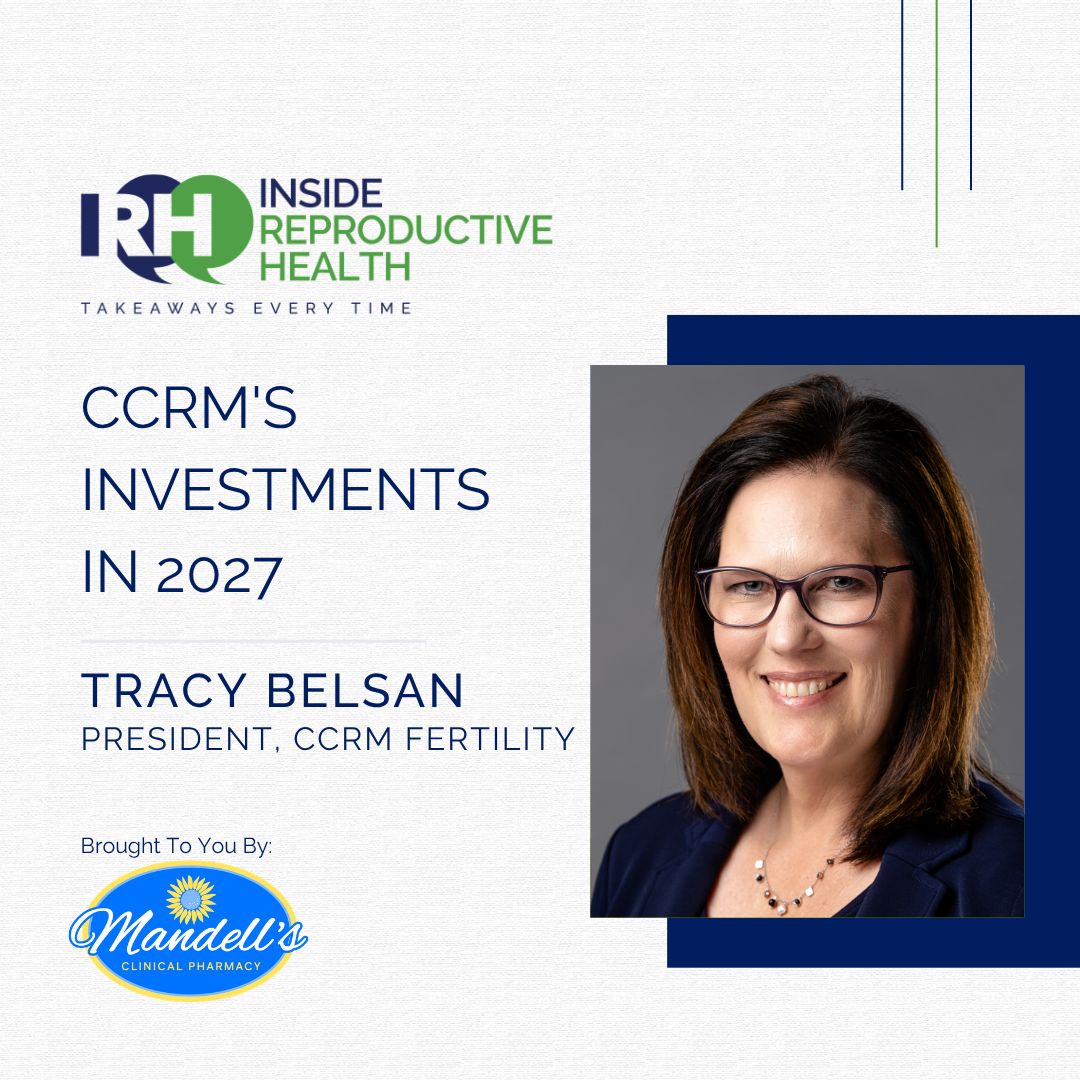
Tracy Belsan, President of CCRM Fertility, joins the episode to share how they’re thinking about growth, operations, and the patient journey.
We dive into:
The KPIs CCRM focuses on
The operational barrier they removed (Moving patients into care faster)
How technology is being implemented across the patient journey
CCRM’s approach to patient finance and access to care
The role of APPs and evolving clinical models
What it takes to consolidate an entire network onto a single EMR by 2027
Keep Patients In-Cycle with Lower Costs and Trusted Support
Medication cost and uncertainty are two of the biggest reasons patients drop off. Mandell’s helps reduce both.
Through its Serono Preferred Pharmacy Partnership, Mandell’s Clinical Pharmacy supports the Fertility Instant Savings Program, helping significantly lower out-of-pocket medication costs so patients are more likely to stay in-cycle.
Mandell’s earns a 4.8-star Google rating and an NPS of 96 by making patient education a priority. Pharmacists are readily available to explain medications and standard fertility procedures, helping patients feel informed.
👉 See how Mandell’s supports patients before and during treatment
-
Tracy Belsan (00:00)
The number one obstacle is really the financial piece for patients. That's where we see the largest drop-off and it really is, that's a global phenomenon, that that's where one of the biggest barriers to care is. And so for us, it's how do we remove those barriers? How do we make the patient journey and the patient experience as seamless as possible from the moment that that patient finds us,
However the patient comes into our front door, we have to remove all the barriers to make it easier to access that care.
Griffin Jones (00:41)
What's CCRM up to? And because they're a part of Unified Women's Health, how are they positioning for the hub and spoke era that I believe we're entering and removing that gap between the spheres of REI and OBGYN.
My guest is their president, Tracy Belsan. She's been at the helm of CCRM for about a year now. She shares which KPIs she pays most attention to patient satisfaction, new patient numbers, conversion to treatment, and others. She talks about a barrier that she removed very early on in her tenure alongside her team to move patients into the journey more quickly and efficiently.
I mention a little bit about how fertility centers and networks rely on Mandell's Pharmacy for things that ultimately help them with patient satisfaction, retention and conversion. Tracy shares some of the technologies that CCRM is implementing to help with the patient journey. She talks about CCRM's approach to patient finance. She talks about where CCRM is with regard to having OBGYNs perform egg retrievals. She shares how CCRM leverages APPs.
Tracy talks aboutCCRM's progress consolidating 1 EMR. Right now different CCRM clinics use different EMRs. In 2027, the expectation they'll all be on one, and what's going into that process. So if you enjoy learning about CCRM's vision, tell Tracy Belsan, you heard it here on Inside Reproductive Health.
Griffin Jones (03:21)
Ms. Belsan, Tracy, thank you very much for joining me on the Inside Reproductive Health podcast.
Tracy Belsan (03:27)
Thank you for having me, Griffin. It's a pleasure to meet you.
Griffin Jones (03:29)
You've been on the job for about a year now if LinkedIn serves me correctly. What's the hardest part about running a very large multi-center IVF network?
Tracy Belsan (03:40)
It's been right at about a year. It's been an amazing year. The hardest part is just making sure that we have as broad a patient access as we can. That's really near and dear to our hearts at CCRM. We are a network that certainly leans into the patient experience, leans into quality. And we know from the statistics, there are a lot of patients out there who need our services. And for us,
operating in 21 sites. We want to make sure that we have the right physicians, the right access, the right processes and systems so that as many patients that need to get care from us possibly can. So that's, think that's one of the most challenging pieces and coupling that with physician recruitment and ensuring that we are at the forefront of physician recruiting across the nation is also another challenging piece. But those are challenges that we have readily accepted. We have an amazing team that's out in the market.
really tackling those particular issues. But overall in the last year, are a couple of things that have been top of mind.
Griffin Jones (04:40)
When you say access, do you mean like having the capacity to be able to meet the demand for IVF? Tell me more about that.
Tracy Belsan (04:48)
Yeah, it's capacity. It's also, again, there's a lot of patients out there. There's a lot of patient need and fertility certainly has been in the spotlight over the last few months. And we understand that there's about one in six patients that will experience some type of infertility. And we want to ensure that we're the places that we need to be. And we get feedback from our patients that say, are you operating in this community? Are you operating in that community? And we certainly want to be. We can't be everywhere.
but we kind of pull back and look at the chessboard and say, where does it make sense for us to be offering fertility services? Where can we collaborate and partner? so patient access is really about services that we provide, but also how can we extend into markets that we're not currently in to pull patients into our markets that we currently have.
Griffin Jones (05:37)
So right now there's about half a million IVF babies born worldwide each year. People like David Sable think that that number should be more like 15 million per year. I think we did probably 400,000 or so IVF cycles in the country in the past couple years. People like John Sokolop Moncap want to see that be a million by 2030.
So there's a sort of gradient of how quickly you can scale up. And you're not doubling CCRM cycles tomorrow, but just for a thought exercise, what's in the way of CCRM doubling the number of IVF patients they're able to serve?
Tracy Belsan (06:24)
The number one obstacle is really the financial piece for patients. That's where we see the largest drop-off and it really is, that's a global phenomenon, that that's where one of the biggest barriers to care is. And so for us, it's how do we remove those barriers? How do we make the patient journey and the patient experience as seamless as possible from the moment that that patient finds us, whether that's through an internet search, whether that is through a friend, however,
However the patient comes into our front door, our virtual front door, we have to remove all the barriers to make it easier to access that care.
And some of the things we've done to mitigate that is moving more of the financial diligence, that process upfront. We want the patient to know very clearly, be as transparent as we can. What is the treatment plan? What are the treatment options that the patient could encounter?
What is the cost that goes with that practically? This certainly is a clinical journey for the patient and we understand that, but practically it's also can be a financial journey for the patient and for their family. And so just ensuring they have as much information as they can that we are walking them through some of the different options that are there for them. But that really is the biggest, one of the biggest obstacles for us at CCRM. It's not our internal process. It's not the number of physicians that we have. It's certainly not quality. We have some of the best in class.
but it really can be some more of those barriers around the financial piece and the cost.
Griffin Jones (07:54)
Tell me more about that. I know some fertility centers now are starting to have the patient read about those options, see those options, even talk to financial counselors prior to even their first visit. Are you now doing that prior to first visit or does it come after?
Tracy Belsan (08:10)
It comes shortly after, again, we're pushing that to as close to the beginning of the patient journey as we possibly can. We also partner with some great technology companies that help with that, right? They help us identify how to, what the benefits are for a patient, if you will, and then how to kind of move them through the patient continuum a lot quicker. So we don't ever want that to be the cost piece, to be a barrier for a patient. We want to work with them, we want them to understand.
their clinical options, we want them to understand the clinical operations of CCRM and what that will mean to them throughout their patient journey. And so we don't want the cost to be prohibitive for them to receive care, but we understand that's just a practical, a practical part of this process.
Griffin Jones (08:55)
Tell me about some of those tech solutions. Who do you like so far?
Tracy Belsan (08:58)
have some tech solutions around the benefit verification piece. And we also have some technologies that just tell the patient, they kind of tell us upfront what's there for the patient, what's available and what isn't. And then financing options, you know, that's really a big piece for the patient of they know they want a family. We explain to them what the cost is and then what. Then they're at really a crossroads of
Where do I go from here? Is there financing available to me? And so we have partnered, we have a couple of really great partners in that space that help the patient get to treatment quicker, help them to understand the financial, the different options that are there for them and move them through that patient journey a little quicker. there's, and it's been great to see even in my year with the company, there's just more and more technology, more platforms that are coming online.
to help the patient. As more data comes out, what I said earlier, that this is a global issue around the cost piece and where we see the patient drop out. We've just had some really great partners that have had stepped forward for us.
Griffin Jones (10:03)
the patient journey side of those technologies that CCRM has built or using something like either EngagedMD or Barry or Frame or any of those.
Tracy Belsan (10:13)
All of the above, all of the above. And we're meeting more and more partners, â you know, every time we are out at a conference or we get a lot of inbounds actually of different companies wanting to partner with us. Frame has certainly been a great thought partner to us actually over the last few months. We've met with them on a few occasions and EngageMD we have in our locations right now. And we're looking at Patient5, we have FutureFamily. So a lot of great partners that we have out in the market currently.
Griffin Jones (10:41)
I was, while we're on the topic of finance, I was talking to a practice owner that owns a practice within a network. This doctor told me that they are probably, probably 40 % of their patients are financed. And this individual said that that was probably double the next highest practice in that network. And
I asked this person, do you think that we're under financing, that there weren't that not enough patients are going through financing? Should the other practices in your network be more commensurate with where you're at? And this person thought, yes, where do you stand on that?
Tracy Belsan (11:27)
I agree. I agree with that assessment. What we have found is in looking at the data, more patients could be getting that those financial options and that financial approval in order to get the care that they are that they're wanting, right, to build a family. And so our partners, though, have been exceptional in stepping up and saying, how can we make this? How can we make their own journey through their process of their technology? How can we make that?
better, how can we make it more streamlined for the patient? How can we make approvals quicker? How can we change the threshold of approval? So it's been a really good collaboration with those partners to say, you know, the data isn't trending how we thought it might trend. We actually need to open the aperture a bit more to get the patients the access that they need to funding. And our partners have stepped up really, really beautifully in that process.
Griffin Jones (12:18)
Maybe I'm wrong about this assumption, but I gotta believe that in your first few months as you're getting into running CCRM, you're noticing one of these barriers, whether it's financial or something else, but you're noticing a specific barrier that you're thinking that should just go away. Or that should be a quick fix. And maybe you bit your tongue for a couple months to really get your head around it. But I gotta believe that
Tracy Belsan (12:42)
Yeah.
Griffin Jones (12:45)
you had something like that. What was it as specifically as you can be? What was a specific thing that you saw that it's like, let's get rid of this barrier now.
Tracy Belsan (12:54)
Well, that's a pretty easy one. And I didn't have to bite my tongue too very long, but we had made a pretty cumbersome process on the amount of forms that a patient had to fill out. And there were lot of reasons that that happened, but over time, it just continued to grow, right? The number of forms, just the process, the amount of time that that took for a patient. And we had to take a step back and say, well, wait a minute, patients are coming to us with a clinical issue.
It's also an emotional issue and it's an emotional journey for these patients. Are we putting up an impediment to patients and their families to get into us quicker? And the short answer really around that was yes. And so we spent a lot of time in my first few months and I'm happy to report this has been corrected, but we spent a lot of time just really kind of going back to basics and stripping down some of our processes and getting it to.
a level that was much more manageable for a patient that didn't seem overwhelming. They get the appointment with us and then comes all the hard stuff that they need to do. They need to then do the forms and the process and the financial counseling, not to mention the physical and the clinical piece of their journey. And so we've just really taken a lot of that burden away from the patient and from their family and said, come to us. Yes, there's some forms. There's always the paperwork that you have to fill out. And yes, you have to do that.
but let's try to make that easier so that's not at the forefront of your mind, just part of the process. And really the clinical piece and getting you to the outcome of having your family is really the part that's at the forefront.
Griffin Jones (14:27)
Such a trade off of where you put that, right? So the forms that they had to fill out, was that prior to scheduling they had to do that? It was right after, and now you wait until after the first consult before they have to do all that stuff?
Tracy Belsan (14:35)
right after.
And the forms are still there, but we've really, really reduced the amount. We've reduced the time that it takes. We've reduced the effort on the patient's part that that takes and taken on some more of that burden ourselves and helping them through that part of the process. It just, we don't want them to come in and all they're thinking about is paperwork, right? That is not, that's not where their mind should be. And so we're not perfect there, certainly. It's been quite a journey.
for us at CCRM, we're just, again, we're just trying to go back to basics and have what we do at CCRM focus around the patient experience, the science of CCRM, which we, in our approach, are tied together. The patient experience and the science are all one. And we want them to come into us and say, I've been having an infertility issue. I'm here to get help, and we help them.
and they leave with the outcome of having the beautiful family that they want. we just have had to get better at operational processes and structures. And we've done a lot of great work over the last year on that.
Griffin Jones (15:46)
So as a marketer and a salesman, I really like that approach because you want to lower the barrier to entry, period. So I like it from that perspective. I think of what my friend Dr. Harrington says, and I'm always paraphrased it, so I might be getting it a little bit wrong, but he says something to the effect of I am most useless to the patients that I know the least about.
And so I know there are some practices that all of that stuff has to be done upfront because then the consults are more effective. How do you balance that trade off? How do you measure if, okay, well, yes, now it's made our new patient volumes go up, but it's actually hurt our conversion rate. How do you measure that trade off?
Tracy Belsan (16:16)
Yeah.
Data, I mean, we have some phenomenal data at our fingertips. We have a really great analytics group that provides us with daily, weekly, monthly data. have whatever we need. And we are constantly looking at how do those measures, how did our hypothesis in the beginning of streamlining our operations, is that moving the needle? Are we able to get patients in the door quicker? Are we able to move our conversion time down?
What do our patient satisfaction results look like? What are our employees telling us? Because they're the ones that are on this journey with the patient. So we take all of, and what are our physicians telling us? We take all of those data points and we bring them together and say, are we moving the needle the way that we thought we were? If the answer is yes, great, but we continue to monitor that. If not, go back to the drawing board and say, what piece did we miss there? And what do we need to change? And sometimes it's a piece of technology. Sometimes it's,
It's just a little part of the process that we needed to tweak. Sometimes it's, we need more resources in a certain area that we hadn't anticipated. So we are constantly looking at data dashboards every day, every week, and trying to make sure that we're lining up with what our expectations of the business are and how it's actually trending and what the outputs are.
Griffin Jones (17:48)
What's on your dashboard, the numbers that you care most about above all others, patient satisfaction, new patient volumes, conversion? What are the main five or six KPIs that you're really stressing?
Tracy Belsan (17:56)
huh.
New patient visits, which goes back to the access that tells us, we opening up and broadening the access as much as the patients are telling us they need us to? So new patient visits is one of them. Also our conversion rate, how is that trending? it too long? Can we shorten that? Are there patients that are getting then stuck somewhere within the patient care continuum? We have some great analytics that shows us from the moment a patient walks in the door.
What are the different treatment modalities that are triggered for that particular patient? Are they getting hung up in one particular area? What are we doing possibly in CCRM that's preventing them from moving through the journey? Is it a clinical issue, a non-clinical issue? So we look at, we triangulate a lot of different data points to look at that. We look at patient satisfaction, certainly. And we just look at our overall mix. We look at our mix of patients. We look at...
our physician satisfaction and engagement. And we tie all of that together to create a story and a picture for how well we are doing within a particular market and then more broadly just across the enterprise. And are there some threads we can pull maybe over, you know, from New York that they're doing really well in an area and maybe another market is struggling and we can move that over as a best practice.
Griffin Jones (19:18)
Satisfaction and retention start with experience. When patients feel supported, informed, and in control, they stay in treatment. That's why clinics and fertility center networks partner with Mandell's Clinical Pharmacy. Their pharmacists focus on education, access, real human support so patients actually understand their medications and what comes next. Combine that with lower out-of-pocket costs through the Fertility Instance Savings Program and staying in cycle.
becomes easier. Mandell's has a 4.8 star rating on Google. You can look it up. They've got a 96 net promoter score. That reflects an experience that patients trust and recommend. And you can look and see fertility pharmacies that don't have that and think about which is going to better serve your clinical team and which is better going to serve your patients. Visit mymandellspharmacy.com.
to see how they support teams like yours or reach out. I'll be happy to make that intro for you. That's mymandellspharmacy.com. Tracy, tell me about the appropriate balance between.
Practice autonomy, clinical autonomy, like at an individual level versus networks adopting a standardization that allows for best practices to permeate throughout.
Tracy Belsan (20:36)
That's always such a balance for think any healthcare network to find regardless of specialty. But for us in CCRM specifically, we do not insert ourselves in the exam room of a physician. What we do standardize is we standardize our lab practices across all of our sites. That's very important to us. We standardize some support services functions such as legal and compliance, regulatory, HR, IT.
But from a patient care perspective, we really leave that to the individual physician, the individual market. And there can be certain clinic locations that decide to do things one certain way. And that's okay. We certainly give guidance. We have physician councils and we have physician groups that meet. So we certainly will give our guidance and our advice based on industry best practices, based on research.
but we do not insert ourselves into the exam room or into the surgery suite.
Griffin Jones (21:37)
But do you think it's generally better that clinics are using the same PGT labs that they're using the same supplies? Is that better than having everybody kind of choose for themselves?
Tracy Belsan (21:47)
We do.
We do on the lab side on the procurement side. There certainly is. There's some leverage there and there's also some scale, but just from an outcomes from a clinical outcomes perspective, having our lab functions consolidated, having it standardized, having SOPs that are across each of across all of the sites we find and we pride ourselves really in the impact that that has on our clinical outcomes, on our quality and
just across the board on how we see that translate into our patient care.
Griffin Jones (22:23)
How about on the clinical side, things like pharmacy, things like carrier screening, things like anesthesiologist staffing or CRNA staffing, that sort of thing.
Tracy Belsan (22:34)
Anesthesia is tough. That's tough across the whole country right now, and we are working to go towards a standard model for that. Historically, that has been more of a market-based approach, but we will be going to more of a national model, again, just to get some of that scale and leverage, and certainly in some of our markets, some more predictability around service there. And for all of our testing, all of our clinical testing, that happens on a consolidated basis out of our Denver location.
And we find that that's just the best possible, gives us the best possible chance for outcomes.
Griffin Jones (23:08)
Do you get some pushback from that? think of, I say that I really admire Beth Zoneraich from Pinnacle because she's been on this show a couple times. I've seen her give talks. I think she's very transparent about this is the Pinnacle way and if you don't like it, then maybe this isn't gonna be a good fit where I see other groups kind of tell doctors what they wanna hear and then
there's tension later of, no, it's not gonna be that way because we need to standardize some things and so you can't do it that way anymore. so what kind of pushback do you get when you try to roll things out at the network level?
Tracy Belsan (23:49)
First of all, Beth is great and I really admire her. And we think we do strike a good balance at CCRM. We call it the CCRM way and our new physicians, our new locations, they all go visit our Denver location, which is our flagship location. And they go through the process of the patient care journey. They go through the business, the operations process. So kind of.
front office and back office. So we do have a CCRM way, we do, and we have a lot of standardization. But as I said, where we do let the physician make the decision is with the patient, directly with the patient, because every patient that presents is going to be different. There's going to be different clinical indicators, there's going to be different socioeconomic indicators. There's just a lot of different factors for each and every patient. So we don't...
legislate what's going to happen in the exam rooms, but we certainly give our physicians, we give our nurses, we give all of the teams at our CCRM sites, the resources and the structure that they need so that they're just focused on patient care.
Griffin Jones (24:55)
While you're here, I'm going to solicit you for some free consulting, which is people tell me ask me how I'm going to expand the media company and they ask, you going to do this in other fields? And I think the smarter way of growing our media company isn't just duplicating it and saying, now we're inside MFM, but rather to expand as the field expands. so as genetics and REI overlap more,
then our genetics audience increases in the content that we create for genetics as OBGYN gets back into the IVF space more and overlaps more than I'm creating more content for them and they're becoming part of the audience. What should I be paying attention to in the OBGYN space as it overlaps with the fertility space?
Tracy Belsan (25:44)
Well, there's such overlap and we have CCRM and within the entire unified, there is, there hasn't been, there hasn't been, you would think just inherently that there is and that there should be. And CCRM were part of Unified Women's Healthcare of which we have over 3000 OBGYNs within our own network, which gives us an amazing platform to serve women across the entire
Griffin Jones (25:47)
Well there should be such overlap, right? But there hasn't really been a lot.
Tracy Belsan (26:11)
care continuum across their whole lives. And so, you what we look for, I'll speak for CCR and what we look for is where are those synergies in care? What are the different diagnoses that our OBGYNs are treating that have a direct impact on the fertility of a patient? That could be PCOS, that could be endometriosis. How are we sharing the latest research information on those diseases and sharing it back with the OBGYN? We're really proud. We have
great synergy between our REIs and between the OB-GYNs. They share clinical information, they meet routinely, they talk about what do the OB-GYNs want to treat for a fertility patient? Is there any workup that they want to do? What's the workup that we're going to do? That can vary by market, that can vary by region, but we have ongoing dialogues with the OB-GYNs on just that. The clinical care of the patient.
when to send the patient to us, when we're going to send the patient back, the services and the care and that white glove service that they can expect from us at CCRM for their patient. And so we have a lot of good overlap and a lot of good synergies. I don't know that there's many more companies or which other companies are able to do that because of our uniqueness of having this embedded network of OBGYNs and of REIs within one company.
Griffin Jones (27:36)
Within that network is there the appetite to further segment OBGYN? So it's like these clinics or this division or at a bare minimum these doctors, all they really do is sort of IVF triage. They're doing the fertility treatment or diagnoses prior to the REI to ensure that fertility centers are really just seeing
IVF ready patients and the most complicated cases. Is there an appetite to segment it that way that they're not doing obstetrics, they're not doing routine gynecological visits, that you're segmenting either clinics or OB-GYN physicians to just be that space in between routine gynecological care and REI?
Tracy Belsan (28:30)
There's not an appetite to segregate and just do one or the other. Where the appetite is, is to actually do both. To say, we want to be your partner. We might be an affiliated location that's three hours away, but we can do these 10 things on a fertility workup for you on your behalf. And then we send the patient over to you. We'll help with monitoring throughout the clinical care journey. We'll help kind of define what that looks like.
So we don't segment off OBGYNs and say, now all you're doing is fertility workup. They're actually doing both. So the appetite is there to say, how can we as OBGYNs be more involved in what is happening on the REI side of the business? How can we help do some of the testing? And then the appetite for the REI is that partnership with the OBGYN, whereas before, and you alluded to it, it's you're either an REI.
or you're an OBGYN and the two sometimes shall not meet, particularly networks that aren't like us where it's consolidated and where we have both of them together. But we've really broken down all of those walls and our physicians, what we found is kind of thought there might be just this built-in tension or resistance of not wanting to work together. And what we found is there actually was a huge appetite to work together and to have those walls broken down and say,
Let's really partner just on the clinical aspects of the patient care. What can we do? What do you do? The two certainly overlap and our patients will be better off for it with the collaboration.
Griffin Jones (30:05)
How is Unified starting to think about the hub and spoke model that people talk about? I've become convinced that we will not see anywhere near the number of patients that need to be seen or better said treated without REIs doing many more cases, but doing that in a tech enabled way where they're overseeing OBGYNs and APPs doing a lot of different things. And I've come to support Dr. Harrington's point that
REIs need to be the ones designing that system. Otherwise, the other players in the market will just design it without them. so how is Unified and CCRM's relationship positioned to do that hub and spoke model? What's the vision?
Tracy Belsan (30:50)
We have fully embraced hub and spoke within CCRM and within Unified. The feedback when we presented it out into the markets and we've done somewhat of a road show we did in 2025 and continuing in 2026 to go out and meet with our OBGYN partners, showing the value proposition. What does it mean for the patient? What are the expectations around clinical care? What are the outcomes that their patients will have? And we have just had overwhelming support for implementing hub and spoke and
Again, that's part of breaking down the barriers of communication. And we have just had this incredible outpouring of hand raising of when can we go next? When can our market participate? When can we get together as OBGYNs with our REIs and vice versa to talk about the best path forward for hub and spoke in a market and to think about, as I talked about earlier, that helps us extend the reach of CCRM.
and our OB-GYN care into markets that maybe we don't have an actual brick and mortar for REI, but it certainly helps us extend into those markets and pull patients in that might otherwise have a tougher time getting access to care.
Griffin Jones (32:01)
Does that include OBGYNs doing IVF egg retrievals?
Tracy Belsan (32:06)
It doesn't at the moment. I think it could in the future. For us, it doesn't. That's not part of the model. It's more around the monitoring piece and the collaboration on the patient's clinical journey through CCRM. But I think it certainly could. That's something that we have discussed at a very high level. I think that might be phase two or phase three. But initially, we were just focused around, first thing was making sure that the REIs and the OB-GYNs were aligned.
on what does does hub and spoke look like, what should it look like, who wanted to participate, and then making sure that we have the patient access and all of the structures and the clinical processes in place to be able to provide those services. And we've done that over the last year.
Griffin Jones (32:48)
I'm thinking of different CCRM practices right now. All the ones that are coming to me are in fairly large markets, Boston, Orange County, Northern Virginia, Denver, obviously, Houston. I imagine that Unified, do they have OBGYN practices in much smaller cities?
Tracy Belsan (33:11)
They do, but we have a lot of overlap with where we are with our CCRM locations. And that's where we've been able to lean in and leverage the relationship and leverage the OBGYNs and the REIs working together. But certainly we are at, they have 3000 plus OBGYNs. We have 60 REIs. So we have a significant amount of overlap, but they have a lot of good penetration on the OBGYN network and a lot of other markets.
Griffin Jones (33:36)
My point is that REIs are mostly in large markets. And if you look at those that are graduating from fellowship, 80 % of them want to go to 20 cities or contrast that with OBGYNs where most towns of a certain size have an OBGYN. And so there's a lot deeper penetration. is it an inevitability?
Tracy Belsan (33:41)
Mostly.
Sure.
huh.
Griffin Jones (34:05)
that we're going to have to have OBGYNs do IVF egg retrievals if we're gonna scale care to population health.
Tracy Belsan (34:16)
It could be depending on the market and depending on depending on the patient base that's there in a certain market. So it certainly could be. And, you know, I think that's really ultimately for the physicians to decide around. Number one, do they want do they want to perform those services on the OBGYN side? How are the REIs and the OBs partnering on that? But I expect that that will be very market dependent.
Griffin Jones (34:41)
Is the barrier there, you said there are some barriers to think about before you get to that phase. Is the barrier just current REIs and the way they think things should be done?
Tracy Belsan (34:53)
I think that could be part of it. I think that they get just like OBs and other specialties, you kind of get into a rhythm of what you do and what your clinical practice looks like on a day-to-day basis. And the REIs are, as with our OBGYNs, it's heads down. They have full patient schedules every day, and then they have their surgery schedules, and they're moving through the day. So it's just not something.
I don't know that they're adverse to it. It's not something that we've really put at the forefront right now that's on the roadmap. But again, that could be down the line. But for us, it was just making sure that we were getting all of our processes in place and as I said, really streamlining what we do so that the patients that came to us from our OB-GYN partners was as seamless as possible. And so I don't say, I'm not saying that it won't happen. It just hasn't been at the forefront of the discussion to date.
Griffin Jones (35:47)
I wonder if I want to push it more to the forefront because I've come a little bit off of the fence in that there just is no way to serve all of these people. And there are hundreds of thousands, if not more people in the United States of America right now that need fertility treatment, that need IVF specifically, that cannot either afford it or access it. Actually, I did a little
â analysis, take a wild guess how many counties, what percentage of counties in the United States do you think have an IVF lab? Take a wild guess.
Tracy Belsan (36:24)
I would say five.
Griffin Jones (36:25)
Yeah, it's 8%. So 8 % of, so you win by prices, right rules, Tracy. 8 % of US counties have an IVF lab. Like we just can't serve, like try getting an REI to move to Tucson, Arizona or Buffalo, New York or Little Rock, Arkansas. I have, and you can't do it unless they're from there or their spouse is from there. So.
Tracy Belsan (36:27)
If we said
Griffin Jones (36:50)
We need other people to be able to do IVF. I'm not gonna tell docs how to do it. I'm not a clinician, so I'm not gonna tell you how to do it, but I am gonna tell you that this problem has to be solved. Are you reluctant to push them like that?
Tracy Belsan (37:07)
I'm not in your right to push on it. And it's something that you're exactly right. It's you just look at supply and demand. How many patients to your point need our need care across the board? How many resources there truly are? And the math is the math on that. It's pretty easy to figure that out. So no, you're right to push on that. I'm not reluctant at all. I don't think that our our physician leadership within CCRM within Unified would be reluctant to have that conversation either. And and
Another part of that is to your point, freeing up those REIs to do as many procedures as they can to meet the demand. We look at our APP structure and how many APPs are we using and do we need to invest more there? And I think the answer to that is yes. And we've seen our physicians come around on that. That can be very physician dependent on how APPs are used within their clinic and to the extent the scope that they like to use them.
And even in my year here and just in my 40 years in healthcare over the last decade or so, I've really seen that turnaround where doctors used to be pretty resistant to using that. And now they really see with the right APP just how much leverage they can get out of that. But also it just, from a scheduling perspective, it can get the patient in the door a lot quicker to at least do that initial triaging, that workup, take the history and physical.
talk about what the patient goals are, and then hand it off to a physician. you know, for us, that's been a big push over the last year to think about how do we use APP smarter? Where do we need more APPs? I certainly think there's a lot of leverage there with their skill set.
Griffin Jones (38:49)
Dr. Emels has me thinking about top of license, not just top of license for REIs, which is the way I'd always kind of thought of it. But top of license goes all the way up and all the way down. So an REI shouldn't be doing anything that an OBGYN can safely and effectively do. An OBGYN shouldn't be doing anything that an APP can safely and effectively do, that a nurse shouldn't be doing that a medical assistant shouldn't be doing. What do you feel like?
Tracy Belsan (39:10)
Right.
Griffin Jones (39:17)
APPs could be at risk for being put on their plate that should actually not be on theirs that should be nurses. How should APPs be at the top of their license?
Tracy Belsan (39:27)
Yeah, and that's always you're right that that is always a risk, but our APPs and we have some fantastic APPs. We do use them to the top of their license. They are seeing new patients that come in. They are they are fielding patient questions. They are helping and working with the physician to look at patient list to kind of say, you know, which patients are you taking? Which patients am I taking? I need more leverage here is the physician to free me up so that I can.
can be in the procedure room. And so it's about having the open communication, the ongoing dialogue. I've seen in cases where APPs, you're right, are functioning more like nurses, and that doesn't benefit anyone to have them not working at top of license. And we find that our patients actually like the experience too. They're getting a second set of eyes on them. They're getting a lot more.
a lot more attention for their care. They're getting quicker care. They're seeing the APP. They're taking a lot of the information. Then they get handed over. They get that warm handoff to the physician. They'll probably see the APP again throughout the journey. So it just really adds to the patient care team.
Griffin Jones (40:37)
If you want better support for your patient care team and you want better patient retention, start with a better experience. When patients understand their meds, they have someone they can actually reach, and they don't feel blindsided by cost, they stay in care. That's exactly what Mandell's Clinical Pharmacy delivers. Their pharmacists lead with education, real human support, so patients feel confident in every step. And on top of that, Mandell's neutralizes sticker shock with lower out-of-pocket medication costs.
through the Fertility Instance Savings Program. Their 4.8 star Google rating and their 96 net promoter score reflect the level of care patients trust and recommend. If you're using a pharmacy that's something less than that, then patients are perceiving your patient experience as something less than that. So if patient experience matters to your team, visit mymandellspharmacy.com. Reach out to me, I'll be happy to make an intro to you. That's mymandellspharmacy.com.
my mother was in nursing for a long time and toward her retirement, the CEO of that health system said, we're in the nursing business. And I think of the nurses in pretty much every segment of healthcare is the unsung heroes, because you just can't sing it enough, right with nurses. And they still have so much
administrative BS on their plate that is a complete waste of their time and not good for the patient experience. How do you start to single that? What have you done? What do you think technologies and practices that you've implemented have been the best for allowing nurses to do what they do best?
Tracy Belsan (42:22)
I completely agree with you on nurses. They are. They are the foundation and the backbone for the patient. For all of us. And we want to let nurses be nurses. You go into nursing because you want to take care of people. And what we don't want is that the majority of their time is spent in that administrative burden.
It's spent online. It's been spent tracking, you know, tracking down administrative items, which is why we've really over the last year, gone on our own journey. what we started off calling the patient financial journey to streamline that process and really remove the word financial. It's just the patient. It's just the patient journey. And part of that is getting it right up front.
I talked a little bit about that with our administrative process and the forms. But the more we can do upfront that streamlines the experience for the patient. When the nurse, when the nurse starts interacting with the patient, we want their job to be just taking care of that family, of that patient, so that that patient knows this is my person, this is my nurse throughout this entire process, for me and for my family.
And so it's difficult. I don't think we can ever fully get rid of any of the administrative, parts that a nurse has to do, but making sure that our technology is sound, that we're constantly looking at the data that we have, the data that we can provide to our teams, but we do want to let nurses be nurses, and they're they're the direct partner with the physician.
I mean, that is a, you know, that is a dyad partnership in all of our clinics. That's hugely important to making sure that the patient has the best experience possible, the best outcomes. And we want to keep we want to keep good nurses. Nurses are vital to what we do within CCRM and really across all of health care. So, I give a huge shout out like you did to every nurse out there and the ones that work with CCRM.
Griffin Jones (44:20)
Are there some technologies that you're looking at that can help reduce some of that administrative burden and what can you share about that?
Tracy Belsan (44:29)
We are. We're looking at an EMR right now. The you know, within CCRM we're on a few separate different EMR across the entire platform. And and looking at how do we get that streamlined, how do we think about that. possibly next year, getting an EMR implemented. And, you know, I think that helps with standardization, that helps with, having all of the data and information in one place that that, lends itself to a lot more of a, seamless process where people aren't going in and trying to to figure out where the data resides. So that's, I think, a big area that solves a lot of different issues for our clinical staff.
Griffin Jones (45:08)
Are you sort of baby stepping everybody in to be ready for that? Like kids, we're going to the dentist tomorrow. People hate switching their EMRs. Is that the reason why you didn't do it on day one? Is that it's taken you a year just to get people warmed up to the idea?
Tracy Belsan (45:26)
It's a process. And it's one of those initiatives that sounds everyone gets very excited about it. And yes, yes, we want to consolidated EMR until you have to get into the actual implementation of it. And what does it mean and how much time is it going to take. And you know, fingers crossed. But nothing happens once you go live. So it's not a quick transition, nor should it be. We want to get it right. Certainly we want to get it right for our clinicians. We want to get it right for our care providers, our care teams, and most importantly, for our patients. but it does take a little bit of time to do diligence around that.
What's going to fit best within CCRM? What's that right technology I don't think there's 100% fit yet for any all of health care with a particular EMR. But we're certainly doing a lot of diligence and making sure that on the CCRM side, that our technology that we currently have is up to speed with where we need it to be, so that when we do overlay a new EMR, it can be as as effective and seamless as possible.
Griffin Jones (46:26)
Have you all made that decision? Is that made up in your mind? Like if I interview you in later 2027, is CCRM going to be standardized on one EMR?
Tracy Belsan (46:40)
I think that's a pretty good bet. I think that's a pretty good hedge there, yeah.
Griffin Jones (46:43)
Are you certainly going to go with one of the EMRs that your practices have been using? Would you consider one that you all, that no CCRM practice has been on yet?
Tracy Belsan (46:55)
I think it's likely that we'll go with someone. Someone that we know, a company that we've already done diligence on. But it's, you know, it's interesting the technology changes. There's new companies that come online. So it's we're going to have to just go with who we think fits best for now, but also a company that can scale and that will be able to make the updates and the changes and keep up with the industry. Also, over the next coming years. Because, once we switch EMR, this is not something certainly that we want to do every couple of years if we don't get it right. So that's top of mind for me.
Griffin Jones (47:36)
Seriously, the EMR sale cycle is the longest sale cycle because the best solution in the world could come out tomorrow, but if you just switch your EMR, you ain't doing it for â a few more years. that's a challenge that I see with EMRs is that you have some that maybe they have more IVF experience, but they started so early that they just really haven't been able to adapt to the new technologies. You have some that they're more recent. And so it's like, wow, this is awesome. This is what people have been asking for, but they might not have the experience yet. And then you have people in the middle that are either the worst of both worlds or the best of both worlds, depending on your point of view. Have you, is it, the decision of who all but made up in your mind? Or are you on a short list?
Tracy Belsan (48:27)
Yeah. It's a short list. It's really close. And I think there's also some, of the larger that don't want to go into the fertility side, and that's. That's okay too, right? That's fine. You can't be all things to all specialties sometimes as an EMR. And that's certainly okay. And because of the nuance of our specialty with fertility, we know that we need a very specialized system for what we do. And and as I said, a system that can scale with us a system that and a company that we can work with to say, you know, for our particular table space, what we have found is we need this functionality, we need this upgrade. And having a partner that's willing to let us have a voice in that so that we can, we can make those changes throughout the years and, and adapt, adapt to adapt to changing, research technologies as we grow and scale can keep up with, with our growth. And, you know, that will be really critical for us. And then also our physicians interaction to interaction and our nurses that it is for them a system that they can move through pretty easily. What we don't want to do is add to the administrative burden much of what we were talking about with the nurses, we're very sensitive to the fact that our physician time is very precious, and they have a limited amount of that every day to see the new patients, to be in the surgery suite, to see the follow up patients. And what I don't want for our physicians is that we implement a system that becomes a burden to them, that becomes, a platform that they can't pull effective data out, that can impact walking into the next patient room and rendering care. We want it to be very clinically sound.
Griffin Jones (50:09)
What do you see from what you've seen in the last year, what CCRM has done in the last year that you think puts CCRM in a really good position to help lead the field?
Tracy Belsan (50:20)
Well, for us, it's really it's kind of a it's a triad or a triangle, if you will. We have our lab, our genetics, our research and development. And we stay wholly focused on clinical outcomes. partnered with patient access. But our outcomes, our labs, our standardized process, the leadership that we have leading these functions is critical for us. And, in my opinion, and I know I'm biased, running the company, but, very much second to none. But our outcomes, our patients depend on excellent outcomes, excellent patient outcomes. When patients come to see us and they share with us their desire to have a family, our goal is to get them that family. Yes, quickly, but also as safely with the best outcome as possible. And so, for us, the lab, the research, our genetics, that consolidation, that standardization and being at the cutting edge of that is something that we're really proud of.
Griffin Jones (51:25)
What do you think that most people don't know about CCRM that you would want them to know?
Tracy Belsan (51:32)
what I just explained around the quality outcomes. We have an amazing culture at CCRM. We have a group of physicians, a group of leaders on the business side. We are all moving in the same direction. And that might really sound cliche, but it's it's not. We focus on a few very vital key initiatives within CCRM with the patient, first with the Patient Access Initiative first. But I would like everyone to know, like CCRM is the place to come if you want an outcome and you want that family and you want that quality and you want standardized, high quality testing, then CCRM is really, a network that's at the tip of the spear of that. And we have dedicated a lot of resources. We've put the right leadership in place clinically to get us there.
But we certainly are are known for our outcomes. And, and quite frankly, we're getting better at doing the storytelling around that scrum is has been a place over the last 30 years that has been, a very well known entity. And we have a lot of patients that come to us if treatment has failed along the way. And, and we're a network, you know, see, CCRM should be the first stop along the way in your fertility journey.
Griffin Jones (52:52)
I think maybe a great place to pick up next time would be bringing on a couple of those leaders with you and talk about how you've aligned on that. And it'll be my pleasure to have you back because it was a pleasure today. Thank you so much for joining me, Tracy, on the Inside Reproductive Health
Tracy Belsan
LinkedIn