/*Accordion Page Settings*/

IVF Lab

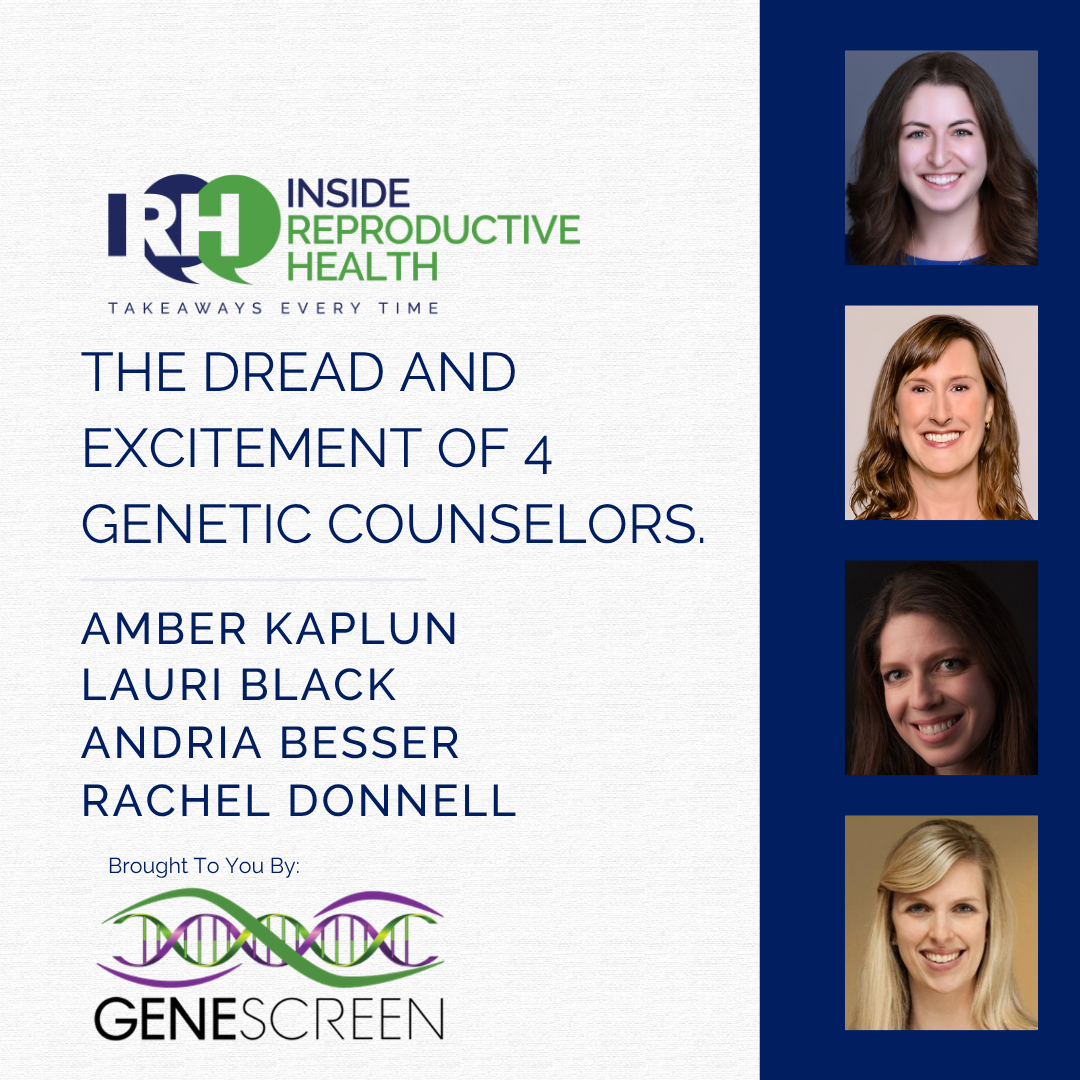
286 The Dread and Excitement of 4 Genetic Counselors. Andria Besser, Lauri Black, Rachel Donnell, Amber Kaplun


Today’s Advertiser helped make the production and delivery of this episode possible. But the themes expressed by the guests do not necessarily reflect the views of Inside Reproductive Health, nor of the Advertiser. The Advertiser does not have editorial control over the content of this episode, nor does the Advertiser's sponsorship constitute an endorsement of the guest or their organization. The guest's appearance is not an endorsement of the Advertiser.


Genetic testing in IVF is only getting more complex, and more common.

REIs, you’re not supposed to do this alone, help is already here.

We speak with four genetic counselors, Amber Kaplun, Rachel Donnell, Andria Besser, and Lauri Black, about how this works in practice.

We dive into:

  • How to embed genetic counselors into your workflow

  • How to free up REI time while improving patient experience

  • Why access to genetic counselors isn’t as limited as it seems

  • How third-party services like GeneScreen fit into clinical operations

  • Their perspective on PGT-P vs. PGT-G (and where the field is heading)


Genetic counseling is no longer optional in fertility care — it’s foundational.
The real question is how to deliver it well, at scale.

In many fertility practices, genetic counselors help shape lab strategy, donor eligibility decisions, complex case management, and clinical policy across growing networks. But not every practice has that level of in-house genetic leadership. 

GeneScreen partners with fertility clinics to provide concierge-level reproductive genetic counseling — whether you need full-service support, scalable coverage alongside your existing team, or experienced guidance to help build and strengthen your genetic services. 

Built to scale. Designed for patients. 

  • Lauri Black (00:00)

    Pre-implantation genetic testing is being used more frequently and more widely, and carrier screening has gotten more complex. So I don't think that there's a patient that walks into a fertility clinic anymore that isn't having some genetic testing. So genetics is part of everybody's fertility care now.


    Griffin Jones (00:32)

    Help is on the way. REI's genetic testing is too complex and now too prevalent for you to be doing genetic counseling. You have help. And today that help comes from four genetic counselors. Here, listen to their voices so you know who's talking when.


    Amber Kaplun (00:49)

    I'm Amber Kaplan from IVI RMA America.


    Rachel Donnell (00:52)

    I'm Rachel Donnell from Shady Grove Fertility.


    Andria Besser (00:54)

    I'm Andria Besser from NYU Fertility.


    Lauri Black (00:56)

    Lauri Black from Inception Fertility.


    Griffin Jones (00:59)

    They tell you how to embed genetic counselors into your practices workflow, how to save REI's time getting them performing at the top of their license, all while improving patient experience.


    how to understand that there are enough genetic counselors out there, even though they couldn't possibly meet every patient. This was an interesting nuance and the pushback in our conversation helped us get there. How they use third party services like GeneScreen, what they like about GeneScreen and how they get GeneScreen integrated into their workflow and SOPs. Then PGTP versus PGTG. They're excited about one.


    while dreading the other. What about you? Please do let us know after you listen.


    Amber Kaplun (02:43)

    genetic testing is evolving so quickly and there are so many new technologies that are on the market, some of which I wasn't even really trained on in grad school. So it's being able to keep up with some of those technologies to be able to adequately counsel patients and advise providers that I work with. And I would say the second part is especially in the field of fertility and working for such a large network, just being able to kind of keep up with all of the patients that are coming in.


    with questions, the providers that have questions, being able to see patients. It's really rewarding, but it does get to be a lot at times.


    Rachel Donnell (03:19)

    Mm-hmm.


    Griffin Jones (03:19)

    To educate me about the technology, what technology are you seeing now that you weren't trained on in grad school?


    Amber Kaplun (03:25)

    Polygenic risk scoring, I think, is the one that comes to mind first. When I was trained, that wasn't even a thing. And so that's something that I've really had to self-educate and self-train on to be able to understand the technology, understand the risks, benefits, and limitations so that I can have discussions with patients about it.


    Griffin Jones (03:44)

    When did that start coming about and what percent of your caseload does that represent today?


    Amber Kaplun (03:52)

    So it started being offered in the field of fertility probably around like 2018, 2019. It had been around in postnatal populations, for example, cardiology for a while before that. Currently, that is not a test that we offer our patients, but obviously when I'm speaking to patients, there are patients that have questions about it. So I wouldn't say that it's something that comes up super commonly, but when it does come up, I need to be able to answer the questions appropriately.


    something that you need to be on top of even if it's not something that's making up a significant proportion of your caseload.


    Griffin Jones (04:27)

    Lauri, you were nodding your head when you were talking about the increase in patient volume, it sounds like. Talk to me about that.


    Lauri Black (04:34)

    Yeah, it's been a steady increase, I think, over the decades, in part because pre-implantation genetic testing is being used more frequently and more widely, and carrier screening has gotten more complex. So I don't think that there's a patient that walks into a fertility clinic anymore that isn't having some genetic testing. So genetics is part of everybody's fertility care now.


    And I feel like that that wasn't as much the case when I started in the field, you know, a while ago.


    Griffin Jones (05:11)

    When would you say that changed? And talk to me about the changes in workload. Like from a day-to-day perspective, try to describe to me how it's changed.


    Lauri Black (05:21)

    So I think the level of complexity has significantly increased and that ⁓ has the potential to make the conversations with patients much more in depth, broader, more detailed and more nuanced. So, you know, we used to do carrier screening with just one or two genes. And now it's pretty typical to do hundreds of genes on a carrier screening panel.


    We used to think of carrier screening as, if you're a carrier, you're unaffected, nothing to worry about there. We just need to make sure that if the female is a carrier of an excellent condition or if both reproductive partners are carriers for the same recessive condition, that we talk about options like pre-implantation genetic testing. And now we're getting into the nuance, well, you're a carrier, there's reproductive consideration, but you also may have a personal health risk.


    associated with that carrier status and we need to take that in consideration as well. So the conversation really has evolved.


    Griffin Jones (06:22)

    Andrew, how has your workload changed in the last five, 10 years? Try to walk me through someone that hasn't been in your position to help me understand what it really looks like differently on a day-to-day level.


    Andria Besser (06:36)

    Yeah, it's completely changed. When I was originally hired as the first genetic counselor at NYU Fertility Center, so that was just over 10 years ago, I was hired part-time. I think the thought was that I would occasionally see a patient for a single in-depth consult and that would be that. The need would be solved from that.


    Rachel Donnell (06:47)

    Mm.


    Andria Besser (06:56)

    ⁓ Very quickly, within about a year and a half, I ended up going full-time because it was realized that that just was not enough when everything that we do is genetics now, as Lori said, every single patient has some sort of genetic component to their cycle and to their treatment. So now we've got three full-time genetic counselors, a full-time nurse practitioner who's only in genetics and a specific genetic admin. So we've grown so much in the last 10 years.


    And a lot of that is because, like Lauri said, so much more carrier screening. We're seeing more more carrier couples as those panels have really expanded. We're doing a lot more PGTA. We are just doing a lot more genetic testing in general. so patient need has really evolved. I personally have taken on kind of more of an operations role, just as the need has really.


    gotten there, you know, started off with this need for just somebody to consult with patients. And now it's moved on to, well, how can we integrate genetics into our everyday workflow, into all of our patient materials, our marketing materials, our consent forms? How do we oversee just the whole, the whole process of PGT from beginning to end? How do we choose a lab for PGT for carrier screening? So it has just really changed quite a bit.


    Rachel Donnell (08:12)

    Mm-hmm.


    I had probably the same experience as Andria, which she was describing with something very similar for me. I started out as part-time and then moved quickly up to full-time, ended up hiring a team. And I think something else that the clinicians see, like working with genetic counselors with their practice, is truly being able to work at the top of their scope. And what I mean by that is physicians should not be having the conversation of, is carrier screening? Let's go over PGT results.


    A lot of that can actually be handled by genetic counselors so that we can help our physicians really work at the top of their scope of practice. And I think that that's something that physicians quickly see as they hire a genetic counselor and perhaps why Andria and I had this experience of, we'll bring you part-time, we'll see how it goes and then quickly realize, okay, these practitioners can really help us work at our top of scope as well.


    Griffin Jones (09:09)

    What needs to be changed specifically or adapted, Rachel, in the workflow in order for that to happen, for genetic counselors to take over some of that work from the REI to allow them to perform a topo license?


    Rachel Donnell (09:23)

    Yeah, bottom line is you have to integrate a genetic counselor in your practice. There's really no other way about it. Having somebody that works for your clinic, for your company, knows your protocols and your processes can really help patients navigate that process as it becomes more and more complex on the genetic


    Andria Besser (09:42)

    Yeah, integrate really is the key word there because I think that there is availability of genetic services outside of the clinic. There's ways to refer patients to outside practitioners. There's labs that have genetic counselors that are all super valuable, but it's that integration that I think is missing for a lot of centers.


    Griffin Jones (10:03)

    So talk to me about more what that integration is because in my mind, I hired a genetic counselor. Her office is down the hall and that's it, right? So, but I imagine that there's more to it than that. I imagine that it takes a few months and I want to understand what goes into those few months of how you truly integrate a genetic counselor into the practice.


    Andria Besser (10:26)

    Yeah, so it's not just those one-on-one consults with patients. It's creating those workflows that are gonna get patients the support that they need. One genetic counselor in an IVF center is not gonna be able to see all of the patients in a busy practice. So of course it's gonna depend on the size of the clinic, how many attendings there are, but generally, one genetic counselor


    can't service every single individual patient for all of their genetic needs. But what we can do is we can create those workflows. We can create those partnerships with other outside resources to make sure that there is a flow for these patients. That how do they learn about carrier screening, for example? How do they learn about PGT? How do they get their results? Who goes over the results with them? Who triages those results and figures out who the patient should see next?


    ⁓ We're familiar with kind of all that's going on in the industry. So we know the differences between labs. We know the differences between technologies. We can support not only the physicians, but other practitioners, know, the nurses, the admin staff. I mean, I can't even tell you how much time I even spend with billing and trying to figure out diagnosis codes, for example, ⁓ and how to...


    to prove medical necessity in a certain case. We have access to all of the patient's records, which I think is a really big difference too. We're directly in the EMR. ⁓ Like Rachel said, we know the clinic's policies. We know the little nuances that our attendings like, and so we can kind of put ourselves in their shoes and say, I think your doctor would probably recommend this is your next step. You kind of gain that experience as you work with the clinic.


    Amber Kaplun (12:04)

    And I think just to add on to that, like as Andria mentioned, being embedded in the same EMR, being embedded in the same workflows, the same clinic environment, every clinic is a little bit different, but being able to have that knowledge to be able to guide clinic leadership in how to create these workflows effectively.


    And from a patient safety perspective, to make sure that they are catching the patients that they need to catch is a really, really big benefit of having a genetic counselor in-house. You're just not going be able to get that familiarity with someone who isn't day-to-day doing the same thing as your nurses, your physicians, et cetera.


    Griffin Jones (12:39)

    Is the existing technology sufficient for moving the patient along in this way? you just do all this through EMR or are you wishing for some sort of patient journey system that you don't have yet?


    Amber Kaplun (12:52)

    I think a lot of it because it is really trying to mimic clinic workflows, that is mostly going to be related to EMR. Now I know that there are certain companies that are trying to navigate things like, what do you do with patients that have carrier screening through different platforms and stuff like that, which is a common challenge that we face. And those types of technologies would be really great when they get to the point that they can take a patient and partner carrier screening report, tell you exactly


    was everything screened, is anything missing, is any additional testing needed. I'm just not sure that we're really there yet to be able to do that effectively, but I'm sure it's coming.


    Griffin Jones (13:31)

    If you could wave a magic wand at any of you and have your technology do X, what is X?


    Rachel Donnell (13:37)

    Double check all embryos for transfer.


    Amber Kaplun (13:40)

    That's a good one. Yeah. Compare carrier screening results. You know, be able to effectively summarize genetic records that we get in from outside institutions. And this is something that like our team is working on a little bit, like being able to leverage things like artificial intelligence to be able to do some of that. So just being able to kind of like extract information reliably that we can then use in our counseling.


    Rachel Donnell (13:48)

    Mmm.


    Griffin Jones (14:05)

    But you don't feel like the AI is quite there yet?


    Amber Kaplun (14:08)

    I mean, I think that AI generally is still an evolving practice. So do I think that AI generally is there for anything? No. But I think that, you know, there are some early stage tools that are really great and coming out to be able to help leverage these types of situations.


    Griffin Jones (14:24)

    said don't


    Lauri Black (14:24)

    Yeah, I think


    they're at the beginning right now. They definitely are there. I'm hearing of carrier screening labs that do have some AI assisted patient facing tools that explain carrier screening results. I'm hearing of tools that are AI fueled that can extract pertinent information from a medical record that's received from outside of the


    the clinic or even summarizing the medical records and the progress notes from the clinic's own platform. So you can really get the salient and relevant pieces of information digested and summarized. So those things are coming. They're in their infancy, if you will, but they are there to help make all the workflows more efficient. But they need to be based in


    foundation of knowledge. So I think that's where genetic counselors can help shape these things and make sure that they're going to be accurate and reliable tools.


    Griffin Jones (15:26)

    But still in their infancy, because I imagine many of those companies aren't just calling on your company, Lauri, that they're calling on you, that you're testing them out and looking into them. And it sounds like there are those that show some promise, but nothing that's blowing you away thus far.


    Lauri Black (15:42)

    There are some of the AI-fueled carrier screening reporting for labs that I think are looking pretty good already. They certainly don't serve all purposes though. They're really good for a low-risk couple based on their carrier screening results. Like there's not an indication for PGTM for them.


    So it's just a nice streamlined way to be able to explain a couple's carrier screening results and the idea of residual risk without involving ⁓ a genetic counselor. And I know that the genetic counselors in the clinics are so much busier and needing to use their time to address the more complex cases that talking about a low risk


    career screening result for a couple is probably not their use of their skills and best use of their skills. And it certainly doesn't keep them practicing at the top of their scope.


    Griffin Jones (16:42)

    When you all talk about the importance of having genetic counselors in-house, you've been very consistent with this theme, Amber. You've been on the show three times, and I think one of the episodes, the topic was entirely about that. And so you've made your case. What about those centers that are either too small or maybe they're big and they have some genetic counselors, but I don't think you could possibly have enough genetic counselors for...


    Andria Besser (17:05)

    Thank


    Griffin Jones (17:10)

    all of the cases in house, what do you do? Who do you use? Or are you just screwed?


    Amber Kaplun (17:16)

    What?


    Do you want to push back on this idea that there's not enough genetic counselors? I feel like I hear that all the time and it's just not true. I can tell you that I get so many emails, so much interest from people that want to work in this space. They're just looking for the right position. And you know, I've spoken with different providers in the fertility field that are leveraging maybe MFM services at their hospital or their academic institution and it's getting them by, but they're saying that they're referring patients


    to discuss a topic like mosaic embryos, for example. And the prenatal genetic counselor has a much different level of knowledge and background than an ART IVF genetic counselor. And so the type of genetic counseling that those patients are receiving is different depending on who is actually seeing them.


    Now, I acknowledge that it can be challenging for small clinics to be able to try and like find the budget, for example, for a genetic counselor. And so I think that there can be opportunities maybe for outside services, but I never think that that's going to replace the value of having a genetic counselor. Also, the cost savings for you as a practice avoiding potentially very expensive lawsuits that we have seen come up in the fertility industry before.


    So think that there are workarounds and there are 100 % enough genetic counselors out there for the positions if you frame it the right way and you put the position out there.


    Griffin Jones (18:43)

    How many genetic counselors work in the whole RMA network right now?


    Amber Kaplun (18:48)

    We are three full-time genetic counselors.


    Griffin Jones (18:50)

    for the whole network.


    There's three just in Andria's practice. So if you were to serve the whole RMA network, how many genetic counselors would you need? Like a couple dozen?


    Amber Kaplun (18:55)

    Right.


    Well, but remember that we said that there are a lot of indications for which we may not necessarily need to be seeing those patients, for example, like low risk carrier screening results, right? And so that's where you can create a program that focuses your services on the things that you absolutely need to see. And so there are situations where outside services can become beneficial for some of those more routine indications. And that's the reason that we still use those services, right? So, you know, it is not that...


    it's like a one size fits all approach. We found something that works really well for us that I know is shared by a lot of other like clinics and networks, you know, that have in-house genetic counseling services. And so, you know, having that in-house genetic counselor can be a super big benefit, but it's not gonna necessarily meet all of the genetics needs for your practices.


    Andria Besser (19:51)

    Yeah, it's not about replacing the outside genetic counselors. We, and I speak for in-house genetic counselors, we need outside genetic counselors because there is no way to see all of the patients. We would need to have at least a one-to-one ratio with every physician, if not more, to be able to see every patient for every genetic indication. So it's more about how do we work with the outside genetic counselors so that patients are getting the benefit of both worlds.


    And I would even push back a little further and say, a little clinic that maybe doesn't have the budget for a genetic counselor, do they have a budget for a nurse? Do they have a budget for a billing manager? I think that the more that we see genetics integrated into fertility care, that it's such a prominent feature of it now, I think we are getting to the point of how can you not have the budget for a genetic counselor?


    Rachel Donnell (20:45)

    Mm-hmm.


    Lauri Black (20:46)

    And I think you should also remember that while, for example, a nurse may be trying to help with coordinating some of the genetics care at a clinic, that nurse is not able to bill for their time. And it's also, they're probably practicing a little bit beyond their scope if they're trying to do genetic care. So consider this, having a genetic counselor even in a smaller clinic.


    that can take some of those genetics duties off of a nurse, so let the nurse assist with more procedures that physicians can bill for, and then the genetic counselor can take over the genetics duties and bill for their services. it's really just, know, practices need to rethink how they might distribute those duties and what might be billable or not.


    Griffin Jones (21:36)

    As long as we're all pushing back. I think we may have discovered why people have that confusion, because people may be conflating two issues that sound similar but are different that I would have seen as the same had you not made that clarification. So people say there aren't enough genetic counselors out there. I think the reason why people are saying that is because of what Andria just said, which is there


    Rachel Donnell (21:39)

    Ha ha.


    Lauri Black (21:40)

    you


    Griffin Jones (22:04)

    we couldn't possibly meet all of the patient demand. So, but what you're saying, Amber, is that there are enough genetic counselors for what we need, and then there are outside people for all of those other cases that don't meet that threshold.


    Amber Kaplun (22:22)

    To put it into context for you,


    if we have an open position, we usually get around 100 applications. Yeah.


    Griffin Jones (22:27)

    I'm sure. Yeah.


    Lauri Black (22:29)

    I've


    heard similar things from other hiring folks, yes.


    Griffin Jones (22:33)

    So


    for outside folks, how do you use them and what's the best way to use them?


    Lauri Black (22:38)

    There are so many ways that this can be pulled together. So I agree wholeheartedly with everything that's been said about having an in-house genetic counselor, whether that genetic counselor is an employee of the clinic or contracts with the clinic, but they're somehow more embedded with the clinic, familiar with the SOPs.


    can really have a more one-on-one relationship with the providers within that clinic. So I think that's really the optimal model. But there are other ways to have genetic counseling services brought into the clinic to take care of those patients. You can lean heavily into webinars that are offered by PGT labs to give patients pre-test education before they do their pre-implantation genetic testing. You can lean heavily into the carrier screening lab for results genetic counseling for those low risk results. There are also a number of excellent third party genetic service providers that can have a pretty close relationship. It's kind of a second best to having your own in-house genetic counselor. They can become familiar with the practice. They still have to follow their own company SOPs and processes, but they can become very familiar with the practice, try to customize their services to that practice. are quite a few. GeneScreen is an example of one and they have genetic counselors that specialize in fertility. A number of other services do as well. I think that's really key is making sure that if you're working with a third party genetic counseling service, that you're working with a subset of their genetic counselors that are familiar with fertility counseling, fertility care.


    Griffin Jones (24:35)

    Do you use GeneScreen as well, Amber? So what's the best way to use them? How do you get the most out of them?


    Amber Kaplun (24:37)

    Yeah, we do.


    Yeah, so they do counsel their patients a lot related to carrier screening results. We also have a lot of patients that come in with general questions about like, have this in my family history, what could this mean? Is additional genetic testing indicated? And they've been really helpful in those situations as well.


    they do see a lot more than that, you know, for other clinics that they may be supporting. But once we start getting into discussions around things like pre-implantation genetic testing, we like to keep that all in-house because that is going to be related to clinic policies and procedures. And so that's really something that more in-house genetic counselors can take on.


    Griffin Jones (25:19)

    I like GeneScreen and companies like that, they have to have their own company SOPs, but how do you get them using your SOPs in the best way possible,


    Lauri Black (25:28)

    That's communication. It's communication, tight communication with that service provider and making sure they understand your needs and expectations and communicating about how to get those needs met and how to get those referrals sent across appropriately and efficiently so that you don't have any delays in patient care and get those reports back.


    Amber Kaplun (25:28)

    Go


    Thank


    Lauri Black (25:53)

    Oftentimes there's lots of infrastructure that they have to offer to make sure that workflow goes smoothly.


    Amber Kaplun (25:59)

    I mean, I was just going to mention that a lot of these companies are really great at working with clinics, right? But I think as Lauri said, at the end of the day, they have their own SOPs and policies and procedures. And so there is absolutely flexibility there. But people may find themselves coming to a point where the SOPs and the procedures may not necessarily align between the two entities. And so there has to be some sort of reconciliation there.


    Griffin Jones (26:23)

    Rachel and Andria, why not just use the genetic counselors from the carrier screening labs?


    Rachel Donnell (26:30)

    So maybe a good example of like some disconnect or where SOPs at one company can conflict with another. The main kind of example I think of are embryos available for transfer. consider a situation where we have a patient that did embryo testing, they have some mosaic embryos. Clinic A might transfer mosaic embryos all the time. Clinic B certainly doesn't. You can run into situations where sometimes


    a clinician just wants to know, okay, which embryo should I transfer? And you're gonna run into issues with one company not feeling comfortable saying what embryo should be transferred versus another, just dependent on those different clinic policies and different company policies. So similarly with carrier screening laboratories, a great example would be, you could certainly pursue PGTM for certain indications based on carrier screening results.


    but those laboratories might not feel comfortable saying which situations that might be. Because again, that extends beyond their scope, which is just simply reviewing carrier screening results. They don't go into next steps after what happens now. So I guess bringing it back to having an in-house person can help with that translation between the two companies. And I think that's kind of where I sit at this point. I'm with Shady Grove and we have.


    I think 57 clinic locations. So I'm a full-time genetic counselor and I do not meet with patients. I do not do patient consults. I certainly help with the translation between the companies that we use for genetic counseling and then integrating that information into actionable clinical next steps, which I think is kind of where it can be helpful to have somebody internally kind of getting those next steps available.


    Amber Kaplun (28:11)

    Yeah, I mean, I think one thing that's coming up in my mind is we're having this discussion as well. We talk so much about patient retention and patient experience within the field of fertility and.


    utilizing outside providers can be really beneficial for getting that service, but the continuity of care, being able to set patient expectations, being able to clearly tell patients what their next step is, is really going to be something that an in-house genetic counselor excels at and almost like can handhold that patient to make sure that the patient experience is being, you know, pushed up to the highest level. So that practices can retain these more complicated genetics cases that are coming in because otherwise patients get frustrated. They feel like


    they don't know what their next step is, they don't properly understand what the outcomes are going to be and what's going to be offered to them. So I think that that's another really big benefit.


    Griffin Jones (29:02)

    Andrei, what about the panels themselves? How different are they from one care screening company to another? Are they meaningfully different or are they so similar that it doesn't really matter? And are the genetic counselors sort of limited to being able to interpret that panel, but there might be other considerations to the patient's broader situation that you would need extra help for?


    Andria Besser (29:26)

    Yeah, you bring up a really good point. The panels can be very different. Even if they differ by one or two conditions, if you have a patient who's a carrier for one of those one or two conditions and their partner wasn't tested for it, that's meaningful. We do carrier screening specifically for the purpose of trying to identify reproductive risk. And so if we're not testing both partners for the same conditions, we may not be really getting an accurate read on their reproductive risk. And that's something that has


    changed so much over the last few years. It used to be pretty uncommon that we would have patients bring in prior carrier screening that needed to be checked before we could order new carrier screening. Now, I would say it's probably a good, at least in New York, a quarter of patients, a third of patients are coming already having had carrier screening with a provider at some point, or they've had maybe direct to consumer testing, they need someone to explain the difference.


    So it's not as simple as let's just order carrier screening on the two of you and send you off to the carrier screening lab to review your results because we also often need to incorporate prior results and maybe the new test is different from the old test and somebody has to make sure that we have at least tested for the necessary condition that one person carries and one doesn't. So that's something that my team takes care of. The four of us are really


    spending a lot of time reviewing old outside results and making sure that any new testing is going to complement that or enhance that, but that we're not going to be missing something based on the fact that a patient said, but I had prior carrier screening, so everything's good. Or let's just order new testing and ignore the fact that maybe one partner is a known carrier of something that isn't going to come up on the new panel. And it's not just the differences in the diseases or the genes on the panel, there's differences in the way they get reported.


    reported. One lab might call a variant as causing a risk. Another lab doesn't even put it on the report because they see it as uncertain significance. So sometimes we're weighing all of the evidence that we can find based on the literature, based on databases, and not just looking at the report itself. So kind of going back to what Rachel said about using the carrier screening lab genetic counselors, I mean, we use them a ton. They see


    more patients, I'm kind of in a similar position as Rachel where I don't see a lot of patients. I think the term genetic counselor is a little bit misleading sometimes because I don't do a whole lot of counseling anymore in my position. And even, you know, my other full-time genetic counselors where that's their main job, there's so much more that goes into it other than just those one-on-one consults. And part of that is knowing all of these little nuances that we've learned.


    Rachel Donnell (31:55)

    you


    Andria Besser (32:15)

    through our training, through experience, ⁓ that isn't gonna be something that a lab genetic counselor whose role really is just to focus on the test at hand, the test that their lab offers. It's not within their scope to be kind of looking at some of these outside details.


    Griffin Jones (32:30)

    Is that within the scope of someone like a GeneScreen or an outside provider, Lauri and Amber, or is that something that you feel like you'd really want to, in order to be able to compare those nuances?


    Lauri Black (32:41)

    Yes. That's kind of on the cusp, it really depends on how embedded that third party service is and how tightly coordinated that third party service is with the clinic. I would say as a general rule where an in-house genetic counselor might be able to speak directly to that clinic's SOP on what's suitable for transfer, the third party service genetic counselor may say, you need to follow up with your reproductive endocrinologist for that final decision about whether something is suitable for transfer, but I can tell you about this result. But if there is such tight coordination and communication between the clinic and that third party genetic counseling service, that clinic may have shared their SOP and in referring that patient said, hey, this patient needs to talk about embryo A and embryo B and here are the results and embryo A's result is suitable for transfer if they're comfortable with it, but embryo B's result is not suitable for transfer in our clinic policy. So that level of detail can be incorporated into the counseling that's provided by a third party service like GeneScreen as long as they know.


    Griffin Jones (34:01)

    Well, that's gonna be my question, because if I own a third party genetic counseling service, seems to me like the way to win that game is to be as integrated with the center as I possibly can be. Where are my challenges going to lie? And you might say both, you can't say both. Is it more in my own limitation to adapt my own SOPs or is it our center's very protective of their SOPs? Or maybe even if they're not protective, is it just really hard to integrate on the clinic side into those SOPs?


    Lauri Black (34:33)

    I don't think it's difficult to share the SOP. In fact, I think it's appropriate if you're asking that third party service to counsel your patients for a test result and they're considering action based on that. The third party service to best benefit that patient should know what the clinic SOP is on how they might handle that result, how that's actionable within the clinic. That is optimal. But as I understand it, sometimes that's the missing piece and that third party service doesn't have that level of detail. And so they're just speaking in more general terms.


    Amber Kaplun (35:09)

    I think it also comes down to that third party service, are they considering themselves an independent service? Are they considering themselves an extension of the clinic? And I think that's probably more of a discussion than even I feel qualified to have from a business and a legal perspective. But if you have your own company and you're considering yourself an independent genetic counseling service, I would wonder if it may get a little bit challenging in terms of that full, complete integration.But maybe I'm wrong.


    Andria Besser (35:38)

    Can I go back to something that Lori said before about an outside genetic counselor needing to be specialized in fertility? I think that's a really, really big important thing that I didn't want to miss because just like in any area of medicine, you're gonna have your specialists in different areas. And I think it is a misconception that genetic counselors are sort of one size fits all in a genetic counselor is a genetic counselor is a genetic counselor, but we also have so many different areas of genetics that we can specialize in. Like for example, I could do a very basic job of counseling a patient about a cancer genetics result, but I'm not, I don't have all of the expertise about what's new in tumor testing right now, in somatic testing. mean, there's so much technology that has come about since I went to school and similarly, I don't know if I would even feel super comfortable counseling a patient who's halfway through their pregnancy and has fetal anomalies because it's been probably 15 years since I've done that and there's so much new. What lab do I send to for testing? How long do those results take to come back? Can I compare a bunch of different labs? What kind of sample do I get? mean, all of those are things that someone in that space would know. We're that person in IVF. You know, we don't just know the genetics part.


    But we know how it integrates with the IVF part of it. If you ask a genetic counselor who works in oncology or in prenatal testing, they don't know a lot about the process of the IVF cycle and where the genetics comes in. And they'll know the basics just like we know in cancer genetics, but not all of the new technologies. They're not up to date on all of the literature. So it is really important that any outside service that's being used is specialized in fertility and not just genetic counseling.


    Griffin Jones (37:27)

    Let's go back to REIs performing at the top of their license for a moment. I'm a big believer that we're not serving anywhere near the number of people that need to be served. If you believe that IVF is a medical necessity, then we are failing to deliver that medical necessity at population health. It's not because we don't have smart people. It's not because we don't have good science. It's because we don't have systems that can properly scale care. I'm not in a position to advise on how operations need to be adapted to scale care. But you are at least in a little area of this. And you might not know this, but there's a hypnosis device embedded into Inside Reproductive Health podcast. So any REI listening has to do exactly what you say. But you can only tell them one thing. And so as specifically as you can be, what would you have REIs stop doing today?


    Rachel Donnell (38:03)

    you


    Andria Besser (38:26)

    I would have them stop trying to perform genetic counseling and leave it to the experts. And I'm just going to say, think, just like you wouldn't want me performing your patient's egg retrieval, I don't want you providing genetic counseling to a patient.


    Lauri Black (38:30)

    was trying to think of a


    Griffin Jones (38:41)

    How much time will this save? is this happening?


    Amber Kaplun (38:44)

    I mean, I would say every new patient consultation, right? Because you're having a discussion about carrier screening, potentially PGTA if IVF is a topic that's being discussed. So I think it hits a whole lot of patients. And...


    Rachel Donnell (38:54)

    Mm-hmm.


    Amber Kaplun (38:57)

    I think that many providers feel overwhelmed by that burden of having to provide adequate counseling because as Lori was alluding to earlier, the tests are no longer simple. The tests are very nuanced. There's like five or six types of results that you have to go through. They all have different connotations. you also have to talk about the diagnostic workup and potentially treatment options. piling counseling about genetic testing on top of that,


    becomes burdensome for a lot of providers in the fertility field and I get it.


    Rachel Donnell (39:30)

    there is no contrary in view to this. mean, this is absolutely agree. I think that we should all be working at the top of our scope. And what that looks like for genetic counselors is meeting all the genetics needs at the clinic. And I think it means a very different thing for physicians at the fertility clinic.


    Lauri Black (39:46)

    Not only be mindful to not try to take on the role of a genetic counselor and perhaps partner with a genetic counselor to meet that need for your patients, but the other thing that I see coming up sometimes is physicians in their effort to


    facilitate a patient being able to access PGTM because the patient says, hey, I was once told I have XYZ condition or my aunt has ABC genetic condition. Can you test for that? Trying to take on diagnostic genetic testing is.


    one of the most complicated things that you can do in genetics and making sure that you're ordering the correct tests and interpreting them correctly and addressing any of the medical management based on the test results. So if I could wave that magic wand and have REs stop ordering genetic testing, diagnostic genetic testing is very different from carrier screening.


    Please keep ordering that. But trying to make a genetic diagnosis for a patient is very complicated.


    Griffin Jones (40:57)

    Rachel, you had mentioned you would like technologies to be able to double check embryos. Were you talking about gamete identity? Were you talking about something that electronic witnessing is something supposed to do or something else?


    Rachel Donnell (41:04)

    Yeah.


    genetic test results before transfer, double checking that everything is in the EMR and entered incorrectly, and then double checking which embryo we're transferring or the order in which we transfer. And I think that really only comes from, I think a lot of patients are super concerned now about making sure the right embryo is being transferred and that their embryos are their embryos. So yeah, was just a... ⁓


    I think it would be nice and helpful if we had that ability at the clinic to provide that additional reassurance for patients. But I know a lot of fertility clinics are double and triple checking these things, but using AI or a technology versus humans could add an additional layer of support.


    Griffin Jones (41:52)

    I'm going to leave this question open-ended so you can go either way with it, depending on which way you want to go. As specifically as you can be, what technologies or methods are you dreading or really excited about in the next two to five-ish years?


    Andria Besser (42:13)

    If we can dread something that already exists, I guess dreading the expansion of is the polygenic PGT. I think it has, even though it has been around now for a few years, I think just in the past, yes, PGTP, yeah. We've now seen more companies taking it on. We've seen some aggressive marketing out there from some of these companies, and we've seen a shift from looking at polygenic risk scores of


    Griffin Jones (42:26)

    Is that PGTP, Andria?


    Andria Besser (42:42)

    diseases or conditions move over into traits like IQ and height. And I think that that's got a number of issues, not only ethically, I mean, I think we could talk about that for hours, but also just the science of it is obviously very much in question for a number of reasons. But I think, at least from where I sit, helping patients make decisions about embryo transfers based on the information we have right now.


    PGTA data, PGTM data, just embryo grade and day of biopsy. That's a lot already and patients are really having a difficult time. The sex of the embryo, let's incorporate that in there. They have a really difficult time ranking their embryos and making decisions. So I think adding on to it, okay, well, this embryo not only is the...


    the opposite sex of the one that you were hoping for and maybe the lowest grade, but it's actually got the lowest breast cancer risk, but it's got a higher risk of bipolar disorder. So how do you feel about that? I just, I don't know how any human can make those types of decisions. So I would say I'm really dreading the potential expansion of, of PGTP.


    Griffin Jones (43:54)

    When you say the science is in question, Andria, I've heard this a lot. Just last week, I had someone from a PGTP lab show me their deck and talk about height and make claims about height. And they're claiming that it's very validated. My social sciences degree didn't prepare me to scrutinize that. So what questions should I ask when someone tells me that the next time?


    Andria Besser (44:23)

    Yeah, I think there's a few things. I think that a lot of the data that's out there has been based on modeling. We don't actually have outcome data, which is, mean, to be fair to these companies, it's pretty impossible to get at this point because what are we going to do? Follow these kids for 75 years and then wait and see what diseases they develop. We don't really have a way to get a lot of that data. So it's not that they're missing doing these studies, but I think it does put a lot of the data in question.


    I think the other thing is just being realistic about how many embryos patients have to choose between. I think if we were talking about humans as if we were cycling rabbits and we had a hundred embryos to choose from, that's a very different story. But most patients are gonna have what maybe two euclid embryos if they're a good responder. And now those two euclid embryos maybe have a small difference in risk that could be, it depends on the condition, but for something uncommon like schizophrenia, maybe the difference in risk is going to be 1.5 % versus 1.2%. So how much is that really going to help the patient feel more comfortable and actually reduce the disease burden? I think it is a question.


    Amber Kaplun (45:35)

    And I think just to add on to that, all of these companies have their own proprietary algorithms and bioinformatics methods, and none of that is really transparent at this point. So there have been articles published in popular media about people that send information to two different labs and get two very different responses back. So I think there needs to be some agreement on like, okay, what type of validation are we seeking out? But then two, there also has to be some sort of metric or way that clinicians can independently evaluate those labs and we're just not there yet.


    Griffin Jones (46:07)

    Where do the rest of you sit on the dread excitement spectrum? All dreading the same thing?


    Rachel Donnell (46:13)

    I think I'm dreading but also excited for the same thing. So it's a bit of a conflicting answer here, but I both am dreading and excited about these labs that are potentially offering like what they're calling PGTG or like whole genome, whole exome sequencing of embryos. Yeah.


    Griffin Jones (46:30)

    Well, that is pretty different from PGTP, right? Like it's the same technology, but a very different application.


    Rachel Donnell (46:37)

    Mm-hmm. But again, to Andria's point, just so much information and like, you know, at the end of the day, sometimes I'm left with like, do you want a baby or not? Because like none of these embryos are going to be without anything because none of us are and none of us get out of this whole experience alive at the end of the day. So I dread it from a, you know, patient understanding and all the counseling and, you know, these poor physicians having to like rank these embryos. But it is exciting from the standpoint of like, it's just so cool how much testing we're able to do of embryos. And that is just fascinating to me.


    Griffin Jones (47:13)

    How many of your cases have done whole genome sequencing? I was at dinner with a number of doctors last week and it was amazing how the room was divided. The California doctors were saying, it is so many of our patients. In some cases, may have been, I don't think it was a majority, but some people were saying, so many of our patients have whole genome sequencing and the doctors in middle America were saying, I don't think I've ever seen a patient who's had their whole genome sequence and how common do you all suspect it is right now?


    Rachel Donnell (47:45)

    not very. It's quite cost prohibitive.


    Andria Besser (47:47)

    on embryos.


    Yeah, for talking on embryos, it's so expensive. I think that's a big issue with it. We've had one patient who has done it. So, know, occasional request, but not common.


    Lauri Black (47:57)

    And we, you know, looking at all the clinics throughout ⁓ North America, I think that there are definitely hot spots where that is a question brought to the providers from patients more frequently, but then there are clinics where it really just isn't a conversation that they're having. And even if the conversation is raised and the question is asked, it doesn't mean that the test is actually done. So, I think that it's gonna be an interesting thing to observe, to see how this unfolds. think I'm cautiously optimistic. I'm kind of with Rachel on the PGTG and how that may improve and offer more options to patients that actually have some clinical utility, but I am wholeheartedly in agreement with what Andria and Amber were saying about PGTP.


    Griffin Jones (48:48)

    In the next few years, I have a feeling we're going to see a lot more questionable technologies and hopefully many more hopeful technologies as well. And as they continue to pervade, I'll need your help to help me understand them. And I'll happily bring you back on because it's been a pleasure today. Thank you all for joining me on the Inside Reproductive Health podcast.

NYU Langone Health
LinkedIn

Inception Fertility
LinkedIn

Shady Grove Fertility
LinkedIn

IVI RMA America
LinkedIn

Andria Besser
LinkedIn

Lauri Black
LinkedIn

Rachel Donnell
LinkedIn

Amber Kaplun
LinkedIn


284 Don't Get It Twisted. PGT-G Thwarts PGT-P In Battle for Embryo Genome Sequencing. Dr. Mili Thakur & Dr. Sasha Hakman


Today’s Advertiser helped make the production and delivery of this episode possible. But the themes expressed by the guests do not necessarily reflect the views of Inside Reproductive Health, nor of the Advertiser. The Advertiser does not have editorial control over the content of this episode, nor does the Advertiser's sponsorship constitute an endorsement of the guest or their organization. The guest's appearance is not an endorsement of the Advertiser.


A tale of two PGTs.

One is making bold promises and headlines, the other is quietly gaining traction and relevance.

Between PGT-P & PGT-G…what’s actually moving the needle?

Dr. Mili Thakur of Genome Ally and Dr. Sasha Hakman of HRC Fertility break down what they’re seeing in real patients, especially when everything else has already failed.

We dive into:

  • The real difference between PGT-P and PGT-G

  • Why some genetic claims are under scrutiny

  • Where whole genome sequencing is actually helping

  • How PGT-G may reduce repeated failed IVF cycles

  • Whether this can truly shorten time to pregnancy


The New Standard of Care in IVF
Juniper Genomics’ PGT-G for “Genomics” delivers deeper genetic insight beyond standard PGT.

Built for high-performance IVF clinics.  

Scale seamlessly without disrupting workflow. 

Learn how leading clinics are adopting the next generation of PGT. 

See what you’re missing with standard PGT.

  • Dr. Sasha Hakman (00:00)

    Patients are hearing about these tests and wanting that control. And I think that's where like a lot of the counseling will come into play of like,


    Yeah, this test exists, however, can never guarantee that you're going to have a child that does not have the phenotype that you're looking to eliminate.


    Griffin Jones (00:26)

    PGT-P has made headlines for bold direct-to-consumer marketing, but the ASRM has recently issued guidelines warning about the absence of scientific evidence behind such big promises.


    Meanwhile, a different way of doing whole genome sequencing, or at least a different approach to it, of the embryo has quietly been gaining traction. PGT-G doesn't tout wild claims, but it's steadily widening its relevance.


    as the evidence starts to come forth and use cases mount.


    joined by Dr. Mili Thakur who is an REI at the Fertility Center in Grand Rapids and has her own specialty practice, Genome Ally, where she sees the cases that you, her colleague REIs, send her when you trust your embryologists and your protocols, but you know there's a genetic challenge afoot.


    and by Dr. Sasha Hakman an REI in the Los Angeles area who believes that genetics has a lot more to offer to avoid repeated failed IVF cycles.


    Doctors Hakman and Thakur talk about Juniper Genomics, a PGT lab that does both PGTA and PGT-G. But specifically, what advantages Juniper's tests offer


    and how these two physicians believe, if I can steal a phrase from Abigail Sirus and Dr. David Sable, it reduces time to baby.


    I've only started paying attention to these differences between PGT-G and PGT-P.


    The vast majority of you seem freaked out by PGT-P.


    Almost everyone I've talked to about PGT-G sounds guardedly optimistic.


    But I'm only starting to figure this out, so listen to this episode, tell me, what do you think? What's for real and what's unfounded?


    Griffin Jones (02:57)

    Dr. Hakman Sasha, welcome to the Inside Reproductive Health podcast. It's about time. Dr. Thakur, Mili, welcome back to the show for the 80th time. like the Steve Martin of Inside Reproductive Health. You keep coming back. Sasha, what are the latest technologies impacting PGT right now?


    Dr. Mili Thakur (03:07)

    Thank you.


    Dr. Sasha Hakman (03:07)

    Thank you.


    So there's definitely been, I mean, the newest, latest, greatest is whole genome sequencing being used. However, different companies have different focuses. So the technology itself of whole genome sequencing, I think is a very attractive emerging aspect of our field when it comes to pre-implantation genetic testing.


    A lot of people have already heard of PGT-P, which is looking at polygenic risk scores, but not all companies that are doing whole genome sequencing have that focus in particular. And I know that it's been a very controversial topic since some companies are sort of advertising this as a way, like almost direct to consumer for people to sort of create designer babies or whatever have you. you know, there was even a New York Times article


    about it, but I don't think that, I don't know if everyone realizes that not every company that's doing whole genome sequencing is doing necessarily the same thing, where some are looking at polygenic risk score, but some are looking specifically at genetic causes of infertility and recurrent pregnancy loss on a single gene variant level, as well as looking at things like reduced viability variants.


    and the company that's actually doing this right now is called Juniper Genomics.


    Griffin Jones (04:41)

    And so there's different names for tests that do hold genome sequencing, Like PGT-P is one test and PGT-G is a different test.


    Dr. Sasha Hakman (04:51)

    G.


    Correct.


    Griffin Jones (04:53)

    Who comes up with the names of the tests? I remember 10 years ago, I had just got it straight. Okay, this is PGT and this is PGS and I had finally gotten it straight and then we don't do that anymore. And it was overnight. It was like there was a memo that went out and everybody got the memo at the same time. Who's making these memos? Who gets to decide what these tests are called?


    Dr. Sasha Hakman (05:17)

    Mili, you probably know this better than I, because I mean, I think the ASRM is the one that came up with changed it to PGTAM and SR, right?


    Dr. Mili Thakur (05:17)

    I think, yeah.


    Yeah, yeah. Thank you, Griffin, for having me. I think like when we were doing just PGT and PGTS, you know, at that point, I think in the early to late 2000s, you know, there was this need of like coming out with like technology that was changing. at that before that time, I think right around like 2000 is like 2000 to 2013, you know.


    Next Gen sequencing was coming out. And with Next Gen sequencing came out cutoffs for the test and how we call euploids and aneuploids and mosaic embryos. And when those guidelines were coming out at the same time, know, PGT, SIG and other, you know, ASRM and other societies came together to kind of demarcate that. So right now, you know, as all of our listeners know, we have the PGTA, which, you know, a focus of a lot of ⁓ practices is.


    Dr. Sasha Hakman (06:04)

    . .


    Dr. Mili Thakur (06:27)

    But we have PGTM for single gene disorders. We have PGTSR for structural rearrangement where there is like translocations and inversions. And then you have the other less frequently used ones. So PGT-HLA, when you want to match an embryo to a sibling for HLA matching, you have PGT-P, which is upcoming and we are still trying to figure out the ethical benefit of it. And then PGT-G, which is this new terminology, mainly I think


    Dr. Sasha Hakman (06:42)

    Announce.


    Dr. Mili Thakur (06:56)

    brought up by Juniper.


    Dr. Sasha Hakman (06:58)

    Yes.


    Griffin Jones (06:58)

    So


    do the labs, are the labs the ones that say this is what the test is and then the medical societies decide if they're going to adopt that nomenclature or do the medical societies get together and say this is what we're calling each one of these tests?


    Dr. Mili Thakur (07:15)

    I think the initial four tests were through medical societies. like PGTSR has a different technology than PGTM and PGTA. So those were kind of decided. And now these additional ones like PGT-P, the labs that were pioneering it are pushing that name quite a bit. And then PGT-G for the companies or labs that are using the whole genome sequencing. So I don't think ASRM or any other societies have yet.


    Dr. Sasha Hakman (07:22)

    .


    Dr. Mili Thakur (07:44)

    and


    or PGT-G, however PGT-P there was a recent guideline from SRM about how to use it and where to use it.


    Griffin Jones (07:52)

    And I'm sure we'll get into that today. But the earlier tests, was it ASRM that said, here's the definitions? then do like, does Eshry have their own nomenclature and the Asian society has their own or how do they all get together on the same page?


    Dr. Mili Thakur (08:07)

    I think all the societies right now have the same nomenclature. We call it PGT-A, PGT-M, PGT-SR, and PGT-HLA.


    Griffin Jones (08:14)

    People are like, why is he laboring this benign point? And it's because I know that I'm not the only one who's wondering. So is it the case that, to your point Sasha, it's universal adoption, but are they getting together or is there one authority above all of them, like the WHO or something that is saying this is what we call tests?


    Dr. Mili Thakur (08:38)

    I think from my standpoint, our field is so small, even globally taken everything together, like ASHRAE and ASRM and PGT Special Interest Group and the PGT Society. All of those, I think are still very few scientists and physicians are involved in that. So I think in my mind, I think most everybody is calling it the same, the PGT-A.


    Dr. Sasha Hakman (08:47)

    .


    Griffin Jones (09:02)

    And then they just


    send out an email to the rest of us and then that's what we call it.


    Dr. Mili Thakur (09:04)

    Yeah.


    Dr. Sasha Hakman (09:06)

    I do think ASRM


    has a pretty big influence on how a lot is adopted worldwide. And this isn't to say like the US is the be-all end-all. I mean, there certain things that are not necessarily adopted, like when the ASRM changed the definition of infertility to be more inclusive, that wasn't necessarily the case with Escherich, for example, right? But there was a very specific reason why ASRM did this, and it was in hopes of improving insurance.


    benefits and improving access to care. So if more people fall under the definition of infertility, then perhaps that could improve access to care through insurance coverage. But maybe that's not necessarily the same priority for Escher, because a lot of countries already have incredible benefits, though there's probably a lot of populations that require third party reproduction that are still left out in that, in the traditional definition of infertility. But I think for things that are just more


    I mean, I would say less controversial. I think that if one society creates certain guidelines that are easy to follow, that make sense and scientifically sound, then a lot of the other medical societies will adopt that just to create a little bit of more of a universal language. like Mili said, our field is so small in comparison to a lot of the medical fields that there's just a ton of overlap. And there are things like


    you know, different organizations having meetings together to have expert consensus on new guidelines, depending on what we're talking about.


    Griffin Jones (10:39)

    20 % of my audience is glad that I dug so deeply in that and the other 80 % has been hitting the skip button for the last five minutes. I heard of a test called PGTWGS. Is that a test or was that just a brand name that someone is working on?


    Dr. Mili Thakur (10:44)

    You


    the whole.


    Dr. Sasha Hakman (10:56)

    It's a whole genome sequencing.


    I think everyone's just calling it whole genome sequencing. I don't know about you, Mili, but when I bring it up to my patients, I mean, obviously I'm not saying WGS because patients will look at me and be incredibly confused, but I tell them, you have this option now where we have, know, obviously routinely everyone's getting their genetic carrier screening, so you're figuring out.


    do you need to do PGTM or not, but for those where you don't necessarily need to do PGTM or PGTSR because there's no translocation or any structural rearrangements there, you're doing PGTA, most of us I think are doing it pretty much routinely in most IVF cases, and I'm really curious to see Mili's thoughts on that as someone who's also board certified in genetics, but with whole genome sequencing, you're really just testing the entire genome, and you can call it,


    WGS or you can call it G. I don't think it really matters. You're just describing what the technology is.


    Griffin Jones (11:52)

    So Sasha, is PGT-G and PGT-P the same test? They're just used for very different applications, or are they different tests?


    Dr. Sasha Hakman (12:03)

    Well, concept of whole genome sequencing is the same. Like you're getting that information, like the DNA information, but how you process it and interpret it is going to be different, right? And so, you know, with polygenic risk scores, that's totally different than say, like a company like Juniper.


    who's looking at reduced viability variants, which I think that they're the only ones that have that data, if I'm not mistaken. They have a list of genetic variants that essentially are not in the population, basically meaning that anyone who is alive does not have these variants because...


    they are not compatible with life. And so it just helps to prioritize which embryo to transfer first to reduce time to baby. That's the ultimate goal. Or to provide specific information to a couple that perhaps has recurrent implantation failure or recurrent pregnancy losses, including of euploid embryos. And you can't necessarily pinpoint what the issue is to understand better why these pregnancies are not occurring or why they're not ongoing.


    ⁓ So I think that, you know, I don't know necessarily, Mili maybe has a better understanding of the technology of the other companies and what they're doing. But, you know, the different platforms will give us different information when it comes to whole genome sequencing.


    Griffin Jones (13:37)

    would you describe Mili the difference between what we understand about PGT-P is and what someone like Juniper Genomics is doing?


    Dr. Mili Thakur (13:45)

    Yeah, so I think the ⁓ important thing is that word whole genome sequencing, right? So when we are saying whole genome sequencing in an adult or a child, you know, we have a phenotype that's already there. That means there is a child or an adult with a health condition or some sort of a family history. And then we are looking at the data for all genes that can be sequenced in as much depth as it can be. And then the work really starts. So whole genome sequencing can be done by any lab.


    but then the annotation of the genes, the curation of the genes, how to take that data that is such a large volume of data and making it meaningful for that particular patient in front of you, you know, is a slight bit easier. And whole genome sequencing is still clinically in adults and children also coming after whole exome sequencing. So we understand about protein genes better.


    And so for adults and children, whole genome sequencing still has to be curated very carefully. And you might miss some areas that are difficult to sequence. But in the embryos, when we are saying whole genome sequencing, the whole amplification of the DNA, so the biopsies taken from the outer shell of the embryos, from the trophectocytes cells, you do the whole genome amplification.


    And then you can annotate the data for whatever you would like. So basically all of the data is coming through a technology called next generation sequencing. They're looking at the data, but it depends on company to company or lab to lab as to how that whole genome amplification is happening. the reads that are being made are clear. And then how is your scientific team working and what are they kind of focusing on? So a lab that is focused on PGTA,


    Dr. Sasha Hakman (15:19)

    Mm-hmm.


    Dr. Mili Thakur (15:30)

    It's looking at copy number variants and depending on lab to lab, they are focused on making sure that the embryo sample is eucloid, has all 46 chromosome, all pieces of it, and the sex chromosomes are fine. Labs that specialize or the division of the labs that specialize in PGTM is focused on that single gene that we requested and making sure that that embryo is not going to get that disease. It's unaffected by the disease, right?


    Dr. Sasha Hakman (15:59)

    And after the creation of probes.


    Dr. Mili Thakur (15:59)

    And the third lab,


    yeah, so like linkage is established. It's a whole different workflow. They are focused on doing something that is going to be making sure as accurately as possible, mostly above 90 % and somewhere around 98 % that linkage PGTM test would tell us that the mutation is there in the cells of the embryo or not in there, right? But these labs that are now,


    taking other pieces. So there are some PGT labs that are doing whole genome sequencing. They are saying that they are doing whole genome sequencing, but in reality, they are looking at like 1800 or so different genes. So they're not looking at a family history or a personal request for a particular gene. They're going and saying, there is no direct mutation in any of these genes that were looked at, right? But there are 25,000 genes in the genome.


    and they're looking at 1800 genes. So we have to be very careful of saying, yes, your technology is whole genome sequencing, but what you're really looking at it is this much and there are areas in those genes and there are tripple repeat disorders that everybody's trying to optimize. Like fragile X type genes are not very easily read in an embryo sample. And then there are other companies and their labs who take that data. They're not focused on PGTA or PGTM.


    they have data or they have a means of looking at that data and grading the embryos for certain parameters. So they are looking at certain SNPs and saying, diabetes is more likely in your embryo number one, but less likely in embryo number two. So that's PGT-P scoring. So polygenic risk scoring is commonly used in other kind of paradigms, but we are trying to predict a phenotype in an embryo that has no phenotype as of now, plus also we are...


    adding another layer to these embryos, like all of them are healthy, right? Healthy in the sense they're PGTA normal, they don't have the PGTM gene, but now we have graded them. And if our first two or three don't take in the PGT-P based on their lower risk of diabetes or schizophrenia or hypertension or physical attributes or whatnot, then the parents are settling for their third best embryo when there was no actual difference in all of those embryos.


    Dr. Sasha Hakman (17:54)

    .


    Dr. Mili Thakur (18:16)

    Right, so that PGT-P is just a layer of analysis that's been put on the data to grade embryos based on certain predefined parameters. In whole genome sequencing where reduced viability variants are being looked at, like Juniper, what they are doing is they are looking at PGTA, they are looking at PGTM if you have a single gene, but then they're also looking at the data for reduced viability variants.


    Dr. Sasha Hakman (18:21)

    . .


    Dr. Mili Thakur (18:45)

    So the lab curates that data. kind of, they have that data and they're increasing that by having more patients do it. And so based on the analysis, your product or your panel becomes stronger. you can, like right now for an adult or a child, when I order whole genome sequencing, you can do it for a thousand dollars, but I can't take that data and make it meaningful for my patient.


    Griffin Jones (18:46)

    Thanks. ⁓


    Dr. Sasha Hakman (18:52)

    Mm-hmm.


    Griffin Jones (18:53)

    you


    you


    you


    Dr. Sasha Hakman (19:10)

    .


    Dr. Mili Thakur (19:11)

    The same thing, we have to take all of that data and make it meaningful for each embryo.


    Dr. Sasha Hakman (19:12)

    Okay.


    Dr. Mili Thakur (19:17)

    and then to the parents.


    Griffin Jones (19:18)

    And is the reason why you can't make it useful for your patient is because they're actually only screening 1800 genes or that's a different concept?


    Dr. Mili Thakur (19:28)

    That's the different things. Yeah. So basically for an adult or a child, there's 25,000 genes. Some people


    say 30,000, some people say 20,000. Out of those 18,000 genes are something that we can sequence. And out of that, if you look at these companies that do it for adults and children where there are millions of cells and everything's there, there are gene areas that don't sequence well. They're kind of in the dark.


    And then on top of that, amount of data generated from whole genome sequencing is immense. Like even in, I sometimes will provide a 600-joll gene list to these companies because I'm looking for infertility-related genes or recurrent implantation failure genes. Even then I'm getting like seven to 10 variants of uncertain significance in just 600 genes. So what I'm trying to say is whole genome sequencing, even though it sounds like a very fancy word, at the end of it,


    the test is useful to our patients and to our physicians based on the curation of the data and how we kind of make it meaningful. Like I would want to transfer an embryo that would have the highest chance of a live birth, lowest chance of a disease causing gene. But then I don't want to add decision-making to already stressed out couples or individuals to say, hey, you have these five embryos, one has this wrong with this.


    Dr. Sasha Hakman (20:28)

    Mm hmm. Mm-hmm.


    Dr. Mili Thakur (20:52)

    second one has this wrong, which one would you like to pick? Right, we have to tell them at the end of it, our patients are looking at our guidance and we have to say embryo number one seems to be the best and let's never transfer embryo number five because it has a disease causing risk.


    Griffin Jones (21:08)

    Sasha, tell me more about the significance of these reduced viability variants. What is that? How do you counsel your patients on it?


    Dr. Sasha Hakman (21:15)

    We're in an age now where a lot of patients are looking for answers on social media. We know that on average 15 to 20 % of couples with infertility will be given the diagnosis of unexplained infertility. I don't know how much you guys are consuming online. I consume a lot about what is being said because I wanna know what my patients are seeing and hearing online. And there's a lot of BS of...


    There's no such thing as unexplained infertility. There's always an explanation. It's usually something like PCOS or endometriosis. And couples who are getting this diagnosis always assume that there's some sort of inflammatory disease happening that is causing their infertility. And everyone's forgetting an incredibly important part of biology, which is genetics.


    You know, with like the PGT-P, for example, we're looking at polygenic risk scores, but you're forgetting that like a big part of that is there's an environmental component that affects the phenotype. And so you may have a genetic predisposition to something and there may be an embryo that has a higher risk of, for example, type 1 diabetes, but you know, it's usually the Coxsackie virus exposure that then creates a cross reaction.


    where you create antibodies that attacks the pancreatic beta cells that eventually will lead to type one diabetes or insulin dependent diabetes, right? And so we can't predict what the environmental exposure is necessarily gonna be. And so that's a lot harder to really provide a guarantee of any sort. And obviously we can never guarantee anything when it comes to reproductive medicine, but that to me is just sort of.


    a lot harder to utilize for anything clinically meaningful. But I think that if somebody's coming and we have these genetic variants that are highly associated with infertility or with recurrent pregnancy loss and somebody's gone through multiple IVF cycles, we don't necessarily have answers. This is where I often will encourage them to consider using a test like Juniper because then if I'm able to get this information,


    Griffin Jones (22:58)

    But I think that if somebody's coming, we have these genetic


    associated


    Dr. Sasha Hakman (23:20)

    with reduced viability variance, and I have seen this with couples, where up until that point, creating embryos and sending it out and testing through Juniper, I had no answers for the patient, right? Why did you fail for embryo transfers? I don't know, we've tried everything. We're now assuming it's the embryo, or sorry, it's the uterus, and we're doing endometrial biopsies of tests that really have no real evidence to support whether we should do these tests or not.


    Griffin Jones (23:23)

    you


    until that point.


    Why did you build?


    I'm assuming it's the embryo, or sorry, the uterus, and we're an in-vitro biopsy.


    Dr. Sasha Hakman (23:49)

    And then when we go to create new embryos and send it out to Juniper, and now I'm seeing that there's a common variant amongst the parents, the embryos that keeps showing up again. And I see that there's maybe one embryo that doesn't have this reduced viability variant. It allows me to now select out of a handful of embryos which one to transfer first. And if it's accessible, then I feel pretty confident that this is likely the reason.


    Griffin Jones (23:50)

    And then when we go to create new embryos and send it out to Juniper, and now I'm seeing that there's a common variant.


    And I see that there's maybe one embryo that doesn't have this reduced survival experience. It allows me to now select out of...


    Dr. Sasha Hakman (24:15)

    I like to give one clinical example of something that was discovered in a patient that we didn't know prior, and this test gave us a lot of answers. So I had a patient who started off with me at the age of 23, actually. She has high ovarian reserve, but she's 23, no PCOS, extremely regular cycles, no signs of hyperandrogenism. It was a classic case of like,


    Griffin Jones (24:15)

    And I like to give one clinical example of something that was discovered in a patient that we didn't know prior.


    And the test gave us a lot of answers. So I had a patient who started off with the endocardial disease. She had thiobarine reserve when she was 23. No PCOS, extremely regular cycles.


    Dr. Sasha Hakman (24:44)

    unexplained, you can kind of argue mild male factor, like lower morphology, but other parameters were normal. Did IVF, we did an embryo transfer, unsuccessful, second transfer, successful, which we expect with either PGT or in this case, they were untested embryos. Because she was so young, I actually counseled her that PGT was probably unnecessary at this age. So after the second transfer, she was ready for baby number two.


    Griffin Jones (24:52)

    Did I? Yeah.


    Dr. Sasha Hakman (25:11)

    She had four embryos remaining. All four embryos failed. In a 23-year-old, that's very unusual. And so now we decided to make more embryos and given her high level of anxiety, not understanding why so many embryo transfers failed, we decided to do genopogenomics. And then we discovered, and this was a part of her family history that she failed to tell me, but that there was familial hypercholesterolemia coming from the maternal side.


    Griffin Jones (25:16)

    and 23 or the very unusual.


    So now we decided to make more embryos and given a high level of anxiety, not understanding what's going on in their future cells, we decided to use the


    Dr. Sasha Hakman (25:40)

    and half of the embryos were affected, actually probably more than half of them were affected by this. It's autosomal dominant, that's not surprising. But the particular variant that she had, if you go into the literature, highly associated with implantation failure. And so at that point, I decided to check her lipid levels and her cholesterol through the roof.


    And that's not something we routinely test in a young, healthy patient. We don't do fasting lipids routinely. You're assuming that they're going to their PCP, getting their preventative care, but it's not necessarily a required test outside of the clinical picture of PCOS prior to a transfer. And so now it was easy to say, well, let's get your lipids within normal range in preparation for an embryo transfer and pick.


    the euploid embryo with reduced viability variants, but we're also able to discover that a lot of these embryos had other medical conditions that arose from the parents that were not known about before, like dilated cardiomyopathy.


    Griffin Jones (26:41)

    With that patient, were you able to find embryos that successfully implanted?


    Dr. Sasha Hakman (26:45)

    So we're getting ready now. So I'm very curious to see what the outcome will be, but her transfer is gonna be in about two weeks.


    Griffin Jones (26:53)

    fingers crossed everyone I think will be very interested in that outcome. I want each of you or either of you to tell me if I have this understanding correct and if I have my terms incorrect, you'll correct me. Are people looking to polygenic risk score for a genetic promise but that promise might not materialize because it doesn't account for epigenetic variables post embryonic development?


    Dr. Sasha Hakman (26:54)

    Fingers crossed, yeah.


    Dr. Mili Thakur (27:21)

    So basically what polygenic risk code for embryo, the science is not ready yet. So basically what we are doing in PGT-P labs is they're taking the data, they're trying to predict an outcome for an embryo or the likelihood of that outcome, which is like a polygenic condition. So type one diabetes, schizophrenia, hypertension, breast cancer risk, or.


    risk for like physical attributes that are different, right? So when we're trying to do that, the prediction is on the premise of the data that's available. And the data is available for a certain ethnic background, certain age group. And we're trying to predict an embryo's health or a future health of an embryo based on that. And that's the ethical consideration of VGTP right now. So in order to like,


    Dr. Sasha Hakman (28:06)

    .


    Dr. Mili Thakur (28:13)

    be able to tell a couple or an individual who's been struggling to conceive whether or not they will have a live birth is the outcome that most of the physicians in this field want. They want an outcome of a live birth with no obvious health concerns to a child or an infant, right? So PGT-P is trying to predict if the child will develop hypertension or type 1 diabetes and


    For certain populations, it might be an important answer to know out of their five embryos that are euploid, which one would have a lesser chance of say a mental health condition or type one diabetes. And it could be meaningful information. But if you're trying to give that information to a couple that came in the door, just looking for a healthy life worth, that information is overwhelming. It's falsely kind of making that premise. And there comes your...


    Dr. Sasha Hakman (29:00)

    .


    Dr. Mili Thakur (29:08)

    you know, genetic promise versus what happens in an epigenetic way. And to, you know, Sasha's point, you know, environment is going to play a role. So trying to limit our embryo number to be transferred from a euploid embryo, right, or from an embryo that did not have a PGTM condition to something where now the couple is doing another round of IVF to find an embryo that would have a lower risk of a mental health condition, which


    by the way, polygenic, it may or may not happen to the child, is not a good idea of our resources for our doctor's time, for all of the stress that the parents have go through. Even though the information seeking patients, the ones that are looking for this additional information, they're still human. At some point, they're going to have to say that this embryo is all right to transfer, right?


    Dr. Sasha Hakman (29:43)

    you you


    Dr. Mili Thakur (30:05)

    and stop doing another round of IVF


    because they would exhaust themselves out with that pursuit. So that is why new guidelines came out that PGT-P is not ready for prime time. For some families, it might bring some meaningful information after the rest of the testing has been all right. to your point, the post zygotic epigenetic changes and all of that is far away from where we are right now.


    If you try to grade embryos based on physical attributes, it just makes sense. A healthy euploid embryo is very difficult to make and to have access to one healthy euploid embryo without knowing its PGT-P score is rather what I would recommend to my patient if they're on board with that information.


    Griffin Jones (30:50)

    And so I don't know any or I'm not aware of I might know several but I don't I can't think of any REIs that I know have been ordering PGT-P. Are some REIs doing that right now or were they up until the ASRM guidelines?


    Dr. Mili Thakur (31:06)

    I think doctors still are at independent, they can order the test. Like if somebody has a personal history of ⁓ type one diabetes and their spouse has something going on and it's very meaningful to them, they are good candidates, they have multiple embryos already, PGTAU employed in another lab and they want to pay that extra information, they can get that information and make that choice. So I think.


    Dr. Sasha Hakman (31:09)

    Yeah.


    Dr. Mili Thakur (31:30)

    Doctors who are doing PGT-P, you know, will do it on a case to case basis. What we want to do in the field here and globally is access to an embryo, whether naturally or through IVF, right? Access to pregnancy that is not going to have a major health risk as best as we can tell. So PGT-P factors into that for small percentage of patients that have a specific requirement.


    but not for the general population. be presented to the patients that way. Like any parent would want to minimize the risk of everything that they could to a child. would want a child to have...


    Dr. Sasha Hakman (32:08)

    I think it's mostly patients


    that are requesting it is what I've seen. And it's typically under the guise of like, had a brother with really bad schizophrenia after seeing him live like this and ended up committing suicide. I want to make sure I don't have a child who has this issue. And so I think that's where Patients are hearing about these tests and wanting that control. And I think that's where like a lot of the counseling will come into play of like, you know,


    Yeah, this test exists, however, you know, this can never guarantee that you're going to have a child that does not have the phenotype that you're looking to eliminate.


    Dr. Mili Thakur (32:47)

    Yeah. And for our practice, like for me, like if there was that mental health condition or if there was a severe autism in a, in a nephew or in a family member or another previous child, sometimes by doing this


    kind of testing and reassuring them falsely, you're actually missing the actual gene. That would have been the reason because you do not have access to that person who was affected genetic information.


    Dr. Sasha Hakman (33:08)

    No. Thank


    Dr. Mili Thakur (33:12)

    You can miss a monogenic condition and then try and reassure yourself with polygenic risk scoring, but it could completely recur in the child because the gene wasn't found in that family.


    Griffin Jones (33:24)

    And so the reason why PGT-G seems to be a more hopeful option, at least that's what doctors seem to be cautiously optimistic about the promise of PGT-G is because we can get to the science sooner. Is that correct? Because we're looking for results happening in embryonic development. Is that right?


    Dr. Sasha Hakman (33:43)

    Yeah, it's like time to baby, right? Like we're still very limited in our pregnancy rates with all the technology that's advanced.


    pregnancy and live birth rates per transfer and now everyone's pretty much doing single Euclid embryo transfers. Like ESET's a great practice to reduce the risk of multiples, but we've also plateaued in our pregnancy rates. And I'm sure, like I talk about this on Instagram all the time so that patients understand this. My patients understand this well because I counsel them.


    But I think it's important for people to understand that every embryo transfer is going to be successful. And even as an REI who was just the patient, like I had my first embryo transfer recently be unsuccessful, would the second one be successful? Knowing like it does take more than one embryo, but why are we always having to do multiple embryo transfers to get there? And in the cases of recurrent implantation failure or recurrent pregnancy loss of euploid embryos.


    how do we move the needle because there's this really common practice of starting to say, there must be something wrong with the receptivity of the endometrium. Maybe there's something else like we need to do intralipids and add prednisone and do all of these add-ons. People are doing uterine PRP and we're.


    doing a lot of experimental things that if you look at the overall data and listen, I add these things on too when I don't know what else to do and everything else has failed. sometimes the missing link and maybe the thing that'll help us move the needle to improve our pregnancy rates is having more comprehensive genetic testing of the embryos to see is this actually really going to result in a pregnancy and life birth or not? Are we able to gather this information? And the more that


    They're able, know, one thing I've really liked about working with Juniper is that they sit down with me as a physician. I get to talk to their genetic counselor. We can look at, you know, they do a lot of hand holding to help interpret the information and because you're in constant contact with their team, they gather more data and they're providing more information to try to get you sooner. We've had a handful of patients who've had recurrent failed embryo transfer, recurrent implantation failure.


    transferring into a surrogate only for it to fail multiple times again. And that's how you know that there's something wrong with the embryo. If you're transferring these embryos into a GC and multiple different GCs and it's not successful, and then you move on to doing something like whole genome sequencing where they're able to actually give you a genetic reason, now it gives you a lot more information and what to do with it.


    Griffin Jones (36:08)

    Thank


    Dr. Sasha Hakman (36:29)

    You could at least give a little bit of closure like, okay, maybe the next step is actually moving on to donor GAMI or maybe the next step is just making enough embryos until you get the ones that don't have this reduced viability variant, for example.


    Dr. Mili Thakur (36:41)

    yeah.


    Griffin Jones (36:42)

    more


    information on the embryo prior to implantation was the prior to transfer that is, was the promise of PGT and now we're debating the relevance of mosaicism. tell us about that evolution, how that plays into this and is PGT-G relevant in that conversation?


    Dr. Mili Thakur (37:02)

    Yeah, so I think I disagree with the statement that we don't have the promise of the genetic testing kind of play out. I think genetic testing overall is like improving quite a bit. We are better than ever in our PGTA analysis right now. There are cases that I see at genome ally, my practice, we only get referred cases from other IVF doctors where the embryo testing is picking up something that was never picked up in a parent.


    Dr. Sasha Hakman (37:03)

    .


    Dr. Mili Thakur (37:30)

    And I've shared this few examples before we have embryos that were tested by a combined next-gen sequencing SNP-based platform, only 400 SNPs in that platform at that time, where they picked up something unbalanced in four out of 10 embryos. it was chromosome number seven was showing again and again. Patient had two previous miscarriages, had gone to PGTA just like that. The doctor did the keter type analysis after the embryo showed it and it was normal.


    Keterotype came back normal, which is not possible. If multiple embryos have a problem, something's gotta be wrong with the parent. The case came to me. We went back to the lab that looked at the parents and we said, there has to be a translocation. I had taken a detailed history of the male partner and the female partner. And the male partner had a brother who had a translocation involving chromosome seven and 14. And we had them look at that area and they found it.


    But in all true sense of the way, if they were going routinely, this was a couple with unexplained recurrent pregnancy loss with normal ketyotypes, and now PGT-A for the first time picked up something in an embryo. And there's cases after cases where we've picked up deletions that the PGT lab is reporting. So what


    Dr. Sasha Hakman (38:43)

    So


    Dr. Mili Thakur (38:45)

    I'm trying to say is, yes, of course, we have to take care of how we report mosaicism embryos, whether it should be reported or not reported.


    Dr. Sasha Hakman (38:45)

    So.


    Dr. Mili Thakur (38:54)

    Lomozake embryos are as good as euploid, test results and all that kind of information has to be sorted out and it's another talk for another time. But what I'm trying to say is at this point, PGT labs all across the world, the scientists that are working in these labs are doing amazing work. We have to realize that PGT is picking up stuff in embryos that could never been picked up in the parents. And the beauty of the PGT


    platform, any platform is that you have actually the combination of the two parents. You can look at the male partner and the female partners embryogenetics in the embryo at one go. So the point of the whole thing is PGTA is like all the scientists that are working in the PGTA field are making the test better and better. We have to come together as a field and say,


    where our cutoffs should be, what we should do with mosaicism and how to give this test to the patient. What are the best candidates? I think that's for the clinicians to decide, not the PGT labs to decide, right? Which is the best test for PGTM. The labs are now doing as best as possible. And the way I'm using PGT-G right now is the curation of the data. So I have patients where there are recurrent implantation failure, unexplained, you know,


    Dr. Sasha Hakman (40:11)

    .


    Dr. Mili Thakur (40:15)

    maturation issues with eggs or eggs don't fertilize. So what we are doing is developing a test, right, that is going to be pre embryo test. So you're going to have PGT-G available to the couples that require that test. But first we need to pick up those couples ahead of time before many failed IVF cycles happen. So on a regular basis, I'm getting referrals at genome ally from doctors like


    one to two per week where cycle after cycle, eggs are not mature. The embryos don't go to blastocyst. There is like something wrong in that and we can see that it's wrong. There are some couples that have referred to me after they use donor egg and still there wasn't a blastocyst conversion. The embryo did not make into a blastocyst. So the juniper's data


    Dr. Sasha Hakman (41:09)

    Okay.


    Dr. Mili Thakur (41:10)

    is going to have wide applicability in the future. Right now they are collecting it on patients who have like many attempts and haven't gotten pregnant, the kind of patients Sasha was saying, right? But eventually we're going to collect this data in embryos and then be able to give it to anybody who walks into the door with


    infertility and say, hey, you are the low risk couple. And hey, you are the one that's gonna fail four IVF cycles. So we got to do this, this and this.


    Right now, we are at the point where you have to get through those four or five cycles, different labs. Anytime you go, and I've had patients who've been to three different doctors, as soon as a patient with a failed IVF cycle goes to the next doctor, the next doctor thinks that they've got it, their lab is gonna do it, they have the technology and their protocols are better, and the cycle fails again with the same exact results.


    If there is a reduced viability variant, if there is a variant in one of those OZEMA genes, O-Z-E-M-A genes, no matter what you do with your technology and our embryologists are doing amazing work, the cycle's gonna fail. You're not gonna have fertilization if sperm genes are abnormal. You're not gonna have blastocyst development if your embryonic genes are abnormal. Right now, we are just scratching the surface. And so we partner with Juniper


    for cases where we have found something in the parents and now we need an answer or sometimes we are using it for patients where it's like the end of the road situation. We need to find out if we need to move to donor gametes or something like that.


    Griffin Jones (42:45)

    Do you think that that it will quickly move beyond just edge cases?


    Dr. Mili Thakur (42:50)

    Yeah, I think we are working hard at genome ally. You know, we are collecting our data and we have a pretty good yield. Like we are having about 10 to 15 % of patients who are walking in the door with something abnormal. And if the phenotype is good, we can literally pinpoint what is happening. So like if you have empty follicle syndrome, right? Every time you go in for an IVF retrieval, your trigger has worked and eggs are not coming out.


    Dr. Sasha Hakman (43:01)

    .


    Dr. Mili Thakur (43:20)

    There is a certain set of genes that are going to be responsible and many times will pick it up. The same


    thing with failed fertilization. Like we need to get to the place where this is normalized. Like our doctors in the field right now are doing the best ever work that has ever been done in ARIA because they have the tools at their fingertips. Our scientists have the cutting edge technology. But what we are trying to do is cycle after cycle, getting our patients through


    the hope that it will work, right? In every practice,


    Dr. Sasha Hakman (43:52)

    Mm-hmm.


    Dr. Mili Thakur (43:53)

    one to 2 % of patients are gonna be in this boat right now. And when you see the amount of cycles we do in the US every year, that one to 2 % is a big number, right? In my practice, every week I see two patients. So that's a big number, right? I see patients from 26 different states. Everybody has these cases that they are looking answers for. So it's gonna be huge for these patients initially.


    Dr. Sasha Hakman (44:00)

    So. So.


    Dr. Mili Thakur (44:19)

    but then the broad application of this data is going to go to a test that will happen at the beginning of their journey rather than after fail cycles.


    Griffin Jones (44:27)

    Sasha, do you think it could be the case in the not too distant future that people have to consent out of whole genome sequencing their embryos?


    Dr. Sasha Hakman (44:37)

    I think we're pretty far away from there. I don't know if it'll get to.


    I mean, maybe, who knows what's gonna happen in the future. I do think that if over time there's enough data to show that live birth rates are much higher, like from the first embryo transfer, I think that a lot of clinics will start adopting it because, you know, when the SART data comes out, we're all looking at our data and then everyone always wants to think like, how do we...


    get even higher, like the data keeps getting better, but like how do we keep getting higher? How do we reduce the number of times we have to call someone and say, sorry, your embryo transfer was unsuccessful, we have to do this again. And so like that's always been the goal in this field is to, you know, create some level of like cost effective treatment, reducing the number of IVF cycles that are required per baby, reducing the number of embryo transfers that are required because


    Not only is it like there's a financial, financially just a huge toll for patients, there's the emotional burden and then there's treatment fatigue when cycles are unsuccessful. So how do we gather more information to be able to, the first question everyone will always ask is why didn't my IVF cycle work? Why didn't my embryo transfer work? People want answers and in many cases you don't necessarily have the answers right off the bat. So if you know that there's a test that's available that could potentially


    give you that information. And I love that Mili brought that up because I actually just called Juniper the other day saying, hey, I have a patient who out of, she has diminished ovarian reserve, but out of the mature follicles that we get, she's already done five IVF cycles. Less than half of those follicles will give me an egg out of the mature follicles despite a really high estradiol level and even good progesterone after trigger, which is like highly correlated with mature eggs.


    I can't get the eggs and once we get the eggs, have very poor fertilization despite having excellent sperm and we just can't get to blastocysts and she's only 37. Like that's very unusual at that age. Or you get the patient where you get tons of eggs and you never get any blastocysts in the end of the IVF cycle. AMH is high but they have very poor fertilization and blastulation.


    This is where I asked them, like, hey, can we send you this tissue early on and can you test the parents to help give me some answers so I can give them answers because that patient went first, second and third opinion. The other doctors did a totally different protocol. Patient had an even worse outcome. Fewer eggs retrieved, none were mature, no embryos. like, there's, like you said, there may be a genetic reason to it. And I...


    Dr. Mili Thakur (46:59)

    Yeah.


    Dr. Sasha Hakman (47:19)

    You know, I actually often tell patients who come to me for a second or third opinion, I often tell them, your past performance is highly predictive of your future performance. I can change the protocol, I can do something totally different than the last two doctors, but I don't know that it's going to result in anything different than you've already seen. And so ⁓ I actually do think it's really interesting how some doctors will act like,


    Dr. Mili Thakur (47:43)

    and and and Griff


    Dr. Sasha Hakman (47:47)

    a different protocol will make or break the outcome, at the end of the day, if biology's in your favor, it's really not that difficult to stimulate the ovaries and to get eggs and to create embryos.


    Griffin Jones (47:49)

    Okay.


    Dr. Mili Thakur (47:58)

    Yeah, so I wanted to say to Griffin's question of like whether PGT, like genomic test for the PGT, right? The whole genome sequencing for PGT become like a norm. I think before that, newborn screening by whole genome sequencing will become a norm. So right now, newborn screening happens for rare genetic conditions. For most states, it's around 50 to 60 disorders. We are in that case. But there is a lot of studies going on now where every newborn baby will get its whole genome


    sequenced, we'll find out what the risks they are at, pick up all the rare genetic diseases ahead of time, then be able to, that becomes normal, then we will be able to kind of incorporate whole genome sequencing in embryonic data. And then I've spoken about this before, even for our carrier screening.


    we should do whole genome sequencing, have all the genes available, and then based on where you match the donor or where the partner test results are coming, you can unmask the gene. Right now, a panel is done, and if I need another gene added, I have to have the patient go and do a new test. But the technology of whole genome sequencing, the backbone should be the same, and then we should be able to pick up the data for the carrier screening.


    Patients are being screened by 800 plus conditions and some donors or their partner were screened by only 300 conditions. Now, how do you figure out the rest of the four? You will have to do a new panel, but if it was a whole genome sequencing based test, then we would just unmask those genes and say, hey, give me the results of this. So to your point, I think overall, once we create our workforce for genetics, once we have the support for the reproductive endocrinologist,


    to have that genetics backup, right? In a busy practice, these patients are going to require disproportionate amount of the doctors and the staff's time. And if we are able to create practices like Genome Ally, where we take on that work, we understand genetics really well, then you can order more of these tests. But if the staff and the doctors are getting overwhelmed with the genetic tests that they are opening,


    then it becomes difficult for the patient experience, for the physician's experience and all of that. So to your point, newborn screening with whole genome sequencing will come first or in parallel. And last thing, the last thought I wanted to give is it's very important for us to work with a team that is focused on genetics for infertility. So Juniper, the scientists and the genetic counselors are focused on infertility.


    Griffin Jones (50:13)

    More things out of the


    Dr. Mili Thakur (50:29)

    rather than going to a medical genetics lab that do commercial whole genome sequencing, their databases are full of disease-causing genes that are affecting children, infants, and adults. They're not focusing on our genes. They always report the genes that I'm asking them for as a variant of uncertain significance because they don't have that key data. So for us to build the systems inside of the infertility field is very important. So we can know


    These are the genes that are important and these are the variants. So the broad applicability of Juniper's data set is going to come in a few years when we get that data available to everybody.


    Griffin Jones (51:10)

    still ordering tech.


    Dr. Sasha Hakman (51:10)

    And I predict that there will


    probably be a panel for the infertility patients who will want that information prior to even doing their treatment so they understand what they're getting into.


    Dr. Mili Thakur (51:15)

    Yeah. Yes.


    which is what we are trying to do right now. So Griffin, what we are doing is because we don't have the test developed as yet as I would like it to be. We are going through a clinical grade, medical grade, whole genome sequencing lab. And then we are providing them a curated list of genes that I want them to read and give me results back. But their curation of the data and interpretation of the data is not happening through a genetic counselor.


    that is well-versed in infertility genes. So they're just sending us the data and we are having to do a lot of work. Every case that I'm seeing for this kind of testing takes a lot of effort. But with Juniper, when we send them a case, because their team is focused on infertility-related genes and reduce viability variance. Like when I have meetings with them, I'm an advisor for them, right? So when I have a meeting with them, I say the gene and they know the gene.


    Right? When I say WEE1, they know that this, gene that we are talking about, TUB8, like these should be genes that now REIs will get very well versed in once we have all the tests available. Like we could say to the patient and say, Hey, let me check your TUB8 gene because your phenotype looks like that. Right now, that's not the case. Right now we are still at the phase of like, let me try a different protocol. Let me try something different. And then doctors are


    working really a lot of volume. So sometimes if you take the history, there will be history of consanguinity. As soon as you see a shared ancestor and a failed IVF cycle, your answer is, I would say, majority of the time genetic. It just hasn't been found yet. So if you have empty follicles in somebody, and I have a case where there were empty follicles, she's from a background where there is consanguinity. Her parents are first cousins.


    And as soon as we did the whole genome sequencing with our candidate gene testing, we found the LHCGR receptor was abnormal. Nothing's gonna work with your trigger in that patient. And that's a very good answer. Like we shouldn't be doing cycle after cycle with empty follicles because she does not have the gene to make the receptor for a particular thing that's very important in IVF.


    Griffin Jones (53:33)

    What about for those of us whose parents are not first cousins? about further up the family tree? Are you still seeing that same pattern that I'm sure that if people are from the same ethnicity, they probably have one 15th great grandparent in common. So how far up are we talking?


    Dr. Mili Thakur (53:49)

    again.


    The farther it's better, but then I was surprised that there are communities in the US even. Like mostly I thought there are certain global communities that we would always seek consanguinity with. But thanks to PGT labs, and there are some PGT labs that are SNP based labs, we got results where it said common ancestor in the embryo. Both of the copies had loss of heterozygosity. And now when I went back and I kind of traced their family, they really are related.


    And it was found in a PGT report, not in their family history taking. So embryo testing can also pick up common ancestry now. And we have found it in the US population. There are still communities where consignancy existed long ago or still recently. So what I'm trying to say is, as physicians, when I was a fellow, a lot of our...


    focus goes on to surgery, a lot of our focus goes on to reproductive endocrinology and how to trigger and protocols and other things. It's more and more important now to teach our fellows and the physicians how to recognize these red flags for genetics. They don't have to take care of the whole piece of it, but as soon as they recognize it, there's your catch. And then, you know, referral to us or any other genetics counselor or genetics professional would be a good idea.


    But those cases are the ones where we have found the greatest yield.


    Griffin Jones (55:15)

    So Sasha, this whole question on cutoffs, we're gonna have to come back to another time, we? That could be its whole topic, this whole debate that's happening on mosaicism. Like, what is mosaicism even? Is it even relevant? That's probably gonna have to be its own topic, isn't it? Sasha, what would you advise to other REIs who are fairly unfamiliar with PGT-G, and how would you recommend that they approach this?


    Dr. Mili Thakur (55:23)

    soon.


    Dr. Sasha Hakman (55:41)

    I would say if you're at the very least in a situation with patients where you had poor


    IVF cycle outcomes that can't where you have no explanation you're trying to figure out how to troubleshoot. Ideally the first time you consider using this test to allow you to gather information, but especially in the cases of multiple failed transfers or poor IVF outcomes with fertilization and embryo development. It's a really good idea to really consider doing PGT-G.


    to gather information so that patients are not doing repeat IVF cycles erroneously, wasting time, money, injections, appointments, emotions, to then land in the same position over and over again. Because likely if a patient has something genetic happening, you can do all the protocols in the world and all you did is waste their time and money and give them more false hope, especially for those who are out of pocket, which is the large majority of patients.


    Dr. Mili Thakur (56:45)

    my thought is that labs and physicians, know, who have their protocols really well and who have really good blast conversion rate and watching and auditing their system and they're doing amazing well, they should feel confident that when they have a failed IVF cycle, shouldn't


    go and say, okay, this must be my protocol or this must be the batch of eggs or this must be the thing. Okay, you could repeat one more cycle, but don't go to the third or fourth cycle. Be confident in your lab and your embryologist and in your own protocols and say, hey, I want you to go see somebody. Let's find some answers before that. Patient may or may not be open by that time. They might want you to do.


    Dr. Sasha Hakman (57:11)

    Mm-hmm.


    Dr. Mili Thakur (57:27)

    a junk's like Omnitrope or this or that, but instead of steering them there, get the check mark of the genetics out of the way, and then go back to your protocols. Patients will appreciate it because those small percentage of patients that are not gonna have any success with what you do, you're picking them up sooner. So I want physicians to feel confident in their labs and their embryologists when their embryologist says, I made blast off all the patients except for this one. It's not the protocol mostly.


    it's the patient characteristic. And part of that patient characteristic is the genetics. seeking those kinds of answers early is very important.


    Griffin Jones (58:04)

    We've outlined a whole number of topics that we could come back to and that we will. And I hope to do a couple of articles on that. It doesn't always have to be in podcast form. I'd like to give each of you a platform where we could do some, if not longer, form maybe very specific dives on some very specific topics in some articles. I'd like to do that with each of you. And Sasha, we'll all be keeping our fingers crossed for your patient.


    and I look forward to updates again.


    Dr. Sasha Hakman (58:30)

    I'm very anxious for her.


    I'm dying to do the transfer already.


    Dr. Mili Thakur (58:34)

    and we wish her the best.


    Dr. Sasha Hakman (58:36)

    thank you.


    Griffin Jones (58:36)

    Thanks to both of you for coming on the program.


    Dr. Mili Thakur (58:38)

    Thank you.

Genome Ally
LinkedIn

HRC Fertility
LinkedIn

Dr. Mili Thakur
LinkedIn

Dr. Sasha Hakman
LinkedIn


283 Proof of Concept. IVF Lab Automation. Dr. Jason Barritt. Dr. Jacques Cohen


Today’s Advertiser helped make the production and delivery of this episode possible. But the themes expressed by the guests do not necessarily reflect the views of Inside Reproductive Health, nor of the Advertiser. The Advertiser does not have editorial control over the content of this episode, nor does the Advertiser's sponsorship constitute an endorsement of the guest or their organization. The guest's appearance is not an endorsement of the Advertiser.


Lab automation in IVF is no longer theoretical, it’s been proven.

Proof of concept doesn’t mean it’s ready to replace embryologists…

But it does mean this works.

Chief Scientific Officers Jason Barritt of Kindbody and Jacques Cohen of Conceivable Life Sciences join the episode to discuss a recent study published in Human Reproduction examining AURA, the robotic lab system developed by Conceivable Life Sciences.

We dive into:

  • What “proof of concept” actually means in IVF lab automation

  • Why this study matters (And where it falls short of current standards)

  • The role of automation as a testing ground for new lab technologies

  • What a fully automated IVF lab could unlock

  • Whether “hub and spoke” models in fertility have been misunderstood (and what they could actually become)

If automation continues to progress, the scale of what’s possible in fertility care may look very different than it does today.


A Historic First in IVF: Can Day 0 Be Fully Automated?
For years, IVF automation has focused on single-point solutions. One step. One tool. One task at a time. Human Reproduction recently published Conceivable Life SciencesDay 0 research to answer a much bigger question:

Can multiple automated systems sequentially perform Day 0 IVF procedures?

This is the first published data exploring whether integrated automation can execute the earliest phases of IVF, from retrieval forward, as a coordinated system.

Inside the Day 0 paper, you’ll discover:

  • Why Day 0 has remained one of the least standardized stages in IVF

  • How sequential automated systems were engineered to work together—not in isolation

  • What technical validation data reveal about system performance

  • How human oversight is integrated at every stage

  • Why this marks a shift from single-point tools to workflow-level automation

This isn’t about replacing embryologists.  It’s about proving whether complex IVF procedures can be supported by coordinated systems designed to deliver consistent, expert-level performance.

Before this paper, there were proof points. Now there is system-level evidence.

If you care about the future scalability of IVF, this is required reading.

👉 Conceivable Is The Ultimate Family Business, follow on LinkedIn.

  • Dr. Jason Barritt (00:00)

    It is amazing what automation and AI has been able to somewhat replicate us humans. Because the truth is when you sit down at one of these apparatus and you start working at it, your brain is functioning on so many levels, with so many things and so many axes and so many focal planes that now imagine you're trying to let a computer learn how to do that and then manipulate it with electronics in a timely fashion that does not harm humans.


    Griffin Jones (00:38)

    Proven. Lab automation as a concept is proven. That's according to the findings of a paper published last year in Human Reproduction and the conclusions of my guests, doctors Jacques Cohen and Jason Barritt Now, proof of concept does not mean non-inferiority. No one's saying that. It just means that this thing can work. Inside Reproductive Health is not a medical journal. We don't do peer reviews here. And Cohen and Barritt try to very clearly separate the findings of the study


    from future speculation. And I take us back and forth between the two because it's my show. Conceivable is not responsible for that. Neither are Cohen and Barritt. I like to shoot the breeze. If you want a medical journal, read Human Reproduction. And you should, by the way, because we'll link to that study.


    in the page where you find this podcast episode and the email that it goes out in.


    And you can easily find it on Conceivable Life Sciences website.


    So find and read this paper in the appropriate place. Here's what stood out to me. In the study that analyzed Conceivable Life Sciences robotic lab automation system, AURA five healthy babies were born, 64.3% of the eggs fertilized


    And out of hundreds of eggs, none were damaged by the robot.


    Can your embryologist say the same?


    Dr. Jason Barritt is, of course, the chief scientific officer of KindBody, and Dr. Jacques Cohen is the CSO of Conceivable. While they're both very tempered about their excitement of the study, still not meeting or exceeding current standards, it proves the concept of lab automation as a viable possibility.


    And as Dr. Cohen observes, a fully automated IVF lab would be the supreme testing ground for new solutions in the IVF lab. These observations allow us to think about the future. If the words hub and spoke excite you in the fertility space, the second half of this episode is for you. We don't know what hub and spoke means right now as we misuse those words all the time in this field.


    Now, when you listen to this, you will see what real hub and spoke looks like, what IVF will look like in some years time at a magnitude that so far people have only dreamed.


    I hope you enjoy this conversation as much as I did.


    Griffin Jones (03:47)

    Drs. Cohen and Barritt, Jacques and Jason, welcome back to both of you to the Inside Reproductive Health Podcast.


    Dr. Jacques Cohen (03:55)

    Yeah, good to see you, Griffin.


    Dr. Jason Barritt (03:56)

    Thank you.


    Griffin Jones (03:57)

    Jacques is the concept of IVF lab automation proven.


    Dr. Jacques Cohen (04:02)

    I call that an A question. I prefer B questions. That's a really, really good question. think Jason will be probably in a better place and more objective to answer that. think we're going in that direction. So proven, we'll need a lot more time for that, but we're going definitely in that direction.


    Griffin Jones (04:21)

    What's your answer, Jason?


    Dr. Jason Barritt (04:21)

    I think I'm willing to go a little farther than Jacques did, to be honest. I think one of the main items that we're going to discuss today is actually proven that we have reached it. I am not saying, and I want to be very careful.


    I am not saying it's fully ready for full prime time. It's not better than what we can offer in some ways. But that doesn't mean it's not proven it can work. That, I think we've reached.


    Griffin Jones (04:50)

    So before I go into why you feel that way, Jason Jacques, what causes you to maybe stop a little bit short of that?


    Dr. Jacques Cohen (04:58)

    Well, I look at proof in science and medicine in particular, we look at proof is a very loaded word, very loaded terminology. And so I look at it from an evidence-based medicine point of view, which is usually a process that takes many years, And so I was answering from that perspective. So are we in the right way? there's no doubt about it. There's no doubt about it. We're moving right ahead. ⁓


    Griffin Jones (05:05)

    Mm-hmm.


    Dr. Jacques Cohen (05:23)

    A lot of good papers have come out in the last year or two. The paper I think you're interested in was published at the end of December by our group, Conceivable Life Sciences. And that work I think really is very interesting. We were doing a proof of concept study, in actual fact started in 2023 and finished in 2024.


    on replacing single vitrified blastocysyts which were obtained after going through a series of different automation steps, not just one, but several. And I think what Jason is alluding to probably is the fact that it's not just, we not singled out a single thing, we did several. And this combined two or three or four automation steps that we can separate.


    when you handle eggs and finding the eggs automatically and then processing the eggs so that they're ready for ICSI then that those are really, I think we would agree there are two steps. Some would consider that one thing. I think it's like really two distinct steps with greatly different outcomes per embryologist. They're very sensitive steps. The other one was sperm preparation. We don't talk much about sperm preparation. All technology that's been


    come a little better over the years. But we have automated that at least the first attempts of it. And then there is ICSI, which we have automated and have gone into autonomy of the different steps that involve the ICSI process, of which we think there are 15 to 17 steps. And so that whole thing, we have tried to combine in a very small set of patients, because you have to be very careful when you do this.


    for the first time. So you can't go kong ho. It's just a randomized clinical trial, obviously IRB reviewed in Mexico, in Guadalajara, with the HOPE IVF clinic. And that was published in December. Five babies born out of nine, no, 11 transfers. Oh my God, Jason, help me out. 11 patients, 12 transfers or 12 attempts here.


    Dr. Jason Barritt (07:37)

    Yeah, nine


    pregnancies and five healthy births.


    Dr. Jacques Cohen (07:41)

    Yeah, five births, five babies born.


    Griffin Jones (07:44)

    So you do make a good point, Jacques, that I should define terms and by, if our measure is automated lab technology producing the same or better outcomes as today, that would be beyond proof of concept in my view. By proof of concept, I simply mean this can work, that it proves that it can work. So you would agree that the concept has been proven in that sense.


    Dr. Jacques Cohen (08:01)

    Yeah. yeah, yeah.


    absolutely. absolutely.


    Yeah, this can work. For instance, fertilization rate. Well, would we have liked to see it higher? Yes. But it's on the way. It's on the way. I think an important thing people need to realize, yeah, it's a concept study, but we haven't excluded anybody. We haven't done 50 patients or 500 embryos before this, before we went into this study.


    This includes all the patients. This is the learning curve that we have published in the form of a trial that makes sure that the patients have a good chance by taking about half the eggs and handling those through the manual laboratory, the regular embryology laboratory, because we were doing this in an embryology laboratory. This was not done in a separate unit. And so half the eggs were treated conventionally, regular IVF, ICSI and...


    and the other half were handled by us. So that's how this was done and it includes all the data.


    Dr. Jason Barritt (09:08)

    So that's what I want to jump off here, Griffin. So ⁓ the amazing thing is I was trying to do the calculation last week. I was a brand new PhD, just finishing up presenting my work when I was thankfully plucked out of the anonymity of doing my stuff on the side. And I was given the opportunity to go work with Jacques Cohen about 27 years ago. And I came in and did


    a three-year fellowship there. And yes, under his leadership and the things that were done there, it is important to get to the science of the proof. It is not just about what you might be able to do one time and things like that. You gotta prove it. And you gotta actually have somebody else prove that you can do it too in order to actually be able to put this out and to put it into a paper. So I wanna fully


    my director here, one of my absolutely most important things in making sure that I had a great career and I started off wonderfully. I definitely appreciate that. But what it is is the idea of what we really need to discuss is the paper is it is a proof of concept and it's the learning curve as Jacques said. The thing is if you're willing to talk about your learning curve and put it into a paper and get it published, even when it's not perfection, that demonstrates how


    Dr. Jacques Cohen (09:55)

    Okay. Okay.


    Dr. Jason Barritt (10:24)

    really important this step is because no one just immediately jumps to a solution and proof. This is many, many stages and many steps. I'll say, technically this work is started and or not even mostly completed nearly three years ago in its preparation. We are three years past this already, but this was the first time they're putting it out.


    Dr. Jacques Cohen (10:38)

    Okay. Okay.


    Dr. Jason Barritt (10:51)

    in an organized way so that everybody else can look at it and analyze it and that is the key thing here. So he was cautious about calling it proof, but I am saying they've reached that point at this point with all respect to my mentor. I think they have reached that with this paper and that's why it's so important. As he said though, is it perfection? It is not. It's not bad at all and that's what really needs to come out of this.


    Dr. Jacques Cohen (11:15)

    Yeah.


    Dr. Jason Barritt (11:18)

    It is amazing what automation and AI has been able to somewhat replicate us humans. And that is the key factor of what is the outcome of this paper. And as Jacques said, automating ICSI is not 50 steps, there's 500 steps. Because the truth is when you sit down at one of these apparatus and you start working at it, your brain is functioning on so many levels.


    with so many things and so many axes and so many focal planes that now imagine you're trying to let a computer learn how to do that and then manipulate it with electronics in a timely fashion that does not harm humans.


    Wow. That is an amazing thing. And it is not easy to do. So this is a heck of a proof of concept and beautiful learning curve paper.


    Dr. Jacques Cohen (12:01)

    Yeah. Yeah.


    Griffin Jones (12:08)

    Did you, as someone that doesn't know how to read scientific literature, Jason, did you find the paper lacking for anything that you would have wanted to see validated?


    Dr. Jason Barritt (12:18)

    So the answer straight up is no. would I love them have potentially jumped over all 10 hurdles and run the entire Olympic race and won it in gold medal? Yeah, would've loved it. That's not how you learn to race. Right now, we're learning to race. This was the demonstration of that. So I don't think it's lacking anything or


    Dr. Jacques Cohen (12:34)

    Yes.


    Dr. Jason Barritt (12:38)

    not showing us anything that I would expect it to have. Would I always want it to go farther? Yes. But guess what? They've been working on things for three more years since this. Guess where they might be now with this. This was the true proof all the way through birth and healthy children. That is a giant step and a lot of time to prove that automation can work in the field. So I'm not saying there's anything lacking. It's just like you always, you always want to


    Dr. Jacques Cohen (12:58)

    Okay.


    Dr. Jason Barritt (13:06)

    win everything right away, don't you?


    Griffin Jones (13:09)

    So Jacque said the paper was published in December. What were the dates of


    the RCT?


    Dr. Jacques Cohen (13:15)

    The RCT started in late 2023, December 2023, was finished around April 2024. But then you need to complete it because all the blasts were fictified. That's the concept. We go with what the host clinic normally does. And that's what they do. They fictify everything. And then the patient comes back two, three, four.


    cycles later. In our case, because they had separate consented, they were asked to come back and not wait years. So they and they agreed with that process. They came back as soon as they were ready and the clinic was ready. And that means that the premises then come in, in the course of the next months. So you're always a little behind. So that's why there's such a long period and gap. Yes, of course. And then of course, nowadays,


    Very difficult enough for people to publish something without having live births. So you have to wait even longer than you normally would want. So yeah, a lot of patience was needed to reach that point. That's why it only saw the light at of the last week of December. 2025.


    Dr. Jason Barritt (14:23)

    So additionally, remember, they


    had to develop all this technology before they even jumped off to do the first patient. So that's why this is a multi, multi-year process here to even get to actually applying it clinical. This is not theoretical. They did it on humans, made babies. They're now here. That is a huge giant leap. And that's what this talk's about.


    Dr. Jacques Cohen (14:44)

    Yeah.


    So we invaded somebody's IVF lab and took all their equipment and made them miserable for about half a year or longer. I'm very grateful to the group at Guadalajara at the time. And nowadays we do this, the next step which you're asking about in Mexico City because


    Griffin Jones (14:48)

    What comes next,


    Dr. Jacques Cohen (15:10)

    It is something to evade your lab. know, Jason knows this very well. We're very wary about visitors. And now they had visitors who were invasive visitors, people who were coming in with computers, know, ⁓ took over entire stations and tried to automate those stations and cameras and microphones. They brought in their mobiles. They were doing things from their mobiles.


    Griffin Jones (15:28)

    and cameras and microphones.


    Dr. Jacques Cohen (15:39)

    ⁓ the thing was completely digitally controlled. So you didn't really have to be there, but in order to look at a system that was makeshift, the systems engineers had to be there. And ⁓ software engineers at least wanted to be close by. So it was very invasive. So that's already very remarkable. What's also remarkable, we didn't realize that in the beginning so much that the whole thing is actually not that we're sitting at the microscope and then moving things.


    directly from each movable device, from each smart device that you can control. No, the whole thing went just on a computer, from a computer, not so much from a phone, that would be very risky, I think, but from a computer using your keypad, using your mouse, and then you could direct all the steps that were taking place. Now, we published a paper earlier last year where we...


    where we showed that you could take that over thousands of miles. So the desk where I'm standing right now was also used, I used that for a few acts to do the ICSI process digitally, giving it commands to do some autonomous steps, but that was so early in the process that a lot of times those then fail, but that still means you have to digitally control things. You know, when we do micro-application and ICSI, we're sitting there with these joysticks, right? You must have seen this in pictures and in action.


    It is like driving your car without a steering wheel, but you have two joysticks, a bit like flying in some cases. Okay, so you have all these other controls for suction control, aspiration, taking a sperm in a needle, releasing it, holding the egg on another device. So you have all these little controls. Yeah, there you go. Thank you, Jason. There you go. It's right behind them.


    Dr. Jason Barritt (17:25)

    So there's a full micromanipulation


    setup. You work in three dimensions at magnification, as well as you then control the fourth dimension, that's moving the fluid up and down the micromanipulation pipettes. But you have to be perfectly focused. You have to be able to handle what are here, multi-dimensional joysticks in each hand continuously while you're looking through a microscope at high magnification. And focal planes matter.


    and then you use the thing on the very end for moving fluid up and down. So you're working in four dimensions on both hands simultaneously. It is a major thing for a human to learn this. It honestly takes a human usually about three to four years to actually be good at any manipulation. had to teach a computer to do this and then control it all. It's an absolutely amazing thing what's been done.


    Dr. Jacques Cohen (18:10)

    Yeah. Yeah.


    Yeah, so good to have one behind you. I have some paintings behind me. You have the real thing behind you. So imagine that setup, Griffin. We had to automate all of it. So rather than hands, all of that had now to be connected with motors and microchips and computers and cameras instead of eyes. Every little opening there, the oculus, two cameras on their side port.


    perhaps another camera there. So you're completely taking over the entire apparatus and get control over everything. You can move the stage automatically, can change the lenses automatically. We couldn't touch anything anymore, everything was automated in exactly a setup that looks like what Jason has behind him. Digital control, if you don't automate it, if you don't make it autonomous,


    each little step, it becomes really difficult to have digital control. If you ever were involved in driving your first time you were in a Tesla and you were driving it, it's very difficult. Because you want the window washer, you want to your windows, wipe the windows, it's on a pad. So you're going to look at the pad and you get in an accident. Everything is on


    So that's how that works, digitally control. We don't want the necessary digitally control in the way we were doing it at that point. So we're going to change that. But you asked me about what is the next step. The next step is going away from changing this existing system and building it from the ground up. And we call that Aura. And Aura is a line of systems. have Aura egg, which is doing the egg finding.


    Later removing all the nursing cells around the egg, which are called cumulus cells, removing those, difficult process. Ambiologists have to get very experienced doing that well. It's very easy to damage the egg. And then sperm prep, which means you have to remove seminal plasma, which is the fluid, from the spermatozoa. And you have to try to take out the best spermatozoa and make those ready for ICSI.


    People don't talk about it much. It's incredibly important. And that had to be automated. And then the XC process, which is 70 major commands, but I Jason alluded to it. He said 500, I agree with that. In code, it is at least 500. In terms of the tiniest step or small steps, it's about 100. In terms of actually clicking on...


    So you can click on something that says immobilization, which means sperm, of course. You need to immobilize them before you do ICSI. And that also activates the sperm when you do that. And without that kind of activation, making it ready for fertilization, fertilization won't take place. So we had to automate that. And we had to automate finding the sperm, selecting the sperm. So for that, have AIs. We have an existing AI, fortunately.


    which the program started with, called SIDS, sperm ID is what it stands for. Alejandro Chavez Barriola was the one who came up with that concept and it's great AI. You can use it by itself in an IVF lab, but in this case it was integrated. The best sperm is selected by the system without human interference and it's based on mortality, also on the way they're shaped.


    based on motility, it's picked and it then has to drag it to the middle of the visual field while it is still motile. And in the middle of the visual field is a little laser that calculates where is the middle of the tail and lays a little bit of the middle of the tail very quickly, all of this in microseconds. So that's what that did. But we are now building that from the ground up. We're not anymore.


    We're not anymore going into an existing lab and taking the existing equipment and changing that. Way too complicated because everybody has different equipment. So we're building this from the ground up. So you have the ICSI station, you have a fictification station, you have an egg finding and egg denudation station, you have a culture station and putting those in the line and behind there is a robot. One of our favorites because it's the only one that really is moving.


    out of its station, it's called Handler. And Handler takes plates out of one station and moves them to another station. And the plates hold the petri dishes and where the culture is done or where the procedures are done. So yeah, that's what we are developing now, this ORAS system. And we're doing a second pilot study to make that work. And that's from the ground up and behind it all,


    moving the apparatus around and doing everything. All these handling is called the Nexus system. It's a software system we're developing from the ground up with AIs being enforced in almost all of these stations, all of the stations. So very complicated orchestra to keep that going. It's tested, it's tedious work. You have to know if single systems work and you have to know whether in combinations they're.


    So that's been going on for more than half a year and will continue for a bit.


    Griffin Jones (23:43)

    So


    I want to talk about that next trial, but what Jacques is talking about with regard to no longer building the aura system in an existing IVF lab, but rather building a new, is that where we kind of left off in our last conversation, Jason? Were you talking about a hub and spoke model? that what you're visualizing with that?


    Dr. Jason Barritt (24:04)

    Yes, ⁓ the idea here is that, and this initial paper here is not that situation, it's what is coming from this initial paper, is the demonstration that when you can automate it and you can have it operate efficiently, you become no longer the limiting factor in where you can get care and what can happen. Because you can put it in different places.


    and therefore you can bring the patient to it instead of having to build it everywhere. Because the truth is, this is not an easy task and it's not gonna take no time and it's gonna cost a lot of money. But the efficiency of it is what will make this a hub and spoke model. An aura system will sit in some major city or cities and around those cities potentially even.


    And the vast majority of patients will come to it in order to get the care rather than an aura system being put in all 500 IVF labs across the country or thousands in the world. It won't be at all like that. It's just that the scalability is not possible. And you wouldn't be able to do enough patients in each center to actually make this an efficient, well-used thing. In this paper, I know it sounds really shocking. It's like 12 patients, 11 patients involved.


    Dr. Jacques Cohen (25:04)

    . you


    Dr. Jason Barritt (25:24)

    We're talking thousands that will be able to go through a machine in a year instead of 11, and type thing. And so the scale is huge, which will allow so much more access to care and will absolutely, ultimately reduce cost to do this. And the funny thing is, think Zock sort of mentioned it, it will take out the variability of us humans. Because truthfully, we're the ones who are quite variable.


    And when you let a computer system and an automated system and then an AI controlled system, it actually can do better than us already, is what they've shown.


    Griffin Jones (26:01)

    So does this give you as lab directors more control? You feel like that sort of hub and spoke system? Because the way I perceive it right now, and maybe I'm wrong, but at least in the United States, it seems like the lab is the attachment to the clinic, not the other way around, that the owner of the fertility center is almost always the REI, and very often the lab director doesn't even own equity in the overall practice.


    Dr. Jacques Cohen (26:23)

    Yeah.


    Griffin Jones (26:28)

    And now


    you're going to have the lab as the central point and different clinics plug-in. Does this give more control to lab directors to say, this is the way we do things. And then you figure out how you're going to do all the other stuff on the clinical end.


    Dr. Jacques Cohen (26:46)

    Yeah, if I may say something, I do want to give an observation on the how Harbin spoke. That model is in existence in the Netherlands since the 1980s. And there are several publications from the 80s, unfortunately not followed up.


    People don't realize this, the entire country, it's a national health system. It's very different from the health care system here. But that is organized in 13 hubs. And all of those have spokes where the egg retrievals are done and the embryo transfers and the follicular stimulation. And those 13 hubs are the labs. There are rooms there to do also egg retrievals and to do also embryo transfer. But there are other hospitals.


    other clinics that feed in the eggs and sometimes take the embryos back because they can be thought locally. So that is an existing system. So on the national level, that has been working there for them. Difficult to follow the national data. The advantage we have is the CDC data and the SAR data is just enormous. We know how well we're doing or how poorly we're doing, and therefore we strive to be the best.


    not as good in other countries except for maybe some. So it's difficult to say if that affects the system, this harp and spoke model in that way, which is transport acts. You're transporting acts to the laboratory, but that can be done safely, can be done safely and the conditions can be well maintained. And so I think that's a country to look at in terms of harp and spoke.


    So if you now add automation to this, I'm sure that the Dutch government, I think, will be interested in that. You add automation to this, you're driving the process to ultimately not to eight hours a day or 10 hours a day, but to 16, 20 hours a day. And in the case of setting up, preparing for the case, I left out what we call C-dish. C-dish is the conceivable way of...


    or preparing the cases dishes. Tedious job. Ambient still like it. They don't like it. They run for the access when you say next week you're preparing the dishes each day. They run for the exit. So it's not something they enjoy. It's tedious. It's programmatic. It is ready for automation. So that you could do if you automate that, we are automating it. That you could do all day round.


    It doesn't have to be in that window where everybody is saying, well, at the end of the day, I have to prepare the dishes. I'm tired. So it's often neglected. And it's incredibly important. Every step in the lab, every step in the clinic is incredibly important. You can't leave anything out. Everything plays a role. And so this star variation is determined by these many steps.


    And with a system like Aura, we hope, on the supervision of embryologists, possibly remotely, right? You don't have to be there as a lab director. For Jason directing 19 labs, think, 19 labs, he can just have his iPad or telephone at hand wherever he goes. He probably does that already and uses the EMR.


    But now you extend the EMR to something much bigger. You can actually control everything and you will be able to see everything. Because everything, you can't do a procedure when you do a procedure with humans, which is the standard, has worked very well. You see everything. So you can't have a black box and not see things. So you'll have to have cameras everywhere, at every position and get reports back so that somebody like Jason can do the entire country.


    from the convenience wherever he wants to be, wherever he needs to be. That doesn't mean you exclude embryologists. You need embryologist local supervision, or you need embryologist with expertise like Jason's to supervise the entire thing and direct everything and ask the questions that are not maybe delivered. So I think ⁓ it's a completely different way of looking at the IVF process as it's done now.


    There are examples of it like the Hop and Spoke you just discussed. There are examples of that around the world. We very focused into the United States, but we have to open up because it's done differently in other countries. In the case of the Netherlands, I think that is interesting what they have done since the 1980s.


    Griffin Jones (31:15)

    So that


    and hub and spoke in the Netherlands might mean one thing because you can drive from one end of that country to the other in four hours, right? And I can't even get through halfway through New York state driving that long. And so, Jason, in this country, or at least in this continent, do you need to have.


    that volume and scale in order to have a true hub and spoke model. Because we'll say, some people will say, we do a hub and spoke model. All they mean is like, you know, our lab is in Chicago and, you know, we have an office in Milwaukee and I'm not picking on anybody, that, or, you know, we have a lab in Boston and we have an office in New Hampshire. And that's what people say when they mean hub and spoke, but a real hub and spoke is that you,


    you've got massive volume and then you have a system that allows people to use that as a reference lab from all different types of clinics. Is that right?


    Dr. Jason Barritt (32:14)

    Yeah, that's much more correct. So I'll give the example. I ran a center for 11 years here in Beverly Hills, California. We served eight, seven or eight internal physicians at that location. And we served 19 physicians who brought their cases to that location in that laboratory. That allowed them to stretch out, go much farther out and farther distance away from the lab. The patient really only, probably has to come two times to that location.


    one for the retrieval and then thankfully when we put the embryos back in and they get pregnant, they don't ever have to come back to us again unless they're for their next one. So the idea is that, I'll call it around LA where it can take three hours to get three miles. The truth is you only have to do that once and you don't do that on a daily basis and you don't have to build all these labs all over LA just to serve it. It could be one location and you could serve, I'm not gonna truly say the number here, but you could probably serve


    Dr. Jacques Cohen (32:59)

    .


    Dr. Jason Barritt (33:10)

    half the population that are getting daily retrievals done in LA at one location. And as Jacques said, a clock matters, the hour of the day matters, but the truth is the machine goes 24


    hours a day. It doesn't need a break. It's not gonna take lunch. It doesn't worry about its dog at home. There's nothing to this system that limits its capability of scaling. And that's what really, really allows Hubman's Boat to work even better.


    Dr. Jacques Cohen (33:22)

    Okay.


    Dr. Jason Barritt (33:37)

    I know it sounds terrible, but you can do things at six a.m. in the morning, a lot of surgeons do, by the way, and you can do things all the way at nine p.m. at night. That extends the day and how many patients we can see, how much stuff can be done, because the


    Dr. Jacques Cohen (33:43)

    Okay.


    Dr. Jason Barritt (33:51)

    machine doesn't get tired. It can go all the time. Therefore, you're able to serve stuff more.


    Dr. Jacques Cohen (33:55)

    Needs to be serviced, it needs to be


    we're going into a direction of 20 hours a day instead of 12. And ultimately you go beyond that because you'll have twin systems. So one does these 30 hours and the other one does the other 20 hours or 15 hours each. So.


    So you will have that, you'll have that. And I think that means you're servicing all around the clock. And that also means that people from other countries with experience can oversee it. You go 24 hours a day. Yeah, so Jason could labs in Europe at his leisure around the time when he is the middle of the day.


    Dr. Jason Barritt (34:28)

    ⁓ there's the other thing is, yeah, I still have to sleep.


    Dr. Jacques Cohen (34:39)

    or the end of the day, five o'clock in the afternoon, he's doing labs in Paris. So I think that's the strength that I think will come out of this plus the standardization. Those are two big things. will ultimately, Jason used the word ultimately for driving down the price, driving down the cost. And I think he's right about that.


    Dr. Jason Barritt (35:01)

    Yeah, it's gonna take some time on that one. The other big factor here is where you're going Griffin, I think is actually what I'll call the large fertility networks, especially in the US at the moment. I don't know the rest of the world as well, but I mean, EV is a big one, of course, but those have to work on scale. They have to have many, I'll call it feeding clinics into the main place in order to be the most efficient.


    That is where all the networks will want to go. They will have their main hub in LA, Chicago, New York. know, there'll be the main hubs there and everybody will come to them in that network. The networks will absolutely want to do this because they can scale up so dramatically and help so many more patients. It might even allow multiple networks to come to the same one, which would be even more cost effective to be completely honest. The truth is everybody building a car by themselves


    Great, beautiful. But the truth is, we don't use our car probably 95 % of the time. It has been assembled and is sitting there. Therefore, the efficiency is horrible. We need to find a way to make it more efficient and bring the patients to the unit, which will allow it to happen.


    Griffin Jones (36:14)

    a drawback to the embryologists having more control, like being in the driver's seat of the lab being the reference lab, of them being the hub and the clinics being the spoke as opposed to having more of a kind of one-to-one relationship that they've more or less had in the current fertility center dynamic.


    Dr. Jacques Cohen (36:31)

    Well, I think


    you described, it's interesting what you describe and how you're formulating this. I think that situation already exists to some extent. Doctors are very dependent on embryologists. They are looking and keeping them happy, trying to keep them happy, trying to keep them interested. So I think that is not really going to change going forward. I think


    I think we'll move automation out into the clinical area. That's already happening with some AI, quite a few AIs that you see in place or available for doctors to do, instance, help them with follicular stimulation, standardized follicular stimulation, because often done in a way where one doctor on duty one day does something else than the doctor the next day. And it's a complicated thing, actually, follicular stimulation. It's not really a truly


    100 % standard operating procedure. So, there are AIs helping with that. There could be AIs helping with the accurate retrieval and semi-automated processes with the accurate retrieval. I think it's going to take some courage to automate an accurate retrieval. I'm not saying it's not possible. It is possible, but it will take courage and it will be difficult from a regulatory point of view because...


    If you look at the history of the Avinci, regulatory is in charge there. And it makes sense from a liability perspective, it makes sense for the safety of the patient. And so it's going to be a bit more difficult to automate or include, introduce automation on the clinical side, but that is going to happen. I don't think that when you get automation in the lab, that that means the embryologists are in a better position. They're probably happy to hear that from you, Griffin.


    We're not listening to this broadcast, but I think that we will have to wait and see. They are actually, a lot of embryologists, I think are somewhat afraid of automation, not only because they think they are going to be replaced, which is absolutely not the case. Their job is going to change. That is scary enough. Once your job changes, you have now, you have learned this for five or 10 years, this is what you're doing, and now that is going to change.


    That is involving, they become more like engineers. So ⁓ it's not just embryology anymore, they become more like engineers. We call them embryoneers, by the way. It's a terminology that we are using for those people in the future. And I think the job of embryologist is going to be a lot more interesting. This is the best time to become an embryologist. There's no doubt about it. This is the best time.


    and it has improved in that quality in the last 10, 20 years. But there's also a lot of stress and we need to take that away. I think automation in part will take that stress away. So you don't have to do the sperm preparations that you don't like to do. You don't have to set up the dishes. And at some point this goes well beyond conceivable and other automation companies. But at some point we hope to get to a point where we don't have to look at the monitor 50 % of the day.


    because that's what embryologists do. They look at the monitor 50 % of the day, putting in data, doing quality control studies, ordering stuff. All of that needs to be automated. They want to get rid of that because that's what's stressing them out. It's at least 50 % of the day. Doctors spend 50 % of the time in profession behind the monitor. That's why when you go and visit a doctor, they're often looking at the monitor and you're sitting right behind them. Next to the monitor,


    And you get a glance or so. That needs to change. The things that we need to type in all the time, we have this incredible AI that is skyrocketing right now. And we're still typing. We're still using a mouse. That's slowing us down. That needs to be automated. I think once you do that, and that's going to be done, I think in the next 10 years, five years, this is starting to happening already.


    People are thinking about it, technologies are thinking about it, using that. The job of embryology is only going to get better. Of course, less monitor time, more action, more supervision, more intelligence. It'll really good fun.


    Dr. Jason Barritt (40:37)

    Yes,


    they are going to advance. The human is going to advance in this also. We are going to be engineers, reproductive engineers, and we're going to help make it better. So the big thing about any of the automations and any of the AI is we're going to take out variability. It's something we monitor every single day. We spend probably an hour at every single location doing quality control to make sure all the equipment's functional before we even do anything.


    This thing can do it all the time. It can monitor everything all the time and it doesn't take a human to have to do it. And it can be adapting to something that might not be working much faster than we can. Therefore, it actually has efficiency and scale. all the way back to your question is, the embryologist is actually gonna love this. But yes, it is gonna be a change in their careers and what they do as a hands-on, daily, everyday job.


    but it's gonna bring so much consistency. So back to where your question was, the embryologist is per se gonna be in control of the fact that they have this hub location that everybody wants to come to because that's gonna be the best place they have the option to bring anything to anyway. It's gonna be so consistent and so reliable, it takes out all the variables. Therefore, they get to be the best doctor they can be and bring it to the best place it can be done embryologic.


    Griffin Jones (41:56)

    What needs to happen next in with regard to the trial? So, Jacque, it sounds like you're working on a trial and I know that people are kind of sometimes restricted in what they're able to say and in what they're working on. But again, this is me coming from someone that doesn't know how these types of studies work. Do you just repeat the same trial with a larger sample size or what will be different?


    Dr. Jacques Cohen (42:20)

    Yeah. Yeah.


    Yeah, well, it's definitely that. It has to be a larger sample size. When we did ⁓ work with HOPE in Guadalajara, the HOPE clinic in Guadalajara.


    They love minimal stimulation. They have great results with it. It's a rare approach in the United States. actually, one thing Jason said to me not too long ago, what is amazing about the paper is that it involves so few accidents because we do minimal stimulation. Incredibly challenging. So we're moving away from that in the other whole clinic in Mexico City where the first oral line is installed and it involves dish preparation.


    It involves sperm prep, egg prep, egg denudation, ichthy, and culture, and vitification. It's a lot. So you have to have lots of eggs. If you ask me what is my biggest challenge, oocytes, my biggest number of oocytes, that's my biggest challenge. So this requires a lot of observations, and we're developing the technology. And in the meantime, you don't want to jeopardize the patient.


    So you have to make sure she gets enough oocytes from the manual conventional IVF laboratory there that does really, really well. And so that of that is going to play a role in the next year in this trial or the next few months in this trial. It's a process of development. Is that usual in trials? No.


    trials is you actually, you do randomized trials where you have a technology that several people have published about and you say, well, but nobody has really done a good randomized trial. So let me do a randomized trial where I have an arm of patients that getting the conventional treatment and an arm of patients that have that one thing added to the conventional treatment. And then when those patients are comparable, then I can compare them or you do a trial, which is the same as in this trial.


    where you have what they call a sibling oocyte study, where you take half the oocytes from a patient and do your new work, and the other half of the oocytes you do what you normally do, the conventional regular approach. And so that is in place. We take acts for the patient through the regular IVF lab and compare them with this very advanced new system while developing the technology and learning from the first patients we know more.


    for the next 10 or the next 50. So yeah, this is a process. Clearly more complicated than the first study, which we are making use of existing equipment that for an IVF lab works. And we're making use of that, automating that. Now we're building it from the ground up.


    Griffin Jones (45:02)

    The last study took about six months, the RCT itself, and then it was another year and a half, give or take, before it was published. Should we expect the same timeline for this one? Could it be even longer?


    Dr. Jacques Cohen (45:13)

    Yeah,


    it will probably be a little longer. Yeah, it's like that. But we hope to take the second version of what we have now into the first lab in the United States, and hopefully not long after the second one, at least a good portion of what we have, and then take that, install it, and then those centers, I think, no doubt will require or demand


    that they do their own trial. And so you're looking at a process like that. Also, I want to add that if you have automation done at some point where you say, well, I have my platform, now I'm done, can improve it, optimize it and improve it. The advantage of that is that anything new that the field produces, like a new culture medium that people have tested in the mouse and are crazy about.


    Well, if we want to do that in human, automation and automated laboratory is the place to test it because you have removed a lot of factors. A lot of these variables are now gone because that's the problem when we do randomized trials. Good randomized trials always involve more than 500 patients. And the reason is that there so many variables that if you look at a population of just 20 patients, you're not telling anybody something that's new.


    you're looking at a bag full of variables and we think there are hundreds of them. And so you need to do a lot of patients to do a really good randomized clinical trial for one, for testing one item, whether that's a hormone or a drug in a clinical lab or in a clinical environment, or whether that is a single step, something new in the embryology environment. So I think automation in that respect will make a difference, that and the worldwide system that it can unfold.


    and the 20 or 24 hours a day that these labs can operate.


    Griffin Jones (47:05)

    Would it be accurate to summarize your point, Jacques, that an automated lab would be the supreme testing ground for new point solutions in the lab?


    Dr. Jacques Cohen (47:14)

    Yeah, I hate the word point solution. You must have noticed I'm talking around it. Point solution sounds always like something little, but behind on the right of Jason is standing what you could call a point solution, right? It's just that blue box, that beautiful blue box with the smile, the ambioscope. That's a point solution. So let's not underestimate what a point solution could mean. When we start, when we went from


    the precursor micro-replacement systems in the 1980s to ICSI early in 1992. Those were all point solutions and ICSI is a point solution, it does take over the world. So I don't like that combination of point and solution. doesn't mean, okay, clear, the aura is not a point solution. That's maybe 50 point solutions or 40 point solutions, but...


    I have never been a fable. Yeah, yeah, okay, okay. Yeah, yeah, okay.


    Griffin Jones (48:07)

    So I'll get rid of one of those words and we could say that an automated lab would be the supreme


    testing ground for either points or solutions.


    Dr. Jacques Cohen (48:15)

    Correct, yes, thank you.


    Griffin Jones (48:17)

    Jason, what threshold would you want to see from from the next study to say that if they do X


    that would mean that it's ready for prime time and if they don't do X then it's not ready yet. What threshold would you set for them?


    Dr. Jason Barritt (48:29)

    you


    they want to be non-inferior to us, the human. That's where we're gonna start. Well, let me just highlight a couple points that are in this paper. Remember, I'm not an author. I didn't do this work. But I look at it and I evaluate it and I figure out where it's gonna happen. So first off, safety. They did not damage a single oocyte in the full process of denuding.


    the eggs. I hate to admit this, but humans sometimes damage things. Not one. Hundreds of eggs, hundreds and hundreds of eggs didn't damage one. That is a huge leap and that already tells me we're succeeding. They had five healthy births already. That's telling me that everything they made from the second they caught a cumulus complex all the way through the baby worked.


    Dr. Jacques Cohen (49:00)

    Thank


    Dr. Jason Barritt (49:23)

    Every step worked because any failure, any point failure, would have resulted in none of these, which means they've worked out so many of them. Technically, I'm gonna come back to the, I always think we can all do better. I mean, the automated fertilization rate, now remember, they caught the eggs, denuded the eggs, they processed the sperm, they got the sperm, they automated the Ixie, they selected the one, got it all done, and then cultured the things on.


    they fertilize 64.3 % of the eggs.


    All of us are shooting for higher numbers. Of course we are. But it's well within the Vienna consensus for an expected fertilization rate. So the truth is they may have already got us. The machine has already got us. And then let's talk about their usable blast rate, which is a hugely important thing for all of us. They have 42.2 % usable blast rate. That is a hugely positive number. Is it?


    Dr. Jacques Cohen (50:03)

    Yeah.


    Dr. Jason Barritt (50:18)

    still lower than we're all shooting for every day. Yes, and there are clinics that are achieving a lot more than that, who are unbelievably controlled and have had years and years and years and years, 30 years of work to be that good. Their machines there now. Imagine where they're gonna be in three years. Or wait a second, that three years has already passed, they're already there now. That's why I'm saying that the paper helped me get to, this is the learning curve.


    This is teaching a kid to walk, but now they run. So guess what? We all learned to learn to walk. We all got there at different time points. This thing's already there. It's had three years. It's already running like an Olympian and achieving Vienna consensus numbers of an average human already. Imagine that it will win the gold medal when they have enough time to make this thing work the right way and have 5,000 point solutions.


    Because that's truly what this is. This is all of them at once in order to improve overall outcome. So look, I look at this as a, a huge proof of concept, but I just got to watch it learning to walk and it can walk already. Is it gonna be that some, richest man in the world or the richest person in the world can decide to...


    fund a whole bunch of robots and make all this happen in a way. Sure, that type of thing could happen, but that's probably not the way this is all going to go. This is going to go through a lot of work by a lot of people, 50 to 100 plus engineers, all trying to figure these things out. And then automated systems that have been developed, AI systems that have been developed by other people, but then applied to what we do. All of that is huge amount of human power, a huge amount of computing power that is going to push us way beyond where we are now.


    and make us better, more consistent. And truthfully, almost everybody's gonna want this. This is going to be the elite of it. If it's already walking, it tells me where we can go. And with the speed that AI is developing in six months or even a year, or even two years ago when I first played with ChatGPT, it is a completely different person now. It is better than me. It can come up with things faster than-


    It knows more than me. It will know more than me ever, ever, ever. And it can learn everything that's coming out from every single paper on this field in one minute. And it can apply things and combine things that would take me my entire career to do. It can do it now. Now imagine putting all of that power into this. It can adapt to every bit of variability instantly. And it can know that it saw it hundred other times and knows what to do. That's where we're getting.


    Dr. Jacques Cohen (52:31)

    Yeah.


    Dr. Jason Barritt (53:00)

    with this type of system.


    Griffin Jones (53:02)

    And if Elon Musk is listening, maybe he'll decide that he wants to take advantage of Conceivables next funding round. That's right.


    Dr. Jacques Cohen (53:06)

    Write a check. Write a check. Yeah,


    Dr. Jason Barritt (53:10)

    I wasn't calling out any specific, by the way. Just the in general, thing is a humanity thing. Let's be completely honest. Reproduction is basically a human right. And we want to actually allow its access and allow everybody to have that access to it. The truth is we're trying to overcome where biology is limiting this.


    and we're finding ways to do that. And the truth is, we're all having to work very hard to do that, but we already succeeded. Jacques was there at the beginning of IVF. Imagine where we are now. They weren't not thinking of this level and this many millions of babies and everything else at that time. Well, now imagine we're sitting right now and we're thinking about, well, it's a million babies a year. We're gonna talk 10 million. We're gonna talk 50 million because this will be able to do it and it'll be able to do it safely.


    accurately and in a way that's better than everything that we can do it right now.


    Dr. Jacques Cohen (54:04)

    We had to learn artificial insemination, assisted reproduction after that, and are finding, using the least fertile patients, are finding that the results are due to nature and because of


    Dr. Jason Barritt (54:18)

    Hmm


    Dr. Jacques Cohen (54:24)

    The testing that's done and all the diagnostic tests that are being developed, we think that in due course, this will be considered the safest ways to reproduce. I think that is what Jason is saying because he's going from 1 million to 50 million. That is not covering infertility. He's saying, why would you do anything else? We're not there yet because I don't think you want to come to a clinic 10 or 20 times or five times.


    You really want to donate probably some cells for both male and female partners. So we still have to go a ways. We still have about 20 or 30 years before that's going to happen, I think, and maybe longer. But this is going to be the safest way to reproduce.


    Griffin Jones (55:07)

    Dr. Cohen, Dr. Barritt, I've had you on before and I'll have you each on again. Thank you so much for rejoining me on the Inside Reproductive Health podcast.
Kindbody
LinkedIn

Conceivable Life Sciences
LinkedIn

Dr. Jason Barritt
LinkedIn

Dr. Jacques Cohen
LinkedIn


270 Quality in IVF Labs. From Acceptable to Exceptional. Drs. Michael Baker & Robert Mendola


Today’s episode is paid content from our feature sponsor, who helps Inside Reproductive Health to deliver information for free, to you! Here, the Advertiser has editorial control. Feature sponsorship is not an endorsement, and does not necessarily reflect the views of Inside Reproductive Health.


Embryologists have a lot riding on the line.

Bad supplies can cause big problems. Good supplies can create big improvements. Either way, success rates and patients’ lives hang in the balance. Every detail in the IVF lab matters.  “Good enough” can cost more than it saves, because only the highest standards protect consistency, outcomes and trust..   

We’re joined this week by two of the most respected leaders in embryology. Dr. Michael Baker, Lab Director at Aspire HFI, and Dr. Robert Mendola, Lab Director at CCRM and member of the network’s Innovation Advisory Board.

Together, they break down:

– The full chain of quality assurance, from suppliers to networks to individual lab

– The burden and importance of retesting lab materials

– Why labs should evaluate not just blastocyst formation but cell counts per blast

– The tension between cost control, standardization, and lab autonomy

– The suppliers and products that stand out for exceptional quality (including Vitrolife’s media and oils)

– Why transparency and competition should set the standard for lab supply quality (instead of regulation)


Bottled Brilliance for Life’s Most Delicate Journey
An unbroken chain of quality, crafted to nurture every stage of embryo development. 

In the IVF lab, there is no room for compromise. That’s why Vitrolife media is built on a foundation of scientific precision, safety, and consistency

  • MEA-tested media — every batch tested to exceed industry standards to ensure embryo viability  

  • OVOIL & OVOIL HEAVY — engineered for consistency and stability you can rely on 

  • G-MOPS™ buffer — trusted for proven performance during critical handling steps 

  • Gx Media & EmbryoGlue™ — clinically proven solutions that strengthen embryo development and support successful implantation 

With Vitrolife media, you gain more than products — you gain a partner committed to protecting embryos and supporting your lab with peace of mind, every step of the way.

  • Robert Mendola, PhD, HCLD (00:00)

    You want to test even in-house these medias and consumables that you use. an extreme importance to that to not even just solely rely on the commercial, testing and the passing grade or whatnot. So any kind of consumable, any kind of media that comes in, there's such an importance to testing all of these end products to make sure that there's no toxicity, there's no potential ramifications, negative ramifications on our patients' outcomes.


    Griffin Jones (00:39)

    Embryologists, you have a lot riding on the line, don't you? Bad supplies can cause big problems. Good supplies can cause big improvements. Either way, it affects your success rates and your patients lives. REIs and executives, you're on the hook too. Your success, tragedy, mediocrity, glory, and that of your patients can sometimes be tied to a gosh darn dish of media. Two of the most listened to voices, in my opinion, on the subject of quality of IVF lab supplies, are doctors Michael Baker and Robert Mendola.And for all the manufacturers of lab supplies and devices out there, these two give you an hour of free consulting on how to be first in class and how to sell a lot more product to colleagues like them. Dr. Mendola is a lab director at CCRM and he's on the Networks Innovation Advisory Board. Dr. Baker is an onsite lab director at Aspire HFI and an offsite director for many other labs in the Prelude Network. They described the order of quality assurance the supplier to the fertility network to the individual IVF They described the burden of retesting and why it's so important for labs to choose the highest quality suppliers. They call on suppliers to measure not only the number of blastocysts that develop, also the cell counts of each blast. They weigh the tensions between cost control, standardization of best practices and the autonomy that local lab directors and embryologists need to choose the best quality supplies. They share which products they like the best from different companies, including where Vitrolife has gone above and beyond in media and oils and why Vitrolife's level of quality control is so crucial. They opine on why it should be the suppliers themselves, not a government agency or consumer watchdog that through transparency and competition sets and forces the standard of quality of supplies, and thus the responsibility of networks and labs to confirm those standards are They each sign off with their specific request for transparency from manufacturers of IVF lab supplies. Enjoy this conversation from two lab directors raising the bar for quality of IVF lab supplies.


    Robert Mendola, PhD, HCLD (03:52)

    So I think one of the most concerning is the need for a universal standards for quality control from the commercial companies. So that being said, a more of a higher standards when it comes to testing their media.


    and their consumables. Right now, in most cases, they use MEA, myosin embryo assays, where a lot of the times they just look at blastocyst development, how many blasts develop. But I think they could take it one step further. I know some companies do, where they not only look at the blasts that develop, but they look at the total cell counts in each of these blasts. So it gives a more specific and a higher standard that they have to meet.


    to make sure there's no toxicity in their consumables, in their media, in their oil. So that being said, I would like to see that to have a universal standard so that each commercial company can abide by that and then give us the reassurance as IVF centers that purchase these products to make sure that the highest quality, especially when it comes to success and potential success for our patients. ⁓


    Griffin Jones (05:01)

    What's in the absence of the universal standard?


    What does it look like without that?


    Robert Mendola, PhD, HCLD (05:08)

    So a lot of times it could be, you know, some companies can just, they use a mouse embryo assay and there's different strains of mice that they can use that are more sensitive. So if you're using a more of a, an outbred mouse instead of the inbred kind of versions, you're looking at a higher potential sensitivity so that you can kind of test the product. And then with that,


    ⁓ with the higher sensitivity testing have more reassurance that you're not missing any potential toxicity. That being said, not only about particular strains that you're choosing, but also to go one step further, you're looking at the developed blasts, you know, to kind of see, okay, what kind of ramifications, if any negative ramifications, made this testing have on the specific blasts. So you're doing a cell count on top of just developed blasts, so that you can reassure.


    what you're having is not any mist toxicity or compounding toxicity that can have negative ramifications at the end product.


    Griffin Jones (06:09)

    And so is it that some of them don't even have that testing or they just have different thresholds for what's acceptable?


    Robert Mendola, PhD, HCLD (06:17)

    They have a limited testing. So in other words, if they just meet the blastocyst development, then that's, we're good and clear check. And so therefore, you know, continue the process. But even if you have a blastocyst as much as we see in our IVF centers, you have different quality blastocysts. So you want to make sure that the testing you're seeing is at the highest quality that you're not having any negative ramifications that impeding the development. So you're having less cell development.


    ⁓ And so that, you know, having that higher standards, I think would kind of hold these companies to a higher standard of testing.


    Griffin Jones (06:56)

    What do you think, Michael, what do you think is the biggest missing piece in terms of quality assurance or something that is controversial that you're not totally satisfied with yet?


    Michael Baker (07:08)

    Well, as I'm thinking about that question, just looking back at the multitude of laboratories that I've touched across the years and just seeing the variations between each lab and what they're looking for when I arrive, both in terms of internal quality control but also external. We have a lot of


    trust that just has to be in the partnership between us and our.


    suppliers. If there's just not a capacity to be retesting at the highest levels once we get a product in, that certificate of analysis needs to be reliable. I've seen a lot of corrective actions put into place that respond to some poor event internally that we are going to begin


    more testing, more busy work. I'm trying to hold the suppliers accountable so that they come to us with their corrective actions and asking them, what have you done to prevent that from happening again? And they all have put heavy investments into their quality improvement over the past several years. And I...


    look forward to hopefully a decreased frequency of negative media tension that draws the public eye where we really want to demonstrate our commitment to excellence.


    Griffin Jones (08:44)

    I want to make sure that I understand the retesting. So are you saying that a product comes in, it has a certificate of analysis from the supplier and then you all are retesting it? Am I understanding that correctly?


    Michael Baker (08:56)

    That's going to vary widely from lab to lab, but some lab directors would respond to a ⁓ quality event by trying to solve that internally. So bringing in mouse embryo testing or sperm survival testing into the laboratory where our embryologists are hard pressed for time already, and we need to be focused on taking care of our patients' embryos.


    It's concerning when we feel like we have to take on that burden of ensuring the vendors' consistent, reliable products.


    Griffin Jones (09:33)

    What are those quality events that trigger that? Is that only when you hear about some kind of recall or when an incident happens or if you're noticing some sort of inexplicable dip in your numbers or is it something that you do routinely?


    Michael Baker (09:47)

    In my my moderate tenure, I've fortunately arrived onto the scene after the fact of most of the horror stories that happened decades in the past as we were trying to learn these lessons the hard way.


    If there was a problem with oil or culture media, it's going to first show up in the statistics that we're monitoring consistently, but then it will be disclosed to patients. It will be possibly picked up on a national level.


    when those things have happened in recent memory, it's just, what is the level of response necessary to protect the patients from that type of repeating incident?


    Robert Mendola, PhD, HCLD (10:36)

    Michael said, you you want to test even in-house these medias and consumables that you use. there's an importance, an extreme importance to that to not even just solely rely on the commercial, you know, testing and the passing grade or whatnot. So any kind of consumable, any kind of media that comes in,


    And this is, as Michael said, it's tougher with the smaller programs, even in a big program, there's such an importance to testing all of these end products to make sure that there's no toxicity, there's no potential ramifications, negative ramifications on our patients' outcomes. So we test all our medias, all our consumables. We have a central quality control center that does all this testing, testing each lot prior to a circulation within the IVF center.


    because that gives the reassurance that you're not relying solely on these companies that, as I said before, don't have the universal standards. So we take it upon ourselves to do that reassurance to make sure that there's no negative ramifications on our patients. And I think that's a priority and it should be a priority to the centers out there because you have to have that reassurance to make sure that there's no unforeseen toxicity. look, they test it in-house when they're


    production during production, but you have transport, you have things that take place much further after that, that could have some negative ramifications so that when the end product comes, before we put it into circulation, we test everything to make sure we get the blessing from our quality control team to say, is good, continue use, and it's fair to use.


    Griffin Jones (12:23)

    That central quality control center that you've got Bob, is that at one place in the CCRM network or is that at each lab?


    Michael Baker (12:24)

    Yeah.


    Robert Mendola, PhD, HCLD (12:30)

    Yes.


    We well, we tried to and again, this is the benefits of a big program. We have a centrally located quality control lab, so they test all lots of any consumable. They test all lots of any potential media that's going to go into circulation. So we buy in bulk so that all of our networks can use that same specific lot. But it's not in use until they give the go ahead to say, look at we tested above and beyond.


    what the restrictions are on the company itself. And again, that gives us the reassurance that there's no end product concerns from production that we can see and that we get to go ahead and have the best quality that we can have for our patients.


    Michael Baker (13:14)

    Yeah, we've also identified that strategy again to let the embryologists focus on the embryos. Finding ways to do annual lot holds of your consumables and be able to test that is going to provide immense efficiency in a multi network or multi location network.


    Still a lot of independent shops out there though and...


    there are third party vendors that are taking that upon themselves for those small practices and they will test things beyond the certificate of analysis as well. you get that security of, of that secondary test one way or the other.


    Griffin Jones (14:03)

    Michael, are you calling for retesting to be done by the supplier and if so outside of quality events?


    Michael Baker (14:12)

    I'm calling for the quality management of the suppliers to be best in class.


    Outsourcing of quality control testing has its pros and cons, but having it in-house, yet independent, having it...


    not influenced by the overarching business concerns, we'll be able to hopefully meet a higher standard than sending it off to some testing facility that's outside of your oversight altogether.


    Robert Mendola, PhD, HCLD (14:49)

    I agree with Michael and I think that, you know, we would like to see a higher standard of testing that we cannot do in-house. So in other words, we can do the human sperm bioassay, we can do our own mouse, assay as well, but we want to see above and beyond so that they're reassuring everything that they're putting out there is of the highest quality. So to do the confocal microscopy staining where they're counting cells, to do...


    you know, high end stuff that we can't do in-house, even if it comes to, you know, even the future of a transcriptome or a genomic, you know, profile of these medias and impact on cells. And that's kind of what we would like to see from these companies to hold them at the highest standards to kind of say, look it, we're doing this above and beyond what you could even see in your lab. And we are reassuring that it's of the highest quality, which we would love to see from these companies.


    Griffin Jones (15:41)

    Are any of them doing that right now, Bob?


    Robert Mendola, PhD, HCLD (15:45)

    I do know that Vitrolife in particular for their oil, they test that with the highest standards. And I do know that they kind of do the mouse embryo assay, counting the cells on top of just blast development. So they go one step further and they do the confocal microscopy, the staining to kind of determine how many cells develop as well as just blast development for their oil production, I know for sure. So.


    That's a reassurance that, you know, okay, they're going above and beyond that what we can do in house, you know, that that gives you a better reassurance on the quality of their product. So.


    Griffin Jones (16:22)

    So when I asked this question, you're getting it from somebody who was a D student in high school biology. So I am hearing that media isn't just media and that in this day and age that we're in of everybody's got to do cost control. Everybody has to watch the PNL closely. and there are different pressures, but it sounds like


    that maybe that's not a commodity that's just, it's just toothpaste, who cares? Can you tell me more about what the consequences are like when you don't have that rigor of quality control?


    Robert Mendola, PhD, HCLD (17:00)

    ⁓ Yes, so I mean with the quality control of the commercial company itself you want the highest and the highest standards After that, of course, you still want to do your quality control in your own particular network and then on top of that you want to have a quality control of your particular lab to make sure all the parameters are in place and this is the most important stuff checking the pH is checking the temperature checking osmolality


    checking oxygen content. we look at those parameters to make sure, yes, okay, so the media is reassured that it's fine. We do our bioassays to make sure it's to be in use, but then we got to maintain that. And that's when the everyday quality control is of the utmost importance, you know, so that we're monitoring our pH, we're monitoring our temperatures to make sure that these medias are at the proper levels for our best case scenario and offer our best success.


    And when you look at the specific medias, okay, yes, you have different medias, you know, and IVF media has seen significant advancement over the past three decades, you know, and you have different medias that some people would choose for their own potential reasons for, whether it's time-lapse for extended culture, whatever that kind of pertains to your own specific procedures and protocols to give you the best potential patient outcome. But it takes the quality control program to make sure each specific media


    is held at the proper levels because without the proper levels you can have significant implications on embryo development, know, genetic disposition. You could promote possible, you know, negative ramifications if you're not maintaining that. So depending on even which media you choose, you have to set your incubators for the right levels to make sure that the proper pH is maintained. So like I just mentioned, vitriolife, they're a little bit more basic in media.


    So the CO2 level of your incubator would be around six or 6.5 to maintain that pH of 7.26 to 7.3. If you use Cooper Surgical Sage One Step, that's a little more acidic. So your pH then, or your CO2 levels in your incubator will only have to be around five to 5.3. And again, the constant everyday QC checks is of the utmost importance because you're testing specifically to your location, your incubator settings.


    the proper levels for your patients.


    Griffin Jones (19:24)

    You said Michael, that you want to see first in class quality control. And I know that you will go to different companies, different products, different solutions for that across the lab. if this, if these guys have got the best witnessing system, that's where you're going. If this company over here has got the best incubator, that's where you're going. the, and so, and, and I like to see that because I, I,


    it to me, it shows me that the lab director is making the decision. And I worry that as more capital risk firms consolidate more of the marketplace, that just those types of decisions will start to get taken out of people like yours hands. And not that people are going to be negligent, but


    just that they'll say, okay, yeah, one person can kind of make these decisions across the board and, and not have somebody in the lab being able to have the autonomy to say, no, I don't agree with that. I really think this is the strongest quality. Can you tell us about what control you think is really, really important for the lab director to retain at the local level?


    Michael Baker (20:37)

    Yeah, I've been very fortunate in recent years to be afforded a significant amount of local autonomy for making those decisions for each local laboratory. The decision of what incubator to purchase or what media to use as a network being able to negotiate preferred arrangements with


    multiple products and still giving the local lab director the Flexibility of making choices even if it's more expensive if it's justified Costs of what I spend are honestly not far from or they're they're honestly fairly far from my mind except that I want to use the


    least amount of the best product that I need to use. But without having to compromise on quality due to cost, we've been able to find those vendors that can do their part very well for our patients and we've found great success with that.


    Griffin Jones (21:41)

    The flip side of the autonomy part is standardization, because as much as I want autonomy, also would like to see some more standardization that kind of kicked off the conversation. does, how do autonomy and standardization converge well, specifically? how do you give the lab directors the appropriate autonomy, but have


    Michael Baker (21:53)

    No.


    Griffin Jones (22:09)

    the appropriate standardization so that Sally's not doing this and Rick's not doing this when it might not be in line with best practices.


    Michael Baker (22:17)

    I'll say, so you take it from daily quality control, checks of pH and equipment and gases, then you get up to your quality management and your quality assurance of your statistics, setting high benchmarks and small tolerances so that when things start to drift, that there's corrective action. Within our network, we also have a ton of support.


    So I'm not making these decisions in a vacuum. We have our laboratory steering committee that will help with the.


    identifying best practices and sharing and if everything's working exceptionally well then those choices are left alone and if there's cause for concern we've got people to ask for advice.


    Griffin Jones (23:11)

    You got lots of different suppliers that you work with and like and think are first in class in different areas. Who's first in class in consumables?


    Michael Baker (23:20)

    Consumables is a broad topic in general. ⁓ I'll give Beat Your Life credit. Early on in my directing years, I was in Denver and they invited me to their production facility with their mouse embryo assays and really built that foundation of reliability and quality. So all things culture media and...


    I'm quite a fan. When you start getting into pipette tips, dishes and micro tools, find Cooper or IVF store reliable sources of quality products and then just throw out the last big one of the big three.


    Next spring has really my trust with all things cryo with eggs and embryos. So I know I've got a broad range of ⁓ praise to give everybody and hopefully I spread the love.


    Griffin Jones (24:24)

    You know what I'm going to do some day. we started to take all of the companies on the industry side, categorize them. We've got them in 16 primary categories now, devices, AI, operations software, pharmacy, pharmaceuticals, that sort of thing. And then we're starting to build out all of the sub categories. And what I want to do eventually is be able to have our audience vote on different things of who's the best.


    who's got the best witnessing system? Who's got the best EMR? Who's got the best pharmacy? There's a lot more infrastructure that I got to build to have good sample sizes and also have the right people. I don't want to ask embryologists who the best pharmacy is. I want to ask nurses who the best culture media company is, but...


    Robert Mendola, PhD, HCLD (25:08)

    .


    Griffin Jones (25:11)

    And I would like to be able to see like if we're doing something like EMR, what's the breakdown of ⁓ doctors voted that this was the best EMR, but practice managers voted that this was the best EMR. Coming someday, fellas. Don't hold your breath because it's not tomorrow, but that's on the roadmap of our product roadmap. I'm thinking about the...


    Robert Mendola, PhD, HCLD (25:24)

    Mm-hmm.


    Griffin Jones (25:36)

    standardization, the universal standard that you started the conversation with Bob and then thinking about what Michael said about there are third party quality control centers. Could one of those third party quality control centers be the body that sets and enforces the standard or do you think it needs to be a government agency or some other kind of consumer watchdog?


    Robert Mendola, PhD, HCLD (26:03)

    I don't know about government. mean, it may be that, know, again, I'm not huge into the whole government, you know, know, enforcing that I think it comes from the demand of the IVF centers themselves, as if, you know, one, as you were talking about all these different companies that set the standard or set, you know, here's number one, here's number two.


    I think if you have those specific centers set the pace to say, look at what we're doing for you, lab directors and IVF centers. We're taking care of and making sure, we're reassuring there's no toxicity, there's no negative ramifications because we're doing X, Y, and Z tests way above from what you could even look at. So that gives us the reassurance that, okay, then that's a priority if that fits in our mold of what we're using.


    that I would like to choose that one because it's a of reassurance for us that what we're getting is of the highest quality. So I think it comes from that, that the commercial company almost advertises that look what we're doing above and beyond. And I think from that, that sets the standard that others have to kind of follow through and catch up to kind of have that as a benefit to our end users. So.


    Griffin Jones (27:20)

    So you don't think that there necessarily needs to be a watchdog? Am I understanding that correctly? That if the suppliers start competing on the different measures that you suggested, that that could be sufficient?


    Robert Mendola, PhD, HCLD (27:33)

    Yeah, yeah.


    I think that could be sufficient. I think that that could be a good advertisement for these specific companies to say, look, we're reassuring that you don't have to worry about this. And then if any, you know, you know, and avoiding any potential negative repercussions because of the lack of testing, the lack of, you know, toxicity testing. So I think that could set the standard.


    And again, of course, if necessary, then there would be some kind of mandatory standard set, universal standard. But I think that if the commercial companies use that as a tool or as an advertisement, it kind of catches our attention real fast to say, OK, that's that's something that we would like to kind of look further into or, you know, choose if we had a fair assessment from what we're choosing.


    Michael Baker (28:27)

    Yeah, I think the vendors are setting the standard. And when something slips through, as long as they identify the root cause and fill that crack, any third party middleman would still be learning lessons the hard way. And at least with our primary suppliers, they are, again, they're trying to do


    5,000 % more quality control than the embryologist, the end user can perform. And when we have that level of confidence, perhaps we don't have to start talking about, well, maybe we should do a mouse embryo assay with confocal cell counts, because if we take that on as the fertility clinic, the cost ultimately gets passed on to the patient. So we have to rely on the


    Robert Mendola, PhD, HCLD (29:19)

    Mm-hmm.


    Michael Baker (29:22)

    vendors to step up and do the highest levels of testing so that our patients are safe and they don't pay for quality twice.


    Griffin Jones (29:34)

    So the way I see it, because the vendor setting the standard and doing the policing is certainly at a minimum, it's part of it. And it may be the best policing option, by policing, simply mean enforcement of the standard and setting of standards. You've essentially got three different paths, none of which are perfect, right? Because if you have a government agency,


    there's regulatory capture all the darn time that you've got this agency that's supposed to regulate this industry. And then they capture the people have interests in that agency one way or the other, and they can mess things up in a way that that that makes the problem worse. The same thing can happen when you have private


    watchdogs, private consumer watchdogs. Look at what happened with S &P and Moody. They're not government agencies, but their financial incentives align in such a way and then they start to relax their standards a little bit. I totally see your point about the vendors being the ones that set the standards, but how do you know that they're actually fulfilling those standards because they might be using subcontractors somewhere down the road and


    And so how do you, if you do that third route where it's the supplier that is the one setting the standard, how do you know that they're actually completing what they say they are?


    Robert Mendola, PhD, HCLD (31:04)

    Well, I think that's where it comes down to even with all the bells and whistles of what they're offering and they could reassure that we're testing above and beyond and that's great, but you still are doing your own QC testing for the end product user just for that reassurance that there's no unforeseen, you know, toxicity that has occurred post-production during transport. You still come back to having that tried and true and,


    quality control program and reassurance that you need to have as the end user before you put anything into circulation for your patients.


    Griffin Jones (31:42)

    Michael, it sounds like from what you're describing that that level of quality control, both at the network level and the IVF lab level right now isn't just being the last line of defense and maybe it should really be the last line of defense as opposed to picking up the slack. Sounds like there's a lot of slack being picked up right now. Am I understanding that correctly?


    Michael Baker (32:06)

    with the careful selection of high quality vendors, I don't feel like we are having to pick up the slack. If your decisions are being motivated by financial profitability, then you may need to play better defense, but the cost is gonna get paid one way or the other. We have taken the approach of really


    Asking the hard questions of our vendors, wanting to see their evidence of compliance and improvement, learning about their ISO certifications and their external inspections and everything they're doing to, well, hopefully that we're seeing vendors bring their quality control more in-house so that they're not reliant on external.


    third-party testing that, I mean, it's not just about quality. When you start getting into those relationships, then we've got supply chain disruptions, and that is equally impactful to a fertility laboratory. They need to be ⁓ in full control over those pipelines and get rapid feedback and have very high degrees of transparency with the end user.


    so that we can share mild alerts across their user base and that transparency builds up trust and confidence as well.


    Griffin Jones (33:36)

    Dumb question, does every consumable in the IVF lab need to be FDA approved? Every pipette, every media, every oil?


    Michael Baker (33:47)

    There, so like a freeze and a thaw kit will have FDA approval. Things that are sort of nourishing and growing human embryos, those get FDA approval. Some of the plasticware and consumables, they'll have the bioassay testing and all of the quality control, but there's some generic supplies that have


    have not been brought forth to the FDA, suppose. correct me if I'm wrong, anything that's not FDA approved for use goes through validations and approval by the lab.


    Robert Mendola, PhD, HCLD (34:34)

    That's


    Griffin Jones (34:35)

    So with, would that be an issue with the generics? Because I wonder with lab, every lab director hates the whole process of getting an FDA audit. It's, I say if you, the quickest way to ruin a lab director, practice director, medical directors month is to get these endless FDA audits and these surprise things. And, you're always really trying to follow the checklist.


    to the letter, but would it be, could it be something that is negative in an FDA audit or exposes you to more risk if you had some generics that weren't FDA approved?


    Robert Mendola, PhD, HCLD (35:14)

    I don't even know necessarily FDA approved, but again, like Michael said, has to have the bioassays has to have the testing done for reassurance that it can be used with human material, you know. So that has to be first and foremost before you can use it, you know, for human material. So that all of those restrictions are, you know, carefully weighed and analyzed before you're choosing which


    potential consumable you're using in your lab. So aside of that, once those are tried and true and acceptable, then you're looking into the further quality control testing of this material just for the reassurance, you know, for use for these patients.


    Michael Baker (35:56)

    It's probably a fairly frequent misconception of the FDA audit though. The FDA comes in looking for


    compliance in protecting recipients of donor tissue from infectious disease. Many of them do start asking about things inside of the laboratory, but specifically the purviews on third party infectious disease control.


    Robert Mendola, PhD, HCLD (36:22)

    or donor material and such.


    Griffin Jones (36:24)

    Michael, you were talking a bit about supply chain and how critical that is. Are there other instances where the quality of a product affects the workflow of your embryologists?


    Michael Baker (36:38)

    Outside of the reliable delivery of routine scheduled shipments and the ability to count on having the supplies, that's some of the most disruptive stuff in the laboratory. It turns a normal day into a little bit of adventure and troubleshooting, trying to...


    figure out what the solution is going to be when a vendor falls short of getting you what you need in a timely basis. But we try to have three months supply of stock and have safety nets to our safety nets.


    mean, sometimes there's micro tools that we have to discard and that requires a little bit more time to set up if we're catching imperfect products before use. But yeah, I just love to not have to worry about the next COVID emergency disrupting supply chains and all the chaos that came with that.


    Griffin Jones (37:44)

    I think we'd all need higher pay grades to prevent all of that. Can either of you think of instances where you saw an immediate difference that maybe you weren't even expecting when you switched products or when you found that, wow, there was something that really kind of impacted our success rates from just changing something that you were using?


    Robert Mendola, PhD, HCLD (37:48)

    for having.


    We've so in the past we've seen, you know, certain consumables that pass the MEA test that show doesn't pass our QC, you know, and that goes to some specific catheters that we saw prior that we had to do our own QC. So that's one way how it impact workflow because now it sets into standard of, okay, now we're expecting this could be a potential concern.


    So now we have to make sure we focus on this and have our QC specific for these particular consumables, catheters and such to assure that that's not gonna happen and take place. that again is the imperative benefits of having your own internal QCs just to kind of catch that, that the production, the commercial company is not catching because


    even though they passed their MEA for whatever testing they did, it didn't pass our end user bioassay. So that is one instance. So that's one particular consumable example. We've just from our quality control, of course, making sure pH is the utmost importance and temperature.


    You know, we've seen, you know, just doing a quality control of our temperature in the hood. Of course, you want to make sure that the temperature is set so that, you know, whatever your culture drop is in the dish is reading the correct temperature, you know. So a lot of times looking at the digital reading of your hood, even if it's at 70, 37 degrees in the dish itself, you know, the best thing to do would be test the culture drops in your dishes on the hood.


    because you might have to bump up the temperature a little bit on that hood to get the proper reading for what you want to have your temperature dishes in. One thing of concern, and I found this in the past, that there's a lot of centers out there that use bell jars in their laminar flow hoods. And the bell jar is basically a little bell jar that's connected to the gas tube. So if you're using bicarbonate media, you want to maintain the pH in that hood.


    So a lot of people put a bell jar that's connected to a gas supply and they cover their dishes in that process. Well, the concern is with that, that you're putting the bell jar on these cultured dishes. You're maintaining the pH, but you have to be concerned about the temperature. Because what you're doing is you're preventing the flow from the laminar flow hood and you're actually increasing the temperature of your dishes to a significant concern.


    So anyone who's out there using bell jars, I would have to say refrain from, or even do your own internal QC check of that, where you're not having any negative ramifications on your potential culture dishes underneath that bell jar. So that's one thing I'd like to share.


    Griffin Jones (41:03)

    Are they that problematic where people just shouldn't be using them?


    Michael Baker (41:04)

    And so.


    Robert Mendola, PhD, HCLD (41:08)

    Yeah, we don't use it at all. And we kind of cease and desist, you know, it's our protocols are moving, you know, of the culture dishes are timely enough that you're not sitting it on the hood, you know, trying to regulate in the hood, you know, that specific gas, you know, co2 levels. So that's kind of like, yeah, so we kind of do not use those whatsoever. ⁓


    Griffin Jones (41:32)

    Are some people


    still using them? And if so, why?


    Robert Mendola, PhD, HCLD (41:37)

    because they're not looking at that potential concern, you know, possibly, you know, so that's, that's, that's correct. So that's why yes, public service announcement for all the centers out there.


    Griffin Jones (41:42)

    Because they haven't listened to this podcast episode, and then once they do...


    Michael Baker (41:53)

    Well, for as frequently as we're checking on our KPIs, our FERT rates, our BLAST rates, our pregnancy rates, and we're trying to maintain consistent excellence and for any fluctuations, we're going to investigate. And when you were asking for examples,


    there was an unexpected increase in success rates and we investigated that just the same to try to figure out was that a change in media lot or a oil lot or anything else on the clinical side, on the lab side.


    Griffin Jones (42:28)

    What did you find?


    Michael Baker (42:30)

    I honestly, the most recent improvements in laboratory success rates that I have been fortunate to participate in was I concluded that over the course of a year, the simplifying of process and letting the embryologists focus on what they do best. They take care of embryos. They have the utmost respect for daily quality control.


    and letting them focus in on that work without causing inefficient communications and busy work. That was a really nice lesson to learn.


    Griffin Jones (43:10)

    I do an entire episode about that. Speaking of other embryologists at the local level, how do you distribute quality control? Because of course you might have somebody trained to do the testing, but at some level, everyone in the lab is responsible for quality control. How do you train young embryologists, not just young embryologists or new embryologists, everyone, but how do you train them and what do want them looking for?


    Robert Mendola, PhD, HCLD (43:39)

    You want to instill in even in your youngest embryologist, even your lab assistants, just the science behind of what you're doing, what you're trying to prevent, you know, any negative ramification on subsequent development. So when you kind of are showing someone, don't just say, okay, do the dish prep for tomorrow. But if you kind of instill in them why it's important to move fast, why it's important to not do.


    30 dishes at one time and have the media, you know, to air where it's kind of, you know, evaporating and you're changing the osmolality. You want to instill in them the importance of what kind of ramifications that, you know, protocol that purpose that job task.


    how can have significant ramifications from that day forward? So it's like, and a lot of times when we have our youngest, you know, we have them do the dish prep, because it's like, that's the first thing you can do, we do the dish prep. But if you don't instill in them, you know, the importance of that, you know, doing it properly, making sure that, you know, you're not having evaporation of your small culture drops where you're making one dish at a time or, you know, a couple of dishes, getting that oil overlay on their fast to avoid.


    any shift in osmolality. That is such importance. And I think that that needs to be portrayed by the lab directors and senior embryologists to instill in them, you know, what's going on? What's the science behind this? And why is this important? And how this can impact, you know, significantly day five or day six of this embryo development and so on. So that's kind of important in the quality control.


    Michael Baker (45:09)

    It comes down to education and opening their eyes, not just showing them what to do every morning at 6 a.m., but making them realize how important it is. And exactly as Bob was saying about the embryologists making dishes, doesn't take any fine motor skills, no familiarity with a biopsy microscope. It's something that can be learned quickly.


    but it has some of the highest levels of impact on our.


    overall success. That dish is going to take care of those embryos for five, six, seven days and starts from the very beginning. ⁓


    Griffin Jones (45:52)

    You've both suggested multiple things that suppliers and labs can do to improve quality across the supply chain. If we turned on the Inside Reproductive Health Jedi mind control frequency in this episode that the suppliers had to do one thing that you say, and they have to do it. What one thing are you each picking?


    Robert Mendola, PhD, HCLD (46:19)

    I would pick the higher standards of MEA testing. So I would select, set a standard where it increases that need for the universal standard so that you're looking at more than just blast development, you're looking at the specific cell development in that blast. So you're looking at more specifics and have that transparency so that


    It could kind of then filter down to more confidence on the end user to assure there's no toxicity in what we're purchasing from them.


    Michael Baker (46:48)

    for something that is it would take a Jedi mind trick to pull off but I would ask for complete open transparency to their quality logs I'd love to be able to know the frequency of their products failing their own tests and what


    corrective actions they've put into place for things we will never hear about ⁓ because it's on the, it's entirely under their roof, but the frequency of failures is a major leading indicator for when the stars align and some.


    something manages to escape from their control. And so I think I'd ask for that level of insight into quality management.


    Griffin Jones (47:35)

    For all you lab and device, lab device and supply companies out there, you just got an hour of free consulting from Dr. Mendola and Dr. Baker. They told you exactly how you can improve your market share and sell a lot more products. So I hope they, I hope they take your advice gentlemen, and I appreciate you sharing these insights. And I also think that you painted attention for other topics that we'll cover in depth in the future and hopefully with each of you coming back onto the program. Thank you so much for joining me.

Aspire HFI
LinkedIn

CCRM Fertility
LinkedIn

Dr. Michael Baker
LinkedIn

Dr. Robert Mendola
LinkedIn


268 The IVF Lab in 5 Years. Dr. Denny Sakkas


Today’s Advertiser helped make the production and delivery of this episode possible. But the themes expressed by the guests do not necessarily reflect the views of Inside Reproductive Health, nor of the Advertiser. The Advertiser does not have editorial control over the content of this episode, nor does the Advertiser's sponsorship constitute an endorsement of the guest or their organization. The guest's appearance is not an endorsement of the Advertiser.


What will the IVF lab look like in five years?

Trying to predict and shape that response is Dr. Denny Sakkas, Chief Scientific Officer at Boston IVF and head of the scientific advisory board for AutoIVF.

In this episode of Inside Reproductive Health, Dr. Sakkas about what automation really means for embryologists, and how new technologies could transform lab operations, chain of custody, and patient safety.

Dr. Sakkas shares:

– The potential downsides to automation and where caution is needed

– How AutoIVF differs from AURA by Conceivable Life Sciences

–  His prediction about time-lapse imaging within five years

– The areas where embryologists must hold firm on lab standards

– The next big innovations he’s watching (and what Boston IVF plans to purchase next year)


90-Day Free Trial for Qualified Fertility Centers!
Experience the future of embryo evaluation with a risk-free 90-day trial of EmbryoScope

See all the benefits that EmbryoScope’s time lapse technology can bring to your clinic, including: 

  • Continuous uninterrupted culture

  • Improved embryo development

  • Streamlined workflow for maximum lab efficiency

No risk. See if your IVF lab is eligible to participate.

Don’t miss this exclusive opportunity!  Click here to see if your IVF center is eligible to participate in a 90-day Embryoscope trial to measure the impact it can have in your lab.

  • Denny Sakkas (00:00)

    I give quite a lot of talks to embryologists and, The first question that always comes up is, you know, am I going to lose my job? ⁓ what's my job going to look like, in, 10 years time?

    So I really think there'll be more jobs created in the future. may be, as I said, you may be playing a different role. The role will change. I think it's hard to predict, but the position will still be there, but it will evolve in some way.

    Griffin Jones (00:35)

    What will the IVF lab look like in five years? Trying to shape the response of that question as much as answer it is Boston IVF's Chief Scientific Officer, Dr. Denny Sakkas. In addition to running Boston IVF labs and having ran labs in England and Switzerland, Dr. Sages is now the head of the scientific advisory board for a venture called AutoIVF.

    I asked Dr. Sakkas about the potential downsides to automation in the lab, how his new venture works, and what are the differences between it and Aura from Conceivable Life Sciences.
    Denny's prediction that all IVF labs will have some version of time lapse imaging in five years? When and where embryologists need to stand firm about what type of conditions or supplies they have to work with, other innovations he's excited about, and what he says he plans to buy for Boston IVF labs within the next year. Enjoy this episode about automation and chain of custody management in the IVF lab with Dr. Denny Sakkas.

    Denny Sakkas (02:30)

    if you think about it, we've been actually, we've had automation for a long time. Some of the older embryologists, and maybe I'll include myself in that, that ilk, you know, we used to make their own culture media, for example.


    We used to make our own micro-pipettes for micro-manipulation. Automation basically took that away from us in some way because automated companies, well, if you want to call it that, but companies now are automating that process. So we buy all our culture media. I'm not really aware of any clinics now that make their own culture media.


    Sadly, I think if you ask most of our embryologists, they wouldn't know how to make even culture media. So that's been automated for a long way, even though it's automated by commercial providers and we buy it. And micromanipulation puppets, they were a pain to make. I can guarantee you that. And now, know, the companies have automated that. There's quite a few companies that...


    provide them, they know when we buy a pipette, we know it's gonna be the right diameter, the right angle, the right consistency. And I can guarantee you many, many years ago, it wasn't like that. So in some forms, automation sort of has been around for quite a while. I think now we're starting to look at it slightly different in terms of how it's sort of coming into the process.


    Griffin Jones (03:48)

    You said sadly, many people wouldn't know how to make culture media today in the lab. Are you just waxing nostalgic when you say sadly is a figure of speech or do feel like we did lose something by people not having that practice?


    Denny Sakkas (04:05)

    You know, I think it's maybe a topic of another podcast you might want to do, but, you know, the change in, in our field, you know, many years ago, the embryologists were all PhDs. They'd come out of animal backgrounds, ⁓ you know, and I'm talking 30, 40 years ago and just the growth in the areas demanded that we have, you know, you, don't have enough people with that training. a lot of, a lot of the embryologists now that are getting trained.


    I don't want to call them technicians because they're really clinical embryologists, but a lot of the background that people that have been in the field for 30, 40 years is missing. And little things like, not little things, but understanding culture, how you make culture media, how we used to make pipettes, that's changed a lot with the implementation of being able to get these products. And that's happened in all fields. Genetics is the classic. I don't think


    half of your molecular biologists running genetic assays in the lab probably would know how to make some of the buffers and some of the materials that go into running the genetic tests. So I think it's happened across the field everywhere.


    Griffin Jones (05:15)

    Now my understanding would be that if people are doing less of that, if they're not having to put pipettes together because they're paying to make, if they're not having to figure out how to make culture media, that they are becoming less of technicians and then they're able to free up their time for more study, for more experimentation, for more research to become more


    of scientists and less of technicians. But is that not necessarily the case?


    Denny Sakkas (05:45)

    ⁓ I think it will, it could happen depending on the personalities in the field. So I think that definitely has occurred in the past and hopefully it will occur in the future. We're talking about automation, one of the good things hopefully of automation will allow the embryologist to do other things, be more focused on certain procedures that are much more difficult.


    maybe to sort of have more patient interaction, which will be a better thing. And obviously, hopefully think about things that will improve IVF in the laboratory especially, which is sort of the area I'm involved with. So I think you're correct that hopefully it will allow certain people that have that drive within them to have more time to do things like think about.


    How do I improve the process and what else can I do to make things better for the patients?


    Griffin Jones (06:43)

    Do you think that patient interaction with embryologists is an inevitability? Is it something that we're just starting to see a little bit of not yet? had Professor Christina Hickman or Dr. Christina Hickman on the program who runs a program called Avenues in London. And then I've seen some other folks talking about using embryoscope for the reason of being able to show patients, here's what's going on with your embryos. But it's the embryologist


    that is having some contact with the patients, at least in some programs, at least in Dr. Hickman's program. Is that something that you think will become the standard or are you not so sure?


    Denny Sakkas (07:24)

    Historically, know, the embryologists had a lot of contact with patients and they would do a fertilization call. They, you know, they were more in touch with them about, you know, how their embryos are growing and things like that. if patients had a question, they would sometimes, you know, contact the embryologist to talk about it. That sort of has, it's stayed in a few of the smaller clinics, but I think the larger clinics, you know, it's sort of, they're just too busy and it's gone away. So I would hope that


    having a bit more, not downtime, but having some automation would allow that. And even, as you mentioned, automation for patients being able to access their embryo videos or embryo pictures through patient portals and maybe more interaction through patient portals, which are secure, allow that. So I would hope in the future that


    that embryologists do have a particular place where they are able to interact more with patients. Because in the end, I think a lot of us get into this field because of want and feeling that we're really helping patients. if you're not talking to them, you lose a little bit about, lose a bit of that. So I know, and I still do, I still enjoy talking to patients when I can.


    Griffin Jones (08:41)

    So I want to talk about those benefits that could come from automation because maybe those are among the duties that embryologists are able to pursue and then perhaps more research and other things they can do when they don't have to be doing so much manual work. I do want to ask if in your view, you, there a risk to automation? you see, can you foresee some downsides or some unintended


    consequences, some second or third order consequences that if we're not careful about, even if they don't outweigh the benefits that automation would bring, that you still wouldn't want them. Are there some things that you're concerned about?


    Denny Sakkas (09:20)

    Well, I mentioned before that it may help us sort of interact more with patients, but it may remove that personalization from talking to patients. there is a risk as much as we don't really want it that the true clinical embryologist that we have may become a bit more technical in some way and not have the background about talking to patients.


    understanding basic embryology. So that's one of the risks that it may become just a technical expertise or move more to a technical expertise. So that I think is always one of the risks with automation. But as you said, hopefully I think that may not happen or it may allow embryologists to pursue maybe a more technical


    career, but others to pursue more of a, you know, research or, you know, a more embryology, clinical embryology focused career. So it may in some ways separate sort of the type of people that we have in a laboratory. It might be different roles that they may play in the future.


    Griffin Jones (10:30)

    Your sample size might be skewed. The question I'm to ask you is what you're hearing from embryologists because you're working on automation. So maybe you're talking with folks who are more excited about it. What is your litmus test of feedback from embryologists on automation? My guess is that it would generally be good if they can see


    Denny Sakkas (10:39)

    Hmm.


    Griffin Jones (10:52)

    these other opportunities because I've talked to so many young embryologists. I'm talking folks in their mid 20s, late 20s that want to leave embryology because they just don't want to be in a lab all day. They don't want to be in a 10 by 12 room or whatever it is and feeling like they're just going back and forth from station to station and no windows and no ability to work from home, et cetera, et cetera.


    And so to me, seems like, if they could be doing other things while there are, there's robotics and technology in the lab that they'd be favorable to it, but maybe not. there are, do see, I do see some people on LinkedIn, especially that like to comment that they're very skeptical of it. What is, you know, what's your straw poll of what embryologists are saying?


    Denny Sakkas (11:42)

    I obviously give quite a lot of talks to embryologists and, The first question that always comes up is, you know, am I going to lose my job? ⁓ you know, what's my job going to look like, you know, in, 10 years time? you know, firstly, automation and any, any, new practice or new equipment or whatever.


    always takes a long time to develop. you know, there's a timeline of when these things will come in that might be longer than, you know, all of us think. Secondly, you know, I tell them that automation, one of the things we hope it does is bring a greater access for patients. So, you know, in many ways, the labs might be much busier than they are today.


    So that may not be a thing if someone doesn't want to work that much, but I'm sure they will be busier. So I really think there'll be more jobs created in the future. may be, as I said, you may be playing a different role in terms of you may be running different types of equipment. You may have more of an interface with computers and...


    interfaces with instruments if you want. The role will change. I don't know if it's going to be, you you're going to be locked up in a room in a 10 by 12, hopefully not. And hopefully the automation will allow you to get away, you know, for 10, 15 minutes, you know, rather than fully having to concentrate on a particular technique. And, you know, you will have 10, 15 minutes to get away.


    maybe do administrative work, do other work. So as I said, I think the role will change. I mentioned before that a lot of embryologists spend a lot of their time making micro-pipettes and making culture media. We forget about that, but we're still busy and we're still able to do other things. So like all these things, I think the role will evolve. How that will evolve, will it evolve the more technical?


    Will you be more of a technician or will you have time to do more research or think about novel ideas, have more time to interact with patients? I think it's hard to predict, but the position will still be there, but it will evolve in some way.


    Griffin Jones (13:56)

    Tell us about the project that you're working on with regard to automation.


    Denny Sakkas (14:00)

    Yeah, so, you know, we've good or bad, you know, they say that, you know, if you keep repeating the same thing, you might be either crazy or, or, you know, brilliant. I'm probably more on the crazy side. I've been involved with a few startups for quite a few years, going back to the early 2000s, and even before that, actually, the the current project I'm involved with is, you know, we're really excited. It's a


    startup company called AutoIVF and I'm lucky I'm chairman of their scientific advisory board. This is a novel technique based on microfluidics. Microfluidics, you know, I'm calling it a novel technology, but it's a platform that's been around for many, many years actually now. I'm lucky to work with some really amazing people that are in that field. And it's been used for many years for isolating, you know, rare cells from


    you blood basically. you can, it's quite amazing. You can find one rare or two rare cells from blood in particular cancer diagnosis from, you know, leaders of blood to detect cancer. So that's been around for a while. So we've actually in collaboration with the people we work with, we've used the similar technology where you can isolate from large volumes and the volumes that I'm talking about a follicular fluid. So


    what we've developed is a system that actually can confine the oocytes in the follicular fluid and it's completely automated. So you pour the follicular fluid in one side, the device actually sorts through all the blood, the tissue, the somatic cells, finds your oocytes and then it will denude your oocytes. from, you know, 100, 150 ml of follicular fluid, you end up with a few microliters.


    of very clean oocytes at the other end in a very 15 to 20 minutes. So it's quite exciting. And the company also has other techniques in the pipeline, again, using micro fluidics for doing other processes in the IVF lab.


    Griffin Jones (16:05)

    And what was the genesis of deciding on this as opposed to any number of different other approaches you could have taken?


    Denny Sakkas (16:13)

    I think it's the team that we had developed. It's a very strong team. Obviously, their focus was microfluidics. We also wanted to not repeat what's going on in the lab, so not sort of just mimic all the steps that are going on in the IVF lab now. We wanted to introduce novel concepts. And actually, the...


    the technology has brought some amazing surprises to us in terms of just simply, you know, trying to take a novel approach at, you know, an egg retrieval process. The egg retrieval process, I'm sure in 1978, the way Bob Edwards did it then, it hasn't really changed that much. You you put the fluid in a dish, you look around, you know, for cumulose-al-sac complexes, you clean them and put them in, you know, in a new drop. So...


    Griffin Jones (16:54)

    Mm-hmm.


    Denny Sakkas (17:02)

    We wanted to challenge those concepts with novel technologies and with new technologies. And I think we've done that, having some of the results that we've seen already.


    Griffin Jones (17:11)

    So what do you think will be the wider application of this? Is this something that labs need to buy additional equipment for, or do they need to change the space of their lab in any way? Do they need to change their workflow in any way?


    Denny Sakkas (17:25)

    No, actually, it's something that will fit into their workflow. you know, every lab, know, every IVF lab does an egg retrieval. The device is probably the size of a printer. You know, not many people use printers now, I think, even so. It could replace the space that you had your printer in. So it's just a little bit larger than a just genuine printer. It could sit in your egg retrieval room.


    it could sit where you're actually currently doing your egg retrievals. So it basically will allow you to, you know, pour the fluid in, whether that's a, you know, an embryologist, a technician, even a nurse in the operating room. And, know, 20, 30 minutes later, depending on the type of retrieval, you will have a dish ready for the embryologist to take, take those oocytes and continue, you know, to do ICSI, to do egg freezing, whatever. So


    it basically will help the workflow. It'll take away the embryologist's job of having to concentrate there and doing the egg retrieval process. And as I said, there's some added benefits that we've already seen to this process.


    Griffin Jones (18:38)

    Are there still decisions as this standardization happens and automation happens across the lab, are there still decisions that really should be being made at the local level? So part of the promise of standardization is you don't want so many darn decisions made at the local level because there's so much variance and with that variance, it's hard to do quality assurance and quality control and come up with best practices and follow the scientific method. And so you want to come up with here's the


    the best practices and then we replicate those best practices at scale. But are there still decisions that should be being made by the embryologists as these things become automated and standardized? What do embryologists still need to be in control of at the local level?


    Denny Sakkas (19:25)

    You know, I think just the process, the logistics of the process, so handling the material, making sure the chain of custody is correct, making sure, you know, that the quality control of all these instruments, you we have a lot of instruments in the labs already. You know, one of the things we're very pedantic on is that the temperature is correct, the gas environment is correct.


    ⁓ You know that the eggs and the embryos and the sperm, you know, are very precious and that we're treating them correctly. You know, in effect, we're chaperoning them from the ovary back to the uterus in some way. That's the job of the lab. If they're good, you know, we're quite good now at getting pregnancies, establishing pregnancies, but definitely in those five to seven days and obviously freezing, et cetera, you can do a lot of things wrong that will harm


    Griffin Jones (19:57)

    Hmm.


    Denny Sakkas (20:13)

    the chance of a patient's pregnancy chances. So I see the lab as a very strong chaperone for this process. I think still, whatever we do, whatever automation we introduce, see the role of the laboratory, the embryologist is in making sure that sort of piece of chaperoning is consistent. And like you said, that we're doing it the same in all labs around the world.


    Unfortunately, we know that that probably isn't happening. know, there are some labs of better quality than others, and there are many other biological reasons too that, you know, there's variation in labs also.


    Griffin Jones (22:03)

    as consolidation happens in the field, I see a bit of a spectrum on one end of the spectrum, you might have a network that they make decisions very centralized. And if this is what we're doing across the board, we're doing it at every lab, we're doing it at every clinic. And then there are others where they're still very much kind of letting this clinic do it their way and this lab do it their way. I do worry about clinicians not being able to practice


    the way that they want to.


    what things of yours do you feel very protective about that I want to be able to order this, I want to be able to buy this or fire this person or hire that person or build this way or not this way that you really want embryologists to stay in control of?


    Denny Sakkas (22:47)

    Yeah, that's an interesting question. think it expands, as you said, to the clinical side too. You know, the fear is that you get these big conglomerates coming in and they focus somewhat on finances in a way. So the concern is both for clinically and in the laboratory that they


    believe a cookie cutter method of treating patients will work, and you can do that for all patients. So they sometimes may remove flexibility from either the clinician or the embryology lab. The cookie cutter approach probably maybe works for 70, 80 % of the patients. We do pretty well with those. But then you've got 20 to 30 % of patients that may be more challenging, let's say.


    So, you know, there's still a lot of fundamental arguments. I won't go into the clinical side about, you know, stimulations and that, but even in the lab, fundamental arguments about techniques that we do in the lab, you know, and again, know, PGT is good for everybody. Ixie versus insemination, you know, is that good for anyone?


    things like fresh transfer versus frozen transfer. So we're still struggling with a lot of these questions, know, 40 years after the first baby, basically. So making us do things in a particular way may change the flexibility of, you know, how we treat patients. And as I said, I don't think it's probably gonna hurt, you know, 70 to 80 % of cycles, but having some flexibility maybe for 20, 30 % of patients could


    could mean for that particular patient if they have a live birth or not. ⁓ A difficult patient that may benefit from a fresh transfer, for example, may not benefit from a frozen embryo, they may not have enough embryos, but we still are not 100 % convinced that maybe a patient's poorer looking embryo, let's say, that we might put back as a fresh and we may not have frozen,


    we know that they sometimes can give live birth. So I think there are things that we still need to be cognizant of and have some control, know, and that comes down to media, know, sperm preps, the ability to transfer maybe fresh versus frozen embryos, doing PGT or not. You know, it would be nice that we still have some flexibility in treating patients, you know, in the future and not maybe...


    be told that this is what you're doing. You're just doing things in one way and that's the way that works good. But I don't, I think some percentage of patients may lose out if we take that approach.


    Griffin Jones (25:32)

    I think you've listened to this show before and you know that I'm not an embryologist. I don't have a scientific background. So I can't judge if how significant the quality of oil matters or the quality of media matters. Who's out there that has good quality or does it matter? Is it relatively substitutable?


    Denny Sakkas (25:35)

    Yes.


    you know, one of the good things that came out of the commercialization of, of, of IVF media, let's say now as an example, and oil is that the processes they use are very stringent. Okay. We've had some, you know, deviations, let's say, but in general, when we buy culture media from, from whatever company, you know, that, that we were pretty, ⁓ confident that that


    media has been well controlled, made with good medical practice, good conditions. So I think all the companies do a pretty good job now at doing this. And as I said, oil was like the biggest phobia of embryologists. If you had one batch of good oil, for example, we would hoard it to a sort of a...


    maybe a very strange state that you would lock all your good bottles of oil in a cupboard and not let anyone touch them. But now we're much more confident. all the companies do a very good job. Historically, some of the media I was lucky. I worked with David Gardner many years ago. And we had sort of developed the origins. It's probably changed 100 times more now of the Vitrolife media.


    But so I'm a bit more familiar with those. But in general, all the culture media that are being made now are very high quality, well tested. And I think most people can trust them, I think.


    Griffin Jones (27:21)

    One area where I have noticed a discrepancy between what lab directors say they want and what the business seems to be paying for is time lapse imaging. I've asked every lab director, at least in recent memory, maybe earlier on I didn't, but I've been asking them, do you view time lapse as a nice to have or a must have? I think all of them have said either must have or quickly becoming a must have.


    I maybe there's somebody that says nice to have and maybe you'll be the contrarian that says it's just a nice to have. What's your view on time lapse?


    Denny Sakkas (27:54)

    So the best description I've heard about time-lapses from Michael Alper, our CEO at Boston IVF. He calls it pornography for embryologists. And he's right. I can still sit and look at these time-lapse images, the videos, they're really, they're amazing. I think we've always wanted to watch the embryos in some manner. So I think


    I think having the time lapse is a huge bonus in the labs. Like all new items, it becomes a commercial thing, the cost versus the benefit. All the studies we've seen today indicate that


    The benefit is actually in that these time-lapse incubators are very good incubators. So they're very good at growing embryos and taking care of them, allowing us not to move the embryos and being able to see how embryos are progressing. So in that manner, they're fantastic. I know people have discussed AI, artificial intelligence, machine learning. At that level, we're still sort of trying to understand how much that's gonna help us.


    We still do quite well with blastocyst morphology and picking the embryos. I think eventually in five years time, I think all laboratories will have some concept of time lapse videos or time lapse incubators in their laboratories. It may not be what we have currently, know, the embryoscopes and the other types of ⁓ time lapse systems.


    So it may not look like that, but I think we will all have time lapse imaging capabilities in our incubators and our laboratories, I think in five to 10 years.


    Griffin Jones (29:44)

    Why? Why is that important?


    Denny Sakkas (29:46)

    Well, I think, you know, as I said before, one of the difficulties is we do get that information. We'll get a nice blastocyst and a lot of those blastocysts are great. We can buy off, them get, you euploid embryos. But again, you know, focusing on patients that may not have performed that well, we can then go back and look at their videos and say, okay, this is what we've seen in this patient. You know, they've had delayed fertilization.


    their cleavage was not in characterization. So getting that information, getting the time lapse imaging information for, again, the majority of patients is probably not gonna change that much for that patient. But again, for your patients that are having issues getting to a live birth, having a successful treatment, we may see things in those videos that might tell us, a second, there's something wrong that...


    with the embryos of this patient. Now that may mean we tell that patient, you may want to look at another approach to IVF or to achieving a life, having a baby at home basically. And that hopefully will quicken the diagnosis for that patient. So they're not doing multiple attempts of three, four, five IVF cycles, which are very draining on a patient's


    know, morale and, you know, it's very difficult for patients to go through those treatments. So if we, if the, I think the time-lapse will also help us in giving more feedback to patients in terms of their embryology, you know, their embryo development.


    Griffin Jones (31:21)

    Is it possible to fully automate the IVF lab without time lapse imaging?


    Denny Sakkas (31:26)

    you probably could, but I think again, you know, I think we do get a lot of information from the time lapse videos. So I, I think if you're automating, you know, if we're going, as I mentioned before, the auto IVF system has an egg retrieval, you know, automated, if, if we, we can link that with an embryo scope, which, you know, we're, we're, we're already thinking about, ⁓ with, and, then, you know, the whole process is, I think, you know,


    why wouldn't you, if you're automating, why wouldn't you want those videos, especially if it's, know, the capabilities are already there, the incubators are really good. I think we will do that because that will be extra information that we will get. think in the long run, even though artificial intelligence probably hasn't, you know, given us the specific embryo morphology picture, I think having all the data, having a lot of data,


    including patient data, maybe other information from culture media. I think time-lapse will actually help us going forward in the future with more information.


    Griffin Jones (32:32)

    Do you have time lapse incubators in your labs?


    Denny Sakkas (32:35)


    So we're a very big lab. we actually, we had one, but we were actually looking at getting some in now. As I said, I think inevitably, I think down the road we'll be getting them. Historically in the US, time-lapse has sort of been less, I don't want to call pervasive, but utilized because of our, a lot of labs rely heavily on genetic testing, PGT.


    In Europe, they're much more in Europe, in Asia, in Australia, you probably see more time lapse instrumentation, but I think in the US also they'll be coming in soon. we're similar for us also, we'll probably start using them also.


    Griffin Jones (33:16)

    So the trend seems to be moving towards time lapse. It seems from my lay point of view that embryoscope has a slight lead in that market. That when I ask people, it seems like there's a slight preference towards embryoscope. I imagine you're checking out them all and you're looking into them. Have you looked into embryoscope and what do you see good, or neutral?


    Denny Sakkas (33:37)

    Yeah, I know the Embryoscope much better. They were first to market. We had historically had a lot of involvement with the initial company Unisense that had developed the Embryoscope. So we knew them very well. And as I said, they've probably been on the market the longest. like all instrumentation, it's gone through its development and it's probably


    I don't want to say the most mature, it's the most common one. So I think people sort of gravitate towards that in a way for, if you're automating the time-lapse system, if you want.


    Griffin Jones (34:13)

    So we're talking in late 2025, maybe this recording will ⁓ air in late 2025 or early 2026. But if we were recording again in late 2026, think you'll have a time lapse incubator.


    Denny Sakkas (34:19)

    You


    Yeah, I think so. Yeah, yeah, we'll definitely have them. And hopefully we'll, we may be doing the retrievals automated also.


    Griffin Jones (34:35)

    Tell me more about that.


    Denny Sakkas (34:37)

    As I said, for us, that's an incredibly exciting technology. So I can just, I can't tell you everything about it, but the approach that we've taken where it is a novel technology and where we're not sort of relying on mimicking systems that we already do, it's actually allowed us some surprises. So one of the biggest surprises we have,


    is that consistently we actually find more eggs than the manual screening. we're actually finding in when we look at screened that embryologists have already looked at and we've done this in multiple centers, we actually find extra eggs. And we've tested those eggs, we've done a lot of, they're not ones that would have been useless. We actually have a live birth, I can tell you now. ⁓


    we actually have a live birth from an egg that would have actually been discarded that was not found manually. So we're super excited about this technology. We believe also that we mentioned some of the benefits of automation and any of the types of automation that I think are coming out now. One thing it does do is it homogenizes the treatment of eggs, embryos.


    freezing, it sort of does standardize that in some way, which is a thing that we worry about a lot in the lab, making sure everyone's doing the same protocol. So we're pretty excited that at least at this first step, this technology is apparently giving us some...


    more eggs, which is huge for a patient. The first question a patient always asks you, how many eggs did I get? And we've known from years of studies that the more eggs you get, the more chance you have of getting a live birth. It's a pretty straight correlation. So we're pretty excited about that. The other thing that I think is interesting about going to the retrieval step for automation is that


    One of our, one of, one of my collaborators called it's the gatekeeper of IVF. If you want, you have to get the eggs. So one of the things, and I, and I think I mentioned at the beginning, you know, we spoke about like automation, there's some good things and some things that we concerned about. But one of the biggest things I think automation will bring and you know, hopefully this device that we're talking about from auto IVF is that.


    you can then take that device and do a retrieval anywhere in the US. You can go to the smallest little town in the US and do a retrieval. You can freeze those eggs, ship them to the big lab. So in doing that, you're actually taking the lab to the patient. And I think that's the big thing for the future, that we will then increase access of IVF for the...


    majority of patients who are infertile that don't actually have that access today. So I think that's the biggest benefit that at least we hope, you know, will bring with our technology.


    Griffin Jones (38:07)

    So forgive me for not knowing the life stage of Auto IVF. I'm only slightly familiar with this venture. are you all in commercialization stage yet, pre-commercial? you doing this in conjunction with all of the pre-commercialization steps with Boston IVF? Tell me about that.


    Denny Sakkas (38:26)

    So we have a full prototype. We have a few full prototypes that we're now starting to put out to clinics around the US and internationally to do the next step of validation. A lot of validation has already gone on in the human. As I said, we have a live birth and we've got a lot of data.


    with multiple clinics that we're able to actually see extra eggs. So that's something as an embryologist surprised me at the level we're seeing it. given this technology's agnostic to sort of visualizing the embryo, it's like using ⁓ nighttime vision glasses in the dark, basically. You're getting a better.


    idea of where the oocytes are. So it's finding the oocytes much better than, I hate to say, than I think an embryologist. ⁓ So the stage, the company was in stealth mode for quite a few years. It's now sort of coming out if you want, as companies do. And now making the instrument available to a number of clinics for clinical validation as


    like you said that's part of the whole commercialization process.


    Griffin Jones (39:36)

    If you've been down to Mexico City to see Conceivable, and if so, where do they converge or diverge from what you all are doing?


    Denny Sakkas (39:44)

    Yeah, so yes, I have seen it. I've seen the full aura system. I haven't seen it actually operating, you know, collecting oocytes and running cases, but I know they're doing a clinical trial. It's, you know, it's an amazing set of instruments. You know, I'm an embryologist, so I'm very easily impressed by, you know, the engineering that's gone into it, which is pretty impressive.


    You know, it's, as you know, it's a series of five large, I think five large instruments that, you know, are robots in a way. So, you know, I could imagine someone in the, you know, in the early 1920s seeing a car manufactured by hand and then seeing, you know, robots coming into it, you know, and being able to manufacture a car. And so, you know, what's,


    great is they've taken the lab process and taken all the manual processing and used robots to do everything, is pretty cool. They've got some other innovations, which are like the freezing technologies are very interesting. So it's a really impressive system. I think where we fit in, we're obviously using a completely different technology.


    I don't want to say, well, in some ways it's a bit more novel. The robotics has been around for many years. So, you know, we do fit in with their system, you know, in terms of maybe in the future if they're set up in a large warehouse system of a lab that's more centralized, you know, we could definitely feed oocytes to them to process and then, you know, bring them back to be transferred if needed.


    We also, in some way we're competitors, AutoRVF is a competitor. They're also developing ⁓ the whole lab eventually, it's already, we know that we'll be in a much, much smaller footprint than what they basically have currently developed. Although that, I think in a few years will probably change in a way.


    Griffin Jones (41:45)

    What other innovations do you want your colleagues to adopt in the coming years? Do you think about what's in the pipeline or maybe what's currently available, but many of your colleagues haven't adopted yet? If you could do a Jedi mind trick with your colleagues and get them to do what you wanted to do, what innovations are they implementing in the coming years?


    Denny Sakkas (42:09)

    You know, I spoke before about our system, you know, even conceivable system, hopefully will change access for patients. So the innovations I really want to see, and we're already seeing some of these, you know, we've seen at home semen testing, for example. There's a lot of effort going into at home hormone testing and even ultrasound testing. So allowing


    the patient to do things more in their privacy. Reproduction to infertility historically has been a really emotional thing for patients to deal with, I think. Has some taboos, I think some of those have been lessened in a while, but many cultures, we're lucky in the US in some way, but many cultures, there's still a taboo to infertility.


    the more we can take things back to the patient and whether that's testing, allowing, you know, collection of the samples at home or closer to where they live. think the technologies that I really want to see in the next few years are at-home ultrasound, at-home hormone testing. I'd love to see retrievals taken to the doorstep of patients.


    ⁓ So they don't have to travel, you know, hours sometimes for some patients or even, you know, even if you're in Boston, it can might take you an hour to get to your local clinic to have a blood test, you know, in New York, it's the same thing. if we can take the treatment more to patients, allow them to do it, you know, in a more comfortable state, I think, you know, the stress.


    even the stress will actually come down and you know we may see improvements in live birth rates and pregnancy rates just from allowing you know a more friendly procedure for these patients because I don't know Griffin if you've been involved with IVF at all you know it's it's ⁓ an emotional roller coaster you know right from the beginning of your diagnosis to you know maybe even having the live birth it's it's ⁓


    it really is ⁓ difficult for patients. So if we can change that in a way by making it more accessible through various technologies, that's what I'd really like to see in the future.


    Griffin Jones (44:22)

    I'm glad you mentioned that because I think of David Sable and Abigail Cyrus three criteria for innovation and IVF they're thinking, reducing costs to baby, reducing time to baby, and reducing life disruption to baby. often talk about the first one, sometimes talk about the second one, third one probably don't talk about enough, which you just mentioned. and it just can't be understated how disruptive it is to have to leave work to have to drive across town to have to get a babysitter to have to


    etc, etc. And, and I hope that the innovations that that you're talking about and others really make a dent in that in the coming years. Dr. Sakkas I look forward to having you back on the program. Thanks for coming on and sharing your thoughts with us today.


    Denny Sakkas (45:05)

    Thanks, Griffin. It's been a pleasure. ⁓ You're right, David Sabel has been talking about this for many, many years. And we're following in some way in his footsteps. But it takes a village, as they say. So hopefully, we're part of that village and can get. It really is true that the access is one of the missing pieces. So the better we can get at that, I think, in the future, ⁓ hopefully we'll be back in a few years telling you. we've got technologies that creating that access. So I look forward to talking to you again.

Dr. Denny Sakkas
LinkedIn


265 The Leadership Lesson. Dr. Alison Bartolucci & Cara Reymann


Today’s Advertiser helped make the production and delivery of this episode possible. But the themes expressed by the guests do not necessarily reflect the views of Inside Reproductive Health, nor of the Advertiser. The Advertiser does not have editorial control over the content of this episode, nor does the Advertiser's sponsorship constitute an endorsement of the guest or their organization. The guest's appearance is not an endorsement of the Advertiser.


If you’ve ever tried to get doctors, embryologists, and executives on the same page…you’ll want to hear this one.

In this episode of Inside Reproductive Health, Dr. Alison Bartolucci (CSO) and Cara Reymann (CEO) of First Fertility talk candidly about leadership, lab management, and network-wide decision-making.

They discuss:

– The emotional cost of leading a fertility network

– When to build consensus (and when to just drive the bus)

– The decision to implement digital witnessing across all nine IVF labs

– The “magic question” Cara uses to align stakeholders

– Why First Fertility abandoned plans for a single EMR

– Why Alison swears by using a lab monitoring service (and the business benefits beyond happy embryologists)


Alison Bartolucci Trusts This System. Here’s Why…
When a refrigerator failed, XiltriX caught it immediately - saving the lab.

“Their customer service is second to none. When we needed help, they were on a plane getting us hooked up and troubleshooting right away.” -Alison Bartolucci, Chief Scientific Officer, First Fertility

With 24/7 live monitoring, automatic escalation alerts, and a dedicated response team, XiltriX gives IVF labs an extra layer of security others don’t offer.

Request your free demo to see if your IVF lab can benefit from the same advantages. In your free demo, you’ll receive:

  • A tailored presentation focused on your lab’s priorities

  • A live software walkthrough

  • Real-world IVF case studies

  • An overview of XiltriX’s 24/7 SafetyNet Team

See why Alison and her team rely on XiltriX to keep their labs safe.

👉 Request your free demo today!

  • Cara (00:00)

    How you manage people's expectations can really determine success or failure. We want alignment, but we also have to be realistic that we're not going to get a hundred percent of people on board a hundred percent of the time. And so this idea that there will be times that we have to disagree, but commit is important because what matters is what are we trying to accomplish and does that accomplishment represent, a step forward for the organization, even if it's not the way that you see it.

    Griffin Jones (00:41)

    Ruling fertility practices with an iron fist. That's what I'd do, but I can't get doctors to come work for me for reasons that are probably unrelated. So I talked to two people for whom fertility doctors and embryologists do actually work. And we talk about when and how to build consensus and when and how to say this is the direction the bus is driving in. I think it's the first time I've had the CEO and the CSO of a fertility network on at the same time. I've wanted to do it for a little while. And because of Ms. Cara Reymann and Dr. Alison Bartolucci from First Fertility, I think we'll do plenty more of it. They share the emotional cost of being a leader, the network wide decision to implement digital witnessing in all nine of First Fertility's IVF labs, the relationship between the clinical business and lab executives, including Alison's and Cara's. A magic question. I'm the one calling it that by the way, that Cara asks. to get stakeholders on the same page about an issue. Cara's decision to abandon a mandate to implement one EMR across first fertility. Why Alison thinks the customer service of a lab monitoring service called XiltriX is so phenomenal and the business benefit of that beyond happy embryologists. And Alison's approach to building rapport with her embryologists and lab directors when they were at first reluctant to open up to her.

    Each Dr. Bartolucci and Ms. Reymann deserve their own interview. Don't worry, I will. In the meantime, enjoy this one.


    Alison Bartolucci (03:11)

    I think Cara and I, you know, share the same vision. And that's why when, when, at least when I met her, I was so excited to have the opportunity or the potential at that time opportunity to really have a seat at the table as a lab representative, as a lab director. And our interactions are sometimes very formal and have a clear mission. Other times it's more casual, but I would say all of the above. We talk on the phone, we text, we meet once a week, we meet with other executive leaders, other lab leaders. She's very much in the trenches as am I.

    Griffin Jones (03:51)

    So a good interviewer would have looked up who the chief medical officer of First Fertility was first before asking this question, but let's pretend a good interviewer was asking this question. Are you doing it with your, is it always CSO, CMO, CEO at the same time, or sometimes you're having one-to-one meetings? How does everybody come together?


    Cara (04:14)

    We don't have a chief medical officer. So what we do have is a medical advisory board and we meet with that medical advisory board on a monthly basis. And so other executives in the organization participate in that meeting. And it's really the opportunity to shape the direction of the organization clinically. We really let the lab and our scientific partners as well as the physicians shape the agenda for that meeting.


    And then our administrative team is there to add contact support, take away, know, thoughts, ideas, make sure we can execute on some of the things that they talk about. But it's been a journey over the last two years to really build that part of the organization. I came to First Fertility in 2023. We did not have active teams in these areas at that time.


    So it was one of the first things that we tried to organize around was, what does our medical leadership, clinical leadership look like? What does our scientific leadership look like?


    Griffin Jones (05:18)

    There wasn't a medical advisory board at the time you joined, Cara?


    Cara (05:22)

    There was not. There was an idea of one. There was not a formal cadence of meetings. There wasn't a lot of engagement around that. So I think the foundation was there. And then it was just, how do we actually make it meaningful? And really, what do we want that group to add? What value do we want to learn from that group? What value do we think we can bring to that group?


    I'm very pleased to have a very engaged group, both with the Medical Advisory Board and the lab, and really pleased to see that they come to the table with ideas that, you know, their own. do a journal club, think. What is it, Alison? Once a quarter, the Medical Advisory Board meeting, actually, rather than just being a board meeting, it's a journal club. That was the idea of one of our board members that leads some research in one of our centers. So...


    I think all around it's created a culture of engagement that has created a lot of camaraderie and great value, just professionally, but also for the organization.


    Griffin Jones (06:26)

    How did you decide, how did you all decide on that structure of having a medical advisory board as opposed to, or as opposed to and or a chief medical officer?


    Cara (06:35)

    Yeah, it's a good question. I think it's an evolution. think for sure as we grow, a chief medical officer is something that has been on my radar and I have a desire to pursue that. But I think we were still trying to learn who we were as an organization when I joined. And this has given us some room and some space to get to know each other, to understand what everybody's priorities are.


    to really build our own priorities as an organization. And also we grew really quickly. We almost doubled in size just in a single year. So there was a lot to work through, adding as many new team members into the mix during that period. So one step at a time, and I think we still have a lot ahead of us and are still looking forward to this landscape evolving and our leadership evolving.


    Griffin Jones (07:27)

    So it's part of the evolution. Alison, do you have a scientific advisory board or are you ruling the labs with an iron fist?


    Alison Bartolucci (07:35)

    No, that's not my style. And again, like that was something that ⁓ Cara had envisioned and really formalized as well as creating this laboratory advisory board where the lab gets to come together, the lab directors and even the lab managers as well come together once a month and they are deciding what's important. They're deciding the policies that they want to have implemented across the network. They're deciding what


    vendors they're going to align with, things that are important to everybody. And they're making the decisions and they're making the plans on how to execute on them. What was really exciting for me was that I feared that as we came in as First Fertility, there would be resistance from the lab.


    I was initially a little bit nervous about how they would embrace being part of First Fertility, being part of the advisory board. I have to admit, it was a little bit quiet in the beginning.


    a lot of me talking and crickets. But over time, we really formed these relationships. And what was so telling to me was that everyone actually was really looking for this opportunity to have a bigger community. By design, the lab is, if you think about the physical IVF lab, if you've ever seen one, they tend to be completely. Exactly, yeah.


    Griffin Jones (09:03)

    Not much bigger than a prison cell. I'm pretty sure Scandinavian


    countries have bigger prison cells than most IVF.


    Alison Bartolucci (09:09)

    Yes, there's


    no windows. It's on purpose, isolated from the rest of the clinic. And what happens is that physical isolation kind of drifts into the cultural isolation. So to bring everyone together and sharing these tales of woe, but also shared experiences, it's become this broader community that they


    ask each other, know, they ping each other when they have questions or it's been really great to watch it unfold.


    Cara (09:43)

    Yeah, and I've watched this evolution. And I warned Alison that these first meetings, it's always going to be very quiet. I think people are wanting to know what to expect. They're afraid to engage. And I told her, just keep moving forward. Keep developing a agenda or a forum where people can speak up.


    And then the more they do it, the more they'll speak up. And so I don't attend all of the lab board meetings, but I like to drop in periodically. I do that to everybody. I don't know if they love it or hate it, but I learn a lot from those interactions. And it is remarkable. It's remarkable to see how enthusiastic that team is. It's remarkable to see how much candid conversation they have with one another. And Alison and I, some of our conversations,


    you know, have been, you know, hey, I had this meeting with the lab board, it did or didn't go as expected, you know, what were your thoughts about what you saw? So I think a lot of leadership is just being reflective and unpacking, you know, okay, I took this approach, did it work, it not work? You know, what might have worked better? And that's why I try to spend a lot of my time because I think how we engage with each other matters. And then, you know, it becomes


    It creates that momentum for more engagement.


    Griffin Jones (11:01)

    Alison, when you were having a bit of one way conversations in the beginning, do you think that was because people were thinking, this, she's just going to make us do it her way that this is, they weren't necessarily seeing it as a First Fertility team yet that here's Alison, she's from cars, she's from Yukon system. and so like,


    That's her way of doing things as opposed to our way of doing things. that why you think there was a bit of trepidation in the beginning?


    Alison Bartolucci (11:36)

    Definitely. Definitely in that, you know, almost all of us are total introverts and shy by nature. So that those two things combined. Absolutely. But I think, you know, and that's that's how I felt. You know, that's how everybody feels. And it's completely normal. But, you know, I I think that once the realization occurred that I just like Cara had brought me in to have a seat at the table for First Fertility, I was bringing these


    people in to also have a seat and to really voice their concerns, their perspectives and really make a difference in First Fertility, but that translates to the field as a whole.


    Griffin Jones (12:19)

    Looking back, do you think of any things that you might have been able to do to speed up that process? Or is that just the nature of rapport building? It takes time. It takes you just showing up, doing it, them seeing that they can trust you. Are there any things that you look back at and you think, maybe if I had introduced this practice, I could have started to get the ball rolling a little bit more quickly, or is time just necessary?


    Alison Bartolucci (12:47)

    No, I mean, I think, I mean, we're in different, we're in completely different locations. I think, you know, when you were first asking me that, the first thing that came to mind was like, well, yeah, if I was with them every day and working side by side, like I used to be as a lab director, but that's impossible. Cara really was the one who encouraged me to meet with them individually, one-on-one. So that process evolved, I think.


    if I had been more maybe proactive about meeting with them one-on-one, maybe we would have expedited that process. But overall, I think the way it unfolded was very organic and contributed to the success.


    Griffin Jones (13:26)

    what have the consequences been of the prisoners getting together? Have the riots started yet?


    Cara (13:30)

    I know you always wondered.


    Yeah, exactly right. Will the inmates run the asylum?


    I think the way that we manage expectations is, you you have to be realistic. You're working with groups of people and not just the lab group. you know, everybody wants the outcome that they want, right? But that outcome has to be delivered in the context of a very dynamic environment. So, you know, the lab team might want one outcome.


    the physician and clinical teams might want a different outcome. The network of First Fertility might want yet a third outcome. So How you manage people's expectations as you kind of move through those exercises, you know, can really determine success or failure. I think we try to message at every step of the way that, you know, we are seeking input. We want alignment, but


    We also have to be realistic that we're not going to get a hundred percent of people on board a hundred percent of the time. And so this idea that there will be times that we have to disagree, but commit is important because what matters is not your opinion or my opinion. What matters is what are we trying to accomplish and does that accomplishment represent, you know, a step forward for the organization, even if it's not the step forward, the way that you see it.


    you know, helps people at least be able to feel like, okay, I got to have a say. And more importantly, can you understand where somebody else is coming from? I have this conversation a lot. I've had to have a lot of difficult conversations and I try to tell people, you know, my commitment is you may not always agree with me, but I want you to understand. And I think when you give people those opportunities, you know, everybody in the end,


    is generally a reasonable person. And if you can just establish that respectful culture where feedback is not only sought but appreciated, then I find it easier to kind of get through those difficult conversations where there's kind of multiple different goals and personalities and desires at the table.


    Griffin Jones (15:42)

    That's what makes it hard being in that top seat is that you've got multiple constituents and those needs are sometimes at odds. Your job is to find out where they aren't at odds and to bring them together. But that does require some people to focus on some of their needs more than others or getting them to see the value in the bigger picture. Can you think of a specific example? And you might be limited into how much detail that you can go into, but to the extent that you can.


    What's a specific example you can think of where you had to have one of those harder conversations?


    Cara (16:18)

    can think of many. ⁓ But we've done a couple of things over this last year. We implemented the electronic witnessing system, which Alison can talk more about. But we went through a thoughtful process of how we evaluated the different products that were on the market, what we felt was going to serve our goals and needs. And the word that people like to use, and I never let them get away with this, by the way, and I think it's part of a healthy culture, is people like to show up and use


    Alison Bartolucci (16:19)

    Thank


    Cara (16:45)

    you know, sometimes some language that's not always productive, like, you know, just tell me if this is a mandate. Is this a mandate? Because if it's a mandate, then, you know, we'll just do whatever you tell us to do. And, you know, I just don't let people get away with painting it, you know, with that broad of a brushstroke. We all agreed that pursuing an electronic witnessing system was material, you know, to the quality of the services.


    and the risk management of the organization. And that's what it's about. It's not about whether or not it's a mandate. It's about whether or not this is technology that makes us safer and creates more value. And if that's the goal, then it just comes down to, it going to be product A or product B? And what does it mean in practical reality when we have to actually implement and use those products?


    I try to do my part in keeping people's perspectives coming from the right direction because you definitely, I think, get some of that language and verbiage. But Alison can talk about the process because we also learned a few lessons in how we went through the exercise. And we were communicating in one channel and maybe needed to communicate a little more broadly and in a little more detail to other channels so that they could also


    be brought along and understand. So, know, Alison, maybe you can share some of your lessons learned there.


    Alison Bartolucci (18:15)

    So, I mean, that's actually, it's a good example because the, I was really patting myself on the back about bringing the lab board in and letting them kind of vet the vendors and the products and then make a decision as a group, which they did. And it was really a wonderful process. And the whole point was that, you know, to Cara's point, I mean, it's not about being a mandate. If it was, that's not, that's going to defeat the purpose of


    implementing these systems because if they're not embraced and used as part of the daily operation of the lab, then there's no point, then you're wasting your money. So, you know, it was this great process, but I kept it very much, you know, contained within the lab people, you know, the lab directors, lab managers, the embryologists, the andrology technicians, but, you know, I was really proud of how much I was communicating.


    But the one piece I didn't think about was like all the administrative people and the center leaders totally in the dark. And when we kind of just made the announcement, yeah, it floored me. I was like, well, what do they care? But yeah, it does affect them substantially. It's their budgets. They actually have to use the systems as well. And also just having


    transparency and visibility into what we're doing is key. And again, that helps.


    Griffin Jones (19:43)

    Let's spend


    a little bit more time on that. might sound like the minutia of one particular example, but I think it illustrates the principle that a lot of people are going through. What are some of the, because I probably would have shared your default point of view, which is what do they care? We're doing witnessing in the lab. What does it matter to these admin folks? What were the downstream implications that mattered to them?


    Alison Bartolucci (19:58)

    Yeah.


    I don't want to waste their time.


    You know, I think at the very core, was just that they were kept in the dark. And I think that is important for me as a leader to understand that people, you know, fear what they don't know. And I think we all do this. You can kind of construe all these imaginary conspiracy theories in your head as to what people are cooking up. And so the fact, just the mere fact,


    that I was not sharing this with them was, I think, the most egregious. But really, was, I think, from a real practical standpoint, just knowing, understanding what it was, what they were going to need to prepare for from a logistical standpoint, how they could then support their lab in terms of


    purchasing consumables and budgeting and expectations and.


    Cara (21:02)

    Yeah, there were some downstream things that


    were fair when you think about, who needed to know? There was a budget implication, because obviously you're purchasing a system. You can't bill for that system, and so you're absorbing the cost of that system. There was some installation that had to happen in terms of hardware, software, devices. I don't know all the details, but there certainly was an element of that. So then it's like, OK.


    How do you schedule around that, especially in a busy laboratory where you're trying to do your day-to-day work? I do think there's some point of entry that maybe happens across different team members. So now it becomes a workflow consideration. And then it's timing, who's going first? And you learn something every time you do an implementation. So it's always like, OK, you've got to get one under your belt. What do you learn from that? Then you move on to the next one.


    You know, they were really fair considerations across all of those things. And to Alison's point, you you can think that you're doing everything right. And listen, we could have a whole podcast about how it would be so much easier to just run things with an iron fist and say, we're doing this. This is what it's going to look like. Move along. I mean, we could move so fast. ⁓ But what you do when you approach things that way is you lose the goodwill.


    Alison Bartolucci (22:01)

    Hahaha.


    Cara (22:18)

    I think eventually maybe you can get it back because if these things then prove themselves out and everybody ultimately comes around and says, yeah, this is better. That's great. But like, man, the friction, the goodwill that you have to try to push through is really difficult, can be very damaging. So we choose to do the hard work upfront, which is to be engaged, to welcome opinions. But we're not going to be perfect. In this instance,


    you know, we had to take a step back and, know, tell us this point. She was really proud of the process that she ran and she did get some harsh feedback when she shared that we were going to be doing this, expecting it was going to be so, you know, well received. And she called me and was like, man, I'm a little caught off guard. And I said, well, and you know, I'm here to give her the perspective of like, okay, well, if you think about it from this perspective, kind of, you know, then you can understand where that might be coming from. And she said, okay, you're right. I didn't think about it that way. And it's like,


    The great thing is, you can just go back and fix that. It's not like you've lost that opportunity forever, right? Like you just pause and say, hey, I listened to your feedback. You're right. I should have been shared more information sooner. Let's do it now. And then we'll get there. And that's what we did in that circumstance. I think how many more do we have to do, Alison? We're almost done.


    Alison Bartolucci (23:37)

    Just two.


    Yeah, two more left. Nine.


    Griffin Jones (23:41)

    Out of how many labs?


    So I want to ask about when you decide to do something across all nine labs versus when you decide to do some things at some labs, because I imagine there are things where it's more important to do it across all nine and others where you can do it this way or that way. know that at some of the labs that you use, I think you use XiltriX. I've had people like Dr. Jindalhan seem to really like it and


    People like Dr. Shankman seem to really like it. What do you use XiltriX for?


    Alison Bartolucci (24:15)

    So we use XiltriX in a couple of our labs. It's the main alarm system for one of them and will be for ⁓ one of the ones that's sort of under construction right now. I remember Dr. Jindal talking about the customer service and I second that comment. It is second to none. actually the lab that


    we have it installed in currently needed something kind of urgently. And they were, I mean, on a plane getting it hooked up, troubleshooting. In fact, this is a great story that I kind of forgot actually. They put ⁓ a temperature probe in one of the refrigerators that was in there and they called me and they were like, I think this refrigerator is dying. And I was like, ⁓ that's a coincidence.


    You know, like you just put something in there, blah, blah. But we looked at the data and it's true. Like the temperature was like all over the place. And I mean, literally, as soon as they installed that, they were saving our butts. So they are exemplary. I do like they, one of their features that I think puts them apart is they have, you know, the


    The alarms will call the lab people and there's a phone tree kind of like what you would expect. But if none of the lab people respond, it goes to them and they're there 24 hours. And I think that's a really nice measure of security there that others don't offer.


    Griffin Jones (25:45)

    I want to come


    back to that principle of customer service. I want to not lose the other question I wanted to ask about when you decide to do something at the network level. So for example, for witnessing, you could have said just some of our labs should have witnessing. Sounds like you all came to a consensus and decided that it's material to the quality of the work to have all nine labs have electronic witnessing.


    What, how do you decide when something should be done at all nine versus this lab can decide for themselves?


    Alison Bartolucci (26:18)

    Well, with the witnessing, know, it was a unique opportunity to really align on something because none of them had anything in place currently. you know, understanding and identifying that this was an important technology that I think we all, everyone can agree is crucial. And then saying, so none of us have it and we have an opportunity to all have the same thing.


    So that was how we approached it there. Now, when we look at other systems, like alarm systems, for example, they all have alarm systems. So it's a little bit different. So it's like, as you're looking for new systems, here's what we've recommended from the network standpoint. Here are the people we have good experiences with, but we're not going to sort of fix something that's not broken.


    Griffin Jones (27:06)

    So


    one part of the criteria is, there a blank enough slate? But is there also a criteria of need? Like, so for example, let's say they were all using, you know, some were using this kind of time lapse or that some were using this kind of alarm or some were using this kind of oil and media or some were. At what point is it, or maybe there isn't one.


    Alison Bartolucci (27:10)

    Yeah, right.


    Griffin Jones (27:25)

    is to say, not just is there a blank slate, but one in any one of these categories is clearly so much better of a product or maybe so much better of a practice than the others that we've got to standardize this across the board.


    Alison Bartolucci (27:38)

    Yeah, and I'm not sure, you know, there's so many great products out there that I don't know. I don't know if there's anything that's not really subjective, you know, in terms of this one is better than the other. But what we do again, the lab board together with me is we establish criteria like you can use you can use whatever media you want. But this is how you know, this is what your blast.


    This is what we've established for benchmarks for blastocyst development for fertilization. So as long as you are operating within these guidelines, that is sufficient. So I think the approach that we've taken is to say, you have the autonomy to some extent, but we all have to be meeting these standards together.


    Griffin Jones (28:26)

    Cara, that doesn't drive you crazy as a business person to have different labs in different clinics, ordering things, doing different things. And if I can say so, I think First Fertility has a reputation of being on the spectrum that allows for more clinic autonomy. And I think that might mean for more lab autonomy as well. So if there's a spectrum, maybe on one end of the spectrum, you've got, I had Dr. Kishitz Murdi on from Indira IVF in India. He's like, I hired 250 docs.


    who are all younger than me, and I tell them exactly what protocols to do. It's more democratic in coming up with the protocols, but those are the protocols. You don't do other protocols. And as a business person, I'm like, yeah, I like that. But you all kind of have a reputation of being on the other end of the spectrum where you let this clinic decide and that lab decide. And I don't know that situation too intimately, so maybe I'm making that up. But Alison seems to...


    Alison Bartolucci (29:07)

    my god.


    Griffin Jones (29:23)

    be providing some evidence for that. doesn't drive you crazy as a business person. Just say, let's let's come up with these things. So we're all buying the same thing and following the same processes. So it's easier to have a scalable business.


    Cara (29:36)

    Yeah, I wouldn't say that it doesn't drive me crazy. I would say that I'm a very practical person at heart, and I also am very committed to a long-term goal and vision. And I know precisely how to make progress along that timeline. And sometimes the best way to make progress is actually to move a little slower so that you can build the trust.


    Get people's, know, build consensus, get people's buy-in. You know, what you're seeing with First Fertility is that we are moving closer and closer to looking alike, but it's by choice. It's by choice because we've done things one at a time. People have seen the value of those things. And now when we want to do the next thing, their experience is such that, well, the last time we did this, had a good outcome. Maybe it wasn't a perfect outcome.


    ⁓ But they're more trusting in that next decision to do the next thing. And so what I expect to see with First Fertility is that we will accelerate on that journey. But I also believe you don't have to have everything look exactly alike. I remain probably one of only clinics that doesn't have, I mean, big networks that doesn't have a single EMR. When I came to First Fertility, there had been


    a mandate as I was informed that everybody would move into the same EMR, that EMR had been selected, and there was a complete uproar across the organization about that decision. And, the first thing I did


    in my role was to just say, hey, I'm going to pump the brakes here. I need to learn a little bit more about this decision before I'm ready to commit. I do come from a background. I worked for a company for 12 years. I went through the process of that company moving on to a single EMR, but it was a different circumstance. That company came together under a single tax ID. That's typically not the case in networks. You don't have single tax ID. fertility is not a space that has matured.


    in its technological advancements and applications. And so it's somewhat risky, I think, to move too quickly in forcing some of these changes at a network level, because the field, the technology hasn't matured to that point. For me at that time, I was less, I had less of a desire to force physicians to make


    clinical workflow changes than I did to just have access to the data that I needed the way that I needed it. And so the way that we kind of compromised early on in First Fertility was to say, like Alison said, look, we have to meet certain criteria. Some of that is our criteria and some of it like is imposed upon us just regulatory criteria. And I said,


    You know, look, clinical decisions are your decisions. I respect the tools that you want to use for your clinical practice. But the administrative decisions are my decisions, are our decisions, and for fertility and, you know, the administrative team. And we need the tools that we need to do that work for you. And so we'll select those tools, right? So I'm not going to select your tools, but you're also not going to select my tools. And kind of once we looked at it that way, everybody thought, that sounds OK.


    So we've moved into a single billing system. Same thing. We'll do our last installation in the next month or so here on that billing system. I knew that the network was going to naturally move probably towards a single EMR. We're down to, for all intents and purposes, two EMRs in our network. I don't doubt that our journey eventually gets us there. But again, it will get us there, I think, in a more organic way. And I think that will be healthier.


    Griffin Jones (33:18)

    Let's


    talk about that overlap for a little bit because I ask every CEO that comes on when every CEO says we don't make clinical decisions for our doctors, we don't tell them what to do. And everybody except for Dr. Murty has pretty, pretty much said that. And I don't think that they're being disingenuous. I think that that's the way they view it. I just don't think that they fully really appreciate the overlap between administrative operations and clinical operations and that if I


    If I'm saying, okay, here's the pharmacy that we're using guys, you might think that's an administrative decision, but not entirely. That does impact what works with nurses. Or if I say, here's the patient software that we're going to use, the patient education software that we're going to use, that impacts how well patients are informed and they go through treatment and they might sound like administrative decisions.


    And again, I am a person that I like standardization. I don't think it's standardization is always good or always bad. These are trade-offs. But I do think that you're pointing to something, the MR being good example where there is that overlap between admin and clinical. at the end of the day, somebody's got to win. And in this case, you were willing to say, all right, we're just going to do the billing part and you make the decisions on the clinical side. But doesn't, isn't.


    their attention there.


    Cara (34:43)

    always, the way that I handle that is you gather the information holistically. What happens on the admin side? What happens on the clinical side? And then you look at it, you actually just ask the question, tell me how we can afford not to do it. And that's a hard question to answer when you put the right information together. So that makes the conversation a little bit easier. And when physicians


    finally get the opportunity to have dialogue around what it takes to be successful in the environment and support and provide everything that they want, they begin to understand that everything is a series of choices. And I'm perfectly willing to support their choices, but they have to tell me, you know,


    how we can do that under certain restrictions or limitations because I'm always willing to compromise. But oftentimes, what you have to compromise, you're not willing to. So you have to go back and re-examine your decision and say, OK, I understand now there's many more moving parts to this than I realized. And it requires me to be more thoughtful or critical in how I'm looking at something.


    ⁓ And then we come back to the table, we have another discussion and you know, I have yet to be confronted with a circumstance and I've been confronted with some very, very difficult ones that I haven't been able to navigate successfully. That doesn't mean that everybody's walked away happy, but I think it does mean, you know, we've all been able to walk away and say, you know, that, okay, I'm satisfied, I can live with this because at least I understand it.


    Griffin Jones (36:25)

    Some people might not have an answer to the question, tell me how we can afford not to do it because it's not their domain. But does that question sometimes help people to see that there are implications that are much more broad for the organization than just their domain?


    Cara (36:42)

    100%.


    Griffin Jones (36:43)

    have you all and Alison, maybe you've come to this or maybe you haven't yet, but you've talked a little bit about the there's benefits to ruin, ruling with an iron fist, but there's benefits to consensus. And you've talked about the benefits of coming to consensus and hearing people out. But there are also downsides to that. And I think ultimately, good leadership is about building the skills


    that allow you to hit the perfect spot on the X, Y axis. It's very, very hard to be perfect with that stuff. But I've definitely erred on the too much consensus in the past and realizing that I was involving people that it wasn't really their domain and they didn't really have consequences if the decision didn't pan out, yet they felt like they should have the say over certain things. that was a consequence of ⁓ poor management on my part. But I did see that


    Cara (37:12)

    you


    Griffin Jones (37:36)

    there is a way to build the consensus and then there's a time for saying, now we've made the decision and this is what we're doing. And there has to be a spokesperson for that. And that's the leader's job. So if you come to the point where you've gotten bitten from too much consensus or too slow to execution,


    Alison Bartolucci (37:58)

    Yeah, absolutely. I mean, somebody said to me once, you know, it's about giving everyone a voice. That doesn't mean that we are going to, that doesn't mean they have a decision, like they get to make the decision necessarily, but having a voice so that their opinion is heard is what is important. you know, yeah, I have certainly fallen victim to trying to get everybody's consensus, trying to...


    to sort of like make everybody happy. And we all know what happens. mean, nothing gets done and everyone is unhappy. So, you know, I think, yeah, it's a learning experience. It was important to me to form relationships with all the lab directors. But of course, at some point I need to say, and have had to say, no, this is not a non-negotiable.


    this needs, like for example, I mean, I'm not saying they were doing this, but we, know, some of the things that I have said are non-negotiables. There has to be, before we had electronic witnessing, double witnessing, there has to be, you have to be identifying patients and samples with at least two unique identifiers. The men have to be present when they bring their samples into the clinic. So there have been, and,


    You know, I did get some pushback on some of those things that, you know, down the line. But those were things that I, you know, in my experience will burn you. that those are the non-negotiables. And these things come up all the time.


    Cara (39:32)

    This has been an interesting evolution for Alison and actually I've loved watching it. I think she and I had some conversations early on about the tendency to be too nice, to want to build too much. And by the way, you know this is a female thing, right? This is completely a female thing. The desire to want, to make everybody happy and to please people and we're wired.


    to do this. And it really, I think, erodes our ability to be strong leaders sometimes, or to be seen as strong leaders sometimes, because you're too busy trying to please people. And you need to learn in those moments to be very clear and very confident in what you are willing and what you are not willing to either tolerate or accept based on what it means.


    for the team or for the organization. And those are really hard moments. So I've been super proud of how Alison has really embraced her leadership skill and developed that. Because she certainly, I think, stepped into this a little more timid. This was her first chief scientific officer role. So it's always hard to step into that first role and show up in a way.


    where you can walk into a room and have the command of the room. And she's worked very hard on it, and she's earned it with her team, and she's coming from the right perspective and direction. Sometimes you just need somebody behind you saying, why are you questioning yourself on this? Like, of course, this is the right decision and the right direction, and you just need to be clear about saying, like, hey, I appreciate your point of view here. You the rationale is the safety and the risk and all of those things, and we can't compromise on those things, and therefore, this is the process.


    There does come that time when you have to draw that line.


    Griffin Jones (41:16)

    I think that you're hitting on the balance of mature leadership, which is the balance of agreeability and disagreeability. And it's not being infinitely one or the other. think after Sheryl Sandberg wrote her book, it was like, let's just be disagreeable. just, it's like, you didn't like that from the old guard. Why would you like it from a new generation of leaders? It's more about, no, there are times where you have to be disagreeable. And


    in those times, you do it. And that's part of being a good leader. in those moments, like the examples you were illustrating, Cara, what I like to do is meet with the stakeholders that I know aren't bought in that prior to any group meetings individually, steelman their argument to them say, I understand this is important to you because of A, B, and C. And A, B, and C are important. We are going to go in this direction instead because of D, E, and F. And here's why I've got to


    I've got to prioritize D, E, and F over A, B, and C at this time. It helps a lot. I run a very small company. I imagine that would be really, really hard to do in a bigger organization. What's the limit to how much you can do that in an organization your size?


    Cara (42:26)

    I would tell you maybe the unexpected answer is I don't know there's a limit in terms of you know number of issues that you can do that with but I will tell you there's an emotional limit. It takes a lot to invest in you know just building the consensus across an organization because you are personally like you said Griffin you are personally showing up you know you are personally you know there to listen and learn and and you are


    giving that the airtime it needs and you're letting that inform your decision. And then, knowing you've put that much time, effort, emotion, care into something and know that you can never please everybody and there will always be people who no matter what are just gonna throw all the darts at you.


    can be super difficult because you know how much you put into caring about, you know, making the right decision and giving people the right platform, but also knowing like you're going to end up at a student. It can be hard. And so the more that you're navigating that, you know, if you're doing three, four, five different things, yeah, it's super hard, I think, to absorb, you know, that type of feedback because we're all human at the end of the day and we all have good intentions.


    ⁓ We hope that we can align and you know end up at good conclusions. But yeah emotionally I would tell you is the limitation like how much can you absorb as a single person in terms of you know, just Heat, you know, and sometimes it's very personal by the way, right? Somebody's not happy and they can be very personal with that Yes, as long as I've been doing it


    You know, I don't always have as tough of an exterior as I need to make it through, you know, kind of multiple different disruptive phases at the same time.


    Griffin Jones (44:22)

    When do you decide that, okay, we're beyond the point of having healthy debate and a consensus now somebody's this person's a saboteur, they're not letting this go forward. And therefore, we have to part ways with that person, because I've been there before, too. I want my team to bring issues to me, I want them to fight for what's important. And I want to hear them out. And I do that steel man steel manning. if they're if they're still fighting, I'd see like, okay, did I miss anything? But I don't mean to do this.


    to say that I'm doing this infinitely. We get to a point where it's like, okay, I've still managed argument back to you. You're not pointing out anything else that I've missed. This is the decision that we're going forward in. And if someone were to keep fighting against that, I'm going to part ways with that person more quickly than I would have in the past. at that point, it's not about, you haven't heard the opposing sides. It's


    that you have someone that is making a decision because they think they're at the top of the organization and they're not. When do you decide that this is somebody that you got to part ways with?


    Cara (45:28)

    Yeah, I think there's a dynamic that we have to acknowledge that is unavoidable, which is you can't part ways with doctors necessarily. I mean, of course you can, but you never want to get to that point. And that can be a major barrier. And so in those circumstances, what I rely on is the whole of the group has generally been very aligned. And so that's the strategy of look.


    we're all headed this way. We invite you. We invite you to be with us. But if you don't want to be with us, that's OK. But you will end up alone. And then we just have to be OK with understanding. We can't bring that person along. There are certain things that, again, what do you tolerate and not tolerate? That we won't tolerate safety, quality, risk, things of that nature.


    But generally speaking, those aren't the problems. And so we all just support each other and say, let's just keep moving forward because we can't let one person be an obstacle. On the administrative side, obviously, there's more discretion there. And Alison can maybe speak up for me here. But I believe I do a very good job of being very clear in setting expectations, not just


    know, directionally, strategically for the company, but just culturally, right? Like there are things that we can do as a team and there are things that we cannot do that I will not allow because they do not represent the team that we're trying to build here. And everybody gets to have a choice, right? Like, again, you can come with us, you know, or, you know, you'll be left behind. And if being left behind makes you very disruptive to what we're trying to accomplish,


    then we will have a conversation about what it looks like to be successful here. And I tend to try to handle those in a way that says, listen, this is what success looks like. It's your choice to show up and represent that because if you can't, you can't be successful here. And I've had that conversation in the organization and it means one of two things, which is you can decide that this isn't for you and that someplace else is a better fit, which is okay. Like listen.


    There's no judgment, right? Everybody has a fit for themselves and this is not the fit for everybody. This is a super engaged team, like we're all in it together and that's not for everybody. Or alternatively, right? Like if you can't come along, I owe it to the team, actually. I owe the organization the best team and I have a strategy or I have, it's not a strategy, it's just my way.


    I will fully invest in you as a leader. You get everything for me. You get one on one time. get, know, like call me when you need to bump something off of me. You know, like you will get it. And I will heavily invest in you. But if you can't come along and overcome the challenges that are natural to trying to, you know, step up into leadership, then there will come a time when I actually owe the team the decision. And I have to shift my thinking and my perspective from.


    okay, what do I owe this individual in terms of supporting their leadership growth versus what do I owe the team in terms of the leaders that are leading them? And you never like to have to get to that point, but it is a reality. And if you're not ready to make those decisions, like you're just not ready to be in an executive position. It means making tough decisions.


    Griffin Jones (48:45)

    Alison, I want to talk about how that parlay's to your team and then how you help your team to make arguments that are that keep the organizations, the other needs in the organization in focus. So as opposed to just thinking of this is beneficial because it impacts my lane, here are other areas and not to pick on XiltriX, but you gave that example of XiltriX's customer service.


    customer service is something where I could see a lot of executives, maybe even myself, if my team members were just like, but they have great customer service, I'd be like, that's nice. These guys are 20 % cheaper over here, or whatever it might be. Or these guys let us do annual terms as opposed to monthly or vice versa, or some other business consideration. That they would have to make it make sense from a business.


    perspective. And customer service, I'm not just picking on Zilltrix. I do think there are organizations that have really, really good customer service out there that doesn't end up being as much of a competitive advantage as it should be. How do you make the business case for something like that? Why is that important?


    Alison Bartolucci (49:52)

    Well, from a customer service specifically standpoint, mean, the thing to keep in mind is that a lot of, know, Murphy's law is that these things that will happen in the lab will happen on a Sunday at seven o'clock at night and or on Christmas Eve or something. so customer service does end up playing a really important role because oftentimes the person that's in the lab, you know, either


    needs help or doesn't understand how to work the, know, or something's happening with the equipment so they can't reach the lab director so they call the manufacturer. Or even like, even from a, you know, like for PGT, for example, like so many times we were like, I gotta call the lab. I don't know, like they didn't send me a box to ship the samples or they didn't send me a shipping label. And being able to like just pick up the phone and get in touch with someone.


    ends up having a real material impact on the operations of the lab. I mean, I see your point. It can't be that like it's double the cost, but the customer service is a really important part because the embryologists, you know, it's not like they have somebody just sitting there answering the phone, filing paperwork. I mean, they're also in the middle of doing ICSI and performing important procedures. So they don't want to be stuck trying to get through to somebody and they want to


    somebody that they can just count on to help them. Yeah.


    Griffin Jones (51:20)

    What is one thing that has really benefited you that the other person does or has done? So, I'll start with you. What's one thing that Cara does or has done that has been a big help to you?


    Alison Bartolucci (51:36)

    Well, in case you hadn't picked up on this, the concept of leadership has been transformative. And I've been able to, I hope, really convey that to the people that I work with. But I started this position thinking like, yeah, I'm a really good leader. I'm a lab director. I know what I'm doing. I am really good at ICSE and I can biopsy an embryo and therefore I am a good leader.


    But there's a book and a saying that the skills that got you into this position are not necessarily the skills that are going to make you successful. And I think what Cara has brought to me in my professional career is that she has driven home the importance of leadership and that it is something that we can teach and that you can.


    that you should be, or we all should be learning as we go and paying it forward to everyone else.


    Griffin Jones (52:31)

    What you, Cara? What's something that Alison does or has done for you that has been a big help?


    Cara (52:37)

    Alison's biggest responsibility is to ensure that she keeps her fertility out of the news. you know, we have an incredible group of, you know, centers and professionals that are part of the organization. And of course, everybody believes that they're doing all the right things. And yet,


    Griffin Jones (52:45)

    you


    Cara (52:58)

    Alison is able to spend time with those team members in those environments and immediately identify areas that people didn't even realize either were risks or were potential areas of affecting their lab environments. And who would even know that those circumstances exist?


    if you didn't have somebody who was responsible for that. And so I'm thankful every day. mean, Alison got on a call with us the other day, one of our team meetings, and she was in her scripts. And I was like, oh, where are you today? And she was in the lab with the team. And so being able to have the visibility into those environments for the purpose of ensuring that we just understand what do they look like? Are they aware?


    you know, of different developments that have happened or different standards or different risks, because who knows who they were trained by and, know, what did that look like for them? You know, now we're setting our own standard. And so, you know, I'm very thankful every day that I have somebody who is at the helm for us in that regard. And it just comes back to that appointment of the chief scientific officer role, which is if not that, you know, then then what you're relying on everybody's different perspective.


    of what quality, value, risk, et cetera means. But now with Alison here, you get to formulate that perspective together and establish it together and ensure that it's consistent. And everybody then has an opportunity to learn from that. So she's also, again, just very much present with her teams. She's not just sitting.


    in an ivory tower somewhere. She's traveling, she's spending time. She's developing leaders the way that I invest in developing our leaders in the administrative world. And I just think it makes for a good environment and experience and commitment to purpose for everybody.


    Griffin Jones (55:07)

    And now that I know that each of you are interesting enough to have your own podcast episodes, that's allowed now. We'll have each of you back on. You deserve your own shows because I could keep talking to each of you for a lot longer. Cara Reymann, Ellison Bartolucci, thank you to both of you for coming on the Inside Reproductive Health podcast.


    Cara (55:12)

    Yeah.


    Alison Bartolucci (55:12)

    Thank


    Cara (55:25)

    was a pleasure. Thank you.

    Alison Bartolucci (55:26)

    Thank you.

First Fertility
LinkedIn
Facebook
Instagram

Cara Reymann
LinkedIn

Dr. Alison Bartolucci
LinkedIn


260 Avoiding IVF's Next Public Catastrophe


Today’s episode is paid content from our feature sponsor, who helps Inside Reproductive Health to deliver information for free, to you! Here, the Advertiser has editorial control. Feature sponsorship is not an endorsement, and does not necessarily reflect the views of Inside Reproductive Health.


They were lucky

The gas to the incubator stopped flowing, but XiltriX caught the failure in time, no embryos were lost… and no headlines were made. 

But what happens if the next failure isn’t? 

In this episode, Dr. Matthew “Tex” VerMilyea of Ovation and US Fertility, and Moises Eilemberg, CEO of XiltriX North America, return to Inside Reproductive Health to ask a hard question: 

What would your lab do in a crisis? 

You’ll hear: 

  • The catastrophic loss Sweden’s biobank suffered (and what you need to learn from it

  • Why embryologist shortages are reshaping the IVF lab 

  • What standardizing monitoring protocols could mean for your network 

  • Why Tex believes monitoring as a service is the future 

  • The steps to take after a public lab failure (and how to avoid needing them

  • How XiltriX helps fertility labs gain 24/7 visibility, rapid response alerts, and peace of mind 

This isn’t about tech. It’s about protecting the future of your lab, your brand, and your patients. 


“Tex” Loves This System. Here’s Why...
 > 23% of alarms are missed. See why Dr. Vermilyea doesn’t have that problem*

Dr. Matthew “Tex” Vermilyea gets 24/7 live assistance from XiltriX’s SafetyNet Team at his IVF labs. Request your free demo to see if your IVF lab can benefit from the same advantages; 

In your free demo, you’ll receive 

  • Tailored presentation to meet your priorities 

  • Software demo 

  • Real-life case studies 

  • 24/7 live support overview
    *Based on product claims 

Request your demo now to see how Ovation and other fertility centers are keeping their IVF labs safe!

  • Tex (00:03)

    Do it sooner than later. You know, this is not funny business. it's also doing it for your staff, right? Your staff needs to feel comfortable in a good system, So I'd get in touch as soon as possible, start exploring opportunities, really assess your current system, have a chat with the XiltriX team and see if they've already figured that out. I would not sit on it. I would reach out because a failure could happen tomorrow.


    Griffin Jones (00:35)

    Do it sooner than later. What could Tex be talking about?


    Here's what we're talking about overall. Workforce crisis and burnout, particularly in the embryology lab. 24-7 operations and the financial pressure of the efficiencies that labs need to yield. Public scrutiny and risk management and what the IVF lab of the future will have that separates the best in the field from those that are run of the mill.


    My guests are Dr. Matthew VerMilyea. You know him as Tex. Everybody seems to know Tex, the guy with the cowboy hat that has become the vice president of scientific advancement at Ovation and US Fertility. He oversees a lot of labs.


    And Moises Eilemberg CEO of XiltriX North America, XiltriX is a monitoring solution as a service.Might be thinking I've heard that name a lot now. That's because doctors Steven Katz, Eva Shenkman, Sangita Jindal. have we've all been talking about why they use XiltriX and what they like about it. And because Tex and Moises work with so many different IVF labs. they're able to go into some detail about what labs are doing to solve for these challenges. Challenges like severe embryologist staffing shortages, standardizing protocol, the right balance of autonomy for embryologists, and the standardization of best practices when you've got a lot of labs and a lot of liability.


    They talk about the hidden costs of cheap solutions, the role of monitoring as a service, standardization strategies to save cost, and head count and workflow hours. They talk about one situation that could have been really bad with an incubator, and how they caught that. They tell the story of what happened with a Swedish biobank last year that could have been prevented.


    Tex shares what he would do to restore trust after a public failure like that and how to prevent it in the first place, and they talk about the essential elements for new IVF labs being built in 2026. The equipment, the setup, and the integration with new technologies and the implication that AI is going to have with all of that.


    ASRM is going to be here sooner than you know it. You might just shoot XiltriX an email and set up a time to meet. You might schedule a demo or a Zoom meeting beforehand, because whether it's Dr. Jindal, Dr. VerMilyea, Dr. Shenkman, Dr. Katz, they're all saying the same things.


    And when I asked Tex if he thinks that network operators and lab directors should try to get in touch with XiltriX just to at least start the conversation, just at least to see what they've got. If he thinks it's worth it, what he thinks. And he said, do it sooner than later. Of course, it helps Inside Reproductive Health, if you mention that you heard about them through us.But even if you don't want to do that, just help yourself. Find a time to meet with XiltriX at ASRM or a little bit before, and enjoy this conversation with Moises Eilemberg and Tex VerMilyea


    Griffin Jones (03:49)

    Mr. Eilemberg, Moises, Dr. VerMilyea Tex Welcome to the Inside Reproductive Health Podcast.


    Tex (03:58)

    Happy to be here


    Griffin Jones (03:58)

    Gotta give a shout out to Moises and his people for putting us in contact, Tex, because I feel like I've known you for a long time because we always have been in each other's periphery. This is actually the first time you've been on the show. What's the biggest challenge in the lab right now or group of challenges or what are you seeing in the lab right now?


    Tex (04:18)

    Yeah, great question. You know, we are currently in a time where it is a struggle to find personnel in the laboratory, not only at the bench, but just, you know, kind of supporting, you know, support teams just to help us get the job done. So I think we're really in a little bit of a crisis of trying to identify where we can find some of these usable individuals to really kind of embrace the work that we do in the laboratory and stick it out with us. ⁓


    Griffin Jones (04:42)

    Was this the case before the 2021 labor shortages happening everywhere? Was it bad before then, Tex? Just got worse? Or had it been okay? And then that really put the finger on the scales.


    Tex (04:58)

    Yeah, I think it feels like it's gotten worse. And I think that's just because there's a surge of volume. COVID really put a lot of patients through our laboratories post-COVID. And I think ⁓ there's a lot of burnout and trying to find ways of how we can sort of standardize processes within the laboratory to kind of improve workflow efficiencies. it's always, I feel it's always been a growing problem. More labs are popping up. Patients are demanding services. So trying to keep up with supply and demand issues.


    Griffin Jones (05:24)

    Do you feel like, it still getting worse like since the 2022 era? Is it sort of like leveled off and now it's just like this constant challenge?


    Tex (05:35)

    You know, I feel that it's a constant challenge. really do. think that there's, you know, we have individuals that are retiring and we have, you know, others that are coming into the field wanting to be in the field. And it's just a matter of having time actually to spend to train these individuals and get them up to speed. You know, there's a lot of desire and will to be an embryologist, but just trying to figure out, you know, who maintains what they have to be able to stay within the field and really do good bench work.


    Griffin Jones (06:04)

    We'll go into this more deeply today, but kind of as an overview, what do you see as the consequences of that labor shortage?


    Tex (06:14)

    Yeah, ultimately, you know, unfortunately, we just can't get cycles in the laboratory. I think in addition to having physicians ⁓ availability to see new patients, think the last thing you want to do is have the laboratory sort of be the gatekeeper as to how many patients can be cycled through. But often that happens just based on pure shortages of personnel or lack of physical space to accommodate those numbers of patients and number of embryos within the laboratory.


    Griffin Jones (06:42)

    Moises, you work with a lot of different labs. have a lot of different IVF labs. There are customers. They're telling you stuff. How would you describe the challenges that they're telling you about?


    Moises Eilemberg (06:53)

    yeah, it's actually really interesting to hear Tex's perspective. We obviously see things from our end as a partner to a lot of IVF groups. And we absolutely see the stress on the staff. Shortage of human capital is a theme that we continuously hear.


    And there's a couple more that kind of come to mind. One of them is also financial pressure. There's been a lot of financial investment into the space. even though there is, as Tex was saying, a tremendous amount of demand, you can only do so much with a limit on human capital. And so


    I think there's also stress from the investment that has gone into the field that is looking for a return. And so that translates into financial stress that we see and feel. And then as we all know, there's a tremendous amount of scrutiny on the industry. Unfortunately, every time something


    not so good happens in the space, it becomes highly, highly publicized. So there's a lot of eyes on the industry from a regulatory perspective, from a just public perception perspective. So I think those areas are also ⁓ areas that are facing the space.


    Griffin Jones (08:14)

    All right. So you've got a shortage happening in the workforce and the stress that's caused from that, the burnout that comes from that. You have an additional financial stress of people that have made investments in either opening or buying labs and clinics. And they need a high efficiency because they have to return their investment. then Moises is like the external scrutiny of...


    Anytime there's a lawsuit, anytime there's a bad news story, anytime that heat gets brought on to the field. Let's start with that. Let's stay with the workforce for a second. And either of you guys can tackle this one. But how are labs addressing that right now? How are they dealing with burnout and shortages?


    Tex (09:03)

    Yeah, I can speak to that. what I see, it's a lot of investment into personnel and trying to get them to training centers, potentially, to learn and build those skill sets. It's extremely competitive with regards to trying to identify a senior embryologist with a full set of skill sets. And at end of the day, they're very expensive. And so to accommodate their compensation requests can be difficult.


    You know, we do, US Fertility does a lot of recruitment at universities, try to get students that are looking to enter the field and try to grab them when they're young and train them up accordingly. with that as well, I think we're seeing a revolution or an evolution of technology and some capabilities that will allow us to standardize some of the more repetitious processes within the laboratories.


    automation into the field, we're seeing some robotics into the field that hopefully can do some of the mundane tasks within the laboratory allowing for those embryologists to really focus on their skill set for the latter part of the embryo culture process.


    Griffin Jones (10:05)

    Yeah, because throwing bodies at the problem only works to one, to the extent that you can get the bodies and sometimes you can't even do that. And then two, then it starts to jack up that financial stress that Moises was talking about too. So you need technology to leverage. Moises, I'm guessing that's why a lot of people are coming to you. What are they coming to you for? And what are...


    What have you seen that you've been able to help them with from a standardization aspect of so that they're not just relying on having to throw bodies at the problem every time?


    Moises Eilemberg (10:42)

    Yeah, no, sure. That's the reality as Texas saying is you have you have the need to do more with inputs that are limited. So you have your human capital, you have financial capital, and those are not in endless supply, especially the human capital. As Texas saying, it just takes time. You can't just, you know, go to the store and purchase 10 embryologists. It takes time for


    Tex (10:45)

    Thank


    Moises Eilemberg (11:08)

    REI is to get education and train people and get up to speed. So I think really the way to go at this problem is to get more output out of the inputs that you have. And that's, I mean, that's the story of humankind, right? That's the way it is and the way.


    the way we solve hard problems not only in IVF but across industries. so I think the first thing that I would recommend and that we actually help our customers with is stop using scarce and very expensive human capital to address issues that are non-core to what they're equipped to do better than anybody else.


    Griffin Jones (11:57)

    What are those specifically?


    Moises Eilemberg (11:58)

    Yeah, so I often use the analogy of you used to have a Microsoft Exchange email server in your server room, and that meant you need to have an IT guy that would come in and would have to maintain that server and upgrade it and fix it when it goes down.


    Nowadays, you can take that server, can dump it in the trash, and you can use Gmail, or the corporate version of Gmail. And that way, you let somebody who specializes in email provision that solves all the problems for you, and you don't need to worry about having some of your own staff dedicated to managing


    a problem that is not core to your practice. So for us, we're obviously in the environmental monitoring space and I am shocked at the amount of very expensive and very specialized staff time that goes into troubleshooting, maintaining systems like the ones we provide.


    when we can provide a turnkey service and ⁓ free up the scarce human capital for things that are really going to move the needle for our customers.


    Griffin Jones (13:20)

    Tex, what does that look like in the absence of an environmental monitoring solution like that? What is it that embryologists are wasting time on or doing that they don't need to be doing?


    Tex (13:31)

    Yeah, so every day we kind of go through a quality control component whereby we're checking our systems in place, you know, making sure incubators are being maintained at the right temperature, making sure that our cryo storage containers are being held at the right temperature. And it can be a fairly labor intensive, you know, project or labor intensive process. So you can imagine, you know, having a senior embryologist come in the day and spending, you know, a good 30 to one hour potentially of their day.


    doing this sort of monitoring ⁓ if they don't have a auto monitoring system that's you know, truly identified to where there's validation in place and that it can do the process for them. So I think if we're able to sort of remove that human element and, you know, kind of put the time back at the bench, you know, for some of our embryologists so that they can just kind of allow some of these systems to go on autopilot. But I agree, it can be


    another one of these mundane tasks that doesn't necessarily require human capital to complete as long as the system is robust and trustworthy.


    Griffin Jones (14:33)

    What was it about XiltriX's solution that you thought was the way to go for you guys? Pretend Moises isn't here. Earmops, Moises. But I know how many people are calling on you because we work with almost everybody on the industry side at one point or another. And when you ask folks,


    Who you going after? Obviously, US Fertility Ovation is at the top of a lot of people's list. Your name is mentioned specifically. So I know almost anybody that's selling anything that has to do with the lab is trying to get your attention. And there's just only so many solutions they can get picked. the fact that you pick them tells me something. What was it about their solution that you felt like


    wasn't offered or as good with some other kind of solution.


    Tex (15:26)

    Yeah, sure. And I'll lead into that question with your previous question, like what's the main hurdle around laboratories? And yes, I agree about, I mentioned personnel, but one of them also is lack of standardization. And so we thought XiltriX offered a solution whereby we could standardize our alarming process, not only just for cryo storage, but our incubators, our VOC levels within the laboratory, our temperature, our humidity, our refrigerator door openings, all these aspects that really


    We're dependent on a system that we can trust. We're also reluctant to have a system that goes back to the boy who cried wolf, right? Occasional alarms that go off, you go 4.30 in the morning, 2.30 in the morning, you go and check and it's nothing or it's a false alarm. So we were very comfortable when we first installed XiltriX that we figured out the kinks, we got this system humming just the way we wanted it.


    And then based on that standardization process for one laboratory, we just rolled it out across the entire network. And with the further experience, and I can have a call with my lab directors, and we can all talk about the same system. We can go to XiltriX and say, hey, guys, can we adjust this particular parameter? And I can adjust that particular parameter for the entire network. And so we're all compliant. We're all consistent. We're all standardized. So that was a key element for us to go that route with XiltriX.


    early on and had been a value.


    Griffin Jones (16:47)

    Why not try


    it on your own? We're in an environment where every executive is faced with build or buy. You got to make that decision. Why not try it on your own?


    Tex (16:58)

    It's a lot. And I think we could do it well, but I think these guys do it, you know, super well. And the ability to have a third party involved in our monitoring, right? So system alarm goes off. Yes, all the lab stuff is notified, but they're also XiltriX notified. And we get a follow-up call from XiltriX saying, hey guys, there is an alarm. This is legit. You guys need to go respond to it. So having a partner on that sort of risk,


    risk management sort of component of what it is that we do is super valuable. Because you have a third set of eyes. We don't want to miss something. We're busy in the laboratories. just like any other staff, especially embryologists, they like to get their sleep when they can. So if we get an alarm in the middle of the night and it's not responded to, XiltriX is there to follow up and make sure that somebody is attending to that alarm and able to give us some context. I will say back in the days, there was an alarm system


    that the alarm would go off, but you would have no idea which incubator it was. You would have no idea what cryo system it was. You had no idea why it went off. Did the power go off? Was there a lightning strike? Was there a glitch in the system? Are you really out of gas and temperature? But this is able to dial down and remotely we can access to find out exactly what the issue is. And that's obviously an added benefit.


    Griffin Jones (18:13)

    So the alarm gets escalated to ziltrix if there's a not response. Moises, can you think of examples of how your systems have helped catch errors? Like what comes to mind?


    Moises Eilemberg (18:26)

    Yeah, that's what we do every day, multiple times a day. It is a huge part of the value that we bring to the table because failures are going to happen. Systems are going to have glitches. Internet connections are going to go out. And to have somebody there to help you understand and diagnose what the issue is and what you need to do about it.


    is a huge value added. So I was just actually listening to a phone call, because we record all the phone calls that we place out to our customers, where there was a failure with an incubator. And this was probably around 10 o'clock at night. Oftentimes, if you don't have a provider like XiltriX,


    it would be up to the staff to figure out what the problem is. And in this case, the person was convinced that it was a problem with connectivity. And they very much likely would have potentially not addressed the issue right away because oftentimes you get connectivity glitches and your staff


    learns to then ignore alarms. In this case, our team reached out to the person and they confirmed that it was absolutely not a technical issue. There was a problem with the incubator. That person got in their car, drove 45 minutes to the lab, and indeed the CO2 connection to the incubator was that the tank was out.


    So that could have been a pretty bad event. But because there's somebody there who does this like us for lots and lots of customers, we have a much better understanding of what we're looking at. We can help diagnose an issue and prevent a huge failure from happening. It was good.


    Griffin Jones (20:19)

    What would have


    happened if that error went unattended? If that CO2 issue with that incubator went unaddressed for the whole night, what would have happened?


    Moises Eilemberg (20:30)

    Well, Tex probably knows better than I do, but I think there would have been potentially a loss of some embryos in that incubator.


    Tex (20:37)

    Absolutely,


    yep. You'd have some pH fluctuations within the culture media and then basically could lead to degeneration of the cells and ultimately loss of embryos. And that would be a hard case to fight, especially if there is indication that an alarm went off and nobody attended to it. So that's where I say, going back to this boy crying wolf, like we take...


    every alarm, especially from ziltrax, we take every alarm seriously because we just trust in the system and know that we're not, you know, it's not a fluke and it's better to be safe than sorry and, you know, make the, make the way in. also, you know, you get tired of going on false alarms. And as Moisa said, kind of become a little bit, you know, not paying so much attention to some of those, but, ⁓ but yeah, it would have been devastating for the patients and ultimately for the laboratory as well.


    Griffin Jones (21:31)

    I think that's... To me, that seems why it's so useful having an external body too, right? It would be like... It's like fire drills at a school or fire drills in an office building, right? You take your sweet time getting out of the building because you're like, this is just another drill. It's not the real thing. And if there was... And that can cause serious issues to people if there was some sort of...


    It's third party that was like, this isn't a drill. Get your ass out of the building right now. To me, it sounds like a little bit of the value that you're playing. Moises, have you seen that impact workloads in any way? So that shifting workloads more equitably, preventing burnout in some kind of way?


    Moises Eilemberg (22:15)

    Yeah, I was actually gonna bring it back to the point of efficiencies. Again, there's a lot of pressure on providers and on IVF providers to be more efficient. So accommodate more cycles without the luxury of being able to add more staff at will. But not all efficiencies are created equal.


    There's a lot of criticism, I think, that I've read about in the industry about how with outside investment into the space, things are being forced into being more of a factory and not allowing the doctors to perform medicine. And I think, again, not all efficiencies are created equal. There's a lot of efficiencies.


    that you can implement across a network that make a lot of sense and have nothing to do with patient care. You can centralize finance, can centralize accounting, you centralize marketing, and you don't need a CFO per location. So you can create a lot of efficiencies. And so I think similarly for something like what we do, if you simply ⁓ purchase a piece of technology,


    and place the burden on your expensive and scarce laboratory team to manage, maintain, troubleshoot, diagnose that system, that is a huge burden. It's not just responding to alarms. know, technology sometimes has glitches and sometimes it's got to do with


    and not the technology itself, know, connectivity goes down, things of that nature. And relying on the lab team to handle that certainly takes away from time on the bench and serving patients. And so for us, when we partner with a customer and we take that burden off of the shoulders of the staff, it just, it frees up time.


    And it may seem a little bit more ⁓ expensive upfront, but in terms of the time that you're creating for your team, there's very few areas where I see more ROI than outsourcing things to a specialized provider, particularly when it comes to monitoring.


    Griffin Jones (24:43)

    text you and every other lab director, every other chief scientific officer out there, I have to make a business case to the rest of your organization to make investments like these. I think of yesterday, I go to the mechanic, mechanics telling me it's gonna be seven grand and and it needs this and that or the car is gonna fall apart and say, let me take a look. And I'm looking at like, I don't think so. I'm taking some video and and photos, sending it to my cousin who's


    mechanic and he's like, dude, that's not an emergency. Yeah, it's several months to think about it. You're probably gonna buy a new car anyway. And in this case, I am analogous to the business person, the auto mechanic. It might be an embryologist who wants everything. But then there are times where it's like, no, I'm the expert here. We need this for safety. And it's being ignored.


    Tex (25:17)

    Thank


    Yeah.


    Griffin Jones (25:40)

    The business person has to suss that out. They have to think, is this just one more bell and whistle that would be nice to have? Or is this something that we have to have as a business? How do you make that argument? Maybe using XiltriX as an example, but how do you show that? How do you make that business case to the business people when...


    It really is a must to have and not a nice to have.


    Tex (26:07)

    Yeah, great question. And it sometimes is a challenge, absolutely. These systems are not cheap, but I and I'll use XiltriX as an example because we're on the subject. Being able to further ⁓ vocalize that this company is actually a partner, right? It's not just a service provider. They've got skin in the game as well. Mojis has talked about you could buy an alarm system.


    off the shelf, install it yourself, and then it's me as the lab director to be responsible for any upgrades, updates, et cetera, et cetera. XiltriX does all that. That's on them, right? A new probe comes into the industry and it's more accurate. They're the ones that are gonna come and put it in because A, they want their system to be the best and B, they wanna make sure that we have the right appropriate services. showing that in this business case that we have a true partner in this assessment and I'm a stickler for anything we can do to reduce risk.


    in this day and age with the litigious environment, it's worth the investment. And one thing we have not spoken about at all, we're talking about monitoring and alarms and so on and so forth, the amount of data that XiltriX is able to also produce, All these systems are monitoring 24 seven, every 30 seconds, 20 seconds, and you've got actual data points that you can go back and start identifying trends before they even happen.


    if you're really into the data, which we should be. So we can even predict that, this incubator's kind of been warming up and creeping up over the last week and a half. Maybe we need to take it out of use and invest in something else. So showing that, it's not just an alarming system. We have hell of a lot of data that we can look back at. When to change air-conditioned filters, because our VOC levels are rising.


    versus just watching and seeing, hey, embryos are not looking so good, maybe we need to go change the filters. All these kind of additional aspects to the system that we can put in place and that I can propose and put in front of the real business decision leaders as to, this is more than just a nice to have. This is gonna potentially save our ass if there is an issue.


    Griffin Jones (28:07)

    jump on that for a second, Moise. Tell me not just about the data points but how they can be practically applied for a benefit.


    Moises Eilemberg (28:16)

    Yeah, absolutely. We create a tremendous amount of visibility as to what is actually going on in


    you know temperatures and cold storage, the number of times that you open a freezer, how often the tanks, the cryotanks are open, what the gas levels are in incubators. You know all of this equipment has internal sensors but ⁓ we have our own sensors and we sort of bring a third-party


    independent source of truth, if you will. So what we often find is, you know, a lab may rely on what the display in the incubator is telling you, and they will tell you that everything is at 5 % CO2 100 % of the time, but we know that's not the case. And so when we install our system,


    We identify that half of the incubators are at 4 point something and half of them are at 5 point X. And so we help the lab get that visibility so they can actually get more consistency and potentially improve outcomes. And that's just one example of the type of visibility that we create. It's like putting on your glasses and all of sudden you see


    a lot of things that you were not seeing before.


    Tex (29:34)

    Yeah. And to add to that, that's where you're able to start, you know, really getting to the nitty gritty of standardization. Especially on something like this, you know, I'm one very much of, you know, what the lab directors have some autonomy, right? We all were educated in this field. You know, we may choose a specific culture media. That's OK. But, you know, if we can standardize the alarming system, that's one less headache for everybody involved. And by having a lot of that data to be able to to churn through and better understand, you know, ultimately identify best practices and


    Better patient success.


    Griffin Jones (30:05)

    You had also alluded to the litigation that's happened in the field and you guys are making me think of an interview I just recorded with Matt Maruca. He's the chief legal officer of Inception. I don't know if his episode will come out before after your guys. I think it comes out before. What he's talking about is litigation is on the rise in the field. And it's not just because it's not like that more incidents aren't necessarily happening. It's


    A lot of it is being driven by the plaintiff's attorneys. So these law firms that make their money suing people have taken their playbook from the personal injury attorneys. can't drive 100 feet in any city without seeing a billboard for a personal injury attorney. That's happening in our field too. they know what they're going after. They know how to assemble these cases. They've got it templatized.


    and they're looking for any possible thing. And I'm not a lawyer, but to me, seems like the incident that you were describing where the lab director had to drive back and address that CO2 issue with the incubator had that resulted in a loss of embryos. It's like, if I'm the lawyer, I know every single solution that's out there. all I... Is part of my case prep. I'm just sharing like...


    Here's what they could have had, Your Honor. Here's what other clinics are using as the standard. And they didn't, therefore they're culpable. And I think lawyers are really good at being able to make that the case. It's why you've seen so many successful personal injury cases or settlements that are probably from frivolous cases because they've got that system buttoned down and they're doing it to us now.


    How much do you think about that Tex as a scientific director in your seat? Is that something that most lab directors are thinking like, well, that's kind of an... Is it an issue that haunts lab directors like this lurking litigation landscape out there? Or is it something that you think is more that they let the C-suite worry about?


    Tex (32:16)

    Short answer is all the time. And unfortunately, I shouldn't have to be thinking about that all the time. I should be thinking about improving patient outcomes and doing better in the lab. it is constantly on our mind, especially as we start thinking through new technologies. The first part is, wow, this is great. This is going to advance the field. This is going to help create better blastocysts. This is going to get more patients pregnant. What if it goes wrong?


    You know, what system do I have to back up? Do I have another tool in the toolbox that can show that the validation was properly done, that, you know, we've got approval on doing this, et cetera, et So it definitely causes one to pause, which is unfortunate, but now it's just part of it. know, we think full circle as to what could this get us into trouble, you know, with a lawsuit.


    can't, then we really push ahead. But if there's a little bit of hesitance, like, what if the battery goes dead? Then we start thinking through, OK, well, what's the backup plan? And it's just part of the daily thought now, unfortunately. But again, if I have a system in place and a good partner that's sort of behind me, that's one last thing I need to think about. And risk mitigation, that's a common topic on a daily basis, especially in my world.


    Griffin Jones (33:30)

    How much does standardization help to avoid that? So is your standardizing... What is it that you really want to standardize for? And what are the risks of not standardizing where it's like every lab is just doing it their own way?


    Tex (33:47)

    Yeah, great question. So again, you know, I'm a true advocate for some autonomy within the laboratories. But, you know, here's the scenario. Your US fertility largest network in the US. We've got, you know, 30 labs that are on ziltrex and we have two labs that are still using Sensiphone. Heaven forbid something happened in Sensiphone, in one of the Sensiphone laboratories, and we had, you know, loss of embryos.


    Imagine that court case. Well, why do you have XiltriX and all the other labs and not those two? That's negligence, right? You know it's a good system. You know you're using it. You chose it for a reason. You're on this initiative to standardize. Why did you leave out those two? was like, well, we're in the process of converting or something like that, or we just never did. So those kind of bits can save our butts in a bit of legal time. But other events of standardization with making sure that we're using


    Same consumables and and allows us to identify if there's any issues that are going along But also I want to I don't want to keep all my eggs in one basket especially on some of those bits and that's where it's nice to have a little bit of diversification within the laboratories, but I think on systems that systems that can easily be implemented and that can be standardized and that can improve workflow processes within the laboratory and outside I mean to me that's a that's that's a no-brainer it just makes life a bit easier and


    allows us to defend, heaven forbid, something but to go wrong.


    Griffin Jones (35:09)

    Moises, how do see AI playing into all this in the future for you guys more broadly? How do you think AI is going to impact monitoring?


    Moises Eilemberg (35:18)

    Yeah, mean, think AI, as in most other fields, it's going to allow us to do things much more efficiently and potentially do things that are very difficult to do today. I mean, for us, particularly in the monitoring space,


    Oftentimes when there is a problem or a failure in any of the environments that we monitor, there are usually some symptoms of a failure potentially occurring. And so I think with using AI, we're going to get a lot better at potentially predicting and picking up on those symptoms before a failure actually occurs. ⁓


    mean that's a clear area where I think there's probably a lot of low hanging fruit for us in the space.


    Griffin Jones (36:02)

    Tell me, was there a case study that you guys did, my sister, 12 incubator alarm case study, was that what you were referencing before?


    Moises Eilemberg (36:10)

    Yeah, that was the instance in which there was ⁓ a ⁓ failure of the gas input to the incubator. And there was a lot of confusion about what the actual issue was. And we were able to indicate and have the person actually pay attention to it. One of the things that I want to circle back


    to and maybe emphasize is look, this is an area where almost everyone I've met are talented, smart, well-intentioned, people working for a noble cause. But when errors happen, they are costly. They're very emotionally charged. And as you said, have the plaintiff's attorneys that are


    latch on to those those instances and get some pretty big judgments, so I think you know the level of scrutiny that is in the industry makes it so that You know when you talk about cost efficiencies Some short-term cost efficiencies can be very very expensive in the long run so when I see You know somebody relying on a


    on a very inexpensive but potentially not very reliable piece of technology to monitor what could potentially cost the business. That doesn't seem like a great short-term cost efficiency. It's almost like canceling your health insurance. Yeah, you're going to pay less this month, but you're probably not going to have


    Griffin Jones (37:37)

    But you better pray you


    don't get nailed.


    Tex (37:39)

    Yeah.


    Moises Eilemberg (37:39)


    So, look, we do a lot of work in the pharma and biotech space where we deal with good manufacturing practices. And the first thing that these organizations do when it comes to a GMP regime is they do a risk assessment and they figure out what's the risk of failure and what's the cost of that failure. Well, if you apply that to IVF, the cost of failure


    is can be tremendous. mean, the loss of reputation besides the financial cost. And so there are that would indicate that this is an area where you really want to try to mitigate risk. you know, when it comes to critical failures, more than 20 percent of the time, those critical failures result in us getting alerted because we're always right there with our customer when it comes to alarms.


    24 hours a day, seven days a week. And so 20 % of the time is a lot of the time. ⁓ It's probably more than you would want, but it makes all the difference. It makes all the difference to have somebody there to catch that alarm and then to help you, just like in the incubator case, figure out and identify that this is a real issue you need to pay attention to.


    Tex (38:35)

    Good.


    Griffin Jones (38:50)

    What happened with Swedish Biobank last year?


    Moises Eilemberg (38:53)

    So, yeah, so this was a highly publicized, just like there's been ⁓ others, instance of a loss of basically years and years of samples that had been collected because in this instance, I think there was an alarm going off and I believe a maintenance person silenced the alarm.


    because it was annoying and nobody who really needed to know was notified and the freezer failed and you lost years and years of invaluable research that you're never going to get back. As we often see, know, the technology is great and it's helpful, but usually when something like this happens, it's usually the result of


    combination of things and combination of failures, almost always one of them is human error. And so in this case, evidently somebody, a human, made an error even though the technology was there. The combination of the failure of the freezer with the human error of turning off the alarm with not notifying anybody resulted in a catastrophic loss.


    To have somebody there, a third party, that can reduce the likelihood of that human error, again, makes all the difference.


    Griffin Jones (40:16)

    Jax, let's say this happens at a lab that isn't one of your labs. It happens some other company and they're in a huge crisis mode, PR, public crisis. They bring you in because we need a new face and we need to show people that we're making this right. What are the first things that you're doing to restore trust?


    Tex (40:37)

    Yeah,


    getting a new system in place. I getting a reliable system in place, something that has historical evidence of being reliant, showing that, hey, we've got the best. This is not going to happen again. And really listing the reasons why. We've got state-of-the-art technology. We have another set of eyes. We have validated the system.


    I will say too, a bit of a sidestep, but having exceptional customer service to be able to work with us to identify those alarms. And every new tech is going to have a little bit of issue, but it's a matter of ironing it out and having, again, a partner to help us do that, that understands the value of making sure everything is humbling along accordingly. I think regaining trust on something of that scale is an uphill battle.


    There are some systems in place that can help revitalize that process or just the ability to show that we're taking this more seriously. And we should have taken it seriously the first time by having to.


    Griffin Jones (41:38)

    One of


    the other issues in the lab is just the space. I've been in some of these labs and there's just doers, doers, doers, and people are kind of weaving their way throughout the lab. And they can be pretty small spaces sometimes. And oftentimes putting on an addition is not an option. Moving a lab sucks. Tell us about the challenges created by space limitations in the lab.


    Tex (42:05)

    Yeah, I think a lot of the laboratories built previously didn't think through how frozen embryo transfers were going to take off or the evolution of cryopreservation and the ability to be able to freeze embryos in such a great stable state. Not only that, just our embryo culture techniques within the laboratories have very much improved. So we are getting more blastocysts. We are getting more embryos from a cycle. So therefore, we need to store accordingly. So I think the biggest bit is


    what to do with cryo storage and either send stuff off site or keep it on site. And those cryo containers and robots are all fairly big and take up a lot of space. But also just having incubator space to be able to accommodate not only the employees working around in a safe environment and making sure there's no blind corners when you're walking around with a dish in your hand with 10 embryos, but just the ability to, our incubators have gotten smaller.


    more desktop, more smaller foot space and footprint. And that's helped. But I think if we would go back and survey all the laboratories, I'm sure everybody would want a larger space. But having said that, installing an alarm system of this scale will not hamper that space. If anything, you can work around it to a point where you wouldn't even know it's there in your pre-existing space.


    So I don't, if there's ever an excuse of, I can't adopt this technology because of space constraints, I would argue against that statement because there's, where there's a will, there's a way, and certainly this is not gonna be, you know.


    inhibitor of spatial activity within the laboratory.


    Griffin Jones (43:38)

    How close or far do you guys think we are from a 24-7 operational IVF lab?


    Tex (43:44)

    I've got my opinion. I'll let Moises go first.


    Moises Eilemberg (43:47)

    Well, we may have ⁓ similar thoughts on this text. ⁓ mean, I think...


    Obviously human capital and having people work 24-7, I don't think is particularly in the horizon or viable. But, you know, there's companies which I'm sure we all know about, like Conceivable, who are developing, you know, what is presumably a much more automated process.


    ⁓ end-to-end and so I think technology is going to help us expand the capacity of the industry. I think there's no doubt that that's going to help a lot. Love to hear what you think Tex.


    Tex (44:28)

    Yeah, I would agree with that. We have gone down the path with having sort of shift work within the embryology laboratories based on just the volume. So we'd have an early team to come in and do the retrievals and kind of look at embryos and get things sorted out and then an afternoon team. And that's far from 24 hours, but yet based on the demand, we're having to provide the human supply to be able to accommodate accordingly. I do feel through


    no technology and if there was more of a robotic system that was truly validated and can do the stuff we do at the bench just as well, if not better, then that's gonna open up opportunities and a lot of the sort hub and spoke models whereby you've got spokes out where you do an egg retrieval, you freeze the eggs and then you send the eggs, send the sperm to the main mother lab and then you process and it becomes a bit of a


    processing factory-like system. How far are we away from that? Truth be told, I think none of us really know, but there's definitely been an acceleration of that sort of thought process through the development of some of this tech as of recent years. So it could be upon us sooner than we think, potentially, if it all pans out.


    Griffin Jones (45:41)

    You said most lab directors probably wish they had built their labs bigger. Those building a lab in 2026 have an advantage that those that built in 1996 didn't have. You're starting brand new. I'm talking complete new lab. It's going to be high volume. You're going to do between two and 10,000 cycles. How are you building it?


    Tex (45:54)

    So there.


    A massive embryology staff playroom is key. We're talking stadium seating, we're talking concession stands, we're talking absolutely, you gotta treat these people right. So that would be my first objective. Space for staff is super important, right?


    Griffin Jones (46:09)

    haha


    The Nespresso machine, massage chairs.


    Tex (46:27)

    they've got to be able to break away a little bit from the lab and go back and sort of decompress and either check an email or look at their phone for 10 minutes before they go back in to kind of take a break. I think a lot of just an area for them to break away from the lab is super important. Then it depends on which way you want to go with cryo storage. Are you going to keep it in-house or is it better just to outsource it and sort of move that risk to a third party repository?


    And I think that comes into play with a lot of it. Are we gonna have benches that are relatively higher that we can roll these doers or cryo-micro-nitrogen storage doers underneath? What about the footprint of technology coming through? We've seen some robots already. It was just an S-ray and they're pushing a dish-making robot. So what does that footprint look like? Is that gonna be the size of a Flowhood? Therefore we need to accommodate. ⁓


    find some space for that. And then obviously, what's the next evolution? Are we going to continue to do invasive ⁓ embryo biopsy? So do we need micro manipulation setups across the laboratory? Or is technology going to beat us where we're doing non-invasive? We're looking at cell-free DNA and culture drops. Therefore, we need to put more of an emphasis on incubator space and maybe larger incubators to accommodate single embryo culture so we can assess that spin culture media.


    Yeah, it's just keeping your fingers on the tab with where the tech's coming up. But I honestly say, priority number one is a good safe space ⁓ for our very dear embryology staff.


    Griffin Jones (47:59)

    Anything you'd add to that, Moises?


    Moises Eilemberg (48:01)

    No, think everything that Tex brought up sounds right on point. The one thing I would maybe add is you asked about how technology and better use of space can help alleviate some of the stress and some of the constraints and challenges that we're facing.


    And I think technology is a huge part of it. In our world, we call it internally here, it's like the, it's a technology paradox because when it comes to doing something like what we do, environmental monitoring, usually more monitoring leads to more alarms and more alarms typically leads to alarm fatigue and alarm fatigue leads to...


    more risk. So you started trying to address risk with technology and you ended up with more risk. And so when I think about the application of technology to alleviate some of these things, think they're going back to where we started partnering with specialized providers that can


    make sure that that technology doesn't add to the burden but instead reduces the workload and the burden is the critical difference here. And I think that probably applies to a lot of the things that Tex mentioned earlier.


    Griffin Jones (49:12)

    What do you guys think will separate the really, really successful IVF labs from the rest of the pack in the next 10 years?


    Tex (49:22)

    think being open to some of new technology coming down the pipeline. A lot of it still needs to be properly validated. The IVF and ART is one of those fields that just constantly evolving. And you don't want to be left in the dust, but you also don't want to adopt a new tech that hasn't proven its worth. I think there's also a more genuine focus on specialized patient care.


    and really treating each patient as an individual patient versus grouping them into our SART age groups, you know. And I think we're going to get to more of a precision offerings within the laboratory and clinically that is more catered to that individual patient as itself. And I think artificial intelligence is really going to allow us to dig through that data that we already have, you know, from


    the millions and thousands of cycles that we've already performed, how can we start identifying where those best practices are and applying them to specialized, personalized care for the patients.


    Griffin Jones (50:19)

    What do you think, while you work with lot of labs, not just IVF labs, what do you think is going to be the standard bearer in the next 10 years?


    Moises Eilemberg (50:28)

    Well, I mean, I think when it comes to what's going to drive the most success right now, it seems like a little bit of a longer term thinking makes a big difference because I think some of the pressures that we were talking about are leading to some short term focus. And I think that's that's risky. I think.


    you know, focusing on the factors that techs brought up, the long-term success of a particular practice, focusing on patient care, making sure that your staff is not overworked and burnt out and overburdened with non-core activities, and really investing for the long-term. I think it's gonna make a difference because any blip,


    as a result of short-term thinking usually has a pretty ⁓ negative outcome.


    Griffin Jones (51:18)

    This episode will probably come out like two months, six weeks, something like that before. As around this point, a lot of the people that are listening now, they've heard, well, Ava Shankman seems to really like XiltriX and Sangita Jindal really liked XiltriX and Steve Katz seems to think that it's a lot better for my insurance and for my legal liability in Texas and why he likes them.


    They sound pretty cool. I've got 900 other things to do. For somebody that's thinking, yeah, maybe I should get in touch with these guys and maybe I should schedule a Zoom or a demo before ASRM or at a bare minimum, find a time to meet with these guys at ASRM. What would you advise to somebody thinking like that, Tex?


    Tex (52:06)

    Do it sooner than later. You know, this is not funny business. mean, you've got to make sure that... And, you know, it's also doing it for your staff, right? Your staff needs to feel comfortable in a good system, you know, and most likely some of them are going to be, you know, having to attend to some of these alarms. So I'd get in touch as soon as possible, start exploring opportunities, you know, really assess your current system.


    and think, wow, this really sucks about this system. I wish this could be improved. And yeah, have a chat with the XiltriX team and see if they've already figured that out. These guys are always been open to suggestions of improvement. And that's been very, very helpful with us, especially as we standardize things across our laboratory and say, hey, can you do this? And can we do a blanket launch across the entire network? And ⁓ that's been amazing. But yeah, I would not sit on it. I would reach out because a failure could happen tomorrow.


    Griffin Jones (52:56)

    Moises, thank you both very much for joining me on the Inside Reproductive Health Podcast.


    Moises Eilemberg (53:01)

    Thank you, Griffin, and thank you, Tex. I learned a lot today. Appreciate it.


    Tex (53:05)

    Same here, my pleasure.

XiltriX North America
LinkedIn
Facebook
Instagram

Moises Eilemberg
LinkedIn

Dr. Matthew “Tex” VerMilyea
LinkedIn


253 Booming IVF Innovation. What the US and world can learn from Mexico. Daniel Madero. Juan Moctezuma.


Today’s Advertiser helped make the production and delivery of this episode possible. But the themes expressed by the guests do not necessarily reflect the views of Inside Reproductive Health, nor of the Advertiser. The Advertiser does not have editorial control over the content of this episode, nor does the Advertiser's sponsorship constitute an endorsement of the guest or their organization. The guest's appearance is not an endorsement of the Advertiser.


What if 25–35% of patients in the U.S., Canada, or Europe left for equal-quality IVF at a quarter of the cost?

In this episode we take you back to Mexico City, ground zero for what may be the next global IVF surge.

Juan Esteban Moctezuma, Co-Founder and Co-CEO of Reina Madre, and Daniel Madero, CEO of Fertilidad Integral, join the show to discuss:

  • The hub-and-spoke model fueling their growth

  • How they plan to scale egg freezing and IVF nationwide

  • Why they’re betting big on automated IVF labs from Conceivable

  • How tech, capital, and Ob/Gyn funnels could transform IVF care across Latin America

  • Why this may be one of the biggest untapped investment opportunities in global fertility care.


Get Exclusive Updates on the Future of the IVF Lab
100 Patients Enrolled in Groundbreaking IRB-Approved Study

  • Follow Conceivable Life Sciences on LinkedIn for exclusive updates from the AURA IRB study.

  • Measuring AURA’s automated IVF lab against today’s clinical benchmarks

  • Designed to improve consistency, efficiency, and outcomes

  • Get early insights before results are widely published

  • Be first to see what could redefine embryology

The revolution is underway. Don’t miss the data that could change your lab forever.

Follow Conceivable Life Sciences on LinkedIn today.

  • 00:00:02:21 - 00:00:15:10

    Speaker 1 - Juan Moctezuma

    Mexico is already, a third or even less of the cost. Us as in the US. Right. And then, other has always been and will be about access and about delivering the best quality, but at lower cost.


    00:00:15:12 - 00:00:45:12

    Speaker 2 - Daniel Madero

    That means that even though we used evidence based medicine at the treatment level, we are supporting the patient throughout. The experience with wellness is what we call it. So we have a psychologist and, nutritionist. We do acupuncture and massages.


    00:00:45:14 - 00:01:09:10

    Speaker 3 - Griffin Jones

    What if a quarter or a third of your patients left the US or Canada or Europe to get equal quality IVF for a quarter of the cost in another country? What country could that be? If you saw what I'm seeing here in this stunning district of the largest city in North America, the answer would be heir apparent. Juan Moctezuma is the co-founder and co-CEO of Reina madre, which among other specialties, is one of the largest ObGyn networks in Mexico.


    00:01:09:12 - 00:01:34:04

    Speaker 3 - Griffin Jones

    Daniel Madero is the CEO for Fertilidad Integral, one of the largest IVF groups in the city with two labs and three clinics. They talk about the hub and spoke model that each of their organizations are developing, how they plan to multiply the number of IVF and egg freezing patients in Mexico, how they plan to use technology like conceivable to scale IVF care and fill patient pipelines.


    00:01:34:06 - 00:01:57:02

    Speaker 3 - Griffin Jones

    Starting with the ObGyn, they discuss the capital markets in Mexico and why it's one of the biggest opportunities for investment in health, tech and IVF on the planet. They're both sold on this automated IVF lab from conceivable, but why? They talk about why it's such an integral part of their strategy for vast expansion. Joy.


    00:01:57:04 - 00:02:18:23

    Speaker 4

    Today's advertiser helped make the production and delivery of this episode possible for free to you, but the themes expressed by The Guest do not necessarily reflect the views of inside reproductive health, nor of the Advertiser. The Advertiser does not have editorial control over the content of this episode, and the guest appearance is not an endorsement of the Advertiser.


    00:02:19:01 - 00:02:44:14

    Speaker 3 - Griffin Jones

    Mr. Moctezuma, Juan, welcome to the Inside Reproductive Health podcast. Mr. Madero, Daniel, Danny, my friend, welcome back to the Inside Reproductive Health podcast. This time in person, this time on your turf. Looking forward to talking to both of you. Tell me a little bit, Juan, about the business model of Reyna madre, which is a large ObGyn group, a large group, a few different specialties as I understand.
     

    00:02:44:14 - 00:02:52:03

    Speaker 3 - Griffin Jones

    But tell me a little bit about Reyna madre at the global level. And then specifically in in an area.


    00:02:52:05 - 00:03:20:08

    Speaker 1 - Juan Moctezuma

    Of course. It's a pleasure to be here. Thank you for the invitation. So, both Reyna madre and Maria Linda, we are the largest network of ob gyn pediatrics and dermatology in in Mexico. We have a chain of 14 clinics throughout four states with a plan of going national in the years to come. And entering into ob gyn, we have a network of over 120 abortions.


    00:03:20:10 - 00:03:55:15

    Speaker 1 - Juan Moctezuma

    We have, five areas recently, in the last five years, and we are hoping to increase a lot. Our outreach, in terms of fertility, right now, we provide about 500,000 consultations in the three specialties that I mentioned at the beginning. Fertility is a very nascent, niche that we are covering, today. But with the help of of conceivable, we are sure that we will be able to, expand our access and reach much more, families.


    00:03:55:17 - 00:04:03:15

    Speaker 3 - Griffin Jones

    And that's so right now with those five areas, no IVF labs, you use other folks, IVF labs. That. Right.


    00:04:03:15 - 00:04:23:15

    Speaker 1 - Juan Moctezuma

    Exactly. So, so we mainly, are partnering with Hope IVF, nowadays and these five areas, we've given over 10,000 consultations in over three years, about 350 treatments on more than 100, IVF. But we we're hoping to increase the number significantly.


    00:04:23:17 - 00:04:44:12

    Speaker 3 - Griffin Jones

    Of those 120 OB GYNs. How much of what they're doing involves gynecological surgery related to fertility? Are many of those 120? Are they just practicing obstetrics? Are they doing delivery in hospitals? Tell me about what they're doing and what they might be doing. As you go further down the road of Roe, I sure.


    00:04:44:12 - 00:05:15:21

    Speaker 1 - Juan Moctezuma

    So today, are over. Provide about 25,000 consultations per month. And that's mainly, prenatal care that that's our core. We, deliver about 500 new babies per month in a chain of on a network of partner hospitals that that we have in the 14 clinics. And the other half is normal ob gyn. So they're they are not really doing any fertility, specialized fertility nowadays.


    00:05:16:02 - 00:05:21:06

    Speaker 1 - Juan Moctezuma

    But we are hoping to change that then. And we'll talk about that. Here.


    00:05:21:08 - 00:05:36:11

    Speaker 3 - Griffin Jones

    Denny, when you were last on the podcast, I couldn't believe it had been that long. You weren't even the CEO of Fertilidad Integral yet. I think you may have been in talks with them, but for the last year and a half, you've been running one of the biggest centers here in Mexico City. Thank you for increasing my Latam audience.


    00:05:36:11 - 00:05:54:21

    Speaker 3 - Griffin Jones

    Last time you were on the Latam audience increased. And so like to see those numbers go up some more hit subscribe. So tell me a bit about what you've learned in the last year. And a half. What have you seen from this IVF center that maybe you hadn't seen before or or just now that you're running one?


    00:05:54:21 - 00:05:55:23

    Speaker 3 - Griffin Jones

    What's it been like?


    00:05:56:01 - 00:06:21:16

    Speaker 2 - Daniel Madero

    So we are three clinics now. We have two full clinics, and we have a satellite clinic hub and spoke in Toluca, the same place where they have a hospital. This past year and a half has been very eye opening. So coming into Fertilidad integral, I had a view of IVF that's more traditional and in line with what we are used to seeing in the US.


    00:06:21:18 - 00:06:59:15

    Speaker 2 - Daniel Madero

    But Fertilidad integral is focused on providing integral treatment. So holistic treatment, that means that even though we use evidence based medicine at the treatment level, we are supporting the patient throughout the experience with wellness is what we call it. So we have a psychologist and, nutritionist. We do acupuncture and massages, and we include this as part of the treatment for patients going through IVF, be it freezing their eggs for preservation or trying to conceive.


    00:06:59:17 - 00:07:09:10

    Speaker 3 - Griffin Jones

    You talked a little bit about hub and spoke. So right now to IVF labs with those three clinics. Is that the case or where do you see the hub and spoke model going?


    00:07:09:12 - 00:07:33:17

    Speaker 2 - Daniel Madero

    One of the things that we've seen with our satellite clinic is we have a big population of patients that. So for context, Mexico City is a country. It's massive. And then when we talk about Mexico City, you also have Mexico State, which is basically the surrounding area around Mexico City. But it's a different state.


    00:07:33:17 - 00:07:36:23

    Speaker 3 - Griffin Jones

    So like LA and LA County, but bigger, correct.


    00:07:37:01 - 00:07:38:19

    Speaker 2 - Daniel Madero

    24 million people.


    00:07:38:21 - 00:07:40:14

    Speaker 3 - Griffin Jones

    In the city or in the state.


    00:07:40:16 - 00:08:15:07

    Speaker 2 - Daniel Madero

    In city and state. So we are seeing that a lot of people within the state are still two, three hours away, drive from Mexico City from our main lab. So we want to disrupt their everyday life as little as possible. So we're building this satellite clinics to try to get closer to them. So that drive is no longer two hours, but 30 45 minutes where they're going to have to do most of the treatment, their stimulation, follow ups, and then only be at the clinic for retrieval and transfer.


    00:08:15:08 - 00:08:22:21

    Speaker 2 - Daniel Madero

    That means that they only have to travel twice if they're doing IVF, or ones if they're doing egg freezing.


    00:08:22:22 - 00:08:36:17

    Speaker 3 - Griffin Jones

    Juan, do you see Reina madre getting into this hub and spoke model as well? Do you see yourselves being more of the spokes funneling into hubs like Hope, IVF or Fertilidad Integral. What's your vision for this?


    00:08:36:19 - 00:08:59:09

    Speaker 1 - Juan Moctezuma

    Yeah, sure. So we're thinking of doing something that has worked, very well for us in new deliveries. So we started in Toluca having our own hospital inpatient clinic with 20 with 20 rooms. And the way we expanded, we we were talking to the owners of these big, hospital groups, such as the Star Medical Center in Killeen.


    00:08:59:09 - 00:09:23:20

    Speaker 1 - Juan Moctezuma

    And they said, like, okay, if you bring me all of your volume, of course we'll give you, great prices. So we like that idea. We see ourselves. That's our very low CapEx, model going forward. And we don't want to own a single lab in IVF, but we want to do hundreds or even thousands of IVF. And I think that's where where, hope IVF and conceivable enter for us.


    00:09:24:00 - 00:09:37:17

    Speaker 3 - Griffin Jones

    So you've we're here at hope IVF and conceivably ora is here on site. What have you been looking at the past couple of months and how do you see it growing into your system.


    00:09:37:19 - 00:10:00:23

    Speaker 1 - Juan Moctezuma

    Sure. So so I think the key for us is to empower our OB GYNs to be able to be the first point of contact and, training them and giving them all the tools so they can refer to our areas and, and then, to patients to come to one of the spokes, such as hope, IVF. So the main, main point is our doctors.


    00:10:01:01 - 00:10:05:19

    Speaker 3 - Griffin Jones

    Don't you see that going the same way? Do you see the OB GYNs being the front line?


    00:10:05:21 - 00:10:35:07

    Speaker 2 - Daniel Madero

    This is a place where most of the markets that I've seen are similar. There is a clear break between rise and OB GYNs, and one of the biggest challenges that we have anywhere really, is how to actually bring that gap closer together. Here in Mexico, we are starting to pilot some programs with OB GYNs in order to empower them as well.


    00:10:35:09 - 00:11:01:04

    Speaker 2 - Daniel Madero

    In this case, as you know, I've worked I was working with Levy last time I was in this podcast. So with Levy with translated the product, and we're going to start putting it in the hands of doctors so they can be kinds so they can start, doing more with less, meaning they don't have to get educated in order to get to a concrete diagnosis.


    00:11:01:06 - 00:11:23:09

    Speaker 2 - Daniel Madero

    But we can give them tools so they can get there faster. And once we have, diagnosed patient with a treatment line that we need to follow, then we work with those who begins to either bring those patients to Fertilidad Integral or work with them in the stem, and then doing the retrieval and everything else, and certainly integral.


    00:11:23:11 - 00:11:49:17

    Speaker 2 - Daniel Madero

    But this is a pilot and I'm hoping this works. And you've seen it one. Right. Like you have access to hundreds of OB GYNs that are seeing patients on a daily basis. And in fertility, it's 1 in 6 that, in fact, that's affected like 1 in 6 patients that will be affected. So a lot of patients that are getting to your OB GYNs will either today or down the line, need treatment at some point.


    00:11:49:19 - 00:12:03:00

    Speaker 2 - Daniel Madero


    So bridging that gap is going to be key for the success of, I guess, what you're doing with what we want to achieve with conceivable as well. And for us moving forward.


    00:12:03:02 - 00:12:23:09

    Speaker 3 - Griffin Jones

    Do you see these pilot programs being able to replicate in the United States, or is there anything specific about the health care system in Mexico that makes the testing of this hub and spoke model either easier, or just makes Mexico more logical place to do it? First?


    00:12:23:11 - 00:12:42:22

    Speaker 1 - Juan Moctezuma

    Sure. So so I mean, Mexico is already, a third or even less of the costs us as in the US, right. And the other has always been and will be about access and about delivering the best quality, but at lower cost. So, so for us the game means volume. And with volume comes, lower costs on lower prices.


    00:12:42:22 - 00:12:56:17

    Speaker 1 - Juan Moctezuma

    Talk to our patients. So, today I don't see, that that's so clear. In the US, I see more for the US patients to come to Mexico. Really to be, to be honest. But that's my opinion, I don't know.


    00:12:56:19 - 00:13:11:19

    Speaker 2 - Daniel Madero

    And I'm going to speak from experience of working in the U.S here. I think that one of the bottlenecks that the US currently has is the amount of rice that are coming out every year. You know these better than I do.


    00:13:11:20 - 00:13:13:01

    Speaker 3 - Griffin Jones

    60 last year.


    00:13:13:03 - 00:13:14:22

    Speaker 2 - Daniel Madero

    And how many retired?


    00:13:15:00 - 00:13:17:08

    Speaker 3 - Griffin Jones

    I don't know, I actually want to find that number.


    00:13:17:09 - 00:13:41:18

    Speaker 2 - Daniel Madero

    Exactly. So I think the we're going to get to a point in which we might have in the US more rice, retiring than those coming into the market. But talking about Mexico, we actually have a steady flow of rice. The main challenge that we have in Mexico is that a lot of those rice and the practicing traditional ob gyn as well.


    00:13:41:20 - 00:14:18:16

    Speaker 2 - Daniel Madero

    So there are things that we can bring from the American market, which is something that we are trying to do vertically integral focus those rice in doing what they're best at and putting those acquired that acquired knowledge into action. So just focusing on, fertility and then augmenting them. So we're thinking about augmenting or begins trying to get more people in through the door to, fertility treatments, but also here in Mexico, we need to get more rice doing just reproductive endocrinology.


    00:14:18:18 - 00:14:23:06

    Speaker 3 - Griffin Jones

    Why is it the case that there's a steady flow of rice in Mexico? What's producing that?


    00:14:23:08 - 00:14:54:03

    Speaker 2 - Daniel Madero

    Multiple programs across the, across the country. But this is more of, particularity of the of Mexico. So in the US, if you just had more programs graduating, rice, that would be great. Here in Mexico, we just have more programs graduating rice. And you'll have, you know, 2 or 3 areas graduating from where I'm program and other ones turning out like 4 or 5.


    00:14:54:05 - 00:15:01:21

    Speaker 2 - Daniel Madero

    So we have, compared to the population, a lot more graduating than in the US.


    00:15:01:23 - 00:15:13:16

    Speaker 3 - Griffin Jones

    Why is it the case that so many of them are practicing obstetrics? Is that because there's not enough economic demand for IVF, or is it just what they're used to?


    00:15:13:18 - 00:15:50:00

    Speaker 2 - Daniel Madero

    The latter is a good one. I think it's that's a multi-pronged answer. Tradition is one of them. I think they like to, you know, they do this subspecialty, but they also like surgery. So they still do surgical procedures and they also have their own patients. So they like to do ob gyn. And what that creates in the market is also this dynamic in which a lot of the OB GYNs don't like to send rice their patients because they think and it sometimes happens, that they will keep those patients all the way to delivery.


    00:15:50:02 - 00:16:11:21

    Speaker 2 - Daniel Madero

    But it's market dynamics. That's one thing. The other one is there aren't enough places that are hiring rice just to practice reproductive and archeology. So that's the second particularity here. We are not seeing enough places where those areas can just focus on IVF.


    00:16:11:23 - 00:16:20:17

    Speaker 3 - Griffin Jones

    Is that because there's something broken in the pipeline, or that there's not a pipeline established for bringing in IVF patients?


    00:16:20:19 - 00:16:48:01

    Speaker 2 - Daniel Madero

    That, and also the market has been somewhat stagnated over time. So there needs to be a push in making that pie bigger. And I think with Reno already starting to make a push with conceivable, we're also excited about joining forces with conceivable, we can increase that potential and open doors for rice to just do, IVF.


    00:16:48:03 - 00:17:17:14

    Speaker 2 - Daniel Madero

    Getting one IVF patient is costly. Going out there and finding an IVF patient is expensive. If you're going to be doing direct to consumer marketing. And you know this because you work with a lot of clinics, but if we can generate a steady flow of patients for those areas, I think we can shift that dynamic into one that we can have them practice solely.


    00:17:17:16 - 00:17:22:09

    Speaker 3 - Griffin Jones

    Hence the pipeline. Is there any major? Is that a private equity backed group?


    00:17:22:11 - 00:17:24:21

    Speaker 1 - Juan Moctezuma

    Yes. Family office from from Monterrey.


    00:17:24:23 - 00:17:47:12

    Speaker 3 - Griffin Jones

    So I want to talk a little bit about the capital. That seems to have been injected in Mexico City. Last time I was here was 2010, and it was a pretty city and had great universities. And there have always been nice neighborhoods. But here we're basically in Bel-Air. We're basically in Beverly Hills. You walk around in the nicest of restaurants, the nicest of cars, the nicest of houses.


    00:17:47:14 - 00:18:09:12

    Speaker 3 - Griffin Jones

    It seems like a lot of capital has come in that the capital has caught up to the size of the city, to the educational infrastructure that's here. Is that been the case? Is it is this is this money mostly coming from Mexico? Is it coming from outside of Mexico? Tell me about the capital ecosystem.


    00:18:09:14 - 00:18:32:13

    Speaker 1 - Juan Moctezuma

    Sure. So so something to remember in health care and particularly in Mexico, is that only 8% of the population is is insured. Right. So probably of all the IVF cycles in the entire country, 90 to 95% I would say is out of pocket. So the insurance part of it is still still very nascent, with a lot of opportunity.


    00:18:32:13 - 00:19:00:10

    Speaker 1 - Juan Moctezuma

    If you put your optimistic glasses, there's a huge market opportunity out there, for a rainy day, for example, we are 100% out of pocket. All our population based out of. And we're targeting the middle income segments, but there's a huge, need and a huge demand for IVF and reproductive services. So, capital is there ourselves are in the process of of making another, round of capital.


    00:19:00:10 - 00:19:11:10

    Speaker 1 - Juan Moctezuma

    And there's, a lot of the men that and a lot of, people interested. So I think, we're at a prime time in Mexico, as you are mentioning, to raise capital and to enter healthcare in particular.


    00:19:11:15 - 00:19:21:08

    Speaker 3 - Griffin Jones

    For context for the audience. Normally when we talk about a percentage of the population having insurance, we're talking about IVF coverage. But in in our case, we're talking about health insurance, period.


    00:19:21:12 - 00:19:21:23

    Speaker 1 - Juan Moctezuma

    Private.


    00:19:22:00 - 00:19:25:07

    Speaker 3 - Griffin Jones

    8% of the Mexican population has health insurance.


    00:19:25:07 - 00:19:26:05

    Speaker 1 - Juan Moctezuma

    Has private has.


    00:19:26:05 - 00:20:06:00

    Speaker 3 - Griffin Jones

    Private health insurance. And so you're asking me will probably be 1% or fewer. Have any kind of coverage for IVF. So the capital is there. Tell me about the technological infrastructure that has been, has been happening because Trump tariffs aside, it seems that there's been this this reshoring and this re industrialization of North America and that part of the strategic plan for the US at least, has been that lower cost but higher education workforce from Mexico, particularly on the tech side.


    00:20:06:02 - 00:20:12:15

    Speaker 3 - Griffin Jones

    Give me give us some background on, the tech investments in the tech workforce here.


    00:20:12:16 - 00:20:41:22

    Speaker 2 - Daniel Madero

    I'm going to lead that off with did you know that Nvidia is building the biggest mega factory in Guadalajara, Mexico, which is where conceivable, was developed? That gives you an idea of the way that big tech is looking at Mexican talent, and also the injection of capital that you're seeing into the market. You also have a lot of Mexican capital, so you're backed by a family offices.


    00:20:42:00 - 00:21:12:10

    Speaker 2 - Daniel Madero

    Family offices here have big pockets, and they have the capacity to fund a lot of these technical technological innovation that's going to be happening. And moving forward. We have conceivable to how to but from the healthcare perspective, you can see big hospital groups as well. You are becoming one of them. There's your competitor called plena, but they're VC backed, as we are.


    00:21:12:10 - 00:21:44:13

    Speaker 2 - Daniel Madero

    But you also have hospitals, Mike, you have star medic, Arjuna coming in from Peru. So you have a lot of capital coming into Mexico, either from Mexican capital, but also because the Mexican market is incredible. So I'm going to speak from my perspective, one being Colombian working, having worked in the US, in in Europe before, the Mexican market is incredible in terms of the opportunity that you see.


    00:21:44:15 - 00:21:50:02

    Speaker 3 - Griffin Jones

    Mexico, not just the capital market, but you're talking about the entire the opportunity in the marketplace, right?


    00:21:50:04 - 00:22:17:02

    Speaker 2 - Daniel Madero

    Mexico City is 22 million people, 24 million people. Their margin of error is a city, a big city in Europe. That's how large Mexico City is. Chilean goes the people from Mexico City, they talk about provincia, which is this like smaller cities, the smaller cities are 6 million people. Monterrey. Well, O'Hara and then you have other populations like Puebla, 2 million people.


    00:22:17:04 - 00:22:32:17

    Speaker 2 - Daniel Madero

    That's a large European city. That's a large city in America. So the market, be it capital or for any type of product that you can come up with, will work in Mexico so that you.


    00:22:32:19 - 00:23:02:04

    Speaker 1 - Juan Moctezuma

    Well, I like that foreigners are always so optimistic, but I share that that view and I think we're in, prime time. That's why I'm mentioning a lot of investments, not only in health care, but also, neobanks, emerging and being, strong competitors such as Clara and, clip and, and a lot of, of businesses that are already reaching, unicorn status and, are growing quite successful.


    00:23:02:05 - 00:23:27:08

    Speaker 3 - Griffin Jones

    So you have this talent base, there's a large gap in cost, as you mentioned, healthcare costs very often. A third, and in the case of IVF might even be a quarter, but it doesn't seem to be that gap in quality. So you have a lot of people from the United States coming to Mexico for care. And Alejandro Chavez very well has said that a third of the patients that is Guadalajara, Guadalajara office come from the US.


    00:23:27:10 - 00:23:31:14

    Speaker 3 - Griffin Jones

    Tell us about the US patients that you're seeing.


    00:23:31:16 - 00:24:04:10

    Speaker 2 - Daniel Madero

    So we're seeing US patients come from the US, but also we are serving the expat market here in Mexico City anywhere. And a fourth of our patients come from the US. They fly down to get treatment. And about 35% are non Mexican. We are right now at Benchmark in Vienna consensus meaning that we're up there with the best clinics in Europe, and we can compare our numbers to the best clinics in the US as well.


    00:24:04:12 - 00:24:28:07

    Speaker 2 - Daniel Madero

    One of the beauties in our space is that when you have the right technology, the right training, medications are going to be the same. Stimulation protocols are going to be caught up on pretty quickly. You just need to go to ESRI or SRM to learn the latest, and then you can bring that knowledge and implement it in your probably state of the art lab.


    00:24:28:09 - 00:24:55:00

    Speaker 2 - Daniel Madero

    So across the board, IVF numbers are going to be like outcomes are going to be similar. We pride ourselves in being very meticulous, both at the Evidence-Based, treatment level, but also within the lab. So we have a state of the art lab, and this means that we can track at a granular level, temperatures in all our services, in all our equipment, be it.


    00:24:55:02 - 00:25:03:21

    Speaker 2 - Daniel Madero

    Thanks. We had incubators, be it, stations, but we are at the highest level of outcomes that you can find.


    00:25:04:02 - 00:25:06:20

    Speaker 3 - Griffin Jones

    Are you able to share the costs for an IVF cycle?


    00:25:06:20 - 00:25:42:09

    Speaker 2 - Daniel Madero

    For sure. It would be $120,000, which is about $6,000 in meds is going to be between 2 and $3000, actually less between. Yeah, let's say $23,000. And then if you want to do PGT, that's going to set you back about $400 per embryo. All in all, you're going to end up spending with trip stay everything 11 to $12,000 for your whole IVF treatment.


    00:25:42:11 - 00:26:06:20

    Speaker 1 - Juan Moctezuma

    And if I may add something important like, we've been hearing that in the States, for example, wait times, are six months or even a year, right? In, in Mexico, it's extremely fast. You can have your appointment, the next day or the next week at the most. And you have a very personalized care, like all the way since entering, like, as Danielle is saying, we're going to pamper you.


    00:26:06:20 - 00:26:13:14

    Speaker 1 - Juan Moctezuma

    We're going to be with you all this step of the way. We really, really, take care of you from start to to finish.


    00:26:13:16 - 00:26:36:19

    Speaker 3 - Griffin Jones

    It's it's incredible. I can't yeah, if you could have that price for an IVF cycle and be in Bel Air and it's, it's almost like why not if you're, if you have to go through something extremely stressful, why not go do it in a very nice setting for less, for also for less money. So I see that opportunity.


    00:26:36:19 - 00:26:55:13

    Speaker 3 - Griffin Jones

    I don't think wait times are that long in the US, or at least they haven't been since Covid. I mean, it's probably a couple lucky doctors with really long waitlists like that, but in Canada that that does tend to be the case in some places where they can't get to see you very then four months or so. And so this is an opportunity for some of these folks.


    00:26:55:15 - 00:27:11:13

    Speaker 3 - Griffin Jones

    What opportunities are you seeing with regard to AI in emerging technologies, or what specific applications are you seeing for them across your health system? What are you really paying attention to? What are you investing in now, specifically?


    00:27:11:15 - 00:27:37:17

    Speaker 2 - Daniel Madero

    I think I might name a few of the companies that we work with that a lot of your audience is going to know. We recently, started, working with eLife. So we're using their embryo tool. And it's it's been great because we've actually have access to the full AI capability of the tool. I think that's an advantage that we have as a market compared to the US.


    00:27:37:17 - 00:28:19:19

    Speaker 2 - Daniel Madero

    We can use a lot of these AI tools at their full capacity, even prior to any clinic in the US. We are also using AI to better communicate with patients. And we're leveraging AI to look at our data. We're using Foley scan from MIM to make the process of follicular counts friendlier for the patient. So instead of it taking ten minutes, this takes a three second video that you can get done in three minutes or less, and then spend more time with the patient sitting in front of you.


    00:28:19:21 - 00:28:39:15

    Speaker 2 - Daniel Madero

    So we are leveraging AI in improving the patient experience through communication, through making the treatment more efficient, and also in improving outcomes with tools like a life and some others that we are starting to test out.


    00:28:39:17 - 00:29:00:06

    Speaker 1 - Juan Moctezuma

    In our cases. Mainly we have a very big team, in call center, we have over 60 people and we are streamlining that with, with third party company. But in order for us to be able to have a much better interaction, with the patient and of course, with conceivable, we're very excited as well to, to join forces with them.


    00:29:00:11 - 00:29:20:02

    Speaker 3 - Griffin Jones

    Does that include does that call center investment, does that include scheduling. So you automating scheduling is that is that part of what's happening. And then are you automating the patient journey in certain places so that you know, if they need labs or, any, any of the next steps are, is that happening in automation or not quite yet?


    00:29:20:04 - 00:29:50:05

    Speaker 1 - Juan Moctezuma

    So the first phase, let's say it, it's going to be appointment that agenda scheduling and so forth. We were last week in, in Brazil meeting different companies. And for example, we were thinking of partnering with a company, care code. And they are building their own agents and we are, pilot testing in a few months time, probably having our own agents to have an interaction and to be able to, have the first diagnosis and to be able to, talk to the patients as a first, step.


    00:29:50:07 - 00:29:57:23

    Speaker 1 - Juan Moctezuma

    Yeah, we like, at, 1 a.m. or 2 a.m. or if it's, kind of on an emergency then.


    00:29:57:23 - 00:30:01:03

    Speaker 3 - Griffin Jones

    And you said you're excited about conceivable. What are you excited about?


    00:30:01:05 - 00:30:40:03

    Speaker 2 - Daniel Madero

    One of the things that absolutely blew my mind when I first saw the robot at work was its capacity to make very specific changes at a, microscopic level in the process of doing things like moving the micro manipulator at this speed instead of that speed. When you walk into an IVF lab, what you're seeing is a very manual way of doing things, and one of the most amazing things of seeing this happen is seeing the embryo at the end of the day.


    00:30:40:05 - 00:31:14:20

    Speaker 2 - Daniel Madero

    But when you start having standardization within the lab, you can start playing around with the amount of things that, that you do. So I was talking to Alejandro Ro, a few months back, and there is I used to watch a lot of, biking bicycles. And in the UK, the Sky Team Ineos now used to be like the laughing stock of biking, until they hired this guy called Sir Richard Brailsford.


    00:31:15:00 - 00:31:16:02

    Speaker 2 - Daniel Madero

    If I'm going to say Richard.


    00:31:16:02 - 00:31:16:22

    Speaker 3 - Griffin Jones

    Branson, is.


    00:31:16:22 - 00:31:17:10

    Speaker 2 - Daniel Madero

    It. No. No.


    00:31:17:10 - 00:31:19:11

    Speaker 3 - Griffin Jones

    But okay, so somebody that we haven't.


    00:31:19:11 - 00:31:51:06

    Speaker 2 - Daniel Madero

    Heard of know. So this guy they made him the team lead. And he came with this philosophy of saying let's find incremental gains, let's say marginal gains. And by changing small things like nutrition, sleep, standardizing and personalizing training for each one of their athletes, within two years, they became the best team and they had this hedge money hegemony.


    00:31:51:12 - 00:32:10:21

    Speaker 2 - Daniel Madero

    Is that word? Yeah. Think so. Okay. Good in biking for almost 8 or 9 years where they were not be they were not beat by any other team. And this was because they were making small changes. Now imagine being able to do that in the IVF lab all at once.


    00:32:10:21 - 00:32:23:17

    Speaker 3 - Griffin Jones

    Because when you're automating the entire process and you have robotics and AI throughout the entire process from retrieval to transfer, it's riddled with potential incremental, correct opportunities.


    00:32:23:17 - 00:32:50:22

    Speaker 2 - Daniel Madero

    So it becomes, 1% or a point 5% times appalling, 5.5%. So 1% times up 0.3%. It's compounding. So the final effect might be 30% higher than what we're seeing today. Anywhere from finding more eggs to getting more embryos to having more accurate PGT, you name it.


    00:32:51:00 - 00:33:17:16

    Speaker 3 - Griffin Jones

    Quan. Where do you see the capacity for the market going? So you've got 120 ObGyn. You're a half a million consultations across your different disciplines. You got five eyes and that that can plug into this system for those 120 organs. How big can the market grow in terms of numbers? What do you think that you all will be able to do with conceivable.


    00:33:17:16 - 00:33:19:06

    Speaker 3 - Griffin Jones

    How long do you think it will take?


    00:33:19:08 - 00:33:42:17

    Speaker 1 - Juan Moctezuma

    Sure. So so I mean, what excites us the most about conceivable is really going back to the costs. And how can we really lower the prices to our consumers that are limited with their resources? So I think as, as we become, more innovative on how, we price it and the scale that we reach today we're doing, 6000 deliveries.


    00:33:42:19 - 00:34:00:21

    Speaker 1 - Juan Moctezuma

    Per year. I think we can reach 15 or 20% of of that number, with IVF, probably in 2 or 3 years, if we are able to really communicate our product and, and leverage what already, hope IVF conceivable. I know the players are doing fantastically.


    00:34:00:23 - 00:34:26:06

    Speaker 3 - Griffin Jones

    Do you see the insurance market in Mexico growing? Do you think that IVF will become a part of that? Might we grow from 8% to 20% to 25%, or is that not likely? Do you think it's more likely that clinics will will offer benefits directly to those larger employers that are interested?


    00:34:26:08 - 00:35:02:13

    Speaker 2 - Daniel Madero

    Yes, all of them. That's a really great question, Griffin. Because what we are seeing at Fertility Integral and shout out to both Carrot and Maven, who are our partners, they're providing benefits for their companies in the US. But those companies have to extend the benefits here in Mexico. So because of that, there is now these push from other companies to start finding out about fertility benefits.


    00:35:02:15 - 00:35:31:14

    Speaker 2 - Daniel Madero

    So we work with, Netflix, for example, we see Netflix, employees because they're covered by carrot. But some of the companies that are not covered are starting to come to us and say, hey, what can we do? And to be honest, Griffin, I don't want to become a benefit provider, but if I have to, I will because we will.


    00:35:31:16 - 00:36:01:14

    Speaker 2 - Daniel Madero

    I can't do it myself. We will because the need is there. More and more companies are asking for this. And backstage we were talking about the size, the sheer size of some of the Mexican companies. So Grupo Modelo or Grupo Bimbo, these are companies with thousands and thousands of employees across Mexico, and they're going to have a need for this type of benefits at some point.


    00:36:01:16 - 00:36:32:19

    Speaker 2 - Daniel Madero

    So I'm not going to talk about insurance per se, like private health insurance, but I can talk about the need for fertility benefits starting to rise within the market. And we are talking to a lot of companies just doing informational talks. So we I'm going to say 2 or 3 times a month, we'll be going to companies and speaking to their employees because the company came to us asking if we could do something with them.


    00:36:32:21 - 00:36:50:23

    Speaker 2 - Daniel Madero

    The market is there now. What the future of it looks like, I don't know, but if we have to become a fertility provider benefit provider, we will. If we can do it through Carrot or Maven. I'm happy to talk to you guys. I've already told them, but yes.


    00:36:51:00 - 00:36:58:23

    Speaker 3 - Griffin Jones

    Juan, how much is Reina Madre paying attention to? Egg freezing? What volume do you think you could grow that market to?


    00:36:59:00 - 00:37:25:18

    Speaker 1 - Juan Moctezuma

    Yeah. So? So, with the recent conversations also with, with Josh and, people, experts in the field. Alejandro, we were highly encouraged, with the concept and with, increasing the volume because, unluckily for Reina madre, people are having less and less children. Right. So when we started putting them out of there ten years ago, there were 2.5 million babies in Mexico per year.


    00:37:25:20 - 00:37:53:22

    Speaker 1 - Juan Moctezuma

    And today it's about 1.9 million. So it has been a huge decline. This is happening globally. But what's shifting in the mindset of, of many, women is, okay, I don't, want to have babies or right now, but what if the what if it's something that today is, is a reality? And I think that if we can be there to support them and to tell them this is kind of like an insurance, right?


    00:37:54:00 - 00:38:21:13

    Speaker 1 - Juan Moctezuma

    Like you don't want to have babies right now. You think you don't want to have them, in the next five years. But one of you find the love of your life. What if you decide to be, a mom on your own? Like, why don't you have the option, right? And also with scale and with costs being, lower year after year, I think the market could be, two or even three times as big as the IVF, market, person.


    00:38:21:13 - 00:38:29:07

    Speaker 1 - Juan Moctezuma

    So we as a mother are looking forward to really doing a compelling product in increasing market.


    00:38:29:09 - 00:38:48:01

    Speaker 3 - Griffin Jones

    What do each of you want the global market, the US market, your colleagues in other countries to know about IVF in Mexico or women's health tech in Mexico, or what do you want them to pay attention to?


    00:38:48:03 - 00:39:13:13

    Speaker 1 - Juan Moctezuma

    I would probably, repeat that Mexico is showcasing extremely high quality, extremely good outcomes and results at a fraction of of the cost. So really pay attention. Maybe come, do your egg freezing. Or maybe do the whole IVF. Then come to one of our great, vacation places and come and see Mexico with fresh eyes.


    00:39:13:15 - 00:39:46:06

    Speaker 2 - Daniel Madero

    And I'm going to see the talent here. And the people that are working in this are trailblazers. So as a country, Mexico usually gets a bad rap in the news and with everything that's going on. But once you start seeing the city, knowing the people, seeing the talent that we have here in Mexico, your eyes are opened not only because of the sheer size of the market, but the things that are being done anywhere from fintechs.


    00:39:46:08 - 00:40:12:19

    Speaker 2 - Daniel Madero

    So Juan was mentioning the names of probably half of the cards that are in my wallet from the tech side, Nvidia building, you know, the mega factory and also and medicine. I'm a huge fan of what trainer Maria has built, and I'm very excited to see what they're going to be building into the future. And these are business models that are not unique to Mexico, but they're being born here.


    00:40:13:01 - 00:40:48:04

    Speaker 2 - Daniel Madero

    And people can learn from what we're doing in Mexico, either in the fertility space with conceivable, with Fertilidad Integral, or even in general in women's health as well. I would like for people to give Mexico a chance. We have incredible outcomes. We have an incredible country overall, like pick a place from Cancun, Oaxaca, San Miguel and Mexico City to the high quality of our health care.


    00:40:48:06 - 00:40:56:21

    Speaker 3 - Griffin Jones

    Juan Moctezuma in Madero, thank you both for joining me on this special in person edition of the Inside Reproductive Health podcast.


    00:40:57:02 - 00:40:58:20

    Speaker 1 - Juan Moctezuma

    Well, I'm here, thank you very much.


    00:40:58:22 - 00:41:04:20

    Speaker 2 - Daniel Madero

    My pleasure. Griffin, as always, thank you very much.


    00:41:04:21 - 00:41:26:03

    Speaker 4

    Today's advertiser helped make the production and delivery of this episode possible for free to you. But the themes expressed by the guests do not necessarily reflect the views of inside reproductive health, nor of the advertiser. The advertiser does not have editorial control over the content of this episode, and the guest appearance is not an endorsement of the advertiser.


    00:41:26:05 - 00:41:28:22

    Speaker 4

    Thank you for listening to Inside Reproductive Health.


Fertilidad Integral
LinkedIn

Reina Madre
LinkedIn
Facebook
TikTok

Daniel Madero
LinkedIn

Juan Esteban Moctezuma
LinkedIn


251 OB/GYNs, REIs, and their roles in IVF. Dr. Stephanie Kuku


Today’s Advertiser helped make the production and delivery of this episode possible. But the themes expressed by the guests do not necessarily reflect the views of Inside Reproductive Health, nor of the Advertiser. The Advertiser does not have editorial control over the content of this episode, nor does the Advertiser's sponsorship constitute an endorsement of the guest or their organization. The guest's appearance is not an endorsement of the Advertiser.


OB/GYNs are entering the IVF space—but what role should they play?

This debate is heating up in fertility medicine, and Dr. Stephanie Kuku, a former OB/GYN surgeon in the NHS and now Chief Knowledge Officer at Conceivable Life Sciences, offers her global, tech-forward perspective

In this episode, she talks through:

  • What REIs and OB/GYNs really need from each other

  • Where the line is on fertility care qualifications

  • What REI oversight could look like in different countries

  • How new tech may expand REI roles (not replace them)

  • How Conceivable is building collaborative care models (including their current 100-patient IRB study)

The field is changing. How will REIs lead the way forward?


Get Exclusive Updates on the Future of the IVF Lab
100 patients Enrolled in Groundbreaking IRB-Approved Study

  • Follow Conceivable Life Sciences on LinkedIn for exclusive updates from the AURA IRB study

  • Measuring AURA’s automated IVF lab against today’s clinical benchmarks

  • Designed to improve consistency, efficiency, and outcomes

  • Get early insights before results are widely published

  • Be first to see what could redefine embryology

The revolution is underway. Don’t miss the data that could change your lab forever.

  • 00:00:02:23 - 00:00:48:20

    Dr. Stephanie Kuku 

    If we increase the number of cycles to meet demand of the 1 in 6 people who suffer from infertility, we we need the physician care to meet this demand. Because of course, you know, there's a laboratory element, but there is a sort of clinical care. And the current capacity in really care does not meet that. And so we need a collaborative model where Obagi is supported and supervised by RTI, is a part of the sort of fertility care model, the future fertility care model.


    00:00:48:22 - 00:01:11:07

    Griffin Jones

    What should OB gyns be doing in fertility care? They're coming into IVF, but they're not our eyes. This debate rages on in this field, and I want to keep exploring different angles and hearing different voices. My guest, Doctor Stephanie Kuku, was a practicing ob gyn surgeon in the NHS in the UK. She's been an adviser to some 75 health tech startups.


    00:01:11:09 - 00:01:38:12

    Griffin Jones

    Now she's the chief knowledge officer of conceivable. She's not trying to do IVF. So from my point of view, she doesn't seem to have a dog in this fight. So I ask, what do OB GYNs need from rise? What do rise need of OB GYNs? What's the oversight that you guys have over OB GYNs in other countries? What are OB GYNs qualified to do with regard to fertility care and not qualified to do without our AI training?


    00:01:38:12 - 00:02:03:05

    Griffin Jones

    And I make Stephanie describe what in our eyes work might look like when he or she is overseeing far more cases and potentially teams of providers in apps underneath him or her doctor who thinks we'll need more areas, not less. The career opportunities will be more, not less. The livelihood they make will be greater if they embrace the necessary changes and are part of leading the way.


    00:02:03:07 - 00:02:26:07

    Griffin Jones

    Doctor Kuku is talking about the research that OB GYNs and our allies can collaborate on, including the 100 person IRB study that conceivable Life Sciences is running right now. How will technologies like conceivable bring OB GYNs and our eyes closer together? Listen in on my conversation with Doctor Stephanie Kuku.


    00:02:26:08 - 00:02:47:23

    Announcer

    Today's advertiser helps make the production and delivery of this episode possible for free to you, but the themes expressed by The guest do not necessarily reflect the views of inside reproductive health, nor of the Advertiser. The Advertiser does not have editorial control over the content of this episode, and the guest appearance is not an endorsement of the advertiser.


    00:02:48:01 - 00:02:52:20

    Griffin Jones

    Doctor Kuku, Stephanie. Welcome to the home edition of the Insight Reproductive Health podcast.


    00:02:52:21 - 00:02:55:02

    Dr. Stephanie Kuku 

    Thank you Griffin, I'm so excited to be here.


    00:02:55:04 - 00:03:15:21

    Griffin Jones

    Now, as you can see, it's like being in my living room, except if I had a camera crew with me. And the more this must be how naturally beautiful people or seemingly naturally beautiful people feel all the time. All the work that goes into the most natural setting, setting up, a couch and being very self-conscious about how I turn my jacket.


    00:03:15:23 - 00:03:27:02

    Griffin Jones

    I want to talk to you about the relationship between our eyes and OB GYNs. In your view, what do OB GYNs need from our eyes in order to be more involved in fertility care?


    00:03:27:04 - 00:03:54:15

    Dr. Stephanie Kuku 

    Griffin so firstly, I love to remind people, and I'm sure a lot of people know this, that our eyes are OB GYNs who have specialized in reproductive endocrinology and in fertility, hence ry ob gyns, obstetrics and gynecology doctors. We all go through an ob gyn residency program and then we subspecialties. So I, for example, chose to do a specialization in oncology.


    00:03:54:21 - 00:04:23:23

    Dr. Stephanie Kuku 

    Therefore, I am not a fertility specialist, but a gynecological cancer specialist. The area I fellowships traditionally in the U.S. and abroad, have been few and far between. So if you look at the numbers of ROE as compared to ObGyn, there are under 1500 ROE ice in the U.S and there are over 40,000. Begins the problem. And the reason we're having this conversation is that there is a supply and demand mismatch in IVF care.


    00:04:23:23 - 00:04:48:13

    Dr. Stephanie Kuku 

    In infertility treatment, 1 in 6 people suffer from infertility, yet we are not meeting the needs of over 90%. And so therefore we we are at a at an inflection point when we need to be able to increase supply, increase access to fertility care. And obviously one of the most important things there is increasing lab operations.


    00:04:48:15 - 00:05:20:13

    Dr. Stephanie Kuku 

    And that's what we're doing, we're trying to we're automating the IVF lab so that we can increase the number of cycles that we do per year. Now, if we increase the number of cycles to meet demand of the 1 in 6 people who suffer from infertility, we we need the physician care to meet this demand. Because of course, you know, there's a laboratory element, but there is the sort of clinical care and the current capacity in re care does not meet that.


    00:05:20:13 - 00:06:01:07

    Dr. Stephanie Kuku 

    And so we need a collaborative model where Obagi is supported and supervised by RTI, is a part of the sort of fertility care model, the future fertility care model. And I think what OB GYNs need is this support. And this a collaborative hybrid model where they sort of can be part of fertility care. They see the low risk patients, obviously complex cases go straight to the eyes and they have, you know, training support, virtual hybrid support with red eyes to really be the first point of care for fertility care and fertility patients.


    00:06:01:09 - 00:06:23:06

    Griffin Jones

    I think many areas have a hard time visualizing that, because this debate's been going on for a while. I have it in person with people whenever I can stoke the fire a little bit and get people debating. And you have very eyes that say, listen, this is not that complicated. We could teach a monkey to do egg retrievals, and then you have the other camp that says it's not just about egg retrievals.


    00:06:23:06 - 00:06:43:23

    Griffin Jones

    There's a lot more that goes into AI. And it seems to me that even the folks in that camp see your point about the need, that there's just not enough our eyes, and they'll say things like, we need to add more fellowships. It's like, well, yeah, but how many more fellowships are we going to add? And like it's a drop in the bucket compared to to what needs to happen.


    00:06:44:01 - 00:07:02:10

    Griffin Jones

    But I think that camp has a hard time seeing what that support system looks like. It seems to me like their worry is that OB GYNs are just going to start taking over IVF without any oversight. You talked about a support system and some oversight. What does that look like?


    00:07:02:12 - 00:07:28:09

    Dr. Stephanie Kuku 

    So I think again, I think it's important to remember that obligations are trained in obstetrics and gynecology. Eyes have gone through early Gyn residency to put things in context. And I think David Sable and Eduardo Harrington published this, last year in a paper titled Meeting the Demand for Fertility Services in the U.S, OB GYNs have to perform very technical surgical procedures.


    00:07:28:09 - 00:07:51:18

    Dr. Stephanie Kuku 

    So to get signed off as a board certified ob gyn, you need to have done almost 100 hysterectomies. And so the argument that it's, you know, ObGyn unqualified, you know, you have to have training in ultrasound, you have to do hysterectomies, which are far more complex and technical. The egg retrievals doesn't really stand. I think we need to go back and think about why our eyes are cautious.


    00:07:51:18 - 00:08:17:03

    Dr. Stephanie Kuku 

    I would hope that the first, the first reason is patient care. We must do everything to maintain and improve patient outcomes in IVF, and that means making sure that we are very clear about how the model will work. As I said before, it's very simple. OB GYNs do low risk cases. I think a lot of people will have, you know, a happy with OBC ones during the clinical part of care.


    00:08:17:05 - 00:08:45:23

    Dr. Stephanie Kuku 

    So they do the assessments, they do the triage, they do the holistic look, they do the follicular monitoring and medication management. I think to say that I know that you will and can't manage, follicular stimulation, ovarian stimulation, is incorrect. But the important thing there is everything will be done under supervision. What people need to understand is we need to increase supply.


    00:08:45:23 - 00:09:17:00

    Dr. Stephanie Kuku 

    We need to make IVF more accessible. And to do that, we need technology. And we're going to do that with automating the IVF lab, which means that there'll be more cycles and there'll be more work. Now, rise alone cannot meet this demand. Clinical efficiency is the goal. And with Ob-Gyn starting this process, being involved in the very low risk elements of this under supervision with strict protocols, I will say OB GYNs.


    00:09:17:06 - 00:09:39:14

    Dr. Stephanie Kuku 

    We love following protocols. It's the most litigious specialty. We are very good at sort of triaging high risk, low risk. Any ob gyn would know this is out of my remit. You know, it's time to get the right, you know, telemedicine, the sort of hybrid tech enabled, you know, model is the future we'll have. But it's not a it's not an if it will happen.


    00:09:39:14 - 00:10:00:04

    Dr. Stephanie Kuku 

    We need OB GYNs who are ready. The first point of contact for the patients. Patient first patients trust their ob gyn says continuity of care where you go to your area, you come back. The areas you know and the ob gyn is involved in this care model. And that's that's the future.


    00:10:00:05 - 00:10:26:14

    Griffin Jones

    We want to come back to what that supervision in that caseload distribution looks like. But I want to talk about the complications that arise sometimes feel. And I had this debate going on in a, in a different dinner and one very, very high volume. I said, I've been doing this for years. I've never had a complication with internal bleeding, but another one said, you know, I've had maybe three over the course of my career.


    00:10:26:14 - 00:10:42:22

    Griffin Jones

    So they're rare, but they can happen and it would be a really big concern. I'm going to try paraphrasing something you said yesterday. So you're going to correct me if I, if I got this wrong, but and you don't really have a dog in this fight because you're not a practicing ObGyn right now, you're not trying to do IVF.


    00:10:42:22 - 00:11:01:12

    Griffin Jones

    But you were, you know, began surgeon. To me, it sounded like if you had a complicated organ that maybe the guy isn't the first person that you would want, to to be on the scene there. You might want, you know, a bigger surgeon. I'm paraphrasing, so clean up what I'm saying.


    00:11:01:12 - 00:11:27:04

    Dr. Stephanie Kuku 

    And of course, well, it depends on the area, but I think, you know, generally in surgical practice, they say don't do a procedure for which you can't deal with the complications. And so if you think about the fact that resources specialize in egg retrievals and that they definitely do less emergency laparoscopy and laparotomy than OB gyns, ambulatory gynecologist I by the way, I trained as a cancer surgeon.


    00:11:27:09 - 00:11:50:04

    Dr. Stephanie Kuku 

    So I can guarantee you that even though I haven't practiced for five years, I could probably deal with an acutely bleeding patient. Now, even now, better than, you know, a lot of my friends who haven't done emergency laparoscopy for years. In fact, I was speaking to, an area friend in New York. And, you know, they said if I, if I ever did have a complication, I wouldn't try and deal with it.


    00:11:50:04 - 00:12:11:15

    Dr. Stephanie Kuku 

    I'll put them in an ambulance to the nearest Guinea unit, because I think that would be best, best for the patient. And so I think this idea that OB GYNs will not be able to deal with a complication of an egg retrieval, say unique pelvic artery in the patient is bleeding, doesn't really hold because nobody wants a gynecologist.


    00:12:11:16 - 00:12:16:19

    Dr. Stephanie Kuku 

    We do more gynecological surgery on a day to day basis than our eyes do.


    00:12:16:19 - 00:12:19:19

    Griffin Jones

    OB GYNs do retrievals in the UK and.


    00:12:19:19 - 00:12:30:12

    Dr. Stephanie Kuku 

    Europe and UK, some obese ones who've had additional so who have a specialist interest in fertility can have had some additional training. Absolutely, yes.


    00:12:30:14 - 00:12:46:05

    Griffin Jones

    What does that training typically look like? Because a fellowship in this case tends to be more of an American context, right. You've got a three year area fellowship training in the US, two year fellowship area training in Canada. But does that exist in the UK in that form or in Europe?


    00:12:46:07 - 00:13:07:16

    Dr. Stephanie Kuku 

    Do we have a subspecialty training program for fertility, for oncology? But within Europe, in the UK you have what we call clinical fellows. So you all you don't go through a three year training program, but you have a sort of truncated training program where you are a gynecologist with a special interest, you are under supervision of an area.


    00:13:07:16 - 00:13:31:07

    Dr. Stephanie Kuku 

    You go through sort of years of practice and training and practice. You do lots of cases supervised by NRI. And yes, there are a lot of gynecologists in Europe and UK who are already involved in egg retrievals. I don't advocate that. Gynecologists you do embryo transfers. I think the most important part, if you if you think about.


    00:13:31:09 - 00:13:34:13

    Griffin Jones

    When I was the difference between transfer and retrieval, in that sense.


    00:13:34:15 - 00:14:05:18

    Dr. Stephanie Kuku 

    I think that the transfer, denotes, the, the embryo transfer is comes in sort of under the infertility, the fertility care, embryology laboratory services. I think that we must separate what is clinical gynecology and what is sort of embryology laboratory and IVF. And I and I really believe that the best person for a job should do the job.


    00:14:05:18 - 00:14:31:03

    Dr. Stephanie Kuku 

    So if we are thinking about embryo transfers, we should leave that to the eyes, because at that point you're trying to return the embryo. I think as a patient, I would be very comfortable with my re with my gynecologist dealing with my initial fertility care, managing my stimulation. You know, my gynecologist is brilliant, is scanning. She's a PhD in ultrasound.


    00:14:31:05 - 00:14:54:12

    Dr. Stephanie Kuku 

    But I would want my re doing everything from the point to which my eggs are retrieved and the embryos transferred, just that separation. And then, of course, I'd want to go back to my ObGyn. I, I think that it's we must have and I don't know who's going to set it just very clear protocol. So nobody's stepping on anyone's toes and accountability can be very clear.


    00:14:54:14 - 00:15:16:10

    Dr. Stephanie Kuku 

    And I don't want to go into how that model is going to look like because there are lots of debates. But I think that, collaborative model also has to have very clear delineations. And we want to make it very clear what gynecologists should be involved in and where their role is, which is the patient care, the assessment, anything that can be done.


    00:15:16:10 - 00:15:38:10

    Dr. Stephanie Kuku 

    If you think of patients who live an hour from the fertility center, anything that can be done without you having to travel an hour to the fertility center, for example, ultrasounds, follicle monitoring, and then all you have to do is go to your fertility center for egg retrievals and embryo transfer. I think that that's how the model in reality is going to work in the future.


    00:15:38:16 - 00:16:03:23

    Griffin Jones

    I think that travel is such a big piece that we don't talk about. So I took the number of IVF labs in the US and from the CDC report from the latest data, which is 2022, there's 450 something like 470 something like that. And I told ChatGPT to look up what county, what number of U.S counties or county equivalents each of them are in.


    00:16:04:05 - 00:16:17:00

    Griffin Jones

    And then I told ChatGPT, look up how many counties there are in the United States. Guess what percentage to take a wild guess what percentage of U.S counties have an IVF lab?


    00:16:17:01 - 00:16:19:03

    Dr. Stephanie Kuku 

    Probably less than ten.


    00:16:19:05 - 00:16:20:17

    Griffin Jones

    To 8%. Yeah.


    00:16:20:19 - 00:16:22:03

    Dr. Stephanie Kuku 

    Pretty good.


    00:16:22:05 - 00:16:43:21

    Griffin Jones

    8% of US counties or county equivalents have an IVF lab. So that means that there are people in in large parts of this country that are traveling hours to, to, to get IVF and that it turns out there might not even be an IVF lab in Alaska, that previously there had been people doing remote monitoring. And then you've got to fly to Seattle to get IVF treatment.


    00:16:43:23 - 00:17:11:14

    Griffin Jones

    So there's this there's this big access problem. There's far more OB organs to the tune of 40,000 in the UK, in Europe, for those ObGyn that are doing retrievals under the supervision of an RTI, is the ROI in the room physically or is is there a number of OB gyns doing a retreat retrievals? And in RTI, is there a case manager that's always on site?


    00:17:11:14 - 00:17:12:09

    Griffin Jones

    How does that work?


    00:17:12:11 - 00:17:38:14

    Dr. Stephanie Kuku 

    I think it's safe to say that majority of retrievals. So I know you we we're back to each of the retrievals are done by our eyes. There is a percentage which I'd say is under 50% that are done by gynecologists with a special interest in fertility who have had additional training, especially in places like Spain and in that there's always an ROI in, in the unit.


    00:17:38:14 - 00:18:25:17

    Dr. Stephanie Kuku 

    Absolutely. Who is accountable? But of course, you know, I think that, again, you know, we keep coming back to the sort of the retrievals. I don't think that the retrievals are where we should be focusing on. I think it's the point of care for patients. We talked about these fertility deserts, underserved areas. How do we get this sort of streamline to get patients through faster pathways, increased clinical efficiency, the waiting times from being referred from your gynecologist and ROI without having these for ObGyn led fertility hubs, where essentially where begins a starting the process of trials, the assessment, then making sure that they know which patients are high risk and low risk, they


    00:18:25:17 - 00:18:49:02

    Dr. Stephanie Kuku 

    send the high risks on straight off to the ice is less waiting times. So imagine a world where we have automated the IVF lab and we are seeing, you know, thousands of cycles more so than the current rise in the US and globally and globally can, you know, can manage. And so we need the ObGyn as the first point of quarter A must start.


    00:18:49:02 - 00:19:09:04

    Dr. Stephanie Kuku 

    The first part, the clinical care, the ovarian stimulation and then patients travel again just for those sort of lab operations as a way to centralize, you know, send centralized IVF centers powered by technology, so that we can meet this demand with more cycles.


    00:19:09:04 - 00:19:19:21

    Griffin Jones

    Sorry. Guys are seeing complicated cases. They're doing the transfers. Who's setting the protocol? So in Spain are the OB gyns tending to set protocols? Are they choosing from a menu?


    00:19:20:00 - 00:19:49:15

    Dr. Stephanie Kuku 

    Absolutely not. You know, infertility care will always be led by re eyes. I think that much is clear. Reset protocols. Yeah. The specialists but non ry professionals who are have adequate training follow safe protocols to be involved in part of this fertility Catholic care. I think we have to be very you know doctors especially the big ones are very good at following protocols.


    00:19:49:21 - 00:20:23:11

    Dr. Stephanie Kuku 

    So we must make sure that we don't get into the you know, I think the debate over fertility can arise is sort of losing focus. We need to bring it back to patient care, care delivery, collaborative models, setting clear boundaries and making sure we can meet the demand and meet the need of patients. I think that patients want that for their OB GYNs involved because they're the first point of care, but I think they also wanted their rise to be leading this care.


    00:20:23:13 - 00:20:44:12

    Dr. Stephanie Kuku 

    And so nobody's saying that our eyes are going to take over. And I think that that's where we're not making progress, because it's always about what Aria should do. It's it's that the debate has turned into the sort of turf war, but it shouldn't be. It's it's a collaborative model to increase clinical efficiency. OPG wins over big wins and rallies, especially.


    00:20:44:12 - 00:21:14:11

    Dr. Stephanie Kuku 

    So how can they do what they already doing, which is assessing fertility patients, deciding who needs go straight to fertility care, deciding who can, you know, be tested on simple of ovulation induction protocols, hybrid models of care whereby, you know, you have RTI college, you colleague who says, you know, if you can manage the stimulation and then you can send, send the patient to us for, you know, egg retrieval and transfer.


    00:21:14:13 - 00:21:26:08

    Dr. Stephanie Kuku 

    That's what's happening in Europe. So I think, again, you know, we need to be clear that GYNs, OB GYNs will have their role, but our eyes will always lead fertility care.


    00:21:26:08 - 00:21:29:15

    Griffin Jones

    Talk about the research you've been working on the last year or so.


    00:21:29:15 - 00:21:51:17

    Dr. Stephanie Kuku 

    So what we're doing conceivable and obviously, you know, we've we started this conversation talking about Ob-Gyn sun rise and this sort of the future collaborative model of care. But I think it's important to remember that in order to meet this demand, lots of things have to happen. So first and foremost, everything happens in the lab. The miracle happens in the lab.


    00:21:51:17 - 00:22:22:06

    Dr. Stephanie Kuku 

    And that's why conceivable we are automate automating the IVF labs so we can increase the demand. The goal to increasing access of courses, reducing cost, improving outcomes, and making sure that we can meet the demand for everyone in the U.S and globally. And so what we are doing is trying to show that we have the real world evidence to prove that automating the IVF lab is safe and effective.


    00:22:22:08 - 00:23:09:20

    Dr. Stephanie Kuku 

    And even, our hypothesis is that we can improve outcomes from the current standard. We have started with, you know, pre-clinical testing and have gone through very, very rigorous effort, evidence generation steps. And a lot of our work will soon start to be published. We started with, you know, mouse, animal gametes, donor samples. We went into an IRB proof of concept study, where we, you know, we have 12 life births, 41 patients from our experimental, which shows that our prototypes, which have automated sperm, egg and Icsi, sperm preparation, egg preparation and Icsi, using one of those prototypes or in combination can get the outcomes that we desire.


    00:23:09:20 - 00:23:36:09

    Dr. Stephanie Kuku 

    And, and we've had a 51%, pregnancy rate, which is comparable to, you know, the best clinics in the world. We've now started, this hundred patient validation study, IRB to go to take patients through, line up of automation. So aura is a full, complete, automated lab workstation. And our goal is to show the world that it's safe.


    00:23:36:11 - 00:23:42:01

    Dr. Stephanie Kuku 

    It's, you know, and it can improve outcomes. And that's the that's the sort of the study we're doing now.


    00:23:42:01 - 00:23:48:05

    Griffin Jones

    How far are we into that study of those 100 patients? Have some of them cycled or all of them somewhere?


    00:23:48:05 - 00:24:04:07

    Dr. Stephanie Kuku 

    So we just started we have 33 of the 100 patients already recruited, and we just started treating our first patients. So, you know, we have six months to go. But you know, we're hoping that we have some really exciting, data to show by the end of this year.


    00:24:04:09 - 00:24:05:23

    Griffin Jones

    By the end of 2025.


    00:24:05:23 - 00:24:08:06

    Dr. Stephanie Kuku 

    Yeah, absolutely. That's the goal.


    00:24:08:08 - 00:24:20:09

    Griffin Jones

    That's the goal. Some data to share. What else do you hope to research in the future? If you had your druthers, what would you if if funding wasn't an object, what would you like to see more data?


    00:24:20:11 - 00:24:48:01

    Dr. Stephanie Kuku 

    I think that there is so much potential. I think one of the most important things to accept is that especially when you implement new technology, you never stop reaching to continue to improve outcomes. So one of the beauties of our technology, we have a cloud system that records over 100 data points that we are going to have world class data that no one has on all the confounders.


    00:24:48:03 - 00:24:56:11

    Dr. Stephanie Kuku 

    And so that we can take this data and look and continuously try to improve on the outcomes of IVF. And I think that that is key.


    00:24:56:11 - 00:25:04:09

    Griffin Jones

    How do you see collaborating with other OB GYNs or areas who might want that data or involving them in future studies?


    00:25:04:09 - 00:25:32:22

    Dr. Stephanie Kuku 

    I mean, we are speaking to so many partners at the moment from big, IVF groups to ObGyn small practices who are super excited about partnering with us, but also excited about the possibility of improving outcomes for their patients. One with automation too. With the data that we can use to harness to continue to improve outcomes. But three with, you know, making sure that we can try and get, you know, couples babies on their first IVF cycle.


    00:25:32:22 - 00:25:34:09

    Dr. Stephanie Kuku 

    Not that third.


    00:25:34:11 - 00:26:02:09

    Griffin Jones

    Do you think I'm sort of picturing in the future this sort of minority report, if everybody remembers that movie, but we had this giant screen movie, Matt Damon, Tom cruise, it's pretty similar, though. You're you're thinking of The Bourne Identity. It's it's it's pretty similar. Action 2000. Never a juristic technology. The protagonist overcomes adversity to show us how humanity and technology can come together.


    00:26:02:11 - 00:26:28:06

    Griffin Jones

    And he's got this big screen and he moves things around. And I'm sort of picturing the eye of the future looking at multiple cases for different ObGyn and maybe advanced practice providers, folks that are doing retrievals or that are seeing patients. Do you think it could be to the tune as technology advances to to dozens of patients at a time, hundreds of cases that, in our eyes, overseeing?


    00:26:28:06 - 00:26:32:07

    Griffin Jones

    Do you think it's too soon to be able to picture that?


    00:26:32:09 - 00:26:59:12

    Dr. Stephanie Kuku 

    I think that if you look at history and trying to implement technology in medicine, from laparoscopic surgery to AI diagnostics and decision support tools, we have now, the cycle is the same, whereby, you know, we start with a kind of skepticism, you know, cautious exploration. Then we have the forward thinkers and the early adopters has started testing to evaluate.


    00:26:59:13 - 00:27:23:13

    Dr. Stephanie Kuku 

    Then we get the real world evidence, you know, building like we're doing with a study now, and then you eventually get implementation whereby people have seen the data and the naysayers are suddenly like, great, this, this can improve outcomes. It's not a, an if I think it's a when that automation of the IVF lab will become the standard of care.


    00:27:23:13 - 00:27:26:09

    Dr. Stephanie Kuku 

    I mean, look at the Da Vinci robot. It's the same. So tell me about.


    00:27:26:09 - 00:27:27:10

    Griffin Jones

    Your experience with that.


    00:27:27:12 - 00:27:44:14

    Dr. Stephanie Kuku 

    Well, you know, I trained on the Da Vinci Robot. I think it's such a great analogy because, you know, when I was in training and you'd say to you, just as you said, this futuristic world in an IVF lab where we have 100 data points, our eyes are overseeing thousands of cycles meeting the current demand. We have lots of data.


    00:27:44:14 - 00:28:11:04

    Dr. Stephanie Kuku 

    We can use to select patients. It will happen. And in the end, you know, the early 2000s when it was, you know, surgeons were saying, oh, we can do robotic surgery. Most people said, come on, that's ridiculous. You know, who wants to do robotic surgery? And of course, you know, there were the early adopters. People started to see that, especially urologists, that you could reduce blood loss, you could reduce hospital stay, you could improve patient experience.


    00:28:11:04 - 00:28:58:00

    Dr. Stephanie Kuku 

    And those same naysayers and skeptics became, you know, the proponents of robotic surgery, more so now, you know, they say, come to our hospital, they use robotic, services to market their hospitals. We we offer robotic surgery. And so I think that it will be it's the same cycle where we will see this futuristic area, who's got an, a conceivable powered or a lab who's got tons of data points and screens, who has, you know, 24,000 cycles a year and who has a collaborative kind of fertility care delivery team that has the OPG and the nurse practitioners and areas being able to meet this demand.


    00:28:58:02 - 00:29:18:07

    Dr. Stephanie Kuku 

    Yeah. I think, you know, the, the, the sort of implementation and the sort of cycle of implementation of the, of the da Vinci robot is sort of it's a great analogy. Now, it's standard of care for urologists, gynecologists because it's better precision, better outcomes. Cardiothoracic surgeons use the robotic surgery now.


    00:29:18:07 - 00:29:21:12

    Griffin Jones

    So it's all the all the surgeons are trained on da Vinci.


    00:29:21:12 - 00:29:44:08

    Dr. Stephanie Kuku 

    Now not all surgeons are trained. Again, this is you know, if you think of how many studies around the world, but not, you know, well, we we when technology is implemented, the cost is high. And as you start to get, you know, you prove the business case, you get competition in the market economies of scale. You know, we now have the Medtronic's Hugo.


    00:29:44:09 - 00:30:03:07

    Dr. Stephanie Kuku 

    We have CMS versus versus. And so essentially what you have is as the cost also come down, more and more hospitals can afford to buy. Da Vinci wrote of of well, da Vinci, the other competitors, the robot and then also it's expensive, but it's pretty much standard of care for certain surgeries.


    00:30:03:07 - 00:30:10:03

    Griffin Jones

    To people go back. So if surgeons get good at using da Vinci, do they say, I'm going to go back to the old way?


    00:30:10:03 - 00:30:32:12

    Dr. Stephanie Kuku 

    Or I think, I think the use case is always going to be there. So for example, not, you know, the robotic surgery is not appropriate for all surgeries. But you know, IVF, Icsi in a lab is quite standard. You know, and that's why it's such a beauty to automate standardize eggs preparation, sperm preparation, Icsi vitrification is pretty straightforward.


    00:30:32:12 - 00:30:37:13

    Dr. Stephanie Kuku 

    It's almost easier than, you know, implementing robotics into surgery.


    00:30:37:15 - 00:30:56:13

    Griffin Jones

    I just don't see a world where the AI goes away. I think there I think many of the people who are opposed to OB gyns having more involvement in fertility care, they just can't visualize what they're going to be doing. And I think OPG wins or running away with it, or they think, oh, you OB GYNs are going to make all the money on these easy cases.


    00:30:56:13 - 00:31:10:19

    Griffin Jones

    We're going to be stuck handling a few of the complicated cases. But to me, it seems like there's so much for them to be able to do. There's still a major upside to the career they're going to be overseeing. Many more people.


    00:31:10:21 - 00:31:36:12

    Dr. Stephanie Kuku 

    Are. The eyes will never go away. We don't we don't want our eyes to go away. We need to train watery eyes because we're going to have demand that needs more eyes. And a number of OB GYNs who are supporting this demand. And I think, again, we are approaching this all wrong because of course, everybody's scared about changing, change their existing practices and making less money.


    00:31:36:12 - 00:32:03:19

    Dr. Stephanie Kuku 

    But we need to go back to the to the to the ultimate problem. We need to scale. IVF technology can do that. If we scale IVF and we have an additional 12 million cycles, we need more people to do this work and nobody's going to make less money. What we need to do, though, is make it cheaper for patients so that more people can.


    00:32:03:19 - 00:32:40:16

    Dr. Stephanie Kuku 

    You seen the work of David Adamson? Cost goes down, utilization goes up. The demand is there. We know that the data is out there. Not just in fertility. The increasing need for family building in LGBTQ communities for co miscarriage, over 3% of people, genetic diseases. The fear and I think, you know, innovation breeds fear initially. And I think that this fear in our eyes is as soon as we automate the IVF lab to increase demand, I think that will be a real domino effect.


    00:32:40:16 - 00:32:50:07

    Dr. Stephanie Kuku 

    And everyone will see that there's nothing to worry about, there's enough work to go around, and nobody's going to make less money because let's face it, I think that's what a lot of people are worried about.


    00:32:50:09 - 00:33:02:09

    Griffin Jones

    Doctor Stephanie Kuku. You know the famous Mexican expression Alejandro's oficina a su casa. Welcome to thank you for coming on the living room edition of Inside Reproductive Health. I've had a great time talking to you.


    00:33:02:13 - 00:33:04:17

    Dr. Stephanie Kuku 

    Thank you. So nice to be here. Thanks.

    00:33:04:19 - 00:33:28:18

    Announcer

    Today's advertiser helped make the production and delivery of this episode possible for free to you, but the themes expressed by the guests do not necessarily reflect the views of inside reproductive health, nor of the advertiser. The Advertiser does not have editorial control over the content of this episode, and the guest appearance is not an endorsement of the advertiser.

    Thank you for listening to Inside Reproductive Health.

Conceivable Life Sciences
LinkedIn
Facebook
Instagram

Dr. Stephanie Kuku
LinkedIn
Instagram


249 The Biggest Thing In IVF Right Now. Joshua Abram, Alan Murray, Dr. Alejandro Chavez-Badiola


Today’s episode is paid content from our feature sponsor, who helps Inside Reproductive Health to deliver information for free, to you! Here, the Advertiser has editorial control, but in the case of this episode, the Advertiser chose not to make any edits. Feature sponsorship is not an endorsement, and does not necessarily reflect the views of Inside Reproductive Health.


What’s the biggest thing happening in the IVF lab?

It might just be automation. This isn’t hypothetical. It’s operating now.

We visited Hope IVF in Mexico City to see AURA, the fully automated IVF lab created by Conceivable Life Sciences. We sat down with co-founders Joshua Abram, Dr. Alejandro Chavez-Badiola, and Alan Murray to ask the questions you submitted—and some of our own.

Tune in as the founders share:

  • The origin of AURA and what problems they set out to solve.

  • How a team of 3 embryologist technicians could run 2,000+ cycles per year.

  • What IVF cycles really cost (And why CFOs should pay attention)

  • The commercialization strategy behind automation.

  • How this might change costs, outcomes, and the embryologist role forever.


Get Exclusive Updates on the Future of the IVF Lab
100 patients enrolled in groundbreaking IRB-approved study

  • Follow Conceivable Life Sciences on LinkedIn for exclusive updates from the AURA IRB study.

  • Measuring AURA’s fully automated IVF lab against today’s clinical benchmarks

  • Designed to improve consistency, efficiency, and outcomes

  • Get early insights before results are widely published

  • Be first to see what could redefine embryology

The revolution is underway. Don’t miss the data that could change your lab forever.

Follow Conceivable Life Sciences on LinkedIn today.

  • 00:00:03:13 - 00:00:37:10

    Joshua Abram

    We are entering the digital age of IVF. I mean, if you think in the first 40 years of flight, we went from the Wright brothers to propeller planes, but we only entered the jet age after 40 years of history. We're about to enter the jet age of IVF in the best sense of the word. I don't think any of us can look at the field and not say, we are poised on a moment of remarkable innovation. The innovation that we're doing here conceivable is going to, I think, fundamentally change the field.


    00:00:47:10 - 00:01:09:10

    Griffin Jones

    The biggest thing happening in the IVF lab. We use that title for the LinkedIn live. I think it might have to be the title for this podcast. Episode two what's bigger than end to end automation of the IVF lab? I'm here in the Bel Air of Mexico City at an IVF center called Hope IVF, where Conceivable Life Sciences has installed their automated IVF lab, Aura, and I came with questions.


    00:01:09:11 - 00:03:20:10

    Griffin Jones

    Questions provided by you, the inside reproductive health audience. I sit down with the three co-founders of the company Joshua Abram, Dr. Alejandro Chavez-Badiola and Alan Murray. Joshua and Alan have been in the venture capital and entrepreneur space, co-founding and investing in companies together for decades. About ten years ago, IVF caught their eye, and they founded Tomorrow.

    Alejandro is a founding partner of Hope IVF. He's an MD, PhD, and together they took on this challenge of automating the IVF lab. Why? We discussed the human and commercial tragedy of the fraction of the total addressable need for IVF that's currently being served.

    How big should this field of medicine be? And it's supporting industry. What are the numbers behind that? We talk about the mechanics of this automated IVF lab. No more zigzagging back and forth, no more embryologist bumping into each other. They detail the steps that allow a team of three to operate a state-of-the-art IVF lab that they're hoping will perform 2000 cycles per year.

    That's three embryologist technicians, a team of three. What is an IVF cycle though? I never really thought about I'll blank out of a term. IVF cycle is for the widely differing IVF work orders that are all categorized as IVF cycles. Alan Murray talks about the research they're working on with regard to the costs associated with these different work orders.

    For the CFOs, listening, you need to hear this. It will give you a better understanding of your operational costs and the wide variance that happened after retrieval.

    How did all this happen? What's the adjacent possible? What are all the technologies that came together to build this system? How are they going to make money off of it?

    What's their commercialization strategy? Will it bring costs down? Will it improve outcomes? How? Why has there never been a better time to be an embryologist? I couldn't get enough content while I was down here. I don't have the qualification to say that the future has arrived here or conceivable, but everyone I've talked to that has visited here seems to think so.

    And I did try to press on those questions that you gave me. You'll decide for yourself, but you're going to want to listen to this whole episode, because I don't think things will ever be the same.


    00:03:20:10 - 00:03:42:12

    Announcer

    Today's episode is paid content from our feature sponsor, who helps inside reproductive health to deliver information for free to you. Here, the Advertiser has editorial control, but in the case of this episode, the Advertiser chose not to make any edits. Feature sponsorship is not an endorsement and does not necessarily reflect the views of inside reproductive health.


    00:03:42:12 - 00:03:56:05

    Griffin Jones

    Doctor Chavez-Badiola. Hola. Mr. Abram. Mr. Murray. Alejandro, Joshua, Alan. Bienvenido, and welcome to the first ever in-person podcast episode of Inside Reproductive Health.


    00:03:56:07 - 00:04:00:07

    Joshua Abram

    Is it not the first international podcast of Inside Reproductive Health?


    00:04:00:09 - 00:04:21:10

    Griffin Jones

    Certainly not the first with international guests, but certainly the first where I have been abroad. All right. We've been waiting offshore. You've taken me offshore, and I am interested in exploring. Tell me, Joshua, what's the tragedy happening in IVF right now? How might you be able to fix it, be a part of fixing it?


    00:04:21:12 - 00:04:47:11

    Joshua Abram

    Well, I think there's a tragedy, but first of all, I think there is a lot of glory to talk about. here we have a Nobel Prize winning therapy, that has the ability to cure people of a disease, that, has plagued mankind, humankind, since the beginning of recorded history and features prominently in the Bible.


    00:04:47:13 - 00:05:16:22

    Joshua Abram

    And, in this disease strikes people uniquely in the prime of their life, curing this disease. will change the course of their life forever. And when Bob Edwards was awarded the Nobel Prize with the very fulsome, comment from the from the committee that said he had achieved a milestone in modern medicine, I think the Nobel Committee thought for good reason, done and dusted.


    00:05:17:03 - 00:05:44:22

    Joshua Abram

    We've got this behind us, certainly the science. And it's a blessing to be involved in this field. I'm surrounded by the brilliant people who drive it. certainly the science has improved dramatically over the last 40 years. it's our our rate of innovation is stalled a little bit of late, but historically, we have improved success rates 1% year over most in four decades.


    00:05:45:00 - 00:06:13:03

    Joshua Abram

    but the reality is that, with the awarding of the Nobel Prize, we did not in the problem, with Edwards, we had a we did not in the problem. We have a therapy that has failed to scale 95% of infertile people around the world, will never receive treatment, even in the very rich West, even in America, 80% of patients will go in treated.


    00:06:13:04 - 00:06:50:20

    Joshua Abram

    And I don't think that any of us can or want to be satisfied, with that kind of situation. It's a ethical disaster. It's a clinical disaster. And frankly, it is a commercial disaster because this is one of those problems that if we all work together, which we will to solve it, we at once are going to have a clinical triumph and ethical triumph in terms of access to care and the commercial moment.


    00:06:51:00 - 00:07:19:19

    Joshua Abram

    IVF will enter a renaissance there. There'll be, more opportunity for more people to do more good work and to profit by doing that work fairly. And in the history of IVF, we are entering the digital age of IVF. I mean, if you think in the first 40 years of flight, we went from the Wright brothers to propeller planes, but we only entered the jet age after 40 years of history.


    00:07:19:21 - 00:07:48:11

    Joshua Abram

    We're about to enter the jet age of IVF in the best sense of the word. And I don't think that anyone can look at the field right now and looking at the statistics and the situation I just described, you described it as a tragedy. I agree with you. It's also an opportunity. I don't think any of us can look at the field and not say, we are poised on a moment of remarkable innovation.


    00:07:48:13 - 00:08:16:16

    Joshua Abram

    The innovation that we're doing here conceivable is going to, I think, fundamentally change the field. But we're not alone. We're surrounded by innovators. There are innovations, in other parts of, AI and service delivery innovations. Again, however, that pay for this. Companies like Diya make it more affordable. And I think that there's never been a more exciting time to be involved in


    00:08:16:16 - 00:08:17:18

    Joshua Abram

    IVF.


    00:08:17:20 - 00:09:03:23

    Joshua Abram

    We have the demand. 12 million babies want to be born every year rather than the less than 1 million a year that we're achieving now and an equitable, just and fair world. We will reach at 1 million babies, about 12 million a year in fertility. And then once we have together innovated sufficiently to reduce the price by having to streamline service delivery, we can address Asra emphasize, as the true demand for IVF, which is 20 million babies a year, an 80 fold increase in the number of children IVF is delivered in its entire 40 year history.


    00:09:04:01 - 00:09:08:20

    Joshua Abram

    Think of the opportunity and think of the number of people who can be helped.


    00:09:08:22 - 00:09:37:02

    Griffin Jones

    1 million IVF babies per month is a lot more than 30,000 or so currently in the United States, or far less than that, because I'm thinking of cycles. We're talking 1 million IVF babies per month. That brings us here to hope IVF in Mexico City. Your state of the art clinic, Alejandro, where you have decided to be the first to raise your hand and install conceivable aura in your IVF lab.


    00:09:37:02 - 00:09:54:16

    Griffin Jones

    I got to see it yesterday. What I've been hearing from people and a little straw poll when I ask, is the IVF lab ready to be automated? The majority of people and those folks that haven't been here yet, they say no. When I ask everyone who's come before me to visit here, they say, this is not a prototype.


    00:09:54:19 - 00:10:27:04

    Griffin Jones

    This is either ready for primetime or we're talking months away, not years from from being everywhere. Tell me, what did I see yesterday? I saw a single line assembly that, it seems, goes from retrieval to transfer. the size of a small IVF lab, with where robotics takes the the egg from that face. When? When it comes from the patient all the way back to the patient.


    00:10:27:04 - 00:10:35:10

    Griffin Jones

    So describe what I saw, because I want to try to match it to some of the footage we might be able to capture today.


    00:10:35:12 - 00:11:17:19

    Dr. Alejandro Chavez-Badiola

    So would you had a chance to see yesterday is an end to end system that can now automate the full process of the IVF lab. From this preparation, egg finding, preparing the egg for for ICSI, preparing sperm fertilizing, going through culture with time lapse capabilities and beautification. So that is the full process. So the system was built to support with this space and and with a capacity of, 2000 cycles per year with three operators.


    00:11:17:21 - 00:11:49:15

    Dr. Alejandro Chavez-Badiola

    So to the point of our Joshua saying this is the only way to improve access and scale IVF to be performed capacity, we know that embryology is passionate about what they do. They're passionate about getting better, doing things better because they care about patients. I don't think of any embryologist that sign up to work for 2 or 4 hours preparing a dish.


    00:11:49:17 - 00:12:25:20

    Dr. Alejandro Chavez-Badiola

    They want to focus their attention, to work in an intellectual space that allows them to think how to get results better. So this is what the system is about. Eat is preparing dishes. It is preparing sperm. So the embryologist can work along with that and make it better and better. But that's what you saw. Of course I'm biased, but in a word, I think that what you saw is what the future of IVF is going to look like.


    00:12:25:22 - 00:12:46:15

    Griffin Jones

    Tell me a little bit about the role of the embryologist in this system, because the first room that we walked into, there were some screens. I believe you explained to me that if for whatever reason, the embryologist needed to take control of the machine, the embryologist is right there in the control room. Tell me about that.


    00:12:46:17 - 00:13:17:16

    Dr. Alejandro Chavez-Badiola

    So safety is priority for us. So we have very strict protocols and processes to make sure that the system is working, that we can identify when we need intervention. And we have trained people to run the proper interventions in the system like these. And I think that this is true for the foreseeable future. A human, the embryologist, the senior embryologist is the agent is responsible of what is happening.


    00:13:17:18 - 00:13:47:03

    Dr. Alejandro Chavez-Badiola

    They are assisted throughout so they can. In any case, let's say that they don't like the sperm that was selected by the system and immobilize. They can always request for another sperm to be selected. If for any reason which is highly unlikely. and we saw the paper from Colombia showing how automated this preparation is, ten times more consistent than than humans.


    00:13:47:08 - 00:14:18:04

    Dr. Alejandro Chavez-Badiola

    But even if this senior biologist doesn't like the dish that the system prepared, it can just as if it was if it were a junior biologist, ask it to repeat the dish. So what you were saying, we have different levels of of safety that are people that is in charge in the control room. Next to the lab, are able to overrule and take full control over the system digitally from the room next door.


    00:14:18:06 - 00:14:21:14

    Dr. Alejandro Chavez-Badiola

    So that's the first level of safety.


    00:14:21:16 - 00:14:33:14

    Griffin Jones

    Describe the key handler and how that works through the system and the built in. You witness thing that comes with that in the QR codes.


    00:14:33:16 - 00:15:02:23

    Dr. Alejandro Chavez-Badiola

    So as you know, there are different ways in which embryologist identifies samples. Because I think that the one thing for which we have zero margin for error in IVF is sample misidentification. So that's been a top priority for us. So again, when you go to labs they can use different systems tags with QR codes or RFID or writing with these diamond pens.


    00:15:02:23 - 00:15:35:05

    Dr. Alejandro Chavez-Badiola

    Then the information that is relevant to identify the samples, what we have done as part of our preparation system is that, the system automatically engraved with laser, the dish with the information that is relevant to the embryologist. And he also, imprints, QR code that is unique for that. These in such a way that the system always know where each sample is at any given time throughout the entire process.


    00:15:35:07 - 00:15:58:23

    Dr. Alejandro Chavez-Badiola

    Once that the dish is prepared and this is moved from one station to the next, the C handler, which is a system that is moving samples from one station to the next, is making sure that the right sample is there, and then before it access any station, it reads a QR code from the station, making sure that the right sample is entering the right station for the right procedure.


    00:15:59:01 - 00:16:04:14

    Dr. Alejandro Chavez-Badiola

    So that's top priority for us. Sample identification.


    00:16:04:15 - 00:16:14:05

    Griffin Jones

    Elen, how the heck did this all happen? What's the concept of the adjacent possible? Maybe explain the concept for those that are unfamiliar with it. But then how is it applied here?


    00:16:14:05 - 00:16:41:23

    Alan Murray

    sure adjacent possible for us means borrowing from other industries, standing on the shoulders of massive investment that have perfected individual things. Maybe it's better explained by looking at examples. So within the AR system, we have a many stations that use, image recognition technology, a form of the I. This did not exist ten years ago with the quality and velocity that we needed to run an IBM.


    00:16:42:01 - 00:17:05:11

    Alan Murray

    if we think about, IVF at its most core, we're building self-driving pipe that. So we borrowed A.I. systems where hundreds of thousands of guys are. We all see it today when we use ChatGPT V and other image generators, we see image recognitions and self-driving car that are trying to isolate basketballs or baby carriage or stop signs.


    00:17:05:13 - 00:17:37:21

    Alan Murray

    So the technology we're using to recognize cocks, eggs, embryos and position instruments around it comes directly from standing on that massive investment. when you saw the robots that were using these are industrial robots that didn't exist ten years ago. Robots that have been perfected to assemble things like an iPhone, they're cramming ever smaller components together, testing circuits that are getting smaller and smaller.


    00:17:37:23 - 00:17:56:00

    Alan Murray

    So we're using robots that come out of, the electronics assembly, industry. They're extremely precise. Some micron precise repeatability, high reliability that have been cycled, tested way beyond the needs.


    00:17:56:00 - 00:18:03:18

    Griffin Jones

    Of an IVF lab. When we look at that, tell me a little bit about that cycle testing. What when what went into that.


    00:18:03:20 - 00:18:28:12

    Alan Murray

    So when we think about the number of cycles, the different term that IVF cycles, of course, but the number of repeated motions a robot needs to make. So when we look at industrial scale stuff, it's doing assembly of iPhone ons. And to get in an iPhone factory, these things have to be doing high repeatedly for millions and millions of cycles without failure.


    00:18:28:14 - 00:18:59:07

    Alan Murray

    So how many cycles to failure are these things going? What environment are they being used in that if that factory gets shut down because that robot broke down, it's lots of dollars on the table. another area we've picked out is and looked deeply into is advanced optics. Today's IVF lab is using effectively the same microscopy with the same lenses, the same focusing mechanisms of 20 years ago.


    00:18:59:09 - 00:19:32:16

    Alan Murray

    But over the last, with AI systems combined with, you hear about lidar in cars, we're using effectively light our system to find eggs. So we've looked not just to use conventional microscopy, but let's build better models based on resolution of advanced microscopy that in some cases, more than 100 times the information that we get from a kind of a two dimensional view coming out of a simple inverted microscope.


    00:19:32:18 - 00:20:12:15

    Joshua Abram

    Data is not a good one. Allen, just said I mean, you asked about the adjacent possible, which is a theory of a of a, I named Stuart Kaufman, who's on the shortlist for the Nobel Prize. And, he, he describes adjacent as an important word in that. And it means that, innovation is only possible, when there are precedents around that empowering, Uber and Lyft were both established within 12 months of the introduction of an iPhone with a GPS and an App store.


    00:20:12:17 - 00:20:28:17

    Joshua Abram

    that was an adjacent, hospital. Steve Jobs didn't invent anything on the iPhone. He didn't invent the MP3 player. He didn't invent the phone itself. He didn't invent GPS. What am I missing out? all the all the great, all the great features of the iPhone.


    00:20:28:20 - 00:20:31:20

    Griffin Jones

    He didn't invent compasses. He didn't make an LCD.


    00:20:31:20 - 00:20:32:17

    Alan Murray

    Screens.


    00:20:32:19 - 00:20:33:15

    Griffin Jones

    And but but.


    00:20:33:15 - 00:21:06:21

    Joshua Abram

    He did what, one and exactly what Allen would say he did with one very, very senior lab leader who came here, said Allen. Describe what we had done. He said, what you guys have done is string the pearls. You've taken the best of innovation from around the world, in industry, in science and medicine, and all proven in their own field, backed by Bill and outset, backed by billions and billions of dollars of research and practice.


    00:21:06:23 - 00:21:23:10

    Joshua Abram

    And you strung the pearls and you may have made a beautiful necklace from things that were never contemplated to be together. But just like in the iPhone, once we assembled, everyone thought, wow, why didn't we do that before?


    00:21:23:12 - 00:21:44:03

    Griffin Jones

    I want to come back to maintenance and and talk about that and, and talk about the schedule and the different possibilities, because that was one of the categories the audience has been most interested in. But I think they've been even more interested in how are you going to commercialize this pretty necklace? they really want to know how it's going to be implemented.


    00:21:44:03 - 00:21:56:14

    Griffin Jones

    They want to know who's going to be buying it and, and, and how that's going to work. So I want to unpack this and get my head around it. Wants to tell me about the plan for taking the Or the market.


    00:21:56:14 - 00:22:26:16

    Joshua Abram

    And we'll have something to say on this. But let's start with with the simple facts. we've decided as a business model to bring the technology, to market in a lab as a service model. This is nothing new to advanced medicine. So Quest Diagnostics, a great company. Roughly a third of its revenue comes from operating labs and a service basis within great hospitals.


    00:22:26:18 - 00:22:55:03

    Joshua Abram

    and bringing the efficiency of quest experience and centralized function and all the rest. They do it better than any hospital to do it. So, lab is a service, and we are absorbing, the cost of installing the technology. it will be a collaboration between our people and, our clients people to run the the, machine in rough numbers.


    00:22:55:05 - 00:23:26:10

    Joshua Abram

    each or, will do about 2000 cycles a year and will require three people, an engineer who will be a member of our team, senior embryology is probably initially a member of our team, but increasingly involving, our partners and maybe even involving our partners. By the way, we are very collaborative by, my nature, and find me a lab technician, who will probably be supplied by our partner.


    00:23:26:11 - 00:23:47:05

    Joshua Abram

    So lab is a service is the first thing to understand about this. Not new. Widely used in medicine. Lots of benefits for, our clients. Reduced CapEx. We're always there to, guarantee the success. Nology on and on and on.


    00:23:47:07 - 00:24:10:08

    Griffin Jones

    And some doctors do that. Now. They all use one person's lab. And in larger cities you might have someone that has a lab, and then you have four doctors that each use that lab, and they've got a boutique practice. And so I could see how you could really scale that lab as a service. Will you start there? Will you do you think you'll work first with some of the large fertility clinic networks that be on.


    00:24:10:08 - 00:24:44:17

    Joshua Abram

    Premise at first? So we'll be on premise with our partners. And I think, as you started, the podcast by saying, we've been blessed to have a who's who, innovators and leaders from both the commercial side, the C-suite and the science side. The lab leaders come down, and spend time with us here often a day or two, really digging into what we're doing, the business model and the, the science and the response to that.


    00:24:44:17 - 00:25:04:20

    Joshua Abram

    And just incredibly gratifying. I think people see the logic of what we were doing, how it's going to help them in their business. I was going to help patients, and it's how it's going to help the field. address what you described as a tragedy, what we think of as finding the missing on to demand.


    00:25:04:22 - 00:25:26:11

    Griffin Jones

    Some of the questions have been about who's going to want to have a whole bunch of equipment and these big machines, these big, expensive machines installed in their IVF lab and have to move things around and have to incorporate all of this? Well, next to me, I have the guy that's done it.


    00:25:26:13 - 00:25:53:09

    Dr. Alejandro Chavez-Badiola

    So me, I am the first one to do that thing that, you know, IVF doctors and biologists, we always have patients as our top priority. Patients interests are our interests and we want to make sure that we're offering the best medicine possible. So if we have a system that is consistently every cycle performing at its best, why wouldn't you want to have this system?


    00:25:53:11 - 00:26:21:05

    Dr. Alejandro Chavez-Badiola

    So I think that. For me, the decision was very easy. I've been in this field for two decades now. This clinic has been in Mexico for 15 years. I built a reputation which is very hard to build, and I needed to make sure that the system was ready to treat patients, at least to the level that I'm used to treating patients.


    00:26:21:07 - 00:26:48:09

    Dr. Alejandro Chavez-Badiola

    And then with the first results we have from our first IAB study, I mean, it's like, wow. I mean, the question is why was not why not is the question for me was, how soon can we get so I know that for embryology, for existing clinics, there will be a lot of questions. And how we implemented, how we adopted, how do we learn.


    00:26:48:11 - 00:27:18:14

    Dr. Alejandro Chavez-Badiola

    And that's one of the reasons why we're operating, the, our system ourselves. We want to walk hand in hand with our partners so they can learn how to use it. We want to make sure that we keep top service, top trained people, to make sure that they want they have results that can match results from 5% of the top best clinics in the world.


    00:27:18:16 - 00:27:43:06

    Dr. Alejandro Chavez-Badiola

    So just think about this. An embryologist, as a clinic owner, whether you are just opening a new clinic, planning to expand or planning to improve the results you're offering to patients, imagine I knock on your door and I tell you they want. I can offer you results that can compete with the top 5% clinics in the world. Would you take me on board.


    00:27:43:08 - 00:27:48:00

    Griffin Jones

    If I saw a whole lot of evidence that said so?


    00:27:48:02 - 00:28:11:08

    Dr. Alejandro Chavez-Badiola

    We're working on that. We are having. I mean, the first IAB study is showing that we were there. These were prototypes. And of course, with this, study that the pilot that we just launched here in Mexico City is one of the objectives that we can show that the results that we had last year can be scaled at larger, with a larger number of patients.


    00:28:11:10 - 00:28:13:10

    Dr. Alejandro Chavez-Badiola

    Yeah. We don't have the data.


    00:28:13:12 - 00:28:31:17

    Griffin Jones

    How do you think you might counsel them on change management? What challenges did your own team have you? I think you took part of your andrology lab and part of your conventional Ed, but you still have your andrology lab and you still have your conventional lab, and you're able to fit Ora in there. What challenges did your team have?


    00:28:31:17 - 00:28:40:20

    Griffin Jones

    How do you think you might counsel these folks that start to take on Ora in the United States in 2026, and this change management?


    00:28:40:22 - 00:29:11:21

    Dr. Alejandro Chavez-Badiola

    So the first step that I think that made or helped make things as fluent as possible was incorporating the team stands at the Andrology team and biologists, to work with Alda before the system was installed. Then before we started running patients, we ran drills for safety. So when we had the first patient, all the lab team, then nurses that doctors were already familiar with the system.


    00:29:11:23 - 00:29:39:20

    Dr. Alejandro Chavez-Badiola

    So this collaboration, this communication is critical, is crucial. As you were saying, yes, we had to make modifications because our lab was not. In this clinic has has been here for 11 years. I didn't even dream about the existence of this technology ten years ago. As Josh was saying, the technology was not there, not even to to imagine this.


    00:29:39:22 - 00:30:09:01

    Dr. Alejandro Chavez-Badiola

    So it was very easy to accommodate again, because of the layout. We still have some space constraints, but again, this is the first automated lab in the world. And the idea is that we're learning a lot with intention to make the transition way more, fluent for our future partners. And the conversations that we've had so far have been very positive.


    00:30:09:03 - 00:30:13:04

    Dr. Alejandro Chavez-Badiola

    They see this base, they have an idea about what they need.


    00:30:13:06 - 00:30:46:00

    Joshua Abram

    And yeah, I think I mean, to your point, I look, change management is always an issue. And, addressing the concerns and the needs and the ambitions of our partners is paramount. But I think one thing is to point out, particularly to the science and biology side, that we are bringing tools to them that simply could have been dreamed of, three years ago that, our, chief science officer, abused one of their own.


    00:30:46:00 - 00:31:11:04

    Joshua Abram

    Jack Cowan. We started talking about the Nobel Prize. was, Jack, of course, was the, person, the young man, in his lab, who Edwards had enormous confidence in and turned to Jack and said, Jack, in this science experiment, I've created you clinical medicine. Of course, Jack has been in the forefront of doing that ever since innovating.


    00:31:11:06 - 00:31:53:08

    Joshua Abram

    throughout, associated with many of the key developments, whether it's Icsi or of education, either. Is it a mentor or the advocate practitioner? So we are automating many of the steps that Jack and other leading embryologist created, but want to make. And, what we're really doing at the end of the day is providing embryologist. The job I'd be says, is trained us to think a single cell surgeons your job lectures us and says you are not to think about the demands of this field as anything other than surgery.


    00:31:53:08 - 00:32:39:20

    Joshua Abram

    These are single cell surgeons under enormous pressure, and they need the same tools that great surgeons have in other parts of medicine. And what the da Vinci robot, for instance, has done to, surgery, the kind or conceivable is going to do, for IBM. We are the da Vinci robot of IVF, putting the tools needed by these brilliant single cell surgeons in their hands for the first time, and relieving them of a lot of the pressure, that goes in running lab and operating the lab and letting them focus on the key decisions that now our I was started by talking about in person the loop at all times that


    00:32:39:20 - 00:32:54:18

    Joshua Abram

    only an embryologist to make. so a lot of change management is making clear how we are empowered with the latest technology, but none of us could have dreamed of just a few years ago.


    00:32:54:20 - 00:33:24:06

    Dr. Alejandro Chavez-Badiola

    I think that this is a very good point. any embryologist that, walk into our lab and look at the hybrid system working, they wouldn't be surprised with what the system is doing. We're not inventing new processes. We are following the processes that have been proven for decades with millions of treatments and liberties. The only thing that we have done is we have automated these steps.


    00:33:24:08 - 00:34:03:14

    Dr. Alejandro Chavez-Badiola

    Everyone will recognize the dishes that we're using, the pipettes, the Icsi needles and the protocols that we're following. So there are no surprises there. There's no magic, which is automating and increasing the precision, the accuracy of these processes. so again, no surprises. The other thing that, I forgot to mention in taking again, the example of the of the Da Vinci problem, if you have a recently graduated ObGyn wanting to work in operate, we did the robot.


    00:34:03:16 - 00:34:34:15

    Dr. Alejandro Chavez-Badiola

    They wouldn't be able to do it. They would be able to recognize everything the same technique, the same equipment that they would use in laparoscopy, but they would need to get special training. And after that, there is no turning back as a doctor or as a patient. And as an example, if I had a need for prosthetic surgery, I wouldn't go to a doctor that is not going to operate me with the robot just because of the precision.


    00:34:34:17 - 00:34:43:04

    Dr. Alejandro Chavez-Badiola

    And yes, that doctor had to undergo extra training to improve the quality of of medicine that he's practicing.


    00:34:43:06 - 00:34:50:22

    Joshua Abram

    90% of prostate surgeries in America for 90% of patients demanded doctors money.


    00:34:51:00 - 00:35:14:21

    Alan Murray

    I was going to have the, I think 100% of our visitors who are in clinical operations are here. They're looking at ways to grow their business. They're looking at ways to grow their business. In some cases where we how do we double in the next five years? How do we provide more points of care? What is the technology and tools that need to be baked into our disruptive business models?


    00:35:14:23 - 00:35:48:18

    Alan Murray

    So it's not been about growth and pulling costs down. Cost per maybe laboratory efficiency, ability to generate more embryos with fewer eggs. So our conversations haven't been so much about retrofitting an existing laboratory environment, but what does the future look like? How do we grow? How do we integrate increased enterprise value to our networks? How are we on the on the forefront of technology to recruit more patients?


    00:35:48:20 - 00:36:15:17

    Alan Murray

    So it hasn't been so much about within the lab and how to change a current lab. It's been how do we grow our network aggressively? We are chasing we all agree that 80% of patients in the United States, 95% worldwide, are not getting treated. That's our opportunity. And so Josh left it off when you said that missing opportunity is also commercial opportunity.


    00:36:15:19 - 00:36:43:06

    Alan Murray

    That's a total focus of our conversation is what's next. How did they take advantage of this new technology? Yeah I think this this conversation we're talking a lot about change management, as though our target was to retrofit current labs into an oral system. with the visitors we've had down almost all, all of them are looking at how do we grow and expand our network.


    00:36:43:08 - 00:36:49:05

    Alan Murray

    We have aggressive growth plans. You know, smaller growth patterns is how do we double in the next five years?


    00:36:49:05 - 00:37:15:00

    Alan Murray

    There's a huge untapped market. We're only servicing 20% of the population need in the United States. What new business models can we come up with to expand together using this new technology? We need things that are enterprise scale that can grow with us at the pace we want to grow and bring quality levels.


    00:37:15:02 - 00:37:39:06

    Alan Murray

    how many, you know, our time to pregnancy down our success rates per cycle? all of that comes through automation. So it's been much less about change management in the existing lab, but changing the vision for the future of how IVF can be delivered to service at population scale to get more of that 80% that's unserved.


    00:37:39:08 - 00:37:43:12

    Alan Murray

    And that's where Ora fits in as a key part of those strategies.


    00:37:43:14 - 00:38:05:18

    Griffin Jones

    How do you do that without driving up costs? Earlier, you gave the examples of smartphones, which are among the best example of how you had a very primitive technology that broke phone that was several thousands upon thousands of dollars, couldn't be afforded by the average consumer. And now people can buy a supercomputer for a few hundred dollars. And almost everyone on the planet has worked.


    00:38:05:18 - 00:38:30:09

    Griffin Jones

    So that's an example of where scale has really brought costs down. But there have been other things in in education and health care where, oh, now we have online education so that you bring the cost of college tuition down. And yet college tuition skyrockets. How do you make sure that you're able to make costs go down when some doctors think there's there's nothing that will make costs go down.


    00:38:30:09 - 00:38:40:06

    Griffin Jones

    Costs will just keep going up. And this is this might improve quality and it might improve, capacity. But but how do you make costs.


    00:38:40:11 - 00:39:03:09

    Alan Murray

    So let's turn it let's turn it to consumer demand. And they're looking at cost per baby. So we can talk about cost per cycle, cost per lab flow. But the end point here is cost for baby. In the US we're averaging about $75,000. Is the out of pocket cost to have a baby. That's two two and a half cycles.


    00:39:03:11 - 00:39:26:12

    Alan Murray

    And of course, you know, that varies by age and other, issues. But $75,000 is twice the take home pay of the average American. It's an impossible thing to enter the market. Biggest lever we have to pull costs down out of IVF is to pull down the number of cycles. Let's take two cycles, make it one and a half for that demographic.


    00:39:26:12 - 00:39:53:13

    Alan Murray

    Let's take two cycles. Let's make it one cycle. And the laboratory is the key driver for that. How many eggs come in to how many usable blastocyst go out? How many shots on goal do we have a transfer? If we take and we stack up the principle of IRA and we map it toward the Vienna consensus, we are mapping to be at the very top.


    00:39:53:13 - 00:40:21:13

    Alan Murray

    The aspirational levels of DNA consensus and continue to improve from there. The average lab in the United States is producing two usable blastocysts for every ten eggs that come into the laboratory. Can we take that from two usable blast per cycle to four usable Blast per cycle? That is our vision, and that's directly mapping to that over the coming years.


    00:40:21:15 - 00:40:45:09

    Joshua Abram

    And that ties back into at 100 point earlier in that, with automation and what we're seeing, given our very early tests, that we can be at the very top and share with our partners a lab at day in, day out through automation is at the very top of the pyramid. Consensus. The top 5% and a lab in the top 5% performing day in and day out.


    00:40:45:09 - 00:41:03:16

    Joshua Abram

    And that will gets us to the kinds of ratios that Allen has described. Human beings have done this on good days. It's not impossible. But what we haven't been able to do is replicate it day in and day out and just scale. That's the power of automation, and that's how we're going to reduce costs.


    00:41:03:23 - 00:41:29:03

    Griffin Jones

    You mentioned that very rough numbers and or and do 2000 IVF cycles with three technicians, embryologist for those that might be thinking, well, that has to be more expensive than the number of embryology, I don't know if it's ten or 12 or 15 that would normally to to take to do or even more. I don't know what the number is to do 2000 cycles.


    00:41:29:05 - 00:41:40:05

    Griffin Jones

    They think that the technology must be more expensive than that. How does the and what volume does or makes sense


    00:41:40:08 - 00:42:10:12

    Alan Murray

    We are looking at it in large scale opportunities. or makes sense at some threshold over a thousand cycles per year. the economics and cost per embryo produced goes down the higher that throughput number is. So we can take one or line, we can amp it up. We don't have to operate eight hours a day like a normal lab, or it can operate 16 hours much easier.


    00:42:10:14 - 00:42:40:15

    Alan Murray

    so it's easier to double shift an instrument. We talk about a team. One team can operate two or a line simultaneously. So we can increase capacity there. So we can pull labor costs down. We're pulling CapEx down. We're pulling the price of consumables down. Just like all large scale manufacturing or the higher the scale, the lower the price.


    00:42:40:15 - 00:43:12:16

    Dr. Alejandro Chavez-Badiola

    thinking, as the owner of an IVF clinic that is expanding, that's pretty much a dream come true. I don't have to put down money to buy new equipment, which is part of the highest expenses in IVF. I don't have to worry about the leasing costs. It is conceivable is putting the machine in my lab now, we were talking about the complications or the challenges of adopting out of system.


    00:43:12:17 - 00:43:44:21

    Dr. Alejandro Chavez-Badiola

    This is the first one, and there's a lot of redundancy, but the system is capable to stand on itself. Each unit, which some unit has all the air filtration to guarantee top quality of air, even if you are in an unprepared room. We have ups at every single station for backup. You don't need to invest in extra ups for it for your system.


    00:43:44:21 - 00:44:15:20

    Dr. Alejandro Chavez-Badiola

    So again, I don't have to worry about that. I don't have to worry about if I if I'm planning to double the number of cycles over the next 12 months, I don't have to worry about hiring new embryologist. How many more? 1015? 20 when there are no embryologist, I don't have to worry about making sure that the results from this new expanded lab are up to the level of the results that I had yesterday.


    00:44:15:20 - 00:44:29:06

    Dr. Alejandro Chavez-Badiola

    I know that day one I'm going to have at least the same, if not even better, results than the ones that I had yesterday. So expansion is easier in that sense.


    00:44:29:08 - 00:44:39:21

    Griffin Jones

    How will or how might or, take the average lab from two usable blasts to 40 blasts?


    00:44:39:23 - 00:45:16:04

    Dr. Alejandro Chavez-Badiola

    Let's start with this preparation. And I mentioned something about this earlier on. There's a paper from, Columbia showing how improved automated these preparation can improve than 11%. The number of usable blastocysts for a then next step, you need to prepare sperm. With our system, we have reduced DNA from station. We are using a system that is centrifuge free, so that in itself has a potential to improve.


    00:45:16:06 - 00:45:46:17

    Dr. Alejandro Chavez-Badiola

    But if we take it one step further, we're not now selecting sperm based on how I feel the sperm is looking, whether I think that he's moving good or not, whether I think that the morphologies of the or not. Now we're selecting the best sperm based on a quantitative analysis and the results that we've shown. And we have the bodies, we can improve last generation by about 15% just by improving sperm selection.


    00:45:46:19 - 00:46:18:20

    Dr. Alejandro Chavez-Badiola

    Now taking another example, PSA is not used in in Western countries because of many different reasons. The complexity of setting up the system to concerns about dumping fluid. But the papers coming out from Japan and now Australia show improved results. With the use of PSA. Fewer eggs get generated, higher rates of normal fertilization. Now, with the precision of the robots, we don't need a dumping fleet.


    00:46:18:22 - 00:46:47:17

    Dr. Alejandro Chavez-Badiola

    We don't need specialized bipeds for PSA. We use conventional needles, and the level of precision means that we just need one PSA movement to break the axis and bring down dramatically the percentage of degenerated eggs through XY. And with this increase, the proportion of eggs that get normal fertilization. And I think the idea is at each system, each step is doing this again vitrification.


    00:46:47:19 - 00:47:27:07

    Dr. Alejandro Chavez-Badiola

    Another example, the modifications that we've done that automated vitrification system allows to 55 up at 30 times 40 times faster than manual beautification using the same protocols, just standardizing what we're doing and including some, improvements. So if you add all these and you do these consistently, then you can easily explain how can we get from two blastocyst recycle to four again, you have an embryologist.


    00:47:27:08 - 00:47:53:21

    Dr. Alejandro Chavez-Badiola

    Your best immunologist is not going to have the same fertilization and blast formation rates every day. It's not going to get the same places formation rates from different cycles throughout the day. We have variations within our practitioners in this clinic. I have another clinic in Valhalla. There are variations between the clinics and we have our patients month after month.


    00:47:53:23 - 00:47:55:15

    Dr. Alejandro Chavez-Badiola

    How can we start to dissect?


    00:47:55:17 - 00:48:34:10

    Joshua Abram

    We had one major lab. They could come here and say, look guys, I am convinced, I think you would good for results. Having heard Alejandro go through the data on improvements in each one of these steps. But then he said, it's for God's sakes, if you could just normalize within my own network performance because on some key indexes and he cited two American cities, and the, the benchmark for fertilization to be key and the, the success rate at one clinic was an 82 wedding, 3%.


    00:48:34:12 - 00:48:39:01

    Joshua Abram

    And at another clinic, also in the United States, it was 50.


    00:48:39:03 - 00:48:40:06

    Dr. Alejandro Chavez-Badiola

    Just over 50.


    00:48:40:06 - 00:49:08:16

    Joshua Abram

    So it was a 50% swing. But this is a great operator. And the same protocols, the same, technology, the same good intention, the same training. And on a month to month basis, they're just seeing these kind of swings. I mean, it's the devil in the system. And it goes back to the point that I think Clovis made that is very difficult to scale this manual, artisanal analog system.


    00:49:08:18 - 00:49:16:19

    Joshua Abram

    This is the job of automation. And to put it at the top of the beginning, consensus every single day of the week.


    00:49:16:21 - 00:49:40:22

    Griffin Jones

    I'm glad you had to do a question about the answer protocol two, but that was a question from our audience, from Simon Lumsden, who wanted to we wanted that question answered. So thank you for answering that. Speaking of swings, Alan, you got me thinking about swings in costs, and I know you're still doing some research into this, but you got me thinking that the the term IVF cycle is a really general blanket term.


    00:49:41:01 - 00:50:01:06

    Griffin Jones

    You know, anything with a retrieval, any time an egg is retrieved, that's an IVF cycle. But sometimes you might retrieve it eggs, sometimes you might retrieve 21 eggs. And you could you could have big swings in the number of eggs that are retrieved and therefore the the amount of embryology work. How are you thinking about this?


    00:50:01:07 - 00:50:28:08

    Alan Murray

    I think in helping our partners understand their cost basis. We've done something with, twin brothers. Close the paper very soon. We're in the final publication of something called an activity based costing of an IVF lab. You know, it's basic. Think about putting a stopwatch on an embryologist, looking at what they're doing, looking at what they consume. so when we talk about a cycle, we talk about some kind of a generic cycle.


    00:50:28:10 - 00:50:56:13

    Alan Murray

    I don't know what it is anymore. what's coming into the laboratories? Our demands for an IVF are UI preparation. It's a work order coming into the laboratory. Now, their work order comes in. We're going to do egg preservation for a patient. So. And we looking throughout this roughly seven different definitions of work orders that are coming in the lab from an AI UI to prepping for an embryo transfer.


    00:50:56:15 - 00:51:17:18

    Alan Murray

    So as in this body of research, we've looked at the cost associated with each of those work orders or procedures that are coming into a laboratory. and we start looking at swings on it, number of eggs for, call it a standard cycle in the US that might include,


    00:51:17:18 - 00:51:29:07

    Alan Murray

    patient gametes going through an XY cycle with a biopsy and then freezing all the, resulting embryos.


    00:51:29:09 - 00:51:53:22

    Alan Murray

    I mean, look at the cost swing if it was a lower stem or lower response, and we saw ten eggs come in a lamb versus a high responder or a high stem protocol, it's all 30 eggs coming in. The cost of a cycle varies by more than 60%, just on the number of eggs per cycle. We look at, the time of day utilization.


    00:51:54:00 - 00:52:18:11

    Alan Murray

    How well balanced is the workload on the daily basis? Some days the embryology team is just crammed or the andrology team is quiet. Other days they've got some time to breathe and catch up, so they're not operating at peak times. We look at clinics that are large and have scale. Labor doesn't move that much. Labor overhead of supervision stays constant and can be spread.


    00:52:18:11 - 00:52:49:08

    Alan Murray

    So there's some economies of scale on labor. They've got more purchasing authority on supplies. so defining the cost of the cycle is more complex than just thinking about the rules of thumb. we needed this work so we could understand. So we're doing simulations on the throughput capacity for an Or system, and it's really, dumbed down to say it does 2000 cycles a year.


    00:52:49:09 - 00:52:56:01

    Alan Murray

    It's doing close to the 4000 work orders that come into a laboratory every year.


    00:52:56:03 - 00:53:17:22

    Dr. Alejandro Chavez-Badiola

    So, I'm going to try to answer as a doctor every time. And again, I have plenty of experience every time that I face a patient. And I have to make a decision about when is the best time to trigger, whether I push a bit more to get a few more follicles to mature, and trying to get a few more eggs or not.


    00:53:18:00 - 00:53:59:04

    Dr. Alejandro Chavez-Badiola

    I think that I am doing the best to get the best. But then how do you define the best time when we don't have the technology just want to make sure that they fertilize and that they make embryos. And that's how we assess equality. Now imagine what we can do with a system that standardizes everything, how we'll be able to learn a lot about whether one particular protocol is working better for one set of patients, whether triggering with one medication or another is better for certain group of patients because your patient endometriosis patient older patient younger patient.


    00:53:59:05 - 00:54:26:18

    Dr. Alejandro Chavez-Badiola

    So I can start personalizing these key decisions. The other important thing is that right now, we're only as good as the quality of the gametes that we're working with. So the key in the lab is making sure that we're giving each of these gametes the best opportunity. And the bottleneck is eggs. Now, right now in the lab, because of the way in which we work, we treat eggs as batches.


    00:54:26:20 - 00:54:53:00

    Dr. Alejandro Chavez-Badiola

    So I collect the eggs, put them in the incubator for a couple of hours, let's say. Then we go for XY. I will do need all the eggs one 1012 eggs at once. And if they were not ready. So then I will inject every year with a polar body. That doesn't mean that the cytoplasm was mature. It's an indirect measure telling me that they could be ready.


    00:54:53:02 - 00:55:30:12

    Dr. Alejandro Chavez-Badiola

    Why then do I the new the different times? Why don't we inject at different times? Because we don't have that capacity. We can't have our embryologist occupying stations at different times and then bringing Rd. I mean, they're busy with the next case with the technology that we have implemented without anything like modern microscopy, we can actually evaluate the presence of a polar body before denuding the egg so we can stop treating eggs as batches.


    00:55:30:14 - 00:55:55:05

    Dr. Alejandro Chavez-Badiola

    We can define which hacks can be the new now, which other eggs should keep. It should be kept in the incubator before then, using to give them a better chance for hydration. We can actually identify this. We need to decide when is the best time to inject, and those that don't show this being at the right time can be it could be injected later.


    00:55:55:06 - 00:56:24:08

    Dr. Alejandro Chavez-Badiola

    So this level of individualization in the decision process can transform what we're doing into giving each egg the best opportunity to become an embryo, which could make the difference for a patient between having a baby or not. And these can only happen throughout the nation. Or unless you duplicate the number of embryologist and the workstations that you have on European.


    00:56:24:10 - 00:56:47:13

    Griffin Jones

    Machines, don't have the variants that humans do. Machines can work. Double shift machines don't call in sick. Machines don't bump into each other in the lab. Crossing back and forth. But machines break. We were yesterday doing a LinkedIn live in my freaking microphone that I use for every podcast. Just doesn't work for LinkedIn live. But we did the test at home.


    00:56:47:13 - 00:57:14:21

    Griffin Jones

    I come here with stupid microphones not working. That has been among the biggest worry that people have with any technology. And certainly here is what is maintenance look like? What happens if we have Doctor Emily Thacker ask some questions about what maintenance looks like? Of course, Steve Rooks has more very specific questions about median time to repair and median time between failure.


    00:57:14:23 - 00:57:21:07

    Griffin Jones

    What's maintenance look like? How frequently do errors happen? What happens when they do? What are the proactive measures?


    00:57:21:08 - 00:57:44:15

    Dr. Alejandro Chavez-Badiola

    I'll let Alan answer this one, but I just want to give an example. I think that is about that how flexible you are with mistakes. How what is your threshold? A few months ago I saw that that,


    00:57:44:17 - 00:57:47:11

    Dr. Alejandro Chavez-Badiola

    How do you deal with pilots after their instrument?


    00:57:47:11 - 00:57:48:14

    Joshua Abram

    Cockpit? Dashboard? Cockpit?


    00:57:48:14 - 00:58:24:09

    Dr. Alejandro Chavez-Badiola

    Yes. And I haven't seen these for decades. I remember when I was a kid and these were open or were analog instruments. This time, for the first time ever, 100% digital. When I flight transatlantic our flights, I know that the pilots are not behind the wheel. During the 12 hour flight, I know that is how the pilot. It's just that the aeronautic industry has practically zero margin for error.


    00:58:24:11 - 00:58:49:15

    Dr. Alejandro Chavez-Badiola

    So where are we? And that's the key. And we're dead and in. And I will be able to tell you more about the team that we have dedicated to quality control and quality assurance and to my maintenance and all these. But that's the key. What's how tolerance for error. And we know that in medicine is or should be zero.


    00:58:49:17 - 00:59:15:14

    Alan Murray

    Yeah. Look up. and I think we begin with culture and we totally recognize the need for high reliability laboratory that is you know, it's it's table stakes for us. So from culture led to our recruiting philosophy. We have a team of incredible engineers and we can think of roughly half of them are come from an R&D world.


    00:59:15:16 - 00:59:50:19

    Alan Murray

    Experimental mechatronics, experimental optical physics, coders, AI people all very experimental. Move fast. Let's get things done. Other half of the team comes out of the automotive industry. The quality control programs in automobile component manufacturer are so far beyond anything we've ever seen. Close to the IVF community. So the guys we brought in out of suppliers to the automotive industry, who were responsible for bringing products to market that drive cars.


    00:59:50:21 - 00:59:52:10

    Joshua Abram

    Autonomous driving.


    00:59:52:12 - 01:00:23:01

    Alan Murray

    Including autonomous driving, the guys that are making the lidar systems that have to work every time that are doing the controllers. For power, speed, engine management, all of these things. And in that culture, it has to work. They are supplying to BMW, Chrysler, Ford, Hyundai, big wide. These corporations are putting out millions of cars that are that have passengers inside of them.


    01:00:23:03 - 01:00:57:00

    Alan Murray

    Anything goes wrong. There's a huge problem. So we've got recalls which bankrupt companies. So what we come from is a culture of validation, verification, design, organizational flow that goes all the way through testing. And you mentioned Steve Brooks. Meantime, the failure testing for a component going into a car is 100 million times or more. So before they release full production, they do a limited run and run.


    01:00:57:00 - 01:01:31:05

    Alan Murray

    These things. So that's the culture of our team that transcends down to then what do our suppliers are doing? Are they under this rigorous quality program? so we've looked at our supply chain training and we're looking for quality suppliers. So when I mentioned our robots came out of electronics manufacturing, we're going to robot manufacturer that are making a thousand a month or 100,000 a year robotic components and selling them into lines that are doing assembly of electronics.


    01:01:31:05 - 01:02:02:16

    Alan Murray

    And that line goes down. They're losing million dollars a minute. So it's not the human cost, but there's an economic cost. So have looked for rigid quality control suppliers and everything from our optical movement to our optical component to our robots, to our linear motion devices, to our micro robots, to our anti vibration tables that are all being sold at scale into environments that are 100 to 1000 times more demanding every day.


    01:02:02:18 - 01:02:05:06

    Alan Murray

    Than running 12 human cycles through a lab.


    01:02:05:06 - 01:02:15:15

    Griffin Jones

    mentioned, it can vary so much between clinics. What will it be for it? Will there be remote monitoring? And will someone come on site to inspect every three months, or what will routine.


    01:02:15:15 - 01:02:22:06

    Alan Murray

    You know, so we're starting it ourselves. So we have an on staff engineer. behind that engineer is a team.


    01:02:22:11 - 01:02:23:14

    Joshua Abram

    Every hour of operation.


    01:02:23:17 - 01:02:26:14

    Alan Murray

    Every hour of operation. And this is a,


    01:02:27:17 - 01:03:05:11

    Alan Murray

    Embryo engineer cross-trained in embryology. They know our systems. They know how to swap out robots or robotic components. They know the service and maintenance schedules. We've got a QMS department that's actively, developing very detailed maintenance, whether it's, daily, weekly, monthly program or annual program for each component. so the systems are coming live today that, both predictive maintenance, because we know from our optics whether a robot is is hitting as precision every time.


    01:03:05:13 - 01:03:15:11

    Alan Murray

    So we've got early indicators, through the digital components. And then we have, of course, very rigid schedule maintenance procedures.


    01:03:15:13 - 01:03:45:00

    Griffin Jones

    We talked about how increasing the number of usable blasts and decreasing the cost for manpower, they reduce the cost for IVF and certainly cost for baby. so I think we answered most of Mark Evans question, but he wondered about a regression model that correlates to to price in the patient adoption of IVF. So I wondered, do you have any way of how will you be thinking about this a year or two from now to see, did we actually bring cost down?


    01:03:45:04 - 01:04:19:15

    Joshua Abram

    I would start with a landmark paper by David Adamson, through his organization, A command, which was published a couple of years ago. it's the only, W.H.O. affiliated NGO, econometrics, economists involved, the paper physicians involved in the paper. And they documented that for every, point reduction, in cost against disposable income, it was a 3.2, 3.3 increase in utility of the service.


    01:04:19:17 - 01:04:55:21

    Joshua Abram

    So we've actually mapped this out. But and I would not scope the figures here, but I'm happy to supply the data, which was interesting that as the cost of IVF begins to drop, there is more leverage in pricing than in almost any other field that we have seen. I mean, this is a credibly price I field field and the big opportunities over time in the future, we think with providing high quality IVF at scale and undoubtedly many innovators are going to choose models that are less expensive.


    01:04:55:21 - 01:05:13:05

    Joshua Abram

    I mean, it's just inevitable our innovation will beget other innovations. so I think there's a very, very fair path between, automation, the ability to innovate across the field, but particularly on price. If that's what you want to do.


    01:05:13:07 - 01:05:26:23

    Griffin Jones

    People will be thinking, good luck getting FDA approval, but you've gone a route where they have everything that touches the embryo is already FDA approved. Tell me why that's important. Tell me more about that.


    01:05:27:01 - 01:05:52:02

    Alan Murray

    So let me jump in. I mean, it's, our governing body, as we come into the US, will actually they'll be doing inspections here as cap college American pathologist. So we've engaged with them. They've been down here, started looking at our systems. And how do we make protocols or clear lab protocols here. And using their international program, which is a mirror of the US program.


    01:05:52:04 - 01:05:56:02

    Alan Murray

    we're working with Cap, which is the gold standard of laboratory.


    01:05:56:02 - 01:06:07:14

    Alan Murray

    certification and inspection. we have components which are going to go through an FDA 510 K if that's a piece of it. So we have a few elements that will be going through an FDA 510 K.


    01:06:07:14 - 01:06:36:07

    Alan Murray

    And then as you started the conversation, we have built for a version one to use petri dishes coming out of IVF, general suppliers. So they've gone to FDA. We're using media produced and commonly used throughout U.S labs. Our micro tools. We've adapted the robots to use existing micro tools to everything that's happening within the dish, or 1 or 2 degrees away from a cell.


    01:06:36:08 - 01:06:39:11

    Alan Murray

    Are FDA cleared components.


    01:06:39:13 - 01:07:17:03

    Dr. Alejandro Chavez-Badiola

    Imagine you hire me as a consultant. You wouldn't because I am a doctor, not an embryologist. Can you imagine? You hire me as a consultant to design and equip your new IVF lab. I will choose the equipment that I think that is the best. I will lay the equipment down based on whatever I think is most efficient. And nobody's going to come and assess the equipment that I have that I selected, or the layout.


    01:07:17:05 - 01:07:51:00

    Dr. Alejandro Chavez-Badiola

    Would, cap is going to come into maturity is that everything is working according to protocols and all the things that we're meeting. So what we're doing is that we're equipping, designing, equipping IVF labs with 21st century technology. And the protocols, again, are the same protocols that have been that have demonstrated safety and results with media inside of libraries.


    01:07:51:02 - 01:08:02:16

    Dr. Alejandro Chavez-Badiola

    So this is where we are. The other thing again is it makes a difference, is that we are not selling the equipment we own and operate, that we're assisting.


    01:08:02:18 - 01:08:12:12

    Griffin Jones

    I'd like each of your thoughts on this, but you said there's never been a better time to be an embryologist. Would you be better at.


    01:08:12:14 - 01:08:43:15

    Joshua Abram

    look, I think the market demand is extraordinary. as we said before, if you take the sort of boring banker, analysis of demand by 2034, we're going to be doing globally 6.5 million cycles. if you, take the SRM approach, and think about what represents, true consumer demand, 12 million, babies are waiting to be born annually just for fertility.


    01:08:43:17 - 01:09:15:16

    Joshua Abram

    20 million. If we include things like, making miscarriage and other valuable uses for IVF, that's if they don't happen. It's too expensive and too hard to access. So I think be hard to find whether you are a clinician of any kind or a businessperson of any kind. Involvement. Yeah. I think it'd be hard to imagine a more golden moment to be involved in the field, but, people at the front lines are better remain, and biologists are treasure single cell surgeons.


    01:09:15:18 - 01:09:46:00

    Joshua Abram

    And, we are going to give them as many, intervention robots as they need to meet this demand. And I think together, we've got to march into a future where, you know, we're not giving birth to 1 million children, per year or 10 million to over 40 years. We're doing, providing meeting to demand for 10 to 12 million children every single year.


    01:09:46:02 - 01:10:28:21

    Joshua Abram

    I mean, it's just self-evident that there's never been a better time to be an embryologist. It's not. Is it more, is going to eliminate the need for embryologist. We are embracing embryology. So we're going to need embryologist involved in every single station. I think the only thing embryologist, should be worried about. and I don't know any Brighton biologist you feel this way is, what happens if I don't train, if I don't change, if I don't embrace innovation, what happens if I'm the person in my office who said no, lambs and chat GTP and having them integrated into my business life is not for me.


    01:10:29:02 - 01:10:53:05

    Joshua Abram

    I'll leave it to all the rest of my colleagues and see what happens. Well, that person I worry about, I worry about that we. But I don't think that is true of many people in the field. Should be not many of the leaders in the field and people at the front lines doing very vital work every day. So never a better time with coming technologies coming, stress is going to be relieved.


    01:10:53:07 - 01:11:14:13

    Joshua Abram

    Opportunities are going to grow. And I don't know of a single embryologist who doesn't want to help as many people as they can. They've chosen to be in a helping profession and to go from one field. So to, a year to 12 million, that's a lot more people to help. So we're going to do this together.


    01:11:14:15 - 01:11:16:01

    Griffin Jones

    What do you see?


    01:11:16:03 - 01:11:37:00

    Alan Murray

    you know, it's hard to add much to that. from the embryologist perspective who embraces change, is curious, is intellectually curious, who takes advantage and learns about AI system and understands robotics and that intersection with the evolving embryology lab.


    01:11:37:01 - 01:11:40:06

    Joshua Abram

    And we're going to help in that education process.


    01:11:40:08 - 01:11:59:19

    Alan Murray

    It's a fantastic and it's a growing population need. We're going to need more and more embryologist. I think it's great time, man in the field. If you're curious, if you embrace technology. And I think that's broadly, you know, every job in America almost fits into that category.


    01:11:59:21 - 01:12:07:16

    Griffin Jones

    What do you still value now that you have this automation? What do you still value from your human embryologist? As a clinician?


    01:12:07:18 - 01:12:19:22

    Dr. Alejandro Chavez-Badiola

    Exactly the same that I value today. From my perspective, embryologist are scientists. They're not human. Roberts is down by 15. Or they they are scientists.


    01:12:20:00 - 01:12:50:22

    Dr. Alejandro Chavez-Badiola

    I still value the same. I want people that want, that I can just or discipline who put patients care is top priority or diligent. It's exactly the same values that I use. And it branches today are the ones that I'm looking for in the biologists of the future. Now, I'll just add to your previous question. And biologists are scientists.


    01:12:50:22 - 01:13:32:07

    Dr. Alejandro Chavez-Badiola

    That's what they are. If I think about Edwards and Jack Coleman, he was a fantastic time to be an embryologist. Anything. Everything that you did was new. You were discovering. Today, I think that most embryologist are overwhelmed by administrative chores and manual are additional steps that leave very, very little room for their imaginations to run wild and create and test what they can do to improve patient's results.


    01:13:32:07 - 01:13:39:23

    Joshua Abram

    30% of their time is spent on paperwork. I mean, who wants to do that? And something robots do very well, I think.


    01:13:39:23 - 01:14:07:17

    Dr. Alejandro Chavez-Badiola

    I don't know if it's going to happen ten, 50 or 100 years, but imagine the time when 99.9 to 100% of the patients get pregnant. That's a very important time to be an embryologist. But right now, as Joshua was saying, we're entering digital era in in the IVF lab right now, we have the toys, we have the technology so we can become scientists again and start improving.


    01:14:07:23 - 01:14:37:21

    Dr. Alejandro Chavez-Badiola

    And with this system, without a system, without a nation, now, you don't have to spend that much time, hopefully zero time with administrative chores and these additional steps. Now you have time to create, to imagine, to become a scientist again, and then to apply that those improving patients results and getting to these 100% when becoming an allergist will be more.


    01:14:38:03 - 01:15:15:17

    Joshua Abram

    Than doubling on our description of embryologist as scientists, scientists do research. And one of the things that every senior scientist embryologist has struck by coming down here is that, we are going to unleash a entirely new era of science and scientific innovation in IVF, because one of the things that automation does is removes the hungry hundreds of confounders involved in creating a sperm, an egg into an embryo.


    01:15:15:19 - 01:15:40:16

    Joshua Abram

    Each of these individual steps, which are hard to account for and hard to do with exacting precision to maintain the control. And so everything will be standardized. And then and this was the comment of, Mitch Rosen, who came down here and he was not alone in saying this. Mitch Rosen, who he spoke to in HDL day, and in Ari, I one of the few, be immersed in California, San Francisco.


    01:15:40:16 - 01:16:04:05

    Joshua Abram

    He was down here, I guess, ten days ago. And Mitch said, you guys don't understand just how important this is going to be for science, because it is isn't obviously an academic institution. This was hardest, you were going to take noise out of IVF research. You're going to take the noise out and allow me to listen to one variable at a time.


    01:16:04:07 - 01:16:30:05

    Joshua Abram

    And if I can have that environment, I and my colleagues can make progress. It's going to make the world's head spin in the best possible way. So, you know, we've actually talked about promoting x percent of the time on the robotics to research projects. We're absolutely fascinated by this. We are committed to it. It's it's something that we want is part of our legacy.


    01:16:30:06 - 01:16:37:13

    Joshua Abram

    And we are looking, to our embryology scientist partners, to help us move this forward.


    01:16:37:15 - 01:16:59:22

    Griffin Jones

    I'm not a clinician or a scientist. I'm not the validate. I'm not the one to validate everything that you've done here. But what I can do is come and see everything working harmoniously, and I can see the team and how invested they are in this. And when you were taking me through or yesterday, does your embryologist and your technicians, how much pride they had in explaining to me, you can see that something is working here.


    01:17:00:01 - 01:17:23:08

    Griffin Jones

    And the other thing that I can do is talk to all of the people that have come down thus far, and I've talked to Ari Ice, talk to the business folks, I've talked to the lab folks. They're all blown away. You should be very proud of what you've done thus far. I'm impressed. And thanks to your and Watson and her team for making this first in-person podcast episode possibility. It's been a pleasure.

    01:17:23:10 - 01:17:24:16

    Joshua Abram

    Thank you so much for being here.


    01:17:24:16 - 01:17:46:18

    Announcer

    Today's episode is paid content from our feature sponsor, who helps inside reproductive health to deliver information for free to you. Here, the Advertiser has editorial control, but in the case of this episode, the Advertiser chose not to make any edits. Feature sponsorship is not an endorsement and does not necessarily reflect the views of inside reproductive health. Thank you for listening to Inside Reproductive Health.

Conceivable Life Sciences
LinkedIn
Instagram

Joshua Abram
LinkedIn

Alan Murray
LinkedIn

Dr. Alejandro Chavez-Badiola
LinkedIn


244 The IVF Orchestra: Winners & Losers In the Patient-Driven Marketplace. Dr. Cristina Hickman


Today’s Advertiser helped make the production and delivery of this episode possible. But the themes expressed by the guests do not necessarily reflect the views of Inside Reproductive Health, nor of the Advertiser. The Advertiser does not have editorial control over the content of this episode, nor does the Advertiser's sponsorship constitute an endorsement of the guest or their organization. The guest's appearance is not an endorsement of the Advertiser.


Who’s adding the most value in IVF today—and who might not be here tomorrow?

This week on Inside Reproductive Health, Dr. Cristina Hickman, founder of Avenue Center for Reproductive Medicine in London, breaks down the fertility field’s evolving landscape. As a PhD embryologist and clinic owner, she shares her perspective on industry leaders, automation, and the shifting role of technology in fertility care.

Tune in to learn:

  • Why some clinic networks might be overextending by bringing too many verticals in-house.

  • How automation could scale embryologist efficiency to 2,000+ cycles per year.

  • The surprising relationship between robotics and AI in embryology.

  • Which companies are providing the most value right now--in lab automation, EMR, financial management, and cryo storage and more

  • How new intelligence could challenge the current standard of single embryo transfer.

Listen now to hear Dr. Hickman’s take on where the field is headed—and who’s leading the way.


The Future of IVF Is Here—Fully Automated, AI-Powered, and Game-Changing
Meet AURA by Conceivable Life Sciences—the first robotics-driven IVF lab designed to revolutionize fertility care.

  • AI & Robotics: Precision-driven automation for every step of the IVF process.

  • Scalability & Efficiency: Higher throughput, lower costs, and consistent results.

  • Accuracy: Minimize human error and optimize embryo outcomes.

  • Accessible & Innovative: A bold leap toward the future of fertility care.

Be among the first to see what’s possible. Visit Conceivable Life Sciences today.

  • Dr. Cristina Hickman (00:03)

    It will make you unemployed if you don't adapt to the new technological infrastructures and you don't acquire the necessary new skills that are needed for the embryologists of the future. Okay? So that generation of embryologists will be struggling to find a job, but all of us can learn, all of us can evolve, all of us can adapt.


    Now with Conceivable, we finally get this level of efficiency that allows us to better understand, to better treat more patients per embryologist. And the numbers are great. We've now gone in this journey that I've just told you from 80 cycles per senior embryologist to 2000. It's a completely different scale.


    Griffin Jones  (00:57)

    Who's on their way to becoming obsolete in the IVF space? Who are the players adding the most value in the fertility field right now? My guest names names, at least for the second question she does. I'm talking with Dr. Christina Hickman, the founder of Avenue Center for Reproductive Medicine in London. She's a PhD embryologist who, as the owner of her own practice, finds herself as the maestro of the orchestra. These seats in the IVF orchestra


    are all of the different companies in the fertility sector, from AI clinical prediction tools to witnessing companies and every point solution in between. She explains the relationship she sees between different point solutions and the end-to-end ecosystem that the consumer-driven patient marketplace demands.


    Dr. Hickman issues a warning to fertility clinic networks who are trying to take every last service in house. She explains why robotics improve AI, not just the other way around, and what new intelligence means for the concept of single embryo transfer and patient success rates. Does it flip the concept of single embryo transfer on its head as we know it today? She shares which companies she thinks are the best right now in each of the categories of EMR.


    financial management, cryo storage, clinical prediction, and more. And if the status quo is 80 IVF cycles per embryologist per year, how is Dr. Hickman's clinic doing 500 IVF cycles per embryologist? What is she doing? And what did she see in her visit to Conceivable Life Sciences, the lab in Mexico City that's automating the IVF lab, that will scale that 80 cycles per embryologist number to 2,000? Enjoy.


    This is my conversation with Dr. Christina Hickman.


    Griffin Jones  (03:05)

    Professor Hickman, the conductor, welcome back to the Inside Reproductive Health podcast.
     

    Dr. Cristina Hickman (03:11)

    Thank you Griffin for having me, it's a pleasure to be back.


    Griffin Jones  (03:15)

    Are we going to get to 10 million IVF babies born worldwide per year with point solutions, or do we have to blow the whole thing up and replace it with a new end-to-end solution?


    Dr. Cristina Hickman (03:30)

    Yeah, I definitely am on the end-to-end camp here. We've been trying the point solution for years and it's worked for us until today. you know, building up one solution for looking at sperm assessment, one solution looking at the egg assessment, having this artisanal approach to practicing embryology.


    It's okay, but it's not going to allow us to scale to the level that we need to go to. So a full end-to-end approach is the only way that we're going to solve the entire journey that this patient is going through. Not looking at information in a siloed manner. Bringing all of it together so that we can make decisions which are specific to the entire concept that this patient is experiencing.


    This for me has been something that throughout my career we've been trying to provide this end-to-end solution and Really it hasn't been until it clicked to me that this is not going to happen with a single company Doing the end-to-end it's too big a journey. The fertility is too complex We need to create this ecosystem of different companies working together So that we can tackle every single challenge at once


    Griffin Jones  (04:46)

    So when I hear multiple different companies in an ecosystem, to me that sounds more like point solutions. Tell me about how you see the difference.


    Dr. Cristina Hickman (04:56)

    Yes, so at the moment what we have is companies who are looking at focusing on what I call it the what's in it for me, right? So they're trying to build their own proprietary solutions to their patients. So I'm thinking of this at the clinic level. So rather than going off to bring in a commercially medical grade robust AI solution, they're trying to build it in-house with limited data, which leads to


    all the challenges that we see associated with AI, know, biased information that's not generalizable, that doesn't provide an explanation and traceability. So this means that you're trying to kind of provide yourself with one, everything under one proprietary company. But what, what the approach that we've been giving is, okay, why don't we go out there and try to find all the different instruments in the orchestra, so to speak, right? So


    who is the best violinist out there? Who is the best cellist out there? And put them all together. Now we need to orchestrate it all so that it doesn't feel like a single instrument playing. When you get everybody in an orchestrated manner, it now feels like a completely different music. And this completely different music is the end to end approach. So yes, there's multiple companies, each one focusing on an instrument to get you there, but...


    The experience that you provide by stitching it all together allows you to provide a whole new experience to the patient, a whole new experience to the doctor. So that you're not just getting embryo assessment or sperm assessment, you're getting a holistic approach to the patient.


    Griffin Jones  (06:36)

    So is it the clinic's role in your view to be the end-to-end solution and then every potential partner are those different point solutions that end up being the seats in the orchestra?


    Dr. Cristina Hickman (06:47)

    Not necessarily. The clinic could be one of the instruments as well. So in a truly community-based approach, it becomes less clear who is the maestro, because everybody is playing a role in that. what I say that determining who is going to still be alive in the future, who are going to be the dinosaurs who are going to cease to exist,


    is going to be determined by how integrated in this ecosystem you are. it's now about, in the past it was about, I'm building my own proprietary thing. But the problem of doing that is that your own proprietary thing is no longer the best in the market. So it's really within this ecosystem that we start understanding what is the true end-to-end solution. And this is when we start looking at certain tools that provide you


    this end-to-end in a way that has never been able to do before, such as the conceivable system.


    Griffin Jones  (07:49)

    So who's the maestro or is the patient the maestro?


    Dr. Cristina Hickman (07:53)

    The patient is the one who benefits from it first and foremost. So we have everybody saying that they have patient-centered care, right? And so this is something that they say, a patient-centered care, but I'm not gonna use the best product in the market because I wanna use the one that we built ourselves, right? And this now means that you're not patient-centered care, you are clinic-centered care, right? I'm gonna keep the patient waiting in the waiting room because it makes me feel like an important doctor.


    you're definitely not patient-centered care when you're thinking in those terms. I'm going to create a waiting room that doesn't feel like, that feels like a hospital because that's as cheap as I can get it. That's not patient-centered care. Patient-centered care is you're sitting down and you're thinking strategically, what is the best way to apply the global resources so that we can achieve the best for this patient? If what I've built,


    is inferior to what's out there in the market, let's get that thing that's out there in the market. And now let's find a way that it doesn't feel like it's separated from everything else. Let's give the transparency of this information to the patient. And this means allowing things to become obsolete quickly. In a world of fast innovation, you need to be prepared to let go of things that are no longer at cutting edge, right? And in the world of digitization and AI,


    this is happening incredibly fast. Right. So what, what analogy that I heard from, from Alan, from one of the founders of Conceivable, he was telling me, Chris, I don't care about where the puck has been. He was talking about hockey, right? I don't care where the puck has been. I care about where it's going. Okay. And then I care about being prepared for when it gets where it's going. Right. And it's this, this adaptability to be able to


    to foresee where things are going and letting go of the past, letting go of the old technology and starting to embrace what is the way that we should be in the future. I know I'm using past and future tense at the same time, but that's the point. The point is that we accept that technology moves fast and this requires a community approach.


    Griffin Jones  (10:07)

    So it's a lot more of an adaptable system. Is this what David Sable means when he says ditch the travel agent model of care where you used to have a travel agent plan your entire vacation and now you go to a Priceline or an Orbitz and you might get your rental car over here or you might get an Uber or Lyft over here. You might get a hotel over here. You might get an Airbnb over here or find some other accommodation and then you might get your


    and you might bundle it in or you might get your airfare somewhere else. And so what I think what he's suggesting is that as opposed to having the everything done in one place that patients have a lot more to be able to shop if it's able to all integrate together. Is that the way you see it?


    Dr. Cristina Hickman (10:53)

    Yes, but also having it in a way that the patient has full visibility of what's going on. Gone are the days where it's a doctor-led approach. It's now consumer-led. And we need to figure out a way that we create this level of transparency that didn't exist before. And having this ability to get fertility care on the palm of your hands and empowering the patient to be able to make those decisions.


    in a more involved manner, in a more data-driven manner, in a more visual manner, in a more engaging manner. This is the direction that things are going, right? So this is what I kind of expect and what our patients are expecting from us as well.


    Griffin Jones  (11:34)

    You talked about conceivable life sciences and there are some people that probably seen some of what's going on with them in our news coverage and or on LinkedIn. And there might be other people that don't know what conceivable life sciences is. So I want to ask you about your visit. But conceivable life sciences is a venture automating the IVF lab from right after retriever retrieval to right up to the point that it goes back to the clinician for transfer from ICSI from


    dish prep to everything that's happening in the IVF lab being automated by artificial intelligence and robotics. You just went to see their lab in action at a fertility center called Hope IVF in Mexico City. What was that like?


    Dr. Cristina Hickman (12:19)

    It blew my mind. Honestly, I had seen all the previous creations from the same founder team in the tomorrow.


    I have seen their proposals that we're going to be putting this together, but to see it in reality, you know, it's no longer just a slide on a PowerPoint. It's no longer a CGI. This is a three dimensional, full reality existing machine. And just to watch the capabilities and the potential, you know, we were just sat there just talking about, do you guys realize what you've created here? you know, give you some numbers. Okay. So the British society here.


    They just published a guideline last year talking about how we should have 80 cycles per qualified embryologist. 80 cycles. I know this in my mind that was like no way because in the technologies that we've created we've published already at ASRM and also at Escherich that if you're using the AI solutions you can achieve 300 cycles per embryologist, right? Because you're removing a lot of that administration that is spending


    precious embryology time. Now in avenues what we've done is a full end-to-end approach using the best products in the market, having everything talking to each other. So we achieve 500 cycles per embryologist. Why? Because we are making data-driven lessons, so we remove the administration. Everything is data-driven decisions, but you're still doing the artisanal work.


    So if you ask the embryologists, what were they doing before avnios? They were doing administration. What are they doing now in the majority of their time? They're doing artisanal embryology. Now, when you move on to conceivable, you're not talking about 500 cycles per embryologist, you're talking about 2000 cycles per embryologist. Now, they're no longer doing the artisanal side. The artisanal side is replaced by robotics, but that data-driven approach remains.


    And a data-driven approach now, the amount of information you're capturing because you removed the variation that comes from artisanal work means that you now have to spend more time doing more intellectual decision-making. So less artisanal, more intellectual.


    And the ability for you to go to 2,000 cycles per embryologist, this is the solution. This is the true end to end that we need to achieve to be able to serve all the patients out there that need our support.


    Right? So going the way that we've been going is not scalable to the level that we need it to be. Now with Conceivable, we finally get this level of efficiency that allows us to better understand, to better treat more patients per embryologist. And the numbers are great. We've now gone in this journey that I've just told you from 80 cycles per senior embryologist to 2000. It's a completely different scale.


    But what really kind of made it special is when we started looking at the movement and precision of the robot. We started kind of coming up, wait a minute, there's more that we can do here. It's not just about efficiency. It's not even just about the precision, right? It's the possibility that we might be able to enhance embryos and not just use AI to predict what's going to happen.


    we might be able to use AI to identify issues with the embryos that we might now be able to rectify. some of these potentials are only possible in a robotic scenario. So examples of that are at the moment in avenues when we're vitrifying and we're warming, every single procedure that we do, we record. We're very proud of the fact that we may not have the biggest data set in the world.


    but we have the biggest number of data points captured per patient. So this means that we have videos of everything that happens in the lab. When they warm, when they freeze, when we icksy, when we biopsy, we have all these videos which are all geared towards training future AI. Now what you have here are some challenges that are, okay, so maybe the embryo just zooms in a bit more and it zooms less, you know, or maybe it's at the edge of the image as opposed to in the center.


    And that's the issue with the fact that it's quite artisanal. So this makes it harder for our AI to learn from it, which means that we're slightly limited of how much AI we can apply because of this limitation of the artisanal aspect. The moment you apply robots, now you're able to capture every image with the egg in the center, every image with this level of focus, every image with this particular filter. You remove all the artisanal aspects. You bring a level of standardization.


    that will now allow us to pick up things about these embryos that we've never been able to before. And one example of that would be like when we've done a lot of work where we use AI to track not just each embryo, but each individual cell of the embryo. We know that this cell derived from this one and the grandfather of this cell was this one. So we can do the cellular linearity tracking.


    Many clinics do more for kinetics. We're doing something else, you know, looking at the cell lineage so that we can look at individualized care, not down to each embryo, but each cell in the embryo, which is pretty cool. You can't do that without AI, right? But the beauty here is that with the robotics, potentially, you might be able to identify these are the cells that are too far away from each other. Okay, so maybe a slight nudge.


    on the embryo, a slight little hug, little squeeze on the embryo might be able to fix that gap between those two cells that might now lead to a blastocyst when before it wasn't going to be able to. And this level of intervention, this level of micromanipulation cannot happen without robotics. So this is when I saw the system that had been built by the conceivables team.


    all of these ideas started popping up going, well, if you're able to do that, by doing just get the arm of the robot to do this movement instead, we now are creating a whole new way of practicing embryology. And that would be a complete game changer.


    Griffin Jones  (18:37)

    How do you do this on the clinical side though, Christina? So I see in the lab side, you have human beings currently doing a lot of robotic tasks, and therefore it makes sense for a robot to do those robotic tasks. In the case of the clinic side, we're talking about human beings and a lot of different things going on, probably a lot more variables in the order of operations. How do you begin to get this level of efficiency and scale?


    on the clinic side.


    Dr. Cristina Hickman (19:08)

    So really it's getting that balance between the three David Sabel parameters, right? Yes, we want efficiency.


    But because we've got so much savings because of technology that we're incorporating our end-to-end solutions, can let go of some of that efficiency in order to provide better convenience to the patients, right? So it's a balance between the two. So an example of that is, yes, our embryologists are not doing as much administration, but they spend more time with the patients. So the patients get full access, they get to see their embryos developing live, okay? So they're sitting at home and


    through their phone, they can see the moment that the cells have divided, the moment that it reached the eight cell stage. Now a lot of embryologists tell me, don't your patients get anxious? Don't your patients get, know, does this actually help? Well, we know from data, including from KindBody, including from Institutes Smart Cares, including from our own clinic, that around, on average, across these clinics, around 78 % of patients see this as reassuring and help them better understand their care.


    a fifth of patients, they find that it makes them anxious. So it is true that it does make patients anxious, but it's a minority of them. The majority of them, this allows them to better understand their care, but it cannot be offered to the patient on its own. So we use the time from the embryologists that we would otherwise have wasted on administration to be face to face with the patient, having a call just like we're having now because they're sitting at home. And then we share the screen.


    with the embryos developing using the fertility system and showing all of the different things that AI is highlighting for you. Right? And that extra information may not get that patient pregnant, but it's going to help them better understand their care and better understand their personal fertility potential. Right? So this is kind of where we see the shift in time of the embryologists. So when I see Conceivable coming in,


    I see there being a further switch where we are going to be capturing so many more data points on these particular embryos. We're going to have these huge data centers where embryologists sitting watching all sorts of camera and additional data points about these embryos and eggs that will need an additional level of explanation and human contact. It's getting that balance right between technology and compassion.


    Technology on its own does not work, not in reproductive care. It's too human, it's too important a moment in your life. You're creating a person during this care. So this means that we're going to have to have more compassionate embryologists in the future who are not hidden away in a locked up lab. They're going to be involved in this communication of this data and information coming over to the patient.


    Griffin Jones  (22:02)

    You have an embryologist speak to every patient who's going through IVF?


    Dr. Cristina Hickman (22:07)

    multiple times. So on day zero, on the day of our collection, this is when we find out whether this is going to be one of the 22 % of patients who don't want to see their videos live. So we give the patients, we personalize whether they get access to the link or not. So that happens on day zero. So let me explain what is going to happen the next few days. Then on day three, that's a video call. On day one, we give a phone call and we release the link.


    On day two, we may do a call or not, depending on whether the patient wants daily updates or not. But what's routine is a day three call. On day three, we sit down with the patient and we can already tell them accurately, is this going to form a blastocyst or not? And then at this point, we already giving them some further determinations of an example would be I got a patient with 17 eggs.


    and we can tell them already with certainty either day two or day three we tell them we don't think you're going to get blastocysts. I know you have 17 eggs but looking at the AI assessment the chances of or our level of confidence that a blastocyst will be formed is extremely low. And then we have another patient who has one egg and that patient we get a score of 10 so we tell them we're extremely confident that this is going to form a blastocyst.


    Usually I would have given that advice the other way around to these patients, but now I can manage their expectations better. Avoiding that roller coaster of emotions, right? And this means that I can have this discussion with them with all the little color coding showing on the embryos. Here's your inner cell mass and here's a morphokinetics that was right or wrong. You just need to understand the traffic light system to know this is green, this is good, this is red, this is not good, right?


    so, so we're able to kind of sit down with the patients. It's not about alarming or raising concerns, but it's about managing their expectations with their own data. And this maintains the trust in the clinic. Now imagine doing that, not just on the embryology side, imagine doing that with bits of information that's coming from the cumulus, from their uterus, from their follicles, from their, so this is kind of going,


    with that complete package to the patient so that for that two thirds of patients that don't go home with a baby, have a reason, we have the key information, this is what we're going to do next because we have all this information from your past, right? So every cycle becomes a diagnostic tool that contributes towards making the right decision within the journey of this patient.


    Griffin Jones  (24:42)

    So what if the patient has questions that are more on the clinical side than the embryology side? So the embryologist explains it's day three, it doesn't look like this is gonna grow to blast. And what if the patient asks a question like, well, how are we gonna change my protocol next? And it's a question for the REI. Is the embryologist just stuck saying, sorry, you're gonna have to wait to talk to the doctor?


    Dr. Cristina Hickman (25:03)

    So the beauty is that within our ecosystem, we have the communication tool with the members of the team. So the patient has access through their app to the different departments. And within that, we can very easily connect the patient with the relevant departments to support. Because it might be a genetics question that we can send to the genetics. It might be a donation. Can you tell me more about the donor eggs that I've just received? I know they've been matched. It might be a...


    It might be looking at, okay, can you tell me how this compares with the cycle I've had in the past? You know, so this sort of thing allows us to have this direct contact with the different members of the team. And this...


    Interestingly, we give the patients the option that they can call us or they can use a chat like function within the app. And the chat like function is by far the preferred method of communication by the patients. This I found surprising, but they like it because they have everything that they can refer back to what's been written. So even when we do a verbal communication with them, we have the AI tool that's recording it and then create a little summary to them so that they know what's been


    communicated to them in writing at all times, which is extremely helpful for the patient.


    Griffin Jones  (26:18)

    Have you been able to measure yet what this has done to conversion to treatment? Or patient dropout?


    Dr. Cristina Hickman (26:25)

    So yes, do have, the beauty of what we have at the moment is the live KPI system. So all the information, all the data that's being captured during the care goes into this live. We don't have to wait for the KPI meeting at the end of the month to know what our FERT rates are or how many cycles that we have or how all the conversions are. And we can see the differences between the different doctors and so on. And there are...


    actually widely different from one doctor to the next. We're able to identify who needs further support, who needs further training, and so on. So this is the beauty of the live KPI system. I haven't been able, what I haven't done is done a comparison of before and after because we've developed the clinic around this technology and infrastructure. So it's the first clinic in the world to be fully end-to-end AI driven. So this has made


    it's hard for me to be able to answer your question to prove improvement. What we have is a lot of feedback from the patients going, wow, compared to my previous clinic, I seem to know more about my care than I knew before. you know, having this approach to the patient of seeing their journey as a whole, not on a per cycle, not per embryo transfer, we're looking at, we're going to do a triple-I collection for this particular patient. We're going to, or the other one,


    to just do frozen embryo transfers for her or for this one we're going to cancel these embryo transfers because AI is telling us the chances are so low let's go straight to another egg collection to save on time. So we're making some some more bold decisions regarding the journey of the patient. For me the measure of success


    is does this patient go home with a baby within two years of knocking on your door? So nine months of that is lost with carrying the baby. And then so this leaves you with a year and a bit to get this patient pregnant. And this includes them going on holiday, having a break in between cycles. But you need to have that patient with a baby in their arms, every single one of your patients within two years. And this is something that I think should be the measure of success for everybody.


    Griffin Jones  (28:26)

    I was gonna say it's a much more patient centric way of thinking about it, isn't it? Because you wouldn't report to SART that way, you wouldn't report to the CDC that way, and that's the way we often think. But of course, that's the way the patient thinks. How long is it going to be before I have the bundle of joy in my arms, including pregnancy, including all of the things that might disrupt life during that time?


    Dr. Cristina Hickman (28:40)

    Yeah.


    And we use that from a financial perspective as well, right? So how can I reduce the cost of care by not spending the patient's time on transferring a DUD embryo, right? So an example of this is our measure of success in the UK that ranks all the clinics is per embryo transferred. But if the AI is telling me this got a low chance of implanting,


    The best odds are either I cancel the transfer altogether or at least transfer a couple of embryos because we know that they're not going to get twins with these particular embryos. Our AI is giving us confidence in that. But I'm not going to waste their time doing two transfers with two embryos that are not going to lead to an implantation. Right. So we start making these decisions that if that is the right decision to the patient, but in terms of the success rate that the UK uses per embryo transfer, that's going to put us lower in the rankings.


    but that is not the right success rate to use, right? So if we're making the right decisions in identifying these embryos should be transferred in pairs and these embryos should be transferred in single, and I am 100 % accurate in identifying when multiple pregnancy will not take place, then this should be the better measure of success for the patients. Do they go home with a baby later? And I don't want them going home with twins and I want them to be healthy babies on their arms.


    Griffin Jones  (30:11)

    this AI clinical decision making tool might be one seat in the orchestra. Do you think that it should generally be different companies occupying different seats in the orchestra? Do you think it's a mistake for one company to try to occupy every seat in the orchestra itself?


    Dr. Cristina Hickman (30:29)

    I think that the approach, if you look at it as a model, the Apple approach, they didn't try to go out there and build every single app. They created a platform that the other apps came in and used the Apple system as a platform. So this is what we should be focusing on. If you consider the clinic using conceivable, so conceivable coming in as an example, that's a change in your orchestra, right? You're going to be removing all of those traditional


    laboratory equipment that you have in the lab and you're to replace it with this robot that does everything. Right? So this is one change in your orchestration that's going to happen. But there are other examples as well, because yes, it might be that you're using the conceivable tool to do the assessment of the egg, but then I don't know, fertility might come in and they have a better way of assessing the embryo.


    So this ability to plug and play and interplay between the different companies allows you to get the best of all the systems and also puts the pressure on the companies. It is up to them to stay cutting edge. It's up to them to maintain the evolution. Are they still using old fashioned AI or are they using LLMs now? Right? LLMs are going to become obsolete very, very quickly. What's the next thing that's coming in? Right? So


    what the way that we've been building AI five years ago, that's gone. You know, the RCT that they did on the VitroLife tool, by the time the RCT finished, they're using two versions later, right? There's no point in us delving in digital tools for more than one or two years. And that timeframe is going to get shorter and shorter. And for companies to survive, they're going to have to focus on a certain niche. And then that niche,


    needs to go into this bigger platform that brings it all together. And so for me, that's how I see the future of our ecosystem coming. It's going to be lots of companies willing to work in an integrated manner. No more of those old fashioned EMRs that are not integrated with anything, right? Those are dying. are, their days are counted. Now it's not thinking about a digital solution. It's thinking about


    an integrated approach of non-proprietary, lots of open source materials that come together to create a whole new synergistic approach to patient care. And that's not, I don't say that as something that should be in the future. This is happening today. This is how we work here at Avenues. And I just see like what Conceivable is bringing as a whole new layer of exponential evolution.


    to what has already come into play.


    Griffin Jones  (33:13)

    Who gets to be Apple?


    Dr. Cristina Hickman (33:14)

    Who gets to be apple? Do we need to have a single apple? Can we be multi-sourced? I think there's going to be an apple in each area, right? There's going to be an apple of who is in front line with the patient. There's going to be an apple that's doing the robotics aspects. So I think Conceivable will obviously corner the robotics side of things. But I see others playing the role of kind of being the maestro.


    Traditionally, the person who or the entity that controls what reaches the patient and what doesn't is the clinic. But now we're seeing more consumer led brands coming in who are actually connecting with the clinic, with the patients better and bringing them to the clinic. So they're partnering with the clinics so that the clinics are no longer the maestro in that scenario.


    At the end of the day, determines what meets what reaches a patient or not is the front, the trusting face that the patient has chosen for them, which increasingly, I don't know if that's a good thing or a bad thing, we can have a whole debate on this, but increasingly we're seeing more diverse front lines than just the traditional doctor.


    Griffin Jones  (34:28)

    So I'm seeing your point that there might not have to be an apple, that if everyone is able to integrate with everyone else, then you wouldn't necessarily need to have that central sort of apple. But then the analogy breaks down if everybody's an apple. And it seems to me that some of the fertility clinic networks, maybe particularly in the United States, are trying to occupy that apple space.


    Dr. Cristina Hickman (34:54)

    Thanks.


    Griffin Jones  (34:54)

    where they


    themselves are the ecosystem. And so now we're making our own EMR, and now maybe we're making our own AI solution, and now maybe we have our own genetics


    Dr. Cristina Hickman (35:05)

    the irony there is that the more they try to be the apple, the less of the apple they are.


    Okay, because the more that you're trying to make it what's in it for me what's in your proprietary the more that they trying to to say I'm going to build my EMR and I'm going to be the clinic and I'm going to be the the robot and I'm going to be the more they try to do all of that the less they're good being the best at any particular aspect so in comes somebody else who who turns around going who's the best in robotics I'm going to use conceivable who's the best on embryo assessments I'm going to


    is fertility. Who's the best on X, Y, and Z, right? So you start putting it all together, that can now create something that feels different to the patient. Remember, we're leading into consumer-led. So if this becomes noticeable to the patient, that, wait a minute, but they can see the eggs with a completely different visual. They're giving me an explanation to why I am not getting pregnant. You're just giving me a ranking, right?


    So when you start getting this difference in care, the market eventually notices it. And this is why I think that this approach of, I'm going to do, this is a difference between the what's in it for me and the consumer-based, sorry, the community-based mindset. So what's in it for me is going to lead to the dinosaurs of tomorrow. The consumer-based mindset.


    The maximized interconnectivity within the existing best technologies in the market is what's going to maintain you in existence for the future.


    Griffin Jones  (36:40)

    What about in your view the limited concentration of buyers? Does that disrupt this ability to have a community type of orchestra where you have so many different companies innovating in different seats because you might have a really good EMR solution, for example, but if 60 % of the clinics are owned by six or eight companies, then it's really hard to get that scale as an EMR company.


    to where previously maybe you would have had 500 to 1,000 buyers and all you need is 20 and so you could carve out your own little niche. But now getting 20 clinics or especially if there are certain volume of cycles, that's a lot harder to do because of this limited concentration of buyers. How will these companies in this community based system be able to get through that?


    Dr. Cristina Hickman (37:33)

    Yeah, so the roles of each of the community players are going to become more more defined and the niche of each of the community players is going to be very, very focused. So I do see that as being the case, but I'm not saying that nobody should have the ambition to be able to fulfil the whole role. I'm just saying that if you're going to do that, make sure that you have the right instruments in your orchestra, right?


    It's a big gamble and I've tried doing it myself and I've tried doing it with companies that raised more than a hundred million and when you start putting it all together, all the different companies that we put in our ecosystem, it's billions of investment that have led to the ecosystem that we have brought to the patients, right? But it's not feasible to raise billions to be able to build an equivalent product in the market. And I think that's why


    It's not either we're going to see a change in mindset or we're going to cease to exist because they're players now who are doing the whole community approach. It sounds like a socialist approach. I'm not a socialist, okay? It's just trying to think not at the level of what's best for my company, but look up from a field and say, if I were to put the best players in these different places, how can I get the maximum return for the patients?


    How can I get the maximum KPIs from David Sabel in terms of the convenience and the cost and the success rates? How can I really kind of play those to the maximum level? And you're going to have to do that through partnerships.


    Griffin Jones  (39:03)

    do you label these different seats in the orchestra either in your head or on paper somewhere? Like do you think, okay, this is the cryo storage seat and this is the patient triage seat and this is the clinical AI seat. How do you think about that?


    Dr. Cristina Hickman (39:19)

    So we do, but what I find is that sometimes what I thought was one seat gets split into five different seats. So what I thought was the equivalent to the patient facing app, I now find a whole bunch of other tools that I incorporate into that to try and create more, a different experience to the patient, right? To get a different dynamic. So for instance, yes, there's


    a place where all the data gets recorded from the consultation, but it's a completely different player that's doing the recording and then turning that into summary notes that get sent left, right and center so you don't have to use the old-fashioned dictaphone. So the communication that we're having with the patients going back and forth, having that in a centralized data set that now uses a completely different tool that measures the positivity and negativity of each word.


    so that we can predict when a patient is going to think about maybe having a complaint. So these are what I thought was one tool, which was a patient app, turns out to be a dozen tools within that. So I don't want the patient having to write their name during the registration. So we have a different partner that all the patient does is take a picture of their passport. And from the passport, it takes their name, the date of birth. No more incorrect data names, no more having to...


    you're on the area with an I, not a Y, you know? So this is something that you take the information directly from the source every step of the way. And this then allows you to have a a more streamlined, less mistakes. You're spending less time on these mistakes. And the patient is not seeing mistakes coming from your side, which gradually erodes the trust as they're going through care, right? So yes, we do have very specific seeds.


    but we find ourselves that the number of increases as new technology comes in. We had somebody else who just popped in into our ecosystem where they're working on WhatsApp tools that communicates with our central database, creating new ways to communicate with the patient. So this wasn't a seat before, but it's become a seat as this new technology kind of emerged.


    Griffin Jones  (41:29)

    So you are the maestro because you're the one saying who's playing in a given seat or not. And I remember in conversation you told me that if you're not the best violinist, you're out of the orchestra. Tell me about a time where you've made a decision like that.


    Dr. Cristina Hickman (41:40)

    Right.


    We've changed our data capture point. We've changed the patient app has changed. The EMR has changed. The AI tools that we're using in the clinic have changed. I don't want to name the companies that have been replaced, but we have had several examples where we've made major changes in our ecosystem.


    and sometimes quite central. Very recently we changed the central core of the data because the data set was not being stored in a manner that would allow us to use AI to learn quicker. It made it harder to integrate into. I'm not even talking about EMRs now. I'm talking about two generations later after EMRs where we modified the entire central structure. We had before...


    Each of our individual doctors had their own sub-dataset. We've now created a system where they've all merged into one, still providing the independence and the and the privacy within each of the doctors within their ecosystems. So we have already replaced, I mean, we've only been open for a year. We've just had our first birthday cake, first year birthday which is aligned with a lot of the...


    the babies coming through as well now. It's a nice stage to be at. But the point is you have to have this mindset of being comfortable with change. And we recruited a team here at Avenue's that is not just comfortable with change. They're looking for the next change. They're excited about the next change, right? They're going, woo-hoo, look at this tool that we have just...


    Griffin Jones  (43:00)

    I bet it is.


    Dr. Cristina Hickman (43:22)

    brought into our ecosystem two months ago, but there's something better coming in and they celebrate it. But there's also a way for us to be able to feedback the companies that have been removed from the ecosystem. come back to them to say, go back and I needed to get better. The bar has raised. Okay. I needed to get better. So we actually provide the feedback to say, this is what you need to go with next. Okay. Why don't you focus on this particular niche?


    I have an empty seat on our orchestra. I need that seat taken by someone. Why don't you guys focus on that? You're really good at something slightly off. You divert your attention to this. You can come back to the orchestra. So we have violinists that become cello players, right? And this is something that, look, I know you're not the best anymore in the market for this, but you have this particular strength in your team. Use it. Okay. And we will, we will provide you the data to help you develop that.


    We will provide, we will open our doors. I'll put a team of my embryologists sit down with you to help you develop it. Right? So it's creating that relationship with the suppliers so that we are here at their beck and call to help them succeed. Cause if they succeed, we succeed. Right? So this, is kind of the approach that we've had all the way through.


    Griffin Jones  (44:38)

    Who would you say are some of the best players in the orchestra right now? And you can name names of companies and we know that we're recording this in February of 25 and it might not be the same answer as what you have in February of 27 or even February of 26. But right now in February of 25, who would you say some of the best players are?


    Dr. Cristina Hickman (44:58)

    Sure, fertility is one that's full disclosure. I have worked with them for two years as their chief clinical officer. I don't work with them at the moment. Now I am their customer. And I think when it comes to embryo assessment and egg assessment,


    and they are by far the best ones in the markets in terms of the experience we can create to the patient in terms of the efficacy of their tools. The patient facing side we're using Wawa at the moment, so Wawa Fertility is one to look out for. I like the ability to create these customizable


    notes all the way through. So our team likes the fact that they can just create their own templates. So it's not as rigid as a traditional EMR. But we're able to pull the relevant information that we need from that. Their financials and their billings work really, really well. In terms of managing our financials, we're going with Xero. So Xero at the moment, I still think is the best product in the market, but we're still no lookout for other tools out there.


    When you look at the follicular assessment, believe Folliscan is the leader in the market at this point in time. Also when it comes to the assessment of your endometrium, that would be with Folliscan. Tomorrow is still the leader for cryo storage. So the robot captures the data in an automatic manner. We have the full traceability coming through and then you can connect it back with Wawa.


    to provide the patient-facing cryostores. Right now, in terms of time lapse, we're using the embryoscope, but I believe that this will then be replaced with the conceivable system. So this is just some of the many, many players. RFID, we're using the RI witness, but not using the RI witness in its traditional sense. We've rigged the backend of the data capture.


    so that the embryologist no longer needs to go to computer to document their procedures and so on. So effectively we have this whole range of tools. We have Fertile Eye at the moment who looks at their assessment and determining what is the right day of doing your egg collection so they can maximize success rate whilst improving your efficiencies on your day-to-day operations in terms of volume of egg collections per day. So these are, it's not...


    I'm sure I feel like I'm in the Oscars trying to name everybody who was involved in the movies. I'm sure I have missed a lot. But there are some fantastic tools out there and a lot of these that I'm naming are startups, right? They're not huge companies that have been with us for the last decade. So I think this is the thing to look out for, looking out for tools that are new, that may not quite be as robust.


    Griffin Jones  (47:18)

    It is like that.


    Dr. Cristina Hickman (47:38)

    as we wish it to be, but we can fill that extra little gap that will bring it to the level of medical robustness that we want that our patients deserve.


    Griffin Jones  (47:47)

    So you really have these different seats and pulling people and you talked a lot about conceivable in the beginning and how much that blew your mind. How close to a prototype does it seem to you versus how soon do you think we're gonna see conceivable automating the IVF lab all over the world?


    Dr. Cristina Hickman (48:09)

    I went down there expecting to see a prototype.


    When I got invited to come and see the system, was, I'm going to see a prototype. It's going to be like, you know, band-aided together and some things will be working and some are not. No, it was a fully functional system end to end. Patients were already stimulating to have the first cycles through. They have a hundred cycles planned to provide the demonstration of the level of robustness. So I can't call it a prototype. It was a fully functioning.


    egg collection, to sperm preparation, to dish preparation, to vitrification. It was quite impressive. You're going soon, right?


    Griffin Jones  (48:49)

    I'm going down in less than two months to see for myself.


    Dr. Cristina Hickman (48:53)

    Okay, don't expect a prototype, but I also feel like I am spoiling the end of the movie for you. You're about to come and see the best movie that you've ever seen, and I've already told you the ending. But it's more robust than I expected it to be. And I expect this to be in clinical use elsewhere. Later in 2025 or early 2026, we're not talking about five years down the line.


    we're talking about within the next, so this first birthday that we've had, by the next birthday, I want to see this here in our clinic.


    Griffin Jones  (49:27)

    That blows my mind because when you think about how quickly things have moved to this point, but one, you answered a question that I've had out for a little bit and, and I've sort of wondered, okay, once humans are no longer being robots and right now, embryologists are treated like robots for a large percentage of their jobs, what do they do once they're not robots?


    You answered that question of this is how you have embryologists be humans and interface with other humans in addition to advancing the science. I'd never heard that before and I imagine that somebody's listening to that and being like, there's no way that I want my embryologist talking to all of the patients about the growth of their blastocysts. How would you respond to that skepticism?


    Dr. Cristina Hickman (50:12)

    Look, there's been a letter that's gone out from the ARCs, this is the British Society for Embryologists, And this was a letter that went out which...


    exemplified to me the biggest challenge of technology entering the market, the biggest challenge of technology reaching the patients, which is the human factor. It's the human barrier to technological implementation. It's the fear of change, it's having this mindset of positioning technology as a competitor to the humans. There's been no example in the human innovation era


    where technological innovations have led to unemployment. They have led to a shift in the workforce. They have led to a diversification on the skill sets that had to be acquired. But look, if you look at our own innovations in our field, I don't miss the days where, yes, I've been around long enough now, I'm going to be displaying my age, but I've been long enough.


    that I was pulling my own pipettes and I was mixing my own culture media, right? I don't miss those days where I was doing those swans with my glass pulling, right? I love the fact that I've got now commercial tools that are much better than what I've had access to before that made me more successful in making babies than before. And, you know, quite frankly, I am still busy.


    I still don't have enough hours in the day to do everything I want to do, despite the fact that those aspects of my professional life have been automated. And I know it's hard for us to, as embryologists, to see that somebody has created a robot that goes from 80 cycles per embryologist to 2000 cycles per embryologist. And the first thing that comes to your mind is, is this going to make me unemployed? And the answer is a flat out no.


    It will make you unemployed if you don't adapt to the new technological infrastructures and you don't acquire the necessary new skills that are needed for the embryologists of the future. Okay? So that generation of embryologists will be struggling to find a job, but all of us can learn, all of us can evolve, all of us can adapt. And this is what I see should be the responsibility of the letters going out to the membership.


    So I disagree with what ARCS has set out in the letter they've sent. They should have sent out, this is how we embrace the new technologies coming in. you know, this is how we support, we understand the challenges that human artisanal embryology leads to or cause. And we embrace technologies that start eliminating a lot of these challenges. And this is good for embryologists, these technologies.


    It's good for patients. It's good for doctors. It's good for everybody. Right? So the fears that we're having are not reality and there's absolutely no basis for them whatsoever.


    Griffin Jones  (53:16)

    Dr. Christina Hickman, think it's been two years since I last had you on the show. And as we're talking, I'm thinking it can't be two years before I have you on the next time. It's going to be much sooner than that. I look forward to following you as this changes. will send you some updates when I'm down in Mexico City of what I'm seeing. And thank you so much for coming back on the program.


    Dr. Cristina Hickman (53:35)

    Thank you for your time and we appreciate the invite.

     Now with Conceivable, we finally get this level of efficiency that allows us to better understand, to better treat more patients per embryologist. And the numbers are great. We've now gone in this journey that I've just told you from 80 cycles per senior embryologist to 2000. It's a completely different scale.

Avenues Social Links
LinkedIn

Dr. Cristina Hickman
LinkedIn


241 Embryologists Demand Standardization. Time Lapse Now a Must-Have in the IVF Lab


Today’s episode is paid content from our feature sponsor, who helps Inside Reproductive Health to deliver information for free, to you! Here, the Advertiser has editorial control. Feature sponsorship is not an endorsement, and does not necessarily reflect the views of Inside Reproductive Health.


Are time-lapse incubators a necessity or just a nice-to-have? 

While the clinical improvements may seem incremental, three IVF lab directors—Ms. Christine Yeh, Dr. Mina Alikani, and Prof. Alison Campbell—explain why they are essential for the future of standardized fertility care.

Tune in to hear:

  • How EmbryoScope helps scale IVF volumes with small teams.

  • Why standardization is crucial for both labs and networks.

  • How an IVF system at CARE Fertility saves six months of embryology time per year.

  • The role of AI integration in automating embryo assessments.

  • Key mistakes to avoid when implementing time-lapse technology.

Listen in to learn how leading labs are leveraging EmbryoScope to drive efficiency, and find out how your clinic may be eligible for a free 120-day trial through Vitrolife.


120-DAY FREE TRIAL FOR QUALIFIED FERTILITY CENTERS!
Experience the future of embryo evaluation with a risk-free 120-day trial of EmbryoScope

  • See all the benefits that EmbryoScope’s time lapse technology can bring to your clinic, including: 

    • Continuous uninterrupted culture

    • Improved embryo development 

    • Streamlined workflow for maximum lab efficiency

No risk. See if your IVF lab is eligible to participate.

Don’t miss this exclusive opportunity—email here to see if your IVF center is eligible to participate in a 120-day Embryoscope trial to measure the impact it can have in your lab.

  • Dr. Mina Alikani (00:03)

    Time lapse as a tool in the embryology lab is moving from a nice to have toward a must have. And I think that that is really rooted in the desire to make what we do in the embryology lab more objective rather than


    subjective, so more precise embryo assessment. We also want an AI driven embryo selection tools, which time-lapse makes possible. And of course, there's the aspect of undisturbed culture conditions that are also important. So yes, I agree that we are moving from time-lapse incubation being nice to have.


    toward a must-have.


    Griffin Jones (00:59)

    Scalability and standardization. Are time lapse incubators a nice to have or a must have? Every time I ask this of embryologists, I get some version of the same answer. There's nuance, but it's a must have, they say. The nuance? Obviously, embryoscopes aren't a panacea, right? Some benefits might be more important than others. The clinical improvements may only be incremental right now. Even my guests on this episode say that some labs will be just fine without them. And yet, virtually every embryologist I've asked


    has said time lapse incubators are a must have for the future of the standard of IVF care. Why? Thanks to my guests, three different IVF lab directors, Ms. Christine Yeh Dr. Mina Alikani, and Professor Prof. Alison Campbell, I now understand why. It's all about standardization and consequently scalability. How can you scale your fertility clinic or network if you haven't standardized your best practices across labs?


    Listen to how each of my guests keep coming back to this need for standardization.


    Christine Yeh shares how she uses embryoscopes to manage standards between one small team on the East Coast and another on the West Coast. She talks about how she uses embryoscopes to grow IVF volumes with a small team because you probably can't hire a bunch of extra embryologists either. She shares how she uses embryoscope to maximize the space she has in a small IVF lab because you're probably working with limited space too. Dr. Mina Alikani Alikani talks about the necessity of standardization.


    as the operative shared word in the concept of standard of care. She reframes the question for all the C-suite listeners. She talks about her first uses of embryoscope, things that she had never seen before in an embryo.


    Prof. Alison Campbell shares how Care Fertility invested one million pounds in a complete embryology system that also included embryoscopes and how that system saves six months of embryology time per year.


    They talk about how their IVF labs scale care by reducing time for FERT checks, embryo assessments, and integrating with AI to automate annotation.


    They each share mistakes they would avoid and what they would do to take advantage of an offer that VitroLife has for eligible clinics to try Embryoscope for free for four months. Listen to what these lab directors have to say and then give it a try for free for four months to see if you can replicate the success that they were each able to standardize. Contact VitroLife to see if your clinic is eligible and enjoy this conversation about the standardization of best practices in the IVF lab with Ms. Christine Yeh, Dr. Mina Alikani and Professor Prof. Alison Campbell.


    Griffin Jones (03:59)

    Ms. Yeh Christine, Dr. Alikani, Mina, welcome to the Inside Reproductive Health Podcast. And Professor Campbell, Alison, welcome back for your third time, I believe, on the Inside Reproductive Podcast.


    Dr. Mina Alikani (04:12)

    Thank you very much for having me.


    Prof. Alison Campbell (04:14)

    Yeah, thanks. It's great to be back.


    Christine S Yeh (04:15)

    Yes, thank you.


    Griffin Jones (04:16)

    Mina, I see different embryologists starting to have a consensus. One of our audience members said that time-lapse imaging in the IVF lab is increasingly moving from a nice to have to a must have. What do you suspect that person means? Do you share that view and why?


    Dr. Mina Alikani (04:37)

    I actually do share that view. think that time lapse as a tool in the embryology lab is moving from a nice to have toward a must have. And I think that that is really rooted in the desire to make what we do in the embryology lab more objective rather than


    subjective, so more precise embryo assessment. We also want an AI driven embryo selection tools, which time-lapse makes possible. And of course, there's the aspect of undisturbed culture conditions that are also important. So yes, I agree that we are moving from time-lapse incubation being nice to have.


    toward a must-have.


    Griffin Jones (05:28)

    Christine, you're nodding your head.


    Christine S Yeh (05:29)

    Yes, I would agree with that. I also think there is the aspect of the procedures that are going on in the laboratory and being able to take out a portion of observing the embryos and evaluating them out of the physical laboratory allows that space to be used for other techniques. The world of fertility is just growing and laboratories are getting busier and busier. It's a big overhead in general, each square footage of your lab compared to other areas of the clinic. So


    being able to remotely do, remotely meaning outside of the laboratory perform some of those techniques that we would typically need a microscope station for just makes it possible to do more in that same space and for the embryologists to have more area to work in.


    Griffin Jones (06:15)

    I want to go into each of these buckets as we talk more today, the clinical outcome side, the workload improvement side. Alison, do you feel that it is neck and neck between those two of what's tipping the balance towards time lapse becoming the standard or is right now, is it more about one of those buckets than the other?


    Christine S Yeh (06:19)

    Mm-hmm.


    Prof. Alison Campbell (06:35)

    I think there are so many benefits as we've heard, but I think in terms of nice to have, best to have, think it's a much better system. And I think the main benefit, if I had to choose one bucket, would probably be embryo selection, assessment and selection together. Because as we know, we've heard the human is so subjective.


    And this information that we get from the time-lapse systems allows much more objectivity and much more information. You can't compare the quantity of information you get from a snapshot, morphological, microscopic evaluation, and the time-lapse system, a series of images collected over five, six days.


    Dr. Mina Alikani (07:19)

    I definitely agree with Alison on this, how she described it. And I do want to kind of look at your question in a slightly different way, which will probably make the answer much more obvious. And that is, do we want to move toward more subjective?


    assessments or do we want to move toward objectivity? And then the answer is quite straightforward. We don't want subjectivity. We want objectivity and we want a certain level of standardization so that, so that we can actually be


    Griffin Jones (07:49)

    We don't want subjectivity, we want objectivity, want a certain level of standardization so that we can actually be


    Dr. Mina Alikani (08:05)

    able to predict outcomes more reliably, regardless of where we are in the world, which laboratory we're practicing in.


    Griffin Jones (08:05)

    able to predict outcomes more regardless of where we are in the world, which laboratory we are practicing in.


    Dr. Mina Alikani (08:15)

    And that, in the end, is to the benefit of the patients.


    Griffin Jones (08:16)

    In the end, it's to the end that's the question.


    Christine S Yeh (08:17)

    Mm-hmm.


    Griffin Jones (08:20)

    Explain to me how subjective it can be right now between embryologists versus the objectivity that AI and other tools by way of time lapse provide. Objectivity for someone who's not an embryologist, for the business people listening, why is that significant?


    Prof. Alison Campbell (08:41)

    we know as embryologists when we look down the microscope at a blastocyst at a late stage embryo it has a couple of main features, maybe three main features. It has a diameter, it has two cell types, the inner cell mass and the trophectoderm, but they can look broadly different. The diameter can change, it does.


    And we don't have a measuring tool down on microscope while we're looking. So you've got nothing really apart from your experience and what you've seen before to calibrate it on is just a really momentary assessment. And it's just so subjective because the lighting might be subtly different. There are other embryos might be around in the same field of view that could influence your opinion. You may have met the patient in the morning just.


    So many human factors and different elements that could subtly but significantly change your opinion. And also if you were to look at the same embryo half an hour later or half an hour before, or even five minutes, it can look substantially different. It doesn't very often look substantially different, but sometimes it does. So you may give it a completely different grading. And this grading consists of three letters or numbers.


    And based on that, big decisions are made. Is this embryo going to be transferred? Is it going to be cryopreserved? And then down the line the following year, maybe if it has been cryopreserved, is it going to be warmed and transferred now or shall I choose a different one? So it's such a simplistic assessment and momentary assessment that has major impacts on what's going to happen to that patient.


    and even future decisions for that patient. So if you've assessed a group of embryos, you've given them these simplistic scores, which do relate to clinical outcomes somewhat. They're not absolutely useless, but they're very simplistic. But if you've done that, then that information could and will dictate what happens to that patient, and it could make or break whether they will have the baby they want. Many patients give up.


    Griffin Jones (10:30)

    which do relate to clinical outcomes somewhat. They're not absolutely useless, they're very simplistic. If you've done that, then that information could and will dictate what happens to that patient and it could make or break whether they will have it. Maybe they want many patients to


    Prof. Alison Campbell (10:51)

    because they've not had a success first time with cryopreserved embryos still in the tank. So this is heartbreaking. Had we chosen a different embryo potentially based on our quick assessment, they may have the baby and they may go on to have another one from the same cohort. it's, yeah, it's a, don't want to put too much pressure on the embryologists, but it's a very important piece of their work.


    Christine S Yeh (11:15)

    Just to add on to what Alison was saying as well and to bring it, Mina had made a comment about standardization between laboratories. And I think bringing time lapse into more laboratories standardizes the tools that people have to evaluate. So in certain laboratories, they might only have a stereoscope to do their observations of their embryos, which the embryo


    features are not going to show up as much. can't see as much detail whereas other laboratories will have an inverta-scope which you can get a higher magnification. You can see more granularity in the cells. So their grading is going or could be vastly different. You think of looking at a picture that's extremely pixelated and trying to make a grade on that versus one that's high definition. I mean we look at TVs. What we can see on the actor's faces are completely different nowadays because the resolution is so much better.


    So if we're looking at different technologies in different laboratories, evaluation of the same exact embryo is going to be different simply because of the resolution that you can see. So if you put time-lapse incubators in each one, one, there would be the ability to share pictures of that embryo. So even if grading schemes are slightly different from laboratory to laboratory, the new laboratory that receives those embryos, if we're talking about transfer of embryos from one lab to the next,


    could look at the picture image and say, okay, do I agree with what the previous laboratory graded this on paper? Or would I choose a different embryo based on the pictures that we have and the grading scheme and the way that we decide things internally from lab to lab? So I think that standardization would also be extremely beneficial on just the technology side.


    Griffin Jones (12:56)

    Mina, tell me about the papers that you've been involved in with regard to research on the topic.


    clinical outcomes being different with time lapse versus with traditional incubators.


    Dr. Mina Alikani (13:07)

    Right, so I think to some extent the jury is still out on whether time-lapse microscopy and the use of this instrument actually leads to a significant improvement in outcomes. There have been many publications on that topic and


    Some will say yes, others will say no. Unfortunately, comparing these studies is actually quite difficult because they are heterogeneous in the design of the experiments or the studies and also measuring the impact. Is it live birth? Is it cumulative live birth? Is it fertilization? Is it development?


    you have a whole spectrum of outcomes that have been assessed during these studies, many of which, if not most, are retrospective. is this impression that we need more proof that this instrument will lead to improved


    outcomes. But you know, if I could just talk about it in a more philosophical way, and the way I normally talk to physicians to try to convince them that this is actually a good way to go, is that, you know, it really it takes more than a single technology to improve outcomes in IVF. And


    At this juncture, you know, in 2025, the future really is about automation and standardization and integration of artificial intelligence in all aspects of IVF. And time-lapse is a step toward that future. In fact, that future is here already.


    we are seeing it unfold, although somewhat incrementally, we are seeing it unfold. again, don't we need to question, do we need actually to question and move from subjectivity toward objectivity? And, know, in terms of looking


    at outcomes. Is the technology being applied properly? You some people have it and just use it as an incubator, which is nice because it's great incubator. But it's supposed to do more. You're supposed to use the data that it generates for development of algorithms that will help you.


    Griffin Jones (15:33)

    Is the technology being applied properly? Some people have it and just use it as an incubator, which is nice because it's a great incubator. But it's supposed to do more. You're supposed to use the data that it generates for development of algorithms that will help you


    better select your embryos.


    Dr. Mina Alikani (15:59)

    better select your embryos, but if they are not using


    Christine S Yeh (15:59)

    Mm-hmm.


    Dr. Mina Alikani (16:02)

    that feature, it's not going to be helpful to them, is it? And are the right expectations being set? you can't suddenly using one instrument improve your outcomes by 20 percentage points. It's just, especially, especially in labs where


    good outcomes are being produced already, it's very difficult to reach that differential and fulfill that expectation. It's just not the right expectation. So you have to look at it holistically and looking at workflow, looking at environment for development of embryos,


    Christine S Yeh (16:34)

    Thank


    Dr. Mina Alikani (16:56)

    looking at the ability to select embryos more objectively and looking at outcomes to see if you can improve incrementally. So this is how I look at it. But this is not exactly how it's presented very often.


    Griffin Jones (17:14)

    Then why is time-lapse such an integral part of the holistic picture Christine you're opening a new IVF lab. Are we allowed to talk about that?


    Christine S Yeh (17:23)

    Yes. Thanks most people now. Yes.


    Griffin Jones (17:24)

    You're opening a new lab. You've been managing your lab in Toronto. You're opening up a new one in


    Vancouver. From what I understand, you really wanted embryoscopes in that lab. One, is that the case? And two, if so, why?


    Christine S Yeh (17:39)

    huh.


    Yes, that is the one, as Mina mentioned, it's a fabulous incubator. They're very sound. They work extremely well if you just use it as an incubator. From my experience starting the laboratory in Toronto, we opened in 2022. Most laboratories start with a small team and we don't batch cycles. So they come as they come. And one thing that's the


    embryoscope or a time lapse incubator has allowed us to do is grow more naturally with less stress with a small group of embryologists. Your timing, you don't have to be as exact on timing for FERT checks in the morning. And being able to retrospectively watch how the embryos grow, one, gives you a great insight to how your culture system is doing. Especially with an early stage laboratory, when you don't have a lot of cycles, you can spend a lot of time and look at


    optimization of your culture system based on the morphokinetics of your embryos based on how they're growing, what's coming, your time points. We know that embryos can make it to a blastocyst, but certain time points aren't as ideal if they're not getting to the cleavage stage at a certain point or the blastulation stage. Maybe there's things that you can tweak. So having that extra data and information to be able to analyze can really help, and I believe it helped us.


    to get great success rates right off the bat. Also with an offsite laboratory, having a time lapse is very helpful to be able to support from offsite. You can have somebody remote in and evaluate embryos together. If you have a new team or new embryologists, it's a great training tool because you don't need to leave your embryos out longer. You don't need to be switching people at the eyepieces.


    of your microscope to look at an embryo, you can look at it for five minutes and really dissect everything that you're analyzing and teach the people that are eventually going to be doing that as well. And having the ability to do that off site is instrumental. And then also we're really pushing for wanting to integrate seamlessly an AI system. Again, that's here and it's available and that's something that


    myself and my team at TWIG is very passionate about and being able to do so seamlessly with a time-lapse incubator is necessary. And if we went with a bench top incubator or box incubators, that integration is much more difficult and we're right on the precipice of it. So why go with something that is going to be harder to advance into the future? Does that make sense?


    Griffin Jones (20:14)

    I keep hearing about FERT checks and saving time not having to do FERT checks at a certain time and how important that is to embryologists and they really like embryoscope for that reason. A business person might not understand what the implications of that are. you tell me specifically why do embryologists keep saying that as a benefit? How does that impact the rest of the management of the lab?


    Christine S Yeh (20:39)

    So the timing of looking if eggs have been fertilized or not is very specific. There are what we call pronuclei that show up for a very small window of time. And that's how we know if the sperm has fertilized the egg. If you're looking at an Ixie case or where you inject the sperm directly into the egg, typically a fertilization check you would do between 16 to 20 hours.


    post-fertilization or post-IXI because this is the most likely time point that you're going to see those two pronuclei, which is the morphological features that an embryologist evaluates to know if that egg was fertilized. So if you have a very early morning retrieval and you do your IXI at eight o'clock in the morning, that fertilization check is going to be happening at four, five, six o'clock in the morning.


    getting embryologists into the lab at that time can be difficult. And if you miss those signs of fertilization, because there's two pronuclei, eventually they disappear. And then every egg looks the same. So if you don't see those pronuclei, then you might deem an egg unfertilized when actually you just missed it. In the case of conventional IVF, this window is a little bit more in flux because we don't know the exact


    time that that sperm entered the egg to fertilize that egg. So there could be a heightened chance of missing that sign of fertilization, whether you look at the egg too soon or too late. But with time-lapse, you're able to know exactly when fertilization happened, when those pronuclei appeared, how long they stayed, and when they disappeared as well. So it's very beneficial to be able to do those FERT checks and not feel as


    strapped for time of I need to look at exactly this time point to make sure that I don't miss it. And Mina and Alison, please, you have much more experience than I do. Please add to this if you feel.


    Prof. Alison Campbell (22:36)

    Yeah, you're quite right. It gives this flexibility. So how it can impact the wider team is that the lab can be more flexible. So if we need to schedule the egg retrievals at different times, we're not restricted by this specific window that we were before. So it has benefits throughout the whole clinic.


    Griffin Jones (22:55)

    Did you want to add anything to that Mina?


    Dr. Mina Alikani (22:58)

    I agree with everything that was said. I do want to point out though that even though the use of ICSI has increased significantly over the past decade or so, we still have somewhere


    between 30 and 40 % of the cases that have standard insemination and not all laboratories have switched to a 100 % XC model. So in that case, you still have to stick with the timings and observe those requirements for fertilization checks when


    eggs have been inseminated via standard IVF rather than ICSI. And those eggs are not put into the time-lapse incubators until the day or a day later after insemination on day one, after fertilization has been checked already and


    we know which eggs have been fertilized and which have not. So that caveat is still there.


    Griffin Jones (24:32)

    it seems to me that probably only 10 % of clinics maybe 20 % of clinics in the US have


    time-lapse incubators. know that number is a lot different in Europe and in the UK. Is it that way in Canada as well, Christine?


    Christine S Yeh (24:48)

    the exact number, but I would say more and more clinics are adopting the time lapse in Canada. Whether they use it for all cycles or not is another question. I think there are some clinics who have a time lapse incubator and they use it for select cycles or select patients. But just anecdotally, I would say probably 50 % have time lapse. It's not more in Canada.


    Griffin Jones (25:04)

    Alison, do you?


    That's many more than I would have thought. Alison, do you think we're at a tipping point in the US now that you're part of a network that has a presence in the United States and you get to see a lot of the US market? Do you think that we're going to see an upward trajectory of adoption or is something standing in the way?


    Prof. Alison Campbell (25:29)

    I don't see it being at a tipping point, to be quite honest. It seems to just be a really slow trickle to me in the US. In the UK, we must be more than 90 % of clinics, I would say, have at least one time-lapse device. And we've been using it at Care Fertility since 2011, so it's such a long time. In the US, it seems to me that the primary embryo selection


    technique is PGTA and that the mindset generally speaking is well, this is superior in terms of embryo selection to time lapse. we don't, why would we need both? But actually we know from the data and the evidence that we can distinguish between euploid embryos. So for PGT patients who are fortunate enough to have multiple euploid embryos, then let's add the time lapse to really


    Christine S Yeh (26:00)

    Okay.


    Prof. Alison Campbell (26:26)

    aid selection between them just to get these additional marginal gains and give the patients the best possible success rate as soon as possible.


    Griffin Jones (26:35)

    Do you think from the network seed, Alison, that it's possible for networks to test out time lapse in certain labs? So if you have enough labs in your network, should every network have at least some of their labs with some embryoscopes or how do you think about that?


    Prof. Alison Campbell (26:52)

    Well, I prefer within a network to have a standardised best lab practice, so time lapse in all of the labs. But saying that, it's not always realistic. They are very expensive. So I'd rather spread them out and have at least one in each lab than some of the labs being 100 % time lapse. And that's how we are at Care Fatility. We don't have capacity for all patients to have time lapse.


    So there is some selection and some patient choice there. But what we have done is use the knowledge that we've learned from the time-lapse systems over the decade or so to apply it to our standard practice. So we've learned, for example, that we really don't need to be disturbing the embryos from the standard incubator at all after Fert Check right through to the blastocyst stage. So we don't make observations like we used to in the...


    interim at the cleavage stage just to see how they're getting on and try and anticipate how the blastosis will be. There is no point in doing that. And again, with the fertilization timing we've learned and we've published this and it's fed into the new Istanbul consensus guidelines coming out soon, that to assess fertilization should be bit earlier than we originally thought in order to maximize the chance of observing them in a standard system.


    Christine S Yeh (28:10)

    Okay.


    Prof. Alison Campbell (28:13)

    So it has benefited standard practice, even if you're not fortunate enough to have time-lapse yourself.


    Griffin Jones (28:21)

    So maybe this business case is part of what is a little bit of what I see just as an outsider is a bit of a divergence between the business side and the lab side. Because I have every embryologist on, I ask them, I ask them a handful of things. One of the questions I go to every time, time lapse a must have or a nice to have. So far everybody said must have. And that if even if they feel like, well, it could be a nice to have in these circumstances now.


    We think it's a must have for the standard of care going forward. It seems to me like that consensus is firming in a way that wasn't even some years ago on the lab side. But yet at least maybe other countries have caught up on the business side. But in the US, they're still viewing that as, all right, we have to judge that investment against other investments that we're making. You sitting in the network seat, Alison, owning equity in your company.


    How long does this take, if properly utilized, to return the investment? If we're buying a handful of embryoscopes, are we looking, relative to cycle volume, are we looking at a three, four year return on investment?


    Prof. Alison Campbell (29:33)

    Well, it depends on the business model. think what we've done is charge for using the time-lapse devices, for using the algorithms that predict outcomes. And we've had some criticism. I've had some criticism from some colleagues, scientific colleagues, because of course, ideally, we don't want to be taking more money off our patients. We want to give them the best, most cost-effective treatment, the lowest possible price.


    but these devices are expensive. made investment, big financial investment and R &D investment in them. So we have to charge a fee to use it. So we can get the return on that investment through the patient fees.


    Griffin Jones (30:14)

    Tell me about the time savings and tell me about, I had Dr. Schenkman on the podcast a month ago, asked her the same question she said must have, and she had referenced a paper that I hadn't seen from UCSF of something like they think that they're saving the equivalent of one embryologist time per day. Anecdotally, what are you observing with regard to


    saving embryologists time or reducing their workload.


    Prof. Alison Campbell (30:46)

    Well, I would say that if you used a time lapse device, in the typical way, let's say without any algorithms automation, just a manual annotation, which is how we all started using it. Then it will actually take you more time than not having it. So it increases the time required because.


    You're looking at the embryos every day and you're annotating using the software that comes with the device. And on average, it will take two minutes per embryo and most patients, let's say, have eight to 10 embryos. So it'll take you 20 minutes, whereas typically with standard practice, no time lapse, you may just make one or two quick observations and it may not take as long as that. But more recently, we've had the introduction of automated annotation.


    So the software is analyzing the development of the embryo, the morphokinetics, and generating that data, which is clearly taking much less time. So our own system, it takes two seconds. So we've gone from 20 minutes to two seconds. And that we invested, it cost us about a million. And we've talked about this before, Griffin, but that million pounds was


    Really well spent, I would say, because we've got a singing and dancing system that's saving six months of embryology time across our network.


    Griffin Jones (32:10)

    Christine, you've got partners. Your REI partner is Dr. Rhonda Zwingerman, and then you've got business partners, Tanner and Zach to Bay Street, entrepreneur, finance, business guys. Besides being really good guys who listen to their teams, why did they go for your


    Christine S Yeh (32:20)

    Thank


    Griffin Jones (32:30)

    proposal when you said, really want embryoscopes in Vancouver. Why did they go along?


    Christine S Yeh (32:35)

    mean, this is extremely multifaceted and we're only going to scratch the surface of it. One is the standardization across laboratories. Alison already mentioned it. She has vast experience with running a network. It's much more difficult to run laboratories when their procedures are extremely different. That goes down to the equipment that's being used. The protocols for using a time lapse incubator versus a bench top or a boxed incubator are very different.


    from, as Mina mentioned, the dishes that you use and how you prepare those, as well as the daily observations and how you have to work with that, as well as how you have to work with other equipment in your laboratory and what gets used at what time. So there's the standardization aspect. There's the aspect of us wanting to standardize the use of AI for assisted embryo evaluations.


    One thing that we're evaluating, as Alison mentioned, is potentially taking out day three observations, which then would correlate to saving a lot of embryologist time, because that's one full day of observations that are not going to have to be done. Being able to use assisted calling helps to reduce that time. We do use assisted calling in our laboratory in Toronto, and it works extremely well. It's very beneficial for the patients. We also believe, myself and Alla put


    Dr. Zwingerman in here as well, that the time lapse incubator is a phenomenal incubator for the embryos and where we don't have a large study showing that there is an increase in pregnancy rate due to the undisturbed culture, we do believe that there is an incremental benefit to our patients because of that. And to be able to expand that over to our new laboratory in Vancouver is necessary.


    Additionally, with the embryo scope itself, the space savings in the laboratory is very helpful with growth of the laboratory and because you can fit so many samples in a smaller incubator. So it fits 15 patient samples in there, 16 samples each dish. So to maximize the space or the usage of square foot in the laboratory,


    This for us was the most beneficial time-lapse incubator to have.


    Griffin Jones (34:52)

    That topic of scale makes me think of everything that David Sable has been talking about, everything that patient advocates have been talking about, that we are a field of medicine that has a cure for people. I'm paraphrasing Joshua Abrams, who might be paraphrasing someone else, but putting it in these terms has lasered my focus of that we have a cure for a disease that strikes people in the prime of their lives, but we don't have a delivery mechanism that


    Christine S Yeh (35:03)

    and


    Griffin Jones (35:21)

    delivers that to patients at the level of population health and I look at the investment coming in and I look at the the companies growing I look at the political climates and I don't see the status quo as acceptable for For much longer. I we are seeing people demand much broader access to IVF I believe that they will get it both through the markets and through legislation


    It sounds like that the standardization provided by time lapse is a big ingredient. Can you tell me about any of this is for any of the three of you, why this is so important for scale?


    Prof. Alison Campbell (36:00)

    I think it's all about the data for me. If things are standardized, you can be more confident in the data that's being generated. And so we don't have all the answers. And one of the main reasons that we went for time-lapse was to get a better understanding of how the embryo develops and to help us collect data in order to make some more informed decisions. yeah, I think that for me is the main thing.


    So it's scalability in order to generate the data, in order to plow it back in to continuous improvement.


    Dr. Mina Alikani (36:31)

    I think that's a very important point that Alison just made. I mean, we live in an information age and big data and more and more of our decisions are data driven. And so it only makes sense that we would do the same in the embryology laboratory and push


    for data, more and more data and the analysis of the data, which will eventually actually help those who may not have contributed the same amount of data to this analysis. We want others to benefit from the data that Alison collects and so meticulously


    Christine S Yeh (37:14)

    Mm-hmm. Mm-hmm.


    Dr. Mina Alikani (37:22)

    A great example is actually the paper on checking fertilization and how many laboratories may be doing this one hour later than they should be checking fertilization, therefore ending up with these, you know, unfertilized embryos.


    which is a complete misnomer and it's a misinterpretation of what has actually happened. So we are benefiting, the community at large is benefiting from all the data that were collected in Alison's laboratories and were in turn analyzed and the conclusion was made that is relevant to


    Griffin Jones (38:09)

    that is relevant


    to everybody, all practitioners in the field. And that's very, very important. And I think that this discussion with the people who hold the purse about cost and benefit, you it really has to shift. It has to shift from a focus on pure...


    Dr. Mina Alikani (38:11)

    everybody, all practitioners in the field. And that's very, very important. And I think that this discussion with the people who hold the Paris and about cost and benefit, you it really has to shift. It has to shift from a focus on pure,


    what's the profit in it? And are we getting


    amazing increases in pregnancy rate in to what is it we are achieving here? And is that important to the program as an individual program, but also to the field and to all the patients as a whole? You know, and the answer to that is yes, it is to the benefit of the general population of


    patients as well as clinics that are doing IVF. So the more data we have, the more power we have to make the right changes, to choose the right direction. So I don't subscribe to this very narrow


    interpretation of what these add-ons, which I don't use. I don't use that terminology. I'm just using it as to illustrate my point. This very narrow ideology that if time-lapse microscopy has not been shown to lead to major increases or significant increases in pregnancy rates,


    Griffin Jones (39:41)

    not been shown to lead to major increases or significant increases in pregnancy rates,


    Dr. Mina Alikani (39:49)

    then it's an add on it's unnecessary. I just don't subscribe to that vision and that idea.


    Griffin Jones (39:49)

    then it's an add-on, it's unnecessary. I just don't subscribe to that vision and that idea.


    Christine S Yeh (39:56)

    Mm-hmm.


    Dr. Mina Alikani (39:57)

    know, IVF has improved since the 1980s and I don't think there's anyone except for perhaps one person who will remain unnamed. There's agreement that IVF


    Dr. Mina Alikani (40:17)

    has improved incredibly over the past four decades or so. And these improvements have been incremental and due in large part to the changes and innovations in the lab. And so we have to look at time-lapse and other tools in that specific context, rather than saying, well, does it improve pregnancy rate? What? It doesn't? No, we're not interested. It's an add-on. It gets a red light. It gets an orange light or, know, I just don't see it that way.


    Christine S Yeh (40:56)

    Mm.


    Griffin Jones (41:07)

    for embryoscopes for eligible labs and they'd have to check who's eligible. Well, I'll put some info in the show notes, but provided that a lab is eligible, VitroLife will give them the embryoscopes, install them, If labs are eligible for that,One, should they take advantage of that? And if the answer to that is yes, how should they take advantage of those four months?


    Prof. Alison Campbell (41:33)

    I would say always take advantage of a nice piece of kit being offered to your lab. It's a privilege to have time-lapse in the laboratory. It's a privilege to watch the embryos developing. yeah, I think the advice would be geek out, read the papers, talk to experts, use it properly, collect the data.


    Prof. Alison Campbell (41:58)

    Show your patients their beautiful embryos developing and yeah, embrace it. Why not?


    Griffin Jones (42:04)

    Mina and Christine, would you give people any tips of try to learn this or try to obtain this information or try to test this workflow or anything that what tips would you give to someone during that four month period?


    Dr. Mina Alikani (42:21)

    You know, I think that bringing time-lapse technologies into the lab is not trivial at all. It's nerve-wracking, at least it was for me. And I always show these stages of dealing with incorporating the technology. You at first you have sticker shock and then...


    You are euphoric that it's there and then you are pulling your hair out because you're seeing things that you've never seen before in embryos and you're saying something is wrong here, what's happening and you need therapy and all of that. And then you pass that stage and you go into this, wow, what a tool. And I went through all of those stages and I suspect that other people will too. And if you can get help avoiding some of the more unpleasant aspects of that integration, then I think you should. If the company is offering to help you establish the technology


    Christine S Yeh (43:14)

    Mm-hmm.


    Dr. Mina Alikani (43:25)

    in your laboratory and integrate it in the right way,I would go for it. The more help you get, the easier it becomes. It's not easy. Don't expect it to be easy, but it does get there. And the more help you have before you get really involved with patient material, the better it will be.


    Christine S Yeh (43:31)

    Mm.


    Griffin Jones (43:35)

    You get the easier it becomes. It's not easy. Don't expect it to be easy. But it does get there. And the more help you have before you get really involved, the patient is the better it


    People always seem to say embryoscope like Q-tip. Like we don't say cotton swab, we say Q-tip. And I there are other time lapse incubators out there.


    Christine S Yeh (43:53)

    Thank you.


    Griffin Jones (44:02)

    they might be pretty good, but it seems like there's a general preference towards embryoscope. For those of you that use embryoscope, why embryoscope as opposed to a different incubator? What was it that you were dealing with that you've preferred embryoscope for?


    Prof. Alison Campbell (44:28)

    Well, we chose Embryoscope really because it was the only one available at the time. And once you've got one system in, it's especially across a network and you've got your protocols and you've got the data collection and it's all working seamlessly. It's quite hard to change. Saying that, we do have GERI time-lapse incubators from Junaea as well now, because we've acquired clinics that have had them or we've decided to evaluate.


    Prof. Alison Campbell (44:53)

    We look at both systems and they're similar but they're also different. And the main difference I would say is the humidification in the jerry whereas the embryoscope is a dry incubator. So I don't think there's much between them. It's great that there is competition and that we do have choices and there are others also available.


    Griffin Jones (45:09)

    that there is competition and that we do have choices.


    Christine S Yeh (45:13)

    well, to your Q tip question. One, I think embryoscope is one of the first ones out there. So it caught on. Also, they hit the name very well, embryo scope, a microscope for embryos. I think it kind of tells exactly what a time lapse does in more layman's terms. So I think that is very catchy and easy to use.


    in regards to our decision to use the embryo scope or to go with the embryo scope, a lot of it went down to one, the reliability of the incubators. think the Jerry also has a very reliable incubator. It's very good, very sound. think Miri as well has a time-lapse incubator. But for us, it was the square footage and how many patients we could fit into a small area. We built a laboratory in a city. We're building a new one in a new city.


    Real estate is expensive and you don't have a lot of it. So we don't have the space to grow in the laboratory, or we don't have infinite space in a laboratory and overheads are already very expensive. So if we're able to fit 15 patients in a, what is it about 18 inch by 18 inch area on a bench top versus something that's one and a half times that size for the same amount of patients for us, that was the cost per square footage.


    Griffin Jones (46:27)

    How important is it to be able to have quality control and do quality control in one chamber for 15 dishes as opposed to having multiple different chambers?


    Dr. Mina Alikani (46:37)

    Yeah, I think the engineering and design of this particular time-lapse incubator are really quite impressive. that's maybe partly the reason for the name embryoscope being used.


    Griffin Jones (46:46)

    really surprised.


    Dr. Mina Alikani (46:56)

    as a sort of generic for this type of incubation systems. They were also the first, if you don't count Eva, which was a very different concept, although it sort of the same, it was the same idea, but it wasn't an independent incubator. So they were the first.


    Griffin Jones (47:11)

    So they were the first.


    Dr. Mina Alikani (47:21)

    And very often this happens that name then becomes generic. In terms of quality control, think yes, there is an advantage to having a larger number of patients in the same incubator so that you're focused on that one incubator to QC rather than 10 different incubators to QC. But I am not sure if I see that necessarily as an advantage, at least in the context of regulations in the United States. I think our problem is that those regulations are actually outdated.


    Griffin Jones (48:09)

    think our problem is that those regulations are actually outdated. You know, we have in the embryos scope a system that is monitoring continuously all the conditions within the incubator. Yet, we are obliged to use external instruments that may not be...


    Dr. Mina Alikani (48:18)

    in the embryo scope, a system that is monitoring continuously all the conditions within the incubator. Yet we are obliged to use external instruments that may not be, may


    or may not be as accurate as the instrument itself, you know, to double check to see that those values


    Griffin Jones (48:38)

    And then you're going to have an actual instrument itself to double check to see that those values


    Christine S Yeh (48:41)

    Thank


    Griffin Jones (48:47)

    are within range. So the Ambioscope is such a sensitive piece of equipment and also in my experience, very, stable. So on this little thing.


    Dr. Mina Alikani (48:47)

    are within range. So, you know, the embryo scope is such a sensitive piece of equipment and also, in my experience, very, very stable. So all this fiddling, you know, trying


    to measure this and measure that external to the incubator itself may actually be not only superfluous, but


    It may backfire at some point. So I think there are issues, you know, the other issues that, okay, you're collecting all of the data, all the data are being collected by the instrument itself, but very often there is no connection to your EMR. you have information, enormous amounts of information.


    Dr. Mina Alikani (49:40)

    that are being collected separately and you have to still go into your EMR and enter data by hand on development of the embryos. So there are issues like that that need to be resolved and in some cases may have been already resolved. yeah, QC.


    is an important aspect and I think that because of the stability of this system and because it continuously records the conditions of the incubator, that is helpful.


    Griffin Jones (50:09)

    report each individual edition.


    For any or all of you, what should people consider about time lapse incubation that I haven't asked you about?


    Prof. Alison Campbell (50:25)

    I think we haven't talked about how you use it and how you would choose the embryos and how you can be confident that you're doing that correctly, especially if we're thinking if we've got new potential new users listening, it could be quite daunting. Do they just because it isn't it could be just plug and play. But if it is plug and play and that plug and play provides you with an automated assessment and


    grading or score for each embryo, then how do you know that you can trust it? And that's quite a daunting prospect for new users. So the advice would be to validate in-house as with anything else. You can say, OK, the machine says this is the best. You either agree or not. But record when you agree, when you don't agree, what you do if you don't agree. And try and then tally up all the numbers and see.


    if it's better than you and if you can embrace it wholeheartedly and use it, trust it completely to do the choice for you because that is quite a leap of faith, I would say for new users, especially if you're relying on an algorithm or a system that you've not built yourself and you don't really know how it's been built. So ask questions and yeah, take it and enjoy it. Enjoy the ride.


    Christine S Yeh (51:31)

    Thank


    Dr. Mina Alikani (51:41)

    I would say that, like I said before, it's not easy. And like Alison said, it's not quite plug and play. You need to invest the time and energy and you need to collect the data and look at how, decide how.


    you're going to be selecting embryos if you don't have the automated version, which I'm not sure if in the US that embryo selection feature is available yet. So, you may not have that. And if it costs additional dollars for that, people may shy away from it. it is...


    Griffin Jones (52:06)

    with version which I'm not sure if in the US that NBO selection features is available yet. So, you do not have that. And if it costs additional dollars for that.


    Dr. Mina Alikani (52:26)

    You need to work it out. And I think Alison said it very nicely that you need to think about how you're going to validate it. You need to know how you're going to use it. You need your own protocols. It is not a, from lab to lab, it may be different. We still have not really found algorithms that are universally


    applicable and so it takes work. You have to expect to work a little bit before you feel comfortable and confident about using the system for embryo selection.


    Griffin Jones (53:05)

    using the system for embryos


    Christine S Yeh (53:07)

    I'll just add in here to sum my opinion up. think the embryo scope and time-lapse incubators are a phenomenal tool to be able to elevate a lot of embryology labs. Is it essential at this time for all embryology labs to have it? No, I think the laboratories that don't have time-lapse also have great fertilization and pregnancy rates. And like we've mentioned before,


    is a time-lapse incubator going to make that jump up exponentially? Not at this time, but every incremental bit helps. And I think to move forward into kind of the next frontier of IVF, the time-lapse incubator is going to be essential and it's going to be necessary to be able to seamlessly integrate AI assisted calling or assistance in the laboratory in a very smooth and trouble-free


    Griffin Jones (53:44)

    I to move forward into kind of the next frontier of IVF, the time-lapse incubator is going to be essential and is going to be necessary to be able to seamlessly integrate AI assisted calling or assistance in the laboratory in a very smooth and troubled


    Christine S Yeh (54:04)

    free manner that's not gonna take a lot of time to do that


    Griffin Jones (54:04)

    free manner that's not going to take a lot of time.


    Christine S Yeh (54:07)

    and a lot of embryology time. I think the information that we're gathering, like Mina had mentioned before, is bleeding into all laboratories and just the standard of care that we're able to give our patients and to be able to move the standard of time to pregnancy to decrease that. We're learning a ton of information from these laboratories that are able to collect this data and are able to share it. So I think...


    time lapse incubators are essential to our field. I think that they're going to become more more important. And I urge the vendors to help develop payment plans for laboratories who might not be able to make that one time payment to make it possible to get it into their laboratories. Initiatives to be able to support research with AI being, or not AI, maybe AI, but with time lapse incubators to support or offset the cost.


    of the incubator can be essential to get that integrated kind of into the laboratory. But if you can make that payment plan, so it's a year or two years, build it into the cost of supplies.


    get more creative with the ability to get those machines into the laboratories. I think it's going to benefit everybody.


    So just got to work together.


    Griffin Jones (55:19)

    Alison Campbell, you're becoming one of my favorite people in the field as we get to know each other more. Mina Alikani, we will someday. You will be one of my favorites too, and I am honored to have all three of you. Thank you for coming on the Inside Reproductive Health Podcast.


    Dr. Mina Alikani (55:39)

    Thank you very much.


    Prof. Alison Campbell (55:40)

    Thank you.


    Christine S Yeh (55:41)

    It's been such a pleasure, Alison and Mina feel honored to be able to be on this podcast with the two of you and Griffin. It's always a pleasure. So thank you so much.

CARE Fertility
LinkedIn

Twig Fertility
LinkedIn

Prof. Alison Campbell
LinkedIn

Ms. Christine Sykas Yeh
LinkedIn

Dr. Mina Alikani
LinkedIn


240 Are IVF Labs Safer In 2025 Than In 2015? 3 Must Haves. Dr. Steven Katz. Dr. Eva Schenkman


Today’s Advertiser helped make the production and delivery of this episode possible. But the themes expressed by the guests do not necessarily reflect the views of Inside Reproductive Health, nor of the Advertiser. The Advertiser does not have editorial control over the content of this episode, nor does the Advertiser's sponsorship constitute an endorsement of the guest or their organization. The guest's appearance is not an endorsement of the Advertiser.


Are IVF labs safer today than they were a decade ago? They can be, but much of the available safety potential isn’t being fully realized.

In this week’s episode of Inside Reproductive Health, we’re joined by Dr. Eva Schenkman, an IVF lab director and founder of ArtLab, and Dr. Steven Katz, an REI and founder of REI Protect, to discuss risk mitigation and safety in IVF labs.

Here’s what you’ll learn:

  • The biggest risks IVF labs face (and cost effective strategies to reduce them)

  • The non-negotiables for lab safety (The 3 must-haves)

  • How manual tasks in the lab increase the risk for embryologists and practices.

  • What younger embryologists are demanding for better safety and support.

  • What Dr. Katz and Dr. Schenkman each like about a company called XiltriX

  • The top causes of malpractice lawsuits against fertility practices (and how to avoid them)


LAB SAFETY ISSUE: MISSED ALARMS
Benchmarks on missed alarms in the IVF Lab

  • XiltriX has released lab alarm data from the second half of 2024. Is your practice or network at serious risk? See how your clinic is stacking up. 

    • % of Total Alarms Missed

    • % of Each Alarm Type Missed

    • Number of Alarms by Equipment Type

    • Number of Alarms by Day of Week

    • Number of Alarms by  Time of Day

    Just click the link to get your free report to see the staggering number of missed alarms in the IVF lab.

  • Dr Steven Katz (00:03)

    That is really the focus of human safety people can perform really well to a certain point and Then usually there's not a gradual drop-off. There's a cliff, All of a sudden you're overwhelmed you got too busy and a and that mistake can change a career it can end the practice it could permanently harm a brand and Sadly, it really hurts patients and that's what we're all about trying to protect patients. So that's my number one thing is really you know monitoring caseload.


    Griffin Jones (00:47)

    Are IVF labs safer in 2025 than they were in 2015? They certainly can be much safer, but a lot of that potential isn't being utilized right now. Relatively speaking, IVF labs are extremely safe, but we're not afforded the luxury of relativity in the IVF space, are we? We're with the likes of air traffic control and civilians in a battle zone in that regard, where even one incident can be a catastrophe. I have back with me Dr. Eva Schenkman, an IVF lab director from North Carolina, who's directed multiple IVF labs and runs her own embryology training program, ArtLab, and Dr. Steven Katz, an REI who now helps practices and networks with malpractice insurance and other risk mitigation through his firm, REI Protect. If you're an investor, you're going to hear how to protect your investment so you don't end up paying millions of dollars when you could have eliminated the risk for a fraction of the cost. If you're an embryologist, you're gonna hear about what percentage of labs have what types of equipment in these three main categories, electronic witnessing, cryo storage, and monitoring, and what young embryologists are demanding.


    They each talk about what they like about a solution called Xiltrix and how that empowers and protects lab directors beyond the status quo. If you're a clinician or an REI practice owner, you're gonna hear about how the caseload and the tedious manual tasks that your embryologist shouldn't be doing are putting your practice at risk. You'll hear what PGT does to that embryology workload, as well as the number one set of causes for lawsuits against fertility practices. Enjoy.


    Griffin Jones (02:42)

    Dr. Schenkman, Eva, Dr. Katz, Steve, welcome back to both of you to the Inside Reproductive Health Podcast.


    Dr. Eva Schenkman (02:51)

    Thank you, morning.


    Dr Steven Katz (02:53)

    Griffin, thanks for having us. Good to be here.


    Griffin Jones (02:56)

    Steve Katz, are IVF labs safer in 2025 than they were in 2015?


    Dr Steven Katz (03:02)

    say yes. I think over the course of this podcast Griffin will break it down a little bit more. Dr. Schenkman will have a lot to add. But the lab itself, the workflow in the lab, the technology in the lab, the advancements in the lab have made it safer. I think you pose the question in part because labs are busier, there's more procedures going on. And when there's more units of risk, the risk can be higher. But overall, labs are significantly safer.


    Griffin Jones (03:37)

    Amy, can you talk to me about how volume increases risk other beyond the obvious? some specifics, if we're making 1000 pizzas, of course, we're likely to burn more pizzas than we were if we were making 100 pizzas. But be in with regard to specifics, what risks are added as volume increases?


    Dr. Eva Schenkman (03:56)

    You know, I think the problem is, you we can't scale up new staff as quickly as we've scaled up, you know, increase in volume. So, you know, and, you know, with, you know, new procedures, with freeze-all procedures, with PGT procedures, that's added, you know, much greater level of complexity to a lot of the cycles that we do. And, you know, basically it's just, like you said, with making the pizzas, you've got a lot more cases on the same level of staff.


    So there's potential for more errors to happen with the complexity of these procedures that we're adding on.


    Griffin Jones (04:27)

    What do those errors tend to be?


    Dr. Eva Schenkman (04:30)

    You know, the errors can be, know, obviously with PGT, it can be, you know, the big one that we're most concerned with is you mix up embryos between patients. I've not seen that one happen as often as mixing up the embryos within a patient. You know, so you're trying to get, you know, you've got 10 embryos, 10, 15 embryos to biopsy for a patient, and you have to make sure that, you know, number one, you know, stays number one throughout the entire process. So, you know, lot of errors on, I shouldn't say a lot, it is very rare that we do have errors, but mixing within a patient, I see more often than mixing between patients. I don't know, Dr. Katz, if you agree on that, but I've seen a tremendous number of more of thawing the wrong embryo for a patient instead of thawing, mixing it up between patients.


    Dr Steven Katz (05:20)

    Yeah, I think that that's correct. Griffin, gave a talk this weekend at the Southwest Embryology Summit and I presented our data at REI Protect, our incident data for the last five years. And the number one etiology for errors in the IVF lab is or are related to PGTA testing and we may break that down later in the podcast, but Ava gave a snap picture. It's not just the test results, but it's the handling of the biopsies, the labeling of the biopsies, matching up the results from the genetic testing lab to the chain of command, chain of custody in the IVF lab. So that's the number one cause mismatching is the number one, number two cause, mislabeling. And again, Dr. Schenkman's correct. Our data does suggest that these errors are more intrapatient than between patients.


    Griffin Jones (06:21)

    And you said this is the most common coming from incidents related to PGTA testing. That's the most common within the last five years.


    Dr Steven Katz (06:29)

    by far.


    Griffin Jones (06:31)

    Can you explain to me the difference between mismatching and mislabeling? Because I might think of mismatching as a consequence of mislabeling, but can you explain to me the difference?


    Dr Steven Katz (06:43)

    Yeah, I mean, I think I can start and then Dr. Schenkman can add a little bit of a focused lab perspective. Mislabeling, the way I use that word, is more related to gamete egg sperm and embryo mislabeling. So that could lead to a mix up between patients, i.e. the wrong sperm was used to fertilize the correct egg.


    mismatching I use intrapatients internally. So in essence, they were thinking of transferring embryo number three of the cohort. And somehow for reasons we may discuss later in the podcast, they transferred embryo number six. So that's how I differentiate between mislabeling and sort of mismatching.


    Griffin Jones (07:34)

    So how does that happen, Ava? Is it just a question of I think I'm grabbing number six and I'm grabbing number three? Or how do those mismatching incidents tend to happen?


    Dr. Eva Schenkman (07:36)

    Just a question of, I think I'm grabbing number six and I'm grabbing number three.


    I kind of see those those errors happening, know, one of three ways. know, one is, you know, the labels that we put on these straws are very small. So sometimes it's it's, you you look at it, you thought it was a six and it was an eight. You know, the other things that I see is when you have patients that have multiple cycles and they have multiple cycles with embryos with the same number.


    So if a patient banks some embryos and has four from each cycle that are frozen, they may have three or four embryos labeled number one. So it's also doing those multiple identifiers, making sure you got the right patient and the right date and then the right embryo. And then lastly, the other thing I see happen more often is when labs are renumbering embryos at biopsy.


    And then especially because we had a few years where we had a lot of per diems coming into the lab or a lot of changeover with staff. And perhaps new staff not realizing that the lab was renumbering embryos. And where that happens is let's say you got 20 embryos, but you're biopsying number two, four, and six. And when you biopsy them, they're renumbering them as to now that's biopsy number one, two, and three. So if you've got embryo


    But let's say you've got on the first day, you biopsy number five, that's now renumbered number one. And on the second day, maybe your embryo number one is being biopsied and now that's renumbered number two. So if that sounds a little confusing, you can imagine just that same thing is going on in the laboratory. And it's not common that all labs renumber. So I think when you've got a newer embryologist that may not be as familiar with that,


    and you just quickly glance at the report and you've glanced at the record and you don't realize that the embryo's been been renumbered. And then also, it's like I said, you add the complexity that perhaps the patient had multiple cycles. So you've got multiple cycles with the same number and you're trying to match up the PDF from the PGT result, making sure you grab the right number. And the writing is extremely small and you're trying to keep them under liquid nitrogen.


    while you're confirming this, if your lab doesn't use electronic witnessing and you're able to zap the barcode or the RFID tag, it happens that they've grabbed the wrong one.


    Griffin Jones (10:00)

    And so is you said that that practice isn't that common to renumber biopsies? Why does it happen at all? Is there other asrm guard guidelines or other guidelines that say this isn't perhaps the best practice because of the risks that you mentioned? Why are why is anybody doing it that way?


    Dr. Eva Schenkman (10:18)

    I actually find it, it's probably, find it more when I'm in labs either in the Midwest or on the West Coast, but I'm not gonna say that that geographically is done, but working here for most of my career in the East Coast, most of the labs that I've worked with did not renumber. The labs that do it think it's easier. And if they're constantly working that environment, it may be. So they have only embryos one, two, and three to deal with. And if you've got a single cycle, that may be


    somewhat simple, but it's when you've got multiple cycles too that you've now got multiple embryos that are renumbered. There are no ASRM guidelines on this. There's really little guidelines as to how this should be. But with electronic witnessing or with some of these other RFID technologies, some of that could


    could be avoided if we're able to just kind of have a secondary scanner of some sort to make sure that we've not grabbed the wrong embryo. Added onto this is the fact that most labs don't have a robust EMR, that we are still dealing with a paper PDF from the PGT results. I don't know, Dr. Katz, do you see more issues come from labs that are still using a lot of paper as opposed to ones that are


    that are more electronic.


    Dr Steven Katz (11:29)

    You know, think I would. I see very few labs that are predominantly on paper now. So, I think...


    Technology overall enhances safety. So the more paper they use, I would agree, the more likely it is going to be a problem.


    Dr. Eva Schenkman (11:46)

    Yeah, there's


    a lot of EMRs that don't fully have their interfaces connected to the PGT labs. And you're either just getting the results via PDF, as opposed to getting discrete data come across through the connection, which then kind of locks down. Typically, even if you do have an EMR, somebody's having to go into the embryology module, take the PDF that they've gotten.


    and then flag which embryo is normal or euploid or which one is abnormal, which in and of itself has some room for error for manual transcription data.


    Griffin Jones (12:23)

    That sounds very tedious. How often are tasks like that happening, Ava, whether it's the example that you just described or just tedious manual work of connecting things from disparate databases or disparate interfaces.


    Dr. Eva Schenkman (12:39)

    We're doing it all the time. A lot of labs are still entering into multiple databases to have their cryo inventory. They're entering into an Excel spreadsheet for their KPIs. They're entering, hand entering into the SART database. I think a lot of the EMRs are really trying to increase their robustness, but they're still...


    I'd say the majority of labs are still putting data into multiple databases. Most of them are still using paper worksheets in the lab. There's very few that I know of that have gone completely paperless in the lab. So there's constant transcription of data into multiple systems.


    Griffin Jones (13:17)

    I wanna come back to how those systems talk to each other. I wanna come back to PGT volumes. I wanna set the stage for later on when we talk about some of the solutions. And Dr. Katz, you mentioned that technology makes things safer, generally speaking, or at least has the potential to. so can you set the stage for us for the different categories of technology? Like you've got monitoring, you've got witnessing, you've got cryo storage.


    And so there might be embryologists listening that they know everything about that, but there's clinicians that are listening that know less about the differences in the overlap between each of those. And then there's investors and there's legal professionals and other folks listening that really don't know the technical differences. So can you set the stage of those different categories?


    Dr Steven Katz (14:02)

    be happy to. You know I think the most important category for those listening for safety now and moving into the future is electronic witnessing. This really helps prevent mislabeling issues and plays a role in preventing mismatching issues. So I think the electronic witnessing technology is crucial.


    In our program, Griffin, we're really pushing all of our IVF labs to be working with electronic witnessing programs. And there's some really good ones out there. So I think all labs should be focused on that in 2025 if they haven't already brought one in. The second category that I like to really focus on is storage.


    Storage is not just storage as we think about it in the tank, but storage allows for, in my opinion, better identification of tissues. Whether it's RFID or other technologies, there's very good storage platforms now available for use. And I urge labs to really focus on that.


    Storage was never meant to be a revenue stream for IVF Labs. With the large amount of investment, it sort of has become.


    but safety, I think, in storage is really of paramount importance. There's also advancement in storage itself, storage protection. There's a patented weight sensing device out now that we highly support because it's very predictive of the liquid nitrogen Dr. Eva Schenkmanporation rate.


    So as you can imagine, if the Dr. Eva Schenkmanporation rate goes up substantially, the tank is showing you it has a problem well before there's a real temperature change or a physical abnormality that you can pick up on the tank. The third category for us is really sensor platforms, alarm platforms, monitoring platforms. There's a number of good ones out there.


    You know, one in particular is Xiltrix. These platforms are really important for monitoring most everything in your laboratory, certainly air quality, incubator status. They play a role in storage, but again, there's additional technology, the weight sensing device technology that I think really is the future. That's sort of how I break it down in categories. And I think all of these technologies are cost effective. None of these technologies are expensive that should create a problem from a cost basis in running a laboratory.


    Griffin Jones (16:48)

    You mentioned Xiltrix, that's a monitoring solution as a service. How does that work?


    Dr Steven Katz (16:53)

    Well, I'll give my overview and then I'd like Dr. Schenkman to give her perspective inside the laboratory. But there's different parameters that can go unnoticed and silent. And then we all know the history in our space of alarms either going off too often or not going off at all or going off to the people that may not even be employed. So these alarm systems like Xiltrix, not only do they censor important aspects of the lab, but they follow up the alarms. So when the alarms ring, they're on top of the alarms so that they can make sure that a human being is notified in the proper way so the alarm can be addressed. It's a little bit like a burglar alarm in a house, right? If the burglar alarm goes off every night, no one pays attention to it because


    Dr. Eva Schenkman (17:37)

    you


    Dr Steven Katz (17:46)

    useless, but if it goes off, you know, it's important that people figure out why.


    Dr. Eva Schenkman (17:51)

    Yeah, definitely. think there used to be that we had very older system called a sense of phone. That whenever there was alarm that was triggered in the lab, the sense of phone would call us. But the problem with that is we didn't really know apart from it telling us what triggered, we didn't really know the state of that. It would say incubator one or something like that. But what I really like about systems like Xiltrix is they can also check the temperature, check the CO2 levels, check the O2 levels, check the refrigerator temperature, check the status, whether we've got electricity to the lab, and that they've got a dashboard that you can log on to remotely, either through your phone or through your computer, and you can kind of see the status of what's actually going on within the laboratory. You need to really make sure that you've got a system that's redundant, that's got multiple levels of redundancy. So whether it's sending you notification, a push notification, a text, an email, a phone call, and that it just goes down the chain until somebody answers and responds to that alarm. I think that's really critical to make sure. And systems like that do, like Xiltrix, do have that redundancy built in, which is really reassuring for the lab. Because the alarms always go off at about two o'clock in the morning. And if you just get a text message, you're not going to hear that, you're not going to answer it. So there's that really importance of having that redundancy and that ability to be able to log in without having to drive 30 or 40 minutes. You can log in, you can see what the problem is. And if it's a critical alarm, if you need to get up and go into the lab and address it immediately.


    Griffin Jones (19:25)

    What percentage of clinics would you say have at least one of these three types of solutions, meaning that they've got a good storage platform, they've got a good witnessing system, or they've got a good sensor platform? Do you have an anecdotal guess or real data if you have it, but can you give me a picture of what percentage have at least one of the three of labs?


    Dr Steven Katz (19:49)

    I can talk about that in my program, Griffin, and then Dr. Shankman may decide to add to it. I would say that 90 % of our programs have at least one, and I'm pretty confident within this year of 2025, all of them, 100 % will have at least one. I think 70 % currently have at least two, and I would say 60 % have all three.


    And my hope is that we can get within REI Protect 90 % of all our programs that have at least three, will have all three by the end of 2025. It's been a paramount goal because you can imagine we're all about reducing risk.


    Griffin Jones (20:38)

    And you might have a, so therefore you might have a skewed sample, right Steve, because you, if someone's hiring you, it's because they care about risk and that's your job to help get them safe.


    Dr Steven Katz (20:42)

    Thank you.


    Dr. Eva Schenkman (20:43)

    Yep.


    Dr Steven Katz (20:46)

    Right. I totally agree, Griffin. Well said. I think this is a skewed sample size. And so I think Dr. Schenkman could maybe add more light.


    Dr. Eva Schenkman (20:58)

    Yeah, I was just going to say, you know, I wish the majority of labs had had that percentage. I would say that probably 90 percent have one of them because most labs have some sort of monitoring system. You know, unfortunately, a lot of those labs that have monitoring still have, you know, the older technology, you know, like the the the sense of phone, you know, where it's just, you know, alerting you that that something's an alarm. I don't think many of them have, you know, multiple levels of redundancy. I would add two more things that


    besides your monitoring, your electronic witnessing, and your storage, that I think go a long way to improving safety and efficiency in the lab. One of those is time lapse imaging. And then the other is just having a robust fertility-based base DMR. I don't think 60 % of the labs, Dr. Katz, have electronic witnessing. I think that number is far, far less. Yeah.


    Griffin Jones (21:49)

    I think it's like 20%. It just


    from my, that's from my guess of, but that's not based on data. It's just kind of based on talking to folks. But do you think it's that low, Ava?


    Dr. Eva Schenkman (21:58)

    I might


    even say it's one in 10. I think a lot of the networks have definitely started to put this into their programs, if I just were to speak of the clinics that reach out to me for training or for other services, I'd probably say it's, and now that's US-based. I do work with a lot of clinics outside the US, and I think the US has been a lot slower.


    at taking on a lot of this technology seems to be far outpacing us in Europe, for example. What do you think that is? One is a lot more regulation, some requirements. it's just, yeah, the patient safety, part of it is, and what's interesting is they charge far less for IVF, yet they have adopted.


    Griffin Jones (22:29)

    Why do you think that is, Ava?


    Dr. Eva Schenkman (22:51)

    more of these technologies, from monitoring, from electronic witnessing, and even time lapse. And the way that time lapses can make labs safer is you don't have to take those embryos out of their environment to go and look at them. You can look at them through in your office. Your physicians can check in remotely. So just that ability to not have to walk around with them and accidentally bump into something or


    know, exposing them to the ambient air, kind of putting them in the incubator, leaving them alone, you know, for those five days is pretty important. But, you I do think it is where here we have kind of best practice and ASRM guidelines. They do have more regulation, which that regulation has more teeth attached, that they are mandatory requirements.


    Griffin Jones (23:42)

    You mentioned time lapse, Ava, and I don't wanna go too deeply into it because I am doing another episode just about time lapse and is it the standard of care now, but you can help me prepare for it a little bit. Do you view time lapse as a must have or a nice to have and why?


    Dr. Eva Schenkman (24:00)

    I would like to say it's a must have. I do find a lot of pushback from investors and from physicians when we're building new laboratories, just because the initial investment into that. But if you're a forward thinking lab and you see the efficiency that it can provide to your lab, I know a group at UCSF did a


    did an abstract on how much time that was saved in their lab with the incorporation of time lapse. And it saved the equivalent of almost having one embryologist per day for how much, from walking back and forth, from having a double witness, checking things that the time lapse really improved the efficiency of the workflow in their laboratory.


    Dr Steven Katz (24:49)

    Griffin, maybe we should add a small category as well for artificial intelligence, for AI, and what it will mean moving forward in terms of best embryo selection or best algorithm for ovulation induction. While it's early, think, in the life of AI in our space, I do think AI will play a more prominent role and a safety role over the next few years.


    years.


    Griffin Jones (25:20)

    And with that safety role, you envision AI being more involved in monitoring, the creation of labeling or of checking labels? And how do you see that working, Steve?


    Dr Steven Katz (25:32)

    Well, mean, I think from an ovulation induction point of view, know, cycle clarity, A-life, they have programs that really streamline ovulation induction.


    there's still a move to bring in mid levels to perform ovulation induction either alone or alongside an REI. I think that will provide safety. Anytime you select a better embryo for transfer, that also means to me that, you know, there's a safety component to it. And so that is where a lot of these AI companies are also focused, using data to better predict


    one of these embryos on a morphologic basis or a growth rate basis is the better embryo to transfer.


    Griffin Jones (26:20)

    You're an REI by background, Dr. Katz, not an embryologist or a lab director. As you've gotten into this realm of total fertility center safety, which obviously the huge chunk of that is the lab, and you're meeting with REIs, what do you find that you often need to illuminate them to? What's happening in the lab that they aren't always readily aware of?


    Dr Steven Katz (26:45)

    I think Dr. Shankman pointed it out at the beginning of your podcast. I think they may not be readily aware of the fact that their embryology caseload is too great.


    That is really the focus of human safety people can perform really well to a certain point and Then usually there's not a gradual drop-off. There's a cliff, right? All of a sudden you're overwhelmed you got too busy and a mistake and that mistake can change a career it can end the practice it could permanently harm a brand and Sadly, it really hurts patients and that's what we're all about trying to protect


    patients. So that's my number one thing is really you know monitoring caseload.


    Griffin Jones (27:34)

    part of the reason for the increase in caseload in addition to just rising demand and demographics is the number of PGT cases and the workload that those require. Is it simply that there's more PGT being done because the overall cases have increased and the percentage of PGT has remained the same or in this time span from 2015 to now has the percentage


    Dr. Eva Schenkman (27:42)

    Thanks.


    it simply that there's more PGT being done because the overall cases have increased and the percentage of PGT is the same for in this case.


    Griffin Jones (28:02)

    of PGT increased with cycles.


    Dr Steven Katz (28:07)

    Yeah, I think it's both. And while I'm not on your show to predict, I think the use of PGTA has peaked. I don't see the percent of cycles using PGTA as growing really much higher than it is now. If anything, I think there's going to be a study of the literature, the study of its role, the study of its effectiveness.


    how much it decreases remains to be seen, but I think we're really at the peak of the use for PGTA. And there's a lot of pressures to use PGTA. There's sex selection, the hopes of eliminating aneuploid embryo transfer, but as so many lab directors and


    and researchers have pointed out, it's been unclear as to when PGTA is really effective.


    Dr. Eva Schenkman (28:56)

    Yep.


    Yeah, and I think Dr. Katz, you had a really good point the other day at the talk you gave at SWESS about the importance of managing patient expectations. Because with PGTA, it would kind of make sense, you would think, like, well, I'm screening my embryos to make sure I only transfer the ones that are normal. But the studies that are out there are showing that the use of PGTA does not improve.


    success. It may clearly decrease rates of miscarriage, it doesn't eliminate it, but that misunderstanding from the patients that this is not going to give them a guarantee of success or that a single biopsy is not truly representative of the entire embryo. And I think it's really important that we convey that message to patients to make sure that when they're choosing to do PGTA,


    that it truly is an informed decision that they're making. And we're not potentially discarding embryos over that single snapshot of that single biopsy from the embryo. And I think that's what's resulting in this increase in lawsuits regarding PGTA.


    Griffin Jones (30:09)

    Does the flurry of lawsuits, does that coincide with the peak? Dr. Katz, or do think that that's causing it? I'm not asking you to comment on any litigation, but just as the headwinds are meeting in the public square, is that part of what you think is tipping the iceberg?


    Dr Steven Katz (30:27)

    I think there's a confluence of events. In our data that I presented this weekend, the number one etiology of a patient lawsuit at the practice level is misaligned expectations.


    Now, misaligned expectations is a broad category, but if we focus that to PGTA, I think their expectations of the results of PGTA are still perfection. And I know my programs do a really good job in their informed consent and their discussions that PGTA is not 100 % accurate. I know they do, but patients sometimes hear 97 % to be 100%.


    And so we focus on informed consent in this area, but I think my point is is that patients expect perfection right now. Unfortunately, we're providing medical care. We can't be perfect. There will always be errors. We need to reduce them as low as possible, but there'll always be errors.


    So I think that's the confluence of events, that patients expected the PGTA results to be perfect. They're not perfect. Our community is questioning the role of PGTA moving forward. And yes, I think some patients have made clinical decisions with their doctors based on PGTA results that may not be correct.


    Griffin Jones (31:55)

    The number one ideology of lawsuits at the practice level is misaligned expectations. isn't some sort of damage to the gametes or to the embryos.


    Dr Steven Katz (32:07)

    So I separate that out. There's those etiologies related to the IVF lab, which we sort of mentioned a few minutes ago, and those etiologies related to the practice. Misaligned expectations, procedural complications, medical misdiagnosis, things of that nature. So that's how we've split it up.


    Griffin Jones (32:27)

    So as these different changes take place, and you start to think of 2035, what does 2035 look like in an ideal scenario? And what do we need to do to get there?


    Dr. Eva Schenkman (32:44)

    I think there's going to be greater integration of all these advanced technologies that are coming on board. Probably the complete manual nature of IVF will probably decrease. It doesn't mean that the embryologists are going anywhere. I think it's just going to empower them to work more efficiently, to work more effectively.


    And I think through automation, like time-lapse through these AI driven tools, I think the price of these is going to come down so that they are going to be able to be implemented in more and more clinics. as Dr. Kat just spoke about, these more sophisticated monitoring systems, it's going to give us improved precision. We're not ever going to be perfect, but we're going to be able to...


    reduce human error, to streamline our processes. And this shift away from IVF being mostly manual is really gonna give back valuable time to the embryologist to focus more on the complex aspects of their work and not be so much transcribing data into multiple systems.


    especially as we talk about AI, these AI systems are going to be able to pick up things quicker than we would pick it up by eye and be able to analyze and troubleshoot data quicker. And that's going to improve our success and make everything safer for the patients is our long-term goal.


    Griffin Jones (34:11)

    You mentioned automation, and we don't have to get too deep into it because I'm also going to do an entire episode on automation. But what parts of the lab do you think are ready for automation? And some people are really trying to automate the entire IVF lab. And I'm going to talk about that in that episode as well. What do you think is ready for prime time versus what isn't?


    Dr. Eva Schenkman (34:34)

    I think definitely incubation is ready for automation through the time lapse. There's multiple options right now on the market. Crowd storage is either ready or just on the cusp of being ready, certainly for automation. just getting all of these, as these new technologies come on board, what we really need to make sure is one is that they're not rushed to market.


    that they are properly validated and tested. And then secondly, to make sure that all of these different technologies speak well together. It doesn't do very much help, but you've got an automated crowd tank if it's not speaking to your EMR. Or especially if your time lapse incubator is not speaking to your EMR and you have to go up to it and manually type in all of your patient's information. So I think the technology is important, but then the integration of all of this technology is just as important or even


    more important so that we really do make it more streamlined.


    Griffin Jones (35:29)

    You have something out Dr. Katz?


    Dr Steven Katz (35:32)

    And I'm really excited to see what the space, the IVF space looks like in 2035. I think the space in 2025 is amazing. In the early 2000s, we were hopeful that a patient's IVF cycle would be successful. Now, many or most IVF cycles under good conditions are successful.


    I think clinical success rates will be even better in 2035. It'll give patients more options to decide whether they want to use assistive reproductive technologies to create their family. And I think the cost of IVF will be coming down over the next decade to introduce this technology to a new subset of patients who maybe are not doing it now.


    I think the technology will make our space much safer. I spend my time trying to create a safer IVF lab from the seat I sit in and I'm very impressed with the technology. No technology is immediately incorporated. Auto technology, airplane technology.


    but I see our space really incorporating technology and some automation like you just said. I don't know what the space looks like from a business perspective in 10 years or a management perspective, but from a clinical perspective, I'm very excited. We're all about patient care and patient success. again, I've said it a number of times.


    I think it'll be fascinating to get there.


    Griffin Jones (37:23)

    Many of those safety solutions also seem to tie into the effectiveness of the workforce. Dr. Shankman has a training school for embryologists. And so as you're bringing on embryologists, do you see a world, Ava, where, to me it just seems wholly unacceptable that embryologists are transcribing data into multiple systems.


    Dr. Eva Schenkman (37:43)

    just seems totally unacceptable that embryologists are transcribing data.


    Griffin Jones (37:48)

    Do you see this as a necessary evil that is gonna continue in some way? Or are we going to be able to eliminate all of that transcribing, manual reporting to start, manually copying this over? Are we gonna be able to make that go away or is there always gonna be a piece of it?


    Dr. Eva Schenkman (37:49)

    see this as unnecessary evil, is it continue in some way, or are we going to be able to eliminate all of that transcribing?


    So.


    Yeah,


    no, absolutely. think it can go away. know, there are companies that are launching tablet-based systems for the laboratory that integrate with EMRs. You can integrate your EMR to SART. And as I said, think what really needs to change, not only with this bringing on of new technologies, but is getting them to communicate effectively together. And there's absolutely no reason.


    that in the majority of labs, from the paperwork standpoint in the lab, that has not changed much in 30 years. We are still, for the most part, entering things on paperwork sheets, and at the end of the day, we're typing into, or at the end of the procedure, we're typing into a system. There are very few labs that are entering it right away into a computer. Or if they are entering it into the computer, that computer doesn't do their KPIs very well, so they still have to...


    enter it into an Excel spreadsheet or Excel spreadsheet for their cryo inventory. So 100 % I think that should go away. And I think we are at a spot where it can start going away. Now we just need the technology there to be able to communicate, to interface between these different systems.


    Griffin Jones (39:17)

    It also seems to me like not only do we need that technology to take some of this manual tedious work away from embryologists so that we can properly meet demand with the workforce that we have. Also seems to me though that younger embryologists just aren't going to tolerate that crap. I don't know if you if you you think the same way. But I have had embryologists reply to jobs for my company. a media company. I'm like, you know, somebody will pay you good money to do what you have been trained to do. And they say, yeah, but I don't want to


    Dr. Eva Schenkman (39:34)

    You


    Griffin Jones (39:46)

    sit in an IVF lab and be in a box and have to fill all of this stuff out and just be walking from that corner to that corner and feel like a human robot. Are you seeing any of that as well where the embryologists are like, I'm gonna go to the place that has the best storage system and the best monitoring system and the best and has time lapse so that I don't have to do all of this junk. Is that happening yet or?


    Do you think that people are putting up with it?


    Dr. Eva Schenkman (40:15)

    don't think it's fully happening yet, but I certainly think that the clinics and the networks that bring on these technologies should definitely use that in their recruiting. I know that when studies have done, I think it was Dr. Beck Holmes that did a study on the witnessing, when they reach out to embryologists and question them, does this make them more comfortable working in the laboratory that has


    electronic witnessing, the embryologist overwhelmingly state yes, that it makes them less stressed and more secure in their operations. Same thing with time lapse. The fact that you have to walk, go over to the incubator, walk across the room once a day to take a static image. I think, and that brings up an interesting point that I probably need to start encouraging my embryologist to


    to reach out to clinics that have adopted these technologies as preferred places to work.


    Dr Steven Katz (41:11)

    I think you nailed it. think the younger embryology crowd is going to want to be using technology for all the reasons you just said. I see that already. I see in the movement of young embryologists, they want to be in a place where there's technology for all the reasons you said.


    Griffin Jones (41:31)

    It also seems to me, Dr. Katz, that there's a major safety issue with any time that someone has to duplicate something, any time that someone has to enter something manually, there's room for error. And so how much does that parlay into the legal risk that labs are susceptible to?


    Dr Steven Katz (41:51)

    It's massive. It's massive. I mean, the more human touch that you're describing, the greater the risk. As Dr. Shankman pointed out, you still need human oversight. But if you can limit the human touch, that's how you decrease risk.


    Griffin Jones (42:08)

    If I'm an investor, I feel like I have to calculate that I have to take that into account into the investment, which is, okay, things might look great from an EBITDA perspective. But if a certain lab has a number of manual procedures, then that puts me at a greater risk to lose a whole lot.


    Dr. Eva Schenkman (42:28)

    Yeah.


    Dr Steven Katz (42:28)

    investor


    comes into a lab or an acquisition they should have a technology plan from day one.


    Griffin Jones (42:35)

    We've talked about a couple of the different solutions in that technology plan, going into the main categories of witnessing, monitoring, storage. It seems to me though that some people think that they might have a solution in place. Like Dr. Shankman said, there's maybe 90 % of clinics have monitoring to some level, but I forget how you described it, Ava.


    those sensor platforms, what was the, that something phoned that you said how they're built on, you said most of them aren't like Ziltrex, can you explain to me the difference again?


    Dr. Eva Schenkman (43:09)

    Yeah, the older technology was something called a sense of phone, you know, yeah, sense of phone, which basically, you know, your alarms would be plugged into when an alarm was triggered, it would call you. And, you know, the new ones, like I said, with the redundancy that they have built in, you know, and the dashboards that they have built in, which are, you know, which are far advanced from what we used to get weak. It's almost like being in the lab. You know, lot of these systems can even incorporate in a camera as well.


    Griffin Jones (43:12)

    sensor phone.


    Dr. Eva Schenkman (43:35)

    So that, you from trying to figure out what's going on with my incubator, I can actually, you know, go into my camera. It's kind of like a Nest Cam and look at the front of the incubators and see what's going on. So I think, you know, the importance and one of the things I think it's partly educating investors as well, because, you know, a lot of places they're building a new clinic, they do want to keep capital costs low or, you know, they don't want to replace a piece of equipment until it's literally broken and it's unable to be serviced.


    But if we understand that the incubators we have, the systems that we have, have an end of life and that we should be investing in technology. So if you're an investor, I wouldn't think, you don't really wanna be in the lab that doesn't have some sort of electronic witnessing. If you understand that that's gonna limit your liability, one lawsuit from a mistake that happens in the lab would probably pay Dr. Katz, what do you think? 10 years, 15 years, 20 years?


    of having an electronic witnessing installed in your lab. So they're really taking a gamble when they say, you know what, we're gonna hedge our bets and we're not gonna put that $10 per patient into electronic witnessing. We're gonna take the risk that my staff is never gonna make transcription error or never gonna pull the wrong embryo. And I think that's really short-sighted by them because...


    you know, one large mistake and you end up in the news and you end up, you know, on social media and you end up, you know, on, you know, with your brand tarnished and, know, even more importantly with, with, you know, the patients harmed and, know, the patient either getting, you know, the, you know, an affected baby or somebody else's baby. And, you know, that affects them for, for the rest of their life. And I think I said, it's just, it's education that these systems are out there that we need to,


    to start demanding them, whether we're demanding them as this new generation of embryologists or as investors going in. If they realize putting the money into technology is in the long run going to make things more efficient, more streamlined, more safer. by going along with that, a more profitable venture for them. And I think if we kind of educate them to that.


    Hopefully then we'll get an adoption of this technology.


    Griffin Jones (45:53)

    If they don't have engineering backgrounds, I doubt many of them know the difference between Sense of Phone and a solution as a service like Xiltrix. How does the Xiltrix dashboard look versus how things normally look? Why is that important?


    Dr. Eva Schenkman (46:07)

    You know, I think it's, one is obviously ease of use, but you know, being able to, the fact that it's got this remote monitoring, that I can know everything from, you know, from the VOCs in the air, in my lab, to what percent, you know, CO2, to what my gas levels are. You know, do I have an entire critical, you know, is my lab, you know, out of power? Is it just my, you know,


    my refrigerator, somebody left the door open. It can sense if somebody didn't close the door properly on the incubator. They're really game changing. And I think just an understanding that these technologies exist and making sure that labs adopt these technologies, they're very, very modifiable for how you do, for your workflow.


    can interface with lot of different types of incubators. And I think they're really a game changer.


    Griffin Jones (47:08)

    we get toward this path to 2035, where should folks start? So we painted a picture of what the IVF lab looks like in 2035, hopefully not having to do the manual entry, hopefully having witnessing a good storage system and a really good monitoring system. Where in your view, you think, in each of your view, do you think folks need to start?


    Dr Steven Katz (47:36)

    I would start Griffin with looking at the staffing model. I think if your embryologists are overworked and doing too many cases, that's literally immediate. It has to be fixed immediately. The second consistent area is to look at your lab and make sure that the space is a quality space. Is it big enough? Can you keep it clean?


    Can you avoid embryologists from bumping into each other? Do you need a new lab?


    I think I would then go to electronic witnessing because electronic witnessing is not just electronic witnessing. It sort of creates the proper flow of work in your laboratory. I would then go to safe storage. I don't just call safe storage a safe tank. I call safe storage identification of your specimens.


    So not only is your storage safe, but when you put a specimen, a human tissue specimen in your tank, it's labeled, it's RFID'd correctly. When you go to use it, it comes out as the correct tissue. All of that goes into play. And then overall, I think you need to sensor monitor your space so that either during the day or at night if something's going awry, not only are you notified, but you're notified in a way that it's workable. Xiltrix in particular has a 24-hour service. They don't just let an alarm go all night. They're fully focused on making sure that human embryologists, lab directors, are aware that there's an alarm going on. That's sort of imprinted in what I do. But again, caseload is at the forefront.

     Griffin Jones (49:29)

    Where do you recommend that labs start? Dr. Changman.


    Dr. Eva Schenkman (49:33)

    I definitely think that electronic witnessing is one of the easier technologies to adopt. One of the things that I find very, very frustrating, and most of it is going to be even in clinical education for the physicians, is that even today, when I'm consulted about building laboratories and I talk to them about the HVAC system and the importance of filtering VOCs out of the system.


    is it's one of those things it's something they can't see. So they don't really think it affects the embryos. And these systems to put in, life air systems and or units are expensive to put into the laboratory, but there still really isn't an understanding of how we hear about environmental pollution and indoor pollution and how this can affect cancer rates. These things affect our embryos as well.


    If you don't have a well-built laboratory, if you don't control those VOCs in your laboratory, we don't know how that's gonna affect our embryos two, three, four, five decades into their life. And that's now what studies are showing. I go into labs all the time and I'll say, have you looked at your VOCs? well, my blast rate is just fine. You can still have embryos grow and make blastocysts.


    but that are affected by the air quality in their lab. And I think we need our laboratories to have a good foundation, well-built, enough space for the embryologists to work in. You need to pre-plan this. What's the maximum caseload for this size lab? And also to protect those embryos. And I think we need to start at the beginning with how we build the labs and understanding that labs have lifespan. That if you built your lab in 1995, you probably need a new lab by now. But I think starting with the technologies that are out there, because obviously not everybody can just go and build a new lab, but adopting electronic witnessing, adopting monitoring systems, looking at that. And I agree with Dr. Katz as well, that weight-based system for poration for tanks, which is also a company here in North Carolina where I am, is fantastic. It can predict a tank failure weeks or months before any of the other systems that measure just temperature alone or liquid nitrogen levels would pick up on that. So I think it's education, it's doing things like you're doing, Griffin, doing these podcasts so that physicians, investors, and embryologists know that these technologies exist. And if we can get investors, physicians, and embryologists on board to insist that these are incorporated in their labs, or even getting patients to bring it up at their discussions with their physician. Do you have any of these systems in place? So when they're having their consultations and they're asking, they may be looking up where their physician went to school, but what sort of systems does their clinic adopt these new systems? I think it's really important.


    Griffin Jones (52:36)

    There's a reason both of you have been on the show multiple times and that you will be back each of you multiple times. I've jotting down notes of, that's a good topic for next, that's a great topic. Well, we could go down that further. So I look forward to having both of you back on the program together and individually. Dr. Eva Shankman, Dr. Stephen Katz, thank you both for coming back on the Inside Reproductive Health podcast.
     

    Dr Steven Katz (53:00)

    Thank you, Griffin, and thanks for doing these.


    Dr. Eva Schenkman (53:02)

    Yeah, thank you.

Gattaca Genomics
LinkedIn

Dr. Steven Katz
LinkedIn

Dr. Eva Schenkman
LinkedIn


224 The Best of Fertility Network C-Suite

DISCLAIMER: Today’s Advertiser helped make the production and delivery of this episode possible. But the themes expressed by the guests do not necessarily reflect the views of Inside Reproductive Health, nor of the Advertiser. The Advertiser does not have editorial control over the content of this episode, nor does the Advertiser's sponsorship constitute an endorsement of the guest or their organization. The guest's appearance is not an endorsement of the Advertiser.


Since 2019, Inside Reproductive Health has conducted over 220 interviews, featuring prominent physicians and executives from numerous fertility companies.

Among them, nine CEOs continue to lead their respective Fertility Clinic Networks or chair their network’s board.

Together, their networks have overseen an estimated 1.6 million IVF cycles and other reproductive treatments that have resulted in over 2 million pregnancies,

This is an episode you don’t want to miss as we showcase:

  • Gina Bartasi and the only three things she believes matter in healthcare

  • Dave Burford sharing his battle-tested sales advice

  • TJ Farnsworth’s entrepreneurial journey and his perspective on the necessities of field wide collaboration.

  • Dr. Kshitiz Murdia’s reasoning on why doctors make good CEOs

  • Marc Segal’s perspective on private equity and its place in Fertility’s future

  • Francisco Lobbosco’s first 100 days as CEO and the power of listening

  • David Stern’s steps to finding the right financial partner (Hint: It’s like a marriage)

  • Lisa Van Dolah’s philosophy of transitioning nurses into executive leadership roles

  • Andrew Meikle discussing the power of perspective (Both patient & entrepreneur)


Dave Burford, CARE Fertility
Website

Gina Bartasi, Kindbody
Website | LinkedIn | Facebook | Instagram

Dr. Kshitiz Murdia, Indira IVF
Website | LinkedIn | Facebook | Instagram

TJ Farnsworth, Inception Fertility
Website | LinkedIn | Facebook

Francisco Lobbosco, FutureLife
Website | LinkedIn

Marc Segal, US Fertility
Website | LinkedIn | Instagram

Lisa Van Dolah, Ivy Fertility
Website | LinkedIn

David Stern, Boston IVF
Website | LinkedIn | Facebook | Instagram

Andrew Meikle, Fertility Partners
Website


Transcript

[00:00:00] Griffin Jones: Since 2019, Inside Reproductive Health has conducted roughly 230 interviews and counting featuring prominent physicians and executives from numerous fertility companies across the world. Among them, nine CEOs continue to lead their respective fertility clinic networks or chair their networks board.

Together, their networks have overseen an estimated 1. 6 million IVF cycles and other reproductive treatments that have resulted in over 2 million estimated pregnancies. 

Sponsor: This episode was brought to you by Organon, Organon is committed to championing care equity in fertility. By elevating education, expanding resources, and investing in innovative solutions, Organon stands with aspiring parents on their unique journeys. Learn more at FertilityJourney.com.

Announcer: Today’s Advertiser helped make the production and delivery of this episode possible. But the themes expressed by the guests do not necessarily reflect the views of Inside Reproductive Health, nor of the Advertiser. The Advertiser does not have editorial control over the content of this episode, nor does the Advertiser's sponsorship constitute an endorsement of the guest or their organization. The guest's appearance is not an endorsement of the Advertiser.

[00:00:28] Kevin Ali: Hi, I'm Kevin Ali, CEO of Organon, and at Organon, we're committed to engaging with leaders across reproductive medicine. I'm proud to help introduce the best of Fertility Network's C Suite.

For the Inside Reproductive Health podcast. 
[00:00:43] Griffin Jones: Thank you, Kevin. Our best of reel begins with the CEO of Inception Fertility and the Prelude Network, TJ Farnsworth's vision emphasizes the power of collaboration among networks and clinics to advance the fertility field. 

[01:00:00]Now you're at the head of one of the largest fertility networks in the Western world, and it didn't exist five years ago, and so talk about that speed. 

[00:01:07] TJ Farnsworth: Yeah, so I think that, you know, we opened our very first practice from scratch. We didn't want to inherit, you know, ideas, not that ideas from established practices are bad. We've got some fantastic practices as part of our network that have been around for 20, 25, 30 plus years that bring a ton to the table.

But we wanted the opportunity to be able to experiment with things and ask the questions of why are things being done the way they are? And the answer being that's just the way they're done is always a bad answer. There may be a lot of great answers, but that's just the way it's always been done is never a good one.

So That allowed us to challenge what we can do and experiment. And then we also have the, we look at it as the best of both worlds. And then we have practices as part of Zora Network that have been around for, you know, with Eastern Fertility Specialists in Houston, which was our first acquisition practice.

They've been around for 25 plus years, you know, to the President's Network with RBA and TSC and NYU, bring a ton to the table. And the idea that we can bring the knowledge base From all of these places, people that are challenging the norm and saying, why can't we do things differently with de novo development from scratch operations to establish practices that have been doing it in such a way that really does work and those work for a really great reason.

And that way we can take the best of all worlds and combine them together. It's sort of been a unique approach. To how we grow the business, it's allowed us to grow into, you pointed out, you know, one of the largest networks in the world, and we're very proud of that. And mostly we're very proud of the fact that the way it came together, because it came together in such a way that lots of different people bring a lot of really great talents, really great experiences and really great processes to the table that we can blend to create the best of all worlds.

I'd love to see a whole lot more collaboration with our industry. You know, I think that coming out of a different specialty, I am surprised at all a return at how the lack of collaboration that exists between all of the big national networks and the independent practices in terms of sharing best practices, what can we be doing to make them successful?

You know, to the extent that the other national networks are successful to the extent that other independent practices are successful. That's good for me. That's good for inception. That's good for all of us as an industry. We want to see people be successful. And you know, we need to focus less on our competition amongst ourselves and more on our customer as our patient.

And that can be done through greater collaboration. 

[00:03:39] Griffin Jones: Rather than dictating from the top, our next guest engaged with staff across all levels, gathering insights to guide future life's growth. Hear how Francisco Lobbosco spent his first 100 days as CEO of FutureLife. 

So that leads you after your 100 days to recommend changes, and you said that they accepted all of the changes you proposed. What were they? 

[00:04:01] Francisco Lobbosco: So listen, so I went on by having, let's say, Um, one strong mandate, which was not imposed by anyone, but I could read it through my first a hundred days. Future life from a medical perspective is very well positioned and our medical outcomes are it. Fantastic. Francisco. Now you know that don't touch that.

Right? So let's, let's make sure that whatever you do, you don't mess up with the medical excellence that we're having in the business because that is what describes us. But then I went on and said, okay, so one of the things I'm asking is why are you here? And I'm getting different, different views, all great views, all great answers.

Um, and especially when I go around clinics, the purpose is there. What I was missing was this little trick on asking the same question around support center and saying, why are you guys here? And perhaps we were missing that, you know, to verbalize the, the purpose, the mission, the vision, the values of importantly, the values of future life.

So I went on and asked, why are we here? And then I went on and asked, what are we, uh, what are we setting ourselves to achieve? I, what our strategy is going to be in the next five years. And then finally, how are we going to. You know, just go through that strategy. So the why, the what, and the how. Um, so quite simply after my 100 days, the first thing I did is to grab, um, collect a number of associates across clinics, different roles, support center, different roles.

And we set ourselves with support of a, um, of an agency to define the future life purpose. Why is future life here? What's our vision of the world? What's our mission? And most importantly, what are our values? Um, and obviously we have clinics, as I said to you, that were quite independent and they are still independent for many years, very successfully.

And some of those clinics have strong statements in place. And my purpose is not to, my mission is not to change those statements. But to have a united voice on future life and why is future life here to, to, to drive that core identity. So we've done that. And actually, I'm not sure when, when this podcast is going to go live, but I'm flying to Barcelona tomorrow to the first global leadership summit, where we're going to introduce those.

Those statements to everyone, to all our leaders in clinics. And then obviously we're going to introduce the strategy. And the strategy, as you can imagine, is something that together with my management team, tapping into the medical advisory board, tapping into some key opinion leaders from country, we developed and we put on a paper.

And that strategy went through my supervisory board, of course, in June, and that was approved. And now we're going to introduce you, introduce a strategy into, into the FutureLife Society again at the end of this week. Um, and that is how we're going to go through that strategy and what is important for us to achieve.

And this question of why do we have a group? What is group going to do different than the clinics we're doing until now independently? That's a very important question that needs answering quite fast. Um, the synergies that we'll have a group. Those roles and responsibilities between, okay, clinics are doing this, fantastic.

How can groups support the clinics on, on being better at that, you know, at that quality of care? How can we help the clinicians in particular, the, the EMTs, the embryologists, the nurses to have more time with patients? Instead of having, you know, non value added activities or non value added time. So that's the purpose of group.

And that's what we're setting here to, to, uh, to achieve through the how. And finally, and with this I finish, um, it's all about, as I said earlier, to keeping that medical excellence in place. And therefore we introduced. Literally two months ago, our medical advisory board to the CEO, uh, which are 10 of our 10 of our great, uh, associates, you know, medical doctors, embryologists.

Um, and we'll get together once a month, um, and they have three different topics in the agenda that they need to help us, um, drive just as a final thought from my end, which is something I said to my team quite often. Um, I know that people like you Griffin, most of your listeners, if not all have been, have been in this sector in this space for, for quite some time.

And you're very familiar with it. Um, but sometimes it's good to have someone external timing, uh, reminding On how powerful it is to work that you guys do on a daily basis. And I'm talking about everyone working in clinics, right? So um, this goes for everyone working in a clinic, MDs, embryologists, nurses, receptionists, coordinators.

It's just fascinating what you guys do on a daily basis. I mean, your job is to put smiles on people's faces. Um, so my last words would be encouraging you to continue going. Um, I think what you're doing helps the sector in particular Griffin, uh, and for everyone else out there, just, just keep going. I think, um, we, or you in particular, uh, are changing the world one baby at a time.

So big thank you from my end. 

[00:09:16] Griffin Jones: Boston IVF says that in order to take good care of patients, you have to have a business model that takes good care of their providers and staff. Listen to David Stern discuss the vital steps to finding the right long term financial partner. 

[00:09:28] David Stern: And you know, one of the important things, it sounds a little corny, um, but the Boston IVF, our model is we want to do what's right for the patient first and foremost.

So we believe, and this is instilled because the physicians founded the practice and I'm not a physician, I'm an MBA, but I can tell you, I don't mess with the lab and I don't mess with the physicians. because those are the two most important assets that we have in our company. And I'm never going to tell an embryologist if they want to use a certain media and they want to use a certain microscope or an incubator because they get better success rates.

It's in my interest as a business person to make sure we get the best success rates that we can because our patients are going to be happy. Our referring physicians are going to be happy. Everybody's going to be happy. So I'm not going to cut corners and say, Hey, I got a great deal on this media. From A, B, C media factory, and it's not the same quality as Irvine or Cooper, but you gotta use it because we're saving money.

Same thing with catheters. We have physicians that choose different catheters. We don't have one catheter. We let the physician who's doing the transfer use the catheter they feel comfortable with. It costs us more, but the physician feels like they're doing a better transfer and they're more comfortable doing it.

So who am I as a business person to tell a physician how to practice or an embryologist how to practice? When you're dating someone, your first date is not about getting married. You have to date someone, see if it's a right fit and then get married. And I think we approach it the same way. We want to date our practices that we're going to partner with, see if it's a good fit, see if the culture is right.

See if we have, you know, commonality and an IVF center that's being approached by anybody, a strategic, a private equity, venture capital, whoever. Should be doing the same kind of due diligence. Is there a cultural fit? Do you agree on what the midterm and long term goals should be? Where do you see yourselves in five years?

And having a very open discussion about what that looks like and, and talking about who makes the decision. Does business trump medicine or does medicine trump business? And those are important discussions to have before, you know, on those dates, um, before you get married. I was, you know, with COVID, we've gone out and it's very important.

We go out and we do site visits. We want to look at the IVF center. We want to talk to the physicians. We sit down with them. I can't tell you the number of deals that we haven't won, where the other party that wins has never set foot in an IVF center that they're buying. They've never met the physician face to face.

It's all been on Zoom and they do a video tour. And if I'm spending that kind of money, Now, granted when private equity is doing it, it's not their money. It's someone else's money, but it's kind of like going in to buy a house and doing it on a Zoom video and never walking in that house. That's kind of scary.

Um, and so if a physician, if I'm a physician selling my practice and I never get to meet the person and they never come to see what my practice looks like, I would think long and hard about, are they the right partner for me?

Sponsor: Organon is dedicated to delivering impactful medicines and solutions for a healthier tomorrow. Guided by its mission of being here for her health, Organon proudly recognizes fertility providers around the world focusing on care equity. 

We believe everyone should have access to fertility education and treatment. By collaborating with providers, advocates, and communities, Organon is working to elevate fertility awareness, expand resources, and invest in innovative products that help more aspiring parents access the care they deserve. 

Every journey to parenthood is unique. Organon stands with you. Learn more about Organon’s resources at FertilityJourney.com

[00:12:39] Griffin Jones: Here, Chairman of U. S. Fertility, Mark Segal, delve into the enduring presence of private equity in the fertility sector, emphasizing the significance of aligning business goals with a genuine passion for solving critical issues in the fertility field.

[00:12:52] Marc Segal: Private equity is no question. Private equity is here to stay, right? It's not going anywhere. Um, and it will, there will [00:13:00] always be this need for capital and equity. Um, and I also, I also believe, you know, These innovative, uh, in physicians want to be something part of something larger than than themselves, right?

Um, and so finding the right fit. Yeah, is is, of course, paramount. Um, I would say that I've seen in my career again, uh, private equity. make very poor decisions and very poor business decisions and in some cases, you know, destroy practices, um, and, and, and the culture that they may have created. Uh, but I've also been very fortunate to be part of a group, be part of groups that I think have driven real value and innovation that's benefited both just both physicians and patients.

I believe, you know, the group that we are affiliated today called Amulet Capital is exactly that. I've been very, very impressed. And as I said, I've been involved with many different private equity groups. Um, I think there's this misconception about, uh, uh, that private equity, you know, what the does is.

drive down, drive costs and it's, uh, and therefore that impacts quality of medicine. I think that's a, that's actually a false. narrative. I think it's a false assumption. 

[00:14:34] Griffin Jones: You think it's false that it drives them up or because they're seeking profits or, or drives them down for efficiency? Which one of those do you think is a fallacy?

I think it's, I think 

[00:14:43] Marc Segal: it's a false narrative that, that driving down costs, driving down costs drives down quality of medicine. Um, Where I think private equity and again, maybe larger groups succeed is in the ability to drive to drive costs in an efficient through efficiency. Right. And, and, uh, and to me, driving down costs, which hopefully at the end of the day implies driving down price to patients or driving or driving access through increased payer contracts, etc.

Leads to better access to patients. And in fact, if you look at the larger groups, you look at, you look at the, you know, pregnancy rate outcomes, it completely validates the point that the larger groups are driving, driving innovation, driving pregnancy rates, doing different things that I think others are taking note of and trying to learn from.

Um, so, um, I, I do think it's, you know, at the end of the day, yes, you should do your homework and you should pick your right partner. Um, because not everyone's the same, not every private equity is the same. Um, but I, I, you know, I am a believer they're here to stay. I'm a believer, I'm a firm believer that they will, That they will continue to add value and make change in a positive way, not a negative way.

What is it that I need to do to kind of grow my, my practice? in order so I can maximize the valuation, uh, or potentially exit that type of thing. And, um, and what I think, and I would say this is actually all businesses in general, this is not specific to physicians or even healthcare, but, but, you know, when you've got, uh, when you've got a founder and entrepreneur that has started a business, it may be a family owned business,

If they are, if they start or have started having the conversation, you know, if they, if they're thinking about, I want to sell my business in a year's time, or even two years time, it's probably too late to have that to start thinking what I need to do. To maximize value, the conversation or the thought process about maximizing value has to occur much earlier on because it's part of a strategy.

It's part of a mindset, you know, of this is what I'm after. This is where I think I can build it. This is what I and so it's really to maximize value. It's a five year process. Now again, here's the calculus. Do I, do I spend, uh, do I spend the next five years building, hopefully, you know, doubling the size, tripling the size of the business that I have today and will valuations remain where they are today, right?

That's the big question. Because no one knows what tomorrow brings. No one knows what, what valuation, what interest rates and valuation and how much it's private equity will want to participate five years from now. Um, and so I think the calculus you have to make in all of this is, I'm either in it for the long term, if I'm only focused on, I want to figure out what the exit and how to maximize value so I can exit at some point, I actually think it's the wrong conversation to be having with yourself, right?

If I'm that entrepreneur, I think you've got to be driven by, you What are you trying? What problem are you trying to solve? What? What motivates you? What gets you to get up? You know, um, out of bed every morning. I want to do the kinds of things that you do. And you've got to love it. You've got to have a passion for it.

I mean, I know that I wouldn't be doing this for 25 years. If I didn't feel excited and passionate about it. 

[00:18:43] Griffin Jones: Our next leader, CEO of Care Fertility, Dave Burford, sheds light on the imperative of enhancing business processes to improve the patient experience. One of the biggest criticisms about so much external finance entering this field of medicine is the that there is a financial pressure and sometimes an oversight on operational quality.

There's operational improvements to be made for days in this field. There's, there's no shortage of those, but there is also the reality that there. It's a way of looking at things where it can be just looked at from a spreadsheet without the consideration of actually making the operational improvements.

And you had to at least experience some of the other sides. So what were a few of the surprises that awaited you? 

[00:19:37] Dave Burford: I think first and foremost, um, finance is very good on spreadsheets. Operations is very bad on PowerPoints and spreadsheets. Operations is about people and it's about process. And you only really can deal with one when you understand the other.

And so if I take us back to cares challenges at the time, it was very much around, um, a business that was geared up to, um, serve the clinic rather than the patients. And that's okay. When you've got a lot of demand and not much supply, but when, when that dynamic changes slightly and you've got more competition in town and you've got other people that are doing things in a more dynamic way, and actually.

The challenge is bringing in, um, supply or patients, then you've got to change your processes to adapt to that. And you've got to be more patient friendly and you've got to be more, um, Uh, adaptive and fluid in the way that you deal with things. And so, yeah, you can only really do that by talking to the people on the ground, talking to the staff, understanding what their challenges are, and then adapting the processes to meet the demands of patients and the needs of staff.

Um, So it was, for me, it was nice to get away from the, the laptop and the, and the, and the, and the PC and to actually talk to people and understand what is it that is the challenge here and that's best supported by a bit of data, if I'm honest as well, because sometimes anecdotal conversations only take you so far and you need to have a bit of skepticism about what you hear and then you need to look at the data and say, well, actually, look, we've got a thousand people calling us at The seven o'clock at night, you're telling me that patients don't have a demand for late night calls.

But why have I got a thousand, why have I got a thousand people ringing me when the lines are closed and it's just tweaking then some of those operational processes to meet those needs. Um, generally not that challenging, but, um, involved, yeah. Sales side device is critical and these advisors do an amazing job, but it's when it's a very fast six week process and highest bid wins kind of thing.

It might be perfect for some sellers, but in my experience, what you'll find is that there's sometimes a misalignment after the sale because you didn't really get chance to talk about what it is that you want and what it is that they want and how can you, it was a very quick, it was a very quick process.

And so this is. Quite often somebody's lifetimes work, right? They spent 20 years building this business. Why not spend a little bit longer just getting to know who it is that you're going to be partnering with after the, after the deal would be my main advice, really, to, to people. And then, as I say, my passion and, and cares passion, having done lots and lots of these acquisitions over the years is to really understand what it is that people want, uh, and then to try and tailor that deal to suit them.

[00:22:38] Griffin Jones: Dr. Kshitiz Murdia, CEO of Indira IVF's CLIPS, revolve around the importance of standardizing protocols across the entire network of doctors, emphasizing the need for consistency and quality. 

[00:22:50] Dr. Kshitiz Murdia: I think that brings me to another important point, Griffin, is around the doctor recruitment, as to how we have done it.

Because. Ours is a B2C brand and patients are coming to Indira IVF and not to a particular doctor. I mean, patients don't come with a mindset that I have to go and meet such and such doctor or get treated by such and such doctor. They just see Indira IVF, they would come to Indira IVF, and then they would get to know who is the doctor treating them.

And every other day we have a roaster, so somebody is consulting today. Their pickup might be done by a separate doctor. Their embryo transfer might be done by a separate doctor. It's as per the schedule or the roster in the clinic. Uh, so it was our responsibility to ensure that we have similar protocols, similar outcomes across all the doctors because that's what we were doing.

One patient could be meeting two or three doctors in the clinic at different points of time during the same cycle and the protocols should not differ. The language that they speak should not differ. And that's why we started this Indira Fertility Academy back in 2016, which is one of the world class setups in training in fertility.

Our training center has been recognized by, recently by British Fertility Society. Our training center is recognized by Merck Foundation in Egypt. They regularly send, uh, uh, African and Indonesian and Malaysian, Vietnam, all the Asia Pacific doctors for training. We run a fellowship program with them for three months.

And 99 percent of the doctors who are working with us, I've been trained through our own fertility academy and same with the embryologist also. And once we got a hang of it, uh, we understood that, you know, IVF is not so difficult. It's not a rocket science. You know, every gynecologist and a life science, uh, a postgraduate could be trained into either being a IVF doctor or an embryologist.

Uh, either ways. Uh, we developed a structured program and we understood that there are 15 or 20 steps during the whole IVF cycle. Once you have an SOP around each and every step, you just hammer in the training that you just need to follow the SOP. Don't bother about the final outcomes. Final outcomes are bound to come.

And we've been very successful. I think the average age of our doctors is 35 or 36 in spite of, you know, a few doctors being with us for almost 10 years now. Uh, so that gave us a very good handle on expansion because. See, expansion, the major limiting factor for any clinical enterprise or an organization to expand rapidly is not funds, it's not infrastructure.

You, everybody has deep pockets, everybody has private equity money. You can fund a hundred centers in one year. You have the infrastructure available. You can buy spaces, you can rent them, you can do. I think the critical bottleneck for any organization could be having skilled manpower, you know, and then there's always shortage of manpower in whichever field you go.

And we decided that we would not struggle with this part. Let us create our own skilled manpower and let us not depend on the market, uh, uh, to get skilled manpower. The idea was to select somebody working with the company for, for, for last few years, because. You know, when DA invested, we were only at 50 center, we were the largest in the country in terms of number of centers, in terms of doctors being trained, in terms of business and, and the overall top line.

I think the idea from DA's side was, uh, nobody has done, uh, good work in the country in India in the IVF suite apart from Indira IVF. Let us have somebody from the group internally, uh, and promote them to the, to be the CEO. And I think because of, uh, uh, some of the diligence is being done on the company before DA invested.

Uh, so there were a couple of private equities, uh, looking at us and in all the big force coming and doing diligence. So I got exposed to many more financial aspects, many more HR and marketing aspects as well. And, uh, so I think, I think it was. Because everybody, all these shareholders thought that I had a very broad based idea about the business and not just the medical function.

Uh, and, and, and obviously we are very strong believers that a medical organization should always be headed by a doctor because that gives you much more leverage. In terms of talking to the doctors, because ultimately all these, uh, businesses are built on the ground in the clinics and not sitting in the corporate office in your air conditioned chambers and working on excels or laptops or you can't build a business.

Their business is actually being done at the clinical level by the clinicians, by the nurses, by the embryologist. So you would need somebody who could have that wavelength of talking to these doctors who the doctors would also respond to and respect. Uh, and it's not just about number, number, number that you need to clock certain revenue.

You need to clock certain number of patients being treated. It's always more to do with the medical outcomes and how do you treat and how do you excel in, in the overall outcome. So I, I, I strongly still feel, uh, that a non medical person, uh, one sounds very commercial to the doctors. Uh, doctors would not give that much of respect because.

Again, they feel the other person has no knowledge about medicine and is just come here and just telling us all the numbers on Excel. And we feel it's not like that. And, you know, Patients are different. The actual clinical life is different. So I think a good balance, uh, uh, between the medical and the financial work is required when you want to control the doctors.

And when I say control, because ours is a very different culture and DNA, it's not doctors independently practicing in their own. world and they have a different protocol and they have a different business mindset. All of us, uh, all the two 50 plus doctors run on a single platform, run on a single protocol.

Everybody, uh, is, is, is in very. Close touch, I would say, and everybody's using the similar protocol.

[00:29:13] Griffin Jones: How many nurses, what percentage that you've worked with over the course of your career, which is a lot, do you think have it in them to be an executive? And do not say a hundred percent, do not say all of them. I don't want it. I want any kind of fluffy millennial feel good answer. I mean, if you work with a ton of people, ballpark, what are the percentage, uh, that you feel like really have it within them that they could be not manager, not director, but top C-suite?

[00:29:47] Lisa Van Dolah: Anybody that sets their mind out to do it can do it, but you have to be willing to, to learn, um, and step out of, uh, Kind of a comfort of a clinical based mindset. And I think, um, many nurses don't want to have anything to do with that. They went into the profession, um, to be a clinical focused expert and they should, that's amazing.

Um, and they should continue to explore that, how they can continue to contribute there. Um, you know, there's only so many individuals that went into nursing originally that then look at organizational, um, Uh, you know, goals and organizational, you know, success as being something that are even interested in, in being responsible for.

So, you know, we all can contribute at every level of nursing, um, to that organization success, whether or not you want to be the one that's. that's thinking about that 100 percent of the time is, you know, it's only an interest of certain, certain individuals. And, you know, but I don't think any nurse should limit themselves, um, to that possibility if that's something they're interested in doing.

If this is a role that you want to learn, we'll be here to support you. And so if it's something that you want As a nurse to step into something that maybe is outside of what you perceive to be your training. I think you need to seek that opportunity, um, and ask for those around you to support you, um, in learning things that maybe you don't have any experience in yet.

Um, and I think nursing, um, has tremendous foundation to offer you the skill set. Uh, in a variety of roles, whether it's administrative management, leadership, um, or, you know, like you said, project management, sales, marketing, business development, all of those things are, are, are ways training, teaching, um, for nurses to, to advance their career.

And so it's not just one path, but I think nursing has tremendous foundational, um, value that, that you can build on if you're interested in. 

[00:31:58] Griffin Jones: The three things that matter in healthcare are patient experience, patient outcome, and cost, according to our next leader, Chair of KindBody, Gina Bartasi. Here, Gina stressed the value of team collaboration and employee well being in delivering exceptional patient care.

[00:32:11] Gina Bartasi: Really? Only three things matter in healthcare? Any kind of health care, but specifically fertility, um, patient experience, patient outcome and cost. It's the only thing that matters to the patient, patient experience, patient outcome and cost. And by the way, it's the only thing that matters to the employer.

And what I have found after building and running the largest care navigation firm as a care navigation or middleman or an insurance company, um, Um, you cannot effectuate change in those three areas. An insurance company or care navigation firm cannot affect member experience. They cannot affect outcomes and they cannot affect costs.

Only the doctor's going to set his reimbursement rate. He's only going to decide how many embryos to transfer. Only he can decide how to give that patient bad news, whether that's, um, uh, diminished ovarian reserve diagnosis or a failed IVF cycle. But in order to really effectuate change. And really change kind of how patients go through the process.

You have to be in the doctor business. So today the employers are issuing RFPs. Um, I think in the beginning, uh, large tech companies on both coasts are really in the Valley kind of started this fertility benefit. But today you see requests coming in from very, very large employers in retail and manufacturing and automotive.

Like again, it's moved from kind of a nice to have to a must have benefit. Employees always come first. They have to because the employees will take care. If you take care of your employees first, they will take care of your customer. They will take care of your patients. And that's when we're talking to doctors, you know, and doctors say, well, I used to do that.

You know, we want the doctors to know that we can train and teach. nurses and front desk managers and practice managers to be just as kind and just as empathetic to that patient that the doctor can. So again, employees always come first as it relates to the lab. 

[00:34:11] Griffin Jones: Talk a bit about how you use the brand for culture.

[00:34:15] Gina Bartasi: Yeah, I think, um, a lot of it starts with humility, right? The brand is humble. It's not anybody's last name. It's not, you know, um, and our culture really starts with this humility, right? So those two things are ingrained. I think, um, it's not just humility to, it's a vulnerability to it. Um, you know, uh, It's also our brand and our culture.

We do embrace risk. You know, we tell our doctors, we're like, embrace risk, do something crazy on TikTok. Can you tell a doctor to, or a scientist embrace risk? They're like, whoa, whoa, whoa, whoa, whoa. I'm a doctor. I don't embrace risk, except that if you teach them, we're not talking about embracing risk when it comes to, a prognosis of an onco patient.

We're talking about taking risk as it relates to the brand, as it relates to culture, allow yourself to have fun, allow yourself to smile, giving devastating news. Another failed pregnancy test is hard. It's hard. And we're so glad you're empathetic to your patient. But outside of that, how can we make you smile?

How can you be cheery and yellow and optimistic? And so we believe that there's a lot of similarities that brand and culture do go together. And I don't think our brand would be as successful if our culture wasn't so strong. And I don't think our culture would be so strong if our brand wasn't so strong.

And there's a, I think the other thing that I would say about culture and brand is team. Right. Um, I think too often, you know, healthcare people and doctors in particular may think solo first, like I'm a doctor and hierarchical and solo. And those are not things that belong in our brand or our culture. We don't do anything singularly.

Not any of us. And, and Dr. Beltsos would say the same thing. And Beth Eschbach, Greg Poulos, none of us do anything by ourselves. And that's intentional. We make group collaborative decisions and same thing with our brand. It's, it's, it's, we invite feedback. We invite constructive feedback, constructive criticism, because we want to get better every day.

And again, that goes back to our brand and our culture. 

[00:36:25] Griffin Jones: Andrew Meikle, Executive Chairman at The Fertility Partners, challenges traditional paradigms as he advocates for financial awareness and entrepreneurship in clinic management. 

[00:36:33] Andrew Meikle: I think that, um, you know, the typical practice owner is not an entrepreneur, and they're not typically very business savvy.

Some are, and they're doing exceptionally well. This space has grown 10 percent compounded forever. And, and, you know, No disrespect, but almost anyone can do well in that sort of a setting, especially when supply is not meeting demand. So everyone's doing well. Um, almost everyone's doing well. I think there's another level.

It's not just about revenue and EBITDA, you know, our mission and, you know, I'm a healthcare provider at heart is to drive clinical outcomes to use science, collaborate with stakeholders and our group to, to drive clinical outcomes, to be more successful for our patients. And as well to improve, dramatically improve the patient experience, the patient journey.

So it's pretty simple. All of our decisions are made, um, You know, based on those two things. And I think there's a tremendous opportunity to professionalize some of the areas in the space. Um, when you look at, at management, for example, I think there are a lot of people doing a lot of great things, but it's, it's sort of doctor first, it's not patient first.

So we're flipping this, um, profession on its head and looking at the management and the operational efficiency and effectiveness of, of clinics. We're looking at Uh, you know, lean processing from a patient perspective. We're looking at, um, sort of value innovation from a customer perspective. It's gotta be driven by, um, by the patient.

We have to serve the patient. Um, and I, and I think it's largely the other way today. So we, we have a completely different lens and I think most groups, um, we're investing for the longterm. Um, we can get into private equity if you want. I am now. Back. We are now backed by private equity. You got to be careful who you choose, who you partner with.

You got to be careful who you marry. You got to spend time. You got to do your diligence. You got to go on dates. Um, and you have to be, um, ruthless in your due diligence because it is a life sentence. I don't know how to turn a physician into an entrepreneur per se. I think you have to have the fortitude for it.

You have to be able to delegate tremendously because you need to see everything from 60, 000 feet and not be too in the weeds. Um, I think an absolutely critical element and some Something that I see as a weakness generally in the space is a lack of, um, financial, um, awareness, a lot, a lack of operating the business, uh, with financial metrics.

Um, people in the space seem to look at it in the rear view mirror rather than in real time. You know, our organization, we provide a full P and L every month. Month by the eighth day of the next month. So our partners can see what they've done in their business and and uh, How it relates to the strap plan that we've worked on them for going forward.

Um, so I think you know We don't have enough time, but I you know, I mean a start would be Definitely start reading some, some books, you know, um, there's a ton of great information on entrepreneurship out there. Gerber has a whole series. Uh, uh, you know, those things are very helpful, but, but you really have to take yourself out of the day to day equation, be able to see it from 60, 000 feet, have the best, most independent.

You know, brightest people you can working for you, um, actually, you know, executing on things. And I think that's a big first step. There are tremendous opportunities out there to, um, to partner with various organizations if it, if it suits you. And I think it's just really important to, you know, Have your house in order before entering into that do your due diligence find the right fit um, and look this this profession right now, is it incredibly, um, is that an inflection point it is changing and If you want to change, you might, you might look to join an organization that, um, aligns with your values and they can help you.

They could support you, um, to implement changes in your clinic, to drive patient flow, to, um, to make your life easier so you can provide the best possible medicine. 

[00:40:56] Kevin Ali: In today's episode, we learned how various leaders are working to evolve the landscape of reproductive medicine. Working together, we can drive innovation to help improve the aspiring parent's experience.

I'm Kevin Ali, CEO of Organon. Thank you for listening to the Inside Reproductive Health podcast. 

Sponsor: This episode was brought to you by Organon, Organon is committed to championing care equity in fertility. By elevating education, expanding resources, and investing in innovative solutions, Organon stands with aspiring parents on their unique journeys. Learn more at FertilityJourney.com.

Announcer: Today’s Advertiser helped make the production and delivery of this episode possible. But the themes expressed by the guests do not necessarily reflect the views of Inside Reproductive Health, nor of the Advertiser. The Advertiser does not have editorial control over the content of this episode, nor does the Advertiser's sponsorship constitute an endorsement of the guest or their organization. The guest's appearance is not an endorsement of the Advertiser.

223 The $1 Billion Project to Automate the IVF Lab. Updates on the collective progress in the R&D Pipeline with Dr. Jacques Cohen

DISCLAIMER: Today’s Advertiser helped make the production and delivery of this episode possible, for free, to you! But the themes expressed by the guests do not necessarily reflect the views of Inside Reproductive Health, nor of the Advertiser. The Advertiser does not have editorial control over the content of this episode, and the guest’s appearance is not an endorsement of the Advertiser.


When will embryologists be robots?

Dr. Jacques Cohen, Chief Scientific Officer of Conceivable Life Sciences, walks us through the research and development currently underway for the automation of the IVF lab.

Tune in to hear Dr. Cohen discuss:

  • The next potential game changing innovations in IVF

  • His opinion on time-lapse incubation and its future in the lab

  • What the FDA doesn’t like about AI solutions

  • The $1B project to automating the IVF lab

Dr. Jacques Cohen
LinkedIn

Conceivable Life Sciences
IVF 2.0
IVFqc
LinkedIn
Instagram


Transcript

[00:00:00] Dr. Jacques Cohen: You don't go to a dentist hoping that your root canal is going to work or not. You go to a dentist and expect it to be a hundred percent successful. Maybe you got a little infection, but that can be treated, but you want it to be a hundred percent successful. And that's what we want in IVF. We want things to be a hundred percent successful, not 98%, not 80%, or what it is now in some clinics over 60%.

No, we want it to be a hundred percent. And we really want that as soon as possible. So, I think all this technology that we discussed today will play a role in that process. 

[00:00:33] Sponsor: This episode was brought to you by Future Fertility, the global leaders in AI powered oocyte quality assessment. Discover the power of magenta reports by Future Fertility.

These AI driven reports provide personalized oocyte quality insights to improve treatment planning and counseling for IVF ICSI patients. Magenta can help you to better identify the root cause of failed cycles and counsel patients on next steps to optimize treatment. Download a sample Magenta report plus four key counseling scenarios and see the difference it makes in patient care.

Visit futurefertility.com/ivf. That's futurefertility.com/ivf.

Announcer: Today's advertiser helped make the production and delivery of this episode possible for free to you, but the themes expressed by the guests do not necessarily reflect the views of Inside Reproductive Health nor of the advertiser.

The advertiser does not have editorial control over the content of this episode, and the guest's appearance is not an endorsement of the advertiser.

[00:01:49] Griffin Jones: When will all the embryologists be robots? Soon enough, probably, but that's my speculation. For a more measured walkthrough of what's in the research and development pipeline, For the IVF lab, I bring in veteran lab director, veteran scientific director, Jacques Cohen, Dr. Jacques Cohen, as I should say. And many of you know him very well.

He is now the chief scientific officer of conceivable life sciences. They're working on fully automating the IVF lab. I have Jacques walk us through what they're doing at conceivable at other companies that he's involved with. And I have him walk us through what is preliminary, what's well established, and what's in between.

Is time lapse going to be a must have for embryologists within the next couple years? Dr. Cohen has an opinion. What does the FDA not like about AI solutions? Jacques tells me why and I never knew that. If PGTA and vitrification were among the biggest game changers in the IVF lab in the last decade, what are the next two?

Dr. Cohen walks us through what he thinks might easily be a collective 1 billion project in automating the IVF lab. Enjoy this conversation with Dr. Jacques Cohen. Dr. Cohen, Jacques, welcome to the Inside Reproductive Health podcast. 

[00:03:00] Dr. Jacques Cohen: It's a pleasure being here with you, Griff, and really looking forward to it.

[00:03:04] Griffin Jones: Maybe the pleasure should be mine because people say Jacques Cohen is a legend. Jacques Cohen is a legend. And I've worked in the field for nine years. And I think 2023 was the first year that we met in person. So I'm, I'm interesting to, to see if the legend lives up to the hype in this conversation. But many of our listeners are familiar with you already.

And I wanted to go through oftentimes, you know, sometimes I go into the past cause I'm curious about what led to the developments that got us here. I'm more interested in looking at what are today's nice to haves in terms of what's in the R and D pipeline in the IVF. lab that you think are going to be tomorrow's must haves and tomorrow might mean three years from now.

It might mean 11 years from now, but I want to explore that with you. And so maybe just give us a, maybe we just do a little bit in the past are what are a couple things that were nice to haves in the IVF lab a decade ago that are now must haves that any, that the vast majority of them. Embryologists wouldn't even, you know, want to operate in the IVF lab if they didn't have these things.

What are a couple things that were, were nice to have just a few years ago that are now must haves? 

[00:04:27] Dr. Jacques Cohen: Yeah, well, it all depends. Well, first of all, that depends, and it's a very good question, but it depends on, on where you are in the world. The philosophy, let's say in Japan, where there's a lot of IVF and a lot of programs, and they're very advanced.

It, it, it very much depends where you are. So, in Japan, they would focus on, on strictly single embryo transfer, nothing else is allowed. They would focus on minimal stimulation, which is done in this country, but only in a few laboratories and a few clinics. So it very much depends where you are. In the U. S., I think in the last 10 years.

The technologies have been kind of the same of the years before. It's always hard to give, to have a hard cut, right? Say it's 10 years, it's a 12 years, 15 years, but in, in that ballpark, I see, I think the most important things to do nowadays are, are, are fitifying at the blaster stage, incredibly successful that took, you know, honestly, that took from the early 80s, the first paper on, on, on, on, uh, Embryo fritification in an animal, in a mammal, that, that, that was, that was published in 1985.

And the results, frankly, were intriguing because nobody had thought it could freeze that fast, but the results weren't great. And that's why for many years, decades, really, nobody looked at fritification. And it's only in the last 10, 15 years that that's been implemented worldwide. Uh, and, and nowadays, uh, It's considered a must to have, not only for spare embryo freezing, but maybe freezing all the embryos.

Because one thing that is obvious and has become obvious slowly over time is that the cycles where the stimulation occurs are good for the ovaries and you get multiple eggs. Well, it's not good for the uterus and, or it's not optimal for the uterus. I should say, because of course there are a lot of fresh embryos that have never been frozen and are being transferred for like the stimulation cycles that just implant.

So that's one area. The other area that is very much now driven in, in, in. in IVF in the United States is of course PGTA, pre imaging genetic testing for aneuploidy. That has had seen a slow process as well. I think we're now close to 50 percent of all cycles where PGTA is being performed. So, some clinics, it's completely routine, and they do a big case as PGTA.

Other clinics are more careful or more selective, I should say, and do it maybe in a proportion of patients, whereas in some clinics, it may not be done at all, but the average is close to 50 percent in this country. It's very different from the rest of the world. There we kind of stand out, and this has not been happening overnight.

The data is very good. The data that we have gotten over the years is coming very slowly. There has been tremendous debate back and forth. Debate isn't finished yet, particularly internationally, on PGTA. But we see major advantages of this in this country, and particularly because it gives you a higher chance early on in your adventure as a patient having having MBLs transferred because what is striking with the, looking at the data now from, from SART, what is striking the, the, the, is that A lot of patients don't come back after one or two attempts, irrespective of their economic or insurance situation, they just don't come back.

And so you want to, you want to strike it when the iron is hot. You want to get an embryo transfer now, or the embryo is frozen and you get an embryo transfer in a couple of months or next month or three months from now. That is when people are not just motivated, but not exhausted yet, and yet unfortunately A very exhaustive process and most, and most, and most patients experience it like this.

Not everyone does, but most patients do. I think those are two areas where these are now considered must haves. You don't have to do PGTA in each patient. Also it's expensive and it's, it's, it's cumbersome. It's very time consuming for ambiologists and doctors and nurses. And so we want to maybe do it a bit more selective than some clinics do, but I do think it's of the total package.

It's not going to disappear anytime soon. So those two, fitification, PGTA, and, and they go hand in hand. I think PGTA wouldn't have happened on this scale without the success of fitification. They're very much tied in together. So those are two examples. 

[00:08:58] Griffin Jones: Your point that what is a nice to have in some areas might be a must to have, must have in other geographic areas and vice versa.

Makes me think of what I've been starting to learn about time-lapse incubation. I'm not a a scientist, I'm not an embryologist, so I don't know enough about the cost benefit. But all I can observe is that for some people, time lapse incubation appears to be an absolute must have for some people. It, it, they would, they would never work in a lab that didn't have TLI.

And there are many countries where TLI is the norm, but in the United States it seems like it hasn't really taken off. So can you tell me why that is? 

[00:09:42] Dr. Jacques Cohen: Yeah. Thank you for bringing up TL. I, I probably, uh, I'm, I'm more leaning towards the people who, who couldn't do without it. Not necessarily because I think it improves pregnancy, although I don't see a reason why it shouldn't.

It's nice to leave the embryos alone for the entire period. Um, you're, you're sitting in, you know, the embryos are basically in a, it is a robot, it's an incubation robot, and, and they're being photographed every few minutes or. Or every minute and each one at a time, you get a timeless video at the end. What is really, really good about this.

You have a permanent record of that patients and BOS at all times. It also, these incubators have been sought through with so much detail that they kind of are. on the high end side, and they have very, very good results. So, so why it hasn't happened in this country as much as, let's say, some countries in Europe, particularly in Scandinavia, and then England?

I think, I think that is because maybe of the expenditures, and also we are very much data driven in this country, and that's because we have the luxury of looking up our own data. The data of our competitors and clinics in SAR and the CDC, and that is something, don't take it for granted because there is only maybe five, six countries in the world where we have data reporting that is, that's mandated.

And, and, and in most countries, and particularly in Europe, you, you see some data reporting, but it's very, very cursory. And so when we look at those other countries that have data reporting and we compare it, we try to compare it, it's a difficult process because there's so many other factors involved when you analyze data.

But if you try to compare it. I think we're a little better per embryo. I think we're a little better than, than let's say most of the European countries. And I know I'm sticking my head out here and I hope, hope nobody from Europe is watching. But if you are, I think that is the reason why we haven't jumped onto time lapse because all the time lapse, the initial five, six, seven years all came from European countries.

And but I, I think time lapse is, is here to stay. I think this is now the norm. But the reason I didn't mention it is because you set that 10 year limit and time lapse is now 15 years. We've had time lapse for 15 years, hundreds and hundreds of papers. I think it's pretty convincing. Um, things have been discovered we didn't know about before and there's still a long way to go.

So I think time lapse is not going to disappear. Yeah, I think it's the standard to leave the embryos alone while they're being watched by a machine. It's just a wonderful thing. You don't have to take them back and forth to an incubator. It's, it's, it's, it's an absolute must, but you know, they're expensive and they have to be maintained.

So there's an extra cost as well. I don't know if clinics charge an extra fee for it. I would be, that would be unusual, but maybe, maybe that is the case. I'm not, I don't know enough about that, but yeah, at least it drives up the cost for the clinic as well. Definitely. It's not just the investment. 

[00:12:46] Griffin Jones: Is, is the use of PGTA somehow related to adoption of, of time lapse incubators to that other countries don't, or they use time lapse incubators more because they don't use PGTA.

I've heard something like that, but I don't understand, but I don't understand the rationale. Can you explain that? 

[00:13:07] Dr. Jacques Cohen: Well, there are a few papers that have suggested that if you look at embryo development using time lapse, not using, using the, the archaic manual systems, if you use time lapse, there is a correlation with euploidy.

is normal chromosome detection and abnormal chromosome detection. It's being debated. There's very few papers about this, but that's one of, you hear people, indeed, you're quite right. You hear people say, well, specialists say, you hear say, well, I do, I do time lapse. I don't need to, I don't need PGTA. I hear that less the other way around, but I hear, hear that, hear you say, hear that.

that occasionally, but I think, I think our reaction in this country of not using time lapse is mostly associated because we have the data to show we have so much detail. There's so much information going inside a CDC that's not published in the national report that you do not see in the individual clinic reporting of SARC, which is fairly extensive, very detailed.

It's not, we don't see that in any country, including, including the UK. But it has been data reporting for less, less time, but data reporting nationally has been happening in 1988. It's quite an, in 1987. I mean, it's, it's, it's unbelievable, 35 years of it. And, and if you compare it to our Southern neighbor, Mexico, where there are a lot of good clinics.

There is no national data reporting. That is the norm for, for 80 or 90 percent of all countries in the world, including the ones that do a lot of IVF, including China, where there probably now is much more IVF than anywhere in the world, and including India. But there's also an enormous ton of patients.

Tons of patients that are being treated there, although the accessibility for the country's population is very, very limited because it's all, it's all out of pocket. So it's still a small population, but because it's so many people, there's a lot of IVF cycles being done. None of that is nationwide reported.

We do not know how well these clinics do. 

[00:15:10] Griffin Jones: I want to make sure I understand this relationship between the comprehensiveness of data reporting and time lapse incubation. Is it that other countries where there isn't this national level of reporting where they can see other clinic success rates and the other data points?

Is it, is it they're getting something from time lapse incubators that, They're getting a level of data from time lapse incubators that that they need because they're not getting from a wider pool of data. Or is the United States, because we have a wider pool of data, we're not convinced by the value of time lapse incubators.

I'm, I'm, I want to make sure that I understand the relationship and I don't think that I do. 

[00:15:56] Dr. Jacques Cohen: No, no, and I think that maybe I've, I've slightly misled it, misled you, because, because listen, you need to know the data in order to go forward and understand how well, how, how, where you, where you lag or how well you are doing.

You need to have data, data feedback so that you can compare with your colleagues and other clinics. Time, that's data and actual fact. It's not really entered in the SART data reports in the, you know, that, that would overload the system so much because timelapse, as you know, generates an enormous amount of data on, on an M, on the individual embryo level, on the individual oocyte and sperm level, the data that goes into SART and other national reporting sites in other country.

is, is limited or none. So that, that data is very independent from, from the argument I made, which is, you need to know that data. And I think that data has driven this process. In our country, we've just looked at like, look how we are doing. We have a national report. And if we look at that national report, yeah, we are slightly better than other countries.

I only, Do the comparison looking at individual embryos, because if you look at it on a patient level, well, some patients will have two embryos, quite a lot still. Most will have now one embryo, which is what has changed in the last 10 years. But it's difficult then to compare. What you really have to do is compare on each embryo that's being transferred, how many led to live births.

How many implanted, how many led to live births. You're going to get a live birth rate per embryo that's transferred. And if you compare that to other dead populations that are out there, I think we are clearly better corrected for confounders and confounder is a factor that affects the outcomes.

Maternal age is the most important confounder, but there are probably hundreds. My colleague of mine called Rusty Poole from Texas has, has published this years ago and he came with more than 200 co founders and he was probably being modest. There are probably more, in other words, those are all factors that affect the outcome.

So, it is a little difficult to look at another country and say, well, this is what you're They're not doing as well. But if we just look at if they report on maternal age groups, we can make the comparison. And that's what we do. Often counties will only compare patients over 40 and lower than 40. If you look at it per age, 35, 36, 37, 38, they compare all age groups.

You see that drop off in panacea rate and an increase in abnormal chromosomes. and aneuploidy. Highly correlated with each other. That's why we have gone to the PGTA route. We, and also the sync. We think we're syncing PGTA because, yeah, you may be, you may be living in a country. So I'm originally from the Netherlands and in the Netherlands, you get three free treatments for everybody.

It's for everybody. You have three, three treatments. That is three egg retrievals. You can have 10 transfers, all included and free. So you could have 12. Okay. Also there, you see a drop off and how patients returning. It's just, it's just, it's striking that not everybody necessarily the pleats, all the embryos that have been frozen.

It's striking. And that may even be, they may, it may even have PGTA. So they know they have no embryos that look nice, that have normal chromosomes and they do not return. And so, therefore, you need to get, you need to get the first shot is the most important thing. The first and the second, the second attempt are the most important.

Some patients react differently to this. I'm, I'm, I'm not trying to generalize. Some patients say, well, no, I'm going to go for this. I will take a look at every embryo that I have and have that transferred one at a time. And if that doesn't work, I'll have another act of retrieval. But that's, that is not the norm.

[00:19:45] Griffin Jones: Do you think that time lapse will become the norm in the United States, that it will be a must have in the next some years that Embryologists will demand it if they if they've gotten a taste of it elsewhere And they then perceive it as the is the standard or do you think it will continue to be an option?

[00:20:06] Dr. Jacques Cohen: That, that is a hard prediction to make. I think, I unfortunately don't have the data saying, well, how many clinics out of the 400 clinics, how many of those have time lapse and use it all the time? 

[00:20:17] Griffin Jones: I'm guessing it's less than 20%, right? And I don't, I don't know. I don't know how much it is, but it's probably, it's maybe 10%, maybe between 10 and 20.

Yeah. That's, that's a, that's a guess. 

[00:20:28] Dr. Jacques Cohen: Yeah. But let's not forget that if we would know those numbers, which we don't, if we would know that number and would know how much it is in the Netherlands, right? So how many, how many time lapse clinics are there in the Netherlands? How many are there in the UK? Well, there are frankly, we don't have the numbers.

We think everybody in Europe is using time lapse, I can assure you they don't. And it's the same for them saying, well, every, every, every patient in the United States gets PGT-A. They were saying that about us 20 years ago, and it was only a few percent. Right. And now it's just climbing up to 50%. So it's hard.

So once you know those numbers, it's always striking to see that there's not necessarily the norm and that it's just the frequency. Their frequency is probably higher than ours. But I think, I think you have to, now, now we're driven by large clinic networks. And, and, and so they often look at the bottom line and time lapse is more expensive, not just buying an incubator.

The incubator is just one expense. It's just embryology spent more time analyzing the data that comes unless you have a fully automated process and data analysis, which, which, which involve AI, artificial intelligence, and those packages have been approved in Europe or are used. experimentally and they have not been approved in the United States necessarily.

So the European clinics have much newer versions of their software and AI analyses than we do. We, we still have to do it kind of by hand. I think that may be changing and maybe I'm a few months behind and it was approved, but it's very difficult to get. An IVF related AI or any clinical AI that's based on, on, on machine learning, uh, and neural networks.

It's very difficult. to get those, uh, approved by the FDA, simply because the FDA loves algorithms that are stuck. So in other words, it's the same algorithm that's approved, but if you're changing the algorithm because you have AI feedback, well, then you have an intelligence system. And that they, they haven't gone into that very much in that they're, they're, they're worried about it, I guess.

I, it's hard to tell, but I think that they're worried about it. So. The Europeans have that advantage over us. They have more updated time lapse software than we do. So that is a big difference. 

[00:22:44] Sponsor: In IVF, the sperm, embryo, and endometrium are all evaluated to set and optimize treatment plans. Yet we remain in the dark about oocyte quality, a critical factor in successful outcomes.

To date, IVF There has been no standard of care for assessing oocytes. At best, general age based estimates are provided, which incorrectly assume that all patients of the same age have the same quality. This creates so much untapped potential for clinicians to better manage patient expectations for success, while creating treatment plans tailored for each patient's unique oocyte quality.

Future fertility has addressed this gap in care, enabling your clinic to drive a superior patient experience while optimizing IVF outcomes. Future Fertility developed the world's first clinically validated AI powered Oocyte assessment. Magenta, made for IVF ICSI patients, integrates seamlessly with any lab, with or without time lapse, to deliver objective and personalized Oocyte quality insights.

Magenta leverages the industry's largest oocyte dataset to provide oocyte quality scores that directly correlate with blastocyst development and blastocyst quality. These unprecedented insights are a game changer in helping you uncover the root cause for unsuccessful cycles, enabling you to plan more precise strategies for future cycles while delivering a superior data driven patient experience.

Let Magenta become your partner in fertility planning, transforming the way your clinic approaches treatment and counseling for IVF ICSI patients. Visit their website today at futurefertility.com/ivf to receive your free sample report plus four key patient scenarios where Magenta Insights can transform your treatment planning.

That's futurefertility.com/ivf.

[00:24:56] Griffin Jones: Is it that European regulators have accounted for the machine learning feedback in algorithms and they, they have a different criteria for, for algorithms where the FDA? prefers one set algorithm or, or what, uh, or already set algorithms as opposed, as opposed to adjustable algorithms.

Is there a difference in, in how the European regulators look at it? 

[00:25:22] Dr. Jacques Cohen: That, that I don't know. I presume there is. There's one or two countries, there may be more that have said, well, let's see, let's wait and see about this and accept it as it is. I see the UK is one of those, whereas in the U S it's no. No, no, we're interested and we will evaluate this, but we need to know more about it.

So I think the FDA is more conservative than the European regulators, but I don't really have numbers and it may be different from country to country, but I know some countries have said, well, let's, you know, let's look at, let's not panic, which is what we do about AI a lot. We panic and we say, well, this is going to take over from us, so it's going to do.

funny stuff. You know, you don't get checked GPT, you know, but it hallucinates, as they say, well, AI packages in healthcare do that too. And I think, I think you can avoid that because you can have a very solid mechanism that, that catches that. And those AIs are not comparable to the large language model, but I think the Europeans have a more, a little bit more open minded about AI than we are.

[00:26:23] Griffin Jones: As we look into the research pipeline, does it make sense to talk about robotics first or to talk about AI first? 

[00:26:31] Dr. Jacques Cohen: They go hand in hand. Yeah, they go hand in hand. So, so the, the, the time, some of the time lapse incubators, this doesn't apply to all time lapse incubators, but, but some of them have, have, it is a robotic system, right?

You put a little dish inside an opening and then that dish is taken away and goes inside incubator and it's photographed all the time. And AI is applied to it, at least to one or two of them. Or two types of incubators. And, and, and you got basically a reading tells you, well, we recommend that you transfer the following or freeze these four embryos and recommend that you can choose one of this is the best one.

According to us, but it doesn't mean you have to do that, of course, but that, that level is, is very different from what we have and where we are. I hope that answers your question. 

[00:27:19] Griffin Jones: So it, well, they, they go hand in hand and, and whenever there's a chicken and egg question, I remember that I remember a quote that David Sable told me like two or three years ago.

He said the entrepreneur's job is to solve the chicken and the egg. And so our, right now is our, where are we further ahead in your view? Are we further ahead in the development of the robotics or are we further ahead in the development of the AI? Bye. 

[00:27:48] Dr. Jacques Cohen: Okay. So just, yeah, no, very nice. It's a very good point.

We, I see, I think, uh, I think there's a lot of effort in AI and also now a lot of effort in robotics. Robotics started earlier. The first papers are from 2007, 2008. Uh, mostly coming from Montreal from new songs, a program professor, you saw at Toronto university, you know, at, at university of Montreal and, and, and he and his group have been building this up for the last 15 years slowly and more and more interest now, at least five, six efforts in companies that have started up in the last few years, starting different aspects of IVF or studying the entire IVF process and see if all of it can be automated or maybe should you just focus at one particular aspect.

AI is, has had a tremendous interest because robotics. It's on a different economic level, robotics is relatively expensive, whereas AI is very doable. And you can, you can develop nice AI packages for relatively limited amounts of money. And so there are a lot of AI companies, uh, David Sable, you just mentioned him, he and his colleagues calculate that the.

There was a few months ago, there were 35. Uh, I wouldn't be surprised if we're over 40 and also wouldn't be surprised that the researchers missed several of them because they are basically, basically not noticeable. These could be companies or, or clinics or university groups that are not noticeable because they haven't published yet or they haven't really been loud enough as a matter of speaking and they're being loud enough that you know about them.

There could be as many as 50. So that is an explosion and most of them focus on embryo selection. Well, I can tell you that, that, that it's going to end up in the typical civic and valley frequency, 95 percent of them will fail. Maybe higher, but this cannot be sustained, particularly because they're competing with established methods.

The established methods are time lapse, morphology analysis, development rate. If you don't lose time lapse, there are other methods and also PGTA. So you're going, going up against 40 years of IVF and to see that replaced overnight, it's just not going to happen easily. But what is nice about an AI is you can just ignore it.

I think AIs need to be either for free or affordable. It's very affordable. So if PCTA means that you charge, let's say, 100 per MVO, an AI should be a few dollars per MVO. Also free. That's, that's my opinion. Because all of this is just somebody's opinion. An intelligence system that's looked at a lot of data and has come to conclusions that are maybe holding up or not.

We don't, we don't have enough papers yet that it is really making much of a difference. I've been involved in one effort and that seems very interesting. But. That's just one and a couple more that have been published, but you know, the advantage of AI is it's simply to, it has to be simple in terms of installing.

You just download a program and you get an interface to work or your, or your system in the lab and it shouldn't involve hardware. So it's very easy. It's just like an app on a phone, but you need input of data, morphological data. You need Maybe photographic or video data input, but if it's time lapse, then you need that kind of input, more, more hard, more computer hardware needed.

If it's just still pictures, it's very easy to do, and you really literally could do it on your phone. And then you get an opinion, and if you don't like that opinion, as an embryologist or a doctor, It's usually nowadays that, that's a, that's a team decision which I'm able to transfer or which I'm able to solve first.

Then you, then you, you can use an AI. If you don't like it, you got another AI. And if you like them both for different reasons, and you have tested two, why not use them both? Then you have two opinions. That's all it is. It's an opinion and it's an assistant. It's not, this is not what you should necessarily be doing.

You, you're, you're, you're. You're the end point of hundreds of millions of years of evolution. AIs cannot compete with you, but they can do one particular thing, one particular thing very well, particularly if they are based on experience of other clinics and you may be in a small clinic and you could use that experience and that, that, so it is democratizing in a way the solutions that you're building in the IVF lab by making use of an AI or it is an assistant.

So that's. A very big, big difference with robotics, where you have to develop, you have to imitate what an ambiologist is doing, what the lab technician is doing. The lab technicians that we, that, that are nowadays, they have been trained for years and experience counts, and you can just see that in a lab.

You don't see many publications showing. results of embryologist expressed of how they perform in the, in the lab, but it can assure you there are differences. And of course, as a lab manager, a lab director, you try to minimize that, but it's, it's, it's, it's, it's amazing that the robot is basically being put in place, replacing that kind of experience.

I personally think it's doable and I think it's going to happen. The timeline, I'm not sure about. Some of these applications could be a couple of years away. Others may take longer. It's hard to say. I hear all sorts of numbers out there. Some people think it will take a generation or two. Others are saying it's going to be a few years.

The truth, the truth we'll find out later. This is going to happen. There are some procedures that embryologists either don't like doing. Or maybe not so good at, you know, you get tired in the lab. When you do a lot of procedures, you get tired and you have good days and bad days. A robot, if it's well developed and well tested, it doesn't have good base, good days and bad days.

It doesn't bring out what it's experiencing at home into the lab. It doesn't look at this phone and pick up the phone or text. It's not distracted. It's, it's, it's an idiotic system that's very, very focused on one particular task and, and that, and that's how you use it. And then it can be very, very helpful.

We developed the sperm selection AI. I don't see if you, once you have had that, I think that is such a wonderful thing to have. It, it, it actually makes your decision faster and you know, you know, you can use it all the time. But you can ignore it. And that's the beauty of AI, whereas if you have a robot in place, well, you would have to stop the process and go into the robot and take the embryos out, or the eggs out, and interrupt the process.

So a robot has to be very, very well tested before it's implemented on a routine basis. It's a very different process. I, I, I think it, it will literally take hundreds of millions of dollars to develop robotic systems. And it probably, if you add it all up, and once you're done, let's say in five years from now, you add it all up, what all our efforts have been, this could be a billion dollar project, maybe more.

So, so AI, where if you can get data from different clinics, you're in, you're in a good place to develop an AI product that could make, could make a difference. Thanks. 

[00:35:04] Griffin Jones: So, when you say that you think that the AI should be either affordable or, or, or very, very low cost or free, do you mean as, uh, as a pass on to the patient?

And do you mean for as long as it is simply as good as an opinion as, uh, an embryologist or a clinician? 

[00:35:27] Dr. Jacques Cohen: Yeah, it goes both ways, right? So if it's a, if it's an add on cost to the clinic, it often is passed on to the patient and discounted. I think this is on a level that it shouldn't be. I've always been surprised that if you are able.

at some point in time to make maybe a difference with a new technology in terms of success rate, whether that's higher fertilization, whether it means that you can get more embryos to develop by changing things in your culture system. We don't pass that on to our patients directly. But there's sometimes these, these develops, like PGTA is of course a good example because it's so labor intense and costly.

But there are others, like assisted hatching used to be in the past, and, and clinics would charge a fee for something that takes a few minutes. And I don't think, I, I personally never felt comfortable about that. I think that, that is, that's often a decision of administrators, but the practitioners may not feel comfortable about these things.

So, we need to tinker on the, with the culture system, which is still the major. research line that exists, right? We're talking usually about sexy things like robotics and AI, and gametogenesis, artificial syntax, making synthetic sperm and eggs. I mean, those are the big sexy projects out there. Most of our research is about how can we make things better and safer?

And those are spreading tiny little steps and suggestions in the scientific literature. And that's where we focus most of our energy. It goes back to your earlier question, because that's really, that's really improving the culture system is never going to change. We will always think of Mr. Culture system.

That is a research line. That's incredibly important. Big breakthroughs in the last 40 years in that area. But because You know, if you change the culture medium ingredients and test different culture media against each other, and I've been hundreds of those trials, people don't get overwhelmed by that.

The lay people out there, they don't, they don't see that as something they're necessarily interested in, but that's why we got better. The cultures making changes to the culture systems, why we have gotten better over, over the decades. That will, that will not stop. That's not going to stop. That's going to continue.

[00:37:44] Griffin Jones: Will the AI not get to a point where it's better than an opinion, where it's better than the average opinion of the average embryologist and average clinician? Will we not get to a point where the AI has the closest to certainty? 

[00:38:00] Dr. Jacques Cohen: Well, that's a loaded question. It all depends on, on what your end point is.

If your end point is helping an, uh, an ambriologist setting up instruments and timing themselves, uh, you could develop an AI. We have developed an AI that's tracking the ambriologist. And I think there, you're probably going to say at some point, well, this is your guide. It's basically somebody who's keeping the books, right?

It's telling you, well, that those tools are, this tool is not looking good. Get another tool. You know, you need to position this differently. Oh, well, one second. You don't see there's a hole in this zone of Pellucida, you know, their AIs can actually take over and, and, or take over, help you to, in such an extent, you're going to ignore it.

Definitely. The decision AIs, those that are not observing and just helping you, but are making decisions, not necessarily for you, but making decisions like this is the best sperm. This is the best ag. This is the best embryo in their opinion. That's an opinion. Is that going to be equivalent to what you would come up at some point?

Yes, I think it will be. I think it will not only be an equivalent, it will be better than what we have come up with. But this is a development. Is that going to be a year from now? I'll be very surprised. Five or 10 years from now. It's going to be, it's going to be there. And look how long it take, took to get PGTA somewhat accepted in this country.

It took 15 years, maybe longer. With AI, it's going to be in the same timeline. So for every, every clinician, every embryologist to be, to accept that technology will take a long time. Uh, but I have little doubt that it's going to be at least as good as what we do, if not better. 

[00:39:46] Griffin Jones: Are you using it right now in the IVF lab, or do you use it to grade cases?

[00:39:51] Dr. Jacques Cohen: Yeah, I'm not running an IVF lab anymore since, since at least a year. But when you're consulting? Yeah, definitely. Yeah, I definitely, I definitely suggest it. There are AIs you can get for free or for very little. There are some that are charging hundreds of dollars per embryo. I don't understand that. It's a changing algorithm.

And I, I don't understand why it has to be that expensive, certainly wouldn't have cost that much to develop. So, so I think, I think should be for very little or for free. And I, I am consulting people say, well, these should get for you for very little or for free. And you could use several of them. That's, that's my advice.

Don't, don't use one embryo selection AI, but use several. If it's, if it's reasonably priced or for free, then that's what you should do. And you got, you got, you got, and then you can basically keep track of that data. See what you thought as an embryologist, for instance, what did you think should be transferred?

What did the two AIs think? And then you can get some analysis later on. You've done a thousand of those after a year or two years and then analyze that data. See if it has worked for you. Are you just kicking AI out, right? It's just turning over an app, just turning over an app. It's not a big deal. I think, I think a lot of it should be for free.

[00:41:05] Griffin Jones: With regard to robotics, you said that this will end up being a hundreds of millions of dollars, possibly a billion dollar project to fully automate the IVF lab. How far into that billion dollar project are we? 

[00:41:22] Dr. Jacques Cohen: I think we're over 100 million, but they're probably between 100 and 200 million right now. I mean, if you just look at Overture, that's already 150 million, I think, so, so we're probably at a quarter, quarter, quarter billion or 300 million in that ballpark, and I really don't have figures.

You know, that's the amazing thing, really, really hard to find out, but we're already probably 300, 400 million up there. I'm changing the numbers as I speak, but, but, but it's, it's a, it's a guess. I think within a few years we'll be at a billion. That, that's, so that includes all the companies. That doesn't mean that the, that one company that is serious about robotics is spending hundreds of millions of dollars, that you could actually focus into robotics.

And if you only are interested, let's say in, in finding eggs during egg retrieval to automate that process, you're probably looking at procedures that probably could be quite inexpensive to apply. But if you're looking at a fully automated robotic. Existation, which doesn't exist yet, or at least has not been published.

There you're looking at a massive amount of AIs, and you're looking at very intricate, very, very subtle and tested robotics and automation. There you're probably looking at a relatively expensive instrument to develop. So that will cost you many, many millions but yeah, if you look at the total effort, really a billion is not so you know, I'm being pushed back all the time when I say this, but is it really if you're already up to 300 million now, by the end before it's fully automated, which I think will take a while, fully automated will take a while.

Easy to predict it will be. 

[00:42:59] Griffin Jones: And so within that system, what pieces have we established in the last two to four years? And what pieces are still missing? 

[00:43:12] Dr. Jacques Cohen: Okay. So what we have established are preliminary data in most procedures, except for one. And that is tomorrow, the tomorrow system based in New York City.

I'm on the advisory board and I've been associated with them since the early days in 2018. So they have developed two robots that will label embryos or their little devices that they're held in during the verification process and cryo store all the samples. So cryo storage, which was which has been notorious in terms of mishaps over time.

These, these refrigerators, we call them dealers. These refrigerators can fail as all machines can. And so they, they are under a very harsh and then a very harsh environment and they will fail at some point, but it could take 20, 25 minutes before, before these fail. When that happens, it's a disaster. Also, what happens a lot, it's a lot of errors being made.

Because there are all sorts of good reasons for that. Almost all labs will have errors, at least in communication or errors in, in, uh, in the data processing of individual embryos and eggs. And so it's very common. So we want a more secure method. And RFID chips, which is of course an electronic way of labeling, Each embryo separately.

That, that had to be introduced. And it has been done, and TAMUA uses that technology. And then takes, takes a tube filled with a device that has the embryo stuck to it, that's already fittified, keeps it cold. And then sticks it in a pre programmed place. The advantage for the clinic is that they have immediately a log.

If you tell ambiologists, let's audit our, our units. Doers. Let's order a cryo storage lab. It could be 60 doers. There could be thousands and thousands of patients, embryos in there. Everybody looks for the exit. All the ambiologists are looking for the exit because it's so much work. 

[00:45:09] Griffin Jones: Yeah. 

[00:45:10] Dr. Jacques Cohen: And you're going to find things you don't like.

And so. Here and all that is, literally, you take your, you take your, your phone, you take your phone, you click on it, you have done your audit. It doesn't matter if there are 10, 000 embryos there or a million embryos. It will be a second thing after audit. You know exactly where they are and that they are still there.

That system has been put together by tomorrow. That is a robot that is in place and that's available now. There is, there are two other robots that have been developed. for our field, except for time lapse, which of course is a robotic system. Two other robots which have to do with part of the fitification procedure.

Fitification consists of four or five parts, and one of those has been been available already from Overture in Spain and Genia in Australia. The Genia one is at least 10 years old, but because it only does one in four, of the aspects of the procedure and biologists, including me, frankly, have never been interested.

Why would you have a robot where you do the other three procedures and the robot does the fourth part? I want one that hears the dish, frees this, and I then want the frozen embryos to come out and go in something like a tumoral system also automatically. So I don't have to be worried about it, and I get the data in my EMR.

That's really what I, what I want as an embryologist, because that'd be very, very helpful. Fidification is one of these things where experienced embryologists get very, very good at it. But it's, it takes a while to teach somebody to understand all the little details. details of it, and really start being excellent about it.

And so there, robotics would make a major difference. And Xe would make a major difference in things like egg finding, sperm prep, all of those procedures, yeah, so it would make a difference. 

[00:47:07] Griffin Jones: Are there people working on each of those areas right now? Automating AXE, AXE automating, egg freezing, is that, are we in sort of a race to see which company develops that first?

Or is that in very preliminary stages? 

[00:47:24] Dr. Jacques Cohen: It's right now, if I'm to guess and going by the literature, which is maybe only a couple of dozen papers, it's in preliminary stages, but it's getting closer. I think we'll see entirely a series of robotic systems being published in the next year or two, the first stages of that, before robotics becomes really implemented on a routine basis.

also involving the regulatory aspects that are sometimes needed for that, depending on the situation, depending on the type of robotics. I think you'll see, you'll see that that will take, of course, always a lot longer before something comes in team, but within the next months or years, you're going to, you're going to get papers where people are planning.

I can do X finding, not find all that. And I should find out maybe finding more X than I thought that worked. So, so that those things are going to happen probably sooner than, than. And then later, because there are quite a few efforts worldwide. I mean, I said five or six early on. It may be more than that.

Maybe a lot of, a lot of things, but the, so there are two, there are two types of robotics initiatives, companies that are looking at every aspect. And then there are companies, uh, looking at particular application. I don't know what's the better, best approach, but that's, that's, that seems to be what's, what's going on right now.

[00:48:40] Griffin Jones: How about with regard to non invasive genetic testing, non invasive biopsying of the embryo? And I have to give credit to your colleague, Cynthia Hudson, for planting this idea in my mind, because after her interview, she said, shoot, I wish I Thought and talked more about that and, and so she gets credit for, for putting the, the idea in my mind to ask the question, but how, how close do we are, are, are, are, are there preliminary papers about that or, or are we really far away?

[00:49:12] Dr. Jacques Cohen: Now, I say about preliminary paper, Stephanie, um, what are two approaches if you have an AI that selects embryos based on the development of the embryo and, and use machine vision to analyze embryos, that is kind of non invasive, right? That's non invasive embryo selection. And, and that could be trained on, on, on whether embryos are genetically normal or not.

I mean, I've been involved in an effort, it's a company called IVF 2. 0 based in Mexico. We've developed an AI called Erica and Erica was trained, really only trained on embryos. On a lot of MBLs, looking at whether they were normally, whether they had normal chromosomes or abnormal chromosome counts. So whether they were euploid or aneuploid.

Yes. The data was also provided there, which one of those MVOs would make a pregnancy or not, and which one miscarries or not. But the basic training set was euploidy versus aneuploidy. And so that is a non invasive way of doing PGTA, but probably Cynthia was hinting not at that, but at taking a sample from the culture medium.

Where the blastocyst has been, provided the blastocyst was by itself. And then, and then analyzing that chemically or maybe taking a sample of the fluid that's inside the blastocyst, as you know, the blastocyst is fluid filled and the cells are on the outside. Taking a sample from that. Both of those approaches have been done.

Interesting data. But for me, the most interesting paper is if you find DNA there that comes from ambiose, you could wonder, well, why, why is that? Why did that DNA come there? And the group in Bologna in on the, on the Luca Girodi's leadership in Bologna, Italy, they have found recently and published that if you find DNA, The culture fluid that the chances of fantasy of dose ambose is actually significantly lower than the embryos that do not have DNA in their culture media.

And so embryonic, DNA in the culture media, so that tells you, you may be finding DNA and that may help you what anomaly you're gonna find, but it also means what the DNA is there, that's already not a good sign. The advantage of this finding is that you could just test for DNA and that's very affordable.

Just looking at DNA. Rather than getting information back, you have to confirm it has to be embryonic DNA. Once you confirm that, that's all you need to know. If that's there, that embryo probably should be chosen not up front compared to embryos where you could not find the DNA, the embryonic DNA. So, because why would they lose cells?

Well, that means something's going wrong in that embryo. That means that cells die. or lice, and all the, all the content comes out, including the chromosomes and the DNA. That's why they end up in the medium. It's probably not the best sign that it's there. So in my, in my opinion, that kind of non invasive DNA assessment, chromosome assessment, if you like, has a future.

Particularly if you can just, in an easy way, sample the culture medium, say, in a 15 minute test, there's embryonic DNA there, yes or no, and that has a future. To get details of that embryonic DNA, I think that is far, far short. I would, I would go with the AIs looking for embryo selection based on just data and morphology, PGTA data, and, and choose those AIs, and, and already have a dozen of them.

I would look for those. the answers that those have to offer. That's also non invasive PGTA. So whether it's a very good point, non invasive PGTA, getting rid of biopsy is something that we need to try. We really need to focus on that because biopsy is difficult. It's difficult and it's expensive. 

[00:53:09] Griffin Jones: So, it sounds like getting rid of biopsying is on the preliminary end of the spectrum, on the very preliminary end of the spectrum, whereas it sounds like something more like the robotic labeling of embryos and the cryo storage inventory of tomorrow is on the mature side of the, of the spectrum.

What's in the middle right now? 

[00:53:32] Dr. Jacques Cohen: Well, I think the efforts on ICSI, one of them has been published, the Overture Group in Spain, and MBA Tools Lab in Barcelona. They looked, there was an editorial with that paper, they looked and the editor calculated how many of the steps were actually automated. It was a modest number, but nevertheless, that's never been done before and had, had fantasies.

So this was published. Just a few months ago or half a year ago. And I think that that tells you that there is a lot of work done in that area. There's work done on all aspects. I think on the fertification side, I think there's work done to complete those procedures, not look at one part of the procedure, but the entire set of procedures, and it's the same of all aspects.

So we have done, the field has accomplished making culture, the culture system. Robotic. It has accomplished making the acquired storage systems through tomorrow robotic and, and, and it's, it's, it's looking, it's obviously looking at all the other aspects, which means sperm prep, automation, sperm prep, and, and that, that, that's going forward in strides or making it at least so simple that only involves one or two activities by embryologists on andrology donations.

At finding in the laboratory, there's of course an egg finding or egg retrieval. There's two. There's two efforts going on. It's the surgeon, it's the gynecologist or the, the IE extracting follicular fluid. And then the, that follicular fluid goes through the lab and the embryologist looks through the follicular fluid in very shallow layers, so they decant it into battery dishes and look very quickly for acts.

And sometimes those are hiding, sometimes they sit in blood clots. So it's a bit of an art. It needs to be done in, in a, in a. In a timely fashion, you can't take hours, you need to do this in minutes. So that can be automated, the laboratory part can be automated. I stay away from the clinical part, I think in true course that can be automated too.

But the laboratory part can be automated and you'll probably see the first data sets coming out in the next year. 

[00:55:36] Griffin Jones: How about the systems being developed by Conceivable for automating the IVF lab, where does that fall in the, in the spectrum of preliminary to mature? for listening. 

[00:55:46] Dr. Jacques Cohen: Okay, so Consiglio Rouvas is now 12 months old.

I'm the Chief Scientific Officer. So we are looking at trying to automate all aspects of the IVF procedure. And there's at least one other group out there that's trying to do the same. So we're looking at egg retrieval, sperm preparation, we're looking at, you know, Denudation, the process where you strip cumulus cells away from the eggs before they go to eggsheep.

Automation, the full automation of the entire eggsheep process we're looking at, we're looking at full fertification. We're also looking at automation in, in the embryo culture system because we feel that the culture systems are very expensive. So we want to come up It's culture systems and timelines that are much more affordable.

So we're working on that and we're, we're working on full certification with the tomorrow system at the end to cryo store the MVO. So it is, it is the idea is to do all of these processes and then string them together. 

[00:56:49] Griffin Jones: I feel like I've gotten a really good look into the pipeline today, and you've also made a few points to me that really educated me on why time lapse hasn't been adopted to the level that it has in other countries, why the FDA has not approved it.

Uh, AI algorithms. And so I want to give you the concluding floor. How would you like to conclude about the, the research and development pipeline in the IVF lab? 

[00:57:22] Dr. Jacques Cohen: Well, I think, I think overriding what we do in the United States is the fact that funding is so difficult to come by. The largest funding agency in the world is NIH.

And they found, found, what is it, 60, 60, 70 billion in healthcare research. Thank you very much. Why don't they fund the IVF lab? Since IVF started in the early 1980s in this country, I think the first lab is from 1981, the Norfolk lab. There has not been a single. experiment. A single observational set has been funded by NIH.

There's a moratorium on embryo research since the, since the late 1970s, since 1979. That's now by law. So there cannot be any public money spent on human embryo research. It's outrageous because Everything we try to do in IVF, we have to actually go and do this on patients and spend private monies rather than public money.

And so, yes, we can study IVF and do IVF related research in animal systems. But at the end, if you look, for instance, at chromosomal anomalies, there's no animal system that's helpful. You have to find out in the human. So embryo biopsy studies have been very slow to come by. It's because there's not been any.

NIH funding available. I think we have to frame it like that. People saying, well, this is going very slowly. There is progress each year. If you, if you look at the data analysis and, and two of my colleagues, Alex Bissignano and Mina Alikani and I published a paper in 2012, where we looked at fine combed, uh, um, SAR data and found that there is progression in outcomes per embryo of, of 0.

9 percent a year, year by year. That was only a 10 year analysis and it includes all the clinic, but I've, I've looked since then. And it's going up by 0. 9 percent a year. It's more profound in young patients. In patients younger than 35, it's one and a half percent per year, but it is going up. So in other words, we're doing a lot of good things, but it is very, very slow.

Do we have the patience? Do we have the patience to go, to go this slowly? to where it becomes as good as dentistry, right? We go to a dentist, and you don't go to a dentist hoping that your wood canal is going to work or not. You go to a dentist and expect it to be 100 percent successful. Maybe you got a little infection, but that can be treated.

But you want it to be 100 percent successful. And that's what IVF. We want things to be 100 percent successful. Not 98%, not 80%, or what it is now in some clinics over 60%. No, we want it to be 100%. And we really want that as soon as possible. So I think all this technology that we discussed today will, will, will help us.

Play a role in that process, but it's not only technology driven. It's not only technology driven that we go up by 0. 9 percent per embryo in this country each year in terms of implantation and life births. It's not just technology. It's also communication. So what you do, communicating to the community. Uh, conferences, other webinars.

Training is very important in this country. There has always been a lot of emphasis in training. Our doctors s are trained, that's very unique in the world. In, in other countries is usually usually an OB GYN or, or a GP that becomes an IBF specialist. And could they become good at it? Oh yeah, they could become really good at it, but it's a little bit more tedious to do it that way.

And so. So, I think training also of embryologists has changed a lot over the last 20 years. All of those factors, particularly the communication and the awareness, creating the awareness of all this and having a discussion and comparing our data and comparing our methodology, that is making as much a difference to just saying what's all driven by new technology.

It's not just new technology. But the new technology could be introduced a lot faster if we had NIH funding. And we don't. 

[01:01:33] Griffin Jones: Dr. Jacques Cohen, I look forward to having you back on to look at the updates on the research and development pipeline in the IVF lab. I enjoyed this conversation today. Thank you for coming on the Inside Reproductive Health podcast.

[01:01:46] Dr. Jacques Cohen: It was a pleasure. Pleasure. Thank you, Griffin. 

[01:01:50] Sponsor: This episode was brought to you by Future Fertility, the global leaders in AI powered oocyte quality assessment. Discover the power of magenta reports by Future Fertility. These AI driven reports provide personalized oocyte quality insights to improve treatment planning and counseling for IVF ICSI patients.

Magenta can help you to better identify the root cause of failed cycles and counsel patients on next steps to optimize treatment. Download a sample Magenta report plus four key counseling scenarios and see the difference it makes in patient care. Visit futurefertility.com/ivf. That's futurefertility.com/ivf

Announcer: Today's advertiser helped make the production and delivery of this episode possible for free to you. But the themes expressed by the guests do not necessarily reflect the views of Inside Reproductive Health nor of the advertiser. The advertiser does not have editorial control over the content of this episode and the guest's appearance is not an endorsement of the advertiser.

This has been another episode of the Inside Reproductive Health Podcast. Tune in for a new lineup of episodes premiering in June, where we'll be taking a tour of the C suite with a powerful new series featuring CEOs from some of the largest fertility networks in the world. We can't wait to share these inspiring conversations with you.

Until then, stay informed of the latest fertility news with our weekly digest, delivering curated content straight to your inbox every Thursday. Stay tuned for more updates and thank you for listening to Inside Reproductive Health.

186 How Fertility Centers Can Save (Patients’) Money, Line By Line with Dr. Mark Amols


Let’s save you and your patients some money!

From the materials you buy to the software you invest in, it can be difficult trying to find where to safely and effectively reduce, replace, or eliminate to save money and maximize your practice’s bottom-line.

We talk with Dr. Mark Amols, founder of New Direction Fertility Centers, and he walks us through his low-cost affordable IVF model. He reveals where and how he invests, or doesn’t, to keep his practice thriving.

Dr Amols breaks down his four categories when purchasing materials and services:

  • Which line items can be completely eliminated

  • Materials that can be reduced or replaced with cheaper alternatives

  • Finding cost-effective versions of necessary commodities

  • How to know the expensive must-haves to pony up full price

Dr. Amols opens up his playbook and gives specific cost examples from his own practice, so listen in and see where you can cut your bottom-line.


Dr. Mark Amols’ LinkedIn
New Direction Fertility

Transcript

Dr. Mark Amols  00:00

There's nothing special we're doing. I mean, this is typical supply and demand type of economics and in when it comes to the vendors, I think one of the most important things that I do as a business person is I don't look at it as me trying to get the lowest price. I don't try and get the best deal. I kind of look to the vendor, I say, how can we work with each other?

Griffin Jones  00:28

Let's save you some money. Let's go through your income statements, fertility doctors, let's go through your costs and see how we can save you money by eliminating, replacing, reducing, negotiating. But before we do that, I have to fess up to some technical difficulties that messed up this interview a little bit. It was my part I know that breaks your heart, you're not going to get to hear all of my witty insights the same as you would if the recording for the audio went properly. But Dr. Amols who was our guest, Dr. Mark Amols from New Direction Fertility in Arizona, gave us so many good insights. I was late to the interview to begin with, but no good excuse just my carelessness, I didn't want to have to bring him back on for his time for the audio issues that were on my end, but my audio stopped recording about a quarter of the way into the conversation. So I re recorded my questions, I tried to do my best to match them up with how the conversation went. And the answers that Dr. Amols gave, if any of the answers seem off, blame it on me. But the insights in this episode are terrific. I asked Dr. Amols to walk us through his low cost affordable IVF model that he's had a lot of success with in the Phoenix area, I have him go through those things that he spends less money on things that he doesn't spend less money on in his system for approaching that I definitely wanted to have him back on for another conversation about top of license, not just the REI, but everyone in the fertility practice, going through the accountability chart and what that would look like. But today, we focus mostly on materials and services. And we break those into four categories. The first is those materials and services that you just don't need, you can eliminate those costs altogether. The second, which ones can you reduce or replace with cheaper alternatives? Because you're reducing them in some way? The third is those commodities that you need them. But there's a wide range of prices and not a wide range of quality. So how do you get the cheapest? And then the fourth, maybe there is a wide range on prices, maybe there isn't, but there is a wide range on quality. And you really have to pony up sometimes. So we break into those four categories. We also talk about things like software and professional services. And Dr. Amols is very generous. In this episode, he gives specific examples, he gives specific costs, he opens up some of his playbook very transparently. And he shares that with you. So if you talk to Dr. Amols, please tell him thank you because I want him to come back on and share more. But I also want everyone to come on and share a little bit more. And it always pushes the envelope when somebody's willing to just share a little bit more makes that episode that much more popular, more valuable. And then people want to mimic that and they tend to share more valuable information and give more value to the audience when they come on. So enjoy this conversation with Dr. Mark Amols, Dr. Amols. Mark, welcome back to Inside Reproductive Health.

Dr. Mark Amols  03:28

Thank you, I greatly appreciate it.

Griffin Jones  03:31

I thought to invite you back on because I was in a meeting not too long ago, with an older physician who was expressing distress in their voice, I could hear how troubled this person was that they wanted to reduce costs at their IVF center because they wanted more people in their area to be able to afford treatment. And they legitimately did not know how to do that they're already being squeezed on the margins, I could see their numbers. It's not like they're raking in a whole bunch that you know, it's just coming out of a inflated top line for them. And there's been a handful of people that have been able to do a lower cost affordable IVF model in the country, only a handful. And you're one of them. You've been on the show to talk about that for and that's still one of the most popular episodes. And I remember at that time we did it live and it was during the COVID shutdown and we had more people than we had capacity for in the Zoom Room we had we had to you know upgrade our our account. And so I wanted to have you back on and I wanted to go through with you how you select your partners, meaning your strategic partners, your vendors, because a lot of people would like to be able to lower costs and they just feel like they're getting squeezed everywhere. So how do you think about this challenge?

Dr. Mark Amols  05:06

Yeah, you know, it's interesting when you told me about the topic, I was kind of confused when he said, How do I choose my vendors, but it actually does all come together? I think the question isn't so much how we do it. But why other people can do it, there's nothing special for doing I mean, this is typical supply and demand type of economics. And in when it comes to vendors, I think one of the most important things that I do as a business person is I don't look at it as me trying to get the lowest price, I don't try to get the best deal. I kind of look to the vendor, I say, how can we work with each other. And so for example, like I understand the vendor has shipping costs. So if I want them to send me something every month, I realized that's gonna cost them more money. So I'll work with them say, hey, whatever, I just take like two large shipments a year, I'll take a huge volume, you give me a lower cost. Now you're not paying shipping all the time. And I'm, you're guaranteed dismount every time I'm again. And so that helps kind of like, you know, look at it as a relationship in that standpoint. But the other thing is, is I understand the point of volume. So when you're talking about low costs, I mean, it to go like Target and stuff, you have to have more volume, if you don't do more volume, you're going to lose. And the way that traditional IVF is set up is really this kind of, you know, we're gonna get 1020 patients in per month to do IVF. And so they rely on making a lot of the sale, and they don't have the volume. And so when you do have the volume, or at least if you're going to have that volume, you can go to these vendors and say, Hey, here's my volume, here's my projected volume, you can see how much growing each year. And I tell them I say listen, if you make a deal with me, and help me, I will stay with you. You know, even your prices go up a little bit, I'll stay with you. And so down to the vendor pick, like we were saying, so getting back down to how do I pick my vendors, you know, it depends on your product. So there are some products that are made by multiple vendors. There are some products that are not right. So if you think of, let's say, fairing, or you go up at the end of the men's out there, that's like the electric company, you really don't have a choice, right, you only have a choice between Gameloft and follistim. But when it comes to manufacture, you really don't have a choice. So for those type of companies, there's really not much you can do that the relationship is really just them being nice to you and your stuff to keep buying their product, but with Folsom and go limp off, so you can work with them to try to get better pricing for your patients. When it comes to things like product for the lab, you're a little bit limited, because there are quality differences. Luckily, it's been very standardized in their industry now. So you know, most we're using the same products now. But with those vendors, it comes down to, I think building some type of loyalty with them. So you know, you work with a company every single time they know you're going to come in and buy, you know, six ultrasound machines, you know, 620 incubators the same time, they're going to, you know, keep giving you better prices through the years because they know you're gonna stay with them. And again, building that relationship with them, you know, always sending stuff that way. And then the other vendors are going to be your vendors that have multiple vendors that do the same thing. So when you talk about things like speculums, or you talk about things like drapes, you can get drapes from multiple companies, there's stuff I buy off the Amazon, because it's cheaper for me to get them off the Amazon than it is through my suppliers like Henry Schein, they have tegaderm, which goes on the skin after you put an IV in. Bye bye for them. It's like 100 bucks for 100 of them or 80 bucks. I got off amazon for $15 the exact same things. So when it comes back to choosing the vendors, going back to that question of how do we make it work? So one of the things is, is I tried to find those strategic partners. And and I talked to them like they're a business, I don't talk to them, like I'm trying to buy their product. I taught them to say Listen, how can we both help each other? What do you need me to buy? How much have you need me to do? Because like there's things I want a lower price, I'll go to come I said I need this at a lower price. And they said, we can't go any lower, it's okay. But if you buy more of this, then they'll offset I can lower that price. And so again, it still ends up the same, right? We're still looking at the same thing, which is overhead, which is your expense versus what you make. And that's really all it is. It's just the differences. It's harder to do. So I'm not trying to say that about most doctors, most doctors don't want to do business. I mean, why would you still want to become a doctor, you want to go out and just make money. And so for most people, they see money in their bank account, they're happy, they're like, it's going up, I'm happy I see the numbers going up. But that doesn't mean they're efficient. That doesn't mean that they've actually at the point that they're getting the most amount money they make. I can almost guarantee you that if they went and got a person like you know, Scott Robertson, you know, from practice up, they got him to go through their practice, I guarantee they'll make more money just by him going through and finding out where they're wasting tons of money. And so in those situations where you have those practices that already have this high overhead they're trying to do this low cost model, but they're not efficient. And that's really that the main thing is you have to be efficient, and there's more to it, we'll go over that in a little bit more detail. But that's really the biggest thing is when you're looking at vendors, you're trying to make sure that, you know, you pick vendors that you can build that relationship with. So you can get lower prices and be able to offer things you know, better cost. So things like speculums. I mean, I, my spec homes costs, I think some like 10 cents. Whereas like, when I was at another clinic, it was a buck 50 per speculum, and it wasn't needed. And so again, there's things you can do to get better pricing, that doesn't matter. No one's gonna have a bad idea of cycle because respectable isn't great. But they aren't going to bear the IVF cycle, if they're incubators bad.

Griffin Jones  10:47

So I do want to go through those different categories of what's more interchangeable versus what you think is less interchangeable, and I want to break up those different categories. First, I want to think about how do you approach looking at this systematically? Or do you like do you do you just start to negotiate and look for different options? When you're ordering something? Do you go through your p&l at different points of the year and, and go line by line and say, How can I start with this and go all the way down the spreadsheet? How do you approach it?

Dr. Mark Amols  11:21

Yeah, every three months, I go through and I look at everything that we order. And I find out if it's one of those categories of where we can't change, right, there's no option. It is something that we can change, but we can have very little room because it might be something like an incubator, I'm like, I can't go for the crappy incubator, or is it something that's easily changeable, like a drape or something like that. And then what I do is I always go through and look for the best price. And so for example, like propofol is one of the drugs we use for anesthesia, I found a way for us to get propofol at 20%, the cost we originally paid. And again, it doesn't sound like a big deal. Because most clinics, if you're only doing 10, 20 cycles a month, you're not going to notice a couple of dollars here and there, when you started doing 100 Something a month. Now all of a sudden, that becomes several $100 Every month in that one product. And so those little differences make, you know, make a big difference. And so yeah, I go through every every three months, I look at things, I'm always looking for ways to reduce costs. Here's example. So one way we reduce our costs for bloods by 50%. So we made more margins was I know this, we were buying 10 milliliter tubes to fill the bloods up. And then one day, I was wondering, they make smaller tubes that cost less. And we went and found that they make like four milliliter or five milliliter tubes. And so we went and got five milliliter. And then later we found even made a smaller tube when we run like six tests in our clinic, so we realized we could use less blood, it costs half the amount and we reduced our costs overhead for those supplies by 50%. So just things like that, looking for things, looking at what do you need? And what are you getting, and you may not need what you're getting, 

Griffin Jones  13:04

I would love to have you back on for another topic to talk about top of license throughout the accountability chart. So you and I can go through the accountability chart of fertility center together, because we often think of top of license as just the REI. But the whole purpose of getting someone to practice at the top of their license is to get the next person to practice at the top of theirs down to the person that is checking someone in and bring someone to their room.

Dr. Mark Amols  13:32

So it means a culture, right. So as a culture as a clinic, we all believe in the same thing, which is making this affordable. So everybody knows that the better our overhead is the lower we can keep costs for patients. And so my lab, you know, will always look for the best price and other times they'll come to me and say this is all we can do. And I say okay, let me look at it, I might look into a little bit more. I have to be very nerdy. I love numbers. Like a dat in there. So I love that stuff. So I enjoy doing it. But yeah, I have other people who will do a lot of that for me. And then when they can't, they'll come to me and but I'm I'm always thinking of ways that we can reduce costs, just because our field I do believe has a lot of fluff and a lot of overhead. It's not needed. You know, we made some big changes just recently on just even staffing away I thought the box of we have staffing our clinic different where you know, medical assistants are very difficult now to find. And you know, I kind of looked into the legality of like, do we really need medical assistants for every little thing and so we found out that we could even just put greeters out there who can help us just you know, put patients in rooms and then again, that brought cost down so it's just it's not resting on your laurels and just saying hey, this is what we're gonna do. It's always gonna be this way we're always changing and adjusting. Same thing with vendors, you know, always looking at different things. Now, there's the point where again, once you have that relationship, you know, if you're constantly just changing for the lowest price, well then no one's ever gonna work with you. So I mean, there's a little bit of flexibility you have to have right so if someone's give me a great price now and then two years later that go up a little bit. And they're a little bit more than next one, I'll still stand with them. Because at that point, I know I've built that relationship. And again, that's an I'll talk to them and just say, hey, it was a little harder than we need. Is there anything we could do to get that down? Can we can we purchase more at one time? Can we do this stuff like that, but things like there was little things like shipping all those different things working with your vendor, you can get better pricing by just working with them and ordering more and committing them more. So

Griffin Jones  15:25

For the sake of this topic, let's break it into four categories, those costs which you can cut, eliminate entirely those which you can reduce significantly, either by replacing them with something else or reducing them by a lot. Third, that which is a commodity, you need them. But you can find a wide range of prices for not a wide range of quality and that fourth category, those things that really matter, there might be a wide range of prices. But there might not be and there certainly is a wide range of quality. And it's too significant. 

Dr. Mark Amols  16:01

Exactly. 

Griffin Jones  16:02

What are those costs that fall into the first category that you can eliminate entirely. 

Dr. Mark Amols  16:06

One of the things I when I was in other clinics, you know, obviously did this with one person training and then prior business I was with, is there was a lot of stuff we did to make, like a few dollars, but wasted a lot of our time, I think the thing that's most important understand is there's only so much time in the day, right? As a physician, I only have so much time, I'm probably when you think about when it comes to resources, the most scarce resource in the clinic. And so what happens is, is that there was a lot of stuff I was doing as a physician that made absolutely no sense. So we used to do what are called IVF consults, where we would sit there and go over the whole process with the patient of the IVF, we used even do a surgical visit the day before then make an extra dollar or two through the insurance. The problem is that same hour and a half being used for retrievals could do three retrievals. Or I could do two consults. And so one of the things that can be thrown away is really using people who can do things in their category. So for example, there are things no one else can do that I can do right as a fertility doctor. And so those are under my license, any nurse can do those things I was doing before those other clinics. And I can guarantee you there are claims out there today, where the physician is still doing a ton of stuff. And there's no reason to do that. It's a waste of money, it's a waste of your time, you'll never build do this low cost money, because you're looking at going, I gotta spend all these different employments eight payments, before I get to this point. Now you don't you have a team that that can do this stuff. And so part of what's important is, is you want to utilize people to the max they can be what's the most are allowed to do as a nurse. And then but you also don't want to waste their time doing things that you don't need to right because you're paying them too much. So when you look at overhead, so when you talk about what can you get rid of, it's for not getting rid of it, but adjusting it to out of the wrong hands instead of the doctor bringing it to the nurse, bring it to maybe you have a specialist, that's all they do is bring in someone, let's say off the street, you pay him 16 bucks, Darren, you're like, you teach them everything about IVF, you say this now is our IVF consultant, and they're just going to tell them about IVF. And you know what, they're gonna be pretty damn good at that job. You don't have to pay someone $80,000 a year as a nurse to do this every day when someone else can do it. And they'll do just as good because that's what they're specialized that that's kind of the way I look at things when you're looking at these models. I think one thing that's really interesting, though, about our clinic versus some of the others is that I think it's really important, though, to stay a high quality clinic, you know, not seeing other claims are bad, and I won't name the clinic. But there are a lot of people who do what I do, and have very poor pregnancy rates. And there are clinics like me who have very good pregnancy rates. And I think that's really important in this big thing. So when you're doing all these things, you're making these adjustments, you don't lose being a good clinic. You know, it's not about just getting low cost and having bad service, you have to stuff that service. So all these things I'm saying when they take them out. It's not that they're there's none important, like I said, so one of the fluffs I always talk about is like, most people don't want to sit there for an hour and hear about the idea of like, you know, the prepper rather read it on paper or give it to him in a text or something like that. So just stuff like that is how I've taken those things out product wise, is more just choice. Some physicians like use an iodine, you don't really need iodine. There are other changes you can do, but those are very small.

Griffin Jones  19:24

How about the second category that which you can reduce quite a bit or swap it out for a much less expensive alternative?

Dr. Mark Amols  19:31

Yeah, I mean, a lot of the things it sounds crazy, but like going from four by fours to two by twos for certain things, you know, we just did it away. We we always did it one way needles. You know when I'll give you example, one thing that a lot of clinics use, is they use other fine needles. Butterfly needles are really expensive. I mean, the best price you're gonna get for them. It's maybe a buck, but usually they're like a buck 52 bucks. You go to a regular needle mean the pennies and so Oh, you know, you think about your doing 1000 or 2000 needle sticks, you know, every few months as 1000s of dollars versus a couple $100. So that's something where, you know, we still had those if needed, but any phlebotomist knows what they're doing does not need to use a butterfly. But yeah, clinics use up you can get skinny needles that are still butterflies. So another example, too, was not only going from the five milliliter tubes was a big difference. But we actually found out that there are other brands of the tubes. And so a lot of people when they use like tire top tubes, most expensive from you know, Beckman, but you can actually get these ones caught we call McDonald tubes, or they look like a McDonald's franchise, too. And those are when I say lower costs, like 1/10 of the cost of the other tubes. And so again, something as simple as that can save a ton of money.

Griffin Jones  20:56

And how about that third category? Those things that you definitely need, but they're commodities, you can find them from enough for a number of different vendors for a wide range of prices? How do you find the best price for those?

Dr. Mark Amols  21:08

I think one is, obviously you have to have a company where you can keep looking at you have to look at see if they have multiple companies that sell that product. Now, here's an example of drapes, the pads the patient's sit on. So we were buying a certain size, but they were kind of too big. And I found if I just get a size, it was like two inches smaller, we see it like half the amount. This is like little things like that, and always ask them the question of do we need that, we obviously need the purpose of protecting the patient so that you know, but not sitting on a drape. But if it's falling over the sides, well you can wear when there's two inches smaller. And now you see a cat and mouse like little things like that that we look at. One was a male stands we used to use Mayo stands all times when you do surgery thing called Mayo stand up, put up a sterile drape over and then that way it protects anything on which you obviously want to have is sterile. But then one day I was I was wondering why why are we putting a male stand that we put a sterile thing on top of already when we open up the instrument. So instead, what we did is we took our instruments by a slightly bigger kind of like the truth that we cleaned it with, put it on there, we opened it up, and now that becomes kind of our sterile drape. And we saw at the same benefit, as if we were being the man stamp, but we're paying a fraction of the cost. And again, we're not losing a sterility, everything's still the same is that we just use the drape that it came with that we have everything cleaned in sterile area. I think of other things where we've we've made some changes to sorry, is that there's a lot of things I mean, but you know, those are kind of some of the big examples of you know, things where we would just look at everything. Here's another one, I just thought one was a probe covers. So when you buy pro covers, if you buy them in bulk, you get a huge difference in costs. If you just buy like the 100 pack every time you pay a premium, but you can buy like 1000s of them in bulk, and they're clean. And then that way you just put those in into your rooms and then use those. So again, another place you can save a lot of money. I think the big question for speculums is you have to ask what what your volume is. So if you're only doing let's say, five a day, you're probably going to save more money than using something like a reusable one and just you know, clean them but that takes money cleaning those it takes a person cleaning them in a busy clinic like mine, that could never happen. You have to use disposable. And like if you use the common disposable, you'll pay a lot of money. So here's one I'll give away. This is a good one people really like so if you buy Welch Allen lighted speculums they're very expensive. The light that goes in them are very expensive. Everyone loses those all the time drives me nuts when my nurses there were some because they're like 300 bucks for those lights. The speculums themselves cost about once you about $5 Each speculum. So Henry Schein makes another version of it. But the problem is, it's a wired version. So the problem is you have to put a wire into it which is which is horrible. You want to have it you know portable. So there's a company that actually makes a little light that fits into the Henry Schein when I figured it out. And so we were able to buy all the lower cost Henry Schein lightest speculums and use a disposable light. So the best part about it is, is that if a man loses a light, it was just 10 bucks on that light. And the second thing is we reduced the cost by half of our speculums. Just another thing I found by researching things though, it's not always just the supplies you use, but also the time committed to it. So for example, like a Sano histogram, way most clinics I've seen do it, they by saline models, they pull the ceiling up into a 10 cc syringe. And then they go and they do their solo histogram pushing with the st lame. When we used to do it that way. We had to do solid histograms about every 15 minutes. And then I found prefilled syringes, and I thought well if they're more expensive, we're gonna pay more, but then we'll have to To time into it and said, How fast can I do it? We're using everything prefilled we end up doing them every eight minutes. And so again, one of the things you also look at is not just the cost of them, but you're also looking at, does it make it more efficient. So we switched over now completely to prefilled ceilings. And back to that thing where I said about the 10 CC's. So we were just buying 10 CC's for everyone. And then I went spoke to the nurses, I said, Well, how much do you use, they go, Oh, we only use about three or five. So then I went looked up and found out they make three or five milliliter ones, or those lower costs, and they were so at that point, okay, oh, by the lower cost ones. And the same thing with like propofol, people, when I got the better price, one of the things I found out was sometimes when they're given propofol, they open up a whole nother bottle for just a tiny bit. I thought, well, one of the really tiny bottles so that way, we don't waste so much medicine. And they did. So we bought those. And so then and this is all just these need a little bit more use smaller bar, which cost less. And so it's not always just about getting a different product, but finding out are these these little areas that you're not using so much, you know, and stuff like that is really how you do it, even on the pay what you do each ESGs for, there's several bottles, and you'll find that there's one bottle, it's about a third the cost. So so back to that fourth category. Yeah, you know, again, I think it depends on how you look at your clinic. And that's why I made that point. They were the biggest difference or clinic, we have, we have to have high quality, I feel like what good is do they have a lower cost, and you're just gonna have bad rates. And so the things that I feel like you can't come away from are some of the main products, you know, good incubators, you know, you really have to be up to date on their incubators, I think there is some adjustments you can make between them. But you know, I feel like, Sure, you can get a cheap pair cell incubator, but it's not gonna be the same quality as a benchtop incubator. Same thing with things like gases, you know, I would love to be able to use cheap gas. But you know, you're not able to if we're using mix gases, we, you know, we have to have it certified, that we did find another company again, for cost again. So we always are working on that. And we're even looking at now mixing our own gas to save money. But but the point is, you can't, you really can't do much, you know, now there is like, like I said, when it comes to medicines of it, you can't change that. There's nothing you can do the company. But when it comes to things like incubators, you know, we look at a lot of things, we buy a lot of them so we're able to get good deals. But there's really not a lot of like I said adjustment. I mean, other than when you want to be one of the top, you have to use some of the top stuff.

Griffin Jones  27:29

What about other costs, particularly related to your tech stack things like your EMR, your payroll, software, other software, your billing and scheduling software?

Dr. Mark Amols  27:38

So EMRs I feel they all suck. I don't think there's a good one. If anyone says they have a good one, I want to know about it. But I don't believe there are any good ones. So when I looked at I said, well, listen, there's no good ones, I'm just gonna go with something that gives me the fastest speed. So we went with a system called Dr. Chrono. And what's unique about it is is you can do the whole thing on the iPad. And it's very fast. It's not made for fertility, we're actually trying to make a component for for fertility. But so we went with that, but it's free, doesn't cost me anything. So my EMR costs nothing, they do my billing for me as well. And take the same fraction amount and take it from any other biller. So we just use a company, sometimes there's some things that are cheaper to do when you outsource until your volume gets high enough. So obviously, like a big company, like Pinnacle or CCRM, right, forgive them when they charge and stuff. But for smaller places, it's actually cheaper to just find the company that will do it, than hiring someone to do it. So we do all that outside. 

Griffin Jones  28:36

How do you approach paying for professional services? Things like business consulting, marketing, consulting, accounting, financial consulting, legal expertise? How do you pay for professional services or think about costs, like, associated for those?

Dr. Mark Amols  28:53

So because I like the business side, I do a lot of it myself. Honestly, I only have so much time in the day, I do have a CPA. So my CPA does all my bookkeeping does that. We do have a legal firm that we work with all the time if needed. Luckily, we don't have to use them a lot, except for all the expansion we're doing right now. And through the other cities, when it comes to financial stuff like that. I do a lot of that myself. We don't do much for marketing. Luckily, we're very fortunate that we don't have to, but I do do my own marketing when it comes to things like Facebook, my podcast.

Griffin Jones  29:25

My recommendation for professional services is to separate them into sporadic engagements whenever possible. So sometimes you need professional services for execution, some marketing services, some things that you might need for legal help in terms of drafting documents that are pretty easy to do here and there. Just the drafting part of it. I'm talking about things that you might need accounting services like bookkeeping, those ongoing things. Try to minimize those costs as inexpensive as you can and then be willing to pay for professional services as at a high hourly rate. That's something thing that I do now I charge at a higher hourly rate. And I could do packages and things, but that allows people to engage us at a rate that works for us because they're paying high by the hour, but also works for them because they don't have to lock it in every month. So go ahead, pay for expensive business consultants, expensive legal consultants, but try to separate that from the ongoing costs of monthly implementation when possible.

Dr. Mark Amols  30:25

Recurring costs are one thing that can kill a company. And so you know, you're hitting right on your right things like consultations, you don't need recurring forever, but it's worth getting the best when you do it. And usually, that does cost more. And you know, now that we're doing all this expansion, we use lawyers more. And so we've been looked at potentially going to have an in house lawyer, but again, recurring costs get expensive. And so I agree with you 100%. on them,

Griffin Jones  30:50

You're still independently owned, I sometimes see independently owned fertility practices having more leverage because of consolidation. Because there are fewer people to buy services, there is more emphasis on those buyers that remain. And so even if you're not the size of the networks, as an independently owned, Fertility Center, do you have more leverage, because everyone else is consolidated? And people have to make deals with those that remain? Or am I fantasizing too much about this? 

Dr. Mark Amols  31:23

You know, I think, again, comes back to that slide the man or thing, right, so if you have a clinic that's not using a lot, I mean, I don't know how they're gonna be able to really get best prices and things like that. I think clinics that do more, you give example I see and why and you see why it's humongous, or I'm in the summer, like 4000 retrievals a year, they're able to get the best pricing just as big as like a pinnacle or CCRM. You know, and so I think I would tell someone, if they're trying to do what I'm doing, is I think the most important part is explaining, show them your growth, right? If you can show growth every year and say less number grow in play in expanding, then you become kind of your own group, you know, Purchasing Group, and you say, Listen, every client I opened up, I'm gonna still order from you. And that helps it one of the things that you I think you and I spoke about one time is why not all the little guys teamed together and make one group you know, and then that way, we'll be our own Purchasing Group. I think it's a little bit fantasizing, I think, as a company, if I was a company, and symbol was so low, and they were doing a lot, I wouldn't give them lower prices, you know, because that's the only reason you're given the lower prices at the bigger companies is because of the volume they're doing. And it just wouldn't make financial sense to give it to someone who is using very

Griffin Jones  32:33

Giving us really specific examples. You've also given us a framework for practice owners to go through their own books and see how they can lower costs, how they can increase profit for themselves and ideally pass on a lot of those savings to patients. How would you like to conclude?

Dr. Mark Amols  32:52

If anyone's ever interested in learning about this, I mean, I don't try to hide at this you know, I'd love for everyone to make fertility more affordable. And I think there's always going to be those niche, you know, offices that offers you know, that one on one the whole time process with with a doctor and those are going to do great, but if anyone's ever interested, I'm more than happy to talk to you if they want some of the ideas. I have the reduced money costs, you know, on their overhead, more than happy to talk to you about but hopefully I was able to help some people.

Griffin Jones  33:20

Dr. Mark Amols, owner of New Direction Fertility in Arizona. Thank you very much for coming on Inside Reproductive Health and I look forward to having you back on for another topic very soon.

Dr. Mark Amols  33:31

I look forward to it.

Sponsor  33:33

You've been listening to the inside reproductive health podcast with Griffin Jones. If you are ready to take action to make sure that your practice thrives beyond the revolutionary changes that are happening in our field and in society. Visit fertility bridge.com To begin the first piece of the fertility marketing system, the goal and competitive diagnostic. Thank you for listening to Inside Reproductive Health.

184 Mastering Efficiency in the IVF Lab: Strategies and Insights with Dr. Liesl Nel-Themaat


Are you seeking ways to enhance the efficiency of your IVF lab and improve patient outcomes? We invite you to listen to the latest episode of Inside Reproductive Health, where host Griffin Jones engaged with Dr. Liesl Nel-Themaat, IVF Lab Director and Associate Clinical Professor at Stanford University.

Here are some key takeaways:

  • Identifying and addressing common inefficiencies in the IVF lab.

  • The importance of standardization and its impact on success rates.

  • Strategies for optimizing workflow and reducing turnaround times.

  • The role of technology in enhancing lab efficiency and patient care.

  • Overcoming resistance to change and implementing effective process improvements.

  • Best practices and practical tips for managing patient flow and scheduling.

Stanford Fertility and Reproductive Health
Dr. Liesl Nel-Themaat’s LinkedIn

Transcript

Dr. Liesl Nel-Themaat  00:00

You don't have to spend 1000s of dollars to implement very expensive new technologies to become more efficient. You can start tomorrow in your own lab just by making some small adjustments in your own workflow or products that you pick staffing models, things like that.

Griffin Jones  00:24

Ask 23, IVF, lab directors and embryologist. What the biggest inefficiency in the IVF lab is and get 23 different answers that was part of the talk that my guest a vet PCRs Her name is Dr. Liesl nelta Ma. She's the lab director at Stanford's IVF lab. She has been an embryologist and lab director at different labs throughout the country over the last 20 years. And her model was about the inefficiency or talk was about the inefficiencies in the IVF lab. And I started the conversation off equating that with automation, we sort of got into a little bit of a semantic discussion, I hopefully still wasn't thinking that I perceived her as being anti automation. But I also didn't think it was entirely semantics, she was painting something for me where I could see that it's not just automating things in the IVF lab that is going to make it more efficient that you could automate quite a bit in the IVF. Lab. And you'd still have inefficiencies in different areas. So she made that clear to me. And it's I'm also on this cake that you hear me talk about with David sable a lot about when does it just make sense to replace a model entirely? You know, we could have made faster cars, but eventually you come up with something that replaces that entirely with aviation, for example, when does the existing IVF model just become marginal at best with the improvements, you can make an efficiency versus scrapping it and starting with something all together? And so I was having that like, philosophical question in my mind while she was thinking of the particular inefficiencies that she was isolating. So hopefully, that didn't mean she didn't feel like I thought she was anti automation. I certainly didn't. But I moved on past that part of the conversation for your sake inside reproductive health listener. And we got into specific examples talking about plastic where how that became worse. During the COVID pandemic, we talk about paperwork and what paperwork could be automated. We talk about those times sets or inefficiencies in the IVF lab that should be eliminated altogether, because you should never delegate something that should be automated. It also should never automated something that could be eliminated altogether. Then I made the sole say what she thinks is the biggest inefficiency in the IVF lab and extend that to globally as opposed to being in the IVF lab because in her view, it's something that affects the IVF lab is related to the IVF lab, but isn't coming from the IVF lab after this episode. I would love it if you email me or comment on any of the social media platforms that you came across the episode on what you think the biggest inefficiency is, if you think we missed anything. I would love your opinions of what you think are the biggest inefficiencies in the IVF lab. But right now enjoy it from the viewpoint of my guest, Dr. Liesl Melton on Dr. nelta mod, Liesl, welcome to Inside reproductive health.

Dr. Liesl Nel-Themaat  03:40

Thank you very much. I'm thrilled to be here.

Griffin Jones  03:43

I became aware of you at PCRs you are giving a talk about automation in the IVF lab or maybe about the lack of automation happening in the IVF Lab is a very comical talk, you involved a lot of people, you had a couple of different things in your giving examples of things that are all, you know, antiquated in the lab that could should be automated should be improved. At least I want to go into those examples today. But maybe let's start with just a synopsis of what was your talk about and what were you seeking to educate the audience about?

Dr. Liesl Nel-Themaat  04:19

Well, in essence, actually, it was not pushing towards automation. More what I was going for is the base back to the basic lab efficiency. So a lot of times these days people are getting excited about the automation, the new technologies, robotics, fluidics AI, things that make very cool presentations. But what I was trying to more convey to the audience is that the vast majority of labs are still working with basic things, basic skills, basic supplies. In the lab, and there is a huge opportunity to make things much more efficient. If you just look at the things that you already have and work with, you don't have to spend 1000s of dollars to implement very expensive new technologies to become more efficient. You can start tomorrow in your own lab just by making some small adjustments in your own workflow or products that you pick staffing models, things like that. Automation would be a completely the next step. You know, if you want, I think there's a lot you can do before the automation,

Griffin Jones  05:38

I want to make sure I understand this difference. So what would a couple of examples be of just those basic skills or supplies that could be made more efficient?

Dr. Liesl Nel-Themaat  05:46

One big example, go to your staffing model. For example, in my talk, I talked about all these different types of personality get in the standard IVF lab, and that is heavily influenced by the size of your program. So the more IVF cycles you perform, the more people you need in the lab and a basic small program, maybe would have five embryologist and maybe two juniors maybe to seniors and a lab director. But then at the as this practice grow, are you going to one of these larger networks where you have a hub and spoke model, you might end up with, like 20 Different people in your lap. And it's the range from on site lab director, there's managers, supervisors, team leads, seniors, juniors assistants, shipping coordinator per DNS. And all of these different roles have different costs associated to it when it comes to your staffing model, right. And I shown in my presentation, just by adjusting how you put your team together, you can have enormous savings, and bring down your lab expense significantly, just by being wise with how you build your staffing model. So that's one example. You don't need any technology for that. Right.

Griffin Jones  07:03

So what maybe we'll get into a conversation about it, if that's necessary because of automation. But first, let's dig into those examples a little bit if we've got a hub and smoke model with a need for 20 people in the lab, how do you restructure that team so that you don't need as many people are so that you're getting more out of each of them?

Dr. Liesl Nel-Themaat  07:27

So a classical example is, a lot of times, senior embryologist, you know, as a practice grows, they small practice have limited number of staff and they can do up to a certain number of, you know, cycles, same average is about 150 per embryologist starting with minimum of two. But then what happens sometimes is as this practice grows, we need another embryologist, we need another embryologist. But the reality is a lot of this stuff that embryologist have been useful these days is data entry, administrative tasks, filing paperwork, retrieving paperwork, shipping coordination, all these things that you really don't need a very expensive, senior embryologist to do. So by replacing some of your high high cost center neurologists by more specialized people, like a lab assistant or shipping coordinator, or even using some per diems for when crunch time comes, you can actually significant, reduce your overall, you know, expense on your staff, just by redistributing the tasks and the responsibilities.

Griffin Jones  08:37

So wouldn't the proponent of automation just say well, yeah, but you shouldn't be giving those tasks to even a more junior person, if you don't have to the if you could totally automate the data entry. For example, if you could totally automate the renewal of ordering of supplies, then why give that to any human being? Why not just to have that as a part of the system? So why is efficiency important if automation seeks to make the efficiencies that we would gain by restructuring, pale in comparison?

Dr. Liesl Nel-Themaat  09:12

So just to you know, if there was any misunderstanding, I'm not against automation at all right. But let's say my program, we decided, you know, what we're going to automate that How long do you think that will take for the companies whoever is working on automation to complete developing, tasting, getting approval, then bringing it to market? Implementing it like, Yes, great. If five years from now, I can eliminate four of my staff members by bringing some fencing automated automation unit into my lab. Right, but I have five years that I don't have it right now. vast majorities of labs are not automated right now. So what can I do until I did get that technology. Again, I'm not against bringing in technology, I'm just trying to make efficient what we have and what you can easily achieve right now, before these next big things come into the picture, you know,

Griffin Jones  10:14

so I guess it depends on which next big thing is here and how now they are actually now actually present and ready there. Because I'm guessing that concern that you have is, which is we can automate. But there are things that we can do right now to be more efficient. If I'm a salesperson for any one of these companies, I'm thinking you trying to be more efficient is the waste of time, you should replace it entirely with our solution, whatever if whatever that solution might be for a particular thing. I'm thinking of one example, where I was recently speaking with the venture capitalists behind this new solution, that closets to be able to build a lab that can do 500 cycles a year with five techs, and nothing more. And so if that is the case, then I guess where I'm struggling is, is how do you know if the process of making it more efficient is worth the squeeze whether rather than trying to eliminate and automate the process? And,

Dr. Liesl Nel-Themaat  11:22

again, I don't know why there's that idea that I'm against automation. I'm not trying to eliminate it.

Griffin Jones  11:28

I'm not I'm not starting any I'm not starting any rumors on on this pocket? No, I know that you're not I'm asking because I'm thinking I'm trying to make the MCAT that calculus because I imagine that many of your peers are thinking, say, Well, should we do something or not? And I don't know what that what that calculus is for deciding, okay, we should try to just restructure and spend some time trying to restructure or we should seek a different solution. And how you approach that I

Dr. Liesl Nel-Themaat  11:58

think you should do both. I don't think it's one or the other, I think and even if you get your automation, there's still going to be places that the automation is not really touching, that you can still be more efficient paper usage. Let's talk about that. The amount of trees we are killing by doing paperwork and not going more electronic, you can have a machine that can automatically make your dishes it's not gonna resolve your your paperwork, wastage issue, right. Or you can restructure your staffing model, but it's not going to do anything for the plastic ware that you're using. So there's no one solution that's going to touch all the different areas that you can make more efficient. Like I played video, where I had asked multiple experts across the industry, what is the biggest lab inefficiency, not two people gave me the same answer. And that's the point I'm trying to make is yes, there are big ticket items that we could bring in new technologies. But there are so many places where you can be more efficient can save money for your organization can make your processes more streamlined and be friendlier to the environment. If you just conscientious and have this overall mission to be more efficient in everything you do, not just the one or two big ticket items that companies are trying to sell us right now,

Griffin Jones  13:27

as those examples that I want to make this conversation about, maybe we got bogged down in semantics for a second. But the you talked about paperwork as one of these examples. Why what's stopping the lab from being paperless right now, and what specifically should be paperless? And

Dr. Liesl Nel-Themaat  13:45

I think change is hard. I think everybody knows and use less paper and transition to all electronic and a lot of groups are moving towards that. But it is very difficult to make such a big change in a lab that you are used to I have my patient chart right here. This is where I document everything I do. It's first of all a big expense on the program. And then there's something about having a hard copy. And people just don't like change. It's difficult. I think we are definitely steadily moving towards it. But it's not something that you overnight going to be paperless than any practice right. So but you can make small steps towards it. And you can maybe double copy some of the things that you have at the moment still paperwork maybe the practice is not comfortable going completely paperless yet, but if you have the right mindset, you can move towards it or at least cut your paper usage in half like every time you print something Do I really need to print this is there a way I can have this electronically but doesn't interfere too much with my that workflow because there's always a balance, right?

Griffin Jones  15:02

Are there examples that you can think of, of things that shouldn't be printed almost categorically that, that that's just a waste

Dr. Liesl Nel-Themaat  15:10

consents, definitely. And I think COVID actually helped a lot with some of this where traditionally, patients would have signed paper copies of consents and get it notarized if they're not in the space, or gonna be able to come to the clinic. And I think COVID has forced the whole industry to become more electronic from telehealth visits to online consenting to, you know, explaining the treatment cycles, everything, instead of now giving paper handouts or welcome packets, and all that everything is done electronic. So we actually have COVID, to thank for some really good things that have come to our industry, I believe, the paper forms, I think sometimes there's a lot of duplicate things that might be recorded on forms where you could make it more concise, or just maybe have, if you if you're not comfortable going completely paperless, you can be wise about what has to be on a paper and what does not. So I think it depends on each practice, what kind of forms they do have, you know, when I was surveying a group of embryologist online and asking them, you know, how many pieces of papers was on average it 15 sheets? That would be things like, you know, your neurology worksheet and then you have your individual in row tracking sheets, you printing out your order, because you want it Do you really have to print out the order, you know, if that's electronic PGT worksheets that the company saying you print that out? Do you need to have a print out of that and your own PGT worksheet? You know, this, it really depends on every practice. But again, it's it's all about the mindset and the the, the vision and the mission to try to become more efficient. I'm sure every lab can go and look at the paperwork they use and identify at least one sheet of paper they can get rid of, you know,

Griffin Jones  17:02

can you give an example of where else it would go? Like, if you think back to the last five years or so where you were using paper? And some example it did it was? Was it something that changed to the EMR? Or was it something in a different type of workflow software? How did you eliminate paper?

Dr. Liesl Nel-Themaat  17:18

So we have not, we're still using a lot of paper, in fact, my my Kayla bow about six trees a year at the moment,

Griffin Jones  17:28

do they now listen to your talk? Yeah, you don't just you don't just sit them down and play the same talk for them.

Dr. Liesl Nel-Themaat  17:35

Now we started mentioning it, I haven't given this presentation to my whole clinic yet. But that gives you an example. So we have not but we started the conversation. Because when I had to find out how much does our whole clinic use, obviously our practice manager, I told her why wanted to know and say how, you know, we started the conversation, how much paper do you use? And now he's on the table. And then I say, Do you guys realize we kill six days a year? And now we're talking about it? So yes, I like I said paper consent to something, I think probably the majority of clinics I've gotten laid off, we still get copies in some instances. But we should not that that's the easiest for me to think of is that anything that can be electronic. And the good thing is this is not a form that we are generating on our end, when it gets difficult is when you have to do data entry. But you're not sitting at your computer while you're looking at, for example, embryo grading, right? I have I'm sitting at a microscope and looking at each embryo one at a time, and I have to write it down. And then I can take the computer and put it in my EMR. Now you could argue well, if you have the AI technologies with the live imaging, you don't have to do that, which is true, but most labs don't have that yet. Right. So can you get around that? Can you get comfortable enough that you might be can use the iPad instead of a piece of paper in real time while you're writing your embryos?

Griffin Jones  19:01

Oh, did COVID make plastic were more or less of a problem if it made paper less of a problem? What did it do with plastic where because you know where it didn't make plastic were any better? The whole effing rest of the world, you know, plastic everywhere. Now we have now everything's takeouts in styrofoam, it's in their individual wrap masks that all go everywhere. And so it seems like the plastic were got problem got worse in so many other areas of the economic sector. Was it better or worse after COVID

Dr. Liesl Nel-Themaat  19:40

classic where we've gotten much worse but for a different reason. It's because suddenly we have such big supply shortages because everyone was buying it at such a rate because they were worried we're going to run into supply shortages and then we created this superficial shortage or this this it wasn't real


Griffin Jones  20:00

Do you toilet paper and yourself? The IVF? The the IVF? Lab field toilet paper themselves said it.

Dr. Liesl Nel-Themaat  20:06

Yeah, you were listening to my talk. It's my cousin's analogy. You know, yes, we, it's not like suddenly all the labs, were doubling using dishes, they were just not available because big, people were just ordering more than they actually needed because they were worried they were gonna run out. And then we created this to a certain extent, artificial shortage of plastic where so people were scrambling, trying, you know, just to find get their hands on what ever plastic they wish they could find not necessarily getting the true and tested and, you know, validated plastic containers and dishes and stuff, but just, you know, open it up more for whatever we can get. But I do think that it did make us or at least for myself, so thinking, you know, where can I eliminate some of this plastic usage in the lab. And so part of my presentation, also, I use an example of one of my previous labs, how many pieces of plastic we were using per cycle, and it was 27 pieces. And what can I do in my workflow? Where can I maybe reuse some of the plastics instead of throwing every you know, when you're doing retrieval? Do I really need a new tube for every follicle that gets asked to write it? For example? Do I really need to pour it into a new dish? Every time I search for an egg, you know, where can I reduce the number of plastic that I use. And by doing simple things like that, you can really make a big difference in that now, of course, again, people don't like change. And it's difficult to implement something like that, you might think it's such a simple thing. But if you have a shortage of whatever that thing is, you use you very quickly have to out of necessity, make that change. So I'm actually curious to know if labs started using less plastic due to COVID? Because of the shortages? And would they maintain that going forward?

Griffin Jones  22:04

As far as you can tell, are we still living with the consequences of that over ordering in the beginning?

Dr. Liesl Nel-Themaat  22:10

Now we've sitting with boxes full of expired product, because people over order, because they were worried they're gonna run out. And now, you know, we in during my talk, I surveyed the audience and several people raise their hands on ask how many of you have supplies that you ordered during COVID? Because you were worried you're gonna run out and now it's sits in your storage room, and it will expired? Which shows that it was really an artificially created partially at least crisis.

Griffin Jones  22:43

Is there any application for those expired product? Like, can they be used in different kinds of applications?

Dr. Liesl Nel-Themaat  22:50

Oh, absolutely. You can use it for research purposes. You know, we all know that plastic dish is not suddenly toxic. But because of regulations, you have to follow the manufacturer's expiration dates, but any research lab would welcome it, you could even try to sell it to, you know, the research labs, but what we would do is we just donate it to Stanford's, you know, whatever lab wants to take it, I have people that some of my fellows that do research in my lab, and I would just give it to them, and they would use it for whatever research they're doing.

Griffin Jones  23:27

How do you make some of that reuse some of that limitation of usage into a system into like protocols that and processes that staff follow? I think your example of freezing a retrieval tube for aspirating follicles are maybe one of the other examples you gave. Is that up to the individual embryologist to figure out is there a way of standardizing that. So that's a process to get the whole lab is using less plastic ware.

Dr. Liesl Nel-Themaat  24:00

And that's a very good point. Actually, it's not just up to the lab, right? It is really the whole clinic. It's the physicians, it's the nurses, it's, you know, everyone, it should be like a joint vision. But for example, when you do a retrieval, there is a physician amazing is the geologist, there's a medic or a nurse, you know, there's a team of people and, you know, putting your heads together and thinking, Okay, we typically use 25, round bottom tubes. How can we reduce that number? Is it possible to you know, we take the first five, we d canted and we give it back to you and you reuse those tubes. You know, this is just one thing I can think of we full disclosure, we haven't done it. But that is one example or

Griffin Jones  24:46

we're going to play this podcast episode for everyone that you work with the whole leadership team will pass on that will go to that will go beyond the division chief to the dean of the medical school or whatever they Is it Stanford circulate this, will LinkedIn, target everybody at Stanford and play this episode.

Dr. Liesl Nel-Themaat  25:07

I think when I show the financial part of it, then I would have some big fans on my side. And when I hit the green, the environmentalists, you know, so they are people that love me people that will hates me. But the truth that we can be much more efficient, especially with plastic use, I would even go as far as saying, Have you heard of glass? You know, do you know that in the good old days, we were washing glass tubes and autoclaving them. Now by no means am I saying we shouldn't be doing that. But just at least open your mind and think about, there was a time when we didn't have any of these things. Right. And it is my one year anniversary at Stanford today. Just FYI. So if I get fired,

Griffin Jones  25:48

often there's a two year anniversary after this episode comes, this is

Dr. Liesl Nel-Themaat  25:53

a big project. And it's something that you need to get buy in from many different parties. I'm not going to say that I have made or implemented all of the changes that I'm suggesting that it's possible, but I'm trying to throw ideas out there. Because every program is set up differently, something that might have worked in my lab, that's an easy improvement in efficiency might not work in the lab next door who has a different workflow, they use different products, or they'd like a different culture system. So that's why I say that every lab person has to walk in their own lab and look at every component and ask yourself the question, is there a way I can do this more efficiency? Is there a way I can do like, Can I not use so much paper towel? Can I get away with you know, switching off some of the electric components of my lab at night and but only only the person working in that lab, the lab director, supervisor, the biologist only they can really identify it. I can't identify in someone else's lab, what efficiencies they can implement. I can just give ideas and hopefully try to get people to think about these things more.

Griffin Jones  27:03

So plastic ware was a big area paper work was another big area of those. Yeah, I think you said 23 or something suggestions of what what the most, the biggest inefficiency in the IVF lab was and you have 23 different answers. What were some of the other ones that you can remember,

Dr. Liesl Nel-Themaat  27:20

time is like a half hour. But biggest resources as you know, and that's one of the things that we have the least amount of. And I think there are a lot of things that we do in the lab that takes a lot of time that we don't necessarily need to be doing. There are procedures, for example, trimming of your egg osios side cumulus complex after retrieval, just for background for you and an egg comes out. It's surrounded by these little cells called cumulus cells. Now a lot of labs routinely use syringe needles or some other device to trim it. And then later on, take all the cells off with the enzyme anyway, to make it clean or make it easier to strip is the term we use for cleaning of the egg. But a lot of labs don't do it. And one of my questions to the audience was, how many of you people are still trimming? And I think it was about half of them. And then the question is, why is it necessary, it takes so much time it takes resources, it takes more plastic, if you can eliminate that step, you can use your embryologist for something else, and eliminate how many ever minutes from that workflow. Another thing is how many times do you wash your sperm? Right? They are practices that wash everything twice after doing a gradient. They are devices microfluidic devices, that saves you a lot of time because it's you the way the procedure works, you basically put the sperm into this device, but even culture and you don't touch it again. Now that device is pretty expensive. So you have to decide for your own workflow. What is more valuable for me here to save my embryologist time, or to not make this big expense of using this expensive device? Right? So there's always a balance, but the main Time is money. We know that. But you have to think how much does it cost me to save this amount of time? Is it you know, Palin's a doubt?

Griffin Jones  29:20

So the the device itself it doesn't automate the process? Does it circumvent the process altogether to tell me more about that. It's just a different

Dr. Liesl Nel-Themaat  29:29

technology that instead of doing manual nation steps that someone have to come back repeatedly, you just can use this device and put it in the incubator and let the sperm swim through it. But there are cheaper ways to achieve the same thing. And I don't want to go into speaking about specific products or brands or anything like that and they are things that for example, changing out your biopsy. When you do low your biopsy fragments. They are programs have changed out that tip every single time between every single biopsy fragment. And there are groups that don't. And there hasn't been any apparent difference. If you just rinse it out, you're saving on plastic you're saving on time, because a lot of times, switch out these things. And then there are ways techniques that you can use when you're doing some of the procedures. For example, XE is a time consuming procedure. But if you look at how different people are doing xe, probably everyone does it slightly different the way you set up your dish, the way you move the eggs around the way, you know how many spam you catch at a time. And by adjusting some of those things, you can actually save a lot of time I actually showed a video during my talk of I actually wouldn't play unfortunately, the technical difficulties, but there's a way that this embryologist Lisa Ray, she she she manages to hold on to an egg and then just roll it with a very swift movement, like five, six eggs in a row, just injecting jig, it takes like two minutes where, you know, if you have a differently organized, it could take you 20 minutes to inject the same amount of eggs just by adjusting how you do that procedure.

Griffin Jones  31:14

So you're in that talk where you also asking for examples of things that still don't work was that was that a segment that I'm remembering correctly? Where you ask people? If for however many years you've been in the lab, what's one thing that still doesn't work properly or, or work the way you want it to was that was that a segment that you did

Dr. Liesl Nel-Themaat  31:35

to video was on pet peeves and frustrations that people keep doing that really can be quite irritating, for example, leaving bubbles in your culture drops, you know, or using the last of a pipette and not replenishing in the in the hood, or using too much paper napkins and put it in the Biohazard. Which when it's not biohazard, and just this again, small little things that can become really irritating or people that complain that they are always the only one that does this, or does that. And if you look at the distribution, no, really, it's not that these were just complaints or pet peeves of some of my peers that were quite funny. Not writing open data, little vials and, you know,

Griffin Jones  32:28

and so some of them might be sort of comical. But other of those might point to bigger process efficiencies, you know, the writing on the vial, for example, could be something that is, is changed or automated in some other way. And as you're going through a lot of these examples, I'm thinking of the acronym, eliminate automate delegate, I don't know if anyone's put that into an acronym that is more that sounds better than EAD. But, you know, you're you're focused a lot on the elimination or because while one could say well, don't delegate anything that should be automated, you could also make an argument that says don't automate anything that should just be eliminated altogether. Are there a couple other examples that you think of either from your talk or just from your day to day work that you think, are pretty easy to just simply eliminate in the IVF? Lab? And if so?

Dr. Liesl Nel-Themaat  33:26

Absolutely. You know, you talk about delegation and automation, and elimination. There are delegation, I think, is extremely important, not only for streamlining things, but also for team morale, I really believe you have to have a strong, solid, happy team. And if you give different people specific delegated duties that they can take ownership of, I think it's healthy for the team in general that everyone knows who's responsible for what, who is the go to person for any particular thing. But then I think a lot of the things that ultimately fell on the IVF lab to handle really should not be handled by IVF. For example, sort of data entry or sorry, the initial cycle initiation, when a patient's first come through, should really be falling on the clinical team and shipping coordination. There are many of these things that really should not be handled within the IVF lab and can be eliminated from the IVF lab. Now, if you don't have a person outside of the lab, to do it, then delegate it to someone that has protected time to do that role, because it becomes quite chaotic, and it becomes a sore point if, if no one has that specific role in the lab and whoever has time has to just do it and then people that well, I'm doing it more than this person and this stuff isn't didn't have a turn yet. If you delegate everything just becomes more organized. Of course, if you can eliminate it all together, if it's not something that appropriately should be in the lab. That's even better.

Griffin Jones  35:01

I can also see though, it's sometimes easier to know what to eliminate when you do a better job of delegating, because you're isolating that particular things. And one of the things that I've started doing with my own company in the last year is it just started jotting out and mapping it alongside our accountability chart, all of the outcomes that the company is responsible for doing, you can break those into more junior outcomes, and then section those off to more junior people. And then you could take bigger outcomes that are more complex and assign those to senior people. And those often require more resource. But by mapping it in that way, it's, it's clear what can be eliminated after some time. Because if if you just have it as part of someone's job, that isn't really part of their job, and it's also kind of somebody else's job, then you don't even really see what can be eliminated. Whereas if, if you start to parse these things out, you, it's easier to eliminate? Have you found any things like in the last year or two by ft after you delegated it that you were like, No, I think we could actually get rid of that altogether.

Dr. Liesl Nel-Themaat  36:17

You know, actually, but em our integrations with SAR has done that where, you know, in the old days, something like three, four years ago, you would have to manually enter data into sources, we talking about data entry, and you know, who should do that. But most of the EMRs now will talk directly to salt and will send the data directly to salt or to NAS. And that is actually a automation step. Yes, your data entry still has to happen somewhere, but at least it is. It's in one place. And these two systems talking to each other has made a huge difference, which is also why going to electronic medical medical record system is very valuable, because a lot of clinics honestly still don't or paper,

Griffin Jones  37:06

which is amazing to think about to begin with. But put please go off. Yes. But

Dr. Liesl Nel-Themaat  37:10

I'm telling you, it's a massive investment. It's not just oh, we're going to switch to EMR. And we're going to just do it. I mean, I lived through a transition recently where we had to start a brand new EMR and it is a very, very difficult process. And there's a reason why clinics are not just jumping on it, you think but it's such a no brainer. But yes, once you get on the other side, it's great, but it's a difficult process to go through. And if a clinic already doesn't have the bandwidth, people are hanging on edge. And you know, there's budget issues. And it's not that simple. And so again, back to my point is okay, well, if you don't if you're not ready for that big step, what can you do? That's easy, that still makes a difference.

Griffin Jones  37:55

But how do you model the costs? For example, like if you so you, we started the conversation talking about different staff models, and ways of making that more efficiency more efficient? How do you model the costs so that it's easier to see for someone that has to make that calculation of should we replace this system with that? Should we should we move from paper to an EMR? How do you model costs?

Dr. Liesl Nel-Themaat  38:23

Well, it really depends on the system you're talking about, right? And let's use cry storage as an exam. Because I know it's such a hot topic right now. And I'm sure some of these automations, you're referring to refer to that component. There are various different routes you can take if you want to restructure your price storage system. But there are so many different factors to consider everything from your staffing model, you know, does your staff have the capacity to keep managing it in house? Is your practice dependent on the revenue that you are hopefully getting from your patients, those that are in fact paying? You know, at what point does it make sense for me to outsource the entire thing, but then I'm giving up a big piece of revenue, but I'm also giving up a big legal liability. And we're actually in the process of that right now. And Stanford is building this future for our careers storage systems. And we haven't come up, you know, decided exactly where we're going to go yet. But it is a, it, there's so many different components. And at the end of the day, you know, you have to have your spreadsheet and say, Okay, this is this is what I'm gaining, this is what I'm sacrificing, but how do you put a monetary value on your legal liability, you know, and what your insurance costs you every year and like Stanford is extremely risk adverse, right? Every clinic has a different tolerance for that liability. So it's not a very simple question. Something that's more that's easier to do is like the use of plastic for example, Which dish do I want to use? And I showed a table where, you know, I have two different dishes. This is what these dishes cost. The one dish might cost more per He's but then the amount of volume of oil you use for this dish is this much versus that dish. But then the media that you use cost this much, and then how long it might it takes to make the dish that's a time component. And then then in the end, you make a table and you add it all up and say, Okay, what is the most what makes the most sense, economically? And is that what we want to make our decision on workflow wise? I mean, it's, it's complicated.

Griffin Jones  40:29

How do you factor people's time into that table? As an estimate? Is there any time tracking in the lab, like how a lot of client services firms, a lot of remote companies will use apps like Harvest? Or I think another one is tea sheets? And so harvest can go in your browser? Anytime you switch windows, it can say, are you working on a different task, you record at a time it integrates with a project management software, I suspect that it's it's pretty inaccurate, or at least that it's, it is it is far from purely accurate, because it still requires so much human use to say, this is what I was working on at this time. But you can get an idea, a lot of remote company, a lot of tech based companies, this is how long this task takes. And it's just once AI takes that over, then we could really get a good idea of what people are actually working on for how long is there any kind of time tracking like that happening in the lab right now?

Dr. Liesl Nel-Themaat  41:30

Are some of the witnessing systems or try starting to track that and look into that? Obviously, it can be met with some resistance. Because there is a balance, you know, I was talking the intro to my talk was really the difference between efficiency and effectiveness right. Now, when you start going down to that granularity, I think you do run the risk. If your staff knows they are being timed, every time they do a procedure, they may start going too fast, and then start making mistakes, or, you know, maybe you see more eggs per minute, but your fertilization rate goes down. So there's a sweet spot and my my hesitation to embrace this kind of tracking of staff is exactly that is I would rather have my staff workout is a comfortable pace. And not everyone is equally fast with everything right. But it doesn't mean one that is not as fast it's less effective in your overall outcome. So yes, it is that is coming into the market, I don't know how many clinics are actually using it. I know some of the bigger networks would have their staff much more a day much more structurally. With time, at 745, you can start doing this at 752. This should be done. Now you're going to do that I can see the necessity in very, very giant big programs and how that brings in that efficiency. I don't think any embryologist particularly likes working like that. And so that could touch your team at all.

Griffin Jones  43:11

The concern that you have is one that client services firm share with their own time tracking of that, if I'm am I being monitored on this because it's down to the billable hour, and you can err on either Sen, either end of the spectrum, you can err on work completely, we bill everything down to the hour, and everything has to be tracked. And that causes a lot of stress on the team. Because one they're worried about what it is that they're spending their time on. And it can affect quality, but too often just it can be inaccurate. And they spend so much time just doing the tracking itself and the logging of the tracking that it's it's it's futile. And then you could also err on the other end of the spectrum where you do no tracking and you just don't have any. So what we done in the past, is it say listen, you're not so we never aligned it with incentives, and we never aligned it with billable hours either. And I think that helped because it was just we're doing this just to get an idea just to be able to practice, but it wasn't against the billable hours. So they didn't have to feel like it was it was for that exclusive purpose. And I also didn't want them just every single time they were switching from one little task. Well now I'm checking email minute one, but I'm checking the project management software minute two, and I'm back to email minute three. And so if you did that in the lab, and you just kind of got an idea. What do you suspect is the biggest inefficiency in the IVF lab.

Dr. Liesl Nel-Themaat  44:46

Their biggest inefficiency is not based on a procedure. In my opinion, it's scheduling. The biggest inefficiency that I think is hurting our IVF lab the most is in with consistent scheduling on the clinical side, that the lab has to absorb, that you don't know how many procedures are going to come your way at any given day, which day they're going to fall on. We know there are ways that we can do this can be done more efficiently. But this is not up to the lab. You know, that is the problem. So I know you want me to say in the lab, the most inefficient thing is how we stripping our eggs, but I don't have an answer. But I think globally, what affects us the most probably, is inefficient scheduling of procedures. And that's a big pet peeve of many, many lab directors, where there is no template with X number of slots with only these types of patients can come through on this day. And once it's full, they have to wait for the next month. I think for me, that is a big one.

Griffin Jones  45:54

I could just say I will save that topic of how to fix it for somebody who speaks on scheduling. And that's their topic, but let's try to give them a little bit more to work with how, how do you suspect that can be improved? Yes. So

Dr. Liesl Nel-Themaat  46:08

what I have seen was very successful was when scheduling is outsourced, where it's centrally controlled by someone that is not emotionally pulled into the decision or have to make a decision on the spot. Because what we often hear is, Well, this patient is so nice, and she wants to go to Italy for her vacation, can we please add her. And now I'm standing there with the person making the request. And I have to make the decision right now. And the problem is for other very nice patients to scold three of the other doctors. And before I know it, I have five more patients than I can safely managing the lab. So by taking that off of the labs plate where this is centrally controlled, only the lab can make kind of proof an addition but I'm not dealing directly with the physician or the nurse or whoever has emotional relationship with the patient. You know, I think that has made what I've seen when, you know, during transition that I lived through that made a huge difference. When you

Griffin Jones  47:19

say centrally controlled, you mean like that scheduling function outsourced altogether, or simply concentrated somewhere within the clinic that it's not just the doctor doing here, the

Dr. Liesl Nel-Themaat  47:30

example I'm using is, you know, in a network and a big IVF practice network that was centralized by scheduling department that was not even on site where we were. But in a standalone clinic, you can have a person responsible for that. That's not part of the clinical team that doesn't have a relationship. And that person should have the authority to say yes or no and follow the rules. There's a reason we have a template, we know what would be an exception. For example, if I have a cancer patient coming through that starting chemotherapy next week, and we need to freeze her eggs 100% That is a legitimate reason for an exception, someone that wants to go to Italy and she doesn't want to wait till next month, that's not a reason, insurance expires, you know, but that needs to be written down in a policy. And if an answer to make a change, or to deviate from the rules is no then that should be no and everyone is on the same page. And it shouldn't come become emotional decision between the lab director or lab supervisor and the doctor

Griffin Jones  48:41

is that where the bulk of the problems are coming from with regard to scheduling and your view just from trying to fudge in different exceptions at different times?

Dr. Liesl Nel-Themaat  48:54

A lot of it is yes, also communication, you know, you hear of patients that suddenly appear on the schedule and that patient was never presented earlier or was not planned in advance. And somehow there was a communication gap that the lab somehow didn't know that this person was coming until the day before. Also just you know, the clinical practice. Now, I'm not a physician, I do not, you know, have no input in the stimulation protocols or the treatment plans at the patient's other than what happens in the lab. But we know there are ways to manage the volume of patients how many FTEs and which days they fall on by just doing program cycles, right? So and same with retrieval cycles, you know, do we do birth control or not we you know, some patient wants to be on natural cycles. But that is something that really the clinic should be everyone should be on the same page and the physicians, not everyone likes to change the way they've traditionally practiced medicine and there is still in the list. The chair, not there's not really an agreement on if if it affects outcomes or not. But I know that most of the large networks do have better workflow because they have these scheduling rules and templates. And the majority of the cycles can be predicted because they use program cycles instead of natural cycles. But a lot of divisions are are not comfortable with that yet.

Griffin Jones  50:32

Is this an argument for batching? Or is that something different?

Dr. Liesl Nel-Themaat  50:36

batching is something a little bit different. But for batching, you definitely need that's not natural cycle, right, because you have true batching, you do one week of basically, sometimes it's just two or three retrievals data retrieval days a month. And then the lab is very, very busy. But you know, what's coming your way you can plan accordingly. And then people can, you know, during the downtime, catch up on a lot of the administrative stuff, and, you know, ordering and setting up the lab and get ready for the next cycle. So true. batching is a little bit different. This is just basically managing if you're not a batching clinic, just managing the flow of your patients coming through.

Griffin Jones  51:22

Well, I want to let you conclude with what you how you would summarize remedying and efficiencies in the IVF lab where you would like to see things go we have a lot of lab directors and embryologist that listen to especially when we bring on someone to talk on a laptop, but we also have some CFOs listening that are responsible for p&l, and we have practice owners. And so some of that support on the clinic side. And we do have some DIVISION CHIEF So there are people thinking about how they can get through the red tape, but their health system? How would you like to conclude?

Dr. Liesl Nel-Themaat  51:57

Definitely saying that, you know, we talk now quite a bit about, you know, stimulation protocols. And you know, whether it's programmed on program cycles and how that affects scheduling, every clinic is different, right? What works, one clinic is not necessarily going to work for another clinic, which is why it's important that you have to within your own practice, put on the hat of what can I do to be more efficient in all these different aspects of my practice? What will work for me may not work for you, right? If if I say I can eliminate this process or delegate this process out of my lab, the way in a neighboring clinic is set up, it might not work at all. So the most important thing is to just be searching for ways that you can make your practice more efficient. The one is not right and the one is wrong. It is very individualized because everyone is doing things differently. Just wear the glasses off. I want to be more efficient. What small changes can I make sometimes mighty big changes, but what can I do right now to become more efficient? That could be my message.

Griffin Jones  53:09

Dr. Liesl Nel-Themaat, thank you so much for coming on inside reproductive health and sharing this for your lab colleagues and your colleagues and the rest of the field

Dr. Liesl Nel-Themaat  53:19

is a pleasure.

Sponsor  53:20

You've been listening to the inside reproductive health podcast with Griffin Jones. If you are ready to take action to make sure that your practice thrives beyond the revolutionary changes that are happening in our field and in society. Visit fertility bridge.com To begin the first piece of the fertility marketing system, the goal and competitive diagnostic. Thank you for listening to inside reproductive health

182 6 Barriers To Automating The IVF Lab, Featuring Eva Schenkman and Helena Russell


What is stopping IVF labs from becoming fully automated? Tune in to this week’s episode of Inside Reproductive Health, as Griffin Jones sits down with Eva Schenkman and Helena Russell of ARTLAB to breakdown the six main barriers to automating the IVF lab.

Listen to Hear About:

  • Why automation isn’t happening in certain areas of the IVF lab.

  • Risk and inefficiency of data entry.

  • Lack of trust that comes from business intelligence software.

  • Lack of adoption of the Vienna consensus.

  • Which metrics are meaningful for safety that don’t necessarily improve clinical outcomes, but are required to improve safety and productivity.

  • Delivery vs operations- what needs to be prioritized now vs. what should be prioritized for the future.

Website: www.artlabconsulting.com

Eva’s LinkedIn: https://www.linkedin.com/in/eva-schenkman-ms-phd-cc-eld-hcld-6121778/

Helena’s LinkedIn: https://www.linkedin.com/in/helena-russell-5aa60214/

Transcript


Eva Schenkman  00:00

They're missing the point that you know I think UCSF did some data where they showed that having an embryo scope in their lab saves them the equivalent of one embryologist time per day. And if you look at the cost of an embryo scope which is probably akin to about you know, one year embryologist salary that is becoming more efficient with these devices will in the long run, save you money, especially now when there is no embryologist to be found.


Griffin Jones  00:32

All of the change that is not happening in the IVF lab we talk all about the automation is coming to the field and seemingly every talk at every conference many episodes on, I want to know why hasn't it happened already? Why isn't it happening faster. And so I explore those obstacles and barriers with my two guests on today's program. That's Dr. Eva Schenkman. She was a lab manager for a number of years to different practices. She has been a consultant. She now runs a program called ART Lab. And I bring in her colleague Helena Russell, and we talk about the barriers to implementing automation categorically. In the IVF lab, we talked about the risk and inefficiency of data entry, we talked about the lack of trust in the data that comes from business intelligence software, if estimates that fewer than 10% of IVF labs have fully automated their data entry with business intelligence software, we talk about the Vienna consensus. Why has there been a lack of adoption in the Vienna consensus again, I asked Helena and Eva just a ballpark how many labs they think have adopted the Vienna consensus. And I'm asking them to do this off the top of their head, but they think it's about half that have adopted some meaningful level of the Vienna consensus. We talk about other metrics that are meaningful for efficiency and safety that don't necessarily improve clinical outcome, but are necessary for improving safety efficiency. And for activity. We talked about this person dynamic between delivery and operations where you are on the hook for doing a certain number of IVF cycles, you're on the hook for serving a certain number of patients, you have to do that to make payroll to keep the lights on to keep the patients happy. Meanwhile, there's the operational systems behind that which are another entity another chore to solve. And those two things are at odds of each other in terms of what is prioritized now in the moment, but what needs to be prioritized and improved for the future and for ongoing delivery. Finally, Helena and Eva say that some solutions are not ready for primetime and boy do they go to town on naming who those folks are? Now they don't try to get them to but of course they go hard and ideas and soft on people as is generally good advice. So it was a constellation for myself, I have to detail what they would like to see from RCTs what they think is missing from solutions that are coming to the via what they think needs to be proved in order for solutions to merit much wider adoption and what IVF centers could do in the meantime to help prove the concept. Enjoy today's episode with Helena Russell and Dr. Eva, Schenkman, Dr. Schenkman, Eva, Ms. Russell, Helena, welcome to Inside Reproductive Health.


Helena Russell 03:19

Thank you, it's great to be here.

Eva Schenkman 03:20

Thank you.


Griffin Jones  03:22

I've finally fulfilled the promise or I'm living up to a promise where I said it was going to create more IVF lab content than I have in the past. I think, this year, we've already done more episodes about the lab than we did in the first three years of the show, combined. So I'm starting to have a rudimentary level of knowledge to where I can maybe start to ask more interesting questions. And one of the things that I want to talk about today is the obstacles behind the automation for the lab. So at a high level, on the show before I've talked about the automation that's coming to the lab, and like to take advantage, speaking with each of you about why it isn't happening faster, and probably have you unpack and give specific examples as we go. But maybe we start at a high level, with just the automation that you're seeing in the lab happening right now that you weren't seeing five years ago, and maybe not even two years ago, what's happening with regard automation.


Eva Schenkman  04:25

Now, one of the ways in which, you know, I've been involved in some of my consulting activities in some of the automation is through data analysis. You know, we spend an awful lot of time in the lab, you know, crunching numbers. And in most labs, we still do it the same way we did 30 years ago, which is, you know, we've usually got two or three different Excel spreadsheets, we've got one for data, we've got one for cryo, you know, we may also be entering something 20 or more, and we used to sit there at the end of the month or the end of a quarter and spend, you know, 234 days to crunch all those numbers. So not only counting the amount of time that embryol Just spending putting in all that data, you know, risking all those data transcription errors, you know, now we've been using things, you know, business intelligence software, like Power BI, to pull that data automatically out of the IVF EMRs, to run that data in real time, so kind of call that real time analytics. So that I see is one of the key ways into which we can save, you know, an enormous amount of time making the labs, you know, a lot more efficient, is on a data analysis standpoint, you know, one of the big talks now with a lot of the meetings or on automation in the lab and efficiencies in the lab, and, and, you know, I think we can talk a little bit more more about that, what the roadblocks are, you know, to those. And, you know, to a long way, I think a lot of the roadblocks are One is cost, you know, a lot of these devices, things like, you know, an embryo scope, for example, are very expensive. And, you know, a lot of physicians or a lot of practices expect to see, oh, I'm gonna get this device, it's going to increase my pregnancy rates, oh, it doesn't increase my pregnancy rates, well, that I'm not investing that kind of, you know, money into it. But they're missing the point that, you know, I think UCSF did some data where they showed that having an embryo scope in their lab saves them the equivalent of one embryologist time per day. And if you look at the cost of an embryo scope, which is probably akin to about, you know, one year embryologist salary, that it becoming more efficient with these devices, will in the long run, save you money, especially now when there is no embryologist to be found. You know, and I think some of the other issues I see with the automation is things are rushed to market quickly, you know, at at a very high price, and they don't necessarily have you know, a lot of the data behind it yet, that you know, that it is going to be you know, just just to save for just the same as a senior embryologist. So I think kind of got, you know, a couple of issues there, you know, between the cost and, and the efficiency, and, you know, making sure that you know, that we can get get current staff to adopt, you know, this new technologies,


Griffin Jones  06:59

because you give me a couple of different avenues that I could further explore. Let's start with the spreadsheets. You mentioned, having two or three Excel spreadsheets previously, for which you need for your data analysis. What were they what what were their roles, those those spreadsheets and the information that they contain


Eva Schenkman  07:19

everything from, you know, you're doing your pregnancy rates, your competency assessments, also your CRO inventory, you know, we typically, for the most part, still keep paper worksheets in the lab, very few of us are using, you know, tablets or have gone paperless. So, you know, we've got that paper, you know, we're either scanning that paper into an EMR or, you know, retyping that data into an EMR. And then typically, a lot of the EMRs, don't do data analysis very well. A lot of them don't have reports that follow the Vienna consensus, you know, guidelines. So we're then keeping separate spreadsheets, so we're putting things into the EMR, putting things into, you know, Excel spreadsheet for data analysis, and then typically having a third sheet for, you know, cryo inventory. So we're entering everything, you know, typically three times, and then taking having somebody you know, typically higher up, then do all of that data analysis, like I said, usually typically the end of the month, sometimes at the end of the quarter,


Griffin Jones  08:17

how is QA done in this instance, when you have three different sources of information, but they're all in different places? How, how is QA done so that the duplicate of information is correct, because anytime you have information, different sources that isn't uniformly exported, you always risk you


Eva Schenkman  08:37

typically an Excel worksheet, you hope you catch it, there's not really a lot of a lot of formulas in there to kind of automate to to pick that up. You're always gonna get data, transcription errors, some of the things like Power BI can can pick that up for you. But I think, you know, honestly, a lot of times it gets caught when you're giving a patient data off of your cryo Inventory spreadsheet and a patient, you know, or nurse, correct shoe, you know, will will that's, that's wrong. That's not what we had, you know, so that that is a problem, you know, with data entry errors, is we really don't have a good mechanism to ensure that the data is accurate.


Griffin Jones  09:14

So when you have three sources of info like that, you got your spreadsheet for cryo inventory, you're scanning into the EMR, and then you've got a separate spreadsheet for the data analysis. There generally isn't like an overarching QA for the data entry to make sure they're all uniform. Now, okay, so even without regard to efficiency, there's still there's a risk there.


Eva Schenkman  09:36

Yeah, absolutely. You know, your data is only as good as the information you're putting in.


Griffin Jones  09:41

You mentioned that is an area where clinics are starting to automate more and those spreadsheets are being supplanted or that's something that you envisioned in


Eva Schenkman  09:51

the know there actually is is a few systems out there. Several of the EMRs have been using business intelligence software either through Tableau or through Power BI and linking those with their EMRs to that automatically pull that data out of the EMR. So as soon as you've done your first check, you know, as soon as you've done, you know, your, you know, your observation or the pregnancy data is entered in, it's pulling it into those Power BI sheets. And those not only that are automated, but they can even be set up to then watch you when there's a problem. So they can send you notifications that, you know, Hey, your XC three P and rate is starting to creep up. So you can, you know, definitely not only from an efficiency standpoint, but also from a troubleshooting standpoint. So I know, you know, recently one of the media companies had an issue with with some oil, for example, you know, and that, you know, typically tends to take a little bit of time until you're able to pinpoint what the problem is. And you know, the hope is that these automated systems would be able to pick up on something like that much quicker than you'd notice by eye or, you know, you got to wait till the end of the month, you know, obviously, something's killing all your embryos, you'll notice that pretty quickly, but let's just say you've got, you know, 25%, drop and blast conversion rates, that may not be something you pick up so easily, maybe you had some bad patients in there. But you can use a lot of that business intelligence software, it's been used by the, you know, financial industry and other industries for for years, you know, now we can kind of harvest the power of that, and and use for the IVF labs,


Griffin Jones  11:20

do you have even a ballpark guess, of what percentage of IVF labs are now automating their data entry with business intelligence software?


Helena Russell  11:30

Automating? I'd say, single digits?


Griffin Jones  11:33

That's a very, very low, yep. What's stopping it from being at 90 100%?


Eva Schenkman  11:39

I think one is trusting in the data. Two is, is, you know, we, for as much as we like to think we're ever changing, we don't actually like to change that much. You know, we don't want to let go of our paper worksheets, we, you know, this is, this is what we've done for 30 years, you know, we don't want to make mistakes, and what we do we know that, you know, an Excel spreadsheet, you know, as long as it's not, you know, sorted wrong or tampered with, you know, it will get you the, you know, the data that that you need, you know, a lot of the EMRs aren't necessarily don't necessarily have the best fertility modules. So, you know, even, you know, a lot of people in the lab, they're, they're still using the paper worksheets, and they're only scanning in their sheets. So one is, is, you know, if you're going to use something like Power BI or Tableau, you really have to have a dynamic EMR, to be able to use that with so. So that's something a lot of the clinics struggle with, you know, and I think just just trusting, trusting in the data is a bit of a learning curve, you know, to to get going with it. And, you know, I think slowly it's, it's starting to come come about, but, you know, slowly,


Griffin Jones  12:46

by the way, Helena, anytime that you want to jump in, I tend to just riff off questions, because I


Helena Russell  12:51

just want to say a couple of things to, to kind of, you know, kind of chime in with Eva, one thing, that's what's really challenging is learning curve, because it's not just trust, it's taking somebody who works with their hands, and putting them into a situation where they're going to have to be working with computers more. And that can be a little daunting. But again, having the right tool and the right support from that tool, helps us something else that even just said, is that they're not, not all of these EMRs are created the same. And that's true across healthcare industry, in general, you know, they're very unique, there are so many out there. And they do different things differently. And so there may be some that are a little bit better for gathering all the information that needs to be gathered, and also to be flexible enough. One thing that you may or may not realize about IVF is that not all IVF centers do things exactly the same way. So you have to be flexible. And the learning curve is one of the one of the things that I think is challenging for people and trust, like Eva said, another way of automating that kind of tails into EMRs. And specifically EMRs built for IVF is witnessing, which is an automated system these days with barcode reading or with radio frequency. And even might want to chime in on this one as well. She has a lot of familiarity with these. And those are also tying in with some of these IVF databases, or electronic medical record systems. And again, pulling a lot of really good valuable information from the lab into that system helps with once we get to that point where we can do the analysis via you know, Power BI, what we can then do is really target quality control, quality enhancement, and quality assurance.


Griffin Jones  14:56

Let's stay on that thread for a second before we get into workflow variance and And the barrier of change. You mentioned one of the issues apart from that is trusting the data itself. So what is the cause for mistrust and data? Or what is the risk of inaccurate or incorrect data in using business intelligence software for data entry,


Eva Schenkman  15:18

when you're pulling data from from an EMR, you know, one of the problems is, these EMRs are all structured differently, you know, they're usually large back end SQL databases, they may not be, so you can't take, you know, three different EMRs take the same Power BI software setup and plug it into these three different systems, they won't work, you know, so these things have to be customized, you know, unless it's something your EMR is already offering, they, they would then have to be customized to each setup. And a lot of it is just in that analysis, knowing you might have two or 3000 different fields on the back end, to pull from, you know, how are you? How is each lab recording that data? Where are they? Where is that data sitting in the SQL? databases for analysis? I think some of it might be generational, you know, I think, you know, the first first generation of embryologist, you know, even though we're we're, you know, we are pretty good at using computers, you know, we, for the most part for the last 30 years have done everything on paper, have done everything, you know, simply the second we have to trust, setting up those scripts and setting up something to to the IT department, you know, it's these things are very difficult to validate. So it's a lot of time, and one of the things we don't have right now is a lot of time in the lab. So I think part of that is, is having the time to validate these systems to trust them, it would be very hard for company to come in to develop, you know, a Power BI software, that's, that's applicable to all EMRs. Because the EMRs are all structured differently. So they need to be done, you know, on a customized or bespoke, you know, level between between each system. But I think it's just as I said, I think it'll be different with this new generation of embryologist coming through, I think they expect it, you know, they practically live with a phone, you know, in their hand, you know, I think they're going to be a bit more comfortable with with having this data. Automated?


Griffin Jones 17:11

Tell me a little bit more about what you mean, by the time it takes to validate systems? Does it mean to like pilot the program to check the…


Eva Schenkman  17:20

Yeah, you know, I'm actually involved with one, you know, right now looking at at some of these, these automated reports, and I have to go into the EMR and I put in test cycles, and I'm putting in, you know, different complicated ones with day one xe or with late for some with thaw biopsy, refreezes, combination cycles with fresh and frozen eggs. And all of these data sets are stored in different tables in the back end of the CMR. So that I have to sit with the IT people and structure each of these queries. And, you know, we tested on these cycles, and, you know, these, how do you tell an IT person, you know, when they're doing a competency for, you know, good day three cleavage rate? You know, for example, you know, what does the word good mean? You know, if you asked, you know, for embryologist, you're gonna get five different answers, you know, and that's part of why, you know, we rely on things like the Vienna consensus, you know, as a standard, you know, guideline to go through, but then, you know, each and every clinic, we roll these things out to, has to validate it on their own, because none of us are doing recording data the same way, you know, there's, you know, we all record it a little bit differently, we're all using different templates, we're all using, you know, different embryo grading criteria. So I think that's part of, you know, a bit of a problem with it, you know, I think but, you know, as clinic start to see the benefit of these systems, I think it'd be easier and easier, you know, we get these things validated, we get a couple of hopefully, key key labs, you know, incorporating them into their workflow. You know, I think we'll, you know, we'll kind of get the message out there, that the systems are, you know, are reliable or trustworthy. And, you know, that'll go a long way to really making the labs, you know, more efficient. Everybody's talking about, you know, lab on a chip and everything else. But, you know, I think, you know, when you're embryologist are spending a significant amount of their time being admins, you know, hand entering data is still using paper worksheets. Were a long way away from talking about, you know, lab on a chip.


Griffin Jones  19:18

How much chicken and egg is happening here, like, if part of the reason why labs are slow to adopt the technology, they're slow to validate the systems because there's so much variance in workflow, people report data differently, they grade embryos differently, how much of so that's the barrier, but it's also the result, isn't it? Like if you had the universal systems implemented, that you might have a more universal way of recording data, you might have a more universal Is that happening?


Eva Schenkman  19:51

We have the Vienna consensus, you know, the paper that was written for KPIs. I think that goes you know, along A great deal.


Griffin Jones  20:01

Okay, what is stopping people from categorically adopting this Vienna consensus across all labs?


Eva Schenkman  20:10

I think for the most part, it's been very well, you know, received, I think it's just it's that the woods that way, we've been doing it for 30 years. You know, it's, it's that belief, it's, it's worked for all this time, you know, this is, you know, in that belief that, that, you know, we're kind of all homegrown cooks in each of our labs, that, you know, we kind of, we kind of do it our way, these are the KPIs that, that that worked for us, there are still some labs that are doing d3 biopsy, you know, as opposed to, you know, blastocyst biopsy and slow freezing, it's just that ingrained, you know, because we don't want to make mistakes and in what we do, so in some ways, we're very reluctant to try new things. And, and part of that comes with doing it the same way it's worked, we don't want to change it, but and


Helena Russell  20:54

so much hinges on it, right? Yeah.


Eva Schenkman  20:59

And that first generation of embryologist is retiring. They're leaving the field. So, you know, I think it's, it's, it's important to, you know, this new generation, they're not going to sit there for the, you know, the amount of hours and hours and hours that we spent typing into three, you know, three databases, they want to enter things on a tablet, you know, they don't want to enter things on on paper and then transcribe so, you know, I think there is a lot of push from, from these newer embryologist to to automate things, you know, and, and hopefully, you know, we'll get some significant changes. They're


Helena Russell  21:31

more comfortable trusting the data, as Eva has said,


Griffin Jones  21:35

what percentage of labs is, if you can even ballpark it? Do you suppose have adopted the Vienna consensus to? If not to the letter, you know, 90%?


Eva Schenkman  21:46

I'd probably have to say, maybe, what do you think Elena, close to 50? Probably


Helena Russell  21:53

I still they're not accepting all of them. They're probably focusing in on a few Don't you think? Eva?


Eva Schenkman  21:58

I think so. I'm still surprised how many lab people I speak to who haven't heard of it. And, you know, as I said, each one typically has their own KPIs.


Griffin Jones  22:06

Thank you, Eva. Now, I don't feel as dumb for asking.


Helena Russell  22:08

Yep. It's unfortunate. And I think it's a lack of communication in our field. But I also think that what we're doing is very difficult. And so the challenge is making sure that we continue to be able to produce what it is our patients need. And to meet our patients needs. I mean, there, there's, there's no excuse for failure. And so when you have something working, it's difficult to hear what somebody else is saying, if it doesn't mean an improvement, which I think you've kind of hit on earlier, unless you can show a, you know, a positive outcome. And it may be that they'd rather spend that extra money to have somebody do something in a less efficient way, then trust in something that may not may or may not give them the outcomes that they are looking for. Yeah, is


Eva Schenkman  23:06

it’s difficult to trust in the scripts that are written by, you know, by someone with a computer background that, you know, you as an embryologist don't really understand. So as I said, that's why the validation of it is so important, get them seeing that this data is accurate, and is pulling correctly. And, you know, I think, you know, to be able to have an automated system like that, then alert you, not only when something is out of range, but as deviating towards being out of range, I think will be you know, will be invaluable. And, you know, this, you know, one issue that recently developed with oil is now resulting in a class potentially, you know, class action lawsuit. So, I think, you know, anytime we can develop something that would pick up on these things, not only tell us our what our pregnancy rate is and what our our individual embryologist competency rates are, but to be able to then alert us to any troubleshooting issues in the lab, that we don't have to wait six weeks, you know, now we see something in our data analysis. Now we have to try to figure out, you know, figure out what it is, you know, that's where we're using AI is also going to help at some point, you know, with analyzing this data.


Griffin Jones  24:11

So I'm understanding if there's not a clear clinical outcome that lab directors can see of in terms of success rates, that there often isn't the impetus to impose a change, and I see the agents working against change. We've done it this way forever. It's worked this way forever. We have a big variance in workflow from one place to another. So just because it worked for these guys over here doesn't mean that I know that it's going to work over here, but at this point, why isn't the shortage of embryol embryologist and the constraint on embryologist time enough to have made a bigger catalyst for change? seems like to me it seems like okay, if success rates are equal, but I can get back an embryologist day. Every time that we use this solution, or I can get back this many hours of embryologist time, why is that not enough of a catalyst to be seen way more automation than we're currently seeing?


Helena Russell  25:22

Part of it has to do with time, it takes time to train somebody to do something new. You know, if you're so overwhelmed in your lab or your IVF facility, and you don't have enough time to train a new person, you don't have time to learn something new, don't you think? Eva?


Eva Schenkman  25:44

I think so. And I think it's just that you know, exactly that you don't have time to train something new, it's that chicken and egg, you know, scenario, again, you know, I'm so overwhelmed, I not only have time to not train somebody, and then you say, Oh, well, you know, get this piece of equipment or whatever, for automation, there is going to be a period of time where that, you know, system is going to actually take you more time, until you you know, you wreck it, you know, you're able to be proficient at it and you're able to, to realize its efficiency. And, you know, not all people have the patience for that much time for adopting it and the cost, you know, all of these, these automated systems are very expensive. So getting physicians in groups and practices, it's easy to say, I need another embryologist and they'll pay, you know, six figures. Plus, for an embryologist who see a body sitting there, you know, to pay six figures plus for a piece of equipment sitting on the counter, you don't see the efficiency savings as easily as you see another body sitting there. So I think that's part of it. And without them seeing, you know, like, as I said it, you know, I go back to time lapse, you know, they there was just, you know, paper recently that, you know, basically is, you know, we shouldn't be, you know, looking at time lapse, because there's we didn't see an improvement in pregnancy rate, but you're missing, you know, the picture of it, you're missing, you know, the safety of it, you're not having to take the embryos out to look at them, you can monitor embryos remotely, you know, so if there is, you know, more COVID outbreaks or another pandemic, you know, you can check fertilization from from home. And, you know, just that


Griffin Jones  27:18

you could centralize embryologist could knew or at least part of that workflow,


Eva Schenkman  27:23

you could do you have offsite lab directors could monitor things remotely, they can log in and look at the embryos look at how they're growing, you know, pull the data, you can see these Power BI apps, you can see all of your data on your mobile device, you can even see the images of your embryos on your mobile device. So I think it's, it's, it's, it's that cost barrier, but it is that learning barrier, that it's just not something new that we've done. And, you know, I think you'll I think next years, there'll be some workshops, at some of the meetings that are going to be focusing on future of technology and innovation, and where where things are going to be, but not just theoretical, but actual practical, what's here, what's now you know, what can we kick the tires on now, and part of that is, is training and having these new innovative systems launched at the at training centers, and having a rail just come in and use them because nobody wants to practice on a real patient. You know, you need to be able to have a place that's comfortable, that you can go in and you know, learn this in an environment that's not stressful, you know, not while you're you're trying to, you know, to do real patient samples, that you have a place to get comfortable with these devices and, and to you know, learn how they work.


Helena Russell  28:36

And we're all monitoring is integrated. And I mean, yeah, looking at your incubator, your temperature, your co2 level, your oxygen level, looking to see if your liquid nitrogen tank is got enough liquid nitrogen tank, liquid nitrogen in it, making sure your refrigerators are performing up to par. And having those be part of your automated, automated integrated system so that you literally have every function that you would normally assigned to possibly, you know, an intern or a novice embryologist, somebody who's a junior who's just coming in. Instead, you can have continuous monitoring, which I think is extraordinarily reassuring. Probably there's a role for someone or company out there to help clinics bundle and to become efficiency experts. I think one of the things that our training center does is helped expose new embryologist and even in workshops where we're opening up our center to experienced embryologist to come in to have one or two day workshops, they will be exposed to those kinds of integrated systems as well. And you know, a lot of it has to do with you know, I can I can hear about it all day long. I can read about it all day long. But if I can touch it, and I can move the dials and nobody's sample is going to get hurt by that. And I can actually download an app and do it on my own phone or my, you know, my iPad, while I'm in this Training Center. You know, the


Griffin Jones  30:13

exposure that you're talking about in the training center accounts for some of the issues, the distrust in the data, the lack of familiarity, the validation of the system counts, for some of them. Some of the things that it doesn't like, what you've been talking about is something that I've been obsessing over with regard to my own business and business in general. And I think we can apply it to the IVF lab, and that is delivery versus operations. And often when you hear business books, or you hear business talks, operations, and delivery are almost used interchangeably, like delivery, meaning the fulfillment of the good or service, which we've sold or promise and operations is really the system behind it. So we're roofers, our delivery is we're going to have a new tear off roof on your house by the end of April. That's the delivery. And we have an obligation once that roof is sold to fulfill that deliver, you could use delivery and fulfillment interchangeably. But operations is the system behind that delivery. So delivery is getting the roof on the darn house getting it done by the date, we said we were going to get it done by but operations is what types of materials we buy the workflow behind it, who we assigned to the job, how the job is assigned and accounted for and reported on the QA that comes after it the what what we automate or don't automate. And, and all of that is operations. And there's a tension between delivery and operations, because you have delivery obligations that you have patients cycling through, and you have a finite number of embryologist that can work on those embryos, while those patients are being served while you need to make this institutional change at the operational level. So how do you solve for that how, in this specific to the IVF lab, how do you begin to relieve some delivery obligations, while investing in the operations that will ultimately result in a virtuous cycle.


Eva Schenkman  32:35

Part of what we have here as opposed to just also having, you know, kind of a training facility is is you know, our training facilities a fully functioning mock IVF lab. So one to have all of these different systems communicating here. So that when people do come and try them, it's not just trying one piece of it, it's kind of seeing, you know, the entire system working as if this, this was a functioning lab, the other thing we have to convince them of is, is you know what to do when it goes down, because that's one of the most common things, you know, I hear that if we're going to be entering things on a tablet, or we're going to be entering things, you know, when our mobile device, you know, data patient data is potentially going up into the cloud, you know, nobody trusts that. So, you know, it's, it's the redundancy that's built in, you know, are we going to do you know, backups to, you know, to, to our local desktop, or we're going to print out, you know, a daily report, because what are you going to do when, you know, there's a hurricane that comes through retreating, like, what are you going to do, if a natural disaster comes through, I always have my paper, I always have my paper chart, you know, but there's that trust and what you can't see. And you know, we're all used to the internet going down the Wi Fi going down. But as an embryologist, you still have to do your job. And if everything is up in the cloud, and you come in, you got no Wi Fi, you know, how do you know what patients to do the first checks on or how do you know what patients to, you know, to do the freeze on or which embryos to thaw. So, you know, we do need to get better at that, you know, ensuring you know, what we're going to do from redundancy standpoint, to be sure that those concerns are addressed. And, you know, I think is, is, you know, manufacturers out there, we need to play a bit better in the sandbox with each other, and, you know, working on ways to get these systems communicating better with each other, because each one, you know, is kind of fine on its own, but there are these own little islands that aren't interacting very well with each other. They're very clunky, you know, not not not very quick. So, you know, we do need a lot of development still in those areas. But and I think, you know, the only way is to have kind of testing labs, you know, where where we can kind of kick the tires on these things and bring embryologist in to use them?


Helena Russell  34:40

Well, just to add to the you know, a lot of what we see in other industries, like the banking industry, a lot of what they do is done in the cloud. And you know, they have to have their very, very strict rules and regulations and other health care branches of health care industry. These people are doing a lot of commerce in the cloud, a lot of data storage in the cloud, and those redundancies have to be backed up by a robust IT support system. So they do exist for some of the systems that, you know, we've been talking about, you know, sort of loosely, but the really good ones are going to have that kind of support and structure so that you can, you know, assure those who are using it, hey, that information is going to be there. And they have to have an offline, you know, like a holding place at their own facility, a server that that information can be stored on,


Eva Schenkman  35:36

I still see a lot of doctors practices, their servers are in a closet down the hall. Yeah, and, you know, a lot of clouds. Yeah, that, you know, and, you know, we don't really hear it's not really openly discussed, but you know, we get a lot of clinics, there's a lot of clinics that are hit with ransomware. And, you know, a lot of that is kind of kept swept under the rug. And that's something that we need to, you know, why why do we not have a strict regulations as the financial industry, as far as how we're keeping this data, you know, where we're keeping this data redundancy,


Helena Russell  36:05

if you're thinking about automating, and you're thinking about going down this road with an EMR ask the really important question. And that is, how is this stored? What is your security structure? How is it done and who's handling that? Because, I mean, you have to, you have to have a very robust system, and it has to be redundant, can't just be stored in one place and must be stored in multiple places. And how that is done is actually critical, not only to the, you know, the security of your data, how you trust your data, the validation of the systems, but also whether or not you can move forward and practice one day, you know, if somebody holds you for ransom, you're stuck.


Griffin Jones 36:47

Well, that solves for the issue of redundancy, it solves for a lot of the issue of implementation. But a lot of what you described is still the challenge of delivery versus operations. A lot of the reason why people have their server in a closet down the hall is because they've been so busy fulfilling delivery commitments, meaning seeing patients doing retrievals doing transfers, and all of the lab work on the other side of that, that they have not had the time, money energy, to focus on the overall operation systems, you happen to have a program that takes care of a lot of the risk that allows people to visit allows people to do this without putting their own things at at risk or and taking their own, you know, having to test everything within their own system. But they still have to say, alright, well, I've got you know, maybe I've got four embryologist and I need seven. And so how am I going to send you one of my foreign biologists when I'm already half staffed? And, and so how do you how do you begin to solve for that


Eva Schenkman  37:56

one of the things we've been doing is offering you know, several, kind of intensive lengthy courses a year, you know, we, we, you know, and Elena primarily has been going out to to the universities we have someone who's also worked with us doing you know, on tick tock, you know, doing tick tock videos of getting those students out here to, you know, for training, so they typically come to us for for 10 weeks and we teach them everything from Andrology to biopsy, you know, we don't expect that these these these, these new embryologist could go back to their clinic and you know, be doing biopsy on day one. But you know, the typical in the old school apprenticeship style, it would take between two and four years to train one embryologist then we're losing embryologist at a much quicker rate than we can replace them. So if not only, you know, the training school that we have, but the other ones that exist in the country. You know, we are we believe that we're able to now get that training, once they're at the clinic down to under 12 months, so that we can speed up their training. So if you've got four you need seven. Well we can send you you know, you know, we're churning out embryologist, every embryologist that has been through here. I know everyone else had been through, you know, the, you know, one of the other firms California has had a job offer, you know, they're all you know, getting employed. And you know, we need to to, you know, bring through more embryologist and you know, and replace somebody even even a faster clip and that's the only way you know, we can't any longer do this, this apprenticeship, where it takes two to four years to get one new embryologist it's, it's not it's not sustainable. You know, we need a better way of of bringing them bringing them up, bringing them through quicker getting them trained. And you know, the style that we do it here which is very intensive, you know, they spend probably close to about 500 hours, you know, doing every literally every procedure and you know, over the course about two and a half months,


Helena Russell  39:52

hundreds of times they do each procedure hundreds of time. So what we're doing is set adding them up to make it easier for those who are doing the training on site in the IVF lab, making it easier for them to get the embryologist they need. I do think that part of the operational pushback is there needs to be kind of somebody who could bundle I really do believe that there's a there's another role out there for it, an IT biologist or something, you know, somebody who could go into a lab and do a consultation and say, you know, an EVA really has that kind of perspective, she may not be the IT expert, but she has, you know, a really good perspective on, you know, hey, you're doing this, this, this, and this, here are some products and, you know, we can put all these things together and deliver them to you. And you know, here's our IT redundancy expert, you know, can come in, look at your system right now, and say what needs to happen? And what tools can we bring in here that are going to meet your needs? What need do you have? Do you want to do all your quality control remotely? Do you want to do your embryo analysis remotely your embryo culture analysis remotely? Do you want to bring all your data together so that you can meet your KPI with a click of a button, review your your KPIs, and then bring all of those things together, and act as a liaison between all these different groups? Because it is a little mind boggling when you look at what is happening in the IVF field. And you have you know, this automated system and this automated system and this automated system and this automated system, how do you bring all of those things together? That's the challenge. And not everybody's going to want all those things. So how do you do that? That's that part of that operation could be someone who's an expert at all these different things, helping to give advice, consulting, and charging a fee to bring it all together for them and stitch it together.


Griffin Jones  42:01

Helena, you were talking about the challenges in having so many different automation solutions, one solution to that problem of having so many is having a consultant or an umbrella solution of some kind that can bring them together. How much of the problem is also those solutions not integrating with each other not integrating with the EMR? How common is that


Helena Russell  42:28

it's happens all the time. And Eva spoke to that earlier that people in these different realms need to play well in the sandbox, they need to be able to open up their their systems a little bit, so that they can speak to each other push and pull data, because a lot of times you'll see, well, one company will let you do one thing, but not the other. And you need both. And, you know, I think it's a little that's an operational hurdle. And again, an integrator, somebody who really is quite savvy and knows, you know, how to communicate with these folks could hopefully bring some of this together, I know of, you know, at least one company who's doing things like that. I'm sure there are plenty of others that are attempting that, you know, it's it's a daunting task, we know that we know it's very difficult to change. But one of the things that the light at the end of the tunnel, you're never going to stop changing. And IVF though that's just plain and simple, it, you're not going to reach a pinnacle and say, Oh, we're done. Now we've reached the pinnacle, because something new is going to happen down the road, something new, some new way of doing analysis. And so you're going to always have to change you're going to have to learn to live with that. And like Eva has said some of the newer generation, they're used to maybe looking at things a little differently, maybe not so much always changing. But at least the electronic aspect of it doesn't seem like it's so that was daunting, not as daunting not as as much of a trust issue. Now I can't trust my computer gets viruses, right, or I can get malware. So I think that, you know, if you if you have the right systems and the right checks and balances the right security systems and redundancies, as we've said, you will begin to you know, get over that hurdle. That's one of the biggest ones.


Griffin Jones  44:20

But if they don't integrate, aren't we back to the same challenge of the spreadsheets?


Helena Russell  44:25

A lot of them are integrating. Yes, we are if they don't integrate a lot of them are seeing the handwriting on the wall. I think Eva, wouldn't you agree?


Eva Schenkman  44:35

I think so. Now,


Griffin Jones 44:37

seeing the handwriting on the wall and that they're not being adopted, if they don't integrate


Helena Russell  44:42

They’ve got to make themselves a lot more malleable in order to be adopted. Like you just said, if if we're trying to show people how to use a KPI and the system that is is giving you your best data and is not you No handing it over that you have to actually export it and upload it a different way that may be not as user friendly, you might do it. But if somebody else down the street will integrate, guess who's gonna get pot?


Griffin Jones 45:14

So there might be a market response that forces people to integrate more you had in the beginning of the conversation, you alluded to some solutions, maybe not coming to market, but not having the scientific proof that they have a great benefit. What are some examples of that?


Helena Russell  45:36

Well, I think even would agree that there are some products out there that we need to more closely scrutinize and names. I'm not going to do that. But I will say that their artificial intelligence base, but the the issue with some of these is, you know, the gold standard in scientific medical research is the randomized control trial. And some of these products, they may have them in progress, but as far as I know, not really have published as much as they should, or at all. And so one of the things that I think we need to as a scientific community, which is what IVF is a part of, is that before we fully buy in, or spend an awful lot of money on something, that I mean, maybe we volunteer to be part of that study, you know, if you're an IVF center, and you're interested, you know, say, okay, all I'll be part of this study in order to help advance this field so that we'll know one way or the other, what they're promising may not be that we have better outcomes, necessarily, but that we might have more efficient outcomes, which might lead to better outcomes, because maybe your embryologist won't be so incredibly stressed out all the time, because they can't function because they can't get all their work done. Because there's not enough of them. And this automation could become part of the workflow that holds an answer for them, at least part of an answer.


Eva Schenkman  47:13

And I think that I agree with Helena, you know, the biggest issue is, is you know, especially, you know, right now, you know, the flavor of the month is kind of anything AI. And you know, each of them have some some papers coming out that they're showing that that, you know, this system is the best or that system is the best. But there's really a lack of well, plans. Well, well, rigorous setup. Yeah, what very rigorous those randomized controlled studies. And that's really, because what happens is people that adopt it, and they don't see the same benefit in their hands. So there's a big distrust of it, when you have for profit companies, who are then also sponsors of these papers, we're putting out data saying that this is the best thing ever. And then when somebody pays the money and adopts the system, they're not seeing, you know, the same, you know, Return, return to there. And so, you know, I think, you know, that's probably the one thing in this field that that I think is hurt us that we don't do, you know, as many well planned RCT studies, that, you know, we do a lot of retrospective, a lot of, you know, prospective, but not necessarily a gold standard, you know, stuff, which is hard to do.


Helena Russell  48:22

I mean, in IVF, it's very difficult to do that. Now, it's very difficult to do certain kinds of randomized control trials, because you do not have, you know, that many chances for fertility, in many cases who are coming to you for treatment. You know, if you're going to do a randomized control trial, it's got to be planned in such a way to limit the harm or potential harm for the patient. What's harm harm is, maybe they didn't get pregnant. And so, you know, in these cases, when you're looking at artificial intelligence, as long as you have a good check and balance, like you're having, you're having your own technicians review, and re and, you know, respect what's coming out, but review what's coming out of the AI. And make sure that well, whatever it is, it's telling you, you have the human aspect that you've learned to, you know, know, you know, and love, and you trust, then, you know, oversight is good, but what does randomized control trial mean? And what is blinded mean? Because a lot of times bias, unfortunately, you know, enters into these things and how do you create a study where there's limited bias, meaning that you're not overtly influencing the people who are conducting the study? The doctors, the even the patients, and certainly the embryologist, how are you ever going to blind the embryologist? Probably not never, you're probably never going to blind them because they're going to have to keep the numbers straight. Somebody has to protect the patient's embryos and make sure they really truly understand they know this is embryo 1234. And this is embryo 3456 and make sure everything is working properly. So blinding, the embryologist is almost impossible.


Griffin Jones 50:07

Which RCTs? Would you like to see happen with regard to AI companies entering the lab space? Like, can you detail what you would like to see an RCT or a couple of RCTs?


Helena Russell  50:18

I mean, even you talked about this the other day with the AI that you were thinking about that, that I think one of the things that we need to see is more numbers, also consistency and how the training database is working. So how you build that artificial intelligence is by having, you know, a large enough number of input and outcomes, you know, so you have something that you're observing, right, and you're applying an algorithm to it. And then what comes out the end is, hey, do it this way, or, or select this embryo. And so if you have a large enough database, you could potentially apply that one of the biggest problems that we have, is applying it across the entire world, probably not doable, because in each and every lab or each and every IVF. Center, there may be some variables that we really have no control over, that we have to kind of focus in on that particular lab and having enough data to have an artificial intelligence algorithm built may not be possible on a center by central basis. So some of these things, I think it takes time to develop the algorithm and then apply that to a randomized controlled trial, where you're looking at either isolating the artificial intelligence and doing it with sibling embryos, for example. So you have to have a special population of patients who have enough embryos that you could put them into different systems and compare them, or potentially looking at, you know, larger populations, if you don't have those sibling embryos to look at, you could look at groups of individuals in those two different, you know, isolated, different ways of producing the embryo, for example. So it goes beyond what we're currently doing in the lab, which is observational, when we even when we look at time lapse imaging, we're looking at changes over time that those are very interesting markers. Because you could see slow development versus fast development versus abnormal development. And you can see all that in a time lapse imager, this is something that you could never see as a, the traditional way of analyzing embryos to pick for transfer is a, you know, a one, a particular time point. And looking at an individual, you know, time point is, is not as superior as looking at, you know, time time points throughout the developmental process over the five to six or seven day period, that we have them in culture. And what Eva's talking about is even more specific and more precise. And that is going after those molecular markers, where you look at gene regulation, you know, those kinds of subtleties are almost impossible to you may not see anything, but and they made the embryo may be developing perfectly well, you know, it's just looks like a normal embryo. But when you actually look at the molecular profile, and look at the genes that are upregulated or downregulated, compared to the perfect environment where you can't replace something like that, you know, and and in past times, some of the things that people have looked at are metabolomics. I don't know if you've ever heard that word, but it's okay, the embryo is growing, and we're looking at metabolites of growth, and you siphon off some of the culture fluid and you look to see oh, is it metabolizing? Well, but actually looking at gene regulation, and and looking at markers that are very fine detail of the health of an embryo could be a potential answer.


Griffin Jones 54:15

I appreciate you both giving these so much insight into the different obstacles that are inhibiting automation from fully taking the IVF lab by storm. How would you like to conclude with regard to what needs to happen in order for automation to take its full rightful place in the IVF lab?


Helena Russell  54:37

I think what we need to do are some very detailed studies, where we look at how the impact of these automations on you know, first adopters, you know, there's always going to be a group of people who say, I'm there with you, I want to go automation all the way I want to do these things that are going to assist us in in prevailing and thriving and And moving forward, those first adopters should be studied. And efficiency should be studied, we should study all aspects of, you know, their turnaround time for troubleshooting, they're, you know, catching things on the on the fly when there's a, you know, a detail that's out of place for their QC, their daily Qc is messed up and they get an automated announcement. And, you know, there are people who are malleable to this, you know, they will be early adopters. And so those are the folks that we really need to study we need to present at meetings, we need to maybe create the perfect training environment like we have here at Art Lab, where you can bring people in, expose them to this integration and say, Okay, this is how it could work in your lab. You show them something, and that barrier is may not be eliminated, but it's gonna come down a little bit.


Griffin Jones 55:55

Helena Russell. Eva Schenkman. Thank you both so much for coming on inside reproductive health.


Sponsor  56:01

You've been listening to the inside reproductive health podcast with Griffin Jones. If you are ready to take action to make sure that your practice thrives beyond the revolutionary changes that are happening in our field and in society. Visit fertility bridge.com To begin the first piece of the fertility marketing system, the goal and competitive diagnostic. Thank you for listening to inside reproductive health

174 The Rise Of In-House Genetics Counselors At Fertility Centers: Featuring Amber Gamma


 In-house genetics counselors may be on the rise among fertility clinics. Amber Gamma, genetics counselor at IVI RMA America, discusses why the profession is trending toward in-house positions, how to address the challenges of funding their placement, and why you might want one of them on your side when it comes to litigation. 

Listen to hear:

  • Which genetic counseling are more suited for in-house vs. external genetic counseling telemedicine companies.

  • How much these in-house positions earn, and how much they cost.

  • Tips on how to bill insurance for genetic counseling.

  • Amber’s response to Dr. Norbert Gleicher’s criticism of the overutilization of PGT-A.

  • What AI will take away from the genetic counseling field, and what will remain in their control.

Amber Gamma’s Info: 

LinkedIn: https://www.linkedin.com/in/ambergamma/

Transcript


Amber Gamma  00:04

One of the biggest barriers, I think, to having an in house genetic counselor is that genetic counselors are not recognized as providers by CMS at this point. So that can make billing pretty challenging. That being said, we do still see that genetic counselors across the country bill, if you're working in a state that has licensure for genetic counselors, you're going to have, you know, a higher chance of success with billing and with significant reimbursements. 


Griffin Jones  00:29

Does your fertility center have an in house genetic counselor? Are you thinking about having an in house genetic counselor? I talked with Amber Gamma. She's an in house genetic counselor for the RMA network. She has been in house elsewhere in the fertility field. She's been on the industry side. She has a master's in genetic counseling from Sarah Lawrence College. She is a board member of the genetic counseling professional group that subgroup within SRM. So I asked her what percentage of fertility clinics have their own in house genetic counselors, that number appears to be on the rise. She talks about the total number of genetic counselors there are in the field, I have her detail what those specific roles are versus which roles are better off for an external genetic counseling telemedicine company. I asked her what kind of revenue and in house genetic counselor brings in and how much they cost. She gives us tips on how to bill insurance companies for genetic counseling. I asked her to comment a little bit on Dr. Norbert Gleicher’s, criticism of the overuse of PGT-A. I don't get too deep into that, because I'm not qualified to but I wanted to see if she thinks that having more genetic counseling in house will utilize less testing or at least different kinds of testing. And then I needed that clarification from her that you may not need of the overlap between genetics counselors and genetic testing labs. I thought there was a lot more overlap. Maybe you do too. So I asked her to delineate that we talked about the advantages and disadvantages to genetic counselors, career mobility being in house versus with a much larger company. And then she concludes with the functions that artificial intelligence will probably take away from the genetic counselor in the next year or two. And what will have to remain within the genetics counselors purview enjoy this episode with Amber Gamma, Ms. Gamma. Amber, welcome to inside reproductive health.


Amber Gamma  02:16

Thank you. Thanks for having me.


Griffin Jones  02:17

I'm trying to think if you're the first genetic counselor that I've had on the show, and I'm gonna feel really bad either way, I guess that I haven't had one over 180 episodes, or that there have been one or two that I'm forgetting. And then I'm going to feel really bad. But welcome. I want to talk to you about genetic counselors in the field. And I want to talk to you about their role in external companies versus being in house for a fertility center, you are in house for e vrma. And can you give us some context about how many genetic counselors there even are in house in fertility centers in the US?


Amber Gamma  02:55

Yeah, so it is around, I would say 20, at the moment. So the National Society of Genetic Counselors does a professional status survey every year. And so in the latest professional status survey, there were about 50 genetic counselors that reported working in this field entirely. So that would encompass your in house genetic counselors, your PGT, labs, your gamete. Banks. So that is growing, it was about 40, a couple years earlier, so we're growing pretty rapidly. But in terms of the in house, GCS, that's definitely where I think we're starting to see a bit of an inflection point and some more growth


Griffin Jones  03:33

of those 20. Do you how many are with IE vrma? How many colleagues do you have at your own company?


Amber Gamma  03:40

So two, as of today, I was the only one before that.


Griffin Jones  03:44

And so the other 18 that might be out there? Do you have an idea what the kind of distribution is between if they're at large group networks? Or if that among independently owned Fertility Centers? Do you have any idea,


Amber Gamma  03:57

you do tend to see a fair number that work in academic centers? So within I'm based in New York City, within the New York City area, a lot of my colleagues are based at, you know, large academic Fertility Centers, you definitely will see genetic counselors in privately owned groups as well. So specifically on the West Coast, within the Seattle area, I have a few colleagues that work, you know, kind of in more private practice. And I will say it does tend to be pretty distributed to the coastal areas. At this point. I definitely do have some colleagues in South Dakota, Missouri, but largely, you'll tend to see that we do kind of fit along the coast a little bit more.


Griffin Jones  04:36

So we think that there's 50 in the field based on the National Society of Genetic Counselors survey, you mentioned that you've thought there's an inflection point going upward for in house Janet concert. That is say you think that there is a trend of more genetic counselors being brought in house tell us more about that.


Amber Gamma  04:58

I think that we're really reaching a point where reproductive genetics and genetics generally is becoming so important in the field of fertility medicine. And that is because of the technologies that are picking up steam within our field, but then also genetic testing technologies and other areas of medicine. So things like pediatrics, you'll have, you know, a lot more genetic testing that goes on for kiddos that have pretty complex medical issues. And then you may find a genetic cause for that child's medical issues. The couple still wants to have more children. So they're coming in for fertility care to be able to reduce that risk. So I think that we're starting to come across some more complex genetic situations where providers aren't necessarily feeling so comfortable dealing with those situations, and feeling confident in their counseling abilities to be able to guide that couple appropriately.


Griffin Jones  05:50

That makes sense why we would expect to see more genetic counselors in the field, you mentioned that it's up fifth, the from 40, a few years back, but why in house,


Amber Gamma  06:01

because for me thinking about an in house genetic counselor, it's really all about, you know, what you really deal with improving the patient experience, right? When we have a couple that comes in, and they've had previous genetic testing, for example, the genetic counselor that works at the PGT lab isn't really going to be focused so much on the appropriateness of the testing, how the how the results will be handled, what we would be thinking in terms of embryos that are eligible for transfer versus not eligible for transfer, the conversation that really happens with the genetic counselor, the PGT lab is more going to be focused on, you know, this is how we set up the PG TM testing this is the process that we're going to go through this is what's needed. But there is always a discussion that needs to happen about how is the couple wanting to use these results. You know, if you're finding things like variants of uncertain significance that are not black and white on genetic testing, how are we going to be handling those? Are we going to be testing for them? Are we not going to be testing for them? What are the couple's goals and testing for them? So those are all things that an in house clinic based genetic counselor can really explore thoroughly with a couple that may not necessarily be part of the PGT lab conversation.


Griffin Jones  07:18

How do you envision it being structured because if there is a an inflection point, and we start to see a growth there, then I guessing we would start to see divisions departments, or at least teams of some kind right now, you're with a really large company, RMA does several 1000 cycles in the US. And there's you said you have two colleagues right now. So there's three of you for this very large company, what will the structure go on to look like?


Amber Gamma  07:48

So there's just two of us at the moment? My second one is starting today. Yeah. So I think that's really going to be dependent on the company. And, you know, for example, obviously, working for such a large company, it's not like I've just been able to come in and take on all of the genetic counseling that happens, it's really been focused towards things that we feel like are more important to be in house versus things that could potentially be handled by genetic counselors that intelligent addicts companies, for example, right, those supporting the supporting organizations that can help bridge the gap if there are not in house genetic counseling services that are available. So over time, what we're really hoping to do as we build the team is be able to bring more in house to be able to provide a better patient experience that continuity of care. Because also in house GCS are very familiar with the clinic policies and how we do things and tele genetics companies, when you're working for multiple different clinics. Those genetic counselors don't feel like it's their role to really be able to say, well, this is what study your particular clinic. It's more this is the information that we have about this genetic testing results and the possible avenues that can be considered. So we're definitely hoping to build a team that can help improve, you know, the genetic counseling services that we provide by you know, potentially bringing more in house and be able to have the resources for our providers to go to you and for nurses to go to when they encounter situations and they need


Griffin Jones  09:22

guidance. Tell me more about those roles specifically and how you see them differentiating from the help that you might be augmenting with at Tella genetics companies, you talked about being a resource for the providers, being able to have more background for the processes that you're running at your clinic as opposed to here's just a particular type of tasks but as specific as you can be talk about what those roles will do versus what the external roles might do.


Amber Gamma  09:57

So for example, I think what a lot of people Little are facing right now is the issue of mosaicism on PG TA, right? So if, as an in house genetic counselor, I'm aware of what our philosophy is when it comes to mosaic results, what our transfer policies are, and our workflows. So things like consent forms that need to be signed, what needs to be in the patient's chart for our embryologist to say, Okay, this embryo is going to be transferred. And so it's a much more seamless process for our patients, right? They meet with me, I handle the consent form, everything is in the patient chart. And there's no questions along the way. If you're talking about, you know, an external genetic counselor at Atella genetics company, they're obviously working with many different clients. And as I said, as a separate entity, a lot of those genetic counselors report not feeling comfortable speaking to that particular clinics policy. So they're going to be saying, well, this is the information and this is the data that we have about transfer of these embryos, go back and speak to your physician and talk about what their clinic policies are, what pre transfer requirements may exist. And so as I mentioned, it just kind of creates that more seamless process for the patients, and having, you know, more of a way that they can feel, I think, supported through that process.


Griffin Jones  11:15

That makes sense to me, I'm trying to think of it in terms of economies of scale, and I'm comparing it to something that I know better, which is marketing firms, marketing agencies, and some corporations have in house marketing agencies, and some do it for reasons of cost effectiveness. And it's almost never more cost effective. So even if you think of very large agencies and very large corporations, you think of a Pepsi, and maybe they're with Saatchi and Saatchi, or universal McCann or group M, or one of these really large Madison Avenue agencies, there will be an entire division that's just on Pepsi, but they're employees of the agency. And so what about a genetics company that has a dedicated rep for a particular clinic or particular network where they are trained on that clinic groups philosophy that clinic groups, workflows, has access to put things in their chart notes, their transfer policy? Why wouldn't something like that be able to work?


Amber Gamma  12:23

I think that there are some questions to be asked about, you know, as a, as a healthcare entity, how much access you want to be able to give to external companies about things like patient information, etc. Right? So usually, in situations where we are referring out for those services, it may not be the case that that service has access to the entire patient chart, right? Because is that really appropriate? Do we really want to be giving that access just from like a HIPAA point of view and a regulation point of view? I think that this is more related to patient care as well, right. And so I know that having the relationships with nurses and physicians within the clinic and them knowing that they can come to me, and having spoken with patients and them knowing that I work for the clinic itself. Again, I just think provides a better patient experience overall. And we do see this reflected, you know, I there was a survey that was done at practice managers that was presented at ASRM last year about people that had hired in house genetic counselors. And the majority of those participants said we did it to try and improve the patient experience. And they felt like it had done that, you know, so we do tend to see that there is this feeling within the field as well that, you know, having the in house genetic counselor is beneficial to be able to improve patient care.


Griffin Jones  13:51

Are you working with all of the different offices of RMA right now, all of the providers across the United States? Yeah. How is that workflow managed.


Amber Gamma  14:03

So we have a very clear list of indications for which patients will come to see me and then we have workflows for other indications, you know, when May a patient be referred to an external service? And so we train our staff really, and we have resources available for the staff, and then it's just habit building over time, right. So, over time, the nurses and the physicians have learned, they can always reach out to me with a question, I'll always direct them in the correct way.


Griffin Jones  14:31

Well, that's how I mean so even if you have a policy of which patients you see and which patients are referred to an external agency, if you are the only person who this is their sphere within a very large organization, are you not getting pinged with emails constantly about what about this? What do you think about these things that aren't even part of your, your ticketed workflow?


Amber Gamma  14:54

Yeah, yeah, I do get a lot of those emails. And so that is a large part of my day as well. Well, it's just being able to provide that support to our providers and to our nurses. What are they asking you? They're asking me about carrier screening results. They're asking me about, you know, what do you think about this history or this genetic counseling note that we got? What do you think needs to be done for this patient? And yeah, I mean, depending on the day, it can be a lot of emails, right. But I think that's one of the beauties of having an in house genetic counselor is that those individuals know that there's someone that they can reach out to that they trust, and that they know is going to be very responsive to be able to get that answer.


Griffin Jones  15:34

You talked about There are criteria for which patients see you and which patients may be referred to an external company. What are the criteria for patients that are a good fit to be referred to me an external to an external company,


Amber Gamma  15:49

it's going to be your more routine things. So things like carrier screening results that don't show an increased reproductive risk. The it's the more complex things that come to me where those clinic policies really become important. So things like mosaic embryo transfers, segmental aneuploid, transfers, complicated PGGM cases. So your more routine stuff is going to be referred out and it's the more complicated stuff that we keep in house.


Griffin Jones  16:16

What kind of revenue does one in house genetic counselor bring in?


Amber Gamma  16:21

Yeah. So this is something that the genetic counseling professional group is working really hard on right now. One of the biggest barriers, I think, to having an in house genetic counselor is that genetic counselors are not recognized as providers by CMS at this point. So that can make billing pretty challenging. That being said, we do still see that genetic counselors across the country bill, if you're working in a state that has licensure for genetic counselors, you're going to have, you know, a higher chance of success with billing and with significant reimbursements. There's a few different strategies for revenue generation may be billing directly under the genetic counselor for appointments, a lot of genetic counselors and other areas, see patients in conjunction with a physician. And so the billing is done under the physicians name. There is also the opportunity to think about bundling in a fee. I know some of my colleagues at their institutions, there is a fee built into embryology fees as part of the IVF cycle that generates revenue and income for the position.


Griffin Jones  17:26

You mentioned some states where there is licensure for genetic counselors, do you know some of those states off the top of your head?


Amber Gamma  17:34

Yeah, um, so a lot of the states that I practice in New Jersey, California, Washington, Florida, Pennsylvania, New Hampshire, Connecticut, it's the majority of the states at this point, I think we're around 30 to 35. And then in a lot of states, like in my resident state, New York, there are active licensure efforts to be able to get bills passed and get licensure in place.


Griffin Jones  18:04

And so those are the states where it's easier to bill directly under the genetic counselor typically,


Amber Gamma  18:10

yeah, when you look at the data, you do see that the licensure does increase the chance of getting reimbursement from insurance companies.


Griffin Jones  18:19

And those where the genetic counselor is meeting in conjunction with the physician and billing on to the physician, does that typically happen in states where there isn't licensure for?


Amber Gamma  18:29

Yep, it'll it can happen as well. In states where there are licensure, it depends on your area of practice. So for example, if you're a genetic counselor working in pediatrics, all of your appointments are going to be happening in conjunction with the physician. prenatal appointments pretty often we see that and I would say it's less common within the field of infertility, but it's always something to consider. If you're thinking about getting a genetic counselor and thinking about billing strategies.


Griffin Jones  18:54

This may be a question for a billing person but I'll ask you in case you know it, do you know about the differences between the traditional insurance companies that united Blue Cross and how they bill genetic counselor time or don't, versus the employer benefits companies, carrot progeny kind body.


Amber Gamma  19:16

So we're really lucky actually progeny recently started to cover genetic counseling services. So we're seeing some changes there. You're big players like Aetna, UHC, Cigna. We do tend to see reimbursement from those insurance companies. I know in New Jersey horizon Blue Cross Blue Shield is a bit of a challenge, you know, to get reimbursements. And there are still some insurances that don't credential genetic counselors, but that doesn't necessarily mean that you won't get reimbursement. So sickness and example they don't credential genetic counselors as providers. But if you build genetic counseling services, we do see that you do get reimbursement in most cases.


Griffin Jones  19:57

I am going to do an episode soon. specifically about reimbursements and negotiating with insurance companies, I have a CEO coming on to talk about that topic. So we don't have to go all the way into a book, what other Can you give us for being able to get reimbursed for in house genetic counseling?


Amber Gamma  20:13

I mean, I think that as much as possible, if you're bringing in a genetic counselor, genetic counselors, it's a small community, we tend to be, you know, connected to each other. And one of the things that the genetic counseling professional group is trying to do is to be able to set up resources, that providers who want to bring an in house genetic counselor have access to on these types of topics. So being able to tap connections and these types of resources, always a good idea. I think the other thing when you're thinking about setting pricing is, you always want to consider that sweet spot of being able to try to get significant reimbursement from the insurance company. But if you're going to be balanced billing patients, and the case that the insurance does not cover the cost of that, you want to be able to have it be an amount that is so reasonable, you know, for the patient to be paying. So you know, when I've looked into this before, you'll see varying amounts I've seen, like around 100 150. And these are the types of amounts that people are playing around with to be able to see, okay, what do we get back? What are our patients being responsible for? So I would say it's an ongoing area of experimentation. And and there are federal advocacy efforts that are ongoing at the National Society of Genetic Counselors, to be able to try and get us recognized as providers by CMS. We're just working on getting ready to reintroduce that bill with the new Congress session. So, you know, I think once that gets passed, the billing landscape is really going to change.


Griffin Jones  21:40

How much does a genetic counselor cost? And what is the point where it's more cost effective than using someone externally? Yeah.


Amber Gamma  21:49

So you get when you look at the professional status survey data of the genetic counselors that are reporting working in this area, and this includes all settings, you'll see a salary of around 100,000 250,000 a year. I think one thing that we do have to keep in mind, as well as it's not just necessarily about revenue that has been brought in from the patient appointments. Having a genetic counselor in house also provides a level of protection for the practice. Because genetics is complicated, you make one mistake, and there's one lawsuit that's brought against, you know, a practice, that's going to be millions and millions of dollars. And so having a genetic counselor that can prevent that money from going out the door, when a lawsuit is settled, is going to be able to, you know, help offset some of the costs of actually having that genetic counselor in house. Also, we hear this pretty commonly, you know, the the concerns about the salaries of genetic counselors, there are other staff at fertility clinics that do not actively bring in revenue that are seen as crucial and important to patient care nurses being a perfect example. And over time, we've seen the importance of nursing within this field increase. And I do think that we are going to go the same way with genetic counselors.


Griffin Jones  23:06

I wouldn't say that nurses aren't tied to revenue, they're not tied to billing, you're not you're not billing for you're not billing the insurance company for the nurse. But if you have an REI that can do X 100 retrievals versus y 100 retrievals, the number of IVF coordinators that they use, typically variable to that. So I would say they're part of the capacity, do you for sure. Do you see genetic counselors is being able to improve the overall capacity in terms of the number of cycles that can be done with genetic testing?


Amber Gamma  23:44

I mean, I think that having a genetic counselor definitely reduces provider time and having to, you know, try and counsel on genetic tests, trying counsel on on results. And through that process, you're you're improving processes like informed consent, right. So when we think about just patient care from a genetic counseling role point of view, I would definitely say that it reduces provider time. We also know that genetic counselors within fertility clinics are not just limited to seeing patients, they're gonna have other roles as well. So this may include things like being part of a third party program, or helping to manage carrier screening workflows, or acting as liaisons for labs. And so all of these things can help reduce time that is spent by other staff within the fertility clinic on some of these matters. So if not about


Griffin Jones  24:35

revenue, but about scale, what size of practice group do you think is too small to bring in a genetic counselor again, III vrma is multinational RMA in the United States is still doing several 1000 IVF cycles and you now have one peer at your company. At what point do you think it makes sense to bring someone in?


Amber Gamma  24:58

I think if you're encountering a lot have genetic testing. And you are feeling like your staff does not have the confidence to be able to deal with that genetic testing and counsel appropriately on it. I think that's really when the discussion should be starting. So we're working on a an abstract for presentation that we're going to submit to ASRM this year, which has just been a survey of in house genetic counselors across the country. And when you look at the number of cycles per start, you know, in terms of the the clinics that do have genetic counselors, yeah, we're talking about clinics that do tend to be on the larger side, like more than 500 cycles a year, right. But you will see one or two clinics that definitely are on the smaller side that have genetic counselors. So part of it is going to be volume, but part of it is also going to be how important do you feel like having that in house support is for your patients? You know, as I mentioned, there may be more opportunities at academic Fertility Centers, if there are already genetic counseling resources within the institution itself to kind of form that relationship with those genetic counselors. But I think, you know, really, once you grow, and you're kind of encountering this more, and you feel like that level of confidence is coming down, that's really when you need to start having that discussion.


Griffin Jones  26:19

Does having genetic counselors in house and doing more of the genetic testing in house change the type of genetic testing that is done on the aggregate versus using a vendor. So


Amber Gamma  26:35

it, it will and it won't, the way that it won't, there is this common misconception or that has sometimes been encountered that as soon as you bring a genetic counselor in house, that all of a sudden you can do any type of genetic testing. And there's really two different types of genetic testing, you're going to have your screening testing, which is more like your carrier screening ahead of time. And that's definitely things that genetic counselors that are working with infertility clinics feel like it's within their scope of practice to order. One other thing that you may encounter is you may get a patient come in that has a complex medical history with a suspicious diagnosis, they haven't been able to make it into see a geneticist yet. And sometimes I do get requests about, you know, can we order this testing for this patient, but that's diagnostic testing, that's testing for the patient to be able to establish a diagnosis for them. So that is not genetic testing that you know, generally fertility GCS feel comfortable ordering, because it is not within our scope of practice. That being said, even on the carrier screening side of things, you tend to start picking up on things that may not have been picked up on before you were in house. And testing starts to be ordered for that. So a good example, you'll get a lot of PGDM cases these days for BRCA one, BRCA two, those two genes are associated with dominant conditions. But they're also associated with recessive conditions. So when you're meeting a couple, and one of them is positive for one of these two genes, one of the things that we usually think about doing is offering genetic testing for the reproductive partner, to be able to see if that partner is also a carrier, maybe he's not aware. And so those are the types of situations where you start to see more discussions happening. That may not have been happening before you had an in house genetic counselor.


Griffin Jones  28:24

How about with regard to the prevalence of even doing PG TA and reason I think to ask this is because I recently interviewed Dr. Norbert glacier. I think his episode will come out before this one does. But in either event, people should listen to that episode. And I want to make sure that I'm paraphrasing Dr. Glaciers argument, right. But in a nutshell, he views that PG TA is far over utilized for lack of scientific consensus and believes that at least in part, it's due to the influence of the lobbying for lack of a better term power of genetics testing companies that in his view, they have replaced the pharmaceutical manufacturers as the big spenders at the conferences and have a lot of influence that is based on their their sheer marketing power. And we didn't talk at all about genetics counselors being in house. So I wonder one if you share that view, if I'm representing it correctly, and people should listen to that to make sure that I am, but to if we might see a change in behavior, particularly with regard to PGA if it's not about being referred out to somebody else.


Amber Gamma  29:49

So I'm obviously very familiar with Dr. Fletcher's point of view on PG TA and I think it comes from I think he and I differ in our perspective. ofs, but we share a common criticism of PG TA. And that's really that if you're going to be bringing a test to market, you need to have a very good understanding about the clinical outcomes for all of the different possible results. So your chromosomally normal your PDT and negative embryos. We know a lot about that, because we transfer those routinely, your mosaic embryos, we've gotten a lot of data on those within the last seven to eight years. The one thing that we don't have a good understanding on for most of the labs, in terms of what they've actually published, is your whole chromosome abnormalities, right, you're plus 21, you're minus one. A lot of clinics don't transfer those. And when you think about the commercial PGT laboratories within the US, there's only one PG ta lab that has done a non-selection study, and has transferred over 100 of these chromosomally abnormal embryos, to be able to understand how many of them make babies, how many of them don't. So that was the Ashley TEKS study, they transferred over 100, and none of them made babies. So if you don't have a good understanding about the clinical validation of your PG ta platform, you can't say with confidence to patients, when you get and whole chromosome aneuploid results, what is the chance that that would make a baby? Right? I've worked with labs that have this information and that don't have it. My counseling with labs when they don't have this information is, yeah, I think there's a very high likelihood that that embryo isn't going to progress to a full term pregnancy. But because you can have these cases squeaked through, that's really what's fueled the glacier controversy, and sort of that perspective of things. But I think if we could get to a place where all of the PGT laboratories have this information, then I think that critique really dissolves, because we have the data to be able to tell us, you know, whole chromosome abnormal embryos with next generation sequencing technology, do they make babies? Do they not make babies?


Griffin Jones  31:58

But then the thought that comes to my mind as a dummy is why do they not have that information?


Amber Gamma  32:04

Because it's very challenging to do as a study, right? You know, when you think about the teak study, that was obviously, because there was a very close relationship between the PGT lab and the fertility clinic that was really working with them. So you know, other labs that don't have that type of relationship? How do you really build that relationship to be able to get that study going, and also, as a study, transferring the abnormal embryos, because we know that there is such a high likelihood that they won't result in successful pregnancies? So a lot of ethical questions that come up, right, and may not be something that all institutions are super gung ho about doing, even if we know that it is something that is so important to this field.


Griffin Jones  32:43

You talking about this? And what you said earlier about one of the advantages for genetic counselors being in house is that they know the fertility clinics transfer policy, they know that fertility clinics, philosophies on different things like mosaicism, how much influence will genetic counselors have over those things from the beginning going forward? And in other words, how much influence will they have over the transfer policy over the group's philosophy on mosaicism and other elements?


Amber Gamma  33:16

Hopefully, more. I mean, I know at my previous institution where I was before my current position. When I had first started there, the conversation about transferring mosaics came up. And the policy was set. And then two to three years later, I was monitoring the the research and the data that was coming out. And I brought it to the physicians and I said, Listen, our policy is not reflective of the data anymore. If we want to be an evidence based practice, we really have to reassess this. So I think that genetic counselors in house can be a huge resource for helping to direct clinic policies based on the evidence and based on understanding of genetic testing.


Griffin Jones  33:55

That brings me back to what you talked about with risk. And maybe that's one of the ways that you see in house genetic counselors being able to reduce legal risk. Tell us more about that. How would an in house genetic counselor team or even one help a clinic reduce their legal exposure?


Amber Gamma  34:17

Hmm. So I think embryo disposition is a pretty big conversation now with these intermediate PGT results. So I know some of my colleagues have been really important in discussions with their institution about what do we keep what do we not keep your third party risk assessment, so things like egg donor sperm donors, especially if you have in house gammy donor programs, they can be really pivotal and being able to, you know, assess family histories, and appropriateness of gamete donors, and also be able to interpret genetic testing that is being done for those individuals. And then just generally, you know, in your day to day practice, being able to make sure that everything is being covered from a genetics point of view, we're not missing anything, results are being interpreted correctly. Those are all ways that we can assess with that.


Griffin Jones  35:12

What are if it's so important, as you mentioned, then why are genetics companies closing their fertility divisions?


Amber Gamma  35:20

Genetic testing companies?


Griffin Jones  35:23

So why why did semaphore close their fertility division? Why didn't vitae close their fertility division? If this is such an important thing, and so important that we should bring it be bring more of it in house? Why are large companies parting ways?


Amber Gamma  35:39

Well, I think we have to separate out genetic testing versus genetic counseling. So that genetic testing labs are really the ones where we're seeing a lot of shifts at the moment. And that is having some downstream effects on tele genetics companies that those labs have working relationships with. But the challenge with genetic testing, especially when it comes to carrier screening, which we deal with a lot, has always been that there have been very, very thin margins for that testing. And things change, you know, around 2018 2019, in terms of how you can bill for that testing, you could no longer stack codes, your margins got thinner, we've also changed into an economic climate where capital investment is not as readily accessible. And so I think it's a combination of all of these things, right, and also individual business practice decisions, that are really influencing a lot of the layoffs that you're seeing across companies.


Griffin Jones  36:32

Well, maybe this is an elementary explanation that my audience doesn't need, but that I'm may have benefited from earlier, I thought there was a lot more overlap between genetics testing companies and the genetics, counseling services done by tele genetics companies. Can you talk about what overlap there isn't, isn't?


Amber Gamma  36:53

Yeah, so a lot of labs will have their own independent like their own group of genetic counselors that work for that lab. But then especially a lot of carrier screening labs, you'll see that they start to build these relationships, these contractual relationships with tele genetics companies. And that's just simply because they have such a large volume of testing coming in that their in house group cannot cover all of the genetic counseling demand. So they will contract with these tele genetics companies to be able to provide your results reviews for your patients. And so the lab is then directing money towards the tele genetics company through that contractual agreements, but they're separate entities.


Griffin Jones  37:35

Okay, so the closures and the reductions that we're seeing with genetics testing labs, we're not seeing that trend with genetic counselor companies.


Amber Gamma  37:48

So like I said, there are some downstream effects, right? Because if you have a contractual relationship with a genetic testing lab that disappears over a couple of months, then you're obviously going to have a gap right in terms of what revenue you're expecting as a company. So a good example is genome medical is a tele genetics company that had a relationship with in vitae when in vitae did a lot of their downsizing and their layoffs last year, there were some layoffs that happened at genome medical later on, right. So these are examples of things where we can see more downstream effects that hit tele genetics companies because of genetic testing lab decisions, but it's really all originating from that genetic testing lab,


Griffin Jones  38:28

not originating from what could be the origin cause one being Insurance Billing that if these lab companies are closing fertility divisions and citing the lack of insurance reimbursement, are we not seeing that same trend in for the counseling companies? Or for or for counseling period?


Amber Gamma  38:54

No, I mean, you know, because we talk about billing in terms of the billing codes, right. They're seen as completely separate services. They're built very differently. And, I mean, there are some areas of genetic testing where you see much more successful reimbursement. So oncology, for example, from a from a lab testing point of view, but we're not, we're not seeing the same level of increasing difficulty that we're seeing within the genetic testing world when it comes to billing for genetic counseling.


Griffin Jones  39:26

Is there a disadvantage to genetic counselors career mobility, working for a fertility clinic, as opposed to a much larger company, given all of the different tracks that a genetic counselor could go on to do?


Amber Gamma  39:40

I mean, the thing that I've always loved about my role is you can be a trailblazer. So I think this type of role is going to attract a genetic counselor that likes a certain level of independence and likes to be able to be very innovative. I always say I would have been a horrible pediatric surgeon had a counselor because even though we're all trained in the same way, the role is very different, right? Obviously, in fertility, I'm not working directly alongside a physician every single minute of my day, whereas when you're a pediatric genetic counselor, there's a lot more of that. So, you know, when you think about working for a large company, someone like maybe a tele genetics company, there are certain advantages to that role. You know, you tend to have a lot of patient facing moments. So if you're really into direct patient care, that's a good role for you. You know, your, your company can work with a lot of different clients, if you like being able to have the influence and the drive and have a hand in many different pots. That's where I feel like the in house fertility GC role is really good, because you have those opportunities, and your genetic counselors that PGT labs are also really wonderful genetic counselors that gammy thanks really wonderful, like all of my colleagues are, are very adept and very with it, it's just that our roles differ slightly right? Your gammy being GCS, they see their patient as being the gamete donor, not the intended parent. And so their role, even though we all work within the same field can be different from what I do on a day to day basis.


Griffin Jones  41:27

What specific functions will AI takeaway from genetic counselors in the next two years?


Amber Gamma  41:34

I mean, you're starting to see like some pretest, carrier screening counseling modalities coming up that are, you know, like videos, and I think are more primed to like aI involvement there. I think at the end of the day, genetic counseling is very much a process of building a relationship within a patient within, you know, half an hour to an hour, and being able to really connect with that patient and facilitate a decision about some sort of genetic test or some sort of genetic results. I question about if AI methods are going to be able to bridge that human connection. I mean, obviously, with chat GPT, things have evolved so quickly. But I think that at the end of the day, genetic counseling really offers an opportunity to be able to connect with a patient that I don't know that AI is really ever going to be able to provide in the same way.


Griffin Jones  42:26

Well, even with Chet GPT, it's like, how do we know that? That's real insight? You know, yeah, I think it's going to be a while before we can tell what insight artificial intelligence is able to provide, because we often can't tell what insight real intelligence is able to provide. And at the end of the day, you're helping someone to make a decision that isn't necessarily a plus b equals c, there's an excessively anti factor and people need help digesting it. And so what are actors envision the role of genetic counselor will become as more of the predictive analysis moves to artificial intelligence, what will the role of the genetic counselor become?


Amber Gamma  43:14

I think it's really going to be focusing on those more complex cases where like you said, the decision is very unique to that patient or to that couple, based on what their fertility history is, what their treatment journey has been, where they're at emotionally and financially, and you know, what their goals are in the short in the long term. Those are the areas that I feel like, genetic counselors are really going to be able to thrive and build that role. But I agree with you like there's more predictive things or more routine things, that I think there are opportunities for scale and opportunities for technological support, to be able to target the resources of in house genetic counselors, to the things that really need it.


Griffin Jones  44:01

There's probably a couple of AI companies listening, being like Go on, what are areas where you where would help to have more of that support.


Amber Gamma  44:11

I mean, if you think about how often we're doing carrier screening, there's a lot of you know, let's say that you have a couple where they're both negative on that carrier screening, what's important for them to know, it's important for them to know their results, but it's important for them to know that this test is not decreased all genetic risk, right. And those are the types of things where that conversation is going to look very similar from patient to patient. So that's the type of opportunity that you may think about creating technological support for same thing for low risk carrier couples. So one partner is a carrier or something the other partner isn't. That counseling session looks very similar, but just with some added information about the genetic results that was identified. And then again, risk is reduced if not eliminated, but again, those those types of conversations look very similar from patient to patient. Those are really going to be I think the first areas are the low hanging fruit for more technological support.


Griffin Jones  45:02

And we're How would you like to conclude knowing that of 180 episodes, this may be the first where I've even broached the topic of genetic counseling. And if there have been one or two others, I apologize, but knowing that most of our audience is probably not genetic counselors, I do get notes from them sometimes. And if there are topics that I'm not covering, please do reach out, because this is how conversations like this happen, and we're able to create more content and serve the broader audience. But the majority of our audience being Rei is being execs being practice owners, how would you like to conclude


Amber Gamma  45:39

just that genetic counselors are way more than just people that see patients, there are ways that can support physicians, practice managers, you know, clinical operations, directors, and many, many more ways than you think just by hearing about genetic counselors. So, you know, I think having a genetic counselor has been so beneficial for the people that have brought them in that I think it's really worth considering, okay, how can we make this happen in the future. And it's been an honor to potentially be the first genetic counselor that has been on the show.


Griffin Jones  46:12

And we're gamma. Hopefully, it's not the last time either. Thank you very much for coming on inside reproductive health. Thank you.


46:19

You've been listening to the inside reproductive health podcast with Griffin Jones. If you're ready to take action to make sure that your practice thrives beyond the revolutionary changes that are happening in our field and in society. Visit fertility bridge.com To begin the first piece of the fertility marketing system, the goal and competitive diagnostic. Thank you for listening to inside reproductive health


172 PGT-A Overuse And Misinformation In Reproductive Medicine, According To Dr. Norbert Gleicher


Dr. Norbert Gleicher breaks down why he believes PGT- A is overused, over-funded, and over-aggrandized on the latest episode of Inside Reproductive Health with Griffin Jones. Is the genetics testing industry the new “big pharma”? Could PGT-A be harming pregnancy chances instead of improving them? And if so, why isn’t anyone talking about it? Tune in to see where you land on this week’s topic.


Listen to hear:

  • Grif and Dr. Gleicher talk about IVF “add-ons”.

  • Discussion on the huge differences in practice patterns.

  • The failures at the early attempts of rolling up IVF centers in the 1990s.

  • Talking points on the efficacy, or lack thereof, of PGT.

  • Gleicher’s stance on scientific literature’s inability to support the use of PGT to the level it is being used. 

  • Gleicher explain why he believes Big Pharma has been replaced by the genetic testing companies, who also happen to be the biggest benefactors of PGT. 

Dr. Gleicher’s info:

LinkedIn: https://www.linkedin.com/in/norbert-gleicher-88101916/

Transcript


Griffin Jones  00:57

Its the same old song, since I've been in the field, or at least working in the periphery of it from my perspective, but I admit that I can't judge the quality of the debates. I can't even assess the arguments properly because I'm not a clinician. What interests me about this topic is because of my vantage point, as a lay person, it seems like there hasn't been a shift. There hasn't been a consensus. Dr. Gleicher is from the very first generation of fertility specialists. He did his residency at Mount Sinai in New York. He went to rush Medical College in Chicago to work on immunology and microbiology, and then he founded his practice the Center for Human Reproduction in 1981. With Dr. Gleicher to talk about IVF add ons, we talked about the huge differences in practice patterns. We talked about the failures of the early attempts at rolling up IVF centers in the 1990s. And we zoom in on the issue of this efficacy or lack thereof of PGT. I need to be careful of how I summarize Dr. Gleicher’s arguments because I'm at risk of getting it wrong, but I think it's safe to say that he feels that the scientific literature does not support the use of PGT anywhere near the utilization that it is being used at in fact that it could be harmful, and that many of the reasons for PG T's wide implementation are from economic and social pressures. Dr. Glasser says the Big Pharma has been replaced by the genetics testing companies and the MSOs the fertility networks that are the biggest benefactors that PGT as the biggest exhibition spaces at annual meetings, there's a limit to how much I can press Dr. gletscher. In this interview business people with no scientific and no medical training should not be doing that. That's your job. What I am interested in is why isn't there a consensus? And is it the case? And how is this impacting the business of reproductive medicine? There may be people that want to argue the counter argument, they're welcome on the show, it's very likely that you're going to hear genetics companies sponsoring this show that I would even let a genetics company sponsor this episode. But I'm not going to be the guy to moderate that debate. Not on this show. I could have someone moderate the debate if I felt like it was going to be meaningfully different from what we've heard at the conferences. I'd be open to that if some of you want to be guests on either side of the argument. But first, you should hear Dr. Gleicher’s argument and I hope you enjoyed this conversation with him on inside reproductive health. Dr. Gleicher. Norbert, welcome to Inside reproductive health.


Dr. Norbert Gleicher  03:25

Thanks for having me. It's a pleasure being here.


Griffin Jones  03:29

The pleasure is mine. You and I have known each other for a while but we finally made each other's acquaintance. Someone mentioned to me that you had mentioned our newsletter in your newsletter, I became aware of your newsletter, and read one of your articles. And such is the compounding effect, the compounding network effect of content creation. And one of the things that caught my eye had to do with the perceived overuse of PGT. And you can correct me if I'm not characterizing it correctly, we'll set that up. But I noticed a concern for empiricism and transparency in medicine. And I want to go through that argument with you today. But first, am I characterizing it correctly?


Dr. Norbert Gleicher  04:17

You are characterizing it perfectly. And I would say that the concern about transmission of information has increasingly become a central issue at our center in our internal discussions in our research, in our evaluation of the literature, and has not the least been a big impetus for the creation or I should say the expansion of our newsletter because if you may have noticed, a very important section of our monthly newsletter is A review of the literature that relates to reproductive medicine. In general, it can be general medical articles, but there must be relationship to reproductive medicine and research in our field. And that section of our newsletter has really grown the most, because the response to it has been really phenomenal. And so we are really addressing this issue very aggressively.


Griffin Jones  05:32

What would you say the issue is specifically?


Dr. Norbert Gleicher  05:35

The principal issue is that I think that, especially since 2010, the the impact on our field from external, often financial sources, has been increasing. And that has been to the detriment of outcomes in IVF. Best characterized by the fact that like birth rates in IVF, which until 2010 have progressively improved since 2010 have been plateaued, and then in more recent years have actually been declining. And this is not only seen in the US, but around the world. And seems to correlate with the addition of add so called add ons. This is a term created by British colleagues several years ago, describing new things introduced into IVF practice without proper prior validation studies, and probably the most significant or one of the most significant is indeed PGT. Specifically PGA I'm not concerned that other PGA formats,


Griffin Jones  07:14

why 2010? In your view, is there a catalyst event, as far as you can tell it? Did it just happen to be around that time?


Dr. Norbert Gleicher  07:23

Well, it's it's really the acceleration of what I and some of our publications have called the industrialization of IVF practice. I don't know if you know that. But I was probably the first to try to roll up IVF clinics in the late 1990s, during the physician management practice, bubble as it is now known. And very quickly, learn how difficult it was and what the arising problems. Become when when when you develop chains of Fertility Centers and try to integrate them and try to establish best practice. All of those things that, really since 2010, have, again, become Vogue and have accelerated. I mean, I don't have to tell you, because I've gotten a lot of my recent information from your newsletter, about what has been happening over the last 12 years, 13 years worldwide in terms of roll ups, and creation of large fertility clinic networks. I think that has played a significant role.


Griffin Jones  08:57

I don't want to take us too far off, but I do think is germane to the conversation as far as discussing IVF centers, workflows and different providers workflows. What were the greatest difficulties at that time, you said you were among the first in the 1990s to attempt a roll up of IVF centers, you very quickly found out the difficulties, what were the greatest difficulties,


Dr. Norbert Gleicher  09:22

huge differences in practice patterns between individual centers for a variety of reasons, and certain conservatism amongst doctors. Meaning, resistance to change. And then, of course, economic considerations. The facts The more you intervene in a physician's established practice pattern, the more of a decline in productivity you will encounter. And so, it, it becomes kind of a vicious circle. It is very, very difficult at least that was our experience to to change a physician's practice pattern. And so if you acquire an infertility practice that had a very distinct or different practice pattern, you will be successful in changing that practice pattern, at least in our experience, then only at the cost of losing significant revenue.


Griffin Jones  10:52

And specifically, as you can please give us examples of these types of practice patterns.


Dr. Norbert Gleicher  10:59

They're almost unlimited if we go into into presentation genetic testing, for example, which in those days already existed, was called pre Implantation Genetic screening. You know, some people then already believed in it, others strongly opposed it. I think this discrepancy if anything has increased over the years, but also the utilization of PG TA has greatly increase. You just have IVF clinics out there, that till today swear that it's it's the best thing that ever happened to IVF. And then there are others like us, who feel that not only is PGT a, useless for most patients, in terms of outcomes, but for many patients, it actually does the opposite of what is claimed it does and actually reduces their pregnancy chances. So this is probably one of the most dominant subjects where this kind of discourse exists today in our field, but there are many other major subjects, routine culture of embryos to blastocyst stage, for example, that the even ESRM considers that today, the routine embryology practice in IVF. But when you look at what is really behind it, the you have to question the routine, embryo culture to blastocyst stage for everybody because the people who initially promoted this did their studies in a very highly selected good prognosis patient population. And subsequent studies who tried to show the same improvements in general populations have universally failed. Yet, we as a as a field, have accepted the claim that routine embryo culture to blastocyst stage improves, improves pregnancy outcomes in IVF. That is categorically false. Yet still, like with pgpa. This is the main treatment that is being pursued in this country for most IVF cycles.


Griffin Jones  13:55

Are you familiar with these very large consulting firms that they're retained by companies in lots of different sectors, health care, energy commodities, and they have rolodexes of experts in different verticals, and then they call you and they pay you for an hour at a time to talk to someone identified. group on the other end, they ask all these questions. Are you familiar with those groups at all?


Dr. Norbert Gleicher  14:20

I'm familiar with them because I get a lot of calls asking, asking me to set up meetings. I rarely do it. But yes, I'm familiar with that.


Griffin Jones  14:32

So I get these calls, too. And I take some of them sometimes, and I often get the question about PGT about its implementation and about its use and if if the doctors view it as an add on or if they view it as necessary, and I tell them I'm not qualified to answer the question. I say the only thing that I'm qualified to remark on is that I've been showing up since 2014 to 2015 And it doesn't look like there's any more consensus than there was eight years ago, it seems to me like it's the same debate. And from my vantage point, it doesn't look like there's any kind of consensus. So that's what I tell them. I can't speak. I'm not I'm not clinicians, I can't speak on the issue of PG. Tea itself. But you said that some people even back when it was still called PGS. They thought that it was it was the great they swore by it. And and some people say today, that is the best thing to happen to IVF and where others, like yourself believe that there's no evidence for that. Why Why isn't there consensus if it's the same darn debate at SRM and PCRs? Well, first off, maybe I'm making an assumption, is it the same debate that's been going on for years? And two, if it is, how has consensus not been able to emerge?


Dr. Norbert Gleicher  15:55

It is the same debate. I would argue that there has been a shift, I think there's increasing recognition that that the hypothesis of PEGDA, which is that by removing supposedly chromosomally abnormal embryos, from the embryo, embryo cohort, before embryos are being transferred into the uterus, will improve pregnancy chances for patients. I think that this increasing doubt about this hypothesis, so that from my vantage point, is a positive development. At the other end, as you correctly stated, they are those who are holding on and if anything else, they even have become more aggressive in in defending PGT A, and I cannot speak to their motives. Um, but several months ago, I spoke to one of those economists who called me and he made the startling comments to me in our discussion of the field, and his comment was, if PG ta were to disappear tomorrow, a third of IVF centers would have to close or at least to restructure. And I found that that interesting, because what what he meant to say was that the profitability of IVF in the US is obviously marginal. I mean, this is not a huge, not in an industry with huge profit margins. And he suggested that, in in many IVF centers, that profit margin comes from PG TA. But without PG TA, there would be no profit and maybe even loss. And, and this, this makes sense, when you think that PGA is not covered by insurance, and so as as a cash payment on top of what IVF centers are getting from insured patient coverage, this is a significant addition to the average cycle revenue. And if that were to disappear, because let's say for example, the FDA comes out with a statement that it considers egta inappropriate in certain circumstances, that would have an enormous economic impact on the field, so you cannot ignore that. But yet at the other side, there are people who, who see PGD as a religion, you know, there are people who are just believers, and they are not convinced by studies. They are not convinced by the opinions of people who are much smarter than I am. And they just stick to their opinions. So the motivations are open for a discussion.


Griffin Jones  19:49

You can't speak to their motivations, but at this point, you should be able to speak to their arguments because you've been on the other side of it for many years. What are their arguments in the best way that you can run? Present them.


Dr. Norbert Gleicher  20:01

Their arguments have been shifting over the 20 plus years that this procedure has been promoted. The the, the original argument of embryo testing was that it would improve pregnancy and life birth rates and would reduce miscarriage rates that has been dismissed over the years by various studies and has been acknowledged by ASRM in policies they statements by Essure, the European counterpart of ASRM are both in repeated statements have concluded that there has been no evidence to show that it really improves outcomes. And so as it became harder and harder to make the argument for improvements in outcomes, the rationale shifted shifted to Okay. It, it makes. It improves outcome, maybe in some subgroups. And first, it was in younger people, and now it is in older people. And again, I don't want to go into technical details. But those in my opinion, at least, those arguments are incorrect and are contradicted by by many studies, then the argument became ei increases, it still reduces miscarriage rates, that was also contradicted by studies. Then the argument became, yeah, but But it helps with single embryo transfer, which is, again another subject that deserves separate discussion, because this is also an add on. That, in our opinion, is is not logical to do single embryo transfer on every patient, in our opinion doesn't make any sense. But that is again, an opinion that has evolved. And so the pro PGD, a crowd argued that by testing the embryos and selecting a normal embryo, it helps with single embryo transfer, pregnancy and life birth rates. Again, studies have shown that that is not true in my opinion. But what is even more important than this proving their argument for potential benefits with which have shifted so much over the years, is that in parallel, there has been increasing evidence that PGT a harms patients and harms many patients in their pregnancy chance. And let me give you only one example for that, which is probably the strongest evidence for harm by PGT. pgpa allegedly classifies embryos as transferable or not transferable meaning, yes, you can put them back in the uterus or you should not use them and even throw them out. And that's that's the whole concept of pgti. Now, we started to doubt this concept in 2014. And we in 2014, started transferring so called abnormal inputs selectively, initially only so called mono soulmates because they are known not to implant and we transferred them under the theory. Okay, if they are really mono Assamese as pgpa claims, then they will nothing implant no big harm there. And lo and behold, we started seeing normal pregnancies. Now, we just published a paper in human reproduction a few months ago, about 50 consecutive such cycles from patients who shipped the embryos into our center because their own centers refused the transfer because they were by PGT. A declared this abnormal So, if they could not have shipped them to us for transfer, those embryos would have been thrown out to not use these patients had even though they were very unfavorable with a median age of 42, which is quite old. These patients had a pregnancy rate in the mid 20s. At that baby take home arrayed in the iteams. Now, what does that tell you? That tells you that there are 1000s and 1000s and 1000s of patients out there who went through PGT, who ended up with embryos that were declared as not transferable and who therefore don't have those embryos transferred. Yet, those embryos have a decent pregnancy and life and life birthrate. And these 50 Women who I just described, they didn't even use all of their embryos, yet they still have over half of the embryos frozen here, and therefore have even higher pregnancy chances sitting up there, they are not used. Is that a better evidence for the potential harm of egta than that? I don't think so.


Griffin Jones  26:21

Is that also not an argument, though, against the financial incentive argument of PGT, that if it is the result that we're not transferring embryos, Fertility Centers aren't in the business of forgoing IVF cycles for nil is, is there not a counter business argument to be made that there might be incentive to not use PGT, because it may result in people not transferring some embryos.


Dr. Norbert Gleicher  26:54

The issue of egta and not transferring embryos leads to another problem. And that other problem is that a lot of women who go to through two or three IVF cycles and are told in every one of their IVF cycles, that all of their embryos are chromosomal abnormal. The next message they're getting is okay, yeah, the only remaining choice is to do donor x. Now, donor eggs are a wonderful option, because they have the highest the pregnancy chances of any IVF cycle that the woman can have, because nothing can compete with 20 or 25 year old eggs. But I always tell patients, and I think this is another thing that differentiates ourselves from from many others, that I have seen very few if any women who came to us and said, Hey, I want to get pregnant with donor eggs, patients usually come to us because they want to get pregnant with their own eggs. And therefore we see egg donation as a wonderful treatment, but only as a last resort. And that is not the opinion of many of our colleagues. They are very, very quick, in in moving into egg donation with their patients. And when you look at national IVF data in the US use the FSC very few patients after age 42 Certainly for the three who still are going through IVF cycles with their own X. At our center, the median age of our patient population, well, the last four or five years has been 43 plus. So I think that's a reflection of of the different philosophy that is prevailing in the field. In most centers and and how we look at what is happening in in the fertility practice today.


Griffin Jones  29:12

If I dig any deeper there, I will leave my scope of competence and and won't be able to contribute. So I'll instead ask each of us to leave our scope of incompetence. Let's each step out of our pay grade for a moment and speculate that if it is the case, that there is a financial incentive to increase PGT add ons because of the increase of insurance or simply because PGT is usually cash pay. And then even if someone is covered via insurance, it allows for a cash pay option that's more profitable. If that is the case. Should we expect to see that bear out one way or the other as we start to see payer provider models so the He's groups that are doing are the payer and contracting with employers, as well as buying existing clinics starting clinics de novo? Shouldn't we see on one end of their model, a correction? Or am I missing something? In other words, if it is to gain more, if it is to just to add more money, would they be? Would they be losing something? Because they're not getting that on the employer benefit side? Or is it in fact better for them to add it on the employer benefit side? Because then they would be that they would be getting better outcomes on their provider side?


Dr. Norbert Gleicher  30:45

So that is a very complex question. With an equally complex as the complexity comes from the question, what is benefits. And I think that is the core issue of the whole discussion. Because in the old days, of IVF, and as you can see, from my hair or lack of hair, I am still a member of the first generation of, of IVF people. In those days in Chicago, when when I started an IVF center, we were the first IVF center in the Midwest, and one of the first in the country. In the early days of IVF. We all competed based on our outcomes. And that was healthy. Today, outcomes almost no longer matter. Yes, they are being listed national reporting sites, but very few patients, take them as a guide. And today, the competition is at a very different level. The competition today is much more than economical competition, it is a competition of academia versus private. It is a competition between networks versus individual practices. It's an economic competition, it is no longer a clinical competition. You know, the issue now is to grow. The issue is no longer to to get better pregnancy rates and better live birth rates. And I think that is at the core of our current problems.


Griffin Jones  33:00

Why do you suppose that is the case, though, because there's still an incentive on the patients and to pursue better outcomes at a lower cost.


Dr. Norbert Gleicher  33:09

There is a an incentive, the patient's on this on a portion of the patient side because insurance coverage has increased. And therefore patients who are insured, the only incentive is to go to somebody who is in their insurance. That financial incentive exists only among the non insurance, a paradoxically, the very poor. And the very wealthy. And, and the very poor, unfortunately, simply can't afford it. And therefore they are not visible. They don't have a voice. And the very wealthy frankly, most of them don't have to care. You know, they go by where they feel they will get the best care and what they perceive to be the best care not only in our field, I think that is true every throughout medicine, most information patients still get from their physicians. Yes, the Internet has become very powerful and and has much more influence than in the past. We had a good example. Because if it wasn't for the Internet, we wouldn't have patients and their so called normal embryos. from Europe and from Asia. God knows from where to us for transfer. But but the truth is still most infamous addition, patients do get from their physicians.


Griffin Jones  35:04

Let's talk a little bit about the information that physicians are getting in your newsletter. You reference a scientist named Carl Bergstrom, who I believe is an evolutionary biologist. But Brookstone wrote a piece where he gives aid rules for combating medical misinformation and for reviewing literature and other sources of info I suppose. And I'd like to go through each of those eight rules with you and see where might apply in this case. And so the first rule that Dr. Bergstrom offers is be aware of the environment into which we release information, how would you describe the environment in which information about PGT is being released,


Dr. Norbert Gleicher  35:50

I'd be happy to discuss his very interesting article, which was based on an even more interesting book. He wrote a while back, but I want to preempt that by making the point that the reason why he wrote that article recently, was his concern for misinformation, that the permits, medicine, medical publishing medical information, etc, etc. And partially driven, obviously, by our environment, and therefore, we have se se correctly, I think makes the point we have to be aware of the environment in into which we are releasing information. If we're sending out a news release, it's a different story than when we are talking to a patient or when we are giving a talk to colleagues. I think that is very important. And and we need to recognize that information needs to be delivered differently to different audiences.


Griffin Jones  37:03

The second rule is avoiding hype and tenuous claims of significance with regard to PGT. You talked about a few of those and summarize that what is you talked about that they have changed that the claims have changed? What are they now?


Dr. Norbert Gleicher  37:21

Oh, that's a very good question. And I think it is a question that that nobody, nobody can answer. Let me give you an example that I think demonstrates that the best. And then just taking PGT as an example again, but it applies to other issues, other subjects and other things. Equally. As I noted earlier SRM released 10 years apart to policy statements or opinions, which clearly declared that PGD has not demonstrated any outcome benefits to those points. The first one was in 2008. The second one was in 2000, at ASHRAE, kind of similar yet, yet. SRM just announced that they will update a release on the interpretation of PGT a results. Now, explain to me how a professional organization logically can provide a document explaining how the results of a test should be interpreted. That same organization claim has no benefit. Where is the logic? And I think that's, again, a good example of that, we need to be careful in what we are saying to the public. You know, we cannot say to the public on the one hand, test X is useless, it doesn't give you any outcome benefits, and then go out and say, okay, but if you do test X, interpret it in this in this way.


Griffin Jones  39:38

The next rule is to recognize the importance of visualization in making figures stand on their own. Is there a way that's being used by the opposition argument, in your view to represent the information that they're trying to get across?


Dr. Norbert Gleicher  39:59

Yeah, I Think this is a this is a more or less technical issue, I'm not sure if it has the same importance as, as the first two, it's more a technical issue in the how you present that, again, you can you can manipulate everything. And and that includes how you how you present that, and how you present that graphically. You know, you can you can present a graph in different ways, trying to, to, to support you with direct message without without really being objective in presenting the data. And I think that's what the author said in this, again, technical aspects. I'm not sure it's a major issue.


Griffin Jones  40:57

Here Berg strim talks about the vantage point of the writer of the literature with trying to envision and head off in advance abuse of one's findings. But let's put ourselves instead in the position of the reader as opposed to the writer, what what abuses Do you anticipate potentially coming? If the arguments have changed multiple times? What will they change to next?


Dr. Norbert Gleicher  41:26

That's a good question. moving the goalposts does not only happen in medicine, as we know, they happen in many other areas of our existence as well. What comes next is, is it's hard to predict. And again, I do not want to concentrate our conversation just on PG TA, because there are so many other issues in involved, as well. But what I think he wants to say with that point is that what you write and what you read, needs to be both done with caution. As a writer, you have responsibilities towards your readers, in how you present your data, and how you present the interpretation of your data. It is not uncommon in our in our medical literature, and again, I'm not referring only to reproductive medicine or only pgpa. I think it's an issue all over medicine and all specialties. It is not uncommon that authors performance study, produce reasonably reliable, good results. But then, in their own interpretation of their own results. lose it. And I think that's what he's referring to. And on this other side to answer your question about the reader. I think readers need to be cautious, I would say maybe even suspicious, not only in reviewing the study design, whether the design is appropriate, or whether you selected patients or you did anything else otherwise inappropriate. But the reader also needs to, to think through the conclusions of the author, it is not appropriate, though I don't think it is smart to automatically assume that the author is right in his interpret, or her interpretation of their own data. Okay, we need to be more critical. And that brings me back to what I said before that's a big part of our newsletter in reviewing literature and providing our subjective acknowledged subjective opinion about papers we think are of interest, both in the good and the bad.


Griffin Jones  44:19

When I see this happening when I see someone give a very different interpretation of the data that they just that they themselves compiled. It's very often not for economic reasons alone. It's very often for social reasons. And those two things overlap. They can compound each other of course, because you can have socially and economically aligned incentives. And if you're really trying to achieve an aim, you do want those two things too, to intertwine. But even though they overlap, it seems to me that the social is a lot more powerful. And even if it's driven by economics, it's Social, not wanting to be a pariah, that often leads someone to giving a very different interpretation from what they know to be fact. Do you see social pressure happening in the field? And what is it?


Dr. Norbert Gleicher  45:15

Absolutely, absolutely. There's social pressure. At every level, there, I can tell you that, in the early days of our criticism of what Ben was still called PGS, I hate to come back always to the same subject. But as an example, again, in the early days, and I'm talking about 2008, we reanalyzed, some early studies on PGS, from Belgium investigators. And we concluded from those studies, that PGS probably doesn't work. And not only doesn't work, but that it actually in older patients may be harmful. And we wrote a paper and send it to every journal, in our field and in the general medical literature and couldn't get it published. Until Swedish colleagues published in the prestigious New England Journal of Medicine, a study that showed exactly that point, much better than we would have shown in our paper, at which point I was called by one of by the editor in chief of one of the journals that had rejected our paper, and had us to resubmit. And they then published our paper subsequently, the point I'm making is that our review process in medicine and again, this is not only in our field, this is universal. Our review process is based on what is called peer review. And peer review is the review of your submission by your peers in that particular field in which you have submitted the paper, the editor of a journal, takes your paper and sends it out to peer reviewers who are quote unquote, experts in that field. But what does that mean that they are experts in that field, it means that they have an opinion in that field. And they usually have the predominant opinion in that field, because that's why they became experts in that field. And if you then come into this with, with a paper that contradicts the predominant opinion, you have a hard time and and it shouldn't surprise, and this is not only a problem in medicine there, this is a problem in physics, this is a problem. In in every field of science, experts are biased. And philosophers have known this for centuries. And our editors, unfortunately, very often still don't understand. But let me kind of make one additional point. In next month's newsletter, we are indeed discussing a paper that that was recently published about the big scandal that has kind of shaking up the medical publishing industry recently. Because I'm sure you're aware that one hot topic in science in general now are fake, fake papers, fake photographs, manipulations. It's it's a it's a major problem allowed this coming out of China, unfortunately, but it's also coming out of local from local sources. So a very prominent journal, not in our field, was notified by some scientists about alleged fake figures, fake photographs, in a whole series of papers by a particular group of investigators, resulting in an investigation. But what that investigation revealed, which is at this point unresolved, it's still open and ongoing. But what they discovered is that the people who complain about those papers which related to the introduction of a new Alzheimer's drug, had shortened the company which produce that Alzheimers truck. So the people who claim that the papers were fake, really had an interest in bringing down the stock price of the drug that was supported by those people. I am mentioning this here. Again, it did not happen in our specialty. I'm mentioning this here, just to demonstrate how closely intertwined today, medical opinion, medical messaging, medical publishing, is with economic interest. And that is a major issue that we are not openly and transparently addressing here.


Griffin Jones  51:05

That impacts what type of information the patients receive, what type of information lay people receive both extremes. fifth rule is if submitting in unreviewed preprint, consider its reception by the public. Let me paraphrase this rule for for the question of the example, which is, when you're seeing patients come with information, where are they? Where are the sources of incorrect information? Most common, as far as you can tell,


Dr. Norbert Gleicher  51:37

today, unquestionably the internet?


Griffin Jones  51:41

Sure, let's try to be a little bit let's try to be a little bit more specific than that. Is that anecdotes from friends? Is it? Are they reading papers that they that have summaries that they just they can't read the scientific literature themselves? And they're reading a couple lines from the summaries? Are they deliberately getting information marketed to them by companies? What do you see as the most common?


Dr. Norbert Gleicher  52:05

I think? To answer your question, we have two separate information to whom, if we're talking about the public, I don't have to tell you that the longstanding controversy in the US has been advertising to the public's about drugs, for example, we are one of the few countries in the world that permits direct advertising of medications to to to the public. And they are you have a direct influence of the public by drug manufacturers and whatever they want to present. That is not our primary concern. Our primary concern is, I think, maybe even more important, because our concern is the influence on those who prescribe those drugs, and physicians. And, and, and I think we underestimate here, what is really going on, I find it ridiculous that the laws were passed that prohibit pharmaceutical companies, from bringing pens to doctors offices, when reps, or coffee cups to doctors offices, when when the reps come by to push a drug. While at the same time we ignoring all the other influences that strap companies have on us, you know, just look at what happened during COVID. And look at what happened to the influence of drug companies on health policy during COVID. I mean, we we we are because of of the trees not seeing the whole forest. Yeah.


Griffin Jones  54:16

Is that because of the necessity of that influence that financial influence in order for the institutions to conduct their business. So the pens, the coffee cups, that's two individual providers, but I tried to picture in SRM where there was no pharmacy support to look at Gold Ruby diamond sponsors or or any conference that we had, I suspect they would look very, very different. And where would that money come from? Where would the money come for? For many of these? And I don't ask that cynically, I asked that truthfully, I appreciate that everything is a trade off, and that there could be benefit to those companies paying for events and studies. And but it seems to me though, that The reason why that may not have been regulated out in the same way that the coffee cups the gifts the individual correspondence was, is because could you even have an ASRM without that level of corporates spot and I'm not picking on SRM. It's true for any society, any conference.


Dr. Norbert Gleicher  55:19

Absolutely. But your observations, very astute. But can I ask you who you saw having the big exhibits at the SRM recently?


Griffin Jones  55:28

It's still still the pharma company. They're not gone. But it's the pharma companies and its genetic testing companies


Dr. Norbert Gleicher  55:34

and genetic testing companies that need


Griffin Jones  55:38

more storage and more AI. And


Dr. Norbert Gleicher  55:41

that's exactly it. That's exactly it. So this is exactly what has been driving our field in recent years ASRM. And, and God bless them. And I can't blame them because they need the money. ASRM does not have the support anymore from the drug company that drug companies because of all the stupid laws that were passed in the in in the last two decades. And what happened, new blood came into the same business and that blood a genetic testing companies and again, not only in the infertility field, go to the oncology conferences, go to other conferences. The genetic industry is now the new drug industry in their influence on what is happening and coming back to your earlier question about social pressures, they determine who the speakers are, who are invited. They determine to some degree what medical journals are publishing, just like the drug industry was very, very influential, you know, 2030 years ago. Now, over the last decade, it has been increasingly become the position of the genetic testing industry. And that is why there is so much genetic testing going on.


Griffin Jones  57:25

I want to conclude with one summary question. When we conclude I will let you conclude with your thoughts. I want to conclude our summary of Bertrams rules by summarizing the last three because they all have to do with media, traditional media press releases social media. And one of them says if you're submitting an unreviewed preprint considered reception by the public, this is the point where you start to see the social pressure come to bear, isn't it when you first release something, it's when people get jumped on that they very often either reverse their opinion or they say, Oh, well, maybe I didn't. And they issue some sort of caveat. They don't express their findings as strongly. Or if they don't do anything to revise their findings, they simply just stop talking about it. They don't submit the posters and and so this is the point where it where you start to see social pressures when you release that into the environment. And you can see people recoil. So what advice do you have I suppose for someone who's going to produce something that that may make them socially undesirable for some time.


Dr. Norbert Gleicher  58:41

It is the political correctness question. Political Correctness exists in medicine, as much as it exists in the political realm and the media environment. If you contradict political correctness, you have to be ready for the social consequences. You know, there are Nobel Prize winners who couldn't get the papers published and had to publish them and some third class journal. You have to be ready for the consequences. You know, it is always easier to be part of the echo chamber. There is no question. That's what what will make you popular that will give you all the invitations to speak. If you are not part of that, you have to live with it.


Griffin Jones  59:47

Dr. Gleicher, I'd like you to conclude with our audience who's largely your peers, but it's going to be some of the folks that are executives of the genetics companies as well. And so we have many practice owners and physicians but We also have a lot of folks that work on the, quote industry side, how would you like to conclude our discussion today?


Dr. Norbert Gleicher  1:00:07

We are in our respective medical fields all together. Like in in politics, I have a very hard time accepting the notion that, that we are enemies that that just because we do not share in opinions, we we have to be antagonistic to each other. I'm a capitalist, I strongly support the profit motive. But I also like to believe that I have a such a social conscience that mandates that I as a physician set the interests of my patients at the very top of all of my considerations. And that just because it's the nature of the bees will at times contradict other people's opinion. But that doesn't mean that we need to be enemies. That doesn't mean that we cannot together fine, find solutions that will benefit all of us and most of us our patients. Dr. Norbert


Griffin Jones  1:01:37

Gleicher, thank you very much for coming on inside reproductive health


Dr. Norbert Gleicher  1:01:41

was my pleasure.


1:01:44

You've been listening to the inside reproductive health podcast with Griffin Jones. If you're ready to take action to make sure that your practice thrives beyond the revolutionary changes that are happening in our field and in society. Visit fertility bridge.com To begin the first piece of the fertility marketing system, the goal and competitive diagnostic. Thank you for listening to inside reproductive health