

Today’s Advertiser helped make the production and delivery of this episode possible. But the themes expressed by the guests do not necessarily reflect the views of Inside Reproductive Health, nor of the Advertiser. The Advertiser does not have editorial control over the content of this episode, nor does the Advertiser's sponsorship constitute an endorsement of the guest or their organization. The guest's appearance is not an endorsement of the Advertiser.
More than half of IVF patients never complete treatment.
Stress, finances, and relationship strain may play a role, but are fertility workflows optimized for cycles completed over families built also to blame?
In this episode, leaders from Inception Fertility share how they’re using technology, workflow design, and operational strategy to improve the patient journey from first inquiry through graduation.
What Inception uncovered by integrating their EMR with Salesforce
Insights into no-shows and cancellations from patient data analysis
Workflow improvements being implemented across staff and physicians
How to evaluate which solutions can scale network-wide
The build vs. buy debate around automation & more
How much friction still exists in your patient journey, and where could better systems make the biggest difference?
Most EMRs Are Made of Duct Tape
See One That Isn’t
Bring Bloomic your biggest operational problem. In <30 minutes you’ll see exactly where your current stack is costing you cycles, revenue, and nursing hours you don't know you're losing.
In Bloomic’s demo, you'll see:
What connected billing, clinical, and lab workflows actually look like in a fertility-specific platform
How multi-site visibility works when it's live, not reported
Where your team is absorbing coordination work the platform should be doing
What a new-site launch looks like when the workflow transfers automatically
Book the demo. Bring your hardest operational problem.
-
Lindsey Rabaut (00:00)
where we see the biggest patient experience failures is when the patient's not in the office, when they're waiting for their lab results, when they're trying to go through three different estimates for three different protocols, when they're waiting for that callback, when they know that they have to do something, their partner has to do something, but they can't quite remember what it was. Those are the moments where they feel lost and alone.
Griffin Jones (00:35)
50 % of IVF patients don't finish treatment. As a field we're optimizing for cycles completed, but not families built.
Inception Fertility integrated their EMR with Salesforce. They built proprietary tools they call Practice Edge and Prelude Connect so they can.
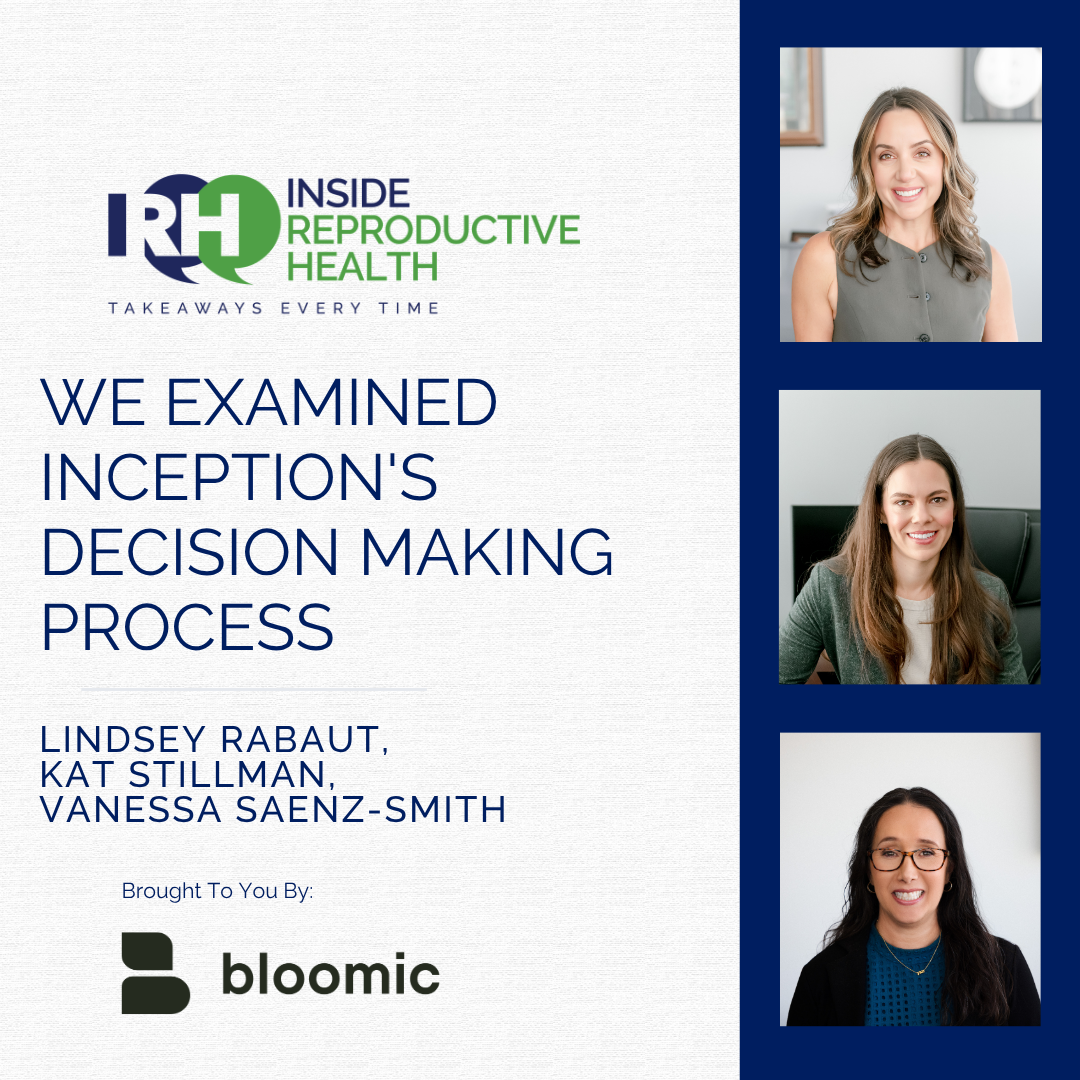
track each patient and help each patient move forward from first inquiry through graduation. I brought on three of Inception's senior leadership. Listen to their voices so you know who's speaking when.
Lindsey Rabaut (01:07)
Lindsay Rabot, Chief Marketing Officer.
Kat Stillman (01:10)
Kat Stillman, Chief Product Officer.
Vanessa (01:14)
Vanessa Smith, President and COO.
Griffin Jones (01:16)
Lindsay shares specific insights about no shows and cancellations that she uncovered from the EMR CRM integration. Kat shares specific workflow improvements from staff to physicians.
Vanessa shares how she's vetting which solutions to scale network wide.
And we talk about how they're getting providers, staff and patients to drive the process. We talk about build versus buy, automation, scheduling, finance, conversion rates and attribution too. I also talk about is a fertility EMR that sounds like they were built for these exact topics. So if you're interested in these kinds of tech enabled improvements for your docs, staff and patients, you might go to bloomic.ai and check out Bloomic's demo.
I enjoy interviewing CEOs, but this was a cool chance to interview the people that work just under the CEO.
and it gives a better picture of how the sausage is made. I hope to do more of these. In the meantime, listen to what Inception is doing.
Vanessa (03:17)
So when families struggling with fertility issues come to our practice, the last thing that we want to do is add more stress to that situation. So every day we're working on solutions, both in the home office and in our clinics, to remove those barriers that patients typically would encounter in physician practices.
That really comes from a collaboration with our employees in each of these practices, working side by side with our home office folks in product, in IT, to remove all of those barriers that they would typically see in any other healthcare setting.
Griffin Jones (03:54)
What are those barriers specific?
Lindsey Rabaut (03:57)
Yeah, so as we talk to patients and one of the best parts that I think Inception really brings to the industry is that we have Ali Dommar, Dr. Ali Dommar as our Chief Compassion Officer and she's spent
her career, really studying patient dropout. And so we have a lot of data that really helps us support this, but we know that it's psychological. It's just stressful. We know that finances play a really large part in it. But I think the thing that's most important to remember is that it's not at any one point. There are like many drop-offs from the day that they go to the website to do their first information.
all the way through to when they are preparing to have a cycle. There are so many different points of drop-off. And as we think about how to best, like Vanessa was saying, help serve those patients from what we do best, I think that's where we're always trying to think through, okay, is there just something small that we can do that would completely change the experience for our staff and our patients?
Griffin Jones (05:07)
Did you find the answer to that? Is there something small that you can do that would completely change the experience for your patients and your staff?
Lindsey Rabaut (05:13)
⁓
Kat, how many things have we found? It's like playing whack-a-mole, It's like every day we're finding a new thing. And I think that that goes to, again, what makes us really special as an organization is that we're never satisfied. We're always looking for that next little thing, but I think...
Kat, I think you would agree with this. We don't go for the home runs. We're looking for all the base hits over and over again so that we can consistently be improving patient experience.
Griffin Jones (05:48)
What are those bass hits, Cap?
Kat Stillman (05:48)
Yeah.
Yeah, I mean, so when you think about my area, which is product, the foundation of everything that we're doing is twofold. It's patient experience and then staff experience. So as Lindsay said, we have literally mapped every single journey point of our patients and then every single journey point of our staff. And we've built this technology layer for both our staff and our patients to actually make sure that we're providing
proactive care. And so for all of our patients, that tiny thing is they're never going to ask, like, what do I have to do next? And for our staff, they're never going to have to ask, what does this patient have to do next? What have they already done? Where are their results? And so that just seems like a very small thing. Like you should know if someone's lab results come back, you should know what your next step in your journey is. But we all know how complicated fertility is. And so if you don't have it actually spelled out for you,
in your hand, on your phone that you can look up at any time, it's not that accessible. So that's like our number one base hit right there is get the journey to be proactive so that patients feel super supported and that our staff feels like they have the capacity to support them through the journey.
Griffin Jones (07:05)
Is that prelude connect in practice edge you're referring to or is that something else?
Kat Stillman (07:10)
Yes.
Yes. So our app for patients is Braille Connect and Practice Edge is our internal practice management workflow tool that we've built in-house ⁓ to specifically serve our teams and fertility patients.
Griffin Jones (07:24)
Why build it in-house? What were you trying to solve for that you weren't finding in the marketplace?
Kat Stillman (07:31)
So we couldn't find anything that just stayed true to those core tenants. From the staff side, every single solution that we looked at required double entry of work into the EMR, into the practice management solution, multiple clicks over here, multiple systems over there. What we're trying to do is empower our staff to really focus on the patient and not have to write something three times or click seven buttons.
⁓ And so building your own technology that actually goes with the process as the best practice was the way for us to go. And we did the math and it made a ton of sense. Same thing from the patient side. You look at the healthcare apps that are available. They don't integrate directly with a patient's treatment plan the way that a fertility treatment plan works. You need a calendar, you need med instruction videos that you can like easily access. You need all of these documents. You need like
access to your care teams in very specific ways. And so we felt after looking at the landscape that we couldn't find anything that would actually serve our patients well. And so we built it ourselves and we've been able to iterate and iterate off of it. As Lindsay said, like we cannot sit still. So we continue to put out features that we know will continue to empower the patient journey.
and continue to help our staff. I we put out new features almost every week at this point, which is really fun and exciting for our teams to be able to see a lot of the feedback that they're giving us put into action in our technology.
Vanessa (09:02)
the benefit of having it in-house is if you're dealing with a big EMR company, to try to get a little change made in a big system would be very difficult. And so they would only be able to get us to 80 % of what we needed versus having it in-house where we can do 100 % of the, know, whether it's a workflow change, a process change, we own it and that...
I mean that's the benefit both to our employees and to our patients.
Griffin Jones (09:30)
Is it also an EMR? Is it an electronic medical record?
Kat Stillman (09:35)
It is not an EMR. We still have an EMR and this sits, it's a layer on top.
Lindsey Rabaut (09:36)
Nope.
Vanessa (09:41)
Yeah, the systems.
Lindsey Rabaut (09:43)
I always like to think of it too, is like we make patient facing tools that are for the in-between moments when you're not, when the patient's not in the clinic. I think so often we think about patient experience being just when they're in front of us, when they're in our office.
where we see the biggest patient experience failures is when the patient's not.
in the office, when they're waiting for their lab results, when they're trying to go through three different estimates for three different protocols, when they're waiting for that callback, when they know that they have to do something, their partner has to do something, but they can't quite remember what it was. Those are the moments where they feel lost and alone.
you can't necessarily proactively reach out in those situations because you don't always know. But like what Kat's talking about is when we develop the technology,
that sits in front of or on top of the EMR, we then know exactly where they are and using, know, surveys and just lots of different data points from our current patients, we kind of now can anticipate what they are needing at that point. And then the technology can help deliver that before they even know that it's what they needed. So that's what the proprietary tool has just really been so critical for.
Griffin Jones (11:03)
The conventional wisdom used to be, Lindsay, that it's marketing's job to get the patient in the door and then operations takes over from there. That it's marketing's job to throw the ball and it's the practice's job to catch it. Agree or disagree?
Lindsey Rabaut (11:20)
completely disagree. I mean, I think maybe my job would be a lot easier if that was the case. But no, I mean, we think of the whole patient journey and that genuinely goes from the first moment that that patient was feeling like, I don't know what I need to do next to get pregnant.
all the way through to them holding a baby in their arms because quite frankly, if for us it doesn't, it also doesn't start just stop at graduation. We've also got our field sales team that continues to follow up with the OBs all the way through to baby. We genuinely want to see our patients from day one to day baby. so marketing is all the way through and honestly operations is also all the way through. It's also not just on me to bring the patients to the
Our operations team, our product team, they're all facilitating me to bring patients through too. So I do see marketing as like the conduit that kind of brings patient to the care that's going to change their lives, but I'm still with them all the way through.
Vanessa (12:09)
you
Griffin Jones (12:22)
I actually thought of you when I was listening to a Scott Galway talk. said it's the end of the CMO that CMOs are over. But I thought of you, I was like, not CMOs like Lindsay, because that's what marketing is. It's not just about getting patients in the door. Because frankly, back to that analogy of throwing the football, doesn't matter if you're Tom Brady and you can throw like that. If the practice can't catch it, nobody gives a crap. So in order to be valuable as a marketer, you have to
Lindsey Rabaut (12:29)
Yeah.
You
Griffin Jones (12:51)
help to see the journey all the way through. And now marketing is about the coms and the experience that connect the journey from beginning to end and then loop it back as a cycle so that your patients at the end are your new patient generators because they're sharing their delighted experience. And Vanessa, I'm.
Lindsey Rabaut (13:10)
Well, in Griffith.
Oh, sorry, I was just going to say real quickly, too, that we're also, think we're all navigating a brand new world since 2024, where the patients that are coming in the door are different than they were pre 2024. I mean, if you think back to Alabama and then the presidential election, IVF becoming a hot topic in every living room when you never would have thought that like pre 2024 to think that like, you know, my grandparents would be asking me about IVF. just wasn't
that wasn't on our bingo card, right? But now awareness has gone through the roof. We've got normalization of the category, all these really great things. But what that means is that you've got more people that are interesting in learning and not everybody's as ready as they used to be. And so from a marketing product and operations standpoint, we also have to make sure that we're meeting people where they are in their own personal journey, because they might be to
continue your football analogy, they might be on the five yard line, the 10 yard line, or they might be at the 50 yard line. And we want to serve all of them personalized in a way that is right for them.
Vanessa (14:21)
And I'm going to say this because I'm a huge fan of Scott's, but I'm not a huge fan of saying that chief marketing officers are going to be benched. I really see Lindsay as my growth partner. She's my chief growth officer and she's helping me to continue to grow the business, grow our patient population and our baby population as well.
Lindsey Rabaut (14:32)
you
Vanessa (14:45)
Scott might be right that the CMO of the past might be on the bench,
Lindsey Rabaut (14:50)
We have to adapt.
Griffin Jones (14:51)
I'm with you on that one, Vanessa. And I think I'm with you on the wanting to build some things in house. if you have to work with an EMR, then aren't you not really like building like, can you really build something on top of it? Aren't you super dependent and enslaved to the EMR?
Vanessa (15:12)
mean, really the EMR is just a medical record, right? That's where all the good stuff, the vitals and the...
Kat Stillman (15:13)
You're not.
Griffin Jones (15:17)
That's what it's supposed to be, but most practices
still use it as an operating system.
Kat Stillman (15:22)
Yeah, we've pulled out from, I mean, our EMR is there for medical records, but our practice flows and works inside of Practice Edge and the two work very closely together. They're super connected. You're never doing double entry. Everything flows bi-directionally. So we're empowering them to do more than what an EMR can provide at this point.
Lindsey Rabaut (15:49)
And I think it's important too, to make sure we say that, you know, we're not, we're not team build everything ourselves. We, we look again with the taking every piece of the journey we look at, should we build it? Should we partner with somebody? and we do both and we do both really well.
Griffin Jones (16:09)
Most fertility clinics don't have a patient journey problem. They have a systems problem disguised as a patient experience or patient journey problem. Behind the scenes, got Frankenstein EMRs, disconnected tools, and teams wasting hours chasing information instead of caring for patients. That's where bloomic.ai comes in. I've checked out a couple of EMRs recently, and there seem to be a couple that are built for the new world.
might have a little bit of an advantage because they seem to have a deep fertility experience, especially being incubated in a fertility center. They built a unified platform designed specifically for fertility clinics. So you get real time data that gives you smoother workflows and patients get the experience they deserve. I'd recommend checking out that demo. If you're serious about scaling without burning out your staff, check out Bloomic
dot AI and go to that demo will also link to it in the show notes. So as you're building this cat, how does practice edge and prelude connect interface with each other or are they completely different systems?
Kat Stillman (17:20)
Yeah, the kind of the way I like to describe those two is like practice at our Praline Connect is for patients only. but if you think about like an iceberg, it's the part you see above the water. And then practice edge is the giant iceberg below the water, empowering all of those teams. So practice edge is where every one of our team members logs on every morning.
and goes through everything that they need to do throughout the day. It tees up the patients that they should focus on. It shows them the messages that they should answer. It brings in all of the different patients from each part of the journey so that our teams are all working together and doing more seamless handoffs.
Griffin Jones (18:01)
And so the iceberg is one system though, there are two different entry points to the same larger system.
Kat Stillman (18:05)
Yes. Yep.
Mm-hmm. Yes. So the pretty part of the iceberg that you see above the water is for our patients, that app that's in their hands at all times, really showing them what to do. And then everything else under the water powering and keeping it up is us on the practice edge side.
Griffin Jones (18:28)
Instead you might be launching a new feature every week. What are some recent features you want to flex about?
Kat Stillman (18:34)
Yeah, I think one of the ones that we're most excited about was born from our patients and our staff saying, I want to know what I've done and I want to know what I need to do next. And so we launched a feature called the patient checklist. So every new patient right after their new patient appointment has a personalized checklist pushed to their app that says exactly what they need to do. You can click into each checklist item to get more information.
You can message your team if you have any questions. And as you go through, there's a progress bar and a checkoff so you can see how close you are to being ready to start treatment. Because as I said, we've counted the massive number of steps that they need to take. And so being able to see it visually has been a huge help for our patients. Being able to know like, okay, I've done my bloods, but I need to do a uterine evaluation still. Okay, I've done this and then I need to do that. Or my partner needs a semen analysis.
And what's even better about it is that the partners can join the app together. So you'll be able to view each other's checklists and make sure that you're aligned on what your partner has to do next and what you have to do next. And there's some shared checklist items as well. So you can really feel like you're moving through the journey as a team.
Griffin Jones (19:51)
And so the patient can see this in list form. Can they kind of see it in a visual, like a timeline to see, all right, if I want to get to IVF, I can see this is how long the timeline is and how many steps are. How does that visual look?
Kat Stillman (20:07)
Yeah, so we have it optimized for a phone. you can vertically scroll through the items that you have, and it'll show you what you've completed and what you have left to do in the order in which you need to complete them. And as things come off the list, they go down into the completed section so you feel like you've done it.
And you can see the timeline bar on the top kind of getting you closer to being ready to start treatment.
Griffin Jones (20:35)
Vanessa, I've seen useful technology before, and I've also seen practices not give a damn and not implement it because they're busy delivering the care that they have to deliver that week. Is that what you're here for? Is that where you got brought to inception to start knocking some heads together and get people to use Cat's cool tools?
Lindsey Rabaut (20:42)
you
Vanessa (20:57)
A little bit, yes. But the reality is, I'm here to ensure that every patient, every time, has the best patient experience. And these tools are going to continue to help with that journey for that patient. I mean, they come to us at one of their most vulnerable times, right? And so any step of this process that we can make it feel better and feel less scary is a win in my book.
Lindsey Rabaut (20:59)
Thanks.
Griffin Jones (21:24)
What has been the biggest challenge from centers, providers, staff adopting the technology and not just adopting it, because I mean, if you get them in that they're using it, but there's a difference between being a user and a super user. And if you want to get the maximum benefit, you probably need to be a super user. What's been the biggest challenge in getting them to is it just their time? that, man, I
That might help me tomorrow, but these are my problems today. And I just don't have time to think about it. What have been the biggest challenges?
Lindsey Rabaut (21:55)
Thank
Kat Stillman (21:59)
Yeah.
Lindsey Rabaut (21:59)
Yeah.
Kat Stillman (22:01)
So I think the benefit of being an embedded product organization is that the providers and the clinical teams are actually my people that are helping me create the products and tell us what the priorities are. So when we go to roll something out, the entire team is actually pretty bought in because they have been the ones to help us scope it. They have been the ones to provide the feedback and they've been the ones to help us actually make sure
Lindsey Rabaut (22:14)
and so does using.
Kat Stillman (22:31)
that we're delivering something that when we bring it to the clinic, they see the value in. And so they see the value in taking that extra minute to get that training on it or do that rollout because they've really bought into that building process. And that's like a huge differentiator from buying something off the shelf. You can really tailor it to what they need in that moment and make sure that it's providing the value because we don't, we don't.
put out or build technology that's not going to provide value. There is no point in that. ⁓ And so it must feed into our product tenants, which is patient experience and staff experience.
Lindsey Rabaut (23:00)
Yeah.
Griffin Jones (23:09)
There's a lot of stakeholders though.
Lindsey Rabaut (23:09)
Yeah, so like the patient checklist.
Yeah, there are. Well, so for the patient,
the patient checklist specifically. So we have a physician advisory board and we have eight physicians every year who really work with us as an executive team on some critical strategic items. And they're at one of our meetings. We literally with eight of our physicians drew out what this checklist would look like. We have like the original sketches of what it would look like. And then Kat and her team took all of the insights from marketing and from
from
the patient surveys that we do. And they went and they built something and they iterated it and got feedback from all of the different practices and built it a handful of times. And then now as we're rolling it out, one of the things that we do to make sure is that it's all based on the flow sheets. So we couldn't even launch the patient checklist unless we had buy-in on all of the different flow sheets that go into it.
had to get that buy-in up front. And then that may, because we tied it to that, that makes it a lot easier to have adoption. But we're rolling it out site by site to ensure that we're bringing everyone at the clinic along.
Griffin Jones (24:23)
Eight doctors is a lot. You have a lot more than that, so that's still only a sample. But it's still okay. You're getting a solid group of doctors to really buy in, to have ownership in the process. They're only one of the stakeholders. You got nurses, you got your APPs, you got, imagine that other staff or managers are using this in other ways. Often what I see is when technologies are trying to get implemented, the people at the top,
were bought in and by top I might mean middle, but then the next layer down is thinking I'm not really incentivized to implement this. And so how do you involve the other stakeholders?
Lindsey Rabaut (24:54)
Yes.
Kat Stillman (25:03)
Yeah.
So we have a lot of, have a couple of leadership committees. So we have a clinical steering committee that is heavily involved in scoping. That's all of our nurse leaders. And then, you know, as a product team, we seek feedback from all of our end users on a quarterly basis. And so my team is doing constant customer feedback from our internal teams, as well as getting
Lindsey Rabaut (25:04)
It's a great question.
Kat Stillman (25:27)
those leaders from from MAs and from nurses and this clinical steering committee to really drive and really scope a lot of the details of that. Cause you're right. We need buy-in from all levels in order to roll this out.
Griffin Jones (25:40)
Do you all go to the, do the three of you go to the physician summit?
Lindsey Rabaut (25:43)
yeah, absolutely.
Vanessa (25:44)
yes.
Griffin Jones (25:46)
Are there two inception meetings? Like there's a physician summit and then there's like a big inception conference or it's all one meeting?
Lindsey Rabaut (25:53)
Great question. So yeah, we've got the physician advisory board, which like I said, is the exec team plus about eight of our physicians. And then we've got physician summit, which usually has 75 to 100 of our physicians in attendance.
Griffin Jones (26:06)
And so do you find that going there is like necessary to get the buy-in? Like as much as you're doing it the methodical way of addressing the pain points, getting them to take ownership, that you still just kind of need that like good old fashioned rapport building. Like you have to hang out with them a little bit for them to not see you as just some business lady in a different city.
Lindsey Rabaut (26:22)
Wow.
Vanessa (26:29)
Listen, Griffin, I was in a practice last week. Now, I was in a clinic in scrubs, sitting side by side with our physicians and our clinicians last week, watching this in action. And by the way, Kat, I'll have to schedule some time with you.
Lindsey Rabaut (26:30)
She just attended her first.
Vanessa (26:46)
They've identified a workflow issue, but that's how we learn and that's how we get better. It's not just, we're not sitting in an ivory tower making decisions. We are sitting side by side with our team every day to ensure that the tools that we're creating work and that it's, again, adding value to their day to day.
Griffin Jones (27:07)
What was that workflow gap that you identified, Vanessa?
Lindsey Rabaut (27:08)
Yeah.
No, no, no secret secret.
Vanessa (27:12)
No, secret. It's a secret.
Griffin Jones (27:13)
Well, tell me some of the workflow gaps that before
we you're going to you're going to plug something cool, Lindsay, I know. But before we move on to that, the gaps that some some of the workflow gaps that you've identified with, I want to hear about like some of those specific things that other practices might still be struggling that you feel like, you know, we've got a pretty good handle on those. What are a couple of those specific ones?
Lindsey Rabaut (27:20)
No, no,
Yeah.
Kat Stillman (27:35)
I think, I mean, the ones that come to mind first are the handoffs. So we have a lot of different teams. You we have financial counselors, have nurses, we have MAs, we have doctors, and you're always going to have a little friction in those handoffs and making sure that the patient feels like it's always a warm handoff. And so that was one of the
you know, one of the core tenants of some of the features that we've built in practice edge was to make sure that the patient doesn't feel like even though they have to talk to a different person about finances than they do about their treatment plan, it feels like it's all timed correctly and handed off in the correct way. And so the tools we built in practice edge based on that feedback really pass that patient from one team to the other in a careful way using technology.
and using the appropriate messaging, using a lot of the techniques that we learned from our nursing team, and then passes them back in the same careful manner. And so I'd say like, that's one of the ones where, you know, has, I know that our practices historically struggled with it and one of the areas that we really focused on.
Griffin Jones (28:49)
Did you all measure like nurse call volume at any point so that you could have a benchmark? think like when we started all the projects in our house, wish we took an inventory of all the things in the beginning and so that we could see some of the improvements. you take any of those benchmarks that you can see like, wait, we can actually see this reducing call volume or reducing time in this area. How are you measuring it?
Kat Stillman (29:12)
Yeah, we're tracking everything. We track the amount of messages we send, the amount of messages we receive, the calls that come in, the calls that go out, the tone of our messages even. We track a lot of, all of those different metrics so that we can actually look at them over time, look at them as we roll out different features and make sure that our products are doing the right thing for our patients and our staff.
Lindsey Rabaut (29:15)
you
Griffin Jones (29:36)
Lindsay, please. You were gonna flex on something. I will never deny you a flex.
Lindsey Rabaut (29:37)
I was I wasn't no
I wasn't it wasn't I was actually gonna say that we don't wait for summit like it's actually pretty
rare that the three of us are all in Houston because we're normally out at the clinics. And so, and that's where we were all always seeking feedback and doing that feedback loop. so Summit is actually more of a, it's us getting together, yes, for the relationship building, but it's also us allowing the physicians to get to talk to each other about clinical things that they want to talk to each other about. It's less about us unveiling new technologies or new products because we've
already done that clinic by clinic.
Griffin Jones (30:15)
You're on the road to a lot. I don't think a lot of networks are sending their CMOs to individual practices too frequently, but it sounds pretty important.
Lindsey Rabaut (30:17)
Mm-hmm.
Yeah, because it's, you know, it's not, I'm not just marketing. I'm not just about putting the leads in the door. also about making sure that they've got the right tools for their patients throughout the journey that they're, our sales team, our physician liaisons who are really the conduit between our physicians and the referring OBGYNs. That's also a part of my team, as well as patient experience. And so I'm there kind of from all threefold.
I'm not there to talk about digital marketing.
Griffin Jones (30:50)
What?
Only if you want to put them to sleep. What would what would have been some tools that you all haven't built that you've been impressed with?
Kat Stillman (31:00)
I mean, we are constantly looking at tools in the market. There's a lot of AI tools that we look at every, you know, I look at a couple of week. I think we've made strategic partnerships in areas, especially in AI, where we think there's expertise outside of what we can build in-house. For example, you know, looking at medical records and if we receive thousands of pages, being able to receive those more efficiently.
That's one area that we've been really looking at. But those are a lot of the really specialized AI models are an area where we've been looking to partner with the right people and we get to do some pilots and we started to look at a couple of different things.
Griffin Jones (31:41)
Vanessa, how have you been vetting? I'm sure you get calls from a number of different vendors and people that want to, maybe they're in one prelude practice and they want to be scaled across the network. How are you approaching your vetting process?
Vanessa (31:57)
I mean, it's really where are those pain points? I mean, if it is a product that, you know, I've heard 10 people raise their hand and say, if we don't solve this as an organization, we're gonna, you know, whatever, quit or leave or, you know, find somewhere else to practice.
That's the priority is if it's a pain point for the organization, it's a product that we should probably evaluate. If it's not, then it's on the bottom of the list of, you know, calls to take at the time.
Griffin Jones (32:27)
Is Prelude Connect a CRM? Would you describe it that way?
Kat Stillman (32:34)
No, we describe it as a patient companion tool. ⁓
Lindsey Rabaut (32:34)
No.
Griffin Jones (32:40)
But you do
use a CRM, Lindsay?
Lindsey Rabaut (32:42)
We do, yeah. And so I was actually going to say that's one of the things that like we're not building our own CRM.
So we partner with a CRM, just like we partner with an EMR. But one of the things that I am the most proud about that I will flex on is the building of the connection between the CRM and the EMR. think, you know, we were talking about when we were talking about marketing, kind of bringing leads to the door. think that partially that is because most marketers are in charge of the CRM. And so we are literally, we have our websites, we're using the CRM to
capture that acquisition point of the person who is interested in booking an appointment. We use the CRM to facilitate a booking of an appointment and then they go into the EMR. So what connecting that CRM to the EMR has allowed is that, we now have the ability to shepherd a patient from literally day one through to becoming a patient.
through their treatment plans and then back to their OB. And I mean, it took 14 months to make it happen and it's, I mean, it's already paying dividends. It's just been, I'm very, very proud of our ability as an organization to connect those two because it took all of us to make it happen.
Griffin Jones (34:02)
Even more than the time it took, it's an accomplishment because there have been people that tried that for 14 years and never really pulled it off. Does the EMR connect to the CRM from Practice Connect or they connect with each other?
Lindsey Rabaut (34:08)
It's a unicorn. Yes. Yeah.
They're all connected.
It's all of it. So yeah, I mean, you know, obviously we're using API connections, but we were, we're able to, hook data now between the CRM, the EMR and practice edge practice edge always access that kind of like middle ground for us. but yeah, they're all, they're all together. And so for, know, for our schedulers for us.
Kat Stillman (34:24)
Thank
Vanessa (34:43)
It's like a clearinghouse.
Lindsey Rabaut (34:45)
it's that way you only have to put in information once and then it's everywhere.
Griffin Jones (34:50)
Are you using HubSpot or Salesforce or somebody we wouldn't know for it? Okay. I ⁓ mean, that's hard because it's, I mean, on one hand, like Salesforce, works with a lot of APIs, but on the other hand, it's like, it's not necessarily the most nimble tool. ⁓ you work.
Lindsey Rabaut (34:54)
Salesforce, no we use Salesforce.
Well, what we've
learned is why it's so hard is within the EMR, you have so many changing components. So if a patient changes their appointment, which who doesn't change their appointments these days, right? If you want to change your appointment, if you need to make an edit.
the EMR really wants to just duplicate that. ⁓ And then that's where the CRM is like, Whoa, now there's too many inputs. so, ⁓ really thinking through how you're going to build those connections. And then for most organizations, if you've got multiple clinics, you've also got multiple ways of using an EMR. mean, I think of an EMR kind of like a blank Excel sheet where you open it you kind of get to build it however you want. so if clinic A and clinic
B have built it differently, that's what makes it impossible for the CRM to input the fields. And so there was a lot of standardization or, you know, making sure that the codes all aligned. There was just a lot of foundational work we had to do at the beginning in order to make it possible. And so like that couldn't have just been a marketing tech, not like it had to be product and IT and ops altogether.
Griffin Jones (36:15)
are all
Vanessa (36:22)
Yeah, lots of them.
Griffin Jones (36:22)
that back to why everything needs
to be integrated are all pretty good practices on one you know our or some practices on different emr's
Lindsey Rabaut (36:24)
Yeah.
Kat Stillman (36:33)
all in one EMR.
Lindsey Rabaut (36:33)
Yeah, for the most part. think there's one that's not, but.
Griffin Jones (36:37)
What specific insights are you able to share that you've been able to see from having a CRM and an EMR that are so integrated?
Lindsey Rabaut (36:48)
So my favorite
one that I'll share ⁓ is actually, we just, we were able to now run an analysis based on when you are as a lead, when you come in, how quickly you then get scheduled for your appointment. Obviously that matters. But what was interesting to us is actually from the moment you schedule your appointment to when your appointment actually is, there's a tipping point. If you have to wait longer than about 21 days, our,
Cancellation rate goes way up and it ends up being about one in five of our cancellations It's because that patient was booked more than 21 days out. Oh, I'm sorry. I just kind of lagged a second So I thought that was really really interesting and that was it's it sounds so easy but if you don't have the connections you can't measure that because the scheduling was happening in a different place than The you know check-in check-out and then the other interesting thing was this that no shows are much more likely if the patient
books within a week of being seen. So it's kind of like if you book too close to when the patient calls, they are more likely to show up. But if you book too far out, they're more likely to cancel. And so really then, I kind of think of it as like an airline. It's like how are you optimizing your flights to make sure that your doctor's capacity is...
Griffin Jones (38:05)
I to make sure I got that right. They're more likely to
to no show if they booked that week.
Lindsey Rabaut (38:11)
they book within a week. so like if you call me and i'm like i can give you an appointment in three days you're more likely to no show for that appointment.
Griffin Jones (38:19)
but more likely to cancel outright if they booked much further out. there's kind of like a J curve. There's a sweet spot. Is that sweet spot like two to four weeks?
Lindsey Rabaut (38:21)
cancel if I book you 21 days out. Yeah.
Yeah. Yeah.
Yeah, 14 days, yeah.
Griffin Jones (38:33)
Yeah, wow. Those are some.
Lindsey Rabaut (38:35)
So
just like one example. The other thing that we are now able to look at, which I can't say the actual data, but we now know by practice and by how did you hear about it? So referral source, so whether you are a Google search lead or a physician referral lead, whether you're at AFCC or Aspire in Texas, we're able to look at how long on average or the median from
lead to appointment, but then also from appointment through to any treatment. So if we want to look at IUI, if we want to look at first retrieval, if we want to look at graduation, and we can look at that full-time journey so that we know on average, but then also on median because there's a very long tail for each of those. But I mean that is something that just was unheard of six months ago.
Griffin Jones (39:26)
There's a breaking point happening in fertility clinics right now. More patients, more complexity, but the same outdated EMRs and manual processes are trying to hold it all together. It's a Frankenstein. And when your EMR can't keep up, what happens? Your staff feels it, your patients feels it, your growth stalls. Bloomic, Bloomic.ai is their site, is built differently. Modern infrastructure, real-time visibility. You should check out their demo. I checked it out at PCRS. I checked it out with someone that
works, heads operations for a fertility clinic. I was impressed, but I'm not a clinician. So you should check it out. And you should see how they do migrations because one thing that's stopping fertility centers from switching EMRs is migrations. They've got a different process. So clinics can modernize without putting patient care, staff workflows or growth at risk. It's not just an upgrade. It's how clinics finally scale without chaos. If all that is hidden close to home, check out the Bloomic
demo at Bloomic.ai You can go to Bloomic.ai or check out in the show notes. Maybe this is tangential, Lindsay, and no one will care about it except for you and I, but I need to talk about it, which is multi-source attribution in marketing. People will just have single source attribution and some marketers will say, if that's what the...
Lindsey Rabaut (40:40)
OOF
It's good.
Griffin Jones (40:48)
patient or the customer said was the source, then that was the most important one. I think that's like drinking 12 beers and saying it was the 12th one that got you drunk. You can't have perfect attribution as much as people want it. And I would find when we would do data for clinics and when we did like a 250 patient survey, we'd ask
Lindsey Rabaut (41:01)
you
Nope.
Griffin Jones (41:18)
people all of the ways that they heard about a practice or they came to decide on that practice and physician referrals were super high. But then when you ask people, okay, of all of these ways, what was the most important way? There, was a much more even split. And so it's like, you, you can't tell all the story from one attribution source. So how do you account for that?
Lindsey Rabaut (41:21)
Mm-hmm.
Mm-hmm.
Yeah, so I mean.
We do ask. We ask a lot of different times too, which is another reason why it was so important to connect the different systems, because we ask you when you fill out your lead form or when you're on the phone with a scheduler. We also ask you at your first appointment. So your nurse would put that into your, into the EMR. But then we also use, you know, sophisticated tracking on the backend to look at things like UTM codes or how they're coming in so that we can see things like, you know, somebody came in, they said they're a physician referral, but
they're in the EMR, but their lead record actually says that they came in through Google search for branded Aspire. They searched for Aspire. They searched for a clinic by name. And so it doesn't mean that the physician referral wasn't who sent them there because they had a different code. It actually means that their physician told them about us. They thought about it. They did some research. They ended up on Google where they researched us by name and then and then chose us.
And so the way I always answer this question is that none of us make any decision in our life based on one point of data. We use all of it. And if we did only go after what people are telling us, we would be so blind right now to AI specifically, because less than 1 % of our patients tell us that AI sent them to us. But we know that that is not the case because it is just so ingrained in how our patients are searching
very up funnel for things like, why can't I get pregnant? Why has this been so hard? Why have I missed another period? And then when they get to Google and they search on Google, AI answers is there. And then they search for us and they see us and they click on our link, but Google gets the credit, right? And so when I think of multi-site attribution, I'm just thinking of like, what are the multiple touch points that probably drove that patient to us?
and how can we make sure that we are showing up consistently on all of them.
Vanessa (43:47)
And by the way, word of mouth is still one of the best ways to get a patient, and that is 100 % driven by the patient experience.
Griffin Jones (43:47)
Where-
Vanessa (43:56)
And so as long as our employees are given a great patient experience when that patient walks in the door and our doctors give a great patient experience, sadly, you can still have a bad outcome and you don't get to graduate. But if we still serve that patient from the start of that journey till the end with the respect that each of these fertility patients deserves word of mouth gets us the patient every time.
Lindsey Rabaut (43:56)
Yes.
Griffin Jones (44:22)
Word of mouth can't be understated, but even that can be attributed or misattributed. think of, I started in fertility marketing just doing very rudimentary organic social for a couple of fertility clinics. And it was small clinics in the Midwest that I used to just get to light on fire word of mouth, but it was happening on Facebook and Instagram. And it was people that would have normally not.
been in touch with each other, like your old college roommate, a former co worker, your second cousin, like you maybe don't speak with them that frequently, or you certainly don't speak with them too intimately about fertility if you haven't been in touch. But now they were saying, ⁓ you went through this too? ⁓ and you went and saw that specialist. And so we made business go up really quickly. And you could attribute that to organic social, but it was really word of mouth.
or you could say it was word of mouth, but it was organic social that made it happen. there's no easy way of being able to just pigeonhole that attribution, which is why I like your approach.
Lindsey Rabaut (45:29)
Yeah, well, and I mean, what we know is that regardless of the referral source or the attribution source, they'll all parents are all patients exhibit the same way when they're in the clinic, which is that they're stressed out and they feel.
They feel like it's hard to move forward. Even the ones that are super motivated. always like, use this analogy a lot of Vanessa, you and I were talking about the other day of the kid on a diving board. Like so wants to jump off. They're so ready and they are just nervous. And so when we think about the greatest thing we can do for anybody that walks through our door, it's how can we leverage technology so that our
staff.
can be the human interaction for them that helps them take that next step forward. Whether it's that the person in our clinic is literally down in the water with a float saying, I'm gonna catch you, I'm gonna catch you. Or maybe our clinic, maybe that nurse is right behind them whispering in their ear, you can do this, you got this. We want our staff to be there for the human moments because we've equipped them with technology that took the busy work
it made it a little less daunting for them so that they could show up for the patient in that human way. And it gets us all emotional every time we think about it because that's why we exist. And that's what we're equipping our teams to do.
Griffin Jones (46:57)
Where does finance come into this intersection of technology and patient experience?
Kat Stillman (47:03)
It's built into our app. It's built into a couple of the things that I mentioned earlier. It's built into those really smooth handoffs. It's built into our patient app. So everything is very clearly laid out for the patient. Every patient has a very detailed understanding of their insurance coverage or their financial agreements. They are able to have video consults or in-person consults with their counselors.
Lindsey Rabaut (47:04)
Any questions?
Kat Stillman (47:31)
They're able to make payments or track anything on their app, so it's all very seamless for them. And then they're working in conjunction with their clinical team as well. So it's all very, very integrated because it's super important in the patient journey and one of the most stressful parts of it for many of our patients.
Griffin Jones (47:55)
Is providers time starting to be opened up now? Like, can you see near horizon cat of now the provider that used to see 250 patients in a year and do 150 cycles now in the same amount of time can see three or 400 patients and do 250 cycles? Is that starting to materialize or are there still
other challenges that despite the technology, we're not able to open up provider productivity like that.
Kat Stillman (48:33)
Yeah, I I think we think about it in like a slightly different way. We see technology beginning to open up provider time that was not well used before. So the way that we think about our technology is the small things that make the outsized impact. So if the physicians are needing to spend an extra,
30 minutes or plus per patient to really get ready for that visit. How can we help them do that more quickly? And how can we really stop them from having to click here, go there, print this out, get their self set, and really free up that time? There's a lot of flashy things that are saying we're gonna double physician capacity.
You know, we're really focused on the things that are going to make impact for our physicians today and impact on their time today using technology and really get those like very annoying things that'll burn them out, out of their practice every single day.
Griffin Jones (49:37)
What do you each want providers and staff to understand or to maybe get a better grasp of? And now's your chance because millions of them listen to this program.
Vanessa (49:52)
Great question.
I think our employees and our physicians are the why. They're why we come to work every day to support them. And they are the why for those patients.
kind of a corny response, it's just truly how I feel.
Lindsey Rabaut (50:09)
you
Kat Stillman (50:11)
I think from the product perspective, the with a lot of the noise that we hear all around us all the time, like every news article about AI doing this and doing that and technology doing this and doing that and disrupting health care. You know, what we like to say to physicians is we want to cut through that noise to actually understand where that
impact is going to be most felt and what AI and technology can actually do in the next year, two years, five years, and thinking about the plan to use technology over that different amount of time to impact their jobs, not in this scary way, like AI is going to take everybody's jobs, but in the way that it's going to help you see the patients the way you want to see them.
you're not gonna have to go to the fax machine, then go to the scanner, then put the scanner into the computer and then check it in the computer. You're just gonna have these things at your fingertips so you can look that patient in the eye and give them the best care that you want. Your nurse is gonna be able to give that patient a call, because they're not doing everything else that they had to do that day. And so that's one of the things that I, cutting through all of that noise and kind of that worry that's going around, like to think about the core of
what technology AI can and should do, and it's to increase that human interaction and empower it to be even better. And that's how we're thinking about it and the Inception Network.
Lindsey Rabaut (51:41)
Yeah, I think I would just layer onto that that we actually, with Allie, did a study that patients, particularly here in the US, would trade success rates.
like a percent, not all them, but a percentage of a success rate for empathetic care. so technology cannot replace the human connection and that interaction. And what I always want all of our physicians, all of our nurses, our front desk staff to know is that when that patient is right in front of them, nothing else is more important. And so if there is something that is pulling them away from the patient to let us know what that is, because if we can automate it,
we can use AI to help with it. If there's anything that we can do about it, we wanna help so that their focus can be on the patient.
Griffin Jones (52:27)
Ladies, not all, but a big chunk of the Inception leadership team. Thank you for joining me on the Inside Reproductive Health podcast for this cross-disciplinary look at the patient experience. I look forward to having you each back on.