


Today’s Advertiser helped make the production and delivery of this episode possible. But the themes expressed by the guests do not necessarily reflect the views of Inside Reproductive Health, nor of the Advertiser. The Advertiser does not have editorial control over the content of this episode, nor does the Advertiser's sponsorship constitute an endorsement of the guest or their organization. The guest's appearance is not an endorsement of the Advertiser.
Patients want clearer pricing, clinics want operational sustainability, managed care wants predictable cost control…
…and everyone wants more transparency.
This episode centers on the groundbreaking Journal of Assisted Reproduction and Genetics (JARG) paper on Activity-Based Costing in IVF and what it actually costs.
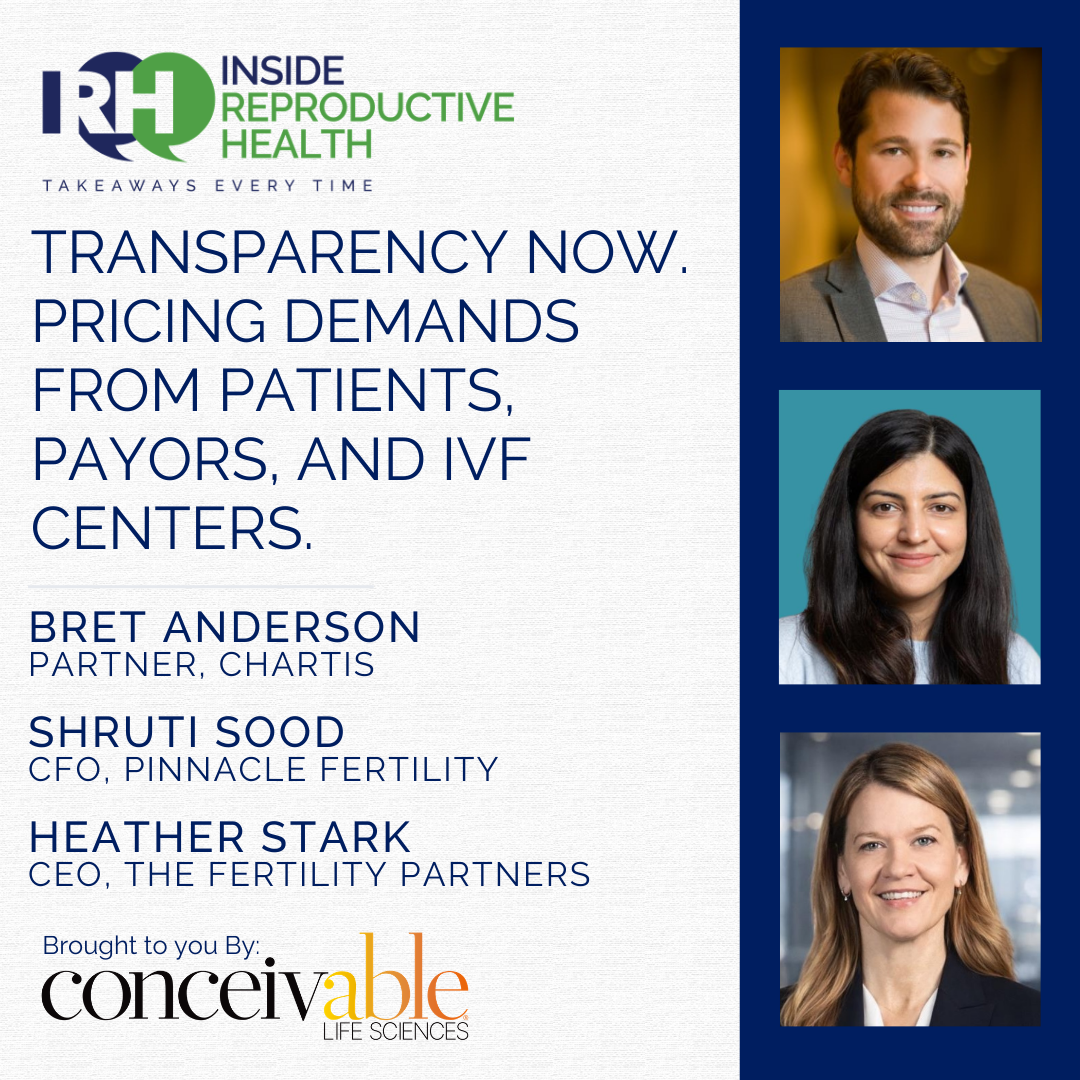
We’re joined by Pinnacle CFO Shruti Sood, The Fertility Partners CEO Heather Stark, and Chartis Partner Bret Anderson to discuss:
Why IVF costs have not been accurately accounted for
How activity-based costing could reshape pricing models
The real impact of payer consolidation
Where clinics confuse capacity problems with volume problems
Whether different prognosis patients should be priced differently
How managed care pressure will change IVF economics
Are Your IVF Lab Costs Hiding in Plain Sight?
Finally — a Promising Framework to Expose the True Economics of IVF Operations
For years, the real costs of IVF have been obscured by traditional accounting methods that can’t capture the complexity of biological inputs, skilled labor, and capital utilization. The result? An opaque view of efficiency, scalability, and profitability.
This groundbreaking Journal of Assisted Reproduction and Genetics (JARG) paper, introduces Activity-Based Costing (ABC) — a transparent, accounting model revealing how leading fertility centers can:
Uncover hidden cost drivers across procedures
Scale operations while maintaining quality of care
Project true per-cycle costs with evidence-based precision
Optimize resource allocation for sustainable growth
Provided by Conceivable Life Sciences, this paper is a must-read for IVF executives, lab directors, and investors seeking clarity in a rapidly consolidating field.
Discover how ABC can transform your understanding of IVF economics — and your bottom line.
Download the JARG paper here to see how leading clinics will redefine efficiency and transparency.
-
Shruti Sood (00:00)
I think what we need today is more clarity. Does an IVF cycle includes the testing of the embryos? Does this cycle package that we are offering includes the medications? And what all actually goes in?
from whether the diagnostic testing done before we start an IVF cycle is included in it. So I'm sorry to say the answer is not as simple as giving you a number, whether it cost a 5,000 or a 10,000 because it varies upon the patient that walks in the door.
Griffin Jones (00:36)
What do we want? Transparency. When do we want it? Well, they definitely want it now.
But my guess point of view...
that transparency something different fertility centers.
than it does to IVF patients.
and even to different populations.
of fertility patients.
informing part of this discussion.
is a paper called Activity-Based Costing in a framework for transparency and operational scaling of fertility services.
And my guests saw things from that paper.
that inform their view how fertility services will be priced and how they'll respond to the pressures.
coming from increased managed care.
Shruti Sood now Chief Financial Officer at Pinnacle.
It's been five or six years.
that she's been in the accounting, finance side of the fertility space.
She talks about areas where care has increased to 90%.
She talks about the decrease of reimbursements, that's simply coming from pair consolidation.
They're not even using activity-based costing as a lever yet.
She talks about how.
in six months since Pinnacle has implemented.
their own electronic witnessing program.
the decrease in embryologist time and was previously being wasted.
She's joined by Heather Stark, Chief Executive Officer at the Fertility Partners, the largest fertility center network in Canada.
also has a presence in the United States.
She gives us an update.
on both provincial mandates.
and employer sponsored managed care.
to me for all the people.
longing for the good old days of self-pay.
My impression is that it's still very much alive in Canada.
But to Heather's point, maybe not for too much longer.
talks about the investments.
being made in technology.
and where she's seen confusing capacity problems for volume problems.
And then we've got Bret Anderson.
whose partner
at a healthcare technology strategy firm called Chartis
talks about the standardization.
necessary reliably predict and control costs still increasing quality.
I ask each of them to weigh in on a friendly Steve Rooks and Dr. David Sable had an Inside Reproductive Health post.
about the viability of different pricing.
for different prognosis patients.
You should all see this paper for yourself. You can download it.
Unconceivable Life Sciences website, you can download it.
on Inside Reproductive Health's where you found this podcast or our email where you found this podcast.
And if you're not there, just Google activity-based costing in IVF,
Journal of Assisted Reproduction in Genetics.
It will make you we have not been accounting for IVF costs accurately. Enjoy.
Griffin Jones (04:11)
Mr. Anderson, Bret, Ms. Sood Shruti, Ms. Stark, Heather, welcome to all of you to the Inside Reproductive Health podcast.
Heather Stark (04:18)
Thank you. ⁓
Bret Anderson (04:19)
Great to be here.
Shruti Sood (04:20)
Nice to be here.
Griffin Jones (04:21)
for a surprise free casual conversation of today's interview. Shruti how much does an IVF cycle cost?
Shruti Sood (04:28)
I'm glad you are questioning it Griffin, but I'm sorry to say the answer is not simple. The cost varies very different. It varies from what all is being included in an IVF cycle. And the question that I would ask is that I think what we need today is more clarity. Does an IVF cycle includes the testing of the embryos? Does this cycle package that we are offering includes the medications? And what all actually goes in?
from whether the diagnostic testing done before we start an IVF cycle is included in it. So I'm sorry to say the answer is not as simple as giving you a number, whether it cost a 5,000 or a 10,000 because it varies upon the patient that walks in the door.
Griffin Jones (05:09)
Shruti, you got to be honest. nobody else is listening. It's just you and me here. Did you think about it in those terms before you read Rook's and Alejandro and Alan's paper? Or did that change your thinking?
Shruti Sood (05:13)
Yes.
I would say that it did add on to another tool in my toolbox of how I look at costing at IVF cycle. And the reason why I say that is because this is going to be my sixth year starting in the fertility space, working in fertility space. And I've seen that cost undergo a huge change in the last five years. Because when we see a cost from a very traditional IVF clinic that was sort of like a mom and pop shop.
to now when we are seeing what happens when there is data to guide our decisions about the costing in a lab space and comparing it to a small lab space versus another. And it's not just about the area of the lab or the capacity. It's about the equipments that we have, the technological advancement, about the skill set of the embryologists that work in a lab or that are in the clinic providing the services to the patients. It has gone huge.
But the answer to your question, I don't think I answered it clearly. Yes, it did change a little bit from what I knew about it five years ago to where we are today.
Griffin Jones (06:29)
We'll talk a little bit more about those changes. But what's your interest been in this? Because you are partnered at technology strategy firms. So when I think of IVF costing, you know, I'm thinking of people that are used to dealing with managed care or finances and fertility clinic networks. How did you come into all this?
Bret Anderson (06:49)
Sure. So I've been involved with ⁓ technology consulting for hospitals, health systems, and other providers for over 20 years now. And we oftentimes will work with those providers to get a better sense of what their overall economics are on that microeconomic level so that they can identify where the different variations to Shruti's point, there are a lot of variations. You know, can't.
predict what the actual cost is going to be for each of the individual patients that walk in through the clinic door. But at the same time, we have a good sense of the different span of different procedures, different types of testing that will be involved. And when you look at the different arrays, the different cohorts of patients, you start to see some different categories or some buckets of costs come into play. And I think what, to get to your earlier question, Griffin, around the paper and where I came into play is, you know, ⁓
connecting with a few folks that I know on the Conceivable team, they were interested in my perspective on how that aligns when I work with health systems or private equity backed outfits and where they are seeing the opportunities for greater economic returns on those investments. Oftentimes, and I think we can all agree that over the last decade or so, there's been great advancements in the coverage levels for IBF. And I think that there has been probably an
a greater focus on the revenue side and less so on the cost side. That's not to say that there hasn't been a focus on the cost side, but when we think about the economics of those investments, especially with so many private equity dollars flowing into IVF clinics over the last decade or so, I think that there has been a greater focus on expanding coverage. Now, what that tells me, having seen different, what I would consider to be some concierge type practices,
or things that have varying levels of coverage, you tend to see a migration towards managed care. As you see an expansion, you know, above 50 % in some locales. live up in Boston, and so there is an insurance mandate for coverage here. And so you have insurance companies up here in Boston and other major metropolitan areas where there is insurance mandates, start to look at what is the actual cost of delivering some of this IVF care.
in some of these bigger cohorts of patients. To Shruti's point, you're not going to be able to ⁓ index the actual reimbursement to each individual patient, but what's the average cost? And are there opportunities to gain efficiencies? Because that will largely be driven by the payers that are expanding coverage, driven by lot of employers that want to provide this for their employees, but at the same time, they want to do it most efficiently. So that's where I see the industry going over the next five years.
We've been focusing over the last five to 10 on expansion of coverage. I think that the next five to 10 are going to be much more focused on the economics of the operating model and the care model that we deliver that care through.
Griffin Jones (09:42)
The premise of the paper, which is titled Activity-Based Costing in IVF, and it's a paper that was released in Jarg last year. Alejandro Chavez, Barriola, Steve Rooks, Giuseppe Silvestri, Alan Murray are the authors, is that IVF isn't one price unit. It is a compilation of work orders that can vary widely in cost depending on the number of retrieves.
eggs that are retrieved, services that are added on such as Xixi and others, and that we haven't done a really good job of being able to account for how widely costs vary per embryo and per egg as those numbers range widely. Bret, is that true in most areas of healthcare or is IVF a little behind in this regard?
Bret Anderson (10:34)
You know, I think that overall in healthcare, because I have ⁓ a broader view of the healthcare delivery landscape beyond IVF, and I think that's where the conceivable team wanted my perspective on where IVF is now and where some of those opportunities for improvement are. You know, I won't say that the rest of the delivery landscape has got that solved, but I will say that there has been a greater focus on activity-based costing and getting a better handle on those economics.
As there have been things driven largely by the payers of migrating care, for example, knee and hip replacements, the outpatient setting. For those health systems that recognize that payers are now demanding that to happen and providing less and less reimbursement than the traditional hospital setting for those procedures, they're now thinking to themselves, how do I make the economics work? Because I don't want to lose the volume of those orthopedic patients.
And now I have to be thinking to myself, what is the average cost for every additional minute of operating time in an ambulatory surgery center compared to the hospital? How do my overhead costs change? How do the marginal costs for each individual procedure change? What are my supply costs looking like? And is there significant variation? So what are the opportunities that hospitals and health systems that I oftentimes work with?
have at their disposal to make these new economics work that they are now being put in this box, you know, largely from the payers that want to manage care in a more efficient way. How do they actually make that work? And so I think that this is going to be a new and emerging imperative for IVF to do a similar type approach over the next, like I said, five to 10 years. It's not going to happen overnight, but as you see greater and greater coverage levels and you have
different payers have different pricing power in different markets, they will be driving much more efficiencies as they get greater clarity into what the actual economics and the costs are delivering this care.
Griffin Jones (12:32)
I want to talk more about managed care and ask Shruti some questions as those pairs force our hands. But first, Heather, how do you get your head around this as CEO? And do you feel like you have to get your head around as quickly being that your network, the Fertility Partners, is not exclusively but largely in Canada. ironically, there's not as much managed care in IVF in Canada yet.
So is activity-based costing something that you got to worry about right now or does having more self-pay give you some more time?
Heather Stark (13:06)
Yeah, you know, the landscape is interesting in Canada, certainly because we have this, you know, private, largely private coverage, but the public landscape is evolving and it varies province to province across the country. And we operate coast to coast. So, you know, we think a lot about, you know, system design to be ready for that and to be able to manage that.
care landscape as it evolves. And I think for TFP, you know, it is important that we understand and cost, sorry, understand cost in the system and about how we evolve our clinics.
Griffin Jones (13:41)
I don't want to take us too far down a rabbit hole, but give us a little bit of a state of Canada. So Ontario provides a certain amount of funding and they increased it by 25 % last year, is that right? And then Quebec used to have a lot of funding and then they, like 10 years ago or so, they slashed it to almost nothing. So where are the provinces at right now with regard to how much care is mandated?
Heather Stark (14:07)
Yeah, so it does vary across the country. So British Columbia is the newest to provide covered care and it provides the cost of a cycle. It is income scale. Alberta doesn't provide coverage at the provincial level. sorry, Saskatchewan and Manitoba have like tax credit level coverage for people.
And in Ontario and Quebec, there is a cost per cycle coverage as well. And that has expanded with the Ontario fertility program most recently. And in the East Coast, there is some coverage as well. So it's evolving and it's important that we are engaged with these payers to help them understand the cost for care so that it is managed responsibly across the various providers in the landscape.
Griffin Jones (14:54)
So there's no province in Canada though that's at the level of like a Massachusetts where sometimes you're paying for five IVF cycles and nothing like that.
Heather Stark (15:04)
No, nothing like that. there's been discussion of sort of federally mandated coverage for that as well. But it's a, I would say, rapidly evolving landscape and one that, you know, we need to be a voice at the table to make sure that the care that's provided isn't squeezed by this cost constraint of a covered cycle. And remembering, of course, that our patients move through cycles over time. You know, our goal at TFP, and I think with all of us in the industry is
It's family completion. It doesn't start and stop with one cycle. So making sure that we can provide great care to our patients and that care isn't just limited to this one potentially paid for cycle by government. In Canada, it's something that evolves with the patient over time. And we need to make sure that we understand costs deeply so that we can provide that great care and not squeeze patients, squeeze staff.
and squeeze margins at end of the day.
Griffin Jones (16:00)
How much has the penetration of carve outs like progeny, carrot, maven, advanced like in a place like Alberta where there's no provincial care, how much insurance coverage or carve out coverage are you seeing from like the average patient in Calgary or something? Because I'm thinking of a place like Atlanta, there's no mandate in Georgia, but I truly would know better than I did. But I would bet like 60 plus percent of the patients in Atlanta have some kind of coverage from
their employers because it's so metropolitan and because employer coverage has become so pervasive. How close are we to that in Canada?
Heather Stark (16:37)
I think so in Canada, we don't have that same mandated coverage. And so we don't.
Griffin Jones (16:44)
No, but I mean,
so even like in places where there isn't a mandate just because the employers are deciding because they want to retain employees or recruit them, they'll use progeny or something. They'll offer it as a benefit. So are we seeing companies do that in the absence of a mandate or still not a lot?
Heather Stark (17:04)
So I think we're seeing a shift in this and an evolution in the coverage of this.
because of the landscape that we operate in, the data and information even about that coverage isn't widely known because you don't have a mandate. So it's not something where like in certain states, you're direct billing, in Canada, the patient is privately paying and then seeking that coverage. So the data and sort of nuance of coverage isn't widely known, I would say.
Griffin Jones (17:37)
Shruti, I imagine that's been one of the biggest changes that you've seen in six years. Talk about how managed care has impacted how IVF centers need to account for cost and.
Shruti Sood (17:48)
Right. So what we are, glad to say that at Pinnacle, what we saw, we saw this coming five years ago. Back in 2022, what we focused was on how to actually do the mechanics of the clinics, how to make it operate at a very efficient level, because we did see this margin compression coming. We want this, we did see this access to care getting better over the years. We have just now seen that January 1st, 2026,
California, the largest state in the country, has actually become a mandated state. So we did see this coming, which is actually great news for fertility access in the country, where we can now see more volume coming through our doors. But that also means that we actually need to look at our cost, not just from the traditional cost perspective, but from all the cost levers, whether it's from the labor side, from capital investment, and actual...
operational changes that needs to be made in the clinic where we can work and be as nimble as the right now the IVF industry is to actually take in more volume, work with the payers because we are seeing this mandated managed care access change a lot. Like compared to Canada, I was listening to Heather, in a state like Illinois, it's 90%.
in a state like Washington, which is not even a mandated state, but because of the employer providing fertility, it acts like a mandated state because 90 % of the employers do provide fertility coverage. So we did see that coming. And to your point, I think for the next five or 10 years, this activity-based costing is actually very important and should be one of the tools, not the only tool, I would be very clear about that, but should be one of the tools.
that should be taken into account when we are looking at strategic decisions, including pricing.
Griffin Jones (19:45)
How have reimbursements changed over that time, Shruti?
Shruti Sood (19:48)
The reimbursements have changed in the sense that when we look at progenies of the world, they are providing better coverage. But yes, we are also seeing employers change their payers, their fertility coverage, because they are getting more nuance like, okay, should we be providing three benefit cycles, or three IVF cycles versus one IVF cycle? So we are seeing that reimbursement actually go a little bit down. So like I talked about, we are seeing that margin compression.
I grows more and more, becomes more, I guess, I think the right word I'm looking at is becoming more prominent in healthcare. It was largely a self care and now it is becoming more and more like hospitals and other healthcare industries work, yes.
Griffin Jones (20:33)
And have they been using activity-based costing to compress the margins or the margins are just compressing by virtue of them having more buying power?
Shruti Sood (20:42)
That's what this is the latter. The margins are being compressed because of that. Yes.
Griffin Jones (20:47)
So they're not even using activity based costing yet. I imagine they will. Nobody said nobody sent this progeny. Nobody sent this paper to the insurance companies because I think they might. mean, truly do you envision a world where they say, OK, we're not going to pay the average of what it cost a clinic to or excuse me, we're going to pay the average. We're not going to pay what it might cost a clinic to retrieve 40 eggs because that cost is very, very different from
⁓ retrieving a patient who has eight eggs. And so whatever the average is, that's what we're going to pay. Do you do see them doing that in the not too distant future?
Shruti Sood (21:27)
I don't want to say I don't think I can speak on behalf of the insurance companies. I wish I could. And I hope there if they are listening, I think the the one issue that we face and we are working towards in our clinics is the lack of data, the lack of data that the insurance company doesn't have today from the fertility care from the fertility centers in the country to get what is a cost of the cycle to get what because
that varies so much with the labor skill set of the labs and everything else in the market that they don't have this, we don't have all of the data with us. So I think one of the issues that I think it does talk about in the white paper as well, which I'm glad it does is that data is our friend. Data should be used to guide these decisions. I don't know if it is guiding these decisions currently with the insurance pairs, but I do hope it does.
Griffin Jones (22:17)
Did you perceive a lack of data when you entered the fertility field, Heather? Because now the CEO of Fertility Partners, you're crafting a vision of what that's going to look like. But you were the CFO of a not too tiny company called Weight Watchers for a not too little while, if I'm not mistaken. so maybe I'm assuming too much and giving Weight Watchers too much credit. But I'll operate on your assumption that you had all kinds of data.
Did you find when you entered the fertility space, I'm trying to make this vision, so I want to do this, but I can't believe that I don't even have these kind of numbers in front of me or what have you been learning?
Heather Stark (22:58)
I think there's two ways to tackle the data question. We are incredibly data rich ⁓ within our space in isolation, within our own environment. So within TFP, I find myself very data rich. It's figuring out how to leverage that data really responsibly to make great decisions with that data. And something like this white paper, I think it's really important that we're thinking about
you know, using costing as a flashlight on cost and, you know, to Shruti's point, like, it's not the single tool. It's something that we can use really responsibly, use it to unlock, you know, how we use talent and technology and where we invest and so forth. And the bigger data challenge, the second part to that is, you know, publicly accessible data. It's just, it's really challenging. And I find that, you know, from a,
patient advocacy perspective, it's really important that we get consistent data. It's different in Canada than it is in the US, pregnancy rates and so forth. They're not as commonly or consistently reported. yeah, sure. Yeah, yeah, yeah, it might be. But anyway, ideally, you want to unlock blind spots with data.
Griffin Jones (24:03)
Well, we don't know if they will be in the US anymore now with the CDC slashing anyway, so we might be on the same page now.
Heather Stark (24:18)
And I really think about how do we leverage it to create better system thinking. There's just so much we can do with data. like TFP, we're relatively new. I think we're six years in now at this point. And we scaled really quickly. Our wait times increased. Our labs felt strained. Our instincts, as I understand it, I wasn't there then.
But the instincts were like hire more, buy more. But with data, you can map the work. You can figure out that the constraints aren't volume, it's flow, like figuring out that workflow design and making targeted investments where they're needed. you know, your capacity problems can often look like volume problems, but they're really flow problems. So I think with the data, this paper, you really can...
force yourself to look at the data and see the work, not just the totals and the component parts of the work. And as I said, shine a flashlight on a problem and use it as a tool to solve.
Griffin Jones (25:22)
Right, you seen that phenomena that capacity problems look like volume problems and what solves for that?
Bret Anderson (25:29)
Absolutely. Heather's bringing up a great point and something that I would also just caveat the white paper, which brings a tremendous amount of value. I recognize that there are a lot of IVF clinics out there where the economics may not be the exact same. There's going to be different fully loaded burden rates of labor, especially in some of the more expensive ⁓ markets like Boston. But I think that the overall directional lessons that I took away from it are one,
know, IVF clinics should get to a point, operationally speaking, where they are standardized enough in a lot of their major processes. Recognizing to Shruti's earlier point, there's going to be a little bit of variation, but you want to reduce the unwarranted variation as much as possible so you can shine this flashlight on them and you can uncover where those different variations exist in your operations and you know, what is actually going to be value add at the end of the day. So
When Shruti is talking about, you know, a lot of employers are, you know, expanding access and, whether or not there's a mandate in a certain state or even in a different province in Canada, I definitely see that. I think employers as well as managed care companies, insurance companies, they want value out of this. And as providers, you can't provide back to them a clear sense of what that value is until you've standardized many of those processes. And you can actually say,
Here's what an average cost is getting back to your original question. And here's what we do. Here are the levers that we pull to try to drive that down. Things that we know, if we minimize the variation in our supply spend, because some clinics are getting charged twice as much for the same Petri dish as somebody else, you want to be able to make sure that those avoidable cost incurrences are managed. I think the other thing that the paper did is that what
what standardization does to some degree is open up the opportunities for greater scale. Now you can't wave your magic wand and say that that's gonna happen overnight, but you can easily scale something that you don't already have standardized and know what it looks like. So you can understand what those resources are from a labor and a supply and equipment perspective are. You can imagine, when you look at,
I know that there was some narrative around thinking about this as a manufacturing line. There are no scaling plans for Bentley or Rolls Royce because they do so much of their manufacturing of those vehicles by hand and manual processes. And that's part of their value proposition. But there's clearly a market for those that want those vehicles at a lower price point. But you need to be able to create a standardized assembly line
recognizing there's still going to be variation in the options you put in the vehicle, the colors you paint on it at the end of the day. But the vast majority of that process is still standardized. And it also helps you avoid variations in quality. That's one of the big things that I'm seeing with a lot of my hospital and health system clients is that they are trying to standardize as many of the care pathways as they can. For those that have IVF clinics, that includes them.
so that they can identify where patients fly off the rails from those care pathways and they can do things just like Toyota does in their production model that has gotten a lot of notoriety over the last few decades about its quality improvement. They have kept that quality high because they know exactly where the assembly line breaks down. And hospitals and health systems, would probably point to Virginia Mason out in Seattle has been great at this. They were embracing the Toyota production model.
and applying that to a lot of their care pathways and identifying where some of that variation was and being able to really drive up and maintain high quality as a result. So I think that that's something that when I'm an employer or a managed care company, I want to know who have the better outcomes and who are maintaining it through a very systematic and standardized process.
Griffin Jones (29:27)
Have you checked out much of conceivables or a machine? How much standardization do you think that will bring to IVF? And is it quite a bit or is there still a lot that needs to be solved for?
Bret Anderson (29:44)
I think that it makes a significant move in the right direction. Will it solve for all the different standardization, you know, variation out there? No, but I think that it certainly moves things, you know, in the right direction. And I also see this as being reflective of a broader trend in lab and pathology where you have so much automation now integrated. I know in the paper there was
the call out of blood testing and LabCorp and Quest Diagnostics are using robotics left and right. And it's driving down the cost for our typical blood panels and even some cancer diagnostics. I know that there's some trepidation about integrating ⁓ robotics into what can be a very deeply personal care experience in IVF, but I would also say that we're introducing it in things like cancer diagnostics and
trying to perpetuate our life and not just create it. So, you know, where robotics come into play, I think are great for achieving greater scale and access, driving down the costs. But at the end of the day, I see a tremendous upside value in minimizing the clinical quality variation that are just, it's inherent with human operators. That's not to say that we shouldn't have humans in the loop, but let's redefine what that operating and care model is.
so that we best deploy those embryologists that we already know that they're at a staffing shortage across the country and across the world so that we can best use them at scale and in conjunction with the robotics and the technology that's now coming online.
Griffin Jones (31:15)
Shruti, you're nodding your head.
Shruti Sood (31:17)
Yes, I definitely agree with everything that Bret just said that we have seen so much technological investment in the IVF, you know, the success rate in the last 30 years. Now we need to see the same technological advancement in outside the outside patient care in terms of whether it's in the clinic operations, in lab operations, and standardization is the key. We don't want again as a non medical provider. I what I'm looking at is
what the best in class lab, lab embryologist, physicians, what they agree with. But as long as they're working on the same standards, they are using the same supplies, that is when you can actually compare the data. And you know you're comparing apples to apples. And that is when you can see, okay, if I have a lab on one coast of the country doing the same volume with, let's say, ⁓ X number of incubators, why does a lab...
doing less half the volume of this asking for more incubators. And that is when you get the two labs together, have them collaborate and self-solve the issue without us or non-medical people getting involved. It's the idea that when we have seen so much advancement in the IVF success rate, let's use the technology for outside the patient care. Let's use it in the clinic operations. Let's use it in scheduling of the resources.
and so that we can actually be very efficient in our costing.
Griffin Jones (32:46)
This is not a rhetorical question and it's for whoever wants to take it. Can you reduce activity-based costing? Can you even truly figure out activity-based costing and then reduce it without first standardizing operating procedures across labs?
Bret Anderson (33:03)
I think you can do it, Griffin, but it's going to minimize the impact that it's going to have on the cost levers that you want to pull as a result. So what I mean by that is you can do an ABC process at your different clinics that have wildly different processes for the same cohort of patients. But what that's going to minimize your ability to do if you're looking at it as like a network strategy move.
you're going to have to have a tailored approach, a different roadmap of activities for each one. And I think that that's going to take an exceedingly long time to actually achieve any sort of economies of scale that you would otherwise get from, you know, the standardization of those processes. And I think it's, you know, what we typically ascribe in our hospital and the health system context is you want to be able to standardize
You want to be able to centralize before you optimize because the optimization needs to come at much more of the system level. And you don't want to have a distributed strategic plan and roadmap for each individual clinic, because that's going to be very cumbersome to manage. And it's, you're just not going to be able to implement and execute to the same degree. If it was much more standardized across the clinics and as Shruti's point, you know, she brought up a great example of, you know, being able to share best practices.
You want this to be a team-based environment across your clinics where they are sharing how they're doing things differently and sharing innovations. mean, we should be continuously looking to improve, but if we're all at different starting points, it's going to be very difficult to scale those innovations across those clinic sites.
Shruti Sood (34:25)
Love you.
And Bret, to add to that, to get the buy-in. If you don't, you you want these people who aren't actually providing these services to actually be bought in. And the only way to buy them in is if it's collaborative, if it's not just pressed upon them. I think that's the very key aspect as well.
Bret Anderson (34:55)
completely agree.
Absolutely.
Heather Stark (35:00)
It's
important to from the network perspective to make sure you're like, obviously, we're providing that connectivity point to sure these point. But you know, it's about providing shared infrastructure and shared learning and targeted investment that we can do with the expansion of all this information, but really importantly, not to flatten that.
Shruti Sood (35:05)
you
Heather Stark (35:18)
like clinical nuance that exists. We've got different patient populations, like the payer landscape, like we talked about earlier, is different. We've got different scales of clinics. And I think it's just important that we're shining this light on studying variation and driving it to, you know, leverage it, like learn across from studying that variation.
Griffin Jones (35:38)
glad you brought up different patient populations, Heather, because one of the patient populations that the paper discussed was egg freezing patients. And I imagine that egg freezing has to be somewhere in your vision for TFPA. And maybe it's something you haven't gotten to yet. But what have you been thinking about it so far? Where do fertility networks need to go with regard to egg freezing?
Heather Stark (36:02)
You know, this is an interesting next evolution. I think it's an important one because it tackles that very problem that drives so much of our demand, which is people waiting so long in their fertility journeys. So yeah, you know, this is obviously an expansion point for the business and making sure that our patient population as it evolves.
is aware of these services and is aware of the ability to preserve your fertility and get ahead of it. an interesting next evolution and important for us to understand even in the context of the lifetime value of a patient and how we serve them over their lifetime because they may come to us for fertility preservation early on in their life and then come back to us for
how to use that egg that they've preserved over time. Obviously, they need help using it. So yeah, I think it's just an interesting next evolution and definitely on the radar of things that we need to understand.
Griffin Jones (37:00)
Jason Barrett, the Chief Scientific Officer of KindBody felt very strongly that the price of egg freezing needs to come down a lot on the front end. activity based costing reveals that because it doesn't cost a lot on the front end relative to other procedures in the IVF lab and that by bringing it down more, get people in more, they are gonna pay more on the back end because that's where a lot of the cost is realized.
But in many cases, it's still going to be less expensive for them if they're not then having to use a donor. so you might say I need more time to know how viable it is, but your gut instinct, what you've seen so far, do you think that's viable that centers are gonna be able to do that in the near future, dramatically reduce the price of egg freezing or is there not the appetite for that yet?
Heather Stark (37:53)
I think that you should be thinking about pricing for that in terms of what it is in the service you're actually providing. You could bundle it with a service later in life for the patient, or you could have it as a discrete service as well. understanding what the costs are that go into that, you should be able to provide them with a reasonable cost. There's also the cryo that comes along with that. Obviously, you've got to preserve the specimens over time.
Shruti Sood (37:59)
you
Griffin Jones (38:20)
So would have to
charge for that separately, right? But you could still really bring down the cost of just like the retrieval.
Heather Stark (38:27)
Yeah,
well, and I think the pricing models vary across landscapes. And, you know, it isn't the price of a full IVF cycle, obviously, it is a piece of that. But yeah, I think patients deserve pricing clarity. And we should think about how to put it in front of them in a...
palatable way but also one that makes sense and also one that makes sense for us as a business with with an appropriate margin like margin and healthcare does matter so that we can continue to invest in it and invest in the talent and technology that we need to to scale our businesses.
Griffin Jones (39:02)
Shruti, what do you see for the potential for egg freezing?
Shruti Sood (39:05)
I do see that yes, there is definitely potential. don't know if it's going to be dramatic, but what I do want to add on, like what Heather said was, it's the transparency. Today's patients want transparency more than the reduction in price. And transparency can mean different things for different people. A transparency for a patient that's coming for egg fries freezing cycle can be just like, give me the details and I'm good with it and I want the details. But then a transparency for another patient would be
I want a package bundled pricing. I want to pay for one all set. what is it that, know, like to your point Griffin, you were asking like there may be clinics that are advertising very low cost IVF cycles, but then I hate to say it's devil is in the details. They are not telling us everything that is not part of that low cost cycle. That is the medication included. Same for egg freezing. I can say, ⁓ I have a very dramatically reduced egg freezing price and not include.
the medication's cost in it, or not clearly specify is the first year storage fees included or not, and is that going to come in the back end. So I think from what I see from the finance side and what this white paper does a good job at is the transparency. Activity-based costing does that. So that is why I really do like this tool, that it shines light on all the aspects of the costing that should be taken into account, because once we are transparent on the cost,
we can be transparent in our pricing to our patients and they don't feel like, why is this clinic offering me a certain price versus this clinic offering the same packages because they're not actually comparing apples to apples in this case. So for, I, when I.
Griffin Jones (40:40)
Am I
inferring too much Rudy that transparency means something different to the people performing the service that it means to the people receiving the service so in other words itemizing Costs might not be as important to the patients It sounds like it's very important to the center because they need to know how much things actually cost and that's why activity-based costing is so important
but what the patient cares about is in a car dealership, it's called the OTD price, the out the door price. So when I go into a car dealer, I'm not playing around with them. I'm just like, me the OTD. I don't want to hear about monthly payments. don't want to hear about this is what it would be if you financed and this is the OTD price is what the vehicle costs, including taxes and fees. And then I'm negotiating off of that. so am I inferring too much, Shruti?
Shruti Sood (41:29)
Right. I don't think.
Griffin Jones (41:29)
thinking that that transparent
means different things for the center and for the patient.
Shruti Sood (41:34)
That is absolutely correct, Riff. And you're thinking about it the right way. And what I also want to say is this, transparency means different for different patients. For some patients, do want to know, they just don't want to know the out of the door price. They do want to know the details. They want to know at what stage, how much is it going to cost? And that's what gives them comfort. Versus a patient saying, give me all of it, like I don't want to have any surprises in the end. So.
That's what I mean as we have to meet our patients where they are in their journey. And that could mean very different transparency.
Heather Stark (42:06)
I think we're in an environment too with, know, patients have access to so much information. Like there's just such a flood of information and they're searching for answers and responsible transparency means, you know, for us as providers, understanding what drives cost underneath. So our pricing can be defensible, but you know, really importantly, we're expanding access without eroding quality, like understanding those component parts. I think about like,
know, payer pricing squeezes for us as we operate in different markets across the country, we want to make sure that we can meet the payer demands without eroding quality. And I just think it's so important. And then transparency in the marketplace itself so that, you know, patients can understand what is in the underlying price. you know, you don't want to distort things and you want to make sure that you're not eroding quality as well ⁓ as your
peeling the onion of cost within the center itself.
Griffin Jones (43:02)
Do you all think that it will be possible to replicate that quality and reduce each of those line item costs without robotics? Conceivable and or they might have the the the lead now, but I'm talking about robotics in general. think to your point, Bret, of sure, if you want to spend 400 grand on a Rolls Royce, somebody will put it together by hand for you. But for those people that need a thirty five thousand dollar Camry, Toyota is not
doing that just by hand. There's a ton of robotics involved and way more than there was five years ago, way more than there was 10 years ago. How necessary is robotics going to be to do this and how quickly do you see it happening?
Bret Anderson (43:47)
I see it happening more and more over the next five to 10 years. Again, it's not going to happen overnight, but I just don't see, when I look at the care and operating model and what goes into it, the ABC paper did a great job of just unpacking all those different costs. There's only so much more we can ask of our embryologists in terms of productivity.
There's only so much more we can drive down the costs at scale of some of the equipment, the supplies that go into these different procedures and processes. And I think that a lot of hospitals, health systems, and other providers are looking to robotics as a way to fundamentally redefine who does what and how we're integrating new technologies to do the processes, to do the work, and how can we drive those transaction costs of those different processes as close to zero as possible.
A lot of hospitals and health systems no longer employ written scribes, know, the people typing on a computer in an exam room because now we have ambient listening to do that. And, you know, I think that that drives down the overall marginal cost of each individual patient for the provider, you know, pretty significantly so that they are less burdened by the administrivia of delivering care. And I can envision
that a lot of the processes that an embryologist and some of the staff that techs in a lab are asked to do, I'm sure that there are a number of things that they would much rather have a robot do because it offloads it from their shoulders. It allows them to focus on much more of the complex, the really interesting cases, if you will. And I think that there's still certainly a hands-on role for them in many regards. But it allows them to reduce the, you know,
the non-critical thinking, the repetitive tasks that a lot of these labs have. And when you unlock those sorts of potentials with the robotics that don't get tired, that can do these repetitive tasks and that can do it at very high quality and limited variation, I think you really unlock ⁓ the potential not just for greater access that you can care for additional IVF cycles, but it's potentially a great engagement tool.
provider satisfaction tool of the embryologists in your lab. They're now able to oversee a lot of these processes and to offload the kind of menial or repetitive tasks that they don't like doing about their job, but it's just been part and parcel to it for decades. And so how do we redefine these different processes within the lab to both get the scale that I think we all need to address the access challenges that we commonly see, the cost challenges certainly.
but also allow for a greater and more engaging experience of the embryologists that we'll still continue to employ. I don't see a need for the embryologists going anywhere. I think that we just need to be deploying them better and more efficiently to take care of the access challenges that we have currently between the supply and demand mismatch we have across the country and across the world.
Griffin Jones (46:42)
Shruti, you're not an embryologist, you don't run a lab, but can you see from the numbers that you look at, my embryologists are still wasting time on this or this is still a wasted cost and what are those?
Heather Stark (46:45)
you you
Shruti Sood (46:55)
That is something that we do shine a light or go through closely. But again, there is more data needed that we are looking at to actually say,
OK, is my embryologist still using time on administrative or repeated tasks that they don't need to? And again, like you said it correctly, I'm not an embryologist. I've never been in charge and responsible for a lab. So I can't speak to it. But the idea is that we
are letting the embryologist also self-solve this. They are part of the decision-making. That is what I think I value at is that they are the specialist and the best in class and we want to empower our embryologists to actually take these decisions as well.
Griffin Jones (47:39)
You want them making the decisions and it sounds like there's still some more conclusive data you'd like to see before you said, okay, this is definitely a waste, but it sounds like you have a hunch and you're talking to your embryologist. Where do you think that administrative time is going? Or what do you think those specific administrative tasks are that you think, you know, this is costing us more money and it's not making them happy? What do you suspect that is so far?
Shruti Sood (48:02)
⁓
I think it changes. I don't have a number for you Griffin today because it has been changing in like in just the last six months. Like we introduced a lab and automated lab witnessing program that actually did count, it did reduce their number of hours. So it's changing from what it is today versus, you know, and I don't have the latest data with me, but yes, like I said, it's the industry is so nimble right now and we are ready to meet the patient demand. I think that.
Griffin Jones (48:29)
But that was
so that was an area though that six months ago, it was costing more embryology time and then with witnessing now it's costing less. So it's a clear measure. Heather, the new CEOs, they'll always say, ask me in a year Griffin, after I've been on and but I'm the new person always sees something and you've been there a few months now, there's almost always something that they see right away. And when you said
Shruti Sood (48:36)
That's yes.
Griffin Jones (48:54)
Something to the effect of the capacity issues are often mistaken for volume issues or vice versa I'm paraphrasing what you said. I know you're thinking of something specific I know that there was something that you noticed pretty early on that you're like this is wasteful. What was it?
Heather Stark (49:09)
Yeah, it's a great question. you know, I love I actually moved from the the CFO role into the CEO role on my nine month anniversary, which wasn't lost on me what we do developing in nine months. Yeah, you know, I've had many aha moments, but you know, I bring it back here to
Griffin Jones (49:21)
Yeah. Poetic.
Heather Stark (49:33)
there's this this beautiful combination of talent and technology back to what Bret was saying, like, there's such human drivers to what we do. And if we can unlock them with great technology around them, I think there's something really interesting that can be built and sort of tying together the threads of information that we can drive in the cost base of cycles, understanding the real drivers of work.
you can really understand how you can invest around the people, the great talent that we have ⁓ in this space to improve outcomes and improve their environment and reducing their long-term strain. So I think that, yeah, I think it's gonna be an interesting road ahead where we match technology innovation with talent.
Griffin Jones (50:20)
I want each of your opinions on how viable you'll think this will be in the future. So Inside Reproductive Health had a little poll about activity-based costing and it linked to this paper by Silvestri and Chavez Barriola and Rooks and Murray. And we just asked the question about
should IVF cycles be priced by activity or flat fee. And it got a little bit of a debate going and Steve Rooks and Dr. David Sable had a very respectful back and forth about the viability of being able to charge different fees based on quality of embryos, number of eggs, number of embryos, the quality of each. Because if I'm not
mistaking his argument and I'm paraphrasing it so people should go back and and and ask Steve Brooks about his argument to make sure I'm not mischaracterizing either his or sables but that effectively you're subsidizing poor responders with with with really good responders. It sounded like David Sable didn't think that was viable. What do you all think is possible or not for the not too distant future?
Heather Stark (51:33)
I on pricing I go back to like
We can pull it apart, we can try to get granular, but I think patients are actually craving more simplicity in what they're finding than pulling it apart and pricing everything individually. And any of us can start competing on price or compete on price, I know people are. But I bring it back to building the systems, the systems that improve outcomes for our patients, importantly protect the teams, like the talent I was talking about.
so important that they can deliver a great standard of care and that we're expanding access really responsibly. There's no shortage of demand here in our market and we need to be expanding that really responsibly and creating value along the way. So I go back to the simpler pricing models versus the pull it apart pricing models, but really digging into the system build.
Shruti Sood (52:25)
And yeah, I think going back to the same, would say that pricing should, I agree with the standard, the pricing should not be determined by the cost, like, you know, of the quality of the patients or the patient embryos. I think those are completely two different, you know, where we look, and pricing is not synonymous with costing. Again, costing is one of the drivers of the pricing.
but there is much more that, you know, like Heather pointed about, about the system and the talent. I think that's where we need to be, you know, we need to focus on and be more transparent with our patients. think that's what, that is what will improve the access to fertility. Our patients are, they want access, they're asking for it and they, and we're moving in the right direction. And that's what I think the focus should be.
Heather Stark (53:12)
I think too, if you reduce it to a commodity, like all these component parts, you're going to get commodity behavior. You're going to get cost compression. You're going to get short-term optimization. You're going to get really fragile systems. So better to treat it like complex clinical infrastructure that it is designed differently around it and create that durable value around it.
Griffin Jones (53:34)
you feel the same way Bret you're to take a contrarian view
Bret Anderson (53:37)
Yeah, I agree with them. I think that there will still be variable pricing across patients, but it's going to be for a la carte services. It's going to be for PGT and, you know, some of the more predictable things that you can make decisions on and decide the value oriented with those different a la carte procedures and services. But I don't foresee at least in the next few years, there being a significant variation in pricing just based on the egg retrieval. And to your point, Griffin,
subsidizing one group ⁓ across another because there's frankly, before the retrieval, there's not much as a patient you can do about that. So there's not much predictability. think Heather's point about wanting simplicity and that pricing is right on. And I also think that there's a significant opportunity across IVF clinics. We have touched on this already is from a standardization standpoint, there's other cost levers.
to drive up margin and margin opportunities that we don't necessarily have to see and capitalize on just from variable pricing. I think that while there is elasticity in the costs associated with different egg count retrievals, I perceive greater opportunity in securing margin across IVF clinics from standardization of processes, driving down supply costs, achieving some economies of scale. And you don't really need to do that for variable pricing based on egg retrievals.
Heather Stark (54:56)
I think too, going back to the comments you're making earlier, Bret on like robotics and technology, it's cost is going to get so much more exponentially more interesting for all of us. ⁓ You know, and it's going to be what differentiates the clinics that we operate.
Bret Anderson (55:07)
Mm-hmm.
Griffin Jones (55:10)
Do say that because
of managed care, Heather, and because of price compression or for other reasons?
Heather Stark (55:15)
Well, I think that it's going to come down to investments and innovation and technology and building great teams and all of this is going to come with a cost. And I think there's risks to optimizing costs or getting too nuanced in pricing in isolation. And we need to be thinking about linking cost visibility or pricing granularity to like outcomes and experience. like all of these things matter so much ⁓ and matter in sort of building defensible.
systems that we can all scale responsibly. system builders are going to be different than cost enforcers in our market.
Griffin Jones (55:54)
I'd like to have each of the three of you back on individually to give you individual time to talk some more. I think Heather, we already have plans to invite you back on. You've given a little preview to what that's going to be like. Thank you to all three of you for coming on the program.
