

Today’s Advertiser helped make the production and delivery of this episode possible. But the themes expressed by the guests do not necessarily reflect the views of Inside Reproductive Health, nor of the Advertiser. The Advertiser does not have editorial control over the content of this episode, nor does the Advertiser's sponsorship constitute an endorsement of the guest or their organization. The guest's appearance is not an endorsement of the Advertiser.
A tale of two PGTs.
One is making bold promises and headlines, the other is quietly gaining traction and relevance.
Between PGT-P & PGT-G…what’s actually moving the needle?
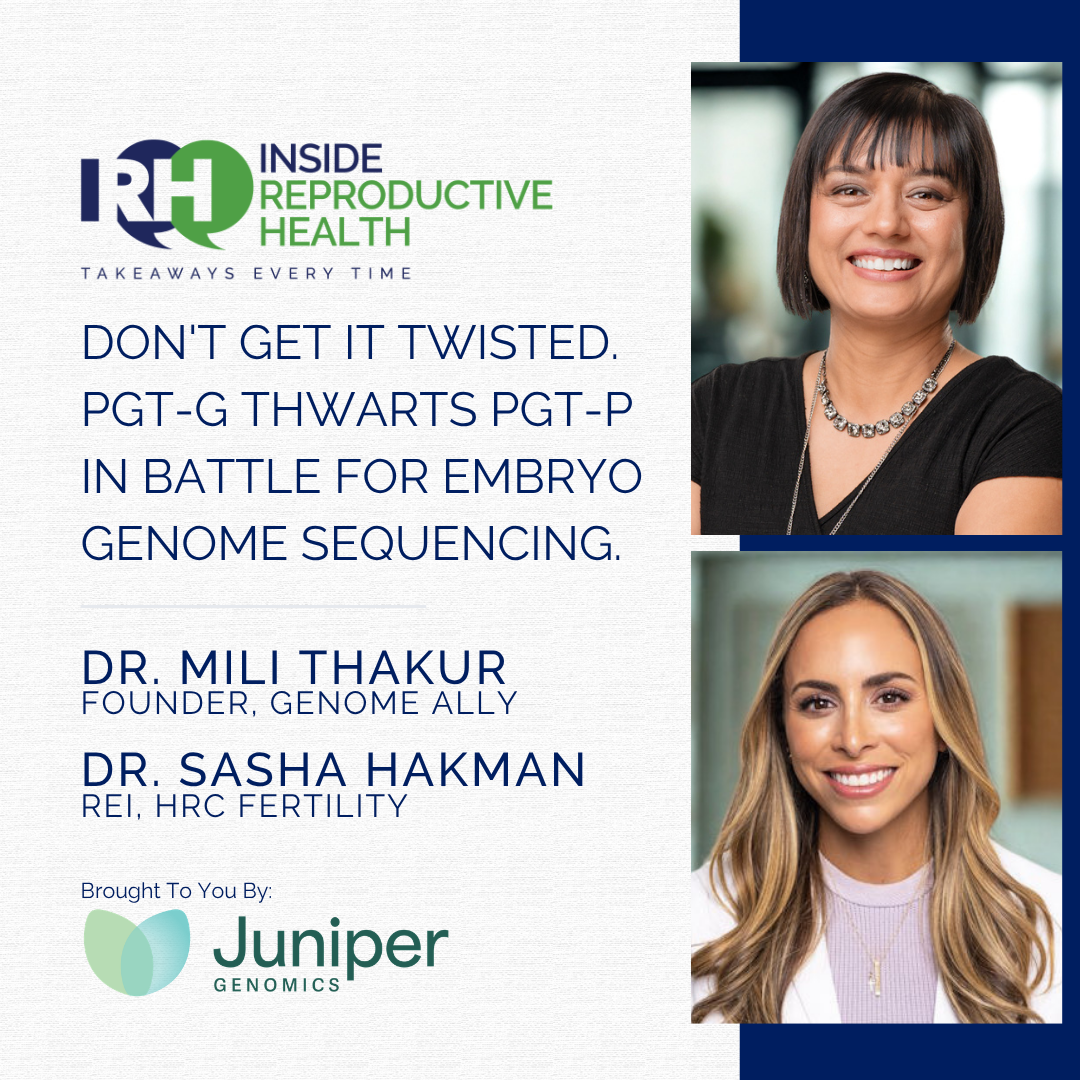
Dr. Mili Thakur of Genome Ally and Dr. Sasha Hakman of HRC Fertility break down what they’re seeing in real patients, especially when everything else has already failed.
We dive into:
The real difference between PGT-P and PGT-G
Why some genetic claims are under scrutiny
Where whole genome sequencing is actually helping
How PGT-G may reduce repeated failed IVF cycles
Whether this can truly shorten time to pregnancy
The New Standard of Care in IVF
Juniper Genomics’ PGT-G for “Genomics” delivers deeper genetic insight beyond standard PGT.
Built for high-performance IVF clinics.
Scale seamlessly without disrupting workflow.
Learn how leading clinics are adopting the next generation of PGT.
-
Dr. Sasha Hakman (00:00)
Patients are hearing about these tests and wanting that control. And I think that's where like a lot of the counseling will come into play of like,
Yeah, this test exists, however, can never guarantee that you're going to have a child that does not have the phenotype that you're looking to eliminate.
Griffin Jones (00:26)
PGT-P has made headlines for bold direct-to-consumer marketing, but the ASRM has recently issued guidelines warning about the absence of scientific evidence behind such big promises.
Meanwhile, a different way of doing whole genome sequencing, or at least a different approach to it, of the embryo has quietly been gaining traction. PGT-G doesn't tout wild claims, but it's steadily widening its relevance.
as the evidence starts to come forth and use cases mount.
joined by Dr. Mili Thakur who is an REI at the Fertility Center in Grand Rapids and has her own specialty practice, Genome Ally, where she sees the cases that you, her colleague REIs, send her when you trust your embryologists and your protocols, but you know there's a genetic challenge afoot.
and by Dr. Sasha Hakman an REI in the Los Angeles area who believes that genetics has a lot more to offer to avoid repeated failed IVF cycles.
Doctors Hakman and Thakur talk about Juniper Genomics, a PGT lab that does both PGTA and PGT-G. But specifically, what advantages Juniper's tests offer
and how these two physicians believe, if I can steal a phrase from Abigail Sirus and Dr. David Sable, it reduces time to baby.
I've only started paying attention to these differences between PGT-G and PGT-P.
The vast majority of you seem freaked out by PGT-P.
Almost everyone I've talked to about PGT-G sounds guardedly optimistic.
But I'm only starting to figure this out, so listen to this episode, tell me, what do you think? What's for real and what's unfounded?
Griffin Jones (02:57)
Dr. Hakman Sasha, welcome to the Inside Reproductive Health podcast. It's about time. Dr. Thakur, Mili, welcome back to the show for the 80th time. like the Steve Martin of Inside Reproductive Health. You keep coming back. Sasha, what are the latest technologies impacting PGT right now?
Dr. Mili Thakur (03:07)
Thank you.
Dr. Sasha Hakman (03:07)
Thank you.
So there's definitely been, I mean, the newest, latest, greatest is whole genome sequencing being used. However, different companies have different focuses. So the technology itself of whole genome sequencing, I think is a very attractive emerging aspect of our field when it comes to pre-implantation genetic testing.
A lot of people have already heard of PGT-P, which is looking at polygenic risk scores, but not all companies that are doing whole genome sequencing have that focus in particular. And I know that it's been a very controversial topic since some companies are sort of advertising this as a way, like almost direct to consumer for people to sort of create designer babies or whatever have you. you know, there was even a New York Times article
about it, but I don't think that, I don't know if everyone realizes that not every company that's doing whole genome sequencing is doing necessarily the same thing, where some are looking at polygenic risk score, but some are looking specifically at genetic causes of infertility and recurrent pregnancy loss on a single gene variant level, as well as looking at things like reduced viability variants.
and the company that's actually doing this right now is called Juniper Genomics.
Griffin Jones (04:41)
And so there's different names for tests that do hold genome sequencing, Like PGT-P is one test and PGT-G is a different test.
Dr. Sasha Hakman (04:51)
G.
Correct.
Griffin Jones (04:53)
Who comes up with the names of the tests? I remember 10 years ago, I had just got it straight. Okay, this is PGT and this is PGS and I had finally gotten it straight and then we don't do that anymore. And it was overnight. It was like there was a memo that went out and everybody got the memo at the same time. Who's making these memos? Who gets to decide what these tests are called?
Dr. Sasha Hakman (05:17)
Mili, you probably know this better than I, because I mean, I think the ASRM is the one that came up with changed it to PGTAM and SR, right?
Dr. Mili Thakur (05:17)
I think, yeah.
Yeah, yeah. Thank you, Griffin, for having me. I think like when we were doing just PGT and PGTS, you know, at that point, I think in the early to late 2000s, you know, there was this need of like coming out with like technology that was changing. at that before that time, I think right around like 2000 is like 2000 to 2013, you know.
Next Gen sequencing was coming out. And with Next Gen sequencing came out cutoffs for the test and how we call euploids and aneuploids and mosaic embryos. And when those guidelines were coming out at the same time, know, PGT, SIG and other, you know, ASRM and other societies came together to kind of demarcate that. So right now, you know, as all of our listeners know, we have the PGTA, which, you know, a focus of a lot of ⁓ practices is.
Dr. Sasha Hakman (06:04)
. .
Dr. Mili Thakur (06:27)
But we have PGTM for single gene disorders. We have PGTSR for structural rearrangement where there is like translocations and inversions. And then you have the other less frequently used ones. So PGT-HLA, when you want to match an embryo to a sibling for HLA matching, you have PGT-P, which is upcoming and we are still trying to figure out the ethical benefit of it. And then PGT-G, which is this new terminology, mainly I think
Dr. Sasha Hakman (06:42)
Announce.
Dr. Mili Thakur (06:56)
brought up by Juniper.
Dr. Sasha Hakman (06:58)
Yes.
Griffin Jones (06:58)
So
do the labs, are the labs the ones that say this is what the test is and then the medical societies decide if they're going to adopt that nomenclature or do the medical societies get together and say this is what we're calling each one of these tests?
Dr. Mili Thakur (07:15)
I think the initial four tests were through medical societies. like PGTSR has a different technology than PGTM and PGTA. So those were kind of decided. And now these additional ones like PGT-P, the labs that were pioneering it are pushing that name quite a bit. And then PGT-G for the companies or labs that are using the whole genome sequencing. So I don't think ASRM or any other societies have yet.
Dr. Sasha Hakman (07:22)
.
Dr. Mili Thakur (07:44)
and
or PGT-G, however PGT-P there was a recent guideline from SRM about how to use it and where to use it.
Griffin Jones (07:52)
And I'm sure we'll get into that today. But the earlier tests, was it ASRM that said, here's the definitions? then do like, does Eshry have their own nomenclature and the Asian society has their own or how do they all get together on the same page?
Dr. Mili Thakur (08:07)
I think all the societies right now have the same nomenclature. We call it PGT-A, PGT-M, PGT-SR, and PGT-HLA.
Griffin Jones (08:14)
People are like, why is he laboring this benign point? And it's because I know that I'm not the only one who's wondering. So is it the case that, to your point Sasha, it's universal adoption, but are they getting together or is there one authority above all of them, like the WHO or something that is saying this is what we call tests?
Dr. Mili Thakur (08:38)
I think from my standpoint, our field is so small, even globally taken everything together, like ASHRAE and ASRM and PGT Special Interest Group and the PGT Society. All of those, I think are still very few scientists and physicians are involved in that. So I think in my mind, I think most everybody is calling it the same, the PGT-A.
Dr. Sasha Hakman (08:47)
.
Griffin Jones (09:02)
And then they just
send out an email to the rest of us and then that's what we call it.
Dr. Mili Thakur (09:04)
Yeah.
Dr. Sasha Hakman (09:06)
I do think ASRM
has a pretty big influence on how a lot is adopted worldwide. And this isn't to say like the US is the be-all end-all. I mean, there certain things that are not necessarily adopted, like when the ASRM changed the definition of infertility to be more inclusive, that wasn't necessarily the case with Escherich, for example, right? But there was a very specific reason why ASRM did this, and it was in hopes of improving insurance.
benefits and improving access to care. So if more people fall under the definition of infertility, then perhaps that could improve access to care through insurance coverage. But maybe that's not necessarily the same priority for Escher, because a lot of countries already have incredible benefits, though there's probably a lot of populations that require third party reproduction that are still left out in that, in the traditional definition of infertility. But I think for things that are just more
I mean, I would say less controversial. I think that if one society creates certain guidelines that are easy to follow, that make sense and scientifically sound, then a lot of the other medical societies will adopt that just to create a little bit of more of a universal language. like Mili said, our field is so small in comparison to a lot of the medical fields that there's just a ton of overlap. And there are things like
you know, different organizations having meetings together to have expert consensus on new guidelines, depending on what we're talking about.
Griffin Jones (10:39)
20 % of my audience is glad that I dug so deeply in that and the other 80 % has been hitting the skip button for the last five minutes. I heard of a test called PGTWGS. Is that a test or was that just a brand name that someone is working on?
Dr. Mili Thakur (10:44)
You
the whole.
Dr. Sasha Hakman (10:56)
It's a whole genome sequencing.
I think everyone's just calling it whole genome sequencing. I don't know about you, Mili, but when I bring it up to my patients, I mean, obviously I'm not saying WGS because patients will look at me and be incredibly confused, but I tell them, you have this option now where we have, know, obviously routinely everyone's getting their genetic carrier screening, so you're figuring out.
do you need to do PGTM or not, but for those where you don't necessarily need to do PGTM or PGTSR because there's no translocation or any structural rearrangements there, you're doing PGTA, most of us I think are doing it pretty much routinely in most IVF cases, and I'm really curious to see Mili's thoughts on that as someone who's also board certified in genetics, but with whole genome sequencing, you're really just testing the entire genome, and you can call it,
WGS or you can call it G. I don't think it really matters. You're just describing what the technology is.
Griffin Jones (11:52)
So Sasha, is PGT-G and PGT-P the same test? They're just used for very different applications, or are they different tests?
Dr. Sasha Hakman (12:03)
Well, concept of whole genome sequencing is the same. Like you're getting that information, like the DNA information, but how you process it and interpret it is going to be different, right? And so, you know, with polygenic risk scores, that's totally different than say, like a company like Juniper.
who's looking at reduced viability variants, which I think that they're the only ones that have that data, if I'm not mistaken. They have a list of genetic variants that essentially are not in the population, basically meaning that anyone who is alive does not have these variants because...
they are not compatible with life. And so it just helps to prioritize which embryo to transfer first to reduce time to baby. That's the ultimate goal. Or to provide specific information to a couple that perhaps has recurrent implantation failure or recurrent pregnancy losses, including of euploid embryos. And you can't necessarily pinpoint what the issue is to understand better why these pregnancies are not occurring or why they're not ongoing.
⁓ So I think that, you know, I don't know necessarily, Mili maybe has a better understanding of the technology of the other companies and what they're doing. But, you know, the different platforms will give us different information when it comes to whole genome sequencing.
Griffin Jones (13:37)
would you describe Mili the difference between what we understand about PGT-P is and what someone like Juniper Genomics is doing?
Dr. Mili Thakur (13:45)
Yeah, so I think the ⁓ important thing is that word whole genome sequencing, right? So when we are saying whole genome sequencing in an adult or a child, you know, we have a phenotype that's already there. That means there is a child or an adult with a health condition or some sort of a family history. And then we are looking at the data for all genes that can be sequenced in as much depth as it can be. And then the work really starts. So whole genome sequencing can be done by any lab.
but then the annotation of the genes, the curation of the genes, how to take that data that is such a large volume of data and making it meaningful for that particular patient in front of you, you know, is a slight bit easier. And whole genome sequencing is still clinically in adults and children also coming after whole exome sequencing. So we understand about protein genes better.
And so for adults and children, whole genome sequencing still has to be curated very carefully. And you might miss some areas that are difficult to sequence. But in the embryos, when we are saying whole genome sequencing, the whole amplification of the DNA, so the biopsies taken from the outer shell of the embryos, from the trophectocytes cells, you do the whole genome amplification.
And then you can annotate the data for whatever you would like. So basically all of the data is coming through a technology called next generation sequencing. They're looking at the data, but it depends on company to company or lab to lab as to how that whole genome amplification is happening. the reads that are being made are clear. And then how is your scientific team working and what are they kind of focusing on? So a lab that is focused on PGTA,
Dr. Sasha Hakman (15:19)
Mm-hmm.
Dr. Mili Thakur (15:30)
It's looking at copy number variants and depending on lab to lab, they are focused on making sure that the embryo sample is eucloid, has all 46 chromosome, all pieces of it, and the sex chromosomes are fine. Labs that specialize or the division of the labs that specialize in PGTM is focused on that single gene that we requested and making sure that that embryo is not going to get that disease. It's unaffected by the disease, right?
Dr. Sasha Hakman (15:59)
And after the creation of probes.
Dr. Mili Thakur (15:59)
And the third lab,
yeah, so like linkage is established. It's a whole different workflow. They are focused on doing something that is going to be making sure as accurately as possible, mostly above 90 % and somewhere around 98 % that linkage PGTM test would tell us that the mutation is there in the cells of the embryo or not in there, right? But these labs that are now,
taking other pieces. So there are some PGT labs that are doing whole genome sequencing. They are saying that they are doing whole genome sequencing, but in reality, they are looking at like 1800 or so different genes. So they're not looking at a family history or a personal request for a particular gene. They're going and saying, there is no direct mutation in any of these genes that were looked at, right? But there are 25,000 genes in the genome.
and they're looking at 1800 genes. So we have to be very careful of saying, yes, your technology is whole genome sequencing, but what you're really looking at it is this much and there are areas in those genes and there are tripple repeat disorders that everybody's trying to optimize. Like fragile X type genes are not very easily read in an embryo sample. And then there are other companies and their labs who take that data. They're not focused on PGTA or PGTM.
they have data or they have a means of looking at that data and grading the embryos for certain parameters. So they are looking at certain SNPs and saying, diabetes is more likely in your embryo number one, but less likely in embryo number two. So that's PGT-P scoring. So polygenic risk scoring is commonly used in other kind of paradigms, but we are trying to predict a phenotype in an embryo that has no phenotype as of now, plus also we are...
adding another layer to these embryos, like all of them are healthy, right? Healthy in the sense they're PGTA normal, they don't have the PGTM gene, but now we have graded them. And if our first two or three don't take in the PGT-P based on their lower risk of diabetes or schizophrenia or hypertension or physical attributes or whatnot, then the parents are settling for their third best embryo when there was no actual difference in all of those embryos.
Dr. Sasha Hakman (17:54)
.
Dr. Mili Thakur (18:16)
Right, so that PGT-P is just a layer of analysis that's been put on the data to grade embryos based on certain predefined parameters. In whole genome sequencing where reduced viability variants are being looked at, like Juniper, what they are doing is they are looking at PGTA, they are looking at PGTM if you have a single gene, but then they're also looking at the data for reduced viability variants.
Dr. Sasha Hakman (18:21)
. .
Dr. Mili Thakur (18:45)
So the lab curates that data. kind of, they have that data and they're increasing that by having more patients do it. And so based on the analysis, your product or your panel becomes stronger. you can, like right now for an adult or a child, when I order whole genome sequencing, you can do it for a thousand dollars, but I can't take that data and make it meaningful for my patient.
Griffin Jones (18:46)
Thanks. ⁓
Dr. Sasha Hakman (18:52)
Mm-hmm.
Griffin Jones (18:53)
you
you
you
Dr. Sasha Hakman (19:10)
.
Dr. Mili Thakur (19:11)
The same thing, we have to take all of that data and make it meaningful for each embryo.
Dr. Sasha Hakman (19:12)
Okay.
Dr. Mili Thakur (19:17)
and then to the parents.
Griffin Jones (19:18)
And is the reason why you can't make it useful for your patient is because they're actually only screening 1800 genes or that's a different concept?
Dr. Mili Thakur (19:28)
That's the different things. Yeah. So basically for an adult or a child, there's 25,000 genes. Some people
say 30,000, some people say 20,000. Out of those 18,000 genes are something that we can sequence. And out of that, if you look at these companies that do it for adults and children where there are millions of cells and everything's there, there are gene areas that don't sequence well. They're kind of in the dark.
And then on top of that, amount of data generated from whole genome sequencing is immense. Like even in, I sometimes will provide a 600-joll gene list to these companies because I'm looking for infertility-related genes or recurrent implantation failure genes. Even then I'm getting like seven to 10 variants of uncertain significance in just 600 genes. So what I'm trying to say is whole genome sequencing, even though it sounds like a very fancy word, at the end of it,
the test is useful to our patients and to our physicians based on the curation of the data and how we kind of make it meaningful. Like I would want to transfer an embryo that would have the highest chance of a live birth, lowest chance of a disease causing gene. But then I don't want to add decision-making to already stressed out couples or individuals to say, hey, you have these five embryos, one has this wrong with this.
Dr. Sasha Hakman (20:28)
Mm hmm. Mm-hmm.
Dr. Mili Thakur (20:52)
second one has this wrong, which one would you like to pick? Right, we have to tell them at the end of it, our patients are looking at our guidance and we have to say embryo number one seems to be the best and let's never transfer embryo number five because it has a disease causing risk.
Griffin Jones (21:08)
Sasha, tell me more about the significance of these reduced viability variants. What is that? How do you counsel your patients on it?
Dr. Sasha Hakman (21:15)
We're in an age now where a lot of patients are looking for answers on social media. We know that on average 15 to 20 % of couples with infertility will be given the diagnosis of unexplained infertility. I don't know how much you guys are consuming online. I consume a lot about what is being said because I wanna know what my patients are seeing and hearing online. And there's a lot of BS of...
There's no such thing as unexplained infertility. There's always an explanation. It's usually something like PCOS or endometriosis. And couples who are getting this diagnosis always assume that there's some sort of inflammatory disease happening that is causing their infertility. And everyone's forgetting an incredibly important part of biology, which is genetics.
You know, with like the PGT-P, for example, we're looking at polygenic risk scores, but you're forgetting that like a big part of that is there's an environmental component that affects the phenotype. And so you may have a genetic predisposition to something and there may be an embryo that has a higher risk of, for example, type 1 diabetes, but you know, it's usually the Coxsackie virus exposure that then creates a cross reaction.
where you create antibodies that attacks the pancreatic beta cells that eventually will lead to type one diabetes or insulin dependent diabetes, right? And so we can't predict what the environmental exposure is necessarily gonna be. And so that's a lot harder to really provide a guarantee of any sort. And obviously we can never guarantee anything when it comes to reproductive medicine, but that to me is just sort of.
a lot harder to utilize for anything clinically meaningful. But I think that if somebody's coming and we have these genetic variants that are highly associated with infertility or with recurrent pregnancy loss and somebody's gone through multiple IVF cycles, we don't necessarily have answers. This is where I often will encourage them to consider using a test like Juniper because then if I'm able to get this information,
Griffin Jones (22:58)
But I think that if somebody's coming, we have these genetic
associated
Dr. Sasha Hakman (23:20)
with reduced viability variance, and I have seen this with couples, where up until that point, creating embryos and sending it out and testing through Juniper, I had no answers for the patient, right? Why did you fail for embryo transfers? I don't know, we've tried everything. We're now assuming it's the embryo, or sorry, it's the uterus, and we're doing endometrial biopsies of tests that really have no real evidence to support whether we should do these tests or not.
Griffin Jones (23:23)
you
until that point.
Why did you build?
I'm assuming it's the embryo, or sorry, the uterus, and we're an in-vitro biopsy.
Dr. Sasha Hakman (23:49)
And then when we go to create new embryos and send it out to Juniper, and now I'm seeing that there's a common variant amongst the parents, the embryos that keeps showing up again. And I see that there's maybe one embryo that doesn't have this reduced viability variant. It allows me to now select out of a handful of embryos which one to transfer first. And if it's accessible, then I feel pretty confident that this is likely the reason.
Griffin Jones (23:50)
And then when we go to create new embryos and send it out to Juniper, and now I'm seeing that there's a common variant.
And I see that there's maybe one embryo that doesn't have this reduced survival experience. It allows me to now select out of...
Dr. Sasha Hakman (24:15)
I like to give one clinical example of something that was discovered in a patient that we didn't know prior, and this test gave us a lot of answers. So I had a patient who started off with me at the age of 23, actually. She has high ovarian reserve, but she's 23, no PCOS, extremely regular cycles, no signs of hyperandrogenism. It was a classic case of like,
Griffin Jones (24:15)
And I like to give one clinical example of something that was discovered in a patient that we didn't know prior.
And the test gave us a lot of answers. So I had a patient who started off with the endocardial disease. She had thiobarine reserve when she was 23. No PCOS, extremely regular cycles.
Dr. Sasha Hakman (24:44)
unexplained, you can kind of argue mild male factor, like lower morphology, but other parameters were normal. Did IVF, we did an embryo transfer, unsuccessful, second transfer, successful, which we expect with either PGT or in this case, they were untested embryos. Because she was so young, I actually counseled her that PGT was probably unnecessary at this age. So after the second transfer, she was ready for baby number two.
Griffin Jones (24:52)
Did I? Yeah.
Dr. Sasha Hakman (25:11)
She had four embryos remaining. All four embryos failed. In a 23-year-old, that's very unusual. And so now we decided to make more embryos and given her high level of anxiety, not understanding why so many embryo transfers failed, we decided to do genopogenomics. And then we discovered, and this was a part of her family history that she failed to tell me, but that there was familial hypercholesterolemia coming from the maternal side.
Griffin Jones (25:16)
and 23 or the very unusual.
So now we decided to make more embryos and given a high level of anxiety, not understanding what's going on in their future cells, we decided to use the
Dr. Sasha Hakman (25:40)
and half of the embryos were affected, actually probably more than half of them were affected by this. It's autosomal dominant, that's not surprising. But the particular variant that she had, if you go into the literature, highly associated with implantation failure. And so at that point, I decided to check her lipid levels and her cholesterol through the roof.
And that's not something we routinely test in a young, healthy patient. We don't do fasting lipids routinely. You're assuming that they're going to their PCP, getting their preventative care, but it's not necessarily a required test outside of the clinical picture of PCOS prior to a transfer. And so now it was easy to say, well, let's get your lipids within normal range in preparation for an embryo transfer and pick.
the euploid embryo with reduced viability variants, but we're also able to discover that a lot of these embryos had other medical conditions that arose from the parents that were not known about before, like dilated cardiomyopathy.
Griffin Jones (26:41)
With that patient, were you able to find embryos that successfully implanted?
Dr. Sasha Hakman (26:45)
So we're getting ready now. So I'm very curious to see what the outcome will be, but her transfer is gonna be in about two weeks.
Griffin Jones (26:53)
fingers crossed everyone I think will be very interested in that outcome. I want each of you or either of you to tell me if I have this understanding correct and if I have my terms incorrect, you'll correct me. Are people looking to polygenic risk score for a genetic promise but that promise might not materialize because it doesn't account for epigenetic variables post embryonic development?
Dr. Sasha Hakman (26:54)
Fingers crossed, yeah.
Dr. Mili Thakur (27:21)
So basically what polygenic risk code for embryo, the science is not ready yet. So basically what we are doing in PGT-P labs is they're taking the data, they're trying to predict an outcome for an embryo or the likelihood of that outcome, which is like a polygenic condition. So type one diabetes, schizophrenia, hypertension, breast cancer risk, or.
risk for like physical attributes that are different, right? So when we're trying to do that, the prediction is on the premise of the data that's available. And the data is available for a certain ethnic background, certain age group. And we're trying to predict an embryo's health or a future health of an embryo based on that. And that's the ethical consideration of VGTP right now. So in order to like,
Dr. Sasha Hakman (28:06)
.
Dr. Mili Thakur (28:13)
be able to tell a couple or an individual who's been struggling to conceive whether or not they will have a live birth is the outcome that most of the physicians in this field want. They want an outcome of a live birth with no obvious health concerns to a child or an infant, right? So PGT-P is trying to predict if the child will develop hypertension or type 1 diabetes and
For certain populations, it might be an important answer to know out of their five embryos that are euploid, which one would have a lesser chance of say a mental health condition or type one diabetes. And it could be meaningful information. But if you're trying to give that information to a couple that came in the door, just looking for a healthy life worth, that information is overwhelming. It's falsely kind of making that premise. And there comes your...
Dr. Sasha Hakman (29:00)
.
Dr. Mili Thakur (29:08)
you know, genetic promise versus what happens in an epigenetic way. And to, you know, Sasha's point, you know, environment is going to play a role. So trying to limit our embryo number to be transferred from a euploid embryo, right, or from an embryo that did not have a PGTM condition to something where now the couple is doing another round of IVF to find an embryo that would have a lower risk of a mental health condition, which
by the way, polygenic, it may or may not happen to the child, is not a good idea of our resources for our doctor's time, for all of the stress that the parents have go through. Even though the information seeking patients, the ones that are looking for this additional information, they're still human. At some point, they're going to have to say that this embryo is all right to transfer, right?
Dr. Sasha Hakman (29:43)
you you
Dr. Mili Thakur (30:05)
and stop doing another round of IVF
because they would exhaust themselves out with that pursuit. So that is why new guidelines came out that PGT-P is not ready for prime time. For some families, it might bring some meaningful information after the rest of the testing has been all right. to your point, the post zygotic epigenetic changes and all of that is far away from where we are right now.
If you try to grade embryos based on physical attributes, it just makes sense. A healthy euploid embryo is very difficult to make and to have access to one healthy euploid embryo without knowing its PGT-P score is rather what I would recommend to my patient if they're on board with that information.
Griffin Jones (30:50)
And so I don't know any or I'm not aware of I might know several but I don't I can't think of any REIs that I know have been ordering PGT-P. Are some REIs doing that right now or were they up until the ASRM guidelines?
Dr. Mili Thakur (31:06)
I think doctors still are at independent, they can order the test. Like if somebody has a personal history of ⁓ type one diabetes and their spouse has something going on and it's very meaningful to them, they are good candidates, they have multiple embryos already, PGTAU employed in another lab and they want to pay that extra information, they can get that information and make that choice. So I think.
Dr. Sasha Hakman (31:09)
Yeah.
Dr. Mili Thakur (31:30)
Doctors who are doing PGT-P, you know, will do it on a case to case basis. What we want to do in the field here and globally is access to an embryo, whether naturally or through IVF, right? Access to pregnancy that is not going to have a major health risk as best as we can tell. So PGT-P factors into that for small percentage of patients that have a specific requirement.
but not for the general population. be presented to the patients that way. Like any parent would want to minimize the risk of everything that they could to a child. would want a child to have...
Dr. Sasha Hakman (32:08)
I think it's mostly patients
that are requesting it is what I've seen. And it's typically under the guise of like, had a brother with really bad schizophrenia after seeing him live like this and ended up committing suicide. I want to make sure I don't have a child who has this issue. And so I think that's where Patients are hearing about these tests and wanting that control. And I think that's where like a lot of the counseling will come into play of like, you know,
Yeah, this test exists, however, you know, this can never guarantee that you're going to have a child that does not have the phenotype that you're looking to eliminate.
Dr. Mili Thakur (32:47)
Yeah. And for our practice, like for me, like if there was that mental health condition or if there was a severe autism in a, in a nephew or in a family member or another previous child, sometimes by doing this
kind of testing and reassuring them falsely, you're actually missing the actual gene. That would have been the reason because you do not have access to that person who was affected genetic information.
Dr. Sasha Hakman (33:08)
No. Thank
Dr. Mili Thakur (33:12)
You can miss a monogenic condition and then try and reassure yourself with polygenic risk scoring, but it could completely recur in the child because the gene wasn't found in that family.
Griffin Jones (33:24)
And so the reason why PGT-G seems to be a more hopeful option, at least that's what doctors seem to be cautiously optimistic about the promise of PGT-G is because we can get to the science sooner. Is that correct? Because we're looking for results happening in embryonic development. Is that right?
Dr. Sasha Hakman (33:43)
Yeah, it's like time to baby, right? Like we're still very limited in our pregnancy rates with all the technology that's advanced.
pregnancy and live birth rates per transfer and now everyone's pretty much doing single Euclid embryo transfers. Like ESET's a great practice to reduce the risk of multiples, but we've also plateaued in our pregnancy rates. And I'm sure, like I talk about this on Instagram all the time so that patients understand this. My patients understand this well because I counsel them.
But I think it's important for people to understand that every embryo transfer is going to be successful. And even as an REI who was just the patient, like I had my first embryo transfer recently be unsuccessful, would the second one be successful? Knowing like it does take more than one embryo, but why are we always having to do multiple embryo transfers to get there? And in the cases of recurrent implantation failure or recurrent pregnancy loss of euploid embryos.
how do we move the needle because there's this really common practice of starting to say, there must be something wrong with the receptivity of the endometrium. Maybe there's something else like we need to do intralipids and add prednisone and do all of these add-ons. People are doing uterine PRP and we're.
doing a lot of experimental things that if you look at the overall data and listen, I add these things on too when I don't know what else to do and everything else has failed. sometimes the missing link and maybe the thing that'll help us move the needle to improve our pregnancy rates is having more comprehensive genetic testing of the embryos to see is this actually really going to result in a pregnancy and life birth or not? Are we able to gather this information? And the more that
They're able, know, one thing I've really liked about working with Juniper is that they sit down with me as a physician. I get to talk to their genetic counselor. We can look at, you know, they do a lot of hand holding to help interpret the information and because you're in constant contact with their team, they gather more data and they're providing more information to try to get you sooner. We've had a handful of patients who've had recurrent failed embryo transfer, recurrent implantation failure.
transferring into a surrogate only for it to fail multiple times again. And that's how you know that there's something wrong with the embryo. If you're transferring these embryos into a GC and multiple different GCs and it's not successful, and then you move on to doing something like whole genome sequencing where they're able to actually give you a genetic reason, now it gives you a lot more information and what to do with it.
Griffin Jones (36:08)
Thank
Dr. Sasha Hakman (36:29)
You could at least give a little bit of closure like, okay, maybe the next step is actually moving on to donor GAMI or maybe the next step is just making enough embryos until you get the ones that don't have this reduced viability variant, for example.
Dr. Mili Thakur (36:41)
yeah.
Griffin Jones (36:42)
more
information on the embryo prior to implantation was the prior to transfer that is, was the promise of PGT and now we're debating the relevance of mosaicism. tell us about that evolution, how that plays into this and is PGT-G relevant in that conversation?
Dr. Mili Thakur (37:02)
Yeah, so I think I disagree with the statement that we don't have the promise of the genetic testing kind of play out. I think genetic testing overall is like improving quite a bit. We are better than ever in our PGTA analysis right now. There are cases that I see at genome ally, my practice, we only get referred cases from other IVF doctors where the embryo testing is picking up something that was never picked up in a parent.
Dr. Sasha Hakman (37:03)
.
Dr. Mili Thakur (37:30)
And I've shared this few examples before we have embryos that were tested by a combined next-gen sequencing SNP-based platform, only 400 SNPs in that platform at that time, where they picked up something unbalanced in four out of 10 embryos. it was chromosome number seven was showing again and again. Patient had two previous miscarriages, had gone to PGTA just like that. The doctor did the keter type analysis after the embryo showed it and it was normal.
Keterotype came back normal, which is not possible. If multiple embryos have a problem, something's gotta be wrong with the parent. The case came to me. We went back to the lab that looked at the parents and we said, there has to be a translocation. I had taken a detailed history of the male partner and the female partner. And the male partner had a brother who had a translocation involving chromosome seven and 14. And we had them look at that area and they found it.
But in all true sense of the way, if they were going routinely, this was a couple with unexplained recurrent pregnancy loss with normal ketyotypes, and now PGT-A for the first time picked up something in an embryo. And there's cases after cases where we've picked up deletions that the PGT lab is reporting. So what
Dr. Sasha Hakman (38:43)
So
Dr. Mili Thakur (38:45)
I'm trying to say is, yes, of course, we have to take care of how we report mosaicism embryos, whether it should be reported or not reported.
Dr. Sasha Hakman (38:45)
So.
Dr. Mili Thakur (38:54)
Lomozake embryos are as good as euploid, test results and all that kind of information has to be sorted out and it's another talk for another time. But what I'm trying to say is at this point, PGT labs all across the world, the scientists that are working in these labs are doing amazing work. We have to realize that PGT is picking up stuff in embryos that could never been picked up in the parents. And the beauty of the PGT
platform, any platform is that you have actually the combination of the two parents. You can look at the male partner and the female partners embryogenetics in the embryo at one go. So the point of the whole thing is PGTA is like all the scientists that are working in the PGTA field are making the test better and better. We have to come together as a field and say,
where our cutoffs should be, what we should do with mosaicism and how to give this test to the patient. What are the best candidates? I think that's for the clinicians to decide, not the PGT labs to decide, right? Which is the best test for PGTM. The labs are now doing as best as possible. And the way I'm using PGT-G right now is the curation of the data. So I have patients where there are recurrent implantation failure, unexplained, you know,
Dr. Sasha Hakman (40:11)
.
Dr. Mili Thakur (40:15)
maturation issues with eggs or eggs don't fertilize. So what we are doing is developing a test, right, that is going to be pre embryo test. So you're going to have PGT-G available to the couples that require that test. But first we need to pick up those couples ahead of time before many failed IVF cycles happen. So on a regular basis, I'm getting referrals at genome ally from doctors like
one to two per week where cycle after cycle, eggs are not mature. The embryos don't go to blastocyst. There is like something wrong in that and we can see that it's wrong. There are some couples that have referred to me after they use donor egg and still there wasn't a blastocyst conversion. The embryo did not make into a blastocyst. So the juniper's data
Dr. Sasha Hakman (41:09)
Okay.
Dr. Mili Thakur (41:10)
is going to have wide applicability in the future. Right now they are collecting it on patients who have like many attempts and haven't gotten pregnant, the kind of patients Sasha was saying, right? But eventually we're going to collect this data in embryos and then be able to give it to anybody who walks into the door with
infertility and say, hey, you are the low risk couple. And hey, you are the one that's gonna fail four IVF cycles. So we got to do this, this and this.
Right now, we are at the point where you have to get through those four or five cycles, different labs. Anytime you go, and I've had patients who've been to three different doctors, as soon as a patient with a failed IVF cycle goes to the next doctor, the next doctor thinks that they've got it, their lab is gonna do it, they have the technology and their protocols are better, and the cycle fails again with the same exact results.
If there is a reduced viability variant, if there is a variant in one of those OZEMA genes, O-Z-E-M-A genes, no matter what you do with your technology and our embryologists are doing amazing work, the cycle's gonna fail. You're not gonna have fertilization if sperm genes are abnormal. You're not gonna have blastocyst development if your embryonic genes are abnormal. Right now, we are just scratching the surface. And so we partner with Juniper
for cases where we have found something in the parents and now we need an answer or sometimes we are using it for patients where it's like the end of the road situation. We need to find out if we need to move to donor gametes or something like that.
Griffin Jones (42:45)
Do you think that that it will quickly move beyond just edge cases?
Dr. Mili Thakur (42:50)
Yeah, I think we are working hard at genome ally. You know, we are collecting our data and we have a pretty good yield. Like we are having about 10 to 15 % of patients who are walking in the door with something abnormal. And if the phenotype is good, we can literally pinpoint what is happening. So like if you have empty follicle syndrome, right? Every time you go in for an IVF retrieval, your trigger has worked and eggs are not coming out.
Dr. Sasha Hakman (43:01)
.
Dr. Mili Thakur (43:20)
There is a certain set of genes that are going to be responsible and many times will pick it up. The same
thing with failed fertilization. Like we need to get to the place where this is normalized. Like our doctors in the field right now are doing the best ever work that has ever been done in ARIA because they have the tools at their fingertips. Our scientists have the cutting edge technology. But what we are trying to do is cycle after cycle, getting our patients through
the hope that it will work, right? In every practice,
Dr. Sasha Hakman (43:52)
Mm-hmm.
Dr. Mili Thakur (43:53)
one to 2 % of patients are gonna be in this boat right now. And when you see the amount of cycles we do in the US every year, that one to 2 % is a big number, right? In my practice, every week I see two patients. So that's a big number, right? I see patients from 26 different states. Everybody has these cases that they are looking answers for. So it's gonna be huge for these patients initially.
Dr. Sasha Hakman (44:00)
So. So.
Dr. Mili Thakur (44:19)
but then the broad application of this data is going to go to a test that will happen at the beginning of their journey rather than after fail cycles.
Griffin Jones (44:27)
Sasha, do you think it could be the case in the not too distant future that people have to consent out of whole genome sequencing their embryos?
Dr. Sasha Hakman (44:37)
I think we're pretty far away from there. I don't know if it'll get to.
I mean, maybe, who knows what's gonna happen in the future. I do think that if over time there's enough data to show that live birth rates are much higher, like from the first embryo transfer, I think that a lot of clinics will start adopting it because, you know, when the SART data comes out, we're all looking at our data and then everyone always wants to think like, how do we...
get even higher, like the data keeps getting better, but like how do we keep getting higher? How do we reduce the number of times we have to call someone and say, sorry, your embryo transfer was unsuccessful, we have to do this again. And so like that's always been the goal in this field is to, you know, create some level of like cost effective treatment, reducing the number of IVF cycles that are required per baby, reducing the number of embryo transfers that are required because
Not only is it like there's a financial, financially just a huge toll for patients, there's the emotional burden and then there's treatment fatigue when cycles are unsuccessful. So how do we gather more information to be able to, the first question everyone will always ask is why didn't my IVF cycle work? Why didn't my embryo transfer work? People want answers and in many cases you don't necessarily have the answers right off the bat. So if you know that there's a test that's available that could potentially
give you that information. And I love that Mili brought that up because I actually just called Juniper the other day saying, hey, I have a patient who out of, she has diminished ovarian reserve, but out of the mature follicles that we get, she's already done five IVF cycles. Less than half of those follicles will give me an egg out of the mature follicles despite a really high estradiol level and even good progesterone after trigger, which is like highly correlated with mature eggs.
I can't get the eggs and once we get the eggs, have very poor fertilization despite having excellent sperm and we just can't get to blastocysts and she's only 37. Like that's very unusual at that age. Or you get the patient where you get tons of eggs and you never get any blastocysts in the end of the IVF cycle. AMH is high but they have very poor fertilization and blastulation.
This is where I asked them, like, hey, can we send you this tissue early on and can you test the parents to help give me some answers so I can give them answers because that patient went first, second and third opinion. The other doctors did a totally different protocol. Patient had an even worse outcome. Fewer eggs retrieved, none were mature, no embryos. like, there's, like you said, there may be a genetic reason to it. And I...
Dr. Mili Thakur (46:59)
Yeah.
Dr. Sasha Hakman (47:19)
You know, I actually often tell patients who come to me for a second or third opinion, I often tell them, your past performance is highly predictive of your future performance. I can change the protocol, I can do something totally different than the last two doctors, but I don't know that it's going to result in anything different than you've already seen. And so ⁓ I actually do think it's really interesting how some doctors will act like,
Dr. Mili Thakur (47:43)
and and and Griff
Dr. Sasha Hakman (47:47)
a different protocol will make or break the outcome, at the end of the day, if biology's in your favor, it's really not that difficult to stimulate the ovaries and to get eggs and to create embryos.
Griffin Jones (47:49)
Okay.
Dr. Mili Thakur (47:58)
Yeah, so I wanted to say to Griffin's question of like whether PGT, like genomic test for the PGT, right? The whole genome sequencing for PGT become like a norm. I think before that, newborn screening by whole genome sequencing will become a norm. So right now, newborn screening happens for rare genetic conditions. For most states, it's around 50 to 60 disorders. We are in that case. But there is a lot of studies going on now where every newborn baby will get its whole genome
sequenced, we'll find out what the risks they are at, pick up all the rare genetic diseases ahead of time, then be able to, that becomes normal, then we will be able to kind of incorporate whole genome sequencing in embryonic data. And then I've spoken about this before, even for our carrier screening.
we should do whole genome sequencing, have all the genes available, and then based on where you match the donor or where the partner test results are coming, you can unmask the gene. Right now, a panel is done, and if I need another gene added, I have to have the patient go and do a new test. But the technology of whole genome sequencing, the backbone should be the same, and then we should be able to pick up the data for the carrier screening.
Patients are being screened by 800 plus conditions and some donors or their partner were screened by only 300 conditions. Now, how do you figure out the rest of the four? You will have to do a new panel, but if it was a whole genome sequencing based test, then we would just unmask those genes and say, hey, give me the results of this. So to your point, I think overall, once we create our workforce for genetics, once we have the support for the reproductive endocrinologist,
to have that genetics backup, right? In a busy practice, these patients are going to require disproportionate amount of the doctors and the staff's time. And if we are able to create practices like Genome Ally, where we take on that work, we understand genetics really well, then you can order more of these tests. But if the staff and the doctors are getting overwhelmed with the genetic tests that they are opening,
then it becomes difficult for the patient experience, for the physician's experience and all of that. So to your point, newborn screening with whole genome sequencing will come first or in parallel. And last thing, the last thought I wanted to give is it's very important for us to work with a team that is focused on genetics for infertility. So Juniper, the scientists and the genetic counselors are focused on infertility.
Griffin Jones (50:13)
More things out of the
Dr. Mili Thakur (50:29)
rather than going to a medical genetics lab that do commercial whole genome sequencing, their databases are full of disease-causing genes that are affecting children, infants, and adults. They're not focusing on our genes. They always report the genes that I'm asking them for as a variant of uncertain significance because they don't have that key data. So for us to build the systems inside of the infertility field is very important. So we can know
These are the genes that are important and these are the variants. So the broad applicability of Juniper's data set is going to come in a few years when we get that data available to everybody.
Griffin Jones (51:10)
still ordering tech.
Dr. Sasha Hakman (51:10)
And I predict that there will
probably be a panel for the infertility patients who will want that information prior to even doing their treatment so they understand what they're getting into.
Dr. Mili Thakur (51:15)
Yeah. Yes.
which is what we are trying to do right now. So Griffin, what we are doing is because we don't have the test developed as yet as I would like it to be. We are going through a clinical grade, medical grade, whole genome sequencing lab. And then we are providing them a curated list of genes that I want them to read and give me results back. But their curation of the data and interpretation of the data is not happening through a genetic counselor.
that is well-versed in infertility genes. So they're just sending us the data and we are having to do a lot of work. Every case that I'm seeing for this kind of testing takes a lot of effort. But with Juniper, when we send them a case, because their team is focused on infertility-related genes and reduce viability variance. Like when I have meetings with them, I'm an advisor for them, right? So when I have a meeting with them, I say the gene and they know the gene.
Right? When I say WEE1, they know that this, gene that we are talking about, TUB8, like these should be genes that now REIs will get very well versed in once we have all the tests available. Like we could say to the patient and say, Hey, let me check your TUB8 gene because your phenotype looks like that. Right now, that's not the case. Right now we are still at the phase of like, let me try a different protocol. Let me try something different. And then doctors are
working really a lot of volume. So sometimes if you take the history, there will be history of consanguinity. As soon as you see a shared ancestor and a failed IVF cycle, your answer is, I would say, majority of the time genetic. It just hasn't been found yet. So if you have empty follicles in somebody, and I have a case where there were empty follicles, she's from a background where there is consanguinity. Her parents are first cousins.
And as soon as we did the whole genome sequencing with our candidate gene testing, we found the LHCGR receptor was abnormal. Nothing's gonna work with your trigger in that patient. And that's a very good answer. Like we shouldn't be doing cycle after cycle with empty follicles because she does not have the gene to make the receptor for a particular thing that's very important in IVF.
Griffin Jones (53:33)
What about for those of us whose parents are not first cousins? about further up the family tree? Are you still seeing that same pattern that I'm sure that if people are from the same ethnicity, they probably have one 15th great grandparent in common. So how far up are we talking?
Dr. Mili Thakur (53:49)
again.
The farther it's better, but then I was surprised that there are communities in the US even. Like mostly I thought there are certain global communities that we would always seek consanguinity with. But thanks to PGT labs, and there are some PGT labs that are SNP based labs, we got results where it said common ancestor in the embryo. Both of the copies had loss of heterozygosity. And now when I went back and I kind of traced their family, they really are related.
And it was found in a PGT report, not in their family history taking. So embryo testing can also pick up common ancestry now. And we have found it in the US population. There are still communities where consignancy existed long ago or still recently. So what I'm trying to say is, as physicians, when I was a fellow, a lot of our...
focus goes on to surgery, a lot of our focus goes on to reproductive endocrinology and how to trigger and protocols and other things. It's more and more important now to teach our fellows and the physicians how to recognize these red flags for genetics. They don't have to take care of the whole piece of it, but as soon as they recognize it, there's your catch. And then, you know, referral to us or any other genetics counselor or genetics professional would be a good idea.
But those cases are the ones where we have found the greatest yield.
Griffin Jones (55:15)
So Sasha, this whole question on cutoffs, we're gonna have to come back to another time, we? That could be its whole topic, this whole debate that's happening on mosaicism. Like, what is mosaicism even? Is it even relevant? That's probably gonna have to be its own topic, isn't it? Sasha, what would you advise to other REIs who are fairly unfamiliar with PGT-G, and how would you recommend that they approach this?
Dr. Mili Thakur (55:23)
soon.
Dr. Sasha Hakman (55:41)
I would say if you're at the very least in a situation with patients where you had poor
IVF cycle outcomes that can't where you have no explanation you're trying to figure out how to troubleshoot. Ideally the first time you consider using this test to allow you to gather information, but especially in the cases of multiple failed transfers or poor IVF outcomes with fertilization and embryo development. It's a really good idea to really consider doing PGT-G.
to gather information so that patients are not doing repeat IVF cycles erroneously, wasting time, money, injections, appointments, emotions, to then land in the same position over and over again. Because likely if a patient has something genetic happening, you can do all the protocols in the world and all you did is waste their time and money and give them more false hope, especially for those who are out of pocket, which is the large majority of patients.
Dr. Mili Thakur (56:45)
my thought is that labs and physicians, know, who have their protocols really well and who have really good blast conversion rate and watching and auditing their system and they're doing amazing well, they should feel confident that when they have a failed IVF cycle, shouldn't
go and say, okay, this must be my protocol or this must be the batch of eggs or this must be the thing. Okay, you could repeat one more cycle, but don't go to the third or fourth cycle. Be confident in your lab and your embryologist and in your own protocols and say, hey, I want you to go see somebody. Let's find some answers before that. Patient may or may not be open by that time. They might want you to do.
Dr. Sasha Hakman (57:11)
Mm-hmm.
Dr. Mili Thakur (57:27)
a junk's like Omnitrope or this or that, but instead of steering them there, get the check mark of the genetics out of the way, and then go back to your protocols. Patients will appreciate it because those small percentage of patients that are not gonna have any success with what you do, you're picking them up sooner. So I want physicians to feel confident in their labs and their embryologists when their embryologist says, I made blast off all the patients except for this one. It's not the protocol mostly.
it's the patient characteristic. And part of that patient characteristic is the genetics. seeking those kinds of answers early is very important.
Griffin Jones (58:04)
We've outlined a whole number of topics that we could come back to and that we will. And I hope to do a couple of articles on that. It doesn't always have to be in podcast form. I'd like to give each of you a platform where we could do some, if not longer, form maybe very specific dives on some very specific topics in some articles. I'd like to do that with each of you. And Sasha, we'll all be keeping our fingers crossed for your patient.
and I look forward to updates again.
Dr. Sasha Hakman (58:30)
I'm very anxious for her.
I'm dying to do the transfer already.
Dr. Mili Thakur (58:34)
and we wish her the best.
Dr. Sasha Hakman (58:36)
thank you.
Griffin Jones (58:36)
Thanks to both of you for coming on the program.
Dr. Mili Thakur (58:38)
Thank you.