

Today’s Advertiser helped make the production and delivery of this episode possible. But the themes expressed by the guests do not necessarily reflect the views of Inside Reproductive Health, nor of the Advertiser. The Advertiser does not have editorial control over the content of this episode, nor does the Advertiser's sponsorship constitute an endorsement of the guest or their organization. The guest's appearance is not an endorsement of the Advertiser.
Genetic testing in IVF is only getting more complex, and more common.
REIs, you’re not supposed to do this alone, help is already here.
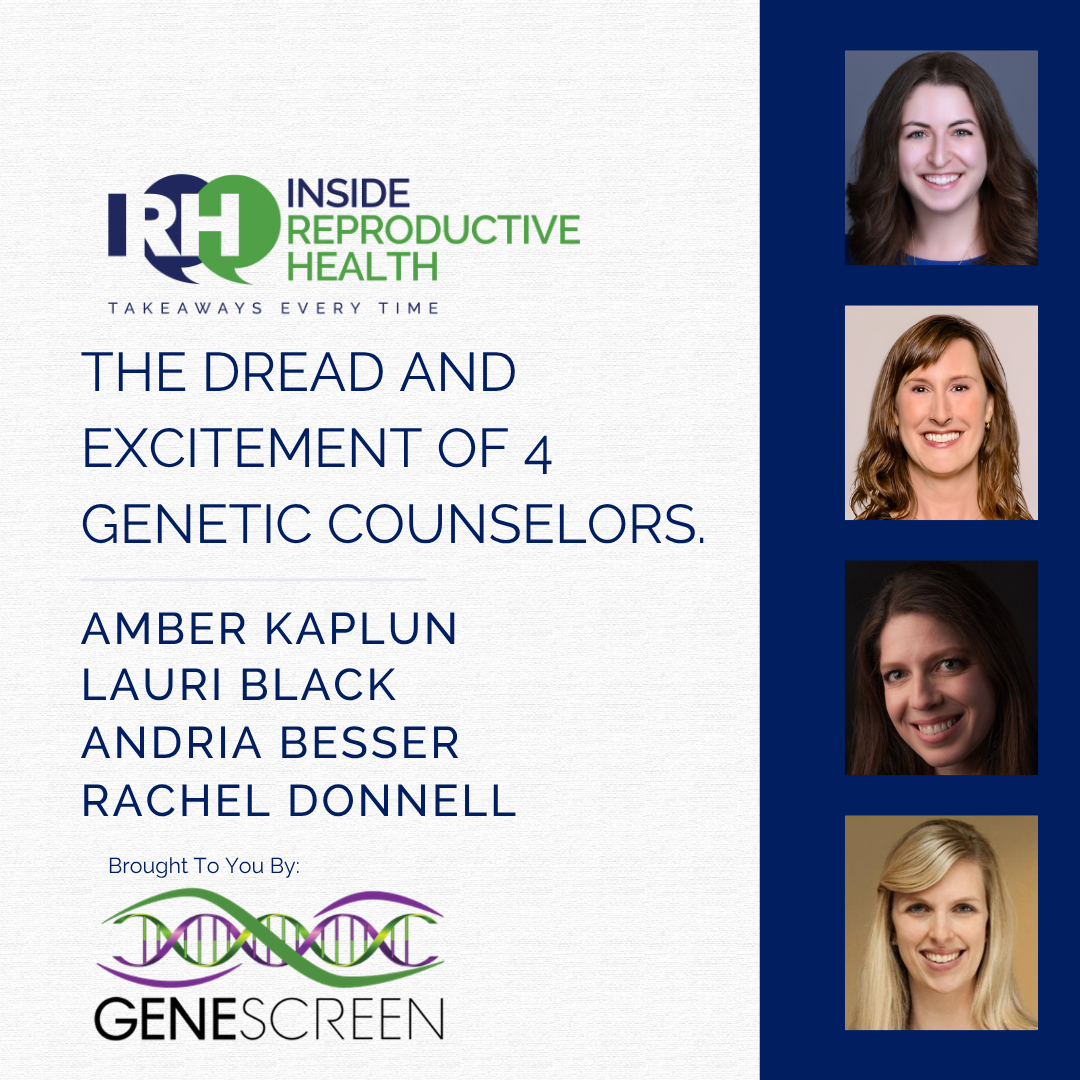
We speak with four genetic counselors, Amber Kaplun, Rachel Donnell, Andria Besser, and Lauri Black, about how this works in practice.
We dive into:
How to embed genetic counselors into your workflow
How to free up REI time while improving patient experience
Why access to genetic counselors isn’t as limited as it seems
How third-party services like GeneScreen fit into clinical operations
Their perspective on PGT-P vs. PGT-G (and where the field is heading)
Genetic counseling is no longer optional in fertility care — it’s foundational.
The real question is how to deliver it well, at scale.
In many fertility practices, genetic counselors help shape lab strategy, donor eligibility decisions, complex case management, and clinical policy across growing networks. But not every practice has that level of in-house genetic leadership.
GeneScreen partners with fertility clinics to provide concierge-level reproductive genetic counseling — whether you need full-service support, scalable coverage alongside your existing team, or experienced guidance to help build and strengthen your genetic services.
-
Lauri Black (00:00)
Pre-implantation genetic testing is being used more frequently and more widely, and carrier screening has gotten more complex. So I don't think that there's a patient that walks into a fertility clinic anymore that isn't having some genetic testing. So genetics is part of everybody's fertility care now.
Griffin Jones (00:32)
Help is on the way. REI's genetic testing is too complex and now too prevalent for you to be doing genetic counseling. You have help. And today that help comes from four genetic counselors. Here, listen to their voices so you know who's talking when.
Amber Kaplun (00:49)
I'm Amber Kaplan from IVI RMA America.
Rachel Donnell (00:52)
I'm Rachel Donnell from Shady Grove Fertility.
Andria Besser (00:54)
I'm Andria Besser from NYU Fertility.
Lauri Black (00:56)
Lauri Black from Inception Fertility.
Griffin Jones (00:59)
They tell you how to embed genetic counselors into your practices workflow, how to save REI's time getting them performing at the top of their license, all while improving patient experience.
how to understand that there are enough genetic counselors out there, even though they couldn't possibly meet every patient. This was an interesting nuance and the pushback in our conversation helped us get there. How they use third party services like GeneScreen, what they like about GeneScreen and how they get GeneScreen integrated into their workflow and SOPs. Then PGTP versus PGTG. They're excited about one.
while dreading the other. What about you? Please do let us know after you listen.
Amber Kaplun (02:43)
genetic testing is evolving so quickly and there are so many new technologies that are on the market, some of which I wasn't even really trained on in grad school. So it's being able to keep up with some of those technologies to be able to adequately counsel patients and advise providers that I work with. And I would say the second part is especially in the field of fertility and working for such a large network, just being able to kind of keep up with all of the patients that are coming in.
with questions, the providers that have questions, being able to see patients. It's really rewarding, but it does get to be a lot at times.
Rachel Donnell (03:19)
Mm-hmm.
Griffin Jones (03:19)
To educate me about the technology, what technology are you seeing now that you weren't trained on in grad school?
Amber Kaplun (03:25)
Polygenic risk scoring, I think, is the one that comes to mind first. When I was trained, that wasn't even a thing. And so that's something that I've really had to self-educate and self-train on to be able to understand the technology, understand the risks, benefits, and limitations so that I can have discussions with patients about it.
Griffin Jones (03:44)
When did that start coming about and what percent of your caseload does that represent today?
Amber Kaplun (03:52)
So it started being offered in the field of fertility probably around like 2018, 2019. It had been around in postnatal populations, for example, cardiology for a while before that. Currently, that is not a test that we offer our patients, but obviously when I'm speaking to patients, there are patients that have questions about it. So I wouldn't say that it's something that comes up super commonly, but when it does come up, I need to be able to answer the questions appropriately.
something that you need to be on top of even if it's not something that's making up a significant proportion of your caseload.
Griffin Jones (04:27)
Lauri, you were nodding your head when you were talking about the increase in patient volume, it sounds like. Talk to me about that.
Lauri Black (04:34)
Yeah, it's been a steady increase, I think, over the decades, in part because pre-implantation genetic testing is being used more frequently and more widely, and carrier screening has gotten more complex. So I don't think that there's a patient that walks into a fertility clinic anymore that isn't having some genetic testing. So genetics is part of everybody's fertility care now.
And I feel like that that wasn't as much the case when I started in the field, you know, a while ago.
Griffin Jones (05:11)
When would you say that changed? And talk to me about the changes in workload. Like from a day-to-day perspective, try to describe to me how it's changed.
Lauri Black (05:21)
So I think the level of complexity has significantly increased and that ⁓ has the potential to make the conversations with patients much more in depth, broader, more detailed and more nuanced. So, you know, we used to do carrier screening with just one or two genes. And now it's pretty typical to do hundreds of genes on a carrier screening panel.
We used to think of carrier screening as, if you're a carrier, you're unaffected, nothing to worry about there. We just need to make sure that if the female is a carrier of an excellent condition or if both reproductive partners are carriers for the same recessive condition, that we talk about options like pre-implantation genetic testing. And now we're getting into the nuance, well, you're a carrier, there's reproductive consideration, but you also may have a personal health risk.
associated with that carrier status and we need to take that in consideration as well. So the conversation really has evolved.
Griffin Jones (06:22)
Andrew, how has your workload changed in the last five, 10 years? Try to walk me through someone that hasn't been in your position to help me understand what it really looks like differently on a day-to-day level.
Andria Besser (06:36)
Yeah, it's completely changed. When I was originally hired as the first genetic counselor at NYU Fertility Center, so that was just over 10 years ago, I was hired part-time. I think the thought was that I would occasionally see a patient for a single in-depth consult and that would be that. The need would be solved from that.
Rachel Donnell (06:47)
Mm.
Andria Besser (06:56)
⁓ Very quickly, within about a year and a half, I ended up going full-time because it was realized that that just was not enough when everything that we do is genetics now, as Lori said, every single patient has some sort of genetic component to their cycle and to their treatment. So now we've got three full-time genetic counselors, a full-time nurse practitioner who's only in genetics and a specific genetic admin. So we've grown so much in the last 10 years.
And a lot of that is because, like Lauri said, so much more carrier screening. We're seeing more more carrier couples as those panels have really expanded. We're doing a lot more PGTA. We are just doing a lot more genetic testing in general. so patient need has really evolved. I personally have taken on kind of more of an operations role, just as the need has really.
gotten there, you know, started off with this need for just somebody to consult with patients. And now it's moved on to, well, how can we integrate genetics into our everyday workflow, into all of our patient materials, our marketing materials, our consent forms? How do we oversee just the whole, the whole process of PGT from beginning to end? How do we choose a lab for PGT for carrier screening? So it has just really changed quite a bit.
Rachel Donnell (08:12)
Mm-hmm.
I had probably the same experience as Andria, which she was describing with something very similar for me. I started out as part-time and then moved quickly up to full-time, ended up hiring a team. And I think something else that the clinicians see, like working with genetic counselors with their practice, is truly being able to work at the top of their scope. And what I mean by that is physicians should not be having the conversation of, is carrier screening? Let's go over PGT results.
A lot of that can actually be handled by genetic counselors so that we can help our physicians really work at the top of their scope of practice. And I think that that's something that physicians quickly see as they hire a genetic counselor and perhaps why Andria and I had this experience of, we'll bring you part-time, we'll see how it goes and then quickly realize, okay, these practitioners can really help us work at our top of scope as well.
Griffin Jones (09:09)
What needs to be changed specifically or adapted, Rachel, in the workflow in order for that to happen, for genetic counselors to take over some of that work from the REI to allow them to perform a topo license?
Rachel Donnell (09:23)
Yeah, bottom line is you have to integrate a genetic counselor in your practice. There's really no other way about it. Having somebody that works for your clinic, for your company, knows your protocols and your processes can really help patients navigate that process as it becomes more and more complex on the genetic
Andria Besser (09:42)
Yeah, integrate really is the key word there because I think that there is availability of genetic services outside of the clinic. There's ways to refer patients to outside practitioners. There's labs that have genetic counselors that are all super valuable, but it's that integration that I think is missing for a lot of centers.
Griffin Jones (10:03)
So talk to me about more what that integration is because in my mind, I hired a genetic counselor. Her office is down the hall and that's it, right? So, but I imagine that there's more to it than that. I imagine that it takes a few months and I want to understand what goes into those few months of how you truly integrate a genetic counselor into the practice.
Andria Besser (10:26)
Yeah, so it's not just those one-on-one consults with patients. It's creating those workflows that are gonna get patients the support that they need. One genetic counselor in an IVF center is not gonna be able to see all of the patients in a busy practice. So of course it's gonna depend on the size of the clinic, how many attendings there are, but generally, one genetic counselor
can't service every single individual patient for all of their genetic needs. But what we can do is we can create those workflows. We can create those partnerships with other outside resources to make sure that there is a flow for these patients. That how do they learn about carrier screening, for example? How do they learn about PGT? How do they get their results? Who goes over the results with them? Who triages those results and figures out who the patient should see next?
⁓ We're familiar with kind of all that's going on in the industry. So we know the differences between labs. We know the differences between technologies. We can support not only the physicians, but other practitioners, know, the nurses, the admin staff. I mean, I can't even tell you how much time I even spend with billing and trying to figure out diagnosis codes, for example, ⁓ and how to...
to prove medical necessity in a certain case. We have access to all of the patient's records, which I think is a really big difference too. We're directly in the EMR. ⁓ Like Rachel said, we know the clinic's policies. We know the little nuances that our attendings like, and so we can kind of put ourselves in their shoes and say, I think your doctor would probably recommend this is your next step. You kind of gain that experience as you work with the clinic.
Amber Kaplun (12:04)
And I think just to add on to that, like as Andria mentioned, being embedded in the same EMR, being embedded in the same workflows, the same clinic environment, every clinic is a little bit different, but being able to have that knowledge to be able to guide clinic leadership in how to create these workflows effectively.
And from a patient safety perspective, to make sure that they are catching the patients that they need to catch is a really, really big benefit of having a genetic counselor in-house. You're just not going be able to get that familiarity with someone who isn't day-to-day doing the same thing as your nurses, your physicians, et cetera.
Griffin Jones (12:39)
Is the existing technology sufficient for moving the patient along in this way? you just do all this through EMR or are you wishing for some sort of patient journey system that you don't have yet?
Amber Kaplun (12:52)
I think a lot of it because it is really trying to mimic clinic workflows, that is mostly going to be related to EMR. Now I know that there are certain companies that are trying to navigate things like, what do you do with patients that have carrier screening through different platforms and stuff like that, which is a common challenge that we face. And those types of technologies would be really great when they get to the point that they can take a patient and partner carrier screening report, tell you exactly
was everything screened, is anything missing, is any additional testing needed. I'm just not sure that we're really there yet to be able to do that effectively, but I'm sure it's coming.
Griffin Jones (13:31)
If you could wave a magic wand at any of you and have your technology do X, what is X?
Rachel Donnell (13:37)
Double check all embryos for transfer.
Amber Kaplun (13:40)
That's a good one. Yeah. Compare carrier screening results. You know, be able to effectively summarize genetic records that we get in from outside institutions. And this is something that like our team is working on a little bit, like being able to leverage things like artificial intelligence to be able to do some of that. So just being able to kind of like extract information reliably that we can then use in our counseling.
Rachel Donnell (13:48)
Mmm.
Griffin Jones (14:05)
But you don't feel like the AI is quite there yet?
Amber Kaplun (14:08)
I mean, I think that AI generally is still an evolving practice. So do I think that AI generally is there for anything? No. But I think that, you know, there are some early stage tools that are really great and coming out to be able to help leverage these types of situations.
Griffin Jones (14:24)
said don't
Lauri Black (14:24)
Yeah, I think
they're at the beginning right now. They definitely are there. I'm hearing of carrier screening labs that do have some AI assisted patient facing tools that explain carrier screening results. I'm hearing of tools that are AI fueled that can extract pertinent information from a medical record that's received from outside of the
the clinic or even summarizing the medical records and the progress notes from the clinic's own platform. So you can really get the salient and relevant pieces of information digested and summarized. So those things are coming. They're in their infancy, if you will, but they are there to help make all the workflows more efficient. But they need to be based in
foundation of knowledge. So I think that's where genetic counselors can help shape these things and make sure that they're going to be accurate and reliable tools.
Griffin Jones (15:26)
But still in their infancy, because I imagine many of those companies aren't just calling on your company, Lauri, that they're calling on you, that you're testing them out and looking into them. And it sounds like there are those that show some promise, but nothing that's blowing you away thus far.
Lauri Black (15:42)
There are some of the AI-fueled carrier screening reporting for labs that I think are looking pretty good already. They certainly don't serve all purposes though. They're really good for a low-risk couple based on their carrier screening results. Like there's not an indication for PGTM for them.
So it's just a nice streamlined way to be able to explain a couple's carrier screening results and the idea of residual risk without involving ⁓ a genetic counselor. And I know that the genetic counselors in the clinics are so much busier and needing to use their time to address the more complex cases that talking about a low risk
career screening result for a couple is probably not their use of their skills and best use of their skills. And it certainly doesn't keep them practicing at the top of their scope.
Griffin Jones (16:42)
When you all talk about the importance of having genetic counselors in-house, you've been very consistent with this theme, Amber. You've been on the show three times, and I think one of the episodes, the topic was entirely about that. And so you've made your case. What about those centers that are either too small or maybe they're big and they have some genetic counselors, but I don't think you could possibly have enough genetic counselors for...
Andria Besser (17:05)
Thank
Griffin Jones (17:10)
all of the cases in house, what do you do? Who do you use? Or are you just screwed?
Amber Kaplun (17:16)
What?
Do you want to push back on this idea that there's not enough genetic counselors? I feel like I hear that all the time and it's just not true. I can tell you that I get so many emails, so much interest from people that want to work in this space. They're just looking for the right position. And you know, I've spoken with different providers in the fertility field that are leveraging maybe MFM services at their hospital or their academic institution and it's getting them by, but they're saying that they're referring patients
to discuss a topic like mosaic embryos, for example. And the prenatal genetic counselor has a much different level of knowledge and background than an ART IVF genetic counselor. And so the type of genetic counseling that those patients are receiving is different depending on who is actually seeing them.
Now, I acknowledge that it can be challenging for small clinics to be able to try and like find the budget, for example, for a genetic counselor. And so I think that there can be opportunities maybe for outside services, but I never think that that's going to replace the value of having a genetic counselor. Also, the cost savings for you as a practice avoiding potentially very expensive lawsuits that we have seen come up in the fertility industry before.
So think that there are workarounds and there are 100 % enough genetic counselors out there for the positions if you frame it the right way and you put the position out there.
Griffin Jones (18:43)
How many genetic counselors work in the whole RMA network right now?
Amber Kaplun (18:48)
We are three full-time genetic counselors.
Griffin Jones (18:50)
for the whole network.
There's three just in Andria's practice. So if you were to serve the whole RMA network, how many genetic counselors would you need? Like a couple dozen?
Amber Kaplun (18:55)
Right.
Well, but remember that we said that there are a lot of indications for which we may not necessarily need to be seeing those patients, for example, like low risk carrier screening results, right? And so that's where you can create a program that focuses your services on the things that you absolutely need to see. And so there are situations where outside services can become beneficial for some of those more routine indications. And that's the reason that we still use those services, right? So, you know, it is not that...
it's like a one size fits all approach. We found something that works really well for us that I know is shared by a lot of other like clinics and networks, you know, that have in-house genetic counseling services. And so, you know, having that in-house genetic counselor can be a super big benefit, but it's not gonna necessarily meet all of the genetics needs for your practices.
Andria Besser (19:51)
Yeah, it's not about replacing the outside genetic counselors. We, and I speak for in-house genetic counselors, we need outside genetic counselors because there is no way to see all of the patients. We would need to have at least a one-to-one ratio with every physician, if not more, to be able to see every patient for every genetic indication. So it's more about how do we work with the outside genetic counselors so that patients are getting the benefit of both worlds.
And I would even push back a little further and say, a little clinic that maybe doesn't have the budget for a genetic counselor, do they have a budget for a nurse? Do they have a budget for a billing manager? I think that the more that we see genetics integrated into fertility care, that it's such a prominent feature of it now, I think we are getting to the point of how can you not have the budget for a genetic counselor?
Rachel Donnell (20:45)
Mm-hmm.
Lauri Black (20:46)
And I think you should also remember that while, for example, a nurse may be trying to help with coordinating some of the genetics care at a clinic, that nurse is not able to bill for their time. And it's also, they're probably practicing a little bit beyond their scope if they're trying to do genetic care. So consider this, having a genetic counselor even in a smaller clinic.
that can take some of those genetics duties off of a nurse, so let the nurse assist with more procedures that physicians can bill for, and then the genetic counselor can take over the genetics duties and bill for their services. it's really just, know, practices need to rethink how they might distribute those duties and what might be billable or not.
Griffin Jones (21:36)
As long as we're all pushing back. I think we may have discovered why people have that confusion, because people may be conflating two issues that sound similar but are different that I would have seen as the same had you not made that clarification. So people say there aren't enough genetic counselors out there. I think the reason why people are saying that is because of what Andria just said, which is there
Rachel Donnell (21:39)
Ha ha.
Lauri Black (21:40)
you
Griffin Jones (22:04)
we couldn't possibly meet all of the patient demand. So, but what you're saying, Amber, is that there are enough genetic counselors for what we need, and then there are outside people for all of those other cases that don't meet that threshold.
Amber Kaplun (22:22)
To put it into context for you,
if we have an open position, we usually get around 100 applications. Yeah.
Griffin Jones (22:27)
I'm sure. Yeah.
Lauri Black (22:29)
I've
heard similar things from other hiring folks, yes.
Griffin Jones (22:33)
So
for outside folks, how do you use them and what's the best way to use them?
Lauri Black (22:38)
There are so many ways that this can be pulled together. So I agree wholeheartedly with everything that's been said about having an in-house genetic counselor, whether that genetic counselor is an employee of the clinic or contracts with the clinic, but they're somehow more embedded with the clinic, familiar with the SOPs.
can really have a more one-on-one relationship with the providers within that clinic. So I think that's really the optimal model. But there are other ways to have genetic counseling services brought into the clinic to take care of those patients. You can lean heavily into webinars that are offered by PGT labs to give patients pre-test education before they do their pre-implantation genetic testing. You can lean heavily into the carrier screening lab for results genetic counseling for those low risk results. There are also a number of excellent third party genetic service providers that can have a pretty close relationship. It's kind of a second best to having your own in-house genetic counselor. They can become familiar with the practice. They still have to follow their own company SOPs and processes, but they can become very familiar with the practice, try to customize their services to that practice. are quite a few. GeneScreen is an example of one and they have genetic counselors that specialize in fertility. A number of other services do as well. I think that's really key is making sure that if you're working with a third party genetic counseling service, that you're working with a subset of their genetic counselors that are familiar with fertility counseling, fertility care.
Griffin Jones (24:35)
Do you use GeneScreen as well, Amber? So what's the best way to use them? How do you get the most out of them?
Amber Kaplun (24:37)
Yeah, we do.
Yeah, so they do counsel their patients a lot related to carrier screening results. We also have a lot of patients that come in with general questions about like, have this in my family history, what could this mean? Is additional genetic testing indicated? And they've been really helpful in those situations as well.
they do see a lot more than that, you know, for other clinics that they may be supporting. But once we start getting into discussions around things like pre-implantation genetic testing, we like to keep that all in-house because that is going to be related to clinic policies and procedures. And so that's really something that more in-house genetic counselors can take on.
Griffin Jones (25:19)
I like GeneScreen and companies like that, they have to have their own company SOPs, but how do you get them using your SOPs in the best way possible,
Lauri Black (25:28)
That's communication. It's communication, tight communication with that service provider and making sure they understand your needs and expectations and communicating about how to get those needs met and how to get those referrals sent across appropriately and efficiently so that you don't have any delays in patient care and get those reports back.
Amber Kaplun (25:28)
Go
Thank
Lauri Black (25:53)
Oftentimes there's lots of infrastructure that they have to offer to make sure that workflow goes smoothly.
Amber Kaplun (25:59)
I mean, I was just going to mention that a lot of these companies are really great at working with clinics, right? But I think as Lauri said, at the end of the day, they have their own SOPs and policies and procedures. And so there is absolutely flexibility there. But people may find themselves coming to a point where the SOPs and the procedures may not necessarily align between the two entities. And so there has to be some sort of reconciliation there.
Griffin Jones (26:23)
Rachel and Andria, why not just use the genetic counselors from the carrier screening labs?
Rachel Donnell (26:30)
So maybe a good example of like some disconnect or where SOPs at one company can conflict with another. The main kind of example I think of are embryos available for transfer. consider a situation where we have a patient that did embryo testing, they have some mosaic embryos. Clinic A might transfer mosaic embryos all the time. Clinic B certainly doesn't. You can run into situations where sometimes
a clinician just wants to know, okay, which embryo should I transfer? And you're gonna run into issues with one company not feeling comfortable saying what embryo should be transferred versus another, just dependent on those different clinic policies and different company policies. So similarly with carrier screening laboratories, a great example would be, you could certainly pursue PGTM for certain indications based on carrier screening results.
but those laboratories might not feel comfortable saying which situations that might be. Because again, that extends beyond their scope, which is just simply reviewing carrier screening results. They don't go into next steps after what happens now. So I guess bringing it back to having an in-house person can help with that translation between the two companies. And I think that's kind of where I sit at this point. I'm with Shady Grove and we have.
I think 57 clinic locations. So I'm a full-time genetic counselor and I do not meet with patients. I do not do patient consults. I certainly help with the translation between the companies that we use for genetic counseling and then integrating that information into actionable clinical next steps, which I think is kind of where it can be helpful to have somebody internally kind of getting those next steps available.
Amber Kaplun (28:11)
Yeah, I mean, I think one thing that's coming up in my mind is we're having this discussion as well. We talk so much about patient retention and patient experience within the field of fertility and.
utilizing outside providers can be really beneficial for getting that service, but the continuity of care, being able to set patient expectations, being able to clearly tell patients what their next step is, is really going to be something that an in-house genetic counselor excels at and almost like can handhold that patient to make sure that the patient experience is being, you know, pushed up to the highest level. So that practices can retain these more complicated genetics cases that are coming in because otherwise patients get frustrated. They feel like
they don't know what their next step is, they don't properly understand what the outcomes are going to be and what's going to be offered to them. So I think that that's another really big benefit.
Griffin Jones (29:02)
Andrei, what about the panels themselves? How different are they from one care screening company to another? Are they meaningfully different or are they so similar that it doesn't really matter? And are the genetic counselors sort of limited to being able to interpret that panel, but there might be other considerations to the patient's broader situation that you would need extra help for?
Andria Besser (29:26)
Yeah, you bring up a really good point. The panels can be very different. Even if they differ by one or two conditions, if you have a patient who's a carrier for one of those one or two conditions and their partner wasn't tested for it, that's meaningful. We do carrier screening specifically for the purpose of trying to identify reproductive risk. And so if we're not testing both partners for the same conditions, we may not be really getting an accurate read on their reproductive risk. And that's something that has
changed so much over the last few years. It used to be pretty uncommon that we would have patients bring in prior carrier screening that needed to be checked before we could order new carrier screening. Now, I would say it's probably a good, at least in New York, a quarter of patients, a third of patients are coming already having had carrier screening with a provider at some point, or they've had maybe direct to consumer testing, they need someone to explain the difference.
So it's not as simple as let's just order carrier screening on the two of you and send you off to the carrier screening lab to review your results because we also often need to incorporate prior results and maybe the new test is different from the old test and somebody has to make sure that we have at least tested for the necessary condition that one person carries and one doesn't. So that's something that my team takes care of. The four of us are really
spending a lot of time reviewing old outside results and making sure that any new testing is going to complement that or enhance that, but that we're not going to be missing something based on the fact that a patient said, but I had prior carrier screening, so everything's good. Or let's just order new testing and ignore the fact that maybe one partner is a known carrier of something that isn't going to come up on the new panel. And it's not just the differences in the diseases or the genes on the panel, there's differences in the way they get reported.
reported. One lab might call a variant as causing a risk. Another lab doesn't even put it on the report because they see it as uncertain significance. So sometimes we're weighing all of the evidence that we can find based on the literature, based on databases, and not just looking at the report itself. So kind of going back to what Rachel said about using the carrier screening lab genetic counselors, I mean, we use them a ton. They see
more patients, I'm kind of in a similar position as Rachel where I don't see a lot of patients. I think the term genetic counselor is a little bit misleading sometimes because I don't do a whole lot of counseling anymore in my position. And even, you know, my other full-time genetic counselors where that's their main job, there's so much more that goes into it other than just those one-on-one consults. And part of that is knowing all of these little nuances that we've learned.
Rachel Donnell (31:55)
you
Andria Besser (32:15)
through our training, through experience, ⁓ that isn't gonna be something that a lab genetic counselor whose role really is just to focus on the test at hand, the test that their lab offers. It's not within their scope to be kind of looking at some of these outside details.
Griffin Jones (32:30)
Is that within the scope of someone like a GeneScreen or an outside provider, Lauri and Amber, or is that something that you feel like you'd really want to, in order to be able to compare those nuances?
Lauri Black (32:41)
Yes. That's kind of on the cusp, it really depends on how embedded that third party service is and how tightly coordinated that third party service is with the clinic. I would say as a general rule where an in-house genetic counselor might be able to speak directly to that clinic's SOP on what's suitable for transfer, the third party service genetic counselor may say, you need to follow up with your reproductive endocrinologist for that final decision about whether something is suitable for transfer, but I can tell you about this result. But if there is such tight coordination and communication between the clinic and that third party genetic counseling service, that clinic may have shared their SOP and in referring that patient said, hey, this patient needs to talk about embryo A and embryo B and here are the results and embryo A's result is suitable for transfer if they're comfortable with it, but embryo B's result is not suitable for transfer in our clinic policy. So that level of detail can be incorporated into the counseling that's provided by a third party service like GeneScreen as long as they know.
Griffin Jones (34:01)
Well, that's gonna be my question, because if I own a third party genetic counseling service, seems to me like the way to win that game is to be as integrated with the center as I possibly can be. Where are my challenges going to lie? And you might say both, you can't say both. Is it more in my own limitation to adapt my own SOPs or is it our center's very protective of their SOPs? Or maybe even if they're not protective, is it just really hard to integrate on the clinic side into those SOPs?
Lauri Black (34:33)
I don't think it's difficult to share the SOP. In fact, I think it's appropriate if you're asking that third party service to counsel your patients for a test result and they're considering action based on that. The third party service to best benefit that patient should know what the clinic SOP is on how they might handle that result, how that's actionable within the clinic. That is optimal. But as I understand it, sometimes that's the missing piece and that third party service doesn't have that level of detail. And so they're just speaking in more general terms.
Amber Kaplun (35:09)
I think it also comes down to that third party service, are they considering themselves an independent service? Are they considering themselves an extension of the clinic? And I think that's probably more of a discussion than even I feel qualified to have from a business and a legal perspective. But if you have your own company and you're considering yourself an independent genetic counseling service, I would wonder if it may get a little bit challenging in terms of that full, complete integration.But maybe I'm wrong.
Andria Besser (35:38)
Can I go back to something that Lori said before about an outside genetic counselor needing to be specialized in fertility? I think that's a really, really big important thing that I didn't want to miss because just like in any area of medicine, you're gonna have your specialists in different areas. And I think it is a misconception that genetic counselors are sort of one size fits all in a genetic counselor is a genetic counselor is a genetic counselor, but we also have so many different areas of genetics that we can specialize in. Like for example, I could do a very basic job of counseling a patient about a cancer genetics result, but I'm not, I don't have all of the expertise about what's new in tumor testing right now, in somatic testing. mean, there's so much technology that has come about since I went to school and similarly, I don't know if I would even feel super comfortable counseling a patient who's halfway through their pregnancy and has fetal anomalies because it's been probably 15 years since I've done that and there's so much new. What lab do I send to for testing? How long do those results take to come back? Can I compare a bunch of different labs? What kind of sample do I get? mean, all of those are things that someone in that space would know. We're that person in IVF. You know, we don't just know the genetics part.
But we know how it integrates with the IVF part of it. If you ask a genetic counselor who works in oncology or in prenatal testing, they don't know a lot about the process of the IVF cycle and where the genetics comes in. And they'll know the basics just like we know in cancer genetics, but not all of the new technologies. They're not up to date on all of the literature. So it is really important that any outside service that's being used is specialized in fertility and not just genetic counseling.
Griffin Jones (37:27)
Let's go back to REIs performing at the top of their license for a moment. I'm a big believer that we're not serving anywhere near the number of people that need to be served. If you believe that IVF is a medical necessity, then we are failing to deliver that medical necessity at population health. It's not because we don't have smart people. It's not because we don't have good science. It's because we don't have systems that can properly scale care. I'm not in a position to advise on how operations need to be adapted to scale care. But you are at least in a little area of this. And you might not know this, but there's a hypnosis device embedded into Inside Reproductive Health podcast. So any REI listening has to do exactly what you say. But you can only tell them one thing. And so as specifically as you can be, what would you have REIs stop doing today?
Rachel Donnell (38:03)
you
Andria Besser (38:26)
I would have them stop trying to perform genetic counseling and leave it to the experts. And I'm just going to say, think, just like you wouldn't want me performing your patient's egg retrieval, I don't want you providing genetic counseling to a patient.
Lauri Black (38:30)
was trying to think of a
Griffin Jones (38:41)
How much time will this save? is this happening?
Amber Kaplun (38:44)
I mean, I would say every new patient consultation, right? Because you're having a discussion about carrier screening, potentially PGTA if IVF is a topic that's being discussed. So I think it hits a whole lot of patients. And...
Rachel Donnell (38:54)
Mm-hmm.
Amber Kaplun (38:57)
I think that many providers feel overwhelmed by that burden of having to provide adequate counseling because as Lori was alluding to earlier, the tests are no longer simple. The tests are very nuanced. There's like five or six types of results that you have to go through. They all have different connotations. you also have to talk about the diagnostic workup and potentially treatment options. piling counseling about genetic testing on top of that,
becomes burdensome for a lot of providers in the fertility field and I get it.
Rachel Donnell (39:30)
there is no contrary in view to this. mean, this is absolutely agree. I think that we should all be working at the top of our scope. And what that looks like for genetic counselors is meeting all the genetics needs at the clinic. And I think it means a very different thing for physicians at the fertility clinic.
Lauri Black (39:46)
Not only be mindful to not try to take on the role of a genetic counselor and perhaps partner with a genetic counselor to meet that need for your patients, but the other thing that I see coming up sometimes is physicians in their effort to
facilitate a patient being able to access PGTM because the patient says, hey, I was once told I have XYZ condition or my aunt has ABC genetic condition. Can you test for that? Trying to take on diagnostic genetic testing is.
one of the most complicated things that you can do in genetics and making sure that you're ordering the correct tests and interpreting them correctly and addressing any of the medical management based on the test results. So if I could wave that magic wand and have REs stop ordering genetic testing, diagnostic genetic testing is very different from carrier screening.
Please keep ordering that. But trying to make a genetic diagnosis for a patient is very complicated.
Griffin Jones (40:57)
Rachel, you had mentioned you would like technologies to be able to double check embryos. Were you talking about gamete identity? Were you talking about something that electronic witnessing is something supposed to do or something else?
Rachel Donnell (41:04)
Yeah.
genetic test results before transfer, double checking that everything is in the EMR and entered incorrectly, and then double checking which embryo we're transferring or the order in which we transfer. And I think that really only comes from, I think a lot of patients are super concerned now about making sure the right embryo is being transferred and that their embryos are their embryos. So yeah, was just a... ⁓
I think it would be nice and helpful if we had that ability at the clinic to provide that additional reassurance for patients. But I know a lot of fertility clinics are double and triple checking these things, but using AI or a technology versus humans could add an additional layer of support.
Griffin Jones (41:52)
I'm going to leave this question open-ended so you can go either way with it, depending on which way you want to go. As specifically as you can be, what technologies or methods are you dreading or really excited about in the next two to five-ish years?
Andria Besser (42:13)
If we can dread something that already exists, I guess dreading the expansion of is the polygenic PGT. I think it has, even though it has been around now for a few years, I think just in the past, yes, PGTP, yeah. We've now seen more companies taking it on. We've seen some aggressive marketing out there from some of these companies, and we've seen a shift from looking at polygenic risk scores of
Griffin Jones (42:26)
Is that PGTP, Andria?
Andria Besser (42:42)
diseases or conditions move over into traits like IQ and height. And I think that that's got a number of issues, not only ethically, I mean, I think we could talk about that for hours, but also just the science of it is obviously very much in question for a number of reasons. But I think, at least from where I sit, helping patients make decisions about embryo transfers based on the information we have right now.
PGTA data, PGTM data, just embryo grade and day of biopsy. That's a lot already and patients are really having a difficult time. The sex of the embryo, let's incorporate that in there. They have a really difficult time ranking their embryos and making decisions. So I think adding on to it, okay, well, this embryo not only is the...
the opposite sex of the one that you were hoping for and maybe the lowest grade, but it's actually got the lowest breast cancer risk, but it's got a higher risk of bipolar disorder. So how do you feel about that? I just, I don't know how any human can make those types of decisions. So I would say I'm really dreading the potential expansion of, of PGTP.
Griffin Jones (43:54)
When you say the science is in question, Andria, I've heard this a lot. Just last week, I had someone from a PGTP lab show me their deck and talk about height and make claims about height. And they're claiming that it's very validated. My social sciences degree didn't prepare me to scrutinize that. So what questions should I ask when someone tells me that the next time?
Andria Besser (44:23)
Yeah, I think there's a few things. I think that a lot of the data that's out there has been based on modeling. We don't actually have outcome data, which is, mean, to be fair to these companies, it's pretty impossible to get at this point because what are we going to do? Follow these kids for 75 years and then wait and see what diseases they develop. We don't really have a way to get a lot of that data. So it's not that they're missing doing these studies, but I think it does put a lot of the data in question.
I think the other thing is just being realistic about how many embryos patients have to choose between. I think if we were talking about humans as if we were cycling rabbits and we had a hundred embryos to choose from, that's a very different story. But most patients are gonna have what maybe two euclid embryos if they're a good responder. And now those two euclid embryos maybe have a small difference in risk that could be, it depends on the condition, but for something uncommon like schizophrenia, maybe the difference in risk is going to be 1.5 % versus 1.2%. So how much is that really going to help the patient feel more comfortable and actually reduce the disease burden? I think it is a question.
Amber Kaplun (45:35)
And I think just to add on to that, all of these companies have their own proprietary algorithms and bioinformatics methods, and none of that is really transparent at this point. So there have been articles published in popular media about people that send information to two different labs and get two very different responses back. So I think there needs to be some agreement on like, okay, what type of validation are we seeking out? But then two, there also has to be some sort of metric or way that clinicians can independently evaluate those labs and we're just not there yet.
Griffin Jones (46:07)
Where do the rest of you sit on the dread excitement spectrum? All dreading the same thing?
Rachel Donnell (46:13)
I think I'm dreading but also excited for the same thing. So it's a bit of a conflicting answer here, but I both am dreading and excited about these labs that are potentially offering like what they're calling PGTG or like whole genome, whole exome sequencing of embryos. Yeah.
Griffin Jones (46:30)
Well, that is pretty different from PGTP, right? Like it's the same technology, but a very different application.
Rachel Donnell (46:37)
Mm-hmm. But again, to Andria's point, just so much information and like, you know, at the end of the day, sometimes I'm left with like, do you want a baby or not? Because like none of these embryos are going to be without anything because none of us are and none of us get out of this whole experience alive at the end of the day. So I dread it from a, you know, patient understanding and all the counseling and, you know, these poor physicians having to like rank these embryos. But it is exciting from the standpoint of like, it's just so cool how much testing we're able to do of embryos. And that is just fascinating to me.
Griffin Jones (47:13)
How many of your cases have done whole genome sequencing? I was at dinner with a number of doctors last week and it was amazing how the room was divided. The California doctors were saying, it is so many of our patients. In some cases, may have been, I don't think it was a majority, but some people were saying, so many of our patients have whole genome sequencing and the doctors in middle America were saying, I don't think I've ever seen a patient who's had their whole genome sequence and how common do you all suspect it is right now?
Rachel Donnell (47:45)
not very. It's quite cost prohibitive.
Andria Besser (47:47)
on embryos.
Yeah, for talking on embryos, it's so expensive. I think that's a big issue with it. We've had one patient who has done it. So, know, occasional request, but not common.
Lauri Black (47:57)
And we, you know, looking at all the clinics throughout ⁓ North America, I think that there are definitely hot spots where that is a question brought to the providers from patients more frequently, but then there are clinics where it really just isn't a conversation that they're having. And even if the conversation is raised and the question is asked, it doesn't mean that the test is actually done. So, I think that it's gonna be an interesting thing to observe, to see how this unfolds. think I'm cautiously optimistic. I'm kind of with Rachel on the PGTG and how that may improve and offer more options to patients that actually have some clinical utility, but I am wholeheartedly in agreement with what Andria and Amber were saying about PGTP.
Griffin Jones (48:48)
In the next few years, I have a feeling we're going to see a lot more questionable technologies and hopefully many more hopeful technologies as well. And as they continue to pervade, I'll need your help to help me understand them. And I'll happily bring you back on because it's been a pleasure today. Thank you all for joining me on the Inside Reproductive Health podcast.