

No organization or individual mentioned or participating in this podcast reviewed or had editorial control over its content. Any sponsor-related information, where applicable, was considered by Inside Reproductive Health through its Business Intelligence Hub.
What are the drug makers up to?
And who’s about to win or lose in fertility pharmacy?
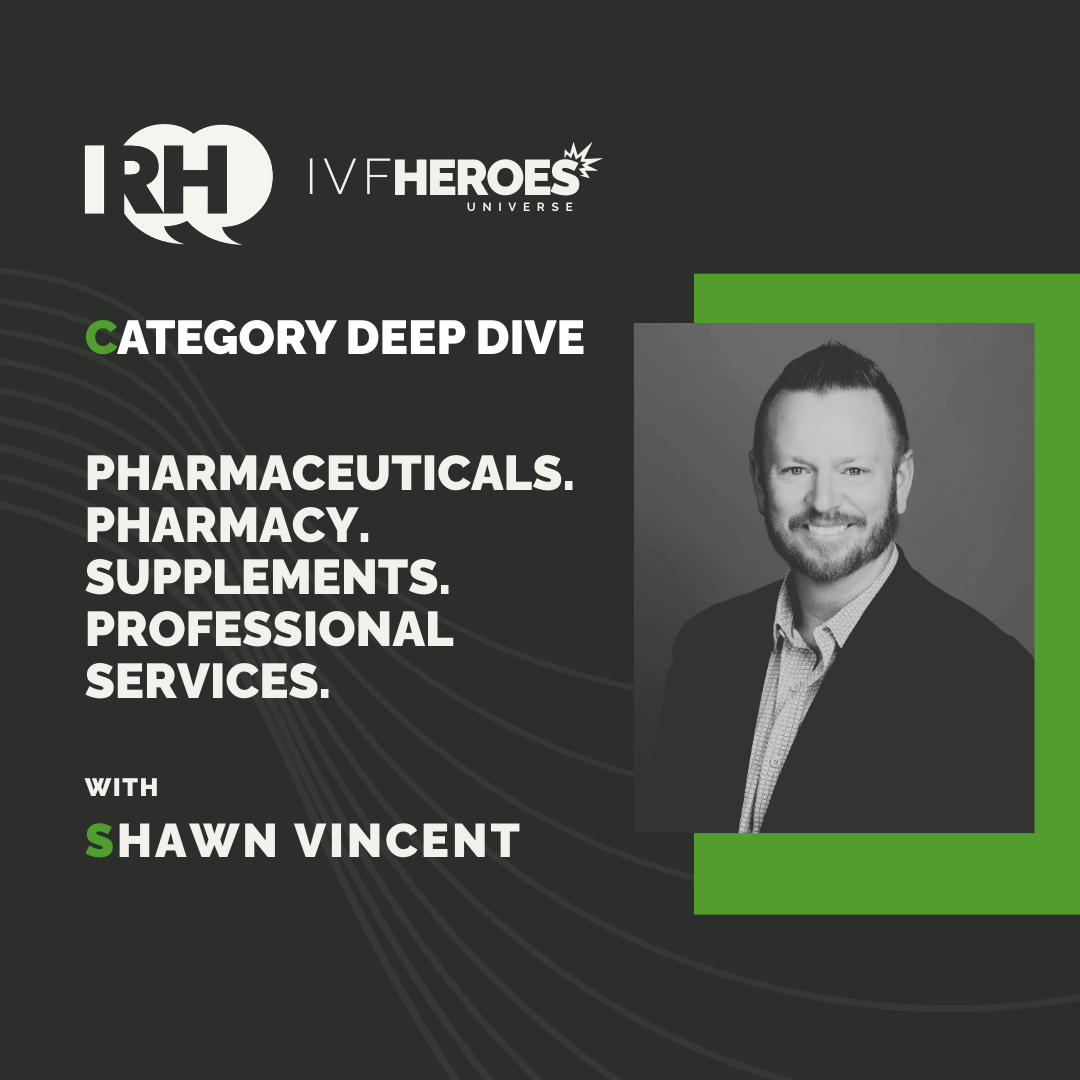
This final category overview takes a hard look at the shifting pharmaceutical landscape: legacy manufacturers, rising challengers, supplement disruptors, and the latest in professional services.
We also dive into:
Why the pharmacy “middle” may be hollowed out
Which models are positioned to scale (and which aren’t)
Who operators are calling when they need expert guidance
The consultants and firms quietly shaping growth behind the scenes
Get an even deeper inside look at the current state of fertility networks from our recent Intel Articles:
Pharmacy, Pharmaceuticals, Professional Services, Supplements
You Can Stop Being Left Out Now, Y’Know
Next Big Exposure Before ESHRE!
If your organization belongs to this category but wasn’t included in this category overview podcast episode, then your competitors are dominating the attention of your customers: REIs, fertility network executives, embryologists, and others.
These same competitors will get more coverage in a report or podcast episode, about your category
To start the year
Before PCRS
Before ESHRE
Before ASRM
Why let them get all the attention?
If you don’t want to miss out before ESHRE, you have to join the IVF Heroes Universe as a sponsor now, before the next deadline.
You read it. Your employees read it. Your customers read it. Why miss out when you get so much for so little?
-
Griffin Jones (00:09)
What are the drug makers up to?
What's going on with EMD Serono and Organon?
What's gonna happen with fairing now?
Why are Meitheal and Granada picking up so much steam?
Why is Bird&Be taking over supplements?
Why do I say?
The middle going to be completely hollowed out in sector.
and we got a list your go-to guys and gals.
the consultants, experts and firms you call for professional services.
when you're growing or in a bind. And a special guest joins talk about a few of them.
Enjoy.
Griffin Jones (01:33)
This episode has to do with two serious topics you want to talk to your kids about. Drugs and Trump. TrumpRx has shaken up the fertility pharma space quite a bit, as you know.
The administration did a deal with the EMD Serono.
Now there's big discounts on Gonalaph and other drugs.
They're working a drug called Pergaveris approved through the FDA.
that will in many ways compete with Menopur.
This is interesting for a couple reasons. Dr. Gata had told me that...
Organon's follow stem had been growing in market against gonalaph in the coming years. So this might blunt that. probably going to Organon to match the discounts or get close to it.
Now Ferring has a competitor.
to I saw a post from Dr. Amols.
in February at the time of this recording.
Where
he was publicizing cheaper alternatives to Menopur.
Ferring hasn't had kind of competition before, at least not in long I wonder if that affects their fertility team.
Late last year, had axed 500 employees, none of them were from the fertility division.
So is this going cause a hit
to their golden cash cow?
Are you going to see of your favorite fairing reps getting axed? Are they going to have a little bit smaller of a presence?
or maybe not.
Maybe this and some other things happening.
cause volumes to grow.
Ferring does better than ever and expands.
I think there would probably need to be some sort of intermediary event for that to happen.
But we'll see.
I really have no idea what Organon's doing.
Their CEO had to resign at the end of last year.
There was an investigation about wholesaler sales practices, that doesn't seem to have affected their fertility division at all.
And they must be cooking up some kind of response.
But for the longest time, R &D has just dragged in the fertility space.
And I think Granada Bio is making a big dent in that. started in 2018.
That's Evan Sussman, Steve Medeiros.
Now they're working on commercializing early stage assets.
across various drug classes.
getting them through regulatory approval.
all the research trials, the partnerships.
They with Gideon Richter.
to bring recombinant FSH to the US acquired OVIVA therapeutics.
that focuses on ovarian aging.
And they're also advancing an FSH product.
What I'm hoping for is that Granada is not a boutique name five or six years.
but it's a really big player in this space.
Keep your eyes paid attention.
And if you're into research, if you're into finding viable ways to work,
clinical trials your business might check them out.
And this cost debate was happening long before...
White House ever put their thumb on the scales.
Dr. Brian Kaplan had commented on a post of Inside Reproductive Health months back.
And he said, listen, if drug costs are 30 to 40 % of IVF order to reduce total cost to patients by 50%, wouldn't you have clinical expenses by 60 or 80 %?
Dr. Kaplan was.
observing that issue that you can't bring down the cost of IVF care without bringing down the cost of meds. I think Meitheal got ahead of that.
Some of you hadn't heard of Meitheal before last year. Many of you know them now. out of Chicago.
They're in generics and biosimilars.
They've and
and they're advancing an FSH in their pipeline.
and they introduced a multi-dose Ganarelex pen.
no idea Trump RX mean for me, Hall. I hope it doesn't blunt their growth.
because they could be critical in bringing down.
Griffin Jones (04:50)
It took all this to shake up that sleepy pharmacy category.
And I say this with due I have a lot of friends in the pharmacy sector.
But I just feel like so many the pharmacy space have checked out.
And I can't say I blame them either you just have to be the cheapest and you're just doing deals with networks based on price.
and F patient experience because it is what it is, your commodity.
Like a Spirit Airlines.
Doesn't matter if there's no value adds because % of the flyers are buying on price alone.
Or you have to be like a Mandell's.
Ultra customer focused.
You have to be so good at patient experience.
that patients and providers are negotiating for you.
to their payers and practices and networks.
because you are an extension of their patient experience. look at Mandela's Google reviews, it's of hundreds of reviews.
And they're not the only ones. There's a couple pharmacies with really good reviews. there are also some with really bad reviews. And now that you have TrumpRx,
think those are the only two camps that are going to win. Everybody in the middle. wonder if we don't see many of them either go out of business or just get bought.
and consolidate.
because pharmacies do a behind the scenes. And you can read your practices reviews.
often times complaints.
come from some sort of dropping of the ball you and the pharmacy.
And if pharmacies have to charge extra...
for these ancillary services, I suspect that they now will because the drug manufacturers going to take the haircut just by themselves.
then they either have to be so good.
at customer service like a Mandell's
or really cheap. have a 2.8.
satisfaction rating or whatever the heck and just deal with it.
You know why I don't think it will all go to the latter? of patients and nurses.
You can only push nurses so far, man.
I agree with Abby Mercado of Rescripted she predicts.
that this is going to take a lot of admin and put it on nurses.
think those nurses are going to want to push it right back off.
and customer service will remain a viable only a couple of pharmacies, only those ones at the tippy top.
Griffin Jones (06:58)
supplements. Interesting category.
Maybe a little bit of a sleeper I just don't think.
You can underestimate trend of consumer behavior.
In medicine,
and the type of brand loyalty that you see.
in other sectors of women's consumer products now coming into women's health.
That's here. And supplements are already routine.
70 % of patients say they take supplements.
If you're a doctor you say, no, it's not that high.
The source in Inside Reproductive Health's state of fertility supplements that came out in that only 25 % of patients
disclose their supplement use to their care team.
And for a long time I think Theralogix was the game in town.
I'd like to know more about what they're up to.
But Bird&Be
is really shoring up.
a very strong positioning in supplements.
because they have that it factor ja ne se quois
that really strong.
women's consumer products, lifestyle brands have.
And that's getting them into places like Ulta Beauty. They're in 300 Ulta Beauty locations.
That also makes them a source of
new patient generation, right?
because they are bringing fertility into the mainstream.
That's what I pay attention to.
as pay attention to are flocking to, they're flocking to burden B. You care more about the clinical research.
I wish I could go more into that.
and what Bird&Be is doing with their medical advisors.
but I can barely pronounce methylated folate.
So I'm just going to go ahead and leave that link.
in the state of supplements.
report that came out in Inside Reproductive Health in January. you can click on that if you're interested Bird&Be's clinical research.
Griffin Jones (08:30)
What another cameo appearance, I'm getting celebrity bombed here. Shawn Vincent from Blue Cardinal Advisors is here. Thanks for joining me, Shawn.
Shawn A. Vincent (08:39)
Hey Griffin, happy to be here.
Griffin Jones (08:41)
help me overview this professional services category of which you're a part of one category that I didn't think would be that interesting because it's not like it's AI. It's not like it's tech, right? But at the same time, it's like these are some of the most trusted people in the space, people that have worked in this field for decades and we can't get along without them. So it ended up
to me being a lot more interesting than I was kind of thinking. And I think maybe even more relevant because centers, fertility centers are using these professional services, firms, experts, consultants to fill in gaps from the labor shortages that have not gone away. I think in my opinion, 2021 and 2022 were the worst for companies abroad, but
I don't think most clinics have seen any kind of relief since then. What are you seeing?
Shawn A. Vincent (09:41)
Yeah, it's interesting. And even through having the ability to partner with you and having the opportunity to interview some of the physicians I've worked closely with with you for years, you're seeing the same theme, constant growth, but how do you keep the same care? Right. And there's also always been that struggle with making sure you can maintain the nurses and the staff's happiness. So how do you do that? There's all these different companies that are out there. We know that the REI and IVF space is bumping and there's so many different solutions coming at you.
and the providers, there has to be a way to kind of look through all of those and figure out what's going to be best for each particular clinic. And I've seen different clinics partner with different professional services, everything for ways of getting patients through the process faster, answering all those questions that they all get inundated with in the beginning. But then also on the back end, which we've talked a lot about is helping support the physicians and the nurses when it comes to the genetic questions they get as well.
Griffin Jones (10:39)
Our readers and listeners gave us the names of some of the firms that they work with and we'll go through a couple of those. Cedro Strategy was one of them and I figured out who that is. It's Ryan Salem. I don't know if that name rings a bell to you, but that is the CEO or he was the CEO of Blue Ocean Health, I want to say, in the UAE. I think he was involved in IVF Michigan for a long time. So he's done a lot internationally.
and they help with operating models and scaling the page and journey. And they've worked with some massive, clinic groups and that's a C level experience. So I think that some people are looking for staffing. Other people are looking for sales support. there's some C suite level experience there, which I thought was really interesting. And I think people look for expertise from a little firm called blue Cardinal advisors. You know anything about that one?
Shawn A. Vincent (11:34)
I do. So 20 years of women's health experience, starting OB-GYN and then jumped into the REI space specifically when I launched, helped launch Semaphore out of Mount Sinai back in 2018. This was going to be my third carrier screening company. And from there, I knew as the genetic testing was getting bigger and bigger, if I were going to go to the doctors I've been working with, they were going to have to have some type of support. So that's where I actually partnered with GeneScreen.
And a lot of physicians will say we revolutionized or changed the way that we actually support our physicians and our staff when it comes to the carrier screening process. Once Semaphore went public, my time there was done. I had had a great run in labs, but I wanted to go try something new. So I created my own company called Blue Cardinal Advisors. I took my experience and also the people I know and the thought leaders in the industry. And I wanted to be able to minimize the cost.
to all these startup companies that are coming into this space, whether they're international companies coming into the US or earlier stage companies that may be not able or not funded to have massive sales teams. So what Blue Cardinal Advisors does is we understand what they're trying to do to help the big clients that are out there. I want to hear their message, see if it's the right message, see if it's going to be something that actually is going to fulfill the right need. And I try to partner with them.
to help them go to commercialization faster and also save them money along the way.
Griffin Jones (13:02)
The value to startups of what you do is immediately obvious to me, but the value that you bring to them is also that providers and a lot of these network execs pick up the phone when you call them, which to me suggests that you're providing some value to them. How are you nurturing those relationships? Why are they so good?
Shawn A. Vincent (13:25)
It's a great question and that's the biggest, call it one of the most stressful parts I have because let's say I get presented to by a new opportunity every two weeks. And a lot of times I have them present to me these new ideas and I'm like, that's amazing. Let's go. That sounds great to me. But what I try to do is go out to certain people that I feel are passionate about that particular topic or we've had discussions around it in the past.
Some may be genetics, some may be staffing, some may be PGT products, whatever it is, right? There's so many that you've reviewed all throughout this time. So what I try to do is find those different providers or even nursing staff or even head nursing staff. I would say, hey, this sounds good to me. Could you take a look at this or have you heard of it? And does it make sense? Will it help your practice? Will it help your patients? Is there going to be an ROI to you and your practice?
Some of them may meet one or two criteria, but then they may fall flat on others and it doesn't work. So I try to be careful on going to the same people too many times because I don't want to dilute my credibility by bringing them every one of them. So I'm trying to create new touch points and different things I've learned through the last three and a half years with Blue Cardinal to say, okay, this sounds good, but it might not work because of this.
Griffin Jones (14:50)
people say they got a guy, you're who they're talking about. I look at some staffing needs that are happening across the place and I see a lot of practices struggling with filling their anesthesia needs. They might have a group and then that group has some of their anesthesiologists retire or they just can't meet the needs or they get way more expensive. And then I also see
Shawn A. Vincent (14:52)
Yeah.
Griffin Jones (15:18)
Probably half of the anesthesiologist workforce going to retire in the next five ten years and so this is gonna get worse and it doesn't seem like we're putting as many people in the pool to replace those folks at least from what I read in that report and I see a lot of people using Kaleidoscope Anesthesia. It's cool from our perspective because
We've worked with them and then we see the groups that they work with and we get to interview some of the people that they work with like Lynn Westfall and Dr. Ben, Dr. Lynn Westfall and Dr. Ben Harris. And then we see them start to work with more practices and then some months go by and now those people that may have originally heard about them on Inside Reproductive Health get some experience working with them.
Shawn A. Vincent (15:53)
⁓ huh.
Griffin Jones (16:12)
Then they get more and more exposure and you've had kind of ⁓ a similar Working relationship with GeneScreen. I think that and I covered them in the genetics Episode and We don't have them listed in the professional services category, but they kind of are right
Shawn A. Vincent (16:31)
so GeneScreen is interesting. Like I said, it started Semaphore partnered with GeneScreen back in 2018. And way that GeneScreen has adapted to the changes in genetic testing has been pretty interesting. When GeneScreen first partnered, it was going to be a comprehensive consult. And just to be clear what a comprehensive consult is and
We've had some great interviews on your podcast about what these are with so many brilliant doctors. Comprehensive is where they do a 45 minute consult with a patient and a partner. They do family history. They talk about everything. And you also are going to make sure that you get a comprehensive couples report. What we've learned is some practices like US fertility, IVI RMA, and some NCCRM.
We now have been starting a trend called stratification of risk. And we have those patients come into GeneScreen after you have the patient and the partner. We have a way to look at those risks based on the criteria that that practice prefers. And then we can put them in a low risk model or a high risk model. Low risk model is still gonna get a 20 minute conversation. We can answer all those questions at GeneScreen so they understand what.
what the test was, what the results mean, what is a carrier screening, and they still get a report. Comprehensive, it's around a lot of times like 12 % of the time, it's allotted a 45 minute consult. So we can get patients through faster at GeneScreen, but we're still seeing every patient to make sure that we're providing support for the providers as well as the staff. But just to go back, just to touch on one other thing, I smile when you describe that other commercial
growth that you were describing, because that's what happened with GeneScreen. It was, let's start with, we were in RMA New Jersey's boardroom, pitching some of the physicians there. And it was, if they approved what we were considering doing, we knew we could take this and take it across the country. So after we had RMA New Jersey, which wasn't even EV back then, then we went to US Fertility, and then we went to KindBody.
And then there was more and more and the street cred continued to grow out there with all the different groups that we were closing, working with, and we were getting word of mouth out there. So really there wasn't a lot of banging on doors. It was a lot of word of mouth. So if you look at the projectory of ChainScreen starting in 2018, it was quadrupled in business, quadrupled in business, and then doubled the year after.
Griffin Jones (19:06)
And then you're throwing gasoline on the fire in a positive way and then it becomes the rule rather than the exception and then it's like, well, who isn't using GeneScreen
Shawn A. Vincent (19:16)
yeah, so then you sprinkle on a lot of the donor business that GeneScreen does. There's some hereditary cancer stuff that's kind of tied in there now because of the access for patients having PGT. Also, we're doing PGT consults because sometimes some of the things that they're gonna be reviewing, they wanna have it reviewed by a third party genetic counseling company as well. So it's been a good growth strategy and... ⁓
Jill, the founder, is always very patient-centric and would rather make sure that it's done right, supporting the physicians and the patients first. So I feel like our trajectory has been smooth and even with our big growths, we've always learned patient and physician first.
Griffin Jones (19:57)
one of the areas that I know that I want some more ops expertise to direct people to so if people are working on on sales stuff, especially on the b2b side sales I'm sending them your way if it's marketing I can send them to some people if it's some things that they need with
patient concierge and one of the areas that I have kind of struggled with is like, who's like the ops expert that I should send people to? And I want to check out the fertility consultancy more. To be honest with you, I don't know a lot about them. The reason why I know a little bit about them is that they participate in our IVF Heroes universe. And so I've got to read a little bit about them, but they provide services to help streamline clinics, to help with outcomes.
benchmarking, SOPs, management decision making, optimizing results and.
patient satisfaction, delivering some systems to both get feedback and implement at working on clinic reputation and expanding clinic capacity. So that's a group that I want to learn more about. They're fertility consultancy, fertility consultancy.com is where people would find
Shawn A. Vincent (21:11)
being in this field for so long. Some of the greatest partnerships I've had with laboratories, blue cardinal advisors, GeneScreen, whatever it is, when you can find a tenured nurse who's been there since for years and have gone from seeing patients, supporting her providers.
and then gets opportunities to do operational strategic roles. Immediately, the one person I think of is Jessica Medavich. You've seen her become so successful because she's lived it. She's done the day to day. She's kept up with a group that's grown so much. And when you even watch their growth strategies, even through a partnership with KKR, she's been able to maintain and keep patient care a priority.
And that also came through when we did our interview with Maria and Tom Molinaro as well. So I love those consulting concepts and they're desperately needed out there because these groups are growing so fast. And even the people that can run point on those there's you just listed call it eight different initiatives that are like critical when it comes to having a successful practice in having that culture within that goes out to the community as well.
So I think that's gonna be a big emerging market that you just touched on. And I also think you're gonna see other, even nurses, if you will, that have been in this industry for a long time. Because I've even been approached by some and saying, hey, is this something do you think I could do in the future where I could help other practices out?
Griffin Jones (22:48)
I'll add to that, I think another expert comes from that RMA tree in terms of building new practices. put Lindsay McBain on that list for sure. And I don't want to too much, too much sunshine for RMA, but I think that someone that also came from that tree or just did work with them in the earlier days was Dwight Ryan. Maybe I've got that wrong. I know he did a lot of work with RMA of New York.
Shawn A. Vincent (22:58)
Absolutely.
Yeah, no, you're right.
Griffin Jones (23:17)
But MedTech
Shawn A. Vincent (23:17)
Yeah.
Griffin Jones (23:18)
is one of those groups that I put on the list of that's one of the people and firms that clinics go to when they're building a lab for the first time. And they have been for a really long time. It's like the blue chip for lab building. And maybe that space gets a little bit more competition. Maybe there's more people trying to do that coming in. I think that they'll have big shoes to
to try to replicate because I think people really trust Dwight. Rita Gruber worked for them for a long time and she was awesome and people just trust them implicitly. When you're building a lab, that's really what you need. You need to know that these are people that have done this so many times before. They've run into all the mistakes and we're not taking guesses with people that this is only their fourth or fifth time doing this. They've done it several times a year for the last.
Shawn A. Vincent (23:51)
Yes.
Griffin Jones (24:14)
many, years. And I think that they're among the people that trust the
Shawn A. Vincent (24:20)
I couldn't agree more Griffin. He's on my speed dial list. If anything falls under the lab utilization or anything like in his sweet spot, I certainly always reach out to him. He's so busy with all the different things that he's doing, but if I can, I try to set up a call with him and I certainly try to get his expertise. He's definitely on the list for sure.
Griffin Jones (24:40)
What else do you see happening in this category that you think people need to be paying attention to this year?
Shawn A. Vincent (24:45)
I just think it's going to be, it's going to be a big shift on still continuing to just focus on the patient care. We're seeing so many changes. We're seeing so many growth strategies that are kind of hopefully perhaps settling down. I just think that it's all going to revolve around helping access to care. How many times did we hear that in 2025? I think there's going to be so many groups that are trying. I, there's a lot of those out there that help with the access to care. I'm hoping that some of those kind of merge together.
so that we can kind of unite them.
Griffin Jones (25:16)
Are you talking about
that like patient journey automation kind of category, like the digital clinic, patient concierge, the
Shawn A. Vincent (25:23)
Yes, absolutely.
There's so many of those that are coming to me and there's also so many products that are like, hey, we can do this at home. We can do this at home, but we can't do this. So I just feel like there's a lot of silos right now. And the advice I give to lot of the companies that present to me, it's like, could you maybe partner with a platform or could you also partner with this group? Maybe lower the egos a little bit, bring three great products together and have one good product.
and then bring that to a bigger group and try to solve a couple of solutions with a really good platform.
Griffin Jones (25:57)
You think there's too many point solutions?
Shawn A. Vincent (26:00)
If I were a provider or a group, I would be yes. I mean, it's the market we're in. We're in a group that's exploding with all this innovation. Like you said, AI, but there's so many other things too. I just think that it's great for all the attention that our group's getting and it's fun to watch. And it's exciting for me who went our journey. I have two great kids from fertility. So it's personal to me to see all the benefits, but I just think there's so many. I don't even know how
providers are dealing with it. I'm noticing in some groups, they're creating, I'm sure you've seen this, they're creating a new role for some of these groups to have a person that manages all these new presentations, concepts, partnerships, and it makes sense because there's so many of them. How do you go through all of them and identify which ones you're going to partner with? We've seen that with US Fertility, IVI RMA First Fertility, and others, you know.
Griffin Jones (26:57)
our best job to make it as easy for those folks as possible as we start to build out data.insidereproductivehealth.com as we start to categorize this, building it into a relational database. We're not doing it overnight. We're doing it at a pace that makes sense for our company, our size, but these are the types of things that we're trying to map out and we appreciate you coming on to give us a little color commentary over it. Thanks, Shawn.
Shawn A. Vincent (27:13)
Yeah.
It's a pleasure being on. I appreciate all you're doing.
Griffin Jones (27:28)
Here's a group that maybe you don't know about that you should. IVF service. Have ever heard of them?
They do preventative maintenance, they do repair and service of IVF lab equipment.
They relocate equipment, disassemble it, package it, relocate it, unpack it, reassemble it, install it.
all according to the equipment certification.
Who would have thought?
That's a business.
And yet if you work in our field...
You're thinking, yeah, of course. Because who would you want to do that?
other than people that do that for a living. That is ultra sub specialized. I gotta meet these guys. Who's their president? Looks like Matt Haley. I gotta meet Matt. That is a cool.
idea for a business. I bet a lot of you can take advantage of that. It's called Nationwide IVF Service, but they have this lab called the Gene Perti Calibration Lab. You know who Gene Perti is.
It's a controlled environment and that's where they calibrate all the equipment that they use.
to make sure they can trace all their measurements back to national and international standards.
like those used by National Institute of Standards and Technology. I bet a lot of you didn't know that. I a lot of you were going to be calling them.
Some of you have also told me about EverSana.
They have a donor eligibility system. It's an automated web-based platform. It assists in donor eligibility determination.
So if you're an egg bank, a sperm bank.
third party agency.
according to the source that's referenced in the State of Professional Services report.
They've had 120 plus successful FDA inspections. They've been doing this for 15 years.
And they say it saves 60 % in cost and 40 % in time.
So if you're trying to grow your third party program, you probably want to read about Eversana's donor eligibility system.
These professional service experts should be in your Rolodex. Luckily, you can just go to data.insidereproductivehealth.com, go to the professional services category. They're all right there for you.
Shawn Vincent
LinkedIn