/*Accordion Page Settings*/

Technological Innovation

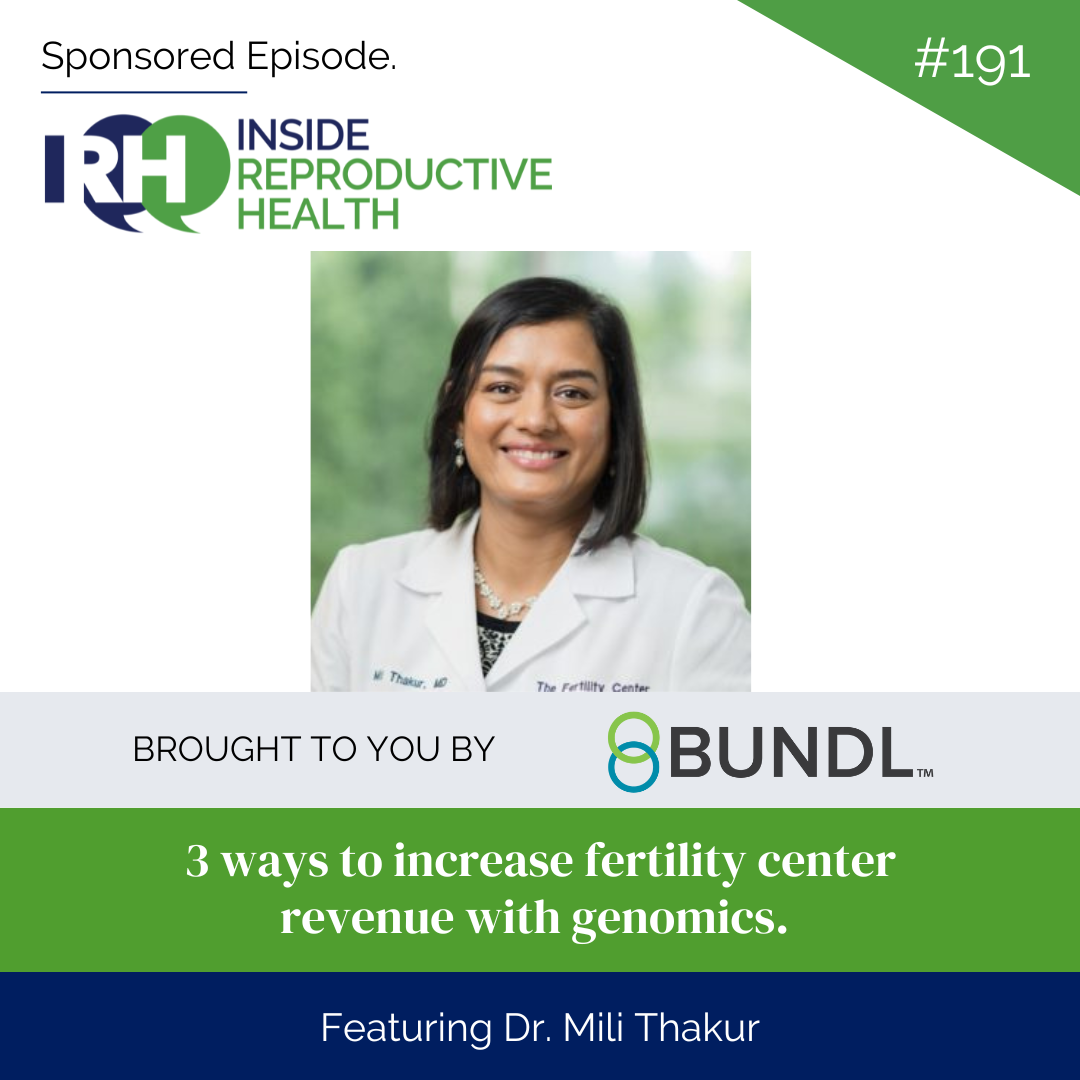
191 3 ways to increase fertility center revenue with genomics featuring Dr. Mili Thakur

DISCLAIMER: Today’s Advertiser helped make the production and delivery of this episode possible, for free, to you! But the themes expressed by the guests do not necessarily reflect the views of Inside Reproductive Health, nor of the Advertiser. The Advertiser does not have editorial control over the content of this episode, and the guest’s appearance is not an endorsement of the Advertiser.


Should you consider integrating an in-house genetics counselor into your practice?

Today’s guest, Dr. Mili Thakur, makes her case on the future of genomics and its place in the REI medicine space. She walks us through how an in-house genetic counselor can boost practice revenue and optimize patient retention.

Tune in as Dr. Thakur gives us insights into:

  • Her 3-point business plan showcasing the importance of genomics integration into REI practices

  • The number of cases she believes warrants an in-house genetics counselor [It’s not as high as you think]

  • Why Carrier Screenings matter [And her criteria on how she vets companies]

  • The future of Genomics [And why it’s the biggest investment opportunity even beyond the infertility space]

  • And more…

Dr. Mili Thakur:
LinkedIn
Genome Ally, website coming in May

Transcript

Dr. Mili Thakur  00:00

I think it would be dependent on the total volume that you're able to bring in to the practice. I would say if a doc is seeing about like 10 to 12 some of 15 new cases in a week, you know, there's going to be at least two or three of them that are genetics or their hidden genetics like they're not obviously I but like recurrent pregnancy loss if you're seeing five or six recurrent pregnancy loss patients in a in a week. You know, in about two weeks, you're gonna have a PG DSR case.


Sponsor  00:33

This episode was brought to you by bundle, you may be able to receive a free list of financially qualified IVF patients across the US and Canada. Contact bundle at bundlfertility.com. That's bundlfertility.com/contact-bundl. Today's advertiser helped make the production and delivery of this episode possible for free to you. But the themes expressed by the guests do not necessarily reflect the views of inside reproductive health, nor of the advertiser, the advertiser does not have editorial control over the content of this episode. And the guest appearance is not an endorsement of the advertiser.

Contact BUNDL for financially qualified IVF patients

Griffin Jones  01:27

A call for action amidst the turmoil of the reproductive genetics field now I didn't write that but my guest did her name is Dr. Mili Thakur. Dr. Thakur is double train. She was the first fellow to graduate from an ABOG ACMG combined fellowship in reproductive endocrinology and infertility and medical genetics. She did that in 2017. From Wayne State when she left fellowship and join private practice in Grand Rapids, Michigan, she made a business plan she made a business case for why they needed an in house genetics counselor at a four Rei practice in not a very big market. We go through that business plan having an in house genetic counselor and having genomics be a part of the REI practice today, Dr. Thakur supports that plan with three different points. First is the revenue that's generated downstream from genetic counseling, the additional cycles, the testing storage that might be necessary. Second is patient retention. Dr. Thakur argues that if patients really struggling with a genetic abnormality and you're the one that finds it, they're going to stick with you. Third is donor IVF cycles if you can prove that they're necessary from finding abnormalities then that patients going to need donor cycles. I pressed Dr. Thakur on why genomics is so valuable to the practice why it's so valuable to the patients as well. And I come across a point where her background might give her an insight that is not at odds with you potentially and that has to do with carrier screening and the variance in the quality of panels. I've got the impression from my nine non scientific polling of many of you that it doesn't really matter who does your carrier screening. There's a dozen or so companies out there. Many of you have told me it's one or the other doesn't matter too much. Being a geneticist, Dr. Thakur has a different opinion. Dr. Thakur thinks the carrier screener does really matter. And she shares her criteria for how she and her genetic counselor that carrier screening companies criteria such as actionable conditions versus non actionable conditions, and they have to be actionable criteria of the curation of data that labs have to be able to curate that data and I pushed afterthought core on how scalable these revenue upsides are for fertility networks that might be trying to cut the lowest possible deal with a carrier screening company that leads us to the question does someone with a genetics background have to be a part of the governance of a fertility network the same way a chief medical officer and a chief scientific officer are asked Dr. Thakur for a ballpark what number of genetics cases make sense to have one full time in house genetics counselor turns out not that many in her view, Dr. Thakur surmises, we have 10 to 12 new patients a week two or three of them might very well be genetics cases, she gives the caveat that you have to be looking for that which is at the crux of the whole conversation. And she shares more detail about that we talked about the future of genomics and art and how that might become so much bigger of a marketplace than the infertility segment alone. Dr. Thakur thinks that genetics is far and away the biggest investment opportunity in art. So I asked her why the heck doesn't it look like that now with genetics companies closing their fertility divisions? Her answer made sense to me. I want to see if it makes sense to you. Finally, Dr. Thakur talks about her new venture genome ally that she's beginning to prove concept for and bootstrapping my thumb to the wind test of all of this is that we are in an atypical role for genetics in the fertility field and then it's going to come roaring back my perspective. Isn't that interesting? I think Dr. Thakur is more so I hope you agree and enjoy this episode. Dr. Thakur, Mili, welcome to Inside Reproductive Health.


Dr. Mili Thakur  04:57

Thank you Griffin for having me. It's a privilege to connect to your audience.


Griffin Jones  05:01

It's a pleasure to have you on you've become a bit of a voice for genomics in the fertility center, I saw that you were quoted in an article that one of our journalists wrote a few months back about the changing business landscape of genetic testing and genetic counseling. And then I've seen you at a few talks throughout the field. And so let's start there, maybe how did you become a champion for genomics inside the fertility practice? 


Dr. Mili Thakur  05:34

So Griffin, I am a combined reproductive endocrinologist and a geneticist, which is great privilege that I had off training that way. So I am a OB GYN, I always took care of women I trained back in India did a residency there then came to Wayne State in Detroit did a residency and fellowship here. And that phenol shear force, namely, for me, was an opportunity to combine both the fields. So I'm the first fellow to graduate from a combined reproductive endocrinology and infertility and medical genetics fellowship. And that's what got me interested because I had a different perspective of both the fields combined together. So even though I trained in traditional genetics, and I know how to do cancer genetics, and pediatric genetics, and, you know, genetics for neurological conditions, and I trained for it with my fellowship, I specialized in reproductive genetics. And because I'm a reproductive endocrinologist, I do IVF every day, that's part of my, my practice, I take care of patients from the infertility struggles, and help them with both of these things combined together and merge, which is an amazing opportunity.


Griffin Jones  06:48

What's his specific use in your own practice in the way that you practice that you feel that you've benefited from having that genetics part of the or that genetics fellowship, that you feel that you wouldn't have been able to implement in your own practice of REI had you not had that fellowship?


Dr. Mili Thakur  07:09

So I think all reproductive endocrinologist or REIs do genetics as part of their job. But the advantage that I had from this additional training was that I was able to be well versed in the lab aspect of it, the moleculer aspect of it. So I understand the test, I just don't offer the test, I understand what's the science behind those tests. And I am also able to take care of like, complex situations that involve genetics. So because of our training, you know, we, during my training, I took care of like newborns who were diagnosed by the newborn screening program in the state of Michigan. So I've seen those conditions firsthand, and how they affect children. So when a couple comes back to us, saying that they have a child that's affected, you know, I've seen the other aspect of it. So the combined fellowship helped me hone into a specific area. So it's not difficult for an area to take care of genetics on a day to day basis, they do it all the time that traditionally it's been done. It's just I've been able to cater to a niche of patients, because I understand that complexity. And it's easy for me to say, you know, what needs to be done here and how to select the test. So there is this specialization that has developed based on that


Griffin Jones  08:36

I won't go too deep into the clinical, because it's not a clinical show is a business show, which is what I'm more qualified to talk about. But I am curious when you're talking about not just being able to read the test results, but to understand the science behind the test results. Can you think of an instance where it was really paramount that you knew the science behind those test results, as opposed to being able to just read the test results to any does any one instance come to mind?


Dr. Mili Thakur  09:04

So one of the common tests that all are used, and I know your audience is primarily people working in the reproductive medicine field is a carrier screening. So preconception carrier screening is a common test, it's been given by different companies. So there's like more than about 10 to 12 companies that offer that test, it may be even more than that. So each one of those companies uses a technology called next gen sequencing. And each one of those companies offers a panel of tests and that panel can range between sometimes 23 conditions to like now 600 700 conditions. So what advantage that that additional testing brought for anybody working in the field of reproductive genetics is that I understand carrier screening testing from a different angle sometimes i i unlike colleagues like myself, would be able to understand more than the medical representative or the salesperson who's coming to sell the test. So for an example, like for cystic fibrosis, you know when for cystic fibrosis is a common condition that we are carriers of that tests can be done by next gen sequencing, most labs are up to par and sequencing that gene and like looking at different spots on there. But then when a certain type of mutation comes through, there is another additional testing called five t testing. So to be able to ask the medical rep to say, do you do five t testing? Is there a reflex that we can do if needed? Same thing for like fragile X? Do you do AGG repeats? And how is your curation of radiant? How often do you guys look back? So we have another stringent layer that I'm putting any tests that I am wearing for my patients through? So it helps me serve my patients better? Because I have an understanding of what they're doing behind the scenes? How is that report being signed off? You know, what are the things that they are not reporting out, because they're not reporting out the whole gene to say, and so in genetics, you know, our colleagues in genetics will relate to this much more, we don't say, hh, you're negative for the condition, we say there is a risk reduction. So you being a carrier, based on an ethnic background is a certain number. So say one in 30, after the test, that risk slows down to being one in 10,000. But it's never going to be negative, because the science hasn't advanced to the point where they can look at the whole gene completely. So by knowing that back end workflow, and what is out there, I can challenge them and have them give us the best possible test.


Griffin Jones  11:47

So you can vet the tests better than you could if you didn't have this background, and you mentioned a couple of different applications for it. So you're ultimately getting more productivity from the test, you're, you're getting better results from the test, is it also to vet so are some tests? Did they have features that are unnecessary that are, that people are paying for? Is that part of the vetting or not as much?


Dr. Mili Thakur  12:12

It is. So basically, what we do is like for each of the patients that comes to me, especially with complicated, complex genetic history, we are able to find the right test for them. And then kind of streamlining the cost of it as well. So as, as one of your previous guests on the show, Dr. Arredondo, Paco, always says, you know, we have to cut the frills out of the thing. So sometimes with these complicated histories, you know, because we are in such a busy practice, you know, you might order five tests, but then if you had that understanding of the test, you would be able to go straight to the test that's right for that family, and be able to serve them. So a quick example is, I had a patient who will their their dad had a condition and five of the boys, you know, three out of those five had a certain condition where their hair nails and skin was abnormal. They now wanted to do IVF. And they wanted to do IVF, because they didn't know that genetic mutation in their family, their dad and mom had gone through some genetic testing 20 years ago, they didn't know you know what the mutation was, at that point, they just wanted to do IVF with PGT A and select for boy embryos, they said, We don't know what's affecting our family, three out of the five boys are affected by this condition, we don't look good, right? So let's just have a boy so at least he wouldn't be bullied in school or have issues there. And because now they were coming to see me and times have changed. Now I could look at him and say you have some form of ectodermal dysplasia, there is a panel available for it. And then we worked with the family and with our colleagues in genetics at a local hospital, called them the right test, we were able to identify a variant now variant of uncertain significance means that you know, we don't know if it's really the causing disease because it had never been reported before. We had a family where three boys who are affected to were not affected, we were able to segregate the variant test everybody in the family. And then not only that person, but we were able to identify a novel variant. It's never been reported. This is the first family in the entire world to report with that condition. And then that person and his brother went through IVF for selecting embryos that are disease free, they were able to transfer all different genders that they wanted to and also have a healthy child for two of the brothers that are affected. And so coming back to your point of like the business aspect of it, had I just gone and done IVF for pcta saying okay, we can't find the answer for you. We would have just finished up with one cycle, the patient wouldn't have been served to the best interest because their mystery would not have been solved their story would still be like, we don't know what's affecting the children in our family, right. But now with this additional testing, our practice, my practice got not just one, but multiple IVF cycles, because they were searching for the right embryos, they're coming again for another transfer each one of those families has had done now for transfers, right, they have two children each. So it's a long term relationship that you build. And the revenue generated from all of that is what then justifies that process. So I spend extra time because I'm extra trained and like, I have this additional training. So I spend extra time but then I make up for my time with that additional revenue that I generate from these cases. So the biggest thing that's driving us is patient benefit. Now they have an answer. Now they have a healthy family. But it took extra effort, it took some time to get to that answer. And you know, we were able to solve that case. So that additional piece is what makes this model sustainable. 


Griffin Jones  16:16

So we ventured into PG ta but back to carrier screening for a second, I had always gotten the impression from doctors that they didn't really care which carrier screening provider, they chose that many of them do care who they use for PGT A but for carrier screening, I'd always gotten the impression that doctors feel like that it's a commodity, is that less so in your view? Is it? Is it not as much of a commodity as doctors think it might be? And that there's a bigger difference between carrier screening providers?


Dr. Mili Thakur  16:45

Yeah, so actually, for from my perspective, and many of my colleagues in genetics, we are extremely thorough and careful in the products that we select, we consider them as products. And like any other thing that a clinician would be offering to their patients, you know, you have to understand what they are doing. Because the main things to consider is one, are there actionable conditions on their panel. And there are conditions that are not actionable, there are very, very rare conditions on there, and they are going to be reporting those out, you would have a very high positive rate, and you will have to deal with the back end of it. So first should be actionable conditions. Like I don't want a panel that has an MTHFR on it. MTHFR is a genetic change. That's very, very common. So I don't want a panel that has that change, because it doesn't change what I do clinically. And it kind of raises red flags for no reason. The second thing is how thorough is reporting, you know, of the different genes that they're doing? And then also about how is the curation? So some of the our viewers will, you know, be able to understand this? Well, it's like these changes that are being reported, some of them are very new, and they are being reported as variants of uncertain significance. We don't know if they're gonna cause disease or not. But because the science is advancing so fast, all of these labs have to curate, they have to keep every six months look back into the database and say, okay, now, is this mutation something that's deleterious? is causing disease or not? Is it something that's going to be causing problems? So if a lab does not curate their data every so often, then you're going to have gaps in there. And then in prenatal testing, or in preconception testing, if a variant is reclassified? Is the lab going to let us know? Because you know, for future, like if this couple is going to have situations where a couple came to us for second opinion, because despite a normal carrier screen, they had an affected baby, because they had a variant of uncertain significance, which was not reported out. So we went back to the lab, and we wanted them to look back at the data, reclassify the variant, and that's why, you know, it's important for busy clinicians, REI providers, doing high volume IVF, all of these networks, to consider working with somebody who's, who can take care of those extra genetic needs, like when you're picking up product, no matter which genetic product you're using. So some of the products that we use, one of them is carrier screening, another one is stereotyping. Another one is products of conception screening. PGT is another product, you have to know what you're offering to your patient. What are the gaps there and challenges there so you can counsel them appropriately. There are some companies that are not reporting out HCG repeats and FMR gene. So if you've got somebody in that certain situation, then you will have to request it extra versus there are some companies that will do the FMR gene, and if they found a certain thing, they will do the AGG repeats. So when the results come to you, you're able to say, yeah, this is something that's actionable or not actionable. So the complexity of it is being lost because of the volume terrible providers are seeing and you know, you were at some recent conferences, there is this shortage of REIs, like all of us are doing a lot of cycles. So in all of that, the piece that a single test is playing is so small that it can be overlooked. And you know, things can fall through the cracks. So there has to be safeguards put in place of like, okay, which, which tests are we doing, if we said to a patient, you are negative. And sometimes, you know, in practices that don't have that expertise, or leverage, a nurse might give out test results. And she might say, Oh, you're negative, and the patient who doesn't know the science of it just thinks, oh, they're negative for cystic fibrosis, but that's not the case, do the test that, that your risk of being a carrier has now been reduced. And now, you know, your partner has been tested and their risk is reduced. That means there is still a likelihood very, very small, though, that something could happen to a child, you know, so the understanding of it is a little bit different. Our viewpoint is different, basically. So I would read, I always read the test, I understand I sit down with the reps, you know, I would look at all the information before I will select the test.


Griffin Jones  21:33

With regard to understanding I read your bio, a little bit of it before we sat down for our interview here. And it seemed that your center, the your fertility center, the Center in Grand Rapids hired an in house genetic counselor in 2017. Is that right?


Dr. Mili Thakur  21:50

Yeah. Yeah. So I started out of my fellowship in 2017. So as soon as I landed the job, you know, I wanted to have an in house genetic counselor.


Griffin Jones  21:59

Tell me about how you made that case at that time, because at that time, you're an independent center. So now you're Ovation now US Fertility at least on the lab side of things, but the at that time, you were completely independently owned fertility center, is that right? 


Dr. Mili Thakur  22:14

Yeah. 


Griffin Jones  22:15

And Grand Rapids is not a huge market. And so how did you make that case that, that you needed an in house genetic counselor in the practice?


Dr. Mili Thakur  22:26

So I had to write a business plan. So like anything else, we wrote a business plan. And, you know, I had a strategy of how to make it financially viable for any practice to embrace a new set of paradigm, you know, you have to make the case of how we are going to make it financially viable. And the way we did it, and one of your previous guests, Amber gala talked about it, you have to work with whatever is happening in that state. So in some states, genetic counselors are able to bill at the time, you know, in Michigan, genetic counselors, were not able to build for it. So the way I did the things was one, in my mind, you drag generate revenue downstream from the genetic counseling. So if you are able to one, number one is engaged the patient, if somebody comes to you, and you're able to provide the right service and engage them, you're gonna have a better chance of them going through a complicated treatment. That's number one. The second thing is patient retention. If you've had somebody coming in for failed cycles, and now you're able to do some genetic tests, you find the abnormality, they will, the patient is not going anywhere else, no matter how long it takes. The third thing is because of all the support that you have from a genetic counselor, or that expertise that I have, because of my training, you aren't able to have them go through donor cycles, like if you found a genetic mutation, and they now know that there's something wrong, they're gonna do egg donor or sperm donor, and you're gonna be able to engage them. So when I wrote the business plan, those are the avenues that we were able to do and you wouldn't believe it. Like in the first three months of our genetic counselor working, we were audited, like any other practice with audit their new process, and we were we were cutting even because like I was able to see double the number of patients I like I was seeing my own infertility patients, and also seeing a patient with the genetic counselor at the same time. So her time and my time was build right and then I was able to feel a level higher than what I would with her support. So if you have a comprehensive visit, they are able to spend half an hour with me and then half an hour with my genetic counselor. We are able to provide the best possible care for them. We We are able to solve some of these complicated situation order the required amount of testing on that same day, and then I was able to build a level five visit. And because we were able to get them to write tests, we were able to engage them to do IVF with PGT M, PGT SR, which is like many, many cycles would come out of that one, one situation for that couple, they might do multiple cycles to find the right embryo, and then they will come back for their second and third children, because their embryos are stored with us. So if you are able to do the math there, you know, you did multiple IVF cycles out of that one console that you could do because of your expertise or your partnership with that, that genetic counselor. So and, you know, Amber, gamma had previously told you the salary that a genetic counselor would have, it's usually I heard her podcasts with you, and she mentioned somewhere around 100, 250,000 Is what she mentioned, based on their professional society survey, 100 or 150,000, you are able to do it, get that revenue back in a few IVF cycles. Right? So it's like, yeah, so it's the understanding of the best care for the patient, in a model that embraces that new technology. So you're freeing up your staff, you're freeing up the doctor to do other things they are able to do IVF practice while that person is totally every day doing complicated genetics for you.

Sponsor  26:34

The number of patients who do not continue after a failed IVF cycle is on the rise at some IVF centers to counter the decrease in IVF. Revenue. Fertility Centers are turning to partners who have IVF ready financially qualified patients, but who don't yet have a fertility clinic. Courtney from bundle has a list of treatment ready patients in each city, there is no fee, but the offer is for the US and Canada only. Contact Bundl for your free list of financially qualified IVF patients at bundle. That's bundlfertility.com/contact-bundl.

Contact BUNDL for financially qualified IVF patients

Griffin Jones  27:19

Maybe we should talk about that time that was freeing up for you because I'm understanding the picture of the revenue that is generated downstream from the genetic counseling that you're painting. I, if I were a hiring doc might look at you and say, well, I've got you, what do I need to hire a genetic counselor for you just did this double fellowship, you have this genomics experience and credentialing, so why do I need to hire a genetic counselor when I have a doc that also has this training?


Dr. Mili Thakur  27:49

Sure. So one of the key things pioneers in the field right now are talking about this, you should use or utilizes the right word, everybody at the top of their license. So for me as an REI, the top of my license is surgery. Right? So if I'm doing a hysteroscopy, if I'm doing an egg retrieval, if I'm doing an embryo transfer, nobody else can do it in my practice. The nurse can't do it, the genetic counselor can't do it. So that's my top of the practice. What the genetic counselor does is she works, she or he, you know, any they work on the top of their license, and their top of the license is to be able to take that information, break it down into an actionable plan, get the testing ordered, and then be able to give the test results. And then you're able to utilize the doctor's information of like, oh, yes, you need IVF. And you're able to use their expertise to take that patient through IVF. So the way we have it in our practice, and, you know, I'm about to launch a new venture where I would be working as a liaison like I want to uncover the case for the doctor to then take it through for IVF.


Griffin Jones  29:05

I want to ask you about how you would liaise with them and what you plan to do for that venture. I'm interested and it's making sense the type of license argument for your genetic counselor, there's four or five Doc's in your group four or five REIs? 


Dr. Mili Thakur  29:21

Yeah, so there's four, 


Griffin Jones  29:23

Do all of the docs utilize the genetic counselor or or just you?


Dr. Mili Thakur  29:29

The way we have it set up in our practice, or the way I set it up for our practice, is that the genetic counselor is available for any of the patients that are going through so we have tried to specialize in genetics for the whole practice. Nobody else except for we and the genetic counselor and we have an genetics assistant are the ones that are holding all the workflows of the genetics so the dogs don't have to worry about it. The nurses don't have to worry about it. They don't even give the test results about They don't even get a phone call, we have kind of streamlined it to just be our area. So it takes away from the headache that the other doctors would have to face. So if the complicated case comes through, we prep the whole thing for them. And then the IVF still goes under, through them, for whatever needs to be done, 


Griffin Jones  30:23

How does the way that the other REIs interface with the genetic counselor differ, if at all, given they don't have the double training that you do?


Dr. Mili Thakur  30:34

So they could take care of the case, as anybody else would, like, all of my colleagues in REI, without the extra genetic traces are, are able to take care of most cases, you know, unless there is new testing that's required, but they're gonna be able to achieve that at the cost of time, they're gonna have to spend four or five hours per case, at least in our practice five to 10 hours minimum to get that case to get through, it's a high stakes liability case, when you're doing a PGT M case, right? Because you they are not necessarily infertile, they're just coming to you to be able to have a healthy child. So it's a different kind of scenario. So that doctor will be able to still do it, they will be able to look up the mutation, go through all the history and everything, but then they're going to be utilizing the time, by having our model of like somebody specialized in genetic taking care of all of your genetic needs, you're able to free up that time, you know, I prep the case, I see all my cases with the genetic counselor, I understand it, it's easier for me, because I do that every day, I'm well versed in the technology and keeping up with the science of it. And the genetic counselor is part of a group of elite group of genetic counselors in the country. So she understands what is going on, we keeping up with the science of it, were able to prep the case. And then the doc can just meet with the patient and say, hey, go ahead and meet with our team, and they're gonna take excellent care of you, we prep everything. And then they go see the doctor again and say, you know, we have this is what we found. And this is what we are going to do, then you take them like a regular genetics case. And when it comes time to give results. Again, after the IVF is done, and the embryos been tested, which embryo to transfer, you know, it's a very critical decision making. And again, it comes back to us we meet with the patient, we give them the test results, and then you're back to transferring an embryo vision areas workflow anyway involved. So the doctors can rely with a lot of firsts on our team, and then get back to what they were doing. In the meantime, they're not spending extra time to be able to understand the new mutation or understand what needs to be done. Sometimes you have to call these genetic testing companies, you know, many of these countries have done more than 5, 6000 cases, right? So for 800, 900 disorder, but I feel like 901 disorder comes you sometimes have to call them and say, you know, is this something we can do for this family. So you're spending the back end time, it's just being taken away by this specialized group. So what I'm coming to, again, is that there is this need inside of our field to recognize that genetic testing is here to stay, it's going to become more and more complicated. The technologies are evolving day by day, the doctors in REI can lean on a group that is going to be just doing genetics all day. And they are keeping up with all the things and reading the different tests and the technologies that are coming through and then do what they do best, which is patient care. So they're not like worried about okay, they did get documented in the chart, that a certain embryo should not be transferred or should be transferred, right. It's like a busy practice for most of the areas that I know about, you know, they shouldn't be burdened with something that they're not doing every day. You know, these cases are special cases that require a certain amount of focus that has to happen. 


Griffin Jones  34:16

So I'm seeing the focus that's necessary and the support that's necessary from the genetics counselor, and even the revenue upsides that can come from it. I want to push a little because as we talk about scaling, I imagine that this is the people who do the scaling what they think about in that okay, so I buy your case for a genetic counselor, I see the revenue upside I see how much they help the doc why in house though, why isn't this something that we can outsource that we can do via telemedicine that if we've got a network we can you know, maybe you will maybe we got 100 doc's in our network across the country and we have four or five genetic counselors. Why is this something that has to be in house in your view?


Dr. Mili Thakur  35:00

For me, it needs to be in house because you know the type of volume that I do. So the volume justifies what you're able to build for and keep up with it. So if it is network, or if it is a high volume, practice for sure, they should have some sort of partnership with either an in house genetic counselor or a company that just takes this whole genetics and does it for their practices or you know, the clinics that they are. Or if you're a small practice, you're not going to be able to afford a genetic counselor at all. At that point, you could have a hybrid model. So hybrid model means that you know, you could do some of your regular day to day genetic results giving through the company. So all of these reference labs will have genetic counselors, and they can give easy test results. They're not based inside of the practice. So they're not able to tell the patient what to do or what not to do, they don't basically take away the work from a nurse or the doctor, but they are just a resource. So that can be some of the results that can be given. And then you could have a group of practices in sharing a genetic counseling service or telemedicine genetic counseling service, there's a few of them right now. And a lot of people are leaning on them after what happened in the IVF field with some of these big tech companies, genetic testing companies, you know, entirely dissolving their fertility units, there were no genetic counselors available for a short period of time. So telemedicine companies to con that extra work, and then if you're a big volume, practice, and you're able to justify a genetic counselor, you should have some partnership with either an in house genetic counselor or through a company that takes on that work for you and not worry about it. Because the revenue will be generated in no time, you know, I have no doubt about it. But if you're a small practice, you're doing like less than 100 cycles, you're gonna see maybe one or two generic cases in in a month that it doesn't make sense to have a genetic counselor. Although another thing that I wanted to kind of point out as if somebody has that genomics business aspect of it, we are only scratching the surface of what is the potential out there. So there is a lot of families that want answers, they just don't know that they want answers. So if somebody wants to build a bigger practice, they are smaller practice, but they want to do more cases, by building your genetics brand, you can like be stronger. So there's all sorts of models. And I think at this point for what I see in the field, a hybrid model is good. That means, you know, depending on what you can and cannot do you lean on a certain way.


Griffin Jones  37:48

So for you hybrid wouldn't work because your volume is big enough, can you give us a general rule of thumb, like a ballpark rule of thumb of what number of genetic cases make sense, where the genetic counselor should be full time in house,


Dr. Mili Thakur  38:03

I think it depends on the total number of patients coming through in a year or a month for a patient for practice. So if a doc is saying about, like, I would say if a doc is seeing about like 10 to 12, some of 15 new cases in a week, you know, there's going to be at least two or three of them that are genetics, or their hidden genetics, like they're not obviously I but like recurrent pregnancy loss. So, you know, if you're, if you're seeing five or six recurrent pregnancy loss patients in a, in a week, you know, in about two weeks, you're gonna have a PGT SR case, because you're going to find a balanced translocation in one or the other patient. So I think it would be dependent on the total volume that you're able to bring in to the practice. 


Griffin Jones  38:56

But that's not crazy, high volume, I suspect that the probably the median of people listening is probably doing that doing that about 10 to 12 new patients a week. And so you're saying of those 10 to 12 new patients, you're likely going to have two or three cases that,


Dr. Mili Thakur  39:11

If you're looking so the caveat to that is are you looking, you're gonna only find those cases, if you're looking very well. So like, in our practice, we have a protocol. And you know, for my new venture, I have a protocol that if you have a couple that has male infertility, and the count is lower than 5 million, you have to look for the karyotype of the male to find the translocation. And then if you have to do the Y chromosome testing, so if you did enough tests, you know, about 10% of them are going to be abnormal, and then you're going to find that one extra case that you solved. So you have to be looking, there are other ways of doing it. You know, the count is low, let's just do IVF. Let's just, you know, make embryos and that's why you have sometimes failed IVF cycles after failed IVF cycles, because the protocols that have been given by our professional societies are not being able to be followed. Because you know, it's like a cookie cutter type of model that's going through, like everybody comes in, let's do some IUI. And let's do IVF. And then if you don't get pregnant, that's bad luck for you. But there are these cases that are hidden, you have to go and follow the guidelines to be able to find those answers. So we look for them, and we find them. And then because of our relationships with geneticists in the area, just because of my interest and my expertise, you know, we get direct reference. So I, I don't find PGT M cases based on carrier screening alone or male factor testing alone, I get direct reference. So people will come to me and say, we just had an affected baby who was in the NICU, and this couple is thinking about another baby in two, three years, can you see them? So we are getting these other reference cases, which right now, most practices, and I've talked to all the big networks, mostly, you know, about what they're doing, there is no process right now of capturing those cases, which, you know, by having that genetics, specialization, you're able to get those relationships. And then another thing that we have kind of leverage quite a bit is oncofertility. If you have relationships with oncologists in the area, you're going to get to serve patients who have a genetic mutation for cancer. And then you're able to do IVF procedures for them, whether it be like egg freezing or it be sperm freezing, or it be you know, embryo freezing, and an embryo freezing with genetic testing for those. So you have to genetics is an all encompassing thing like it, it percolates different areas are male factor is one pregnancy losses. And other one, cancer is another one, we capture them from all different areas. And you know, we are able to bring it to the forefront, sometimes the patients don't even know they have the issue. And now the whole plan is changed. So sometimes they will come for like, okay, male factor infertility, we wanted to semi, but then you find something and you show them and say, this is a condition that, you know, could affect the children. And you know, we can test for it. And then you change the plan to an IVF plan.


Griffin Jones  42:31

And part of the all encompassing of what you're talking about is being used in ways that are applied beyond infertility cases, but simply for anyone that wants to avoid genetic disorder using genomic says part and using ART as a means of how they have their kids. I want to talk about that broader market implication, I have one last question on the carrier screening that I can think of because you've you've made the case for a certain volume, where it makes sense to have genetics counselor, where you've made the case for the the revenue streams that come downstream from generating that you generate with genetic counseling, you talked about the patient retention benefits, and you talked about the donor cycles is all of this enough at scale, for you to choose a carriers screen name company that might not be able to do a certain deal if another carrier screening company can cut a really low deal. So I'm thinking of the MSOs as they start to consolidate fertility clinics, as they start to broker these deals to ostensibly drive down costs. If they go with one that is they can do a really, really low deal. And perhaps one that meets your vetting criteria can't Is there enough in those three areas, patient retention, downstream opportunities and donor cycles, that makes that is enough to offset big deals being done at the enterprise level?


Dr. Mili Thakur  44:13

So the point of the whole discussion at this point, Griffin is that the experts in that field should be part of the decision making process. The reason being that if if a non clinical person takes the decision, and you know, makes it a low cost test is available to everybody and everybody binded is bound to use that test. Then at some point it's going to be affecting in an indirect way. So what I mean to say by that is if you have a non clinical person somehow cut a deal without understanding the test and its implications downstream. There could be an error that can happen or an oversight that can happen and then that one or two cases will suffice for, like a huge liability. And that's why you know, all all of these clinical decision making, especially in complicated areas, so some of the complicated areas that I see in, in IVF, or infertility care as such, one of them is genetics. It's like, really, really multifaceted, complicated. There should always be a person with specialized genetics training, be it like an IVF doc with genetics training, or a genetic counselor who's trained in that field be part of that decision making, they should be sitting on the table and saying why or why not? We can do that.


Griffin Jones  45:35

Let's zoom in on that for a second, because I think that might actually be more at the crux, because it could be a clinical person that makes that decision. It could be the chief medical officer, who is an REI, I've had multiple REIs, to me say they don't care who the their carrier screening provider is that it's all the same to them. And so does there need to be, does there need to be something in the governance of a large network where genetics is represented? Or is it simply the case that the docs and the genetic counselors with that experience need to make that case to their, their chief medical officer? Or do you think there needs to be something baked in to the governance of an organization where there's more consideration of genomics?


Dr. Mili Thakur  46:20

So the way I see it is like in any organization, the head of the organization or the decision making, they have advisors? So So a good example is the President of the United States signs off on a lot of things or, but they have like NIH chief, as being their advisor who sits with them and says, Why or why not they should be doing something, or they have a surgeon general. So if a Chief Medical Officer or CEO is going to be taking those decisions, they should have a clinical genetics train person when they are saying yes or no to a certain company and say why or why not? Because if you're going to have, say, $5 difference between which is like what is happening in the field, right now, genetics is becoming less and less expensive right now. And it's going to be available. There is a $5 difference, but there is a huge difference in the clinical strength of the test, you know, would you go with, the better test? Or would you go with that $5 deal? Because I think I in one of your previous episodes, do you know, one of the doctors who talked about how to cut costs in the in IVF talked about that they would never negotiate the price or go with a crappy incubator, because the embryos are going in there, versus a speculum is easier to make the decision making. So like, if you're going to be doing something. Right, and taking a decision about it, that's binding to multiple clinics, you should always have an advisor. So you know, I've been an adviser to a lot of those, those experts that are taking the decision in multiple different categories. And that's the way to go. Like you could have somebody who can give you advice and tell you what's happening in the field and why and why not that things should be happening. Because when a non clinical person or a clinical person who's not an expert in that area takes the decision. They don't know, you know, what they're saying yes or no to and the drug reps sometimes don't know, I've had multiple instances where myself and our genetic counselor is the one who's telling them, can you tell me this? And then they'll say, Oh, let me find out from the genetic counselor in our lab, she probably will, they would probably know better, as to what is happening. So the, and the salesperson is doing their best. They're not clinical people. You know, they're not doing genetics every day, they are selling the genetic tests, but their education is in marketing or in sales. So you know, the person. Any REI physician out there, who's now offering a test to the patient is going under their license, all the testing all the results giving all the downstream effect of it is under the REI who did that, that care. So sometimes we don't have the bandwidth to do all sorts of things. So you have to quickly decide how how you are going to navigate that whole system. Like if you have the capacity, there are some areas who might feel extremely comfortable, they have done 1000s of cases of this complexity, and they feel great, wonderful. But then if somebody has been practicing in the field for a number of years, and they are not kept abreast with the technology right now, they're better served with like having somebody else be their partner for just that little piece of it, and then you go back to doing what you're doing. But you consulting advisors, or I think the way to go, I don't take any of the network's would want to take decisions on a clinical thing. without consulting the right expert for anything like if I wouldn't set up an IVF lab without an embryology lab director, like I don't know what happens inside of that place, right? I'm gonna have an embryology person, a PhD in embryology, set by me and tell me and then we can do it together. Right? If I was opening the door for a new test to be brought into the system, I would want to know, you know, what does the test do? Why is the cost higher than the other company next door? Like what are you doing extra that other person is not doing? And they can like tell you they very well, the salespeople would exactly be able to pinpoint the difference. And then you say is the difference like something that's just a frill? Like, is it just something that's additional? Or is it like really something that's like a clinical change, it affects us, it has a huge patient advantage of going with a certain company. 


Griffin Jones  50:51

Well, let's talk about what it's going to be like as it becomes more of the marketplace. So Dr. Stable has been on the show, and he talks about genomics and ART as infertility just being a fraction of what that could be for the general population. I've had other people on like Jamie Metzl, the author of Hacking Darwin, who I don't want to paraphrase him too much, but he posited something like, within a few decades time, we would expect almost everybody to be born from ART and using genomics as part of that. Where do you see the marketplace going?


Dr. Mili Thakur  51:31

So I think in the next 5 to 10 years, you know, there is going to be emergence of a lot of new things. So what we're going to see in my mind, is whatever has been available is still going to be continued to be available. But there's going to be this emergence of new technology with all the big data analysis that's now going to happen with artificial intelligence, there's going to be new things that we are going to be suddenly be able to offer to patients. And that's why you need to develop the workforce. So if there is any listeners out there who are looking for the next big opportunity of like, where to invest, you know, genetics is one of those big areas. And that's because there's going to be this influx of information that's about to hit us, that's going to be all these new tests and all these new data analysis that is available, are we ready for it? Is there a company out there, you know, that's able to just handle all that needs that these doctors are going to suddenly have to face? You know, that's the, for the next 5 to 10 years, we're going to be in transition, like it's not going to be an overnight change. And artificial intelligence in all different forms needs to learn, and it's going to learn from humans. The second thing is that on the other side, have any of those tests like or any of that artificial intelligence, data analysis is a human, you're still going to give it to patients, and patients have physical needs, they have their emotional needs, they have their family needs. And you know, no, no deep learning language model is able to tell a patient or comfort a patient who's crying, you know, sometimes these genetic test results bring an overwhelming amount of information. And, you know, so there is going to be the transition. So we will have our traditional models still be there, and then this new emerging technologies are going to overlap. And then at some point, you know, hopefully, we are able to get to a point where everybody is able to benefit, like, I'm a huge, huge proponent of proactive genetics, like in my mind, at this day and age, a young person should never be in the blind, they may or may not choose to do the testing, or any of the IVF process to take care of it. But they should, they should not be a single young person in this day and age in the US who doesn't know that they have a high risk cancer gene in their family that either they are a carrier or they're not or that they're a carrier of a certain preconception genetic carrier condition that's available by a saliva test done in about two minutes, and doesn't cost too much. And they still don't know their carrier status, like we have to change that we have to bring genetics to the mainstream in an easy way. So everybody knows I'm a carrier of cystic fibrosis, and you know, I'm going to test the partner if they're going to ever be in a relationship before they have a child so no child is then affected.


Griffin Jones  54:47

You're making a really strong case that this is one of the biggest investment opportunities in this space, partly because, why does anyone have to be born with a chronic disease that could have been preventable and that pool of people is even larger than the pool of people that we're serving now. But if it is one of the biggest areas and opportunities for investment, Mili, why doesn't it look like it is right now?


Dr. Mili Thakur  55:14

So the reason why it does not look like right now is because the two fields are being seen separately. So the advantage that I have is that I see both the fields and I have this view, vantage point that's different. So IVF, doctors specialize in doing IVF and taking care of couples who are trying to conceive by non IVF processes, right, they are busy with it, that's what they do. The doctors in genetics are busy taking care of people who are sick. So any genetics department is mostly situated in an academic center, and they are taking care of the reference that they get to find answers after the disease has happened. You know, from my vantage point, though, there is this huge gap in between those two specialities that can be filled. So if there is somebody out there who's able to uncover the risk for individuals who are not sick yet, you know, we are able to prevent the disease from happening, and also be a partner to the IVF practices for something that they're not even getting a referral off. So the reason why it's not been seen as an opportunity is because it's an untapped market. It's not been tapped, because the two specialities are not being able to see that. But from my vantage point, and with the expertise that, you know, we are able to have, you know, I'm able to see it, like it's right there. And it's been pointed out by a number of prominent speakers, you know, preventing adult onset cancer in our child, it would be huge, like, they would not have to go through all these screening tests and risk reducing surgeries that, you know, adults now are going through, but you don't test for these conditions in a baby or a child you test for these conditions and a transfer a disease free embryo. The same thing for neurological conditions, you know, there is conditions that that can be prevented the same thing with newborn condition. So newborn diseases, you know, are inherited metabolic diseases, and it's preventable. It's like completely preventable, if we are able to merge those two fields, and that merger will happen. But the opportunity lies now because it's untapped.


Griffin Jones  57:45

These genetics companies that have closed their fertility divisions, are they going to be able to get back into this space, this merger of the two worlds as you describe it? Or are they going to regret closing their fertility divisions?


Dr. Mili Thakur  57:59

So I think what is driving their closure is not a disinterest in the field. I think it's the challenges that the financial world is facing right now. And, you know, if they're part of your audience, you know, I would want them to look at that, again. So at this point, when the technologies are emerging, you know, you have a better view of investing in that thing. So right now, you know, a good example would be the artificial intelligence field, it's not there yet. But all the venture capitalists are looking for the next best thing that's going to be there on the horizon. And in our field, you know, one of the there are multiple fields, multiple things that are important. One of those things is reproductive genetics. So right now, whoever focuses on reproductive genetics and builds a strong infrastructure around it is going to have a definite advantage, not at the current time, it would start to show in the next 235 years, so technology in genetics is not going anywhere else. The biggest advantage they would face is the same advantage that the practices that invested in genetic testing for cancers have so good analogy for some of the people who are thinking about jumping into this field or, you know, thinking about it, is that in cancer, feel you you are able to serve the patient by doing chemotherapy. And right now, there is a whole science and a field that has developed inside of the cancer field, oncology field, that banks on molecular testing for the right mutation and the cancer and then giving the right chemotherapy. So any pharma company who was going to be developing these new tests needs a genetic mutation, and anybody who's going to give that chemotherapy so that hospitals benefit by giving the chemotherapy to that patient and the insurers the insurance companies better become stronger. So everybody in that whole system that so basically what I'm trying to say is we need to develop an ecosystem that combines the different genetics inside of the reproductive field right now they are scattered, they are in different locations. And we need to create that ecosystem with the understanding and the nurturing under a specialist.


Griffin Jones  1:00:26

Where does the new venture that you're working on fit into that ecosystem?


Dr. Mili Thakur  1:00:30

So I want to create that ecosystem. So the new venture that I'm venturing in is is genome ally. So we want to be partners for anybody's genetic needs. The first phase of that venture is to be able to help patients uncover their risk. So proactive genetics, to be able to make them aware, have them do the testing, get the test results, and then you know, if the test results are negative, they go back to their normal trying or, you know, family building as they please. But if we uncover a risk and we find something, then they are able to go through the process of IVF to prevent the disease, that they are a carrier, often, it also helps them proactively take decisions to be not getting the disease that they carry. So if it has an adult onset condition, if we take care of somebody who's like in their 20s, or 30s, they're not going to be suffering from lung cancer, because you already picked the condition and you're able to do it, it's going to also benefit some of the other specialities in our field. So if there is an employer based benefits company, if they're able to provide that to their employees, you know, it's a huge advantage, you're going to have a person not drop out of the workforce, as a young person with an adult onset condition are you going to have a family not get affected by a newborn, who suddenly so sick, and then they can't come to work? You know, these conditions are very rare in individuality, but then when combined together, it's a very big group. So I was looking at the data the other day, you know, there are about 3000 babies born with a certain number of a certain condition, and then 3000, more and 3000, more and 3000 more of certain other things. So if employer benefit company is able to provide the service to the employees, we are going to find some some families that are going to not then use up a whole lot of insurance and have sick children or have a disease to themselves. And it's a win win situation, it's the biggest win for the patient, that now doesn't have a preventable condition. It's a big win for the child that is born that is healthy, and doesn't have to worry about it in the future generations. And then it's a huge win for the employer because they get the goodwill of the company plus also for the benefits company, because they are they were the one for you know, your listeners and Walt progeny and carrot and Maven and all of these employee benefits company, it's such a huge win for them


Griffin Jones  1:03:15

Will Genome Ally be a carrier screening company, as part of it, or is it partly genetic counseling platform that interfaces with any kind of carrier screening company? How does that work?


Dr. Mili Thakur  1:03:31

Yeah, so I want to partner with industry partners. So what I would like to do is I would like to be the one providing the consultation and ordering the test, giving the test results and then bridging them to the required specialist. But then I would work with the industry partners and select them carefully to see you know, which one we are going to be using. And it changes over time. Sometimes these companies as you know, are evolving, you know, they come out of a certain test and don't do that test anymore. So, you know, you should be able to do what you do best and not reinvent the wheel. So if there is a donor company, right, that has like egg donor sperm donors, they're only needed to like match the intended parents with the right donor, and then we would, we would be able to handle that little piece of it while they do their job of matching and doing the cycle and everything. So what I'm suggesting with this company, and you know, that's my vision of the company is to be able to develop that ecosystem of having different partners and being providing the service that is required for reproductive genomics in a wholesome way. The first phase of it is going to be direct care. So be able to see patients whether they are coming to us, you know, by direct marketing or whether they are coming through employer benefits, you know, with that would be a huge advantage for the patients.


Griffin Jones  1:05:01

How far along are you with this venture? Are you just proving concept right now? Are you raising money? Are you selling any early stage customers? 


Dr. Mili Thakur  1:05:09

Yeah, so we are about to offer the services to patients, you know, the website should be ready in the next few weeks. So by the time I think your episode will air we there should be a website that's available, you know, I have all the other required things. And because, you know, in this day and age, you have to be ready to scale up pretty quickly, the scalability, I might consider investors at that point, but right now, you know, I just want to take some patients through and to and to be able to, you know, be in the know, of like, how the whole system works.


Griffin Jones  1:05:49

Yeah, I think that it's also really good to have something that you know, is going to scale, when you get the investors to help scale it. I think there's been a lot of people in the era of free money that have had ridiculous valuations, just to prove a concept that was never proven, we might be going back to the era of you work hard to build something to prove the concept. And then and then you can get people to scale it. And so you've got something here in that school, that it's that right now. It's you, you know, it's your your venture, and there's no outside money in it. We've covered a lot of ground today, Mili, and we got deeper into carrier screening than I thought we were going to, but I'm glad we did. Because you've you've convinced me to the extent that I can be convinced I'm not a clinician, but you've convinced me that it isn't the commodity that maybe I'd gotten the impression that it was but of all of the topics that we covered today, how would you like to conclude?


Dr. Mili Thakur  1:06:48

So I would like to say that, you know, in your audience, there are different types of stakeholders, and they all have like a different vantage point of the field for reproductive genomics. At this point, we are at a point where there would be a lot of emerging technologies, we have to be ready for taking care of the patients as we are bombarded by these technologies. And we should be ready to take care of the physicians and the clinical staff in an IVF practice, to be able to support them and giving the best patient care is going to cause them to have better patient engagement and retention, and then it will help them generate revenue for the practice.


Griffin Jones  1:07:36

Dr. Millie Thakur, thank you so much for coming on the Inside Reproductive Health podcast. I look forward to having you back on in the future.


Dr. Mili Thakur  1:07:44

Thank you so much for having me, Griffin.


Sponsor  1:07:46

This episode was brought to you by bundle, you may be able to receive a free list of financially qualified IVF patients across the US and Canada. Contact bundle at bundle. That's bundlfertility.com/contact-bundl. Today's advertiser helped make the production and delivery of this episode possible for free to you. But the themes expressed by the guests do not necessarily reflect the views of inside reproductive health, nor of the advertiser, the advertiser does not have editorial control over the content of this episode. And the guest appearance is not an endorsement of the advertiser. You've been listening to the Inside Reproductive Health podcast with Griffin Jones. If you are ready to take action to make sure that your practice thrives beyond the revolutionary changes that are happening in our field and in society. Visit fertilitybridge.com to begin the first piece of the fertility marketing system, the goal and competitive diagnostic. Thank you for listening to Inside Reproductive Health.

Contact BUNDL for financially qualified IVF patients

184 Mastering Efficiency in the IVF Lab: Strategies and Insights with Dr. Liesl Nel-Themaat


Are you seeking ways to enhance the efficiency of your IVF lab and improve patient outcomes? We invite you to listen to the latest episode of Inside Reproductive Health, where host Griffin Jones engaged with Dr. Liesl Nel-Themaat, IVF Lab Director and Associate Clinical Professor at Stanford University.

Here are some key takeaways:

  • Identifying and addressing common inefficiencies in the IVF lab.

  • The importance of standardization and its impact on success rates.

  • Strategies for optimizing workflow and reducing turnaround times.

  • The role of technology in enhancing lab efficiency and patient care.

  • Overcoming resistance to change and implementing effective process improvements.

  • Best practices and practical tips for managing patient flow and scheduling.

Stanford Fertility and Reproductive Health
Dr. Liesl Nel-Themaat’s LinkedIn

Transcript

Dr. Liesl Nel-Themaat  00:00

You don't have to spend 1000s of dollars to implement very expensive new technologies to become more efficient. You can start tomorrow in your own lab just by making some small adjustments in your own workflow or products that you pick staffing models, things like that.

Griffin Jones  00:24

Ask 23, IVF, lab directors and embryologist. What the biggest inefficiency in the IVF lab is and get 23 different answers that was part of the talk that my guest a vet PCRs Her name is Dr. Liesl nelta Ma. She's the lab director at Stanford's IVF lab. She has been an embryologist and lab director at different labs throughout the country over the last 20 years. And her model was about the inefficiency or talk was about the inefficiencies in the IVF lab. And I started the conversation off equating that with automation, we sort of got into a little bit of a semantic discussion, I hopefully still wasn't thinking that I perceived her as being anti automation. But I also didn't think it was entirely semantics, she was painting something for me where I could see that it's not just automating things in the IVF lab that is going to make it more efficient that you could automate quite a bit in the IVF. Lab. And you'd still have inefficiencies in different areas. So she made that clear to me. And it's I'm also on this cake that you hear me talk about with David sable a lot about when does it just make sense to replace a model entirely? You know, we could have made faster cars, but eventually you come up with something that replaces that entirely with aviation, for example, when does the existing IVF model just become marginal at best with the improvements, you can make an efficiency versus scrapping it and starting with something all together? And so I was having that like, philosophical question in my mind while she was thinking of the particular inefficiencies that she was isolating. So hopefully, that didn't mean she didn't feel like I thought she was anti automation. I certainly didn't. But I moved on past that part of the conversation for your sake inside reproductive health listener. And we got into specific examples talking about plastic where how that became worse. During the COVID pandemic, we talk about paperwork and what paperwork could be automated. We talk about those times sets or inefficiencies in the IVF lab that should be eliminated altogether, because you should never delegate something that should be automated. It also should never automated something that could be eliminated altogether. Then I made the sole say what she thinks is the biggest inefficiency in the IVF lab and extend that to globally as opposed to being in the IVF lab because in her view, it's something that affects the IVF lab is related to the IVF lab, but isn't coming from the IVF lab after this episode. I would love it if you email me or comment on any of the social media platforms that you came across the episode on what you think the biggest inefficiency is, if you think we missed anything. I would love your opinions of what you think are the biggest inefficiencies in the IVF lab. But right now enjoy it from the viewpoint of my guest, Dr. Liesl Melton on Dr. nelta mod, Liesl, welcome to Inside reproductive health.

Dr. Liesl Nel-Themaat  03:40

Thank you very much. I'm thrilled to be here.

Griffin Jones  03:43

I became aware of you at PCRs you are giving a talk about automation in the IVF lab or maybe about the lack of automation happening in the IVF Lab is a very comical talk, you involved a lot of people, you had a couple of different things in your giving examples of things that are all, you know, antiquated in the lab that could should be automated should be improved. At least I want to go into those examples today. But maybe let's start with just a synopsis of what was your talk about and what were you seeking to educate the audience about?

Dr. Liesl Nel-Themaat  04:19

Well, in essence, actually, it was not pushing towards automation. More what I was going for is the base back to the basic lab efficiency. So a lot of times these days people are getting excited about the automation, the new technologies, robotics, fluidics AI, things that make very cool presentations. But what I was trying to more convey to the audience is that the vast majority of labs are still working with basic things, basic skills, basic supplies. In the lab, and there is a huge opportunity to make things much more efficient. If you just look at the things that you already have and work with, you don't have to spend 1000s of dollars to implement very expensive new technologies to become more efficient. You can start tomorrow in your own lab just by making some small adjustments in your own workflow or products that you pick staffing models, things like that. Automation would be a completely the next step. You know, if you want, I think there's a lot you can do before the automation,

Griffin Jones  05:38

I want to make sure I understand this difference. So what would a couple of examples be of just those basic skills or supplies that could be made more efficient?

Dr. Liesl Nel-Themaat  05:46

One big example, go to your staffing model. For example, in my talk, I talked about all these different types of personality get in the standard IVF lab, and that is heavily influenced by the size of your program. So the more IVF cycles you perform, the more people you need in the lab and a basic small program, maybe would have five embryologist and maybe two juniors maybe to seniors and a lab director. But then at the as this practice grow, are you going to one of these larger networks where you have a hub and spoke model, you might end up with, like 20 Different people in your lap. And it's the range from on site lab director, there's managers, supervisors, team leads, seniors, juniors assistants, shipping coordinator per DNS. And all of these different roles have different costs associated to it when it comes to your staffing model, right. And I shown in my presentation, just by adjusting how you put your team together, you can have enormous savings, and bring down your lab expense significantly, just by being wise with how you build your staffing model. So that's one example. You don't need any technology for that. Right.

Griffin Jones  07:03

So what maybe we'll get into a conversation about it, if that's necessary because of automation. But first, let's dig into those examples a little bit if we've got a hub and smoke model with a need for 20 people in the lab, how do you restructure that team so that you don't need as many people are so that you're getting more out of each of them?

Dr. Liesl Nel-Themaat  07:27

So a classical example is, a lot of times, senior embryologist, you know, as a practice grows, they small practice have limited number of staff and they can do up to a certain number of, you know, cycles, same average is about 150 per embryologist starting with minimum of two. But then what happens sometimes is as this practice grows, we need another embryologist, we need another embryologist. But the reality is a lot of this stuff that embryologist have been useful these days is data entry, administrative tasks, filing paperwork, retrieving paperwork, shipping coordination, all these things that you really don't need a very expensive, senior embryologist to do. So by replacing some of your high high cost center neurologists by more specialized people, like a lab assistant or shipping coordinator, or even using some per diems for when crunch time comes, you can actually significant, reduce your overall, you know, expense on your staff, just by redistributing the tasks and the responsibilities.

Griffin Jones  08:37

So wouldn't the proponent of automation just say well, yeah, but you shouldn't be giving those tasks to even a more junior person, if you don't have to the if you could totally automate the data entry. For example, if you could totally automate the renewal of ordering of supplies, then why give that to any human being? Why not just to have that as a part of the system? So why is efficiency important if automation seeks to make the efficiencies that we would gain by restructuring, pale in comparison?

Dr. Liesl Nel-Themaat  09:12

So just to you know, if there was any misunderstanding, I'm not against automation at all right. But let's say my program, we decided, you know, what we're going to automate that How long do you think that will take for the companies whoever is working on automation to complete developing, tasting, getting approval, then bringing it to market? Implementing it like, Yes, great. If five years from now, I can eliminate four of my staff members by bringing some fencing automated automation unit into my lab. Right, but I have five years that I don't have it right now. vast majorities of labs are not automated right now. So what can I do until I did get that technology. Again, I'm not against bringing in technology, I'm just trying to make efficient what we have and what you can easily achieve right now, before these next big things come into the picture, you know,

Griffin Jones  10:14

so I guess it depends on which next big thing is here and how now they are actually now actually present and ready there. Because I'm guessing that concern that you have is, which is we can automate. But there are things that we can do right now to be more efficient. If I'm a salesperson for any one of these companies, I'm thinking you trying to be more efficient is the waste of time, you should replace it entirely with our solution, whatever if whatever that solution might be for a particular thing. I'm thinking of one example, where I was recently speaking with the venture capitalists behind this new solution, that closets to be able to build a lab that can do 500 cycles a year with five techs, and nothing more. And so if that is the case, then I guess where I'm struggling is, is how do you know if the process of making it more efficient is worth the squeeze whether rather than trying to eliminate and automate the process? And,

Dr. Liesl Nel-Themaat  11:22

again, I don't know why there's that idea that I'm against automation. I'm not trying to eliminate it.

Griffin Jones  11:28

I'm not I'm not starting any I'm not starting any rumors on on this pocket? No, I know that you're not I'm asking because I'm thinking I'm trying to make the MCAT that calculus because I imagine that many of your peers are thinking, say, Well, should we do something or not? And I don't know what that what that calculus is for deciding, okay, we should try to just restructure and spend some time trying to restructure or we should seek a different solution. And how you approach that I

Dr. Liesl Nel-Themaat  11:58

think you should do both. I don't think it's one or the other, I think and even if you get your automation, there's still going to be places that the automation is not really touching, that you can still be more efficient paper usage. Let's talk about that. The amount of trees we are killing by doing paperwork and not going more electronic, you can have a machine that can automatically make your dishes it's not gonna resolve your your paperwork, wastage issue, right. Or you can restructure your staffing model, but it's not going to do anything for the plastic ware that you're using. So there's no one solution that's going to touch all the different areas that you can make more efficient. Like I played video, where I had asked multiple experts across the industry, what is the biggest lab inefficiency, not two people gave me the same answer. And that's the point I'm trying to make is yes, there are big ticket items that we could bring in new technologies. But there are so many places where you can be more efficient can save money for your organization can make your processes more streamlined and be friendlier to the environment. If you just conscientious and have this overall mission to be more efficient in everything you do, not just the one or two big ticket items that companies are trying to sell us right now,

Griffin Jones  13:27

as those examples that I want to make this conversation about, maybe we got bogged down in semantics for a second. But the you talked about paperwork as one of these examples. Why what's stopping the lab from being paperless right now, and what specifically should be paperless? And

Dr. Liesl Nel-Themaat  13:45

I think change is hard. I think everybody knows and use less paper and transition to all electronic and a lot of groups are moving towards that. But it is very difficult to make such a big change in a lab that you are used to I have my patient chart right here. This is where I document everything I do. It's first of all a big expense on the program. And then there's something about having a hard copy. And people just don't like change. It's difficult. I think we are definitely steadily moving towards it. But it's not something that you overnight going to be paperless than any practice right. So but you can make small steps towards it. And you can maybe double copy some of the things that you have at the moment still paperwork maybe the practice is not comfortable going completely paperless yet, but if you have the right mindset, you can move towards it or at least cut your paper usage in half like every time you print something Do I really need to print this is there a way I can have this electronically but doesn't interfere too much with my that workflow because there's always a balance, right?

Griffin Jones  15:02

Are there examples that you can think of, of things that shouldn't be printed almost categorically that, that that's just a waste

Dr. Liesl Nel-Themaat  15:10

consents, definitely. And I think COVID actually helped a lot with some of this where traditionally, patients would have signed paper copies of consents and get it notarized if they're not in the space, or gonna be able to come to the clinic. And I think COVID has forced the whole industry to become more electronic from telehealth visits to online consenting to, you know, explaining the treatment cycles, everything, instead of now giving paper handouts or welcome packets, and all that everything is done electronic. So we actually have COVID, to thank for some really good things that have come to our industry, I believe, the paper forms, I think sometimes there's a lot of duplicate things that might be recorded on forms where you could make it more concise, or just maybe have, if you if you're not comfortable going completely paperless, you can be wise about what has to be on a paper and what does not. So I think it depends on each practice, what kind of forms they do have, you know, when I was surveying a group of embryologist online and asking them, you know, how many pieces of papers was on average it 15 sheets? That would be things like, you know, your neurology worksheet and then you have your individual in row tracking sheets, you printing out your order, because you want it Do you really have to print out the order, you know, if that's electronic PGT worksheets that the company saying you print that out? Do you need to have a print out of that and your own PGT worksheet? You know, this, it really depends on every practice. But again, it's it's all about the mindset and the the, the vision and the mission to try to become more efficient. I'm sure every lab can go and look at the paperwork they use and identify at least one sheet of paper they can get rid of, you know,

Griffin Jones  17:02

can you give an example of where else it would go? Like, if you think back to the last five years or so where you were using paper? And some example it did it was? Was it something that changed to the EMR? Or was it something in a different type of workflow software? How did you eliminate paper?

Dr. Liesl Nel-Themaat  17:18

So we have not, we're still using a lot of paper, in fact, my my Kayla bow about six trees a year at the moment,

Griffin Jones  17:28

do they now listen to your talk? Yeah, you don't just you don't just sit them down and play the same talk for them.

Dr. Liesl Nel-Themaat  17:35

Now we started mentioning it, I haven't given this presentation to my whole clinic yet. But that gives you an example. So we have not but we started the conversation. Because when I had to find out how much does our whole clinic use, obviously our practice manager, I told her why wanted to know and say how, you know, we started the conversation, how much paper do you use? And now he's on the table. And then I say, Do you guys realize we kill six days a year? And now we're talking about it? So yes, I like I said paper consent to something, I think probably the majority of clinics I've gotten laid off, we still get copies in some instances. But we should not that that's the easiest for me to think of is that anything that can be electronic. And the good thing is this is not a form that we are generating on our end, when it gets difficult is when you have to do data entry. But you're not sitting at your computer while you're looking at, for example, embryo grading, right? I have I'm sitting at a microscope and looking at each embryo one at a time, and I have to write it down. And then I can take the computer and put it in my EMR. Now you could argue well, if you have the AI technologies with the live imaging, you don't have to do that, which is true, but most labs don't have that yet. Right. So can you get around that? Can you get comfortable enough that you might be can use the iPad instead of a piece of paper in real time while you're writing your embryos?

Griffin Jones  19:01

Oh, did COVID make plastic were more or less of a problem if it made paper less of a problem? What did it do with plastic where because you know where it didn't make plastic were any better? The whole effing rest of the world, you know, plastic everywhere. Now we have now everything's takeouts in styrofoam, it's in their individual wrap masks that all go everywhere. And so it seems like the plastic were got problem got worse in so many other areas of the economic sector. Was it better or worse after COVID

Dr. Liesl Nel-Themaat  19:40

classic where we've gotten much worse but for a different reason. It's because suddenly we have such big supply shortages because everyone was buying it at such a rate because they were worried we're going to run into supply shortages and then we created this superficial shortage or this this it wasn't real


Griffin Jones  20:00

Do you toilet paper and yourself? The IVF? The the IVF? Lab field toilet paper themselves said it.

Dr. Liesl Nel-Themaat  20:06

Yeah, you were listening to my talk. It's my cousin's analogy. You know, yes, we, it's not like suddenly all the labs, were doubling using dishes, they were just not available because big, people were just ordering more than they actually needed because they were worried they were gonna run out. And then we created this to a certain extent, artificial shortage of plastic where so people were scrambling, trying, you know, just to find get their hands on what ever plastic they wish they could find not necessarily getting the true and tested and, you know, validated plastic containers and dishes and stuff, but just, you know, open it up more for whatever we can get. But I do think that it did make us or at least for myself, so thinking, you know, where can I eliminate some of this plastic usage in the lab. And so part of my presentation, also, I use an example of one of my previous labs, how many pieces of plastic we were using per cycle, and it was 27 pieces. And what can I do in my workflow? Where can I maybe reuse some of the plastics instead of throwing every you know, when you're doing retrieval? Do I really need a new tube for every follicle that gets asked to write it? For example? Do I really need to pour it into a new dish? Every time I search for an egg, you know, where can I reduce the number of plastic that I use. And by doing simple things like that, you can really make a big difference in that now, of course, again, people don't like change. And it's difficult to implement something like that, you might think it's such a simple thing. But if you have a shortage of whatever that thing is, you use you very quickly have to out of necessity, make that change. So I'm actually curious to know if labs started using less plastic due to COVID? Because of the shortages? And would they maintain that going forward?

Griffin Jones  22:04

As far as you can tell, are we still living with the consequences of that over ordering in the beginning?

Dr. Liesl Nel-Themaat  22:10

Now we've sitting with boxes full of expired product, because people over order, because they were worried they're gonna run out. And now, you know, we in during my talk, I surveyed the audience and several people raise their hands on ask how many of you have supplies that you ordered during COVID? Because you were worried you're gonna run out and now it's sits in your storage room, and it will expired? Which shows that it was really an artificially created partially at least crisis.

Griffin Jones  22:43

Is there any application for those expired product? Like, can they be used in different kinds of applications?

Dr. Liesl Nel-Themaat  22:50

Oh, absolutely. You can use it for research purposes. You know, we all know that plastic dish is not suddenly toxic. But because of regulations, you have to follow the manufacturer's expiration dates, but any research lab would welcome it, you could even try to sell it to, you know, the research labs, but what we would do is we just donate it to Stanford's, you know, whatever lab wants to take it, I have people that some of my fellows that do research in my lab, and I would just give it to them, and they would use it for whatever research they're doing.

Griffin Jones  23:27

How do you make some of that reuse some of that limitation of usage into a system into like protocols that and processes that staff follow? I think your example of freezing a retrieval tube for aspirating follicles are maybe one of the other examples you gave. Is that up to the individual embryologist to figure out is there a way of standardizing that. So that's a process to get the whole lab is using less plastic ware.

Dr. Liesl Nel-Themaat  24:00

And that's a very good point. Actually, it's not just up to the lab, right? It is really the whole clinic. It's the physicians, it's the nurses, it's, you know, everyone, it should be like a joint vision. But for example, when you do a retrieval, there is a physician amazing is the geologist, there's a medic or a nurse, you know, there's a team of people and, you know, putting your heads together and thinking, Okay, we typically use 25, round bottom tubes. How can we reduce that number? Is it possible to you know, we take the first five, we d canted and we give it back to you and you reuse those tubes. You know, this is just one thing I can think of we full disclosure, we haven't done it. But that is one example or

Griffin Jones  24:46

we're going to play this podcast episode for everyone that you work with the whole leadership team will pass on that will go to that will go beyond the division chief to the dean of the medical school or whatever they Is it Stanford circulate this, will LinkedIn, target everybody at Stanford and play this episode.

Dr. Liesl Nel-Themaat  25:07

I think when I show the financial part of it, then I would have some big fans on my side. And when I hit the green, the environmentalists, you know, so they are people that love me people that will hates me. But the truth that we can be much more efficient, especially with plastic use, I would even go as far as saying, Have you heard of glass? You know, do you know that in the good old days, we were washing glass tubes and autoclaving them. Now by no means am I saying we shouldn't be doing that. But just at least open your mind and think about, there was a time when we didn't have any of these things. Right. And it is my one year anniversary at Stanford today. Just FYI. So if I get fired,

Griffin Jones  25:48

often there's a two year anniversary after this episode comes, this is

Dr. Liesl Nel-Themaat  25:53

a big project. And it's something that you need to get buy in from many different parties. I'm not going to say that I have made or implemented all of the changes that I'm suggesting that it's possible, but I'm trying to throw ideas out there. Because every program is set up differently, something that might have worked in my lab, that's an easy improvement in efficiency might not work in the lab next door who has a different workflow, they use different products, or they'd like a different culture system. So that's why I say that every lab person has to walk in their own lab and look at every component and ask yourself the question, is there a way I can do this more efficiency? Is there a way I can do like, Can I not use so much paper towel? Can I get away with you know, switching off some of the electric components of my lab at night and but only only the person working in that lab, the lab director, supervisor, the biologist only they can really identify it. I can't identify in someone else's lab, what efficiencies they can implement. I can just give ideas and hopefully try to get people to think about these things more.

Griffin Jones  27:03

So plastic ware was a big area paper work was another big area of those. Yeah, I think you said 23 or something suggestions of what what the most, the biggest inefficiency in the IVF lab was and you have 23 different answers. What were some of the other ones that you can remember,

Dr. Liesl Nel-Themaat  27:20

time is like a half hour. But biggest resources as you know, and that's one of the things that we have the least amount of. And I think there are a lot of things that we do in the lab that takes a lot of time that we don't necessarily need to be doing. There are procedures, for example, trimming of your egg osios side cumulus complex after retrieval, just for background for you and an egg comes out. It's surrounded by these little cells called cumulus cells. Now a lot of labs routinely use syringe needles or some other device to trim it. And then later on, take all the cells off with the enzyme anyway, to make it clean or make it easier to strip is the term we use for cleaning of the egg. But a lot of labs don't do it. And one of my questions to the audience was, how many of you people are still trimming? And I think it was about half of them. And then the question is, why is it necessary, it takes so much time it takes resources, it takes more plastic, if you can eliminate that step, you can use your embryologist for something else, and eliminate how many ever minutes from that workflow. Another thing is how many times do you wash your sperm? Right? They are practices that wash everything twice after doing a gradient. They are devices microfluidic devices, that saves you a lot of time because it's you the way the procedure works, you basically put the sperm into this device, but even culture and you don't touch it again. Now that device is pretty expensive. So you have to decide for your own workflow. What is more valuable for me here to save my embryologist time, or to not make this big expense of using this expensive device? Right? So there's always a balance, but the main Time is money. We know that. But you have to think how much does it cost me to save this amount of time? Is it you know, Palin's a doubt?

Griffin Jones  29:20

So the the device itself it doesn't automate the process? Does it circumvent the process altogether to tell me more about that. It's just a different

Dr. Liesl Nel-Themaat  29:29

technology that instead of doing manual nation steps that someone have to come back repeatedly, you just can use this device and put it in the incubator and let the sperm swim through it. But there are cheaper ways to achieve the same thing. And I don't want to go into speaking about specific products or brands or anything like that and they are things that for example, changing out your biopsy. When you do low your biopsy fragments. They are programs have changed out that tip every single time between every single biopsy fragment. And there are groups that don't. And there hasn't been any apparent difference. If you just rinse it out, you're saving on plastic you're saving on time, because a lot of times, switch out these things. And then there are ways techniques that you can use when you're doing some of the procedures. For example, XE is a time consuming procedure. But if you look at how different people are doing xe, probably everyone does it slightly different the way you set up your dish, the way you move the eggs around the way, you know how many spam you catch at a time. And by adjusting some of those things, you can actually save a lot of time I actually showed a video during my talk of I actually wouldn't play unfortunately, the technical difficulties, but there's a way that this embryologist Lisa Ray, she she she manages to hold on to an egg and then just roll it with a very swift movement, like five, six eggs in a row, just injecting jig, it takes like two minutes where, you know, if you have a differently organized, it could take you 20 minutes to inject the same amount of eggs just by adjusting how you do that procedure.

Griffin Jones  31:14

So you're in that talk where you also asking for examples of things that still don't work was that was that a segment that I'm remembering correctly? Where you ask people? If for however many years you've been in the lab, what's one thing that still doesn't work properly or, or work the way you want it to was that was that a segment that you did

Dr. Liesl Nel-Themaat  31:35

to video was on pet peeves and frustrations that people keep doing that really can be quite irritating, for example, leaving bubbles in your culture drops, you know, or using the last of a pipette and not replenishing in the in the hood, or using too much paper napkins and put it in the Biohazard. Which when it's not biohazard, and just this again, small little things that can become really irritating or people that complain that they are always the only one that does this, or does that. And if you look at the distribution, no, really, it's not that these were just complaints or pet peeves of some of my peers that were quite funny. Not writing open data, little vials and, you know,

Griffin Jones  32:28

and so some of them might be sort of comical. But other of those might point to bigger process efficiencies, you know, the writing on the vial, for example, could be something that is, is changed or automated in some other way. And as you're going through a lot of these examples, I'm thinking of the acronym, eliminate automate delegate, I don't know if anyone's put that into an acronym that is more that sounds better than EAD. But, you know, you're you're focused a lot on the elimination or because while one could say well, don't delegate anything that should be automated, you could also make an argument that says don't automate anything that should just be eliminated altogether. Are there a couple other examples that you think of either from your talk or just from your day to day work that you think, are pretty easy to just simply eliminate in the IVF? Lab? And if so?

Dr. Liesl Nel-Themaat  33:26

Absolutely. You know, you talk about delegation and automation, and elimination. There are delegation, I think, is extremely important, not only for streamlining things, but also for team morale, I really believe you have to have a strong, solid, happy team. And if you give different people specific delegated duties that they can take ownership of, I think it's healthy for the team in general that everyone knows who's responsible for what, who is the go to person for any particular thing. But then I think a lot of the things that ultimately fell on the IVF lab to handle really should not be handled by IVF. For example, sort of data entry or sorry, the initial cycle initiation, when a patient's first come through, should really be falling on the clinical team and shipping coordination. There are many of these things that really should not be handled within the IVF lab and can be eliminated from the IVF lab. Now, if you don't have a person outside of the lab, to do it, then delegate it to someone that has protected time to do that role, because it becomes quite chaotic, and it becomes a sore point if, if no one has that specific role in the lab and whoever has time has to just do it and then people that well, I'm doing it more than this person and this stuff isn't didn't have a turn yet. If you delegate everything just becomes more organized. Of course, if you can eliminate it all together, if it's not something that appropriately should be in the lab. That's even better.

Griffin Jones  35:01

I can also see though, it's sometimes easier to know what to eliminate when you do a better job of delegating, because you're isolating that particular things. And one of the things that I've started doing with my own company in the last year is it just started jotting out and mapping it alongside our accountability chart, all of the outcomes that the company is responsible for doing, you can break those into more junior outcomes, and then section those off to more junior people. And then you could take bigger outcomes that are more complex and assign those to senior people. And those often require more resource. But by mapping it in that way, it's, it's clear what can be eliminated after some time. Because if if you just have it as part of someone's job, that isn't really part of their job, and it's also kind of somebody else's job, then you don't even really see what can be eliminated. Whereas if, if you start to parse these things out, you, it's easier to eliminate? Have you found any things like in the last year or two by ft after you delegated it that you were like, No, I think we could actually get rid of that altogether.

Dr. Liesl Nel-Themaat  36:17

You know, actually, but em our integrations with SAR has done that where, you know, in the old days, something like three, four years ago, you would have to manually enter data into sources, we talking about data entry, and you know, who should do that. But most of the EMRs now will talk directly to salt and will send the data directly to salt or to NAS. And that is actually a automation step. Yes, your data entry still has to happen somewhere, but at least it is. It's in one place. And these two systems talking to each other has made a huge difference, which is also why going to electronic medical medical record system is very valuable, because a lot of clinics honestly still don't or paper,

Griffin Jones  37:06

which is amazing to think about to begin with. But put please go off. Yes. But

Dr. Liesl Nel-Themaat  37:10

I'm telling you, it's a massive investment. It's not just oh, we're going to switch to EMR. And we're going to just do it. I mean, I lived through a transition recently where we had to start a brand new EMR and it is a very, very difficult process. And there's a reason why clinics are not just jumping on it, you think but it's such a no brainer. But yes, once you get on the other side, it's great, but it's a difficult process to go through. And if a clinic already doesn't have the bandwidth, people are hanging on edge. And you know, there's budget issues. And it's not that simple. And so again, back to my point is okay, well, if you don't if you're not ready for that big step, what can you do? That's easy, that still makes a difference.

Griffin Jones  37:55

But how do you model the costs? For example, like if you so you, we started the conversation talking about different staff models, and ways of making that more efficiency more efficient? How do you model the costs so that it's easier to see for someone that has to make that calculation of should we replace this system with that? Should we should we move from paper to an EMR? How do you model costs?

Dr. Liesl Nel-Themaat  38:23

Well, it really depends on the system you're talking about, right? And let's use cry storage as an exam. Because I know it's such a hot topic right now. And I'm sure some of these automations, you're referring to refer to that component. There are various different routes you can take if you want to restructure your price storage system. But there are so many different factors to consider everything from your staffing model, you know, does your staff have the capacity to keep managing it in house? Is your practice dependent on the revenue that you are hopefully getting from your patients, those that are in fact paying? You know, at what point does it make sense for me to outsource the entire thing, but then I'm giving up a big piece of revenue, but I'm also giving up a big legal liability. And we're actually in the process of that right now. And Stanford is building this future for our careers storage systems. And we haven't come up, you know, decided exactly where we're going to go yet. But it is a, it, there's so many different components. And at the end of the day, you know, you have to have your spreadsheet and say, Okay, this is this is what I'm gaining, this is what I'm sacrificing, but how do you put a monetary value on your legal liability, you know, and what your insurance costs you every year and like Stanford is extremely risk adverse, right? Every clinic has a different tolerance for that liability. So it's not a very simple question. Something that's more that's easier to do is like the use of plastic for example, Which dish do I want to use? And I showed a table where, you know, I have two different dishes. This is what these dishes cost. The one dish might cost more per He's but then the amount of volume of oil you use for this dish is this much versus that dish. But then the media that you use cost this much, and then how long it might it takes to make the dish that's a time component. And then then in the end, you make a table and you add it all up and say, Okay, what is the most what makes the most sense, economically? And is that what we want to make our decision on workflow wise? I mean, it's, it's complicated.

Griffin Jones  40:29

How do you factor people's time into that table? As an estimate? Is there any time tracking in the lab, like how a lot of client services firms, a lot of remote companies will use apps like Harvest? Or I think another one is tea sheets? And so harvest can go in your browser? Anytime you switch windows, it can say, are you working on a different task, you record at a time it integrates with a project management software, I suspect that it's it's pretty inaccurate, or at least that it's, it is it is far from purely accurate, because it still requires so much human use to say, this is what I was working on at this time. But you can get an idea, a lot of remote company, a lot of tech based companies, this is how long this task takes. And it's just once AI takes that over, then we could really get a good idea of what people are actually working on for how long is there any kind of time tracking like that happening in the lab right now?

Dr. Liesl Nel-Themaat  41:30

Are some of the witnessing systems or try starting to track that and look into that? Obviously, it can be met with some resistance. Because there is a balance, you know, I was talking the intro to my talk was really the difference between efficiency and effectiveness right. Now, when you start going down to that granularity, I think you do run the risk. If your staff knows they are being timed, every time they do a procedure, they may start going too fast, and then start making mistakes, or, you know, maybe you see more eggs per minute, but your fertilization rate goes down. So there's a sweet spot and my my hesitation to embrace this kind of tracking of staff is exactly that is I would rather have my staff workout is a comfortable pace. And not everyone is equally fast with everything right. But it doesn't mean one that is not as fast it's less effective in your overall outcome. So yes, it is that is coming into the market, I don't know how many clinics are actually using it. I know some of the bigger networks would have their staff much more a day much more structurally. With time, at 745, you can start doing this at 752. This should be done. Now you're going to do that I can see the necessity in very, very giant big programs and how that brings in that efficiency. I don't think any embryologist particularly likes working like that. And so that could touch your team at all.

Griffin Jones  43:11

The concern that you have is one that client services firm share with their own time tracking of that, if I'm am I being monitored on this because it's down to the billable hour, and you can err on either Sen, either end of the spectrum, you can err on work completely, we bill everything down to the hour, and everything has to be tracked. And that causes a lot of stress on the team. Because one they're worried about what it is that they're spending their time on. And it can affect quality, but too often just it can be inaccurate. And they spend so much time just doing the tracking itself and the logging of the tracking that it's it's it's futile. And then you could also err on the other end of the spectrum where you do no tracking and you just don't have any. So what we done in the past, is it say listen, you're not so we never aligned it with incentives, and we never aligned it with billable hours either. And I think that helped because it was just we're doing this just to get an idea just to be able to practice, but it wasn't against the billable hours. So they didn't have to feel like it was it was for that exclusive purpose. And I also didn't want them just every single time they were switching from one little task. Well now I'm checking email minute one, but I'm checking the project management software minute two, and I'm back to email minute three. And so if you did that in the lab, and you just kind of got an idea. What do you suspect is the biggest inefficiency in the IVF lab.

Dr. Liesl Nel-Themaat  44:46

Their biggest inefficiency is not based on a procedure. In my opinion, it's scheduling. The biggest inefficiency that I think is hurting our IVF lab the most is in with consistent scheduling on the clinical side, that the lab has to absorb, that you don't know how many procedures are going to come your way at any given day, which day they're going to fall on. We know there are ways that we can do this can be done more efficiently. But this is not up to the lab. You know, that is the problem. So I know you want me to say in the lab, the most inefficient thing is how we stripping our eggs, but I don't have an answer. But I think globally, what affects us the most probably, is inefficient scheduling of procedures. And that's a big pet peeve of many, many lab directors, where there is no template with X number of slots with only these types of patients can come through on this day. And once it's full, they have to wait for the next month. I think for me, that is a big one.

Griffin Jones  45:54

I could just say I will save that topic of how to fix it for somebody who speaks on scheduling. And that's their topic, but let's try to give them a little bit more to work with how, how do you suspect that can be improved? Yes. So

Dr. Liesl Nel-Themaat  46:08

what I have seen was very successful was when scheduling is outsourced, where it's centrally controlled by someone that is not emotionally pulled into the decision or have to make a decision on the spot. Because what we often hear is, Well, this patient is so nice, and she wants to go to Italy for her vacation, can we please add her. And now I'm standing there with the person making the request. And I have to make the decision right now. And the problem is for other very nice patients to scold three of the other doctors. And before I know it, I have five more patients than I can safely managing the lab. So by taking that off of the labs plate where this is centrally controlled, only the lab can make kind of proof an addition but I'm not dealing directly with the physician or the nurse or whoever has emotional relationship with the patient. You know, I think that has made what I've seen when, you know, during transition that I lived through that made a huge difference. When you

Griffin Jones  47:19

say centrally controlled, you mean like that scheduling function outsourced altogether, or simply concentrated somewhere within the clinic that it's not just the doctor doing here, the

Dr. Liesl Nel-Themaat  47:30

example I'm using is, you know, in a network and a big IVF practice network that was centralized by scheduling department that was not even on site where we were. But in a standalone clinic, you can have a person responsible for that. That's not part of the clinical team that doesn't have a relationship. And that person should have the authority to say yes or no and follow the rules. There's a reason we have a template, we know what would be an exception. For example, if I have a cancer patient coming through that starting chemotherapy next week, and we need to freeze her eggs 100% That is a legitimate reason for an exception, someone that wants to go to Italy and she doesn't want to wait till next month, that's not a reason, insurance expires, you know, but that needs to be written down in a policy. And if an answer to make a change, or to deviate from the rules is no then that should be no and everyone is on the same page. And it shouldn't come become emotional decision between the lab director or lab supervisor and the doctor

Griffin Jones  48:41

is that where the bulk of the problems are coming from with regard to scheduling and your view just from trying to fudge in different exceptions at different times?

Dr. Liesl Nel-Themaat  48:54

A lot of it is yes, also communication, you know, you hear of patients that suddenly appear on the schedule and that patient was never presented earlier or was not planned in advance. And somehow there was a communication gap that the lab somehow didn't know that this person was coming until the day before. Also just you know, the clinical practice. Now, I'm not a physician, I do not, you know, have no input in the stimulation protocols or the treatment plans at the patient's other than what happens in the lab. But we know there are ways to manage the volume of patients how many FTEs and which days they fall on by just doing program cycles, right? So and same with retrieval cycles, you know, do we do birth control or not we you know, some patient wants to be on natural cycles. But that is something that really the clinic should be everyone should be on the same page and the physicians, not everyone likes to change the way they've traditionally practiced medicine and there is still in the list. The chair, not there's not really an agreement on if if it affects outcomes or not. But I know that most of the large networks do have better workflow because they have these scheduling rules and templates. And the majority of the cycles can be predicted because they use program cycles instead of natural cycles. But a lot of divisions are are not comfortable with that yet.

Griffin Jones  50:32

Is this an argument for batching? Or is that something different?

Dr. Liesl Nel-Themaat  50:36

batching is something a little bit different. But for batching, you definitely need that's not natural cycle, right, because you have true batching, you do one week of basically, sometimes it's just two or three retrievals data retrieval days a month. And then the lab is very, very busy. But you know, what's coming your way you can plan accordingly. And then people can, you know, during the downtime, catch up on a lot of the administrative stuff, and, you know, ordering and setting up the lab and get ready for the next cycle. So true. batching is a little bit different. This is just basically managing if you're not a batching clinic, just managing the flow of your patients coming through.

Griffin Jones  51:22

Well, I want to let you conclude with what you how you would summarize remedying and efficiencies in the IVF lab where you would like to see things go we have a lot of lab directors and embryologist that listen to especially when we bring on someone to talk on a laptop, but we also have some CFOs listening that are responsible for p&l, and we have practice owners. And so some of that support on the clinic side. And we do have some DIVISION CHIEF So there are people thinking about how they can get through the red tape, but their health system? How would you like to conclude?

Dr. Liesl Nel-Themaat  51:57

Definitely saying that, you know, we talk now quite a bit about, you know, stimulation protocols. And you know, whether it's programmed on program cycles and how that affects scheduling, every clinic is different, right? What works, one clinic is not necessarily going to work for another clinic, which is why it's important that you have to within your own practice, put on the hat of what can I do to be more efficient in all these different aspects of my practice? What will work for me may not work for you, right? If if I say I can eliminate this process or delegate this process out of my lab, the way in a neighboring clinic is set up, it might not work at all. So the most important thing is to just be searching for ways that you can make your practice more efficient. The one is not right and the one is wrong. It is very individualized because everyone is doing things differently. Just wear the glasses off. I want to be more efficient. What small changes can I make sometimes mighty big changes, but what can I do right now to become more efficient? That could be my message.

Griffin Jones  53:09

Dr. Liesl Nel-Themaat, thank you so much for coming on inside reproductive health and sharing this for your lab colleagues and your colleagues and the rest of the field

Dr. Liesl Nel-Themaat  53:19

is a pleasure.

Sponsor  53:20

You've been listening to the inside reproductive health podcast with Griffin Jones. If you are ready to take action to make sure that your practice thrives beyond the revolutionary changes that are happening in our field and in society. Visit fertility bridge.com To begin the first piece of the fertility marketing system, the goal and competitive diagnostic. Thank you for listening to inside reproductive health

182 6 Barriers To Automating The IVF Lab, Featuring Eva Schenkman and Helena Russell


What is stopping IVF labs from becoming fully automated? Tune in to this week’s episode of Inside Reproductive Health, as Griffin Jones sits down with Eva Schenkman and Helena Russell of ARTLAB to breakdown the six main barriers to automating the IVF lab.

Listen to Hear About:

  • Why automation isn’t happening in certain areas of the IVF lab.

  • Risk and inefficiency of data entry.

  • Lack of trust that comes from business intelligence software.

  • Lack of adoption of the Vienna consensus.

  • Which metrics are meaningful for safety that don’t necessarily improve clinical outcomes, but are required to improve safety and productivity.

  • Delivery vs operations- what needs to be prioritized now vs. what should be prioritized for the future.

Website: www.artlabconsulting.com

Eva’s LinkedIn: https://www.linkedin.com/in/eva-schenkman-ms-phd-cc-eld-hcld-6121778/

Helena’s LinkedIn: https://www.linkedin.com/in/helena-russell-5aa60214/

Transcript


Eva Schenkman  00:00

They're missing the point that you know I think UCSF did some data where they showed that having an embryo scope in their lab saves them the equivalent of one embryologist time per day. And if you look at the cost of an embryo scope which is probably akin to about you know, one year embryologist salary that is becoming more efficient with these devices will in the long run, save you money, especially now when there is no embryologist to be found.


Griffin Jones  00:32

All of the change that is not happening in the IVF lab we talk all about the automation is coming to the field and seemingly every talk at every conference many episodes on, I want to know why hasn't it happened already? Why isn't it happening faster. And so I explore those obstacles and barriers with my two guests on today's program. That's Dr. Eva Schenkman. She was a lab manager for a number of years to different practices. She has been a consultant. She now runs a program called ART Lab. And I bring in her colleague Helena Russell, and we talk about the barriers to implementing automation categorically. In the IVF lab, we talked about the risk and inefficiency of data entry, we talked about the lack of trust in the data that comes from business intelligence software, if estimates that fewer than 10% of IVF labs have fully automated their data entry with business intelligence software, we talk about the Vienna consensus. Why has there been a lack of adoption in the Vienna consensus again, I asked Helena and Eva just a ballpark how many labs they think have adopted the Vienna consensus. And I'm asking them to do this off the top of their head, but they think it's about half that have adopted some meaningful level of the Vienna consensus. We talk about other metrics that are meaningful for efficiency and safety that don't necessarily improve clinical outcome, but are necessary for improving safety efficiency. And for activity. We talked about this person dynamic between delivery and operations where you are on the hook for doing a certain number of IVF cycles, you're on the hook for serving a certain number of patients, you have to do that to make payroll to keep the lights on to keep the patients happy. Meanwhile, there's the operational systems behind that which are another entity another chore to solve. And those two things are at odds of each other in terms of what is prioritized now in the moment, but what needs to be prioritized and improved for the future and for ongoing delivery. Finally, Helena and Eva say that some solutions are not ready for primetime and boy do they go to town on naming who those folks are? Now they don't try to get them to but of course they go hard and ideas and soft on people as is generally good advice. So it was a constellation for myself, I have to detail what they would like to see from RCTs what they think is missing from solutions that are coming to the via what they think needs to be proved in order for solutions to merit much wider adoption and what IVF centers could do in the meantime to help prove the concept. Enjoy today's episode with Helena Russell and Dr. Eva, Schenkman, Dr. Schenkman, Eva, Ms. Russell, Helena, welcome to Inside Reproductive Health.


Helena Russell 03:19

Thank you, it's great to be here.

Eva Schenkman 03:20

Thank you.


Griffin Jones  03:22

I've finally fulfilled the promise or I'm living up to a promise where I said it was going to create more IVF lab content than I have in the past. I think, this year, we've already done more episodes about the lab than we did in the first three years of the show, combined. So I'm starting to have a rudimentary level of knowledge to where I can maybe start to ask more interesting questions. And one of the things that I want to talk about today is the obstacles behind the automation for the lab. So at a high level, on the show before I've talked about the automation that's coming to the lab, and like to take advantage, speaking with each of you about why it isn't happening faster, and probably have you unpack and give specific examples as we go. But maybe we start at a high level, with just the automation that you're seeing in the lab happening right now that you weren't seeing five years ago, and maybe not even two years ago, what's happening with regard automation.


Eva Schenkman  04:25

Now, one of the ways in which, you know, I've been involved in some of my consulting activities in some of the automation is through data analysis. You know, we spend an awful lot of time in the lab, you know, crunching numbers. And in most labs, we still do it the same way we did 30 years ago, which is, you know, we've usually got two or three different Excel spreadsheets, we've got one for data, we've got one for cryo, you know, we may also be entering something 20 or more, and we used to sit there at the end of the month or the end of a quarter and spend, you know, 234 days to crunch all those numbers. So not only counting the amount of time that embryol Just spending putting in all that data, you know, risking all those data transcription errors, you know, now we've been using things, you know, business intelligence software, like Power BI, to pull that data automatically out of the IVF EMRs, to run that data in real time, so kind of call that real time analytics. So that I see is one of the key ways into which we can save, you know, an enormous amount of time making the labs, you know, a lot more efficient, is on a data analysis standpoint, you know, one of the big talks now with a lot of the meetings or on automation in the lab and efficiencies in the lab, and, and, you know, I think we can talk a little bit more more about that, what the roadblocks are, you know, to those. And, you know, to a long way, I think a lot of the roadblocks are One is cost, you know, a lot of these devices, things like, you know, an embryo scope, for example, are very expensive. And, you know, a lot of physicians or a lot of practices expect to see, oh, I'm gonna get this device, it's going to increase my pregnancy rates, oh, it doesn't increase my pregnancy rates, well, that I'm not investing that kind of, you know, money into it. But they're missing the point that, you know, I think UCSF did some data where they showed that having an embryo scope in their lab saves them the equivalent of one embryologist time per day. And if you look at the cost of an embryo scope, which is probably akin to about, you know, one year embryologist salary, that it becoming more efficient with these devices, will in the long run, save you money, especially now when there is no embryologist to be found. You know, and I think some of the other issues I see with the automation is things are rushed to market quickly, you know, at at a very high price, and they don't necessarily have you know, a lot of the data behind it yet, that you know, that it is going to be you know, just just to save for just the same as a senior embryologist. So I think kind of got, you know, a couple of issues there, you know, between the cost and, and the efficiency, and, you know, making sure that you know, that we can get get current staff to adopt, you know, this new technologies,


Griffin Jones  06:59

because you give me a couple of different avenues that I could further explore. Let's start with the spreadsheets. You mentioned, having two or three Excel spreadsheets previously, for which you need for your data analysis. What were they what what were their roles, those those spreadsheets and the information that they contain


Eva Schenkman  07:19

everything from, you know, you're doing your pregnancy rates, your competency assessments, also your CRO inventory, you know, we typically, for the most part, still keep paper worksheets in the lab, very few of us are using, you know, tablets or have gone paperless. So, you know, we've got that paper, you know, we're either scanning that paper into an EMR or, you know, retyping that data into an EMR. And then typically, a lot of the EMRs, don't do data analysis very well. A lot of them don't have reports that follow the Vienna consensus, you know, guidelines. So we're then keeping separate spreadsheets, so we're putting things into the EMR, putting things into, you know, Excel spreadsheet for data analysis, and then typically having a third sheet for, you know, cryo inventory. So we're entering everything, you know, typically three times, and then taking having somebody you know, typically higher up, then do all of that data analysis, like I said, usually typically the end of the month, sometimes at the end of the quarter,


Griffin Jones  08:17

how is QA done in this instance, when you have three different sources of information, but they're all in different places? How, how is QA done so that the duplicate of information is correct, because anytime you have information, different sources that isn't uniformly exported, you always risk you


Eva Schenkman  08:37

typically an Excel worksheet, you hope you catch it, there's not really a lot of a lot of formulas in there to kind of automate to to pick that up. You're always gonna get data, transcription errors, some of the things like Power BI can can pick that up for you. But I think, you know, honestly, a lot of times it gets caught when you're giving a patient data off of your cryo Inventory spreadsheet and a patient, you know, or nurse, correct shoe, you know, will will that's, that's wrong. That's not what we had, you know, so that that is a problem, you know, with data entry errors, is we really don't have a good mechanism to ensure that the data is accurate.


Griffin Jones  09:14

So when you have three sources of info like that, you got your spreadsheet for cryo inventory, you're scanning into the EMR, and then you've got a separate spreadsheet for the data analysis. There generally isn't like an overarching QA for the data entry to make sure they're all uniform. Now, okay, so even without regard to efficiency, there's still there's a risk there.


Eva Schenkman  09:36

Yeah, absolutely. You know, your data is only as good as the information you're putting in.


Griffin Jones  09:41

You mentioned that is an area where clinics are starting to automate more and those spreadsheets are being supplanted or that's something that you envisioned in


Eva Schenkman  09:51

the know there actually is is a few systems out there. Several of the EMRs have been using business intelligence software either through Tableau or through Power BI and linking those with their EMRs to that automatically pull that data out of the EMR. So as soon as you've done your first check, you know, as soon as you've done, you know, your, you know, your observation or the pregnancy data is entered in, it's pulling it into those Power BI sheets. And those not only that are automated, but they can even be set up to then watch you when there's a problem. So they can send you notifications that, you know, Hey, your XC three P and rate is starting to creep up. So you can, you know, definitely not only from an efficiency standpoint, but also from a troubleshooting standpoint. So I know, you know, recently one of the media companies had an issue with with some oil, for example, you know, and that, you know, typically tends to take a little bit of time until you're able to pinpoint what the problem is. And you know, the hope is that these automated systems would be able to pick up on something like that much quicker than you'd notice by eye or, you know, you got to wait till the end of the month, you know, obviously, something's killing all your embryos, you'll notice that pretty quickly, but let's just say you've got, you know, 25%, drop and blast conversion rates, that may not be something you pick up so easily, maybe you had some bad patients in there. But you can use a lot of that business intelligence software, it's been used by the, you know, financial industry and other industries for for years, you know, now we can kind of harvest the power of that, and and use for the IVF labs,


Griffin Jones  11:20

do you have even a ballpark guess, of what percentage of IVF labs are now automating their data entry with business intelligence software?


Helena Russell  11:30

Automating? I'd say, single digits?


Griffin Jones  11:33

That's a very, very low, yep. What's stopping it from being at 90 100%?


Eva Schenkman  11:39

I think one is trusting in the data. Two is, is, you know, we, for as much as we like to think we're ever changing, we don't actually like to change that much. You know, we don't want to let go of our paper worksheets, we, you know, this is, this is what we've done for 30 years, you know, we don't want to make mistakes, and what we do we know that, you know, an Excel spreadsheet, you know, as long as it's not, you know, sorted wrong or tampered with, you know, it will get you the, you know, the data that that you need, you know, a lot of the EMRs aren't necessarily don't necessarily have the best fertility modules. So, you know, even, you know, a lot of people in the lab, they're, they're still using the paper worksheets, and they're only scanning in their sheets. So one is, is, you know, if you're going to use something like Power BI or Tableau, you really have to have a dynamic EMR, to be able to use that with so. So that's something a lot of the clinics struggle with, you know, and I think just just trusting, trusting in the data is a bit of a learning curve, you know, to to get going with it. And, you know, I think slowly it's, it's starting to come come about, but, you know, slowly,


Griffin Jones  12:46

by the way, Helena, anytime that you want to jump in, I tend to just riff off questions, because I


Helena Russell  12:51

just want to say a couple of things to, to kind of, you know, kind of chime in with Eva, one thing, that's what's really challenging is learning curve, because it's not just trust, it's taking somebody who works with their hands, and putting them into a situation where they're going to have to be working with computers more. And that can be a little daunting. But again, having the right tool and the right support from that tool, helps us something else that even just said, is that they're not, not all of these EMRs are created the same. And that's true across healthcare industry, in general, you know, they're very unique, there are so many out there. And they do different things differently. And so there may be some that are a little bit better for gathering all the information that needs to be gathered, and also to be flexible enough. One thing that you may or may not realize about IVF is that not all IVF centers do things exactly the same way. So you have to be flexible. And the learning curve is one of the one of the things that I think is challenging for people and trust, like Eva said, another way of automating that kind of tails into EMRs. And specifically EMRs built for IVF is witnessing, which is an automated system these days with barcode reading or with radio frequency. And even might want to chime in on this one as well. She has a lot of familiarity with these. And those are also tying in with some of these IVF databases, or electronic medical record systems. And again, pulling a lot of really good valuable information from the lab into that system helps with once we get to that point where we can do the analysis via you know, Power BI, what we can then do is really target quality control, quality enhancement, and quality assurance.


Griffin Jones  14:56

Let's stay on that thread for a second before we get into workflow variance and And the barrier of change. You mentioned one of the issues apart from that is trusting the data itself. So what is the cause for mistrust and data? Or what is the risk of inaccurate or incorrect data in using business intelligence software for data entry,


Eva Schenkman  15:18

when you're pulling data from from an EMR, you know, one of the problems is, these EMRs are all structured differently, you know, they're usually large back end SQL databases, they may not be, so you can't take, you know, three different EMRs take the same Power BI software setup and plug it into these three different systems, they won't work, you know, so these things have to be customized, you know, unless it's something your EMR is already offering, they, they would then have to be customized to each setup. And a lot of it is just in that analysis, knowing you might have two or 3000 different fields on the back end, to pull from, you know, how are you? How is each lab recording that data? Where are they? Where is that data sitting in the SQL? databases for analysis? I think some of it might be generational, you know, I think, you know, the first first generation of embryologist, you know, even though we're we're, you know, we are pretty good at using computers, you know, we, for the most part for the last 30 years have done everything on paper, have done everything, you know, simply the second we have to trust, setting up those scripts and setting up something to to the IT department, you know, it's these things are very difficult to validate. So it's a lot of time, and one of the things we don't have right now is a lot of time in the lab. So I think part of that is, is having the time to validate these systems to trust them, it would be very hard for company to come in to develop, you know, a Power BI software, that's, that's applicable to all EMRs. Because the EMRs are all structured differently. So they need to be done, you know, on a customized or bespoke, you know, level between between each system. But I think it's just as I said, I think it'll be different with this new generation of embryologist coming through, I think they expect it, you know, they practically live with a phone, you know, in their hand, you know, I think they're going to be a bit more comfortable with with having this data. Automated?


Griffin Jones 17:11

Tell me a little bit more about what you mean, by the time it takes to validate systems? Does it mean to like pilot the program to check the…


Eva Schenkman  17:20

Yeah, you know, I'm actually involved with one, you know, right now looking at at some of these, these automated reports, and I have to go into the EMR and I put in test cycles, and I'm putting in, you know, different complicated ones with day one xe or with late for some with thaw biopsy, refreezes, combination cycles with fresh and frozen eggs. And all of these data sets are stored in different tables in the back end of the CMR. So that I have to sit with the IT people and structure each of these queries. And, you know, we tested on these cycles, and, you know, these, how do you tell an IT person, you know, when they're doing a competency for, you know, good day three cleavage rate? You know, for example, you know, what does the word good mean? You know, if you asked, you know, for embryologist, you're gonna get five different answers, you know, and that's part of why, you know, we rely on things like the Vienna consensus, you know, as a standard, you know, guideline to go through, but then, you know, each and every clinic, we roll these things out to, has to validate it on their own, because none of us are doing recording data the same way, you know, there's, you know, we all record it a little bit differently, we're all using different templates, we're all using, you know, different embryo grading criteria. So I think that's part of, you know, a bit of a problem with it, you know, I think but, you know, as clinic start to see the benefit of these systems, I think it'd be easier and easier, you know, we get these things validated, we get a couple of hopefully, key key labs, you know, incorporating them into their workflow. You know, I think we'll, you know, we'll kind of get the message out there, that the systems are, you know, are reliable or trustworthy. And, you know, that'll go a long way to really making the labs, you know, more efficient. Everybody's talking about, you know, lab on a chip and everything else. But, you know, I think, you know, when you're embryologist are spending a significant amount of their time being admins, you know, hand entering data is still using paper worksheets. Were a long way away from talking about, you know, lab on a chip.


Griffin Jones  19:18

How much chicken and egg is happening here, like, if part of the reason why labs are slow to adopt the technology, they're slow to validate the systems because there's so much variance in workflow, people report data differently, they grade embryos differently, how much of so that's the barrier, but it's also the result, isn't it? Like if you had the universal systems implemented, that you might have a more universal way of recording data, you might have a more universal Is that happening?


Eva Schenkman  19:51

We have the Vienna consensus, you know, the paper that was written for KPIs. I think that goes you know, along A great deal.


Griffin Jones  20:01

Okay, what is stopping people from categorically adopting this Vienna consensus across all labs?


Eva Schenkman  20:10

I think for the most part, it's been very well, you know, received, I think it's just it's that the woods that way, we've been doing it for 30 years. You know, it's, it's that belief, it's, it's worked for all this time, you know, this is, you know, in that belief that, that, you know, we're kind of all homegrown cooks in each of our labs, that, you know, we kind of, we kind of do it our way, these are the KPIs that, that that worked for us, there are still some labs that are doing d3 biopsy, you know, as opposed to, you know, blastocyst biopsy and slow freezing, it's just that ingrained, you know, because we don't want to make mistakes and in what we do, so in some ways, we're very reluctant to try new things. And, and part of that comes with doing it the same way it's worked, we don't want to change it, but and


Helena Russell  20:54

so much hinges on it, right? Yeah.


Eva Schenkman  20:59

And that first generation of embryologist is retiring. They're leaving the field. So, you know, I think it's, it's, it's important to, you know, this new generation, they're not going to sit there for the, you know, the amount of hours and hours and hours that we spent typing into three, you know, three databases, they want to enter things on a tablet, you know, they don't want to enter things on on paper and then transcribe so, you know, I think there is a lot of push from, from these newer embryologist to to automate things, you know, and, and hopefully, you know, we'll get some significant changes. They're


Helena Russell  21:31

more comfortable trusting the data, as Eva has said,


Griffin Jones  21:35

what percentage of labs is, if you can even ballpark it? Do you suppose have adopted the Vienna consensus to? If not to the letter, you know, 90%?


Eva Schenkman  21:46

I'd probably have to say, maybe, what do you think Elena, close to 50? Probably


Helena Russell  21:53

I still they're not accepting all of them. They're probably focusing in on a few Don't you think? Eva?


Eva Schenkman  21:58

I think so. I'm still surprised how many lab people I speak to who haven't heard of it. And, you know, as I said, each one typically has their own KPIs.


Griffin Jones  22:06

Thank you, Eva. Now, I don't feel as dumb for asking.


Helena Russell  22:08

Yep. It's unfortunate. And I think it's a lack of communication in our field. But I also think that what we're doing is very difficult. And so the challenge is making sure that we continue to be able to produce what it is our patients need. And to meet our patients needs. I mean, there, there's, there's no excuse for failure. And so when you have something working, it's difficult to hear what somebody else is saying, if it doesn't mean an improvement, which I think you've kind of hit on earlier, unless you can show a, you know, a positive outcome. And it may be that they'd rather spend that extra money to have somebody do something in a less efficient way, then trust in something that may not may or may not give them the outcomes that they are looking for. Yeah, is


Eva Schenkman  23:06

it’s difficult to trust in the scripts that are written by, you know, by someone with a computer background that, you know, you as an embryologist don't really understand. So as I said, that's why the validation of it is so important, get them seeing that this data is accurate, and is pulling correctly. And, you know, I think, you know, to be able to have an automated system like that, then alert you, not only when something is out of range, but as deviating towards being out of range, I think will be you know, will be invaluable. And, you know, this, you know, one issue that recently developed with oil is now resulting in a class potentially, you know, class action lawsuit. So, I think, you know, anytime we can develop something that would pick up on these things, not only tell us our what our pregnancy rate is and what our our individual embryologist competency rates are, but to be able to then alert us to any troubleshooting issues in the lab, that we don't have to wait six weeks, you know, now we see something in our data analysis. Now we have to try to figure out, you know, figure out what it is, you know, that's where we're using AI is also going to help at some point, you know, with analyzing this data.


Griffin Jones  24:11

So I'm understanding if there's not a clear clinical outcome that lab directors can see of in terms of success rates, that there often isn't the impetus to impose a change, and I see the agents working against change. We've done it this way forever. It's worked this way forever. We have a big variance in workflow from one place to another. So just because it worked for these guys over here doesn't mean that I know that it's going to work over here, but at this point, why isn't the shortage of embryol embryologist and the constraint on embryologist time enough to have made a bigger catalyst for change? seems like to me it seems like okay, if success rates are equal, but I can get back an embryologist day. Every time that we use this solution, or I can get back this many hours of embryologist time, why is that not enough of a catalyst to be seen way more automation than we're currently seeing?


Helena Russell  25:22

Part of it has to do with time, it takes time to train somebody to do something new. You know, if you're so overwhelmed in your lab or your IVF facility, and you don't have enough time to train a new person, you don't have time to learn something new, don't you think? Eva?


Eva Schenkman  25:44

I think so. And I think it's just that you know, exactly that you don't have time to train something new, it's that chicken and egg, you know, scenario, again, you know, I'm so overwhelmed, I not only have time to not train somebody, and then you say, Oh, well, you know, get this piece of equipment or whatever, for automation, there is going to be a period of time where that, you know, system is going to actually take you more time, until you you know, you wreck it, you know, you're able to be proficient at it and you're able to, to realize its efficiency. And, you know, not all people have the patience for that much time for adopting it and the cost, you know, all of these, these automated systems are very expensive. So getting physicians in groups and practices, it's easy to say, I need another embryologist and they'll pay, you know, six figures. Plus, for an embryologist who see a body sitting there, you know, to pay six figures plus for a piece of equipment sitting on the counter, you don't see the efficiency savings as easily as you see another body sitting there. So I think that's part of it. And without them seeing, you know, like, as I said it, you know, I go back to time lapse, you know, they there was just, you know, paper recently that, you know, basically is, you know, we shouldn't be, you know, looking at time lapse, because there's we didn't see an improvement in pregnancy rate, but you're missing, you know, the picture of it, you're missing, you know, the safety of it, you're not having to take the embryos out to look at them, you can monitor embryos remotely, you know, so if there is, you know, more COVID outbreaks or another pandemic, you know, you can check fertilization from from home. And, you know, just that


Griffin Jones  27:18

you could centralize embryologist could knew or at least part of that workflow,


Eva Schenkman  27:23

you could do you have offsite lab directors could monitor things remotely, they can log in and look at the embryos look at how they're growing, you know, pull the data, you can see these Power BI apps, you can see all of your data on your mobile device, you can even see the images of your embryos on your mobile device. So I think it's, it's, it's, it's that cost barrier, but it is that learning barrier, that it's just not something new that we've done. And, you know, I think you'll I think next years, there'll be some workshops, at some of the meetings that are going to be focusing on future of technology and innovation, and where where things are going to be, but not just theoretical, but actual practical, what's here, what's now you know, what can we kick the tires on now, and part of that is, is training and having these new innovative systems launched at the at training centers, and having a rail just come in and use them because nobody wants to practice on a real patient. You know, you need to be able to have a place that's comfortable, that you can go in and you know, learn this in an environment that's not stressful, you know, not while you're you're trying to, you know, to do real patient samples, that you have a place to get comfortable with these devices and, and to you know, learn how they work.


Helena Russell  28:36

And we're all monitoring is integrated. And I mean, yeah, looking at your incubator, your temperature, your co2 level, your oxygen level, looking to see if your liquid nitrogen tank is got enough liquid nitrogen tank, liquid nitrogen in it, making sure your refrigerators are performing up to par. And having those be part of your automated, automated integrated system so that you literally have every function that you would normally assigned to possibly, you know, an intern or a novice embryologist, somebody who's a junior who's just coming in. Instead, you can have continuous monitoring, which I think is extraordinarily reassuring. Probably there's a role for someone or company out there to help clinics bundle and to become efficiency experts. I think one of the things that our training center does is helped expose new embryologist and even in workshops where we're opening up our center to experienced embryologist to come in to have one or two day workshops, they will be exposed to those kinds of integrated systems as well. And you know, a lot of it has to do with you know, I can I can hear about it all day long. I can read about it all day long. But if I can touch it, and I can move the dials and nobody's sample is going to get hurt by that. And I can actually download an app and do it on my own phone or my, you know, my iPad, while I'm in this Training Center. You know, the


Griffin Jones  30:13

exposure that you're talking about in the training center accounts for some of the issues, the distrust in the data, the lack of familiarity, the validation of the system counts, for some of them. Some of the things that it doesn't like, what you've been talking about is something that I've been obsessing over with regard to my own business and business in general. And I think we can apply it to the IVF lab, and that is delivery versus operations. And often when you hear business books, or you hear business talks, operations, and delivery are almost used interchangeably, like delivery, meaning the fulfillment of the good or service, which we've sold or promise and operations is really the system behind it. So we're roofers, our delivery is we're going to have a new tear off roof on your house by the end of April. That's the delivery. And we have an obligation once that roof is sold to fulfill that deliver, you could use delivery and fulfillment interchangeably. But operations is the system behind that delivery. So delivery is getting the roof on the darn house getting it done by the date, we said we were going to get it done by but operations is what types of materials we buy the workflow behind it, who we assigned to the job, how the job is assigned and accounted for and reported on the QA that comes after it the what what we automate or don't automate. And, and all of that is operations. And there's a tension between delivery and operations, because you have delivery obligations that you have patients cycling through, and you have a finite number of embryologist that can work on those embryos, while those patients are being served while you need to make this institutional change at the operational level. So how do you solve for that how, in this specific to the IVF lab, how do you begin to relieve some delivery obligations, while investing in the operations that will ultimately result in a virtuous cycle.


Eva Schenkman  32:35

Part of what we have here as opposed to just also having, you know, kind of a training facility is is you know, our training facilities a fully functioning mock IVF lab. So one to have all of these different systems communicating here. So that when people do come and try them, it's not just trying one piece of it, it's kind of seeing, you know, the entire system working as if this, this was a functioning lab, the other thing we have to convince them of is, is you know what to do when it goes down, because that's one of the most common things, you know, I hear that if we're going to be entering things on a tablet, or we're going to be entering things, you know, when our mobile device, you know, data patient data is potentially going up into the cloud, you know, nobody trusts that. So, you know, it's, it's the redundancy that's built in, you know, are we going to do you know, backups to, you know, to, to our local desktop, or we're going to print out, you know, a daily report, because what are you going to do when, you know, there's a hurricane that comes through retreating, like, what are you going to do, if a natural disaster comes through, I always have my paper, I always have my paper chart, you know, but there's that trust and what you can't see. And you know, we're all used to the internet going down the Wi Fi going down. But as an embryologist, you still have to do your job. And if everything is up in the cloud, and you come in, you got no Wi Fi, you know, how do you know what patients to do the first checks on or how do you know what patients to, you know, to do the freeze on or which embryos to thaw. So, you know, we do need to get better at that, you know, ensuring you know, what we're going to do from redundancy standpoint, to be sure that those concerns are addressed. And, you know, I think is, is, you know, manufacturers out there, we need to play a bit better in the sandbox with each other, and, you know, working on ways to get these systems communicating better with each other, because each one, you know, is kind of fine on its own, but there are these own little islands that aren't interacting very well with each other. They're very clunky, you know, not not not very quick. So, you know, we do need a lot of development still in those areas. But and I think, you know, the only way is to have kind of testing labs, you know, where where we can kind of kick the tires on these things and bring embryologist in to use them?


Helena Russell  34:40

Well, just to add to the you know, a lot of what we see in other industries, like the banking industry, a lot of what they do is done in the cloud. And you know, they have to have their very, very strict rules and regulations and other health care branches of health care industry. These people are doing a lot of commerce in the cloud, a lot of data storage in the cloud, and those redundancies have to be backed up by a robust IT support system. So they do exist for some of the systems that, you know, we've been talking about, you know, sort of loosely, but the really good ones are going to have that kind of support and structure so that you can, you know, assure those who are using it, hey, that information is going to be there. And they have to have an offline, you know, like a holding place at their own facility, a server that that information can be stored on,


Eva Schenkman  35:36

I still see a lot of doctors practices, their servers are in a closet down the hall. Yeah, and, you know, a lot of clouds. Yeah, that, you know, and, you know, we don't really hear it's not really openly discussed, but you know, we get a lot of clinics, there's a lot of clinics that are hit with ransomware. And, you know, a lot of that is kind of kept swept under the rug. And that's something that we need to, you know, why why do we not have a strict regulations as the financial industry, as far as how we're keeping this data, you know, where we're keeping this data redundancy,


Helena Russell  36:05

if you're thinking about automating, and you're thinking about going down this road with an EMR ask the really important question. And that is, how is this stored? What is your security structure? How is it done and who's handling that? Because, I mean, you have to, you have to have a very robust system, and it has to be redundant, can't just be stored in one place and must be stored in multiple places. And how that is done is actually critical, not only to the, you know, the security of your data, how you trust your data, the validation of the systems, but also whether or not you can move forward and practice one day, you know, if somebody holds you for ransom, you're stuck.


Griffin Jones 36:47

Well, that solves for the issue of redundancy, it solves for a lot of the issue of implementation. But a lot of what you described is still the challenge of delivery versus operations. A lot of the reason why people have their server in a closet down the hall is because they've been so busy fulfilling delivery commitments, meaning seeing patients doing retrievals doing transfers, and all of the lab work on the other side of that, that they have not had the time, money energy, to focus on the overall operation systems, you happen to have a program that takes care of a lot of the risk that allows people to visit allows people to do this without putting their own things at at risk or and taking their own, you know, having to test everything within their own system. But they still have to say, alright, well, I've got you know, maybe I've got four embryologist and I need seven. And so how am I going to send you one of my foreign biologists when I'm already half staffed? And, and so how do you how do you begin to solve for that


Eva Schenkman  37:56

one of the things we've been doing is offering you know, several, kind of intensive lengthy courses a year, you know, we, we, you know, and Elena primarily has been going out to to the universities we have someone who's also worked with us doing you know, on tick tock, you know, doing tick tock videos of getting those students out here to, you know, for training, so they typically come to us for for 10 weeks and we teach them everything from Andrology to biopsy, you know, we don't expect that these these these, these new embryologist could go back to their clinic and you know, be doing biopsy on day one. But you know, the typical in the old school apprenticeship style, it would take between two and four years to train one embryologist then we're losing embryologist at a much quicker rate than we can replace them. So if not only, you know, the training school that we have, but the other ones that exist in the country. You know, we are we believe that we're able to now get that training, once they're at the clinic down to under 12 months, so that we can speed up their training. So if you've got four you need seven. Well we can send you you know, you know, we're churning out embryologist, every embryologist that has been through here. I know everyone else had been through, you know, the, you know, one of the other firms California has had a job offer, you know, they're all you know, getting employed. And you know, we need to to, you know, bring through more embryologist and you know, and replace somebody even even a faster clip and that's the only way you know, we can't any longer do this, this apprenticeship, where it takes two to four years to get one new embryologist it's, it's not it's not sustainable. You know, we need a better way of of bringing them bringing them up, bringing them through quicker getting them trained. And you know, the style that we do it here which is very intensive, you know, they spend probably close to about 500 hours, you know, doing every literally every procedure and you know, over the course about two and a half months,


Helena Russell  39:52

hundreds of times they do each procedure hundreds of time. So what we're doing is set adding them up to make it easier for those who are doing the training on site in the IVF lab, making it easier for them to get the embryologist they need. I do think that part of the operational pushback is there needs to be kind of somebody who could bundle I really do believe that there's a there's another role out there for it, an IT biologist or something, you know, somebody who could go into a lab and do a consultation and say, you know, an EVA really has that kind of perspective, she may not be the IT expert, but she has, you know, a really good perspective on, you know, hey, you're doing this, this, this, and this, here are some products and, you know, we can put all these things together and deliver them to you. And you know, here's our IT redundancy expert, you know, can come in, look at your system right now, and say what needs to happen? And what tools can we bring in here that are going to meet your needs? What need do you have? Do you want to do all your quality control remotely? Do you want to do your embryo analysis remotely your embryo culture analysis remotely? Do you want to bring all your data together so that you can meet your KPI with a click of a button, review your your KPIs, and then bring all of those things together, and act as a liaison between all these different groups? Because it is a little mind boggling when you look at what is happening in the IVF field. And you have you know, this automated system and this automated system and this automated system and this automated system, how do you bring all of those things together? That's the challenge. And not everybody's going to want all those things. So how do you do that? That's that part of that operation could be someone who's an expert at all these different things, helping to give advice, consulting, and charging a fee to bring it all together for them and stitch it together.


Griffin Jones  42:01

Helena, you were talking about the challenges in having so many different automation solutions, one solution to that problem of having so many is having a consultant or an umbrella solution of some kind that can bring them together. How much of the problem is also those solutions not integrating with each other not integrating with the EMR? How common is that


Helena Russell  42:28

it's happens all the time. And Eva spoke to that earlier that people in these different realms need to play well in the sandbox, they need to be able to open up their their systems a little bit, so that they can speak to each other push and pull data, because a lot of times you'll see, well, one company will let you do one thing, but not the other. And you need both. And, you know, I think it's a little that's an operational hurdle. And again, an integrator, somebody who really is quite savvy and knows, you know, how to communicate with these folks could hopefully bring some of this together, I know of, you know, at least one company who's doing things like that. I'm sure there are plenty of others that are attempting that, you know, it's it's a daunting task, we know that we know it's very difficult to change. But one of the things that the light at the end of the tunnel, you're never going to stop changing. And IVF though that's just plain and simple, it, you're not going to reach a pinnacle and say, Oh, we're done. Now we've reached the pinnacle, because something new is going to happen down the road, something new, some new way of doing analysis. And so you're going to always have to change you're going to have to learn to live with that. And like Eva has said some of the newer generation, they're used to maybe looking at things a little differently, maybe not so much always changing. But at least the electronic aspect of it doesn't seem like it's so that was daunting, not as daunting not as as much of a trust issue. Now I can't trust my computer gets viruses, right, or I can get malware. So I think that, you know, if you if you have the right systems and the right checks and balances the right security systems and redundancies, as we've said, you will begin to you know, get over that hurdle. That's one of the biggest ones.


Griffin Jones  44:20

But if they don't integrate, aren't we back to the same challenge of the spreadsheets?


Helena Russell  44:25

A lot of them are integrating. Yes, we are if they don't integrate a lot of them are seeing the handwriting on the wall. I think Eva, wouldn't you agree?


Eva Schenkman  44:35

I think so. Now,


Griffin Jones 44:37

seeing the handwriting on the wall and that they're not being adopted, if they don't integrate


Helena Russell  44:42

They’ve got to make themselves a lot more malleable in order to be adopted. Like you just said, if if we're trying to show people how to use a KPI and the system that is is giving you your best data and is not you No handing it over that you have to actually export it and upload it a different way that may be not as user friendly, you might do it. But if somebody else down the street will integrate, guess who's gonna get pot?


Griffin Jones 45:14

So there might be a market response that forces people to integrate more you had in the beginning of the conversation, you alluded to some solutions, maybe not coming to market, but not having the scientific proof that they have a great benefit. What are some examples of that?


Helena Russell  45:36

Well, I think even would agree that there are some products out there that we need to more closely scrutinize and names. I'm not going to do that. But I will say that their artificial intelligence base, but the the issue with some of these is, you know, the gold standard in scientific medical research is the randomized control trial. And some of these products, they may have them in progress, but as far as I know, not really have published as much as they should, or at all. And so one of the things that I think we need to as a scientific community, which is what IVF is a part of, is that before we fully buy in, or spend an awful lot of money on something, that I mean, maybe we volunteer to be part of that study, you know, if you're an IVF center, and you're interested, you know, say, okay, all I'll be part of this study in order to help advance this field so that we'll know one way or the other, what they're promising may not be that we have better outcomes, necessarily, but that we might have more efficient outcomes, which might lead to better outcomes, because maybe your embryologist won't be so incredibly stressed out all the time, because they can't function because they can't get all their work done. Because there's not enough of them. And this automation could become part of the workflow that holds an answer for them, at least part of an answer.


Eva Schenkman  47:13

And I think that I agree with Helena, you know, the biggest issue is, is you know, especially, you know, right now, you know, the flavor of the month is kind of anything AI. And you know, each of them have some some papers coming out that they're showing that that, you know, this system is the best or that system is the best. But there's really a lack of well, plans. Well, well, rigorous setup. Yeah, what very rigorous those randomized controlled studies. And that's really, because what happens is people that adopt it, and they don't see the same benefit in their hands. So there's a big distrust of it, when you have for profit companies, who are then also sponsors of these papers, we're putting out data saying that this is the best thing ever. And then when somebody pays the money and adopts the system, they're not seeing, you know, the same, you know, Return, return to there. And so, you know, I think, you know, that's probably the one thing in this field that that I think is hurt us that we don't do, you know, as many well planned RCT studies, that, you know, we do a lot of retrospective, a lot of, you know, prospective, but not necessarily a gold standard, you know, stuff, which is hard to do.


Helena Russell  48:22

I mean, in IVF, it's very difficult to do that. Now, it's very difficult to do certain kinds of randomized control trials, because you do not have, you know, that many chances for fertility, in many cases who are coming to you for treatment. You know, if you're going to do a randomized control trial, it's got to be planned in such a way to limit the harm or potential harm for the patient. What's harm harm is, maybe they didn't get pregnant. And so, you know, in these cases, when you're looking at artificial intelligence, as long as you have a good check and balance, like you're having, you're having your own technicians review, and re and, you know, respect what's coming out, but review what's coming out of the AI. And make sure that well, whatever it is, it's telling you, you have the human aspect that you've learned to, you know, know, you know, and love, and you trust, then, you know, oversight is good, but what does randomized control trial mean? And what is blinded mean? Because a lot of times bias, unfortunately, you know, enters into these things and how do you create a study where there's limited bias, meaning that you're not overtly influencing the people who are conducting the study? The doctors, the even the patients, and certainly the embryologist, how are you ever going to blind the embryologist? Probably not never, you're probably never going to blind them because they're going to have to keep the numbers straight. Somebody has to protect the patient's embryos and make sure they really truly understand they know this is embryo 1234. And this is embryo 3456 and make sure everything is working properly. So blinding, the embryologist is almost impossible.


Griffin Jones 50:07

Which RCTs? Would you like to see happen with regard to AI companies entering the lab space? Like, can you detail what you would like to see an RCT or a couple of RCTs?


Helena Russell  50:18

I mean, even you talked about this the other day with the AI that you were thinking about that, that I think one of the things that we need to see is more numbers, also consistency and how the training database is working. So how you build that artificial intelligence is by having, you know, a large enough number of input and outcomes, you know, so you have something that you're observing, right, and you're applying an algorithm to it. And then what comes out the end is, hey, do it this way, or, or select this embryo. And so if you have a large enough database, you could potentially apply that one of the biggest problems that we have, is applying it across the entire world, probably not doable, because in each and every lab or each and every IVF. Center, there may be some variables that we really have no control over, that we have to kind of focus in on that particular lab and having enough data to have an artificial intelligence algorithm built may not be possible on a center by central basis. So some of these things, I think it takes time to develop the algorithm and then apply that to a randomized controlled trial, where you're looking at either isolating the artificial intelligence and doing it with sibling embryos, for example. So you have to have a special population of patients who have enough embryos that you could put them into different systems and compare them, or potentially looking at, you know, larger populations, if you don't have those sibling embryos to look at, you could look at groups of individuals in those two different, you know, isolated, different ways of producing the embryo, for example. So it goes beyond what we're currently doing in the lab, which is observational, when we even when we look at time lapse imaging, we're looking at changes over time that those are very interesting markers. Because you could see slow development versus fast development versus abnormal development. And you can see all that in a time lapse imager, this is something that you could never see as a, the traditional way of analyzing embryos to pick for transfer is a, you know, a one, a particular time point. And looking at an individual, you know, time point is, is not as superior as looking at, you know, time time points throughout the developmental process over the five to six or seven day period, that we have them in culture. And what Eva's talking about is even more specific and more precise. And that is going after those molecular markers, where you look at gene regulation, you know, those kinds of subtleties are almost impossible to you may not see anything, but and they made the embryo may be developing perfectly well, you know, it's just looks like a normal embryo. But when you actually look at the molecular profile, and look at the genes that are upregulated or downregulated, compared to the perfect environment where you can't replace something like that, you know, and and in past times, some of the things that people have looked at are metabolomics. I don't know if you've ever heard that word, but it's okay, the embryo is growing, and we're looking at metabolites of growth, and you siphon off some of the culture fluid and you look to see oh, is it metabolizing? Well, but actually looking at gene regulation, and and looking at markers that are very fine detail of the health of an embryo could be a potential answer.


Griffin Jones 54:15

I appreciate you both giving these so much insight into the different obstacles that are inhibiting automation from fully taking the IVF lab by storm. How would you like to conclude with regard to what needs to happen in order for automation to take its full rightful place in the IVF lab?


Helena Russell  54:37

I think what we need to do are some very detailed studies, where we look at how the impact of these automations on you know, first adopters, you know, there's always going to be a group of people who say, I'm there with you, I want to go automation all the way I want to do these things that are going to assist us in in prevailing and thriving and And moving forward, those first adopters should be studied. And efficiency should be studied, we should study all aspects of, you know, their turnaround time for troubleshooting, they're, you know, catching things on the on the fly when there's a, you know, a detail that's out of place for their QC, their daily Qc is messed up and they get an automated announcement. And, you know, there are people who are malleable to this, you know, they will be early adopters. And so those are the folks that we really need to study we need to present at meetings, we need to maybe create the perfect training environment like we have here at Art Lab, where you can bring people in, expose them to this integration and say, Okay, this is how it could work in your lab. You show them something, and that barrier is may not be eliminated, but it's gonna come down a little bit.


Griffin Jones 55:55

Helena Russell. Eva Schenkman. Thank you both so much for coming on inside reproductive health.


Sponsor  56:01

You've been listening to the inside reproductive health podcast with Griffin Jones. If you are ready to take action to make sure that your practice thrives beyond the revolutionary changes that are happening in our field and in society. Visit fertility bridge.com To begin the first piece of the fertility marketing system, the goal and competitive diagnostic. Thank you for listening to inside reproductive health

179 Chat GPT Has Arrived In REI: Conqueror Or Collaborator? With Dr. Ravi Gada and Manish Chhadua

DISCLAIMER: Today’s Advertiser helped make the production and delivery of this episode possible, for free, to you! But the themes expressed by the guests do not necessarily reflect the views of Inside Reproductive Health, nor of the Advertiser. The Advertiser does not have editorial control over the content of this episode, and the guest’s appearance is not an endorsement of the Advertiser.


Please Note: We recorded this episode two months prior to release, and Manish and Ravi have already been pinging me about changes that have happened since. I will do another episode with them because this topic is constantly evolving!


Chat GPT is here to change the future of your job in the fertility industry, or maybe even take it. Is this a stretch? Dr. Ravi Gada and Manish Chhadua discuss how Chat GPT and its predictive technologies has the potential to revolutionize is already revolutionizing the fertility space. And what may come next.


Tune in to hear:

  • Uses for Chat GPT in fertility clinics and the Open AI source behind it.

  • How Chat GPT is being used to share data with patients, aggregate data, how it may be used in the future to generate prompts and consult notes.

  • The elimination of scribes and schedulers.

  • How Chat GPT will be able to interface with patients to provide 27/7 availability and access to care.

  • Griffin push Manish and Dr. Gada about what the second and third order consequences will be from this development, and what significant long-term impact it could have on the future of REIs.


Dr. Ravi Gada:

LinkedIn: https://www.linkedin.com/in/ravi-gada-md-mba-a2307527/

Manish Chhadua:

LinkedIn: https://www.linkedin.com/in/mchhadua/
Website https://reuniterx.com/


Transcript


Dr. Ravi Gada  00:00

In the fertility space, what we're going to deal with is who owns the data inside the EMR. So, when we talk about regenerative AI and language modeling, we're talking about being able to talk back and forth with a patient, maybe summarize a chart, create a summary of a consultation and put a note in the EMR. But we also talked about in AI, this whole idea of helping predict outcomes for IVF, as well as dosing for medications for a cycle embryo growth and development and who owns that data.


Sponsor  00:31

This episode is brought to you by Univfy, email Dr. Yao at mylene.yao@univfy.com, or just click on the button in this podcast, email or web page for your free IVF artificial intelligence tips and strategies. Today's advertiser helped make the production and delivery of this episode possible for free to you. But the themes expressed by the guests do not necessarily reflect the views of Inside Reproductive Health, nor of the advertiser, the advertiser does not have editorial control over the content of this episode. And the guest's appearance is not an endorsement of the advertiser.

Email Dr. Yao


Griffin Jones  01:13

A monkey can do an IVF egg retrieval. That's something that more than one REI has said to me. That's a euphemism. That's not really true. But will we be saying that what Rei is can do today is like the intellectual capacity of monkeys, based on what's coming with artificial intelligence? That's the topic of today's episode, you might listen to today's episode and wonder is Griffin high? No, the topic of today's episode is exactly why I don't get high. I talked to Ravi Gada. Dr. Ravi Gada and Manish Chaddua. Both of Reunite RX niche is the founder. Dr. Gada is their medical director, Dr. Gada also practices at Dallas Fort Worth Fertility Associates, we talk about chat GPT, which many of you have heard of some of you may have not the open AI source behind it, we talk about the applications that it's having. In the greater context right now the applications that it's having in the REI practice, how it's being used to share data with patients, how it's being used to aggregate data, how it will be used in the future for prompts and generating consult notes, how it will replace the work of scribes and schedulers and nurses how it will be able to interface with patients as an avatar of you. Because of technology that already exists. Today, I pushed Dr. Gada and Manish To explain what they think the second and third order consequences will be from this and what the REI will do when half of the communication half of the tasks that they're responsible for today are done by artificial intelligence tomorrow, at least half depending on what length of time we're talking about. And if we're talking about a long enough period of time, does it become everything that an REI could possibly do in a way that they couldn't possibly add any more value over what general artificial intelligence can do? You'll notice throughout this conversation, we really tried to keep the conversation about the applications of what happens in the REI practice, at least for half of the episode. But there's almost no way to contain it to just that open AI is Chat GPT product is just the tip of the iceberg and it has implications for every single aspect of the human experience. I might sound dystopian or pessimistic when I'm trying to get Manish and Ravi to think about this during our conversation. I don't think I am I think I'm pretty neutral. I'm not making a value judgment if it's good, bad or neutral, but follow along as we discuss how this conversion of technology not only replaces workflow that happens in the REI practice, does it replace the concept of human production altogether. Buckle up. Don't even consider consuming anything that has cannabis in it and enjoy this conversation with Manish Chadduaand Dr. Ravi Gada. Dr. Gada, Ravi. Mr. Chaddua, Manish. Welcome to Inside reproductive health.


Dr. Ravi Gada  04:06

Good to be here.


Manish Chaddua  04:07

Nice to meet you.


Griffin Jones  04:09

Manish , do you know how many times Ravi has Monday morning quarterback my show and I get a text or an email something that I should have said or something I should have asked. I've always asked him to come on. He says no, I don't want to rock the boat. I don't want to shake salts. I don't want to stir the pot. And finally I got a text from a couple like a month or two ago saying okay, I got a topic let's talk about yet. GPT. And I said all right, great. This'll freak people out. And he said companies government I said Yeah, so I want to freak people out about chat GPT. But we were speculating before we even started recording how much of our audience knows what chat GPT is how many of them know about open AI the platform that it's built on? So why don't we start Elementary and just give context for what we're even talking about? 


Manish Chaddua  05:00

I think a lot of people have read a handful of articles maybe about chat, GPT. But you know, it's an endeavor that kind of started probably about five years ago. It's often invested heavily into it. And then, you know, really just back in November of this year, last year, they basically launched this first kind of forward-facing view for consumers of what exactly it's capable of. And so the founders behind it are, you know, a handful of guys, Sam Altman, Peter Thiel, Elon Musk, I think are some of the original core for it. But since Microsoft has invested upwards of $10 billion into this product,


Dr. Ravi Gada  05:38

well, and Griff just, I don't know if people know what I mean, Sam Altman is the former CEO of Y Combinator, Peter Thiel, former founder of PayPal, Elon Musk, obviously everybody knows. So it's got some pretty big backing behind it.


Griffin Jones  05:54

People know those names but tell us about what Chat GPT is doing.


Dr. Ravi Gada  05:59

Chat GPT is an AI language modeling platform, it's probably considered a SASS platform where users can go onto the web, create a login, it's absolutely free to use, there is a paid version of it that you get a little bit more priority. And you can ask it just about anything. And it has over 100 billion different data points. But you can ask it, you can just talk to it. If you're like, Hey, how are you today and go through a conversation, you can ask it? What's the reason for having an Hmh of less than one, you can ask it to draft legal documents that you can ask it to write a poem. So and really, it puts this together and you can iterate on it back and forth to get to the point where you're happy with the answer, copy paste, but it into your platform and use it a lot of people are saying it will be used to augment the workforce and make our lives easier.


Griffin Jones  06:54

Manish, How does that work? Like how is Chet GPT using open AI to be able to do that?


07:01

So chat, GBT is called the term that's being used for it as generative AI. And so what chat, what they've done is they've basically created, you know, in the term is a caucus of data of about 170 billion data points, which is articles, publications, all sorts of data points across the internet, they stopped collecting that data in about 2021. And really, the way that it works is actually through algorithms and just math, it's predicting the probability of the next word or the next most likely word in how it's generating this text. And so that's kind of the clever thing about it is that it's this large, large data set, it's able to basically look at that data set, and then predict the profitability of the next word. And that's how it turns into the text that gets outputted when you're asking your questions and the context that it actually receives when you follow up with that question, and things like that. So it's a predictive model,


Griffin Jones  08:01

Doctor Gada, give some of the use cases that Chat GPT is being used for what are some of the funky ones that you've seen, one of the funky examples that I've seen was, like, talk about a certain type of story in the tone of comedian Tim Dylan, and it was the comedian, Tim Dylan reading it. And it was pretty close. And even he says, like, wow, this is, this is pretty close. And it clearly wasn't there yet. But it's more than just write a poem or write an article, you can actually say, write an article for this certain type of audience or write it in the spirit of x. And so what are some of the wacky examples that you've seen?


Dr. Ravi Gada  08:43

People are predicting this year, chat GPT, or any other language modeling system is going to write a screenplay for a movie, it's going to give it some input data on what type of movie at once and who the characters are, it's going to write the movie from start to finish finish. And they're going to take that storyline and put it into an animated AI platform dollies for pictures, but there's some animated ones in the background, and it'll create the animated movie and that by the end of this year, we'll have a movie in which the screenplay and the animated movie are all done by AI with minimal human input. Wow. So even


Griffin Jones  09:21

the characters, the action of the animation is going to be created by artificial intelligence.


Dr. Ravi Gada  09:27

Yep, completely based on the language of the screenplay, and it'll make all the action of the characters, the voiceover to voiceover as well. So you can there's voiceover you can do now, so I could probably record all of your podcasts, uploaded it to chat, GBT right what I want Grif to say and replay it, and it's going to sound like I'm doing a podcast with you. And we can call it something else.


09:48

Well, I'm going a step further from that they can actually model based off of a handful of pictures of you an actual animation of your face and have that talking as the actual animation for that. Voiceover so that's so they can mimic like real life people and things like that. And that's not just GBT. But that's other AI solutions that are out there.


Griffin Jones  10:08

Sure. What is that? Is that the deep fake? What is that?


10:12

It's related. I mean, it's in that vein. Yeah, exactly. Yeah.


Dr. Ravi Gada  10:15

Deep fakes, probably the most popular one.


Griffin Jones  10:17

Is that a different type of artificial intelligence? What's behind that?


10:23

Yes, sir. I don't know a whole lot about what's exactly behind that. But it is using AI to basically evaluate facial expressions and things like that, like deep fakes, specifically takes my facial expressions, and it superimposes your face onto it. There's other versions of that that basically will just take text and known kind of vernacular and how mouths moves and things like that, to basically create video or animations of a person actually talking.


Griffin Jones  10:51

Okay, well, I could just totally dive into this part where I'm deeply concerned about someone making a podcast episode.


10:59

That's a really weird edge case, or not weird, but just kind of scary, is that even hackers are using chat GBT to generate clickable content so that way, they can send email blasts out and they'll just ask it things like, hey, create a email that's basically has a link in it, that's the most likely to be clicked by users. And it'll actually generate and so this is another edge use case where it's like, okay, well, you know, the malware the ransomware type of folks out there using it to help move their cars.


Griffin Jones  11:32

Well, I want to come back to this and talk about what we think second and third order consequences might be of all this, but let's talk a bit since this is, after all, a show for Rei is it isn't Rogen were talking to fertility specialists and the people that own fertility practices? What are the applications that open AI can be used in the REI practice at this time?


Dr. Ravi Gada  11:59

So I think at large, right, we've, we've seen in our space companies that come in just using AI for data mining for embryos, look grading eggs, grading embryos, there's companies trying to predict what's the outcome of an IVF cycle. But we haven't really seen too much movement in the linguistics modeling or the language modeling. So in an REI practice, could you create a chatbot that basically communicates back and forth with a patient answering simple questions. So if a patient calls, or has a question about what's my Hmh level? Or what's this thyroid function test, could could a language model reply back and forth with that patient just enough to answer as many of their questions as possible? In healthcare, you want to be very careful in what we call follow up criteria. So if the if the bot doesn't know the answer, then say, Hey, let me get one of the nurses for you or one of the doctors and then someone picks up the conversation from there. But you could think about that in a way where patient has free access or 100% 24/7 access to a chatbot that's been trained by us in the REI community. We've given all the language the data points, the conversational pieces to have. So that's a use case. Interestingly, I did a did a thing the other day I put write a male male couples gestational carrier contract, and it spit out a gestational carrier contract immediately. And then I said, Well, can we add language for what happens in the first trimester if there's abnormal screening, postpartum does the gestational carrier provide lactation and milk for them and and it added all these sections in there along with by the way, an exhibit page to add the financial conditions of all of these things, so I can have it write contracts for third party reproduction pretty easily. I had a patient asked for a work excuse the other day, and I had chat GPT write a work excuse after an abdominal myomectomy for six weeks, and it wrote it for me. It leaves blank so you know template so then you copy paste it and then you add the patient's name, sign your sign it and send it.


Griffin Jones  14:12

Let's talk about the EMH level example for a moment, the thyroid function example for a moment, how would we know if the bot gives the wrong answer?


Dr. Ravi Gada  14:21

So this is the part that gets complicated, right? So what's interesting is there's plenty of companies today that have language modeling, ai, ai ai, so chat. GPT is owned by open AI, open AI is primarily going to become a Microsoft based company. Recently, Facebook launched one called llama and then Google launched one called Bart and so everyone's going to have a version of this. You have to then take their AI language modeling and input your own data set. So perhaps that's recording the next 1000 hours of calls with nurses and physicians with their patient. inputting that data. And then running tests to see is it doing what it's supposed to be doing? And if it is perfect, if it's not, you have to give feedback to the system always. And that's how it's why it's called machine learning or regenerative learning is it has to learn from itself. The patient either has to tell it, it's wrong, the nurse has to tell his strong, but you've got to feed that system enough to be smart enough to give the right answer and smart enough to know when not to give an answer. But that's going to be the biggest challenge in our field is making sure it doesn't overstep its bounds.


Griffin Jones  15:33

And so at what point do we expect it to be able to be a better judge than a human being?


Dr. Ravi Gada  15:41

I think in some cases, we might already be there in certain language modeling. I mean, when we in you open up your Gmail, or Outlook, and it practically finishes your sentence for you when you're typing up an email now, and sometimes I'm like, well, that's better than I would have wrote it. So let's just go with that. But in the healthcare space, I think we're I think we're a bit of ways I think we always are later adopters, for new technologies for that reason. But if I had to guess, I mean, we have to be three to five years from being able to really, I hope within three to five years, where they're where we can leverage this type of technology.


16:14

And the biggest challenge is going to be what Robbie's talking about this Fallout criteria. So when we think about AI, and basically, you know, creating the answers are basically predicting what the answer should be. The probably the, the hardest part is going to be that aspect of just knowing when not to answer and AI is not there yet, or doesn't seem like it's there, which is why a lot of stories are online about how they're tricking chat GPT and providing wrong answers to math questions or, you know, doing a handful of other things like that. So that's probably going to be where, you know, some, the physicians in general, will view this as a tool that helps them get to the answer faster. But it's still, you know, we're far away away from between us getting to the point where we can blindly trust that to do that.


Griffin Jones  17:06

Have you read anything about the regulatory bodies or the agencies thinking about how we're going to regulate this either from ama or from Fe cog or from is anybody talking about this? Rob?


Dr. Ravi Gada  17:19

I don't think anybody's talking about him. I was listening to a couple of podcasts about it. So in healthcare, it's not interestingly Moniece mentioned to me earlier today, chat, GBT did certify that their HIPAA that they have a HIPAA compliant API version to it. I don't think any of the society organizations are talking about it. Even in this sense of copyright. People haven't really quite figured out when chat GPT pulls language from the internet, essentially rewrites that language and spits out an answer. It's not giving attribution for where that came from. And so there's even concern that could chat GPT ultimately get stuck in lawsuits with copyright? And are they just rewriting someone else's language or or verbiage that's out on the internet without site citation of credit? And Google does it right you type a search? It gives you an answer. But there's a link to where it goes from they might summarize a little bit in the in the description part. But ultimately, it gives credit through a link which chat GBD does not. So there's some people looking at this, but I mean, no society organizations from a medical standpoint, no, I don't think anybody is even digested what this technology means


Griffin Jones  18:31

until they hear this podcast. And they're like, Oh, crap, we have to have a board meeting.


18:36

And one of the counter arguments to the copyright thing that Ravi just brought up is that, you know, do humans in general do anything different? Are we just basically absorbing information and data from a variety of sources, and then basically mimicking what we hear with some amount of, you know, how much innovation is actually being produced? Out of what we regurgitate? Right? Some attribution


Griffin Jones  18:59

and some innovation, but very often isn't even possible to totally attribute everything because like the machine, you might be saying, in this case, money's we're aggregating and it's an amalgam of everything that we've consumed. But I was I was going to ask you that question about intellectual property, too. And you brought up the example of Google Ravi. And I wonder if if case law is still been established about that? Because sometimes I think like, is that enough when a creator is putting out information or creating something, and Google just kind of takes it and they put it on a Google search? And yeah, they give it a little bit of credit, but very often, what does the Creator actually get from that credit? If that person gets their answer right there in the search, they don't ever have to go to the creators website. They might see that little URL at the bottom, but they're pretty much just getting their answer from Google. Is there any kind of case law that, you know, Manish that has been established? Or is there are there battles going on about this


20:07

definitely is something that's been brought up even just about how the way Google works. Now Google gets a little bit of away with it, because they are actually providing that attribution. And I think that's where chat GPT will be very different. Because, you know, it's not the Texas generating is somewhat unique, but it's not actually sourcing that direct place of where the data is coming from. Even Ravi and I have had conversations about this as well, just to say, you know, here are the different differences. And then, you know, Google is a little bit different of an animal as well, because it's giving that attribution, it's giving hope to those creators to actually get the clicks or get the referrals. So I think it's a little bit of a different scenario altogether.


Dr. Ravi Gada  20:48

But there, but there is, there is case law for this. So there is something called fair use for copyright. So fair use has been established that our case law underneath that there's four criteria for violating fair use, but one of them is not citing the person, but it has to affect their ability to monetize. So if you have a company that has a bunch of articles about fertility, and you're regurgitating their data and putting it there, and their whole business model is to get links, have people click on that? And then ultimately buy something or lead them down something, then? Yes. And that's where Google pays people for that link. And so there is it's called fair use. I mean, I don't know that it applies to copyrights. Specifically, it's not going to apply to what we're going to deal with in the fertility space. I think in the fertility space, what we're going to deal with is who owns the data inside the EMR. So when we talk about regenerative AI and language modeling, we're talking about being able to talk back and forth with a patient, maybe summarize a chart, create a summary of a consultation, and put a note in the EMR. But we also talked about in AI, this whole idea of helping predict outcomes for IVF, as well as dosing for medications for a cycle, embryo growth and development. And who owns that data? Is that the patient is that the clinic? Is that the EMR? Is that everybody? And I think there will be a little bit of information that comes out from probably not the fertility space, but probably more on a higher level of internal medicine or diabetes of who owns this data.


Griffin Jones  22:27

I wonder if this affects people like me even more so than it might the general public and that those that are in deep niches, and are based around information are in deep niches, part of the reason why anybody picks a niche, whether it's a client services firm, or media company or software company is so that they're delivering specific needs to a small group. And that's where they that's the entire reason why they do it. And if something can just say, hey, take everything that inside reproductive health has gathered and created from original sources, then it could be the small niche companies that are most vulnerable, don't you think?


23:16

Yeah, I mean, content creation is something that's going to transform quite a bit. I mean, even if you look at the way, you know, traffic gets generated, and Google and even beings a algorithms work right. Content Creation is like, been the pinnacle of how they judge what's what's good, what's not what's new and fresh. And so that's definitely a large area of impact. I mean, there's, there's sub companies from chat GPT that have already been created that just create copy, and they create everything from sales, copy, marketing, copy, blog copy. So that's definitely distinct part of I wouldn't call it a threat, but a possible, you know, a rethink of that approach of copy creation or content creation.


Dr. Ravi Gada  23:59

I think the niche markets will get saved in this because when I look at health care, people focus on cancer, diabetes, hypertension, obesity, and fertility, and very small sectors get overlooked. And so all of these companies I think, are going to be focusing on the big three, you know, in terms of hypertension, diabetes, obesity, and then add cancer, and infertility kind of gets overlooked. I think that's why actually, as a field, I feel like we're very technology deficient. We don't have enough technology infused into this space, and maybe will be saved. I don't know.


Sponsor  24:35

Artificial Intelligence is revolutionizing the fertility space. Often we hear about imaging and automation AI in the embryology lab, but there's a different kind of application of AI and machine learning that is radically changing fertility patient care. One company uses AI and machine learning to analyze structured data. Structured data means the data sets in a fertility center’s EMR export their billing data and billing records. One company is using that data to get the smartest information to inform clinicians and patients in service of truly personalized fertility care. Univfy builds IVF prediction models for your specific fertility clinic, using your clinic's own data validated by your own outcomes. What are all the things you can do with a center-specific prediction model? How can you use it to increase patient satisfaction and IVF conversion? Dr. Mylene Yao, CEO of Univfy Fertility has tips and strategies for how to use AI and machine learning in your clinical practice. Email Dr. Yao at mylene.yao@univfy.com, or just click on the button in this podcast, email, or web page for your free IVF artificial intelligence tips and strategies. 

Email Dr. Yao


Griffin Jones  25:57

We talkedabout a couple of the applications that you're using right now what applications do you expect that aren't quite there yet, but that open AI chat GPT will be able to do in less than three years.


Dr. Ravi Gada  26:11

Imagine a day that we're I'm sitting in a consultation room with a patient, there's a TV screen behind me here. And I say well, let's take a look at your Hmh level today. And on the screen, it hears me say that and pop to the h a m h up on the screen behind me for the patient to see that. And then I say, you know that's numbers normal, you know, that should mean that you have a good ovarian reserve. We also do a follicle count to look at that. And here's me say follicle count from your ultrasound. And it puts that up on the screen. And I have this now interactive conversation with the patient. They're asking me questions, we're going back and forth through a return visit or new visit. And at the end of that visit, we walked out of the room, I hit done on the recording device. And it generates the entire consultation note immediately on its own because it's regenerative language modeling gives me You know, I can then sit at my desk take 30 seconds to read it finalize it done, by the way, any edits that I make to that note that I didn't like the way it writes, it's recognizing that I edited it and and learning from that. So I think at the highest level, you could look at that you could look at it basically, you know, every six months, every three months, it reads the entire chart for a patient and summarizes it in a note on a three month update or a weekly update depending on what cadence you want to do that in. So there's things like that there's things that I could have it recording all the calls that my nurses do to patients, right, I rely very heavily on my nurses to communicate back and forth with patients. And I can and the language model can tell me if there was inaccuracies being presented or something that is different than what I would have said based on its understanding of the conversation. And then we can we can retrain that nurse, we can improve things, you know, it goes beyond nursing, to imagine the day that all of these things are just used as tools to make us better, more efficient. And ultimately, it will probably take over half of the I wouldn't say conversation but communication that we have back and forth with our patients.


Griffin Jones  28:24

At what point might we expect to see the avatar Doctor Gada, having that follow up. And so if all of those things are just different data points, and it can compare it to all of the data points from every piece of scientific literature, fertility and sterility is ever covered. And everything from all of the medical colleges, if it can just deliver that type of information, and we can use your video we can use your voice at what point are patients just seeing a virtual Doctor gotta


29:00

so I think the humanity and US will fight that pretty pretty well. So I think if you look at telemedicine, a lot of things like that, I still think the preferences is face to face communication, I don't think you can replace that for some people. Right. And I think for places where we're underserved pay at places where we're trying to get into that aren't getting quite the availability of health care. I think those are the areas where you'll see this kind of really explode or really thrive is to care for patients in in those particular areas.


Dr. Ravi Gada  29:32

But I mean, I've talked to Manish about this you know we have a lot of pilot projects in this area of where where will this technology take us and how do we get in a lot of it's in the datasets that are fed into the system but when I do think does the day come that you asked the patient would you like to see the human doctor or would you like to see the avatar Doctor initially or virtual care models are already there today. Many patients are going online and wanting to order their her own tests and get their information at home or through virtual care. So I think there's a version of it today, I think there's going to be a more sophisticated version of it in the future.


Griffin Jones  30:10

I'm a little skeptical on Manisha is hope for the humanity aspect. I think people want the humanity when they feel that the robot is insufficient. So the reason I yell into my phone when I'm talking to the the banking teleprompter is because it doesn't understand that I'm saying, talk to an agent or review account balance. But if I actually could do that as easily as I could correspond with a human being, I think it has more to do with convenience than humanity.


30:42

Yeah, for sure. And grip, I think my my point of view on that is more for general, for healthcare, I do think fertility is a little bit different, because of the age of the patient and kind of, you know, the fact that every fertility patient coming through as either a for the most part is Millennials or younger, right? You definitely could see this avenue of I'd rather text with my doctor than, you know, talk on the phone with them, or, you know, have to go and show up at a clinic and actually have that face to face interaction. So I definitely could see that scenario.


Dr. Ravi Gada  31:13

You think about this, there's a YouTube video out there, if you type robotic reenact the Moses of bow, using artificial intelligence, there is a cadaver. So it's a pig model of a robot, taking bow and sewing it back together without any human doing it and it healed intact. And then obviously, they checked it sacrifice the cadaver and checked it. And so, I mean, if we're getting to the point where cars can drive themselves, robots can do bowel reenact the most surgery on their own, we will get to the point where communication back and forth with the patient or consumer will get there. The question is how far right do you get to the point where you just do the intake form? And asking a few questions for clarification? Or do you deliver lab results deliver? Do you deliver positive and negative pregnancy tests and that way? That's the part is how far will it take it? I think it's going to go. If you fast forward 30 years from now, there's going to be a way different version of doing this. The question is in the next three to five years, or while we're all around, how far are we going to get?


32:17

And that's absolutely right. Like you take any technology, any innovation like this, and it's all a matter of a timeline, you assess some rate of improvement, and every tech pundit will say that is whatever the rate of improvement you select, that means at some point in time, you know, the technology will surpass the reality.


Griffin Jones  32:36

m&e, as you said, this has been in the works for some time now the technology behind chat GPT. But it seems like there has been an inflection point recently though, no, like, just how good chat GPT is itself. And then I practice with it. And a couple other like, think of translate for exam I, I don't remember the last time I used Google Translate for language, but it used to suck and not too long ago. And recently, I when we were covering the KKR story for buying ie vrma. And their only media coverage was in Spanish. And I speak Spanish pretty well. I put it into Google Translate to see and it was good. I like almost as good as as a native speaker who had been natively raised in both languages. So what's the inflection point when he's what happened recently?


33:28

Yeah, so this is common, right? This is common in a lot of technology, whether it's the smartphone or the internet, or, you know, even AI. And really, it's a byproduct of technology from 1015 20, even 30 years ago, becoming more accessible, less expensive to use, and basically more awareness, right? So you take smartphones from, you know, back in the late 90s. And they existed, and they had a lot of functionality. But it wasn't until the advent of the iPhone, where it really was the right time in place. And the cost equation made the most sense to where it can actually rapidly grow inside of that. And by the way, my background is telecom. So that's why the analogies there. But then pass that chat. GBT really is the first very consumer facing version of an AI model that showed the rest of the world everybody, including, you know, guys, like you and me, as well as you know, just college students and everybody else in between, right, what the capabilities of AI is. And I do think that AI has been in place for a long time. I mean, it wasn't, it was a number of years ago when AI beat, you know, IBM Watson mini in a game of chess. And this is just that acceleration. And I do think in AI, right, if we look at any of these revolutions that have happened, or major disruptions in technology, you know, it keeps happening faster and faster. And so So I think chat GBT has really opened everybody's eyes to what's capable? And now, all the thinkers and innovators are out there? Basically saying, Oh, I didn't realize we were this far along. How can we employ this as a part of, you know, a core model? Or how do we adopt this and find out what the right solution is that's really chasing this already, and integrated into our workflow.


Dr. Ravi Gada  35:18

And Griff real quickly to add on that. So the inflection point was I don't know if sometimes we will realize Chat GBT launched in November of 2022. So the inflection point was the first real launch of a major language model. And it obviously caught fire. And that's why we're all talking about it, or a lot of people are talking about it, interestingly, in that, but it was founded, I think, in 2019, four years, something like that about four years ago. And they've been working on it up until now, interestingly, post chat GPT launched, let's call it circa November of last year 2022. That put a lot of pressure on Google and Facebook to launch their versions. And so Google launched Bart, and they did a commercial about this. And in the commercial, Google asked, or someone asked the chat bot, to tell them about the James Webb telescope. And it was listing some bullet points. And the last bullet point said that the James Webb telescope was the first telescope to take a picture outside of our solar system, which was actually false, it was actually not yet planet and people picked onto that. And as soon as it did, Google's actual market cap value dropped by $100 billion that day, attributed to this error, because everybody said, their language model and their regenerative AI is not as good as Microsoft's, and they're not ready yet. And it lost some around seven to 10%. Market cap $100 billion because of that, but I think chat GPT launching in November is why we're at that flexion point today,


Griffin Jones  36:52

to the point that is a can take over half of communication that's currently happening between the REI practice and patients right now, maybe more than half so when that happens, Rafi not if because it will happen. It's only a question of time when that happens, what is the RBIs role going to be?


Dr. Ravi Gada  37:12

And you know, I mean, I think people worry about this a lot, right? People talking about not just the role of the RBI, but the workforce is these are these technologies going to replace the workforce. I mean, whether it was the calculator, whether it was Microsoft Word, whether it was, you know, all these different technologies that keep making us better and better. But we talk about this all the time in our field, that there's a under underserved population, there's, you know, we're at the tip of the iceberg. Maybe we're only meeting five 10% of the populations need. Does this actually make us better? Ultimately, we're still proceduralist we still do a lot of procedures in surgical procedures, egg retrievals, embryo transfers, IUI. Guys, so I hope or I think this is not going to replace the average ra i think it's going to make us more efficient. I think it's going to make our nurses more efficient embryologist more efficient. But you're right. How does it allow for us? And we talked about how many are the amount of retrievals that an REI can do in a year. And beyond that point, there. It's it's not beneficial maybe to the patient or the ER, and it depends how many nurse practitioners do you have underneath you? How many nurses? Well, this is going to be another adjunct to that technology have an honestly a checks and balance. I mean, imagine the day where we have going into an IVF cycle. And I'm going to do for the physicians and nurses that listen to the podcast, a Lupron trigger. Well, there's certain things for Lupron triggers that you want to know you want to know that that patient has regular menstrual cycles and that they have a normal FSH level. And so the second you order a Lupron trigger, that the that the AI actually scours the EMR and actually pings you and says, Hey, I don't see an FSH level on this patient. Are you sure you want to order a Lupron sugar? And I say, Oh, I'm glad it caught that. Let me order a FSH level real quick and make sure. So I think it'll make us more efficient. It's, you know, replacing us I think we're all going to be replaced one day, you know, whatever, whatever, you know, sector you're in, you're gonna get replaced 100 years ago, everybody was a farmer, or at least knew somebody was a farmer. Today, I don't really know that everybody can say I have a first degree relative. That's a farmer. So machines have already replaced, farmers machines have replaced manufacturing jobs. And that's the worry about this type of AI technology. It will replace jobs, but it will also create jobs. I mean, we didn't have the jobs we have today that, you know, that didn't exist 100 years ago. In fact, I don't know what the population of the US was 100 years ago. Let's make it 100 million people. Today were 300 million people, no manufacturing jobs, very few farming jobs, and everybody's still employed. So there will be new jobs created. Maybe we'll figure out newer ways to help people get pregnant, but things that are replaceable at Everybody should be looking at saying, you know, how do we either make ourselves better to stay ahead of it? Or how do we use it to, you know, augment what we do today?


40:09

And there's there's a lot of people out there far smarter than us that have kind of pondered upon this question as well. One of the other things that I think is kind of changed recently, is initially they thought a lot of low skilled labor would get replaced fairly quickly by automation and AI and things like that. I think chat GPT tests that a little bit and saying, Hey, listen, well, you know, if your job is sitting behind a desk at a computer, basically, replying the emails and doing things like that, there's a lot of risks there, probably more so than a surgeon, or, you know, even a mechanic at that point in time. So I think that's what it's changed kind of some of the view of what would get replaced by AI first, but I do think we're still a fairly long ways away from that, like, years, at least,


Griffin Jones  40:56

well, for now, and I do want to talk more about that. And we'll definitely end on a note where we're really freaking people out, but, Robbie, I want you to think a little bit about what it is that the REI will be needing to do in these coming years as Chat GPT gets an AI in general gets more sophisticated, like how I'm envisioning it is there's human Gada overseeing a hunt the capacity that robot Gada can do and robot Gada is helping to treat 100 patients and human Gada just needs to oversee robot Gada or is that not the right way of thinking about it? Because the human will soon not be?


41:38

Grip? I think the jury's still out on whether or not Robbie's a robot or not.


Dr. Ravi Gada  41:43

It could be it could be, do you wanna see dr ga da, or Dr GA D Ay ay ay.


Griffin Jones  41:50

Oh, it's already there. And and so what's the relationship supposed to be? Yeah,


Dr. Ravi Gada  41:56

I mean, I think ultimately, that relationship kind of goes back to, you know, we already use or have our staff help us accomplish what we accomplished in the day, I don't accomplish in a day, you know, very much if I don't have a nurse, an embryologist, a medical assistant, a billing person. And this will do the same. I think that, but I do think you know, we've managed to have talked about there, I'd love to do a commercial where I have four consultation rooms running with a iPad in there that's actually has my own avatar, speaking back and forth with that patient, one patient, it's their new patient console, the second room is their return visit with their lab results. And the third patient is coming back for another FET after a successful delivery. And all the while I'm actually over in the operating room doing the retrievals all day. I mean, so that day is coming. Now the question is, is that coming tomorrow? No. Is that coming in the next three to five years? Probably not? Is that something that we can work towards in the horizon of a 10 year type cycle? I think so. I mean, I know that might not sit well with some people. But I think you have to embrace this technology. We are looking at this very heavily. We're investing a fair amount of resources to figure out how to do that. And I think that the people that do will do well, I think the people that resist it may do well. But I think there's a high chance that they're not going to be able to be as efficient if they don't adapt to technology, which is the story over the last 100 years.


Griffin Jones  43:30

You talked a bit about it's some of this like data entry type of work that is most vulnerable. And I was hearing one expert on this topic talk about that it's actually more white collar work that is vulnerable rather than blue collar work because blue collar work tends to be more manual. But Manish when are we going to see an intersection between robotics and this type of AI because once that happens, then we don't need human God at all, once we have a robot that can do the very sensitive maneuvering in surgery that the best surgeons can do right now. And we have the artificial intelligence of all of the data points gathered from every surgery ever electronically recorded. When can we what progress are we seeing towards robotics and artificial intelligence? converging?


44:31

You know, it's actually something that's, that's familiar, before even AI right, it's the separation between engineering and technology or software. Right. And so this is I think, why we're seeing this is because replacing things that are soft like on a computer or something like that becomes a lot easier once you can get over a kind of the intellect or the brain of it, right? The biggest issue with robotics right now is probably the expense and so when In the cost of robotic arms, robotic equipment and stuff like that, that's reliable and high precision and things like that start coming further and further down. That's when you'll see this kind of cannibalize even those types of industries. And so that's where I feel like, you know, this low skilled or blue collar laborers, you said it, you know, as a little bit more protected, because the cost of those robots has not come down. And the functions that they pervert perform, and the accuracy of what they do, just isn't quite as inexpensive as, you know, your email solution of being able to message back and forth with patience or something to that regard. So it's going to happen, but it's just, you know,


Griffin Jones  45:42

so maybe there's a silver lining to all of this supply chain crap that it's slowing down the inevitable


Dr. Ravi Gada  45:49

grip. I don't know. Are you old enough to remember the Jetsons? I mean, that's where Yeah, remember


Griffin Jones  45:53

the Jetsons Flintstones crossover?


Dr. Ravi Gada  45:56

Yeah. So you know, I mean, imagine I mean, the Jetsons is looking forward to, obviously, if robots robots replace what we do, and we work, everybody's concerned on what would we what maybe we start enjoying life again, you know, we worked so hard, we, you know, is a society. And I'm not talking about just fertility, I mean, globally. And maybe we actually, you know, a 40 hour workweek becomes a 20 hour workweek. And we actually are able to read and spend time with family and travel. And maybe I mean, robots taking over and doing certain things. I'm not saying they're taking over the world. But maybe we get back to the point where society actually has time to do the things we do rather than being in this hamster wheel that we are in today.


Griffin Jones  46:38

Before it does, what other applications do you see elsewhere in the fertility industry and quote, so you talked about the applications that can happen in the practice between fertility providers and patients? But where can what other applications are we seeing right now with open AI, if any, in the fertility industry, and what more should we expect?


Dr. Ravi Gada  47:01

Yes, I don't think we're seeing I mean, I haven't seen it, I tried to keep a pretty good pulse on what's going on. I haven't seen it. There's some chat bots that are out there. But overall, in terms of chat, GPT, I don't think so we've seen it in obviously, in the lab, there's a lot of work being done to robotics and, and automation and AI. But what's interesting is, I don't, I think also no one in the fertility space, or even a lot of other spaces are going to actually be able to build their own technology on this, they're going to have to leverage I mean, think about Microsoft, Google, Facebook, Amazon, few other companies, I'm probably leaving out, but they have the best of the best, the brightest or the brightest, and essentially unlimited budgets relative to ours to do this. So a lot of this is going to be creating API Interfaces into their technologies. And using our datasets. I wouldn't be surprised if the EMRs that are out there are looking at this today, right? The electronic medical records, they're fairly technology forward, they are probably looking at their datasets, because they have actionable datasets. You asked me hey, you know, Hey, Ravi How much does DFW fertility associates? What kind of data do you guys have to feed into Chad GPT. And I've looked at you and say, I haven't even I don't have data. Like, I haven't started gathering that. But maybe I should, maybe we should start recording every conversation we have in the office with a patient and with each other, myself and my nurses, myself and the embryologist to feed this dataset, and is one individual, clinic or user or even an MSO going to be able to create enough data, perhaps but but likely not, it's going to require a collective effort amongst the industry. So I don't think we're there in terms of that. I mean, like I said, there's the earlier stuff, I was telling you writing a letter writing a contract for third party reproduction. But in terms of the high level stuff, it's got to be a concerted effort of gathering that data, putting it in, and then really, ultimately, you know, garbage in, garbage out. So if you put garbage data in, you're gonna get garbage data out is what that term is. But you've got to do that, then you've got to test the model over and over and over again, because in healthcare, we demand 99% excellence, right? In other industries, they might say 80% lunch, this, you know, we've all talked to a, a answering machine bot on a customer service line, they'll get to 80% and be satisfied with the quality of that work. We have to exceed that above 99%. So no one's there yet, but the question will be how do we get there? I think that a lot of people like us and others are looking at this. And I think that it's around the corner. If you ask me what does around the corner mean? I can't tell you the answer.


Griffin Jones  49:54

So I was going through Dr. Rudy Giuliani's workflow with her and I How she did 1300 retrievals last year and I was thinking of each of the points, she was talking about listening well, I could impact that I could impact and I told her, I said, You should listen to this episode that I'm going to record with Ravi and Monique, because she was talking about her scribes. And I was just thinking your scribes are gone, man, they're not they're not going to have a job in a couple of years. There's no way in schedulers to right.


Dr. Ravi Gada  50:23

Yeah, yeah, exactly. Or are their job changes, right? You know, they, you know, they either they're either gone, you're correct, or it changes, right. So we still like concierge service, right? So they, the bot kind of does that. I mean, Google right now, I think has a platform that you can order a pizza now through a bot or make reservations at a restaurant. And it'll actually if the restaurant doesn't have something like open table that you can go online and do it will call the restaurant and make the reservations for you and interact with the hostess without, without a person, it's a robot talking to a hostess. So those jobs will be either replaced or used in a different way.


Griffin Jones  51:03

Sometimes those applications come and they circumvent solutions that you would think need to happen, right? So for one of the things that we've been saying for many years is that millennials don't want to talk on the phone. But Gen Z absolutely won't talk on the phone. So you guys have to figure out your scheduling, you got to figure out this digital scheduling as well. Maybe you don't, because this Gen Z person can just input into chat GPT called the fertility clinic and make an appointment for me.


Dr. Ravi Gada  51:34

Yeah, that'd be ironic, as we keep focusing on how can we get the clinic to be the Chatbot. And we find out that the Gen Z is actually or the chat bots, and we're still interacting with them on the human side? Well, unfortunately,


51:45

they're not gonna go to the metaverse to schedule appointment anymore. So


Griffin Jones  51:50

well, it's just kind of one of these principles that you think of that we often it's, we have to build a certain type of infrastructure. And there were many countries, for example, that never really built out a telephonic infrastructure never had landlines at scale. And that was probably in their government central plan that, okay, 10 years from now, we're going to build telephone poles and have the wires out to the rural countryside. And they just never had to do that. And so there can be a number of applications that we're thinking of, for artificial intelligence that just circumvent the need for us to build out some other kind of solution.


Dr. Ravi Gada  52:31

So the other day I took I had an Excel sheet, it was a financial Excel sheet. And I took it and I was just curious, because I had heard people were doing this, I copy and pasted it, I didn't format it. And I thought what happened, so I just copy pasted into chat GPT, it looked awful. And I hit submit. And it summarized the Excel sheet for me without even having cells or columns or anything, it was very oddly formatted. So imagine taking the entire data set that we have for IVF patients and outcomes, and just dumping it into this thing. And just at first go saying, What do you think of this? Or tell us in patients less than with a Hmh? A 42 year old with an AMA H of 1.2? Whose BMI is this? Who has unexplained infertility? What what what what should we do? I don't know if that will be the answer that we're looking for today. But that's what we're probably looking to strive for. And, and that's literally just copy and pasting an Excel sheet. Imagine once you get these API's start working with these companies, and you really integrate with them to provide this type of data. I think it's, I think it's also like people, it freaks people out. But I think that when literally, when the calculator was invented, people thought, no one is going to know how to do math, we're all going to be stupid, nobody is going to use their brain anymore. And they're just going to rely on this device. And here we are today doing way, way more amazing things and advancing technology. And the calculator is a tool that you just use, and honestly half of us have moved away from that to things that are on our computer now.


Griffin Jones  54:15

Okay, so we can spend the next 10 to 15 minutes concluding this topic with going down these rabbit holes, because this is going to be fun, what you just brought up Ravi, the example of the calculator, how it's going to make people dumb, and people aren't going to know how to math do math anymore. Ravi, that did happen for probably 80% of the population. They can't do math anymore. And May and 20% can do math into levels of application that we had never even anticipated before. And probably a square root of that number is, you know, has just magnified the Einsteins of the world. But isn't that number getting smaller and smaller and smaller. smaller and the, the applications are greater and greater and greater. But eventually doesn't that number just become nil, because there's nothing that a human being can do to add value to collective general artificial intelligence,


55:17

definitely the edge of what we're talking about, I think Robbie talks about, like these alternative purposes for humans, and basically, what's going to create our, you know, Will and an ability to keep driving forward and stuff like that. And I do think that that those things will happen. But I do think there's a lot of fear around just that, which is, hey, listen, does the population as a whole get less intelligent? Or does a proportion of the population become less intelligent, and then you have this, you know, small niche of the population that continues down the road of research, and basically innovation and stuff like that. And that, you know, that's entirely the storyline of that time machine movie. So so i think i digress to the point


Dr. Ravi Gada  56:02

where it is, right. I mean, people have, maybe, maybe people have become worse at math worse at spelling, because Microsoft Word and everything auto corrects your spelling. And the older generations, like, gosh, we knew how to do all this, I feel like that sometimes. But the newer generation says, Well, you might know how to do math, and you might know how to spell. But these influencers are able to create a whole new, you know, industry, and they're able to create content, videos, edit it with through a computer that does it all with them. And it would take me eons of time to do that. And they can do that in a matter of an hour. And it would take me days, and I still might not get it right. So I might know what you know, the square root of 256 is and they're like, well, that doesn't matter. I've got a computer to help me do that. But you can't use the computer the way I can. So smartness is dependent on the tools that we have, I think that it, it forces people to be resourceful, and be able to use the tools you have. So just like you use a calculator, just like you use Microsoft Word, you're gonna have to learn how to use AI, and whether it's chatting GPT, or some other platform. And someone else might say, well, I could have written a beaut, I can write a beautiful act or essay on my own. Well, that's great. But if someone else can use a tool to do it 10 times faster and 10 times cheaper, they're probably going to win the race.


57:32

And we've seen this from a software point of view, we've seen this over the last, however, long, 40 years or so, right? Where software is now becoming easier and easier to produce, even what developers can accomplish in just a day versus what we had to do to do you know, back 20 years ago, just to get the same type of thing done has has totally changed. And so there's a rate limiter at some point in time where it's not going to matter that they can do more faster, because there's just not more to do. But we're not there yet, either. So, you know, our developers use chat GBT already today and just in the last few months, right? It helps them solve problems faster, it helps them optimize code that code faster, and a lot of things like that. But we have a long way to go before it replaces any of the developers. So


Dr. Ravi Gada  58:19

by the way, for for like normal people speak that like language model. This thing can code because code is a language so it can actually code software. And people are estimating 10 to 20% of software at at big companies is already being written by platforms like Chen GPT.


Griffin Jones  58:36

I see what you guys are saying human intelligence, resourcefulness, resilience, that's only one category of concern that I have. Let's pause it for a moment that we remain committed to innovation that we use this time, Robbie, like he says the possibility to be free to pursue other creative pursuits to enjoy life. Let's pause it for a moment that we don't actually get worse at anything. There still comes a point right? Where there is nothing that human intelligence and creativity can do to surpass that which a general artificial intelligence can think of let's let's think of ancient hominids, for example. It's some point they were equal at some point, humans parted with chimpanzees, and they parted ways with other previous hominids. But then not we live in a world where there is nothing that a chimpanzee can do to add value in a human being world other than be observed and be a pet. So doesn't that happen at some point? Where Yeah, no,


Dr. Ravi Gada  59:36

I mean, it's a great point. So what's interesting though, remember, AI and regenerative learning is data. Data input. So right now, someone estimated chat, GBT has 190 billion data inputs and it regurgitates it out. But it doesn't know what to put out unless it's been put in. So Chad GPT, for example, is likely or any AI is is likely not to figure out How to create this nuclear fusion between protons to generate energy, human intellect still is able to do that, right? They call it the neural network inside of AI. And what's in there is what's been inputted by humans. So a lot of people are saying that what's inside of the datasets, there'll be able to, you know, AI will be able to find it faster, regurgitate it, remodel it continue to do that. But it's always going to need to use or I say always, I should say, as of today is it needs source data, it needs innovation. So innovation is still going to come from humans. And we're going to do that. And then we submit it into a platform such as AI, and go from there. But as of today, I don't know that anybody has any great use cases of AI solving a problem that humans needed to invent or get to, it's really regurgitating all the things we have. And it's just gathering it faster and spitting it out faster. Maybe one day, we'll be able to have, you know, its own neural network that actually generates new ideas, but new ideas are still created by humans and put into the computer software system.


1:01:12

So I do think that there's some places where we're getting there, right. And that has to do with the sheer sheer compute power, right? This ability for it to go after large, large sets of data, right, and basically go through every permutation, right? So it's a little bit different from what we would think about as like new ideas. It's not necessarily a new idea. It's just a, hey, we've gone through every permutation of possible outcomes. And that's how we get there. And so there's, there's this, you know, looming threat or looming kind of, you know, fear of the fact that hey, listen, there's not anything more that we can do that hasn't been done by AI. But I do think that's right now, it's science fiction, at some point in time, it probably will become reality. But hopefully, it will be past my time.


Griffin Jones  1:02:02

The operative phrase that Dr. Gaga was using was as of today, and I think it's okay, as of today. But even Manish can think of a couple of applications where it's starting. And so what about what how long is as of today lasts for? Is it 10 years? Maybe? Is it 100 years? Probably not? Is it 1000 years? Almost certainly not? Almost? Certainly not?


1:02:26

Yeah, in grip. The interesting thing about that is that it's not a conversation about RBIs at all right? No, it's, you know, it's a


Griffin Jones  1:02:33

human race. Yeah. But it's the relevance of the human race.


1:02:37

Yeah. But even before that just passed, are you guys it's, you know, a cure for fertility, right. It's basically, you know, what's the pursuit? What's the purpose for, you know, humans and its happiness, and, you know, procreation and all these other kinds of facets. And so yeah, we'll get to a cure to fertility probably sooner than unnecessary need for humans.


Griffin Jones  1:03:02

I actually think it's going to be the thing that puts us all out of business, because I think it could even it could happen before a cure for fertility. I've said this for years that my long ball sci fi outcome is that,


1:03:16

but it'll be sustaining, right? It's putting us all out of jobs in order to sustain us otherwise, even the AI has no purpose without humans, but


Dr. Ravi Gada  1:03:25

it puts us out of business for what like we all are doing things so that we can be productive and earn money and then use that and enjoy life and have a purpose. But purpose will be redefined as it just as it was 100 years ago, where it is today. And it will be redefined again and another 100 years.


Griffin Jones  1:03:44

So I actually think it puts us out of the business of production. I mean, the the intersection of artificial intelligence and of virtual reality, I think that's what ultimately puts us out of, of the business of human production. Because when we can live in a world where we can augment our intelligence with artificial intelligence, so human beings are already cyborgs. This these devices that we carry around on us help to us to augment our intelligence and our communication abilities and all of our memory and then once that becomes further integrated with our brains with our nervous systems, and there's a virtual world in which we're able to participate, then eventually, what do you even need to reproduce physically in this physical world for you can have your augmented intelligence baby in your augmented reality world that never has to worry about dying that never has to worry about sickness that doesn't have to worry about human suffering. And I'm not saying this to you guys are smiling. Most people are going to be listening to this episode and not watching it so they can't see you smiling right now. I'm not saying this to be dystopian. I think this is just what's actually going to happen.


Dr. Ravi Gada  1:05:00

about maybe it puts us out of the business of being productive production, but it actually puts us back into the business of relationships and, and, and leisure and lifestyle.


1:05:10

And, and just to just to touch a little bit on the philosophical side of this, right, is just keep in mind the lifespan of a human is part of evolution. So,


Dr. Ravi Gada  1:05:24

that was pretty deep. I don't even know what that means.


Griffin Jones  1:05:26

Yeah, explain that many.


1:05:29

Yeah, so just kind of getting to the point that like, humans live the span of life that they live as a part of how we've evolved to become where we are right now, there's plenty of animals that live many, many years longer than humans and plenty of animals that live much shorter years than humans. And so, you know, that's, that's part of the equation as well. And, and the second thing that's kind of goes into that is it like, listen, we might have purpose with AI, but AI has no purpose without humans, either. Because what does a bunch of bots running around, servicing themselves and doing things for themselves me, either, that's a, that's a purposeless kind of function in that vein as well,


Griffin Jones  1:06:13

maybe, but I'm not convinced of that, they may find a purpose because the purpose of any living organism is just to continue existing. And human beings might be the first one to evolve itself out of existence. You talked about our relationship to other species in terms of how long we've been aren't, we haven't been around very long. It's been 200,000 years, I think, since humans separated from the last hominids. And when you look at our, our growth, it's been it's, it's a hockey stick, compared to the first years of leaving the canopy. And now civilization just in the past couple 1000 years, industrialization 200 years ago. And so I don't think this stuff is too far away. And I'm not trying to be dystopian, I just, I just don't think that I don't think there's any way for us to be able to contain it and control it. And so far you guys ever given otherwise?


Dr. Ravi Gada  1:07:09

You know, I think that people thought that when assembly lines came about, I think that they thought that when tractors came along, I think that is always been a worry. And it will always continue to be a worry. But ultimately, in a philosophical sense, humans are resilient. And like I said, we seem to stay ahead of the technology that we create ourselves. You know, at what point do we are we not able to stay ahead of it? Well, up until today, we still have I mean, people thought the world was over when assembly lines came in, and manufacturing jobs just got crushed, and what are we going to do and farming got replaced by equipment. And here we are today, three times the population with you know, 2% 3% unemployment, I mean, people are still employed doing something?


Griffin Jones  1:07:56

Well, if they said that, in the 1860s, as folks, were moving from steam to coal, you know, the late 1860s, or somewhere before the early 1880s. Whenever that happened, if they said, This is the end of humanity in the in the next five years, yeah, they would have been wrong. I think it's the amount of time where people get things wrong. I don't know if this is going to happen in a century or in a, or in an eon or a millennia. But I think it's inevitable that it will,


1:08:31

from that point of view, right? There's a this is not a country point, right? This is, you know, a we're never going to know, or we're not going to know, anytime soon. But in addition to that, yeah, I mean, it's definitely a possibility. And we'll have to figure out something else to do or something else to be or some other purpose to have, at that point in time. But, you know, it's, it's a tricky question, and probably well beyond our scope. So


Griffin Jones  1:08:59

it makes the premise of matrix a lot more interesting, doesn't it? You will never know except, and then and then what will happen? Well, if if you could, if you could evolve yourself out of existence, and then the only thing you had left to do was to recreate a previous existence? What period would you go back to accept the end of the 20th century? And it makes the promise even better,


Dr. Ravi Gada  1:09:22

right, right. Now, I've thought about the matrix A lot, you know, in looking and hearing about AI and its evolution, and it really makes that movie a lot more relevant.


1:09:31

Yeah. My only claim is I don't think they'll need us for batteries. So.


Griffin Jones  1:09:35

So you guys are optimistic. And I know that I might sound pessimistic, I don't think I'm being passed out. And I'm not making a value judgment. If all of this thing is is good, bad or neutral, but I want you guys to think a little bit about second and third order consequences. So Did either of you watch any of the interviews that Brett Weinstein has done about chat? GPT I bet but most of my audience doesn't know who Brett Weinstein is though. Those of you that do, I bet it's half and half about half the like, really critical thinkers really like him. And then other people might not like him because he's like the guy in the movie that is worried about everything. And he's always trying to warn about the media coming. And he's, he's, you know, he's worried about civil war. He's, he's very worried about the entire scientific and medical apparatus and feels that vaccines were rushed in that, you know, that that system was compromised, even if the vaccines themselves are safe, he feels that the the system was co opted. And one of the things that he's worried about is chat GPT given our fragile social relations right now and human beings, general incompetence to assess expertise already, you know, your peers, Ravi are very What are your peers often complained about is Dr. Google? And so if Dr. Google is them, though, and it's a avatar of them pulling from collective data points and, and its expertise that may or may not be scientifically grounded, then what are some second and third world? I'm sorry, second, or third order consequences that you might be concerned about?


Dr. Ravi Gada  1:11:15

Here? I mean, Brett Weinstein, he goes into things like it's able to pass exams, it's able to actually change GBT our licensing exam, as physicians is called the USMLE. It has passed both of those exams. And so if it's able to pass those exams, and people can access it on the internet very quickly, how do we discern who really knows? And who's just using chat GPT to present the answer? And I mean, there's two facets, I think, to that. dilemma. One is, you know, we all have been in oral exams, we've all taken exams in classrooms. I mean, the tool is only as good as you can access a computer and internet and be able to ask it those questions. But there's still a way to assess in education, because his big issue is education, and how people are using it to write essays and pass tests and do these things. Well, we've moved to a virtual education model post COVID. And maybe this brings us back into the universities, doing oral exams. I mean, you know, we've all been there. And and, and you can assess that in real time, you can assess an essay when you have Chad GPT able to write an essay for you, and how do you discern who's a good student and who's not. But again, in person education, we'll do some of that. The second part is, we already have things like chat GPT. Today, as physicians, we have up to date that we use as a resource. I have my partners, I have my colleagues, if I have a case that I'm not sure about, I pick up the phone, I talked to somebody, I get some information. I mean, it's a resource to augment and help our ability, but I think he does a lot of fear mongering, I think he likes to just the world is ending and everything. And that's okay, itself. But ultimately, there are ways in the education system to figure out who knows the right answer, and who doesn't, without having them taste, take tests at home. In the real world. You know, he gave an example, I think, at one point, have an auto mechanic and you just go in the auto mechanic asked Chad GPT. And he just sounds really smart. But how do you really know he knows, versus an auto mechanic who's been around for 20 years? And at


1:13:26

what point in time? Does that matter? Right? If I can get to the right answer, either way, right? It doesn't matter if the auto mechanic use chat UVT or not.


Dr. Ravi Gada  1:13:34

I mean, sometimes when I see someone come to the house for work, or you know, we're interviewing someone, one person might be really old school and has 20 years of historical knowledge. And the other one's a whippersnapper who uses all the resources around them to get to the answer. Which one do you want? I don't know. But that, you know, that depends on you know, what you're looking for?


Griffin Jones  1:13:53

Well, you talked about the assembly line, the farmers, you know, how those jobs have gone away, and how a lot of wealth was created by better jobs. And it really depended you. You all live in Texas, where you have a low regulation, low tech state that saw a lot of growth, but I live in a part of the country where many cities were decimated because they didn't adapt. And so you see different types of trajectories, I guess we would have to have a whole other conversation beyond our pay grade of what is the equitable distribution of, of benefits after chat GPT How do you even materially divide the spoils? And is that something that's possible to so that everybody can enjoy life as opposed to some of the people being able to enjoy life more from chat? GPT Are either of you guys? truckies


1:14:47

when I was a kid, I watched the soundtrack all the time. Yeah, the original


Griffin Jones  1:14:50

are next generation, next generation eyes. So next generation all the way what I'm hoping for is the holodeck. If we can all get the holodeck out of this you Then I think that's where the where the trade off. This has been the closest to any kind of Rogan episode I've ever done with you this is we're recording at almost 1130 at night on the East Coast. And I really could talk to you guys for three and a half hours about this. But we'll save that for another time because people are gonna listen to this, they're gonna Monday morning quarterback me just like Dr. Gowda doesn't say you should have asked them this you should have. And so I'll compile that I'll and I'll happily have you guys back on for a second time because this has been a blast. We've talked about the applications for the REI practice and for fertility patients. But we've also talked about the potential implications for the human race because you can't possibly contain this topic to just the REI practice, even when you're focusing on the applications for our field. It just goes so far beyond that. So how would you both like to conclude?


Dr. Ravi Gada  1:15:57

No, I mean, thanks for having us. Griff. You know, I know we've talked about coming on this before. But this was finally a topic that I feel very passionate about. I think that healthcare in general should embrace this. And I think that health care at a high level, will we as people in the side, the fertility industry have to figure out how do we take the data that we have, and not just data inside of the EMR, but all kinds of data to make sure we keep up and so we are working on this, you know, continuously, I think that others will join in and it will make us better, it will make our patients better, it will make outcomes better. So I'm not worried about the technology of the consequences of what does it do to jobs or do to us, but more how much it's going to improve our efficiencies and our outcomes. So those are the things that I think that technology helps. And technology is deflationary by nature. And maybe this also helps bring down the cost of IVF, which could help us be able to access more of the patients that are out there seeking care. So that's how I would, I would leave it.


1:17:04

And just that on the roof. Absolutely. This is a fun topic. You know, it's one of the ones that I think, you know, I can talk about tech all day long. This is one that, you know, definitely over the last few months has definitely been top of mine. Something that's just interesting has so many implications in fertility as well as far beyond, you know, any of your users that listen to this, if they haven't had a chance to even just log in, and just play around with. I mean, it's a different feeling right? To read an article about it versus actually start asking your questions and see what you'll understand a little bit why we're so excited about it. But appreciate you bringing us on the show. This is a lot of fun,


Griffin Jones  1:17:45

Manish Chaddua,  Dr. Ravi, Gada thank you both so much for coming on the inside reproductive health podcast. I look forward to having you back already.


Sponsor  1:17:54

This episode is brought to you by Univfy, email Dr. Yao at mylene.yao@univfy.com or just click on the button in this podcast, email, or web page for your free IVF artificial intelligence tips and strategies.  

Today's advertiser helped make the production and delivery of this episode possible for free to you. But the themes expressed by the guests do not necessarily reflect the views of Inside Reproductive Health, nor of the advertiser, the advertiser does not have editorial control over the content of this episode. And the guest's appearance is not an endorsement of the advertiser.

Email Dr. Yao

You've been listening to the inside reproductive health podcast with Griffin Jones. If you are ready to take action to make sure that your practice thrives beyond the revolutionary changes that are happening in our field and in society. Visit fertility bridge.com To begin the first piece of the fertility marketing system, the goal and competitive diagnostic. Thank you for listening to inside reproductive health

94 - How Modern Fertility is Changing the Patient Journey, an interview with Afton Vechery

After her own experience with fertility testing, Afton Vechery set out to make the testing process easier for millions of women across the country looking for a better understanding of their reproductive health. From day one, Modern Fertility aimed to provide quality, peer-reviewed information to empower young women to have the knowledge they need to make more informed decisions about her fertility.

On this episode of Inside Reproductive Health, Afton shares the Modern Fertility story. She shares how she brought her vision to life, including how she has been able to raise funds from Venture Capital companies. Griffin and Afton also discuss how Modern Fertility hopes to work with fertility clinics to improve the patient experience across the board.

90 - The Best of 2020

As we head into a new (and hopefully better) year, we wanted to take a look back on all the wonderful, inspiring guests we had on Inside Reproductive Health throughout the year. We talked about affordable care, mentoring new staff in the clinic and the lab. We learned about independent clinics and how they thrive despite heavy network competition, networks and how they continue to provide personalized care even after becoming publicly-owned. We talked about reducing physician burnout and increasing patient communication. And so much more.

On this episode of Inside Reproductive Health, we highlighted your favorite episodes and compiled the best clips into one episode for you to enjoy as 2020 wraps up.

85 - Venture Capital and Its Interests in the Fertility Field, an interview with Dr. David Sable

Venture Capital has been slowly making its way into the field over the last several years. But just what is it looking to improve?

On this episode of Inside Reproductive Health, Griffin talks to Dr. David Sable, a retired REI and current serial investor in biotechnology and other companies that aim to make the field more efficient and accessible by the patients we aim to treat. They discuss what it is going to take to scale to a million cycles in the US and 15 million around the world. From lessons from oncology to bottlenecks holding us back, Dr. Sable shares his biggest hopes for the fertility field and what entrepreneurs need to do to get it to the next level.

Dr. David Sable co-founded and served as director of the Institute for Reproductive Medicine and Science at Saint Barnabas Medical Center in New Jersey, was founder of Assisted Reproductive Medical Technologies, and was co-founder of Reprogenetics. In addition to serving as a reproductive endocrinologist, Dr. Sable also sought to help the field as a whole by finding investors to create new technology to increase the amount of people served by the field. Today, Dr. Sable is a life sciences portfolio manager, an adjunct at Columbia University, and serves as director, advisor, and board member for a wide range of biotech and advocacy organizations.

Learn more about Dr. David Sable at www.dbsable.com or find him on Twitter @dbsable.

81 - Ethical Implications of Physician Investment in Fertility-Related Businesses, an interview with Dr. Kevin Doody

Despite busy schedules taking care of patients and often running clinics themselves, it’s not uncommon to see doctors getting involved in ventures outside of their clinic’s four walls. From investing in pharmacies to serving as medical directors for new ART companies to starting software companies, REIs can be found doing a lot. No matter what the venture is, there is always the potential for creating a conflict of interest. So how do doctors draw the line? How are they able to ensure they are keeping the patient’s best interest at heart, and not just making decisions that are beneficial to the physician?

On this episode of Inside Reproductive Health, Griffin talks to Dr. Kevin Doody. Dr. Doody founded Care Fertility in Fort Worth, Texas with his wife, Kathy, in 1989. He is also co-creator of Effortless IVF, which is a new ART technology treatment that uses INVOcells. He is also the Chief Scientist of Global Fertility and Genetics.

Together, Griffin and Dr. Doody talk about entrepreneurship in the fertility field and then, we dig into conflicts of interest in the field: what is acceptable and what isn’t.

73 - The Academic Fertility Practice: Pros, Cons, and Its Place in the Fertility World Today, an Interview with Dr. Kenan Omurtag

omurtag thumbnail updated.jpg

On this episode of Inside Reproductive Health, Griffin talks to Dr. Kenan Omurtag of Washington University in St. Louis, Missouri. Dr. Omurtag shares what he views as the pros of working in an academic clinic, as well as the downsides to working in an academic system. They also discuss the history of the model and what it will look like in the future as the world of fertility continues to grow.

2005 Article from Fertility and Sterility on Academic Medicine

The Ultimate Guide to Fertility Marketing

To get started on a marketing plan for your company, complete the Goal and Competitive Diagnostic at FertilityBridge.com.

***

Welcome to Inside Reproductive Health, the shoptalk of the fertility field. Here, you'll hear authentic and unscripted conversations about practice management, patient relations, and business development from the most forward-thinking experts in our field. 

Wall Street and Silicon Valley both want your patients, but there is a plan if you're willing to take action. Visit fertilitybridge.com to learn about the first piece of building a Fertility Marketing System--The Goal and Competitive Diagnostic. Now, here's the founder of Fertility Bridge and the host of Inside Reproductive Health, Griffin Jones.

GRIFFIN JONES  0:55  
Today on the show, I'm joined by Dr. Kenan Omurtag. Dr. Omurtag is a dual board certified doc in both OB/GYN and REI--takes care of all things related to pregnancy, infertility and reproductive hormone issues. His normal day consists of minor and major surgery cases, diagnostic testing, and procedures such as IUI all the way to IVF to retrievals and embryo transfers. His practice focus includes PCOS, unexplained infertility, male infertility, recurrent pregnancy loss, third party, and--

DR. KENAN OMURTAG  1:31
What’s left?!

JONES  1:32
--advances and treatments. If there's something left, we're going to have to uncover it in the show! Dr. Omurtag, Kenan, welcome to Inside Reproductive Health.

KENAN OMURTAG  1:40  
Griffin, thanks. It's an honor to be here. I've really admired what you've done with this platform.

JONES  1:44  
I appreciate that! What I didn't include in the intro is part of our focus today, talking about the academic practice, because I come up with guests and topics for the show very often when I'm at one of the meetings and I run into someone that I haven't seen in a while and I think, Oh yeah, that's something I need to talk about and that's a person that I need to interview. And on my show because it is focused on the business side of our field, I have left out the academic centers in much of that conversation. I've only had a couple episodes with guests from academic centers on the show and you're one of the very first--I’ve scheduled a few more--but I ran into you and we started talking about this and I wanted to talk about the future of the academic center and how it is today. And maybe to get to that I'm interested in why you decided the academic route as opposed to partnership at a private practice, as opposed to employment with a large network.

OMURTAG  2:53  
Right. Well, I mean, first of all, again, great to be here. I mean, it's been really fun kind of watching your rise in this space. So it's really cool to talk about this topic. I mean, I think if you want to just jump right in, I mean let me jump right into it! If you want to understand where the future of the academic medical center is in reproductive medicine, I think it's important to kind of look at what the history of the academic medical center is in reproductive medicine to understand kind of how we got to where we are. So just for example, you know, one of the first IVF cycles in this country was done with the Joneses at the Jones Institute, an academic center. A lot of the innovation in early ART was in the academic center. Prior to the advent of ART, it's important to point out that reproductive endocrinology and infertility was actually an OB/GYN boarded subspecialty, but it was called reproductive endocrinology and then the infertility was kind of like a lowercase “i” and the reproductive and the endocrine were kind of like the capital letters and kind of drove a lot of the focus of the subspecialty. So in the late 70s, the specialty of reproductive endocrinology was largely focused on steroid hormones, steroid biosynthesis. How do you actually measure an estradiol level, an LH level, an FSH level? And how do you do it effectively in a timely fashion to help augment, among other things, fertility care? But there was also an emphasis on medical endocrine things. But when IVF became a reality in the early 80s, and a practical reality at that, there became somewhat of a schism. Let's also not forget a lot of reproductive endocrinologists were the early laparoscopic surgeons. So what you have with ART is, Oh, we can do this? Oh, there's this divisionary of people who kind of said, Okay, I think this is going to be big. We should invest in this and we should still be REI, but we should maybe focus on the “I” a little bit more, because quite frankly, no one's gonna pay us to take care of patients. I mean, there are medical endocrinologists who take care of patients with diabetes and thyroid issues and all these other things, where our space is probably better suited for this IVF ART thing. So that's where I think the divide starts to happen in the 80s. And then it kind of goes--

JONES  5:17  
As the divide is happening, does that mean that you chose one of the forks in the road or at least--not that they're mutually exclusive, but that they do have different focuses and you wanted more endocrinology in your practice area? How did you make that decision?

OMURTAG  5:42  
Well, to me--so I became interested in Fertility Care in 1996. When I was a freshman in high school and I took a class on genetics, I did a nerdy summer camp, I guess, at Duke. Shout out to the TIP program at Duke University and at the time, they had cloned Dolly, they were talking about gene therapy. And I was like, Oh, this science is fascinating. What's the future medical application? Or what's the medical application because I didn't want to be a science--like a basic scientist, I wanted to be a physician. And IVF was like, oh, this is a clinical application of the frontier of science. Let me explore that. So it was actually the in vitro fertilization, the future of reproduction, that is what attracted me to the field. So in essence, it's kind of the IVF component. The surgery component, the endocrine component didn't really mature until I went into residency and I understood more about the field.

JONES  6:42  
And so now we're at a place, however, where I see that differentiation in practice areas, but I also see, maybe, is there a reconvergence as well? Because to me, it seems that some academic centers are also really powerhouse IVF centers. So is that more--is that still just further stratification of the differences that we have? Or is there a reconvergence because of its practicality and also probably because of its financial impact?

OMURTAG  7:20  
I think is a combination of both. A lot of--so, honestly, the ability to move egg retrievals outside of an operating room into, like, an ambulatory setting is what moved IVF out of the academics. You didn't need to be in this kind of, like, hospital setting, you just needed to be in an ambulatory center. And then this is the late 80s/90s people are kind of managed care is changing. Physician-owned ambulatory centers are popping up as a result. So you have all this, this new delivery care and IVF and the visionaries who were like this is big, we need to do this, are the ones that were were also able to either politically or through their ability to influence their local hospital leadership to help support the new delivery model of this ART fertility care service. So I think what we're seeing now is we're seeing the academic centers are trying to figure out, I think, people are recognizing that there's a niche that in an academic center that can be had. And one of those niches could be, quite frankly, the fact that these academic medical centers have their own employees and their own self-insured policies. And there might be opportunities for academic medical centers to provide benefits that are exclusive to their fertility clinic center, allowing them to kind of provide immediate market to their own clinic. So I think--just kind of meandering back to where the academic medical center might find future benefit--it could be there.

JONES  9:00  
Well, I want to talk about that future benefit, especially related to the prospective physician employee, and pick your brain about some of the pros and cons about working in academic center. And I can think of a few! And I want to see what readily comes to your mind and then I want to further explore them.

OMURTAG  9:23  
Not all academic centers are the same. I think that's the--I mean, honestly, not every private job is the same. They're all very different. But the pros and cons of academia, in medicine, mirror largely the pros and cons of academia of other industries. You know, in medicine, when you're in academia, the primary goal is to do some sort of academic pursuit, whether that's educating or doing some research. And when I say doing research, that's actually you're getting paid to ask--you're relying on grant funding to pay the majority of your salary. That is an opportunity for academia. When you're in private practice or when you're in any industry, your source of income is your labor as it relates to clinical care. There's a lot of that in academia and the nice thing about academia is you can have people who, I just want to focus on clinical care and that's how I want to get paid, but I want to have an opportunity to kind of maybe dabble in these other things. So and I think that's what attracts me to this kind of model is, really good at seeing patients. I can see a lot of patients. I'm efficient with my time, but I can also make time to do stuff with medical student education, resident education, and then every now and then I can dabble in a research project that I don't have to worry about getting grant funding, but I can incorporate in my routine, so it gives me variety.

JONES  10:51  
What I would like to find the answer to--or better said what I'm interested in to just see what plays out in the next 15 years or so is how millennials and Gen Z shape the nature of or the routine of what happens in the academic practice. Because I want to share one of the cons that I see is very often the autonomy of the division--of the division chief is so limited with what goes on relative to the rest of the health system. And it's so bureaucratic that they get very little special attention. If they do get extra attention, it's often top down. They often can't even make decisions on very--on starting an Instagram channel, for example, or they want to do a Facebook Live event. Someone needs to sign off on that, right? So I see it all the time when I'm talking with division chiefs, and I just don't see millennials and Gen Z employees and physicians are taking to that. So are they going to change the bureaucracy of the system? If that is the case is going to take a long time? Or are they just going to say, you know what, I can get a lot of these benefits working for a larger fertility network, and I don't have to deal with as much bureaucracy. And are the academic centers gonna lose out because of that?

OMURTAG  12:26  
I think there's a threat that they will--that they could lose out on talent. So that's something that has to be that is something I'm very sensitive about. The question is, though, what like, what is the mission of the academic department? What is the mission top down? And where does the reproductive endocrinology and infertility division fit in that mission, and that is always subject to change kind of on whim sometimes, it feels like. But also if you're just looking for, like, hey, I want this job. I want to just see some patients, a bunch of patients. I want to be around some collegial people for a couple years, I'm going to build my brand on Instagram by myself where I'll have more flexibility to talk freely without having to get any approval. You can do that in academia. If you want to manage--so I had this experience managing our WashU Instagram, Facebook page, etc, like it is there's a lot of layers, but I was also doing it at a time when they didn't really know how to do it. So they were kind of learning with us. I think the institution will flex with time, but obviously it's not as nimble. A large organization is never going to be as nimble as a small outfit regardless of how devoted they are and what kind of lip service you get. I also think though, with time, I think the--because IVF units, they make a lot of money for their hospitals and I think with time as hospital leadership and academic medical center leadership evolve, I think more and more of those new leaders will have personal and at least know people who struggled with infertility and needed IVF and will have an intimate window and they'll be more sensitive to making the unit a priority or at least advocating for more tomorrow than they did today and yesterday. 

JONES  14:26  
When you mentioned that exercising the autonomy as an individual, that I can start my own Instagram handle, for example, and promote my own personal brand, but is that always possible even if--it sounds like it's been possible for you. I've spoken with others and granted, some of the people that have been in training, but they have had their own social media channels. I don't want to say anything about where they are or who they are, but they did a great job of promoting awareness and educating and it just included their program at a very peripheral level, like maybe they were wearing something that had the insignia of the institution or it was at this setting. And something came down from their boss's boss's boss that said, Stop, delete this immediately. And they're not even sure why, but they've got this mandate to cease and desist from superiors that are further up the chain than they've even met before. And that seems really discouraging for intrapreneurial physicians, for talent, that want to take ownership, that want to educate, that really want to participate, and, in my view, only benefits the program overall. I guess, how often do you see that or what are the implications of that? Because to me, it means Okay, well, I guess I have my answer if I were thinking about continuing with this institution or joining up with someone else in private practice or in a large group, right?

OMURTAG  16:12  
I think, again, all the institutes, every setting is different, but you need to also figure, you kind of also need to be wise about things. If you're going to say, Okay, cool. I'm in an academic setting. I know there's medical public affairs or some sort of office, let me find out who that person is. Let me let them know this is what I'm doing. And let me figure out what the ground rules are for the institution. There are going to be some people who are going to meet some resistance and trust me, I have encountered those people, but after you explain after you figure out what are your what are the rules, okay, you want me to fill this form out and make sure if I'm going to include a patient's picture, I just need to write fill out this form. Okay, cool. You know, two years later, oh, I haven't been filling the form out correctly? Okay. How do you want me to fill it out? Okay, you want me to fill it out this way. Okay, done. So incorporating these things. Yeah, it's annoying when some-- in a private practice, I could just say, hey, is it okay? Presumably, you could just say, Hey, can I use this on social? Yes. Okay, cool. I don't need to have this written documentation, perhaps. Some clinics, some larger private clients may require it to have something in writing. So I think--so I've encountered these things, they can be turn-offs, but they can also be opportunities. So for example, if you're in an institution, and you have skills with social media and patient education and engagement on your platform, you should highlight that and promote that and say, Hey, Dean of Education, hey, Dean of Curriculum, hey, department head, and I would honestly focus on the medical school apparatus. That's what we've done here and say, look, this is a tool, we should do a faculty development workshop, I can help lead it and that's how you leverage your skill and it's not so much, Hey, let me build my platform, you won't let me build my brand, or you won't help me build our brand. It's let me teach everybody in the institution how to build our brand and their brand. Because an academic center, they want to know what can you do for the center-at-large? Not so much what can you just do for your slice of the community? Even though that's what you want to do, you leverage the whole institution to get buy-in about what your skill set is, and then you cash out later to get whatever you need to do your divisional thing.

JONES  18:33  
Does that contradict that potential benefit of just--well, I mean, you mentioned before--if I just want to build my own personal brand, I can do that. But in this case, I have to sell it back to the--or I can't and then I have to sell it back to the group?

OMURTAG  18:51  
I wouldn't say it’s so much I have to--like okay, I want to build the WashU REI division’s Facebook page. Okay, there's some bureaucracy I gotta go through, I figured out what it is. I just have to fill out these forms, I set up the account, they made me an administrator. I’ve just got to use some common sense and recognize that when I post on here, I'm talking about the institution and give me free rein. They're not going to give someone free rein who's just like, I've never done this before I want to do it, they'll probably want to know a little bit more about what your messaging is. And I would have a--if you're a novice to it, then I would say, these are the things I want to talk about, here's the content I want you to post. And here's how I want it. I mean, I'm happy to advise anybody out there on this, because I think this is so important. And I think there's a good path to do it. And there are other paths that can get you shut down, which again, can be discouraging and be a reason why people might not want to deal with it. But I promise you it can actually be very rewarding.

JONES  19:54  
Great, because I don't want to advise anyone on that! So if you're looking for a consultant on managing approvals through a university setting, Kenan Omurtag is your consultant and he's expensive, but it's worth it.

OMURTAG  20:09  
It's free 99 for the first hour!

JONES  20:12  
Can we go through a hypothetical situation? 

OMURTAG  20:15
Sure, let's do it. 

JONES  20:17
And maybe it's not hypothetical, because maybe you've done it. But I think that every fertility center in North America, possibly the world, should do a baby reunion. I think it's one of the best marketing tools that you can use. And it's also so foundational for every marketing strategy that can come from that. When I consult with practices, usually it comes up early on in strategy sessions. The timing of when we do it might depend on its priority for project, but it doesn't take me too long to convince private practice owners of the value. And it's like, great, all right, well, we're going to pick the venue. We're going to get the food, we're going to get the videographer, and here's what you're going to do, here's the strategy. And it's not terribly difficult to implement. It's logistically involved, but approval wise, it's a thumbs up from the practice owner or the executive director. And that's it. We're doing it. If you wanted to do that within an academic center, what would we need to go through in order to have it become a reality?

OMURTAG  21:29  
So we've talked about it here. And actually they did one for, I think the 20 or 25 year reunion here. They did one at the science center, it was a big production. It was, in talking to our division head, he said, you know, it wasn't really that hard to set up. They just told medical public affairs and then the hospital outreach folks and they arranged it for us. That was in 2005, though, how would you arrange it today? It would be very similar. We would reach out to our--so like, I have liaisons that I'm in contact with that I contact and say this is what we want to do. This is what the game plan is. Let's make it happen. And they will ask some questions about it. And then they'll set it up based on what--who they think is going to show up and whatever their experience is in setting things up. So I agree with you. I think these things are--they're very sentimental. They're amazing emotionally on a number of levels. And yeah, I mean, there is a marketing benefit to it as well.

JONES  22:29  
Does the Dean need to approve it or does the Dean's office need to approve something or elsewhere in the university? Or they say yes, you can have a reunion, but if you want to have a videographer there, you need to have this approved or if you want to have it at this venue, we need to put out a purchase order to pay for the venue? What else is involved?

OMURTAG  22:53  
That's a good question. I think it would vary by institution. So for example, I don't know if the university would have some regulatory things. And this is where it can get frustrating. The university might have some regulatory things, or the hospital might have some regulatory things. It's just variable and I think it just depends on the institution. I think in some places, it'll be more seamless than others. I think it always comes down to who's paying for this is always kind of, like whoever's paying for it is ultimately going to be the one that gets to decide what the process is, whether it's the hospital or the academic center, and that can vary. The Dean may not care, the Chairman may not care. It might be a solely divisional process that's led and paid for. It might be the division that drives it and the hospital pays for it. It is so variable. But you're right, if you're in a private practice, there's fewer layers of bureaucracy that are there. So you can just say, yeah, we're doing this, this is what we're doing, we're paying for it and let's make it happen. I mean, that's the thing when you're in the academic center a lot of things are not coming necessarily out of the division pocket, they might be coming out of other people's pockets. And that's what leads to the bureaucracy.

JONES  24:08  
I'm emphasizing these cons or exploring these cons because I'm an entrepreneur. I have a tilt to a certain way, which is I want to have the control and not have the--that isn't important to everyone. I think it is important for entrepreneurial and some intrapreneurial docs to consider. But let's talk about some of the pros as well, because you outline them, but let's talk about the the passions that you have for the Academic Center, that if you're speaking to a certain profile of a physician that's entering the workforce, you would really want them to consider what the academic IVF center has to offer that might be less common in private practice.

OMURTAG  25:00  
I mean, it kind of comes down to really two principles. And that's, for me, at least, it’s variety and opportunity. And when I say opportunity, it's opportunity for leadership. So you have--in an academic medical center, you have a lot of variety. If you wanted to just grind out and see as many patients as you can, do as many cycles as you can, and that way you can get your experience quickly, there's an academic center for you that can help you achieve that. Because trust me, they want you to see patients as badly as anybody else. Because, as they say, no margin, no mission. You have to see a lot of patients in order to generate the revenue to help support the other missions of the institution. So clinical care and the revenue that's generated is very important. And there's that, but you can also have other variety so that you don't get burned out so quickly. Because you can be out here and within two years see 5,000 patients, and then you're like, okay, I'm like totally burned out. I need to explore something else. That might require you to either leave your current situation or try to find something within your current situation that allows you to have variety. And many people often find it, but the academic center provides you more structured opportunities for education and research that may not be as prevalent anywhere, or at least have the infrastructure or the depth that some people want to explore.

JONES  26:38  
So what do you mean by opportunity for leadership? What exists in the university setting that is a track for leadership that one wouldn't necessarily find in private practice or a fertility network?

OMURTAG  26:53  
Well, if you want--so I mean, just kind of starting,if you want to start at the top--if you aspire to be a administrator In a big academic center like a Dean, a Chairman, I mean, take it even all the way up to a Provost or Chancellor, you got to spend a lot of time bouncing around or staying in one academic institution and gathering a lot of experiences over time. That's not to say you couldn't do those things if you were in private practice and came back. But if you want to be a--I wouldn't say necessarily a Residency Program Director--but if you want to be in hospital administration, if you want to be a Chief Medical Officer, if you want to be a Vice President of Clinical Affairs for an OB/GYN department, because you really know how to see patients very efficiently, you know how to implement an electronic medical record, you know how to engage patients with social media. You can have a bigger impact on the institution at large and the community at large if that is your desire. Now, obviously, if you're just, you're like, you know--I'm seven years out these things were always on my personal radar, but my first five year goal was I'm going to be the best reproductive endocrinology and infertility specialist I can, reevaluate with the next five years will be at that point. Here we are, we’re at the next five years. I'm going to push myself to be the most efficient reproductive endocrinologist and fertility specialist and learn how to incorporate an electronic medical record and social media engagement in my daily routine. And I'm going to try to be the best at that. And I'm also going to advocate for those skill sets within the institution to at least promote the possibility that, hey, this is the future of medicine, I might have a skill set that could be valuable to our division, department and institution at large. So can you come over here and listen to what I have to say?

**COMMERCIAL BREAK**

Do you want your IVF lab to be at capacity? Do you want one or more of your docs to be busier? Do you want to see more patients at your satellite office before you decide to close the doors on it? But private equity firms are buying up and opening large practice groups across the country and near you. Tech companies are reaching your patients first and selling your own patients back to you. And patients are coming in with more information from the internet and from social media than ever before--for good or for bad. You need a plan.

A Fertility Marketing System is not just buying some Google ads here, doing a couple of Facebook posts here. It’s a diagnosis, a prognosis, and a proven treatment plan. Just getting price quotes for a website for video or for SEO, that's like paying for ICSI or donor egg ad hoc, without doing testing, without a protocol, and without any consideration of what else might be needed.

The first step of building a Fertility Marketing System is the Goal and Competitive Diagnostic. It's the cornerstone on what your entire strategy is built. You don't have to, but it is best to do that before you hire a new marketing person, before you put out an RFP or look for services, before you get your house in order, because by definition this is what gets your team in alignment. Fertility Bridge can help you with that. It is better to have a third party do this. We've done it for IVF centers from all over the world and we only serve businesses who serve the fertility field.

It's such an easy way to try us out. It's such a measured way to get your practice leadership aligned and it's a proven process to begin your Marketing System. Without it, practices spend marketing dollars aimlessly and they stress their teams and they even lose patience and market share. Amidst these changes that are happening across our field and across society, if you're serious about growing or even maintaining your practice, sign up for the Goal and Competitive Diagnostic it’s at FertilityBridge.com or linked here in the show notes. There is no downside to doing this for your practice, only upside. Now, back to Inside Reproductive Health.

JONES  30:42
I see that leadership track as something that I--there's definitely a profile of doctors that that’s what they're interested in. I don't think that it's--that type of track exists in parallel with or exists at the same level at a fertility network, let's say. But one benefit that we haven't talked about is the case, I think that had been made for a long time, which is, there's less to worry about that is not related to medicine in the academic center. Meaning you don't have to worry about payroll, you don't have to worry about choosing the HR company, you don't have to necessarily worry about marketing. Whereas if you're a single physician, practice owner or even a partner in a two to four or five group, you do have to worry about those things. And that was very often considered a large benefit. I wonder, are we talking about that less, because there's a third group now? It's no longer a dichotomy between the academy and private practice, but I break private practice almost into two groups entirely, which is the independently-owned, let’s say 1 to however many docs, and then fertility networks, multiple groups, multiple doctors, multiple labs and multiple states, sometimes multiple countries. And now, that might be something that they can offer, the fertility networks can offer, that the academic institutions still offer, but used to have as one of their cardinal selling points. I can go work for this larger group and I don't have to worry about payroll, I don't have to worry about HR. There's a CEO, Chief Human Resources officer, they've got the C suite and the processes in place. Does this new rise of the fertility network disrupt the recruitment appeal of the academic center in any way?

OMURTAG  32:41  
I think it does, but also I don't think it really--I mean, I think it does, just in the sense that you have more job opportunities as a result of the business model. But I agree with you. The “I don't have to deal with payroll, I don't have to deal with my malpractice, I don't have to deal with all these ancillary things,” I think most people are not really interested in doing that any place. And that had been academia’s calling card, you're right. Now that there's this kind of third party or third method, but this has kind of been around for a while now. And a lot of physicians are getting used to--like I came up of an age where, you know, physicians were, it’s kind of like, okay, yeah, cool. I'm an employee. The idea that I would just be under these shingles by myself and setting up the whole thing was something I saw with my own uncle who struggled with that transition. So to me, it was never--I mean, I always viewed my job as being an employee. Now, what I will say though, is the fertility networks may provide new opportunities for leadership over time, not immediately, but there may be new opportunities on the leadership side that had largely been and still are traditionally held by academia. One of the other things that academic centers, you know, talking about a pro, the fertility network will provide you your fringe benefits and all these other things and make it pretty easy for you to just plug and play. But the academic centers, specifically the private academic centers, usually have fringe benefits that are very valuable to a lot of people and the biggest one is a tuition benefit. So for here at WashU, for example, if you've been an employee for seven years, you'll get a tuition benefit, so that your children can go to WashU for free, or they can go somewhere else with 40% towards the cost of that tuition. And that's a big deal. But you could argue, I could go work in private practice, make more money and make that up pretty quickly. So it's, again, you can kind of go back and forth on that pro and con.

JONES  34:53  
I want to go back to convergence because we're talking about fertility networks as one path as academics is another, it seems that they may be coming closer and interweaving in ways that we weren't seeing 10 or 15 years ago. You know, we see certain university systems that their division is owned by a private equity firm or partly owned or they're part of a fertility network. We see private practice groups that have fellowships in concert with large university systems and so-- I'm not too familiar with this area, maybe you can help shed some light on it, but is it possible for any REI division to be sold to a private equity firm or can Fertility Bridge come in with some private equity money and broker a deal with Washington University and say, Okay, now we've got 40% of it and so it is private, but it's also through the university. How does that work and what's the trend that’s happening if there is one?

OMURTAG  36:00  
Yeah, I mean, just purely hypothetical, right? Like, I mean, the example you gave just for the record, purely hypothetical.

JONES  36:09  
Yes. I do not have millions of dollars in Wall Street money yet, unless the right private equity firm is listening!

OMURTAG  36:17  
To your point earlier, yes, we are not trying, we are not scheming something. This is purely hypothetical! No, I mean, seriously, though, again, it comes down to all politics is local, right? I would encourage anyone who's interested in the relationship between Chapel Hill and UNC Fertility Clinic and Integramed, to talk to Mark Fritz and he's told his story about how that relationship came about. I think it really just depends on does the institutional leadership feel like a third party, be it you know, private equity firm or just a practice management firm or whatever--is it better equipped to do the day-to-day operation or satisfy the needs of the division and its clinical services and or its other services for that matter, more efficiently than the current infrastructure? And I mean, I think many times the answer is probably, but it's so different from institution to institution that there might be a financial disincentive in the long term, there might be financial incentives up front that may not be good in the long term. So I think these contracts and these relationships have to be dissected individually. My guess is it always comes back to you know, what's in the best interest of the institution? You know, if the REI division is going to fold, if this doesn't happen, that's a big problem for the department. That's a big problem for the residency program. It's a big problem for the hospital. It's gone down the line, so then it becomes an issue. If it's more we think we can do this better, we think maybe we can make an extra $250k a year based on this and profit wise, maybe the administration is like, yeah, let's do it. Because whatever the negatives are, are outweighed by that benefit. So it's just a cost benefit analysis that each institution has to do based on the relationship and the negotiation between the two parties.

JONES  38:20  
Maybe this is a question for Dr. Fritz or others in similar situations, but does that change the financial relationship or potential for employment agreements or what's in employment agreements between the physician and the system? If, for example, are there partnership opportunities? Can you be an equity owning partner, a shareholder in that institution? So now that you're--does that happen?

OMURTAG  38:50  
I'm sure it does. But I'm curious who gets to be a partner? Maybe not everybody, maybe certain people do. Maybe only one person. Maybe the most senior person who drove the whole project is the one that gets to benefit the most. Maybe a small cadre of people. Maybe everybody does! Maybe everyone is now, you know, university employees, but the hospital runs the whole operation and is responsible for the entire operation and the university is nothing but a symbolic thing and oh, all the physicians keep their University benefits. But the entire project is run and operated by either the hospital, some third party, and they collect all the money, and then they just push it to the University. These relationships can get very complex quickly, because of all the different parties involved, especially in large academic medical centers where you're usually dealing with the university system, the hospital system, and then whatever this third party is. You know, like many places those systems are aligned. Might take partners in Boston, the Harvard Medical System, you know, Harvard Medical School has three partner hospitals and together they are all called partners. But, you know, in a lot of systems, those two entities are wholly separate and they're aligned, largely aligned, but they still have different pieces--they're different components, like our IVF lab is owned and operated by the hospital, but if you walk through a different room, the laboratory that does semen analysis and runs all the bloods is owned and operated by the university.

JONES  40:35  
We have, we have a few guests this year that might be able to share some insight on their experience. And, and I'm going to look for a few more because you've raised some more questions that I'm really interested in and this convergence and divergence of private equity of the of private care and now the university and the health system in a way that I just--this wasn't happening 10 years ago, was it?

OMURTAG  41:06  
It was happening in 2005. I could go back even further. There's a good article--let me tell you this. There's a good article--this, what we're talking about today, as far as kind of the limitations of or kind of like, what is it like practicing our infertility care in an academic center--was talked about by Michael Soules in Fertility and Sterility, Richard Reindollar, Richard Paulson in a 2005 issue dedicated to this question of what is the future of the academic REI practice? At the time, a prominent, I don't really know, Dr. Soules I think he was at University of Washington--and I apologize if I'm getting this incorrectly--but he writes in his article, and I would encourage anyone who's interested in this topic to read this article, he wrote an editorial about talking about the challenge she was facing in the university about promoting his clinical mission and all the bureaucratic layers and everything. And then everyone kind of wrote their own editorials kind of in response. So check out that Fertility and Sterility issue because it shines a light, the same conversation they're having 15 years ago is kind of what is being had today.

JONES  42:21  
Okay, so it has been happening for longer than I had considered. If we're seeing more of it now, it means that there's different types of career paths for people that are going into--whether they're going into a fertility network or private practice or through a university system, there's more. I want to talk about some of the traditional ways that employment agreements are structured or compensation is structured in academic centers. Can we talk about that? 

OMURTAG  42:53
Yeah. 

JONES  42:54
So are most academic systems is there--are most of them RVU based? Or are they all RVU-based--relative value unit for those that might not use that?

OMURTAG  43:08  
Yeah, many of them are. So I get, based on my RVUs I get--we are salaried employees and I get bonus based on clinical production and academic production. So a lot of institutions that will do this thing where they'll have academic RVUs, where you'll get certain points for publishing, teaching, being on a board for something, being on a committee, etc. And then they'll also give you clinical bonuses based on your production that are RVU based. So your base salary can, you know, if the base salary for someone coming out of fellowship is $250 in the academic center, you could get, depending on the structure of the institution, your clinical bonus if you're very pretty productive could get you well into $300 and above, depending on region and all this other stuff.

JONES  44:06  
So if I understand correctly RVUs are typically broken up into work RVUs, which is what we're talking about here. It's mostly what we're talking about when we're talking about RVUs. There's also practice expense RVUs and malpractice expense RVUs. Is academic RVUs and clinical RVUs, is that to say that there's four as opposed to three and each of those two are sort of fill in for work RVUs? Or are clinical RVUs, work RVUs, and academic RVUs, something separate?

OMURTAG  44:44  
The latter. Clinical and work RVUs are the same. And then academic is you know, proprietary.

JONES  44:52  
Got it. And so how are academic RVUs measured? Is that by courseload, or--

OMURTAG  44:59
Point scale.

JONES  45:00
Can that be labs, courses, if you’re the attending for a certain group of physicians--how does that point scale work?

OMURTAG  45:08  
Let me give you some examples. I wrote a, I'm the first author on a paper, I get five points. I'm a co-author, I get two points. I gave a lecture about primary amenorrhea, I get two points. I run a course for the medical students and coordinate 23 hours of whatever content and have to deal with faculty and their schedules, I get 20 points. Those are some examples. I am a board examiner, I get 10 points. And I mean, this is random. But you can see there's like some sort of scaling as to, you know, if you just go give a 30 minute lecture, that's less points than if you spend time managing or you’re the editor-in-chief of a journal, that's 20 points. Oh, you got an RO1 Grant? 50 points. So there's a scale that then everyone's academic RVUs are tallied. And this is again, there's a lot of variety on how this can be done. But people are like, Okay, you got this. So based on the profit for the division or the department or the school, however it's laid out, here's the algorithm that, you know, based on this is how much we have per RVU based on how much total profit, it's so distributed accordingly.

JONES  46:24  
Okay, that makes sense to me. I've seen other systems use what is called--I've seen it called forgiven time or protected time, where let's say a physician has an RVU target and then the institutions say, Okay, but this percentage of time is protected. So that means that they only have to generate--you know, if 10% of the time is protected, they only need to generate 90% of their RVU target or if it were 25 percent and they only have to reach 75%, is that in lieu of having academic RVUs?

OMURTAG  47:06  
No, that would be in addition. So, like, a common scenario in an academic center is like, for example, the medical school will pay 15% of my salary. They'll pay for 15% of my time. Because I educate--I spend time educating the medical students. So in order to get the quality that they want, they have to buy my time. So not only are they supporting my salary--I'm not getting additional money, but my department just has to pay me less because the rest of what they're supposed to pay me for my base is coming from the medical school--coming from another revenue stream. 

JONES  47:54
Okay, yep.

OMURTAG  47:55
But that's how--that's how it works. But I still, on top of that, you know, charge academic RVU time. So I say, hey, look, I'm doing this, I'm still doing this, I'm still doing that. And I'm still seeing all these patients too. So you can generate, depending on the structure, you can fight for kind of your time like, hey, look, I spent all this I spent six hours a week managing a social media account for the division. Maybe it makes sense for me to ask the department to pay for 10% of that time, because I'm going to also manage the entire department’s social media account. You want to do it right, you’ve got to pay me for that time. Oh, we don't think it's important to be paying this person. Okay, fine. Well, then, you know, I'm going to--you don't have a category for it in the academic RVU, make one or I'm just going to put it as 20 points, which is what I did.

JONES  48:43  
Yeah. So does it typically happen when there isn't a category in the academic RVU? Is that typically when time is bought back?

OMURTAG  48:52  
Well, the nice thing is most of the--again, I'm only speaking from my experience, you can just fill in what you think you deserve and they can decide if they think it's worth it. If this is worth giving, like, obviously I'm not going to say, Hey, you know, I drew this picture of how IVF works, 4000 points you know,? Like I'll probably say five points. I made a video, I put it up on the web, it took me some time, so it’s five points. I tried to calculate how much a point is worth, but I wasn't able to get to that, but it was actually worth a couple hundred bucks. So, I think the scale actually works nicely.

JONES  49:35  
Who does calculate the points and then who calculates, this is this service is this many RVUs and then who calculates the compensation for that?

OMURTAG  49:45  
The department management does that and it's subject to change depending on the profit of the entire department. Is typically how--

JONES  49:55  
Do they vary widely from university to university? If we’re at Stanford, would we expect to see something very different at the University of Iowa or in Florida? Or do they tend to do--is a retrieval generally this many RVUs and a transfer is this many? Are they similar?

OMURTAG  50:17  
So for those CPT--yeah, they should actually be the same as far as what the RVU multiplier is. As far as I know, I'm not gonna pretend like I'm an expert in this. RVU multiplier for the procedure should be the same largely, although I don't know if the multiplier changes by region, or if the dollar amount changes by region. There's probably some calculation of that--

JONES  50:43  
I believe it's the latter but I would love for anyone that's listening to correct me if I’m wrong and they'd like to speak on that. I think that's very useful. How many academic RVUs and how many clinical RVUs can a new doctor let's say it's a doctor that's maybe in their first or second year of employment, expect to produce each year each day?

OMURTAG  51:07  
How many academic ones?

JONES  51:10  
Yeah, so how many academics and how many clinical?

OMURTAG  51:14  
Okay, so well the work RVU is obviously just a function--again, like, hey, we're going to start you with four patients and you're like, no, I can see five, that will help drive your downstream work RVUs because if you see that extra patient a day, or a week or two to three a week, those are going to generate more opportunities for a procedure, which is going to generate an RVU and again, depending on--or an ultrasound, which is going to generate a clinical, you know, work RVU--again, all of these are wholly dependent on the local fee structure and how things work. But if you want to boost your work RVUs, you just see more patients, and you figure out a way to work it in.

JONES  52:03  
So are the targets set? You know, let's say if like, I don't know, let's say the average doctor’s expected to produce 9000 RVUs a year and then maybe you take out 100 weekend days and maybe you take out 65 vacation, sick days, etc. Maybe you've got into--you're dividing 9000 by 200. I guess. I don't know what that number that would substitute for 9000 actually is or if you have 45 work RVUs as your target per day, how that is balanced with academic RVUs?

OMURTAG  52:46  
Well, I think it's--you’ve got to figure out, Okay, what is probably the most value. Like what am I going to get? if your work RVUs are dictating your salary and/or your bonus more so than your academic ones, you're going to focus on how can I maximize my work RVUs?

JONES  53:10  
So are you saying that that target is constructed by the individual? They can say I want to spend more, I want to have a higher clinical RVU target than an academic target? Or is it set by the department? They say this is your target for academic and--

OMURTAG  53:27  
You know, I'll tell you, it is variable. All I can really speak to my experience which has been, you know, usually the clinic will tell you, these are how many days of clinic a week you're supposed to be doing. So they may not have a work RVU target. They might say you need to be in the clinic, four days out of five, seeing patients eight to four, and then you can have this fifth day off as an administrative day to do whatever it is you want to do. Like, some of these contracts from the academic center might say, your contract is for four half days a week and then you can kind of do whatever. That's all the contract says. There might not be an RVU target in that contract, which is crazy. It’s not in the contract, but someone will tell you, hey, you're not seeing enough patients and you can be like, but I thought you said I just needed to do four half days a week?

JONES  54:36  
Well, this is one of things--I often criticize employment agreements in private practices that, particularly with eligibility for partnership, eligibility for buy-in, it's not enumerated very often in employment agreements. And so I thought, Well, certainly systems that use RVUs would have that enumerated, but you’re saying that’s not always the case where targets are enumerated.

OMURTAG  55:02  
No. I mean, no one has said--I mean, I get monthly updates as to where my targets are and how I'm doing and I usually compare it. And I'll tell you the first year I was like, What the hell is this? I don't know what this is? Can someone explain it? I mean, I conceptually know what it is, but I don't know what it is, honestly, let's be real. So then I kind of said, Okay, I did this amount. So I guess, okay, this amount of RVUs led to, and academic RVUs led to this bonus plus my base. Okay, that was my target. Alright, cool. So maybe I should stick with that or maybe cool, I wasn't that busy, there was some other stuff. Let me push it next year and let me change the schedule. So I have some autonomy in my current setting to kind of set A) let's do a little bit more here or let's kind of back down a little bit on this side with obviously a sign off from leadership.

JONES  56:04  
Well, you taught me a lot more than I knew about that subject. And hopefully for the listening audience as well, especially those that are mapping out their career path within the next few years. I'd like to conclude with just how you see the future of the Academic Center and the participation of entrepreneurial physicians because I very much include you in that group. You and I met at my very first meeting in the field. So a lot of people don't know this about me, but I had moved back to the United States in 2015. And I didn't know anyone at that time. I went to MRS, which was the Midwest Reproductive Symposium, a meeting that I was unfamiliar with at the time. You were speaking. We started talking because your topic was about social media. And that's how I broke into the field was originally just through Facebook community management, which grew into social media, which grew into digital marketing. And a lot of people are familiar with my book, The Ultimate Guide to Fertility Marketing, because it's what they download. But there was actually a book before that. I don't even know if I still have a copy of it digitally anywhere! It was called Digital Marketing for Fertility Centers.

OMURTAG  57: 23
I remember that!

JONES  57:25
In which you were a contributor, and your name is on that as well. And so I think you may have been the very first person that I ever collaborated with someone on content within the field. Then we didn't talk for three and a half years and now you're back on the show, but I do consider you one of these people that's very intrapreneurial. And so I'd like your thoughts on including of how that intrapreneurial profile, someone who wants to add to the system, not just say I'm already following an established process, but rather contribute to it. What's the future for them and consequently, for the Academic Fertility Center REI Division?

OMURTAG  58:14  
Wow. I mean, I appreciate the shine, man. I mean, I'll just say real quick. I remember after the talk I gave in Chicago, you were like, Hey, man, you should maybe think about this Instagram thing. And I was like, is that what people take pictures of their food and stuff? And you're like, Yeah, and I was like, What about Twitter? And you were like, Nah, man, that moves too fast. You should check out Instagram. And I came back to Instagram like two years later and I'm like, yeah, Griff was right. This is where the action is. This is the best platform for this. So shout out to you man and what you've been doing with Fertility Bridge. I do also remember reading some other blog of yours about and it probably was on Fertility Bridge, just about the future of the field. I mean, I think your insights are pretty accurate and kind of the way I see it is pretty, like--what I read from you is like, I'm like, yeah, that's pretty spot on. So anything I can do to inform the academic side, and really the field in general to add to your knowledge and your community, happy to do! So as it relates to the future, I don't think I'm the first person to say this, I know I'm definitely not, but I think the future is going to be for the field in general, is going to be about consolidating and using IVF as a treatment tool and a prevention tool for disease. I think we'll see more of that. And I think that will be regional at first, but I think over time, that will become more widespread, given the ability to test embryos and the potential use of CRISPR. While terrifying for a lot of folks, maybe inevitable for others. I think that's something we'll be dealing with in our lifetime, for better for worse. But from the academic--I think the other thing to point out is what is the role of the academic medical center in medicine specifically in reproductive care? Because a lot of the innovation, and a lot of the tinkering in science usually comes out of the academic centers and then gets pushed into practice. That's not--like in our field, that doesn't really happen that much anymore. I think ICSI was probably the last thing that came out of a purely academic pursuit. I mean, there might be other things I'm missing, but I think the biggest role the Academic Center has to play in pushing forward the progress of Fertility Care is in its ability to provide access to Fertility Care. Academic institutions are large. They have 15-40,000 employees. State institutions are big. Times are changing. And employees want a fertility treatment benefit, who better to give it than their employers. And I think fertility clinics and reproductive endocrinology divisions have an opportunity to lobby university and hospital administrators to make carve outs for institutional employees that are exclusive to the institution’s fertility practice. I think that will be the future of the academic medical center and how I can leave its best imprint on the reproductive endocrinology and infertility division and its surrounding community. 

JONES  1:01:27  
All capital letters. Dr. Kenan Omurtag, thank you for your kind words. Thank you for your contribution to the content over the years. And thank you for the insight that you gave us today on the show.

OMURTAG  1:01:39  
Yeah, thanks for having me, man.

***
You’ve been listening to the Inside Reproductive Health Podcast with Griffin Jones. If you're ready to take action to make sure that your practice drives beyond the revolutionary changes that are happening in our field and in society, visit fertiltybridge.com to begin the first piece of the Fertility Marketing System, the Goal and Competitive Diagnostic. Thank you for listening to Inside Reproductive Health.
68 - Secrets of the Affordable IVF Model and How it is Poised to Win Market Share Post-COVID-19, An Interview with Dr. Robert Kiltz, Dr. Paul Magarelli, and Dr. Mark Amols

It’s not often that people relate the word “Affordable” with IVF. But the Affordable IVF Model is a thriving business model in a world full of expensive treatments. Despite questions about their revenue, rates, and processes, the model is growing and providing high-quality care to a vast amount of patients across the country. What can all clinics gain from this model, especially heading into a post-COVID-19 world?

On this special live episode of Inside Reproductive Health, Griffin spoke with three leading doctors whose clinics follow the Affordable IVF Model: Dr. Robert Kiltz of CNY Fertility, Dr. Paul Magarelli of Magarelli Fertility, and Dr. Mark Amols of New Direction Fertility Centers. Together, they talk about just how they make the Affordable IVF Model work, as well as answer common objections to their services.

64 - Consents in the Age of COVID-19: Using Digital Solutions to Protect Your Patients and You

“...this is an unprecedented time for everybody. We all have our expertise in different areas and our experience in different areas and now's the time to be talking about our approaches, what we're doing, sharing our ideas, and really, really working together to try to get through this and to put practices and patients in the best positions possible.”

It is business as unusual right now. Patients everywhere have been told that treatments have been put on hold and have been left in limbo. Thankfully, there has been a surge in interest in using digital technology to keep some semblance of normal for patients seeking treatment. Thanks to applications such as Zoom, clinics are able to conduct consults or relay testing results. And thanks to new innovations making consents available online, clinics are able to get patients ready for treatment, while remaining in good legal-standing.

On this special episode of Inside Reproductive Health, Griffin talks to Jeff Issner and Taylor Stein of EngagedMD, a company that has developed an application that not only provides digital consent forms, but also goes the extra mile in patient education. Dr. Steven Katz of REI Protect joins in the discussion, offering his perspective on risk mitigation and ensuring your practice reduces liability in any way it can during these unprecedented times.

This episode was recorded during a live webinar. In the coming weeks, we will continue to provide webinars with updated information on relevant topics. Learn more about our upcoming webinars at FertilityBridge.com.

Please note that all information included in this podcast is not legal advice and is simply to provide fertility clinics with information on the use of digital consents. Before using any advice in this podcast episode, please consult with your legal team.

Find Jeff Issner and Tayor Stein at Engaged MD by visiting Engaged-MD.com.Learn about Dr. Katz and his services at REI Protect at REIProtect.com.

Need help navigating marketing through this unprecedented time? Check out our COVID-19 Toolkit from Fertility Bridge.

62 - Navigating Telemedicine During the COVID-19 Pandemic, an Interview with Jill Gordon and Sarah Swank

The outbreak of COVID-19 is changing the world, in both the present and in the future. In these uncertain times, hospitals and other healthcare facilities are looking to implement new technologies to continue to provide services, while limiting their face-to-face interaction. But implementing HIPAA-approved telehealth applications in a short amount of time can prove to be a challenge. Thankfully, the federal government is lifting rules and reevaluating their regulations to allow healthcare companies to use other tools to reach their patients in these difficult times. On this episode of Inside Reproductive Health, Griffin talks to Jill Gordon and Sarah Swank, lawyers in the healthcare division of Nixon Peabody. They navigate the changes to HIPAA regulations in the midst of the COVID-19 crisis and how clinics can appropriately implement telehealth to help their patients through their journeys without seeing them in office.

Essential Tools For Remote Fertility Employees

The Coronavirus outbreak in the US has many businesses scrambling to maintain operations while keeping employees and customers safe. Having employees work remotely can be an effective solution for some businesses. But for fertility practices - and healthcare providers in general - a transition to working remotely is fraught with challenges: hard copy filing systems, outdated technology and HIPAA compliance to name a few.

61 - Financing a New Business in the Fertility Field, An Interview with Jeff Issner and Taylor Stein

Entering the fertility space outside of owning a clinic is challenging. Entering the space as a tech company, well, that’s a whole other story. On this episode of Inside Reproductive Health, Griffin spoke with Jeff Issner and Taylor Stein, co-founders of EngagedMD. Together, they developed software that helps to educate patients and provide informed consent in clinics across the country. They share the story of how they got started in the fertility space, from idea to execution, without any commercial debt.

Jeff and Taylor also talk about how they got doctors and clinics on board before their software was even fully developed. Plus, they discuss the ever-challenging hiring process and what they do to make sure they are getting the best people on board.

55 - Easing the Strain of Embryo Disposition on Patients and Clinics, An Interview with Andy Gairani

Embryo disposition is a sensitive topic for patients even long after they’ve left a clinic. However, there can also be a burden placed on clinics when it comes to making space and cryopreserving embryo, eggs, or sperm for an extended period of time. On this episode of Inside Reproductive Health, we learn more about how one company is working to alleviate the burden for both the patient and the clinic. Listen to Griffin talk to Andrew Gairani of Embryo Options, a web-based application that provides patients with disposition education and resources, along with other features that make storage easier for everyone.

53 - Has Mentorship in the IVF Lab Suffered Due to Strained Staff? Interview with Bill Venier

Are you struggling to retain your lab employees? You are not alone. Retention is a commonly-discussed issue across the field of reproductive medicine, but no one is hurting more than the lab. On this episode of Inside Reproductive Health, Griffin talks to Bill Venier, IVF Lab Director at San Diego Fertility Center. Together, they discuss what SDFC is doing to keep their employees in for the long haul, as well as some ideas to ease the training process of new reproductive biologists.

51 - All About the Sperm: Testing Standards, Accessibility, and Anonymity - An Interview with Dennis Marchesi

Donor gametes are a crucial pillar of the field of fertility, but what happens behind the scenes? On this episode of Inside Reproductive Health, Griffin talks to Dennis Marchesi, Director of Laboratory Operations at Xytex, a sperm bank located in Georgia. Together, they talk about the nuances of different labs working together, how Xytex is dealing with cultural changes that are affecting anonymity of donors, and the impact mail-away testing kits are having on the lab.

50 - What Impact Will Future REIs Have on the Evolution of Patient Care? An Interview with Dr. Pietro Bortoletto

Millennial REIs are finishing their fellowship programs and entering the workforce. With this passing of the torch, change is bound to happen, but what kind of changes can we expect? On this episode of Inside Reproductive Health, Griffin talks to Dr. Pietro Bortoletto, an REI Fellow at Weill Cornell Center for Reproductive Medicine. Dr. Bortoletto shares his thoughts on the future of REI clinics, both privately-owned and academic, and how the millennial doctors can make a positive impact on their patients and the field as a whole. 

48 - David Wolf, Do Regulatory Restrictions Hinder or Help Innovation in the Fertility Field?

“...I think fighting consolidation is not going to be a winning strategy in the long run. That being said, I think there's still lots of room for creative, innovative, entrepreneurial operators whether they’re at the clinic level or the supplier level and... as the field gets bigger and gets more interesting from a public capital markets perspective, there's going to be a lot more opportunity for funding those exciting innovations.”

Consolidation, IPO, publicly-owned...all words that weren’t a part of the fertility world vocabulary 10 years ago. Now, they are becoming more and more common, which can be both exciting and nerve-wracking to entrepreneurs in the field. On this episode of Inside Reproductive Health, Griffin Jones, founder of Fertility Bridge, talks to David Wolf, President and CEO of Hamilton Thorne. They discuss the implications of consolidation coming into the fertility world as well as the pros and cons of both publicly- and privately-owned clinics and suppliers.

Click here to learn more about David Wolf and Hamilton Thorne.

To get started on a marketing plan for your company, complete the Goal and Competitive Diagnostic at FertilityBridge.com.

46 - Can Innovative Practice Culture Drive Patient Satisfaction? An Interview with Dr. Alan Copperman

Building and growing an IVF practice can have numerous benefits for both the owners and the patients they serve. But growth can sometimes lead to loss of patient-focused care. On this episode, Griffin Jones, CEO of Fertility Bridge and host of Inside Reproductive Health, talks to Dr. Alan Copperman, Co-Founder and Medical Director of RMA of New York, one of the nation’s largest IVF centers. Together, they discuss how RMA of New York was able to retain their patient-focused culture while exponentially growing the practice. Their approach to delegating important tasks, understanding the “new” patient, and finding the right, compassionate employees has greatly contributed to their success today.

To learn more about Dr. Copperman and Reproductive Medicine Associates of New York, visit their website at https://www.rmany.com/.

Visit fertilitybridge.com to learn more about what Griffin and his team can do for your fertility clinic and take the first step in building your marketing system with the Goal and Competitive Diagnostic.