/*Accordion Page Settings*/

Nursing Management

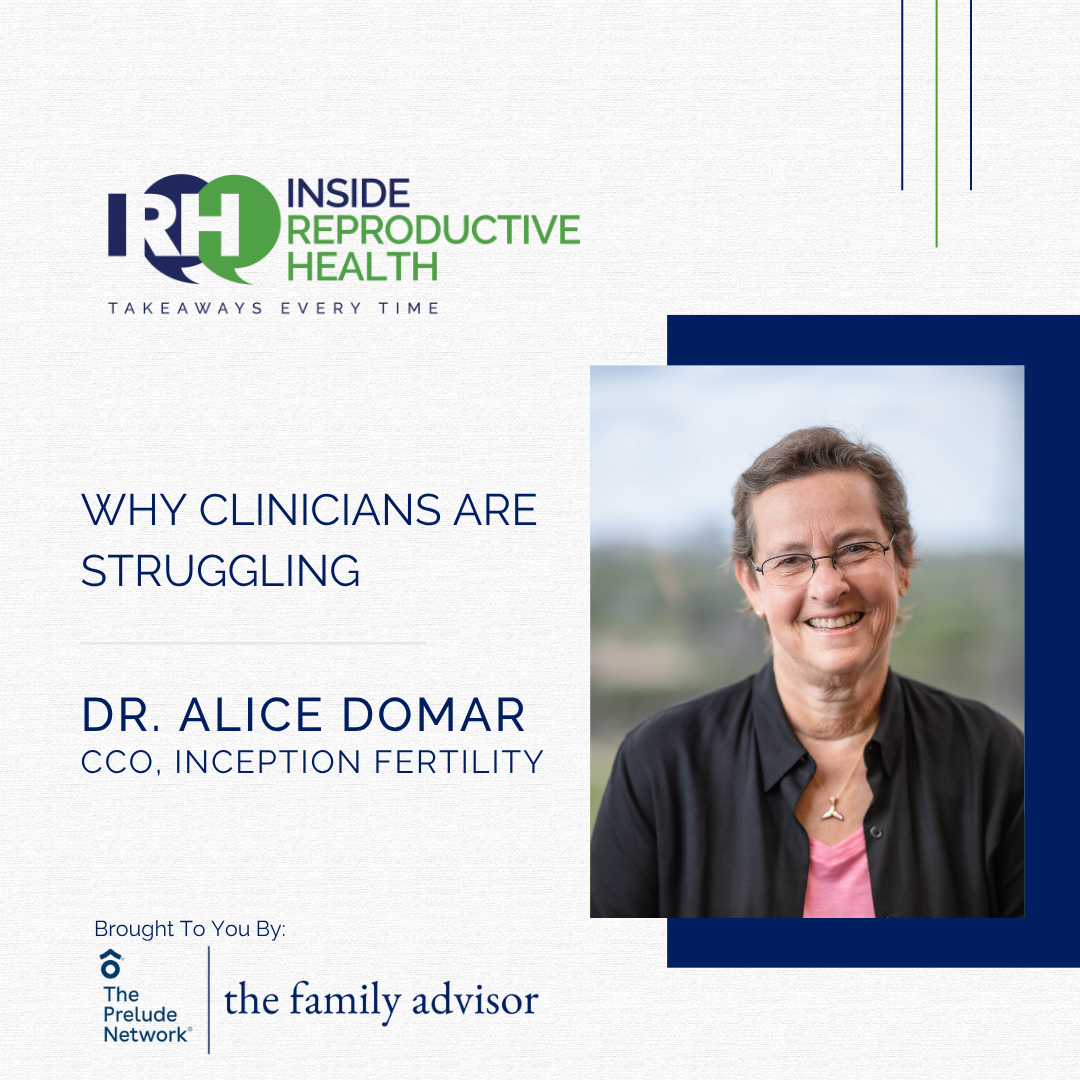
269 Why Clinicians Are Struggling. Dr. Alice Domar


Today’s Advertiser helped make the production and delivery of this episode possible. But the themes expressed by the guests do not necessarily reflect the views of Inside Reproductive Health, nor of the Advertiser. The Advertiser does not have editorial control over the content of this episode, nor does the Advertiser's sponsorship constitute an endorsement of the guest or their organization. The guest's appearance is not an endorsement of the Advertiser.


How are clinicians doing?

Patients are expecting more, offering less gratitude, and leaving negative reviews faster than ever. Sound familiar?

Dr. Alice Domar, Chief Compassion Officer at Inception, talks about the emotional toll of working in reproductive medicine and what can be done about it.

Dr. Domar shares:

– Practical strategies for burnout prevention

– The one small intervention proven to improve patient retention

– Results from three psychosocial trials currently underway at Inception

– The patient traits most predictive of treatment dropout

– How Inception Fertility supports providers through empathic communication training

- What needs to change to better support frontline fertility professionals.


Looking to Take Your Career to the Next Level?
Discover the Fastest-Growing Fertility Network in North America – Your Dream Job Awaits!

Are you ready to grow in a career that matters? Join Prelude, the fastest-growing fertility network, offering exciting opportunities in clinical, administrative, and REI roles with unmatched career growth and a fantastic employee experience.

  • Competitive salary & benefits

  • Growth potential and geographic flexibility

  • A supportive and dynamic team environment

  • Rewarding work that makes an impact<call to action> - short explanation of what will happen when they click the button

Take Action Now!

EXPLORE OPPORTUNITIES TODAY
  • Alice D. Domar, Ph.D (00:00)

    Patients now are very different than patients from 30 years ago. they expect way more of the staff. They are more demanding, they're more critical, And so people who work with these patients feel enormous pressure to meet the needs of the patients and that falls on the physicians and the nurses and the whole team. And so people are really stressed.

    Griffin Jones (00:31)

    How are clinicians doing? Patients are expecting more from their clinical teams than ever. They are quicker to leave scathing reviews and they offer fewer tokens of gratitude than they did in the past, according to my guest. Does that sound familiar? Dr. Alice Domar is back on the program to share what can be done, like burnout prevention, like one tiny little intervention that increases patient retention, three psychosocial trials that she's running right now at the Inception Research Institute, and how Inception and the research institute give her so much free rein to be able to conduct research that helps improve patients converting to treatment and their engagement and their satisfaction and the same for clinicians. talks about characteristics of patients who are more likely to drop out of treatment, cool things that Inception does to support their providers and patients like empathic communication training for clinicians and giving every patient who wants one a copy of Dr. Domar's recently updated book, Conquering Infertility.

    During this interview I zigzag between the challenges providers have and the challenges patients have and I think Dr. Domar shows how these issues are interwoven. She also talks about why embryologists face an even greater level of stress and anxiety and the average tenure of a fertility nurse has been cut in half from four years to two years.

    Ali got me fired up about fertility nurses. promise we'll tackle more issues in 2026 that are issues for fertility nurses. There are times when nurses are completely ignored and I'm fed up with it. Enjoy this conversation with Ali Domar as she sets the stage for why.

    Alice D. Domar, Ph.D (03:11)

    I'm the chief compassion officer at Inception. And so I feel like I'm responsible, not just for patients, but for our employees. And it's hard. You know, I think, I know patients now are very different than patients from 30 years ago. They seem to be, they expect way more of the staff.


    They are more demanding, they're more critical, they post negative reviews on social media. And so people who work with these patients feel enormous pressure to meet the needs of the patients at the time where, you know, everyone's worried about volume and everyone's worried about, you know, meeting the numbers and that falls on the physicians and the nurses and the whole team. And so people are really stressed.


    Griffin Jones (03:58)

    On any given night, who are you more concerned about, patients or clinicians?


    Alice D. Domar, Ph.D (04:03)

    Yes.


    Well, you I'm a psychologist and so, you know, I always feel for patients because infertility is such a traumatic journey. But I'm shocked at least on a weekly basis at how patients treat, you know, nurses and doctors and front desk staff and phlebotomists and ultrasound techs. I mean, the lack of respect, the raised voices, the swearing.


    And again, probably 90 % of patients are wonderful, but it's the 10 % that make people think about leaving.


    Griffin Jones (04:38)

    And so it seems like there's been more of this in the last 30 years. They expect more of clinicians. Is there anything that can be done about that? Is any of your research come across things that can proactively address those? will we end up talking a little bit about that today? And if not, is there anything that can be done about that?


    Alice D. Domar, Ph.D (05:00)

    Well, you know, there is such a thing as burnout prevention and you Liz Grill, who's my work wife, she and I once a year do a, on a cruise ship, a burnout prevention course for healthcare professionals. So the one we're doing in 2026 is a cruise from Athens to two islands and then 48 hours in Cairo. And so we actually have an opportunity with mostly physicians, some nurses, cetera.


    to actually do hands-on experiential burnout prevention strategies. But that's what I do with all the Prelude Clinic staff. I do a lot of what we call stress lunches, where I try very hard to give them a sense of what patients are going through and talk about how hard infertility is. And a lot of people don't really think about what patients are going through in terms of, the patient may be nasty to you today. And it's because last night her little sister called and said she was pregnant by accident.


    which for an infertility patient is very traumatizing. And so I think it's really important for everyone who works in the field to understand psychologically what our patients are experiencing and all their triggers. But yeah, I teach, we teach relaxation techniques and stress management techniques and communication strategies and how to use these apps to, for example, we got the app company, Calm,


    to give us a deal so that every inception employee not only has access to calm, but five of their family members do too. And so I encourage everyone to do some form of relaxation every day or to use them when a patient pushes your button, which happens to a lot of people all the time. But it was interesting, I was in Australia a month ago for their annual, the Australian New Zealand annual meeting. And there was a lecture.


    but I got to a little late because I'm on crutches after knee surgery. And it's by a psychologist in Australia named Elizabeth Bancroft, who herself is autistic. And she specializes in working with infertility patients who are on the spectrum and or have ADHD. And she presented all this data on the fact that for women on the spectrum, the prevalence of endometriosis and or PCOS is much higher in that population. And patients who are on the spectrum


    handle infertility treatment very differently and they really need in effect special care and their dropout rates are high. And I'm listening to this lecture and I was gobsmacked because in my 37 years in the field, I never really thought about how do women on the spectrum handle this. And I wonder if those are the patients that we see as red flags because they don't interpret things the same.


    as women who are not on the spectrum. And so things like fluorescent lighting or a noise in the waiting room may really bother them. And the average nurse or physician may not understand that.


    Griffin Jones (08:01)

    What's the relation between the population on the spectrum and the population with ADHD? I would generally think those are two very different populations, but do they have commonalities?


    Alice D. Domar, Ph.D (08:12)

    they do have some commonalities. And in fact, so since I got back from Australia, I've been communicating with Dr. Bancroft and another colleague of hers, because what I want to do is she has a 40 item questionnaire to basically identify triggers for women on the spectrum and or women with ADHD to see if they need and she's developed a program to meet the needs of these patients. And she has a 0 % dropout rate from treatment and women who go through her program and


    what I want to do and I'm trying to do now is take her 40 item questionnaire, which is way too long, and collapse it into maybe a six item entity that we can give to new patients to know if they have certain sensitivities that the team needs to know about. You know, maybe a little extra TLC, maybe dim the lights, you know, things like that, which will meet the needs of those patients and allow them


    to withstand the rigors of treatment and so they can stay in treatment until they have a baby. That's one of my big goals right now.


    Griffin Jones (09:18)

    that really would be something that you might be able to prevent some of the backlash that comes from patients who are having a really hard time. If you could get ahead of knowing that there are some particular preferences that maybe are beyond just preferences that if they're accounted for, you get less of that backlash later on. you...


    Alice D. Domar, Ph.D (09:41)

    It's sort of prophylactic.


    If we know a patient has sensitivities from their patient questionnaire, we can hopefully at least know about them ahead of time. And so they don't get triggered and they stay in treatment. I mean, the other big thing I've been working on is to try to, you know, I've been doing this for 12 years to try to figure out which patients are at highest risk of dropping out and what can we do to support them better and keep them in treatment until they get pregnant.


    Griffin Jones (10:10)

    Tell us about recent studies that you've done or as recent as you're able to talk about and what characteristics are patients most likely to have that are likely to drop out?


    Alice D. Domar, Ph.D (10:22)

    So I was invited about a year ago by the journal Human Reproduction to write a lit review on psychological interventions to reduce dropout rates. And I thought that'd be, you know, I was very happy to be invited and I did it with one of my interns who was a college student. And this poor kid spent hours and hours and hours and hours hours researching, trying to find any published research other than mine.


    on how to prevent or what psychological inventions and they're literally two published studies and those are mine. So either people are not adequately paying attention or people, I don't know why. So the first study we did was, we did it with Jackie Boyvin and it was supported by what's now called Organon. And we recruited, I think it was 240 women, I think anyway, who were about to do their first IVF cycle.


    half of them randomly were mailed a stress management packet and had relaxation strategies and cognitive strategies, et cetera, et cetera. And the other half randomly were not mailed that packet. We had no contact with them whatsoever for a year. And then at the end of the year, we looked at the dropout rates. So we never, we didn't know if the women received the packet. We didn't know if they opened the packet. We didn't know if they used the packet, but their dropout rates were 67 % less in the control group.


    and they were less anxious and their quality of life was better and they cope much better with treatment. So we published that study and nobody asked us for a copy of that stress management packet. And here, you you could, you know, you would think that any clinic in the world would use say, wow, this packet costs $12. And nowadays you could probably make it all available electronically. So it would probably not cost anything.


    And you can reduce dropout rates by 67%. You think that's a gold mine. And then we published another study, I don't know, maybe a year or two ago, where we looked at patients who had had their new patient consult and never came back. And we, three months later, sent them an email saying, hey, we just want to know why you didn't come back. And is there anything we could have done to support you to come back? Sending that email statistically increased their chances of coming back.


    doesn't cost anything to send an email. You can do it automatically. So what those two studies showed, there's almost these tiny interventions dramatically increase retention.


    Griffin Jones (12:48)

    How much more likely were they to come back if they received that email?


    Alice D. Domar, Ph.D (12:53)

    I think it was 41 % versus, I mean 42 % versus 31%. I think there was an 11 % difference. I don't have the, you think I should have my own stats on my own head, but I'm too old to have my own stats on my own head. It was hugely significant.


    Griffin Jones (13:06)

    Yeah, but that's, yeah, it's pretty significant. And so that means


    you're converting a quarter more of your patients in that case. And we saw something similar. When we were helping clinics with marketing, we would help them a little bit with conversion. And that was one of the things that we found is that if you set up an email sequence and reach out to those patients, you will convert more of them just by touching base with them. And it can be a really low cost.


    Alice D. Domar, Ph.D (13:14)

    Yeah. Yeah.


    Mm-hmm.


    Griffin Jones (13:35)

    intervention from


    Alice D. Domar, Ph.D (13:35)

    Yeah. Well, every clinic in this country or every, every


    clinic everywhere is hemorrhaging patients because you know, it takes a lot of time and effort to get the patient in the door and then they drop out. And, know, again, from a psychological point of view, someone who has infertility has been trying for a year or two is probably unlikely to spontaneously conceive at that point, which means if they drop out, they're unlikely to become a biological parent.


    And if they're dropping out because of stress, is, know, obviously money is the number one reason people drop out. But the number two reason globally for insured patients is stress, which means we're not doing a good enough job. If patients are dropping out because they're simply too stressed to continue, we're not doing our job.


    Griffin Jones (14:21)

    Last I spoke with you, clinics weren't doing the best job of measuring their dropout. Has that gotten any better as networks are really focused on their patient pipelines? they measuring more now, patient dropout?


    Alice D. Domar, Ph.D (14:35)

    Yeah, well, because EMR makes


    it much easier. So it's much easier. You can push a button and know what your dropout rates are. If you have someone who's able to do that kind of data analysis. It's huge. Dropout rates are huge. And it's global. It's not just in the US.


    Griffin Jones (14:50)

    did you vary the email at all? like, experiment with this copy versus that copy?


    Alice D. Domar, Ph.D (14:56)

    mean, the funny thing was it started out as just, I wanted to know why. You know, is it because you got pregnant? Is it because you didn't like the center? Is it you didn't like the doctor? Is it, you know, and then we added a paragraph at the end saying, there's anything we can do to better support you, please, and we gave a person's name and a phone number. And so we did that for, I think, five months. My research assistant at the time sent the email and then she had the audacity to get pregnant and went on maternity leave.


    So for three months, we didn't send the email. And when she came back, I said, huh, I wonder what our dropout rate was when we sent the email versus when we didn't send the email. And that's how we got that data. So it ended up being a publishable quote unquote study, but it didn't start that way. It started as me trying to figure out why patients were dropping out.


    Griffin Jones (15:43)

    In either of those studies or any others, did you find characteristics of patients that were more likely to drop out? College educated women are more or less likely or from this type of background, can you tell us the characteristics of the profile of patients who are more likely to discontinue treatment?


    Alice D. Domar, Ph.D (15:53)

    Less likely.


    So we didn't look at it in that study, and I have not done the research, but there's been a ton of research out of Europe where there, think there are 10 different characteristics that in effect predict dropout rates. And the ones I'm most interested in are being depressed, which more than half our patients are, having inadequate partner support. Ironically, one study out of France showed the more frozen embryos, the more likely they were to drop out.


    which is counterintuitive because the more frozen embryos one has, the more likely one is to get pregnant. There are a lot of different, you know, the older, you know, if a patient in her 40s is more likely to drop out than somebody in their late 20s or early 30s, we actually did a study on that. So there is a relationship between age and there's a relationship between prognosis. Then you have patients who have, you know, extremely low AMHs and their physician has said, give up. Yeah, they're likely to drop out. But the ones that we can change.


    We can change depression levels. Hopefully we can change partner support. We can't change education level, et cetera, et cetera, but we can change the psychological one.


    Griffin Jones (17:07)

    That's interesting to me about partner support. was an article in Inside Reproductive Health recently, a company called Q Engage that that they help with a number of different things. And one of them has to do with online reputation management. And they looked at negative reviews and a lot of it had to do with how the partner was engaged or not engaged and to hear inadequate partner support being a factor in dropout. Well, there's some of that


    that you can't control, right? But there might be, you can't change if the partner's a jerk, but you might be able to extrapolate some of that to say that, an engaged partner may be able to help more than a non-engaged partner.


    Alice D. Domar, Ph.D (17:39)

    No, if the partner's a jerk, you can't change.


    Absolutely. mean, as I said, the frustrating part is there are some things you can change that people are not changing. And actually, when I was doing that research, excuse me, I interviewed about 250 patients who were fully insured. this was in Massachusetts where people have six IVF cycles covered. And these were patients who had insurance and dropped out before getting pregnant, before using their insurance. And so we actually interviewed them.


    And every single one said it was a communication issue with either their physician or their nurse or their team, and they just couldn't handle the stress. And that led to me starting to do empathy training. And so I've been bopping around the country training our physicians in empathic communication. And so in fact, Ferrin has been sponsoring these dinners where I go to any of the prelude clinics and we have a nice dinner.


    And then it's actually fun because I explain all the science about empathic communication and I, you know, go through how to actually communicate empathically. And then I have 14 vignettes on the hardest conversations an ARIA ever has. You know, there's no heartbeat on your ultrasound or, you know, your AMH is too low or an employee is not doing a good job or a nurse has made a mistake. And so they role play. So the physicians either play themselves or the patient or the nurse and


    the ones who are playing the physician, you know, communicates this to the quote unquote patient. And then I criticize them. I literally stand behind them and they do their thing. And I'm like, okay, that was good, but maybe you could try it this way. And this had a really good impact. I've gotten some really nice emails from our docs saying, wow, you know, you're right. This really does work.


    Griffin Jones (19:33)

    and they do it right there at dinner.


    Alice D. Domar, Ph.D (19:35)

    Yeah, they roleplay at dinner.


    Griffin Jones (19:37)

    Do you find them doing things in the role play that you see patients comment about?


    Alice D. Domar, Ph.D (19:44)

    Yeah. Again, these are really tough conversations. How do you tell a patient she's got to lose weight? Or how do you tell a couple that they're severe malfact or infertility? These are the 14 toughest conversations. There are a lot of physicians who do a really good job. In fact, what we ended up doing just to really get the message across is we


    went to two of our physicians who are just really good communicators and we have the six hardest conversations. And so had these two physicians with like fake patients or fake nurses. So we videotaped this and we had them do it badly as a not to do. And then we had them do it well as a this. So that's to train our younger physicians and how to have these conversations. And that's really helpful because in a med school and residency and fellowship, there's not


    any really specific training on empathic communication. And a few years ago, one of our fellows actually did his fellowship research project on this, a randomized controlled trial, and found that empathic communication had a really big impact on how well patients cope.


    Griffin Jones (20:52)

    Would you recommend or recommend against setting the stage? What I mean by that is when I'm having a direct conversation with someone or if I have to broach a more difficult subject, if I set the stage that I'm going to have a direct conversation about a difficult subject with you.


    they're less offended, they're more at ease. And so if I'm a doctor, I might be saying, I'm gonna talk to you about BMI and how that impacts your prognosis and treatment plans that I recommend. Some people might think that I'm calling them skinny or fat. I would never call anyone skinny or fat. And I am only going to talk about how BMI may impact your prognosis and what I recommend. Is that okay? And so I might...


    ask something like that to disarm them at first. Would you recommend doing something like that or do you think...


    Alice D. Domar, Ph.D (21:41)

    Yeah, you'd be a great REI. You'd be a


    great REI sort of the conversation like that. I mean, the focus really needs to be on health rather than on weight. But yeah, it's good to sort of what we call an emotional segue to sort of ease into the conversation and just say, know, I wish I had, you know, if someone doesn't have a heartbeat or their IVF cycle was negative, it's like, I really wish I had better news to share with you and to give them that segue into the conversation.


    These are the conversations our physicians and nurses dread because there's a lot of bad news being delivered in our field and it's really hard. I mean, the problem with our field is our successes disappear. Once they have a good prenatal ultrasound, we don't see them again. We only see the ones who didn't succeed, who come back again and again and again, and that psychologically can feel catastrophic. So all you see are failures. You don't see the successes.


    Griffin Jones (22:39)

    So you have a TikTok account, right? Ask Allie, where patients can ask you different questions. Do you get these kinds of questions from patients that doctors would be on the other side of, or is it more of their mental health journey?


    Alice D. Domar, Ph.D (22:55)

    So I have avoided social media my entire life and it was suggested to me that I stop avoiding social media. So we just started on TikTok and Instagram or as my kids call it, the gram, me recording stuff, but also launching this Ask Allie, really about the emotional aspects of infertility, partner issues, family issues, lifestyle issues, alternative medicine issues, et cetera, et cetera.


    And so we literally just launched it a couple of days ago. So I haven't gotten questions yet, but I'm happy to answer them. It's easier to ask Allie at inceptionllc.com.


    Griffin Jones (23:30)

    Are you going to try and collect them in any way, like putting them into a spreadsheet or anything so that you could analyze them after a long period of time, put them into some kind of sample?


    Alice D. Domar, Ph.D (23:39)

    hadn't thought of that,


    I suspect the marketing department will want to do something with him.


    Griffin Jones (23:44)

    Yeah, I think that would be really interesting to see putting it into a word cloud and seeing what comes up the most. So they talk to you.


    Alice D. Domar, Ph.D (23:51)

    Yeah.


    I mean, do webinar,


    sorry, I do patient webinars once a month and people for like the last 20 minutes can ask questions. And usually there are too many questions to fit in the hours. Then I just email all the patients back. I mean, it's the questions I've been facing my whole career. How do I cope? How do I cope better? How do my partner and I cope? When do I know it's time to stop treatment or move on to donor-agor sperm?


    Griffin Jones (24:21)

    Do you find that they're asking doctors these questions or doctors telling you they're getting these sorts of questions and they don't know how to answer them?


    Alice D. Domar, Ph.D (24:30)

    They do get these questions and the ones who have been in the field for a while know how to answer them. I think for the new physicians, it's tougher because most of fellowship training is on the treatment of infertility, not the care of patients.


    Griffin Jones (24:45)

    So with the Research Institute, tell us more about what and how you do research at the Research Institute.


    Alice D. Domar, Ph.D (24:53)

    So when I got to Inception, about three and a half years ago, they had this little tiny research section and I actually brought a study with me and it was sort of decided that we were gonna really try to grow the Inception Research Institute and I got a couple psychosocial grants, but it became very apparent to me really early on that what we really wanted to do was attract pharma trials and device trials and I'm a psychologist and I can't be the PI.


    And so several years ago, I started to court my BFF, Dr. Gaurang Daftari, and tried to convince him that he would be happy if he joined the Inception Research Institute. And he did. So October 1st of last year, he came on as the Chief Scientific Officer. And so he and I sort of co-run the Inception Research Institute. I am in charge of all the psychosocial trials, and he's in charge of all the pharma and device trials.


    Not go wood, it's been incredible. We are at capacity now. We're doing these amazing studies and we're very attractive because we have one EMR across all of our clinics.


    Griffin Jones (26:01)

    Why is that important?


    Alice D. Domar, Ph.D (26:02)

    because you can effortlessly do a study and collect data across all our clinics. And so we have a grant now to do retrospective analysis and you literally push a button and you get the data from 50,000 patients.


    Griffin Jones (26:16)

    So with those two studies that you mentioned previously, were they through the research institute?


    Alice D. Domar, Ph.D (26:23)

    Yeah, all the research, no, the ones I said about the dropout, that was before I got to inception. So we basically have three psychosocial trials going on. One is with FRAME, which is the coaching support aspect. And we're doing a randomized control trial right now where patients are contacted after their new patient consult. And those who sign up to be in the study have a randomized to get FRAME for free.


    and the others are controls for three months and then the controls get framed. So we're in the midst of recruiting for that. We're also doing a FDA registry trial with Curio. So we're recruiting patients who have been told they need to do IVF and they're randomized either to use the Fertilift, which is a new online web-based cognitive behavioral platform and half a randomized not. And then we've been doing, since I got there, trials with Auto.


    which is a company in Canada, which has a device that measures 54 aspects of physiological stress. And that's, mean, all the research is exciting, but the auto stuff is cutting edge.


    Griffin Jones (27:27)

    So all three of these psychosocial trials are going on now.


    Alice D. Domar, Ph.D (27:32)

    We just finished collecting data on auto. The frame and curio are ongoing now. Auto, we presented at ASRM last year and we're in the middle, knee deep in the data analysis and we're using the biostatistics department at Queens University in Toronto because we wanted to use an impartial stats group. The results are going to be controversial. because what we would like to, what we are


    Studying is whether or not stress manifested physiologically, either through the cardiovascular system or the central nervous system, is associated with IVF failure.


    Griffin Jones (28:09)

    What can you talk about from what you published or discussed at last year's ASRM?


    Alice D. Domar, Ph.D (28:16)

    The first study we looked at was the, when I say stress levels, I'm talking about physiological stress of patients during their baseline, which was seven days before they started their IVF cycle, and then the stim cycle, so when they took medications. I remember I was at Eschery two years ago with the CEO of Auto, and he had just gotten some of the preliminary results. said, and this is a, the Auto has data from 30 years ago. They work with Navy SEALs and the NFL.


    They used to work with like the Russian Olympic teams. They had never seen stress levels like they saw in these women during the STEM phase of their cycle. And so we presented ASRM last year was comparing patients during their baseline versus their STEM phase. And it was P values that I as a researcher can only dream about. was like P is less than 0.0007. So women were extremely physiologically stressed during the STEM phase.


    Griffin Jones (29:13)

    when do you expect that you'll be able to share the, you publish the remaining results of the second phase?


    Alice D. Domar, Ph.D (29:21)

    As soon as we can get the manuscript written, we're going to have, we have three different manuscripts. So I can talk about the baseline versus STEM because we presented it. And then we have another manuscript about how we are using, not me, but Queens biostatistics guys whose IQs are three times mine, how they're using AI to create models about whether or not physiological stress can predict IVF outcomes. So that's going to be another paper. And the third one is the actual data.


    Can physiological stress predict IVF?


    Griffin Jones (29:51)

    So are we talking like this time next year or longer, a couple months or?


    Alice D. Domar, Ph.D (29:53)

    yeah i mean it better darn well


    be published within the next six months. I do have to retire at some point in my life.


    Griffin Jones (29:57)

    How about the,


    yes, well, are you gonna? Good.


    Alice D. Domar, Ph.D (30:03)

    Not for a while. I need to


    finish all this research and I have a lot more to accomplish and now I have all this autism spectrum stuff so now I'm not going to retire anytime soon. Too much to do.


    Griffin Jones (30:15)

    Yeah, we're


    giving you more rabbit holes to go down. Too many stones left unturned, Ali. We've got to keep you around for a while. I'll be interested in hearing about the results from the frame trial as well. When do you expect to be able to publish that?


    Alice D. Domar, Ph.D (30:18)

    Yeah.


    Probably a year is my guess. mean, you have to recruit patients and then they all have to go through the three months and then can collect data and finish the data analysis and then write a manuscript which has like eight co-authors on it and you rewrite and you rewrite and you rewrite and then you submit it to a journal and the first journal rejects it. So you have to go to a second journal and then the reviewers will have lots of such, it's a long process.


    Griffin Jones (30:37)

    Yeah.


    Was the research institute part of your initial charge when you came to? Inception was that part of the deal or what you came on as chief compassion officer and then you nudge TJ and say hey I want to I want to do this kind of stuff or did they come to you?


    Alice D. Domar, Ph.D (31:09)

    I mean, came on as Chief Compassion Officer and TJ and I had six goals for me. And I brought that auto study with me. So I knew I'd be doing a little bit of research and they had a research coordinator, Amber Mendoza, who's amazing. And I think when I got there, you know, as a researcher, having one EMR across all these clinics is a researcher's dream. And so I realized that I could accomplish way more.


    at Inception than I'd ever been able to do in my career. And so early on, Chris Bright, who's the president of Inception said, okay, you're the director of the Inception Research Institute. And TJ, I mean, knock on wood, TJ has never said no to me. So everything I go to him with, he's like, don't ask me, just do it. So.


    Griffin Jones (31:56)

    There's going be a lot more studies about patients with ADHD, DJ. There's a lot of different angles that you can pursue. Do you remember the six goals? Can you rattle them off?


    Alice D. Domar, Ph.D (32:01)

    Yeah.


    No. But I do


    want to say is that the Inception Research Institute within about two years of launching it had more trials registered at clinicaltrials.gov than any other network in North America, which is great because it means we're returning. The six goals, gosh, I, you know, no, I don't remember. I'm sure it's in my contract. mean, you know, obviously one was to create as many stress management programs for patients as I could.


    Number two was to create stress management programs for the staff. I wanted to put a mental health professional embedded in every practice and that's on hold right now. Maybe research, I'd have to go back and look at my contract. That was four years ago.


    Griffin Jones (32:46)

    Is it as important to have a mental health professional embedded in every practice as it was 10 years ago? Is there a lot that can be done with virtual therapy in your view, or does it really need to be in person?


    Alice D. Domar, Ph.D (33:02)

    It's a tough question, because I don't think a name has ever done a study on this, so I can't answer it. I would say that, you know, I was at Boston IVF for 20 years, and I felt like, and there was a whole team of mental health professionals that were embedded, and we didn't just offer a lot to patients by physically being there. So for example, when you're physically embedded, you know, if a patient comes in for a prenatal ultrasound and there's no heartbeat, every patient in that situation was guaranteed to see a psychologist within an hour.


    And that's an amazing thing to offer to patients. And it meant that every staff member could come and talk to us. And so I'd say when I was there, it was half patient support and half employee support. I do think right now, mean, since COVID, I have not physically seen a patient in five, what, five and a half years. Everything I do with patients is on Zoom. And we know that therapy via Zoom is just as good. And so, yeah, you know,


    and curio are both not live interventions. But there's something about a nice warm mental health professional, you know, physically being there to remind people that they're there. It's important.


    Griffin Jones (34:11)

    No one's ever done a study on it with all of these therapy apps that are out there now. You would think that someone would have done a study to see if they're as good as in person, but I guess that would be hard to control for, right? Because you have different therapists.


    Alice D. Domar, Ph.D (34:27)

    It'd very hard. you know,


    yeah. I mean, there's, there've been lots of studies comparing, you know, online interventions to in-person interventions, but not specifically that I know of with infertility patients. ⁓ I mean, to be honest, there's very little research going on in the U.S. I mean, it's, I mean, there's almost no money available to do randomized controlled trials in the U.S. I mean, the federal government, I haven't heard of any funded research. So in the U.S. there's really,


    Griffin Jones (34:39)

    okay.


    Alice D. Domar, Ph.D (34:54)

    not much going on. So one either has to rely on companies like frame and curio and the pharma companies, auto, it's tough to get funding. So, know, in Europe,


    Griffin Jones (35:04)

    But


    elsewhere in therapy there have been studies and what do those studies show?


    Alice D. Domar, Ph.D (35:09)

    yeah, yes, yes.


    The study shows that remote therapy is as good as in-person therapy. So that's why you see all these remote platforms springing up.


    Griffin Jones (35:20)

    You've updated your book Conquering Infertility recently. What's new?


    Alice D. Domar, Ph.D (35:23)

    That's so kind of to mention.


    What's new, so, you know, what's really interesting is that Inception wanted me to update it because they are now giving away free copies of Concrete and Fertility to all their patients. so I took the publisher sent me the Word document, which was written probably 25 years ago. And my assignment was to update it. And clearly there was a fair amount of medical stuff. mean, in the first, in the original version, there's


    all this talk about having a high FSH, which obviously converts into low FSH. And there had to be updates about PGT and all the other medical stuff. And I added a lot more content on LGBTQ and I changed all the pronouns. when we read the book originally, it was really meant for heterosexual couples and we had to make it much more broad. But the emotional stuff hasn't changed.


    I mean, you had to change names, because names that were popular 25 years ago are not popular now. And so I had to look up popular names from like 30 to 35 years ago. But no, the emotional stuff, I mean, I have a small private practice, so I'm still in tune with patients and the emotional stuff I didn't have to revise.


    Griffin Jones (36:37)

    So Ashley used to be the baby's name and now it's the patient's name. Linda's out of the picture and now the baby is Olivia.


    Alice D. Domar, Ph.D (36:42)

    Yeah, Karen's out of the picture.


    Yes, Olivia, Ava, Maya, know, the names have changed. Like boys have to be, you know, Noah and stuff. So yeah, I did change all the names. I also had some fun. I don't know if anyone in inception has caught this, but I changed a lot of the names to people I work with. So there's Lindsay and Cat and Amber. Yeah.


    Griffin Jones (37:09)

    That's fun.


    That's a good way to test if they're paying attention reading the book. They give it to every patient at every clinic?


    Alice D. Domar, Ph.D (37:16)

    I don't think anyone has. So any Inception patient who wants a copy


    of the book, yeah, they have them in waiting room, people can take a copy. Yeah, they order thousands and thousands of books.


    Yes.


    Griffin Jones (37:26)

    Did you


    ever go to inception clinics and do signings?


    Alice D. Domar, Ph.D (37:29)

    I haven't done that actually, that's a good idea. I I did a book signing.


    Griffin Jones (37:32)

    That's next. Let's go, Faring. You got something else to


    sponsor. Let's do book signings at different clinics. I think that would be cool.


    Alice D. Domar, Ph.D (37:40)

    I did one at ASRM


    last year at the Inception booth and we ran out of books within 10 minutes. Yeah, it was fun.


    Griffin Jones (37:47)

    Nice. ⁓


    Was that the updated version of the book yet?


    Alice D. Domar, Ph.D (37:52)

    No, that


    was, think it was actually two of my other books. I think it was Be Happy Without Being Perfect and Self-Nurture. was for people attending A.S. sermon, it wasn't for patients.


    Griffin Jones (38:02)

    Well, let's do it again. You have a talk coming up at ASRM. By the time this episode airs, that talk will have already happened. So what did people hear about at ASRM when they're listening to this episode?


    Alice D. Domar, Ph.D (38:10)

    I know. So Liz Grell and I are


    doing it together. It's an inaugural symposium in honor of Dr. Schlaff, who died recently and his family is sponsoring it. So Liz is going to talk. mean, I'm the chair, I'll sort of open the thing, but Liz will talk about sort of what we know in terms of research on burnout and burnout prevention. And then I'm doing real hands-on, like let's do some relaxation techniques.


    talk about cognitive strategies, how could you better care for yourself? And then we'll do Q and A.


    Griffin Jones (38:44)

    What will Dr. Grill talk about that I haven't asked you about yet with regard to what we know about physician burnout?


    Alice D. Domar, Ph.D (38:52)

    It's actually clinician burnout, not just for docs. ⁓ I saw her talk, you'd think I'd have this sit-in my tongue. I think she just, she presents a lot more data than has been known on burnout in the REI field. know, what physicians are reporting and there's research out of Europe and then ASRM every few years surveys REI nurses. And she's going to talk about nursing turnover and how it's basically doubled in the last five or 10 years.


    Griffin Jones (38:55)

    Okay.


    Alice D. Domar, Ph.D (39:18)

    We nurses used to stay in the field for four years, now it's two. And it cost clinics a fortune to replace a nurse.


    Griffin Jones (39:25)

    Wow. And over what period of time is that? It used to be.


    Alice D. Domar, Ph.D (39:28)

    So used to be nurses


    would stay in the field for four years and now it's two.


    Griffin Jones (39:33)

    Yeah, wow. And do we know over how quickly of a span that changed? Like was it four years average in 2020 and now it's two? That's such a big deal.


    Alice D. Domar, Ph.D (39:35)

    Yeah.


    I actually don't know. It's ASRM data, it's not my data. But the nurses, they do the survey


    and they ask them. And a nurse right now isn't just a nurse, she's a travel agent and she's a counselor and she's a pastoral person. And these nurses have to wear 10 different hats. And they also have to understand the technology because most networks now use portals.


    Griffin Jones (39:49)

    Yeah.


    Alice D. Domar, Ph.D (40:05)

    And so they have to understand how to work with the portals and how to use EMR. And nurses honestly are the ones that are sandwiched between these frantically anxious and depressed patients and the physicians. And patients aren't going to take their angst out on the nurses. take it out on the physicians. They take it out on the nurses and the support staff.


    Griffin Jones (40:24)

    They get ignored a lot too, don't they, the nurses?


    Alice D. Domar, Ph.D (40:26)

    Absolutely. Yeah, they do.


    Griffin Jones (40:28)

    I know it because, or at least from where I stand, because I have built a living making a trade media company for the fertility space. My audience is the people that work for, operate clinics, the clinicians, the business people, the embryologists, and I have different companies that market on.


    our media platform to those different constituents. And the reason why we don't make more content for and about nurses is because it's really hard for me to get companies that want to target them because they just don't feel like they make a lot of decisions for whatever it is they're selling. if I'm, yeah, yeah. And I think thankfully, yeah, thankfully.


    Alice D. Domar, Ph.D (41:11)

    Do you see my eyes rolling?


    They have huge influence. Nurses have huge


    influence.


    Griffin Jones (41:20)

    I


    100 % and what but what it I think they need a larger microphone too. And and I've been working on different companies and I'm like, just give them the mic, give them our microphone and and let them have a bit more of a collective voice. And you'll see how influential they are. And I think that I've gotten a couple people to bite on that I think one pharmacy in particular.


    Alice D. Domar, Ph.D (41:28)

    Absolutely.


    Griffin Jones (41:47)

    really understands the importance of nurses, but it's an area where I feel like this is something we should be talking way more of. that fact, I didn't know it in those terms. I could have intuited something like that, but just the fact that you can button it down to fertility nurses used to have an average tenure of four years. Now it's two. It can't have again, right? Like you can't let that have again.


    Alice D. Domar, Ph.D (41:56)

    Cute.


    Huge.


    Griffin Jones (42:14)

    because then you're talking about an average tenure of one year per fertility nurse. You can't run a clinic like that.


    Alice D. Domar, Ph.D (42:21)

    Well, it takes a


    year to get a nurse up to speed and the practice manager of a big practice told me a couple of years ago that it costs the practice $300,000 to replace a nurse. So it's very short-sighted not to support nurses. And in fact, you should do a whole show with Liz and I that's just for nurses.


    Griffin Jones (42:41)

    Done. Done. We will do one that is just for nurses.


    Alice D. Domar, Ph.D (42:42)

    Yeah, because I


    worry about the whole staff. I worry a lot about the front desk staff, because they are the ones that often take the most abuse. globally, the front desk staff have high turnover rates, because they're abused by patients. mean, again, 90 % of patients are fine, but it's that 10%. And I'm just making that number up. And they...


    Griffin Jones (43:03)

    Yeah.


    No, wait,


    I didn't want to interrupt your thought. I was thinking back to something you said earlier where now the nurses, she's not just a nurse anymore, she's this administrative assistant, she has to do, that's unacceptable in my view. And we have to have a louder voice that nurses should not be doing all of this admin work, especially when the technology exists there. And I don't know if it's the frames out there who I think have a,


    good repute, conceive, levy health, engage in MD might be working on some more stuff. There's, and there's other folks that I'm forgetting that I'm gonna feel bad about not including, but they, these types of solutions are out there and it's not okay to just say, the nurses are just gonna call people. One, because that limits, that really restricts your patient pipeline as well, but two,


    you are, we're driving nurses out of the field by doing that.


    Alice D. Domar, Ph.D (44:02)

    And it's, know, so if you have a nurse who's burnt out, one of the symptoms of burnout is you lose compassion. You just, you know, they become, you know, automated and the patients notice and then the patients drop out or the patients post a bad review. And so there are a thousand reasons why we need to take better care of our nurses, you know, for the nurses, mental and physical health, number one, but clinics run on nurses.


    Griffin Jones (44:30)

    I don't want to


    Alice D. Domar, Ph.D (44:30)

    In Boston, we say


    people run on Dunkin. Infertility clinics run on nurses.


    Griffin Jones (44:35)

    Yeah.


    Who do you think of when you think of most of your healthcare experiences? You think of your interactions with the nurse. That's the person that is representative of your experience in a fertility practice. And if they're not engaged, then good luck improving patient engagement.


    Alice D. Domar, Ph.D (45:00)

    Well, it's interesting because 30 years ago, nurses got gifts every day from patients. I remember you'd go into the Boston IDF lunchroom and there'd be baskets of muffins or bagels or cookies or fruit baskets, et cetera, that patients would show their appreciation to the nursing staff. And they don't anymore. And it's not funny. So a couple of weeks ago, my father-in-law was dying. He was in an ICU. And he actually died. But you know,


    The second day he was, and I was his healthcare proxy, so I spent a lot of time there. And I noticed that the nurses had been given a box of chocolate. And I said, do you guys like chocolate? You know, I'd be very happy to bring in a box of chocolates for you. And you know what they all said to me? Please just write a thank you note. No one writes us thank you notes, but when someone does send us a thank you note, we post it in our break room. And every time we've had a bad moment with a patient, we go into the break room and we read those notes.


    So my husband and I wrote long notes for the ICU staff and the ER staff. I still brought donuts every day, but they want to be appreciated. And, you know, again, 30 years ago, 20 years ago, even 10 years ago, patients showed their appreciation. And, you know, we have a new thing at inception that every month the patient experience director assigns each executive, all the employees who got a shout out on social media.


    And each of us is assigned however many employees at that clinic got a shout out on social media. And we have this, it's called a bonusly program where people get bonusly points and they can use the points to get, you know, gift cards for pretty much anything. And so every month, every executive gets assigned. And so what we do is, you know, I get my, I see what the shout out is and I send a message to that employee with bonusly points and it's, it's broadcast to the entire company. And that way we are acknowledging.


    every employee who got a shout out from a patient. But it should be thousands of shout outs per month and it's not. The patients are just not acknowledging when employees take really good care of them. They post negative reviews, they don't post, I mean, it happens once in a while, but it should be thousands, not dozens.


    Griffin Jones (47:18)

    I would have thought that nurses were still getting a lot of thank you notes. I wonder how common that experience is. And I think it's a good poll question for us to put out there to fertility nurses. Do you get more or less thank you notes than you used to? And what you just said is it should be thousands. I think that in today's day and age, we're so used to expecting everything to be instant. We're expecting everything to be catered


    to us that we've learned some bad habits as a consumer population and that people need to be disabused of some of those bad habits. And that was one of things that I would try to get practices to think about in their marketing that they should talk a little bit about nursing burnout or compassion fatigue in their marketing.


    Alice D. Domar, Ph.D (48:09)

    They should talk a lot about


    it. They should talk a lot about it.


    Griffin Jones (48:12)

    Well,


    so they should definitely talk a lot about but they should talk about a little bit in their external marketing to patients because I want patients knowing that my nurses aren't robots, that they're not these cold steel avatars that don't have emotions, that they are really trying their best that they have so much on their plate. And if I'm coming in with that as my as my preface, then


    I can start being more grateful for what they do because what's the expression? Gratitude is expectation minus delivery or minus actuality. So if my expectation is that everything should just be perfect and how dare it not be, then I'm not gonna be grateful. But if my expectation is, these nurses really have a lot on their plate, then I might start to be grateful for what they're doing and express that gratitude.


    Alice D. Domar, Ph.D (48:51)

    I have no idea.


    Griffin Jones (49:08)

    You've got me fired up about nurses and I am going to have you and Dr. Grill back on and I'm going to think of some sort of goal. think I can get, I don't want to speak for them, but I'm going to speak for them a little bit anyway to, sort of like, to, you know, like to put it into the


    Alice D. Domar, Ph.D (49:10)

    Good.


    Griffin Jones (49:25)

    atmosphere, like Mendell's Pharmacy, I think I can get them to help a little bit with this because they really, they really, really appreciate nurses that they are one of the people that actually stick up for them care about them. I think I can get them to help out a little bit. But I want to 2026 I made a New Year's resolution a couple years ago that I was going to do a lot more content for embryologists. And then boom, it happened and we got more more


    Alice D. Domar, Ph.D (49:47)

    They're stressed too, by the way. Let's


    not forget every other. I just was part of a big study that was published last year.


    Griffin Jones (49:51)

    We did


    Alice D. Domar, Ph.D (49:52)

    Embryologists are very stressed because in most of what one does, a mistake can be remedied. An embryologist's mistake can't be remedied in general. everything they do is really high stakes.


    Griffin Jones (50:07)

    as are they part of the the people that you address? So when you talk about clinician dropout, are they


    Alice D. Domar, Ph.D (50:12)

    Yes.


    always seek


    out embryologists. And in fact, several times now I've gone to New York and literally taken out all the NYU embryologists for a nice steak dinner, just to show how much we appreciate them and talk about stress management and everything else. Yeah, embryologists, I would say that when I go to clinics to do these stress lunches, and then I sort of sit in an office just to do one-on-ones with anybody, a lot of the people that come talk to me are embryologists.

    Griffin Jones (50:41)

    Well, I am going to have you back and we'll talk more about embryologists because they deserve their time. And I'm going to have you back to talk about nurses because I can't get enough of you, Ali. Thank you for coming back on the show.

    Alice D. Domar, Ph.D (50:45)

    Sounds great. Thanks for inviting me.

Inception Fertility
LinkedIn
Facebook
Instagram

Dr. Alice Domar
LinkedIn


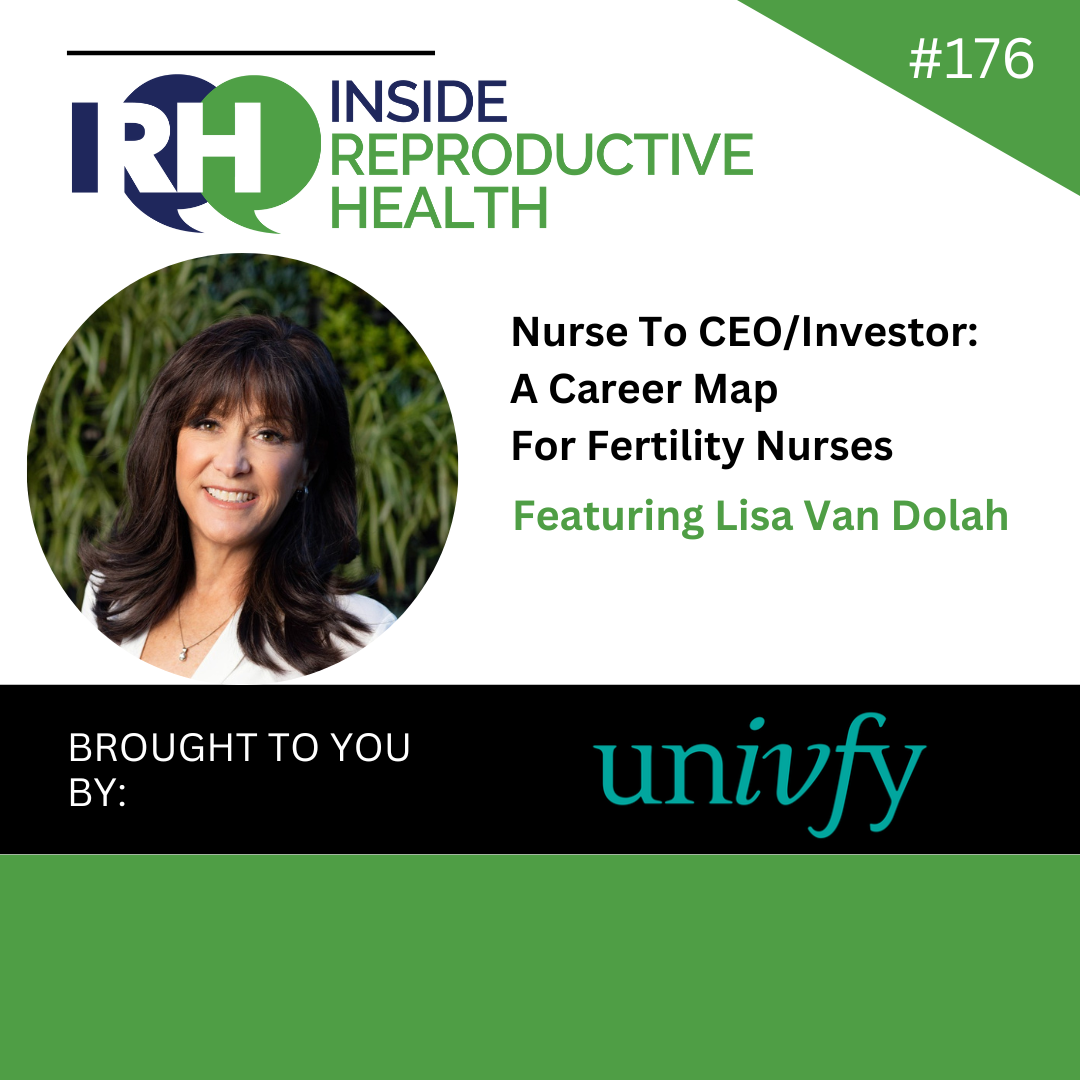
176 Nurse To CEO/Investor: A Career Map For Fertility Nurses, Featuring Lisa Van Dolah

DISCLAIMER: Today’s Advertiser helped make the production and delivery of this episode possible, for free, to you! But the themes expressed by the guests do not necessarily reflect the views of Inside Reproductive Health, nor of the Advertiser. The Advertiser does not have editorial control over the content of this episode, and the guest’s appearance is not an endorsement of the Advertiser.


How does a new grad pediatric nurse climb to the ranks of fertility company CEO and investor throughout the course of her career, while building a family of her own? Tune in to the to find out if you could benefit from a similar path, as Griffin sits down with the CEO of Ivy Fertility on the latest episode of Inside Reproductive Health.

Listen to hear:

  • Steps and career changes Lisa made to end up where she is now, and which aspects she found most critical.

  • Different roles shaped Lisa’s perspective of her field as a whole, and how it benefited patient outcomes, employee satisfaction, and operational success.

  • It takes to marry clinical outcomes with organizational outcomes, and how that in itself can advance your career.

  • Lisa has to say about the 80% rule, and how it can help empower your team.

  • Characteristics she believes makes up a person with C-suite potential.


Lisa Van Dolah’s Info: 

Website: ivyfertility.com

LinkedIn: https://www.linkedin.com/in/lisa-souza-van-dolah-68b51a15/

Transcript

Sponsor  00:16

This episode was brought to you by Univfy. Download Univfy’s free IVF Conversion and Revenue calculator.

Go to Free IVF Conversion and Revenue Calculator


Speaker 4  00:31

Today's advertiser helped make the production and delivery of this episode possible for free to you. But the themes expressed by the guests do not necessarily reflect the views of inside reproductive health, nor of the advertiser, the advertiser does not have editorial control over the content of this episode. And the guest appearance is not an endorsement of the advertiser.


Griffin Jones  00:56

Are you a natural when it comes to business? Many nurses are not, I am not in many areas of business. And that's how you know, the business books that I write at the end of my career are going to be really good ones because I sucked at so many of the principles that I'm trying to master. And I'll be able to deliver really good insights with Nuance having struggled with many of them for so many years, be able to give real-life examples, and really determine the nuance of this lesson versus that lesson, and be able to explain the principle, as though someone was a third grader, I have a feeling that a lot of these business principles that we talked about today come naturally to our guests. That's just the impression I get from the way that she thinks about her answers. She's Lisa Van Dolah. She's the CEO of Ivy Fertility an MSO that has many clinics on the West Coast, most recently an acquisition in Memphis, and presumably soon to be other parts of the country. She was the CEO of San Diego Fertility Center for 20 years. And she has a nursing background, she started off as a nurse, she got her MBA, and we walk through that career path. So for the nurses listening today, we talk about what it's like to go from nurse to a CEO, investor of a private equity-owned network company that owns multiple fertility clinics, starting off as a nurse going into research but with an administrative role that gives you some experience with project management. So project manager, then getting an MBA, then going into a management analyst role, helping to staff senior management teams, getting that exposure to the role of the people at the top the roles of the people at the top working on process improvement, leading to a vice president role, leading them to a CEO role, then to a CEO role in a much bigger company. And as a capitalist, as an investor. We go through each of these points today. And we talk about things like what education is necessary at different points, what skills are necessary, how they relate to nursing, and I press more on how they might not relate to nursing. We talk about negotiation, and hopefully, we light a map for the nurses and nursing managers that listen to this show that are thinking about what the next step of their career is, and how it might look for the rest of the career. Hopefully, it illuminates some possibilities. And if you are thinking about taking action, maybe it gives you the impetus to do so hope you enjoy this episode with Lisa Van Dolah, CEO of Ivy Fertility. Ms. Van Dolah. Lisa, welcome to Inside reproductive health. 


Lisa Van Dolah

Thank you, Griffin, really glad to be here today. 


Griffin Jones

I was interested in having you on because of a career path that I'd like to paint for the nurses and nursing managers that listen to the show for everyone. But I don't think it's terribly common to even find nurses that become sales directors, maybe it's more common than it used to be. But CEO is a different story altogether. And so I'd like to go back into your career and then use that as an opportunity to paint a potential map for those that are listening. And I've got in my notes that you were the CEO of San Diego Fertility Center for 20 years, is that right? 


Lisa Van Dolah

That's correct. Yeah. 


Griffin Jones

And that was prior to your current role as CEO of Ivy Fertility was so when's the last time you functioned as a nurse? 


Lisa Van Dolah  05:00

Well, I maintained my licensure and certainly during my career at San Diego Fertility Center over 20 years, I stepped into the nursing role periodically, mostly out of the opportunity to connect with our patients, but you know, provided bedside care and the pacu and other various functions in infertility. So it's probably aWe've been about five years since I, I think I've actually functioned as a nurse in one capacity or another 


Griffin Jones 

Was CEO your title that whole time since 2003, or whenever your 2000 whatever it was, or was it practice manager at first executive director, President, like Did, Did that change or was it CEO.


Lisa Van Dolah

The whole time it was CEO the whole time it was an evolution of what that role meant. But certainly, I stepped out of hospital administration into practice administration at Seneca Fertility Center with the title of CEO. 


Griffin Jones

Tell me more about the interim intermediary roles between no starting out and CEO. So what was your first job after nursing school? 


Lisa Van Dolah

Yes, I started my nursing career at Children's Hospital-San Diego, now called Rady Children's but started that as a new graduate out of college, the primary role and responsibilities I took on as a new graduate was hematology oncology nursing, so we did pediatric oncology treatment. And that was my first career as a nurse and I did that for about three years at Rady Children's


Griffin Jones

And then you went into women's health or you first became a manager in PCMark. What happened?


Lisa Van Dolah

Yeah, yeah. So the journey is fun. My, I received rewards and knowledge and skills, I think at each turn, so I took a job after being a pediatric nurse in oncology at Rady I moved into infectious disease research, I looked at as an opportunity to learn some more administrative obligations, regulatory requirements, the research and looked at it as a whole nother way to apply my nursing degree. I did that for the Infectious Disease Program at Rady Children's in San Diego for oh shoot probably three or four years and then expanded into actually homecare nursing at Radies. That took on a role primarily interested in doing outpatient care for children, but also afforded me some flexibility in my career while I was having children, and needed a little bit more flexibility in my schedule, which is great nursing offers that many times to us. And so that role in in-home care nursing provided me the opportunity to work with a little more flexibility while I was raising my kids. And so are you a manager at this time or your nose during nursing care at this point, in nursing care, my infectious disease physician was more in an administrative role organizing, coordinating and managing those programs. And then about the time that I was, I was ready to step back into my career full time I went back to school and completed my MBA while I was working as a nurse at Rady Children's. So that was a the time in my career where I was looking at opportunity and picking up more administrative skills, business skills, you know, knowledge of accounting principles and other things that I learned during my MBA program. 


Griffin Jones

Why did you get an MBA instead of an MHA?


Lisa Van Dolah

Good question. I started my nursing master's in nursing and felt like that was a great opportunity for me but wanted to broaden my skill set and knowledge into ideas around brand, Being marketing, business development, plain old accounting planning, and I felt like the curriculum to the MBA program would give me a little bit broader, broader knowledge base. 


Griffin Jones

So you had gone back to school, you were in the master's program for nursing. And while you were there decided to switch to MBA. 


Lisa Van Dolah

That's correct. 


And up to this point, you hadn't really had management experience yet. 


Lisa Van Dolah

Right. 


Griffin Jones

Am I understanding that correctly, you had administrative experience with in infectious disease research, but was that more like project management?


Lisa Van Dolah

Correct, right. To have wide authority management or any other you know, I hadn't stepped into an opportunity for maybe a team lead role or other kinds of leadership roles in nursing. At the time, I decided to go to school to get my MBA.


Griffin Jones

Tell me more about the decision then because it seems like it was a radical departure if we're just looking at it linearly. But what else was it that had been in the back of your mind or this was not in the back of your mind, but rather forward thinking that you want to do achieve? 


Lisa Van Dolah

I don't know if I really felt at the time I was I was making any dramatic shift in my in my career path. I think as I approached any of my nursing, if you will, roles, I looked at those roles to be broad in nature, certainly contributing to the team that I participated in both from a you know patient care perspective but also as an as an employee and part of a team and looking at the services we were delivering. So for me I think it was, it was just a natural evolution and seeking more of knowledge in regard to that. 


Griffin Jones  10:06

Did you see yourself as running an organization?


Lisa Van Dolah  10:09

No, I saw myself as participating in, in an organization, I certainly, simultaneous to starting my MBA program, I started applying for jobs that may utilize more of those skills. So I started to apply for roles, like analyst roles, maybe many middle early, early functions were things that would support the nursing departments and in analyst type behavior, more of the research bases. And then as I completed my MBA, I was then applying in the same hospital for a management analyst role, which provided me opportunities to take on understanding the departments of hospitals that maybe nurses with, but not necessarily have any exposure to like biomedical department or person management. And in that situation, actually stepped into an acting Materials Manager role. And then in the biggest compliments I got were from the nursing units that said that, you know, I had to help them restructure access to supplies, that made their jobs easier that I understood that nurses don't have time to seek and find, you know, supplies and so as I looked at my role as the manager for materials management, which was obviously, initially way outside my skill set, I think I was able to apply a lot of my bedside nursing and nursing science to, to provide, you know, access to supplies, in this case, for the nursing units to make their lives easier.


Griffin Jones  11:46

You had that operational empathy because you weren't just looking at it from the 10,000-foot view, you had been one of the nurses that had to get supplies at some point, did you that management analyst role was that something that you sought before you went and got your MBA, or that was a result of having gotten your MBA that that opportunity opened up to you,


Lisa Van Dolah  12:09

I think it was both I actually applied for the job before I completed my MBA, and I was afforded that opportunity, you know, coming with my bachelor's degree in nursing and, and in my MBA in progress, but so that was a that was something that, you know, I have supported the senior management team at the hospital, in this analyst role, it was a wonderful opportunity to do that. Simultaneously, we're getting my, my degree,


Griffin Jones  12:31

I'm trying to tease out if it's a good idea for nurses, for anyone, but in this case, nurses to go get a degree like an MBA, if they're not, if it's for the means of tasting and exploring rather than the means to an end. And I think a lot of society would say that higher education is a great place to taste. I'm a big believer that that's the reason for the multi-trillion dollar debt crisis that we have in this country, that people very often on the undergrad level, but increasingly at the graduate level, are going to taste and they're tasting something that one isn't the most efficient means of tasting to certainly is nowhere near the most cost-efficient means it's extremely expensive, and then might not be what they want to do at all, I'm more of the Cal Newport ilk of you only pursue any given degree from any given institution, when you can map your desired outcome. Like I want this particular job, I want this post, and I know that this degree from this institution is far more likely to land me that role than not. And that's when you get a degree. I think that should be true of undergrad too. It seems though like you did get some of the eye-opening tasting from that. And then that led you into the next step of your career path. So what do you think? Is it a good idea for a nurse to pursue an MBA if it's in the interest of exploration, but


Lisa Van Dolah  14:07

it's a large commitment time? Right. And it's, it's, like you mentioned likely quite expensive, so I would not use that as the opportunity to evaluate whether or not an interest in in management is, is a value to a person. I think that nurses, you know, when the skill sets that they develop and the opportunity in their roles to step into team lead roles and other areas of responsibility. I think that's where you learn whether or not this is of interest to you not certainly through an education program. You know, certainly I support higher education. And I think that the value of that, for me was tremendous, but a lot of that was through my colleagues that I was in my coursework with, and learning from professionals that had experience that they were sharing. You don't need to get that through a program. You certainly can do do that, you know, with your colleagues at work or volunteering to take on more responsibility or seeking that opportunities through a current employer, even if it's just a project at a time. So, you know, nurses, nurses, nursing education is already fairly broad and, and affords you the opportunity to look at roles, I think without having to pursue education, necessarily, or a degree, I guess.


Griffin Jones  15:24

And then you could always then pursue the degree if you developed enough of an interest and realize that that is the intermediary between the next desired role. I want to talk about the management analyst role some more, but Well, at this point, the management analyst role, are you starting to manage people there


Lisa Van Dolah  15:44

I am, and that the fun thing about this role, which, you know, I think I love to create them in the environments I'm in because it does provide people interested in stepping out of what might be their traditional, if you will, roll channel, mind nursing or clinical, if you will, into something that can support a management team in a variety of ways. And so, the management analyst, analyst role was really to staff the senior management team with a resource that they could deploy in a variety of different ways. And it gave me a huge opportunity to explore anywhere from you know, direct line responsibility, or analytics on whether or not a business plan makes sense, or, you know, stepping into an interim management position, while we were filling that role, or even, you know, process improvement type of project. So, it gave me a broad scope. And I like to see that for people in organizations that you may be stepping into something without really any previous experience but willing to learn and, you know, support a management team. So, for me, it was a wonderful opportunity to explore all of those different variations of skills and responsibilities and, and then gave me and pointed me in the direction that I wanted to step into more of a direct line management role, which is the next job I took in the hospital. So, you know, it afforded me you know, a learning opportunity, you know, outside of education.


Sponsor  17:18

Fertility Centers have unique and unmet business needs. Univfy uses AI and machine learning to improve IVF conversion growth and patient experience. Providers who counseled patients with the support of the Univfy pre-IVF report, see a two to 5x increase in IVF conversion. That means if you make $10 million in IVF revenue today, you can make $3 million more with Univfy. Univfy provides AI white glove platform services to IVF centers including business analytics IVF, live birth prediction modeling to support provider-patient counseling, and using AI and machine learning to support IVF pricing strategies that optimize clinical outcomes and profitability. Fertility Centers can expect to see ROI from using Univfy within one to two months. Univfy’s methods have been published in top peer-reviewed medical journals, HIPAA and GDPR. compliant, Univfy is being used by fertility specialists in the US, Canada, EU and the UK. Download Univfy’s free IVF conversion and revenue calculator.

Go to Free IVF Conversion and Revenue Calculator


Griffin Jones  18:44

Do you think that your administrative experience in research was necessary for you to be able to step into that management role? No, not necessarily.


Lisa Van Dolah  18:55

I think it provided, I think was everything, I think there's a big learning that can occur for individuals is an example of nursing is to step kind of outside what you've learned to be your role and look at the organization from a broader perspective. And so for me, research offered me the opportunity to understand regulatory require, you know, patient protections around informed consent, and those kinds of things that, you know, as you're, as you're in your, your nursing role, you may not look at it from that perspective. So I think, you know, in any role whether it's nursing or embryology, lab or administrative, you know, if you if you have the opportunity to step in and look at it from an organizational perspective. And you know, what you're trying to achieve together I think it gives you the opportunity to to bring more value to what you do. So for me, the research component of that just helped me step outside of what was kind of considered to be treasured traditional have clinical work and look at it in a broader scope. So think


Griffin Jones  20:03

project management is good training wheels for management. In many cases, I've had good project managers. And as I'm trying to counsel them on the next step of their career, it's like, this is where you start to practice your management muscles. Because the project manager isn't really a manager, they're not directly responsible for people there was, they're responsible for timelines, and that involves people. And so in fact, if you can be a good project manager, you're probably going to be a good manager. And if you can be good at the people part of project management, that is, because you can't really fire him. In a lot of instances, you don't have a lot of the stick that is part of you know, the carrot stick incentives, inspiration, etc, that whole mix that characterizes management and leadership, you don't have many of the tools as a project manager. And if you can be successful in getting people to achieve a cohesive outcome. Without many of those tools, it's likely that you're going to be successful when you do have more of those tools at your disposal. But you saw more of the value in terms of being able to see the bigger picture, which is what I like about how you described that role of staffing the senior management team, because then you're really getting a lot of exposure to different areas. And at a high level, at a at a phase of your career, which I don't think is terribly common for that, that maybe intermediary phase to have that much exposure to the, to the senior team and, and that many of them either. So what came after that role.


Lisa Van Dolah  21:47

So after that role, I stepped into a it was a vice president role at that point of clinical programs at Rady Children's read children's hospital back then in those days. So I had direct responsibility of a couple of departments that were not necessarily clinical departments, like I said, some of the back of the house departments, which was great, because it gives you the opportunity of how to run an organization that's not just always clinical in nature, I think. So that would that was my next role. And I wanted to go back to a point. And I think it's really important, and I think nursing brings this skill set just as a result of some of their training experience. And, and that's the ability to influence people without the authority to do so. And you mentioned that with the project management role. And I think, you know, nurses many times are in a position with our patients to influence them and help them move them to a place that hopefully is better for them without having really necessarily authority over them. Right. And so you learn that skill set. And I think that that's one, like you said that a good project manager can learn how to influence drive towards results, moving people and influencing people towards a common goal without being their boss telling, they have to do it. And I think if you can learn that skill set and apply that you become a very good leader, you know, because you, you are able to motivate aligned towards a common goal without necessarily having the authority to do that.


Griffin Jones  23:20

You also when you do have more authority, you have more of those tools, you also have more responsibility. And it isn't just getting a couple things done here or there. It's critical to the outcomes that the organization is pursuing. And so what's that, like? Where, where's the departure from what many people might be used to in nursing from when it starts to become Okay, now, I really have to be a manager and a director. So we talked about the similarities, where's the departure?


Lisa Van Dolah  23:52

That's a good question. You know, I don't know, I think you can apply your skill set as a nurse to your role as a manager, I think the area that may differ is just being able to approach the question from a broader perspective than just a clinical in nature response. Right. So, you know, understanding the needs from a clinical perspective, whether that be, you know, quality of care and in service delivery and training, but also then understanding the context of what you're trying to achieve as an organization. And I think, you know, that's that next level that that we as nurses need to challenge ourselves to do, because as you do that, you can then advance your own specific, you know, if you will objectives but in the context of what the organization is trying to achieve at the same time.


Griffin Jones  24:46

And this is happening while your vice president at the head of one of the clinical teams, and then when does fertility come in?


Lisa Van Dolah  24:55

I got a great call and I had two physicians in San Diego that were interest Started in starting their own fertility practice and asked me to help them and advise them on setting up a laboratory, building out a surgery center, understanding what the regulations look like the regulatory requirements, you know, the facility components of that, and then building out that team. So it was two physicians that had two clinical office staff. They were leaving the hospital that had the lab and surgery center, and they asked me to join them.


Griffin Jones  25:26

Did you know The two doctors or were you headhunted by a recruiter?


Lisa Van Dolah  25:30

No, I knew them through connection. So because I was a pediatric hospital, we did a lot with Women's Health, Labor and Delivery. So I knew them through that relationship. And you know, that was back in the era when most of these physicians were leaving larger institutions. And, and honestly, I thought at that time, in fact, I think that was part of my first hire objective that it was a temporary part time consulting job. I thought I would consult with them on how to do this. And I would gravitate back to pediatrics and famous last words, we know what happened.


Griffin Jones  26:03

So you go off with these two RBIs. At that time, it was two dogs. And how many people did you hire originally,


Lisa Van Dolah  26:12

so they both had each had individual practices with about maybe five employees each. So 10 employees or so together came together, and then we staff the surgery center in the lab, we fortunately are able to recruit one of the embryologist that was with them in their former labs. So he joined as well, in fact, he's still working in the same location. But after that, then it was building out kind of the team as we grew that center.


Griffin Jones  26:40

So when it was 2021, or whenever you went up from San Diego Fertility Center to AV when you had two physicians and 10 employees to start, how many physicians how many employees when you made that transition at the end,


Lisa Van Dolah  26:59

five physicians and 120 employees.


Griffin Jones  27:03

So a 10 employee organization is almost doesn't look anything like 120, employee organization, and we


Lisa Van Dolah  27:13

entered into other locations and also expanded kind of geographically,


Griffin Jones  27:19

your, your title this whole the whole time as CEO, but it's clearly a very different job from when you have 10 120. And you have one office or two offices versus covering multiple geographies? What were the biggest changes in that time period? They, of course, he could say a lot of different things. But think of it in milestones. What do you what do you view as the biggest milestones over those 20 years in terms of the changing in the development of your role?


Lisa Van Dolah  27:48

I think it's, you know, well, all, it's always learning, right? I don't know that the role changed, the scope of responsibility obviously did but you know, with the 10 employees, my job was to bring two centers together and to align them with a common vision. And to help them understand change associated with taking on a surgery center in a lab, and then take on change on how they work together versus two centers. My role really changed like much, you know, 20 years later, was very similar, it was just moving more people and, and many times more, more movement in a faster period of time. Right? And, and how to communicate that and how to how to align my teams around what we're trying to do much easier when you have 10 people you can gather together versus geographically disparate groups and in a much larger dynamic. So you know, certainly hiring and recruiting physicians, you know, got added to the mix as, as the two physicians and I decided that that was how they wanted to grow their business, certainly working with international bass programs, you know, learning regulations, learning how to find paths to grow our center, you know, improve outcomes for our patients. So, you know, a lot of that just evolved, but I think that you're applying the same skill set, whether it's 10 people or 1000. People, you know, it's just how you do that.


Griffin Jones  29:16

I noticed you didn't say anything about middle management, how much hierarchy is there when you have 10 people?


Lisa Van Dolah  29:22

There's none. I mean, we have team leaders, Surgery Center, Team Leader and lab director, we didn't end up with a lot of hierarchy when we had 100 People either really, it's, you know, a team based structures. So, you know, people have the opportunity to step into leadership roles relative to, you know, staffing an area, maintaining regulatory requirements, but, you know, even in 100 person environment, there's not a lot of layers,


Griffin Jones  29:47

there isn't a lot of lead that surprises me because as you start to delegate decision making authority that in and of itself, build somewhat of a hierarchy that person that you know, might be I'm seeing patients isn't making the same decisions as who to hire in for the nursing team, or what the standard operating procedures should be, etc. And so what was that delegation of decision-making authority, like, then I kind


Lisa Van Dolah  30:19

of look at it as kind of an empowerment model, which I think comes back from nursing ranks, you know, this is about identifying, you know, by teams, what, what the team wants to how the team wants to manage themselves, and sometimes that they empower themselves to be self led, and sometimes they prefer to have some authority structure. So, you know, we, we evolved our teams around kind of what, what interests we have, by our employees to step into areas of accountability, and, you know, kind of meet the demands of what was what was being asked of, of them at that time. So I, you know, it's, it's hard for me to say, I think, you know, when you live it, it's kind of hard to go back and analyze it, but I think, you know, the evolution of our field and fertility has been exciting and, you know, certainly has taken on tremendous opportunity for for our employees and team members nursing embryologist physicians to really, you know, step outside of that role and, and learn how to evolve their business. And so, you know, we didn't necessarily do that with a, with a real structured process,


Griffin Jones  31:36

I'm having a hard time analyzing it now, eight. What does it do to continuity, though, like, I see a lot of Fertility Centers having a challenge where people are practicing very differently from one another in the same practice. And people are using different standard operating procedures, and I am not a clinician, I'm not qualified to speak on it, I just see a lot of operational disparity. And it seems to be like, it's one of the things stopping the field from scaling, because I see all of these solutions that are coming into the place in order to be able to scale different people's workflow to be able to automate to be able to use artificial intelligence. And I see a very slow adoption, because people are doing a lot of different things. And it would be difficult to make things uniform in such a way that they can adopt those solutions at scale. And as a result, we've got bottleneck problems all over the field, that's what I can see is, is not having a hierarchy is not having like very specific, you know, rigid structure. I don't want to say rigid, it should be flexible, but certainly delineated is, is that a challenge for being able to scale of fertility center?


Lisa Van Dolah  33:05

I don't know, I mean, I'd like to kind of hear more about your observations, and maybe using a specific example to help, you know, I, I haven't seen, my feeling is that maybe all the things you just described are true, I don't know that. A rigid structure is necessarily going to achieve, you know, be the tool that you necessarily need, because they want to understand more about the question.


Griffin Jones  33:33

I don't mean to say rigid, but I do mean to say, delineating. So rigid, would mean inflexible, and it should be flexible, but it should also be eye, identifiable. And one of the things that I see it's very different, you can go into a clinic and this doc is doing the workups after the first visit, this doc is doing workups before the first visit, this doc is having an ultrasound tech to the ultrasounds and this doc is doing it themselves. And I can't speak to what's the right answer. But it seems to me like when you have such disparity, and as you add provider after provider, and then all of the teams that come with each provider, that it makes it really hard to adopt solutions that you might use to take what might be 500 cycles a year to 5000 because everybody's doing things a different way.


Lisa Van Dolah  34:34

That makes sense. And I think you're you're correct. We have always tried, you know, a model it that is agreement on some standardization, right, you're gonna have your 80% rule 80 Plus, right, so 80% of the time it should kind of follow a similar process. And I think what happens there's always exceptions and patients are not unique individuals, I mean are not identified, you know, identical individuals and they need unique applications. So, you know, truce 100% standardization, I think it is not appropriate. But, you know, as you think about processes, right, and, and empowering our teams to be independent actors on a daily basis, they need a structure that they understand and that they're supported if they follow. So, you know, what we always looked at was less work with the physician, clinical team, if it was clinical in nature from a process perspective, and let's get alignment, let's get agreement on what is the 80% rule? Right. And, and there's always gonna be exceptions. And then how do we communicate those exceptions so that the people that are expected to follow the process, understand when those can be deviated from and it empowers your team. So if you think about the nursing coordinators, if they have kind of standard operating protocols that the physicians traditionally follow with within certain parameters, it makes their job easier and clearer. And they have the authority to act within their scope of practice. That doesn't mean you can deviate, but then how do they know you're going to deviate? Right? And so I think a lot of it is around just clarity on what is expected and what is supported. And then you need your team to support those, right? You can't have the undermining going on where everybody agreed to a process. And so and so voice goes around the process, right. And you know, that's a hard, that's a much harder thing to do than it sounds right. But getting those in this case may be physicians aligned around how are we going to try to standardize things within some parameters. Knowing that as an individual practitioner, we can always vary that with some exception, but if we want to make our organization as efficient as possible, and supporting us in the most efficient manner, and give some independent Accountability and authority to our employees, then let's provide the structure that they function within.


Griffin Jones  37:07

That might be what we're talking about. And I hope I'm not straying from the career path for nurses too much that they're listening and starting to get bored, I hope that it's still germane to the conversation, because if you want to be a leader, this is the type of thing that you're going to have to struggle with, you're going to have to think about these kinds of things, because I'm going to write a few different business books. Later on in my career, at least one of which is going to be a coffee table book of all of the pieces of business advice that contradict each other, all of these axioms that you see on LinkedIn, there is another axiom to contradict it, and you could take either to an extreme and becoming a really good leader is understanding all of the Asterix is that qualify each of those axioms, I really believe that it's gonna be a great coffee table book. But


Lisa Van Dolah  38:01

tell you that back to nursing, I think as nurses mature in their own role and field, again, we're applying the same principles, you, as a nurse have a foundation and a framework to approach every patient situation, you're always gonna have variation. And in understanding when you can vary from that versus what is and why. But, you know, the nursing the nursing profession is exciting, because I think you have a tremendous platform for you know, different channels, depending on your interest and, you know, pharmaceutical lines education and development, areas management, you know, there's a variety of different ways you can take the science of nursing and apply it to other professional tracks.


Griffin Jones  38:52

How many nurses what percentage that you've worked with over the course of your career, which is a lot do you think have it in them? To be an executive and do not say 100%? Do not say all of them, I don't want I want any kind of fluffy millennial feel good answer. A ton of people ballpark what are the percentage that you feel like really have it within them that they could be not manager, not director, but Taapsee, sweet.


Lisa Van Dolah  39:25

Anything buddy that sets their mind out to do it can do it, but you have to be willing to learn and step out of kind of a comfort of a clinical based mindset. And I think many nurses don't want to have anything to do with that. They went into the profession to be a clinical focused expert, and they should that's amazing and they should continue to explore that how they can continue to contribute there. You know, there's only so many individuals that went into nursing originally that then look at organizational you know, goals and organizational You know, success as being something that they're even interested in, in being responsible for. So, you know, we all can contribute at every level of nursing to that organization's success. Whether or not you want to be the one that's, that's thinking about that 100% of the time, is, you know, it's only interested certain, certain individuals. And you know, but I don't think any nurses limit themselves to that possibility, if that's something they're interested in doing.


Griffin Jones  40:27

We've talked about how many similarities there are between what a nurse has to do in his or her day to day responsibilities and what's necessary for business leadership. I also think that there are some places where there is more of a departure in terms of the averages. And I talk sometimes on the show about the Big Five personality traits, conscientiousness, agreeableness, neuroticism, openness to experience, and extraversion. And people that are in positions of leadership are usually not the most disagreeable because they have to, they have to advance other people's interests. But they're, they're seldom highly agreeable people, they're usually kind of in the middle. And I think that there's literature, I can't, I couldn't possibly reference it to you. But I think there is literature showing how much more nurses are agreeable on average, than the average person. And so I think that's an area where you might see a difference of, well, in one scenario, your role is to totally care for someone, and you're really, you're really having that interest at heart, and you need that quality and leadership, you have to have that otherwise, you're a tyrant. But you also need to make really hard decisions and not be popular in many cases, and feel like, gosh, you know, I disappointed this person sometimes, because it's the cost of, of making the right decision for the future of the organization, did you feel like you had to make an adjustment? Or is your personality already kind of, you know, in the middle of the road anyway,


Lisa Van Dolah  42:26

I must be in the middle of the road, I didn't feel like I was making that adjustment. But you know, I also felt like, even in my nursing role, you know, there were times where you were doing things that weren't making your patient, happy, they didn't fact like you, because you were doing what was best for them. Certainly, as a pediatric nurse, I found that out, but you knew that you were making the right choice, given, you know, the circumstances you were in, and in that case, on your patient's behalf. So I don't know that, you know, I necessarily felt like I had to be a certain personality in order to tolerate some of those difficult times when you are making maybe unpopular decisions, I think my role is to be able to support those and, and communicate those. And that's how I felt as a pediatric nurse that maybe I wasn't, you know, providing chemotherapy to a child that really made them happy. But I felt good about what what we needed to do. And I could explain it to the best of my ability of why we need to do it. What separates


Griffin Jones  43:26

a manager or director, someone at that level from top exec in your view,


Lisa Van Dolah  43:33

Governor responsibility? Really, it? I don't know that necessarily. It's a different skill set.


Griffin Jones  43:38

If it weren't a different skill set? Or if it weren't a particular development of some of the specific skills, then wouldn't we expect everybody to have a the same career path? So we have very few people at the tippy top, and they have something that got them there that others didn't? You can't think of what that might be.


Lisa Van Dolah  44:05

I feel like anybody that wants to achieve it can so I guess it's just maybe a personal choice. This wasn't the next, you know, next, if they felt that they had to achieve the next level, if you will, versus contributing significantly at the place that they are, whether that be a team leader, Director, you know, I don't see it necessarily as being something that everybody really necessarily wants to take on his level of responsibility. But that doesn't mean that they're not any less capable.


Griffin Jones  44:36

Why wouldn't someone want to take it on if SEO is the most glamorous thing that somebody could be in an Instagram world where being a CEO being an entrepreneur, being at the top is, is the most glorious thing why wouldn't someone want that?


Lisa Van Dolah  44:53

I don't know that. I'll speak for myself. I just I didn't aspire to be a CEO to be to have a big glamorous, certainly doesn't feel like it all the time. So it's, you know, for me, it's a choice to lead an organization towards the goals that I feel are important. And it's not about glamour, it. That's not why you take this job. Because if you do that, and you're taking it for the wrong reason, well,


Griffin Jones  45:20

and the answer might be because it sucks sometimes. If you're what you're looking for is glamour, it's you're not going to see that very often. Maybe you perceive that it doesn't suck very often, because you're just wired to do you're just wired to do it. And that's how you found yourself in this role. Does that ever suck? Sometimes?


Lisa Van Dolah  45:41

No, really, me.


Griffin Jones  45:45

We went from nurse to not project manager, but research analyst with an administrator was working in research with the administrative function, you went back into home care, then you went and got your MBA, then you started working in a management analyst role. And then you started working in staffing, senior management teams. And that led you into process improvement. And that led you into a vice president role eventually that you came over to fertility and CEO. And then you took another leap recently, where you went from the CEO of a group that was owned by a few physicians, and maybe a lab director to a company that has more people as financiers, and presumably more sophisticated financiers, did you own equity in Fertility Center of San Diego at the time of sale? No. Do you Do you own equity now as CEO? Part of Ev?


Lisa Van Dolah  46:49

I personally invested in it. Yes.


Griffin Jones  46:52

So then you've you've gone from contributor, project manager, manager, Vice President, CEO, and now you're also capitalist. So what have the differences been? What have you had to learn? When now we're working with private equity folks who have limited partners? What were some of the things that you had to learn that you even if you were familiar with them, you really had to dig deeper into?


Lisa Van Dolah  47:19

Well, I go back, first of all, tell the people they're adding up all those years of work, and not as old as actually I am as old as it sounds. So it's


Griffin Jones  47:30

a smell that we never specified most of the years. So


Lisa Van Dolah  47:34

paper parcel years, right? Job hop very quick. It's, it's like anything, it's learning relationships, and, you know, moving from a hospital system, where the relationships had to do with boards, board members and, and nonprofit organizations and physician relations and moving into private practice, it was different, you know, we had less, you know, less equity, you know, equity participants, I had to start but, you know, it's with everything. It's it's learning those relationships and, and aligning goals. But it again, you're just applying the same skill set that you did back when I ran a materials management. Yeah, but


Griffin Jones  48:21

what specific skills? Did you have to bone up on like shareholder rules or types of, you know, like, what did you have to learn more of?


Lisa Van Dolah  48:31

I don't know that I have, you know, I understand obviously, the legal structure, you have to read the papers and understand the documents and know what what you're building and what the structure is from when you're talking to, you know, employees or physicians or others about how the structure works. But it that's not really a skill set. It's just understanding it, so you can explain it.


Griffin Jones  48:54

I want to let you conclude with how you'd like to conclude for nurses that might be listening and thinking about their career path. But before we do that, what do nurses need to know about negotiation?


Lisa Van Dolah  49:11

negotiation? I think you just know to believe in yourself and be clear on what you are representing and what you need by what you're asking for, and how that adds value to whether it's your patient or your carer or your role or your organization. And the negotiation after that is should be easy.


Griffin Jones  49:34

Are they used to it? I am asking this because my maternal grandmother was a nurse. My paternal grandmother was a nurse. My mother was a nurse, my sister was a nurse. All labor and delivery, by the way, are awesome. And these are people that are reluctant to ask for like a refill for their water at a restaurant. So it All right, are there things that you did to practice negotiation outside of just doing it? Were there particular pieces, lessons that you needed to get better at? And if so, what were they? or were there other things that you studied that were helpful?


Lisa Van Dolah  50:17

Not really. I'm probably just like your mom, I probably don't. If my meal comes out, I don't like it. I don't return it.


Griffin Jones  50:24

I never do either by though I seldom do No, I


Lisa Van Dolah  50:27

again, I think it's, it's, I always say get clear on the why, why are you asking for this? And be able to articulate why whatever it is, and if it is meaningful, and and right, in your own mind, you have the white clear, then it's not really feeling like you're negotiating. It's just that you're articulating what's needed. So I'm not sure


Griffin Jones  50:46

what is the right is entirely in my self interest and not in the other person's,


Lisa Van Dolah  50:51

then. And you're probably going to learn how to negotiate skills that I bring to the table,


Griffin Jones  51:01

then learn the hard way could I do I do see that. And I am also a little bit more on the agreeable end of the spectrum. I'm not far on agreeableness, I'm still probably on the bell curve. But I'm on the agreeable side, I think it's actually a good place to be in business, because I am agreeable enough to I really want to advance other people's interests. And if I'm ever at a place where there's a client feeling like they didn't get enough value, I can't sleep at night, not even if if, you know, I've never had things that are real bad. But if they're even just like, yeah, that was okay. It's like, oh, I can't stand and I want to advance other people's interests. But I'm also not so agreeable, that I'm going to work for little money or take on really bad terms that aren't in my interest. And when I started negotiating, I very often would get trapped in the desert of rent. Well, I desert I did this, therefore. And I see people, especially those that are more agreeable, when they're learning to negotiate, they're starting to do it, they tend to get in deserved mode. And I realized it's least in my view, is very useful to just eliminate deserve from the entire lexicon has nothing to do with me deserving things. I think having clients as opposed to having one employer over the years has been helpful for that. There's no me saying, I just deserve that if I can't prove a value to the client, they just let us go. And so it's always he, this is how this advances your interest. And sounds to me, like, you probably maybe already knew that instinctively. And so that's why you're not even thinking of like, like, when you say clarifying the why. Maybe you just had that to begin with. Yep. How would you like to conclude for the nursing manager, let's say the young nursing manager listening right now that thinking, maybe I want to take the next step in my career, what advice would you give to that person and, or any other thought you'd like to conclude the show with? Well, I'm


Lisa Van Dolah  53:10

speaking to one I just hired in Memphis, she's coming out of a hospital or surgery center experience, and she's stepping into the practice administrator role. And, you know, first her and anybody else, if this is a role that you want to learn, we'll be here to support you. And so if it's something that you want, as a nurse to step into something that maybe is outside of what you perceive to be your training, I think you need to seek that opportunity and ask for those around you to support you in learning things that maybe you don't have any experience in yet. And I think nursing has tremendous foundation to offer you the skill set in a variety of roles, whether it's administrative management leadership, or you know, like you said, project management, sales, marketing, business development, all of those things are are ways training, teaching for nurses, to advance their career. So it's not just one path, but I think they're seeing has a tremendous foundational value that you can build on if you're interested in.


Griffin Jones  54:15

So for those of you that are on the fence, maybe you take a shot because we could probably use a couple more nurses at the top. Lisa Van Dolah. Thank you very much for coming on inside reproductive health. Thank you.


Lisa Van Dolah  54:28

Thank you very much for the opportunity. 


Sponsor  54:29

This episode was brought to you by Univfy. Download Univfy’s free IVF Conversion and Revenue calculator.

Go to Free IVF Conversion and Revenue Calculator


You've been listening to the inside reproductive health podcast with Griffin Jones. If you're ready to take action to make sure that your practice thrives beyond the revolutionary changes that are happening in our field and in society, visit fertility bridge dot com to begin the first piece of the fertility marketing system, the goal and competitive diagnostic. Thank you for listening to inside reproductive health


Breaking Through the REI Bottleneck with APPs

Tamara Tobias on Inside Reproductive Health.png

Sometimes it’s the REI that holds back the growth of a clinic because he/she is doing tasks that could be delegated. It’s our job at Fertility Bridge to help you bring new patients through the doors of the clinic and it’s your job to convert as many of those patients to treatment as needed. In this week’s episode of Inside Reproductive Health, Griffin chats with Tamara Tobias on her perspective on the role the APP plays in reducing the REI bottleneck.  

Tamara Tobias is a nurse practitioner supervisor at Seattle Reproductive Medicine with over 24 years of experience. She is active in ASRM, currently serving on the Membership Committee. She helped develop the REI nurse certificate and basic courses available through ASRM and is a recipient of the ASRM Service Milestone Award. She is also an active leader in her local fertility community and publisher of Fertility Walk

Topics covered in this episode include: 

  • What your APPs should be doing vs the REI

  • How the REI could increase productivity by only doing follow-up appointments

  • What to do to have recruiting advantages

  • Training APPs 

Connect with Tamara: 

LinkedIn: https://www.linkedin.com/in/tamara-tobias-0752bb30/

To learn more about our Goal and Competitive Diagnostic, visit us at FertilityBridge.com


Transcript

Griffin Jones: [00:01:01]  Breaking through the REI bottleneck with advanced providers. That's the topic that we're going to delve into on today's Inside Reproductive Health. To help me with that. I've got Tamara Tobias. You might know Tamara because she's a nurse practitioner supervisor at Seattle reproductive medicine over 24 years of experience.

And she's been very active in ASRM before I get into today's show. Today's shout-out goes to the NPG, the nurse professional group, the subgroup within ASRM, who does a lot of good programming. That I think is relevant to today's topic. And because of that, I wanted to give them a shout-out. In today's episode with Tamara, we talk about the role of the physician extender or advanced practice provider.

If you're hip to the current nomenclature, how that started off their role, maybe 15, 20 years ago, how it's changed radically in the last five years, but really in the last year and how they are part of the key to us, being able to see more new patients as a field, move more people to treatment that need it, and aren't stuck in the REI bottleneck.

And so we walk that line together. What those APPs should be doing and what really needs to be in the purview of the REI because that's a sub-specialty for a reason And so Tamara gives you a lot of food for thought In this episode if as a clinician you have a different point of view You're welcome to come on the show I'll tell you every time that I do a show that butts up with something that's clinical operations My job is to get as many people to treatment as needed And I could keep bringing new patients to clinics all over North America But to the extent that we hit this bottleneck there's gotta be other solutions which is why I'm interested in unpacking solutions like these if you have a different point of view, you're welcome on the show. If not sit back and listen to the point of view that Tamara gives us today. Ms. Tobias Tamara welcome to Inside Reproductive Health. 

Tamara Tobias: [00:03:01] Thank you. Thank you, Griffin, for having me excited to be here. 

Griffin Jones: [00:03:04] I'm excited to have you, because I'm looking forward to going down a topic that I think is inevitable.

We were both talking about how some clinics have been so busy recently. And so I think the role of the physician extender or advanced provider, whichever nomenclature people use in their clinic is going to be getting more and more involved in the coming years. And you being a nurse practitioner that's been in this field for a while.

I would love to hear your perspective of just the role of the nurse practitioner. And if you can speak to it also, the physician assistant was when you started and then how it has changed. If that is in fact, the case. 

Tamara Tobias: [00:03:47] Yes, I'd be happy to. So when I started, back in 2004, they really weren't sure what to do with the nurse practitioner.

And so I was actually hired on as the third party, program coordinator to just bring up the third party. I think that's how a lot of nurse practitioners started as people thought, okay, can you develop our third-party programs? And really it has evolved. So much in these last years where we're really utilizing the nurse practitioners skills to its full extent.

And so now by doing procedures and ultrasounds and seeing patients, and really I'm speaking of nurse practitioners and physician assistants, and I think the best term to utilize, which is more, the term everybody's using across the country now is. APP, which is advanced practice providers. So that includes your physician assistants, your nurse practitioners, and your nurse midwives,  in reproductive medicine there right now that the trend, there are more nurse practitioners than PAs.

We did a survey with the nurses professional group. About two years ago. And with that, we had about 30 respondents and there were 23 nurse practitioners at that time and about six PAs and one nurse midwife.  But I see those numbers definitely growing. 

Griffin Jones: [00:05:07] It seems to be the case that nurse practitioners outnumber PAs, at least from just our clients and people that we work with.

So it started off with a third party role and you still see, I see a lot of NPs in that role, in fact some clinics that are bringing on NPS for the first time. I still having them do that first. That's like the first thing that there doing. So how did it grow after that then what happened? 

Tamara Tobias: [00:05:31] You have to push, they have to push. Is there a way to show them that they can do? And,  that was me being a little bug in their ear is like, I, yes, I can see these donors and bring on the third party, but I can see your recipients and I can do their ultrasounds and I can do that donor ultrasounds. And then they can see that if you're performing those well and you're doing a good job at ultrasounds that it opens up to more like, oh, sure Maybe you could do more ultrasounds follicular dynamics. And then it even evolves to doing OB scans and then it becomes procedures. I think if you're working third party, they think, well, maybe you're doing ultrasounds. Now you can do a sailing on a histogram, maybe on my recipient will you do that salient sonar histogram was using an ultrasound, but then you could push a little bit more and say, well, I can do not only recipients. I could do your regular IVF patients. And now I can do office hysteroscopy and HSGs and hysterosalpingogram. And so you just, it's just keep raising the bar because you are practicing within your scope.

And we'll talk a little bit more about scope and different states, but I think it's just letting those physicians realize , The training and the background that you have and how you can apply those skills. 

Griffin Jones: [00:06:46] So let's talk a little bit about that scope. How do we know that a nurse practitioner or a physician assistant is qualified to do those things that you said?

Tamara Tobias: [00:06:56] Yes. So if you look at our training, if you look at federal law, simply states that nurse practitioner needs to follow the training and the education based on your state. And that's where it gets tricky because every state has a different scope of practice. And for example, in Washington, we have a very broad scope of practice.

So in Washington we've really, I really can provide care to my full education. So that's diagnosis, that's management, prescribing, and prescribing medications. That's all within the scope of practice. That's Washington state. Now you have other states, for example Michigan, unfortunately, nurse practitioners there they have to operate under their registered nursing license and the only way they can apply for their skills such as, procedures or ultrasounds under supervision of a physician. But I think having said that, I think in reproductive medicine, we're so specialized that even if we're working in a restricted state and every state is so different, even if we're working in a restricted state, I think in reproductive medicine almost all of us nurse practitioners, or APPs, we are working at collaborating with the physician. And so if we're collaborating with a physician, then we should be able to apply all of those skills and be able to provide all of those services. 

Griffin Jones: [00:08:20] So it really really depends on the state medical board. That's who sets the scope for the APPs?

Tamara Tobias: [00:08:26] It's the state it's both the state medical board and the board, the nursing board of that state and its legislation in that state. 

So you're in Washington state and maybe you can't speak to Canada. It's okay. If you don't have any cursory knowledge of that, but we have some Canadian listeners. Do you know any, anything about the regulations in Canada with regard to APPs?

Not a lot. I do know there was an APP in Canada. She's fantastic. She's reached out to me. I'm just reaching out to find out what I do in my practice and such to see if she can start doing those things in , her office. And so I'm always happy to share. I shared with her, my orientation checklist that I have of every heck includes all of not only procedures, but as well as consults that we do.

And I shared that with her to see if she can start doing that in Canada. 

Griffin Jones: [00:09:19] If we have any Canadian APPs that are listening and they know a little bit about the legislation and the regulations in different provinces. Feel free to email me. We'll have you on the show. We'll do an entire episode about APPs in Canada.

One thing you mentioned infertilityTamara was procedures and talk a little bit about that are we talking IUI, what else are we talking about when you say that APPs? 

Tamara Tobias: [00:09:42] Yeah, Procedures, so ultrasounds and ultrasounds can be ultrasound for follicle, your IVF, as well as OB scans IUI, and the  endometrial biopsies uterine evaluations and the most of the uterine valuations I do our office hysteroscopies,  but we also provide HSGs as well as SIS is the salients on a histogram.  We do biopsies for ERA when we're looking at that and our mutual scratches, which is outdated now, but we can do that a lot of physical exams on all your third parties.

And then I would say the other thing I do a lot is problem visits. So those that are calling in, they have pelvic pain or they have cyst or they're bleeding, somebody that needs to be seen same day. And so that's a lot of  what a day-to-day is. 

Griffin Jones: [00:10:30] I want to come back to the problem visits, because that ties into another sub topic that I want to address with you.

 One of the things that's involved with procedures that I hear people talk about is retrievals for IVF. Can an advanced provider do that? 

Tamara Tobias: [00:10:44] That is a surgery. And so advanced provider, I do not know of any in the United States that would do that. Not necessarily in our scope because it is a surgical procedure.

So again, within the scope of our nursing background, our focus was really,  wellness and education. We can diagnose and treat and do some procedures, but not necessarily a surgical procedure. Now I can't speak on that with a physician assistant. Because they may there's physician assistants who do some surgical procedures or assisting.

And so that could be a possibility. 

Griffin Jones: [00:11:21] Okay. That's an interesting distinction. Let's go back to the problem. Patients. Everybody loves the problem patients and it seems like, oh great. I'm an advanced provider. I'm the one that gets to deal with these problem calls a problem visits and what I'm wondering is how does it tie into one thing that physicians really concerned about, which is what does the physician need to do?

[00:11:48] What does the physician really need to be present for? And some would say, well, absolutely. The high-touch cases are the ones that the REI absolutely needs to be involved with. So. What's the  purview with problem visits. When there's a NP, that's perfectly qualified to take care of at least some of them, 

Tamara Tobias: I think we're all working together.

And so when they, when these patients come in with problems that it could be hyperstimulation, I don't see as much as that anymore. I used to, unfortunately. So it'd be hyperstimulation it may be an ectopic pregnancy. I just had a molar pregnancy. So I think the key point is. The physician or they are may be in a zoom consult.

Right. And their schedule is packed and I might have a 15 minute opening in my schedule. So those patients come on, I'm doing that initial assessment. I'm doing that screening. I'm doing some blood work. I'm seeing what's happening. I'm doing the ultrasound, but I'm then collaborating with the physician. So I think it's important. For all APPs and we all do this. We work very collaboratively with our physician and follow up appropriately. So depending on what I see, I may have to pull that physician in. Maybe during that consult and get in another opinion, or if I have a field demise, I might not. I want another set of eyes. I may say I'm so sorry.

I don't see a heartbeat, but I, that is such an emotionally charged moment that I definitely want to pull somebody in and just get another set of eyes. And so I'll do that. And so I, that's why I feel that even those problems, they're hard. They're very difficult. Cause they're just added on your schedule. But you're not out there flying solo. You're definitely collaborating. 

Griffin Jones: [00:13:28] Collaborating, but is the collaboration triaged is the app essentially doing triage on these problems visits and then bringing the they're the gatekeeper that brings the REI in when there's the most complicated cases. 

Tamara Tobias: [00:13:40] Yeah. Yeah. Unless we can manage it.  But I would definitely consult, like, if I feel like this is what it is, if it is an ectopic pregnancy, I'm not going to be the one doing the surgery on that ectopic pregnancy. So I think it's important.  To absolutely bring them in. 

Griffin Jones: [00:13:56] Well, I'm thinking from the REI, point of view, should they be having, if they can have the ability to hire APPs, should they be having APPs do the problem visits to triage those cases?

And then the REI comes in on those cases that the advanced provider brings them into. 

Tamara Tobias: [00:14:15] Sure. I do think  that the problem visits are going to be the most challenging. And so those are, you're going to want your more experienced APP to be managing. So it may not be until a couple of years down the road where that physician feels very comfortable knowing that APP is more experienced and better able to triage co-manage those patients.

I think the day to day, things like that procedures the routine ultrasounds. Absolutely. We can do those, but I think it does come down until more training and more, more senior.

Griffin Jones: [00:14:54] Well, let's talk about that training and how one gets to that level of seniority, because the entire reason why you and I are talking about this topic Tamara, why is a marketer so fricking interested in nursing operations here?

It's because my job is to get a million people through IVF treatment in the United States that needed versus the 200, 250,000 that are getting it right now. The bottleneck right now is the clinic. The bottleneck is the clinic, the lab, the doctor, and I could bring people. Way more patients, but we're still hitting a wall.

And so anything that starts to get more access that we can treat more patients with. That's what I need to learn about. So you mentioned that. That level of triage and seniority comes after a couple of years, what training needs to happen in order for them to get that senior level of experience?

Tamara Tobias: [00:15:47] Yes 

you're absolutely right when we both talk about marketing because I think about that and, bulk of revenue is from IVF, right? For reproductive practices. It's the IVF, it's the surgery. And that does need to be managed by the RE. But utilizing a nurse practitioner or an APP, I think is a win-win.

If you utilize them for procedures, you're utilizing that for procedures, for ultrasound, that's going to free up your REs time. And so that RE can be doing more of the IVF consults and then your advanced practice providers can be doing more of the procedures and the ultrasounds. And even with the ultrasounds, I think the benefit there is that the APP.

As a nurse practitioner can be helping talking about their plan. We can talk about their next steps can diagnose if they, perhaps they have a yeast infection and it saves nursing calls because they don't have that. The nurses don't have to do as many callbacks if the APP sees that patient.  So training can be tricking. It depends on their background. So it really depends if I have a new nurse practitioner who first was an RE fertility nurse. And I have a lot of those actually in our practice had five of them that were fertility nurses first. And then they went on to go to school to get their master's degree in a nurse practitioner.

So they have a lot of that RE experience. They're not going to take us long to train. But it is. It's not as straightforward and there's not an organized program out there. And I do my best. I developed a program in our practices because of the number of APPs we have, but I think it's important to look at ASRM as a resource, an excellent resource utilizing the ASRM certificate course.

I have them do a lot of independent study, a lot of independent study reading F & S for fertility sterility. If it's a nurse practitioner in a small practice where it's just one doc, if there's going to be a lot of one-on-one training and observing and learning those procedures. And until that physician feels comfortable, APP can do those on her own or he or she on their own so it's time.  

Griffin Jones: [00:17:55] If you could build your master course, if you could create it beyond the, and you've done a lot with your own practicing, I think we've also done work with , NPG and other groups. If you could create this master course, what would the table of contents be for to bring other advanced providers up to the level that REI will feel comfortable turning the reins over to them? 

Tamara Tobias: [00:18:18] So one is the basic understanding. So you're going to have a huge didactic component going through all the components of infertility and then the second is going to be procedure. And I think there's a lot of really good online tools now. For example, ultrasound, how do you train somebody to do an ultrasound?

And there's a lot of good there's even YouTube videos. And I have a list of good, I feel quality YouTube videos that I have my nurse practitioners watch. Unfortunately, there's not a lot of in-person courses right now, so you're really relying online and in the office training, Yeah. And I also, I would, I have a master's so  I think that there's two components.

I think there's a lot of procedures to the APPs. And then I think there's a lot of that infertility diagnosis and management. That's more the didactic and that's where I lead to an APPs. Also see a new patient and maybe we can chat about new patients and how they can help out with the practice as well.

Griffin Jones: [00:21:55] Let's do that because we really, we need to solve some of the new patient bottleneck that's happening right now. And I spoke with one of our clients today and said is, was that something you'd feel comfortable with letting, an NPC, the patients on the first visit? And he said, no. And so let's have you make, or at least show us the path.

For how it, it could be the alternative. 

Tamara Tobias: [00:22:24] I absolutely think there's a combination there that can definitely happen. And so I yeah I also have heard some feedback from perhaps like an OBGYN I say, well, I'm referring to an RE, I'm referring to the specialist,. Why should they why should I refer them to you then just to see that APP And I would say two things to that I would say one is that we are working together with the RE So we are collaboratively working together. And I really think that's a win-win for that patient because that patient is not, is now getting. Two providers instead of one provider. And I would say that APP, I would also encourage that APP to go out to the OBGYN, to introduce themselves, to do lunch and learns, to let them know that I've been doing this extra training.

I am specialized in this and I'm working together with that physician and we are a team. And so I think that can be a really a win-win, Other ways I see it as nurse practitioners or APPs are focuses on wellness. And I think a lot of patients, especially infertility, patients really want a holistic approach because they're out there, they're out there seeing natural paths.

They're seeing acupuncture, they're trying herbs. They're doing all these things on their own before they even see us. So I think an APP is a nice natural fit. I've seen different models and it depends on how that practice operates. And so I've seen models where the nurse practitioner does the initial intake on all new patients.

So they'll do the complete history, physical, not doing so many physicals right now but do the complete  history start the workup. And then the follow-up council has done by the RE and that saves that RE a lot of time because a lot of the front work has been done already. 

Griffin Jones: [00:24:17] Those patients also convert to treatment more readily, if the REI is only going to be at one of the visits, it's better to be the follow-up.

I can't tell people from a clinical outcome one way or the other, what they should be doing. I'm just saying that people that are in that group convert to treatment more readily. 

So one of the things that you talked about with regard to physician assistants and NPs being involved in this process is how they're introduced to referring providers.

And that dynamic that you mentioned about referring to providers is one of the big reasons that people are nervous about having, not just APPs, but also other. Physicians, like if they hire a new doc, we're worried about pushing some of their waitlists to that doc so that they can get busier faster because it's like, well, Dr. Smith referred them to me and we have that relationship. And I think that's such a mistake. And so I want to talk a little bit more about that and I want to share just. A bit about how we do it in my own firm. And I know it's not the same thing as MD referrals, but people hear me on the podcast. They see me at speaking at PCRS with the red pants or around with my haircut.

And so it's like they're buying group, but the first time that they're speaking with us, it's my, it's not just myself. It's my director of client success, who ultimately is the account manager. And so if. If they are going to move forward, they're talking with her from the very beginning and they know that once they're on the other side of this, it's like, Griffin's not the one handling the account.

It's this other person that came in real early, even before we decided we were definitely gonna work together. And if we decide like, Okay. Yeah. We want to talk about this in more detail. Then we bring in our project manager. And so they're even one level deeper before we ever like ink the paper that, yes, this is what we're going to do together.

So that transition for us has been super smooth. It ties into what you were talking about with bringing the advanced provider along. What else can you do to. Help build that relationship with referring providers and we have an referring provider strategy, but I'm asking you in such a way that I want to know.

When did you maybe I feel like a third wheel and or how can you make sure that the advanced provider that you're promoting doesn't just feel like an add-on? 

Tamara Tobias: [00:26:51] Yes. Yes. Got to get out there. I think if you're new to a new APP to a practice, it's getting out to the OBGYN.  We utilize our marketing people and they're wonderful.

They get these lunch and learns, set up. You can do my webinars. I think that's important to just get that face, let them get to know you and know that you're working alongside that. RE , Another way. So, and then your website, a website is another really important tool because I find the biggest mistakes, and this is my personal opinion, but if you go to a website and it lists our providers, some practices, they only list the REs.

And they don't even show the faces or lists the APPs or who are really working in co-managing and helping these patients. And in our practice, we don't list. Who's they're in alphabetical order. And this is your team. This is your team. Who's working with you. And it's not, there's not this hierarchy.

And that's what I love. I love about our practice. And I think that's an important message for marketing is you're a team. It's not one for over another. And you're providing the service together. 

Griffin Jones: [00:28:04] When we do our episode on physician referring physician strategy, which I think is coming out next month, I'm going to make sure that we give a special shout-out to the APPs for this exact reason.

So, okay. So let's say we've assuaged that concern. What does the REI still need to be doing? Because Tamara I'm thinking of my own primary care physician. I don't have a primary care physician. I of course do at the general practice that I go to. I've never once seen it, my provider is the nurse practitioner and has been since I was 18 years old.

And so I just view that person as my provider. People can say, well, fertility is different. REI is different and indeed it is. So what does the REI really need to do still? Even when we have brought in our APPs, 

Tamara Tobias: [00:29:02] Absolutely. So we talked about different models. And so one model, like I mentioned before is sometimes the APP does the initial assessment, the initial workup.

And then the follow-up is with the RE. Another model is looking at what appointments are appropriate, perhaps for an APP. So for example, look at donor sperm patients, same-sex couples. They go to an REI practice. They're not infertile. Right. They may be a little, they may be subfertile because of their using frozen sperm, but they're not infertile.

And so those are completely appropriate patient population that the APP can see, can manage. And in our practice, we sort of have a protocol, like if they're not pregnant after three attempts of this or that, then they're going to have a follow-up with one of the physicians. And so we can get that initial part done and most will get pregnant right. In those initial cycles. So if they're not getting pregnant or they need higher-tech, and I think once we're getting higher tech where we're talking use of daily gonadotropins, or we're talking, getting ready for IVF, then absolutely those need to see that REI.

I think another, good population can be egg freeze patients. And so, and this can be tricky. I think you're going to need more experienced APP to see those patients.  But in our practice, the APP see a lot of the new egg freezing patients for two reasons. One again, they're not infertile. Two, they need a lot of education and that's what APPs are great at providing education and really talking about what's their family building strategy. What's their goal? What do they want to do in the future? And we have that time to really dive in to those discussions. And then what we do in our practices, the APP does a bulk of that work.

Does all that management. And let's say if I see somebody and she has low diminished ovarian reserve, that was surprising or she's older. I'll do the bulk of the work, but then they get a free 30 minute follow-up with a physician, but then RE. So making sure they have those touch points. So that patient feels like they, again, they have this team working for them. And so I think that's another good population.

Griffin Jones: [00:31:15] Why do you say the APP should be a more experienced one if they're partly managing the fertility preservation program? 

Tamara Tobias: [00:31:24] I think an APP to be more experienced, to just to know outcomes and really understand outcomes from egg thaw, how many eggs, the age of the patient, things that could go wrong. And so I would have them more experience perhaps starting with egg donors.

Working with the egg donor population for maybe six months, eight months. So they really get a good feel of how a stimulation cycle goes, how the response goes, because you need to be able to answer questions. Why am I not responding the way, why did I have 11 follicles at my baseline? And now I only have four follicles and to really have that understanding of the IVF and the cycles and how that works, I think may mean more time and experience. 

Griffin Jones: [00:32:08] When did you see the role of the APP? Start to open up beyond just the third party coordinator role. When did you start to see REIs giving more of that work scope to the APP? Was it five years ago or longer? When did this really start to take off? 

Tamara Tobias: [00:32:28] I think you nailed it. I want to say five years ago.

Griffin Jones: [00:32:31] I think so, right. I know, I've only been here for seven years, so I can't really say, but it didn't seem like it was that way in the beginning. It seemed like there was a lot more people pooing it. And to me, it seems like even in the last, really like since this boom post COVID has taken it to another level, like maybe five years ago, this really started more people were doing, it started to be a little bit more accepted.

There were still some people that said now we're not going to do that. And then, this boom that has not gone away since last June. And it's forced people to revisit it. That's what it seems like to me. What do you see happening? 

Tamara Tobias: [00:33:08] I absolutely agree. I think the last five years, I think the volume has pushed it.

I think they're ,  busy and  they, their schedule is so full and they don't have time to do procedures. And then when they see that the APP  can do that, they're like, that's great. Or the problem visits or these new patient consults like donor sperm. They're like, yes. See them because I need to do my IVF patients.

Those take more time. Those are more problematic. Recurrent pregnancy loss. Those that are, really take longer, they're more, much more high, complex cycles where we can take, we can help and take some of those other cycle management off.  Another thing that happened because of COVID, I'll just comment on is we had that brief slowdown period. But when we did have that brief slowdown period,  in our practice in SRM, we developed a PCOS wellness program and you think a PCOS is huge and affects one out of 10 women. And it's huge. And our RE's do not have time in that consult that initial consult to talk about infertility.

And then. All the things that encompass PCOS is life has,  we could do a whole day talking about PCOS, right? And so this piece was program really now focuses on education diagnosis and managing symptoms and treatment of symptoms that the APP can do. So now here, our physicians were like, yes, have it go, go, because they don't have the time.

So we're doing those consults. We're seeing those patients and if they need to do IVF, then we're, co-managing again, we're there helping them manage lifestyle, obesity, insulin resistance.  We're helping that. And then the RE is doing the IVF portion of it. That's work. That's great. It's taken off. 

Griffin Jones: [00:34:55] It's taking off well with the example that you gave with your group, but it's also taking off that APPs are certainly expanding to their scope within the REI world in a way that we hadn't seen five years ago, I could see the pendulum swinging the other way and people saying, okay, we've got so many darn cases coming in and now new York's a mandated state.

And now progeny just landed 10 more companies. And so 800,000 more people in this state are insured. What have you? And I could see us or people just adding advanced providers and maybe not doing so in a way that's systematic. What problems could come from just doing this too quickly?

Tamara Tobias: [00:35:46] I think patient satisfaction, right?

If you throw somebody in there, there was one nurse practitioner on one of the comments that she made in our survey. And she said she went to the sink and swim university. And I think if you do that , you're setting yourself up for failure and that nurse practitioner is going to leave. You're going to invest time and money to train them.

And. And if they're not feeling satisfied or they're thrown in there, and they're not getting a nice balance of maybe doing procedures and new patient visits, but feeling comfortable and feel an educated and supported in that role, they're going to leave.  So yeah I think you could say your self up for failure.

If you don't invest in time to truly train and educate these APPs and then check in on them. How are they doing? Are you utilizing them to the skills that they're capable of? Do they want to do more? Or do they want to do less? Do they have a particular interest? So for example, we had an APP who really wanted to work with male infertility.

So we hooked her up with a urologist and it was a perfect fit. So could there be a role in your practice for that? And so. Yeah, I think you really, you have to invest and you have to do it right, but you can't go too fast. 

Griffin Jones: [00:37:01] When you check in on them. How are you evaluating your APPs? 

Tamara Tobias: [00:37:06] So for me, several ways. One is we have you can call at any time, right over if you have any question of the day. Then we have routine meetings. So routine meetings, quarterly, and those are like a two hour meeting where we could go through our topics. We have reviews twice a year where we sit down and have a formal review.

 We have peer to peer reviews. And so checking in seeing how they're doing on their patients. I check in with the physician. So all of my APPs have a physician mentor. I think that's really important as well. And cause that mentor is going to be my resource to check in, to see how that APP is doing.

Has there been any patient complaints? Has there been any grievances?  And that's important as well. And if there is, let's go back, like, was there a mistake on a procedure? Was there a hiccup or if there was let's readjust it, do we need to do more training? And really have a process for training. So it's not watch one, do one see.  What does it say? What does it say? See one, do one, teach  one, right? Yeah. No, you can't do that. You'd need to have a process. 

Griffin Jones: [00:38:14] Give us some tips for recruiting nurse practitioners, because  I could see this getting even more competitive than it is now. They're easier to recruit then REIs simply because there's only 40, 44 fellows a year.

They're just by numbers. There's more nurse practitioners, but it's not like they're so easy to get either. And so what's the best ways for recruiting and retaining them? 

Tamara Tobias: [00:38:41] That's a challenge. It can go both ways. So I'm gonna share my experience. I've had new grads and so you could go to schools and try to get a new grad.

The tricky part about that is if they have no women's health background or OBGYN experience in their background. You don't get reproductive medicine and your training, not so much. Right? So it's very focused unless you are a women's health nurse practitioner, you're going to be focused in on women's health.

But if you are a family, nurse practitioner, you're getting everything. And so is it diving down, and if you get a new grad, it may not be what they thought it was going to be. And so I would, then if it's a new grad, I would have them maybe do a, a day where they follow you just to watch. We'll see what's involved with that role before hiring them to see if this is really something that they're interested in .

Griffin Jones: [00:39:32] Not as a means of training them, but just as a means of them self screening, like who I want to get in to this, who do I want to run for the hills?

Tamara Tobias: [00:39:39] Yes exactly.

Yes. I had a nursing student come in to just to watch me for just a couple hours. And she passed out on the floor within the second patient. I was like, 

Well, do you really want to be a nurse?

Absolutely.  The other thing I would look is OBGYN practices. Now this can be tricky too, because you don't want to, but.  It's not so easy getting APPs it's I think it's a tight market everywhere, and we're struggling with medical assistance. We're struggling with nurses, we're struggling with ABP.

So  it's not that easy. you need to be competitive with your salary.  And it, and I think, like I said before, there might needs to be some in like observation first before you invest the time and money for training and hiring. 

Griffin Jones: [00:40:31] I suspect that matching of interest that you mentioned for the one example that you gave would be a recruiting advantage as well, because to a certain degree, depending on what market you're in, you may or may not be able to go to the top of the market for the salary that people are getting if there's a lot of demand and you're in LA, for example,  you might just not be able to do it if you're a smaller practice, but if you can say, okay, we have a few APPs and this individual wants to, I'm putting sub-specialized in air quotes, but  in male infertility, we should be able to give them that trajectory. I suspect that's one way when you can allow somebody to pursue the academic pursuit that they want, that gives you a little bit of an edge when you can't make up for it in material benefits. 

Tamara Tobias: [00:41:24] Yeah.  Another thing that we've done in our practice, we have a yearly conference this year was online, but  we do an outreach to the OBGYN community where we educate and train. And a lot of the program development of many of speakers are APPs. And so it's fun for a way to introduce what the role is and what is involved for people that have no idea. They may come out of school and they have no idea that this even exists as an opportunity.

Griffin Jones: [00:41:55] You talked a bit about what REI is, can understand better and more deeply about APPs. And now I want to flip it and giving you this seat to flip it, because I also want to make you blush a little bit, because I'm not gonna say who it was, but one person weren't said about you. They said that there's a handful of advanced providers in the field that the physicians look to as peers and Tamara is one of them.

And so I'm going to let you flip the script and say, what is it that APPs need to better understand about the REI and what they're going through?

Tamara Tobias: [00:42:33] I  think for me, for maybe for me, I just had such a passion. I've always had such a passion in the field and wanting to advance and grow and learn and just take it in another step further. And I think I've had RE's reach out to me actually and say, Tamara, I want to hire an NP. How do I do it?

How do I even start? And  I'm happy to share my orientation, checklists, my protocols. I have so many protocols and SOPs and what I feel is reasonable  for an APP, but understanding the boundaries too, because we're not an REI and I never, ever want even, I mean, that is such a specialty and I have  the utmost respect for all of our physicians. And I feel like I am there to help these patients and sometimes to help them and move them along that those, their journey, right. 

Griffin Jones: [00:43:29] You've given us so much to consider with how we bring APPs into the REI practice. How do you want to conclude for our audience Tamara?

Tamara Tobias: [00:43:38] Love the APPs, utilize us where we, I think there's practitioners, especially nurse practitioners who have our, we have nursing background for the foremost in that nursing. Component that, that teaching in us, the wellness, being a coach, being an advocate, just providing that empathy per patients, if they can see how we will work together with you. We are not out here to.  Take patients over anything like that? I would say I, especially in our practice, I see such a love for our APPs now and really looking at how we help grow the practice and we can help increase the revenue in the practice and we can free up time for REs who really need to be doing all those complex cases and that patient management. 

Griffin Jones: [00:44:28] And give people like me, marketers like me someplace to send all these patients. So God love you. Tamara Tobias, thank you so much for coming on Inside Reproductive Health. 

Tamara Tobias: [00:44:39] Thank you. It was my pleasure.

96 - How to Decrease 96 Burnout and Build Morale Among Your Nursing Staff, an interview with Sima Taghi Zadeh

It’s safe to say that fertility nurses play a vital role in the success of any clinic in our field. But nursing burnout can happen quickly causing staffing shortages and even a reduction in conversion to treatment rates. To combat this, clinics need to remain proactive in their efforts to manage nursing overwhelm. So how do you do it?

On this episode of Inside Reproductive Health, Griffin talks to Sima Taghi Zadeh, the Director of Nursing at Pacific Fertility Center of Los Angeles. Sima began her career in fertility as a Medical Assistant, then went on to continue her education and work up the ladder to her current role, all while being a fertility patient herself. Sima’s perspective gives insight into what clinics can do to retain their nurses through empowerment, building morale, and preventing burnout.

75 - Mentoring, Motivating, and Sharing the Journey: Being An Effective Leader in your Fertility Practice, An Interview with Rita Gruber

Are you leading your employees? Or are you just managing them through every task?

On this episode of Inside Reproductive Health, Griffin talks to Rita Gruber, President of Gruber Group, LLC, a consulting firm helping people in the medical field become effective leaders in their organizations. She shares with us the change in business management practices over the years, how to empower your employees, and what you can do today to help yourself become a better leader.

Whether you are a physician-owner, an office manager, director of a department, are part of the C-suite, or aspire to be any of the above, this episode is for you!

67 - Standard Operating Procedures for Resuming Fertility Practice Operations, An Interview with Jovana Lekovich and Lisa Rinehart

Clinics are slowly opening back up. Patients are returning for services. But things definitely look different than they did two months ago.

On this special live episode of Inside Reproductive Health, Griffin talked to Dr. Jovana Lekovich of RMA of New York and Lisa Rinehart of LegalCare Consulting. Together, we discussed the new normal of clinics and took a look at how clinics can update their Standard Operating Procedures to comply with federal guidelines, all while keeping their patients and employees safe.

66 - Can Fertility Clinics Support New Doctors and Staff after the COVID-19 Pandemic?

The past several weeks have brought about new decisions that clinics never thought they’d have to face. Pausing treatments for almost all patients, furloughing or laying-off staff because of that pause, and so many other never-before-seen challenges. Hopefully, the light at the end of the tunnel is coming and clinics can get back to business as (almost) usual. But what about all the doctors in limbo? Doctors are coming out of fellowship, ready to make a difference in the lives of thousands of patients, but will they have a place to go when restrictions are lifted?

Continuing in our COVID-19 Business Response Series on Inside Reproductive Health, Griffin was joined by Dr. Ruben Alvero of Stanford University Medical Center, Dr. Angie Beltsos of VIOS Fertility Institute, and TJ Farnsworth of Inception Fertility Ventures. Together, they take a look at what will happen once clinics reopen: Will they be able to operate normally? Will contracts from fellows be honored? Will more staff be needed if a backlog of patients is ready to start treatment? These questions and more are discussed among the panelists, hopefully shedding a positive light on the future of clinics after COVID-19.

63 - Is it Time to Reduce Your Staff? Managing Furloughs, Layoffs, and Financial Support during the COVID-19 Pandemic

Determining when, how, and why you should consider staff reductions can be challenging. During the COVID-19 pandemic, making these decisions can be even harder.

On this special episode of Inside Reproductive Health, I spoke with Sara Mooney, Director of Administration at Seattle Reproductive Medicine and Marianne Kreiner, Chief Human Resources Officer at Shady Grove Fertility. Together, we lay out some details of the CARES Act, the Paycheck Protection Program, and answer questions from fertility leaders in clinics across the country.

We are all in this together. If you need help navigating your business through this pandemic and want to know how to prepare your clinic when it is over, sign up for our Communications and Marketing Toolkit.

To get started on a marketing plan for your company, complete the Goal and Competitive Diagnostic at FertilityBridge.com.

56 - Beyond Patient Protocols: Supporting All Aspects of The Fertility Journey, An Interview with Connie Stark

Patient retention is a crucial part to the success of any clinic. While good success rates and pleasant staff can get patients to continue treatment with you, there are other ways that your clinic can help. On this episode of Inside Reproductive Health, Griffin talks to Connie Stark of A.R.T. of Wellness. Their discussion uncovers a new way to help retain patients. Learn about the five aspects of life Connie focuses on in her coaching services and how integrative care can keep your patients all in on their fertility journey.

32 - Marianne Kreiner - Remote Jobs Are on the Rise: Can REI Clinics Follow Suit Successfully

Working from home has become more and more prevalent across all industries and is starting to catch on in the field of fertility. But how can working from home be beneficial and successful for both employee and employer? On this episode, Griffin Jones talks to Marianne Kreiner, Chief Human Resources Office at Shady Grove Fertility. Together, they discuss how implementing telecommuting in your office can boost employee retention, the importance of building culture with those who work from home, and how to appropriately set up telecommuting employees while following labor regulations.

8 - How Can We Set Our REI Nurses Up for Success? An Interview with Monica Moore

In this episode, Griffin spoke with Monica Moore, a former nurse practitioner who currently consults with fertility practices around the globe from her home base in Florida. They discussed the topic of nursing staff retention, how to prevent burnout, and the importance of emphasizing employee engagement.