


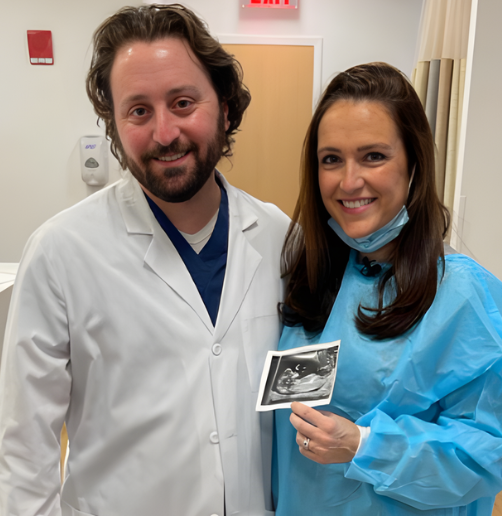
The first thing that stands out about Dr. Eric Forman isn’t a credential, though there are plenty of them. It’s the way he talks about IVF as if it’s both science and story. Not just a set of protocols, but a lived experience. Not just what happens in a clinic, but what happens to people.
As the Medical and Laboratory Director at Columbia University Fertility Center, Forman oversees the medical practice as well as the embryology and andrology laboratories. He also sees patients, those trying to conceive and those hoping to preserve fertility for the future. That dual role is unusual in a field where the clinic and the lab can feel like separate worlds. At Columbia, he prefers the opposite: open doors, shared decision-making, and a culture where doctors and embryologists operate as one team.
“There are clinics where the doctors are not so involved in the lab,” he says. “They’re not so welcome back there. We try to have a very open collaborative practice. We have joint meetings. Doctors go to the lab and look at embryos.”
In a specialty where patients often feel like their future is happening behind closed doors, that kind of transparency, real transparency, not marketing transparency, matters.
Because the truth is, IVF is built on a delicate relationship between what’s best for embryos and what’s best for patients. Those goals overlap most of the time. But not always. And bridging those moments is where Forman’s leadership shows up.
Sometimes the clinical side wants what is easiest to schedule or simplest to explain. Sometimes the laboratory side needs workflows that protect embryo development, reduce variability, and minimize risk. Forman sits at that intersection, making sure neither side gets what it wants at the expense of what patients need.
“The clinical side may have certain preferences that aren’t always what’s best for the embryos,” he says. “Or the lab might have certain preferences that maybe in practice aren’t so patient-friendly. Coming together and getting everyone to realize our ultimate goal is what’s best for our patients and their success… that bridges the gap.”
A Career Built in the Space Between “Possible” and “Practical”
Forman joined Columbia in August 2017, arriving at a pivotal moment: the program was planning a new clinical space and a new lab. The aim was to build an environment that felt bright and welcoming for patients, and state-of-the-art for embryology.
That distinction matters because fertility clinics aren’t just medical settings. They’re emotional settings. Patients remember the waiting room. They remember the front desk. They remember whether the space felt clinical, cold, chaotic, or calm. They also remember whether the “beautiful clinic” was backed by a lab that delivered.
Forman’s work often involves translating innovation into real-world systems: training staff, adjusting processes, and ensuring new tools actually improve outcomes rather than just sound impressive.
One example is Columbia’s work on AI-assisted sperm identification and recovery, a technology designed to find extremely rare sperm that could take a human hours to locate or might never be found at all. For certain patients, this isn’t a nice-to-have. It’s the path forward.
It also changes everything about workflow.
Implementing a new technique affects how sperm is processed, how it’s frozen and thawed, how long cases take, and how the lab team moves through a day. It also requires doctors to understand exactly when it’s appropriate and what it changes clinically.
Forman describes his role as making sure both sides stay aligned: the science, the workflow, and the human reality of a patient who might be hearing the word “only” far too often.
“For some patients, this is their only option,” he says. “So let’s figure out a workflow that works for the lab and for them, and then educate the doctors on how to use it clinically.”
It’s a specific example, but it reflects a broader theme: progress isn’t just discovering something new. It’s making it usable. It’s making it safe. It’s making it accessible to the people who need it most.
“We try to have a very open collaborative practice… Ultimately, our goal is what’s best for our patients and their success.”
Genetic Risk is One of the Most Critical – and Least Visible – Factors in Fertility Care.
Even as advanced technologies transform reproductive medicine, genetic testing alone is not enough. Every test has limitations, and expert genetic counseling is essential to identify meaningful risk and to clearly explain what results can - and cannot – inform clinical decision making.
Without dedicated genetic counseling, key insights are frequently missed:
57% of patients had previously unrecognized genetic or family history risk
42% of those findings changed clinical management
(Thompson et al., Am J Perinatol, 2020)
In donor screening:
84% of applicants shared new or clarifying health information during genetic counseling
19% were subsequently found ineligible under ASRM or program guidelines
(Varriale C et al., J of Assist Reprod Genetics, 2025)
Incomplete genetic review – or failure to clearly communicate test limitations - creates care gaps, regulatory exposure, and loss of patient trust.
GeneScreen delivers concierge-level, comprehensive genetic counseling that integrates seamlessly into clinical workflows—supporting precision, accuracy, and patient-centered care at scale.
The Study That Helped Change IVF’s Safety Story
If there’s one area where Forman’s impact has been widely felt, by patients, clinics, insurers, and professional societies, it’s elective single embryo transfer (eSET).
His randomized controlled trial was the first to demonstrate that transferring a single chromosomally normal embryo could achieve live birth rates comparable to transferring two untested embryos, while dramatically reducing the risk of twins and the complications that can follow.
It’s hard to fully appreciate the significance of that until it’s placed in context.
Forman began a fellowship in 2010. At that time, elective single embryo transfer was rare in the U.S. Transferring two embryos, even in younger patients, was common. Twin rates were high. And culturally, twins were often framed as an IVF “bonus,” even though medically they can involve higher rates of preterm delivery, NICU stays, preeclampsia, gestational diabetes, and complicated births.
As lab technology improved, better embryo culture, blastocyst transfer, and more reliable freezing, clinics reduced the number of embryos transferred. But “reduced” often meant going from three to two. The field still struggled with the same barrier: how to maintain high success rates while reducing the burden and risk of multiples.
The breakthrough in Forman’s work is that it didn’t ask patients to trade success for safety.
It offered a model in which safety could be achieved without reducing the chance of a baby.
Back then, preimplantation genetic testing for aneuploidy (PGT-A) was often framed primarily as a way to improve the chance of success per transfer or reduce miscarriage risk. What clicked, through data, clinical observation, and a key moment of field-wide discussion, was that PGT-A could also make single embryo transfer not just “best practice,” but genuinely reassuring to patients.
A tested euploid embryo could give patients confidence that transferring a single embryo isn’t a compromise.
And it worked.
One group in the trial transferred one chromosomally normal embryo. The other group transferred two untested embryos. Both groups achieved strong live birth rates. But the difference in twin risk was stark. The downstream impact, obstetric outcomes, preterm delivery, NICU admissions, was not theoretical. It was measurable.
The shift that followed has helped redefine standard care. In more recent guidance, the American Society for Reproductive Medicine has stated that transfer of a euploid embryo should be limited to one, regardless of patient age.
The line is simple. The implications are enormous.
Because for patients, this change isn’t just about “one embryo vs. two.” It’s about the kind of pregnancy they’re more likely to have. It’s about whether their baby will come home when they do. It’s about whether the first weeks of parenthood happen in a nursery or in a NICU.
Why Twin Culture Still Lingers, and How It’s Changing
Even with compelling data, fear has a long shelf life in fertility care.
Some patients still feel nervous transferring one embryo at a time, particularly those who think of time pressure or have endured loss. One misconception Forman sees often is the belief that being 37 or 38 means it’s safer, or smarter, to aim for one pregnancy that “covers everything.”
But twin pregnancy isn’t “one pregnancy.” It’s a higher-risk pregnancy. And for many people, two singleton pregnancies are medically safer than one twin pregnancy.
Another misconception is that transferring two embryos guarantees twins. It doesn’t. Embryos can fail to implant. And if a transfer fails, losing two embryos at once can be emotionally and practically devastating.
Forman also notes that patients have changed over the years. The “I want twins” mindset still exists, but it’s less common than it used to be. As patients become more informed, and as more people see the realities of NICU stays and complicated pregnancies, many come to view twins as something to manage if it happens, not something to pursue.
Another shift happens quietly: once someone becomes a parent, the fantasy of “two at once” often loses its sparkle.
Many patients return for a second child, grateful that they didn’t try for twins the first time. Not because they wouldn’t love twins. But because parenting is already a full-body experience, and two at once can turn survival mode into a long-term state.
Forman’s approach is pragmatic and empathetic: education without judgment, and decisions shaped by both medical realities and patient priorities.
What a Genetics Partner Should Really Provide
GeneScreen is proud to support the delivery of this story, reflecting Dr. Forman’s belief that genetics should offer availability, scalability, and real counseling support without delaying care. Clarity, not complexity, and that rigorous science must be paired with thoughtful guidance.
Through concierge-level genetic counseling across the U.S. and Canada, GeneScreen connects patients with more than 45 board-certified genetic counselors licensed in all 50 states, providing timely, expert support throughout the fertility journey. Customizable workflows stratify patients by carrier screening results and individual risk, enabling tailored follow-up and informed decision-making. In-network insurance billing, provider portals with real-time patient updates, EHR integrations, and close collaboration with fertility specialists streamline clinical workflows and help patients navigate complex genetic information with confidence and care.
Fertility visits already cover a vast amount: history, workup, treatment choices, risks, protocols, timing, and emotional support. Genetic counseling requires time and depth, pedigrees, nuance in family history, interpretation of carrier screening results, and guidance on what tests mean (and what they don’t).
While fertility specialists manage an extensive range of clinical responsibilities, they aren’t expected to provide the depth of genetics expertise that comprehensive genetic counseling requires.
A strong genetics partner helps ensure patients don’t miss important information while also avoiding months-long delays that can cost valuable time, especially for those who already feel behind the clock.
Forman also sees genetics continuing to shape the future: broader carrier screening, increased use of PGT-M, and potentially expanded embryo testing approaches aimed at preventing severe disease. But again, he returns to validation. The future must be accurate, ethical, and patient-centered, not rushed.
Mosaic Embryos and the Danger of Overconfidence
Few topics reveal the complexity of fertility genetics like mosaic embryos, results that fall into a gray zone, neither clearly normal nor clearly abnormal.
Forman is cautious with the language.
“I don’t love the term ‘mosaic embryos,’” he says.
He explains why: PGT-A is based on a biopsy of a small number of cells from the outer layer of a blastocyst. Those cells contain tiny amounts of DNA, which must be amplified many times in order to be analyzed. The final result is a copy-number signal across chromosomes: normal, abnormal, or intermediate.
Intermediate signals can be “consistent with” mosaicism, but that doesn’t prove the embryo is mosaic in the way most people imagine. It doesn’t confirm how widespread abnormal cells are, whether the inner cell mass is affected, or whether the embryo would self-correct.
That uncertainty matters because the stakes are high. Reporting or acting on unclear data can change which embryos are transferred, which are delayed, and which are discarded entirely.
“Just because we see a result doesn’t mean we should act on it, especially if it could keep someone from using an embryo that might be their only chance.”

Forman believes the field moved too quickly in some cases, treating intermediate results as definitive, and sometimes creating fear where more research was needed.
“Just because we see a result doesn’t mean we should act on it,” he says, particularly when it could cost a patient an embryo that might have been viable.
He isn’t anti-genetics. In fact, genetics is a passion. But his view is that advanced testing should protect patients, not create new obstacles.
Responsible innovation requires validation. It requires humility. And it needs remembering that embryos aren’t data points. They’re opportunities.
The Social Media Physician: Accessibility Without Losing Rigor
Forman is active on social media and regularly publishes blogs and commentaries about reproductive medicine and patient experience. In a space flooded with misinformation and oversimplified fertility claims, he sees education as part of care.
He’s mindful, though, about tone and interpretation. Online information moves fast. People read what they need to read. They also misread what they fear.
So he writes when it feels right, when he can be thoughtful, accurate, and human. He shares positive stories. When patient stories are involved, permission is essential. And he’s aware that accessibility doesn’t mean being casual with the science.
The goal is clarity, not hype.
Patients deserve information that respects their intelligence and doesn’t exploit their vulnerability. In that sense, the online physician should ideally be the same person as the one in the room.
Off-Duty: Phish, Four Cats, and the Emotional draining of New York Sports
Outside of medicine, Forman’s life is full: a wife, three children, and four cats. He enjoys running (including completing the 2016 NYC Marathon with Team Every Mother Counts), and he’s a loyal fan of the Mets, Jets, Knicks, Rangers, and Duke.
His most surprising personal fun fact: a deep appreciation for the band Phish.
He loves that their shows aren’t scripted. Multiple nights, no repeats, always evolving.
In a way, it mirrors what he respects about the human side of fertility care: the refusal to flatten complex experiences into a single predictable script.
And as for those New York teams, well, loyalty to them builds a specific kind of endurance.
“The ultimate goal matters,” he shared, “Even when the path is messy, even when there’s disappointment, even when nothing feels guaranteed.”
Fertility care asks patients to keep going without certainty. So does being a Mets fan.
But when it finally works, when the baby is in your arms, when the long-awaited win arrives, the story becomes something else entirely.
Not easy. Not linear.
But worth it.
The Future He Wants: Less Burden, Better Experience
When asked about the next decade of IVF, Forman’s hopes are refreshingly grounded.
Not a flashy promise. Not a miracle timeline. A better experience.
He describes innovations designed to reduce friction: easier blood draws for patients who dread venipuncture, protocols with fewer medications, more natural cycle transfers, and smarter workflows that make treatment feel less like a second job.
He also points to prevention: babies are still born with severe diseases that could sometimes be prevented through genetic tools that already exist. The challenge is making those tools accessible and used appropriately, without adding fear or unnecessary exclusions.
The future, in his view, should reduce suffering, both medical and emotional.
Because IVF isn't just about getting pregnant, but also about helping people get through it.
Genetic Risk is One of the Most Critical – and Least Visible – Factors in Fertility Care.
Even as advanced technologies transform reproductive medicine, genetic testing alone is not enough. Every test has limitations, and expert genetic counseling is essential to identify meaningful risk and to clearly explain what results can - and cannot – inform clinical decision making.
Without dedicated genetic counseling, key insights are frequently missed:
57% of patients had previously unrecognized genetic or family history risk
42% of those findings changed clinical management
(Thompson et al., Am J Perinatol, 2020)
In donor screening:
84% of applicants shared new or clarifying health information during genetic counseling
19% were subsequently found ineligible under ASRM or program guidelines
(Varriale C et al., J of Assist Reprod Genetics, 2025)
Incomplete genetic review – or failure to clearly communicate test limitations - creates care gaps, regulatory exposure, and loss of patient trust.
GeneScreen delivers concierge-level, comprehensive genetic counseling that integrates seamlessly into clinical workflows—supporting precision, accuracy, and patient-centered care at scale.
The advertiser does not have full editorial control over the content of this article. As a brought-to-you-by sponsor of IRH In Scope, the advertiser only has editorial control over what is mentioned about their company. Inside Reproductive Health maintains full editorial independence over the remainder of the article. The views and opinions expressed in this article do not necessarily represent the views of the Advertiser or of Inside Reproductive Health.
