
A Brief History of PGT Naming Conventions

The landscape of preimplantation genetic testing (PGT) continues to expand. What began as relatively straightforward screening for chromosomal aneuploidy has evolved into a growing array of embryo testing modalities, each promising deeper insight into embryo genetics and reproductive potential.
For reproductive endocrinologists and fertility practices, the challenge is no longer whether embryo testing is available, but how to interpret the expanding alphabet soup of PGT options and where they fit in clinical care.
A Brief History of PGT Naming Conventions
Earlier embryo testing approaches were broadly described as preimplantation genetic screening (PGS) and preimplantation genetic diagnosis (PGD), referring to screening embryos for chromosomal aneuploidy and testing for known single-gene disorders, respectively.
In 2017, several professional societies jointly recommended adopting the umbrella term preimplantation genetic testing (PGT) with subcategories defined by clinical indication:
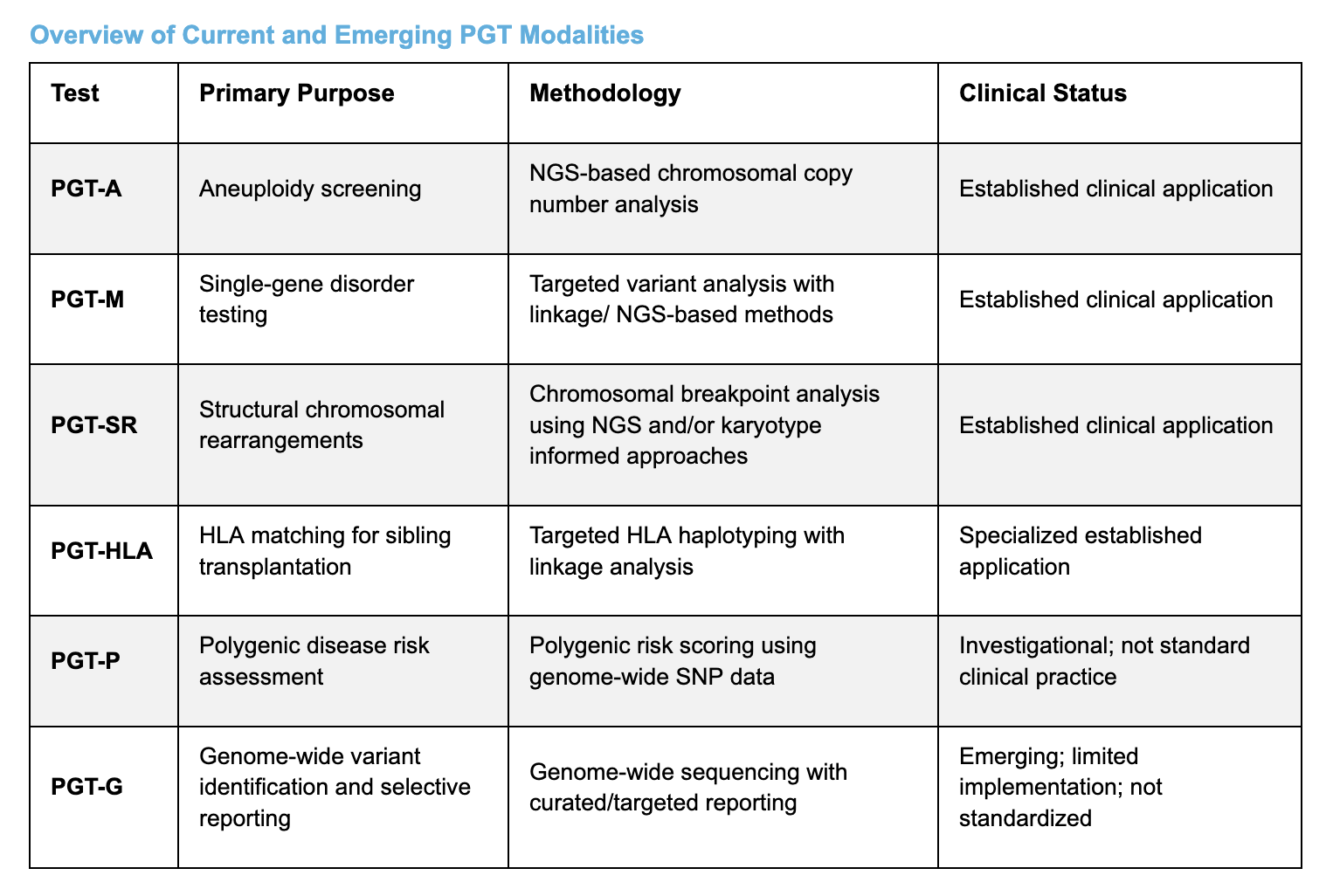
• PGT-A – aneuploidy screening
• PGT-M – monogenic (single-gene) disorders
• PGT-SR – structural rearrangements
• PGT-HLA – select cases for human leukocyte antigen matching for stem cell transplantation for an affected sibling
This framework, developed through guidance from the PGDIS, ASRM, and ESHRE, forms the basis of modern PGT nomenclature. As embryo genomics has expanded, additional acronyms, such as PGT-P for polygenic risk assessment and PGT-G for genome-wide sequencing have emerged largely through research publications and commercial offerings rather than formal nomenclature guidance.
Genetic Counseling Support for an Expanding PGT Landscape
As embryo testing technologies evolve, fertility clinics are increasingly navigating complex conversations with patients about genetic risk, testing options, and embryo selection.
GeneScreen provides independent, third-party genetic counseling designed to support fertility programs and their patients across the full spectrum of preimplantation genetic testing—including PGT-A, PGT-M, PGT-SR, and emerging testing modalities.
Our experienced genetic counselors help patients:
Understand the benefits and limitations of PGT testing options
Review genetic test results and embryo reports
Navigate complex or layered testing decisions
Set realistic expectations about testing outcomes and embryo availability
GeneScreen operates as an independent counseling resource, providing an additional layer of support for both clinics and patients as genetic testing continues to expand.
Importantly, GeneScreen is in-network with many major insurance plans, allowing eligible patients to access genetic counseling services through insurance billing when appropriate.
Learn more about how GeneScreen supports fertility programs.
Importantly, not all PGT acronyms describe the same type of information within the modern framework. Tests such as PGT-A and PGT-SR are defined by the biological abnormality being evaluated—aneuploidy or structural chromosomal rearrangements. In contrast, terms such as PGT-P and PGT-G more often reflect the analytic approach or genomic scale of testing rather than a single, clearly defined clinical indication. For example, polygenic risk scoring relies on genome-wide SNP data to estimate relative disease susceptibility, while embryo genome-wide sequencing may analyze large portions of the embryo genome but report only a curated subset of findings considered clinically relevant. As a result, the acronym alone may not fully describe what information is ultimately generated or reported to patients.
The Rise of “Layered” Embryo Testing
As additional PGT modalities enter clinical discussion, many practices are now encountering a new pattern in embryo evaluation: the stacking of multiple testing approaches on the same cohort of embryos. For example, this may include combining PGT-A with PGT-M, or incorporating PGT-P or PGT-G.
While layered testing may provide additional genetic information, it can also narrow the pool of embryos considered suitable for transfer. Current professional recommendations emphasize clear informed consent, discussion of limitations, and realistic expectations regarding how testing results may influence embryo availability and transfer decisions.
At the same time, many clinicians are navigating how to integrate emerging testing that may already be clinically available but continues to evolve in validation and interpretation. In this context, providers often bridge the gap between rapidly advancing laboratory technologies and the day-to-day clinical conversations needed to help patients understand what information these tests can—and cannot—reliably provide. Genetic counseling can support these discussions, especially when multiple modalities are being considered or when results introduce complex interpretive questions.
What Current Professional Guidelines Say
Professional societies continue to emphasize careful clinical application of PGT technologies.
The ASRM (2024) notes that PGT-M and PGT-SR are well-established when a specific genetic condition or chromosomal rearrangement is present, while the clinical utility of PGT-A remains more context-dependent and requires individualized patient counseling.
The ACMG and the National Society of Genetic Counselors (NSGC) similarly emphasize comprehensive pre-test counseling and informed consent. More recently, ACMG published a points-to-consider statement addressing the use of polygenetic risk scores for embryo selection, highlighting that approaches such as PGT-P remain areas of active evaluation and professional discussion.
Emerging Technologies: Polygenic Risk Scores (PGT-P) and Genome-Wide Embryo Testing (PGT-G)
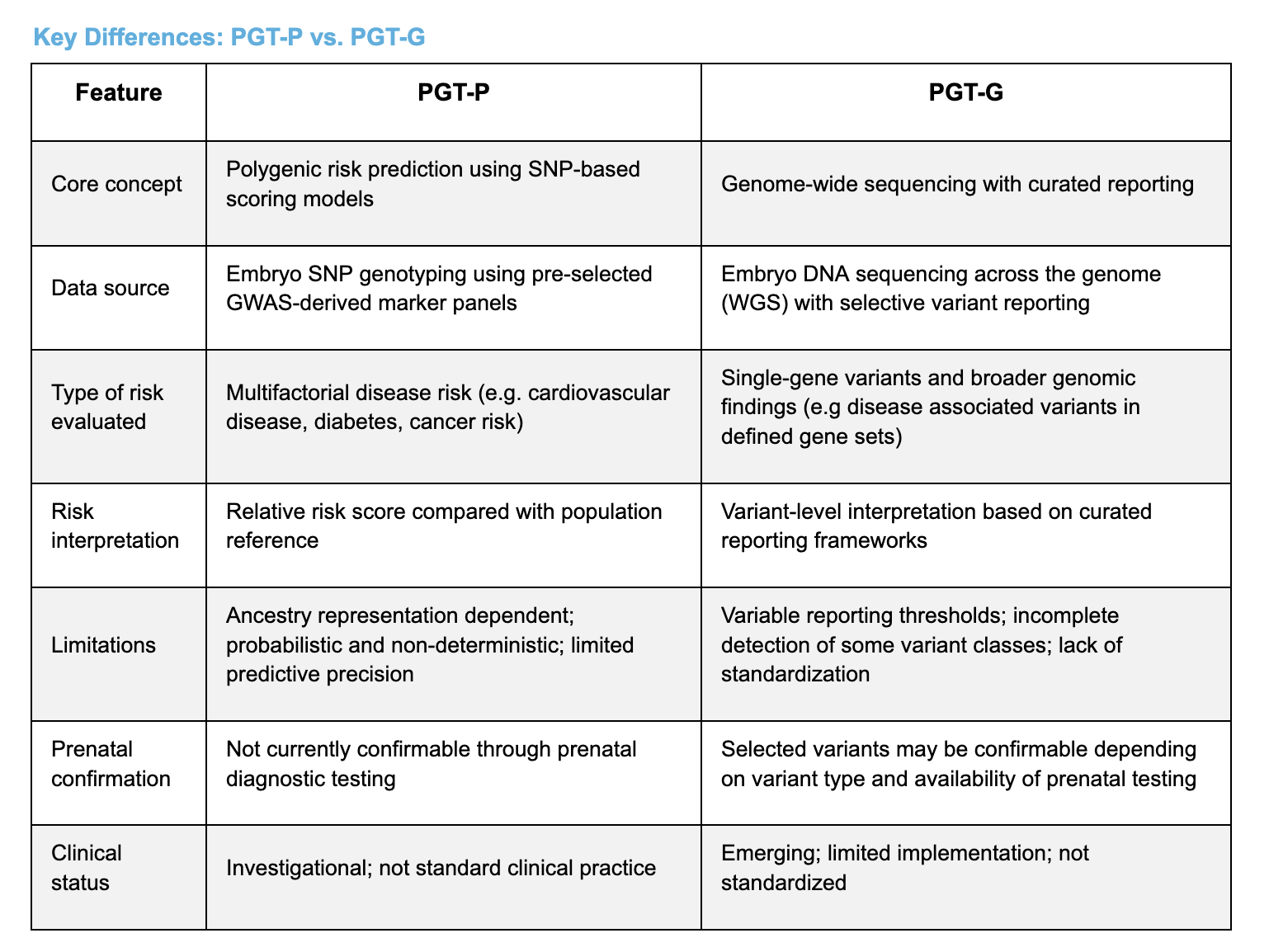
PGT-P evaluates thousands to millions of genetic markers (single nucleotide polymorphisms, SNPs) across the genome to estimate relative risk for complex diseases such as coronary artery disease, type 2 diabetes, or certain cancers. Because these conditions are influenced by many genes and environmental factors, risk estimates are probabilistic rather than deterministic and may vary depending on ancestry representation within the underlying data.
PGT-G, by contrast, aims to assess a broader range of genetic variants across the embryo genome. While proof-of-concept studies suggest that genome-wide sequencing could identify both inherited and potentially de novo variants, clinical interpretation remains complex and many findings may fall outside current prenatal testing frameworks or established reporting categories.
Although embryo genome-wide sequencing suggests comprehensive analysis, most current approaches do not report the entirety of the embryo genome. Instead, laboratories typically apply curated analytic frameworks, evaluating specific subsets of genes or variant categories associated with defined clinical indications. As a result, genome-wide embryo sequencing should not be interpreted as testing for all possible genetic conditions, and additional targeted testing may still be required when specific familial risks are known.
Both approaches remain areas of ongoing research, with clinical validity, population representation, and ethical considerations continuing to shape their evaluation and interpretation.
The Role of Genetic Counseling
As embryo testing options expand, so does the complexity of interpreting results and counseling patients about potential outcomes.
Independent genetic counseling can help fertility programs support patients through pre-test decision-making, discussion of limitations, and interpretation of results—particularly in scenarios involving layered testing or emerging technologies.
For fertility practices, this collaborative model may also help ensure that patients receive comprehensive information while allowing clinical teams to focus on reproductive care.
The Expanding Alphabet of Embryo Testing
As embryo testing evolves, the list of acronyms attached to PGT is likely to grow.
For clinicians and fertility practices, the key challenge is not simply keeping track of the letters, but understanding what each test assesses, how results are generated and how those results should be interpreted within the broader context of patient-centered reproductive care. With technologies now spanning targeted assessments of chromosomal or inherited single-gene conditions to broader genomic and polygenic approaches, clinicians are increasingly being asked to interpret more complex layers of embryo genetic information. In practice, many providers turn to independent genetics partners for additional support. Some clinics consult experts such as Genome Ally, for physician-led guidance on particularly complex or unexplained cases, while others rely on scalable genetic counseling services like GeneScreen, to support patient education and result interpretation across their broader patient population. The field may increasingly resemble an alphabet soup of embryo testing options. However, the goal is not simply to add more ingredients, but to understand which tests meaningfully inform embryo prioritization, reduce chromosomal and genetic disease risk, and guide time to baby in clinical care.
Genetic Counseling Support for an Expanding PGT Landscape
As embryo testing technologies evolve, fertility clinics are increasingly navigating complex conversations with patients about genetic risk, testing options, and embryo selection.
GeneScreen provides independent, third-party genetic counseling designed to support fertility programs and their patients across the full spectrum of preimplantation genetic testing—including PGT-A, PGT-M, PGT-SR, and emerging testing modalities.
Our experienced genetic counselors help patients:
Understand the benefits and limitations of PGT testing options
Review genetic test results and embryo reports
Navigate complex or layered testing decisions
Set realistic expectations about testing outcomes and embryo availability
GeneScreen operates as an independent counseling resource, providing an additional layer of support for both clinics and patients as genetic testing continues to expand.
Importantly, GeneScreen is in-network with many major insurance plans, allowing eligible patients to access genetic counseling services through insurance billing when appropriate.
Learn more about how GeneScreen supports fertility programs.