
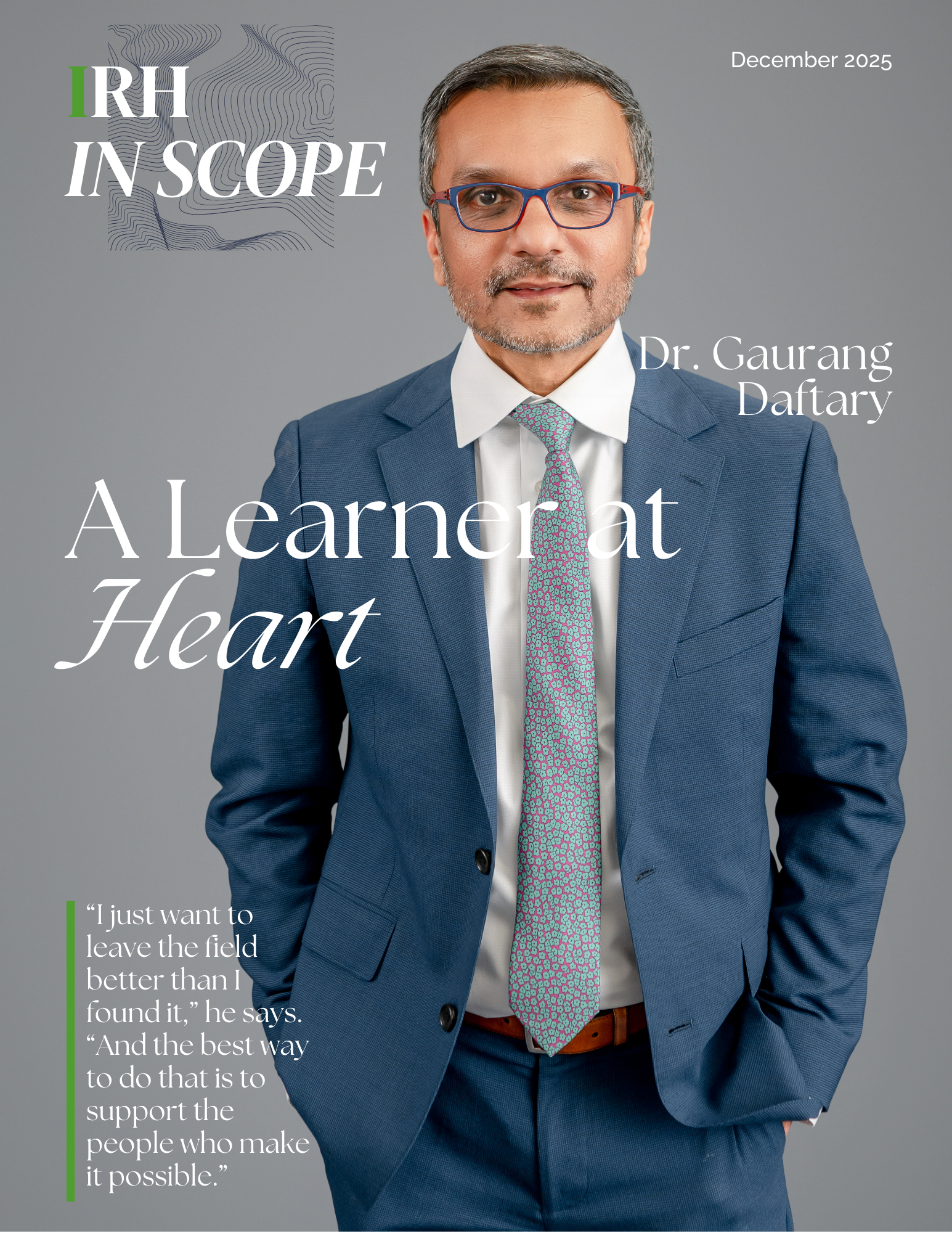

If you follow the arc of Chief Scientific Officer of Inception, Dr. Gaurang Daftary's career, you don't get a straight line; you get a constellation.
Academic researcher, fellowship director, international clinician, quality manager, pharmaceutical leader, MBA graduate, and reproductive endocrinologist. Yet from the moment he begins explaining how it all started, the story feels inevitable.
From Family Medicine to Frontline Innovation
His father was an OB-GYN, his mother a pediatrician, and his childhood was steeped in moments of hope: babies being delivered, families beginning, young parents imagining everything that lay ahead. "I grew up around birth, care, and optimism," he says. "I saw early the kind of difference medicine could make in people's lives." Even before he knew the specialty's name, he understood the emotional core of reproductive medicine.
That foundation followed him into residency at Yale, where he joined the renowned lab of Dr. Hugh Taylor. What he found there would shape his identity as a doctor, a scientist, and later, a leader. "He is my mentor," Daftary says without hesitation. "He showed me what it meant to be there for patients truly." Taylor's work, particularly his focus on uterine disorders and the genetic mechanisms underlying them, offered something rare: a complete loop from clinical care to surgery to lab-based discovery. Daftary saw how a physician-scientist could understand a problem from every angle and move seamlessly between the bench and the bedside. It became a template for the kind of impact he wanted to make.
After Yale, he joined the Mayo Clinic and established the Laboratory of Epigenetic Translation in Reproductive Medicine. There, he focused on a gene with an outsized influence on patients with endometriosis: collagen. The gene is responsible for scar tissue, and Daftary's lab explored whether altering its expression might reduce the scarring that defines the disease. He remembers the painstaking excitement of that work, first manipulating collagen levels in human cells, then validating the findings in mouse models.
The experiments worked. The levels went up when they should go up, and down when they needed to go down. The next step would have been early-stage human trials, an extraordinary possibility. Yet at that very moment, another door opened: the chance to pursue an MBA and shift into pharmaceutical leadership. It was not a direction he had originally planned, but it was one he embraced fully.
"I learned a lot about myself during that time," he says. "It changed my trajectory, but not my passion."
Even stepping away from his lab, the question that guided him remained the same: How do we turn the most promising ideas in reproductive science into reality for patients who will never step into a lab? That vision has followed him into every chapter since.
The Quiet Challenges No One Sees
When asked to name the most under-recognized challenges in IVF today, Daftary describes two broad categories that shape how the field moves forward. The first is access, both financial and logistical. IVF in the United States remains patchwork and inequitable, with outcomes and opportunities often determined by a patient's zip code or insurance plan. "More access means more cycles, which means more babies," he says. "It's a quantitative challenge, and it requires systemic solutions."
“If you’ve identified the perfect embryo, why isn’t the pregnancy rate 100%? That’s the question I want our field to answer.”
Looking to Take Your Career to the Next Level?
Discover the Fastest-Growing Fertility Network in North America – Your Dream Job Awaits!
Are you ready to grow in a career that matters? Join Prelude, the fastest-growing fertility network, offering exciting opportunities in clinical, administrative, and REI roles with unmatched career growth and a fantastic employee experience.
Competitive salary & benefits
Growth potential and geographic flexibility
A supportive and dynamic team environment
Rewarding work that makes an impact
Take Action Now!
The second challenge is less visible, but equally profound: understanding why even the best embryos do not always implant. Despite advances in genetic testing, embryo assessment, and AI-driven selection tools, reproductive endocrinologists still face a "black box" once an embryo enters the uterus. "We can pick the best embryo," he says, "but we still don't fully understand what happens once it's inside. That's where the biggest gains in our field will come."

This is where Daftary's scientific curiosity comes alive. While many experts in the field point first to time-lapse technology or artificial intelligence, he sees those as critical but incremental improvements. The true breakthrough, he believes, will be a deeper understanding of the uterine environment, its receptivity, molecular cues, and the complex interplay between the embryo and the endometrium. Time-lapse imaging may offer insight into the embryo. AI may help distinguish subtle developmental patterns that humans miss. But the next leap will come from unraveling the biology of implantation itself.
"If you've identified the perfect embryo, why isn't the pregnancy rate 100%? That's the question I want our field to answer."
His thinking reflects the duality of a clinician who has practiced in several countries and a scientist who has worked at the cellular level. Globally, he notes, many nations incorporate IVF into national healthcare systems, not always with every technological upgrade, but with a baseline commitment to access. In the U.S., by contrast, care varies widely by geography and insurance. "It's not just a scientific issue," he says. "It's a policy issue. Other countries have found ways to make IVF available without collapsing their healthcare system. We can learn from them."
The Making of a Lab Leader
When he shifts to discussing leadership, particularly in an IVF lab, his answers become even more precise. He believes that two traits rise above all others: meticulous attention to detail and the ability to innovate even when things are already going well.
IVF labs succeed or fail on the smallest variables. Air quality. Temperature fluctuations. Culture media handling. Tiny shifts can accumulate into enormous differences in embryo development. A leader must be relentlessly detail-oriented but also brave enough to disrupt what works to explore what could work better.
“I just want to leave the field better than I found it,” he says. “And the best way to do that is to support the people who make it possible.”

"Perfectionism alone isn't enough," he says. "Innovation alone isn't enough. The magic is learning to be both at once."
That balance, precision, and adaptability define how he evaluates new technologies and mentors those who aspire to leadership positions in the field. Early-career professionals, he says, must understand not only what they love but why they love it. Someone passionate about reproductive surgery, for example, must learn how to integrate it into a practice that also demands IVF productivity. Someone committed to research must determine what questions they can answer without needing a full bench lab. Someone drawn to AI must find the place where human skill and machine capability meet.
"It's not enough to find your passion," he explains. "You have to find the version of it that the world actually needs."
And because reproductive medicine is changing so rapidly, he believes that careers must change, too. The tools that define the next decade may not be the tools that mattered in the last. "This is a world of AI," he says. "People may need a second career within their career. What worked for the first eight years may not work for the next eight."
The Learner Behind the Leader
When pressed to share something surprising about himself, he doesn't offer a hobby so much as a disposition.
"I'm a learner," he says. "That's really my hobby."
He studies fields outside of medicine for the joy of understanding how other disciplines solve problems. He reads widely. He asks questions. He looks for patterns in industries far removed from reproductive endocrinology. "It expands your repertoire," he says. "You become a better problem solver when you understand how others think."
This love of learning is woven throughout his work. It has enabled him to move between academic research, surgical practice, global health systems, corporate strategy, and scientific innovation without losing his grounding. It has made him a connector, someone who understands how breakthroughs happen at the intersection of disciplines.
"I just want to leave the field better than I found it," he says. "And the best way to do that is to support the people who make it possible."
He deeply believes that the field's future depends on the well-being of its providers. Happy physicians, embryologists, nurses, and staff lead to healthier clinics, stronger teams, better results, and happier patients.
It is a holistic view of success—and one Daftary feels he has found within Inception—a place where the mission is grounded not only in science but in humanity.
“Inception wasn’t founded as just another department within a large medical center—or simply as a business offering ART,” Daftary explains. “TJ built it after he and his wife personally walked through IVF, and the experience changed him. He dedicated himself to the field with the hope of easing the heartache and helping future patients achieve their dreams. It’s an endeavor rooted in love. Everyone in this network—executives, providers, and clinic staff—is united in their commitment to bring their best in the service of patients. It is a privilege for me to work alongside such extraordinary people.”
"I don't know a single physician who doesn't want to do their very best for patients," he says. "If we support them, the rest will follow."
Looking to Take Your Career to the Next Level?
Discover the Fastest-Growing Fertility Network in North America – Your Dream Job Awaits!
Are you ready to grow in a career that matters? Join Prelude, the fastest-growing fertility network, offering exciting opportunities in clinical, administrative, and REI roles with unmatched career growth and a fantastic employee experience.
Competitive salary & benefits
Growth potential and geographic flexibility
A supportive and dynamic team environment
Rewarding work that makes an impact
Take Action Now!
The advertiser does not have full editorial control over the content of this article. As a brought-to-you-by sponsor of IRH In Scope, the advertiser only has editorial control over what is mentioned about their company. Inside Reproductive Health maintains full editorial independence over the remainder of the article. The views and opinions expressed in this article do not necessarily represent the views of the Advertiser or of Inside Reproductive Health.
