
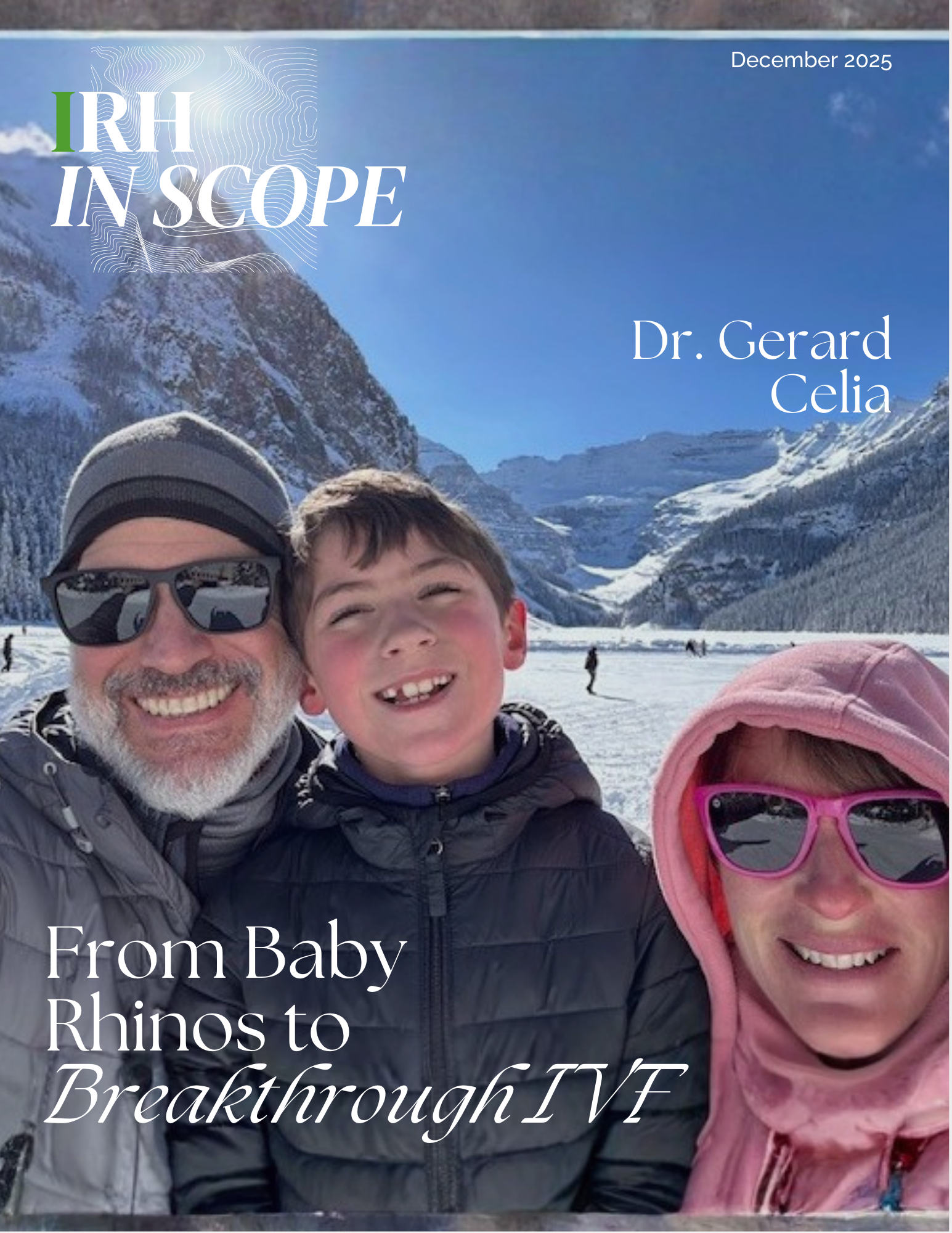
The extraordinary journey of the embryologist whose work you’ll never see—but whose precision could shape your family’s future.

When patients walk into Pacific Fertility Center Los Angeles (PFCLA), they often know exactly which doctor they’re seeing. They’ve researched them, followed them, and placed great hope in their hands. What they rarely see, or even think about, is the person orchestrating half of their care: the embryologist.
For Dr. Gerard “Gerry” Celia, MBA, PhD, HCLD, CC, the story of how he ended up guiding some of the most advanced IVF laboratories on both coasts begins in a far less expected place: a horse farm, a white rhino, and the San Diego Zoo.
Today, Celia serves as Executive Lab Director at PFCLA, directs a high-complexity lab at VCU in Richmond, and oversees embryology operations for Brown/Women & Infants Hospital in Rhode Island. Yet his philosophy of leadership and science remains grounded in one simple truth:
“Everything you do in the lab is going to make a difference in someone’s life.”
That sense of reverence, for life, for precision, for the unseen work required to create families, shapes his entire career.
The Horse Farm Kid Who Fell in Love with Reproduction
Celia didn’t begin his career planning to help families through infertility. He grew up breeding and raising horses, which sparked an early interest in veterinary medicine. He enrolled in the animal science program at the University of Connecticut with every intention of becoming a veterinarian.
But something shifted as he studied. He found himself drawn not to injury or illness, but to the optimism and complexity of reproduction. That curiosity led to an internship at the San Diego Zoo, where he joined their Center for Reproduction of Endangered Species.
There, he worked with exotic animals, including rhinos, and even helped perform what he believes was one of the earliest ovarian ultrasounds of a white rhino in North America. Much of the equipment had to be engineered by hand. It wasn’t just science; it was improvisation, creativity, and a willingness to solve problems without a template.
He laughs that around this same time, he watched a documentary on the animal reproduction program at Busch Gardens and read the original Jurassic Park novel. “It all kind of fed into each other,” he says. “I realized reproduction wasn’t just fascinating, it felt like a calling.”
After earning a PhD in Molecular Physiology and Biophysics at the University of Vermont College of Medicine, where he worked closely with OB-GYN teams, Celia thought he’d stay in academia. But funding grew tight, his life changed, and friends in reproductive endocrinology began nudging him toward clinical work.
He moonlighted in an IVF lab to give it “a test run.” Six months later, he was all in.
“Everything you do in the lab is going to make a difference in someone’s life.”
Why “Trust the Science” Isn’t Enough in the IVF Lab
Celia pushes back on one of the most repeated phrases in medicine: Trust the science.
“In embryology, our first job is actually not to trust the science,” he says with a smile. “Our job is to verify it.”
The IVF lab, unlike many other clinical environments, isn’t governed by universal protocols. Oversight focuses on whether labs follow their own validated procedures, not whether the procedures are identical from lab to lab. That means every new tool, device, media batch, or technique must be tested, validated, and pressure-tested internally before it comes into contact with a patient’s embryos.

Celia’s approach is shaped by years in research environments where experiments fail more often than they succeed. “A good scientist doesn’t fall in love with the first result,” he says. “You ask why, why it worked, why it didn’t, and what might happen when you try again.”
This curiosity and humility led him to co-found Maverick Reproductive Biologists in 2013, a private online community that has since become an international hub for IVF professionals. Members share data, troubleshoot protocols, and have even co-authored papers using crowdsourced information.
“It’s like the bar at the end of a conference day,” he says. “People are relaxed. Honest. Curious. That’s how science should feel.”
From 5% Success Rates to Modern IVF: A Field in Fast Motion
The evolution of IVF mirrors Celia’s own career. When he entered the field, pregnancy rates in many clinics ranged from 5% to 15%. A clinic reporting 30% live birth rates for younger patients was considered exceptional.
Today, thanks to innovations such as:
ICSI (intracytoplasmic sperm injection),
routine blastocyst culture,
modern incubator technology,
vitrification, and
the latest ultra-rapid warming systems,
Many programs expect live birth rates of more than 50% in patients under 35.
Celia has lived through these changes and helped implement many of them.
Another innovation in modern IVF is the ultra-rapid warm blast. This next-generation technique allows embryologists to warm a frozen embryo in as little as two minutes with excellent survival.
“It’s a game-changer,” Dr. Celia explains. “We can warm an embryo minutes before a transfer and know almost immediately whether it’s viable. It makes the process more efficient for the lab, and far less stressful for patients.”
It’s the kind of quiet, technical breakthrough most people never hear about, but it’s transforming the clinical experience in profound ways.
On the topic of advancements, one company has stood out over the decades in the field of embryology: Vitrolife. “They’re more family than vendor,” he says. “I’ve learned more from their QC processes than from all the rest of my time in this field.”
Beyond their culture, he credits them with driving the kind of nuanced, incremental advancements that actually move IVF labs forward. “They’re focused on being successful by being better, not by maximizing profit margins,” he says. “Innovation, integrity, consistency, that’s what sets them apart.”
Time-lapse incubators and AI tools have also changed daily life in the lab. Instead of rigid 7 a.m. fertilization checks, embryologists can log in later and watch footage from earlier in the morning. Celia can even log in from one lab and help triage embryos in another.
Is AI better at ranking embryos? He’s not convinced yet.
“The models are promising,” he says. “But the biggest benefit now is efficiency. They allow embryologists to work smarter, not harder.”
What he does believe in is a hybrid future, human expertise supported by automation, not replaced by it.
The Invisible Half of Care, and Why It Matters More Than Patients Realize
Celia is candid about one of the IVF field’s ongoing challenges: the lab remains largely invisible to patients.
“Most patients know their doctor’s name. They should. But the lab provides half of their care,” he says. “Embryologists handle every stage of development from fertilization to transfer. It’s an enormous responsibility.”
He’s seen how deeply patients can fixate on choosing a physician, even when several doctors at a single center share the same lab, protocols, and the same team of embryologists who actually handle their embryos.
“That connection with a doctor is important,” he says. “But outcomes follow the lab, not the doctor’s personality.”
This invisibility affects budgets as well. Clinics often pour resources into the “front of house”, lobbies, consult rooms, and digital marketing, while asking lab teams to manage aging equipment or stretched staffing models.

It’s why Celia earned an MBA during the pandemic. After years of hearing that scientists “don’t understand the business side,” he decided to understand it intimately. Learning how revenue flows has empowered him to advocate for equipment, infrastructure, and technician training, all of which directly affect pregnancy rates.
“Access to fertility care is important,” he says. “But access without the right lab investment, it isn’t really access.”
Leading Labs You Can’t Be in Every Day
Between his roles at PFCLA, VCU, and Brown/Women & Infants, Celia cannot physically be in every lab at the same time. His system for making this work is deceptively simple:
Find exceptional people. Support them relentlessly. Document everything. And remain reachable
At PFCLA, his trust in onsite lab manager Vicki Bakaturski is unwavering. In Rhode Island, he relies on long-time colleague Brad Millett, who understands the lab’s culture and history intimately. Each handles day-to-day operations and knows exactly which issues require Celia’s immediate attention.
“The minute you walk into a lab like you’re the smartest person in the room, you’ve already failed.”
His leadership philosophy centers on humility and responsibility.
“You’re not the hero of the lab,” he says. “You’re the person who takes responsibility for what everyone else does.”
To him, leadership means writing protocols clearly, evaluating how staff actually perform them, and adjusting based on evidence, not hierarchy. If a team member finds a better, safer method, that approach becomes the new standard.
Horses, Harleys, and the Art of Problem-Solving
Some of Celia’s most memorable stories come from outside the clinic, especially from the horse farm he and his wife still maintain.
Years ago, their prized dressage stallion suffered a tragic injury. With no frozen sperm or offspring, they collected sperm post-mortem, fully expecting it to be useless. Instead, using a compound borrowed from human reproductive research, they coaxed the sperm into motility and performed a carefully timed insemination.
The resulting mare still lives on their farm.
“It all came from the crossover between human and animal reproduction,” he says. “The science serves both worlds.”
This spirit of improvisation has saved more than horses. Celia once kept a lab running during a catastrophic power failure by charging battery packs off a generator in a parking garage and hauling them up six flights of stairs.
He laughs that many embryologists of his generation are mechanics or builders. He owns two Harleys himself (both currently parked while his son is young). To him, the mindset is the same: “If you can fix a machine, trace a wire, or make something work when everything goes wrong, you can run an IVF lab.”
Advice for the Next Generation of Leaders
For aspiring lab directors, Celia’s advice is clear: become an outstanding embryologist before doing anything else. Train in more than one lab. Don’t shortcut your education. And embrace the messy, hands-on parts of science.
“The field you enter today won’t look like the field you’re working in ten years from now,” he says. “If you know only one way of doing things, you’ll struggle.”
What matters most, he says, isn’t a specific credential; it’s adaptability.
“Think like a scientist. Work like a craftsperson. Lead like a teammate.
If you can do those three things, you’ll always have a place in this field.”
For the patients whose future families depend on someone like him, someone they may never meet, that blend of rigor, humility, and ingenuity is one of the most important ingredients in their care.
Bottled Brilliance for Life’s Most Delicate Journey
An unbroken chain of quality, crafted to nurture every stage of embryo development.
In the IVF lab, there is no room for compromise. That’s why Vitrolife media is built on a foundation of scientific precision, safety, and consistency:
MEA-tested media — every batch tested to exceed industry standards to ensure embryo viability
Ultra RapidWarm™ Blast (URWB) — optimized warming protocol shown to support high post-thaw survival and robust blastocyst expansion
OVOIL & OVOIL HEAVY — engineered for consistency and stability you can rely on
G-MOPS™ buffer — trusted for proven performance during critical handling steps
Gx Media & EmbryoGlue™ — clinically proven solutions that strengthen embryo development and support successful implantation
With Vitrolife media, you gain more than products — you gain a partner committed to protecting embryos and supporting your lab with peace of mind, every step of the way.
This News Digest Story is paid featured content. The advertiser has had editorial input and control over its creation. However, the views and opinions expressed in this article do not necessarily represent the views of Inside Reproductive Health. The sponsorship of this content does not imply an endorsement by Inside Reproductive Health.
